English Speaking Practice |

Tag

English speaking practice

Learn 10 Tips to Become Fluent in English in 2026

December 17, 2025 • 6 min read • By Swati Raj

10 Tips to Become Fluent in English

To become fluent in English in 2026, you don’t need perfect grammar or advanced vocabulary.
You need confidence, consistency, and real speaking practice.

Most English learners already understand the language.
They can read emails, watch videos, and follow conversations.
Yet when it’s time to speak, they hesitate.

That hesitation is not because of lack of knowledge.
It’s because fluency is built through daily use, not study alone.

In this blog, you’ll learn 10 tips to become fluent in English in 2026, even if you feel stuck today.

Why Many Learners Struggle to Become Fluent in English

Before fixing the problem, it’s important to understand it.

Most learners struggle because:

  • They translate sentences in their head

  • They fear making mistakes

  • They don’t speak English regularly

  • They rarely get feedback on their speaking

Fluency improves only when English becomes a daily habit, not an occasional activity.

👉 You may also find this helpful:
Speak English Confidently With These 3 Simple Tips
This blog explains why confidence breaks down and how consistent practice helps rebuild it.

1. Stop Waiting for Perfect English

People who become fluent in English are not perfect speakers.

They pause.
They correct themselves.
They keep speaking.

Waiting for perfect sentences increases hesitation.
Speaking imperfectly builds fluency.

2. Think in Ideas, Not Sentences

Instead of thinking:
“How do I say this in English?”

Think:
“What is the idea I want to express?”

This shift helps you respond faster and speak more naturally.

3. Speak Every Day—Even for 10 Minutes

To become fluent in English, consistency matters more than long study hours.

Speaking English for 10–15 minutes daily trains your brain to:

  • Reduce hesitation

  • Respond faster

  • Feel comfortable expressing thoughts

Daily speaking builds confidence gradually.

4. Practice with Feedback

Speaking alone helps, but speaking with feedback helps faster.

Feedback shows you:

  • What sounds unnatural

  • Where you hesitate

  • How to improve sentence flow

Without feedback, the same mistakes repeat.

5. Learn Vocabulary Through Real Situations

Memorising word lists does not help you become fluent in English.

Words become useful when:

  • You learn them in real situations

  • You use them in conversations

  • You hear corrections immediately

Context makes vocabulary stick.

6. Focus on Clarity, Not Accent

You don’t need a foreign accent to become fluent in English.

Clear pronunciation and natural pace matter more than accent.

If people understand you easily, your English is effective.

7. Replace Passive Learning with Active Speaking

Watching English videos feels productive, but fluency needs action.

Try:

  • Answering questions aloud

  • Explaining opinions

  • Reacting in real time

Speaking activates learning far more than watching.

8. Practice Real Conversations

Scripted dialogues don’t prepare you for real life.

Real conversations include:

  • Unexpected questions

  • Interruptions

  • Natural pauses

Handling these situations builds real fluency.

9. Measure Progress by Comfort, Not Grammar

Instead of asking:
“Is my grammar perfect?”

Ask:

  • Do I hesitate less?

  • Do I express ideas faster?

  • Do I recover quickly after mistakes?

These are signs that you are becoming fluent in English.

10. Build a Speaking System, Not Motivation

Motivation fades.
Systems stay.

To become fluent in English, you need:

  • Fixed daily speaking time

  • Real conversation partners

  • Regular feedback

When speaking becomes routine, confidence follows naturally.

How EngVarta Helps You Become Fluent in English

EngVarta is built around how people actually become fluent in English.

With the EngVarta app, learners get:

  • 1-on-1 live English conversations with trained experts

  • Daily speaking practice in real-life situations

  • Personalised feedback after every session

  • A safe space to make mistakes and improve

Instead of memorising rules, learners use English every day — which builds fluency and confidence together.

Start Your English Speaking Practice Today

Fluency doesn’t arrive suddenly in 2026.
It is built one conversation at a time.

Final Thought

By the end of 2026, you’ll either say:
“I wish I had started speaking earlier.”

Or:
“I’m glad I practiced even when it felt uncomfortable.”

To become fluent in English, action matters more than intention.

Frequently Asked Questions (FAQs)

Frequently Asked Questions

How does EngVarta help learners become fluent in English?

EngVarta offers daily 1-on-1 English conversations with experts, personalised feedback, and real-life speaking practice, helping learners build fluency and confidence step by step.

How can I practice speaking English daily if I don’t have a partner?

You can practice daily by using English speaking apps, joining live conversation platforms, or speaking with trained experts who provide real-time feedback.

Is grammar important to become fluent in English?

Basic grammar is useful, but fluency mainly comes from speaking regularly. Grammar improves naturally as you start using English more often in daily conversations.

Can I become fluent in English without joining coaching classes?

Yes. Many learners become fluent in English through consistent self-practice, real conversations, and feedback, without attending traditional coaching institutes.

How long does it take to become fluent in English?

The time to become fluent in English depends on how regularly you speak. With daily practice and real conversations, many learners notice better confidence and smoother speaking within a few months.
Use EngVarta & Learn How to Use Would, Could, and Should in English

April 1, 2025 • 7 min read • By Swati Raj

Use EngVarta & Learn How to Use Would, Could, and Should in English

Ever feel confused about when to use would, could, and should in English? You’re not alone! These little words can be tricky, but once you understand how they work, you’ll sound more fluent and confident. Let’s break them down together with simple rules and everyday examples.

What Are Modal Verbs?

Modal verbs are special helper verbs that add meaning to the main verb. They show things like possibility, ability, or advice. The stars of today’s lesson—would, could, and should—are three of the most popular ones!

When to Use Would

Use would to talk about:

  • Polite requests: Would you help me, please?
  • Imaginary or unreal situations: I would go to Paris if I had the money.
  • Future in the past: He said he would call me.
  • Wishes and desires: I would love a slice of cake.

👉 Quick Tip: Think of would as a softer, more polite version of will.

When to Use Could

Use could for:

  • Past ability: She could read when she was three!
  • Polite requests: Could you please pass the salt?
  • Possibility: It could snow tomorrow.
  • Suggestions: You could try restarting your phone.

👉 Quick Tip: Could is like a more polite or uncertain form of can.

When to Use Should

Use should when giving advice, opinions, or talking about what’s right:

  • Advice: You should drink more water.
  • Expectation: She should be here by now.
  • Moral obligation: People should be kind.
  • Suggestions: Should we go out for lunch?

👉 Quick Tip: Should is a gentle way of saying something is the right thing to do.

Final Thoughts

Learning how to use would, could, and should doesn’t have to be hard. Keep practicing with real sentences, and you’ll start using them naturally. They may be small words, but they make a big difference in your English!

Learn and Practice More with EngVarta

Want to improve your spoken English with live practice? Try the EngVarta, where you can talk to live English experts any time!

Modals also pair with the passive voice—this could be done, the report should be reviewed, that would be appreciated—if you want the full pattern, read our guide on active and passive voice in English grammar.

Frequently Asked Questions about Would, Could, and Should

What is the difference between would, could, and should?
“Would” expresses hypothetical situations, polite requests, or past habits. “Could” expresses past ability or polite possibility. “Should” expresses advice, obligation, or expectation. Quick test: WOULD = imagined/conditional (“I would help if I could”). COULD = ability/possibility (“She could speak three languages”). SHOULD = recommendation (“You should rest”). Each carries a different shade of meaning that English learners often mix up.
When should I use ‘would’?
Use “would” for: (1) Hypothetical/conditional situations: “I would travel more if I had time.” (2) Polite requests: “Would you pass the salt?” (3) Past habits: “When I was young, I would walk to school every day.” (4) Reported speech of “will”: “She said she would call.” (5) Wishes: “I wish I would win the lottery.” Common Indian English error: using “would” for present-tense politeness when “could” or “can” would be more accurate.
When should I use ‘could’?
Use “could” for: (1) Past ability: “I could swim when I was 5.” (2) Polite requests: “Could you help me?” (3) Possibility (less certain than “may”): “It could rain later.” (4) Suggestions: “We could try a different approach.” (5) Past possibility: “He could have been there.” “Could” is generally less formal than “would” for politeness — “Could you” feels softer than “Would you.”
When should I use ‘should’?
Use “should” for: (1) Advice/recommendation: “You should see a doctor.” (2) Expectation: “The package should arrive tomorrow.” (3) Obligation (mild): “We should respect the rules.” (4) Past regret: “I should have studied harder.” (5) Probability: “She should be home by now.” “Should” is the most directive of the three — it implies a recommended course of action, not just a possibility.
What are some examples of would vs could vs should?
Same situation, three meanings: “I WOULD call her if I had her number” (conditional — depends on having her number). “I COULD call her if you want me to” (ability/willingness — I have the option). “I SHOULD call her — it’s been a week” (advice/obligation — I ought to). Or: “WOULD you like coffee?” (polite offer). “COULD I have coffee?” (polite request). “SHOULD I have coffee?” (asking for advice).
What’s the difference between ‘would’ and ‘will’?
“Will” expresses certainty about the future (“I will call you tomorrow”). “Would” expresses hypothetical or conditional (“I would call you if I had time”). Will = definitely. Would = if certain conditions are met. Common error: using “will” when “would” is correct in conditionals — “If I had money, I will buy a house” should be “If I had money, I would buy a house.”
What’s the difference between ‘could’ and ‘can’?
“Can” expresses present ability or permission (“I can speak English”). “Could” expresses past ability OR polite present (“I could speak English at age 8” / “Could I speak English with you for practice?”). When asking for permission politely, “could” is softer than “can” — “Could I leave early today?” sounds more polite than “Can I leave early today?” though both are correct.
How can I practice would, could, and should correctly?
Effective practice: (1) Use each modal verb in 3 sentences daily — one for each purpose (conditional, ability/permission, advice). (2) Listen to English shows and note when speakers use which modal. (3) Practice in real conversation where someone can flag misuse. (4) Read English news articles and circle every “would/could/should” — note why each was chosen. EngVarta‘s TESOL/ESL-certified Experts can prompt you to use specific modals in conversation and explain why one fits better than another. The $1 refundable trial lets you try this on a topic where you typically struggle.

What Are the 12 Rules of Grammar?

November 5, 2024 • 12 min read • By Swati Raj

What Are the 12 Rules of Grammar?

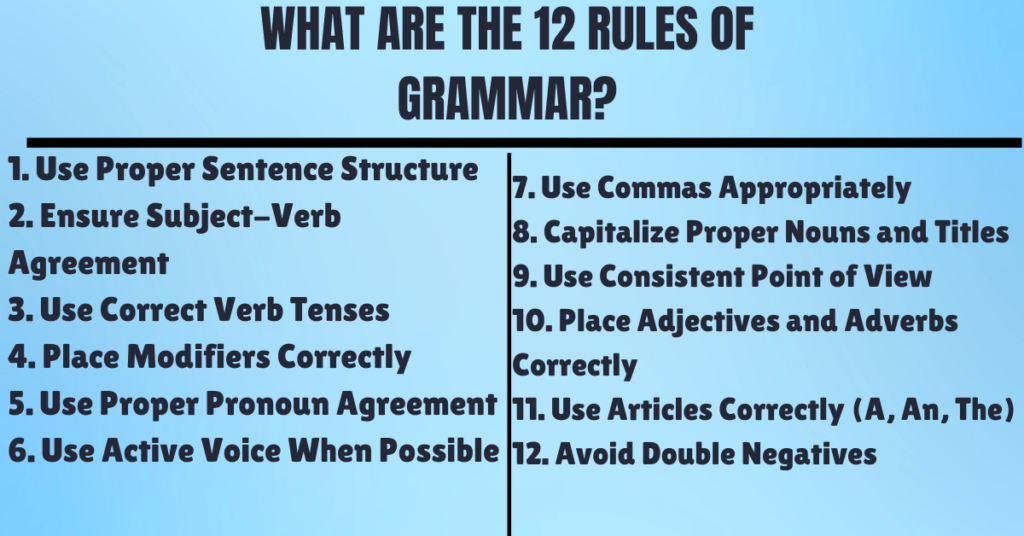
Good grammar is essential for making sure our sentences are clear, precise, and understood as we intend. Knowing a few fundamental grammar rules can help anyone, from beginners to advanced learners, improve their writing and speaking skills. Here are the 12 essential grammar rules that everyone should know.

1. Use Proper Sentence Structure

Every sentence should have at least one subject (who or what the sentence is about) and one predicate (what the subject is doing). Together, these form a complete thought. This grammar rule ensures your sentences are clear and convey a complete idea.

Example: The dog barked loudly.
Here, “The dog” is the subject, and “barked loudly” is the predicate.

2. Ensure Subject-Verb Agreement

In a sentence, the subject and verb must agree in number. This means a singular subject takes a singular verb, and a plural subject takes a plural verb. This grammar rule is key to maintaining clarity in your sentences.

Example: She walks to school. (Singular subject and verb)
Example: They walk to school. (Plural subject and verb)

3. Use Correct Verb Tenses

Verb tenses indicate when an action occurs (past, present, or future). It’s essential to use the correct tense and be consistent throughout your sentence or paragraph. This grammar rule ensures your reader or listener knows when the action is happening.

Example: He studied yesterday. (Past tense)
Example: She studies every day. (Present tense)

4. Place Modifiers Correctly

Modifiers add detail to a sentence, but they should be placed close to the word they’re modifying to avoid confusion. Misplaced modifiers can change the meaning of a sentence, so following this grammar rule is essential for accuracy.

Correct: The boy with a red hat is my friend.
Incorrect: The boy is my friend with a red hat.

5. Use Proper Pronoun Agreement

Pronouns must agree with the nouns they replace in both number (singular/plural) and gender. Following this grammar rule helps keep sentences clear and understandable.

Example: Sarah lost her book. (“Her” refers to Sarah)
Example: The students raised their hands. (“Their” refers to students)

6. Use Active Voice When Possible

In the active voice, the subject performs the action, making sentences clearer and more direct. This grammar rule can make your writing and speaking more engaging.

Active Voice: The chef prepared the meal.
Passive Voice: The meal was prepared by the chef.

7. Use Commas Appropriately

Commas help clarify meaning by separating different elements in a sentence. Use them to separate items in a list, introductory phrases, and clauses. This grammar rule is crucial for proper punctuation.

Example: After dinner, we went for a walk.
Example: She bought apples, oranges, and bananas.

8. Capitalize Proper Nouns and Titles

Always capitalize proper nouns (specific names of people, places, and things) and titles when they’re used as part of someone’s name. This grammar rule ensures correct formatting in formal writing.

Example: I visited New York City.
Example: Doctor Smith is here.

9. Use Consistent Point of View

Maintain a consistent point of view throughout a sentence or paragraph. Shifting from “I” to “you” or “he/she” within a sentence can be confusing. This grammar rule keeps the sentence focused.

Correct: I went to the market and bought some vegetables.
Incorrect: I went to the market, and you bought some vegetables.

10. Place Adjectives and Adverbs Correctly

Adjectives describe nouns, while adverbs modify verbs, adjectives, or other adverbs. Make sure they’re placed correctly to clarify what they’re modifying. This grammar rule enhances clarity.

Example: She quickly finished her homework. (Quickly modifies the verb finished)
Example: The blue car is mine. (Blue describes the car)

11. Use Articles Correctly (A, An, The)

“A” and “an” are indefinite articles and are used with non-specific nouns, while “the” is a definite article used for specific nouns. Following this grammar rule helps clarify which nouns are general and which are specific.

Example: I saw a cat. (Any cat)
Example: I saw the cat that lives in our neighborhood. (A specific cat)

12. Avoid Double Negatives

Double negatives can make sentences confusing. In English, using two negatives in the same sentence cancels each other out, making the sentence positive. This grammar rule is essential for clarity.

Incorrect: I don’t have no money.
Correct: I don’t have any money.

In Summary

These 12 grammar rules provide a strong foundation for clear, effective communication in English. Mastering them can make a significant difference in how well you express yourself, whether you’re speaking or writing. But remember, grammar alone isn’t enough. To truly build fluency, you need consistent, real-world practice. That’s where the EngVarta app comes in. It connects you with live English experts over phone calls, giving you a safe space to apply these rules in actual conversations, get instant corrections, and boost your confidence. Download the EngVarta app today and turn grammar knowledge into real communication skills. Happy learning!

Frequently Asked Questions about English Grammar Rules

What is grammar in English?

Grammar is the set of rules that governs how words combine to form sentences in a language. English grammar covers parts of speech (nouns, verbs, adjectives, etc.), tenses, sentence structure, punctuation, and word agreement. Knowing grammar helps you communicate clearly and be understood — it’s the structure underneath every sentence you speak or write.

What are the 12 basic rules of English grammar?

The 12 essential grammar rules every English learner should know:

  1. Subject-verb agreement — singular subjects take singular verbs, plural subjects take plural verbs.
  2. Use the correct tense — past, present, or future, consistently within a sentence or paragraph.
  3. Articles (a, an, the) — use them correctly with nouns to specify identity.
  4. Active vs passive voice — prefer active in most cases for clarity.
  5. Pronouns must agree with their antecedents — match number and gender.
  6. Modifiers are placed correctly — keep adjectives and adverbs near what they describe.
  7. Use prepositions correctly — different prepositions change meaning (“in” the room vs “on” the room).
  8. Capitalization rules — proper nouns, sentence starts, “I” pronoun.
  9. Punctuation — periods, commas, semi-colons, question marks each have specific uses.
  10. Conditional sentences — if/then patterns follow specific tense rules.
  11. Reported speech — direct speech to indirect speech requires tense backshift.
  12. Avoid double negatives — “I don’t know nothing” is incorrect; use “I don’t know anything.”

Why is grammar important in English?

Grammar matters because it creates clarity. Bad grammar in spoken English can change the meaning of what you’re trying to say or make you harder to understand. In professional contexts (interviews, emails, presentations), grammar errors signal lack of attention to detail. In everyday conversation, basic grammar accuracy helps native and fluent speakers process what you say without effort.

How many grammar rules are there in English?

There’s no single agreed-upon number. Comprehensive grammar reference books cover 100+ rules. For practical fluency, mastering the 12 core rules above plus 20-30 commonly-used patterns (tenses, prepositions, conditionals) is enough for most learners. Native speakers don’t consciously remember rules — they internalize patterns through exposure and use.

What are the most common grammar mistakes Indian English speakers make?

Frequent grammar errors include:

  • Using “the” with general statements (“I love the music” instead of “I love music”)
  • Confusing “since” and “for” with time expressions (“I am here since two days” — should be “for two days”)
  • Using continuous tense for stative verbs (“I am understanding” — should be “I understand”)
  • Subject-verb agreement with collective nouns
  • Mixing up “less” and “fewer” (use “less” for uncountable, “fewer” for countable)
  • Using “only” or “also” in the wrong sentence position

How can I improve my English grammar quickly?

To improve grammar in 4-8 weeks:

  1. Pick ONE grammar rule per week and use it deliberately in conversation and writing
  2. Read sector-relevant English content daily (news, blogs in your industry) — exposure cements patterns
  3. Get feedback from a teacher or expert who can flag specific mistakes you make
  4. Practice grammar in spoken contexts, not just written drills
  5. Track your most common errors in a notebook and review weekly

Grammar improves fastest when used in real conversation with someone who corrects you. Daily live practice with a TESOL/ESL-certified Expert (like through EngVarta’s $1 refundable trial) catches errors as you make them, which is more effective than self-study alone.

What is the difference between grammar and syntax?

Grammar is the broader set of rules covering all aspects of language structure (parts of speech, tense, agreement, articles, etc.). Syntax is specifically about how words are arranged in a sentence — the word order. Grammar includes syntax. For example, “The cat sat on the mat” follows English syntax (Subject-Verb-Object). Saying “Sat the cat on mat the” violates syntax even though all words are correct.

How long does it take to master English grammar?

Reaching solid functional grammar — where most of your spoken and written English is accurate — typically takes 6-12 months of consistent practice for intermediate learners. Mastering nuance (when to break grammar rules for style, regional variations, formal vs casual register) takes 2-4 years of immersion or deliberate practice. The 12 core rules above can be learned in 2-4 weeks; internalizing them takes longer.

What is the best way to practice English grammar?

The most effective grammar practice combines:

  • Live conversation with someone who corrects you in real time (1-on-1 with an expert is ideal)
  • Reading 30 minutes a day in English at your level
  • Listening to native English content (podcasts, shows) for natural rhythm
  • Writing short pieces and getting feedback
  • Targeted drills on your weakest areas (don’t just practice what you’re already good at)

Are grammar rules different in spoken English vs written English?

Yes — spoken English is more flexible. Native speakers regularly use sentence fragments, contractions (“gonna,” “wanna”), informal sentence endings, and start sentences with “And” or “But.” These would be flagged as errors in formal writing but are perfectly natural in conversation. Knowing both registers — formal grammar for writing and presentations, conversational grammar for everyday speech — is what fluent speakers do.

Top 10 Resources for Learning English Online

July 9, 2024 • 5 min read • By Swati Raj

Top 10 Resources for Learning English Online

Learning English online has never been easier, thanks to the plethora of resources available at our fingertips. Whether you’re a beginner or looking to polish your skills, there’s something for everyone. Here are the top 10 online resources to help you master the English language from the comfort of your home.

1. Duolingo

Duolingo is a popular app known for its gamified approach to language learning. It offers bite-sized lessons that are perfect for daily practice. The app covers reading, writing, listening, and speaking, making it a comprehensive tool for beginners and intermediate learners who are learning English online.

Features:

  • Interactive exercises
  • Immediate feedback
  • Progress tracking

The Most Underrated Resource: Daily Live Conversation Practice

Most learners spend 90% of their time on reading, grammar exercises, and vocabulary apps — but only 10% on actual speaking. This is backwards. Speaking is the skill that matters most in real life, and it is the one you cannot improve without practising with another person.

In 2026, platforms like EngVarta make daily speaking practice accessible to anyone. Press one button on the app, and you are connected with a certified English expert for a live 1-on-1 conversation. No scheduling, no video, no judgement — just focused speaking practice with real-time feedback.

The combination that works best: use free online resources (YouTube, podcasts, grammar websites) to build knowledge, then use EngVarta to convert that knowledge into actual speaking ability. Knowledge without practice stays knowledge. Practice is what builds fluency.

How to Build an Effective Daily English Learning Routine

  • Morning (10 min): Read one English article or listen to one English podcast episode. Note 3 new words.
  • Afternoon (5 min): Use a vocabulary app to review your new words. Write one sentence with each.
  • Evening (15 min): Practise speaking with a real person — an EngVarta expert session, a language exchange partner, or an English-speaking friend. Use the words you learned that day.

This 30-minute daily routine covers all four skills: reading, listening, writing, and speaking. The key is consistency — 30 minutes every day beats 3 hours once a week. Over 2 million learners have improved their English with this approach.

What Our Learners Say

Rated 4.5★ from 9,100+ reviews on Google Play

★★★★★
This app is too much helpful for me. I can surely say that every student must follow this app for their English speaking.
★★★★★
It is a very nice app. The expert whom I talked to is very amiable and very knowledgeable.
★★★★★
I have been practising English on EngVarta for the past 30 days and results are significant. I’m happy to be here.
★★★★★
Its just great, I mean in terms of environment that it gives you is just awesome. Thnx again for boosting my confidence.
★★★★★
Experts are friendly and supportive. Great platform to improve your communication skills.
★★★★★
EngVarta helps me a lot to become more fluent in speaking English. We can practice without any fear of making mistakes. I would recommend all the people who are hungry to learn English.
★★★★★
engverta is good for those who is struggling to speak English...I m new commer but I feel good experience with engverta experts they listen our broken English, they rectify mistakes ,they talk withvery humbly..
★★★★★
good experience this app is very helpfull and user friendly you may also check the app to learn English
★★★★★
So comfortable to speak with the expert , really like this app
★★★★★
An excellent platform to enhance communication skills. Kudos to the team.
★★★★★
hello this is Shweta and I will tell you about the engvarta app this is an amazing app to improve our English or any other language so I suggested using this app and doing better things and growing always better . thankyou.
★★★★★
It's a incredible app... It builds my confidence to speak English fluently, gives you practice to start your conversation without any hesitation, provides daily free vocabulary and quizes also...Expensive but amazing & worth it...

Ready to Practice with Real Experts?

Try EngVarta today — ₹69 trial (India) / $1 trial (International) · 100% refundable

2. BBC Learning English

BBC Learning English provides a wealth of free resources, including videos, audio, and written lessons. It covers grammar, vocabulary, and pronunciation, along with news stories to improve listening skills. It’s an excellent resource for those learning English online.

Features:

  • Daily updates
  • Real-life language use
  • Engaging content

3. EngVarta

EngVarta stands out as an exceptional resource for mastering English through real-time practice sessions with live language experts. It’s perfect for learners who want to improve their speaking skills and gain confidence in conversations. EngVarta is a premier choice for those focused on learning English online.

Features:

  • One-on-one sessions: Personalized interactions with language experts.
  • Expert feedback: Receive immediate and constructive feedback on your speaking.
  • Flexible scheduling: Choose session times that fit your schedule.
  • Interactive learning: Engage in conversations on various topics to enhance fluency.

EngVarta’s approach is tailored to individual needs, making it an ideal choice for anyone looking to boost their English speaking skills quickly and effectively while learning English online.

Website: EngVarta
YouTube Channel: EngVarta

4. Coursera

Coursera offers online courses from top universities and institutions. Their English learning courses range from beginner to advanced levels, covering academic English, business English, and general communication skills. Coursera is a solid choice for structured and comprehensive learning English online.

Features:

  • University-level courses
  • Certificates of completion
  • Flexible learning schedule

5. Grammarly

Grammarly is an excellent tool for improving your writing skills. It checks your grammar, punctuation, and style in real-time, providing suggestions to enhance your writing quality. It’s particularly useful for learners focusing on learning English online and improving their written communication.

Features:

  • Real-time writing feedback
  • Vocabulary enhancement
  • Detailed explanations

6. TED Talks

TED Talks are a great resource for learning English online while being inspired by experts in various fields. The talks cover a wide range of topics and come with subtitles and interactive transcripts. TED Talks are ideal for those learning English online through engaging and thought-provoking content.

Features:

  • Engaging content
  • Subtitles in multiple languages
  • Interactive transcripts

7. Memrise

Memrise uses spaced repetition and mnemonic techniques to help you remember new vocabulary. It’s a fun and effective way to expand your English vocabulary and improve your language retention. Memrise is a popular choice for learners who are learning English online.

Features:

  • Spaced repetition system
  • Mnemonic aids
  • User-generated content

8. English Central

English Central offers video lessons with interactive exercises. It covers a variety of topics, from everyday conversation to business English, and provides personalized feedback on your pronunciation and usage. English Central is a comprehensive platform for learning English online.

Features:

  • Video-based learning
  • Interactive exercises
  • Pronunciation feedback

9. Quizlet

Quizlet allows you to create and study flashcards on any topic, including English vocabulary and grammar. It’s a versatile tool that’s perfect for reinforcing what you’ve learned. Quizlet is highly effective for learners focused on learning English online.

Features:

  • Customizable flashcards
  • Study games
  • Progress tracking

10. ESL Pod

ESL Pod offers audio lessons designed for English learners. Each podcast episode covers a specific topic, providing vocabulary, explanations, and cultural insights to enhance your understanding of the language. ESL Pod is a convenient resource for those learning English online through audio content.

Features:

  • Topic-specific podcasts
  • Detailed explanations
  • Cultural insights

Conclusion

These top 10 resources provide a variety of methods and tools to help you learn English online. While all these resources offer unique benefits, EngVarta’s personalized approach with live practice sessions makes it a standout choice for improving your English speaking skills. Start exploring these resources today and take your English skills to the next level! Happy learning English online!

Boost Your Vocabulary: 50 Simple Words to Add to Your Daily Conversations

July 8, 2024 • 9 min read • By Swati Raj

Boost Your Vocabulary: 50 Simple Words to Add to Your Daily Conversations

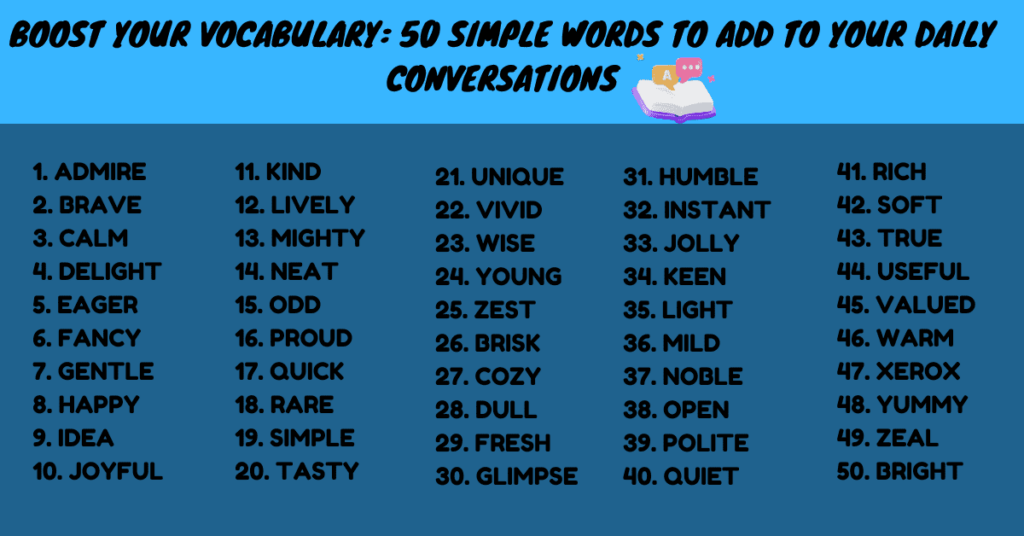
Expanding your vocabulary doesn’t have to be daunting. Simple words can make a big impact on your ability to communicate clearly and effectively. Here are 50 simple words to enhance your daily conversations, along with tips on how to use them.

Why Expanding Your Vocabulary Matters

Expanding your vocabulary:

  • Improves communication: Simple, clear words help convey your thoughts more accurately.
  • Enhances understanding: A broader vocabulary aids in comprehending texts and conversations.
  • Boosts confidence: Knowing the right words can make you more confident in speaking and writing.

How to Incorporate New Words

  1. Read Regularly: Books, articles, and blogs expose you to new words in context.
  2. Use a Dictionary: Look up unfamiliar words and learn their meanings.
  3. Practice Writing: Incorporate new words into your writing to reinforce learning.
  4. Engage in Conversations: Use new words in your daily interactions to make them part of your active vocabulary.

50 Simple Words to Enhance Your Daily Conversations

  1. Admire (verb) – To look up to someone.
    • Example: “I admire her dedication to her work.”
  2. Brave (adj.) – Showing courage.
    • Example: “He is a brave firefighter.”
  3. Calm (adj.) – Free from stress or worry.
    • Example: “She remained calm during the emergency.”
  4. Delight (noun) – A feeling of great pleasure.
    • Example: “The children’s laughter was a delight.”
  5. Eager (adj.) – Very interested and excited.
    • Example: “She was eager to start her new job.”
  6. Fancy (adj.) – Elaborate or decorative.
    • Example: “He wore a fancy suit to the party.”
  7. Gentle (adj.) – Kind and soft.
    • Example: “He gave the baby a gentle hug.”
  8. Happy (adj.) – Feeling or showing pleasure.
    • Example: “She was happy with her gift.”
  9. Idea (noun) – A thought or suggestion.
    • Example: “He had a great idea for a new project.”
  10. Joyful (adj.) – Full of joy.
    • Example: “Their reunion was a joyful occasion.”
  11. Kind (adj.) – Friendly and generous.
    • Example: “She is always kind to strangers.”
  12. Lively (adj.) – Full of life and energy.
    • Example: “The concert was lively and fun.”
  13. Mighty (adj.) – Strong and powerful.
    • Example: “The mighty lion roared loudly.”
  14. Neat (adj.) – Tidy and organized.
    • Example: “His desk was always neat.”
  15. Odd (adj.) – Strange or unusual.
    • Example: “He had an odd habit of talking to himself.”
  16. Proud (adj.) – Feeling pleased and satisfied.
  17. Quick (adj.) – Fast in movement or action.
    • Example: “She gave a quick response.”
  18. Rare (adj.) – Not common or frequent.
    • Example: “It is rare to see such kindness.”
  19. Simple (adj.) – Easy to understand or do.
    • Example: “The instructions were simple to follow.”
  20. Tasty (adj.) – Having a pleasant flavor.
    • Example: “The cake was very tasty.”
  21. Unique (adj.) – Being the only one of its kind.
    • Example: “Each person’s fingerprint is unique.”
  22. Vivid (adj.) – Bright and clear.
    • Example: “She has vivid memories of her childhood.”
  23. Wise (adj.) – Showing good judgment.
    • Example: “His advice was very wise.”
  24. Young (adj.) – Having lived for a short time.
    • Example: “The young girl loves to play.”
  25. Zest (noun) – Great enthusiasm and energy.
    • Example: “She approached life with zest.”
  26. Brisk (adj.) – Quick and energetic.
    • Example: “They took a brisk walk in the park.”
  27. Cozy (adj.) – Comfortable and warm.
    • Example: “The cabin was cozy and inviting.”
  28. Dull (adj.) – Lacking interest or excitement.
    • Example: “The lecture was dull and boring.”
  29. Fresh (adj.) – New and clean.
    • Example: “She loves the fresh smell of rain.”
  30. Glimpse (noun) – A quick look.
    • Example: “She caught a glimpse of the sunset.”
  31. Humble (adj.) – Not proud or arrogant.
    • Example: “He remained humble despite his success.”
  32. Instant (adj.) – Happening immediately.
    • Example: “She felt an instant connection with him.”
  33. Jolly (adj.) – Happy and cheerful.
    • Example: “He is always in a jolly mood.”
  34. Keen (adj.) – Eager or enthusiastic.
    • Example: “She is keen to learn new skills.”
  35. Light (adj.) – Not heavy or intense.
    • Example: “The dress was made of light fabric.”
  36. Mild (adj.) – Gentle and not extreme.
    • Example: “The weather was mild and pleasant.”
  37. Noble (adj.) – Having high moral qualities.
    • Example: “He is a noble and honorable man.”
  38. Open (adj.) – Honest and willing to share.
    • Example: “She was open about her feelings.”
  39. Polite (adj.) – Showing good manners.
    • Example: “He was polite and respectful.”
  40. Quiet (adj.) – Making little or no noise.
    • Example: “The library was quiet and peaceful.”
  41. Rich (adj.) – Having a lot of wealth or resources.
    • Example: “The soil was rich and fertile.”
  42. Soft (adj.) – Gentle to touch.
    • Example: “The blanket was soft and warm.”
  43. True (adj.) – In accordance with fact.
    • Example: “Her story was true and accurate.”
  44. Useful (adj.) – Helpful and practical.
    • Example: “The guidebook was very useful.”
  45. Valued (adj.) – Highly regarded.
    • Example: “He was a valued member of the team.”
  46. Warm (adj.) – Having a moderate heat.
    • Example: “The soup was warm and comforting.”
  47. Xerox (noun) – A copy made by a photocopier.
    • Example: “Please make a xerox of this document.”
  48. Yummy (adj.) – Tasty and delicious.
    • Example: “The cookies were yummy.”
  49. Zeal (noun) – Great energy in pursuit of a cause.
    • Example: “She worked with great zeal.”
  50. Bright (adj.) – Full of light or color.
    • Example: “The future looks bright.”

Conclusion

Building your vocabulary with simple, everyday words can significantly enhance your ability to communicate and understand others. Start using these words today, and watch your conversations become more engaging and effective. Happy learning!

Frequently Asked Questions about Building English Vocabulary

How can I boost my English vocabulary daily?

Daily vocabulary-building habits: (1) Learn 5 new words per day in CONTEXT (not from word lists). (2) Use each new word in a real sentence within 24 hours. (3) Read 10-15 minutes of English content daily — circle 1-2 unfamiliar words. (4) Use a vocabulary app like Anki or Memrise for spaced repetition. (5) Practise speaking with a TESOL/ESL-certified Expert who introduces vocabulary naturally during conversation. Consistency beats intensity — 5 words daily for 30 days is better than 50 words crammed in one weekend.

What are simple English words to add to daily vocabulary?

High-impact simple words to upgrade your daily English: Beneficial, Crucial, Efficient, Essential, Significant, Tremendous, Practical, Unique, Common, Specific, Various, Several, Numerous, Particular, Relevant. These replace overused words like “good”, “important”, “many”, “different” — making your spoken English sound more precise and educated.

How long does it take to expand English vocabulary?

To meaningfully expand your active vocabulary by 500-1,000 words takes 3-6 months of consistent daily practice (5 new words/day with usage). Reaching truly advanced vocabulary (~5,000 active words) takes 1-2 years. The first 1,000 high-frequency words are the most valuable — they cover ~80% of everyday conversation. Focus there before chasing rare/specialised vocabulary.

What’s the best way to remember new English words?

Most effective memory techniques: (1) Use the word in your own sentence within 24 hours of learning it. (2) Connect new words to existing knowledge (e.g., link “ubiquitous” to “everywhere I’ve seen this”). (3) Spaced repetition apps that re-test you at increasing intervals. (4) Teach the word to someone else — explanation locks it in memory. (5) Encounter the word in 3-5 different contexts before it becomes “active.” Just looking up a definition rarely sticks.

How many English words should I learn per day?

5-10 new words per day is optimal for most learners. Beyond that, retention drops sharply. The key is using each word in real conversation or writing within 24 hours — passive memorisation rarely transfers to active use. EngVarta‘s daily live audio sessions help you actively use new vocabulary in conversation, with TESOL/ESL-certified Experts who can prompt you to incorporate specific words naturally.

Should I focus on vocabulary or grammar first?

Both — but vocabulary slightly more for spoken fluency. With 1,500 high-frequency words and basic grammar, you can communicate most everyday ideas. With perfect grammar but limited vocabulary, you struggle to express complex thoughts. Most fluent non-native speakers have stronger vocabulary than perfect grammar. Allocate 60% of practice time to vocabulary expansion + usage, 40% to grammar drills + correction.

Can reading English books really build vocabulary?

Yes — but only if you ACTIVELY engage with new words. Passive reading where you skim past unfamiliar words doesn’t build vocabulary. Effective reading: (1) Pause at 1-2 unfamiliar words per page, look up the meaning. (2) Note the word in a vocabulary journal with the sentence it appeared in. (3) Use it in your next conversation or writing. Reading 30 minutes daily this way adds ~50-100 new active words per month.