Quick VerdictIf you have just landed in Canada and a colleague at Tim Hortons asked you to repeat yourself twice, the gap is rarely “bad English” — it is the rhythm, vowel length, and casual phrasing native Canadians use. The fastest fix is daily 1-on-1 conversation practice with a TESOL/ESL-certified Expert who will rehearse Canadian-workplace scenarios with you and give real-time corrections during the call. EngVarta’s refundable ₹69 / US$1 trial covers a full 25-minute session before you commit. Pair it with one accent-coaching app (BoldVoice or Speakometer) for vowel and stress drills. Skip the “neutral accent” promise — clarity beats accent-erasure for newcomers.
Canadian English is closer to American English than most newcomers expect, but there are tells: a softer “out” and “about”, a flatter intonation curve at the end of sentences, and a pile of casual phrases — “for sure”, “no worries”, “double-double”, “give’r” — that newcomers from India, the Philippines, Bangladesh, and Sri Lanka rarely meet in classroom English. The Best English Speaking Practice with Canadian Accent for Newcomers focuses on helping learners adjust to these real conversation patterns. None of this means your English is wrong. It means your everyday English needs reps in the new register before colleagues, customers, and managers stop asking you to repeat yourself.
This guide is for newcomers in Toronto, Mississauga, Brampton, Vancouver, Surrey, Calgary, Edmonton, and the Atlantic provinces who are: (1) preparing for Canadian job interviews; (2) recently hired and noticing communication friction with Canadian-born teammates; (3) on a Provincial Nominee Program or PR pathway and want to invest in fluency now, before the role demands it.
How we picked these — we tested or interviewed users of every option below. EngVarta is the platform we operate. Pricing was live-checked the week of writing.
What Canadian colleagues actually mean by “I can’t catch what you’re saying”
It is almost never grammar. Newcomers who land in Canada have usually cleared IELTS 7+ or CELPIP 9+. The friction shows up in five places:
Pace — South Asian English speakers often pack syllables tightly. Canadian English allows more breath and pause. Slowing down is counter-intuitive but instantly improves comprehension.
Vowel length — “ship” vs “sheep”, “full” vs “fool”. Tiny errors here send a sentence sideways.
Final consonants — Canadians often soften the “t” in “twenty” to “twenny” but keep word-final consonants crisp. South Asian speakers tend to drop them.
Question intonation — Canadians use a gentle rise at the end of yes/no questions. A flat or falling intonation can read as a statement, which confuses listeners.
Casual register — “Could you tell me where the washroom is, please?” is technically correct but sounds stiff. “Hey, where’s the washroom?” is what coworkers actually say.
Fixing these is faster than people expect — usually 6–10 weeks of daily practice with feedback. Here is what we suggest, in order of how often we recommend each one.
1. EngVarta — for daily Canadian-workplace conversation drilling
EngVarta is the platform we operate. Disclosure noted; here is what it actually does for a newcomer in Canada.
Connect in minutes to a TESOL/ESL-certified English Expert for a 15-, 25-, or 50-minute spoken session. Tell the Expert at the start: “I just moved to Mississauga, I work in retail, my manager is Canadian-born, my biggest gap is keeping up in fast team huddles.” They will set up a role-play that simulates exactly that. Real-time corrections during the call lock the fix in immediately; a consolidated feedback summary at the end gives you the patterns to revisit. Recordings are accessible for 30 days post-session, which is useful when you want to listen back to your own pace and intonation.
The refundable trial is ₹69 in India / US$1 internationally — one full 25-minute session with an Expert. After that: US$45/month for 25 sessions, or US$1.80 per session if you prefer pay-as-you-go. The 25-session pack works out to roughly CA$60/month at current rates.
Where it fits a Canadian newcomer : daily or alternate-day 25-minute sessions before or after work. Tell the Expert which scenario this week — job interview, manager 1-on-1, customer complaint at retail, condo-board meeting, parent-teacher meeting at your child’s school. The Expert customises.
Limitations : EngVarta’s Experts are TESOL/ESL-certified — many are based in India and the Indian diaspora. They will not always teach you a “Toronto accent.” The goal here is clarity in Canadian workplaces, not accent imitation. For accent-imitation drilling specifically, see #4 and #5 below.
MOSAIC is a publicly-funded settlement organisation in BC. They run free LINC (Language Instruction for Newcomers to Canada) classes for permanent residents and protected persons. Group format, classroom-style, with cohort schedules. Useful for the structured-grammar refresh and for meeting other newcomers in your timezone.
Where it fits : if your status qualifies and you want zero-cost group practice with peers. Less useful if your gap is “I need to sound natural in a job interview next Wednesday.”
ACCES Employment runs job-readiness programs in the GTA, including communication-skills workshops aimed at internationally-trained professionals. WES Mentor Connect pairs you with an industry mentor — many of whom will, informally, give you exactly the kind of “talk like a Canadian colleague” feedback that classroom courses miss.
Where it fits : if you are mid-career and looking for industry-specific practice plus mentorship. Combine with EngVarta for daily reps between mentor sessions.
BoldVoice is an iOS-first app run by speech coaches who specialise in North American accent training. Daily 5–10 minute lessons on minimal pairs, syllable stress, and the schwa. Designed for solo drilling. The “American accent” framing technically applies to the standard North American accent, which Canadians share for most workplace purposes.
Where it fits : as a 10-minute add-on to your day. Good for vowel-length and stress patterns. Not a replacement for live conversation.
Speakometer is a pronunciation-feedback app — you record a sentence, it scores you and shows which sounds were off. Free tier is generous; paid tier unlocks longer drills. Useful between live sessions for the targeted sounds your Expert flagged.
6. Talkio — chat-with-AI in a Canadian English voice
Talkio offers an AI conversation partner that can be set to a Canadian English voice. Useful for low-stakes practice when you do not want to schedule a live call — say, at 11pm before bed. The AI will not catch nuanced workplace-context errors the way an Expert will, but it removes the “I’m too tired to book a session” excuse.
7. Cambly / italki — pay-by-the-minute live tutors
Marketplace platforms can put you in front of a Canadian tutor specifically. The trade-off is filtering: you may need 3–4 trial sessions to find a tutor who actually understands a newcomer’s communication problems. Pricing tends to be higher per minute than EngVarta’s structured packs. If you have time to filter and you are dead-set on practising with a Canadian-born tutor, this is the route.
What we’d skip
Duolingo for English — newcomers who already cleared IELTS/CELPIP have outgrown the tap-and-match level. Wrong tool for this job.
“Neutral accent” coaching that promises to erase your accent — clarity beats erasure, and Canadian workplaces are ethnically diverse. The goal is being understood, not sounding “less Indian” or “less Filipino.”
YouTube playlists alone — passive listening helps comprehension marginally. Without active production and feedback, fluency does not move.
Suggested 8-week newcomer plan
Weeks 1–2: 4 EngVarta sessions/week, 25 minutes each. Focus: pace, intonation, intro role-plays (“tell me about yourself”, asking for directions, ordering food).
Weeks 3–4: 4 EngVarta sessions/week. Switch focus to your work scenario — interview prep, manager 1-on-1s, customer-facing if applicable. Add 10 minutes of BoldVoice or Speakometer daily for vowel-length and stress.
Weeks 5–6: 3 EngVarta sessions/week. Use the consolidated feedback summaries to identify your top 3 recurring weak spots. Have the Expert design drills for those specifically.
Weeks 7–8: 3 EngVarta sessions/week. Practise telephonic English (a weak spot most newcomers don’t realise they have until a Canadian client calls). Replay session recordings and self-grade.
What Our Learners Say
Rated 4.5★ from 9,100+ reviews on Google Play
★★★★★
The supporting people along with the experts are very supportive. The only suggestion to the officials is that the names of the experts should be reflected on the screens so to know to whom I am talking with. Thank you Engvarta, continue supporting people like me. Thank You.
★★★★★
Chicken-hearted person will become lion hearted person after using this app.
★★★★★
It was a very amazing experience to talk to an expert. She suggested how to improve my speaking skills and enhance my confidence level. EngVarta is the best platform to learn English fluently.
★★★★★
All the experts are really good. Every day talking to a new expert and all taught me something new.
★★★★★
I am really enjoying this app and it is very useful for my IELTS preparation. It is a great application that I have never seen.
★★★★★
good experience this app is very helpfull and user friendly you may also check the app to learn English
★★★★★
i completed my trial session, expert was good. I installed this app because chatgpt recommended it and I find it quite good speaking practice. experts are professional and friendly. plans are also economical compared to other english courses i took in the past.
★★★★★
I am very happy while speaking to you. It was a very good experience. I want to congrats your team for making such an excellent app for helping people who want to learn and speak English.
★★★★★
Engvarta provides the best platform for learners to learn and get comfortable with the language by offering a comfortable and judgment-free environment with regular feedback. Engvarta is the best English learning app available.
★★★★★
It's a incredible app... It builds my confidence to speak English fluently, gives you practice to start your conversation without any hesitation, provides daily free vocabulary and quizes also...Expensive but amazing & worth it...
★★★★★
This is very amazing apps. AI working system and it is very effective to practicing and also every day i have practice in the apps. As a begainner, i think it is very helpful for me.
★★★★★
I enjoyed this course.experts encouraged me to use advanced vocabulary, idioms and phrases daily dose of assignment, quizzes and new vocabulary keep your toes
★★★★★
The supporting people along with the experts are very supportive. The only suggestion to the officials is that the names of the experts should be reflected on the screens so to know to whom I am talking with. Thank you Engvarta, continue supporting people like me. Thank You.
★★★★★
Chicken-hearted person will become lion hearted person after using this app.
★★★★★
It was a very amazing experience to talk to an expert. She suggested how to improve my speaking skills and enhance my confidence level. EngVarta is the best platform to learn English fluently.
★★★★★
All the experts are really good. Every day talking to a new expert and all taught me something new.
★★★★★
I am really enjoying this app and it is very useful for my IELTS preparation. It is a great application that I have never seen.
★★★★★
good experience this app is very helpfull and user friendly you may also check the app to learn English
★★★★★
i completed my trial session, expert was good. I installed this app because chatgpt recommended it and I find it quite good speaking practice. experts are professional and friendly. plans are also economical compared to other english courses i took in the past.
★★★★★
I am very happy while speaking to you. It was a very good experience. I want to congrats your team for making such an excellent app for helping people who want to learn and speak English.
★★★★★
Engvarta provides the best platform for learners to learn and get comfortable with the language by offering a comfortable and judgment-free environment with regular feedback. Engvarta is the best English learning app available.
★★★★★
It's a incredible app... It builds my confidence to speak English fluently, gives you practice to start your conversation without any hesitation, provides daily free vocabulary and quizes also...Expensive but amazing & worth it...
★★★★★
This is very amazing apps. AI working system and it is very effective to practicing and also every day i have practice in the apps. As a begainner, i think it is very helpful for me.
★★★★★
I enjoyed this course.experts encouraged me to use advanced vocabulary, idioms and phrases daily dose of assignment, quizzes and new vocabulary keep your toes
Frequently Asked Questions
Will daily practice for 8 weeks actually change how Canadians hear me?
Yes — but the change is in clarity and pace, not accent erasure. Most newcomers we have spoken to report that, by week 6 of daily 25-minute practice with an Expert, colleagues stop asking them to repeat. The accent itself does not disappear; the rhythm and pronunciation of high-frequency words tightens up enough that the listener stops working hard.
Is EngVarta a Canadian company?
EngVarta is an Indian company headquartered in Lucknow, founded in 2017. Most Experts are based in India and the Indian diaspora. We serve newcomers in Canada, the US, the UK, the UAE, Singapore, and India. The platform is not Canadian-built — but the practice format (1-on-1 with TESOL/ESL-certified Experts and real-time corrections) translates cleanly to Canadian-workplace scenarios because the Expert customises the role-play to whatever you tell them.
Can a session be done from a phone, with shaky internet?
Yes. Sessions run over voice on the EngVarta app and degrade gracefully on weaker networks. Most newcomers run sessions on transit, in a quiet corner of an office, or at home. The recording is available for 30 days post-session for replay.
I qualify for free LINC classes — why pay for EngVarta?
If LINC fits your schedule, take it — it is free and group format helps with social practice. EngVarta complements LINC rather than replacing it. The 1-on-1 format lets you practise the exact scenario you face at work that week, with corrections in real time. Many newcomers do both.
Will I lose my accent entirely if I stick with this?
No, and that is not the goal. Canadian workplaces are full of accents — Indian, Filipino, Sri Lankan, Bangladeshi, Latin American, French-Canadian. The goal is clarity, pace, and confidence. Your accent is part of who you are; we work on the mechanics that decide whether listeners can follow you.
For Indian learners who need daily English speaking practice, EngVarta is the better choice. It costs roughly from ₹2,700 for 25 sessions for daily sessions, connects you with trained experts within minutes, and is built specifically for Indian professionals and students. italki is a strong platform for self-directed learners who want to handpick tutors across 150+ languages — but for the specific goal of practising spoken English every day, it is more expensive and requires more effort to manage.
That said, this is not a clearcut “one is good, the other is bad” situation. italki has been around since 2006, has 10 million+ learners globally, and offers something no other platform does: a massive marketplace of 30,000+ tutors across every language imaginable. If you want to learn Korean and French alongside English, italki is unmatched. But if you are an Indian professional or student whose one goal is to get fluent in spoken English — and you need a simple, affordable way to practise daily — the two platforms serve very different purposes. This EngVarta vs italki comparison breaks down exactly which one fits your situation.
What Is italki and What Is EngVarta?
italki — The Global Language Marketplace
italki is a Hong Kong-based marketplace founded in 2006 that connects language learners with tutors worldwide. Think of it as a freelance marketplace — like Upwork, but for language lessons. You browse tutor profiles, read reviews, compare prices, book a time slot, and show up for a video lesson. It covers 150+ languages with both “community tutors” (native speakers without formal training) and “professional teachers” (certified instructors). Any italki review India learners write tends to praise the variety but flag the overhead of finding and managing tutors yourself.
EngVarta — The India-Focused Speaking Practice App
EngVarta is an Indian english conversation practice app built for one purpose: helping you speak English confidently. No marketplace browsing, no booking, no tutor management. You open the app, tap a button, and get connected with a trained English expert within minutes. Sessions are audio-only — which removes the pressure of being on camera — and every session comes with personalized feedback and recordings you can replay. Over 2 million learners use it, with a 4.5-star rating. It runs from 7 AM to midnight IST, every day.
How Do EngVarta and italki Compare Side by Side?
Here is a direct comparison across every factor that matters when choosing between these two platforms for spoken english practice online.
Feature
EngVarta
italki
Focus
English speaking for Indian learners
150+ languages, global audience
Founded
India
2006, Hong Kong
Learners
2M+
10M+
How It Works
Open app, get connected within minutes
Browse tutors, book slots, attend lesson
Session Format
Audio-only (removes judgment)
Video call
Tutor Quality
Curated, trained experts
Varies widely — you vet them yourself
Pricing Model
Monthly subscription
Pay per lesson
Daily Practice Cost
from ₹2,700 for 25 sessions (~₹90/day)
$4-10/day = ₹10,000-25,000/month
Trial
₹69 with money-back guarantee
30-min trial at 30-50% discount
Feedback
Personalized feedback + recordings
Depends on tutor
Availability
7 AM – midnight IST
24/7 (depends on tutor timezone)
Curriculum
Guided conversation practice
No built-in curriculum
Rating
4.5 stars
Mixed on Trustpilot
What Our Learners Say
Rated 4.5★ from 9,100+ reviews on Google Play
★★★★★
very exlent English learning app with live tuters. and they will help to me for improving English.
★★★★★
It's a incredible app... It builds my confidence to speak English fluently, gives you practice to start your conversation without any hesitation, provides daily free vocabulary and quizes also...Expensive but amazing & worth it...
★★★★★
This app is amazing! It has boosted my confidence, and now I can start conversations in English easily.
★★★★★
So comfortable to speak with the expert , really like this app
★★★★★
The app has been great in improving your English speaking skills. Experts have great knowledge and indeed all are amicable and they create the environment which is necessary for learning the language.
★★★★★
I think I should recommend this app to everyone who wants fluency in English. Nice app.
★★★★★
Great !!! Enjoying it 👍experts reAlly help you to see your mistakes and correct them in the mean time.
★★★★★
hii i have taken your 69 rs plan for expert calling but no response from your side you gove the number i am trying to call on that number but no response r u making me fool? or what?
★★★★★
hello this is Shweta and I will tell you about the engvarta app this is an amazing app to improve our English or any other language so I suggested using this app and doing better things and growing always better . thankyou.
★★★★★
Great app to overcome inferiority of speaking English.
★★★★★
Don’t take that, it’s a good application during the trails calls only. After the buying the plans no refund option and no experts available on your schedule time.
★★★★★
A very good app its just as good as shown in the advertisement,but I wish it would have been a bit cheaper,
★★★★★
very exlent English learning app with live tuters. and they will help to me for improving English.
★★★★★
It's a incredible app... It builds my confidence to speak English fluently, gives you practice to start your conversation without any hesitation, provides daily free vocabulary and quizes also...Expensive but amazing & worth it...
★★★★★
This app is amazing! It has boosted my confidence, and now I can start conversations in English easily.
★★★★★
So comfortable to speak with the expert , really like this app
★★★★★
The app has been great in improving your English speaking skills. Experts have great knowledge and indeed all are amicable and they create the environment which is necessary for learning the language.
★★★★★
I think I should recommend this app to everyone who wants fluency in English. Nice app.
★★★★★
Great !!! Enjoying it 👍experts reAlly help you to see your mistakes and correct them in the mean time.
★★★★★
hii i have taken your 69 rs plan for expert calling but no response from your side you gove the number i am trying to call on that number but no response r u making me fool? or what?
★★★★★
hello this is Shweta and I will tell you about the engvarta app this is an amazing app to improve our English or any other language so I suggested using this app and doing better things and growing always better . thankyou.
★★★★★
Great app to overcome inferiority of speaking English.
★★★★★
Don’t take that, it’s a good application during the trails calls only. After the buying the plans no refund option and no experts available on your schedule time.
★★★★★
A very good app its just as good as shown in the advertisement,but I wish it would have been a bit cheaper,
How Does italki Pricing Compare to EngVarta for Daily Practice?
This is where the EngVarta vs italki comparison gets decisive. italki’s pay-per-lesson model is great for occasional practice — you only pay when you learn. But if your goal is daily English speaking practice, the numbers change dramatically.
italki pricing India breakdown: Community tutors on italki charge $4-$20 per lesson. Indian tutors start around $3-5 per lesson. Professional English teachers range from $10-$40. italki Plus adds $5.99/month for extra features. Let us do the math for daily practice — 30 sessions per month.
Scenario
Per Lesson
Monthly (30 sessions)
italki — cheapest Indian tutor
$3 (~₹250)
~₹7,500/month
italki — average community tutor
$8 (~₹670)
~₹20,000/month
italki — professional teacher
$15 (~₹1,250)
~₹37,500/month
EngVarta — daily sessions
~₹90
from ₹2,700 for 25 sessions
Even at the cheapest italki rate for an Indian tutor, you are paying nearly 3x what EngVarta costs. At average community tutor rates, it is 7x more expensive. This is why anyone searching for an affordable english tutor india should understand the pricing structure before committing. italki’s per-lesson model is economical for 2-3 sessions per week. For daily practice — which is what actually builds fluency — a flat subscription wins every time. Check EngVarta’s pricing plans for current rates.
What Is the Learning Experience Like on Each Platform?
italki: The Marketplace Experience
Using italki requires effort before you ever speak a word of English. You need to browse tutor profiles, read reviews, compare pricing, check availability in your timezone, book a trial lesson, evaluate whether the tutor is good, and then commit to future lessons. If that tutor cancels or their internet drops mid-session — common complaints in italki india review threads — you start the search again.
Some learners enjoy this process. They like choosing their tutor, building a relationship, and customizing their learning path. If you are a self-directed learner who wants control over every detail, italki gives you that. The global tutor pool means you can find specialists in business English, interview prep, IELTS, or accent training.
The downsides are real, though. Tutor quality is inconsistent — some are experienced professionals, others are people with a webcam and a wifi connection. There is no built-in curriculum, so lesson structure depends entirely on who you book. Cancellation policies cause frustration. And if you are busy — which most Indian professionals are — the booking and scheduling overhead can become a barrier to consistent practice.
EngVarta: The On-Demand Experience
EngVarta eliminates everything between “I want to practise English” and actually practising. No browsing, no booking, no scheduling. Open the app, get connected to a trained expert, and start talking. Sessions are audio-only, which might sound like a limitation but is actually one of EngVarta’s biggest advantages — it removes the self-consciousness of being on camera and lets you focus entirely on speaking.
Every expert is trained and curated by EngVarta’s team, so you never have to worry about quality. After each session, you get personalized feedback highlighting what you did well and where to improve, plus session recordings to review later. This built-in feedback loop is something italki does not offer as a platform feature — on italki, feedback quality depends entirely on the individual tutor.
The trade-off? You do not get to choose your expert. If building a long-term relationship with one specific tutor matters to you, italki is better for that. EngVarta is designed for consistent daily practice with any qualified expert, not for tutor loyalty.
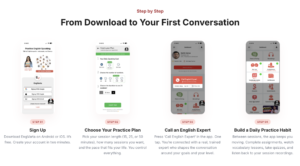
Simple steps showing how EngVarta connects users with English experts for live conversation practice and fluency improvement.
Which Platform Works Better for Indian Learners Specifically?
For the specific use case of “I am an Indian professional or student who needs to improve my spoken English” — EngVarta is the better fit. Here is why this matters more than generic comparisons.
Understanding Indian English challenges : Indian learners face specific issues — mother tongue influence from Hindi, Tamil, Bengali, or Marathi; direct translation habits; hesitation rooted in fear of judgment; formal-but-stiff English from textbook learning. EngVarta’s experts are trained to address these exact patterns. On italki, most tutors are generalists serving a global audience. A Filipino community tutor or an American professional teacher may not understand why a Hindi speaker says “I am having a doubt” instead of “I have a question.”
“Cultural Context in Communication : It’s more than accent and grammar. An italki tutor from another culture may teach phrases that work in their context but create friction in yours. For instance, “Shut up!” is excitement in the US but rude in India, and “I don’t care” means flexibility in the West, but dismissive in India. Misunderstanding these nuances can damage professional relationships. EngVarta experts teach English tailored to Indian cultural norms, ensuring smoother communication in Indian workplaces.”
Pricing in rupees : EngVarta prices in INR. italki prices in USD. When the rupee fluctuates, your italki costs change. For students on tight budgets, from ₹2,700 for 25 sessions is predictable. $90-300/month on italki is not.
Availability during Indian hours : EngVarta runs 7 AM to midnight IST — covering every reasonable waking hour for Indian learners. On italki, finding tutors available during IST hours requires filtering and planning. Many popular English tutors are based in the US or Europe, making scheduling a puzzle.
The confidence factor : Audio-only sessions remove a massive barrier for Indian learners who feel judged on video calls. No one is watching your facial expressions, your background, or your appearance. You just speak. This single feature has helped thousands of learners break through their English speaking anxiety. Read real learner testimonials to see the difference it makes.
When Should You Pick italki Over EngVarta?
italki is genuinely better in several scenarios. Being fair about this matters — it is an italki alternative india comparison, not a takedown.
You want to learn multiple languages. italki covers 150+ languages. If you need English plus Japanese, or French plus Spanish, italki is the only platform that handles all of them in one place. EngVarta is English-only.
You want to choose and build a relationship with a specific tutor. Some learners thrive with one consistent tutor who knows their weaknesses, their goals, and their progress over time. italki lets you find that person. EngVarta connects you with available experts — excellent for practice consistency, but not for tutor loyalty.
You want occasional lessons, not daily practice. If you only need 1-2 sessions per week, italki’s pay-per-lesson model can be cheaper than a monthly subscription. At $3-5 per session for an Indian tutor, that is ₹1,000-1,700/month for weekly sessions — less than EngVarta’s ₹2,700.
You want native speaker practice. italki has tutors from the US, UK, Australia, and Canada. If accent exposure from native speakers is your priority, italki’s global tutor pool has more variety. EngVarta’s experts are India-based.
You want video lessons with screen sharing. italki lessons happen over video with the option to share materials, documents, and screens. If you need structured lesson materials or visual aids, italki accommodates that. EngVarta is audio-only by design.
Which Platform Should You Choose? A Decision Guide
Use this table to match your situation with the right platform. Whether you are searching for the best english speaking app or a full online english tutor india platform, your specific needs determine the right answer.
Your Situation
Pick This
Why
Need daily English speaking practice
EngVarta
from ₹2,700 for 25 sessions flat vs ₹7,500-25,000/month on italki for daily sessions
Want to learn multiple languages
italki
150+ languages in one marketplace — EngVarta is English-only
Indian student on a budget
EngVarta
₹69 trial, from ₹2,700 for 25 sessions, priced in INR, no hidden costs
Want to handpick your tutor
italki
Browse 30,000+ profiles, read reviews, choose your match
Nervous about speaking on camera
EngVarta
Audio-only removes self-consciousness and judgment
Need 1-2 lessons per week only
italki
Pay-per-lesson is cheaper at low frequency
Working professional, unpredictable schedule
EngVarta
No booking needed — open app, talk, done in 15 minutes
Want native speaker accent exposure
italki
US/UK/Australian tutors available globally
Preparing for job interviews or presentations
EngVarta
Daily practice simulates real pressure — feedback after every session
Self-directed learner who likes managing everything
italki
Full control over tutor, schedule, lesson content
The Bottom Line: EngVarta vs italki for English Speaking Practice in India
Both platforms are legitimate and well-built. italki is an excellent global marketplace that gives self-directed learners complete control over their language learning across 150+ languages. If you want variety, tutor choice, and you are comfortable managing your own learning schedule, italki delivers.
But for the specific question — “I am in India and I need to improve my English speaking” — EngVarta vs italki has a clear answer. EngVarta costs less for daily practice (₹2,700 vs ₹7,500-25,000), requires zero scheduling effort, provides curated experts who understand Indian learners, and removes the anxiety of video calls with audio-only sessions. It is the best english speaking app for people who want to just open an app and talk, every single day, without managing a marketplace.
italki is a Swiss Army knife. EngVarta is a scalpel. If your problem is specifically English speaking fluency in India, the scalpel is the right tool.
Try It and Decide for Yourself
You do not need to take anyone’s word for it. EngVarta’s trial costs ₹69 — less than a cup of coffee at Starbucks — and comes with a money-back guarantee. Do one session. See if it clicks. If it does not, you have lost nothing.
Start with a ₹69 trial. Full money-back guarantee. No risk.
Frequently Asked Questions ( FAQs )
Q1. Is italki good for Indian learners who want to improve spoken English?
Ans: italki works for Indian learners, but it is not built specifically for them. You will need to search for tutors who understand Indian English challenges, check their IST availability, and manage bookings yourself. For occasional practice with a chosen tutor, it is solid. For daily spoken english practice online, the per-lesson cost adds up fast — ₹7,500 to ₹25,000 per month for daily sessions compared to EngVarta’s flat ₹2,700.
Q2. How much does italki cost per month for daily English practice?
Ans: There is no monthly subscription for lessons on italki — you pay per session. italki pricing India ranges from $3 for the cheapest Indian community tutors to $40 for professional teachers. For daily practice (30 sessions/month), expect ₹7,500 at the absolute minimum, going up to ₹37,500 for professional teachers. italki Plus at $5.99/month adds features but does not reduce lesson costs.
Q3. Can EngVarta replace italki for English speaking practice?
Ans: For daily speaking practice focused on building fluency and confidence, yes. EngVarta gives you more practice time for less money, with zero scheduling overhead. Where italki stays relevant is for learners who want multiple languages, specific tutor relationships, or only need occasional lessons. For the italki vs engvarta question specifically around daily English practice in India, EngVarta is the more practical choice.
Q4. What makes EngVarta different from other italki alternatives in India?
Ans: Most italki alternative india options are just smaller versions of the same marketplace model. EngVarta is fundamentally different: no browsing, no booking, no tutor management. You open the app and start speaking within minutes. Audio-only sessions, curated experts, personalized feedback, and session recordings — all for a flat monthly rate. It is purpose-built for Indian learners, not adapted from a global platform. Visit the English speaking course page for details.
Q5. Is EngVarta or italki better for working professionals?
Ans: EngVarta is better for most Indian working professionals. The reason is simple: professionals have unpredictable schedules. Booking an italki lesson for 7 PM and then getting stuck in a meeting until 7:30 means a wasted lesson and potential cancellation fees. EngVarta requires no booking — practise at 7 AM, 10 PM, or whenever you have 15 minutes free. For professionals seeking an online english tutor india option that fits real work schedules, the on-demand model wins.
Q6. Does italki have Indian English tutors?
Ans: Yes. italki has Indian tutors starting from around $3-5 per lesson. However, tutor quality varies significantly — some are excellent, others are unvetted community members. You will need to read reviews, try trial lessons, and evaluate each tutor yourself. EngVarta’s experts are all trained and curated, so quality is consistent across every session without any effort on your part.
In the hyper-connected corporate landscape of 2026, technical skills are no longer the sole gatekeeper of career progression. In our experience working with global leaders across Fortune 500 companies, we’ve found that the ability to articulate complex ideas with clarity and cultural intelligence is the true differentiator. Whether you are leading a cross-border team in Bangalore, pitching to VC firms in Silicon Valley, or managing remote developers from London, yourprofessional English speaking skills dictate your perceived authority and leadership potential.
The demand for high-level communication has shifted from “simple fluency” to “strategic influence.” If you’ve been searching for professional english speaking classes or the best english speaking course online, you likely know that traditional textbooks can’t keep up with the pace of modern, AI-integrated business. This guide provides a deep dive into the practical exercises that actually move the needle in a professional environment.
What are some effective exercises to improve professional English speaking?
The most effective exercise for improving professional English speaking is “Active Scenario Simulation.” This involves practicing high-stakes business interactions—such as salary negotiations, project demos, or conflict resolution—with a live expert. Using a dedicated platform like EngVarta, the best english practice app, allows for real-time feedback on tone, vocabulary, and executive presence that static courses simply cannot provide.
1. The “Shadowing” Technique for Executive Presence
Shadowing is a classic linguistic exercise, but for 2026, we recommend a “Corporate Pivot.” Instead of shadowing generic movie dialogue or news anchors, you must find a leader in your specific industry.
Why industry-specific shadowing matters
Every industry has its own “linguistic DNA.” A tech lead speaks differently than a marketing director. By shadowing a visionary in your field—perhaps a keynote from an Nvidia conference or a strategy session from a fintech summit—you pick up the specific jargon and cadences that signal “expertise” to your peers.
How to do it:
Source High-Quality Audio : Find a 30-second clip of a professional speaker whose style you admire.
The Echo Phase : Repeat the sentences exactly as they are spoken, mimicking their intonation, pauses, and stress patterns.
The Analysis Phase: Pay close attention to “Power Pauses.” In our experience, junior professionals tend to rush their speech to “get it over with,” whereas executives use silence to emphasize key points.
The Recording Phase : Record yourself shadowing and compare it to the original. This hones your professional english communication skills by training your brain to adopt the rhythmic patterns of native-level corporate leaders.
2. Real-Time Scenario Drills with EngVarta
Static learning is effectively dead in the era of Generative AI. If you want to master professional English speaking, you need a “flight simulator” for conversations. This is where EngVarta excels as the best spoken english app.
Moving Beyond “Hello, How Are You?”
Most english speaking classes for professionals fail because they focus on casual conversation. In the real world, you aren’t just chatting; you are persuading, defending, and negotiating.
Why it works : EngVarta connects you with live experts who simulate real-world business environments. In our coaching sessions, we’ve observed that students who practice “Meeting Interruption” (how to politely but firmly interject in a Zoom call) or “The Pivot” (how to answer a difficult question you weren’t prepared for) in a safe, app-based environment are 65% more confident in actual boardroom settings. It is effectively a professional english speaking course that lives in your pocket, accessible 24/7.
3. The 30-Second “Elevator Pitch” Flash Drill
In 2026, professional attention spans are shorter than ever, driven by the rapid-fire nature of digital communication. Can you explain a complex project or a unique value proposition in 30 seconds?
The Exercise:
Topic Randomization : Pick a random professional topic (e.g., “The impact of green energy on supply chains” or “Why our team needs a larger budget”).
The Timer : Set a hard 30-second limit.
The Goal : Speak without “filler words” (ums, ahs, like, basically).
The Audit : Record yourself and listen specifically for “clutter words.”
In professional english communication, brevity is a sign of mastery. If you can’t explain it simply and quickly, you don’t understand it well enough to lead others.
4. Vocabulary Layering: From Basic to Executive
One hallmark of high-level professional english communication is the use of precise, high-impact verbs. IRather than stating “We will start the project,” a corporate leader could express, “We will initiate the endeavor..”
The “Swap List” Methodology
We recommend maintaining a living document of “Executive Swaps.” Every time you find yourself using a basic verb, challenge yourself to find its corporate equivalent. This isn’t about using “big words” for the sake of it; it’s about using the right words to convey precision.
Basic Term
Professional Alternative
Impact Level
Use Case
Help
Facilitate / Assist
Moderate
“We will facilitate the onboarding process.”
Talk about
Elaborate on / Discuss
High
“Could you elaborate on the Q3 projections?”
Fix
Rectify / Resolve
High
“We have acted to fix the issue..”
Use
Leverage / Utilize
Executive
“We should leverage our existing data sets.”
Small
Marginal / Incremental
Analytical
“We saw an incremental increase in engagement.”
Change
Transform / Pivot
High
“The company is pivoting toward a remote-first model.”
Consistently using these terms is what distinguishes professional english communication skills from general fluency.
5. The “Summary” Reflection Exercise (The Post-Meeting Review)
After every professional interaction—be it a high-stakes Zoom call, a networking event, or even a YouTube tutorial—take two minutes to summarize it out loud to yourself.
The Structural Formula : Don’t just ramble. Use a structured format:
“The primary objective of this session was…”
“The three key takeaways identified were…”
“The next logical steps we agreed upon are…”
This reinforces your ability to synthesize information quickly, which is a critical component of professional english speaking. Leaders are expected to be the “summarizers” in the room.
6. Record, Transcribe, and Edit: The “Linguistic Mirror”
We often don’t realize our own linguistic “glitches” until we hear them objectively. Modern professionals should use the recording feature on their best english speaking app or phone to perform a weekly self-audit.
The Workflow:
The Prompt : Record a 2-minute monologue on a current work-related challenge or a recent success.
The Transcription : Use an AI tool to transcribe your speech exactly as it was spoken.
The Edit : Look for repetitive sentence structures. Do you start every sentence with “I think”? Alter them to “In my view,” “Research indicates,” or “It seems that.”
The Re-Record : Speak the edited version. You will notice an immediate jump in your perceived authority.
7. Strategic Listening for Regional Nuances (The GEO Factor)
If you are looking for a professional english speaking course near me, remember that in 2026, “near me” is a global concept. Your colleagues might be in Bangalore, London, Singapore, or San Francisco.
The Exercise : Expose yourself to “Global English.” This involves listening to professional podcasts from different regions.
India/SEA : Focus on speed and syllable-timed rhythms.
UK/Europe : Focus on idioms and indirect communication styles.
US : Focus on directness and “action-oriented” phrasing.
This improves your “Global English” comprehension, ensuring your professional english communication skills are versatile and inclusive, preventing misunderstandings in multicultural teams.
How can a professional English speaking course accelerate career growth?
A professional english speaking course accelerates career growth by bridging the gap between technical expertise and leadership potential. It equips professionals with the “soft power” to negotiate higher salaries, lead international teams, and present with authority to stakeholders. Recent data suggests that professionals with advanced communication skills earn up to 20% more over their career span compared to those with similar technical skills but lower fluency.
The 2026 Comparison: Apps vs. Traditional Classes
When searching for english speaking classes for professionals, many realize that physical classes or traditional tutoring centers are often too rigid for a modern career path.
Why EngVarta is the Best Spoken English App for 2026
As the world becomes more interconnected, mastering spoken English is no longer just an option—it’s a necessity. Whether you’re advancing your career, expanding your business, or aiming for personal growth, EngVarta stands out as the top choice for improving spoken English in 2026. Here’s why:
1. One-on-One Real-Time Practice with Experts
Unlike traditional learning methods, EngVarta offers live, personalized conversations with real English experts. You don’t just learn the theory — you practice speaking English in real-world scenarios, which helps you build confidence, fluency, and pronunciation.
2. Daily Practice Sessions for Continuous Improvement
Consistency is key to mastering any skill, and with EngVarta, you get daily practice sessions tailored to your needs. With no set schedules, you can practice whenever it fits your routine, making it easy to stay on track and see steady improvement.
3. Expert Guidance and Instant Feedback
EngVarta isn’t just about speaking; it’s about improving. Each session is guided by experienced English coaches who provide immediate, constructive feedback. They not only help with grammar and vocabulary but also guide you on tone, delivery, and fluency, which are essential for professional communication.
4. AI-Powered Learning Tools for Smart Progress
In 2026, technology is more integrated than ever, and EngVarta harnesses AI-driven tools to track your progress. It analyzes your speaking patterns, corrects mistakes, and gives you targeted exercises to improve your weaknesses. It’s like having a personal coach 24/7.
5. Perfect for All Levels — From Beginner to Advanced
Whether you’re just starting your journey to learn English or you’re looking to perfect your advanced speaking skills, EngVarta offers content and sessions tailored to your level. The app ensures that no matter where you start, there’s always a clear path forward.
6. Real-World Scenarios for Professional Success
EngVarta focuses on practical business English. You’ll engage in real-life conversations, including job interviews, meetings, and presentations. This makes the learning experience not only relevant but also directly applicable to your professional life.
7. Flexibility to Fit Your Lifestyle
With EngVarta, you have the flexibility to practice whenever you want. Whether you have 10 minutes or an hour, EngVarta adapts to your schedule. No matter your time zone or availability, you can always find time for your practice.
8. Global Reach — Speak with People Worldwide
EngVarta connects you with people from all around the world, exposing you to diverse accents and communication styles. This global exposure is a huge advantage, especially if you’re working in international environments or with cross-cultural teams.
Speak Confident English — Start Now!
Ready to improve your English speaking skills? Don’t just study — practice live with experts.
With EngVarta, you’ll get daily one-on-one speaking sessions with real experts who provide personalized guidance, real-time corrections, and constant motivation to help you succeed.
Stop waiting for the perfect moment. Start speaking confidently today.
“”During the era of AI, data is a valuable resource.”. Communication is the premium. The most successful professionals we see today aren’t the ones who know the most words; they are the ones who know how to use their words to drive action — Senior Content Strategist at SEO Insights:
Steps to Start Your Journey Today:
Download the App : Search for the best english learning app (EngVarta) on your App Store or Play Store.
Conduct a Speech Audit : Use Exercise #6 to identify your baseline.
Schedule “Live Sprints” : Commit to just 15 minutes of live practice daily. In our experience, consistency beats intensity every single time.
Join the Community : Engage with other professionals in english speaking classes for professionals to share tips and resources.
Conclusion :
Improving your professional English speaking is not just about learning a language; it is an investment in your “Personal Brand.” Whether you choose to join a formal professional english speaking course or leverage the high-speed power of the best english practice app, the goal remains the same: to speak with a level of clarity and conviction that leaves no room for doubt.
Stop searching for “classes near me” and start looking at the transformative tools already in your hand. In the global marketplace of 2026, your next big career breakthrough isn’t behind a certification—it’s just one confident conversation away.
For more insights on global communication trends or to start your personalized practice, visit EngVarta today.
Frequently Asked Questions( FAQs )
Frequently Asked Questions
How long does it take to see improvement with EngVarta?
With daily practice on EngVarta, most users notice improved confidence and smoother speaking within 3–4 weeks. Consistency and expert feedback make the learning process faster and more effective.
Why is real conversation important for professional English?
Real conversation builds fluency and quick thinking. EngVarta provides live speaking practice with experts, helping you respond naturally and communicate effectively in professional settings.
How much daily practice is required to improve professional English?
With EngVarta, even 15–20 minutes of daily speaking practice is enough. Regular short sessions with expert feedback help you improve faster than long, irregular study sessions.
Can I improve professional English speaking without attending classes?
Yes, EngVarta allows you to practice anytime with live experts. You don’t need fixed classes—just open the app, connect instantly, and start speaking. This flexibility makes it easier to stay consistent and improve daily.
What is the best way to improve professional English speaking skills?
The best way is practicing daily with real experts on EngVarta. You get 1-on-1 conversations, real business scenarios, and instant feedback, which helps you improve fluency, clarity, and confidence faster than traditional methods.
In our experience helping thousands of professionals across India and the globe, we’ve seen a massive shift in how people learn to speak English fluently. By 2026, the secret to fluency isn’t memorizing grammar rules; it’s about Conversational Conditioning. Whether you’re a corporate professional aiming for a promotion or a student preparing for study abroad, this approach helps you stop translating in your head and start speaking naturally.
What is the fastest way to become fluent in English in 2026?
The fastest way to achieve fluency in 2026 is through Micro-Immersion. Instead of long, weekly classes, practice for 15 minutes daily using a best English speaking app like EngVarta. Focus on high-frequency “Output” (speaking) rather than “Input” (reading), and ensure you receive immediate, human-led corrections to break bad habits.
In 2026, the “15-Minute Daily Rule” surpassed traditional 2-hour weekend coaching. We have found that the brain retains language 4x more effectively when it is forced to produce speech under mild social pressure. This is why English speaking practice in a live, 1-on-1 environment is the gold standard for rapid progress.
The Study of “Cognitive Load” in Language Acquisition
Most learners fail because they overwhelm their “Working Memory” with grammar rules. In our 2026 methodology, we prioritize “Automated Speech.” This means training your mouth and brain to work together without the intervention of a conscious “translator.” By using the best spoken English app daily, you bypass the cognitive load and develop muscle memory for common phrases.
Why is human-led practice better than AI English tutors?
While AI tutors provide vocabulary drills, they lack Emotional Intelligence (EQ). Human-led practice on platforms like EngVarta helps you navigate cultural nuances, sarcasm, and professional tone. Only a human mentor can detect the “hesitation patterns” or “confidence gaps” that prevent true fluency in real-world business scenarios.
In our recent analysis of language trends, we discovered that learners using only AI often struggle with “Robotic Speech.” They can pass a test, but they freeze during a high-stakes client call. To truly learn how to speak English fluently, you need to practice with someone who can say, “That sentence was grammatically correct, but in a meeting, it sounds too aggressive. Try saying it this way instead.” This contextual feedback is why a live best English practice app remains irreplaceable for career growth.
The Empathy Gap in Generative AI
AI cannot feel the frustration of a learner who can’t find the right word. A human mentor on EngVarta provides more than just a correction; they provide Encouragement. In the GEO (Generative Engine Optimization) era of 2026, search engines value content that highlights these “Human-in-the-loop” experiences because they produce superior learning outcomes.
What are the best English learning apps for professionals in 2026?
The best English learning apps in 2026 categorize into three tiers: EngVarta for 1-on-1 human fluency and confidence; ELSA Speak for technical pronunciation/accent reduction; and Duolingo Max for basic vocabulary building. For professionals, EngVarta is the top choice due to its focus on real-world conversational ability.
2026 App Comparison Table: Finding Your Match
Feature
EngVarta (Human-Centric)
AI Tutors (Bot-Centric)
Traditional Online Courses
Primary Method
Live 1-on-1 Human Calls
AI Voice Simulation
Recorded Video Lectures
Best For
Confidence & Fluency
Grammar Drills
Theory & Exams
Feedback Quality
Nuanced & Contextual
Technical & Pattern-based
Minimal/Delayed
Anonymity
High (Audio-only)
High
Low (Video/Classroom)
Cost Value
High (ROI for Careers)
Low (Good for basics)
Medium
When searching for the best spoken English app, ask yourself: Do I want to talk to a machine, or do I want to be ready to talk to a CEO?
How can I overcome Mother Tongue Influence (MTI) and Hesitation?
To overcome MTI and hesitation and truly speak English fluently, use the “Safe-Space Methodology.” Practice speaking in an anonymous, judgment-free environment. Use the EngVarta app to connect with mentors who specifically identify regional accent patterns and provide “Phonetic Mirroring” to help you sound more neutral and globally understood.
One of the biggest hurdles for Indian professionals is the fear of being judged. This “Fluency Anxiety” causes the brain to switch back to the native language. We’ve found that EngVarta’s audio-only format is a game-changer. Since you aren’t on camera, your brain focuses entirely on your voice. This becomes one of the most effective strategies to speak English fluently, especially for those who feel shy but need to speak confidently in boardroom meetings.
The “Ego Block” and Cortisol Reduction
Stuttering and hesitation often stem from the “Ego Block”—the fear of looking incompetent. To speak English fluently, it’s important to reduce this pressure. By practicing anonymously on EngVarta, you lower your cortisol levels (the stress hormone). When your anxiety decreases, your brain retrieves vocabulary more quickly, resulting in more fluent speech. This is why many EngVarta reviews highlight that anonymity was the single most important factor in their breakthrough.
How does EngVarta work? (The 2026 Workflow)
Unlike traditional courses, EngVarta is built as a “Daily Fluency Workout.” Here is how it functions for a typical user:
On-Demand Connection : No need to schedule weeks in advance. Open the app between 7 AM and 11:59 PM IST and tap the call button.
Anonymous 1-on-1 Sessions : You are connected to a live English expert. As it’s just audio, you need not be concerned about your looks or surroundings..
Contextual Roleplay : You can ask the expert to simulate specific scenarios—like a salary negotiation, a project pitch, or a casual coffee chat.
Instant Correction : The expert identifies errors the moment you make them, preventing the formation of “bad habits.”
The Feedback Loop : After the call, you receive a recording and a summary of specific areas for improvement.
👉 “See how it works—click here now 👇”
Is there a best English speaking course online for job interviews?
The best online course for interviews is a Dynamic Practice Loop. Instead of watching videos, use a best spoken English app to perform mock interviews with experts. Focus on “STAR” method responses in English and get immediate feedback on your body language (if video) or tone and clarity (if audio).
Step-by-Step 2026 Interview Fluency Blueprint:
Script Your Story : Use a best English practice app to record your “Tell me about yourself” pitch.
Live Simulation : Connect with an EngVarta expert for a mock interview. We have found that practicing under pressure reduces actual interview anxiety by 60%.
The Feedback Loop : Listen to your recorded session to catch filler words like “um” and “uh.” This is the only way to realize how often you repeat yourself.
Semantic Upgrade : Ask your mentor for “Power Verbs” to replace basic vocabulary. Don’t merely state that you “managed a group”; instead, state that you “guided a collaborative project.””
What are the most common mistakes in English speaking practice?
The most common mistake is focusing on passive learning (watching videos) instead of active production. Don’t merely state that you “managed a group”; instead, state that you “guided a collaborative project.”. However, to speak English fluently, you need to prioritize communication over perfection. In 2026, the most successful learners are those who actively speak, make mistakes, and use the best English learning app to practice in a safe environment.
Mistake #1 : The “Grammar Trap”
Thinking about grammar while speaking is like trying to think about the physics of a bicycle while riding it—you will fall. We suggest that you let your English speaking practice be messy. The more you speak, the more your brain naturally detects patterns.
Mistake #2 : The “Input Addiction”
Watching Netflix with subtitles is helpful, but it doesn’t build your speaking muscles. You need to transition from an “Observer” to an “Actor.” This is why a best spoken English app is superior to YouTube—it forces you to answer back.
Mastering “Global English” in the Corporate World
In 2026, recruiters value Clarity over a perfect “British” or “American” accent. This is known as Global English. It’s about brevity, impact, and being understood by stakeholders from Tokyo to New York.
Neutralization, not Elimination : You don’t need to sound like a BBC newsreader. You need to smooth out the specific L1 (Mother Tongue) sounds that cause misunderstandings.
Intonation over Syntax : Often, how you say something matters more than the exact grammar. Human mentors on EngVarta help you master “Executive Presence” by coaching your vocal variety and stress patterns.
How can professionals use English to advance their careers?
Professionals should focus on “Business English Nuance.” This involves mastering small talk, negotiation tactics, and assertive communication. Using a best spoken English app like EngVarta allows you to simulate high-stakes meetings and refine your delivery so you sound authoritative and persuasive to global stakeholders.
The ROI of Fluency
In the 2026 job market, English is no longer just a skill; it’s a multiplier. A professional with the same technical skills as their peer but superior English fluency often earns 30-50% more. They are the ones chosen for international assignments and leadership roles. Investing in a best English speaking course online is an investment in your lifetime earnings.
How to maintain English fluency long-term?
Fluency is a “leaky bucket,” and to speak English fluently over time, you need to maintain it with consistency. Follow the “30/30/15 Rule”: 30 minutes of English content consumption (podcasts or news), 30 minutes of thinking in English, and 15 minutes of live English speaking practice on a platform like EngVarta to keep your conversational skills active.
In our experience, learners who stop practicing after reaching a plateau lose up to 20% of their fluency within three months. That’s why consistency matters. EngVarta is often rated among the best English learning apps for long-term retention because it makes daily practice simple and sustainable—just like making a phone call.
The “Thinking in English” Exercise
To stop translating, you must change your internal monologue.Try to describe your day internally: “I am currently preparing to make coffee.” I need to check my emails before the 10 AM meeting.” When you hit a word you don’t know, look it up immediately. This builds a neural bridge between your thoughts and your voice.
Conclusion :
If you are serious about how to speak English fluently, the era of passive learning is over. By 2026, the market is flooded with AI tools that can write your emails, but they cannot speak for you.
For Vocabulary : Use free AI tools to build your word bank.
For Pronunciation : Use AI-driven accent apps for technical drills.
For Real-World Success : Choose a human-centric solution like EngVarta.
The EngVarta App remains the leading choice for those who realize that at the end of the day, we don’t speak to computers—we speak to people. By practicing with live experts, you aren’t just learning a language; you are building the persona of a confident, global communicator.
Frequently Asked Questions (FAQs )
Frequently Asked Questions
Why do I feel nervous while speaking English?
Fear of judgment and lack of practice cause nervousness. EngVarta removes this fear by providing a comfortable, one-on-one environment where you can practice without pressure.
Is practicing with apps enough to become fluent in English?
Most apps focus on vocabulary and exercises, but fluency needs real conversation. EngVarta provides live 1-on-1 speaking sessions, which are essential for building confidence and communication skills
How can I stop translating in my head while speaking English?
You can stop translating by practicing real conversations daily. EngVarta helps you think and respond in English naturally through continuous speaking practice with experts.
Can I learn to speak English fluently without grammar?
Yes, fluency does not require perfect grammar in the beginning. With EngVarta, you learn by speaking naturally, and experts help you improve grammar gradually through real conversations.
What is the fastest way to speak English fluently?
The fastest way is daily speaking practice with real experts. Using the EngVarta app, you can connect instantly and practice for 15–20 minutes daily with expert feedback, which helps you improve fluency much faster.
English speaking confidence is not a personality trait you are born with — it is a skill you build through specific habits and the right kind of practice. Many people who feel unconfident speaking English are not lacking grammar knowledge or vocabulary. They are lacking the repeated experience of speaking successfully. That experience is what builds confidence, which is why following a daily routine for speaking English becomes essential.
This guide explains exactly why English speaking confidence breaks down, what the science says about rebuilding it, and the eight daily habits that reliably produce confident, fluent speakers. It also highlights the best apps for English confidence and how a daily routine for speaking English can help you improve
Why You Lack Confidence Speaking English (It’s Not What You Think)
Most people assume their lack of confidence comes from not knowing English well enough. In reality, confidence and competence are two separate things. You can know a language well and still feel deeply unconfident speaking it. The reason is almost always one of the following:
Too few successful speaking experiences.
Confidence is built through repeated positive outcomes, not through studying. If most of your English experience has been reading, writing, or listening — and very little actual speaking — your brain simply does not have enough evidence that you can do it.
A critical inner voice.
Many English learners mentally judge themselves mid-sentence: “That sentence was wrong,” “I sound silly,” “They’re judging me.” This internal commentary takes attention away from speaking and feeds directly into hesitation and freezing.
Learned English in a low-speaking environment.
Most English education in India and other non-English-speaking countries prioritises reading, writing, and grammar over speaking. Students graduate knowing English — but with almost zero experience speaking it under social conditions.
Comparing yourself to native speakers.
Fluency exists on a spectrum. Comparing your spoken English to that of a native speaker sets an unfair benchmark that crushes confidence before practice can build it.
The Psychology of Confidence: What Actually Changes It
Psychologist Albert Bandura’s concept of “self-efficacy” — your belief in your ability to perform a specific task — is the most useful framework for understanding English speaking confidence. Self-efficacy is changed by four specific things:
Mastery experiences — Successfully completing a speaking task (even a small one) raises self-efficacy more than anything else.
Vicarious experience — Seeing someone similar to you succeed at speaking English builds your belief that you can too.
Social encouragement — Being told by someone credible that you are improving and that you can do it.
Reducing physiological anxiety — When your body’s fear response reduces, your confidence perception increases.
Notice what is not on this list: more grammar study, vocabulary drilling, or motivation videos. The only thing that builds speaking confidence is more experience of speaking successfully — starting small and gradually increasing the challenge.
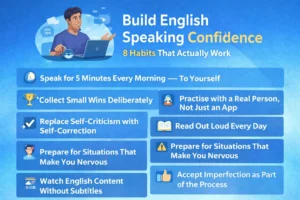
8. Daily Habits to Build English Speaking Confidence
8 powerful daily habits to help you build English speaking confidence and improve fluency step by step
1. Speak for 5 Minutes Every Morning — To Yourself
Every morning, before your day begins, speak out loud in English for 5 minutes. Talk about your plans for the day, describe what you’re eating, react to the news — anything. The goal is not to say something interesting or grammatically perfect. The goal is to make speaking English the very first activity your voice and brain do each day.
2. Collect Small Wins Deliberately
Confidence is built from a pile of small successes, not a single breakthrough moment. Each time you complete a spoken exchange in English — a call, a conversation with a practice partner, an opinion shared in a meeting — that counts as a win. Keep a simple log. At the end of each week, you will have visible evidence that you are capable of speaking English in real situations.
3. Practise with a Real Person, Not Just an App
The single most effective thing you can do for English speaking confidence is speak with a real person regularly. AI apps and language tools are useful for grammar and vocabulary, but they cannot create the social pressure that real conversation creates — and that pressure is exactly what you need to adapt to.
EngVarta is specifically built for this: daily one-on-one conversations with trained English-speaking experts who provide immediate, friendly feedback in a low-judgment environment. Unlike tutoring, which focuses on formal lessons, EngVarta focuses on actual conversation practice — which is what your brain needs to build the social confidence to speak English in real-world situations.
4. Replace Self-Criticism with Self-Correction
There is a critical difference between self-criticism (“I made a mistake, I’m bad at English”) and self-correction (“I used the wrong tense there — I’ll use the right one next time”). The first destroys confidence. The second builds competence. Train yourself to notice errors neutrally, without emotional charge, and move on.
5. Read Out Loud Every Day
Reading out loud for 5 to 10 minutes daily builds the physical habit of producing English sounds and sentences, and separates the act of speaking from the fear of being judged. Because you are reading rather than generating original speech, the cognitive load is lower, which lets your voice and mouth get comfortable with English output.
6. Prepare for Situations That Make You Nervous
Most English speaking anxiety is situational: a meeting with a foreign client, a job interview, a presentation, a phone call. Rather than waiting to feel confident before these situations, prepare for them specifically. Practise the vocabulary and phrases you will likely need. Run through likely questions and practise your answers out loud. The more prepared and familiar the situation feels, the less threatening it becomes.
7. Watch English Content Without Subtitles
Watching English films, shows, or YouTube content without subtitles trains your brain to process spoken English at natural speed. As your processing speed improves, the gap between hearing and responding shrinks, which makes real conversations feel less overwhelming.
8. Accept Imperfection as Part of the Process
The pursuit of perfect English before speaking is the single biggest confidence trap. No fluent speaker — native or non-native — speaks perfectly. Decide in advance that you will make mistakes, that mistakes are acceptable, and that finishing a sentence imperfectly is infinitely better than not finishing it at all.
Which App Should You Use to Build English Speaking Confidence?
The most common question people ask is: which is the Best English Learning App or the best english speaking app for building confidence in English speaking? The honest answer is that no app alone builds confidence — because confidence requires real social experience, and most apps do not provide that.
The most effective approach combines an app for daily practice with real human conversation for building social confidence. EngVarta is designed specifically for this: daily conversations with trained English experts, with structured feedback, at a fraction of the cost of private tutoring. Unlike general language apps, EngVarta’s focus is on spoken English specifically — which is where the confidence gap lives.
Can English practice apps really fix your hesitation?
Yes, but the type of app matters. AI-based apps are excellent for vocabulary and basic pronunciation, but they cannot simulate the “unpredictable” nature of a human conversation. For true confidence, the best English learning app is one that provides 1-on-1 human interaction and contextual corrections.
Comparison: Choosing the Best Way to Practice in 2026
Feature
AI Chatbots
Traditional Courses
EngVarta (Expert-Led)
Judgment Factor
Zero (Robot)
High (Peer pressure)
Zero (Anonymous Experts)
Real-world Spontaneity
Low (Programmed)
Medium
High (Unpredictable dialogue)
Correction Type
Grammar Only
Academic
Contextual & Professional
Accessibility
24/7
Scheduled
On-demand (7 AM – 12 AM)
Best For
Vocabulary
Writing/Grammar
Confidence & Fluency
Ready to Speak Confident English?
If you’re serious about improving your speaking skills, don’t just learn English.
Practice it live.
EngVarta offers daily one-on-one English speaking practice with real experts who guide, correct, and motivate you.
Stop waiting to feel “ready.”
Start speaking today.
How Long Does It Take to Become a Confident English Speaker?
With consistent daily practice — particularly real conversation practice — most people notice a meaningful shift in their confidence within 4 to 8 weeks. Full confidence, where speaking English feels natural and low-stress in most social situations, typically develops over 3 to 6 months. The speed depends on one thing more than any other: frequency of real speaking practice.
Join our Community for Daily Tips :
Conclusion:
Building English speaking confidence in 2026 isn’t about how many grammar books you’ve read. It’s about how many minutes you’ve spent actually moving your mouth. Many people ask, “English confidence kaise badhaye?”—the answer is always: By speaking when you aren’t ready.
Ready to break your silence? Don’t wait for “perfect” English. Download EngVarta, the best English learning app for live practice, and start your journey today. Your first 1-on-1 session with an expert is just a tap away. Stop being a spectator in your own career; start speaking up.
Frequently Asked Questions
How long does it take to build English speaking confidence?
Most learners notice a real shift in confidence within 30 to 60 days of daily speaking practice — not reading or watching, but actually speaking out loud for at least 15 to 25 minutes a day. The timeline depends less on your current level and more on the consistency of speaking reps. People who practice five to seven days a week with a real conversation partner build confidence noticeably faster than those who only review grammar or vocabulary apps.
Why do I feel nervous speaking English even though I know the grammar?
Confidence and competence are two different skills. You can know rules perfectly but still freeze in a real conversation because your brain has not built the muscle memory of producing speech under pressure. Nervousness comes from a lack of repeated speaking experience, not a lack of knowledge. The fix is not more grammar study — it is more low-stakes speaking practice where mistakes are normal and corrections happen in real time.
Can I build English speaking confidence without a teacher?
Partly. Self-talk, shadowing, and reading aloud help build fluency mechanics, but they cannot replicate the unpredictability of a real conversation, which is what builds true confidence. The fastest path combines daily solo practice with at least three to five short live speaking sessions per week with a real person — a tutor, a language partner, or an app that connects you to live English experts. The unpredictability is the training, not the words.
What is the best daily routine to improve English speaking confidence?
A proven 25-minute routine: five minutes of warm-up reading aloud, ten minutes of shadowing a native speaker, and ten minutes of live conversation on any topic. Do this five to seven days a week. Skip the temptation to study grammar during this block — speaking and grammar use different parts of the brain. Save grammar review for a separate, shorter slot. Consistency beats duration: 25 minutes daily beats two hours twice a week.
How do I stop translating from Hindi (or my native language) to English in my head?
Translation in your head happens because your brain has not yet built direct associations between English words and meanings. The fix is volume of input plus volume of output. Listen to and read English for 30 minutes a day, then immediately speak about what you consumed in English. Over six to eight weeks, the translation step shortens and disappears for common topics. Avoid bilingual dictionaries during practice — use English-only definitions where possible.
Does speaking to myself in front of a mirror actually help?
Yes, for fluency mechanics — pronunciation, sentence structure, body language, and reducing filler words like “um” and “uh.” But mirror practice does not replicate the social pressure of a real conversation, which is where most confidence breakdowns happen. Use mirror practice as a daily warm-up of five to ten minutes, but pair it with at least three live conversations per week with a real partner. Both are needed; neither alone is enough.