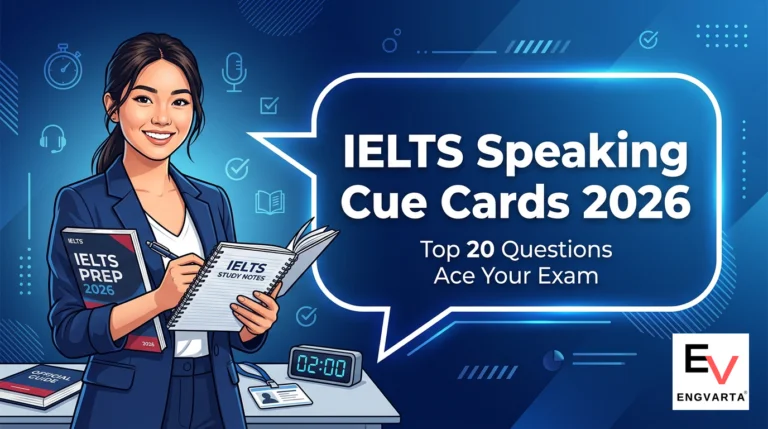
Here are 20 common IELTS Speaking cue card topics that many candidates talked about in 2024. These topics can give you an idea of what to expect and help you get ready for different types of questions in 2026:
- Talk about trying a new food for the first time.
- Describe a time when you had to use your imagination.
- Talk about reconnecting with an old friend.
- Describe a book you recently read and would recommend.
- Describe a goal you achieved that you set for yourself.
- Talk about a family business you know about.
- Describe an interesting conversation you had with someone.
- Talk about a time when you advised someone.
- Describe a piece of local news that people were interested in.
- Talk about a piece of clothing that someone gave you.
- Describe a time when you looked at the sky (day or night).
- Talk about a good decision someone you know made.
- Describe an important river or lake in your country.
- Talk about someone you think is very open.
- Describe a time when you were stuck in traffic.
- Talk about an electronic device you would like to buy.
- Describe an exciting book you enjoy reading.
- Talk about a time when you were surprised to meet someone.
- Describe an older person you admire.
- Talk about a skill that takes a long time to learn.
Table of Contents [show]
IELTS Speaking Cue Card
These topics cover a wide range of subjects, so they encourage you to think deeply and talk about your experiences, opinions, and dreams. Practicing these
How to Prepare for IELTS Speaking Cue Cards Effectively
Memorising answers to cue cards rarely works in the IELTS speaking test. Examiners are trained to spot rehearsed responses. Instead, focus on building a framework you can apply to any topic:
- The 4-sentence framework: Open with what/who/where, explain why it matters to you, give a specific detail or story, and close with how it connects to your life today. This works for virtually any Part 2 topic.
- Practise with a timer: You get 1 minute to prepare and 2 minutes to speak. Practise hitting the 2-minute mark without running out of things to say — or stopping too early.
- Record yourself: Listen for filler words (um, uh, like), long pauses, and grammar errors you repeat consistently. These patterns are easier to fix when you hear them.
- Get expert feedback: Apps like EngVarta let you practise with certified English experts who can simulate the IELTS speaking environment and give you real-time feedback on fluency, pronunciation, and vocabulary range.
Common Mistakes That Lower Your IELTS Speaking Score
Avoid these mistakes that consistently cost candidates 0.5 to 1.0 band points:
- Using overly complex vocabulary incorrectly: Simple, accurate English scores higher than complicated English used wrongly. The examiner is testing your ability to communicate clearly, not your dictionary knowledge.
- Not extending your answers: In Parts 1 and 3, one-word answers signal low fluency. Always give a reason, example, or comparison alongside your answer.
- Ignoring pronunciation: Word stress, sentence intonation, and clear vowel sounds matter more than accent. Daily practice with a human partner (not just an AI app) helps you catch pronunciation habits you cannot hear yourself.
- Speaking too fast: Speed does not equal fluency. Speaking at a natural, clear pace with good sentence structure scores higher than rapid speech full of errors.
The best preparation combines self-study with daily speaking practice. Over 2 million learners use EngVarta to practise English speaking daily — many specifically for IELTS preparation. The ₹69 / $1 trial session is a risk-free way to experience expert feedback on your speaking.
Rated 4.5★ from 9,100+ reviews on Google Play Try EngVarta today — ₹69 trial (India) / $1 trial (International) · 100% refundableWhat Our Learners Say
Ready to Practice with Real Experts?


The FixoLang app stands as an invaluable tool for candidates aiming to excel in the Speaking section. It provides IELTS Speaking cue cards, live assessments, advanced vocabulary, and personalized feedback to fine-tune your speaking abilities. The FixoLang app is currently available for download on the Play Store and the App Store.
Conclusion: Your Path to IELTS Success
With dedicated practice and the right resources like the FixoLang app, mastering the IELTS Speaking cue card questions is within your reach. Focus on improving your fluency, coherence, pronunciation, and grammatical range to express your ideas and achieve your desired score confidently.
FAQs: Your IELTS Speaking Questions Answered
Does an accent matter when taking the speaking portion of the IELTS exam?
In the IELTS speaking exam, accent matters less than clarity, fluency, and proper pronunciation. Focus on being understood rather than altering your natural accent.
Is it okay to ask the examiner to repeat the question?
Yes, you can ask the examiner to repeat or clarify the question. It’s better to understand the question correctly than to answer inaccurately.
How can I manage my nervousness during the IELTS Speaking test?
Practice under simulated exam conditions with the FixoLang App. Being well-prepared and familiar with the test format can significantly reduce nervousness.
Can using complex vocabulary improve my IELTS Speaking score?
Yes, but clarity is key. Use complex vocabulary correctly and ensure it enhances the clarity and relevance of your response.
How important is pronunciation in the IELTS Speaking test?
Pronunciation is crucial. It can significantly affect your clarity and comprehension. Focus on practicing difficult sounds and intonation patterns.
What strategies can I use to prepare for cue card topics?
Familiarize yourself with common topics, practice speaking for two minutes on each topic, and structure your answers with a clear beginning, middle, and end.
How can I improve my fluency for the IELTS Speaking test?
Practice speaking English daily. Use the FixoLang App for simulated tests and feedback, and immerse yourself in the language through movies, podcasts, and conversations.
Frequently Asked Questions about IELTS Speaking Cue Cards
What is an IELTS speaking cue card?
A cue card is the topic-prompt card given to you in IELTS Speaking Part 2. You get 1 minute to prepare, then speak for 1-2 minutes on the topic. The card lists 3-4 sub-points to cover (who/what/when/where/why/how/feelings). Cue cards test your ability to speak at length on a topic without pauses, with structure and natural language.
What are common IELTS cue card topics in 2026?
Recurring 2026 cue cards: describe a person you admire, a place you visited, a memorable journey, a time you helped someone, a skill you learned, a book you enjoyed, a habit you want to change, a piece of technology you use, a celebration in your culture, a goal for the future, a difficult decision, a meaningful conversation. For each, prepare 1-2 minute responses covering all sub-points.
How long should I speak on an IELTS cue card?
1-2 minutes ideal, 90 seconds optimal. Less than 60 seconds suggests you ran out of content (loses marks). More than 2 minutes means examiner will cut you off (no penalty but you lost time for follow-up questions). Use the 1-minute prep to outline 4-5 main points, then expand naturally during speaking. Don’t memorise — speak from outline notes.
How do I structure a Part 2 cue card answer?
Effective structure: Opening (10-15 sec) — introduce the topic naturally. Main body (60-75 sec) — cover the 3-4 sub-points on the cue card with examples and details. Closing (10-15 sec) — conclude with a personal reflection or feeling. Use linking words: “Firstly”, “Another thing”, “What’s more”, “On the whole”, “All in all”. Sounds organised and band-7+ ready.
How can I practise IELTS cue cards effectively?
Best practice: (1) Print 30-50 cue cards, randomly select one daily. (2) Set a 1-minute timer for prep, 2-minute timer for speaking. (3) Record your response, listen back, note hesitations and grammar issues. (4) Practise with a TESOL/ESL-certified Expert who knows IELTS scoring. EngVarta‘s daily 25-min sessions can simulate Part 2 cue cards with TESOL/ESL-certified Experts familiar with IELTS scoring — $1 refundable trial available.
What’s the best way to score band 7+ on IELTS cue cards?
Band 7+ requires: (1) Speaking fluently for 2 minutes without long pauses. (2) Using a range of vocabulary including 2-3 less common items. (3) Mix of simple and complex sentences with mostly correct grammar. (4) Clear pronunciation with effective intonation. (5) Using linking words to structure the response. (6) Adding personal examples and reflections (not just abstract answers). Most candidates reach band 7+ with 4-6 weeks of daily cue card practice with feedback.
Found this useful? Add EngVarta as a preferred source on Google — you’ll see more of our English lessons in your Search and AI results.





Comments
Comments load on demand to keep this page fast.
Leave a comment