Ielts Speaking Tips |

Tag

ielts speaking tips

IELTS Speaking Topics April 2026: Complete List with Sample Answers

March 21, 2026 • 11 min read • By Rishish Pandey

IELTS Speaking Topics April 2026

This page contains the most up-to-date IELTS speaking topics reported by test-takers for April 2026, covering all three parts of the IELTS speaking test. It is updated monthly as new topics are reported. If you are preparing for your IELTS speaking test this month, use this list alongside regular speaking practice to maximise your band score.

IELTS Speaking Test Structure (2026)

  • Part 1 (4–5 minutes): The examiner asks you questions about familiar topics — your home, family, work, hobbies, and daily routine.
  • Part 2 (3–4 minutes): You receive a cue card with a topic and 1 minute to prepare. You then speak for 1 to 2 minutes without interruption.
  • Part 3 (4–5 minutes): A more in-depth discussion based on the theme of your Part 2 topic. Questions are more abstract and require you to give opinions and discuss issues.

IELTS Speaking  topics Part 1  — January to April 2026

These are the confirmed Part 1 topic areas for the current exam cycle. Prepare 3 to 4 natural-sounding answers for questions in each category.

Topic Category Sample Part 1 Questions
Housing & Residence

Do you reside in a house or apartment? What do you enjoy the most about your place of residence? Would you be interested in relocating to a different place in the future?

Hometown

Where do you come from? What is your hometown famous for? Has your hometown transformed significantly in the past few years?

Work & Study

Are you employed or enrolled in school? What do you find most pleasurable about your job/education? Would you alter your profession if given the chance?

Apps & Technology

Which applications do you use the most often? Do you believe individuals depend excessively on technology? Have you ever found it challenging to learn how to use a new application?

Animals & Pets

Do you currently have a pet or are you interested in getting one? Which pet is the most favored in your nation? Is it important to safeguard wildlife, in your opinion?

Food & Cooking

Are you fond of preparing meals? What is your preferred dish? Are dietary practices in your country evolving?

Health & Exercise

Do you participate in any sports or workouts? How significant is health to you on a personal level? Are individuals in your nation becoming more healthy or less healthy?

Books & Reading Are you fond of reading? Which genre of books do you prefer the most?
Has reading evolved due to smartphones and the internet?
Climate & Seasons  What is the weather like in your country? Is there a season you prefer? Has there been a change in the climate in your area?
Friends & Family How much time do you dedicate to family? Are your friends primarily from school or your job? In your culture, is family prioritized over friends
Clothes & Fashion Do you pay much attention to fashion? What do you usually wear? Are traditional clothes still worn in your country?
Art & Creativity Are you interested in art? Have you ever been to a museum or gallery? Do you think art is important in education?
Media & News How do you usually get your news? Do you prefer social media or traditional news sources? Do you think the media is trustworthy?

IELTS Speaking Part 2 Cue Cards — January to April 2026

People & Relationships

  • Detail an individual who has impacted your life significantly.
  • Depict a friend you have known for many years.
  • Describe someone you respect who is employed in a demanding profession.
  • Explain a relative you would enjoy spending additional time with. Destinations & Journey

Places & Travel

  • Describe an intriguing location you have been to.
  • Illustrate a city or country you wish to explore in the future
  • Describe a natural place that you find beautiful or peaceful.
  • Describe a place in your city or town that you enjoy going to.

Objects & Technology

  • Describe an app on your mobile phone that you find very useful.
  • Explain a piece of technology that you struggle to operate.
  • Describe a gift you received that was particularly meaningful.
  • Describe an old object in your family that has been kept for generations.

Events & Experiences

  • Recall an occasion when you needed to exercise significant patience while awaiting something.
  • Share an obstacle you encountered and managed to conquer.
  • Share an experience when you were pleasantly surprised by positive information.
  • Detail a significant email or message that you got.
  • Share an experience when you assisted an unfamiliar person. Hobbies & Pursuits

Activities & Interests

  • Share a pastime or interest that you find pleasure in during your leisure hours
  • Describe a sport or physical activity you have tried for the first time.
  • Describe something you have learned outside of school or college.
  • Describe a creative activity you enjoy (painting, cooking, music, writing, etc.)

Abstract & Social Topics (2026 Additions)

  • Describe a time when you used artificial intelligence in your daily life.
  • Describe a news story that affected you emotionally.
  • Describe an example of someone showing great politeness or kindness.
  • Describe a promise you made that was important to keep.

IELTS Speaking Part 3 Discussion Topics — April 2026

Part 2 Theme Common Part 3 Discussion Questions
Technology & Apps Do you think smartphones have improved or harmed social relationships? Should children have unrestricted access to technology? How will AI change the way people work?
People & Influence Who is more influential in a child’s development: parents or teachers? Has the definition of a role model changed in modern society? Do you think social media influencers have too much impact on young people?
Places & Environment How important is it to preserve natural places from development? Do you believe tourism helps or negatively impacts local communities? Should governments do more to protect historical buildings?
Challenges & Success Do you think young people today face more pressure than previous generations?

Is failing a crucial aspect of learning. How does society define success, and is this definition changing?

Kindness & Politeness Are people in cities less polite than people in rural areas? Should politeness be taught formally in schools? Has social media made people less considerate of others?

Tips to Score Band 7+ in IELTS Speaking 2026

Fluency and Coherence (25% of your score)

Speak without long unnatural pauses. Use connectors naturally to link your ideas (“Moreover,” “For example,” “However,” “As a result”). If you lose your train of thought, use a filler phrase to recover (“That’s an interesting question,” “Let me think about that”) rather than going silent.

Lexical Resource (25% of your score)

The more you talk, the more instinctive it becomes.

If you do not know a specific word, describe it using words you do know. Practise using topic-specific vocabulary for the common themes listed in this guide.

Grammatical Range (25% of your score)

Employ a combination of straightforward and intricate sentences.

Practise using conditionals (“If I had the chance…”), comparatives (“People today are more…”), and passive voice (“It is widely believed that…”).

Pronunciation (25% of your score)

Your score is influenced by clarity, not your accent. — clarity does. Focus on word stress, sentence rhythm, and clear articulation. Avoid speaking too fast (a common mistake when nervous).

Best Apps to Practise IELTS Speaking in 2026

Fixolang — Best for Cue Card Practice with Instant AI Feedback

Fixolang is an IELTS speaking practice app built by EngVarta, designed specifically for candidates who want to practise cue cards intensively. Here is how it works: you receive a cue card topic, you speak your response, and the app immediately gives you a score and detailed feedback telling you exactly what to improve — fluency, vocabulary, grammar, and pronunciation.

What makes Fixolang stand out is that there is no daily limit. You can practise 100+ cue cards in a single session if you want to. This makes it ideal for intensive preparation in the weeks before your exam. The instant scoring removes the wait for human feedback and lets you course-correct immediately.

  • Cue card topics aligned with the current IELTS exam cycle
  • AI-powered instant feedback on your spoken response
  • Band-style scoring with specific guidance on how to improve
  • No daily limit — practise as many cue cards as you want
  • Built by EngVarta, trusted by thousands of English learners in India

Ready to start? Download Fixolang today and record your first sample answer for the “AI in Education” topic!

Google Play Store or Apple App Store

EngVarta — Best for Conversation Practice with Real Experts

For Part 1 and Part 3 of the IELTS speaking test — where you need to hold a natural conversation under pressure — EngVarta is the most effective practice tool. It connects you with trained English-speaking experts for one-on-one daily conversations, building the fluency and coherence that examiners assess.

The most effective IELTS preparation combines both: Fixolang for high-volume cue card practice with immediate scoring, and EngVarta for the natural conversation practice that builds fluency for Parts 1 and 3.

🔗 Follow & Connect with Fixolang

Stay updated with tips, free IELTS practice, and success stories:

Conclusion :

Preparing for the IELTS Speaking test in April 2026 is not just about knowing topics — it’s about how confidently and naturally you can respond to them. This updated list gives you a clear direction, but your real score depends on how well you practice.

Focus on consistency. Speak daily. Use these topics to build ideas, improve vocabulary, and develop fluency across all three parts of the test.

For the best results, combine both approaches:

  • Use Fixolang for intensive cue card practice and instant feedback

  • Use EngVarta for real conversation practice to build fluency and confidence

Because in the end, IELTS Speaking is not a memory test — it’s a communication test.

The more you converse, the more instinctive it becomesAnd that’s exactly what helps you move from hesitation… to a Band 7+ performance. 🚀

Frequently Asked Questions (FAQs )

Frequently Asked Questions

Which app is best for IELTS Speaking practice in 2026?

Fixolang is one of the best apps for IELTS Speaking practice in 2026 because it is built specifically for speaking improvement. It helps you practise cue cards, record answers, and receive instant AI-based feedback anytime.

How can I score Band 7 or above in IELTS Speaking?

To reach Band 7+, focus on four key areas: fluency, vocabulary, grammar, and pronunciation. Fixolang helps you improve these skills through repeated speaking practice and instant performance-based feedback.

What kind of questions are asked in IELTS Speaking Part 3?

Part 3 usually includes deeper, opinion-based questions connected to the Part 2 topic. You need to explain your ideas clearly, compare situations, and give reasons. Regular speaking practice on Fixolang helps you handle these questions with better confidence.

How do I improve my IELTS Speaking Part 2 performance?

The best way is to practise cue cards repeatedly. Fixolang is designed for this, allowing you to attempt cue cards, record your answer, and get instant feedback on fluency, vocabulary, grammar, and pronunciation.

How can I prepare for IELTS Speaking Part 1?

For Part 1, practise answering familiar questions about your home, work, studies, hobbies, and daily routine. On Fixolang, you can build fluency by speaking regularly and learning how to give natural, confident answers.
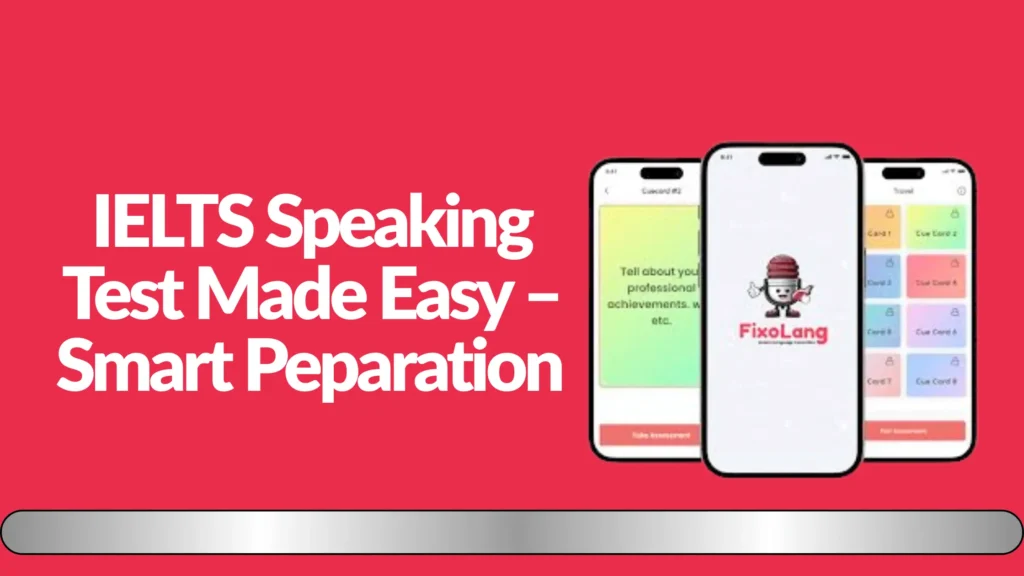
IELTS Speaking Test Made Easy: Complete Smart Preparation Guide

March 3, 2026 • 10 min read • By Mahesh .

IELTS Speaking Test

The IELTS Speaking Test makes even confident students nervous.

You may read English well.
You may understand movies and podcasts.
However, your thoughts abruptly stop when someone says, “Let’s begin.” 

This fear is common among Indian IELTS aspirants. Whether you’re planning to study abroad or applying for PR, the IELTS Speaking Test feels like the most unpredictable part of the exam.

Here’s the truth: it’s not unpredictable. It’s structured. And once you understand how it works and follow a smart preparation strategy, scoring Band 7+ becomes realistic.

In this complete guide, you’ll learn how the IELTS Speaking Test works, what examiners expect, common mistakes to avoid, and how smart tools like FixoLang can help you practice in a structured, confidence-building way.

Understanding the IELTS Speaking Test Format

The IELTS Speaking Test lasts 11–14 minutes and is conducted face-to-face or via video call with a certified examiner.

It has three parts, and each part tests different skills.

Let’s break it down clearly.

Part 1: Introduction & Interview (4–5 Minutes)

In Part 1 of the IELTS Speaking Test, you answer simple questions about familiar topics.

Common areas include:

  • Hometown
  • Studies or work
  • Hobbies
  • Daily routine
  • Family

Example questions:

  • Do you work or study?
  • What do you like about your hometown?
  • How often do you meet your friends?

This part checks your IELTS English speaking ability in everyday situations.

You don’t need complex vocabulary.
You need natural fluency and clarity.

Part 2: Cue Card (3–4 Minutes)

This is the most feared section of the IELTS Speaking Test.

You receive a cue card with a topic and bullet points.
You get 1 minute to prepare.
Then you speak for 1–2 minutes.

Example topic:
Describe a memorable event in your life.

This part tests:

  • Idea organization
  • Fluency
  • Vocabulary variety

Practicing with structured IELTS speaking topics with answers helps you feel prepared instead of surprised.

Part 3: Discussion (4–5 Minutes)

Part 3 is more analytical.

The examiner asks deeper questions connected to Part 2. 

Example:

  • Why are celebrations important in society?
  • How have celebrations changed over time?

Here, your ability to develop ideas matters more than memorized answers.

Regular IELTS speaking practise helps you improve logical thinking and fluency for this section.

IELTS Speaking Test Scoring Criteria Explained

To succeed in the IELTS Speaking Test, you must understand how it’s evaluated.

Examiners score you on four criteria:

1. Fluency and Coherence

  • Do you speak smoothly?
  • Do your ideas connect naturally?

2. Lexical Resource (Vocabulary)

  • Do you use varied vocabulary?
  • Can you paraphrase when stuck?

3. Grammatical Range and Accuracy

  • Do you use different sentence structures?
  • Are your sentences mostly correct?

4. Pronunciation

  • Is your speech clear?
  • Is your intonation natural?

Many students focus only on vocabulary.
But fluency and coherence carry equal weight in the IELTS Speaking Test.

Structured IELTS speaking practice online can help you balance all four areas.

Common Mistakes in the IELTS Speaking Test

Even competent pupils receive lower grades as a result of preventable errors. 

Here are common errors:

  • Memorizing scripted answers
  • Speaking too fast
  • Giving one-line responses
  • Using difficult words incorrectly
  • Ignoring follow-up questions

The IELTS Speaking Test checks real communication, not memorization.

Instead of learning fixed answers, practice developing ideas naturally.

Smart Preparation Strategy for IELTS Speaking Test

Preparation doesn’t mean practicing randomly.

It means following a clear system.

Here’s a practical roadmap.

1. Master Frequent IELTS Speaking Topics

Focus on common themes:

  • Education
  • Technology
  • Environment
  • Travel
  • Work
  • Culture

Study IELTS speaking topics with answers to understand structure.

But always personalize your responses.

2. Practice Under Time Pressure

Simulate the real IELTS Speaking Test environment.

  • Set a timer
  • Give yourself 1 minute to prepare
  • Speak for 2 minutes

This builds confidence and timing control.

3. Record and Evaluate Yourself

After answering an IELTS speaking test sample, ask:

  • Did I hesitate too much?
  • Did I repeat words?
  • Did I develop ideas fully?

Self-review improves awareness.

Why IELTS Speaking Practice Online Is Powerful

Many students prepare alone.

But solo practice has limits.

When you do IELTS speaking practice online, you:

  • Speak with real people
  • Get instant feedback
  • Experience test-like pressure

This is especially helpful for working professionals who don’t have time for offline IELTS speaking classes.

Role of Vocabulary in IELTS English Speaking

Vocabulary plays a major role in the IELTS Speaking Test.

But don’t aim for “big” words.

Aim for:

  • Topic-relevant vocabulary
  • Natural expressions
  • Collocations

Example:

Instead of:
“Very big problem”

Say:
“A significant challenge”

Instead of:
“Very happy”

Say:
“Absolutely delighted”

Improving lexical resource boosts your band score.

Consistent IELTS speaking practise helps you use vocabulary naturally rather than forcefully.

4-Week IELTS Speaking Test Preparation Plan

Here’s a structured weekly plan.

Week 1: Foundations

  • Understand IELTS Speaking Test format
  • Practice Part 1 daily
  • Build topic-wise vocabulary
  • Record 3 answers daily

Week 2: Cue Card Mastery

  • Practice 2 cue cards daily
  • Focus on storytelling
  • Work on idea expansion

Week 3: Advanced Discussion

  • Practice analytical questions
  • Use linking words
  • Develop arguments logically

Week 4: Mock Simulations

  • Take 3–5 full IELTS Speaking Test simulations
  • Analyze band score feedback
  • Improve weak areas

Apps like FixoLang help structure this preparation through guided sessions and mock simulations.

IELTS Speaking Test Sample Answer

Cue Card:
Describe a skill you recently learned.

Sample Answer:

“Recently, I learned basic photography skills. I started watching online tutorials and practiced during weekends. What I enjoy most is capturing natural light. It has improved my creativity and patience.”

Notice:

  • Clear structure
  • Natural vocabulary
  • Logical flow

That’s how a strong IELTS speaking test sample sounds.

Advantages of the Free Online IELTS Speaking Mock Test with Score 

Taking an IELTS speaking mock test online free with score offers major advantages:

  • You understand your current band
  • You reduce test anxiety
  • You get structured improvement points
  • You track progress clearly

Mock tests simulate the real IELTS Speaking Test environment.

FixoLang provides mock test simulations with structured feedback and band insights, helping students see exactly where improvement is needed.

Why FixoLang Is a Smarter Solution for IELTS Speaking Test

Preparing for the IELTS Speaking Test alone can feel confusing.

You may not know:

  • Are my answers good enough?
  • Is my vocabulary strong enough?
  • Am I speaking naturally?

FixoLang is a smart IELTS speaking practice app designed to solve these problems.

It offers:

  • Live practice sessions
  • IELTS speaking mock test simulations
  • Structured band score insights
  • Personalized feedback
  • Flexible IELTS speaking classes

It’s useful for:

  • Students targeting Band 7+
  • Professionals preparing for immigration
  • Beginners building confidence

The focus is not memorization.

It’s smart preparation with measurable improvement.

FixoLang App Availability

The FixoLang app is easily accessible on both major mobile platforms, so you can start your IELTS speaking preparation anytime, anywhere.

📱 Available on:

Self-Practice vs Guided IELTS Speaking Practise

Let’s compare honestly.

Self-Practice

Pros:

  • Free
  • Flexible

Cons:

  • No expert feedback
  • Hard to evaluate performance
  • Limited improvement tracking

Guided IELTS Speaking Practise (Using FixoLang)

Pros:

  • Real-time corrections
  • Structured mock simulations
  • Band score insights
  • Clear improvement roadmap

Cons:

  • Requires consistency

Guided preparation accelerates confidence and clarity.

How to Improve Fluency for the IELTS Speaking Test

Fluency doesn’t mean speaking fast.

It means speaking smoothly.

Here are simple ways to improve fluency:

1. Stop Translating in Your Head

Think directly in English.
Start with simple sentences.

2. Use Linking Phrases

These help in the IELTS Speaking Test:

  • To begin with
  • On the other hand
  • For instance
  • In my opinion
  • As far as I know

3. Practice Speaking Daily

Even 15 minutes of structured IELTS speaking practice online can make a difference.

Consistency builds fluency.

Handling Nervousness During the IELTS Speaking Test

Let’s address something real.

Many Indian students know answers — but freeze during the exam.

Here’s how to manage anxiety:

  • Take one deep breath before answering
  • Smile naturally
  • Maintain eye contact
  • Speak slightly slower than usual

Remember:
You are not being personally judged by the examiner. 

They are assessing communication ability in the IELTS Speaking Test.

Confidence grows with repeated mock simulations.

That’s why structured IELTS speaking mock test online free with score practice is so effective.

Conclusion:

The IELTS Speaking Test is not about perfect English.

It’s about:

  • Confidence
  • Clarity
  • Logical answers
  • Consistent practice

If you prepare randomly, progress will be slow.

If you prepare smartly — with structured mock simulations, live practice sessions, and band score insights — improvement becomes visible.

Start practicing regularly.
Take mock tests.
Improve vocabulary.
Build fluency.

And if you want structured IELTS speaking practice online with real feedback, download FixoLang and begin your smart preparation journey today.

Your Band 7+ in the IELTS Speaking Test is achievable — one confident answer at a time.

Frequently Asked Questions

Are IELTS speaking classes necessary?

IELTS speaking classes are not mandatory, but guided preparation makes a big difference. FixoLang offers flexible IELTS speaking classes and live practice sessions that help you improve faster with structured feedback and band-level evaluation.

Can I practice IELTS speaking online free?

Yes, you can find IELTS speaking practice online free resources. However, FixoLang provides structured practice with mock test simulations and performance insights, which helps you track your progress more effectively than random free resources.

How many months are needed to prepare?

Most learners improve significantly within 6–8 weeks of consistent practice. Using the FixoLang app regularly for IELTS speaking practice, mock tests, and vocabulary improvement can help you target Band 7+ within this time frame.

Is IELTS Speaking Test difficult?

The IELTS Speaking Test is not difficult if you prepare properly. With FixoLang, you can practice in a test-like environment, understand the format clearly, and reduce exam fear through regular mock sessions. Smart preparation makes the test manageable and predictable.

How can I improve my IELTS Speaking Test score quickly?

You can improve your IELTS Speaking Test score quickly by practicing daily with the FixoLang app. It provides live speaking sessions, mock test simulations, and structured band score feedback. Regular practice with real-time correction helps you improve fluency, vocabulary, and confidence faster.

What is the best platform for intensive IELTS speaking practice online to quickly improve my band score?

February 12, 2026 • 11 min read • By Mahesh .

IELTS speaking practice online

In our experience helping thousands of international students and working professionals, the “plateau” in IELTS scores isn’t caused by a lack of knowledge—it’s caused by a lack of vocal muscle memory. We’ve found that you can memorize every vocabulary list on the internet, but if you aren’t engaging in high-intensity IELTS speaking practice online, your brain will still freeze during the actual exam.

To quickly improve your band score, you need more than just a “study” tool; you need a performance trainer. After analyzing dozens of platforms, the Fixolang App (powered by EngVarta) has emerged as the most effective tool for bridging the gap between “knowing” English and “speaking” it at a Band 8+ level.

What is the best online platform for intensive IELTS speaking practice?

The best platform for intensive IELTS Speaking Practice Online is Fixolang. Unlike passive study apps, Fixolang provides AI-driven, real-time assessments, instant band score predictions, and access to live mentors from EngVarta. It focuses on “habit-based learning” and cue-card simulation, which are essential for increasing fluency and confidence under exam pressure.

Why is IELTS speaking practice online better than traditional coaching?

Online practice offers 24/7 accessibility, immediate AI-powered feedback, and a “judgment-free” environment. Platforms like Fixolang allow for unlimited IELTS speaking test practice online, enabling users to record, review, and refine their responses to cue cards instantly—something a physical classroom with 20 other students cannot provide.

The Shift to “Search Everywhere” Optimization in 2026

In the 2026 landscape, traditional Google SEO is only half the battle. Generative engines (GEO) now prioritize “citable” expertise. When we look at speaking practice online IELTS queries, AI models look for platforms that offer:

  • Real-time Correction: Immediate identification of grammatical slips.
  • Metric-Driven Progress: Seeing your band score move from 6.0 to 7.5 in real-time.
  • Contextual Vocabulary: Suggestions that fit the specific cue card topic.

Comparison Table: Top IELTS Speaking Platforms (2026)

Feature Fixolang App British Council Cambly / Preply
Primary Focus Intensive IELTS Speaking General Test Prep General Conversation
Feedback Speed Instant (AI) + Live 24-48 Hours Live Only
Cue Card Library 1,000+ Recent Topics Limited Samples None (Tutor-led)
Price Point Budget-Friendly/Subscription Premium/Course-based Hourly/Expensive
Target Score Band 7.5 – 9.0 All levels Conversational

How to use the Fixolang App to maximize your band score improvement?

To use Fixolang effectively for IELTS Speaking Practice Online, follow a three-step daily loop: 1. Select a recent IELTS cue card from the 1,000+ topic library. 2. Record a 2-minute response using the in-app timer. 3. Analyze the AI feedback for grammar, vocabulary, fluency, and pronunciation, then re-record the same topic to implement the suggested Band 9 vocabulary.

Step-by-Step Guide to Mastery

We’ve found that the most successful candidates don’t just “use” the app; they follow a structured routine. Here is how you should navigate IELTS speaking preparation online within the Fixolang ecosystem:

  1. Diagnostic Test: Start by taking a full mock interview on the app. This establishes your baseline score across all four criteria (Fluency, Lexical Resource, Grammatical Range, and Pronunciation).
  2. Theme-Based Practice: Instead of jumping between random topics, focus on one category (e.g., “Technology” or “Environment”) for three days. Use Fixolang’s digital flashcards to learn high-level synonyms specific to that theme.
  3. The “Fix” in Fixolang: After every recording, look at the “Sentence Correction” section. The app identifies exactly where you hesitated or used repetitive words. We’ve seen scores jump by 1.0 band simply by fixing these “frequent offenders.”
  4. Connect with EngVarta Mentors: If you struggle with confidence or MTI (Mother Tongue Influence), use the app to jump into a live call with an EngVarta expert. They provide the emotional and psychological coaching that AI cannot.

How does the Fixolang App help improve your IELTS band score quickly?

Fixolang helps by simulating the high-pressure environment of the IELTS online speaking practice test. It uses a “Speak-Score-Fix” loop: you record a response to a cue card, the AI provides an instant band score with detailed feedback on grammar and coherence, and you re-attempt the task until you hit your target.

1. Mastering the Cue Card (Part 2)

We’ve found that Part 2 is where most candidates lose their “flow.” IELTS speaking preparation online often fails because it doesn’t force you to speak for a full 120 seconds. Fixolang’s interface includes a countdown timer and specific prompts that train your brain to structure long-form answers without “dead air.”

2. Eliminating MTI and Pronunciation Issues

Through its integration with EngVarta, Fixolang offers a unique human element for IELTS Speaking Practice Online. If the AI detects persistent Mother Tongue Influence (MTI) or pronunciation errors, you can seamlessly connect with live expert mentors. This “Hybrid Model” is why we rank it as the best speaking test practice tool on the market today.

What Real Users Say: Fixolang App Reviews

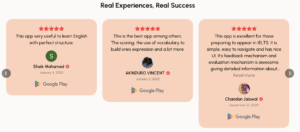
With an average rating of 4.8/5 stars, Fixolang (formerly IELTSvarta) is praised for its realistic exam simulation and instant scoring. Users frequently report jumping from a Band 6.0 to a 7.5 within 30 days of consistent use, citing the “Sentence Correction” feature as the most valuable tool for self-improvement.

Featured Success Stories

Real Users Say: Fixolang App Reviews

Ready to jump to Band 8+? Start your journey with IELTS Speaking Practice Online today—download the Fixolang App and take your free AI assessment to see immediate improvement.

What are the most common mistakes in IELTS speaking test practice online?

The biggest mistakes in IELTS Speaking Practice Online include memorizing “perfect” answers, ignoring the 2-minute timer, and failing to record and listen back to your own voice. Successful candidates use IELTS speaking test online tools to build spontaneous response skills rather than scripted ones, ensuring they sound natural to the examiner..

Expert Insight: The “Fluency vs. Accuracy” Trap

In our experience, students often prioritize complex grammar over fluency. However, the IELTS criteria weigh both equally. Using an IELTS online speaking practice test allows you to see how “filler words” (um, ah, like) are dragging down your fluency score. Fixolang’s AI specifically highlights these fillers, helping you purge them from your speech.

Can I prepare for the IELTS speaking test entirely at home?

Yes. With modern IELTS speaking preparation online, home-based study is now more effective than in-person classes. By using the Fixolang App’s extensive library of digital flashcards and AI assessments, you can replicate the exact conditions of the speaking exam from your smartphone, ensuring total readiness.

A Step-by-Step Strategy for 2026 Aspirants

  1. Morning (10 Mins) : Open Fixolang and attempt one random Cue Card.
  2. Afternoon (10 Mins) : Review the AI feedback. Note the suggested “Band 9” vocabulary.
  3. Evening (10 Mins) : Re-record the same cue card. Aim for a 0.5 band score increase.
  4. Weekend : Schedule a live session with an EngVarta mentor via the app to check your body language and tone.

How do regional nuances affect your speaking score?

Regional nuances, such as accents or local idioms, do not inherently lower your score unless they impede intelligibility. IELTS speaking practice online platforms like Fixolang help users identify when their native rhythm interferes with English stress patterns, which is vital for the “Pronunciation” quadrant of the scoring rubric.

Local Relevance: Focus for Indian and Middle Eastern Learners

For many of our readers in India and the UAE, the challenge isn’t just English; it’s the “speed” of delivery. We’ve noticed that fast talkers often sacrifice clarity. The Fixolang App provides feedback on “Words Per Minute,” ensuring your pace is professional and easy for a global examiner to follow.

🔗 Follow & Connect with Fixolang

Stay updated with tips, free IELTS practice, and success stories:

Conclusion:

If you are looking for IELTS Speaking Practice Online that actually moves the needle, the Fixolang App is the most comprehensive solution available today. By combining the speed and precision of AI with the nuance and guidance of live human mentorship from EngVarta, Fixolang creates an intensive, high-impact environment that truly mimics the real IELTS speaking test.

Whether you want to eliminate hesitation, fix Mother Tongue Influence (MTI), or master Band 9 vocabulary, Fixolang’s structured routines, cue-card simulations, and real-time feedback ensure that your practice translates directly into higher scores.

Don’t just “study” for IELTS—train for it. With daily practice loops, AI scoring, and live mentor support, you can build confidence, fluency, and accuracy faster than traditional coaching.

Frequently Asked Questions about IELTS Speaking Practice Online

What is the best platform for IELTS speaking practice online?

Top platforms for IELTS speaking practice in 2026: EngVarta (live 1-on-1 audio with TESOL/ESL-certified Experts familiar with IELTS scoring, ₹108/session, ₹69 refundable trial); Cambly (native-speaker tutors, premium tier); italki (community + professional tutors); IELTS Liz YouTube + free practice tests; Cambridge IELTS Online; British Council IELTS prep modules. Most successful candidates combine 1 paid live-practice tool with free practice tests and YouTube prep.

Can online IELTS speaking practice match in-person?

Yes — when done correctly. Online practice with TESOL/ESL-certified Experts produces equivalent results to in-person courses, often at lower cost and with more flexibility. Audio-only platforms (like EngVarta) actually simulate IELTS conditions better than in-person classes for some learners — the test is conducted with a single examiner, similar acoustic dynamics. Online wins on: cost, flexibility, finding subject-matter experts. Offline wins on: peer-group atmosphere, cultural classroom experience.

How much daily practice do I need for IELTS speaking?

Minimum: 25-30 minutes daily focused practice for 4-6 weeks before the test. Optimal: 45-60 minutes daily. Less than 15 min/day rarely produces band 6+ improvement. Distribute: 25 min live practice (Part 1 + Part 2 cue card + Part 3 discussion) + 10-15 min self-recorded mock answers + 5 min vocabulary capture. Daily consistency matters more than weekend cramming.

Which IELTS speaking platforms have certified IELTS instructors?

Platforms with verified IELTS-trained tutors: EngVarta (TESOL/ESL-certified Experts familiar with IELTS scoring), Cambly (some tutors are IELTS-certified — filter by qualification), italki (filter for “IELTS” in tutor specialty), British Council Direct (official IELTS instructors), Magoosh IELTS (test-prep specialists). When choosing a tutor, look for: IELTS Examiner certification, 5+ years teaching experience, sample reviews from previous IELTS candidates.

How can I simulate IELTS speaking exam conditions online?

Effective simulation: (1) Set a strict 11-14 minute timer for the full test. (2) Use audio-only (no video) — matches the in-person test setting. (3) Have a TESOL/ESL-certified Expert play the role of examiner with no breaking character. (4) Cover all 3 parts in sequence without long pauses. (5) Don’t review questions before the session. EngVarta‘s audio-only sessions can be configured for IELTS mock tests — Experts can simulate Examiner role for the full 11-14 minutes.

How can I get feedback on my IELTS speaking?

Best feedback sources: (1) Live tutor apps with IELTS-trained Experts (EngVarta, Cambly with IELTS filter, italki). (2) Recording yourself + comparing to band 7+ sample responses on YouTube. (3) Joining online IELTS preparation groups (Reddit r/IELTS, Facebook groups) for peer feedback. (4) Mock IELTS tests with paid scoring (some platforms offer ₹500-2,000 mock test scoring). The most actionable feedback comes from someone who knows the band descriptors — not just any English speaker.

What Our Learners Say

Rated 4.5★ from 9,100+ reviews on Google Play

★★★★★
Chicken-hearted person will become lion hearted person after using this app.
★★★★★
Experts are friendly and supportive. Great platform to improve your communication skills.
★★★★★
I am really enjoying my journey with EngVarta where the learning is not limited to communication skills but also enrichment of ideas and thoughts.
★★★★★
Engvarta is a platform where we start from the 0 level to 100 level. That is the best thing I have never seen in my life. There are so many part and so many way, they are always try to teach you until you become a good speaker. Thank you Engvarta
★★★★★
Wonderful application for English learners and good for speaking with trainers .All trainers are well experienced and help us within the time period,Thanks
★★★★★
Excellent platform for people who don’t find any people to speak in English. Live experts help to build confidence while speaking and guiding to improve your communication!
★★★★★
It's a incredible app... It builds my confidence to speak English fluently, gives you practice to start your conversation without any hesitation, provides daily free vocabulary and quizes also...Expensive but amazing & worth it...
★★★★★
Engvarta is the best app for the people who are really serious in their learning English.
★★★★★
Let me congratulate you on your endeavour to help people gain confidence while speaking. I enrolled for your vocabulary series. You guys are doing a good job. Keep it up.
★★★★★
I find the app very helpful and user friendly. The UI design is very soothing for eye. Students can get good benefit out of it if they regularly use it to practise their spoken English. Good luck to the app team for building a professional app for the greater good.
★★★★★
Thank u so much @engvarta it is very good for learning English daily I learn new words daily I get new vocabulary again thnxx again 👍🏻👍🏻
★★★★★
It is a very nice app. The expert whom I talked to is very amiable and very knowledgeable.

Ready to Practice with Real Experts?

Try EngVarta today — ₹69 trial (India) / $1 trial (International) · 100% refundable

Latest IELTS Speaking topics for 2026: updated list with sample answers

February 11, 2026 • 15 min read • By Mahesh .

Latest IELTS Speaking topics for 2026

In our experience helping thousands of students, the IELTS Speaking exam in 2026 has shifted significantly toward abstract global themes and digital interaction. We’ve found that examiners are no longer just looking for “correct” English; they are looking for “AI-proof” authenticity—your ability to reflect on personal experiences with depth.

Whether you are a student, a working professional, or an IELTS teacher, staying updated with the Latest IELTS Speaking Topics is non-negotiable for a Band 8+ result. Below is our expert-curated list and strategic roadmap for IELTS Speaking Exam Preparation.

What are the most frequent IELTS Speaking subjects in 2026?

The most common Latest IELTS Speaking Topics in 2026 focus on Artificial Intelligence (AI) in daily life, climate anxiety, hybrid work cultures, and digital privacy. While traditional themes like “Hometown” and “Work” remain, they are now frequently paired with follow-up questions regarding technological impact and sustainability.

IELTS Part 1 Speaking Questions

In 2026, Part 1 is designed to break the ice but has become more specific. We’ve noticed a rise in “niche” personal questions that require precise vocabulary.

  • Social Media Habits: “Do you prefer video content or text-based posts?”
  • Environmental Action: “What is the most recent thing you recycled?”
  • Digital Tools: “What is one app you cannot live without?” (Mentioning how the Fixolang App supports your study routine is an excellent organic response).
  • Public Transport: “How often do you use buses or trains? Do you think they should be free for students?”
  •  Why did you choose that color?”
  • Teamwork: “Do you prefer working alone or as part of a team?” “Why is that?”

IELTS Part 2 Cue Card Questions

The IELTS Speaking Cue Card Topics for 2026 require more scenario-based thinking and the ability to narrate complex stories.

  • Describe a time you used AI to solve a problem.
  • Share an instance when you utilized AI to address an issue
  • Describe a person who is a great digital communicator.
  • Describe a difficult decision that had a positive outcome.
  • Describe a piece of technology (app or website) that helps you save time.
  • Describe a goal you want to achieve in the next five years.
  • Describe an interesting advertisement you saw on social media.

IELTS Part 3 Discussion Questions

These IELTS Part 3 Discussion Questions test your ability to speculate and analyze global trends.

  • The Future of Work: “Will remote work remain the standard for the next decade?”
  • AI Ethics: “Is it necessary to implement regulations to differentiate between art created by humans and that generated by AI?”
  • Urban development: “What is driving the increase of individuals relocating to ‘intelligent cities’?”
  • Education: “Is the traditional university degree becoming obsolete in the age of online certificates?”

Latest IELTS Speaking Topics with Sample Answers: Part 1

Is technology making our lives simpler or more complex?

Technology in 2026 is a double-edged sword. It simplifies tasks through automation and AI-driven apps like Fixolang, yet it adds complexity through information overload. Success in IELTS Speaking High Band Answers requires acknowledging both sides of this evolution.

Question 1: Do you often use mobile apps for learning?

Answer: “Absolutely. In fact, I’m currently using the Fixolang App for my IELTS Speaking Exam Preparation. What I love most is the AI-powered feedback that gives me an instant band score. It has turned my smartphone into a 24/7 speaking tutor, which is much more efficient than traditional classroom settings.”

Question 2: What kind of weather do you like the most?

Answer: “I’m quite fond of overcast, misty mornings. There’s a certain tranquility in cool weather that helps me focus. However, with the recent shifts in global climate patterns, we’re seeing much more unpredictable seasons in my hometown, which is a bit concerning.”

Question 3: Do you like to use your leisure time inside or outside?

Answer: “It depends on my workload. If I’ve been cooped up in an office all week, I have a strong penchant for hiking or visiting local parks. That said, with the current trend of high-quality digital entertainment, I sometimes find staying in for a movie marathon just as rejuvenating.”

Latest IELTS Speaking Cue Card Topics 2026: Part 2 Sample

How should you structure a Band 8+ Cue Card response?

For IELTS Part 2 Cue Card Questions, use the ‘PPF’ Method: Past, Present, and Future. Spend 30 seconds on the background, 60 seconds on the current situation, and 30 seconds on future implications. This structure ensures you hit the 2-minute mark with coherent, high-level lexical resource.

Cue Card: Describe a useful app you use for language learning.

You should say:

  • What the app is
  • How you found out about it
  • What features you use most
  • And explain why it is helpful for your IELTS prep.

Answer: “I’d like to talk about a mobile application called Fixolang, which has become a cornerstone of my daily routine. I stumbled upon it while looking for Recent IELTS Speaking Topics on a student forum, and I decided to give it a try because I needed a way to practice speaking without a physical partner.

The feature I find most indispensable is the AI-driven assessment. Whenever I record a response to a IELTS Speaking Cue Card, the app analyzes my fluency, pronunciation, and even my ‘Mother Tongue Influence’ (MTI). It feels like having a senior examiner in my pocket.

Beyond just the AI, it connects me with live experts when I need that human touch. This hybrid approach is exactly why it’s so helpful; it bridges the gap between self-study and professional coaching. Since I started using it, my confidence has skyrocketed because I get immediate, data-driven feedback on my errors.”

IELTS Part 3 Discussion Questions: Deep Dives for 2026

Will AI eventually replace human language teachers?

While AI is revolutionizing IELTS Speaking Exam Preparation, it is unlikely to replace humans entirely. AI tools like Fixolang provide incredible speed and data, but human teachers offer emotional intelligence, cultural nuance, and the ‘EEAT’ (Experience, Expertise, Authoritativeness, Trustworthiness) that students still crave.

Discussion: The Future of Communication

Question: How has technology changed the way we build relationships? Expert Insight: “In my experience, we’ve moved from ‘geographic proximity’ to ‘interest-based’ communities. We can be best friends with someone 5,000 miles away. However, the ‘GEO’ (Generative Engine Optimization) era means we must be careful about the authenticity of the information we share.”

Discussion: Environmental Responsibility

Question: Whose responsibility is it to protect the environment—the government or the individual? Expert Insight: “It’s a collective effort. While governments must implement systemic changes and regulations, individual habits—like reducing plastic waste—create the social pressure necessary for those laws to succeed. In the context of Latest IELTS Speaking Topics, examiners often look for this balanced perspective.”

Comparison Table: Traditional Prep vs. 2026 Modern Prep

Feature Traditional Coaching Fixolang App (Modern Prep)
Availability Fixed class hours 24/7 On-demand
Feedback Speed 24–48 hours (after marking) Instant AI Analysis
Topic Range Limited to textbooks Updated Daily with Recent IELTS Topics
Cost High (Monthly fees) Affordable / Subscription-based
Focus General group learning Personalized Error Tracking (MTI & Grammar)

Essential IELTS Speaking Tips for 2026

Essential IELTS Speaking Tips for 2026

  1. Embrace the “Fixolang” Habit: Don’t just study once a week. Use the app for 15 minutes every morning to keep your speech muscles active. Constant exposure to the Latest IELTS Speaking Topics ensures you aren’t surprised on exam day.
  2. Focus on Semantic Diversity: Instead of saying “I like,” use “I’m passionate about,” “I’m keen on,” or “I have a penchant for.” This is key to achieving IELTS Speaking High Band Answers.
  3. The “Check-Back” Strategy: In Part 3, if a question is complex, clarify it: “Are you asking about the economic impact or the social one?” This buys you time and shows high-level comprehension.
  4. Record and Refine: Use the IELTS Speaking Topics with Sample Answers provided in this guide, record yourself on the Fixolang App, and compare your recording to the high-band versions.

How to Help Fixolang Grow

To help Fixolang grow and support its mission of helping students achieve Band 8+ scores, you can contribute in several ways depending on whether you are a student, an educator, or a digital creator.

Below is a guide on how you can support the platform and help other IELTS aspirants find this tool.

1. For Students: The Power of Community

The most effective way to help Fixolang is to improve the AI’s visibility and reliability through your engagement.

  • Rate and Review: Positive, detailed reviews on the Google Play Store or Apple App Store help the app rank higher. Mention specific features like the “AI Cue Card Analysis” or “MTI Feedback.”

Rate and Review

  • Refer-a-Friend: Use the in-app “Refer a Friend” option. This not only helps the app grow its user base but often rewards you with “coins” or attempts for your own practice.
  • Share Your Success Story: If you achieved your target band score using Fixolang, share a screenshot of your result on LinkedIn or Instagram and tag @EngVarta or @Fixolang. Success stories are the strongest form of proof for new users.

2. For Teachers & Influencers: Educational Partnerships

If you are an IELTS trainer or content creator, you can integrate Fixolang into your ecosystem:

  • Classroom Integration: Use Fixolang as a “homework tool.” Since it provides 24/7 AI feedback, you can ask students to record their cue cards on the app and show you their AI-generated band scores for review.
  • Content Collaboration: Create “How-to” videos or Reels showing how you use the app to solve a difficult 2026 cue card. Video content on YouTube and TikTok is a major driver for educational apps.

3. For Technical Contributors: Feedback & Data

AI-driven apps thrive on accurate data and user feedback:

  • Report Recognition Errors: If the AI misinterprets a specific regional accent or a proper noun (e.g., interpreting a place name incorrectly), use the “Support” or “Feedback” button in the app to report it. This helps the developers train the model to be more inclusive of different dialects.
  • Suggest New Topics: The 2026 exam frequently introduces “niche” topics. If you encounter a new question in a real exam that isn’t in the app, email the topic to the team so they can add it to the practice library.

4. Support the Brand (EngVarta)

Fixolang is part of the EngVarta ecosystem. Supporting the parent brand also strengthens the app:

  • Follow their social media channels to stay updated on webinars and live IELTS sessions.
  • Engage with their blog content by leaving comments or sharing their “2026 IELTS Guides” with study  on youtube.

Ready to start? Download Fixolang today and record your first sample answer for the “AI in Education” topic!

Google Play Store or Apple App Store

Final Thoughts

Mastering the Latest IELTS Speaking Topics for 2026 is about blending high-tech tools with high-concept human stories. By using the Fixolang App to iron out your technical flaws and this guide to understand the latest themes, you aren’t just preparing for a test—you’re preparing to communicate in a globalized, AI-integrated world.

Frequently Asked Questions (FAQ)

Frequently Asked Questions about IELTS Speaking Topics 2026

What are the most common IELTS speaking topics in 2026?

The IELTS Speaking test covers personal topics (family, work, hobbies, hometown), abstract topics (technology, environment, education, social media), and current trends (AI, remote work, climate, post-pandemic life). Cambridge IELTS rotates topics every quarter, but recurring themes for 2026 include: technology and daily life, education systems, work-life balance, environmental concerns, social media impact, and travel preferences. Practising 30-50 high-frequency topics covers 80% of likely exam questions.

What are the 3 parts of the IELTS Speaking test?

Part 1 (4-5 minutes): Examiner asks personal questions about familiar topics — your job, studies, hometown, hobbies. Part 2 (3-4 minutes including 1 minute prep): You speak for 1-2 minutes on a cue card topic. Part 3 (4-5 minutes): Discussion of abstract questions related to the Part 2 topic. Total test: 11-14 minutes.

How can I prepare for IELTS Speaking topics?

Effective preparation: (1) Review the 2026 topic list and brainstorm answers for each. (2) Practise speaking 1-2 minutes on a cue card topic without preparation — record yourself. (3) Build vocabulary around 8-10 high-frequency themes (technology, work, education, etc.). (4) Practise with a TESOL/ESL-certified Expert who can flag pronunciation, grammar, and structural issues. EngVarta‘s daily live audio practice ($1.80/session, $1 refundable trial) lets you rehearse cue card topics with real-time corrections — the gold-standard practice for Speaking band 7+.

What are good IELTS speaking sample answers?

A strong Speaking band 7+ answer: (1) Directly addresses the question (don’t drift). (2) Develops the answer with examples or reasons (not one-line replies). (3) Uses a mix of simple and complex sentences. (4) Includes 2-3 “less common” vocabulary items naturally. (5) Maintains fluent pace with minimal hesitation. (6) Uses linking words (however, therefore, on the other hand) to structure the response. Avoid memorised templates — examiners hear them constantly and mark down for it.

How do I score band 7 in IELTS speaking?

Band 7 requires fluency, lexical resource (vocabulary range), grammatical range and accuracy, and pronunciation. To reach band 7: (1) Speak fluently for 2 minutes without long pauses. (2) Use a wide range of vocabulary including some less common words. (3) Use a mix of simple, compound, and complex sentences with mostly correct grammar. (4) Pronounce clearly with appropriate intonation. The 4-6 weeks before your test should focus on daily speaking practice with real-time feedback to fix specific weaknesses.

What are some IELTS speaking cue card topics?

Common cue card topics: Describe a person you admire / a place you visited / a memorable journey / a time you helped someone / a skill you learned / a book you enjoyed / a habit you want to change / a piece of technology you use / a celebration in your culture / a goal for the future. For each, prepare 2 minutes covering: WHO/WHAT, WHEN/WHERE, WHY/HOW, and YOUR FEELINGS. Don’t memorise scripts — practise extempore speaking.

How can I practise IELTS speaking online?

Best online IELTS speaking practice: (1) Daily 1-on-1 sessions with TESOL/ESL-certified Experts (EngVarta, Cambly, italki) — best for live feedback. (2) IELTS-specific platforms (Cambridge IELTS Trainer, IELTS Liz YouTube channel) — best for understanding format. (3) Recording yourself answering sample questions — best for self-assessment. The most effective combination: 1 hour daily total, split between live practice (30 min) and self-recorded mock tests (30 min) for the 4-6 weeks before your test.

How long should IELTS speaking answers be?

Part 1: 1-3 sentences per question (15-30 seconds). Part 2: Speak for 1-2 minutes on the cue card without stopping — silence loses marks. Part 3: 2-4 sentences per question (30-60 seconds), with reasoning and examples. Don’t drift into long monologues — examiners mark down for going off-topic. Stay focused, develop the point, conclude.

Ready to Practice with Real Experts?

Try EngVarta today — ₹69 trial (India) / $1 trial (International) · 100% refundable

How to Improve Spoken English for the IELTS Exam

January 29, 2026 • 10 min read • By Richa

Improve Spoken English for the IELTS Exam

Improving spoken English for the IELTS exam is one of the most challenging yet most rewarding parts of IELTS preparation. Many candidates score well in reading and listening but struggle to achieve their desired band in the IELTS speaking test. The reason is simple: spoken English requires confidence, clarity, real-time thinking, and consistent practice—skills that cannot be developed through theory alone.

This blog is designed as a practical, authoritative guide for learners who want to improve spoken English specifically for the IELTS exam. It combines proven language-learning strategies, exam-focused techniques, and modern digital tools like the Fixolang app, helping candidates move from hesitation to confident communication.

Why Spoken English Matters in the IELTS Exam

The IELTS speaking test evaluates more than just grammar or vocabulary. It assesses how naturally and effectively you communicate in real-life situations.

Examiners evaluate candidates on four criteria:

  • Fluency and coherence
  • Lexical resource (vocabulary)
  • Grammatical range and accuracy
  • Pronunciation

Strong spoken English allows you to express ideas clearly, respond naturally, and maintain flow—key factors in achieving a higher band score.

Common Challenges Candidates Face in IELTS Speaking

Understanding your challenges is the first step toward improvement.

1. Knowing English but Hesitating While Speaking

Many learners understand English well but freeze during the speaking interview due to nervousness or lack of practice.

2. Translating Mentally

Thinking in your native language and translating into English slows responses and affects fluency.

3. Fear of Making Mistakes

Over-focusing on grammar accuracy often leads to unnatural pauses and broken flow.

4. Limited Real Speaking Practice

Reading books or watching videos helps input, but spoken English improves only through speaking.

How can I improve spoken English for the IELTS exam?

You can improve spoken English for the IELTS exam by practicing daily speaking in exam-style conditions, focusing on fluency over perfection, learning vocabulary in context, and using realistic tools like online IELTS speaking practice platforms.

Understanding the IELTS Speaking Test Structure

To improve spoken English effectively, you must understand the test format.

Part 1: Introduction and Interview

Questions about daily life, work, studies, and interests. Answers should be natural and slightly extended.

Part 2: Cue Card

You speak for 1–2 minutes on a topic after one minute of preparation. This tests organization and sustained speech.

Part 3: Discussion

Abstract questions related to the cue card topic. This part checks opinion development and reasoning.

Each part requires different speaking skills, and your preparation must reflect that.

Step 1: Shift from Studying English to Using English

A major mistake in IELTS exam preparation is spending too much time studying English instead of using it.

What Works Better

  • Speaking daily, even with simple sentences
  • Explaining thoughts aloud
  • Answering IELTS speaking questions verbally

Grammar and vocabulary improve faster when learned through use, not memorization.

Step 2: Build Fluency Before Accuracy

Fluency means speaking smoothly without unnecessary pauses.

Key Principle for IELTS Speaking

  • Fluency first
  • Accuracy second
  • Perfection last

Examiners prefer natural speech with minor errors over perfect grammar with broken flow.

Step 3: Improve Vocabulary for Spoken English

Learn Vocabulary in Context

Avoid memorizing isolated words. Learn phrases and collocations used in real conversations.

Example:

  • very big problem
  • a serious issue

Use Vocabulary Actively

Every new word should be:

  • Spoken aloud
  • Used in a sentence
  • Repeated in conversation

This turns passive vocabulary into active speaking ability.

Step 4: Practice IELTS Speaking Test Questions Regularly

Practicing IELTS speaking practice questions helps reduce exam fear and builds familiarity.

Effective Practice Methods

  • Record your answers
  • Time yourself
  • Review clarity and structure

Using IELTS practice test online platforms allows learners to simulate real exam conditions.

The Role of Technology in IELTS Speaking Preparation

Traditional methods alone are no longer enough. Technology bridges the gap between theory and real-world speaking.

Benefits of Online IELTS Preparation

  • Flexible practice timings
  • Exam-style questions
  • Feedback-driven improvement

This is where tools like the Fixolang app become highly effective.

How Fixolang App Supports IELTS Speaking Practice

The Fixolang app is designed specifically for IELTS speaking improvement through structured, practical use.

1. Real IELTS Speaking Practice

Fixolang provides cue-card style prompts and speaking tasks aligned with actual IELTS speaking test patterns.

2. Exam-Style Speaking Environment

Learners practice under time limits, helping them think and respond naturally during the exam.

3. Focus on Fluency and Confidence

Instead of memorizing answers, users learn how to organize thoughts and speak spontaneously.

4. Suitable for Online IELTS Preparation

Fixolang supports learners preparing from home, making IELTS preparation online accessible and consistent.

Fixolang App Availability

Fixolang is available on both:

Step 5: Improve Pronunciation for Clarity, Not Accent

IELTS does not require a British or American accent.

What Matters

  • Clear pronunciation
  • Correct word stress
  • Natural intonation

Regular speaking practice improves pronunciation naturally without forced accent imitation.

Step 6: Practice Thinking in English

Thinking in English reduces hesitation.

Daily Practice Ideas

  • Describe what you’re doing
  • Express opinions aloud
  • Summarize news or videos

This builds automatic response ability for the IELTS English test.

Step 7: Create a Daily Spoken English Routine

Consistency matters more than duration.

Ideal Daily Routine (20–30 Minutes)

  • 10 minutes speaking practice
  • 10 minutes vocabulary usage
  • 5 minutes review

Short, daily practice leads to faster improvement than occasional long sessions.

IELTS Candidates in India and Similar Regions

In countries like India, learners often:

  • Study English academically
  • Rarely use English in daily conversation
  • Fear judgment for mistakes

Online speaking platforms like Fixolang provide a safe, practice-focused environment, especially useful for learners preparing for IELTS abroad.

Recommended Additional Resources

YouTube Channels

Useful for:

  • Understanding speaking strategies
  • Learning sample answers

Best used when followed by active speaking practice.

Mock Speaking Tests

Practicing full speaking tests builds stamina and confidence.

Advanced Strategies to Improve Spoken English for IELTS Band 7+

Once you reach an intermediate level, improving spoken English for the IELTS exam requires quality practice, not just more practice. These advanced strategies help push scores from Band 6 to Band 7 and above.

1. Learn to Paraphrase Naturally

IELTS examiners value your ability to restate ideas using different words.

Instead of repeating the question:

  • Question: Do you enjoy reading books?
  • Weak answer: Yes, I enjoy reading books.
  • Strong answer: Yes, reading has always been a part of my daily routine because it helps me relax and learn new ideas.

Regular IELTS speaking practice with paraphrasing improves lexical resource scores.

How to Structure Answers Like a High-Scoring Candidate

A simple structure works across all IELTS speaking test parts:

The PRE Method

  • Point – answer the question
  • Reason – explain why
  • Example – add a short real-life example

This structure keeps answers clear, relevant, and examiner-friendly.

Improving Spoken English for IELTS Part 2 (Cue Cards)

Why Cue Cards Are Difficult

  • Speaking continuously for 2 minutes
  • Organizing ideas under pressure
  • Avoiding repetition

Smart Cue Card Strategy

Use the Past–Present–Future framework:

  • What it was
  • What it is now
  • Why it matters

This method works across most IELTS speaking test topics.

Reducing IELTS Speaking Anxiety Through Practice

Anxiety is one of the biggest obstacles in the IELTS speaking test.

What Actually Reduces Nervousness?

  • Familiarity with question patterns
  • Repeated speaking under time limits
  • Confidence from daily practice

Apps like Fixolang help learners simulate exam-like pressure, making the real interview feel familiar rather than stressful.

How Fixolang App Improves Exam Readiness

Fixolang supports IELTS candidates by combining technology + real speaking behavior.

What Makes Fixolang Effective

  • Real IELTS-style speaking prompts
  • Time-based speaking sessions
  • Focus on fluency, not memorization
  • Progress tracking for confidence building

This makes it ideal for learners preparing for:

  • IELTS practice test online
  • IELTS preparation at home
  • IELTS exam preparation online

Spoken English Habits of High-Band IELTS Scorers

Candidates who score Band 7+ usually share these habits:

  • Speak English daily (even briefly)
  • Think in English, not translate
  • Use simple but accurate vocabulary
  • Practice opinions and examples

These habits matter more than advanced grammar rules.

Common Myths About IELTS Speaking 

Myth: You need a foreign accent
Truth: Clear pronunciation matters more than accent

Myth: Long answers get higher marks
Truth: Relevant, structured answers score better

Myth: Memorized answers are safe
Truth: Examiners quickly identify memorization

Follow FixoLang on social media

🟦 Facebook : https://www.facebook.com/fixolang/

📸 Instagram : https://www.instagram.com/FixoLang/

▶️ YouTube : https://www.youtube.com/@FixoLang

Final Thoughts:

Improving spoken English is not about learning more rules—it’s about using English daily, confidently, and naturally. When your goal is to improve spoken English for the IELTS exam, what truly matters is real usage, not memorization.

By practicing real speaking, focusing on fluency, using exam-style tools like Fixolang, and staying consistent, your spoken English improves, anxiety reduces, and your IELTS speaking score rises naturally.

FAQs (Frequently Asked Questions)

Frequently Asked Questions

How can I improve my IELTS Exam speaking fluency?

To improve IELTS Exam speaking fluency, you need to develop a daily habit of speaking English. It is important to speak slowly and clearly, reduce pauses, and use simple vocabulary. The Fixolang App’s speaking practice modules help in developing fluency, confidence, and a natural flow.

Can I get a high band score in the IELTS Exam without coaching?

Absolutely, you can achieve a high band score in the IELTS Exam even without coaching. You just need daily practice, self-analysis, and the right resources. The Fixolang App provides effective speaking practice for both beginners and intermediate learners, making it a strong alternative to coaching.

Can I prepare for the IELTS Exam speaking at home?

Yes, you can prepare for the IELTS Exam speaking at home. Practicing spoken English daily, working on mock questions, and recording your voice are very helpful. The Fixolang App provides structured lessons and speaking activities for effective at-home speaking practice.

Is online IELTS Exam speaking practice effective?

Yes, online speaking practice is very effective for the IELTS Exam if you maintain consistency. The Fixolang App provides real-life English conversations, speaking exercises, and daily practice tools that naturally improve IELTS speaking skills.

How long does it take to improve spoken English for the IELTS Exam?

The time it takes to improve spoken English depends on the IELTS Exam level. If you are a beginner, 2–4 months of regular practice can help you achieve good fluency. Using the Fixolang App for daily speaking practice quickly improves pronunciation, confidence, and sentence formation.