English Learning Apps 2026 |

Tag

English learning apps 2026

Cambly vs italki for English Speaking Practice — A Buyer’s Guide (2026)

May 30, 2026 • 14 min read • By Rishish Pandey

Cambly vs italki for English Speaking Practice comparison of tutors, pricing, and fluency outcomes

Format, pricing, tutor model, and scheduling — the four factors that decide which platform fits your goals. Plus where each one falls short.

Quick Verdict

Quick VerdictChoose Cambly for on-demand native-speaker video conversation. Choose italki for scheduled lessons with a named tutor. If your goal is affordable daily English speaking practice in India, EngVarta is the stronger fit because it is built for frequent live audio reps.

Why this verdict:

  • Cambly is built for spontaneous video conversation practice with native speakers — its strength is availability and accent variety, not structured curriculum.
  • italki is built for tutor-student relationships with named tutors, scheduled lessons, and customisable curriculum across 150+ languages.
  • The trade-off is not “which is better” — it is “which friction do you accept”: Cambly’s per-session pricing that compounds with daily use, or italki’s scheduling and tutor-search overhead.

Practice fit:

  • Best for: Adult learners deciding between two paid English-practice platforms, prioritising live human conversation over AI scenarios.
  • Practice focus: Both platforms cover spoken fluency, accent exposure, and conversation flow. Differ on structure, scheduling, and pricing model.
  • Not ideal for: Learners on a daily-rep budget — both platforms cost more per practice hour than purpose-built daily-practice apps designed for that volume.

How Cambly and italki actually compare on the four factors that matter

Most “Cambly vs italki” comparisons stop at pricing. That misses the four factors that actually decide fit: format, tutor model, scheduling, and the per-hour math when you scale to daily practice.

Factor 1 — Format: video versus video, but different rhythms

Cambly is video-first by design. You open the app, see available tutors, tap to start a call. Most sessions are 15 or 30 minutes. The format prioritises spontaneity — you do not plan ahead.

italki is also video-based, but the rhythm is scheduled-lesson, not on-demand. Sessions are typically 30 or 60 minutes. You book a slot, the tutor prepares (sometimes lesson plans, homework, slides), and the lesson runs to a structure.

Practical implication : if you want to grab a 20-minute conversation right now, Cambly fits. If you want to know your tutor will work through Module 4 of your CEFR B2-targeted curriculum on Thursday at 7 PM, italki fits.

Factor 2 — Tutor model: native marketplace vs tiered marketplace

Cambly’s tutor pool is predominantly native speakers from the US, UK, Canada, Australia, and Ireland. Cambly does not require formal teaching credentials (no TEFL/TESOL requirement) for most tutors — the pool is closer to “conversational native speakers” than “trained teachers.” Some are excellent communicators; some are not. There is a separate “Cambly Pro” tier where tutors are vetted for specific use cases like interview prep and business English, priced at a premium.

italki’s tutor pool is structured in two formal tiers : Professional Teachers (formal TEFL/TESOL or equivalent teaching credentials required) and Community Tutors (conversational partners, no credential required). italki covers 150+ languages, English being one. Pricing reflects the tier — Professional Teachers cost more per lesson than Community Tutors.

Practical implication : Cambly gives you native variety with variable teaching skill. italki gives you a clearer credential filter — if you want a verified teacher, italki’s Professional tier signals that explicitly. The trade-off: italki’s Community Tutors are not screened for teaching ability, only for being a native or fluent speaker of the target language.

Factor 3 — Scheduling: on-demand vs booked-ahead

This is the largest functional difference, and most learners underweight it.

Cambly is on-demand. You see available tutors, tap, call. If your usual tutor is offline, another is usually available.

italki is booked-ahead. You browse tutor profiles, book a specific slot, the tutor confirms, you show up at the scheduled time. Cancellations require advance notice.

Practical implication for daily-rep learners: scheduling friction is the single biggest predictor of whether a daily-practice plan survives Week 2. italki’s booking model adds enough decision friction that most learners settle into a weekly cadence, not daily. Cambly’s on-demand model removes that friction but introduces a different one — you might not get the same tutor twice in a row, breaking continuity.

Factor 4 — Per-hour math at daily-practice volume

Pricing models are different shapes, so a direct number-to-number comparison is misleading. Here’s how the math actually works out for daily practice:

Cambly uses tiered subscriptions:

  • Cambly Private+ (standard, 1-on-1): roughly $11+ per 30-min session
  • Cambly Pro (vetted specialty tutors): roughly $16–$18 per 30-min session
  • Subscriptions auto-renew until cancelled

For daily 30-min practice across 30 days, Private+ runs ~$330/month; Pro runs ~$480–$540/month.

italki uses per-lesson pricing set by each tutor:

  • Community Tutors (English): $4–$20 per lesson per italki’s own published rates
  • Professional Teachers (English): $10–$40 per lesson per italki’s own published rates
  • Pay-as-you-go, no recurring subscription

For daily 30-min practice across 30 days at typical $10/lesson (Community) or $18/lesson (Professional), italki runs $300–$540/month.

Both platforms are designed for weekly or twice-weekly practice. Neither is structured to make daily practice economically sustainable for most learners.

Where Cambly is the better choice

Pick Cambly if:

  • You want video conversation practice with native speakers and value the spontaneity of on-demand calls.
  • You are already conversationally fluent and want accent exposure, cultural register practice, or refinement — not curriculum-driven lessons.
  • You have specific use cases (interview prep, business English) where Cambly Pro’s vetted tutor pool justifies the higher per-session price for 2–4 high-stakes sessions.
  • Per-session pricing is not a constraint on your budget and you don’t plan daily practice.
  • You want 24/7 availability across time zones.

Where Cambly tends to struggle:

  • Daily-rep budgeting (per-session pricing compounds quickly)
  • Long-term tutor continuity (the on-demand pool churns, your favourite tutor may not be available)
  • Structured curriculum (Cambly is conversation-led, not lesson-plan-led)
  • Subscription auto-renewal (some learners have been surprised by silent renewals)

Where italki is the better choice

Pick italki if:

  • You want a long-term relationship with a named tutor and weekly scheduled lessons.
  • You value structured curriculum, homework, and progress tracking.
  • You are learning multiple languages and want one platform for English plus Spanish, German, French, Mandarin, or any of 150+ languages.
  • You want a clearer credential filter (italki’s Professional Teachers carry formal teaching credentials).
  • You’re preparing for an exam (IELTS, TOEFL, business English certifications) and want tutors who specialise in that area.

Where italki tends to struggle:

  • Daily-practice frequency (the scheduling model resists daily reps for most learners)
  • Tutor consistency (if your tutor cancels or their internet drops mid-session, you re-book and lose momentum)
  • Community Tutor variance (the lower tier has no teaching-credential requirement, so quality varies significantly)
  • Pricing at daily volume (per-lesson rates compound quickly when scaled to 30 lessons per month)

What both platforms share — and where neither is ideal

Both Cambly and italki are paid live-human English practice. Both have legitimate user bases. Both work better than AI scenario apps for fluency outcomes.

Neither is built specifically for daily 15-minute reps on a working-professional budget. That is a different product shape — voice-only (not video) for lower friction, on-demand (not booked) for daily reps, per-15-minute pricing (not per-hour) for daily-practice sustainability, and TESOL/ESL-certified Experts as the default tier (not optional premium tier). Platforms purpose-built for that use case (like EngVarta) target a specific learner segment that Cambly and italki do not serve well.

If you are deciding between Cambly and italki specifically, this guide stays neutral — the right answer depends on your scheduling style and budget. If you are deciding between Cambly, italki, and a daily-rep platform, the daily-rep math reframes the decision.

How we chose

We compared each platform on five factors: format (video vs audio, on-demand vs booked), tutor model (native marketplace vs tiered marketplace), scheduling friction, pricing at daily-practice volume, and structured-curriculum support. Pricing was checked against each platform’s public page in May 2026. Tutor-pool descriptions are sourced from each platform’s own public documentation and learner-review aggregations (Trustpilot, Reddit r/languagelearning, italki community forums).

FAQs : Cambly vs italki for English Speaking Practice

Q1. Which is cheaper for daily practice, Cambly or italki?

Ans : Neither is genuinely cheap for daily practice. Cambly Private+ runs around $330/month for daily 30-min sessions. italki at $10/lesson Community Tutor runs around $300/month for daily 30-min sessions. Professional Teachers on italki ($18+/lesson) run $540+/month. Both platforms are economically designed for 2–3 sessions per week, not daily. For daily-rep volume, a per-15-minute-priced platform fits better than either.

Q2. Are italki Community Tutors as good as Professional Teachers?

Ans : Variable. Community Tutors are native or fluent speakers without required teaching credentials. Some are excellent conversation partners; many are not trained to systematically diagnose your weak spots or coach corrections. Professional Teachers hold formal TEFL/TESOL credentials and are more consistent in delivering structured teaching. If you specifically want trained instruction, filter for Professional Teachers; expect the price to roughly double.

Q3. Does Cambly auto-renew my subscription?

Ans : Yes. Cambly uses a recurring subscription that auto-charges your card until you cancel. Multiple user reports flag surprise renewals as a friction point. Set a calendar reminder before your billing date if you intend to cancel. italki is pay-as-you-go per lesson, so this concern does not apply on italki.

Q4. Can I use both Cambly and italki together?

Ans : Yes, and some serious learners do. A common pattern: italki for weekly structured lessons with a named tutor (curriculum + homework), Cambly for between-lesson conversation practice with whoever is available (low-friction spontaneous reps). The combination costs more than either alone but produces faster progress than either in isolation. Whether the combined cost is worth it depends on your budget and pace.

Q5. Which is better for accent-specific practice — US, UK, or Australian English?

Ans : Cambly’s native-speaker pool is wider and accent-tagged, making it easier to find a US, UK, Canadian, or Australian tutor specifically. italki has native-speaker tutors across all major English accents but the pool is more fragmented across the marketplace. For accent-specific practice, Cambly’s discovery is faster.

Q6. Is Cambly or italki better for daily English practice in India?

Ans : Both work, but the math is hard at daily-rep volume. Cambly Private+ at ₹27,000+/month for daily 30-min sessions and italki Community Tutors at ₹25,000+/month do not match what most Indian learners budget for daily practice. EngVarta is built for the Indian daily-practice price point: ₹2,700 for 25 sessions of 15-min, with the same live-human-listener model. Choose Cambly or italki if you want a specific accent or curriculum; choose EngVarta if you want daily reps at Indian-market pricing.

Q7. When should I choose EngVarta instead of Cambly or italki?

Ans : Choose EngVarta when (a) you want daily 15-minute live audio reps, not weekly 30-minute video lessons; (b) your goal is response-time and confidence, not accent neutralisation; (c) you are in India or a market where the per-lesson math on Cambly or italki does not fit your budget; (d) you want TESOL/ESL-certified Experts at Indian-market pricing.

Q8. Which option is better for learners who do not want video calls?

Ans : EngVarta. Both Cambly and italki are video-first — the camera adds appearance anxiety on top of speaking anxiety for many learners. EngVarta is audio-only by design, which removes the camera overhead and lets practice land on the speaking layer specifically. If you have repeatedly avoided live tutoring because of the video element, audio-only is the easier first step.

Q9. What happens if my italki tutor cancels at the last minute?

Ans : You re-book the slot with a different tutor or reschedule with the same tutor depending on the cancellation reason and italki’s policy. Cancellations are a known pain point in italki user threads — the platform’s marketplace model means your booked slot is dependent on the individual tutor’s availability and connection quality. Cambly’s on-demand model avoids this specific failure mode but introduces tutor-continuity variability.

How this guide was compiled (methodology)

This comparison is built from public pricing documentation on each platform’s website (checked May 2026), aggregated learner reviews on Trustpilot and Reddit r/languagelearning, and direct comparison of tutor-pool characteristics from each platform’s own public credential descriptions. We did not run user-side comparisons (because we operate a competing English-practice platform). Treat this as a structural comparison of platform models, not a head-to-head learner-outcome study.

Author

Reviewed by Rishish Pandey — Co-founder and CTO, EngVarta.

Last reviewed: May 2026
Related guides on EngVarta

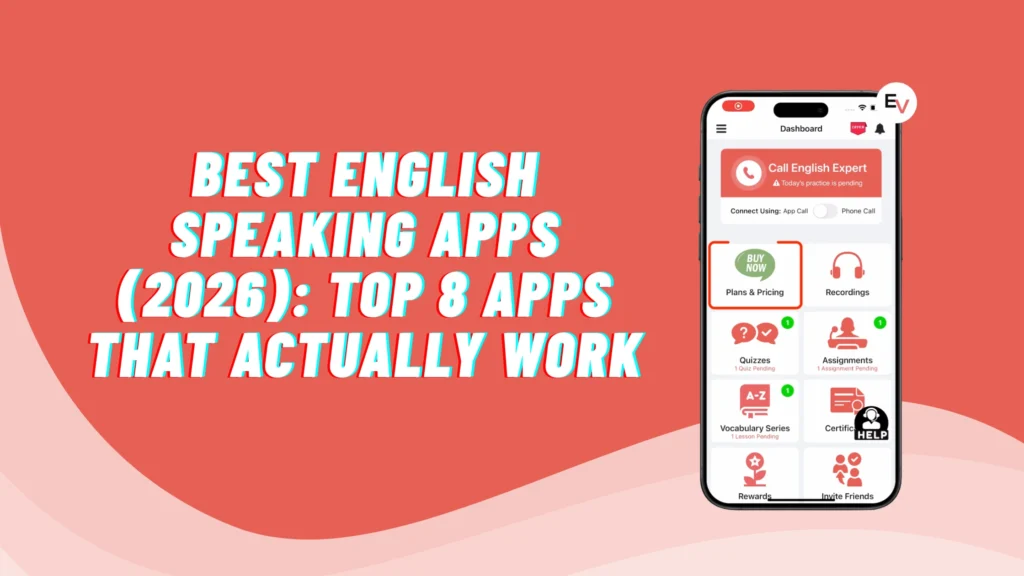
Best English Speaking Apps (2026): Top 8 Apps That Actually Work

April 10, 2026 • 19 min read • By Rishish Pandey

Best English Speaking Apps (2026)
Quick Verdict For most learners, EngVarta is the strongest English speaking app because it pairs you 1-on-1 with certified Experts over live calls, with real-time corrections during practice and consolidated feedback at the end. Speak and ELSA are best for AI drills and pronunciation. Choose EngVarta when you need to actually speak with a real person; choose AI apps when you only want solo practice.

What Are the Best English Speaking Apps in 2026?

The best english speaking app in 2026 is EngVarta (live 1-on-1 conversations with trained human experts), followed by Cambly (native speaker video chats), Preply (global tutor marketplace), italki (pay-per-lesson platform), ELSA Speak (AI pronunciation coach), British Council myEnglish (certified group classes), Tandem (free peer language exchange), and Duolingo (gamified vocabulary builder). Each serves a different purpose, and choosing wrong means months of effort with nothing to show for it.

There is a problem that millions of English learners share, no matter where they live. You studied English for years in school. You can read articles, follow movies without subtitles, and understand conversations perfectly well. But the moment someone asks you a question in English — in a job interview, a business meeting, or even a casual conversation — your mind goes blank. The words disappear. You know what you want to say, but you are unable to express it. . That gap between understanding English and actually speaking it is where the right english speaking practice app makes the difference.

We evaluated all 8 leading apps on what matters most: how much time you spend genuinely speaking, the quality of who you speak with, affordability for daily practice, and whether the app produces measurable fluency gains. Here is what we found.

How Do the Top 8 English Speaking Apps Compare?

This side-by-side breakdown covers every major best english speaking app learners worldwide are downloading right now.

App Type Best For Price Rating
EngVarta 1-on-1 human experts Daily conversation practice ~$32/month (₹2,700) 4.5★
Cambly Native speaker video Accent polishing $12–$269/month 2.1★ (Trustpilot)
Preply Tutor marketplace Structured exam prep $3–$50/hour 4.3★
italki Pay-per-lesson marketplace Self-directed learners $4–$40/lesson 4.2★
ELSA Speak AI pronunciation coach Pronunciation drills Free / ~$12/month Pro 4.5★
British Council (myEnglish) Certified group classes Certification Varies by region 4.0★
Tandem Free language exchange Casual peer practice Free 3.8★
Duolingo Gamified learning Vocabulary and grammar basics Free 4.6★

What Our Learners Say

Rated 4.5★ from 9,100+ reviews on Google Play

★★★★★
Let me congratulate you on your endeavour to help people gain confidence while speaking. I enrolled for your vocabulary series. You guys are doing a good job. Keep it up.
★★★★★
Engvarta is the best app for the people who are really serious in their learning English.
★★★★★
So comfortable to speak with the expert , really like this app
★★★★★
5 days ago I couldn't speak English confidently in front of anyone. Every Expert helped me immensely. They taught me English is mastered through practice, not memorization. I still make mistakes, but I no longer hesitate to speak.
★★★★★
Excellent application to improve your communication skills.Thnk you for introducing new vocabulary everyday.God bless you You might not aware of but personally this is helping me a lot
★★★★★
I am living in Italy for 20 years. I never got the chance to speak English but now I want to speak again to help my children. It was a very good experience. I want to congrats your team for making such an excellent app.
★★★★★
Thank u so much @engvarta it is very good for learning English daily I learn new words daily I get new vocabulary again thnxx again 👍🏻👍🏻
★★★★★
This app is amazing, it's helpful and good. The tutors are very excellent. I am improving and don't shy anymore.
★★★★★
hello this is Shweta and I will tell you about the engvarta app this is an amazing app to improve our English or any other language so I suggested using this app and doing better things and growing always better . thankyou.
★★★★★
Excellent platform for people who don’t find any people to speak in English. Live experts help to build confidence while speaking and guiding to improve your communication!
★★★★★
It was a great experience praticing with EngVarta. Thank you experts for helping me reach
★★★★★
It's always a pleasure talking to you. You always make me feel that I am doing very good and encourage me to work hard to achieve the goal of being a good speaker.

Ready to Practice with Real Experts?

Try EngVarta today — ₹69 trial (India) / $1 trial (International) · 100% refundable

Detailed Reviews: The 8 Best English Speaking Apps

1. EngVarta — Best App for Daily Speaking Practice With Real People

EngVarta stands apart as the best english speaking app for a straightforward reason: every second on the platform is spent in live conversation with a trained human expert. No grammar modules to wade through, no AI bot generating scripted replies. You launch the app, get matched with a professional English speaking expert within minutes, and talk. The audio-only format eliminates the self-consciousness that video calls create, allowing learners to focus entirely on speaking freely. Over 2 million learners use EngVarta, and it is particularly powerful for people from non-English-speaking countries — India, Southeast Asia, Latin America, the Middle East — because the experts genuinely understand the challenges of learning English as a second language.

Pros : 100% live speaking practice with trained human experts (not AI, not random volunteers) · Real people, real conversations — the only english speaking app with real people dedicated entirely to practice · Audio-only removes performance anxiety · Session recordings + personalized feedback after every call · Available 7 AM to midnight IST · ₹69 (India) / $1 (International) trial with money-back guarantee.

Cons : Audio-only (no video option) · Availability window is IST-based · Requires self-discipline to maintain a daily habit.

Pricing: Trial at ₹69 (India) / $1 (International). from ₹2,700 for 25 sessions (~$32/month) for daily 15-minute sessions. That is roughly a dollar a day for dedicated 1-on-1 expert practice. See how EngVarta works or browse learner success stories.

2. Cambly — Best for Native Speaker Conversations

Cambly gives you on-demand video access to native English speakers from the US, UK, Canada, and Australia. If you already hold conversations comfortably and want to polish your accent or absorb native phrasing, Cambly provides that exposure around the clock. The spontaneity of tapping a button and landing in a conversation with a stranger has its appeal for confident learners looking for an app to practice english speaking with native voices.

Pros : Native speakers available 24/7 · Completely flexible scheduling · Useful for accent refinement and cultural exposure.

Cons : Tutors have no teaching certification requirement — session quality is unpredictable · Trustpilot rating sits at 2.1/5 · Daily 30-minute plans reach $269/month — prohibitively expensive for regular practice · Native speakers often lack understanding of challenges faced by ESL learners · Not designed for beginners.

3. Preply — Best for Structured Lessons and Exam Preparation

Preply operates as a $1.2 billion global marketplace connecting students with tutors across every subject. For English, you can browse thousands of tutor profiles, filter by specialty, read verified reviews, and book trial lessons. Pricing spans $3 to $50 per hour depending on tutor qualifications and location. The platform supports whiteboards, homework assignments, and lesson plans, making it a credible best app to learn english speaking through structured curriculum.

Pros : Enormous tutor selection with transparent reviews · Structured lesson tools · Excellent for IELTS, TOEFL, and Cambridge exam preparation · Trial lessons available.

Cons: Per-lesson billing makes daily practice expensive ($90-$300/month for frequent sessions) · Marketplace model means you handle all the vetting · Tutor quality ranges from outstanding to mediocre · Cancellation and rescheduling complaints are common.

4. italki — Best for Self-Directed Learners

italki hosts over 30,000 tutors across 150+ languages with no subscription required. Community tutors charge $4-$20 per lesson; professional teachers range from $10-$40. You book individual lessons, choose your own tutor each time, and build your own learning path. For disciplined learners who prefer variety and want full control over their schedule, italki offers maximum flexibility as an english conversation app.

Pros : Massive tutor pool across all time zones · No subscription lock-in · Wide price range accommodates most budgets · Trial lessons with new tutors.

Cons : Daily practice quickly becomes expensive ($120-$300/month) — the platform is designed for weekly sessions · You manage every aspect yourself (scheduling, progress tracking, tutor selection) · No standardized tutor training means inconsistent quality · No built-in curriculum.

5. ELSA Speak — Best AI Tool for Pronunciation Training

ELSA leverages advanced speech recognition AI to analyze your pronunciation, intonation, and fluency across 25,000+ exercises. It pinpoints exactly which sounds you mispronounce and scores your progress over time. The technology is genuinely impressive and particularly helpful for learners whose first language creates specific pronunciation patterns. As an english fluency app focused on the mechanics of clear speech, ELSA is the strongest AI option available.

Pros : Precise AI pronunciation analysis · 25,000+ targeted exercises · Progress tracking over time · Free version available · Pro subscription around $12/month.

Cons : Zero human interaction — you speak to a screen, never a person · Repetitive drill format · Does not build conversational confidence or spontaneous speaking ability · Cannot replicate the pressure and unpredictability of real dialogue.

6. British Council (myEnglish) — Best for Internationally Recognized Certification

The British Council’s myEnglish platform delivers online English courses through CELTA-certified teachers. The institutional reputation carries significant weight on resumes and for company-sponsored training programs. Modular course structure lets you enter at your level and progress with a digital certificate at each stage. For learners who need a credential alongside their fluency, this is a reputable best app to improve english speaking with formal recognition attached.

Pros : Globally recognized brand · CELTA-qualified instructors · Digital certificates upon completion · Well-structured modular curriculum.

Cons : Group class format limits individual speaking time significantly · Fixed class schedules may conflict with work obligations · Full course pricing is premium · You share attention with an entire class rather than receiving dedicated practice.

7. Tandem — Best Free Option for Casual Language Exchange

Tandem pairs you with language partners worldwide for free. The concept is mutual: you help someone practice your native language, and they help you practice English. Text, voice, and video options make it versatile, and the global user base means finding a partner is straightforward. For intermediate learners seeking a speaking english app free of charge, Tandem is worth exploring.

Pros : Completely free · Authentic cross-cultural conversations · Multiple communication modes · Large global community.

Cons : Partners are peers, not trained teachers — they cannot diagnose or correct your errors systematically · Half your session is spent teaching your language, not practicing English · Widely reported dating-app behavior from some users · Partners frequently become unreliable or disappear · No structure, no feedback, no progress measurement.

8. Duolingo — Best Gamified App for Building Basics

Duolingo is the most downloaded language app on the planet, and for good reason. The gamification — streaks, leaderboards, hearts, XP — keeps learners returning daily. For absolute beginners building foundational vocabulary and grammar, Duolingo makes the early stages enjoyable and habit-forming. It is free, beautifully designed, and available in 40+ languages.

Pros : Free and engaging · Best-in-class gamification drives consistency · Solid vocabulary and grammar foundation · Available everywhere.

Cons : Almost zero actual speaking practice — exercises are overwhelmingly reading, writing, and tapping multiple choice · Does not develop real conversational ability · You can hold a 500-day streak and still struggle to order coffee in English. Not genuinely a best app for speaking english fluently — it teaches about English rather than training you to speak it.

AI Apps vs Human Practice — Which Builds Real Fluency?

This is the most important distinction in the entire app market, and it is one that marketing rarely makes clear.

AI-powered tools like ELSA Speak and Duolingo excel at isolated skills. They teach you to pronounce specific sounds correctly, expand your vocabulary, and reinforce grammar rules. They are patient, infinitely available, and affordable. If your challenge is “I do not know enough English words” or “I struggle with specific sounds,” AI tools deliver genuine value.

But speaking fluency is not a collection of isolated skills. Fluency means forming thoughts in English under pressure. It means responding when someone throws an unexpected question at you. It means keeping a conversation going when your brain searches for the right word and cannot find it. That cognitive pressure — the real-time demand of human conversation — is exactly what builds the neural pathways responsible for fluent speech. No AI in 2026 recreates that pressure authentically.

When you practice with a real person on an english speaking practice app like EngVarta, your brain works fundamentally differently than when you repeat phrases to an algorithm. You process social cues. You handle interruptions. You recover from mistakes in real time. That is the muscle that produces fluency — and it only develops through human conversation, practiced consistently.

The most effective strategy combines both: use AI for mechanics (pronunciation, vocabulary) and a human practice app for the speaking itself. Ten minutes on ELSA plus fifteen minutes on EngVarta daily will outperform any single app used alone. But if you must choose one, choose the one that forces you to speak with a real person. That is where fluency lives.

How to Choose the Right English Speaking App for You

Not every best english speaking app suits every learner. A working professional preparing for client presentations needs something entirely different from a university student building basic confidence. Use this decision framework:

Your Situation Best App Why
You understand English but freeze when speaking EngVarta Daily 1-on-1 conversations with experts who specialize in building speaking confidence — audio-only, private, judgment-free
You want to sound more like a native speaker Cambly Direct exposure to native accents and phrasing — if your budget allows $100+/month
You need IELTS/TOEFL/Cambridge prep Preply or British Council Structured exam-focused curriculum with qualified instructors and test strategies
You mispronounce specific sounds ELSA Speak Best AI pronunciation analysis available — targeted drills for your weak spots
You are on a tight budget Duolingo + Tandem Duolingo for vocabulary foundation, Tandem for free peer conversation — limited but costs nothing
Job interviews, work meetings, presentations EngVarta Live expert conversations replicate professional scenarios — experts provide actionable feedback you can apply the same day
You want a certificate for your resume British Council CELTA-certified teachers, globally recognized digital credential
You prefer managing your own schedule and tutors italki 30,000+ tutors, no subscription, complete scheduling freedom — best for self-starters who practice weekly, not daily

Conclusion :

Each of these 8 apps earns its place for specific learners. ELSA Speak is exceptional for pronunciation. British Council delivers genuine credentials. Duolingo makes studying enjoyable. Preply and italki offer tutor flexibility. Tandem costs nothing. Cambly connects you with native speakers.

But fluency is not built through drills, certificates, or gamification. Fluency is built through conversation — repeated, daily, with someone skilled enough to guide your improvement. That is why EngVarta remains the best english speaking app in 2026. Not because it checks every box, but because it solves the one problem that actually holds people back: the absence of daily, real human conversation practice with an expert who gives you honest feedback.

Whether you are in Sao Paulo, Jakarta, Cairo, or Bangalore, the challenge is the same — and the solution is consistent daily practice with someone who understands how second-language speakers think. EngVarta’s experts know that challenge firsthand. That empathy, combined with professional training, is what makes the difference.

Start with the ₹69 / $1 trial. If it does not work for you, get a full refund. No questions asked.

Frequently Asked Questions ( FAQs )

Q1. What is the best english speaking app for someone who understands English but cannot speak it?

Ans : EngVarta is purpose-built for exactly this situation. Its trained experts specialize in helping learners who comprehend English well but lack the confidence and practice to speak it. The audio-only format removes visual judgment, letting you focus entirely on forming sentences and building real-time thinking skills. At ~$32/month for daily sessions, it is the most accessible best app to improve english speaking for the “understands but can’t speak” gap.

Q2. Can an app genuinely replace a traditional English class?

Ans : For speaking fluency, yes — if the app involves live conversation with qualified humans. Traditional group classes give each student only a few minutes of actual speaking time per hour. An app to practice english speaking like EngVarta delivers 15-50 minutes of dedicated 1-on-1 conversation daily, which produces more speaking practice in one week than most classrooms provide in a month. For grammar foundations, a class may still help beginners, but for fluency, daily app-based practice is more effective.

Q3. How much should I expect to pay for a good english speaking app?

Ans : Free apps (Duolingo, Tandem) work for basics but will not build conversational fluency. AI pronunciation tools (ELSA Speak) cost around $12/month. Tutor marketplaces (Preply, italki) range from $3 to $50 per lesson, adding up to $120-$300/month for daily practice. EngVarta offers the strongest value for consistent daily english speaking course practice at roughly $32/month (₹2,700) for daily expert sessions. Cambly ranges from $12 to $269/month depending on frequency.

Q4. Are free english speaking apps effective?

Ans : They are useful as supplements but insufficient as primary tools. Duolingo builds vocabulary effectively and creates good study habits. Tandem offers genuine conversation with peers. However, neither provides structured feedback from a trained professional, and Duolingo involves almost no actual speaking. If budget is a real constraint, combine both free apps — but understand that a paid english speaking app with real people will accelerate your progress dramatically compared to free alternatives alone.

Q5. How quickly can you become fluent with an english speaking app?

Ans : Learners who already understand English and practice daily for 15 minutes on EngVarta typically report noticeable improvement within 2-4 weeks and conversational fluency within 3-6 months. Complete beginners need 6-12 months. The determining factor is not talent or intelligence — it is how many minutes per day you spend genuinely speaking out loud with another person. AI apps and flashcard tools do not count toward that number because they do not exercise the same cognitive skills.

Q6. Which is better — an AI english speaking app or one with real human practice?

Ans : For pronunciation mechanics and vocabulary, AI apps like ELSA Speak are excellent. For actual speaking fluency — the ability to think and respond in English during real conversations — human practice is irreplaceable. The best app for speaking english fluently combines both: AI for targeted skill drills, and live human conversation for building the real-time confidence and cognitive speed that define fluency. If you can only afford one, prioritize the human practice app. Fluency is a social skill, and social skills require social practice.