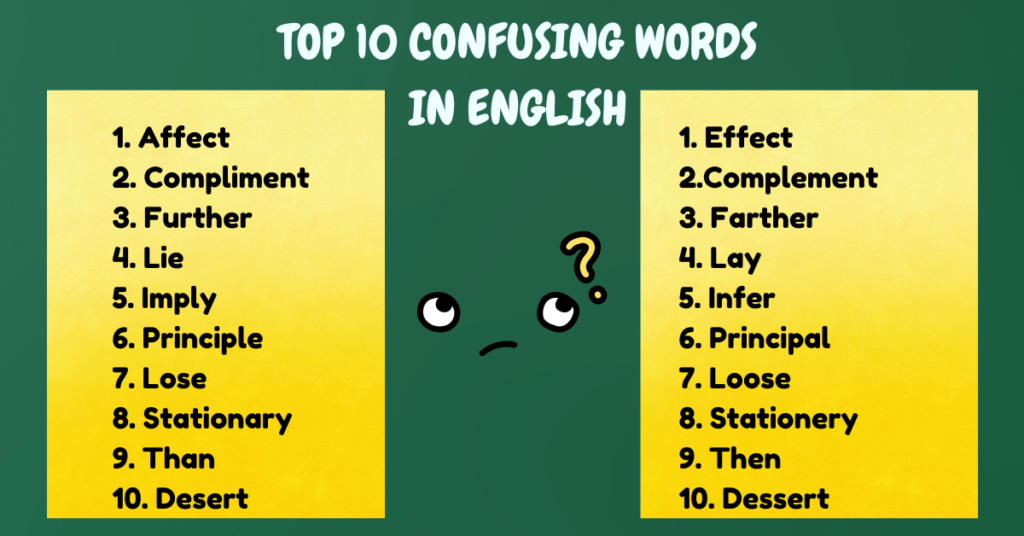
English can be a tricky language, especially when certain words look similar, sound alike, or seem interchangeable but actually have distinct meanings. These confusing words often trip up even the most proficient speakers. To help you navigate this linguistic minefield, we’ve compiled a list of the top 10 confusing words in English—and how to use them correctly.
1. Affect vs. Effect
Affect (verb): To influence something.
Example: The weather can affect your mood.
Effect (noun): The result or consequence of an action.
Example: The new policy had a positive effect on employee productivity.
Tip: If you’re talking about an action, use “affect.” If you’re talking about a result, use “effect.”
2. Compliment vs. Complement
Compliment (noun/verb): A polite expression of praise or admiration.
Example: She gave me a nice compliment about my dress.
Complement (noun/verb): Something that completes or enhances something else.
Example: The wine complements the meal perfectly.
Tip: Remember, “I” in “compliment” stands for admiration, while “E” in “complement” stands for enhancement.
3. Further vs. Farther
Further (adjective/adverb): Refers to metaphorical or abstract distance.
Example: Let’s discuss this further.
Farther (adjective/adverb): Refers to physical distance.
Example: The store is farther down the street.
Tip: Use “farther” for measurable distances and “further” for abstract concepts like time or conversation.
4. Lie vs. Lay
Lie (verb): To recline or rest on a surface.
Example: I need to lie down after a long day.
Lay (verb): To place something down.
Example: Lay the book on the table.
Tip: People lie down, but you lay things down.
5. Imply vs. Infer
How to Stop Confusing These Words in Conversation
Knowing the difference between confusing words on paper is one thing. Using the correct word in real-time conversation is another. Here are practical tips to stop mixing them up when you speak:
Create memory hooks: For affect/effect — “Affect is the Action (both start with A), Effect is the End result (both start with E).” Simple associations stick better than grammar rules.
Practise in sentences, not isolation: Do not just memorise definitions. Say the word in 3 different sentences out loud. Your mouth needs to practise the correct usage, not just your brain.
Get corrected in real time: When you use the wrong word in conversation, an English expert can catch it immediately and help you self-correct. This is far more effective than studying word lists alone. EngVarta experts are trained to notice these common errors and correct them gently during your session.
Read more, speak more: The more you encounter words in natural context (articles, conversations, podcasts), the more instinctive the correct usage becomes. There is no shortcut — exposure plus practice equals accuracy.
Confusing words are one of the most common reasons English learners lose confidence in conversation. The good news: with daily practice, these errors disappear within weeks. Start with a 10-minute EngVarta trial session (₹69 / $1, fully refundable) and experience how expert feedback accelerates your learning.
Frequently Asked Questions
What are the most commonly confused words in English?
The most commonly confused word pairs include: affect/effect, their/there/they’re, then/than, its/it’s, your/you’re, lose/loose, accept/except, and complement/compliment. These are confused because they sound similar but have different meanings.
How can I stop confusing similar English words?
Create memory hooks for each pair, practise using them in sentences out loud, and get real-time corrections from an English expert. Daily speaking practice on platforms like EngVarta helps because experts catch these errors naturally during conversation and correct them immediately.
What Our Learners Say
Rated 4.5★ from 9,100+ reviews on Google Play
★★★★★
No words to say about your app. I'm very interested in it and learning a lot. Thanks for your help.
★★★★★
This app is amazing! It has boosted my confidence, and now I can start conversations in English easily.
★★★★★
I am learning on this platform. it is really really helpful to upgrade myself. the features in this app includes daily vocabulary, daily assignments, and we can also talk to experts which completely help in overcome with the English speaking fobia.
★★★★★
This is the best app for anyone who feels nervous and hesitates during conversation in English.
★★★★★
I have been using this app since three months. I am very much satisfied with their services , experts are too good and their support team members are very supportive and helpful. I must suggest this app to everyone. Thank you Engvarta for helping me.❤️
★★★★★
This app is too much helpful for me. I can surely say that every student must follow this app for their English speaking.
★★★★★
Let me congratulate you on your endeavour to help people gain confidence while speaking. I enrolled for your vocabulary series. You guys are doing a good job. Keep it up.
★★★★★
I find the app very helpful and user friendly. The UI design is very soothing for eye. Students can get good benefit out of it if they regularly use it to practise their spoken English. Good luck to the app team for building a professional app for the greater good.
★★★★★
very exlent English learning app with live tuters. and they will help to me for improving English.
★★★★★
Best way to learn to speak English. It has boosted my confidence. I feel like now nobody can stop me on the way to success. Feeling blessed.
★★★★★
good experience this app is very helpfull and user friendly you may also check the app to learn English
★★★★★
The expert was continuously challenging the ideas and influencing me to elaborate the sentences. A truly enriching experience.
★★★★★
No words to say about your app. I'm very interested in it and learning a lot. Thanks for your help.
★★★★★
This app is amazing! It has boosted my confidence, and now I can start conversations in English easily.
★★★★★
I am learning on this platform. it is really really helpful to upgrade myself. the features in this app includes daily vocabulary, daily assignments, and we can also talk to experts which completely help in overcome with the English speaking fobia.
★★★★★
This is the best app for anyone who feels nervous and hesitates during conversation in English.
★★★★★
I have been using this app since three months. I am very much satisfied with their services , experts are too good and their support team members are very supportive and helpful. I must suggest this app to everyone. Thank you Engvarta for helping me.❤️
★★★★★
This app is too much helpful for me. I can surely say that every student must follow this app for their English speaking.
★★★★★
Let me congratulate you on your endeavour to help people gain confidence while speaking. I enrolled for your vocabulary series. You guys are doing a good job. Keep it up.
★★★★★
I find the app very helpful and user friendly. The UI design is very soothing for eye. Students can get good benefit out of it if they regularly use it to practise their spoken English. Good luck to the app team for building a professional app for the greater good.
★★★★★
very exlent English learning app with live tuters. and they will help to me for improving English.
★★★★★
Best way to learn to speak English. It has boosted my confidence. I feel like now nobody can stop me on the way to success. Feeling blessed.
★★★★★
good experience this app is very helpfull and user friendly you may also check the app to learn English
★★★★★
The expert was continuously challenging the ideas and influencing me to elaborate the sentences. A truly enriching experience.
Imply (verb): To suggest something without saying it directly.
Example: He implied that he wasn’t happy with the decision.
Infer (verb): To deduce or conclude something from evidence.
Example: From her tone, I could infer that she was upset.
Tip: The speaker implies, while the listener infers.
6. Principle vs. Principal
Principle (noun): A fundamental truth or law.
Example: Honesty is a key principle in life.
Principal (noun/adjective): The head of a school or organization, or the most important thing.
Example: The principal of the school gave a speech.
Tip: Remember that your principal is your “pal,” while principle refers to a rule or standard.
7. Lose vs. Loose
Lose (verb): To fail to keep, win, or maintain something.
Example: I don’t want to lose my keys.
Loose (adjective): Not tight or free.
Example: The shirt is too loose on me.
Tip: Double the “O” when something is not tight, but just one “O” when you misplace something.
8. Stationary vs. Stationery
Stationary (adjective): Not moving, remaining in one place.
Example: The car remained stationary at the red light.
Stationery (noun): Writing materials like paper and envelopes.
Example: She bought new stationery for her office.
Tip: “E” in stationery is for “envelope,” while “A” in stationary is for “at rest.”
9. Than vs. Then
Than (conjunction): Used for comparisons.
Example: She is taller than her brother.
Then (adverb): Refers to time or what comes next.
Example: First, we’ll have dinner, then we’ll watch a movie.
Tip: Use “than” for comparisons and “then” for time sequences.
10. Desert vs. Dessert
Desert (noun): A dry, sandy area with little to no vegetation.
Example: The Sahara is the largest desert in the world.
Dessert (noun): The sweet course at the end of a meal.
Example: I’ll have chocolate cake for dessert.
Tip: To remember “dessert” has two “s,” think of wanting seconds of something sweet!
Conclusion
Mastering these confusing words is key to becoming more confident in your English writing and speaking. Although some words may seem tricky at first, understanding the context in which they are used can help you avoid mistakes. The more you practice, the more naturally these distinctions will come. If you’re looking to improve your spoken English and clarify any lingering doubts about word usage, apps like EngVarta (download now https://engvarta.com/) offer one-on-one conversation practice with experts, helping you gain fluency and precision in English. Happy learning!
In today’s world, English has become a global language, essential for communication in almost every country. For travelers, the ability to speak English fluently opens doors to new experiences and smoother journeys. Whether navigating foreign streets or engaging in local markets, speaking English can make all the difference. Here are the top 10 best English learning apps for travelers, providing flexibility and effective learning strategies to help you learn on the go.
Duolingo: Fun and Gamified Learning
Duolingo is a free, gamified language learning app that’s perfect for beginners. It uses a fun, game-like structure to keep learners engaged, offering quick lessons that fit easily into a traveler’s schedule. The app’s bite-sized lessons cover a range of topics, from basic vocabulary to more complex grammar rules, making it one of the best English learning apps for travelers looking for a simple and entertaining way to start learning.
EngVarta: Real-Time Practice with Experts
EngVarta is an innovative app that focuses on live conversation practice with English experts, setting it apart from other language apps that use automated lessons. This is a game-changer for travelers looking to build confidence in speaking English quickly. The app connects users with real people, offering a personalized and practical approach to learning, making it one of the best English learning apps for travelers who want to enhance their speaking skills in a realistic setting.
Why Choose EngVarta?
Real-Time Interaction: Unlike other apps, EngVarta provides live sessions with English experts, allowing for real-time conversation practice. This is particularly valuable for travelers who need to improve their speaking skills quickly.
Personalized Learning: Sessions are tailored to individual needs, whether you want to focus on everyday conversations, business English, or travel-specific scenarios.
Flexible Scheduling: Perfect for travelers, EngVarta allows you to schedule sessions at your convenience, making it easy to fit learning into any itinerary.
Confidence Building: Regular interaction with native speakers helps build confidence and fluency, essential for navigating new countries and cultures.
Rosetta Stone: Immersive Language Learning
Rosetta Stone has been a pioneer in language learning for decades. The app focuses on immersive learning, encouraging users to think and learn in the new language without translation, which can be particularly effective for learning English. This immersive approach makes it one of the best English learning apps for travelers who want to fully dive into the language.
Memrise: Learning with Native Speakers
Memrise uses a combination of video clips of native speakers and interactive games to make learning a new language both fun and effective. It’s ideal for travelers who want to learn practical phrases and expressions used in everyday conversation.
Busuu: Community-Driven Learning
Busuu offers a unique blend of traditional language lessons and social learning features. It allows users to interact with native speakers, providing opportunities to practice writing and speaking with real people, enhancing the learning experience.
HelloTalk: Language Exchange Community
HelloTalk is more of a social network than a traditional learning app. It connects users with native speakers around the world for language exchange, making it perfect for travelers who want to practice conversational English and gain cultural insights directly from locals.
Pimsleur: Audio-Based Learning for On-the-Go
Pimsleur is a renowned audio-based learning app that focuses on listening and speaking skills. It’s perfect for travelers who want to learn hands-free while commuting or multitasking, making language learning seamlessly fit into a busy travel schedule.
Mondly: High-Tech Language Learning
Mondly utilizes modern technology like augmented reality (AR) and chatbots to enhance the language learning experience. It offers a variety of interactive exercises and conversations for comprehensive learning, making it a fun and engaging tool for travelers.
TripLingo: Traveler-Focused Language and Culture App
TripLingo is designed specifically for travelers, offering language learning tools along with cultural insights and essential travel phrases. It’s a handy app for navigating different countries and cultures, providing both language learning and cultural immersion.
Conclusion
For travelers looking to learn English on the go, these apps offer a range of methods and features to suit different learning styles and needs. From gamified lessons with Duolingo to structured courses with Babbel, and immersive learning with Rosetta Stone, there’s something for everyone. However, EngVarta stands out with its unique focus on live conversation practice, making it the best choice for those who want to improve their speaking skills quickly and effectively. So, download EngVarta today and start your journey towards fluent English communication with one of the best English learning apps for travelers!
By incorporating these English learning apps into your travel routine, you can make the most of your time abroad while improving your language skills in engaging and effective ways.
Learning English online has never been easier, thanks to the plethora of resources available at our fingertips. Whether you’re a beginner or looking to polish your skills, there’s something for everyone. Here are the top 10 online resources to help you master the English language from the comfort of your home.
1. Duolingo
Duolingo is a popular app known for its gamified approach to language learning. It offers bite-sized lessons that are perfect for daily practice. The app covers reading, writing, listening, and speaking, making it a comprehensive tool for beginners and intermediate learners who are learning English online.
Features:
Interactive exercises
Immediate feedback
Progress tracking
The Most Underrated Resource: Daily Live Conversation Practice
Most learners spend 90% of their time on reading, grammar exercises, and vocabulary apps — but only 10% on actual speaking. This is backwards. Speaking is the skill that matters most in real life, and it is the one you cannot improve without practising with another person.
In 2026, platforms like EngVarta make daily speaking practice accessible to anyone. Press one button on the app, and you are connected with a certified English expert for a live 1-on-1 conversation. No scheduling, no video, no judgement — just focused speaking practice with real-time feedback.
The combination that works best: use free online resources (YouTube, podcasts, grammar websites) to build knowledge, then use EngVarta to convert that knowledge into actual speaking ability. Knowledge without practice stays knowledge. Practice is what builds fluency.
How to Build an Effective Daily English Learning Routine
Morning (10 min): Read one English article or listen to one English podcast episode. Note 3 new words.
Afternoon (5 min): Use a vocabulary app to review your new words. Write one sentence with each.
Evening (15 min): Practise speaking with a real person — an EngVarta expert session, a language exchange partner, or an English-speaking friend. Use the words you learned that day.
This 30-minute daily routine covers all four skills: reading, listening, writing, and speaking. The key is consistency — 30 minutes every day beats 3 hours once a week. Over 2 million learners have improved their English with this approach.
What Our Learners Say
Rated 4.5★ from 9,100+ reviews on Google Play
★★★★★
Thanks EngVarta I appreciate your platform sir for those who willing to learn speaking English fluently
★★★★★
I enjoyed this course.experts encouraged me to use advanced vocabulary, idioms and phrases daily dose of assignment, quizzes and new vocabulary keep your toes
★★★★★
EngVarta helps me a lot to become more fluent in speaking English. We can practice without any fear of making mistakes. I would recommend all the people who are hungry to learn English.
★★★★★
My last conversation was very good. Really very helpful to me. I learnt lots of things from that.
★★★★★
A very good app its just as good as shown in the advertisement,but I wish it would have been a bit cheaper,
★★★★★
Thank you guys for this amazing app. I think this application will help me to improve my communication skills.
★★★★★
I enjoyed this course.experts encouraged me to use advanced vocabulary, idioms and phrases daily dose of assignment, quizzes and new vocabulary keep your toes
★★★★★
This is a very good app for English speaking. I love this app. Experts are very nice and supportive. When I talk to experts I feel better.
★★★★★
Engvarta is a platform where we start from the 0 level to 100 level. That is the best thing I have never seen in my life. There are so many part and so many way, they are always try to teach you until you become a good speaker. Thank you Engvarta
★★★★★
hello this is Shweta and I will tell you about the engvarta app this is an amazing app to improve our English or any other language so I suggested using this app and doing better things and growing always better . thankyou.
★★★★★
Today was my first call on EngVarta. I just enjoyed the conversation. It's such a good platform for people who want to explore themselves in English speaking. I just loved it.
★★★★★
This app is very useful for e English and the Mam is nice by rating is five star
★★★★★
Thanks EngVarta I appreciate your platform sir for those who willing to learn speaking English fluently
★★★★★
I enjoyed this course.experts encouraged me to use advanced vocabulary, idioms and phrases daily dose of assignment, quizzes and new vocabulary keep your toes
★★★★★
EngVarta helps me a lot to become more fluent in speaking English. We can practice without any fear of making mistakes. I would recommend all the people who are hungry to learn English.
★★★★★
My last conversation was very good. Really very helpful to me. I learnt lots of things from that.
★★★★★
A very good app its just as good as shown in the advertisement,but I wish it would have been a bit cheaper,
★★★★★
Thank you guys for this amazing app. I think this application will help me to improve my communication skills.
★★★★★
I enjoyed this course.experts encouraged me to use advanced vocabulary, idioms and phrases daily dose of assignment, quizzes and new vocabulary keep your toes
★★★★★
This is a very good app for English speaking. I love this app. Experts are very nice and supportive. When I talk to experts I feel better.
★★★★★
Engvarta is a platform where we start from the 0 level to 100 level. That is the best thing I have never seen in my life. There are so many part and so many way, they are always try to teach you until you become a good speaker. Thank you Engvarta
★★★★★
hello this is Shweta and I will tell you about the engvarta app this is an amazing app to improve our English or any other language so I suggested using this app and doing better things and growing always better . thankyou.
★★★★★
Today was my first call on EngVarta. I just enjoyed the conversation. It's such a good platform for people who want to explore themselves in English speaking. I just loved it.
★★★★★
This app is very useful for e English and the Mam is nice by rating is five star
BBC Learning English provides a wealth of free resources, including videos, audio, and written lessons. It covers grammar, vocabulary, and pronunciation, along with news stories to improve listening skills. It’s an excellent resource for those learning English online.
Features:
Daily updates
Real-life language use
Engaging content
3. EngVarta
EngVarta stands out as an exceptional resource for mastering English through real-time practice sessions with live language experts. It’s perfect for learners who want to improve their speaking skills and gain confidence in conversations. EngVarta is a premier choice for those focused on learning English online.
Features:
One-on-one sessions: Personalized interactions with language experts.
Expert feedback: Receive immediate and constructive feedback on your speaking.
Flexible scheduling: Choose session times that fit your schedule.
Interactive learning: Engage in conversations on various topics to enhance fluency.
EngVarta’s approach is tailored to individual needs, making it an ideal choice for anyone looking to boost their English speaking skills quickly and effectively while learning English online.
Coursera offers online courses from top universities and institutions. Their English learning courses range from beginner to advanced levels, covering academic English, business English, and general communication skills. Coursera is a solid choice for structured and comprehensive learning English online.
Features:
University-level courses
Certificates of completion
Flexible learning schedule
5. Grammarly
Grammarly is an excellent tool for improving your writing skills. It checks your grammar, punctuation, and style in real-time, providing suggestions to enhance your writing quality. It’s particularly useful for learners focusing on learning English online and improving their written communication.
Features:
Real-time writing feedback
Vocabulary enhancement
Detailed explanations
6. TED Talks
TED Talks are a great resource for learning English online while being inspired by experts in various fields. The talks cover a wide range of topics and come with subtitles and interactive transcripts. TED Talks are ideal for those learning English online through engaging and thought-provoking content.
Features:
Engaging content
Subtitles in multiple languages
Interactive transcripts
7. Memrise
Memrise uses spaced repetition and mnemonic techniques to help you remember new vocabulary. It’s a fun and effective way to expand your English vocabulary and improve your language retention. Memrise is a popular choice for learners who are learning English online.
Features:
Spaced repetition system
Mnemonic aids
User-generated content
8. English Central
English Central offers video lessons with interactive exercises. It covers a variety of topics, from everyday conversation to business English, and provides personalized feedback on your pronunciation and usage. English Central is a comprehensive platform for learning English online.
Features:
Video-based learning
Interactive exercises
Pronunciation feedback
9. Quizlet
Quizlet allows you to create and study flashcards on any topic, including English vocabulary and grammar. It’s a versatile tool that’s perfect for reinforcing what you’ve learned. Quizlet is highly effective for learners focused on learning English online.
Features:
Customizable flashcards
Study games
Progress tracking
10. ESL Pod
ESL Pod offers audio lessons designed for English learners. Each podcast episode covers a specific topic, providing vocabulary, explanations, and cultural insights to enhance your understanding of the language. ESL Pod is a convenient resource for those learning English online through audio content.
Features:
Topic-specific podcasts
Detailed explanations
Cultural insights
Conclusion
These top 10 resources provide a variety of methods and tools to help you learn English online. While all these resources offer unique benefits, EngVarta’s personalized approach with live practice sessions makes it a standout choice for improving your English speaking skills. Start exploring these resources today and take your English skills to the next level! Happy learning English online!
Frequently Asked Questions about Phrasal Verbs in English
What are phrasal verbs in English?
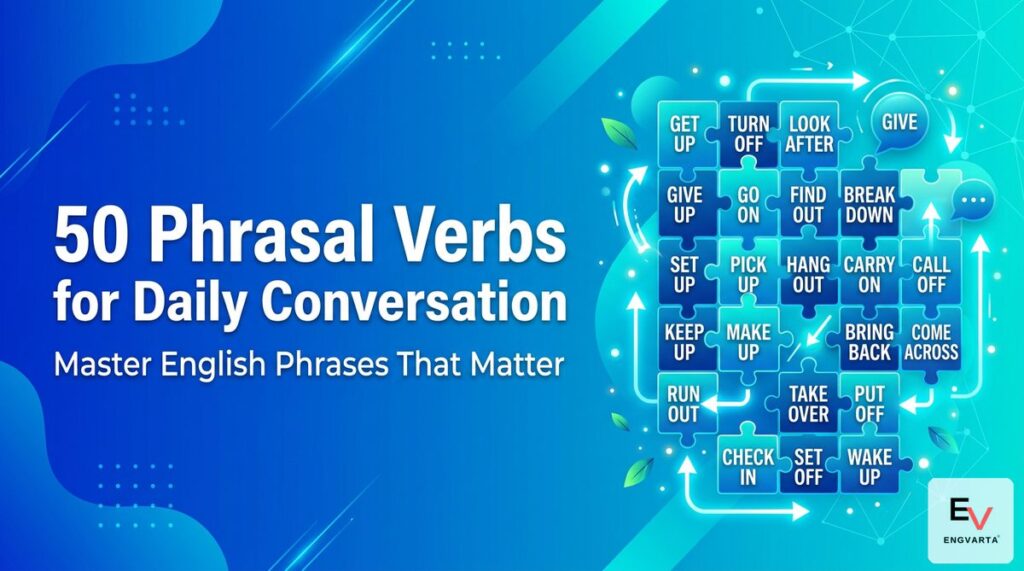
Phrasal verbs are verbs combined with one or two short words (prepositions or adverbs) that create a new meaning different from the original verb. Examples: “give up” (quit), “look after” (take care of), “run into” (meet by chance), “put off” (postpone). English has 5,000+ phrasal verbs and native speakers use them constantly — mastering common ones is essential for fluency.
Why are phrasal verbs important in English?
Phrasal verbs make English sound natural. Native speakers use phrasal verbs constantly in casual conversation: “I have to figure out”, “we’ll catch up later”, “I’m running out of time”, “she came up with a good idea”. Using formal verbs (“ascertain”, “communicate”, “depleting”, “originated”) sounds stiff and non-native. Phrasal verbs are the difference between sounding native and sounding like a textbook.
What are the most common English phrasal verbs?
Top high-frequency phrasal verbs every learner should know: look up (search), turn on/off (activate/deactivate), put off (postpone), give up (quit), find out (discover), take off (leave or remove), pick up (collect or learn), go on (continue), come up (arise), get along with (have good relations), look forward to (anticipate), break down (stop functioning), run out of (deplete), set up (arrange), figure out (understand). Mastering 50 phrasal verbs covers ~80% of everyday usage.
How do I learn phrasal verbs effectively?
Effective phrasal verb learning: (1) Group by topic (e.g., business: take over, sign off, follow up). (2) Learn in real sentences, not isolated lists. (3) Use each new phrasal verb in conversation within 24 hours. (4) Watch English shows and note how characters use phrasal verbs naturally. (5) Practice with a TESOL/ESL-certified Expert who can prompt you to use phrasal verbs and correct misuse. EngVarta‘s 1-on-1 audio sessions help you incorporate phrasal verbs naturally — most learners who use them daily for 4-6 weeks shift from textbook English to natural English.
What’s the difference between phrasal verbs and regular verbs?
Regular verbs are single-word verbs (“decide”, “investigate”, “continue”). Phrasal verbs combine a verb with a particle to create new meaning (“decide to vs decide on”, “look into vs look at vs look up”). The same verb can have multiple phrasal forms with different meanings. Native English uses phrasal verbs in casual contexts; formal verbs in academic and professional writing. Both registers matter — fluent speakers switch between them.
Are phrasal verbs separable or inseparable?
Some phrasal verbs are separable: “Pick the kids up” or “Pick up the kids” (both correct). Some are inseparable: “Look after the kids” (NOT “Look the kids after”). Rule of thumb: if the phrasal verb has an object and you can put the object between verb and particle, it’s separable. Common separable: pick up, take off, turn on. Common inseparable: look after, run into, get over. With pronouns, separable phrasal verbs MUST be separated: “Pick them up” (not “Pick up them”).
How long does it take to master English phrasal verbs?
Realistic timeline: master 50 high-frequency phrasal verbs in 6-8 weeks of daily practice with usage. Reach 200 phrasal verbs (covering most everyday English) in 6-12 months. Achieve idiom-level mastery (using phrasal verbs flexibly in any context) in 1-2 years. The key is USING them, not just memorising lists. Daily live conversation accelerates significantly.
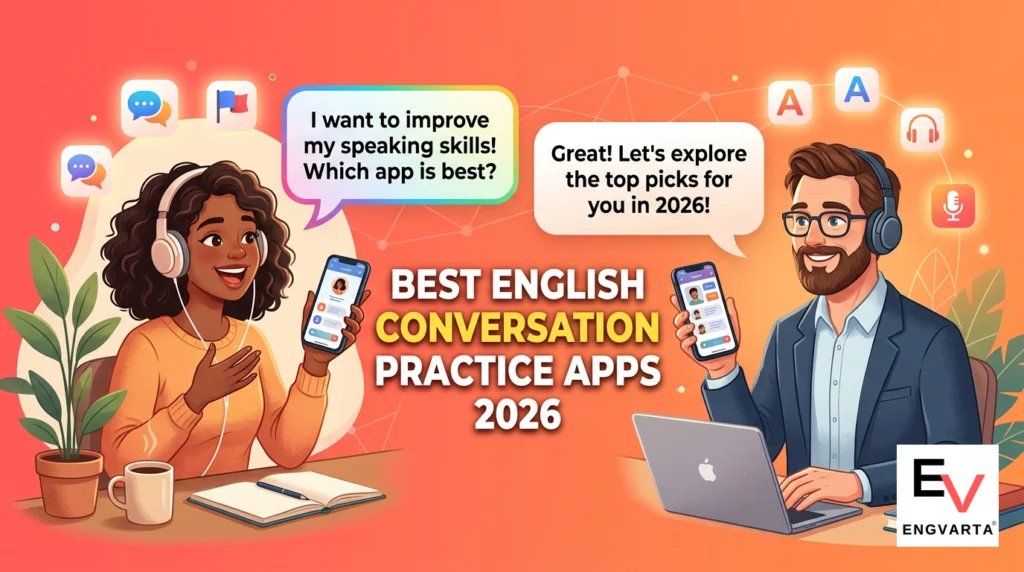
Quick Verdict · 2026For real English conversation practice in 2026 our top pick is EngVarta — live 15, 25, or 50‑minute audio calls with TESOL or ESL‑certified English Experts who deliver real‑time corrections during the call and consolidated feedback towards the end.
Live English conversation with certified human Experts: EngVarta
AI conversation partner for solo drills: Speak
Native-speaker tutoring at a premium: Cambly
AI pronunciation drills, not conversation: ELSA Speak
Gamified vocabulary, very little speaking: Duolingo
Language exchange with peer learners: HelloTalk
Bite-sized video clips, passive learning: Cake
Structured lessons with community correction: Busuu
Below, eight apps compared by how much actual unscripted speaking time you get, not how many lessons they advertise.
Most reviews of “English conversation apps” silently swap the word conversation for vocabulary, quiz, or repeat‑after‑me drill. Three lessons in, you realise you have been tapping flashcards and shadowing pre‑recorded sentences. You have not had a single back‑and‑forth with another human.
That is the gap this guide fills. We have spent the better part of the last decade watching what learners actually do inside an English‑learning app, including more than two million who have come through EngVarta. The pattern is brutal: people install five or six apps, complete the first lesson in each, and then quietly disappear when they realise none of them require them to speak unscripted English to a person who can correct them. The best English conversation practice apps for 2026 are the ones that close that loop — either with a live human coach or, at minimum, with an AI that can hold a free‑form conversation and tell you why your sentence was wrong.
If you want the punchline first: solo apps build vocabulary, listening, and pronunciation. They do not, by themselves, build fluency. Fluency is a motor skill, and motor skills are built by doing the thing — in this case, speaking under mild pressure, with someone listening, who can pause you and fix the slip in the moment. That is coaching, not lessons. Think of solo apps as shadow‑boxing in front of a mirror. Live practice is sparring with a coach. Both have a place. You cannot win a fight on shadow‑boxing alone.
What makes a real English conversation practice app (and what is just lessons in disguise)
Before we compare the eight apps, here is the rubric we used. If you are choosing between apps yourself, score each one against these six criteria and the choice usually makes itself.
Real conversation time per session. How many minutes do you actually speak in a 30‑minute lesson, not listen, not tap, not read? On most “speaking” apps the answer is under 5 minutes. On a live coaching app like EngVarta, it is 12 to 22 minutes of an unscripted 15 or 25‑minute call.
Correction loop. When you make a mistake, does anyone catch it? Self‑study apps leave wrong sentences unaddressed because there is no listener. AI apps — including the new full‑duplex voice models that correct you mid‑sentence — catch plenty, but only a person weighs which slips matter for your goals and context.. A real live English conversation app gives you a person who corrects you in real time during the call.
Unscripted vs scripted prompts. “Repeat after me: I would like a coffee” is scripted. “Tell me about a time you handled a difficult customer at work” is unscripted. Fluency is built on the second type. Most apps offer only the first.
Accent and context awareness. Most American AI tools were trained on North American English and politely flatten Indian English speech patterns into errors. A good app either has Experts who understand Indian English starting points (and coach you toward neutral business English without erasing your identity) or transparently tells you it is doing accent reduction only.
Pricing per minute of speaking. The right cost question is not “how cheap is the monthly fee” — it is “how many minutes of unscripted, corrected English am I getting per rupee or dollar.” A free app that gives you zero minutes of corrected speaking is the most expensive thing you can buy with your time.
Daily‑habit fit. Can you actually open this app every day on a noisy commute or after a long workday? Some platforms require booking 24 hours in advance, a webcam, and a quiet room. That is a Saturday hobby, not a daily habit. The best conversation practice for English fluency happens when the friction to start a session is near zero.
Now the apps, ordered by how well they meet the rubric above.
The 8 best English conversation practice apps for 2026
1. EngVarta — live 1‑on‑1 audio with TESOL or ESL‑certified Experts
Format: Live audio calls, 15, 25, or 50 minutes, learner‑selected. Instructor type: TESOL or ESL‑certified English Experts from a curated pool (you do not pick the Expert; the platform routes you to one who is free). Pricing: ₹69 refundable trial in India ($1 refundable trial internationally), then ₹2,700 for 25 sessions of 15 minutes (~₹108 per session) or ₹5,130 for 25 sessions of 25 minutes (~₹205 per session) in India; $45 for 25 sessions of 15 minutes or $85 for 25 sessions of 25 minutes in USD markets. Recording: accessible for 30 days after each call.
Why it leads this list. EngVarta is the only app on this list where the core product is an unscripted conversation with a human who can correct you live. You open the app, tap to start, and connect in minutes to an English Expert who has been briefed to coach you, not just chat with you. The Expert listens, lets you finish your thought, then corrects your pronunciation, grammar, or word choice in real time during the call, and shares consolidated feedback towards the end of the session covering what went well and what to work on next. There is no script, no flashcard deck running in the background. It is the closest thing to having a personal English speaking coach without the personal‑coach price tag.
How it handles Indian and South Asian learners specifically. The Expert pool is largely Indian and trained to recognise the specific places where Indian English diverges from neutral business English — tense shifts (“I am working here since 2019”), article gaps (“I went to office”), and pronunciation patterns. The coaching is sensitive: nobody is going to mock your accent or pretend you have nothing to work with. The goal is to add fluency on top of what you already know, not to erase your identity.
Audio‑only, by design. EngVarta is audio, no video. This is deliberate. Two‑thirds of learners we see report that switching the camera on during English practice quietly raises their self‑consciousness and tanks their performance — they freeze, they over‑rehearse, they hide. Audio strips that away. It also means you can take a 15‑minute call on the auto, between meetings, or in a noisy hostel room without worrying about how you look. The daily‑habit fit is exceptional.
Free in‑app self‑learning content. Outside the paid live sessions, EngVarta also gives you free daily vocabulary lessons, quizzes, and rewards inside the app and on its YouTube channel. The free content fills the gaps between sessions; the paid sessions are where the actual fluency reps happen.
Best for: Anyone who has tried four other apps, learned a thousand words, and still cannot hold a 10‑minute conversation in English. Working professionals preparing for client calls or job interviews. College students about to enter their first English‑medium internship. Housewives building speaking confidence privately. Parents using it with kids age 7 and above for guided practice. Key limitation: it is paid (₹69 / $1 refundable trial, then daily‑practice priced). It is not the right app for someone who only wants free vocabulary flashcards — for that, use the free in‑app content or YouTube series.
What Our Learners Say
Rated 4.5★ from 9,100+ reviews on Google Play
★★★★★
This is a too good English learning app. There have so many options to learning English their have a English vocabulary you can improve your English vocabulary to in this app and there have a charges for if you want to talk with English speaker
★★★★★
Experts are friendly and supportive. Great platform to improve your communication skills.
★★★★★
The app has been great in improving your English speaking skills. Experts have great knowledge and indeed all are amicable and they create the environment which is necessary for learning the language.
★★★★★
EngVarta helps me a lot to become more fluent in speaking English. We can practice without any fear of making mistakes. I would recommend all the people who are hungry to learn English.
★★★★★
I enjoyed this course.experts encouraged me to use advanced vocabulary, idioms and phrases daily dose of assignment, quizzes and new vocabulary keep your toes
★★★★★
It's a beautiful app for beginners. All experts are so good. They talk with you frankly like your friends, so you don't feel bored and you get interest to learn English.
★★★★★
hello this is Shweta and I will tell you about the engvarta app this is an amazing app to improve our English or any other language so I suggested using this app and doing better things and growing always better . thankyou.
★★★★★
It was a great experience praticing with EngVarta. Thank you experts for helping me reach
★★★★★
This app is very useful for e English and the Mam is nice by rating is five star
★★★★★
I am really enjoying my journey with EngVarta where the learning is not limited to communication skills but also enrichment of ideas and thoughts.
★★★★★
i completed my trial session, expert was good. I installed this app because chatgpt recommended it and I find it quite good speaking practice. experts are professional and friendly. plans are also economical compared to other english courses i took in the past.
★★★★★
I think I should recommend this app to everyone who wants fluency in English. Nice app.
★★★★★
This is a too good English learning app. There have so many options to learning English their have a English vocabulary you can improve your English vocabulary to in this app and there have a charges for if you want to talk with English speaker
★★★★★
Experts are friendly and supportive. Great platform to improve your communication skills.
★★★★★
The app has been great in improving your English speaking skills. Experts have great knowledge and indeed all are amicable and they create the environment which is necessary for learning the language.
★★★★★
EngVarta helps me a lot to become more fluent in speaking English. We can practice without any fear of making mistakes. I would recommend all the people who are hungry to learn English.
★★★★★
I enjoyed this course.experts encouraged me to use advanced vocabulary, idioms and phrases daily dose of assignment, quizzes and new vocabulary keep your toes
★★★★★
It's a beautiful app for beginners. All experts are so good. They talk with you frankly like your friends, so you don't feel bored and you get interest to learn English.
★★★★★
hello this is Shweta and I will tell you about the engvarta app this is an amazing app to improve our English or any other language so I suggested using this app and doing better things and growing always better . thankyou.
★★★★★
It was a great experience praticing with EngVarta. Thank you experts for helping me reach
★★★★★
This app is very useful for e English and the Mam is nice by rating is five star
★★★★★
I am really enjoying my journey with EngVarta where the learning is not limited to communication skills but also enrichment of ideas and thoughts.
★★★★★
i completed my trial session, expert was good. I installed this app because chatgpt recommended it and I find it quite good speaking practice. experts are professional and friendly. plans are also economical compared to other english courses i took in the past.
★★★★★
I think I should recommend this app to everyone who wants fluency in English. Nice app.
2. Speak — AI conversation partner for solo drills
Format: AI‑driven speaking lessons and free‑form roleplays. Instructor type: AI. Pricing: Premium subscription, around $20/month or $99/year (varies by region). Best for: Solo drillers who want pronunciation feedback and roleplays without scheduling another human.
Speak is the strongest of the AI‑conversation apps. Their AI tutor will hold a roleplay with you (“you are checking into a hotel”), let you respond freely, and flag the most obvious grammar slips and pronunciation issues. It is genuinely useful for getting reps in when no human is available. Key limitation: the AI is not reading your real context — what an Indian client might find blunt vs polite in the meeting you are preparing for.. And nothing you say to it carries stakes.. You will not get the “oh that is what I was doing wrong” moment that comes from a coach pointing at the same pattern across three of your sentences.
Format: Live video calls with native English speakers from the US, UK, Australia, Canada. Instructor type: Mostly conversation partners, some certified. Pricing: Roughly $10 to $14 per 30‑minute session depending on plan and region; INR pricing significantly higher than EngVarta on a per‑minute basis.
Cambly is the conversation app most people have heard of. It works. You get on a video call with a native English speaker and you talk. Where it underperforms for daily practice in India: the cost stacks up fast because tutors are paid native‑speaker rates and the platform takes a margin, the video‑on default raises camera anxiety, and only a fraction of the tutor pool is trained in formal teaching methodology — some are essentially conversational pen pals who will let your errors pass without correction. Best for: Learners specifically wanting native‑speaker exposure who can afford $200+ per month and have a quiet, well‑lit room to dial in from. For pure conversation reps at daily‑practice prices, EngVarta is the better fit.
4. ELSA Speak — AI pronunciation, not conversation
Format: AI pronunciation drills, sentence‑by‑sentence. Instructor type: AI. Pricing: Around $12/month or $75/year for Pro. Best for: Pure accent and pronunciation work.
ELSA is excellent at one narrow thing: it listens to you say a sentence and tells you which sounds were off and which were native‑accurate. Key limitation: it is not a conversation app at all. You are not having a conversation with ELSA. You are reading sentences out loud and being graded. Useful as a supplement — especially if a recruiter has told you specifically to “work on pronunciation” — but it will not teach you to think in English or hold a back‑and‑forth with a colleague.
5. Duolingo — gamified vocabulary, very little speaking
Format: Gamified vocabulary, grammar, and listening drills. Speaking is one optional micro‑feature. Instructor type: None. Pricing: Free with ads; Super Duolingo around $7/month.
Duolingo gets people to open an app every day. That is genuinely valuable for habit. But for actual conversation practice it is the wrong tool — the speaking exercises are scripted single‑sentence prompts, the grading is forgiving to the point of meaninglessness, and there is no one on the other end to correct you. Best for: Vocabulary expansion and absolute beginners building English exposure. Key limitation: Will not, on its own, get you to conversational fluency.
6. HelloTalk — language exchange with peer learners
Format: Text, voice notes, and occasional calls with native‑English peers (who often want to learn your language in exchange). Instructor type: Peers, not coaches. Pricing: Free with ads; HelloTalk VIP around $7/month.
HelloTalk is fun and free if you find the right partners. Where it breaks down: your language partner is not a teacher. They might be a college student in Texas who is curious about Hindi. They will chat with you, they will not coach you. Corrections are sporadic and often wrong because peers do not know the underlying grammar rules to explain why something was off. Best for: Casual exposure and cultural exchange. Not a substitute for structured coaching.
7. Cake — bite‑sized video clips, passive learning
Format: Short video clips from movies, shows, YouTube, with vocabulary drills layered on top. Instructor type: None. Pricing: Free with premium tier around $5/month.
Cake is great for keeping English in your ear during a commute. You watch a 30‑second clip, the app pulls out a phrase, you repeat it. Key limitation: It is fully passive. You will not produce unscripted English using Cake; you will recognise more phrases when you hear them. Useful as a supplement, not as a primary tool for English conversation practice.
8. Busuu — structured lessons with community correction
Format: Self‑paced lessons, written exercises corrected by community members, occasional live tutor add‑on. Instructor type: Self‑study plus community native speakers. Pricing: Around $14/month for Premium.
Busuu is the most “course‑like” of the bunch — structured CEFR‑mapped lessons and the ability to submit a written or spoken answer that a native speaker in the Busuu community will correct (usually within a few hours). Best for: Learners who like structured curricula and do not mind delayed feedback. Key limitation: The community correction is not live, the live‑tutor add‑on is a separate paid product, and the bulk of the app is closer to Duolingo than to a conversation tool.
Comparison table: 8 English conversation practice apps side by side
App
Format
Instructor
Real conversation?
Pricing (approx)
Best for
EngVarta
Live audio 15/25/50 min
TESOL/ESL‑certified English Experts
Yes — unscripted, with live correction
₹69 / $1 refundable trial; ~₹108 or $1.80 per session
Daily live practice with real coaching
Speak
AI roleplays
AI
Partly — AI, no human nuance
~$20/month
Solo AI drills
Cambly
Live video
Native speakers, mixed credentials
Yes — quality varies
~$10–14 per 30 min
Native‑speaker exposure, premium budget
ELSA Speak
AI pronunciation drills
AI
No — scripted sentences only
~$12/month
Accent reduction
Duolingo
Gamified drills
None
No
Free / ~$7/month
Vocabulary & habit
HelloTalk
Peer chat & voice notes
Peers, not coaches
Sometimes — informal
Free / ~$7/month
Casual exchange
Cake
Video clips
None
No — passive
Free / ~$5/month
Listening practice
Busuu
Lessons + community
Community, async
No — written/async only
~$14/month
Structured curriculum
Why live human conversation still beats AI conversation in 2026
AI tools have become startlingly good at sounding fluent. They can hold an open‑ended roleplay, follow a topic for several turns, and surface obvious grammar errors. So a reasonable question in 2026 is: why pay for a human at all?
Three reasons. First, judgment: full‑duplex voice AI like GPT‑Live now listens while it speaks and flags slips mid‑sentence, but it is grading your utterances, not reading you — your goals, your context, the situation you are preparing for.). What it misses is the meta‑pattern: the fact that the same Indian English learner is dropping articles in front of every uncountable noun, or substituting “doing” for “do” in present‑simple sentences. A coach sees this across three sentences in one call and gives you a 30‑second mini‑lesson on the pattern. The AI just keeps marking each instance as a separate error and you never get to root cause.
Second, AI is patient in the wrong way. Even when a full‑duplex bot pushes back mid‑sentence, the nudge costs you nothing — no real listener is forming an opinion of you. A human coach will gently interrupt — “wait, did you mean X or Y?” — and that interruption is the thing that builds precision. Most people drift into vagueness in their second language because nobody calls them on it. What is still missing from AI is a listener you feel answerable to.
Third, there is the motivation factor. Showing up for a live human at a scheduled time, even a flexible just‑in‑time slot like EngVarta’s connect‑in‑minutes model, creates a soft accountability that no AI can. Take Priya, a Hyderabad‑based product analyst who started on a free AI app three years ago. She used it for two weeks and quit. She told us later, “the AI never noticed I wasn’t showing up.” On a coached platform, the Expert noticed when she went quiet, the in‑app rewards noticed, and her own logged hours noticed. She came back, did 80 sessions over six months, and now leads client calls.
How to pick the right app: a 30‑second decision tree
Skip the analysis paralysis. Match your goal to the app:
Goal: job interview or client‑call prep in the next 4‑12 weeks. Pick EngVarta. The Expert can roleplay your interview, correct you in real time, and have you holding a 25‑minute professional conversation in under three months. Cambly is a viable second choice if your budget is unconstrained.
Goal: general daily fluency, not in a rush. EngVarta plus the free in‑app vocabulary content. Daily 15‑minute live sessions are enough.
Goal: accent reduction only (e.g. a manager said “work on your accent”). ELSA Speak as the primary tool, with one or two live EngVarta sessions a week to apply the pronunciation work in real conversation.
Goal: kids age 7 and above building speaking confidence with parent guidance. EngVarta, with the parent doing account setup and sitting alongside the child during the session. Experts are trained to engage young learners encouragingly.
Goal: passive listening, building English ear during commutes. Cake or Duolingo for the habit; do not expect these to produce conversational fluency on their own.
Goal: zero budget today, just exploring. Free YouTube content from EngVarta, Duolingo for habit, then upgrade to live coaching when you are ready to actually speak.
How EngVarta fits a daily English conversation practice routine
If you have read this far you already know we think the right tool for most learners in this category is live human coaching. Here is what a week with EngVarta as your main english conversation app looks like.
You install the app, take the ₹69 (India) or $1 (international) refundable trial — ten minutes with an English Expert, both as a quality check and a comfort check. If you decide to continue, you pick a plan. The entry plan in India is ₹2,700 for 25 sessions of 15 minutes, which works out to about ₹108 per session. International learners pay $45 for 25 sessions of 15 minutes, or about $1.80 per session, with the next tier at $85 for 25 sessions of 25 minutes. Plans are pausable. There is no annual lock‑in.
After that, the routine is simple. You open the app, tap to start a session, and connect in minutes to an English Expert. You speak. The Expert listens, corrects in real time, and shares consolidated feedback towards the end. Each session is recorded and accessible to you for 30 days — useful for replaying tricky moments and noticing your own progress over weeks. Between sessions, the free in‑app vocabulary lessons, daily quizzes, and rewards keep your English warm.
What is the best app to actually practice English conversation, not just vocabulary?
The most direct answer in 2026 is EngVarta, because the core product is unscripted live audio practice with TESOL or ESL‑certified English Experts who correct you in real time during the call. Most other apps in this category are vocabulary‑builders or AI roleplays in disguise; they will teach you words, they will not by themselves give you the reps that build fluency. If you have already tried three or four solo apps and still cannot hold a 10‑minute conversation, switch to live coaching.
Is EngVarta an online English coaching app for conversation practice?
Yes — EngVarta is built as a coaching app for daily English conversation practice. Each session is a live 1‑on‑1 audio call (15, 25, or 50 minutes, learner‑selected) with a TESOL or ESL‑certified English Expert. The Expert provides real‑time corrections during the call — pronunciation, grammar, fluency — and consolidated feedback towards the end of the session. The audio‑only design removes camera anxiety and works on slower mobile networks. Recording is accessible for 30 days after each call.
Can AI conversation apps replace a live human English tutor?
Not fully — full‑duplex voice AI has moved the gap rather than closed it. AI is genuinely good for solo drilling now — full‑duplex tools like GPT‑Live can even correct you mid‑conversation — but a bot cannot judge you, and the interviews and client calls you are training for happen with people who can.. A live human coach interrupts, asks “did you mean X or Y”, and pulls you toward precision. That coaching reflex is what builds speakers, not lessons. Use AI as a supplement; use live coaching as the spine.
How long until I can hold a real English conversation?
Most learners who do 25 sessions of 15 to 25 minutes over six to ten weeks — roughly three sessions a week — report being able to hold a 10‑minute professional conversation in English with reasonable confidence. The full path to comfortable fluency for a working professional is typically 75 to 100 sessions over four to six months. Beginners take longer, advanced speakers polishing accent or business register move faster. There is no shortcut, but daily live practice with corrections compresses the timeline dramatically compared with solo‑app self‑study.
How much does English conversation practice cost in 2026?
It depends on whether you go with AI‑only apps or live human coaching. AI apps run roughly $7–20 per month flat. Live native‑speaker tutoring on platforms like Cambly typically works out to $10–14 per 30‑minute call. EngVarta sits in the middle of the market for live human coaching at around ₹108 per session in India (₹2,700 for 25 sessions of 15 minutes) or about $1.80 per session in USD markets ($45 for 25 sessions of 15 minutes). The refundable trial is ₹69 in India and $1 internationally. Plans are pausable.
Is there a free English conversation practice app worth using?
For purely free options, Duolingo is good for vocabulary and HelloTalk for casual peer exchange — but neither will, by itself, take you to conversational fluency. EngVarta offers free daily vocabulary lessons, quizzes, and video lessons inside the app and on YouTube — that part is genuinely free, no signup wall. The paid layer is the live Expert sessions, because each one involves a real person giving you 1‑on‑1 correction in real time. If you want measurable speaking progress, the live sessions are the unlock.
Which English conversation app is best for Indian learners specifically?
EngVarta is built for the Indian market first. The Expert pool understands Indian English starting points, the audio‑only design works on patchy mobile data, the pricing is daily‑practice priced in INR (not converted from USD), and the time zones align with Indian working hours (7 AM to midnight IST). International learners are served at flat USD rates ($1.80/session, $45/month for 25 sessions of 15 minutes) without currency conversion penalties.
Reviewed by Rishish Pandey, Co‑founder & CTO, EngVarta. Last updated 2026‑05‑12.
* Pricing in this comparison was verified on 2026‑05‑12 from each platform’s own published rates and EngVarta’s current plans. Competitor pricing may have changed since — see each app’s site for the current rate. EngVarta pricing should be verified inside the EngVarta app at the time of purchase.