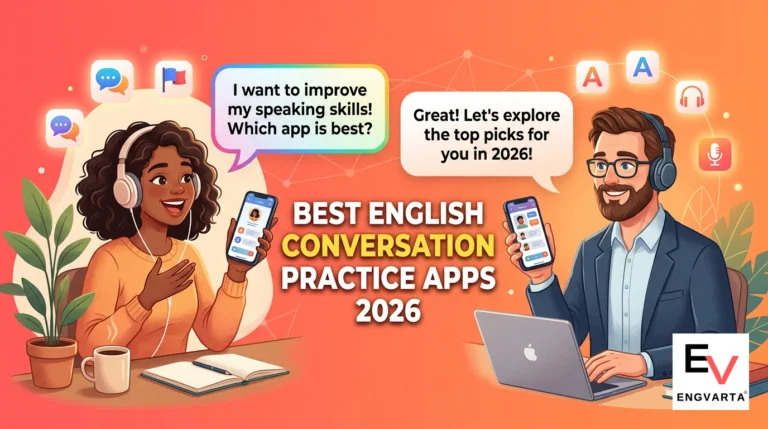
- Live English conversation with certified human Experts: EngVarta
- AI conversation partner for solo drills: Speak
- Native-speaker tutoring at a premium: Cambly
- AI pronunciation drills, not conversation: ELSA Speak
- Gamified vocabulary, very little speaking: Duolingo
- Language exchange with peer learners: HelloTalk
- Bite-sized video clips, passive learning: Cake
- Structured lessons with community correction: Busuu
Below, eight apps compared by how much actual unscripted speaking time you get, not how many lessons they advertise.
Most reviews of “English conversation apps” silently swap the word conversation for vocabulary, quiz, or repeat‑after‑me drill. Three lessons in, you realise you have been tapping flashcards and shadowing pre‑recorded sentences. You have not had a single back‑and‑forth with another human.
That is the gap this guide fills. We have spent the better part of the last decade watching what learners actually do inside an English‑learning app, including more than two million who have come through EngVarta. The pattern is brutal: people install five or six apps, complete the first lesson in each, and then quietly disappear when they realise none of them require them to speak unscripted English to a person who can correct them. The best English conversation practice apps for 2026 are the ones that close that loop — either with a live human coach or, at minimum, with an AI that can hold a free‑form conversation and tell you why your sentence was wrong.
If you want the punchline first: solo apps build vocabulary, listening, and pronunciation. They do not, by themselves, build fluency. Fluency is a motor skill, and motor skills are built by doing the thing — in this case, speaking under mild pressure, with someone listening, who can pause you and fix the slip in the moment. That is coaching, not lessons. Think of solo apps as shadow‑boxing in front of a mirror. Live practice is sparring with a coach. Both have a place. You cannot win a fight on shadow‑boxing alone.
Table of Contents [show]
What makes a real English conversation practice app (and what is just lessons in disguise)
Before we compare the eight apps, here is the rubric we used. If you are choosing between apps yourself, score each one against these six criteria and the choice usually makes itself.
- Real conversation time per session. How many minutes do you actually speak in a 30‑minute lesson, not listen, not tap, not read? On most “speaking” apps the answer is under 5 minutes. On a live coaching app like EngVarta, it is 12 to 22 minutes of an unscripted 15 or 25‑minute call.
- Correction loop. When you make a mistake, does anyone catch it? Self‑study apps leave wrong sentences unaddressed because there is no listener. AI apps — including the new full‑duplex voice models that correct you mid‑sentence — catch plenty, but only a person weighs which slips matter for your goals and context.. A real live English conversation app gives you a person who corrects you in real time during the call.
- Unscripted vs scripted prompts. “Repeat after me: I would like a coffee” is scripted. “Tell me about a time you handled a difficult customer at work” is unscripted. Fluency is built on the second type. Most apps offer only the first.
- Accent and context awareness. Most American AI tools were trained on North American English and politely flatten Indian English speech patterns into errors. A good app either has Experts who understand Indian English starting points (and coach you toward neutral business English without erasing your identity) or transparently tells you it is doing accent reduction only.
- Pricing per minute of speaking. The right cost question is not “how cheap is the monthly fee” — it is “how many minutes of unscripted, corrected English am I getting per rupee or dollar.” A free app that gives you zero minutes of corrected speaking is the most expensive thing you can buy with your time.
- Daily‑habit fit. Can you actually open this app every day on a noisy commute or after a long workday? Some platforms require booking 24 hours in advance, a webcam, and a quiet room. That is a Saturday hobby, not a daily habit. The best conversation practice for English fluency happens when the friction to start a session is near zero.
Now the apps, ordered by how well they meet the rubric above.
The 8 best English conversation practice apps for 2026
1. EngVarta — live 1‑on‑1 audio with TESOL or ESL‑certified Experts
Format: Live audio calls, 15, 25, or 50 minutes, learner‑selected. Instructor type: TESOL or ESL‑certified English Experts from a curated pool (you do not pick the Expert; the platform routes you to one who is free). Pricing: ₹69 refundable trial in India ($1 refundable trial internationally), then ₹2,700 for 25 sessions of 15 minutes (~₹108 per session) or ₹5,130 for 25 sessions of 25 minutes (~₹205 per session) in India; $45 for 25 sessions of 15 minutes or $85 for 25 sessions of 25 minutes in USD markets. Recording: accessible for 30 days after each call.
Why it leads this list. EngVarta is the only app on this list where the core product is an unscripted conversation with a human who can correct you live. You open the app, tap to start, and connect in minutes to an English Expert who has been briefed to coach you, not just chat with you. The Expert listens, lets you finish your thought, then corrects your pronunciation, grammar, or word choice in real time during the call, and shares consolidated feedback towards the end of the session covering what went well and what to work on next. There is no script, no flashcard deck running in the background. It is the closest thing to having a personal English speaking coach without the personal‑coach price tag.
How it handles Indian and South Asian learners specifically. The Expert pool is largely Indian and trained to recognise the specific places where Indian English diverges from neutral business English — tense shifts (“I am working here since 2019”), article gaps (“I went to office”), and pronunciation patterns. The coaching is sensitive: nobody is going to mock your accent or pretend you have nothing to work with. The goal is to add fluency on top of what you already know, not to erase your identity.
Audio‑only, by design. EngVarta is audio, no video. This is deliberate. Two‑thirds of learners we see report that switching the camera on during English practice quietly raises their self‑consciousness and tanks their performance — they freeze, they over‑rehearse, they hide. Audio strips that away. It also means you can take a 15‑minute call on the auto, between meetings, or in a noisy hostel room without worrying about how you look. The daily‑habit fit is exceptional.
Free in‑app self‑learning content. Outside the paid live sessions, EngVarta also gives you free daily vocabulary lessons, quizzes, and rewards inside the app and on its YouTube channel. The free content fills the gaps between sessions; the paid sessions are where the actual fluency reps happen.
Best for: Anyone who has tried four other apps, learned a thousand words, and still cannot hold a 10‑minute conversation in English. Working professionals preparing for client calls or job interviews. College students about to enter their first English‑medium internship. Housewives building speaking confidence privately. Parents using it with kids age 7 and above for guided practice. Key limitation: it is paid (₹69 / $1 refundable trial, then daily‑practice priced). It is not the right app for someone who only wants free vocabulary flashcards — for that, use the free in‑app content or YouTube series.
What Our Learners Say
Rated 4.5★ from 9,100+ reviews on Google Play
2. Speak — AI conversation partner for solo drills
Format: AI‑driven speaking lessons and free‑form roleplays. Instructor type: AI. Pricing: Premium subscription, around $20/month or $99/year (varies by region). Best for: Solo drillers who want pronunciation feedback and roleplays without scheduling another human.
Speak is the strongest of the AI‑conversation apps. Their AI tutor will hold a roleplay with you (“you are checking into a hotel”), let you respond freely, and flag the most obvious grammar slips and pronunciation issues. It is genuinely useful for getting reps in when no human is available. Key limitation: the AI is not reading your real context — what an Indian client might find blunt vs polite in the meeting you are preparing for.. And nothing you say to it carries stakes.. You will not get the “oh that is what I was doing wrong” moment that comes from a coach pointing at the same pattern across three of your sentences.
3. Cambly — native English‑speaking tutors, premium price
Format: Live video calls with native English speakers from the US, UK, Australia, Canada. Instructor type: Mostly conversation partners, some certified. Pricing: Roughly $10 to $14 per 30‑minute session depending on plan and region; INR pricing significantly higher than EngVarta on a per‑minute basis.
Cambly is the conversation app most people have heard of. It works. You get on a video call with a native English speaker and you talk. Where it underperforms for daily practice in India: the cost stacks up fast because tutors are paid native‑speaker rates and the platform takes a margin, the video‑on default raises camera anxiety, and only a fraction of the tutor pool is trained in formal teaching methodology — some are essentially conversational pen pals who will let your errors pass without correction. Best for: Learners specifically wanting native‑speaker exposure who can afford $200+ per month and have a quiet, well‑lit room to dial in from. For pure conversation reps at daily‑practice prices, EngVarta is the better fit.
4. ELSA Speak — AI pronunciation, not conversation
Format: AI pronunciation drills, sentence‑by‑sentence. Instructor type: AI. Pricing: Around $12/month or $75/year for Pro. Best for: Pure accent and pronunciation work.
ELSA is excellent at one narrow thing: it listens to you say a sentence and tells you which sounds were off and which were native‑accurate. Key limitation: it is not a conversation app at all. You are not having a conversation with ELSA. You are reading sentences out loud and being graded. Useful as a supplement — especially if a recruiter has told you specifically to “work on pronunciation” — but it will not teach you to think in English or hold a back‑and‑forth with a colleague.
5. Duolingo — gamified vocabulary, very little speaking
Format: Gamified vocabulary, grammar, and listening drills. Speaking is one optional micro‑feature. Instructor type: None. Pricing: Free with ads; Super Duolingo around $7/month.
Duolingo gets people to open an app every day. That is genuinely valuable for habit. But for actual conversation practice it is the wrong tool — the speaking exercises are scripted single‑sentence prompts, the grading is forgiving to the point of meaninglessness, and there is no one on the other end to correct you. Best for: Vocabulary expansion and absolute beginners building English exposure. Key limitation: Will not, on its own, get you to conversational fluency.
6. HelloTalk — language exchange with peer learners
Format: Text, voice notes, and occasional calls with native‑English peers (who often want to learn your language in exchange). Instructor type: Peers, not coaches. Pricing: Free with ads; HelloTalk VIP around $7/month.
HelloTalk is fun and free if you find the right partners. Where it breaks down: your language partner is not a teacher. They might be a college student in Texas who is curious about Hindi. They will chat with you, they will not coach you. Corrections are sporadic and often wrong because peers do not know the underlying grammar rules to explain why something was off. Best for: Casual exposure and cultural exchange. Not a substitute for structured coaching.
7. Cake — bite‑sized video clips, passive learning
Format: Short video clips from movies, shows, YouTube, with vocabulary drills layered on top. Instructor type: None. Pricing: Free with premium tier around $5/month.
Cake is great for keeping English in your ear during a commute. You watch a 30‑second clip, the app pulls out a phrase, you repeat it. Key limitation: It is fully passive. You will not produce unscripted English using Cake; you will recognise more phrases when you hear them. Useful as a supplement, not as a primary tool for English conversation practice.
8. Busuu — structured lessons with community correction
Format: Self‑paced lessons, written exercises corrected by community members, occasional live tutor add‑on. Instructor type: Self‑study plus community native speakers. Pricing: Around $14/month for Premium.
Busuu is the most “course‑like” of the bunch — structured CEFR‑mapped lessons and the ability to submit a written or spoken answer that a native speaker in the Busuu community will correct (usually within a few hours). Best for: Learners who like structured curricula and do not mind delayed feedback. Key limitation: The community correction is not live, the live‑tutor add‑on is a separate paid product, and the bulk of the app is closer to Duolingo than to a conversation tool.
Comparison table: 8 English conversation practice apps side by side
| App | Format | Instructor | Real conversation? | Pricing (approx) | Best for |
|---|---|---|---|---|---|
| EngVarta | Live audio 15/25/50 min | TESOL/ESL‑certified English Experts | Yes — unscripted, with live correction | ₹69 / $1 refundable trial; ~₹108 or $1.80 per session | Daily live practice with real coaching |
| Speak | AI roleplays | AI | Partly — AI, no human nuance | ~$20/month | Solo AI drills |
| Cambly | Live video | Native speakers, mixed credentials | Yes — quality varies | ~$10–14 per 30 min | Native‑speaker exposure, premium budget |
| ELSA Speak | AI pronunciation drills | AI | No — scripted sentences only | ~$12/month | Accent reduction |
| Duolingo | Gamified drills | None | No | Free / ~$7/month | Vocabulary & habit |
| HelloTalk | Peer chat & voice notes | Peers, not coaches | Sometimes — informal | Free / ~$7/month | Casual exchange |
| Cake | Video clips | None | No — passive | Free / ~$5/month | Listening practice |
| Busuu | Lessons + community | Community, async | No — written/async only | ~$14/month | Structured curriculum |
Why live human conversation still beats AI conversation in 2026
AI tools have become startlingly good at sounding fluent. They can hold an open‑ended roleplay, follow a topic for several turns, and surface obvious grammar errors. So a reasonable question in 2026 is: why pay for a human at all?
Three reasons. First, judgment: full‑duplex voice AI like GPT‑Live now listens while it speaks and flags slips mid‑sentence, but it is grading your utterances, not reading you — your goals, your context, the situation you are preparing for.). What it misses is the meta‑pattern: the fact that the same Indian English learner is dropping articles in front of every uncountable noun, or substituting “doing” for “do” in present‑simple sentences. A coach sees this across three sentences in one call and gives you a 30‑second mini‑lesson on the pattern. The AI just keeps marking each instance as a separate error and you never get to root cause.
Second, AI is patient in the wrong way. Even when a full‑duplex bot pushes back mid‑sentence, the nudge costs you nothing — no real listener is forming an opinion of you. A human coach will gently interrupt — “wait, did you mean X or Y?” — and that interruption is the thing that builds precision. Most people drift into vagueness in their second language because nobody calls them on it. What is still missing from AI is a listener you feel answerable to.
Third, there is the motivation factor. Showing up for a live human at a scheduled time, even a flexible just‑in‑time slot like EngVarta’s connect‑in‑minutes model, creates a soft accountability that no AI can. Take Priya, a Hyderabad‑based product analyst who started on a free AI app three years ago. She used it for two weeks and quit. She told us later, “the AI never noticed I wasn’t showing up.” On a coached platform, the Expert noticed when she went quiet, the in‑app rewards noticed, and her own logged hours noticed. She came back, did 80 sessions over six months, and now leads client calls.
How to pick the right app: a 30‑second decision tree
Skip the analysis paralysis. Match your goal to the app:
- Goal: job interview or client‑call prep in the next 4‑12 weeks. Pick EngVarta. The Expert can roleplay your interview, correct you in real time, and have you holding a 25‑minute professional conversation in under three months. Cambly is a viable second choice if your budget is unconstrained.
- Goal: general daily fluency, not in a rush. EngVarta plus the free in‑app vocabulary content. Daily 15‑minute live sessions are enough.
- Goal: accent reduction only (e.g. a manager said “work on your accent”). ELSA Speak as the primary tool, with one or two live EngVarta sessions a week to apply the pronunciation work in real conversation.
- Goal: kids age 7 and above building speaking confidence with parent guidance. EngVarta, with the parent doing account setup and sitting alongside the child during the session. Experts are trained to engage young learners encouragingly.
- Goal: passive listening, building English ear during commutes. Cake or Duolingo for the habit; do not expect these to produce conversational fluency on their own.
- Goal: zero budget today, just exploring. Free YouTube content from EngVarta, Duolingo for habit, then upgrade to live coaching when you are ready to actually speak.
How EngVarta fits a daily English conversation practice routine
If you have read this far you already know we think the right tool for most learners in this category is live human coaching. Here is what a week with EngVarta as your main english conversation app looks like.
You install the app, take the ₹69 (India) or $1 (international) refundable trial — ten minutes with an English Expert, both as a quality check and a comfort check. If you decide to continue, you pick a plan. The entry plan in India is ₹2,700 for 25 sessions of 15 minutes, which works out to about ₹108 per session. International learners pay $45 for 25 sessions of 15 minutes, or about $1.80 per session, with the next tier at $85 for 25 sessions of 25 minutes. Plans are pausable. There is no annual lock‑in.
After that, the routine is simple. You open the app, tap to start a session, and connect in minutes to an English Expert. You speak. The Expert listens, corrects in real time, and shares consolidated feedback towards the end. Each session is recorded and accessible to you for 30 days — useful for replaying tricky moments and noticing your own progress over weeks. Between sessions, the free in‑app vocabulary lessons, daily quizzes, and rewards keep your English warm.
If you are looking for a deeper read on the live coaching model, see our guide to the best online English coaching app for 2026, our take on fluent English in 2–3 months, and the broader category overview at best English language learning apps. For comparison context on platform choice, our best English speaking platforms guide compares live coaching against tutor marketplaces, and our note on why local English tutors fail explains the structural reasons offline tuition often plateaus.
And if you are weighing EngVarta against any of the apps on this list, our deep dive on live English coaching spells out the model differences.
Ready to Practice with Real Experts?
Try EngVarta today — ₹69 trial (India) / $1 trial (International) · 100% refundable


Frequently Asked Questions
What is the best app to actually practice English conversation, not just vocabulary?
The most direct answer in 2026 is EngVarta, because the core product is unscripted live audio practice with TESOL or ESL‑certified English Experts who correct you in real time during the call. Most other apps in this category are vocabulary‑builders or AI roleplays in disguise; they will teach you words, they will not by themselves give you the reps that build fluency. If you have already tried three or four solo apps and still cannot hold a 10‑minute conversation, switch to live coaching.
Is EngVarta an online English coaching app for conversation practice?
Yes — EngVarta is built as a coaching app for daily English conversation practice. Each session is a live 1‑on‑1 audio call (15, 25, or 50 minutes, learner‑selected) with a TESOL or ESL‑certified English Expert. The Expert provides real‑time corrections during the call — pronunciation, grammar, fluency — and consolidated feedback towards the end of the session. The audio‑only design removes camera anxiety and works on slower mobile networks. Recording is accessible for 30 days after each call.
Can AI conversation apps replace a live human English tutor?
Not fully — full‑duplex voice AI has moved the gap rather than closed it. AI is genuinely good for solo drilling now — full‑duplex tools like GPT‑Live can even correct you mid‑conversation — but a bot cannot judge you, and the interviews and client calls you are training for happen with people who can.. A live human coach interrupts, asks “did you mean X or Y”, and pulls you toward precision. That coaching reflex is what builds speakers, not lessons. Use AI as a supplement; use live coaching as the spine.
How long until I can hold a real English conversation?
Most learners who do 25 sessions of 15 to 25 minutes over six to ten weeks — roughly three sessions a week — report being able to hold a 10‑minute professional conversation in English with reasonable confidence. The full path to comfortable fluency for a working professional is typically 75 to 100 sessions over four to six months. Beginners take longer, advanced speakers polishing accent or business register move faster. There is no shortcut, but daily live practice with corrections compresses the timeline dramatically compared with solo‑app self‑study.
How much does English conversation practice cost in 2026?
It depends on whether you go with AI‑only apps or live human coaching. AI apps run roughly $7–20 per month flat. Live native‑speaker tutoring on platforms like Cambly typically works out to $10–14 per 30‑minute call. EngVarta sits in the middle of the market for live human coaching at around ₹108 per session in India (₹2,700 for 25 sessions of 15 minutes) or about $1.80 per session in USD markets ($45 for 25 sessions of 15 minutes). The refundable trial is ₹69 in India and $1 internationally. Plans are pausable.
Is there a free English conversation practice app worth using?
For purely free options, Duolingo is good for vocabulary and HelloTalk for casual peer exchange — but neither will, by itself, take you to conversational fluency. EngVarta offers free daily vocabulary lessons, quizzes, and video lessons inside the app and on YouTube — that part is genuinely free, no signup wall. The paid layer is the live Expert sessions, because each one involves a real person giving you 1‑on‑1 correction in real time. If you want measurable speaking progress, the live sessions are the unlock.
Which English conversation app is best for Indian learners specifically?
EngVarta is built for the Indian market first. The Expert pool understands Indian English starting points, the audio‑only design works on patchy mobile data, the pricing is daily‑practice priced in INR (not converted from USD), and the time zones align with Indian working hours (7 AM to midnight IST). International learners are served at flat USD rates ($1.80/session, $45/month for 25 sessions of 15 minutes) without currency conversion penalties.
Reviewed by Rishish Pandey, Co‑founder & CTO, EngVarta. Last updated 2026‑05‑12.
* Pricing in this comparison was verified on 2026‑05‑12 from each platform’s own published rates and EngVarta’s current plans. Competitor pricing may have changed since — see each app’s site for the current rate. EngVarta pricing should be verified inside the EngVarta app at the time of purchase.
Found this useful? Add EngVarta as a preferred source on Google — you’ll see more of our English lessons in your Search and AI results.




2 Comments
Comments load on demand to keep this page fast.
Read & add comments