Best English Speaking Courses | EngVarta

Tag

best english speaking courses

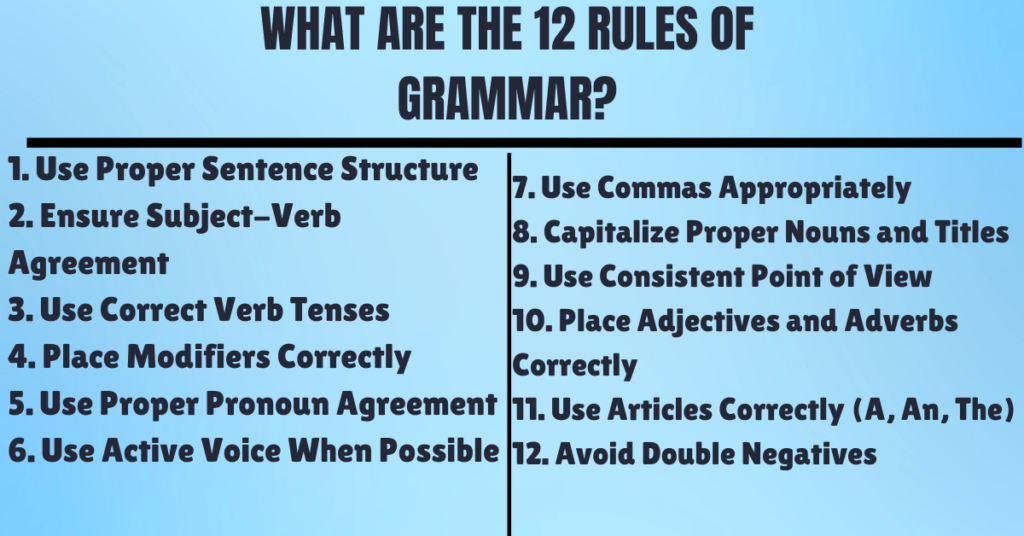
What Are the 12 Rules of Grammar?

November 5, 2024 • 12 min read • By Swati Raj

What Are the 12 Rules of Grammar?

Good grammar is essential for making sure our sentences are clear, precise, and understood as we intend. Knowing a few fundamental grammar rules can help anyone, from beginners to advanced learners, improve their writing and speaking skills. Here are the 12 essential grammar rules that everyone should know.

1. Use Proper Sentence Structure

Every sentence should have at least one subject (who or what the sentence is about) and one predicate (what the subject is doing). Together, these form a complete thought. This grammar rule ensures your sentences are clear and convey a complete idea.

Example: The dog barked loudly.
Here, “The dog” is the subject, and “barked loudly” is the predicate.

2. Ensure Subject-Verb Agreement

In a sentence, the subject and verb must agree in number. This means a singular subject takes a singular verb, and a plural subject takes a plural verb. This grammar rule is key to maintaining clarity in your sentences.

Example: She walks to school. (Singular subject and verb)
Example: They walk to school. (Plural subject and verb)

3. Use Correct Verb Tenses

Verb tenses indicate when an action occurs (past, present, or future). It’s essential to use the correct tense and be consistent throughout your sentence or paragraph. This grammar rule ensures your reader or listener knows when the action is happening.

Example: He studied yesterday. (Past tense)
Example: She studies every day. (Present tense)

4. Place Modifiers Correctly

Modifiers add detail to a sentence, but they should be placed close to the word they’re modifying to avoid confusion. Misplaced modifiers can change the meaning of a sentence, so following this grammar rule is essential for accuracy.

Correct: The boy with a red hat is my friend.
Incorrect: The boy is my friend with a red hat.

5. Use Proper Pronoun Agreement

Pronouns must agree with the nouns they replace in both number (singular/plural) and gender. Following this grammar rule helps keep sentences clear and understandable.

Example: Sarah lost her book. (“Her” refers to Sarah)
Example: The students raised their hands. (“Their” refers to students)

6. Use Active Voice When Possible

In the active voice, the subject performs the action, making sentences clearer and more direct. This grammar rule can make your writing and speaking more engaging.

Active Voice: The chef prepared the meal.
Passive Voice: The meal was prepared by the chef.

7. Use Commas Appropriately

Commas help clarify meaning by separating different elements in a sentence. Use them to separate items in a list, introductory phrases, and clauses. This grammar rule is crucial for proper punctuation.

Example: After dinner, we went for a walk.
Example: She bought apples, oranges, and bananas.

8. Capitalize Proper Nouns and Titles

Always capitalize proper nouns (specific names of people, places, and things) and titles when they’re used as part of someone’s name. This grammar rule ensures correct formatting in formal writing.

Example: I visited New York City.
Example: Doctor Smith is here.

9. Use Consistent Point of View

Maintain a consistent point of view throughout a sentence or paragraph. Shifting from “I” to “you” or “he/she” within a sentence can be confusing. This grammar rule keeps the sentence focused.

Correct: I went to the market and bought some vegetables.
Incorrect: I went to the market, and you bought some vegetables.

10. Place Adjectives and Adverbs Correctly

Adjectives describe nouns, while adverbs modify verbs, adjectives, or other adverbs. Make sure they’re placed correctly to clarify what they’re modifying. This grammar rule enhances clarity.

Example: She quickly finished her homework. (Quickly modifies the verb finished)
Example: The blue car is mine. (Blue describes the car)

11. Use Articles Correctly (A, An, The)

“A” and “an” are indefinite articles and are used with non-specific nouns, while “the” is a definite article used for specific nouns. Following this grammar rule helps clarify which nouns are general and which are specific.

Example: I saw a cat. (Any cat)
Example: I saw the cat that lives in our neighborhood. (A specific cat)

12. Avoid Double Negatives

Double negatives can make sentences confusing. In English, using two negatives in the same sentence cancels each other out, making the sentence positive. This grammar rule is essential for clarity.

Incorrect: I don’t have no money.
Correct: I don’t have any money.

In Summary

These 12 grammar rules provide a strong foundation for clear, effective communication in English. Mastering them can make a significant difference in how well you express yourself, whether you’re speaking or writing. But remember, grammar alone isn’t enough. To truly build fluency, you need consistent, real-world practice. That’s where the EngVarta app comes in. It connects you with live English experts over phone calls, giving you a safe space to apply these rules in actual conversations, get instant corrections, and boost your confidence. Download the EngVarta app today and turn grammar knowledge into real communication skills. Happy learning!

Frequently Asked Questions about English Grammar Rules

What is grammar in English?

Grammar is the set of rules that governs how words combine to form sentences in a language. English grammar covers parts of speech (nouns, verbs, adjectives, etc.), tenses, sentence structure, punctuation, and word agreement. Knowing grammar helps you communicate clearly and be understood — it’s the structure underneath every sentence you speak or write.

What are the 12 basic rules of English grammar?

The 12 essential grammar rules every English learner should know:

  1. Subject-verb agreement — singular subjects take singular verbs, plural subjects take plural verbs.
  2. Use the correct tense — past, present, or future, consistently within a sentence or paragraph.
  3. Articles (a, an, the) — use them correctly with nouns to specify identity.
  4. Active vs passive voice — prefer active in most cases for clarity.
  5. Pronouns must agree with their antecedents — match number and gender.
  6. Modifiers are placed correctly — keep adjectives and adverbs near what they describe.
  7. Use prepositions correctly — different prepositions change meaning (“in” the room vs “on” the room).
  8. Capitalization rules — proper nouns, sentence starts, “I” pronoun.
  9. Punctuation — periods, commas, semi-colons, question marks each have specific uses.
  10. Conditional sentences — if/then patterns follow specific tense rules.
  11. Reported speech — direct speech to indirect speech requires tense backshift.
  12. Avoid double negatives — “I don’t know nothing” is incorrect; use “I don’t know anything.”

Why is grammar important in English?

Grammar matters because it creates clarity. Bad grammar in spoken English can change the meaning of what you’re trying to say or make you harder to understand. In professional contexts (interviews, emails, presentations), grammar errors signal lack of attention to detail. In everyday conversation, basic grammar accuracy helps native and fluent speakers process what you say without effort.

How many grammar rules are there in English?

There’s no single agreed-upon number. Comprehensive grammar reference books cover 100+ rules. For practical fluency, mastering the 12 core rules above plus 20-30 commonly-used patterns (tenses, prepositions, conditionals) is enough for most learners. Native speakers don’t consciously remember rules — they internalize patterns through exposure and use.

What are the most common grammar mistakes Indian English speakers make?

Frequent grammar errors include:

  • Using “the” with general statements (“I love the music” instead of “I love music”)
  • Confusing “since” and “for” with time expressions (“I am here since two days” — should be “for two days”)
  • Using continuous tense for stative verbs (“I am understanding” — should be “I understand”)
  • Subject-verb agreement with collective nouns
  • Mixing up “less” and “fewer” (use “less” for uncountable, “fewer” for countable)
  • Using “only” or “also” in the wrong sentence position

How can I improve my English grammar quickly?

To improve grammar in 4-8 weeks:

  1. Pick ONE grammar rule per week and use it deliberately in conversation and writing
  2. Read sector-relevant English content daily (news, blogs in your industry) — exposure cements patterns
  3. Get feedback from a teacher or expert who can flag specific mistakes you make
  4. Practice grammar in spoken contexts, not just written drills
  5. Track your most common errors in a notebook and review weekly

Grammar improves fastest when used in real conversation with someone who corrects you. Daily live practice with a TESOL/ESL-certified Expert (like through EngVarta’s $1 refundable trial) catches errors as you make them, which is more effective than self-study alone.

What is the difference between grammar and syntax?

Grammar is the broader set of rules covering all aspects of language structure (parts of speech, tense, agreement, articles, etc.). Syntax is specifically about how words are arranged in a sentence — the word order. Grammar includes syntax. For example, “The cat sat on the mat” follows English syntax (Subject-Verb-Object). Saying “Sat the cat on mat the” violates syntax even though all words are correct.

How long does it take to master English grammar?

Reaching solid functional grammar — where most of your spoken and written English is accurate — typically takes 6-12 months of consistent practice for intermediate learners. Mastering nuance (when to break grammar rules for style, regional variations, formal vs casual register) takes 2-4 years of immersion or deliberate practice. The 12 core rules above can be learned in 2-4 weeks; internalizing them takes longer.

What is the best way to practice English grammar?

The most effective grammar practice combines:

  • Live conversation with someone who corrects you in real time (1-on-1 with an expert is ideal)
  • Reading 30 minutes a day in English at your level
  • Listening to native English content (podcasts, shows) for natural rhythm
  • Writing short pieces and getting feedback
  • Targeted drills on your weakest areas (don’t just practice what you’re already good at)

Are grammar rules different in spoken English vs written English?

Yes — spoken English is more flexible. Native speakers regularly use sentence fragments, contractions (“gonna,” “wanna”), informal sentence endings, and start sentences with “And” or “But.” These would be flagged as errors in formal writing but are perfectly natural in conversation. Knowing both registers — formal grammar for writing and presentations, conversational grammar for everyday speech — is what fluent speakers do.

Top 10 Confusing Words in English (and How to Use Them Correctly)

October 17, 2024 • 6 min read • By Swati Raj

Top 10 Confusing Words in English (and How to Use Them Correctly)

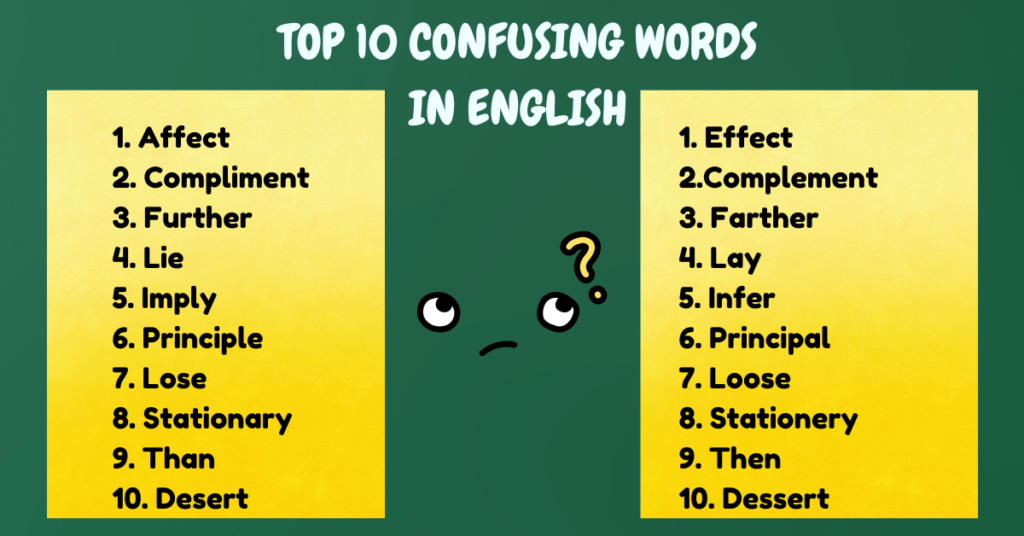
English can be a tricky language, especially when certain words look similar, sound alike, or seem interchangeable but actually have distinct meanings. These confusing words often trip up even the most proficient speakers. To help you navigate this linguistic minefield, we’ve compiled a list of the top 10 confusing words in English—and how to use them correctly.

1. Affect vs. Effect

  • Affect (verb): To influence something.
    • Example: The weather can affect your mood.
  • Effect (noun): The result or consequence of an action.
    • Example: The new policy had a positive effect on employee productivity.

Tip: If you’re talking about an action, use “affect.” If you’re talking about a result, use “effect.”

2. Compliment vs. Complement

  • Compliment (noun/verb): A polite expression of praise or admiration.
    • Example: She gave me a nice compliment about my dress.
  • Complement (noun/verb): Something that completes or enhances something else.
    • Example: The wine complements the meal perfectly.

Tip: Remember, “I” in “compliment” stands for admiration, while “E” in “complement” stands for enhancement.

3. Further vs. Farther

  • Further (adjective/adverb): Refers to metaphorical or abstract distance.
    • Example: Let’s discuss this further.
  • Farther (adjective/adverb): Refers to physical distance.
    • Example: The store is farther down the street.

Tip: Use “farther” for measurable distances and “further” for abstract concepts like time or conversation.

4. Lie vs. Lay

  • Lie (verb): To recline or rest on a surface.
    • Example: I need to lie down after a long day.
  • Lay (verb): To place something down.
    • Example: Lay the book on the table.

Tip: People lie down, but you lay things down.

5. Imply vs. Infer

How to Stop Confusing These Words in Conversation

Knowing the difference between confusing words on paper is one thing. Using the correct word in real-time conversation is another. Here are practical tips to stop mixing them up when you speak:

  • Create memory hooks: For affect/effect — “Affect is the Action (both start with A), Effect is the End result (both start with E).” Simple associations stick better than grammar rules.
  • Practise in sentences, not isolation: Do not just memorise definitions. Say the word in 3 different sentences out loud. Your mouth needs to practise the correct usage, not just your brain.
  • Get corrected in real time: When you use the wrong word in conversation, an English expert can catch it immediately and help you self-correct. This is far more effective than studying word lists alone. EngVarta experts are trained to notice these common errors and correct them gently during your session.
  • Read more, speak more: The more you encounter words in natural context (articles, conversations, podcasts), the more instinctive the correct usage becomes. There is no shortcut — exposure plus practice equals accuracy.

Confusing words are one of the most common reasons English learners lose confidence in conversation. The good news: with daily practice, these errors disappear within weeks. Start with a 10-minute EngVarta trial session (₹69 / $1, fully refundable) and experience how expert feedback accelerates your learning.

Frequently Asked Questions

What are the most commonly confused words in English?

The most commonly confused word pairs include: affect/effect, their/there/they’re, then/than, its/it’s, your/you’re, lose/loose, accept/except, and complement/compliment. These are confused because they sound similar but have different meanings.

How can I stop confusing similar English words?

Create memory hooks for each pair, practise using them in sentences out loud, and get real-time corrections from an English expert. Daily speaking practice on platforms like EngVarta helps because experts catch these errors naturally during conversation and correct them immediately.

What Our Learners Say

Rated 4.5★ from 9,100+ reviews on Google Play

★★★★★
I am learning on this platform. it is really really helpful to upgrade myself. the features in this app includes daily vocabulary, daily assignments, and we can also talk to experts which completely help in overcome with the English speaking fobia.
★★★★★
I highly recommend this app.this App is soo good for beginners who want to learn English.
★★★★★
It was a great experience praticing with EngVarta. Thank you experts for helping me reach
★★★★★
I have been using EngVarta for the past three months and from the period I am using I feel a considerable amount of difference in how I was speaking earlier and now how I am speaking and I think the EngVarta team has done a commendable job in improving my English fluency skill.
★★★★★
It's a incredible app... It builds my confidence to speak English fluently, gives you practice to start your conversation without any hesitation, provides daily free vocabulary and quizes also...Expensive but amazing & worth it...
★★★★★
Good app to express yourself because in our house there are no environment n EngVarta provides you environment
★★★★★
Great app for learning English speaking. All the experts are supportive and non-judgemental. After every session, constructive feedback is provided to enhance yoilur skills. Also it has AI enabled feature for assignment practice. Overall a great platform to practise English speaking with experts.
★★★★★
It is a very nice app. The expert whom I talked to is very amiable and very knowledgeable.
★★★★★
hello this is Shweta and I will tell you about the engvarta app this is an amazing app to improve our English or any other language so I suggested using this app and doing better things and growing always better . thankyou.
★★★★★
Really helpful to me. Many people want to talk but can't because of people who just laugh at their efforts. This app really helps. I love this initiative.
★★★★★
In the beginning I felt very nervous to talk but when I picked the call the expert spoke in such a gentle way. I really liked it.
★★★★★
good experience this app is very helpfull and user friendly you may also check the app to learn English

Ready to Practice with Real Experts?

Try EngVarta today — ₹69 trial (India) / $1 trial (International) · 100% refundable

  • Imply (verb): To suggest something without saying it directly.
    • Example: He implied that he wasn’t happy with the decision.
  • Infer (verb): To deduce or conclude something from evidence.
    • Example: From her tone, I could infer that she was upset.

Tip: The speaker implies, while the listener infers.

6. Principle vs. Principal

  • Principle (noun): A fundamental truth or law.
    • Example: Honesty is a key principle in life.
  • Principal (noun/adjective): The head of a school or organization, or the most important thing.
    • Example: The principal of the school gave a speech.

Tip: Remember that your principal is your “pal,” while principle refers to a rule or standard.

7. Lose vs. Loose

  • Lose (verb): To fail to keep, win, or maintain something.
    • Example: I don’t want to lose my keys.
  • Loose (adjective): Not tight or free.
    • Example: The shirt is too loose on me.

Tip: Double the “O” when something is not tight, but just one “O” when you misplace something.

8. Stationary vs. Stationery

  • Stationary (adjective): Not moving, remaining in one place.
    • Example: The car remained stationary at the red light.
  • Stationery (noun): Writing materials like paper and envelopes.
    • Example: She bought new stationery for her office.

Tip: “E” in stationery is for “envelope,” while “A” in stationary is for “at rest.”

9. Than vs. Then

  • Than (conjunction): Used for comparisons.
    • Example: She is taller than her brother.
  • Then (adverb): Refers to time or what comes next.
    • Example: First, we’ll have dinner, then we’ll watch a movie.

Tip: Use “than” for comparisons and “then” for time sequences.

10. Desert vs. Dessert

  • Desert (noun): A dry, sandy area with little to no vegetation.
    • Example: The Sahara is the largest desert in the world.
  • Dessert (noun): The sweet course at the end of a meal.
    • Example: I’ll have chocolate cake for dessert.

Tip: To remember “dessert” has two “s,” think of wanting seconds of something sweet!

Conclusion

Mastering these confusing words is key to becoming more confident in your English writing and speaking. Although some words may seem tricky at first, understanding the context in which they are used can help you avoid mistakes. The more you practice, the more naturally these distinctions will come. If you’re looking to improve your spoken English and clarify any lingering doubts about word usage, apps like EngVarta (download now https://engvarta.com/) offer one-on-one conversation practice with experts, helping you gain fluency and precision in English. Happy learning!

Related reads on EngVarta:


Phone Call Vocabulary & Phrases in English

July 25, 2024 • 7 min read • By Swati Raj

Phone Call Vocabulary & Phrases in English

Effective communication is vital in both personal and professional settings, and phone calls are a significant part of our daily interactions. Mastering phone call vocabulary and phrases can greatly enhance your confidence and clarity when talking on the phone. Whether you’re making a business call, setting up an appointment, or catching up with a friend, here are some essential phrases and tips to help you navigate phone calls with ease.

Introduction to Phone Call Etiquette

Before diving into specific phone call vocabulary and phrases, it’s important to understand some basic phone call etiquette:

  • Greet politely: Always start with a friendly greeting.
  • Identify yourself: State your name and, if necessary, your company or organization.
  • Be clear and concise: Get to the point while being courteous.
  • Listen actively: Pay attention to the other person and respond appropriately.
  • End the call gracefully: Summarize key points and say goodbye politely.

Common Phone Call Vocabulary and Phrases

Starting the Call

  1. Making a Call:
    • “Hello, this is [Your Name]. May I speak with [Recipient’s Name], please?”
    • “Good morning/afternoon/evening, this is [Your Name] from [Your Company]. I’m calling regarding [reason for the call].”
  2. Receiving a Call:
    • “Hello, [Your Name] speaking. How can I help you?”
    • “Thank you for calling [Your Company]. This is [Your Name]. How may I assist you?”

Requesting Information or Action

  1. Asking for Someone:
    • “Could I speak to [Recipient’s Name], please?”
    • “Is [Recipient’s Name] available?”
  2. Leaving a Message:
    • “Could you please take a message for [Recipient’s Name]?”
    • “Please let [Recipient’s Name] know that I called and ask them to call me back.”
  3. Clarifying Information:
    • “Could you please repeat that?”
    • “I didn’t catch that. Could you say it again, please?”

Confirming and Arranging Details

  1. Confirming Information:
    • “Let me confirm that. You said [details], correct?”
    • “Just to be sure, your appointment is at [time] on [date], right?”
  2. Making Appointments:
    • “I’d like to schedule an appointment with [Recipient’s Name].”
    • “Is [time] on [date] convenient for you?”
  3. Agreeing to Arrangements:
    • “That works for me. Thank you.”
    • “I look forward to it. See you then.”

Handling Issues

  1. Expressing Concerns:
    • “I’m afraid there’s a problem with [issue].”
    • “I’m not happy with [issue]. Can you help resolve it?”
  2. Seeking Assistance:
    • “Can you please help me with [problem]?”
    • “I’m having trouble with [issue]. Could you assist me?”

Ending the Call

  1. Summarizing the Call:
    • “To summarize, we’ve agreed on [details].”
    • “Just to recap, you will [action].”
  2. Saying Goodbye:
    • “Thank you for your time. Goodbye.”
    • “Have a great day. Bye!”

For Commonly Used Telephone Phrasal Verbs in English you can check this blog https://engvarta.com/commonly-used-telephone-phrasal-verbs-in-english/

Advanced Tips for Phone Conversations

  1. Stay Positive: Always maintain a positive and friendly tone, even if the conversation is challenging.
  2. Take Notes: Write down important details during the call to avoid forgetting key points.
  3. Speak Clearly: Communicate your words clearly and avoid speaking too quickly.
  4. Be Patient: Allow the other person to speak without interrupting.
  5. Use Polite Language: Phrases like “please,” “thank you,” and “excuse me” go a long way in maintaining politeness.

Conclusion

Mastering phone call vocabulary and phrases in English can significantly improve your communication skills. By using these phrases and tips, you can handle various phone conversations with confidence and professionalism. Remember, practice makes perfect, so don’t hesitate to use this phone call vocabulary in your daily interactions.

Frequently Asked Questions about Phone Call English

What vocabulary do I need for English phone calls?

Essential phone call English vocabulary: Greetings — “Hello”, “Good morning”, “May I speak to…?”. Holding — “Could you hold on a moment?”, “I’ll put you on hold”. Transfer — “Let me transfer you”, “I’m putting you through”. Asking — “Could you repeat that?”, “Could you spell that?”, “Could you speak more slowly?”. Closing — “Thank you for calling”, “Have a great day”, “I’ll get back to you”. Master these and you can handle 90% of professional phone English.

How do I sound professional on English phone calls?

Professional phone English: (1) Speak slightly slower than your normal pace — phone audio loses nuance. (2) Articulate clearly, especially numbers, names, and email addresses. (3) Use polite phrasing (“Could I”, “Would you mind”, “I’d appreciate”). (4) Confirm details by repeating (“So that’s 9 AM on Tuesday — correct?”). (5) Smile while speaking — it changes your tone audibly. (6) End with clear next steps (“I’ll send the email by 5 PM today”).

What are common English phrases for taking phone messages?

Standard message-taking phrases: “Could I take a message?”, “Who’s calling please?”, “Could I have your name and number?”, “What’s this regarding?”, “When would be a good time to call back?”, “I’ll make sure they get the message”. Have a notepad ready before answering work calls. Confirm spelling of names and numbers — phone audio is lossy.

How do I introduce myself on an English phone call?

Standard professional introductions: “Hello, this is Rishish Pandey from EngVarta”, “Good morning, my name’s Anshul, calling from EngVarta about…”. Always include: your name, your company/role, the reason for calling. Keep introduction under 15 seconds. Don’t start with apologies (“Sorry to bother you”) — sounds insecure. Just be direct and professional.

How can I improve my English phone speaking skills?

Effective practice: (1) Record mock phone calls — simulate work scenarios, listen back, identify weaknesses. (2) Practice speaking through your phone (audio-only) instead of in-person — different cognitive demands. (3) Take a TESOL/ESL-certified Expert call to simulate real conditions. EngVarta‘s sessions are audio-only by design (no video) — perfect simulation of phone-call conditions, with TESOL/ESL-certified Experts who can flag specific phone-English mistakes. The $1 refundable trial lets you experience this on a real-world phone scenario.

What are common mistakes on English phone calls?

Frequent errors: (1) Speaking too fast (audio loses clarity). (2) Mumbling or trailing off at sentence ends. (3) Not confirming details (numbers, dates, names misheard). (4) Filler words (“uhmm”, “yaani”) indicate uncertainty. (5) Not smiling — listeners hear the difference. (6) Cultural mismatches (over-formal in casual contexts, too casual in formal contexts). (7) Hanging up without clear next steps. Daily phone-mode practice fixes most of these in 4-6 weeks.

Top 10 English speaking courses of 2026

June 20, 2022 • 6 min read • By Richa

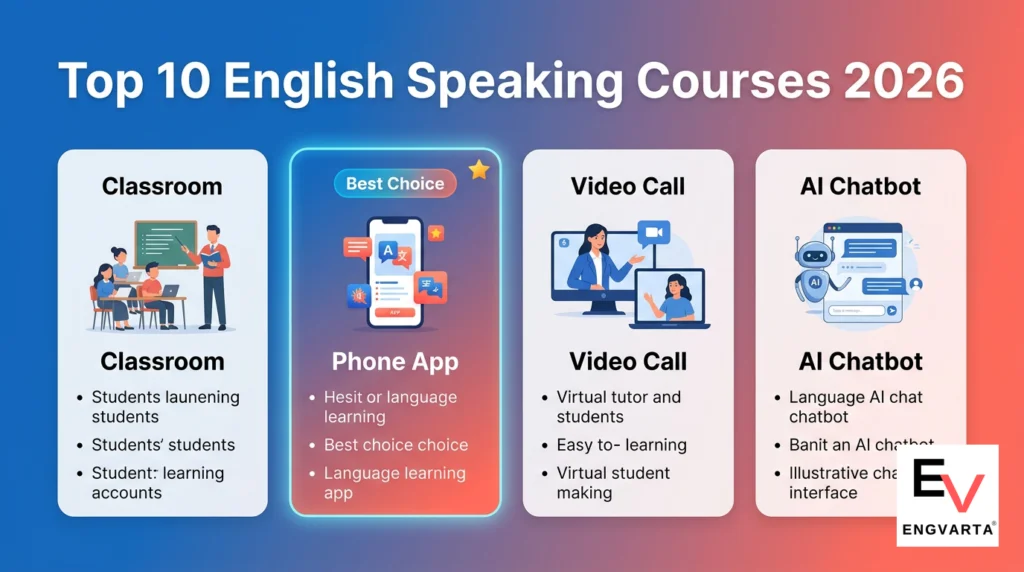
Top 10 English Speaking Courses 2026


Learning English is one of the best ways to improve your job prospects and access new opportunities, but with so much choice out there how do you know which language course will be right for you? 

In this blog, you will come across the Top 10 English-speaking courses of 2026. 

English Conversation – Improve your English speaking skills by udemy 

English Conversation – Improve your English speaking skills by udemy

English conversation by udemy is one of the top English-speaking courses of 2026. 

English conversation course designed to help you improve your English, specifically speaking.

This course is designed for beginners and intermediate students who want to improve their speaking skills. It will also be useful for advanced learners who want a refresher on the most common words and phrases they use in everyday life.

This course features:

  • Over 1 hour of high-quality video lectures
  • Easy to follow, practical lessons that anyone can apply immediately
  • Real-life examples of how these phrases are used in everyday conversations
  • Clear explanations and examples for each lesson

Learn How to Speak English Fluently: Advanced Course by Udemy

Learn How to Speak English Fluently: Advanced Course by Udemy

This online course is designed for people who want to improve their English conversation skills, grammar, pronunciation, and vocabulary. It’s also a great re

What Our Learners Say

Rated 4.5★ from 9,100+ reviews on Google Play

★★★★★
thanks for guide me i will try to connect your team and good communication with person so thank you teaching with me.
★★★★★
Its just great, I mean in terms of environment that it gives you is just awesome. Thnx again for boosting my confidence.
★★★★★
It's a incredible app... It builds my confidence to speak English fluently, gives you practice to start your conversation without any hesitation, provides daily free vocabulary and quizes also...Expensive but amazing & worth it...
★★★★★
Engvarta provides the best platform for learners to learn and get comfortable with the language by offering a comfortable and judgment-free environment with regular feedback. Engvarta is the best English learning app available.
★★★★★
i completed my trial session, expert was good. I installed this app because chatgpt recommended it and I find it quite good speaking practice. experts are professional and friendly. plans are also economical compared to other english courses i took in the past.
★★★★★
Today was my first call on EngVarta. I just enjoyed the conversation. It's such a good platform for people who want to explore themselves in English speaking. I just loved it.
★★★★★
very exlent English learning app with live tuters. and they will help to me for improving English.
★★★★★
The supporting people along with the experts are very supportive. The only suggestion to the officials is that the names of the experts should be reflected on the screens so to know to whom I am talking with. Thank you Engvarta, continue supporting people like me. Thank You.
★★★★★
This is a too good English learning app. There have so many options to learning English their have a English vocabulary you can improve your English vocabulary to in this app and there have a charges for if you want to talk with English speaker
★★★★★
This is very amazing apps. AI working system and it is very effective to practicing and also every day i have practice in the apps. As a begainner, i think it is very helpful for me.
★★★★★
I took two months of subscription. This platform really helped me to improve my communication and get rid of the fear I had earlier. Now I can talk fully confident and without any fear.
★★★★★
This is the best app for anyone who feels nervous and hesitates during conversation in English.

Ready to Practice with Real Experts?

Try EngVarta today — ₹69 trial (India) / $1 trial (International) · 100% refundable

source for students who are preparing for an exam like IELTS. 

The course will take you from beginner level to intermediate level. By the end of this course, you’ll be able to understand native speakers better and speak more clearly yourself.

You’ll learn the most important aspects of spoken English with fun and engaging videos, audio recordings, and interactive exercises. The lessons are easy to follow so you can start speaking immediately!

Engvarta : Best English speaking course for practicing Spoken English 

Engvarta : Best English speaking course for practicing Spoken English

Engvarta is one of the best English speaking course of 2026. 

Here, you can practice English conversation practice with English Experts at your selected time. 

During your live practice session, the experts will be correcting your

✔ pronunciation mistakes, ✔ Grammar errors and will help to ✔ frame better sentences to improve your overall English communication. All the sessions are recorded here for revision & you will also receive assignments after every session.

You can download the English learning app from iOS or android and start with a trial session. 

The main purpose of the EngVarta app is to provide an environment so that you can listen and speak in English on daily basis.  You can practice English for your job interviews, IELTS, or to master communication skills. 

After every session, you get a recording of your previous conversation, so that you can listen to the feedback again and identify the corrections that you need to make. On completing 10 hours of practice, students are awarded a certificate of completion. 

It is undoubtedly the best English app for anyone who wants to practice speaking English on a daily basis with Experts. 

Youtube – Learn English with Let’s Talk 

Let’s Talk offers many lessons, all organized into different playlists, that may as well be an English course. Moreover, it is among the top 10 English-speaking courses of 2026. They provide video lessons that can help a beginner to understand and start using the English language for daily conversation. 

Their lessons are worth binge-watching. From pronunciation to English grammar rules to advanced English phrases for different real-life situations.  

Let’s Talk is a great resource for beginner English learners, but its entertaining lessons are helpful for native speakers to brush up on their language skills. 

Speak English Professionally: In person, Online, On the phone. 

Speak English Professionally: In person, Online, On the phone. 

 In this 5 week’s course offered by the Georgia Institute of Technology,  you will learn : 

  • how to introduce yourself and others, how to agree or disagree, 
  • how to clarify, restate, and summarize. 
  • ou will revise and rehearse how to give information and respond to requests on the phone. You will review and practice effective interviewing techniques. 

In Addition, you’ll also understand how to give a sales “pitch” introducing a product or service. 

Throughout the course, you will adjust your English speaking skills and become more fluent and accurate when speaking it. You will demonstrate culturally appropriate body language and tone. As you work through the course, you’ll complete yourself and peer evaluations. 

Through a combination of lectures, comprehension quizzes, practice assignments, and performance tasks, you’ll gain the skills and confidence to communicate well in English anywhere in the world!

English Grammar and vocabulary – Describing relationships ( Advanced level) 

English Grammar and vocabulary – Describing relationships ( Advanced level) 

This course is ideal if you want to learn how to talk about human relationships, whether they’re with friends, family or partners. You’ll learn commonly used idioms, phrasal verbs and collocations related to relationships, as well as how to use narrative tenses to discuss past habits. This grammar course will help you gain confidence in English.

IELTS Academic Test Preparation from FutureLearn

IELTS Academic Test Preparation from FutureLearn

This course provides a comprehensive overview of the IELTS Academic test, covering all four areas of language proficiency: reading, writing, listening, and speaking. You’ll develop your skills in each of these areas through interactive lessons, practice activities, and mock tests. You’ll also receive feedback on your performance with detailed reports at the end of each module.

Speak English with Confidence: English speaking Course. 

Speak English with Confidence: English speaking Course. 

 This course is designed for students at a pre-intermediate to intermediate level of English (A2-B1). You will improve your English Speaking, English Listening, English Vocabulary, English Grammar, and English Pronunciation skills by completing the course activities.

Inside this course, you will learn : 

  • How to have real-life conversations 
  • Hundreds of vocabulary and phrases for having English conversations. 
  • Participating in various online activities and creating your own booklet of vocabulary. 

Alison: English for career developmen

Alison: English for career developmen

This course is designed for non-native English speakers who want to advance their careers. You will learn about the application process, as well as job search and interview skills while comparing and contrasting the same process in your home country. You will also learn about the various ways in which English language networking can help you land your dream job!

Everyday English Course: Perfectly spoken 

Everyday English Course: Perfectly spoken 

This course will help you to communicate with native speakers from real-life conversations. It will cover basic conversation topics such as ordering at a restaurant, asking for information, or responding to common expressions. 

Conclusion 

I hope this has given you some insights about the Top 10 English speaking course of 2026. 

Besides using a course, it is important to dedicate some time for your English practice at home

Check out this blog on how you can practice English at home. Click here


10 Best English speaking courses to learn English

June 7, 2022 • 11 min read • By Richa

10 Best English speaking courses to learn English


If you’d like to take your English skills to the next level and try speaking English like a native, then you need to know where to start. 

There are a lot of resources out there for learning English and a lot of mainstream English speaking courses that offer the best materials for helping you speak like a native!

Check out our blog on Resources to start learning English for English language learners 

https://engvarta.com/best-english-learning-resources-for-english-language-learners-at-all-levels/

In this article, I’m going to share with you 10 of the best English-speaking courses available online to learn and improve your English.

Coursera 

Coursera is one of the websites with the best English speaking courses. It offers far-flung English courses that you can use anytime and anywhere. These English speaking courses will help you to improve your English speaking skills if you are in a professional environment or if you are learning for career purposes. 

Using these English speaking courses on Coursera, you can improve your grammar, vocabulary, and also communication skills for career growth. 

English for career development by the University of Pennsylvania

English for Career Development is an English speaking course designed to help students acquire the skills needed for professional life. It is aimed at learners who are studying or working in English-speaking environments, or who are preparing themselves for further study or work in English-speaking environments. The course aims to help students develop their language skills through the examination of various aspects of career development, such as resumes and cover letters; job interviews and feedback; job search strategies; and dealing with work colleagues, supervisors, and clients.

Speak English Professionally: In-Person, Online & On the Phone.

Speak English Professionally: In-Person, Online & On the Phone is an English speaking course designed to help you improve your English speaking skills. This English speaking course will teach you how to communicate effectively in real-life situations and how to build confidence while speaking. You will learn how to communicate with people over the phone, in person, and online. You will also be able to practice these skills through interactive activities.

Essential English for Business Professionals Specialization.

Essential English for Business Professionals Specialization is a series of English speaking courses designed to help you develop the language skills that are essential for success in business.

You will learn how to communicate more effectively in English, whether at work or on an international trip. This specialization requires prior knowledge of business English and English grammar.

There are 3 English speaking courses included in this specialization : 

Course 1: English for Developing a Business

Course 2: English for Working Together in Business

Course 3: English for Getting Down to Business

BBC 6minutes English 

BBC 6 Minutes English is a free language learning podcast with bite-sized lessons that you can listen to on the go. It’s suitable for everyone who wants to improve their English, from complete beginners to advanced learners and teachers.

Each week they publish a new episode with a fun theme. They cover topics such as food, holidays and festivals, travel, family life, music, and entertainment. You’ll also get tips on how to improve your pronunciation and grammar.

ESL POD 

ESL POD is an online audio English learning program. It has a simple and intuitive interface, with a clear explanation of each exercise and its purpose. One of the main features of ESL POD is that it allows you to record your voice and compare it with the native speakers’ voices. It’s a great way to improve your pronunciation as well as your fluency in English.

Another great feature is that you can listen to the different exercises without having to record them first or without having to wait for someone else to record them first. This means that you can focus on listening and understanding instead of worrying about how long it will take for someone else to make their recording or how long it will take for them to upload it so that you can listen to it!

ESL POD also has an integrated dictionary which allows users to quickly look up any word they want in English without having to go through several steps or even install another app just for this purpose.

Alison English speaking 

Alison’s English speaking course is a great way to learn English. It’s interesting, easy-to-use and fun. With Alison you will learn English in just 20 minutes a day. It is based on the principles of the Common European Framework of Reference for Languages (CEFR) and includes video lessons, audio exercises and interactive exercises to help you practice what you have learned.

Alison is available as a free trial with a 7-day free trial or as a paid subscription.

Udemy 

Udemy is a great choice if you want to learn English on your own, but it’s even better if you’re looking to brush up on your language skills with an actual teacher. That way, you can ask for clarification and make sure that you understand what the instructor is saying, especially if the class size is small.

Plus, the fact that there are 2,600+ courses available means that no matter how advanced or basic you are in terms of your skill level, there will be a course available to fit your needs. 

The best part is that many programs are also designed for those who want to achieve conversational fluency quickly; as a self-taught student, you might find yourself behind within a few weeks. If this happens to you, feel free to reach out to any of the thousands of active members who participate in discussions each day. By participating in these conversations , you can practice and hopefully keep up with other students’ spoken English abilities.

Future Learn 

In this Future Learn speaking course, you will learn how to communicate effectively with others in everyday situations and make yourself understood in a variety of situations. You will also learn how to express yourself clearly and listen attentively when someone else is talking.

The course is designed to help you improve your communication skills in English by practicing speaking, listening and writing in different contexts such as work meetings, social occasions or everyday conversations. You will be able to practice using these skills in real-life situations by completing activities such as role plays and discussions.

This Future Learn course is suitable for beginners who want to improve their English language skills through listening, speaking and reading activities.

Perfectly spoken English 

Perfectly Spoken offers part of its package for free. Each level contains 60 classes and each program is taught by different teachers. It’s a good way to see if this is the right program for you.

In this English speaking course, The first level contains 30 classes, so it’s a great way to get started with your learning. After you finish a level, you can choose to continue with the next one or not.

Perfectly Spoken teaches pronunciation in a very effective way by using visual cues (videos) and audio cues (audio recordings). It also has an interactive section where students can practice what they learned in class by answering questions related to grammar or vocabulary.

The Perfectly Spoken method is based on five principles: correct pronunciation; correct stress; correct rhythm; correct intonation; proper timing.

Engvarta – Best English speaking practice course. 

Engvarta is an English-speaking practice platform. It is the best English speaking course for those who want to focus only on speaking skills and practice spoken English on their daily basis. 

You can take a trial session to understand how the session works and then go for the subscription for regular practice. 

You can practice any time of the day for 30 minutes to 60 minutes according to your own schedule. 

Conclusion 

So, those were our top picks for the best courses for learning English as a second language. We definitely had to leave some out of this list, so if you think we missed something let us know in the comments below! Also let us know what your experiences have been with these or any other programs.

Frequently Asked Questions about Best English Speaking Courses

What are the best English speaking courses in 2026?

Top English speaking courses for 2026: EngVarta (live 1-on-1 audio practice with TESOL/ESL-certified Experts, ₹2,700 for 25 sessions) — most-used for daily speaking practice; British Council English course (international certification); Cambly (native-speaker tutoring); italki (community + professional tutors); Preply (similar to italki); Speak (AI conversation app); EnglishClass101 (podcast-style lessons). Most learners pair one daily-practice course with self-paced supplements.

Which English speaking course is best for working professionals?

Working professionals at MNCs, GCCs, and consulting firms need: flexibility (sessions around 10-hour workdays), corporate-relevant practice topics, and 4-6 week paths to noticeable improvement. EngVarta is the most-used choice for Indian working professionals — audio-only sessions (no on-camera fatigue), wide booking window (7 AM to midnight), TESOL/ESL-certified Experts, ₹108 per session. Pair with self-paced supplements for vocabulary or pronunciation.

Are online English speaking courses effective?

Yes — when chosen for the right goal and used daily. Online courses with live human practice produce measurable improvement in 4-6 weeks. AI-only courses produce less consistent improvement because they miss the nuance and accountability of human feedback. Most fluent non-native English speakers today learned through online courses + live practice — offline classroom courses are no longer required for fluency.

How much do English speaking courses cost?

Pricing range (2026): Free apps (Duolingo, BBC Learning English): $0. EngVarta: $1.80 per session, $45/month for 25 sessions, $1 refundable trial. Cambly: ~$10 per 15-min lesson. italki: ~$10-25 per lesson. Preply: similar to italki. British Council: $200-700 per module. Local Indian institutes: ₹5,000-30,000 per course. On a per-hour-of-actual-speaking basis, daily live-practice apps deliver the best value.

Which English course gives the fastest results?

Fastest results come from courses with: (1) Daily live conversation. (2) Real-time feedback from a qualified instructor. (3) Personalised topics relevant to your work. (4) Audio-only format (lower anxiety than video for many learners). (5) Flexible scheduling. EngVarta meets all these criteria for Indian learners. Most learners see meaningful improvement in 4-6 weeks of consistent daily practice.

Can I learn English speaking by myself without a course?

Partially yes, mostly no. Self-study works for: vocabulary building, basic grammar, pronunciation drills. It falls short for: real conversation pressure, register-switching, idiomatic accuracy, and the human accountability that drives daily practice. Most fluent non-native speakers had at least some form of structured course or tutor — even if minimal (a few hours per week with feedback). The “self-study only” path takes 2-3x longer and many never break through.

What Our Learners Say

Rated 4.5★ from 9,100+ reviews on Google Play

★★★★★
Engvarta provides the best platform for learners to learn and get comfortable with the language by offering a comfortable and judgment-free environment with regular feedback. Engvarta is the best English learning app available.
★★★★★
This is the best app for anyone who feels nervous and hesitates during conversation in English.
★★★★★
I have thoroughly enjoyed the session and the expert provided me instant feedback that will definitely help me.
★★★★★
I have completed 100 sessions with EV. Today I can speak confidently with anyone and this confidence is a gift from EngVarta. I truly wish I could join the EV family again.
★★★★★
My last conversation was very good. Really very helpful to me. I learnt lots of things from that.
★★★★★
This is a too good English learning app. There have so many options to learning English their have a English vocabulary you can improve your English vocabulary to in this app and there have a charges for if you want to talk with English speaker
★★★★★
This app is amazing, it's helpful and good. The tutors are very excellent. I am improving and don't shy anymore.
★★★★★
It's a beautiful app for beginners. All experts are so good. They talk with you frankly like your friends, so you don't feel bored and you get interest to learn English.
★★★★★
It's a incredible app... It builds my confidence to speak English fluently, gives you practice to start your conversation without any hesitation, provides daily free vocabulary and quizes also...Expensive but amazing & worth it...
★★★★★
Great app for learning English speaking. All the experts are supportive and non-judgemental. After every session, constructive feedback is provided to enhance yoilur skills. Also it has AI enabled feature for assignment practice. Overall a great platform to practise English speaking with experts.
★★★★★
I have been practising English on EngVarta for the past 30 days and results are significant. I’m happy to be here.
★★★★★
Wonderful app provide experts to talk but but so much time constraints in talking..

Ready to Practice with Real Experts?

Try EngVarta today — ₹69 trial (India) / $1 trial (International) · 100% refundable