What Are the Best English Speaking Courses in Chennai in 2026?
The best English speaking courses in Chennai in 2026 are EngVarta (daily 1-on-1 voice practice with TESOL/ESL-certified English Experts, ₹69 refundable trial), British Council Chennai (CEFR-mapped courses ending in an internationally recognised certificate, currently delivered online only for Chennai learners), FITA Academy (classroom and live-online group batches across seven Chennai branches, built around placements), EnglishLabs (four Chennai classroom centres covering spoken English plus IELTS, TOEFL, GRE and GMAT) and Aksent (a Poonamallee academy that teaches beginners with Tamil-language support and maps every level to CEFR). Each solves a different problem, and most learners pick the wrong one because they never define which problem they have.
Chennai’s English problem is specific. Along the OMR IT corridor — Perungudi, Thoraipakkam, Sholinganallur, Siruseri — and across the BPO and GCC floors that run US and UK shifts, the workforce is technically strong and reads English all day. What breaks is live speech: the standup, the client call, the appraisal conversation. Many in that workforce studied in Tamil-medium schools, which produces a very particular profile — comfortable reading and writing, accurate at grammar on paper, and hesitant the moment a sentence has to be produced out loud in real time.
Layered on top is the study-abroad demand. IELTS, TOEFL, GRE and GMAT coaching is a large business in Chennai, and plenty of learners arrive at an English course because a band score is standing between them and an admission letter. Those three groups — shift workers, Tamil-medium learners, and test takers — want three different things. This guide compares the five options Chennai learners actually shortlist, on what each one publishes about itself, and tells you which one fits your situation.
How Do the Top 5 English Speaking Courses in Chennai Compare?
Straight comparison. Where an institute does not publish a fee, that is stated instead of guessed.
| Course / Institute | Type | Best For | Price | Standout Feature |
|---|---|---|---|---|
| EngVarta | Online app, voice only | Daily speaking practice around a shift schedule | ₹69 refundable trial · from ₹2,700 for 25 sessions | 1-on-1 live sessions with TESOL/ESL-certified English Experts, corrected during the call |
| British Council Chennai | Online only for Chennai learners | Internationally recognised certification | ₹20,686 per 30-hour module · ₹44,798 for 90 hours | Five CEFR levels from A1 to C1, with progress checks and a certificate per module |
| FITA Academy | Classroom + live online | Freshers who need English and a technical skill for the same placement season | Fees not published — enquire | Seven Chennai branches listed and a published batch size of 5-6 learners |
| EnglishLabs | Classroom-first, online available | Test prep and multiple languages from one centre | Fees not published — enquire | Four Chennai centres teaching English plus German, French, Spanish and Japanese |
| Aksent | Classroom in Poonamallee + online | Tamil-medium beginners starting from a low base | Classroom fees not published — enquire · online beginners course listed at ₹9,000 | Concepts explained in Tamil, and a digitally verified CEFR-based certificate |
Which English Speaking Course in Chennai Should You Actually Pick?
1. EngVarta — Best for Daily 1-on-1 Speaking Practice
EngVarta is an app, not a centre. You open it, connect in minutes with a TESOL/ESL-certified English Expert, and speak for 15, 25 or 50 minutes depending on the session you choose. Corrections happen live during the call, and the Expert shares consolidated feedback verbally towards the end of the session. Experts are available from 7 AM to midnight IST, and every session is recorded and stays accessible for 30 days, so you can hear your own hesitations rather than guess at them. Since 2017, more than 2 million learners across 50+ countries have used it, and its online English speaking practice format exists for one reason: to remove every excuse between you and speaking.
It is voice-only by design — no video, no classroom, no batch to keep pace with, nothing to travel to. That is the whole appeal for someone on a rotating US shift in Sholinganallur or living in Ambattur where any decent centre is an hour away. The trade-off is equally plain: nobody will chase you. The format only produces results if you turn up almost every day, and it will not hand you an external certificate at the end.
Who it’s for : Working professionals on the OMR and Guindy belts whose batch timings never survive contact with a release week · learners who understand English perfectly and still freeze when they have to produce it · anyone who has already paid for a classroom course and stopped attending it.
Pros : Every minute of the session is your speaking time · corrections live during the call plus consolidated feedback shared verbally towards the end of the session · 7 AM to midnight IST covers night and early shifts · sessions recorded and accessible for 30 days · trial costs ₹69 and is fully refundable · works from anywhere in Chennai with a phone.
Cons : No physical classroom and no walk-in centre · needs daily consistency, which is the part most people underestimate · paid after the refundable trial · voice-only, so no video and no body-language coaching.
Pricing : ₹69 fully refundable trial · ₹2,700 for 25 sessions of 15 minutes, roughly ₹108 a session · ₹5,130 for 25 sessions of 25 minutes. See how EngVarta works.
2. British Council Chennai — Best for Internationally Recognised Certification
The British Council’s Chennai English Language Centre is real, but it currently has no classroom. Its own page states the Teaching Centre “moved online temporarily from 16 March 2026”, the centres index publishes a street address only for New Delhi, and the course pages say plainly that classes are conducted offline in Delhi and online in Chennai. A Chennai learner therefore gets live teacher-led online group classes, not a room on Anna Salai. The old Mount Road premises should not be treated as a current address.
What you are buying is structure and a credential. Teaching is mapped to CEFR end to end — five levels, A1 Elementary through C1 Advanced. The Spoken English course is sold in 30-hour modules taken at three hours a week across ten weeks; each level is three modules, or 90 hours total. Published components include conversation skills, group discussion, presentation skills, extempore speaking, interview practice and pronunciation. Every module carries a mid-course progress check, an end-of-module test, a one-to-one feedback session with the teacher and a detailed feedback report plus a certificate. Enrolment starts with a consultation call.
Who it’s for : Mid-to-senior professionals who need a credential a global employer or university will recognise · learners heading into IELTS who want the test framework from an IELTS partner organisation · anyone who learns better inside a fixed syllabus with tests attached.
Pros : Explicit CEFR level mapping rather than vague beginner-to-advanced labels · certificate and digital badge per module · published, transparent pricing · progress checks, end-of-module tests and a written feedback report · a long-established presence teaching English in India.
Cons : No physical Chennai classroom at present, so the local-centre advantage is gone · by far the most expensive option here · group format, and no maximum batch size is published anywhere on the India pages — “small group” is the only descriptor · fixed ten-week module calendar · one-to-one is only through the separate English Online and IELTS Coach products · no Tamil-language support is offered.
Pricing : its site lists ₹20,686 for one 30-hour module · ₹35,179 for two modules / 60 hours · ₹44,798 for three modules / 90 hours · credit packages start at ₹10,350 for 15 hours, which the site describes as from about ₹472 per hour.
3. FITA Academy — Best for Placement-Focused Group Training Near You
FITA Academy is an IT training institute that also teaches spoken English. Its own description is “Focus’d IT Academy is a leading Training and Placement company managed by IT veterans with two decades of experience”, and spoken English sits inside a broad course catalogue it advertises dominated by Java, Python, AWS, full stack, software testing and data science. That is the honest differentiator: if you are a fresher who needs English and a technical skill before the same placement season, this is the only provider on the list that sells both from one desk.
Chennai coverage is the deepest of the five — seven branches it lists at Anna Nagar, Velachery, T. Nagar, Tambaram, Thoraipakkam on OMR, Porur and Pallikaranai, with stated hours of 7 AM to 9 PM every day. The spoken English course is published as 60+ hours across three levels (Beginner, Intermediate, Advanced), taught in batches of 5-6 learners, available as classroom or instructor-led live online with recorded sessions afterwards. Modules cover vocabulary, pronunciation, grammar, business communication and the reading, writing and listening skills, supported by a language lab with role-play and audio-video assessments. Placement support, mock interviews, resume preparation and interview workshops are advertised alongside — treat those as the institute’s own marketing claims rather than verified outcomes.
Who it’s for : Final-year students and freshers heading into campus placements · learners who want a physical classroom within reach of their own neighbourhood · anyone who wants English bundled with employability coaching rather than sold as a language course on its own.
Pros : Seven Chennai branches listed, including one on OMR itself · batch size published as 5-6 learners, a number many competitors never state · weekday, weekend and fast-track batches · classroom and live online with session recordings · language lab and four-skills curriculum · course completion certificate from the institute.
Cons : No fee is published — every page shows a placeholder instead of an amount · no 1-on-1 format is offered · no total course length in weeks or months, only “60+ hours” · no CEFR mapping; the level names are FITA’s own · no Tamil-medium instruction is claimed anywhere · IELTS and TOEFL prep are separate courses, not part of spoken English · trainer-experience claims differ between its own pages · it is a multi-city institute, not a Chennai specialist.
Pricing : Fees not published — enquire. No rupee figure for spoken English appears on any FITA page.
4. EnglishLabs — Best for Test Prep and Multiple Languages Under One Roof
EnglishLabs lists four classroom centres in Chennai — Anna Nagar, T. Nagar, Velachery and Tambaram — and is the most useful of the five if your English goal sits right next to an exam. Alongside spoken English it sells IELTS in both Academic and General modules with regular mock tests, plus TOEFL, GRE and GMAT, and it teaches German, French, Spanish and Japanese from the same centres. There is also a corporate training arm, a sales training programme and a franchise offering.
Spoken English is structured as three certification levels — Beginner, Intermediate and Advanced — and your level is set by a trainer assessment at the branch before you enrol, which is a more sensible entry point than self-selection. Published modules run from vocabulary development and reading comprehension up to grammar mastery and audio-video learning sessions, with interview preparation, presentation technique, accent training and email writing listed as covered skills. Classroom and online are both available, and the Velachery and Anna Nagar pages state one-to-one sessions can be arranged. Confirm the branch address directly before you travel.
Who it’s for : Study-abroad aspirants who want spoken English and IELTS, TOEFL, GRE or GMAT prep from one place · learners who want a second foreign language alongside English · anyone who wants their starting level decided by a trainer rather than by guesswork.
Pros : Four Chennai addresses listed on its site · unusually wide test-prep range for a local institute · four foreign languages taught at the same centres · level assignment by in-branch assessment · one-to-one sessions available on request · weekday and weekend batches · completion certificate, interview support and resume guidance claimed on branch pages.
Cons : No fee published anywhere on its site — only words like “affordable” · no course duration published for spoken English · the 5-6 batch size it publishes applies to IELTS only, not to the spoken English course, which is described merely as “small” · trainer credentials conflict across its own pages, described variously as Cambridge certified, British Council certified and native speakers · founding year and student numbers also differ between pages · no Tamil-medium instruction is claimed · its ranking and rating claims are self-published rather than from a third-party review platform.
Pricing : Fees not published — enquire. The ₹17,000 figure on its IELTS page is the external IELTS exam fee, not the cost of coaching, and the prices circulating on aggregator sites do not appear on EnglishLabs’ own pages.
5. Aksent — Best for Tamil-Medium Beginners and CEFR-Tracked Progress
Aksent is a single-campus academy in Poonamallee, West Chennai, at the address it publishes as No 8/54, First Floor, Amman Koil Street, Kumananchavadi, 600056, and which its site states has operated since 2001. It is the only provider here that publishes Tamil-language support as a feature rather than leaving you to ask for it. Its beginners course is described as ideal for people in Tamil Nadu who studied in Tamil-medium schools, and its FAQ answers the question directly: explanations and support are provided in Tamil to help beginners understand concepts while learning English. For someone who reads English but cannot yet build a spoken sentence, that scaffolding is the single most useful thing on this page.
CEFR runs through the whole product rather than appearing as a slogan. Levels are published as A1 basic, A2 pre-intermediate, B1 intermediate and B2-C1 advanced, and the completion certificate is described as a digitally verified CEFR-based certificate; CEFR assessment is also sold as a standalone service to schools and companies. The Chennai classroom course is a 12-week, three-month programme with a stated maximum of 15 seats and weekday classes it lists as 7:00 to 8:30 PM. Online, it offers a three-month beginners programme with six months of post-training support, a business communication course, a 12-week communication mastery track and one-to-one private classes sold on subscription. It also carries an unusually deep set of assessment accreditations for a local academy, including a British Council Aptis remote test centre listing and TOEFL-related partnerships on its own published timeline.
Who it’s for : Tamil-medium learners starting close to zero in spoken English · learners who want a documented level and a certificate that states it · people living or working in the Poonamallee, Porur, Vanagaram, Avadi and Ambattur belt · anyone who wants classroom teaching but in a small, single-campus setting rather than a chain.
Pros : Explicit Tamil-language explanation for beginners, published not implied · full CEFR level mapping and a CEFR-based certificate · running since 2001 with a documented year-by-year timeline · a clearly stated 12-week classroom duration, which most rivals never publish · one-to-one private classes bookable between 7:30 AM and 9 PM · six months of post-training support on the beginners course · genuine exam-body accreditations.
Cons : One campus only, in the far west of the city — the roughly 40 localities it lists are catchment areas it serves, not branches, so an OMR, Adyar or Velachery learner is looking at a long trip · no fee published for the flagship Chennai classroom course; you have to contact the admissions team · a maximum of 15 seats is the largest batch on this list · courses are age-gated to 16 and above · several headline figures on its own site render as zeros or garbled numbers, so its scale claims cannot be read reliably.
Pricing : Classroom fees not published — enquire. The only published figures are its online English for Beginners course, listed at ₹9,000 as a limited-period offer against a stated ₹12,000, and an Aptis remote test package at ₹17,700 all inclusive. No price is published for business English, communication mastery, one-to-one classes or corporate training.
Why Doesn’t the Classroom Model Work for Many Chennai Learners?
Because Chennai’s working day and the classroom timetable are built for two different people.
Start with shifts. The IT, BPO and GCC floors from Perungudi to Siruseri run on US and UK clocks, and plenty of them rotate. Aksent’s Chennai classroom batch runs 7:00 to 8:30 PM on weekdays. The British Council’s Spoken English module runs three hours a week across ten weeks on a fixed calendar. FITA offers weekday, weekend and fast-track batches within 7 AM to 9 PM hours, which is genuinely flexible by classroom standards — but it is still a batch that started on a date and moves at a pace. Miss two sessions to a release or an on-call week and you are behind. Miss three and most people quietly stop going.
Then geography. Chennai’s centres cluster in specific pockets. FITA has seven branches and EnglishLabs four, and between them they cover Anna Nagar, T. Nagar, Velachery, Tambaram, Porur, Pallikaranai and Thoraipakkam. Aksent has one campus, in Poonamallee. The British Council currently has no Chennai classroom at all. If you live in Ambattur and work in Sholinganallur, an evening batch means adding an OMR or GST Road commute to a day that already contains one. Add the northeast monsoon, when Chennai roads become the reason plans are cancelled, and attendance stops being about motivation.
Finally, speaking time. A classroom hour is shared. That is not a criticism of the teaching — it is arithmetic, and it is why an online 1-on-1 format solves a problem the classroom structurally cannot.
Online or Offline — Which One Makes You Fluent Faster?
Do the arithmetic with the numbers the institutes themselves publish, and the answer is not close.
FITA publishes a batch size of 5-6 learners. Split an hour of class evenly between six people and each gets about ten minutes of talking — and that is the absolute ceiling, because it assumes the trainer never speaks, which no trainer does. Aksent caps its Chennai classroom at 15 seats; the same arithmetic gives you about four minutes. The British Council publishes no batch size at all, only the words “small group”. EnglishLabs publishes 5-6 for IELTS and nothing for spoken English.
Now compare a 1-on-1 voice session. A 15-minute EngVarta session is 15 minutes of you speaking, every day, with corrections landing while you are still inside the sentence that went wrong. A 25-minute session is 25. Across a week of daily practice, that is more spoken output than most classroom formats deliver in a month, and none of it depends on whether the other five people in the room turn up.
Where offline genuinely wins is the starting line. If you cannot yet form a basic sentence, a trainer at a whiteboard who can explain a structure in Tamil — which Aksent publishes and none of the others do — will get you further, faster, than being handed a phone and told to talk. Grammar foundations, sentence patterns and vocabulary building are taught well in a room. Fluency is not taught at all; it is accumulated, one spoken minute at a time.
The practical answer for most Chennai learners is sequential, not either-or. Build the foundation offline if you need one. Build the fluency online, daily, because that is the only place you will get enough speaking minutes to matter.
What Should You Pick Based on Your Situation?
The five options here are not interchangeable. Find yourself below.
You studied in a Tamil-medium school and cannot yet build a spoken sentence : Pick Aksent. It is the only provider on this list that publishes Tamil-language explanation for beginners, and its levels are mapped to CEFR so you can see where you are starting and what you have moved to. Start there, then add daily speaking practice once you can hold a basic exchange.
You are a final-year student or fresher heading into placements : Pick FITA Academy. Seven Chennai branches listed, batches of 5-6, and the one place where you can pick up a technical skill and English in the same season with interview and resume workshops attached. Ask for the fee in writing at the enquiry stage, because none is published.
You are preparing for IELTS, TOEFL, GRE or GMAT : Pick EnglishLabs for the coaching, or the British Council if you want test framework from an IELTS partner organisation. EnglishLabs runs both Academic and General IELTS with mock tests from four Chennai centres and reserves its smallest batches for it. Whichever you choose, pair it with daily speaking practice — the speaking module is where Chennai candidates most often lose the band they needed.
You need a certificate your employer or a foreign university will actually recognise : Pick British Council Chennai. Nothing else on this list carries the same institutional weight, and its A1 to C1 structure, module tests and written feedback reports give you something defensible to show. Accept that for Chennai it is an online course at present, and that it costs the most.
You work rotating shifts on the OMR corridor : Pick EngVarta. Experts run 7 AM to midnight IST, sessions are 15, 25 or 50 minutes, and there is no batch to fall behind. If your week is unpredictable, the format that survives an unpredictable week is the only one that will still be running in month three.
You already read and write English well but freeze when you have to speak : Pick EngVarta. This is not a knowledge gap and no syllabus will close it — you need repetition under mild pressure, corrections in the moment, and a recording you can listen back to. Fifteen minutes a day for a month does more for this specific problem than a term of grammar.
Conclusion :
There is no single best English speaking course in Chennai, only a best fit. Aksent if you are starting from Tamil-medium foundations and want CEFR-tracked progress with explanations in a language you already think in. FITA Academy if you want a classroom near your area and English attached to placement preparation. EnglishLabs if English sits beside an entrance exam or a second foreign language. British Council Chennai if the certificate is the point and the budget allows it.
And if the actual gap is that you do not speak English enough — which, for the Chennai professional who handles code reviews in writing and goes quiet on the call, it usually is — then the thing you need is not another syllabus. It is daily speaking time with someone qualified to correct you while you are still talking. That is a small, unglamorous habit, and it is the one that moves the needle.
For a focused look at courses that specifically use TESOL or ESL-certified trainers, see our best English speaking courses with TESOL/ESL-certified trainers. For a comparison of every online format by cost and speaking time, see our guide to online english classes in India.
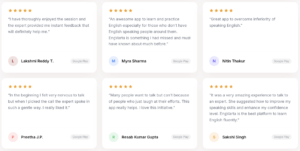
What Our Learners Say
Since 2017, more than 2 million learners across 50+ countries have practised on EngVarta, including a growing community in Chennai and across Tamil Nadu. Having looked at the best English speaking courses in Chennai from both sides — learners and providers — the pattern in the feedback is consistent. The biggest barrier to fluency is almost never grammar or vocabulary. It is fear: of being judged, of making a mistake in front of colleagues, of that pause when you are thinking in Tamil and the English word does not arrive.
The only cure for that fear is doing the thing that causes it, in a space where nobody is scoring you. Read real success stories and reviews from learners who went from avoiding conference calls to leading them. Whichever course you pick, make sure it has you opening your mouth every day. Theory without practice is entertainment.
What Our Learners Say
Rated 4.5★ from 9,100+ reviews on Google Play
Ready to Practice with Real Experts?
You do not have to commit to anything to find out whether this works for you. The trial costs ₹69 and is fully refundable — one real conversation with a TESOL/ESL-certified English Expert, corrections while you are speaking, feedback shared verbally towards the end of the session, and the recording to listen back to. If it is not for you, ask for your money back. If it is, ₹2,700 gets you 25 sessions of 15 minutes each, about ₹108 a session, and you can start tonight from wherever you are in Chennai. The english speaking course that works is the one you actually do.
Frequently Asked Questions ( FAQs )
Q1. What is the typical cost of English speaking courses in Chennai?
Ans : Only two of the five providers publish fees. The British Council publishes ₹20,686 for one 30-hour module and ₹44,798 for three modules totalling 90 hours, which it describes as from about ₹472 an hour. EngVarta publishes a ₹69 fully refundable trial and ₹2,700 for 25 sessions of 15 minutes, or ₹5,130 for 25 sessions of 25 minutes. FITA Academy and EnglishLabs do not publish any fee for spoken English — both ask you to enquire. Aksent publishes a price only for its online beginners course, listed at ₹9,000 as a limited-period offer against a stated ₹12,000, and asks you to contact its admissions team for the Chennai classroom course. Prices circulating on aggregator sites are not on the institutes’ own pages, so ask for the fee in writing before you pay.
Q2. Which online platform is best for spoken English in Chennai?
Ans : It depends on the outcome you want. If you want speaking time, EngVarta — it is entirely live 1-on-1 voice practice with TESOL/ESL-certified English Experts, with corrections during the call, consolidated feedback shared verbally towards the end of the session and recordings you can revisit for 30 days. Experts run 7 AM to midnight IST, which is what makes it workable on the rotating shifts common along the OMR IT corridor. If you want an internationally recognised certificate, British Council Chennai is the online option that ends in one, since its Chennai delivery has been online-only from 16 March 2026. FITA Academy and EnglishLabs both offer live online classes too, but in group batches rather than one-to-one.
Q3. Do I need to join a physical institute to become fluent?
Ans : Not necessarily. A classroom helps most at the very beginning, when you need someone to explain sentence structure and grammar patterns — and if you come from a Tamil-medium background, an institute that explains in Tamil helps more still. But fluency is not taught, it is accumulated through speaking minutes, and that is where classroom formats run out of room: an hour split between five or fifteen learners leaves each person only a few minutes of actual talking. Fifteen minutes of daily one-to-one practice beats a weekly two-hour class you attend twice before the commute or a late meeting ends it.
Q4. How much time does it take to improve spoken English?
Ans : If you already understand English and only hesitate while speaking, there is no fixed timeline, but the sequence is predictable: hesitation drops first in low-stakes conversation, then in prepared professional settings, and last under pressure. Daily frequency shortens that arc more than session length does. For reference, Aksent publishes its Chennai classroom course as 12 weeks, the British Council’s Spoken English level is 90 hours across three ten-week modules, and FITA publishes 60+ hours. The variable that actually decides your timeline is not talent or the institute — it is how many minutes you personally spend speaking each day.
Q5. Are there good English speaking institutes in Anna Nagar?
Ans : Yes. FITA Academy lists an Anna Nagar branch, and EnglishLabs also operates in Anna Nagar. Confirm current batch timings and fees directly with the branch before enrolling, since neither publishes spoken-English fees online. If the commute is the real obstacle, the online options on this list remove it entirely.
Q6. Should I choose online learning or classroom training?
Ans : If you cannot yet form basic sentences, start in a classroom — Aksent for Tamil-medium beginners, FITA or EnglishLabs if you want a centre near your area. Everyone else is usually better served online. The arithmetic is simple: a shared classroom hour gives each learner a few minutes of speaking at best, while a 1-on-1 session gives you all 15, 25 or 50 minutes. Add Chennai’s commutes, rotating shifts and the monsoon, and the format most likely to still be part of your routine in month three is the one you can do from your phone at 11 PM. Many learners get the best result by doing both in sequence: foundations offline, fluency online and daily.
Ready to Practice with Real Experts?
Try EngVarta today — ₹69 trial (India) / $1 trial (International) · 100% refundable