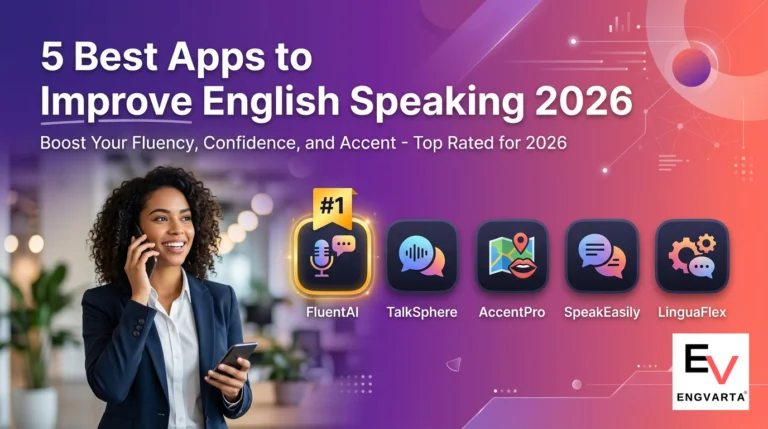
Quick Verdict (2026)Daily live human practice — EngVarta. AI conversation reps — Speak, Loora for business English, Talkpal on a budget. Pronunciation — ELSA Speak. Native-speaker conversation — Cambly. A consistent tutor — Preply. Free practice with real people — HelloTalk or Tandem. Ten apps compared below.
Most people who search for apps to improve English speaking skills have the same profile: you understand English well, you can read it and write it, but when you have to speak — in a meeting, an interview, a phone call — the words stop coming. That is not a knowledge problem. It is a practice problem, and it decides which apps will actually help you.
The uncomfortable truth about this category is that most “English apps” never make you speak. You tap, you type, you match words — and your speaking stays exactly where it was. So this list is built around one question: does the app put words in your mouth, out loud, regularly? The ten below all do, in different ways and at different prices. The order runs from the most speaking per rupee to the least.
Table of Contents [show]
1. EngVarta — Best for Daily 1-on-1 Practice with Live Human Experts
EngVarta is built around one activity: a daily one-on-one call with a TESOL/ESL-certified English Expert. You choose the session length — 15, 25 or 50 minutes — press call, and connect in minutes. The Expert holds a real conversation with you and gives real-time corrections during the call, not a report card afterwards. Every session is recorded, and the recording stays accessible for 30 days so you can hear exactly where you hesitated and what got fixed.
The audio-only format matters more than it sounds: with no camera, most nervous speakers drop their guard faster, and you can practise from anywhere without dressing up a background. Sessions run from 7 AM to midnight IST, every day.
The honest limitations: it is paid — there is a ₹69 refundable trial in India ($1 internationally), and Practice Plans start from ₹2,700 per month (about ₹108 per session; $1.80 per session internationally). Experts are certified Indian professionals, not native speakers — if native accent exposure is specifically what you want, Cambly below serves that better. And it is a practice platform, not a curriculum: you bring the consistency, it brings the conversation.
Best for: learners who understand English but freeze when speaking, and want a human to practise with every single day. You can see how the sessions work here.
2. Speak — Best AI Conversation Partner
Speak is the most polished AI conversation app in the category. You talk out loud to an AI tutor that responds naturally, keeps the conversation moving, and drills you on the phrases you fumbled. Because it is AI, it is available at any hour, never gets impatient, and never makes you feel judged — which is exactly what a hesitant speaker needs for volume practice.
What it cannot do is read you the way a person does. It will not notice that you always steer around the past tense, or that you went quiet because you lacked a word rather than an opinion. In India it runs roughly ₹1,650–2,500 per month depending on plan. Many learners pair it with human practice rather than choosing between them: AI for reps, human for correction.
Best for: building speaking volume without embarrassment, especially before facing real people.
3. ELSA Speak — Best for Pronunciation and Being Understood
ELSA listens to you speak and scores individual sounds, telling you which syllable went wrong and how to fix it. For Indian learners whose English is fluent but who keep being asked to repeat themselves on international calls, this precision is very hard to get from a human — a person will say “say that again”, ELSA will say your /v/ sounded like /w/.
It is a drill tool, not a conversation tool. You repeat words, phrases and short dialogues; you do not hold a discussion. Treat it as a supplement to conversation practice, not a replacement. Plans in India run roughly ₹999–1,499 per month.
Best for: anyone whose problem is clarity and accent rather than confidence or vocabulary.
4. Cambly — Best for On-Demand Native-Speaker Conversation
Cambly connects you to native English speakers over video, on demand, with no booking. Conversations are casual and unscripted, calls are recorded for review, and the tutor pool spans American, British and Australian accents — genuinely useful if you work with those markets.
Two trade-offs. It is priced in dollars — lessons start around $7.99 per 15-minute session — which adds up fast for daily practice from India. And tutors are conversation partners more than trained correctors: some give sharp feedback, many just chat pleasantly. You are paying mostly for native exposure, not structured correction.
Best for: intermediate speakers who want to tune their ear and confidence with native speakers.
5. Preply — Best for a Consistent Tutor and a Goal
Preply is a tutor marketplace: you browse profiles, read reviews, and book repeat lessons with the same teacher. Per-hour rates are set by each tutor, so there is a price for almost every budget. If you are preparing for something specific — an interview, a presentation, an exam — a consistent tutor who remembers your weak spots beats a rotating cast.
The trade-off is friction. You shortlist, schedule, and occasionally switch tutors when one does not fit. For short daily practice the browsing-and-booking overhead gets tiring, which is why marketplaces suit twice-a-week lessons better than daily reps.
Best for: goal-driven learners who want the same teacher every session.
6. Loora — Best AI Tutor for Business English
Loora is an AI English tutor built around open conversation rather than fixed exercises, with a scenario library that leans professional: meetings, negotiations, interviews, small talk with colleagues. If your speaking problem shows up mainly at work, practising the actual situations is worth more than generic chat. Pricing is roughly $15–20 per month.
Like every AI tutor, it is tireless and judgment-free, and like every AI tutor it misses the human read — hesitation, avoidance, the difference between a grammar gap and a confidence gap.
Best for: working professionals who need workplace English reps at odd hours.
7. Talkpal — Best Budget AI Conversation
Talkpal does the same core job as Speak and Loora — spoken conversation with an AI that corrects you — at a lower price, roughly $12–18 per month, with a stronger emphasis on grammar correction in its feedback. The conversation feels slightly less natural than Speak’s, which is the trade you make for the price.
Best for: daily AI speaking reps when the budget is tight.
8. HelloTalk — Best Free Practice with Real People
HelloTalk pairs you with people learning your language: you help them with Hindi or your regional language, they help you with English — text, voice notes, and calls. It is free, and it is real human conversation, which no drill app can replicate.
The catch: your partner is a learner, not a teacher. They may not catch your mistakes, their availability is unpredictable, and conversations can fade. Consistency — the thing that actually improves speaking — is hard to maintain on goodwill alone.
Best for: zero-budget learners who want genuine conversation and accept the inconsistency.
9. Tandem — Best Matching for Language-Exchange Partners
Tandem is the same exchange concept as HelloTalk with a better matching algorithm — you are more likely to find a partner who shares your interests and actually replies. Same fundamental trade-offs: no expert correction, variable partner quality. Free, with paid features around $7–14 per month. Use HelloTalk or Tandem; running both adds nothing.
Best for: exchange learners who could not find a consistent partner on HelloTalk.
10. Duolingo — Best for Habit and Vocabulary (Not Speaking-First)
Duolingo is on this list with an honest caveat: it will not make you a speaker. What it does brilliantly is habit — the streaks, leaderboards and five-minute lessons keep millions of people practising daily who would otherwise do nothing, and it is free. Its speaking exercises are repeat-after-me lines, not conversation.
Use it as the foundation layer: vocabulary and daily contact with English. Then put your actual speaking practice somewhere that makes you talk.
Best for: beginners building vocabulary and a daily habit alongside real speaking practice.
All 10 Apps Compared
| App | Format | Do you actually speak? | Price | Best for |
|---|---|---|---|---|
| EngVarta | 1-on-1 call with certified Expert | Yes — every session | ₹69 trial; from ₹2,700/mo | Daily human practice |
| Speak | AI voice conversation | Yes — with AI | ~₹1,650–2,500/mo | Pressure-free reps |
| ELSA Speak | AI pronunciation coach | Drills, not conversation | ~₹999–1,499/mo | Accent clarity |
| Cambly | Video with native speakers | Yes — on demand | from ~$7.99/15-min | Native exposure |
| Preply | Tutor marketplace, scheduled | Yes — booked lessons | per-tutor rates | Goal + same tutor |
| Loora | AI tutor, business scenarios | Yes — with AI | ~$15–20/mo | Workplace English |
| Talkpal | AI voice conversation | Yes — with AI | ~$12–18/mo | Budget AI reps |
| HelloTalk | Language exchange | Yes — with peers | Free | Zero budget |
| Tandem | Language exchange | Yes — with peers | Free / ~$7–14/mo | Better matching |
| Duolingo | Gamified self-study | Limited | Free | Habit + vocabulary |
How to Actually Improve Speaking with These Apps
Whichever apps you pick, three rules decide whether your speaking improves or stays stuck. First, minutes spoken beats lessons completed — fifteen minutes of actual talking every day will outperform an hour of exercises on Sunday. Second, you need correction from somewhere: pure conversation without feedback fossilises your mistakes, so make sure at least one thing in your stack corrects you, whether that is a human Expert, an AI tutor, or ELSA’s sound-level scoring. Third, two apps are enough — one that makes you speak, one that fills a specific gap like pronunciation or vocabulary. People running four apps usually feel productive while barely speaking at all.
A stack that covers most learners: one conversation app (human or AI) as the core, Duolingo or a vocabulary tool as the free habit layer, and ELSA only if people ask you to repeat yourself.
Frequently Asked Questions
Q1. Can apps really improve English speaking, or do I need a class?
Ans : Apps that put you in real conversation can absolutely improve speaking — the mechanism is the same as a class: speak, get corrected, repeat. What a classroom adds is structure and accountability; what a good app adds is daily frequency at a fraction of the cost. A group class also gives each student only a few minutes of actual speaking time per session, which is exactly what 1-on-1 apps fix.
Q2. Duolingo is free — why is it not enough for speaking?
Ans : Duolingo is genuinely excellent at building vocabulary and a daily habit, and keeping it costs you nothing. But its speaking exercises are repeat-after-me lines, not conversation — you never have to find your own words under time pressure, which is the exact skill speaking requires. Keep Duolingo for the habit; add something that makes you construct sentences out loud.
Q3. Are AI speaking apps as good as practising with a human?
Ans : For volume, yes — an AI partner is available at 2 AM, never judges you, and costs less than any human option. For correction quality, not yet: an AI will fix the sentence you said, but a good human Expert notices the patterns — the tense you always avoid, the topics that make you go quiet — and pushes you into them. The strongest results come from using AI for reps and a human for course-correction.
Q4. Which app should I use if I understand English but freeze when speaking?
Ans : Freezing is a practice deficit, not a knowledge deficit, so pick the option that gets you speaking to a person with the least friction: EngVarta if you want a certified Expert correcting you daily, or Speak if you want to build confidence with an AI before facing a human. Avoid solving it with more grammar study — that is the one approach guaranteed not to work.
Q5. What is the difference between Cambly, Preply and EngVarta?
Ans : All three connect you to a human. Cambly is on-demand video with native speakers — best for accent exposure, priced in dollars. Preply is a marketplace where you pick one tutor and book scheduled lessons — best for a specific goal like an interview. EngVarta is daily 1-on-1 audio practice with certified Indian Experts and real-time correction — built for frequency rather than curriculum. The right pick depends on whether you need exposure, structure, or daily reps.
Q6. How many minutes a day do I need to speak to improve?
Ans : Fifteen focused minutes of actual speaking per day is the realistic floor, and most learners notice less hesitation within four to six weeks at that rate. The metric that predicts improvement is minutes spoken per week, not lessons finished — an hour once a week loses to fifteen minutes daily, because speaking is a motor skill and motor skills need frequency.
Q7. Which apps work for Indian learners on a small budget?
Ans : Fully free: HelloTalk or Tandem for real conversation plus Duolingo for vocabulary — workable if you can tolerate inconsistent partners. First paid step: ELSA at roughly ₹999–1,499 a month if clarity is your gap, or Talkpal for budget AI conversation. For daily human practice, EngVarta starts at ₹69 for a refundable trial session, then from ₹2,700 a month — about ₹108 per session, which is the cheapest daily human correction available in India.
Found this useful? Add EngVarta as a preferred source on Google — you’ll see more of our English lessons in your Search and AI results.







1 Comment
Comments load on demand to keep this page fast.
Read & add comments