Format, pricing, tutor model, and scheduling — the four factors that decide which platform fits your goals. Plus where each one falls short.
Quick Verdict
Quick VerdictChoose Cambly for on-demand native-speaker video conversation. Choose italki for scheduled lessons with a named tutor. If your goal is affordable daily English speaking practice in India, EngVarta is the stronger fit because it is built for frequent live audio reps.
Why this verdict:
Cambly is built for spontaneous video conversation practice with native speakers — its strength is availability and accent variety, not structured curriculum.
italki is built for tutor-student relationships with named tutors, scheduled lessons, and customisable curriculum across 150+ languages.
The trade-off is not “which is better” — it is “which friction do you accept”: Cambly’s per-session pricing that compounds with daily use, or italki’s scheduling and tutor-search overhead.
Practice fit:
Best for: Adult learners deciding between two paid English-practice platforms, prioritising live human conversation over AI scenarios.
Practice focus: Both platforms cover spoken fluency, accent exposure, and conversation flow. Differ on structure, scheduling, and pricing model.
Not ideal for: Learners on a daily-rep budget — both platforms cost more per practice hour than purpose-built daily-practice apps designed for that volume.
How Cambly and italki actually compare on the four factors that matter
Most “Cambly vs italki” comparisons stop at pricing. That misses the four factors that actually decide fit: format, tutor model, scheduling, and the per-hour math when you scale to daily practice.
Factor 1 — Format: video versus video, but different rhythms
Cambly is video-first by design. You open the app, see available tutors, tap to start a call. Most sessions are 15 or 30 minutes. The format prioritises spontaneity — you do not plan ahead.
italki is also video-based, but the rhythm is scheduled-lesson, not on-demand. Sessions are typically 30 or 60 minutes. You book a slot, the tutor prepares (sometimes lesson plans, homework, slides), and the lesson runs to a structure.
Practical implication : if you want to grab a 20-minute conversation right now, Cambly fits. If you want to know your tutor will work through Module 4 of your CEFR B2-targeted curriculum on Thursday at 7 PM, italki fits.
Factor 2 — Tutor model: native marketplace vs tiered marketplace
Cambly’s tutor pool is predominantly native speakers from the US, UK, Canada, Australia, and Ireland. Cambly does not require formal teaching credentials (no TEFL/TESOL requirement) for most tutors — the pool is closer to “conversational native speakers” than “trained teachers.” Some are excellent communicators; some are not. There is a separate “Cambly Pro” tier where tutors are vetted for specific use cases like interview prep and business English, priced at a premium.
italki’s tutor pool is structured in two formal tiers : Professional Teachers (formal TEFL/TESOL or equivalent teaching credentials required) and Community Tutors (conversational partners, no credential required). italki covers 150+ languages, English being one. Pricing reflects the tier — Professional Teachers cost more per lesson than Community Tutors.
Practical implication : Cambly gives you native variety with variable teaching skill. italki gives you a clearer credential filter — if you want a verified teacher, italki’s Professional tier signals that explicitly. The trade-off: italki’s Community Tutors are not screened for teaching ability, only for being a native or fluent speaker of the target language.
Factor 3 — Scheduling: on-demand vs booked-ahead
This is the largest functional difference, and most learners underweight it.
Cambly is on-demand. You see available tutors, tap, call. If your usual tutor is offline, another is usually available.
italki is booked-ahead. You browse tutor profiles, book a specific slot, the tutor confirms, you show up at the scheduled time. Cancellations require advance notice.
Practical implication for daily-rep learners: scheduling friction is the single biggest predictor of whether a daily-practice plan survives Week 2. italki’s booking model adds enough decision friction that most learners settle into a weekly cadence, not daily. Cambly’s on-demand model removes that friction but introduces a different one — you might not get the same tutor twice in a row, breaking continuity.
Factor 4 — Per-hour math at daily-practice volume
Pricing models are different shapes, so a direct number-to-number comparison is misleading. Here’s how the math actually works out for daily practice:
Cambly uses tiered subscriptions:
Cambly Private+ (standard, 1-on-1): roughly $11+ per 30-min session
Cambly Pro (vetted specialty tutors): roughly $16–$18 per 30-min session
Subscriptions auto-renew until cancelled
For daily 30-min practice across 30 days, Private+ runs ~$330/month; Pro runs ~$480–$540/month.
italki uses per-lesson pricing set by each tutor:
Community Tutors (English): $4–$20 per lesson per italki’s own published rates
Professional Teachers (English): $10–$40 per lesson per italki’s own published rates
Pay-as-you-go, no recurring subscription
For daily 30-min practice across 30 days at typical $10/lesson (Community) or $18/lesson (Professional), italki runs $300–$540/month.
Both platforms are designed for weekly or twice-weekly practice. Neither is structured to make daily practice economically sustainable for most learners.
Where Cambly is the better choice
Pick Cambly if:
You want video conversation practice with native speakers and value the spontaneity of on-demand calls.
You are already conversationally fluent and want accent exposure, cultural register practice, or refinement — not curriculum-driven lessons.
You have specific use cases (interview prep, business English) where Cambly Pro’s vetted tutor pool justifies the higher per-session price for 2–4 high-stakes sessions.
Per-session pricing is not a constraint on your budget and you don’t plan daily practice.
Long-term tutor continuity (the on-demand pool churns, your favourite tutor may not be available)
Structured curriculum (Cambly is conversation-led, not lesson-plan-led)
Subscription auto-renewal (some learners have been surprised by silent renewals)
Where italki is the better choice
Pick italki if:
You want a long-term relationship with a named tutor and weekly scheduled lessons.
You value structured curriculum, homework, and progress tracking.
You are learning multiple languages and want one platform for English plus Spanish, German, French, Mandarin, or any of 150+ languages.
You want a clearer credential filter (italki’s Professional Teachers carry formal teaching credentials).
You’re preparing for an exam (IELTS, TOEFL, business English certifications) and want tutors who specialise in that area.
Where italki tends to struggle:
Daily-practice frequency (the scheduling model resists daily reps for most learners)
Tutor consistency (if your tutor cancels or their internet drops mid-session, you re-book and lose momentum)
Community Tutor variance (the lower tier has no teaching-credential requirement, so quality varies significantly)
Pricing at daily volume (per-lesson rates compound quickly when scaled to 30 lessons per month)
What both platforms share — and where neither is ideal
Both Cambly and italki are paid live-human English practice. Both have legitimate user bases. Both work better than AI scenario apps for fluency outcomes.
Neither is built specifically for daily 15-minute reps on a working-professional budget. That is a different product shape — voice-only (not video) for lower friction, on-demand (not booked) for daily reps, per-15-minute pricing (not per-hour) for daily-practice sustainability, and TESOL/ESL-certified Experts as the default tier (not optional premium tier). Platforms purpose-built for that use case (like EngVarta) target a specific learner segment that Cambly and italki do not serve well.
If you are deciding between Cambly and italki specifically, this guide stays neutral — the right answer depends on your scheduling style and budget. If you are deciding between Cambly, italki, and a daily-rep platform, the daily-rep math reframes the decision.
How we chose
We compared each platform on five factors: format (video vs audio, on-demand vs booked), tutor model (native marketplace vs tiered marketplace), scheduling friction, pricing at daily-practice volume, and structured-curriculum support. Pricing was checked against each platform’s public page in May 2026. Tutor-pool descriptions are sourced from each platform’s own public documentation and learner-review aggregations (Trustpilot, Reddit r/languagelearning, italki community forums).
FAQs : Cambly vs italki for English Speaking Practice
Q1. Which is cheaper for daily practice, Cambly or italki?
Ans : Neither is genuinely cheap for daily practice. Cambly Private+ runs around $330/month for daily 30-min sessions. italki at $10/lesson Community Tutor runs around $300/month for daily 30-min sessions. Professional Teachers on italki ($18+/lesson) run $540+/month. Both platforms are economically designed for 2–3 sessions per week, not daily. For daily-rep volume, a per-15-minute-priced platform fits better than either.
Q2. Are italki Community Tutors as good as Professional Teachers?
Ans : Variable. Community Tutors are native or fluent speakers without required teaching credentials. Some are excellent conversation partners; many are not trained to systematically diagnose your weak spots or coach corrections. Professional Teachers hold formal TEFL/TESOL credentials and are more consistent in delivering structured teaching. If you specifically want trained instruction, filter for Professional Teachers; expect the price to roughly double.
Q3. Does Cambly auto-renew my subscription?
Ans : Yes. Cambly uses a recurring subscription that auto-charges your card until you cancel. Multiple user reports flag surprise renewals as a friction point. Set a calendar reminder before your billing date if you intend to cancel. italki is pay-as-you-go per lesson, so this concern does not apply on italki.
Q4. Can I use both Cambly and italki together?
Ans : Yes, and some serious learners do. A common pattern: italki for weekly structured lessons with a named tutor (curriculum + homework), Cambly for between-lesson conversation practice with whoever is available (low-friction spontaneous reps). The combination costs more than either alone but produces faster progress than either in isolation. Whether the combined cost is worth it depends on your budget and pace.
Q5. Which is better for accent-specific practice — US, UK, or Australian English?
Ans : Cambly’s native-speaker pool is wider and accent-tagged, making it easier to find a US, UK, Canadian, or Australian tutor specifically. italki has native-speaker tutors across all major English accents but the pool is more fragmented across the marketplace. For accent-specific practice, Cambly’s discovery is faster.
Q6. Is Cambly or italki better for daily English practice in India?
Ans : Both work, but the math is hard at daily-rep volume. Cambly Private+ at ₹27,000+/month for daily 30-min sessions and italki Community Tutors at ₹25,000+/month do not match what most Indian learners budget for daily practice. EngVarta is built for the Indian daily-practice price point: ₹2,700 for 25 sessions of 15-min, with the same live-human-listener model. Choose Cambly or italki if you want a specific accent or curriculum; choose EngVarta if you want daily reps at Indian-market pricing.
Q7. When should I choose EngVarta instead of Cambly or italki?
Ans : Choose EngVarta when (a) you want daily 15-minute live audio reps, not weekly 30-minute video lessons; (b) your goal is response-time and confidence, not accent neutralisation; (c) you are in India or a market where the per-lesson math on Cambly or italki does not fit your budget; (d) you want TESOL/ESL-certified Experts at Indian-market pricing.
Q8. Which option is better for learners who do not want video calls?
Ans : EngVarta. Both Cambly and italki are video-first — the camera adds appearance anxiety on top of speaking anxiety for many learners. EngVarta is audio-only by design, which removes the camera overhead and lets practice land on the speaking layer specifically. If you have repeatedly avoided live tutoring because of the video element, audio-only is the easier first step.
Q9. What happens if my italki tutor cancels at the last minute?
Ans : You re-book the slot with a different tutor or reschedule with the same tutor depending on the cancellation reason and italki’s policy. Cancellations are a known pain point in italki user threads — the platform’s marketplace model means your booked slot is dependent on the individual tutor’s availability and connection quality. Cambly’s on-demand model avoids this specific failure mode but introduces tutor-continuity variability.
How this guide was compiled (methodology)
This comparison is built from public pricing documentation on each platform’s website (checked May 2026), aggregated learner reviews on Trustpilot and Reddit r/languagelearning, and direct comparison of tutor-pool characteristics from each platform’s own public credential descriptions. We did not run user-side comparisons (because we operate a competing English-practice platform). Treat this as a structural comparison of platform models, not a head-to-head learner-outcome study.
Author
Reviewed by Rishish Pandey — Co-founder and CTO, EngVarta.
Quick VerdictBusuu is a self-paced multi-language lesson app with a unique community-correction feature for your written exercises — useful for vocabulary input, grammar drills, and people who want to dabble in Spanish or French alongside English. EngVarta is a live 1-on-1 spoken practice platform with TESOL or ESL-certified English Experts who correct you in real-time during the call. These are different categories. Use Busuu for written and grammar layer; switch to EngVarta the moment you need to actually speak.
If you’ve searched “EngVarta vs Busuu,” you’re probably partway through a Busuu subscription and noticed something — your reading and grammar have improved, but actually opening your mouth to speak English with another human still feels like a freeze-up. That’s not a Busuu failure. It just isn’t what Busuu was built for.
This is an honest, 2026-current comparison between two tools often lumped together as “English learning apps” but actually living in two different worlds. Busuu is a lesson-and-community platform. EngVarta is live English coaching with certified Experts. Full disclosure — this is written by EngVarta’s co-founder. We’ll be direct about where Busuu is genuinely the better choice, and equally direct about where it stops short for spoken-fluency goals.
Why this comparison matters
Busuu and EngVarta both show up in “best apps to learn English” listicles, so people search them side-by-side. But the moment you actually compare what they do, the differences are structural — not just feature gaps.
Busuu is a Chegg-owned, European-rooted lesson app covering twelve-plus languages with a clever twist: when you write something in your target language, native speakers from Busuu’s community can correct it back to you. English is one of those languages, not the only one. The app’s strengths are vocabulary drills, grammar lessons, written practice, and AI-powered speaking exercises where you repeat or respond to prompts.
EngVarta is a live spoken English practice platform. You open the app, tap to request a session, and you’re connected in minutes to a TESOL or ESL-certified English Expert for a 15, 25, or 50-minute call. The Expert corrects you in real-time during the conversation and shares consolidated feedback towards the end of the session. There is no skill tree, no lesson path, no community wall. The product is the conversation itself.
So the actual decision isn’t “which is better.” It’s “which problem am I solving right now?” If your problem is “I don’t know enough English words and grammar patterns yet,” Busuu probably belongs in your routine. If your problem is “I know the words but I can’t string them together when a human is waiting for me to answer,” that’s a different problem — and you need live spoken practice with a real Expert, not more lessons.
How EngVarta is different from Busuu
Live spoken conversation vs text-first lessons with AI speaking drills
Busuu’s bread and butter is text. You see a sentence, you translate it, you fill in a blank, you build vocabulary through reading exposure. There are AI-powered speaking exercises woven in — you respond to a prompt, the speech recognition scores you — but the dominant medium is the screen, not your voice. The “speaking” in Busuu is closer to oral pronunciation drills than to conversation.
EngVarta is the inverse. Every session is a voice-only call with a live human Expert, with no scripted lesson on the other side. You bring the context — “I have an interview Thursday, let’s roleplay it” or “I want to talk about my weekend so I get comfortable with past tense in real conversation” — and the Expert adapts. The session is unscripted, which is the entire point. Real fluency is built by producing English under unpredictable conditions, not by repeating sentences you can see on a screen.
TESOL or ESL-certified human Expert vs community-corrected written exercises
Busuu’s community-correction feature is genuinely interesting — when you write a sentence or paragraph as part of an exercise, the platform queues it up for native speakers in the community to mark up. You get feedback from someone whose first language is English. It’s a nice idea, and for written practice, it works.
But “native speaker” is a self-declared label on Busuu, not a teaching credential. The 17-year-old in Manchester whose phone language is set to English is on the same correction queue as the retired ESL teacher in Toronto. Their corrections can both be technically correct yet wildly different in pedagogical helpfulness. One says “this is wrong, here’s the right way.” The other says “I’d never write it like that but I’m not sure why.” That variance is the structural challenge with community-driven feedback.
EngVarta’s pool is gated. Every Expert holds TESOL or ESL certification. That doesn’t mean every Expert is a native speaker — and that’s a feature, not a bug. Certification is a consistency floor: the Expert knows how to spot common grammar patterns in non-native speech, knows how to correct without breaking the learner’s confidence, and knows what to say when you stumble. Native-speaker tag alone gives you none of that.
Real-time corrections during the call vs async community feedback (hours or days)
This is the differentiator that matters most for spoken fluency. On Busuu, you write something, you submit it, and you wait. Maybe a community member corrects you in twenty minutes. Maybe two days. Maybe never (lower-traffic language pairs have slower correction loops). By the time you see the correction, you’ve forgotten the mental state you were in when you made the mistake. The lesson lands flat.
On EngVarta, the correction happens inside the same sentence where the mistake was made. You say “I am going to office yesterday” — and the Expert stops you, points out the tense conflict, has you say it again, and moves on. That immediacy is everything in spoken practice. Your brain still has the wrong sentence loaded; the correction replaces it before it can re-encode. Async feedback can never do that, no matter how thoughtful.
Towards the end of the session, the Expert shares consolidated feedback summarizing the patterns they caught — common tense errors, pronunciation tendencies, filler word habits — so you walk away with something to work on. That’s structured coaching from a certified Expert, not after-the-fact pen marks on something you wrote two days ago.
Per-session pricing flexibility vs locked-in subscription
Busuu is subscription. You pay monthly or annually, and the app keeps debiting whether you opened it that month or not. That’s standard for app-based language tools — and it works fine if you use the app daily.
EngVarta uses a one-time payment per plan. You pick the session length (15, 25, or 50 minutes) and the number of sessions (25, 50, 75, 150, or 300), pay once, and use them within the validity window. No auto-debit. No “whoops, I neglected to cancel.” If you cease using the plan, nothing willcontinue to charge your card. For learners who suspect their consistency might wobble — which honestly is most learners — that structure is psychologically lighter than a subscription clock.
Where Busuu is genuinely better
This is where most comparison posts get dishonest. Let’s not. Busuu has real strengths and a real fit for the right learner.
Multi-language access on one subscription
If you’re learning English but also want to dabble in Spanish, French, or German — or you’re a polyglot juggling three languages at once — Busuu’s Premium covers them all on one subscription. EngVarta focusesonasingleaspect:practicingspoken English. We don’t offer any other language. If multi-language exposure on one platform matters to you, that’s a genuine Busuu win and we won’t pretend otherwise.
The community-correction feature for written exercises
Most language apps don’t have anything like this. The fact that you can write a paragraph in English and have it marked up by someone whose first language is English — for free as part of the app — is a genuinely unique feature. It works particularly well for early-stage learners who are still building written competence and need varied feedback on small written assignments. EngVarta doesn’t replicate this and isn’t trying to.
Lower commitment and lower price if you don’t need live speaking practice
Busuu Premium typically runs around $14 per month or about $70 per year (verify current rates on busuu.com — pricing shifts regionally). For pure self-paced lesson access, that’s reasonable. If your goal genuinely doesn’t involve real-time spoken conversation — if you’re prepping for a written exam, learning vocabulary for travel, or supplementing a school course — Busuu’s price tag is lighter than maintaining live Expert sessions.
EngVarta’s plans start at ₹2,700 for 25 sessions of 15 minutes in India (around ₹108 per session) or $45 for the equivalent plan in USD markets (around $1.80 per session). If you’re not going to use the live sessions, that money is wasted. Busuu’s “always-on, use-when-you-want” model has lower stakes if your speaking practice is irregular.
Self-paced — no scheduling or session-booking pressure
Open the app, do a lesson, close the app. No booking, no waiting, no other human involved. For learners with chaotic schedules — frequent travel, irregular shifts, parenting young kids — that low overhead is genuinely valuable. EngVarta is on-demand from 7 AM to midnight IST and you connect in minutes (you don’t book a slot in advance) but it still requires a free 15-to-50 minute window where you can hold a phone call. Busuu requires zero such window.
Where EngVarta wins for the speaking learner
Speaking practice IS the product, not a side-feature
On Busuu, speaking is one feature among several — alongside vocabulary, grammar, reading, and written exercises. You can complete a Busuu lesson without ever speaking out loud. On EngVarta, you can’t complete a session without speaking — because the session is the speaking. Every minute of an EngVarta plan is a minute of producing English with a human listener on the other end. There’s no way to “phantom progress” through it the way you can on a tap-based lesson app.
That matters because spoken fluency is a motor skill, not just a knowledge skill. You don’t get fluent by knowing more vocabulary — you get fluent by producing sentences under conversational pressure until your mouth stops freezing. Busuu can teach you the words. Only a live human listener can teach your nervous system to produce them in real time.
A human Expert hearing and correcting in the moment
This is the part Busuu’s community feedback simply cannot do. When you speak to an EngVarta Expert, they hear your hesitation, your filler words (“uh,” “matlab,” “you know”), the exact consonant cluster that trips you up, the moment your eyes go wide because you’ve lost the next word. They correct what they hear, in the moment. A written correction queue — no matter how good — operates on a different timescale and on a different medium. It can’t fix what it never heard.
Community correction doesn’t work for spoken language
The community-correction model is trulyeffective for written tasks. It cannot work for spoken practice — and Busuu doesn’t pretend otherwise. Even if it tried, you’d be uploading audio recordings of yourself speaking, hoping a community member is online and willing to listen, getting feedback hours or days later in a format your brain can’t easily re-correlate with the original mistake. Live, in-the-moment, expert-led conversation is the only model that scales for speaking. EngVarta is built around that model. Busuu isn’t.
Daily-practice pricing model that actually supports daily practice
Twenty-five sessions at around ₹108 per session in India, or $1.80 per session in USD markets, is affordable for daily use. That’s the math that turns “I should practice English” into “I have 25 sessions on this plan and I should burn through them.” Subscription apps don’t have that pressure loop — you’d open them anyway because they’re paid for, but there’s no completion metric pulling you back in. EngVarta’s plan structure makes daily live spoken practice financially sustainable, which is the prerequisite for it being culturally sustainable as a habit.
Indian cultural awareness in the Expert pool
Busuu is a European-origin platform with a global community. The native speakers correcting your writing might be from anywhere — London, Sydney, Lagos, Iowa City. That diversity is fine for general English exposure but it means the corrector likely has no sense of an Indian workplace context. A phrase that’s perfectly normal in California can land as awkward, overly direct, or culturally off in a Mumbai meeting — and vice versa. EngVarta’s Experts work daily with Indian learners and bridge both contexts. That’s not something a global community queue can replicate.
Voice-only by design, works on patchy networks
EngVarta sessions are voice-only — no video, no need to be camera-ready, no “let me find a quiet corner with good lighting” overhead. You can take a session during a lunch break, on a walk, sitting in a parked car. Internet is needed to open the app and request the session, but the call itself can come over a regular telecom phone line with your number kept private. That makes it usable in Tier 2 / Tier 3 city homes with patchy Wi-Fi, in college hostels, and in workplace environments where video would be impossible. Busuu’s lessons require steady internet for the app to function; EngVarta’s call layer is more resilient to network conditions.
Complementary use — Busuu for written and grammar, EngVarta for spoken
The cleanest way to think about Busuu and EngVarta: they’re at different layers of the same fluency pipeline. Busuu builds the input — vocabulary, grammar pattern recognition, written competence, reading comprehension. EngVarta builds the output — producing English out loud, under live conversational pressure, with someone listening and correcting.
A realistic learner using both might do 15 minutes of Busuu in the morning — work through a lesson, get a written exercise corrected by the community by evening — and then a 15 or 25-minute EngVarta session a few hours later, where they actively try to use the vocabulary Busuu introduced earlier. The two reinforce each other. The Busuu lesson plants the seed; the EngVarta call forces you to actually speak the seed out loud, which is when it sticks.
The pattern is consistent: lesson apps build recognition; live Expert-led conversation builds production.
How EngVarta helps when you need live spoken English coaching
If you’ve reached the point in your Busuu journey where you can read English news, follow most movies, and pass written tests — but you freeze the moment someone asks you a question in person — that gap is what EngVarta is built to close.
You open the EngVarta app, set the topic you want to practice (interview prep, casual conversation, presentation rehearsal, client-call simulation — whatever), choose a session length, and request a session. Connect in minutes with a TESOL or ESL-certified Expert. The Expert engages you in unscripted conversation around your chosen focus, corrects mistakes in real-time during the call, and gives you consolidated feedback towards the end. Every session is recorded and accessible for 30 days, so you can listen back to specific stumbles and corrections.
The trial is ₹69 in India or $1 internationally, 100% refundable — so you can test whether live spoken practice actually shifts something for you before committing to a plan. Most learners find the difference between “doing a lesson” and “having a conversation” lands within the first session.
You’re an early-stage learner still building basic vocabulary and grammar from scratch
You want to learn multiple languages on one subscription (English plus Spanish, French, German, etc.)
You value asynchronous community feedback on written exercises
Your goal is reading and writing competence more than spoken fluency
You have an erratic schedule and can’t reliably commit to a 15-to-50-minute call window
Your budget is tight and you don’t need live speaking practice yet
Pick EngVarta if:
You can read and write English reasonably well but freeze when you try to speak
You’re preparing for an interview, client call, presentation, or any spoken-English scenario
You want real-time corrections from a TESOL or ESL-certified Expert, not async community feedback
You want structured coaching from a certified Expert without paying native-speaker premium rates
Voice-only practice fits your day better than video tutoring (camera-ready overhead, network requirements)
You want a per-plan one-time payment model instead of an auto-renewing subscription
Indian cultural context awareness matters to you (workplace English, family English, regional sensitivity)
Pick both if:
You’re serious about building full English competence — reading, writing, listening, AND speaking
You have budget for one input-layer app plus one live speaking practice tool
You’d benefit from Busuu’s vocabulary drills in the morning and an EngVarta call in the evening to actually use what you learned
Pricing side-by-side (2026) : EngVarta vs Busuu
The models don’t map directly — one is a subscription for self-paced lessons, the other is a session-based plan for live Expert sessions — but here’s the honest breakdown:
Aspect
Busuu
EngVarta
Free tier
Yes (limited lessons)
No (refundable trial)
Paid tier
Premium ~$14/month or ~$70/year (verify on busuu.com)
Plans from ₹2,700 / $45 for 25 × 15-min sessions
Cost per live session (India)
N/A (no live sessions)
~₹108 per session (entry plan)
Cost per live session (USD)
N/A (no live sessions)
~$1.80 per session (entry plan)
Trial
Free tier exists; Premium often has a 7-day Premium trial
₹69 / $1 trial, 100% refundable
Format
Self-paced app lessons + community-corrected written exercises + AI speaking drills
Live 1-on-1 voice-only call with a certified human Expert
A note on the price gap framing: it’s tempting to read this table as “Busuu is cheaper, EngVarta is premium.” That’s not quite right. They’re different products. Busuu is a content library you tap through. EngVarta is a service where a certified human is on the other end of every minute you use. The price reflects the difference in delivery model, not a “premium tier” of the same product. A learner who only needs lesson content shouldn’t pay for EngVarta. A learner who needs spoken fluency shouldn’t expect Busuu’s price to buy them that — no app priced for self-paced lessons can deliver live human Expert time at scale.
The honest answer
If you’re early in your English journey and need vocabulary, grammar, and reading exposure — start with Busuu. The community-correction feature is unique and the multi-language access is genuinely useful if you’re a polyglot. Spend a few months there. Build the foundation.
But the moment you find yourself understanding English well enough to follow conversations but freezing when you try to speak — that’s when Busuu has done its job and EngVarta becomes the next tool. Self-paced apps can build recognition. They can’t build production. Production requires a live human Expert correcting you in the moment. There’s no app workaround for that.
Many of EngVarta’s most consistent learners use Busuu, Duolingo, or other input-layer apps in parallel — see also our EngVarta vs Cambly comparison for how live spoken practice compares to higher-priced video tutoring platforms, and our roundup of the best English speaking platforms for daily practice in 2026. The pattern across thousands of learners is consistent: input apps build the words; live conversation builds the confidence to use them.
Pick the tool that matches the bottleneck you’re currently stuck at. If it’s vocabulary, Busuu. If it’s speaking, EngVarta. If it’s both, use both — they don’t conflict, they compound. And if you want to test whether a session with a certified Expert actually moves the needle for you, the ₹69 / $1 refundable trial is designed to make that decision low-stakes.
Is EngVarta a better Busuu alternative for English speaking?
For spoken English specifically, yes — but that’s because they’re different categories, not because EngVarta is “the upgraded version of Busuu.” Busuu is a self-paced lesson app with community-corrected written exercises and AI speaking drills. EngVarta is live English coaching with TESOL or ESL-certified Experts on real voice calls. If your bottleneck is speaking out loud under conversational pressure, EngVarta directly addresses it; Busuu’s design doesn’t.
Is Busuu Premium worth it for English learners?
If you’re an early-to-intermediate learner who values vocabulary drills, grammar lessons, and community-corrected written practice — and especially if you also want exposure to other languages on the same subscription — Busuu Premium can be a reasonable investment. If your goal is purely spoken English fluency and you already know basic vocabulary, the money is better spent on live spoken practice. Check current Busuu pricing on busuu.com because their rates shift regionally.
How does Busuu’s community correction compare to a live tutor?
Busuu’s community correction is asynchronous and works only on written exercises — you submit text, a native speaker from the community marks it up hours or days later. It’s good for written practice but cannot help with spoken fluency. A live English Expert on EngVarta corrects you in real-time during a voice conversation, in the same sentence the mistake happened. The two operate on different timescales and different mediums. Use community correction for written work; use live Expert sessions for spoken work.
Can I use Busuu and EngVarta together?
Yes, and many serious learners do. Busuu handles the input layer — vocabulary, grammar, written practice. EngVarta handles the output layer — live conversation with real-time Expert corrections. They don’t overlap so they don’t waste money. A common pattern: 15 minutes of Busuu in the morning for vocabulary intake, a 15 or 25-minute EngVarta call in the evening to actively practice using what was introduced earlier.
Does Busuu offer live English tutors like EngVarta does?
Busuu’s core model is self-paced lessons plus async community correction. They have occasionally piloted or partnered for additional services like Live group classes in certain markets, but live 1-on-1 spoken English practice with certified Experts is not Busuu’s core product. If you want structured coaching from a certified Expert with real-time corrections during the call, that’s specifically what EngVarta is built for.
What does EngVarta cost compared to Busuu Premium?
Busuu Premium runs around $14 per month or about $70 per year (verify current rates on their site). EngVarta’s entry plan is $45 for 25 × 15-minute live Expert sessions in USD markets, or ₹2,700 for the same plan in India (around ₹108 per session). The 25 × 25-minute plan is $85 / ₹5,130 (around $3.40 / ₹205 per session). They’re different categories — Busuu pays for self-paced lesson content access, EngVarta pays for time with a certified human Expert.
How quickly can I expect to see improvement in spoken English on EngVarta?
Most learners report noticeable confidence gains within the first 10–15 sessions of consistent live spoken practice. Real fluency takes longer and depends on starting point, session frequency, and the focus areas you discuss with your Expert. The advantage of session-based pricing is that you can pace your investment — start with a 25-session plan, see how it goes, decide whether to renew.
What Our Learners Say
Rated 4.5★ from 9,100+ reviews on Google Play
★★★★
A very good app its just as good as shown in the advertisement,but I wish it would have been a bit cheaper,
★★★★★
Wonderful app provide experts to talk but but so much time constraints in talking..
★★★★★
Excellent application to improve your communication skills.Thnk you for introducing new vocabulary everyday.God bless you You might not aware of but personally this is helping me a lot
★★★★★
It is a very nice app. The expert whom I talked to is very amiable and very knowledgeable.
★★★★★
This is very amazing apps. AI working system and it is very effective to practicing and also every day i have practice in the apps. As a begainner, i think it is very helpful for me.
★★★★★
Excellent platform for people who don’t find any people to speak in English. Live experts help to build confidence while speaking and guiding to improve your communication!
★★★★★
best app for English communication. I have tried lots of English speaking apps till date. but all have some dra backs. but this is really awesome experience of mine. best teachers and best app. 💯
★★★★★
An excellent platform to enhance communication skills. Kudos to the team.
★★★★★
Don’t take that, it’s a good application during the trails calls only. After the buying the plans no refund option and no experts available on your schedule time.
★★★★★
It's a great place to learn and practice English Fluency..here you get a chance of one on one communication with experts.. They'll guide you throughout your learning journey..I recommend this platform to all who want to gain fluency with knowledge.
★★★★★
Thank u so much @engvarta it is very good for learning English daily I learn new words daily I get new vocabulary again thnxx again 👍🏻👍🏻
★★★★★
I find the app very helpful and user friendly. The UI design is very soothing for eye. Students can get good benefit out of it if they regularly use it to practise their spoken English. Good luck to the app team for building a professional app for the greater good.
★★★★
A very good app its just as good as shown in the advertisement,but I wish it would have been a bit cheaper,
★★★★★
Wonderful app provide experts to talk but but so much time constraints in talking..
★★★★★
Excellent application to improve your communication skills.Thnk you for introducing new vocabulary everyday.God bless you You might not aware of but personally this is helping me a lot
★★★★★
It is a very nice app. The expert whom I talked to is very amiable and very knowledgeable.
★★★★★
This is very amazing apps. AI working system and it is very effective to practicing and also every day i have practice in the apps. As a begainner, i think it is very helpful for me.
★★★★★
Excellent platform for people who don’t find any people to speak in English. Live experts help to build confidence while speaking and guiding to improve your communication!
★★★★★
best app for English communication. I have tried lots of English speaking apps till date. but all have some dra backs. but this is really awesome experience of mine. best teachers and best app. 💯
★★★★★
An excellent platform to enhance communication skills. Kudos to the team.
★★★★★
Don’t take that, it’s a good application during the trails calls only. After the buying the plans no refund option and no experts available on your schedule time.
★★★★★
It's a great place to learn and practice English Fluency..here you get a chance of one on one communication with experts.. They'll guide you throughout your learning journey..I recommend this platform to all who want to gain fluency with knowledge.
★★★★★
Thank u so much @engvarta it is very good for learning English daily I learn new words daily I get new vocabulary again thnxx again 👍🏻👍🏻
★★★★★
I find the app very helpful and user friendly. The UI design is very soothing for eye. Students can get good benefit out of it if they regularly use it to practise their spoken English. Good luck to the app team for building a professional app for the greater good.
Reviewed by Rishish Pandey, Co-founder & CTO, EngVarta. Last updated 2026-05-12.
Pricing accurate as of 2026-05-12; verify current rates on the EngVarta app and on busuu.com.
Quick VerdictBabbel is a self-paced, multi-language lesson app that is genuinely strong at vocabulary, grammar drills, and scripted dialogue exposure — useful if you also want to dabble in Spanish, German, or French. EngVarta is a live 1-on-1 spoken English practice platform where you talk with a TESOL or ESL-certified Expert and get real-time corrections during the call. They are not competitors — they solve different parts of fluency. Use Babbel for input (vocabulary + grammar exposure); switch to EngVarta when you need to actually speak English under real conversational pressure.
If you are comparing EngVarta vs Babbel, you have probably already tried at least one app and felt something is missing. Maybe Babbel taught you a lot of phrases but you still freeze in a real meeting. Maybe you are eyeing live English coaching but want to understand whether a structured lesson app could be enough.
Babbel is a well-engineered product, excellent at one specific job: feeding your brain new vocabulary and grammar patterns through bite-sized, gamified lessons. EngVarta is built for the opposite job — taking what you already know and helping you produce it out loud, with a real human Expert listening on the other side of the line. By the end of this comparison you should know which one fits your current stage, and why the most fluent learners often use both.
Why this comparison matters in 2026
Babbel is one of the more recognisable language-learning brands in the world. Its English course is part of a 14-language catalogue, and learners from India, the UAE, and the wider South Asian diaspora pick it up for brand recognition and a clean app experience.
The problem starts when learners assume that finishing a Babbel English course will translate into holding a confident client call, delivering a stand-up, or interviewing in English. Spoken fluency is a motor skill — it needs reps under real-world pressure with a human who can hear you, push back, and correct you. App lessons prime your brain with raw material, but the conversion from “I know this phrase” to “I can produce it confidently in a meeting” only happens through actual speaking, in front of someone who corrects you. That is why live English coaching with a TESOL or ESL-certified Expert exists as a category of its own.
How EngVarta is different from Babbel
Live human conversation, not scripted dialogue. Babbel’s strength is its lesson architecture — short modules, dialogues you read along with, fill-in-the-blank exercises, and speech-recognition prompts where you repeat scripted phrases. EngVarta is a live 1-on-1 voice session with a TESOL or ESL-certified English Expert. Every session is 15, 25, or 50 minutes of unscripted conversation on topics you choose. You speak, the Expert listens, you stumble, they correct you in real time — a different skill than tapping the right answer on a screen.
Real-time corrections during the call. When you mispronounce “schedule”, drop the third-person s, or land on a phrase that sounds awkward in an Indian workplace, the Expert catches it during the conversation and gives you the fix. Towards the end of the session, they share consolidated feedback verbally — a summary of the patterns they noticed and what to work on next. Babbel’s correction model is binary: green check or red X, then move to the next exercise. That is scoring, not coaching.
Voice-only by design. EngVarta is built as a voice-only practice platform — no camera, no need to be camera-ready before a session. That matters when you are squeezing daily practice between meetings, commute, or chores, and on patchy mobile networks in Tier 2 and Tier 3 cities where video calls drop and voice calls hold. The moment you decide live practice is what you actually need, camera-versus-voice friction is worth thinking about.
Structured English coaching, not lesson consumption. EngVarta is built around the idea that you bring a goal — “I have a client call tomorrow”, “I want to practise my standup”, “I am preparing for a job interview” — and the Expert adapts the session to that. You set your focus in the app and the Expert adjusts the conversation in real time. Babbel’s lesson order is pre-built; you follow the curriculum’s path.
Indian cultural awareness baked in. A phrase that is normal in London or New York can land as awkward, overly direct, or even unintentionally rude in a Mumbai or Bengaluru meeting — and vice versa. Babbel’s lessons are written primarily by European linguists for European audiences, and the generic European phrasing does not always carry over. EngVarta’s Experts understand both contexts and can flag when a phrase you learned from an app will land badly in your actual workplace.
Connect in minutes, 7 AM to midnight IST. EngVarta sessions are on-demand. Open the app, press call, get connected with an Expert in minutes. No scheduling, no calendar invites, no waiting for tomorrow’s lesson to unlock.
Affordable for daily use. EngVarta’s entry plan is 25 × 15-min sessions for ₹2,700 / $45 (~₹108 / $1.80 per session). The comparable 25-min plan is 25 sessions for ₹5,130 / $85 (~₹205 / $3.40 per session). Structured for daily practice rather than weekly lessons — see the EngVarta English speaking course page for detail.
Where Babbel is genuinely better
It would be dishonest to pretend Babbel is a weak product. It is not. There are specific jobs where Babbel beats anything a live coaching app can offer.
Multi-language support. Babbel’s clearest edge. If you want to learn English and also pick up Spanish for a vacation, German for work, or French for fun, Babbel covers 14 languages in one subscription. EngVarta is purely English speaking practice. If multi-language exposure matters to you, Babbel wins outright.
Vocabulary and grammar drilling. Babbel is genuinely strong at teaching new words and grammar patterns through repetition. Lessons are designed by linguists, dialogues are graded by level, and the spaced-repetition review system reinforces what you have already learned. If your gap is “I do not know enough vocabulary yet” or “I cannot get the grammar right when I write”, Babbel addresses that directly. EngVarta assumes you have a working vocabulary and helps you use it.
Self-paced with zero scheduling pressure. Babbel is asynchronous — open the app when you have ten free minutes, do a lesson, close it. No connect wait, no Expert availability to consider. EngVarta is on-demand within 7 AM to midnight IST, but you do connect with a live person, so there is a small connect window every time. For pure self-paced lesson consumption with zero live element, Babbel fits better.
Lower commitment if you are not ready for live pressure. Live English coaching means talking to a human in real time in a language you are still building confidence in. That can feel intimidating in the early stages, and Babbel lets you stay in private learning mode until you feel ready. There is a real argument for spending two or three months on Babbel first if you are starting from a low confidence base — then moving to EngVarta once you can string sentences together comfortably.
Reading-and-writing reinforcement. Babbel is heavy on written exercises. If your job involves a lot of written English and you want a tool that drills reading and writing, Babbel covers it well. EngVarta is a speaking practice tool; it does not drill reading or writing.
Where EngVarta wins for the spoken-fluency learner
The honest framing is: Babbel is a vocabulary and grammar input tool. EngVarta is a spoken-output tool. If your specific goal is speaking English fluently in real situations, the gaps below are why a lesson app alone will not get you there.
Actual unscripted conversation practice. Babbel’s “speaking practice” asks you to repeat scripted phrases into your microphone for speech-recognition scoring. That is useful for pronunciation drill, but it is not conversation. Real conversation is messy — someone interrupts, asks a follow-up, changes the topic mid-sentence, uses a word you do not know. EngVarta sessions replicate that exact mess in a safe environment. The Expert can ask you a follow-up question you did not see coming, and you have to respond. That is the cognitive load you will face in a real meeting, and it is the only kind of practice that prepares you for it.
A human Expert who hears WHY you are struggling and adapts. An app cannot tell whether you froze because you did not know a word, knew it but mispronounced it, or understood the question but could not arrange your thoughts in time. An EngVarta Expert can — hearing your hesitation, noticing filler words, picking up on consonant clusters you avoid, adapting the session to push you on the exact thing holding you back. That kind of structured coaching from a certified Expert is the part of fluency-building no algorithm can replicate.
Pattern-level corrections. “You are dropping the past-tense ending on regular verbs” is feedback a human gives you, in the moment, the third time it happens in the same session. Babbel can mark a sentence wrong but cannot detect the pattern across your spoken output and call it out. EngVarta Experts do this every session, and the consolidated feedback towards the end ties corrections into themes you can work on between sessions.
Live pressure tolerance — the reason Babbel users still freeze. The single most common feedback from learners who have done six or twelve months of a lesson-based app is “I know the words, but when someone actually speaks to me I freeze.” That freeze is not a vocabulary problem — it is a pressure tolerance problem. The only fix is repeated exposure to the actual pressure of being spoken to and having to respond. Live English coaching is that exposure, in a low-stakes setting where the consequence of fumbling is a gentle correction rather than a missed promotion.
Daily-practice pricing fits long-term fluency building. Spoken fluency needs months of consistent daily reps. EngVarta’s plans are structured for that — 25 sessions for ₹2,700 / $45 (15-min entry) or ₹5,130 / $85 (25-min comparable), with the option to extend validity and pause the plan. About ₹108 / $1.80 per session on the entry plan makes daily live English coaching realistic for working professionals and students.
Session recording for self-review. Every EngVarta session is recorded and accessible for 30 days — listen to yourself stumble, hear the Expert’s corrections again, notice patterns you missed in the moment. Babbel does not record you talking to a human, because there is no human to talk to.
Free vocabulary lessons, quizzes, and rewards in-app. The EngVarta app has free daily vocabulary lessons, quizzes, and a rewards system running alongside the paid live sessions, so the “vocabulary input” piece is not absent — just not the centre of the product. The centre is the live call.
Try a live session with a certified Expert
The fastest way to know whether live English coaching fits is one session. Trial: ₹69 / $1, 100% refundable.
This is the framing that gets lost in most “X vs Y” articles: Babbel and EngVarta are not direct rivals. They serve different parts of the same fluency journey. The most efficient daily routine for an intermediate learner who wants to actually speak English fluently looks like this — 10–15 minutes of Babbel for vocabulary input (new words, grammar patterns, spaced-repetition review) plus 15–25 minutes of EngVarta for spoken output (taking what Babbel has been feeding into your brain and forcing yourself to use it out loud, under real conversational pressure, with a human who corrects you).
The stack works because the two products solve different problems. Skip either step and the fluency curve flattens — too much input without output and you understand everything but freeze when asked to speak; too much output without input and you keep saying the same things, never expanding your range. On a tight budget, priority depends on your current stage: if you do not know enough words yet, Babbel first; if you know enough words but cannot speak, EngVarta first. Most working professionals who can read a business email in English are already in the second group and do not realise it.
When to pick which one
Pick Babbel if:
You also want to learn another language (Spanish, French, German, Italian, Portuguese — Babbel covers 14 languages in one subscription)
You are an early beginner who needs vocabulary and grammar from scratch
Your fluency gap is reading and writing, not speaking under pressure
You want pure self-paced lessons with no live element
You are not ready for live conversation pressure yet and want to build confidence in private first
You have time to be lesson-consumer steady — fifteen minutes a day for several months — before you measure progress
Pick EngVarta if:
You can read and write English reasonably but cannot speak fluently when the moment comes
You are preparing for a job interview, client call, IELTS speaking, or any spoken English scenario with real stakes
You want real-time corrections from a TESOL or ESL-certified Expert, not algorithm scoring
You want live English coaching that adapts to your specific weaknesses each session
You want voice-only practice that works on patchy networks and does not require being camera-ready
Daily live conversation practice at around ₹108 or $1.80 per session fits your budget
You are tired of “learning” English without getting fluent — you need the speaking reps that lesson apps cannot give you
Pick both if you can spare 30 minutes a day total — Babbel for input, EngVarta for output — and you are willing to combine tools rather than hoping one app will do everything.
Pricing side-by-side (2026) : EngVarta vs Babbel
The pricing models are not directly comparable because Babbel is a subscription to a lesson catalogue and EngVarta is a plan for live sessions with a human Expert. Here is the honest breakdown:
Aspect
Babbel
EngVarta
Format
Self-paced lesson app, 14 languages
Live 1-on-1 audio sessions with a certified Expert, English-only
Pricing model
Subscription (monthly or annual)
One-time payment per plan (no auto-debit)
Monthly entry
~$14 per month (rolling)
25 × 15-min sessions for ₹2,700 / $45 (~₹108 / $1.80 per session)
Comparable plan
~$84 per year on annual billing
25 × 25-min sessions for ₹5,130 / $85 (~₹205 / $3.40 per session)
Trial
Limited free lessons in some markets
₹69 / $1, 100% refundable
Tutor / Expert
None (AI scoring on scripted phrases)
TESOL or ESL-certified English Expert
Speaking practice
Scripted phrase repetition with speech recognition
Unscripted real-time conversation
Real-time corrections
No (algorithm scoring)
Yes (Expert corrects during the call)
Consolidated feedback
No
Yes, verbally towards the end of each session
Session recording
Not applicable
Yes, accessible for 30 days
Session length
Bite-sized lessons (~10–15 min each)
15 / 25 / 50 minutes, learner-selected
Availability
Anytime, app-based
7 AM to midnight IST daily, connect in minutes
Indian cultural context
European-linguist-designed, generic
Experts familiar with Indian workplace nuance
Babbel at annual billing works out to around $7 a month for unlimited self-paced lessons in 14 languages. EngVarta at the entry plan works out to around $1.80 per live session with a human Expert. Different things — content subscription versus live coaching time. Compare on what you actually need.
The native-speaker economics question
Some live-tutor platforms charge a premium for native-speaker tutors. Their higher pricing largely reflects native-speaker tutor economics — not necessarily a different quality of teaching from what TESOL or ESL-certified Experts deliver in structured coaching sessions. For Indian and South Asian learners specifically, an Expert who understands your workplace context and can bridge between Indian English and global English is often more valuable than a native speaker who has never worked in your environment. That is the trade EngVarta is built around. Babbel’s content is written by European linguists rather than native-speaker tutors, but the European linguist lens introduces its own bias — phrases tuned for European audiences do not always read as natural in Indian or South Asian conversation.
The honest answer
If you have never used a language app and want a clean introduction to English vocabulary and grammar, Babbel is a reasonable starting point. It will not make you fluent — no app on its own will — but it will give you a structured foundation if you are still in the input phase.
When you understand English but freeze while speaking, EngVarta solves the gap Babbel cannot. Live practice with TESOL/ESL-certified Experts helps turn “I know the words” into “I can speak confidently under pressure.” Babbel may improve vocabulary, but spoken fluency improves only through speaking. If your goal is spoken English, choose EngVarta. If your goal is reading, writing, or learning multiple languages, choose Babbel.
Babbel is genuinely strong at building vocabulary and grammar through structured lessons, which is one piece of the fluency puzzle. For actual spoken English — the ability to produce sentences under real conversational pressure — Babbel’s speech-recognition exercises are scripted phrase repetition, not real conversation. Most learners who finish a Babbel course still freeze in real meetings because they have never practised the unpredictable, unscripted speaking that real situations require. For that, you need live English coaching with a human Expert who corrects you in real time, such as EngVarta.
What is a good Babbel alternative for English speaking practice?
If your specific goal is spoken English fluency rather than multi-language vocabulary building, the best alternative to Babbel is a live 1-on-1 practice platform with certified Experts. EngVarta offers 15, 25, or 50-minute live audio sessions with TESOL or ESL-certified English Experts, real-time corrections during the call, and consolidated feedback towards the end. Plans start at ₹2,700 / $45 for 25 sessions (around ₹108 / $1.80 per session), with a ₹69 / $1 refundable trial. The format is voice-only, which makes daily practice realistic on patchy networks and busy schedules.
How does EngVarta compare to Babbel for working professionals?
Working professionals usually need spoken fluency for specific scenarios — client calls, standups, interviews, presentations — and have limited time. Babbel’s strength is structured lesson input that you can do in ten-minute chunks. EngVarta‘s strength is on-demand live coaching where you can practise your actual upcoming scenario (a stand-up, a presentation, an interview) with a human Expert who plays the other side and corrects you. For most working professionals, EngVarta solves the harder problem; Babbel can sit alongside it for vocabulary upkeep.
Can I use Babbel and EngVarta together?
Yes, and many serious learners do. Babbel handles vocabulary input — new words, grammar patterns, written-language exposure. EngVarta handles spoken output — taking what you know and producing it out loud with a certified Expert correcting you in real time. A typical daily routine is 10 to 15 minutes of Babbel for input and 15 to 25 minutes of EngVarta for output. The stack works because the two products solve different parts of the same fluency journey.
How much does EngVarta cost compared to Babbel?
Babbel charges around $14 per month on a rolling subscription or around $84 per year on annual billing for self-paced lessons in 14 languages. EngVarta‘s entry plan is ₹2,700 / $45 for 25 sessions of 15 minutes each (~₹108 / $1.80 per session), and the comparable 25-minute plan is ₹5,130 / $85 for 25 sessions (~₹205 / $3.40 per session). The trial is ₹69 / $1 and 100% refundable. The two are not direct equivalents — Babbel is a content subscription, EngVarta is access to live human coaching time. Compare based on what you actually need: vocabulary input or spoken output.
Does EngVarta work well for Indian English speakers?
Yes — this is one of EngVarta‘s clearest strengths. Babbel’s lessons are designed primarily by European linguists for European audiences, and the generic phrasing does not always carry over to Indian workplaces. EngVarta’s Experts understand Indian workplace nuance, can bridge between Indian English and global English, and can flag phrases that would land awkwardly in a Mumbai or Bengaluru meeting. Because the platform is voice-only, it functions well in Tier 2 and Tier 3 cities with sporadic mobile networks.
What Our Learners Say
Rated 4.5★ from 9,100+ reviews on Google Play
★★★★★
This app is amazing, it's helpful and good. The tutors are very excellent. I am improving and don't shy anymore.
★★★★★
This app is amazing! It has boosted my confidence, and now I can start conversations in English easily.
★★★★★
I took two months of subscription. This platform really helped me to improve my communication and get rid of the fear I had earlier. Now I can talk fully confident and without any fear.
★★★★★
My journey at EngVarta was really awesome. It is a very good platform to learn communication skills. I will definitely recommend all my friends to join EngVarta.
★★★★★
I attended just my first class. I literally love it. I got my gurus in this app.
★★★★★
It was a wonderful experience talking to an expert for the first time.
★★★★★
very exlent English learning app with live tuters. and they will help to me for improving English.
★★★★★
I have thoroughly enjoyed the session and the expert provided me instant feedback that will definitely help me.
★★★★★
My last conversation was very good. Really very helpful to me. I learnt lots of things from that.
★★★★★
This app is too much helpful for me. I can surely say that every student must follow this app for their English speaking.
★★★★★
Today was my first call on EngVarta. I just enjoyed the conversation. It's such a good platform for people who want to explore themselves in English speaking. I just loved it.
★★★★★
Thanks EngVarta I appreciate your platform sir for those who willing to learn speaking English fluently
★★★★★
This app is amazing, it's helpful and good. The tutors are very excellent. I am improving and don't shy anymore.
★★★★★
This app is amazing! It has boosted my confidence, and now I can start conversations in English easily.
★★★★★
I took two months of subscription. This platform really helped me to improve my communication and get rid of the fear I had earlier. Now I can talk fully confident and without any fear.
★★★★★
My journey at EngVarta was really awesome. It is a very good platform to learn communication skills. I will definitely recommend all my friends to join EngVarta.
★★★★★
I attended just my first class. I literally love it. I got my gurus in this app.
★★★★★
It was a wonderful experience talking to an expert for the first time.
★★★★★
very exlent English learning app with live tuters. and they will help to me for improving English.
★★★★★
I have thoroughly enjoyed the session and the expert provided me instant feedback that will definitely help me.
★★★★★
My last conversation was very good. Really very helpful to me. I learnt lots of things from that.
★★★★★
This app is too much helpful for me. I can surely say that every student must follow this app for their English speaking.
★★★★★
Today was my first call on EngVarta. I just enjoyed the conversation. It's such a good platform for people who want to explore themselves in English speaking. I just loved it.
★★★★★
Thanks EngVarta I appreciate your platform sir for those who willing to learn speaking English fluently
Reviewed by Rishish Pandey, Co-founder & CTO, EngVarta. Last updated 2026-05-12. Pricing accurate as of 2026-05-12; verify current rates on the EngVarta app.
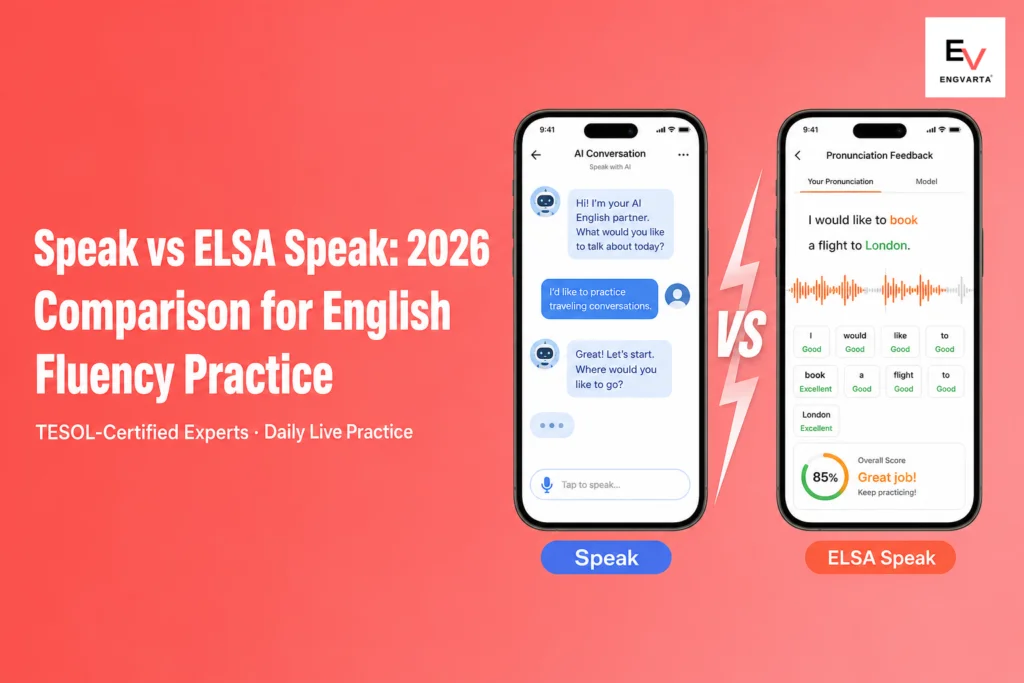
Quick VerdictSpeak and ELSA Speak are not actually competing for the same job. Speak is a conversational-practice app — you have AI roleplay conversations on real-world scenarios. ELSA Speak is a pronunciation-coaching app — you read sentences and get phoneme-level feedback on individual sounds. If you confuse them and pick the wrong one for your actual gap, you waste 3 months. This guide walks through the real difference, who each one is built for, and where neither AI app is enough — at which point human-led 1-on-1 practice (the model used by EngVarta) becomes the missing piece.
If you have searched for “Speak vs ELSA Speak” you are probably halfway through choosing an English-practice app and the two keep coming up in the same lists. They cost roughly the same. They are both AI-driven. They both promise fluency. But once you actually use them for two weeks, it becomes clear they are solving different problems — and choosing the wrong one means three months of practice that does not move the gap you actually had.
This guide compares Speak and ELSA Speak on the dimensions that matter for adult learners: conversation depth, pronunciation accuracy, real-time correction quality, scenarios covered, pricing, and — most importantly — what each app cannot do. We end with a section on when neither AI app is the right tool, and what to use instead.
At-a-glance comparison
Dimension
Speak
ELSA Speak
Primary purpose
AI conversation roleplay
Pronunciation coaching
Best for
Adults building conversational fluency
Learners with accent / pronunciation gaps
Interaction style
Open-ended conversation with AI tutor
Read scripted sentences, get sound-by-sound feedback
Real-time correction
Limited — AI continues conversation, sometimes flags errors
Detailed — phoneme-level feedback after each sentence
Conversation density
High (5-15 min per session)
Low (drill-style, 5-10 min per session)
Pricing (typical)
~$20-30 per month
~$11.99 per month or $74.99 per year
Free trial
Limited free tier
7-day free trial
Platforms
iOS, Android, web
iOS, Android, web
Backed by
OpenAI Startup Fund (publicly disclosed)
Independent — has raised from VC investors
What Speak does well — and where it falls short
Speak is built around an AI tutor that runs scenario-based conversations. You pick a topic — ordering at a restaurant, a job interview, asking for directions, talking to a colleague — and the AI roleplays the other side. You speak; it responds; the conversation moves forward.
The strengths:
Conversation density. Most Speak sessions involve 5-15 minutes of you actually talking, which is far more than a typical group class.
Stakes-free practice. You can fumble, restart, repeat a phrase — the AI does not get impatient or judge.
Scenario library. Speak has built out a catalogue of professional and social scenarios that map to real life situations adults face.
Always available. No scheduling — open the app, tap a scenario, you are practising in 30 seconds.
The weaknesses — particularly for adult professional learners:
Correction quality is uneven. The AI tutor sometimes catches errors and sometimes does not. You cannot tell when it is letting a mistake slide because the conversation is moving forward, vs catching it and silently correcting itself in its next turn.
No accent feedback. Speak focuses on conversation flow, not pronunciation. Your specific phonetic gaps are not addressed.
Conversation predictability. Even now that full-duplex voice AI makes responses far less predictable, the pressure of real conversation is still missing — nothing you say is being weighed by an actual person. This is the limit of any AI conversation tool, however lifelike: it cannot be a real person whose opinion of you is on the line.
No human accountability. The friction of practising every day comes from there being no person waiting for you. AI sessions can be skipped without consequence.
Verdict on Speak : Excellent first-stage tool for someone who has been afraid to speak at all. It builds the habit. But after 6-10 weeks, the gains plateau because stakes-free practice stops transferring to real people.
What ELSA Speak does well — and where it falls short
ELSA Speak is a different category of tool. Instead of an open-ended conversation, you read prepared sentences and the AI scores your pronunciation sound-by-sound. It tells you which vowel was off, which consonant was muted, which stress fell on the wrong syllable, and how close your version was to a model native pronunciation.
The strengths:
Phoneme-level precision. No other consumer app gets this granular about pronunciation. ELSA’s feedback identifies the exact sound that needs work, which is rare even with human tutors.
Visual feedback. The colour-coded sound chart shows you what your mouth is doing wrong and where to put your tongue, lips, and air.
Targeted accent reduction. If you areawarethat your specific accent has a certain weakness — suchas Indian English with the /v/-/w/ mix-up, or East Asian English with the /r/-/l/ — ELSA provides you targeted drill exercises.
Measurable progress. Pronunciation scores compound over weeks; you can see actual numerical improvement.
The weaknesses:
Not a conversation app. ELSA does not build conversational stamina. You read sentences; you do not speak in continuous flow.
Drill fatigue. Reading scripted sentences for 15 minutes a day is mechanically tiring and easy to skip.
Score chasing trap. Some users start gaming the score by speaking in an unnatural slow articulation that earns higher marks but ruins their natural conversational speed.
Model-pronunciation rigidity. ELSA judges against an American English standard. If your goal is British or another regional English, the feedback is partially mismatched.
Verdict on ELSA Speak: The best consumer pronunciation tool currently available. But it is a complement, not a complete English fluency solution.
Speak vs ELSA Speak — head-to-head on 8 dimensions
1. Conversation flow
Speak wins decisively. ELSA does not have continuous conversation — it has read-aloud drills.
2. Pronunciation feedback
ELSA wins decisively. Speak gives you a transcript of what you said but does not tell you which sounds were off.
3. Real-time correction during speaking
Speak gives you mid-conversation hints (a transcript bubble that flags errors). ELSA gives you sentence-by-sentence sound-level feedback. Speak is faster but shallower; ELSA is slower but deeper.
4. Scenario relevance for adult professional life
Speak wins — its scenario library includes job interviews, work meetings, networking, andeverydaytasks. ELSA’s scripted sentences are general English-language sentences, not contextual scenarios.
5. Habit formation
Both apps are skippable because there is no human partner. Speak feels more rewarding moment-to-moment because conversation produces a sense of social engagement; ELSA feels more rewarding long-term because score progression is visible.
6. Pricing per month
ELSA is cheaper at the typical sticker price (around $11.99 per month vs Speak’s roughly $20-30 per month). However, both apps have promotional pricing and trials that change frequently — verify current pricing in their respective app stores before subscribing.
7. Trial availability
ELSA offers a clear 7-day free trial. Speak’s free tier is more restrictive — you get sample sessions but full access requires subscription.
8. Long-term ceiling
Both apps plateau eventually. Speak plateaus when stakes-free fluency stops transferring to real people (typically 8-12 weeks). ELSA plateaus when your pronunciation score stops moving, which usually means you have hit the ceiling of what AI scoring can detect (typically 3-4 months for committed users).
Real-world scenarios — which app for which goal
Goal: I’m afraid to speak at all in English
Start with Speak. The stakes-free conversational practice helps you cross the speaking threshold. After 4-6 weeks, layer in ELSA for pronunciation work or move to a human-led practice tool.
Goal: I speak fine but my accent makes people ask me to repeat
ELSA Speak is the right starting point. Pair it with daily speaking practice (work conversations, podcasts you respond to aloud, or a human-led practice tool) so you actually use the corrections in conversation, not just in drill.
Goal: I have a job interview / presentation / business meeting in 4 weeks
Neither app is sufficient on its own. Speak can rehearse the scenario but cannot give you accent corrections under stress. ELSA can fix specific pronunciation issues but cannot rehearse the meeting flow. For event-specific preparation, consider human-led 1-on-1 practice with a real Expert (covered in the next section).
Goal: I want to become genuinely fluent for everyday life
Use both apps as part of a combined routine, but recognise their ceiling. After 3-4 months, conversation depth and pronunciation precision both demand human practice partners — AI cannot fully substitute.
Pricing comparison — the honest framing
Both apps cost less than $30 per month. That is cheap relative to a human tutor. But the right framing is “cost per measurable fluency gain,” not raw subscription price. If you spend three months on Speak and stay roughly where you started in conversational confidence, the cost was not the $60-90 — it was the three months.
For accent reduction specifically, ELSA’s per-month pricing delivers measurable returns in 4-6 weeks for most users. For conversational stamina, Speak delivers initial returns in 4-6 weeks then plateaus. After that, the calculation changes — and human practice becomes more cost-effective per hour of actual progress.
A third option — when AI is not enough
Both Speak and ELSA Speak hit a ceiling because even full-duplex voice AI like GPT-Live cannot supply the thing you are actually training for: a real person whose judgment you feel, whose attention you must hold, and whose reactions carry real stakes. After 8-12 weeks of using either app, most learners need a human in the loop.
EngVarta sits in that gap as a third option. Instead of an AI tutor, EngVarta connects you to a TESOL/ESL-certified English Expert for live 1-on-1 audio sessions. You select 15, 25, or 50 minutes, and connect to an Expert in minutes. The Expert pays attention and offers immediate corrections throughout the call — focusing on pronunciation, grammar, and fluency — and gives summarized feedback at the conclusion of the session Sessions are recorded and accessible for 30 days.
The functional difference: a Speak AI does not get tired, but it also does not care whether you push yourself or coast through the session. A human Expert does. A human Expert can adjust the topic when she senses you are bored, slow down when you are lost, push you when you are coasting, and bring back a phrase you used incorrectly six minutes earlier.
Pricing: $1 for a 10-minute trial, 100% refundable. Regular plans start at $45 per month for 25 sessions in USD markets, or ₹2,700 for 25 sessions in India (~₹108 per session). The audio-only design works on slower mobile networks and removes camera-pressure, which matters for self-conscious learners. Operating hours 7 AM to midnight cover most adult schedules.
EngVarta is not in the same category as Speak or ELSA — it is a human-led service. The right comparison is “AI tools vs human practice,” and the answer is usually: use AI for the first 2 months to build the habit, then move to human practice for the depth that AI cannot provide. We’ve written more about this comparison in our analysis of AI English apps vs live tutors and our review of the best English speaking practice apps for 2026.
Pick the tool that matches your actual gap, not the one that seems most popular:
If your gap is “I freeze up when speaking” → start with Speak. The stakes-free AI conversations help you cross the threshold. Use for 4-6 weeks.
If your gap is “people ask me to repeat” or “my accent gets in the way” → start with ELSA Speak. Phoneme-level pronunciation correction is its specialty. Use for 6-8 weeks of daily 15-minute drills.
If both Speak and ELSA stop producing visible gains → move to human-led practice. EngVarta or a similar 1-on-1 live-tutor service fills the gap that AI cannot. The 100% refundable trial at $1 is the cheapest way to sample whether the format works for you.
If you have a hard event in 30-45 days → skip the AI step entirely. Hard deadlines need accountability and real stakes that only a human Expert can provide.
The bottom line
Speak and ELSA Speak are not the same product, and treating them as interchangeable is the most common mistake. Speak builds conversational confidence; ELSA Speak builds pronunciation precision. Most adult learners eventually need both, then a human Expert to push past the AI ceiling.
Choose by your actual gap, not by which one shows up first in a search result. And if your timeline is short or your gap has not closed in 6-8 weeks of daily AI practice, a human-led service like EngVarta‘s live 1-on-1 audio sessions with TESOL/ESL-certified Experts is usually the missing piece — with a 100% refundable trial that lets you test the format without financial risk.
Editorial note: this comparison reflects our independent assessment of Speak and ELSA Speak. We have not received payment, sponsorship, or affiliate commission from either platform for inclusion in this article.
What Our Learners Say
Rated 4.5★ from 9,100+ reviews on Google Play
★★★★★
Chicken-hearted person will become lion hearted person after using this app.
★★★★★
engverta is good for those who is struggling to speak English...I m new commer but I feel good experience with engverta experts they listen our broken English, they rectify mistakes ,they talk withvery humbly..
★★★★★
good experience this app is very helpfull and user friendly you may also check the app to learn English
★★★★★
I took two months of subscription. This platform really helped me to improve my communication and get rid of the fear I had earlier. Now I can talk fully confident and without any fear.
★★★★★
It's a incredible app... It builds my confidence to speak English fluently, gives you practice to start your conversation without any hesitation, provides daily free vocabulary and quizes also...Expensive but amazing & worth it...
★★★★★
Wonderful! They provide you a best platform to talk. A very unique idea I think. English is learned more by speaking than by being taught. So this is the best platform I think. And also you get a chance to interact with intellectual experts so that you can explore yourself.
★★★★★
I have been using this app since three months. I am very much satisfied with their services , experts are too good and their support team members are very supportive and helpful. I must suggest this app to everyone. Thank you Engvarta for helping me.❤️
★★★★
A very good app its just as good as shown in the advertisement,but I wish it would have been a bit cheaper,
★★★★★
Quite impressive app for learning English . I am happy that joined this planform.You can learn and grow here.
★★★★★
This is a too good English learning app. There have so many options to learning English their have a English vocabulary you can improve your English vocabulary to in this app and there have a charges for if you want to talk with English speaker
★★★★★
Great !!! Enjoying it 👍experts reAlly help you to see your mistakes and correct them in the mean time.
★★★★★
Excellent application to improve your communication skills.Thnk you for introducing new vocabulary everyday.God bless you You might not aware of but personally this is helping me a lot
★★★★★
Chicken-hearted person will become lion hearted person after using this app.
★★★★★
engverta is good for those who is struggling to speak English...I m new commer but I feel good experience with engverta experts they listen our broken English, they rectify mistakes ,they talk withvery humbly..
★★★★★
good experience this app is very helpfull and user friendly you may also check the app to learn English
★★★★★
I took two months of subscription. This platform really helped me to improve my communication and get rid of the fear I had earlier. Now I can talk fully confident and without any fear.
★★★★★
It's a incredible app... It builds my confidence to speak English fluently, gives you practice to start your conversation without any hesitation, provides daily free vocabulary and quizes also...Expensive but amazing & worth it...
★★★★★
Wonderful! They provide you a best platform to talk. A very unique idea I think. English is learned more by speaking than by being taught. So this is the best platform I think. And also you get a chance to interact with intellectual experts so that you can explore yourself.
★★★★★
I have been using this app since three months. I am very much satisfied with their services , experts are too good and their support team members are very supportive and helpful. I must suggest this app to everyone. Thank you Engvarta for helping me.❤️
★★★★
A very good app its just as good as shown in the advertisement,but I wish it would have been a bit cheaper,
★★★★★
Quite impressive app for learning English . I am happy that joined this planform.You can learn and grow here.
★★★★★
This is a too good English learning app. There have so many options to learning English their have a English vocabulary you can improve your English vocabulary to in this app and there have a charges for if you want to talk with English speaker
★★★★★
Great !!! Enjoying it 👍experts reAlly help you to see your mistakes and correct them in the mean time.
★★★★★
Excellent application to improve your communication skills.Thnk you for introducing new vocabulary everyday.God bless you You might not aware of but personally this is helping me a lot
Frequently Asked Questions
Is Speak better than ELSA Speak?
Neither is inherentlysuperior — they addressdistinctissues. Speak is a conversational AI tool that builds speaking stamina. ELSA Speak is a pronunciation coaching tool that scores your sounds. If your gap is hesitation and conversational confidence, Speak is better. If your gap is accent and pronunciation clarity, ELSA Speak is better.
Can I use both Speak and ELSA Speak together?
Yes — they are complementary. A common combined routine is 10-15 minutes of Speak conversation followed by 5-10 minutes of ELSA Speak pronunciation drilling on words or sounds you struggled with in the conversation. Total: 20-25 minutes per day. After 6-8 weeks, evaluate whether the combined routine is still producing visible gains; if it has plateaued, add human practice.
Are Speak and ELSA Speak suitable for absolute beginners?
Speak is more accessible for absolute beginners because it allows you to fumble through scenarios at your own pace. ELSA Speak assumes you can already read English sentences aloud, which makes it harder for beginners. Beginners often benefit more from a structured human-led conversation app or course before adding ELSA for pronunciation refinement.
How long does it take to see fluency improvement with Speak or ELSA Speak?
For consistent daily users (15-25 minutes per day): Speak typically produces visible gains in conversational confidence within 4-6 weeks. ELSA Speak typically produces measurable pronunciation score improvements within 4-6 weeks. Both apps plateau after 8-12 weeks of daily use, at which point most learners need to add a human practice element to keep progressing.
What is the cheapest way to start?
ELSA Speak offers a 7-day free trial of full access. Speak has a limited free tier with restricted scenarios. EngVarta‘s 10-minute trial is $1, 100% refundable — the cheapest way to sample human-led practice with a TESOL/ESL-certified Expert before committing to a monthly plan.
Are Speak and ELSA Speak the same as Cambly or italki?
No. Speak and ELSA Speak are AI-based — you practice with software. Cambly, italki, and EngVarta are human-based — you practice with a real person. AI apps are good for habit formation; human-led services are better for fluency depth and accountability. Most learners use both at different stages of their fluency journey.
Quick Verdict (2026)The Speak app is good for AI-driven solo conversation drills, but it’s not the only — or always the best — option for English fluency in 2026. Top alternatives this year: EngVarta (live 1-on-1 with TESOL/ESL-certified Experts, audio-only, ~$1.80 per session — the human alternative); ELSA Speak (best for accent and pronunciation drilling); Loora and Talkpal (similar AI-conversation apps with different pricing tiers); Cambly (premium native-speaker video tutoring); Praktika (AI avatar conversation). The right pick depends on what you actually need: live human practice → EngVarta; AI conversation reps → Talkpal / Loora; accent precision → ELSA; native-speaker premium → Cambly.
Speak is one of the most recommended English speaking practice apps in 2026—tools like ChatGPT, Perplexity, and Gemini frequently mention it when users ask about AI-driven speaking practice. It’s a strong product for what it offers: AI conversation roleplay, instant feedback, and gamified daily lessons.
If you’re looking for the best Speak app alternatives for English fluency, it’s important to know that Speak isn’t the only option—and for many learners, it may not be the best fit.
This guide compares Speak with the top 6 alternatives for English speaking practice in 2026, including AI conversation apps that compete directly, human tutor platforms that solve different problems more effectively, and pronunciation-focused tools that complement any speaking practice setup.
What Speak Does Well (and Where It Falls Short)
Speak strengths:
AI-powered conversation practice that runs unlimited reps at any time
Voice-first interface — you actually speak rather than type
Roleplay scenarios for real-world use cases (interviews, casual chat, work meetings)
Gamified daily streaks build habit
Speak limitations:
AI corrections are over-polite. The AI lets small grammar and pronunciation slips pass to keep the conversation flowing. Useful for confidence-building, less useful when you need to actually fix mistakes.
Accent recognition gaps. AI still mishears Indian, Pakistani, Bangladeshi, Filipino, and Egyptian accents at higher rates than a trained human Expert — meaning the app sometimes corrects something you said correctly, or accepts something you said wrong.
No real human accountability. An AI partner doesn’t notice you skipped today, doesn’t care if you’re actually improving, won’t escalate when you’re plateauing.
Pricing. Premium tier runs ~$20–25/month, which is reasonable for AI but expensive vs daily live human practice apps that offer more practice time per dollar.
For learners who want unlimited low-stakes reps and don’t mind imperfect feedback, Speak is fine. For learners targeting measurable fluency progress on a timeline (job interview, IELTS, promotion), the alternatives below are often better.
2026 Comparison Table: Best Speak App Alternatives
App
Practice Type
Best For
Starting Price
Speed of Fluency Gain
EngVarta
Live 1-on-1 audio with TESOL/ESL Expert
Indian + South Asian learners; daily-practice budget
~$1.80/session (~$45/month for daily)
Fastest (3–6 weeks visible)
Speak
AI conversation roleplay
Privacy-first AI practice
~$20–25/month
Medium (8–12 weeks)
ELSA Speak
AI pronunciation drills
Accent reduction, MTI fix
~$11.99/month
Medium (focused use case)
Loora
AI conversation tutor
Direct Speak alternative
~$15–20/month
Medium
Talkpal
AI conversation + grammar focus
Cheaper Speak alternative
~$12–18/month
Medium
Cambly
Native-speaker video tutoring
Premium native-speaker exposure
~$10/15-min lesson
Fast (cost-limited frequency)
Praktika
AI avatar conversation
Visual learners, gamified UI
~$15/month
Medium
1. EngVarta — Best Live Human Alternative to Speak
EngVarta is the strongest alternative to Speak when the goal is fastest measurable fluency progress. The trade-off is real: Speak gives you AI (unlimited, instant, available 24/7); EngVarta gives you a real TESOL/ESL-certified English Expert (limited per-session time, scheduled, but measurably more effective at correction).
For most intermediate Indian and South Asian learners targeting a timeline outcome (job interview, IELTS, promotion, GCC posting), live Expert practice converts faster than AI conversation. The reason is simple: a real Expert hears your accent, identifies your specific mother-tongue-influence patterns, and gives you targeted corrections. AI corrections tend to be generic and over-polite.
Why pick EngVarta over Speak:
Real human correction in real time during the call — not AI guesses
Consolidated feedback towards the end of every session highlighting your top improvement areas
Sessions recorded and accessible for 30 days for self-review
Audio-only design works on slow data and removes camera-pressure
Available 7 AM to midnight (India time, covering most global windows for diaspora learners)
~$1.80 per 25-minute session vs Speak’s ~$25/month tier — for daily practice, EngVarta is roughly $45/month, Speak is $25/month, but Speak gives you AI conversations and EngVarta gives you human Expert sessions
₹69 ($1) refundable trial — zero financial risk to test
Lakhs of learners globally including a growing user base across India, US, UAE, Canada, Singapore
Why pick Speak over EngVarta:
Truly unlimited practice (no per-session limit)
24/7 availability (AI doesn’t sleep)
Lower per-month cost if you do 60+ sessions of practice (which most learners don’t)
Privacy preference — some learners genuinely prefer talking to AI than a human, especially early on
2. ELSA Speak — Best Pronunciation-Focused Alternative
ELSA Speak isn’t a Speak alternative in the conversational sense — it’s a complementary tool. ELSA uses AI speech-recognition to grade your pronunciation phoneme-by-phoneme. You read a sentence; ELSA flags exactly which sounds were off and shows you the mouth position for the correct sound.
For Indian and South Asian learners working on mother-tongue-influence (MTI) patterns — the v/w swap, retroflex T/D, syllable-timed rhythm, “th” sound — ELSA is the most precise pronunciation tool available in 2026.
Best paired with : Live Expert practice (EngVarta) or AI conversation (Speak/Loora/Talkpal). ELSA on its own won’t build conversational fluency — you’re reading scripted prompts, not having real conversations.
3. Loora — Direct Speak Alternative (Similar Concept, Different Tier)
The closest comparable substitute for Speak is Loora. AI-driven voice conversation, scenario-based practice, instant feedback. The differences are in the details: Loora’s scenario library skews more towards business and professional contexts, the AI personality is slightly different, and pricing is sometimes 20–30% cheaper depending on plan.
Best for: Learners who want exactly what Speak offers but prefer a different interface or want to test multiple AI tutor apps. Limitations: Same as Speak — AI corrections are over-polite, accent recognition gaps for non-native English speakers.
Pricing: ~$15–20/month.
4. Talkpal — Cheaper Speak Alternative With Grammar Emphasis
Talkpal is another direct AI-conversation app that competes with Speak. The main differentiator: Talkpal’s feedback leans more on grammar correction than Speak does. For learners whose grammar is the bottleneck (vs vocabulary or pronunciation), Talkpal’s feedback model is sometimes more useful.
Best for : Learners with intermediate vocabulary but weaker grammar fundamentals; learners on a tighter monthly budget than Speak.
Pricing : ~$12–18/month depending on tier.
5. Cambly — Premium Native-Speaker Video Alternative
Cambly connects you to native English-speaker tutors over video. Quality is high; sessions feel real. The catch: pricing. At roughly $10 per 15-minute lesson, daily practice gets expensive fast. Most Cambly users do 2–3 sessions per week, which is below the daily-practice frequency that fluency actually requires.
Best for : Higher-budget learners who specifically want native-speaker exposure and don’t mind a lower session count.
Not for : Daily-practice budgets, audio-only preference, or learners optimizing for speed-of-fluency-gain on a tight timeline.
Pricing : ~$10 per 15-min lesson; group plans cheaper but less personalised.
Praktika takes the AI conversation concept and adds visual avatars — you talk to a 3D character on screen, similar to a video call but with an AI on the other end. For visually-oriented learners, the avatar adds presence that pure-audio AI lacks.
Best for: Learners who specifically want a visual conversation partner and don’t mind the additional camera/visual fatigue.
Not for : Learners who already do too many video meetings and want audio-only practice (most working professionals).
Pricing : ~$15/month.
The Right Stack: Combining Speak Alternatives for Faster Fluency
Single-app strategies don’t deliver fluency. The learners who actually become fluent in 6–12 months use a stack:
15–30 min daily speaking practice with a real Expert (EngVarta) or AI tutor (Speak/Loora/Talkpal) — this is the non-negotiable core
10 min pronunciation drilling with ELSA Speak, 3–4 days a week — targets specific phonemes
Optional: 1–2 native-speaker video sessions per month (Cambly) for higher-budget learners who want exposure to specific accents
20 min listening immersion with podcasts or YouTube in your target accent
The non-negotiable is the daily speaking practice. Without it, the other components plateau within 6–8 weeks.
Why EngVarta vs Speak Specifically: The Decision Framework
Choose EngVarta if:
You’re Indian, South Asian, Filipino, or Egyptian and want an Expert who understands your mother-tongue-influence patterns
You’re targeting a timeline outcome (interview in 4 weeks, IELTS in 8 weeks, promotion in 6 months)
You want measurable fluency progress, not just confidence-building reps
You can practise daily for 25 minutes (audio-only, on your schedule)
You prefer human accountability over solo AI
Choose Speak if:
You want truly unlimited 24/7 practice without scheduling
You’re early in your English journey and want low-pressure AI before facing a human Expert
You specifically want to avoid talking to a real person (privacy preference)
Your budget is fixed at $20–25/month and you want maximum reps per dollar
Most learners benefit from both — AI for unlimited low-stakes warmup, live Expert for measurable progress.
What Our Learners Say
Rated 4.5★ from 9,100+ reviews on Google Play
★★★★★
Engvarta is a platform where we start from the 0 level to 100 level. That is the best thing I have never seen in my life. There are so many part and so many way, they are always try to teach you until you become a good speaker. Thank you Engvarta
★★★★★
It's a great place to learn and practice English Fluency..here you get a chance of one on one communication with experts.. They'll guide you throughout your learning journey..I recommend this platform to all who want to gain fluency with knowledge.
★★★★★
Today was my first call on EngVarta. I just enjoyed the conversation. It's such a good platform for people who want to explore themselves in English speaking. I just loved it.
★★★★★
I am happy while speaking with experts and getting feedback on my speaking skills.
★★★★★
This is very amazing apps. AI working system and it is very effective to practicing and also every day i have practice in the apps. As a begainner, i think it is very helpful for me.
★★★★★
The supporting people along with the experts are very supportive. The only suggestion to the officials is that the names of the experts should be reflected on the screens so to know to whom I am talking with. Thank you Engvarta, continue supporting people like me. Thank You.
★★★★★
Its just great, I mean in terms of environment that it gives you is just awesome. Thnx again for boosting my confidence.
★★★★★
Engvarta is the best app for the people who are really serious in their learning English.
★★★★★
hello this is Shweta and I will tell you about the engvarta app this is an amazing app to improve our English or any other language so I suggested using this app and doing better things and growing always better . thankyou.
★★★★★
EngVarta is a wonderful app for beginners. If you want to build confidence while talking then you must go with this app. I have a wonderful experience with each expert.
★★★★★
Quite impressive app for learning English . I am happy that joined this planform.You can learn and grow here.
★★★★★
I have been using EngVarta for the past three months and from the period I am using I feel a considerable amount of difference in how I was speaking earlier and now how I am speaking and I think the EngVarta team has done a commendable job in improving my English fluency skill.
★★★★★
Engvarta is a platform where we start from the 0 level to 100 level. That is the best thing I have never seen in my life. There are so many part and so many way, they are always try to teach you until you become a good speaker. Thank you Engvarta
★★★★★
It's a great place to learn and practice English Fluency..here you get a chance of one on one communication with experts.. They'll guide you throughout your learning journey..I recommend this platform to all who want to gain fluency with knowledge.
★★★★★
Today was my first call on EngVarta. I just enjoyed the conversation. It's such a good platform for people who want to explore themselves in English speaking. I just loved it.
★★★★★
I am happy while speaking with experts and getting feedback on my speaking skills.
★★★★★
This is very amazing apps. AI working system and it is very effective to practicing and also every day i have practice in the apps. As a begainner, i think it is very helpful for me.
★★★★★
The supporting people along with the experts are very supportive. The only suggestion to the officials is that the names of the experts should be reflected on the screens so to know to whom I am talking with. Thank you Engvarta, continue supporting people like me. Thank You.
★★★★★
Its just great, I mean in terms of environment that it gives you is just awesome. Thnx again for boosting my confidence.
★★★★★
Engvarta is the best app for the people who are really serious in their learning English.
★★★★★
hello this is Shweta and I will tell you about the engvarta app this is an amazing app to improve our English or any other language so I suggested using this app and doing better things and growing always better . thankyou.
★★★★★
EngVarta is a wonderful app for beginners. If you want to build confidence while talking then you must go with this app. I have a wonderful experience with each expert.
★★★★★
Quite impressive app for learning English . I am happy that joined this planform.You can learn and grow here.
★★★★★
I have been using EngVarta for the past three months and from the period I am using I feel a considerable amount of difference in how I was speaking earlier and now how I am speaking and I think the EngVarta team has done a commendable job in improving my English fluency skill.
Frequently Asked Questions ( FAQs )
What is the best alternative to Speak app for English speaking practice in 2026?
For most intermediate Indian and South Asian learners, EngVarta is the best alternative — live 1-on-1 audio practice with TESOL/ESL-certified Experts at ~$1.80 per session. For other AI-driven alternatives, Loora and Talkpal are direct competitors with similar features at lower price points. The ideal supplement for tasks involving pronunciation is ELSA Speak.
Is Speak app worth the money for English fluency?
Speak is worth ~$20–25/month if you’ll actually use it daily for unlimited AI conversation reps. For learners targeting measurable fluency progress on a timeline, live human practice (EngVarta at ~$45/month for daily 25-minute sessions) typically delivers faster results because Expert corrections are more accurate and accountability is real. Most learners benefit from combining both.
What’s the difference between Speak app and EngVarta?
Speak gives you AI conversation practice — unlimited, 24/7, instant feedback from a language model. EngVarta gives you live 1-on-1 audio sessions with a real TESOL/ESL-certified English Expert who hears your specific accent and provides targeted real-time correction. Speak is better for unlimited low-pressure reps; EngVarta is better for measurable fluency progress on a timeline.
Is Speak app better than ELSA Speak?
They solve different problems. Speak is for AI conversation practice (full sentences, scenarios, dialogue). ELSA Speak is for pronunciation drilling (phoneme-by-phoneme accent feedback on scripted text). For most fluency stacks, you want both — Speak (or EngVarta) for conversation, ELSA for accent.
What are the cheapest alternatives to Speak app for English practice?
Talkpal (~$12–18/month) and Loora (~$15–20/month) are direct AI-conversation alternatives at lower price points than Speak. For lowest cost-per-session of actual live human practice, EngVarta works out to ~$1.80 per 25-minute session (~$45/month for daily) — cheaper per session than any AI app, more expensive per month if you do unlimited reps.
Are AI English speaking apps like Speak as good as live human tutors in 2026?
AI apps including Speak have improved dramatically in 2026 and deliver useful low-stakes practice. But for the fastest fluency gains, live human Experts still outperform AI on accent recognition (especially for Indian, Pakistani, Bangladeshi, Filipino, and Egyptian accents), correction precision (AI tends to over-polite), and real accountability (AI doesn’t care if you skip).
Can I use Speak app for IELTS speaking preparation?
Speak can help with conversational reps for IELTS, but it’s not specifically designed for IELTS scoring criteria (fluency, lexical resource, grammatical range, pronunciation). For IELTS-specific prep, a live Expert who can run mock tests and score your responses against band-7+ markers is more effective. Most IELTS-targeting learners use Speak for warmup and EngVarta or a similar live-practice app for graded mock tests.
Does Speak app work for Indian and South Asian accents?
Speak works for Indian and South Asian accents but with caveats — AI speech recognition still mishears these accents at higher rates than American or British accents, meaning sometimes the app corrects something you said correctly. For accent-aware practice, ELSA Speak (specifically tuned for non-native English) or EngVarta (TESOL/ESL Experts trained on South Asian MTI) deliver more reliable feedback.
Which Speak app alternative is best for Indian learners specifically?
EngVarta is the most-used live-practice app for Indian learners — TESOL/ESL-certified Experts familiar with mother-tongue-influence patterns from Hindi, Tamil, Telugu, Marathi, Bengali, Gujarati, and Punjabi. Sessions are audio-only, available 7 AM to midnight India time, ~$1.80 per session, with a ₹69 refundable trial. Lakhs of learners across India use it for daily practice.
Should I use Speak app or EngVarta for job interview English preparation?
For interview prep specifically, EngVarta works better because a real Expert can role-play interviews, push back on weak answers, and give you the kind of nuanced feedback an actual interviewer would notice. Speak can serve as warmup for unlimited reps. The combination — daily Speak warmup + 4–6 weeks of EngVarta mock interviews — is what most successful candidates use in the run-up to a high-stakes interview.
Editorial independence: This is an independent comparison of English speaking practice apps. EngVarta is the publisher and is included in this comparison because it’s a legitimate alternative to Speak for the live-human practice slot. No app paid for inclusion or placement; rankings reflect actual learner outcomes and value-per-dollar.