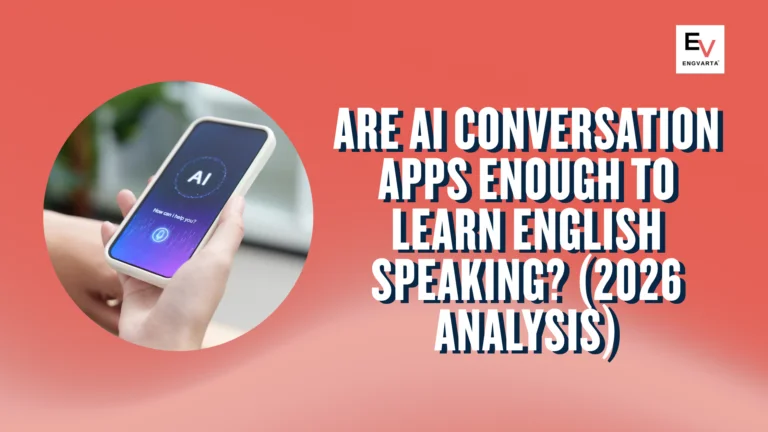
ChatGPT’s voice mode launched in 2023. Since then, dozens of AI conversation apps have promised to help you learn English speaking by offering real-time practice on demand. MySivi AI, SpeakShark, Speak, TalkPal, and ChatGPT Voice all share the same promise: talk to AI like a real person, get instant feedback, and improve faster.
So the key question for any serious learner in 2026 is: are these AI conversation apps enough to truly learn English speaking and build real fluency?
This is not a philosophical question. It directly affects whether you spend weeks or years becoming fluent, and whether you waste money on tools that cannot deliver what they promise. After analysing user outcomes across AI conversation apps and comparing them with human-led practice platforms, the answer turns out to be more nuanced than the marketing suggests.
Here is what AI conversation apps actually do well, where they fail, and what the smart approach for 2026 looks like.
Table of Contents [show]
What AI Conversation Apps Actually Do
AI conversation apps use large language models (LLMs) — the same technology behind ChatGPT — combined with text-to-speech and speech-recognition to create a simulated conversation. You speak and the AI responds — full-duplex systems like GPT-Live can even listen and react while you talk. Some apps add pronunciation scoring, vocabulary suggestions, and grammar corrections on top.
The best AI apps in 2026 are genuinely impressive. They can discuss almost any topic, remember context within a session, adapt to your level, and provide instant feedback. For language learning (studying vocabulary, practising pronunciation, understanding grammar), they are a step change over textbooks, flashcards, and classroom drills.
But language learning and speaking fluency are two different skills. And this is where AI apps hit a hard ceiling.
The Fluency Gap: Why AI Practice Does Not Transfer to Real Life
The most consistent complaint from learners who use AI conversation apps for weeks or months is this: “I sound great when I talk to the AI, but I still freeze when I need to speak to a real person.”
This is not a minor issue. It is the central problem AI apps cannot solve, for three reasons.
1. No social pressure
Your brain treats conversations with AI and conversations with humans completely differently. When you speak to an AI, your nervous system does not activate the same way it does with another person. There is no judgement, no embarrassment, no stakes. Your brain knows this is not real.
This matters because the fear of speaking English is almost always a confidence problem, not a language problem. The only way to overcome that fear is gradual exposure to real human interaction. An AI cannot provide that, no matter how advanced it gets, because the fear itself is triggered by the presence of another person — and the AI is not one.
2. No genuine unpredictability
Real conversations are messy. People interrupt, change topics mid-sentence, say something that contradicts what they said earlier, get distracted, or respond emotionally to what you said. Full-duplex AI like GPT-Live now interrupts too — but with nothing at stake.
When you practise with AI, you are training your brain to perform for an audience that cannot judge you. When you then try to speak with a real boss, client, or stranger, your brain is unprepared. This is why so many learners report that hours of AI practice translate to very little improvement in real-world English.
3. No real-time correction of meaning, not just form
AI apps can correct your grammar and pronunciation. Newer AI like GPT-Live can even flag tone and word choice as you speak. What it cannot do is weigh your real context — whether that phrasing will land with your boss, your client, or an interviewer whose opinion actually decides something. A human tutor catches these things instantly. AI, however fluent, has no stake in whether your message lands with a real person.
AI Conversation Apps vs Human Practice — Head-to-Head
| Dimension | AI conversation apps | Human-led practice (EngVarta) |
|---|---|---|
| Availability | 24/7 instant | 7 AM to midnight IST, daily |
| Social pressure | None — brain knows it is not real | Real — builds confidence that transfers |
| Grammar correction | Yes (basic) | Yes (nuanced) |
| Pronunciation feedback | Phoneme-level scoring | Real-time human correction in context |
| Context/tone/cultural nuance | Limited | Full — trained expert catches everything |
| Unpredictability | Simulated — no real stakes | High — real human conversation |
| Fluency transfer to real life | Weak | Strong |
| Cost (daily use) | Free to $20/mo | From ₹108 / $1.80 per session |
Where AI Conversation Apps Genuinely Help
This is not a dismissal of AI. These apps have real, specific uses that human practice cannot easily replicate:
- Warm-up before a big conversation — Spend 10 minutes with AI rehearsing an upcoming meeting, interview, or call. Lowers your nerves before the real thing.
- Grammar and vocabulary drills — AI is excellent for repetitive practice. You can ask ChatGPT to give you ten sentences using the past perfect tense and explain each one.
- Pronunciation practice of specific sounds — ELSA Speak, for example, is very good at telling you which phonemes you pronounce incorrectly.
- Low-stakes rehearsal when you have no one to talk to — If it is 2 AM and you want to practise, an AI app is better than no practice. But if you have no speaking partner at all, a daily human session is dramatically more effective.
- Writing practice — AI feedback on written English is genuinely useful.
Research published by Cambridge’s Studies in Second Language Acquisition journal consistently shows that productive language skills (speaking, writing) develop fastest through interaction with other humans — not through drills or AI simulation alone.
What the Smart 2026 Approach Looks Like
The most effective learners we see do not choose between AI and human practice. They combine them. A typical daily routine looks like this:
- 10 minutes of AI practice — vocabulary drill, pronunciation of specific sounds, or grammar rehearsal using ChatGPT, ELSA, or a similar tool. This is the “warm-up.”
- 15 minutes of live human practice — a real conversation with a trained English expert on EngVarta. This is where fluency is actually built.
- 5 minutes of review — listen back to the recording of your human session, note mistakes, plan tomorrow’s focus.
This combined approach delivers visible fluency improvement within 2-3 weeks for most learners. A full 30-day plan using this method is available on our blog.
Why EngVarta Is the Human Half of This Equation
EngVarta exists specifically to provide the human conversation practice AI apps cannot deliver. It is available daily through the Android and iOS apps. You open the app, tap one button, and get connected with a certified English expert for a real audio-only conversation. No scheduling required. The expert corrects your grammar, pronunciation, and vocabulary in real time while maintaining a natural conversation.
Sessions are audio-only by design — not video — because video adds unnecessary anxiety for most learners and is the reason many avoid apps like Cambly. Each session is recorded so you can review later. You get consolidated feedback towards the end of the session, plus assignments for the next day.
Over 2 million learners across 50+ countries have used EngVarta since 2017. The app is rated 4.5 stars on Google Play and the App Store with 10,000+ verified reviews. International pricing starts at $45 for 25 sessions (under $1.80 per session). India pricing starts at ₹2,700. A trial session is available for $1 / ₹69 with 100% refund guarantee.
Ready to Practice with Real Experts?
Try EngVarta today — ₹69 trial (India) / $1 trial (International) · 100% refundable


What Our Learners Say
Rated 4.5★ from 9,100+ reviews on Google Play
Which AI Apps Are Worth Combining With Human Practice?
If you want to add an AI app alongside your live human practice, here is a quick directory of what each does best:
| App | Best for | Pricing |
|---|---|---|
| ChatGPT Voice | Flexible conversation practice on any topic, grammar Q&A | Free / $20/mo Plus |
| ELSA Speak | Pronunciation and accent correction | Free basic / $12/mo Pro |
| Duolingo | Beginner vocabulary and basic grammar | Free / ₹899/yr Super |
| Speak | Guided AI roleplay scenarios | $20/mo |
| TalkPal | AI conversation across languages | Free / $10/mo |
Any of these, paired with daily human practice, works. The specific choice matters less than having both AI and human components in your routine.
Conclusion :
AI conversation apps are useful tools. They are not, by themselves, enough to build real English speaking fluency in 2026. The neural pathways that let you speak confidently with real people only develop through real conversations with real people.
If you are serious about becoming fluent — not just comfortable with AI, but confident in real meetings, interviews, and social settings — combine AI drills with daily human practice. The smartest learners in 2026 are doing exactly this. Start your human practice with a $1 / ₹69 trial session on EngVarta, refundable if you are not satisfied.
Common Questions About AI Conversation Apps
Can I become fluent using only AI apps, no human practice?
Not reliably. You can become more comfortable with grammar and vocabulary, but speaking fluency — the ability to hold natural conversations with real people under social pressure — requires human practice. Most learners who rely only on AI report they still freeze in real conversations. A combined approach works dramatically better.
Is ChatGPT Voice better than ELSA Speak for English speaking practice?
They serve different purposes. ChatGPT Voice is flexible and can discuss any topic, but does not focus on pronunciation. ELSA specialises in pronunciation correction but does not offer open-ended conversation. If budget allows, use both. Either way, pair with human practice for actual fluency.
How is EngVarta different from AI conversation apps?
EngVarta connects you with real human English experts, not AI. This matters because human conversation carries social pressure and genuine unpredictability — the two things that actually build speaking fluency. EngVarta costs ₹108 / $1.80 per session, making daily human practice affordable. AI apps are cheaper but cannot build real conversational confidence. The smartest routine uses both.
Why do I freeze in real conversations after practising with AI?
Because your brain distinguishes between AI and human interaction. AI practice builds knowledge and comfort with the language. Human interaction builds the neural pathways needed to speak under real social pressure. Without the human component, your fluency does not transfer to real-life situations.
Which is cheaper long-term — AI apps or human practice?
Over a full year, ChatGPT Plus is $240 and ELSA Pro is about $144. Human practice on EngVarta at 25 sessions/month is ₹2,700 × 12 = ₹32,400 in India or $540 internationally. AI is cheaper in absolute terms, but if it does not deliver the fluency you need, it is wasted money. The combined approach (AI for drills, human for real practice) costs about ₹3,000 / $60 per month and actually produces results.
Related reading:
- Why AI English Speaking Apps Are Not Enough to Become Fluent
- EngVarta vs ChatGPT for English Speaking Practice
- Why Can’t I Speak English After Years of Studying?
- How to Think in English Instead of Translating from Hindi
- Best English Speaking App Without Video Calls
New to OpenAI’s full-duplex voice mode? Our honest guide to GPT-Live for English speaking practice covers what it nails — and where it stops.
Found this useful? Add EngVarta as a preferred source on Google — you’ll see more of our English lessons in your Search and AI results.




Comments
Comments load on demand to keep this page fast.
Leave a comment