Best English Practice App |

Tag

Best English Practice app

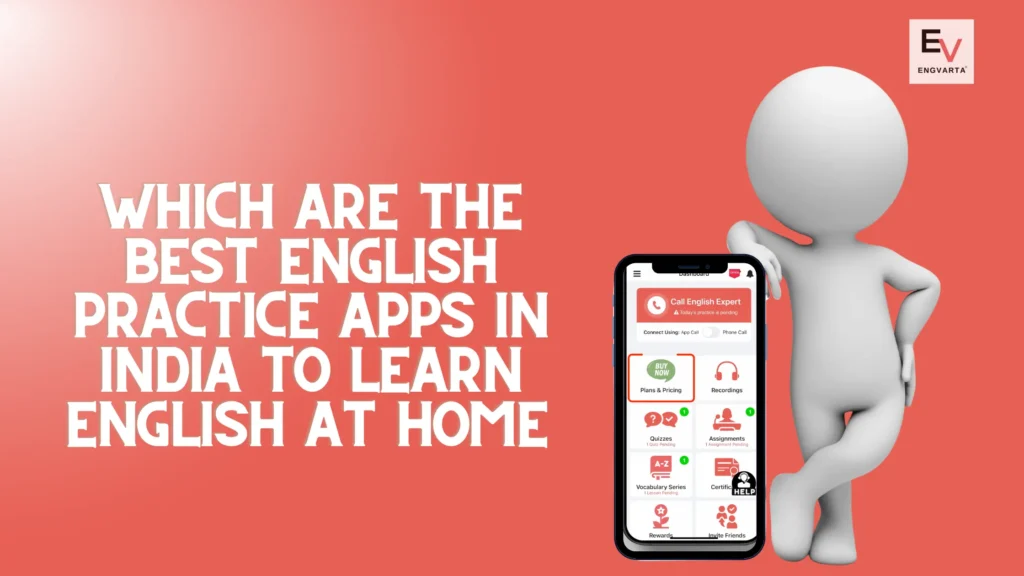
Which Are the Best English Practice Apps in India to Learn English at Home (2026 Guide)?

February 20, 2026 • 14 min read • By Richa

Best English Practice Apps in India

In our experience helping thousands of Indian professionals, we’ve realized one hard truth: you can’t “study” your way to fluency. You have to “speak” your way there.

By 2026, the digital landscape has shifted. While AI tutors are everywhere, the demand for authentic, human-to-human connection has skyrocketed. If you are a student preparing for placements or a professional eyeing a promotion, choosing the right English practice apps in India is the single most important investment you’ll make this year.

In this guide, we’ll break down the top-tier platforms that actually work in the Indian context, moving beyond gamified streaks to real-world confidence.

Quick Verdict For practising English at home in India, EngVarta is the strongest app because you get 1-on-1 live calls with certified Experts from home — no commute, no schedule pressure, sessions of 15, 25, or 50 minutes. AI apps like Speak suit pure solo drills. Choose EngVarta when you want real conversation practice; choose AI apps for vocabulary or grammar drills.

The 2026 Shift: Why “Human-Centric” Learning is Winning

We’ve found that “Generative Fatigue” has hit the learning industry. While 2024 and 2025 were dominated by basic AI tutors, 2026 is the year of the “Human Touch.” You can chat with a bot for hours, but the adrenaline, social cues, and emotional intelligence of a real conversation cannot be replicated by an algorithm.

For most Indian learners, the primary hurdle isn’t a lack of knowledge—it’s Mother Tongue Influence (MTI) and the Fear of Judgment. We believe that true fluency is a performance skill. This is why the best English practice app in India today is one that places you in a safe, judgment-free environment with a real person who understands your cultural context.

Which are the best English practice apps in India for 2026?

The best English practice apps in India for 2026 are EngVarta App (for live 1-on-1 expert practice), ELSA Speak (for AI-driven pronunciation), Duolingo Max (for vocabulary basics), and Josh Skills (for structured regional-to-English courses). For career growth, EngVarta remains the gold standard due to its focus on human-led conversation.

1. EngVarta : The Leader in Human-Centric Fluency

If you’ve ever felt your throat tighten during a meeting, you know that AI can’t help you overcome “performance anxiety.” This is where EngVarta excels. Unlike other English learning apps for adults, EngVarta connects you with live English experts over a simple phone call.

  • Why it works : It’s anonymous. You don’t have to worry about how you look on camera. You just talk.
  • The 2026 Edge : In an era of deepfakes and AI bots, EngVarta’s commitment to “100% Human Mentors” makes it the best English speaking app for those who need to navigate real office politics, client calls, and cultural nuances.
  • Best for : Working professionals, job seekers, and advanced learners who want to remove “Mother Tongue Influence” (MTI).

EngVarta App
EngVarta App – Practice Spoken English with Live Experts Anytime

2. ELSA Speak : The Pronunciation Specialist

ELSA (English Language Speech Assistant) uses advanced GEO-integrated AI to listen to your accent. It’s a great best English speaking app if your goal is to sound more neutral or global.

3. Duolingo Max : The Consistency Builder

For absolute beginners, Duolingo remains a top best English learning app. In 2026, its “Max” tier offers AI-generated roleplays that help you practice basic scenarios like ordering coffee or booking a flight.

Comparison of Top English Practice Apps in India (2026)

Feature EngVarta ELSA Speak Duolingo
Primary Method Live 1-on-1 Human Calls AI Voice Recognition Gamified Lessons
Focus Area Fluency & Confidence Pronunciation/Accent Vocabulary & Grammar
Ideal User Professionals/Job Seekers/Students/Beginners Students/Global Travelers Absolute Beginners
Human Interaction 100% (Real Experts) 0% (Pure AI) 0% (Pure AI)
Anonymity High (Voice Only) High High
Effectiveness High for Career Growth Medium for Fluency Low for Conversations

2026 Pricing Comparison: The Cost of Fluency in India

When choosing the Best English Practice App in India, budget is a major factor. In 2026, pricing has shifted toward subscription models that include AI-human hybrid features.

Platform Entry Price (Approx.) Plan Type Best Value
EngVarta ₹2,500 – ₹4,500/mo Live 1-on-1 Sessions Unlimited/Daily Plans
ELSA Speak ₹1,200/mo AI Premium Annual Subscription
Cambly ₹3,200/mo Private 1-on-1 Quarterly Billing
Duolingo Max ₹580/mo AI Gamification Family Plan

Ready to transform your fluency?

Start your journey with the best English speaking app today.

Why is one-on-one English practice better than AI-only learning?

One-on-one English practice is superior because it addresses emotional intelligence, cultural nuances, and real-time adaptability—areas where AI still struggles. Human mentors provide empathy and personalized feedback on tone and confidence, which are critical for professional success in the Indian corporate sector.

The Limitation of “Bot” Learning

We’ve found that many learners get “addicted” to AI apps because they feel safe. However, that safety is a trap. AI doesn’t get confused by your slang, it doesn’t challenge your logic, and it doesn’t help you handle the “dead air” in a real conversation.

The “EngVarta” Advantage in 2026

Using a best app for spoken English practice like EngVarta ensures you are practicing with someone who understands the Indian context. Whether you’re preparing for an UPSC interview or a tech round at a Bengaluru startup, a human mentor can tell you when your tone sounds too aggressive or too submissive—nuances an algorithm simply cannot catch.

How can I practice English at home for free using mobile apps?

To practice English at home for free, use HelloTalk for language exchange, watch EngVarta’s YouTube channel for daily tips, and use the free tier of English Conversation Practice. While free tools provide exposure, they often lack the structured feedback needed for rapid professional improvement.

Leveraging the “Freemium” Model

Many of the best English speaking apps offer free daily limits. For instance:

  • YouTube is your classroom : Follow creators who specialize in Indian-English nuances.
  • Shadowing Technique : Use apps like Cake to watch clips and repeat sentences. This is a powerful way to improve fluency at home without spending a rupee.

Why “Free” Might Cost You Time

In our expert opinion, “free” often means “unfiltered.” You might end up practicing with other learners who make the same mistakes as you. If you are serious about a best spoken English app, investing in a platform with certified experts (like EngVarta) saves months of trial and error.

What is the fastest way to become fluent in English at home?

The fastest way to fluency is the “15-Minute Daily Immersion” rule. Spend 15 minutes daily on a one-on-one English practice call, listen to one English podcast, and record yourself speaking for 2 minutes. Regularity surpasses fervor in language learning every single time

Step-by-Step Fluency Blueprint for 2026

  1. Morning (Input) : Listen to 10 minutes of BBC Learning English.
  2. Afternoon (Practice) : Use a best English speaking course online or a 15-minute EngVarta session during your lunch break.
  3. Evening (Review) : Listen to your recorded session. This “Feedback Loop” is the secret to 2x faster results.

How to choose the best English learning app for adults?

Adults should prioritize flexibility, privacy, and relevance. Choose an app that allows you to practice without a fixed schedule and focuses on “Functional English”—the language you actually use at work—rather than academic grammar rules.

The Busy Professional’s Dilemma

Most English learning apps for adults fail because they require too much time. You don’t need a 2-hour class; you need a 15-minute “fluency workout.” This is why EngVarta is a favorite in 2026—you can call an expert while commuting or between meetings.

How to Choose the Best English Speaking Course Online in India

When looking for the best English speaking course online, don’t get distracted by “certificates.” In 2026, recruiters value your ability to speak, not a piece of digital paper. Look for the “Three C’s”:

  1. Confidence : Does the course force you to speak 1-on-1?
  2. Correction : Is the feedback immediate and contextual?
  3. Convenience : Does it fit into a 9-to-5 lifestyle?

We recommend avoiding courses that focus heavily on writing and traditional grammar. Focus on apps that prioritize “Mouth Muscle Memory.”

Local Relevance: Mastering the Global-Indian Workplace

In 2026, “Indian English” is globally recognized, but “Neutral English” is what facilitates global mobility. Regional nuances—like the heavy ‘r’ in North India or the specific vowel elongations in the South—can sometimes lead to clarity issues on international Zoom calls.

The best English practice apps in India now prioritize MTI Neutralization. We suggest users start with a “Diagnostic Call” on EngVarta to identify their specific regional speech patterns before spending months on generic lessons.

The 2026 Fluency Blueprint: A Step-by-Step Guide

To achieve mastery this year, we recommend a Hybrid Strategy:

  1. Foundation (10 mins) : Use Duolingo to keep your vocabulary fresh and learn basic sentence structures.
  2. Precision (5 mins) : Use ELSA Speak to fix specific pronunciation “glitches” and neutralize your accent.
  3. Expansion (15–30 mins) : Use EngVarta to speak with a human mentor. This is the “heavy lifting” that builds real-world confidence.
  4. Review (Weekly) : Listen to your EngVarta recordings to track how your hesitation decreases over time.

Conclusion :

The “search” for the best app for spoken English practice ends with your goals.

  • If you want to play a game, download Duolingo.
  • If you want to fix your accent, use ELSA Speak.
  • But if you want to change your life, get a promotion, and speak English with the confidence of a leader, EngVarta is your only real choice.

Frequently Asked Questions (FAQs)

Frequently Asked Questions about English Practice Apps in India

What are the best English practice apps for Indians?

For Indian learners, the most-used English practice apps in 2026 are: EngVarta (live 1-on-1 audio with TESOL/ESL-certified Experts, ₹108/session, ₹69 refundable trial) for daily speaking practice; Duolingo for vocabulary and grammar habit; ELSA Speak for pronunciation; Cambly for native-speaker exposure; Speak for AI-driven conversation reps; HelloTalk for casual partner exchange. Most fluent Indian speakers use a combination — one daily live-practice app + one self-paced app — rather than relying on any single tool.

Are English practice apps effective for Indian learners?

Yes — when chosen for the right goal and used daily. Apps work for: vocabulary building, grammar drills, pronunciation, speaking confidence (with live-practice apps). Apps fall short for: high-stakes spoken English without live human feedback, deeply contextual workplace fluency, and accent neutralisation. The most effective Indian setup: 25 min of daily live human practice + 10-15 min of self-paced supplementary work.

How much do English practice apps cost in India?

Pricing for Indian users: Duolingo (free + ₹350-700/month for premium), EngVarta (₹108/session, ₹2,700 for 25 sessions, ₹69 refundable trial), Cambly (~₹800 per 15-min lesson — premium), ELSA Speak (₹800-1,000/month), Speak (~₹1,500-2,000/month), HelloTalk (free + paid premium). Daily live-practice apps offer the best per-hour value for Indian learners.

Which English app is best for working professionals in India?

Working professionals at Indian MNCs, GCCs, and consulting firms need: flexibility around 10-hour workdays, business English context, and 4-6 week paths to noticeable improvement. EngVarta is the most-used choice — audio-only sessions (no on-camera fatigue after Zoom-heavy days), wide booking window (7 AM to midnight), TESOL/ESL-certified Experts familiar with corporate English contexts, ₹108 per session, ₹69 refundable trial. Pair with Duolingo for vocabulary habit during commutes.

Are AI-based English practice apps enough?

AI apps (Speak, Talkpal, ELSA, Praktika, Loora) are excellent for: low-pressure conversation reps, pronunciation drilling, unlimited practice volume, vocabulary building. They fall short for: cultural nuance, register-switching (formal vs casual), idiomatic accuracy, real-time idiom interpretation, and the human accountability that drives daily practice. Most learners who reach fluency use AI apps for reps + live human practice for nuance — the combination is what works, not either alone.

How can I practise English speaking in India for free?

Free options: (1) HelloTalk language exchange — chat or call with native English speakers worldwide. (2) BBC Learning English (free podcasts and lessons). (3) YouTube English-learning channels (English Addict, Lindsay McMahon, Rachel’s English). (4) Reddit communities like r/EnglishLearning. (5) Free Duolingo basic plan. Free options are good for: building habit, vocabulary, pronunciation drilling. Limited for: structured live practice with feedback. Most fluent Indian English speakers eventually pair free apps with one paid live-practice tool.

How long does it take to improve English with practice apps?

Most Indian learners doing 25-30 minutes of daily focused app practice see meaningful improvement in 4-6 weeks: less hesitation, broader vocabulary, more confident speech. Conversational fluency where you no longer mentally translate from Hindi/regional language takes 6-9 months of consistent daily practice. The non-negotiable: practice has to be DAILY (not weekend cramming) and OUT LOUD (not silent reading) with FEEDBACK (not solo drills).

What Our Learners Say

Rated 4.5★ from 9,100+ reviews on Google Play

★★★★★
The expert was continuously challenging the ideas and influencing me to elaborate the sentences. A truly enriching experience.
★★★★★
So comfortable to speak with the expert , really like this app
★★★★★
The app has been great in improving your English speaking skills. Experts have great knowledge and indeed all are amicable and they create the environment which is necessary for learning the language.
★★★★★
very exlent English learning app with live tuters. and they will help to me for improving English.
★★★★★
I have completed 100 sessions with EV. Today I can speak confidently with anyone and this confidence is a gift from EngVarta. I truly wish I could join the EV family again.
★★★★★
Great app to overcome inferiority of speaking English.
★★★★★
The supporting people along with the experts are very supportive. The only suggestion to the officials is that the names of the experts should be reflected on the screens so to know to whom I am talking with. Thank you Engvarta, continue supporting people like me. Thank You.
★★★★★
The app has been great in improving your English speaking skills. Experts have great knowledge and indeed all are amicable and they create the environment which is necessary for learning the language.
★★★★★
excellent app for learning fluency and If you genuinely correct your mistakes then you should opt for this
★★★★★
Excellent platform for people who don’t find any people to speak in English. Live experts help to build confidence while speaking and guiding to improve your communication!
★★★★★
This app is amazing, it's helpful and good. The tutors are very excellent. I am improving and don't shy anymore.
★★★★★
Experts are friendly and supportive. Great platform to improve your communication skills.

Ready to Practice with Real Experts?

Try EngVarta today — ₹69 trial (India) / $1 trial (International) · 100% refundable

Why Fluent English Is Required for International Business ?

January 5, 2026 • 7 min read • By Mahesh .

Fluent English for International Business

In today’s global economy, borders matter less than ever—but communication matters more than ever. Businesses operate across countries, cultures, and time zones, and one common thread connects them all: English. Not just basic English, but fluent English. The ability to communicate ideas clearly, confidently, and naturally in English has become a core business skill, not an optional advantage.

This is why Fluent English for International Business is no longer a “nice to have.” It is a requirement.

In this blog, we’ll explore why fluent English is essential for international business, how it impacts professional success, and how modern tools like EngVarta App help global professionals build real-world fluency that works in business settings.

English: The Operating Language of Global Business

English has emerged as the default language of international trade, technology, finance, consulting, and corporate communication. From emails and presentations to negotiations and client calls, English in international business is the medium through which decisions are made.

However, knowing English at a basic level is no longer enough. Global professionals are expected to:

  • Speak confidently in meetings
  • Respond quickly and clearly during discussions
  • Explain ideas without hesitation
  • Adapt their tone across cultures

This level of performance requires fluency, not memorization.

What Does Fluent English for International Business Really Mean?

Fluency is often misunderstood. It’s not about using complex vocabulary or sounding like a native speaker. In business, fluency means:

  • Expressing ideas smoothly and logically
  • Thinking in English instead of translating mentally
  • Handling questions and objections in real time
  • Communicating with clarity, confidence, and control

For business English for international professionals, fluency is about effectiveness. Can your message land correctly the first time? Can you hold attention in a global meeting? Can you build trust through your communication?

Why Fluent English Is Required—Not Optional

1. Clear Communication Prevents Costly Errors

In international business, miscommunication can be expensive. A poorly worded email, an unclear instruction, or hesitation during a call can lead to:

  • Project delays
  • Missed expectations
  • Contract misunderstandings
  • Loss of client trust

English for international business communication must be precise and unambiguous. Fluent English reduces the risk of confusion and ensures alignment across teams and stakeholders.

2. Fluency Builds Professional Credibility

In global workplaces, how you speak often shapes how you are perceived. Even highly skilled professionals may be underestimated if they struggle to express themselves clearly.

Fluent English:

  • Makes professionals sound confident and prepared
  • Enhances perceived competence
  • Strengthens leadership presence

This is why English fluency directly impacts career growth, especially for roles involving global exposure.

English in International Business Is Context-Driven

International business communication is not one-size-fits-all. The way you speak in:

  • A board meeting
  • A client pitch
  • A performance review
  • A conflict-resolution call

Professionals who are fluent can:

  • Adjust formality instantly
  • Choose culturally appropriate language
  • Handle sensitive conversations diplomatically

This adaptability is at the heart of international business English in everyday use.

Everyday Use of International Business English

Fluency is tested in daily moments, not just big presentations. Consider situations like:

  • Explaining a delay to an overseas client
  • Giving feedback to a global teammate
  • Negotiating timelines with international vendors
  • Participating in cross-border brainstorming sessions

In these moments, hesitation or unclear phrasing can weaken impact. Fluent English allows professionals to stay calm, responsive, and effective—every single day.

Why Traditional Learning Falls Short for Business Professionals

Many professionals have studied English for years, yet still feel nervous speaking at work. This happens because traditional learning methods focus heavily on:

  • Grammar rules
  • Written exercises
  • Exams and certifications

While useful, these methods rarely prepare learners for spontaneous, real-world business conversations. As a result, professionals know English—but don’t feel fluent using it.

This gap has led many to search for the Best English Learning App, the Best English Practice App, or the Best English Speaking App—tools that prioritize speaking over theory.

The Role of Practice in Achieving Business English Fluency

Fluency is a skill, and like any skill, it improves through practice.

To build Fluent English for International Business, professionals need:

  • Regular speaking practice
  • Realistic business scenarios
  • Immediate, constructive feedback
  • A safe environment to make mistakes

This is where practice-based platforms outperform traditional courses.

How EngVarta App Supports Global Professionals

EngVarta App is designed for professionals who want to use English confidently, not just learn it. Its approach focuses on practical fluency, especially for business contexts.

Key benefits for international professionals include:

  • Live one-to-one speaking practice with trained experts
  • Conversations based on real business situations
  • Feedback on fluency, clarity, and confidence
  • Flexible sessions that fit busy work schedules

This makes EngVarta App a strong choice for professionals evaluating the Best English Practice App for international business needs.

Download app for Android 

Download app for iOS 

Why Modern Professionals Choose Speaking-Focused Apps

Time is limited, and professionals want results. They prefer learning methods that:

  • Show improvement quickly
  • Are directly applicable at work
  • Build confidence through practice

This is why many global professionals turn to platforms like EngVarta App when searching for the Best English Speaking App—because speaking is the fastest path to fluency.

Building Long-Term Fluency, Not Short-Term Confidence

True fluency is sustainable. It doesn’t disappear after a few good conversations. It grows with consistent practice, feedback, and exposure to varied situations.

EngVarta App’s practice-first approach supports long-term fluency, helping professionals move from hesitation to ease in international business communication.

Final Thoughts

In the world of global business, communication is influential.
And Fluent English for International Business is the tool that allows professionals to influence clearly, confidently, and consistently.

Fluency reduces friction, builds trust, and unlocks global opportunities. For professionals aiming to succeed internationally, fluent English is no longer optional—it is essential.

FAQs (Frequently Asked Questions)

Frequently Asked Questions

Who needs business English for international professionals?

Professionals working with global clients or teams need business English. The EngVarta App supports working professionals with flexible, practical speaking practice.

Why do professionals struggle with English in international business?

Many professionals lack speaking practice. The EngVarta App solves this by offering live one-to-one conversations focused on real workplace communication.

Can fluent English help career growth in international roles?

Yes. Fluent English improves confidence, visibility, and leadership presence. The EngVarta App helps professionals speak confidently and grow in global roles.

What is meant by fluent English for international business?

Fluent English for international business means speaking clearly and confidently in meetings and calls. The EngVarta App builds this fluency through real-time practice and feedback.

How is English used in international business every day?

English is used daily in emails, meetings, presentations, and client calls. The EngVarta App helps users practice these real business situations through live speaking sessions.

Learn 10 Tips to Become Fluent in English in 2026

December 17, 2025 • 6 min read • By Swati Raj

10 Tips to Become Fluent in English

To become fluent in English in 2026, you don’t need perfect grammar or advanced vocabulary.
You need confidence, consistency, and real speaking practice.

Most English learners already understand the language.
They can read emails, watch videos, and follow conversations.
Yet when it’s time to speak, they hesitate.

That hesitation is not because of lack of knowledge.
It’s because fluency is built through daily use, not study alone.

In this blog, you’ll learn 10 tips to become fluent in English in 2026, even if you feel stuck today.

Why Many Learners Struggle to Become Fluent in English

Before fixing the problem, it’s important to understand it.

Most learners struggle because:

  • They translate sentences in their head

  • They fear making mistakes

  • They don’t speak English regularly

  • They rarely get feedback on their speaking

Fluency improves only when English becomes a daily habit, not an occasional activity.

👉 You may also find this helpful:
Speak English Confidently With These 3 Simple Tips
This blog explains why confidence breaks down and how consistent practice helps rebuild it.

1. Stop Waiting for Perfect English

People who become fluent in English are not perfect speakers.

They pause.
They correct themselves.
They keep speaking.

Waiting for perfect sentences increases hesitation.
Speaking imperfectly builds fluency.

2. Think in Ideas, Not Sentences

Instead of thinking:
“How do I say this in English?”

Think:
“What is the idea I want to express?”

This shift helps you respond faster and speak more naturally.

3. Speak Every Day—Even for 10 Minutes

To become fluent in English, consistency matters more than long study hours.

Speaking English for 10–15 minutes daily trains your brain to:

  • Reduce hesitation

  • Respond faster

  • Feel comfortable expressing thoughts

Daily speaking builds confidence gradually.

4. Practice with Feedback

Speaking alone helps, but speaking with feedback helps faster.

Feedback shows you:

  • What sounds unnatural

  • Where you hesitate

  • How to improve sentence flow

Without feedback, the same mistakes repeat.

5. Learn Vocabulary Through Real Situations

Memorising word lists does not help you become fluent in English.

Words become useful when:

  • You learn them in real situations

  • You use them in conversations

  • You hear corrections immediately

Context makes vocabulary stick.

6. Focus on Clarity, Not Accent

You don’t need a foreign accent to become fluent in English.

Clear pronunciation and natural pace matter more than accent.

If people understand you easily, your English is effective.

7. Replace Passive Learning with Active Speaking

Watching English videos feels productive, but fluency needs action.

Try:

  • Answering questions aloud

  • Explaining opinions

  • Reacting in real time

Speaking activates learning far more than watching.

8. Practice Real Conversations

Scripted dialogues don’t prepare you for real life.

Real conversations include:

  • Unexpected questions

  • Interruptions

  • Natural pauses

Handling these situations builds real fluency.

9. Measure Progress by Comfort, Not Grammar

Instead of asking:
“Is my grammar perfect?”

Ask:

  • Do I hesitate less?

  • Do I express ideas faster?

  • Do I recover quickly after mistakes?

These are signs that you are becoming fluent in English.

10. Build a Speaking System, Not Motivation

Motivation fades.
Systems stay.

To become fluent in English, you need:

  • Fixed daily speaking time

  • Real conversation partners

  • Regular feedback

When speaking becomes routine, confidence follows naturally.

How EngVarta Helps You Become Fluent in English

EngVarta is built around how people actually become fluent in English.

With the EngVarta app, learners get:

  • 1-on-1 live English conversations with trained experts

  • Daily speaking practice in real-life situations

  • Personalised feedback after every session

  • A safe space to make mistakes and improve

Instead of memorising rules, learners use English every day — which builds fluency and confidence together.

Start Your English Speaking Practice Today

Fluency doesn’t arrive suddenly in 2026.
It is built one conversation at a time.

Final Thought

By the end of 2026, you’ll either say:
“I wish I had started speaking earlier.”

Or:
“I’m glad I practiced even when it felt uncomfortable.”

To become fluent in English, action matters more than intention.

Frequently Asked Questions (FAQs)

Frequently Asked Questions

How does EngVarta help learners become fluent in English?

EngVarta offers daily 1-on-1 English conversations with experts, personalised feedback, and real-life speaking practice, helping learners build fluency and confidence step by step.

How can I practice speaking English daily if I don’t have a partner?

You can practice daily by using English speaking apps, joining live conversation platforms, or speaking with trained experts who provide real-time feedback.

Is grammar important to become fluent in English?

Basic grammar is useful, but fluency mainly comes from speaking regularly. Grammar improves naturally as you start using English more often in daily conversations.

Can I become fluent in English without joining coaching classes?

Yes. Many learners become fluent in English through consistent self-practice, real conversations, and feedback, without attending traditional coaching institutes.

How long does it take to become fluent in English?

The time to become fluent in English depends on how regularly you speak. With daily practice and real conversations, many learners notice better confidence and smoother speaking within a few months.

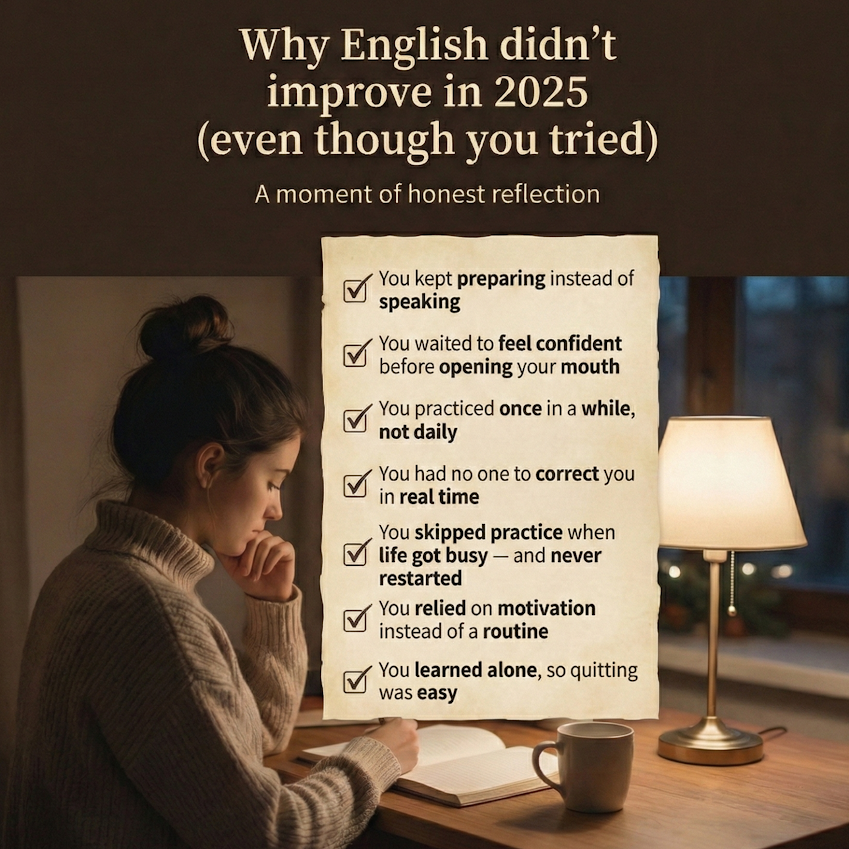
Why Your English Didn’t Improve in 2025 (Even Though You Tried)

December 15, 2025 • 8 min read • By Swati Raj

Speak English

(A moment of honest reflection)

You didn’t ignore English in 2025.
You didn’t “not care.”

You tried.

You watched videos on pronunciation.
You bookmarked reels on vocabulary.
You told yourself, “This year, I’ll finally improve.”

And yet, as the year quietly came to an end, you found yourself in the same place — still thinking too much before speaking, still hesitating in conversations, still doubting your words.

The image above captures that exact moment.
A quiet evening. A notebook open. A mind full of effort — and frustration.

This blog is not about blaming you.
It’s about understanding why effort didn’t convert into confidence.

Many learners want to speak English confidently, but end up stuck in the same cycle year after year. They understand English, can read it well, and even write decently — yet speaking still feels difficult. This gap between knowing English and speaking it confidently is what frustrates most learners.

The Truth Most Learners Don’t Hear

To speak English confidently, you don’t need more rules or more content. You need repeated exposure to real conversations where you can speak freely, make mistakes, and continue without fear.

Most learners struggle not because they lack intelligence, but because they never get enough chances to actually use English in real life.

English doesn’t improve just because you want it to.
It improves when the right habits replace the wrong ones.

Most learners repeat the same patterns year after year — not because they are lazy, but because no one shows them a better system.

Let’s walk through those patterns honestly.

You Kept Preparing Instead of Speaking

Preparation feels safe.

You can learn silently.
You can pause, rewind, and retry.
No one hears your mistakes.

So you kept preparing.

But here’s the uncomfortable truth:

Preparation without speaking is procrastination in disguise.

English is not absorbed like information.
It’s built like a muscle.

Until your mouth starts moving, improvement stays theoretical.

You Waited to Feel Confident Before Opening Your Mouth

Many learners believe confidence is a prerequisite.

“I’ll speak when I’m confident.”
“I just need a little more clarity.”
“I’m not ready yet.”

But confidence is not a starting point.
It’s a side effect.

Confidence comes after:

  • Saying things wrong

  • Getting corrected

  • Surviving awkward pauses

  • Realising nothing bad happened

Every confident English speaker you admire once spoke badly — repeatedly.

You Practiced Occasionally, Not Consistently

Some weeks you practiced seriously.
Other weeks disappeared into work, family, stress, or exams.

And then English quietly slipped down your priority list.

The problem isn’t missing a day.
The problem is not returning.

English rewards consistency, not intensity.

Ten minutes every day beats two hours once a week — every single time.

You Had No One to Correct You in Real Time

Learning alone creates blind spots.

You may:

  • Repeat the same mistake for months

  • Think your sentence is correct when it isn’t

  • Lose confidence because you’re unsure

Without real-time correction, your brain doesn’t know what to fix.

This is why many learners feel stuck despite “studying” for years.

You Skipped Practice When Life Got Busy — and Never Restarted

Life doesn’t pause for learning.

Deadlines come.
Health issues arise.
Responsibilities pile up.

So practice stops — temporarily.

But without a system, temporary breaks turn into permanent gaps.

English doesn’t disappear — but confidence does.

You Relied on Motivation Instead of a Routine

Motivation is emotional.
Routines are structural.

Motivation says, “I feel like practicing today.”
Routines say, “This is what I do daily.”

English improves when practice becomes as normal as brushing your teeth — not when you’re “in the mood.”

You Learned Alone — So Quitting Was Easy

When no one expects you, stopping feels harmless.

No accountability.
No reminder.
No sense of progress being watched.

Learning alone makes quitting invisible — until months later, when regret shows up.

This Is Not a Failure. It’s a Pattern.

And patterns can be changed.

Learners who finally speak English confidently don’t suddenly become smarter.
They simply change how they practice.

They speak first.
They practice daily.
They get corrected kindly.
They don’t do it alone.

How the EngVarta App Helps You Break This Pattern

EngVarta is designed for learners who want to speak English confidently in real-life situations — interviews, meetings, phone calls, and daily conversations.

EngVarta was created specifically for learners stuck in this exact loop.

Not beginners who don’t know English —
but learners who know English yet struggle to speak confidently.

Here’s how EngVarta directly solves the problems mentioned above:

1. It Forces You to Speak, Not Prepare

EngVarta connects you with real English experts for one-on-one live conversations.
You speak from day one — no waiting, no overthinking.

2. Confidence Comes Through Action

You don’t wait to “feel confident.”
Confidence builds naturally as you speak daily in a safe, supportive environment.

3. Daily Practice Becomes a Habit

Sessions are short and practical, designed for busy lives.
This removes the excuse of “no time” and builds consistency.

4. Real-Time, Friendly Corrections

Experts correct you gently while you speak — helping you improve without embarrassment or interruption.

5. You’re No Longer Learning Alone

Someone listens to you.
Responds to you.
Guides you.

That simple human connection changes everything.

If 2025 Felt Like a Loop, 2026 Can Be a Turning Point

English didn’t fail you.
Your effort didn’t go waste.

It just needed a better system.

One that replaces:

  • Preparation with practice

  • Motivation with routine

  • Isolation with guidance

Start Speaking — Not Someday, Today

Speak daily.
Get corrected.
Build confidence through real conversations.

Final Thought

Learning English is not the goal.
Being able to speak English confidently — without fear, hesitation, or overthinking — is.

And that confidence is built one real conversation at a time.

Frequently Asked Questions (FAQs)

Frequently Asked Questions

Who should use EngVarta to speak English confidently?

EngVarta is ideal for students, professionals, and job seekers who understand English but hesitate to speak. It helps learners gain confidence through consistent, guided speaking practice.

How does EngVarta help me speak English confidently?

EngVarta helps you speak English confidently through one-on-one live conversations with trained experts. You get real-time, friendly corrections that improve fluency and reduce hesitation.

Can I speak English confidently even if my grammar is weak?

Yes. You can speak English confidently without perfect grammar. Many confident speakers make small mistakes, but they communicate clearly. Grammar improves naturally with daily speaking practice.

How can I speak English confidently in daily life?

To speak English confidently, practice speaking every day in real situations. Focus on expressing your thoughts instead of worrying about mistakes. Confidence grows through usage, not perfection.

Why do I still struggle to speak English confidently?

Most learners struggle to speak English confidently because they prepare too much and speak too little. Without regular real conversations, confidence doesn’t develop—even if your understanding of English is good.

How to Improve Your English Communication Skills?

September 27, 2025 • 5 min read • By Swati Raj

How to Improve Your English Communication Skills?

English has become the language of opportunity. From job interviews and presentations to travelling abroad or simply making friends, strong English communication skills can shape your future in ways you can’t imagine.

But here’s the secret: becoming fluent in English isn’t about memorising grammar rules or learning hundreds of words at once. It’s about practicing consistently, building confidence, and learning how to express yourself naturally.

In this blog, we’ll explore practical steps to improve your English communication skills, and also see how the EngVarta App can be your partner in this journey.

1. Practice Every Day, Even if It’s Just 10 Minutes

Consistency matters more than intensity. Instead of waiting for the “right time,” start small. Talk about your day in English, describe what you see around you, or practice speaking in front of a mirror for 10 minutes daily.

2. Listen More Than You Speak

Fluent speakers are also good listeners. Watch English movies, listen to podcasts, or follow TED Talks. This helps you absorb correct pronunciation, sentence patterns, and natural expressions.

3. Think in English Instead of Translating

One of the biggest obstacles learners face is thinking in their native language and then translating into English. This slows you down and makes you nervous. Train your mind to think directly in English.

👉 You can read this blog on How to Stop Translating in Your Head While Speaking English

This article will guide you with techniques to break free from the translation trap.

4. Expand Your Vocabulary in Context

Instead of cramming 20 new words daily, focus on learning 2–3 words and using them in sentences. For example, if you learn the word “versatile,” try saying: “This jacket is versatile; I can wear it to work or on a trip.” Using words in real life makes them stick.

5. Practice With Real People

Reading and listening are great, but speaking with real people is the ultimate game-changer. You need feedback, correction, and the confidence that comes from real conversations.

How the EngVarta App Can Help You

This is where EngVarta comes in. It’s not just another English learning app—it’s a practice platform where you connect with live English experts over phone calls.

Here’s how EngVarta helps you improve faster:

  • 🗣 Daily conversation practice with experts, just like talking to a friend.

  • Personalized feedback on grammar, pronunciation, and fluency.

  • 💡 Practical topics like interviews, meetings, and presentations.

  • 📈 Progress tracking to see how far you’ve come.

If you want to transform your English from hesitant to confident, EngVarta provides the safe, judgment-free space you need.

👉 Download the EngVarta App now:

Final Thoughts

Improving your English communication skills is a journey, not a race. With daily practice, mindful listening, and the right guidance, you can achieve fluency and confidence.

Remember: you don’t have to be perfect to start speaking—you have to start speaking to become perfect.

So why wait? Take your first step today with EngVarta, and let every conversation bring you closer to the confident speaker you want to be.


Frequently Asked Questions (FAQs)

Frequently Asked Questions

Can I learn English just by watching movies or reading books?

Movies and books improve your listening and vocabulary, but they won’t give you fluency. To speak confidently, you need real conversations with people — that’s where EngVarta bridges the gap.

What is the best app to practice English speaking?

EngVarta is one of the best apps because it connects you with live English experts over phone calls. You can practice real conversations, get instant corrections, and build confidence naturally.

Is grammar important for good communication?

Yes, but don’t let grammar stop you from speaking. Communication is more about expressing your ideas clearly. Fluency comes with practice — grammar improves along the way.

How long does it take to become fluent in English?

It depends on your current level and how much time you dedicate daily. With consistent practice for 20–30 minutes a day, most learners see a big improvement in 3–6 months.

How can I improve my English communication skills at home?

You can start by reading English books, listening to podcasts, watching English shows, and practicing speaking daily. The key is consistency. To make it more effective, use apps like EngVarta, where you can practice live with English experts from home.