Every week, we hear this from Indian learners: “My Indian accent English is okay, but the accent is holding me back.” It’s almost never true. The Indian accent English isn’t the problem. What’s actually holding most Indian English speakers back — professionally, socially, in job interviews, in the US, the UK, or anywhere else — is something different, and it’s much more fixable than accent change.
This is the reframe that changes everything: your accent isn’t the problem. Confidence is. Here’s the proven, essential data, the examples, and what to do about it in 2026.
Table of Contents [show]
The Indian accent English myth that holds speakers back
The myth goes like this: “To succeed in global English environments, I need to lose my Indian accent English and sound American or British or neutral.”
This myth is reinforced by:
- Accent-training ads promising “lose your accent in 30 days”
- Old-school call-centre training that tried to simulate American speech patterns
- AI chatbots that rank “native speaker” apps as “better” by default
- Bollywood’s portrayal of successful diaspora characters with neutralised accents
Here’s the problem with the myth: it’s just not what actually happens at the top of global professional life. the Indian accent is everywhere at the highest levels.
Look at who’s actually running things — with a clear Indian accent
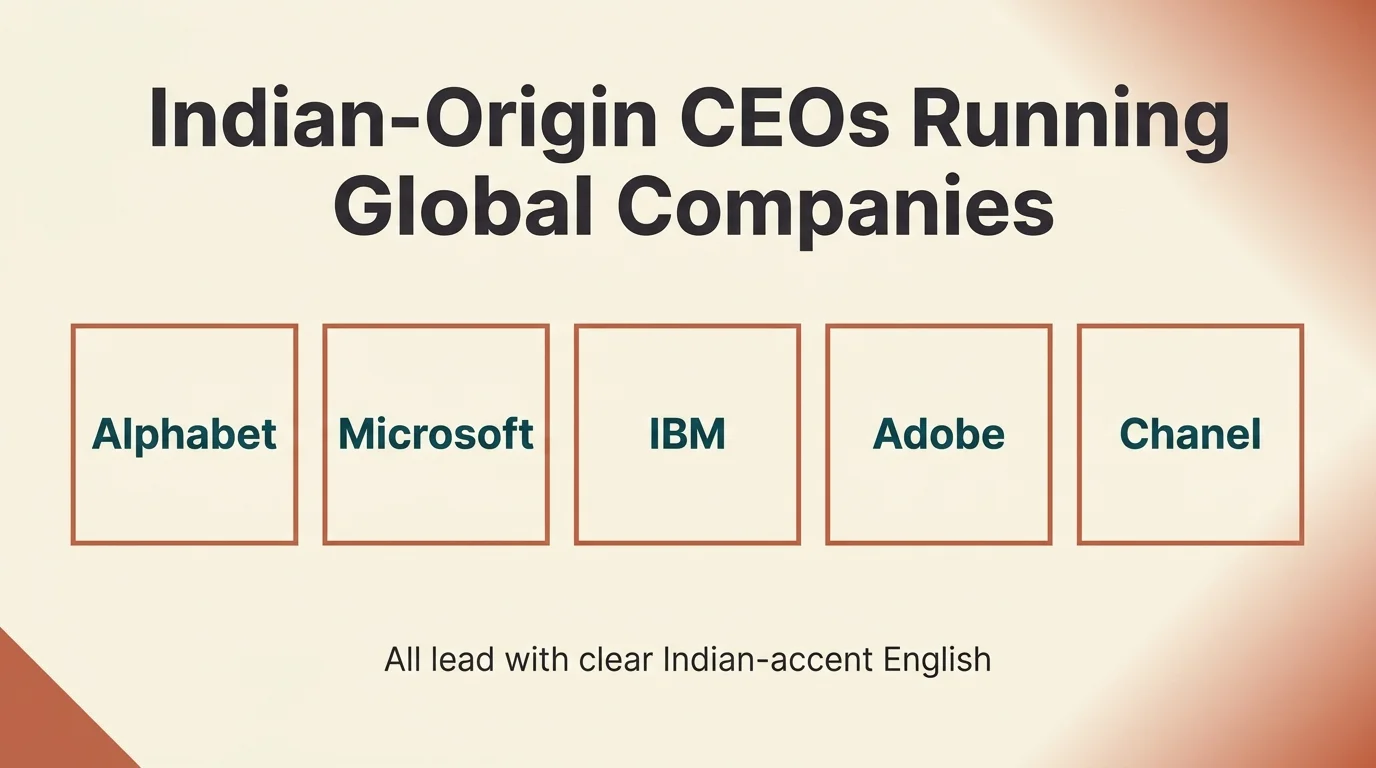
The CEOs of some of the largest and most influential companies in the world are Indian-origin executives who speak with clear, recognisable Indian English. Not neutralised. Not faked-American. Just clear, confident Indian English.
- Sundar Pichai — CEO of Alphabet (Google’s parent company). Raised in Chennai. Clear Indian accent English in every public speech.
- Satya Nadella — CEO of Microsoft. From Hyderabad. Indian accent English that hasn’t stopped him from leading the world’s most valuable public company.
- Arvind Krishna — CEO of IBM. Born in Andhra Pradesh. Recognisable Indian English.
- Shantanu Narayen — CEO of Adobe. From Hyderabad. Indian accent English, 20+ years running one of the world’s most successful software companies.
- Ajay Banga — President of the World Bank. Indian accent English. Previously CEO of Mastercard.
- Raghuram Rajan — Former chief economist at the IMF, former RBI Governor. Clear Indian accent English. Respected globally in economics.
- Leena Nair — CEO of Chanel. Indian accent English. Runs one of the world’s most prestigious luxury brands.
- Parag Agrawal — Former CEO of Twitter. Indian accent English.
- Sanjay Mehrotra — CEO of Micron Technology. Indian accent English.
- Revathi Advaithi — CEO of Flex. Indian accent English.
These aren’t exceptions. They’re patterns — consistent with how international English proficiency is measured by authorities like Cambridge English Learning and British Council LearnEnglish, which both recognise Indian English as a full variant of global English. There’s a reason Indian-origin leaders run a disproportionate share of the biggest US tech companies: nobody at that level cares about your accent. They care about whether you can think, communicate clearly, and lead.
What Americans, Brits, and global professionals actually care about
We asked. Here’s what the research and anecdotal reality both show actually matters when you’re speaking English in a global professional or social setting:
- Clarity — can people understand what you said on the first try?
- Confidence — do you sound like you believe what you’re saying?
- Pace — are you speaking at a comfortable, natural speed (not too fast, not too slow)?
- Content — is what you’re saying substantive and well-reasoned?
- Engagement — do you ask questions, listen, respond genuinely?
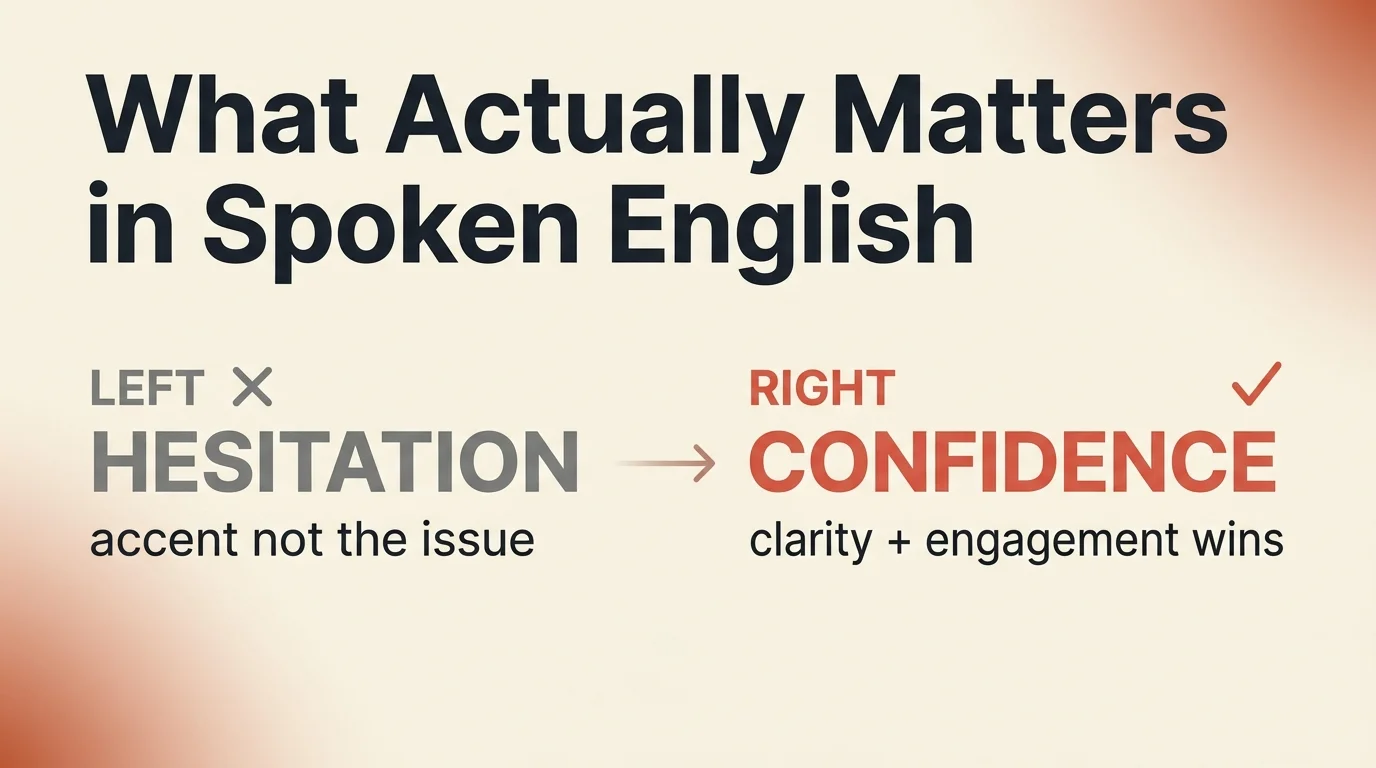
Notice what’s not on that list: accent. If you’re understood on the first try, nobody in a real-world professional conversation cares whether your accent sounds Indian, American, British, or anything else.
The real problem with clear Indian accents: confidence, not accent
Here’s what almost always actually holds Indian English speakers back — in interviews, meetings, small talk, social situations:
- Hesitation — pausing mid-sentence because you’re not sure if you said it right
- Over-apologising — starting conversations with “Sorry my English is not that good” (even when it’s fine)
- Self-editing — second-guessing every word before you say it
- Avoidance — texting instead of calling, emailing instead of speaking up, staying quiet in meetings
- Slowing down unnaturally — because you’re worried about being understood
- Missing small talk — unsure what to say in the casual moments before a meeting, at the coffee machine, at your child’s school pickup
Every one of these is a confidence problem, not an Indian accent English problem. And every one of them is fixable with the right kind of practice.
Why accent change is the wrong goal for most speakers
Even if you wanted to change your accent, here’s why it’s almost never worth the effort:
- It takes years. Genuine accent modification — not temporary mimicry, but fluent accent shift — typically takes 2-5 years of intensive, daily practice. Most adult learners never achieve it completely.
- It’s unnecessary. As the list of Fortune 500 CEOs above shows, there’s zero ceiling on professional success with clear Indian accents.
- It’s distracting. Time spent on accent training is time not spent on confidence, content, and conversation practice — which produce far bigger real-world gains.
- It can backfire. A half-American accent sounds less natural than a clear Indian one. Listeners instinctively trust people who sound comfortable in their own voice.
The exception: if you have a specific pronunciation issue that causes people to genuinely misunderstand you on the first try (rare), targeted pronunciation work with an app like ELSA Speak can help. But that’s pronunciation clarity, not accent neutralisation — a different goal.
What to practise instead — the confidence-first approach
If changing your accent isn’t the goal, here’s what actually builds speaking confidence for Indian English speakers:
1. Daily speaking reps with a real person
Not listening to podcasts. Not watching videos. Not reading English aloud to yourself. Actual two-way conversations, every single day, even for 15 minutes. This is the single biggest lever.
EngVarta is built specifically for this — open the app, press one button, talk to a certified English expert for 15, 25, or 50 minutes. Sessions run 7 AM to midnight. Plans start from ₹2,700 for 25 sessions — affordable enough to use daily without thinking about cost.
2. Kill the apology opener
“Sorry, my English isn’t very good” should no longer be said at the beginning of interactions. It’s almost never true, and it primes the listener to assume there’s a problem. Open with a direct statement or question. Let your accent speak for itself.
3. Build small-talk vocabulary
The hardest English moments for most Indian speakers aren’t work meetings — they’re the casual moments. Small talk with neighbours. Chit-chat at school pickup. Weather comments in elevators. Order modifications at coffee shops. These are all pattern-matching moments. Learn 20-30 phrases and you’ll stop freezing in them.
4. Speak at your natural pace
Many Indian English speakers slow down unnaturally to “sound clearer.” This backfires — it sounds uncertain. Speak at the pace you’re comfortable with, even if you stumble occasionally. Stumbling is fine. Sounding uncertain is what hurts.
5. Track confidence, not accent
Set measurable goals like: “This week I’ll start one conversation with a stranger” or “I’ll speak up at least once in the Monday team meeting.” These are the metrics that actually predict career and social impact — not how close you sound to an American.
6. Get feedback from real listeners, not YouTube accent coaches
Record yourself speaking. Play it back. Better yet, get a trained English coach to give you feedback on clarity and confidence, not accent. What words are you dropping? Where do you trail off? Where do you over-apologise? These are fixable — the Indian accent isn’t the target of change.
When accent training does make sense
To be fair, accent training has a narrow legitimate use case:
- Broadcast / voice-over work — if your job literally requires you to sound like an American radio host, specialised training makes sense
- Acting — for specific roles requiring a specific accent
- Specific pronunciation barriers — if listeners consistently misunderstand specific words, targeted pronunciation coaching (not accent change) helps
For 99% of Indian professionals, students, and homemakers building English speaking confidence — including those who’ve moved to the USA, UK, Canada, or the Gulf — changing your accent is the wrong goal. See our guide for Indians in the USA for context-specific advice.
Use EngVarta to Boost Your English Every Day
Stay motivated and build your English speaking skills with daily tips, real conversations, and expert guidance.
Stop trying to change your accent. Start sounding confident.
Your Indian accent English isn’t the problem. It’s what millions of successful global professionals sound like. The real lever — the one that actually improves your outcomes in interviews, meetings, social situations, and daily life — is confidence through daily speaking practice.
If you’ve been stuck, it’s not because your accent is wrong. It’s because you haven’t had the daily reps to build the speaking muscle. That’s fixable. Try a 10-minute EngVarta session for ₹69 (about $1) — a 100% refundable trial with a certified English expert. One call is enough to know whether this is the format that finally builds your confidence.
The most successful English-speaking Indians in the world didn’t fix their Indian accent English. They built their confidence. You can do the same.
Ready to Practice with Real Experts?
Try EngVarta today — ₹69 trial (India) / $1 trial (International) · 100% refundable


What Our Learners Say
Rated 4.5★ from 9,100+ reviews on Google Play
Frequently asked questions ( FAQs )
Q1. Will my Indian accent English hurt me in a US job interview?
Ans : Almost certainly not. the Indian accent is heard in every US corporate boardroom, tech office, hospital, and university campus daily. What matters in an interview is clarity (can they understand you easily?), confidence (do you sound like you believe your answers?), and content (are your answers well-reasoned?). Indian accent English isn’t a blocker — hesitation is.
Q2. Should I take an accent-training course to sound more American?
Ans : For most learners, no. Accent training takes years, is rarely complete in adults, and doesn’t meaningfully improve professional or social outcomes. Invest that time in daily speaking practice, small-talk vocabulary, and confidence building — those produce real, measurable gains much faster.
Q.3 What if people ask me to repeat myself often?
Ans : That’s a clarity issue, not an Indian accent English issue. Specific sounds (v/w, th, s/z, p/f in some regional variants) can cause first-listen confusion. An app like ELSA Speak can help with those specific phonemes. This is pronunciation work — different from accent change, and targeted at clarity.
Q4. Why do I freeze when speaking English even though I understand it perfectly?
Ans : Because speaking is a different muscle from listening or reading. Understanding requires passive processing; speaking requires active production under time pressure. The only cure is daily speaking reps. 15 minutes of real conversation, every single day, for 3-4 weeks — and the freezing stops. Our 30-day plan walks you through exactly what to do each day.
Q5. Can EngVarta help with Indian accent English confidence even if I don’t want to change my accent?
Ans : Yes — that’s actually what EngVarta is built for. Our experts are trained to help learners build confidence in clear, understandable English without forcing accent change. Sessions focus on natural conversation, real-time correction, and consistent daily practice — the confidence-first approach. Start with a ₹69 trial session (100% refundable) to see if it’s the right fit.
Q6. Are there famous Indian professionals who succeeded with a clear Indian accent?
Ans : Dozens — including the CEOs of Alphabet (Sundar Pichai), Microsoft (Satya Nadella), IBM (Arvind Krishna), Adobe (Shantanu Narayen), Chanel (Leena Nair), and the President of the World Bank (Ajay Banga). Plus senior leaders at virtually every major US and global corporation. Indian accent English is a recognised, respected variant of global English — not a professional ceiling.
Found this useful? Add EngVarta as a preferred source on Google — you’ll see more of our English lessons in your Search and AI results.








Comments
Comments load on demand to keep this page fast.
Leave a comment