How To Overcome IELTS Speaking Anxiety Using Mobile Apps

Category

blog

Importance of Non-Verbal Communication in English

May 28, 2024 • 20 min read • By Swati Raj

Importance of Non-Verbal Communication in English

Non-verbal communication is an essential aspect of effective communication, often conveying more meaning than words alone. In English, as in any other language, non-verbal cues such as body language, facial expressions, gestures, and eye contact play a pivotal role in interpreting and understanding messages. These elements can reinforce what is being said, indicate emotions, and provide feedback without the need for words. Understanding the importance of non-verbal communication in English can greatly enhance one’s ability to communicate effectively and build stronger relationships in both personal and professional contexts.

Understanding Non-Verbal Communication

Non-verbal communication refers to the transmission of messages or information without the use of words. It encompasses a wide range of behaviors and physical cues, including:

  • Body Language : Posture, movements, and physical stance.
  • Facial Expressions : Movements of the facial muscles that convey emotions.
  • Gestures : Hand and arm movements that emphasize or illustrate spoken words.
  • Eye Contact : The use of eye movements and gaze to communicate attention and interest.
  • Proxemics : The use of personal space and distance in communication.
  • Haptics : The use of touch in communication.
  • Paralanguage : Vocal elements such as tone, pitch, and volume.

Each of these components plays a crucial role in the communication process, adding depth and meaning to verbal interactions.

7 Non-Verbal Signals That Matter Most in English Communication

While non-verbal communication covers many elements, there are seven signals that carry the most weight in English conversations — whether you’re speaking to a colleague, giving a presentation, attending a job interview, or making small talk with a native speaker. Master these seven, and your spoken English will feel more natural, confident, and impactful, even before your words do the work.

1. Eye Contact

Eye contact is the single most powerful non-verbal signal in English-speaking cultures. It communicates confidence, honesty, and engagement. Research suggests that 60-70% eye contact during a conversation is ideal — enough to signal interest without feeling like a stare. Too little eye contact makes you appear unsure or evasive; too much can feel aggressive.

Cultural differences matter here. In many Indian and East Asian contexts, lowering your gaze shows respect, especially when speaking to elders or seniors. But in American, British, Australian, and most Western business settings, avoiding eye contact is often misread as a lack of confidence or even dishonesty. When you’re speaking English in a global setting, learn to hold steady, soft eye contact for a few seconds at a time.

Common mistake Indian speakers make: Looking down at notes, the floor, or the table while answering a question. What to practice: During your next conversation, aim to hold eye contact for about three to five seconds, then look briefly to the side, then return. It feels awkward at first, but it becomes natural with repetition.

2. Facial Expressions

Your face is constantly broadcasting signals — often before you say a word. A genuine smile, a raised eyebrow, a slight frown — these micro-expressions shape how your English is received. A warm smile at the start of a conversation instantly puts the other person at ease. A furrowed brow while listening shows you’re thinking hard about what was said.

One of the most effective techniques is to mirror the facial expressions of the person you’re talking to. If they smile, smile back. If they look concerned, match their concern. This mirroring builds rapport subconsciously and makes the other person feel heard. It also helps when you’re nervous — a small, deliberate smile sends a signal to your own brain that you’re relaxed.

Common mistake Indian speakers make: Keeping a flat, neutral expression when speaking English because they’re concentrating on grammar. What to practice: Record yourself on your phone during a two-minute answer. Watch it with the sound off. Does your face tell the same story your words are telling?

3. Body Posture

Your posture tells the listener how you feel about yourself and the conversation before you open your mouth. Open posture — shoulders back, chest slightly forward, arms uncrossed — communicates confidence, openness, and willingness to engage. Closed posture — slumped shoulders, crossed arms, turned away — signals discomfort, defensiveness, or disinterest.

Leaning slightly forward when someone is speaking to you communicates attention and genuine interest. Leaning back — especially with your arms crossed — can be read as skepticism or boredom. In a video call, where only your upper body is visible, posture matters even more because the listener has fewer cues to read.

What to practice: Before an English conversation, take a deep breath, pull your shoulders back, and plant both feet on the floor. This “power posture” takes two seconds and physically shifts your confidence. If you’re building confidence for English conversations overall, our guide on how to build English speaking confidence walks through more techniques.

4. Hand Gestures

Hand gestures add emphasis, illustrate ideas, and help you explain concepts when a word slips your mind. Fluent English speakers naturally use hand movements to underline key points, count items (“first, second, third”), show sizes, and express contrast (one hand here, another hand there). Gestures also help your own brain retrieve vocabulary — research shows speakers who gesture recall words more quickly.

That said, cultural variation is huge. The thumbs-up is positive in most English-speaking countries but rude in parts of the Middle East. Pointing with your index finger is neutral in the US but considered impolite in many Asian cultures — use an open palm instead. Keep gestures above the waist and below the shoulders; excessive or wild gesturing can be distracting.

Common mistake Indian speakers make: Either hiding hands completely (stiffness) or gesturing so frequently that it becomes distracting. What to practice: Rehearse answering a simple question like “tell me about your last project” and deliberately use three or four clear hand gestures. Don’t overdo it — let the gestures follow the meaning, not precede it.

5. Tone and Pitch (Paralanguage)

Paralanguage — the how of your voice, not the what — often carries more weight than the words themselves. The exact same sentence (“That’s fine”) can mean approval, sarcasm, or irritation depending on your tone. In English, a rising pitch at the end usually signals a question; a falling pitch signals a statement or conclusion. Flat, monotone delivery sounds uninterested, even if your content is strong.

Emphasis also changes meaning. Say “I didn’t say he stole it” seven different times, stressing a different word each time — the meaning shifts completely each time. Native English speakers stress the most important word in a sentence to guide the listener’s attention. Learning where to place that stress is one of the fastest ways to sound more fluent.

What to practice: Pick a short sentence and read it five times with different emotions — happy, disappointed, curious, confident, sarcastic. Record each version. This trains your voice to carry meaning, not just words. If you’re working on sentence rhythm and flow, check out the best English speaking apps for sentence framing for structured practice.

6. Proxemics (Personal Space)

Proxemics is the silent distance you keep from others during a conversation — and it varies dramatically between cultures. In Western business settings, people generally maintain about 3 to 4 feet (roughly an arm’s length) during a professional exchange. Getting closer feels intrusive; standing further back feels cold or disengaged.

In many Asian cultures — including parts of India — people stand closer during conversations, and this is perfectly normal. When you speak English with native speakers from the US, UK, or Australia, being aware of their comfort zone is a silent mark of respect. In virtual meetings, proxemics translates to how centered and how close you position yourself relative to the camera — too close feels aggressive, too far feels distant.

What to practice: Watch how native English speakers position themselves in movies, interviews, and meetings. Notice the distance they keep. If someone takes a small step back, give them space — they’re signaling their comfort zone without saying a word.

7. Touch and Handshake

In most English-speaking professional settings, a firm handshake is the standard opening signal. A weak, limp handshake communicates low confidence; a crushing, overpowering one can feel aggressive. The sweet spot is firm, brief (two or three seconds), with steady eye contact and a warm smile. Your handshake is often the first impression a native English speaker has of you.

Beyond the handshake, touch is used sparingly in Western professional contexts — a light pat on the shoulder during an introduction, for example, is fine between established colleagues but generally off-limits with strangers. Cultural awareness matters enormously. In some cultures, a namaste, a slight bow, or no physical contact at all is the norm, and Westerners traveling or working globally have become more comfortable matching these customs.

Common mistake Indian speakers make : Offering a very soft handshake out of politeness. In most Western business settings, this reads as a lack of confidence rather than respect. What to practice: Shake hands with a friend and ask for honest feedback — is your grip firm enough, too tight, or just right?

The Role of Body Language in English Communication

Body language is a powerful form of non-verbal communication that can convey a wide range of emotions and intentions. In English communication, body language often complements verbal messages, helping to clarify meaning and express feelings that words alone may not fully capture.

Positive Body Language

Positive body language includes open gestures, relaxed posture, and appropriate eye contact, which can help build rapport and trust. Examples include:

  • Open Gestures : Using open hand movements and avoiding crossed arms to appear approachable and engaged.
  • Relaxed Posture : Standing or sitting with a straight but relaxed posture to convey confidence and attentiveness.
  • Appropriate Eye Contact : Maintaining eye contact without staring to show interest and respect.

Negative Body Language

Negative body language, such as closed gestures, tense posture, and avoiding eye contact, can create barriers in communication and convey disinterest or discomfort. Examples include:

  • Closed Gestures : Crossing arms or legs, which can indicate defensiveness or reluctance.
  • Tense Posture : Stiffness or rigidity in posture, which may signal anxiety or hostility.
  • Avoiding Eye Contact : Looking away or down, which can suggest dishonesty or lack of confidence.

Facial Expressions and Their Impact

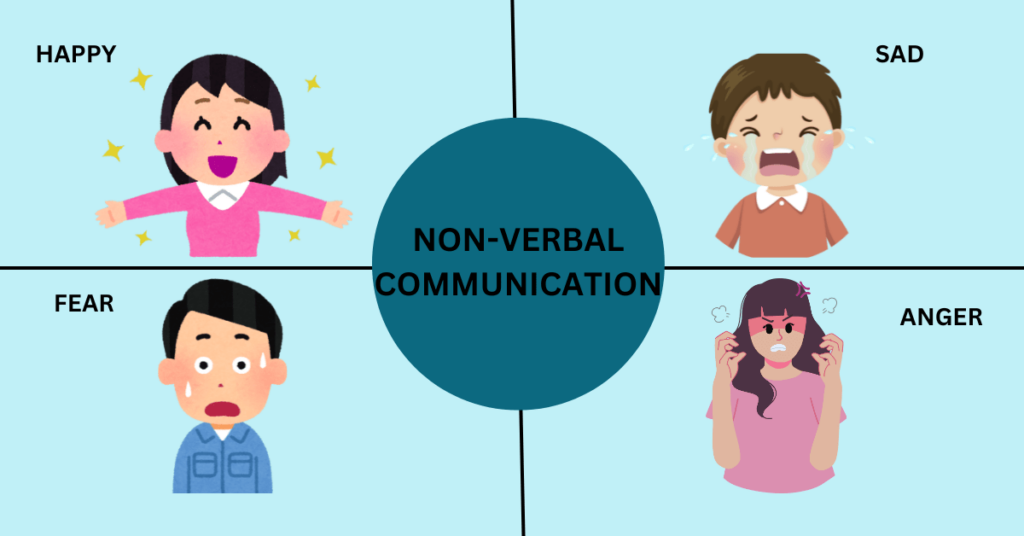
Facial expressions are a universal form of non-verbal communication that can convey a wide range of emotions, from happiness and surprise to anger and sadness. In English communication, facial expressions play a key role in expressing emotions and reinforcing verbal messages.

Key Facial Expressions

  • Smiling : Indicates friendliness, approval, and positivity. A genuine smile can help build rapport and create a positive atmosphere.
  • Frowning : Shows disapproval, concern, or confusion. A furrowed brow can indicate that someone is thinking deeply or is displeased.
  • Raised Eyebrows : Often signal surprise, curiosity, or skepticism. Raised eyebrows can prompt further explanation or clarification.
  • Eye Movements : Rapid eye movements or blinking can indicate nervousness or discomfort, while steady eye contact can show confidence and engagement.

Cultural Considerations

While many facial expressions are universally recognized, cultural differences can influence their interpretation. For instance, in some cultures, direct eye contact is considered respectful, while in others, it may be seen as confrontational. Understanding these cultural nuances is essential for effective communication in diverse settings.

The Power of Gestures

Gestures are deliberate movements of the hands, arms, or other body parts that communicate specific messages. In English communication, gestures can enhance verbal messages, illustrate points, and convey enthusiasm or emphasis.

Common Gestures

  • Thumbs Up : Indicates approval or agreement. It is a universally recognized positive gesture.
  • Nodding : Shows agreement, understanding, or encouragement. Nodding can reinforce that you are listening and engaged.
  • Pointing : Directs attention to specific objects or directions. However, pointing can be considered rude in some cultures, so it should be used with caution.
  • Handshakes : A traditional gesture of greeting or agreement. The firmness and duration of a handshake can convey confidence and respect.

Cultural Variations

Gestures can vary significantly across cultures, and what is considered a positive gesture in one culture may have a different meaning in another. For example, the “OK” hand gesture (forming a circle with the thumb and forefinger) is positive in many Western cultures but can be offensive in some parts of the world. Being aware of these cultural differences is crucial for effective non-verbal communication.

Eye Contact and Its Significance

Eye contact is a fundamental aspect of non-verbal communication that conveys attention, interest, and respect. In English communication, eye contact can enhance the connection between speakers and listeners, making interactions more engaging and meaningful.

Positive Effects of Eye Contact

  • Builds Trust : Maintaining eye contact can help build trust and rapport between individuals.
  • Shows Engagement : It indicates that you are paying attention and are interested in the conversation.
  • Facilitates Feedback : Eye contact allows for the exchange of non-verbal feedback, such as nodding or smiling, which can encourage the speaker.

Negative Effects of Poor Eye Contact

  • Disinterest : Avoiding eye contact can suggest that you are not interested or engaged in the conversation.
  • Dishonesty : Lack of eye contact can be perceived as a sign of dishonesty or evasiveness.
  • Discomfort : Excessive or intense eye contact can make others feel uncomfortable or intimidated.

Cultural Differences

Similar to other forms of non-verbal communication, the interpretation of eye contact varies across cultures. In some cultures, prolonged eye contact is seen as respectful and attentive, while in others, it can be considered disrespectful or confrontational. Understanding these cultural variations is important for effective communication.

Proxemics: The Use of Space in Communication

Proxemics refers to the use of personal space and distance in communication. In English communication, the appropriate use of space can affect the comfort level and interaction dynamics between individuals.

Personal Space Zones

  • Intimate Distance : Reserved for close relationships and private conversations (0 to 18 inches).
  • Personal Distance : Used for conversations with friends and family (18 inches to 4 feet).
  • Social Distance : Appropriate for interactions in social and professional settings (4 to 12 feet).
  • Public Distance : Used for public speaking or addressing large groups (12 feet or more).

Impact on Communication

  • Respecting Boundaries : Maintaining appropriate personal space shows respect for others’ comfort and boundaries.
  • Building Comfort : Adjusting the distance based on the relationship and context can create a more comfortable and effective communication environment.
  • Cultural Sensitivity : Different cultures have varying norms regarding personal space, and understanding these differences is crucial for effective cross-cultural communication.

Paralanguage: The Voice Beyond Words

Paralanguage refers to the vocal elements that accompany speech, such as tone, pitch, volume, and speed. These elements add nuance and emotion to verbal communication, significantly impacting how messages are received and interpreted.

Key Elements of Paralanguage

  • Tone : The emotional quality of the voice that conveys feelings and attitudes.
  • Pitch : The highness or lowness of the voice, which can indicate questions, statements, or emphasis.
  • Volume : The loudness or softness of the voice, which can convey urgency, importance, or intimacy.
  • Speed : The rate of speech, which can reflect excitement, nervousness, or confidence.

Enhancing Communication

  • Matching Tone to Message : Ensure that your tone aligns with the content and emotion of your message.
  • Adjusting Volume : Use appropriate volume levels to match the context and setting of the conversation.
  • Controlling Speed : Speak at a moderate pace to ensure clarity and comprehension.

How EngVarta Helps Improve Non-Verbal Communication in English Skills

EngVarta is an innovative platform designed to help individuals improve their English communication skills through real-time practice and expert feedback. Here’s how EngVarta can support your journey to mastering non-verbal communication:

Real-Time Practice with Experts

EngVarta connects you with English experts who provide real-time practice sessions. These sessions allow you to practice non-verbal communication in a controlled environment, receive immediate feedback, and build confidence gradually.

  • Personalized Sessions : EngVarta offers personalized practice sessions tailored to your specific needs and goals.
  • Immediate Feedback : Receive constructive feedback on your body language, facial expressions, gestures, and overall delivery to identify areas for improvement.

Flexible and Convenient Learning

EngVarta App provides a flexible learning environment that fits your schedule, making it easier to practice regularly.

  • Anytime, Anywhere : Practice non-verbal communication skills at your convenience, whether from home, work, or on the go.
  • Consistent Practice : Regular practice is crucial for building confidence, and EngVarta’s flexible scheduling ensures you can maintain a consistent practice routine.

Safe and Supportive Environment

EngVarta offers a safe and supportive environment for practicing English communication without the fear of judgment.

  • Judgment-Free Zone : Engage in practice sessions without the fear of being judged or criticized, allowing you to focus on improvement.
  • Encouraging Experts : EngVarta’s experts are trained to provide positive reinforcement and constructive feedback, helping you build confidence in your non-verbal communication skills.

Start today with a risk-free trial:

Download EngVarta on Android or iOS.

Try for just Rs 69 / $1 — 100% refundable if it is not the right fit. One real practice session will show you how much daily English speaking practice can transform your results.

Download on Google Play →
Download on App Store →

Available on Android & iOS • 2M+ learners • 4.5★ rating

👉 Connect with EngVarta & Boost Your English Daily!

Stay motivated and improve your English speaking skills with daily tips, real conversations, and expert guidance. Start building confidence and fluency—one conversation at a time!

📸 Instagram : https://www.instagram.com/engvarta.app/
▶️ YouTube : http://www.youtube.com/@EngVarta
📘 Facebook : https://www.facebook.com/engvarta
💼 LinkedIn : https://www.linkedin.com/company/engvarta

Conclusion

Non-verbal communication is a crucial aspect of effective communication in English, playing a significant role in conveying emotions, reinforcing verbal messages, and building rapport. By understanding and mastering the various components of non-verbal communication—body language, facial expressions, gestures, eye contact, proxemics, and paralanguage—you can enhance your overall communication skills and build stronger relationships.

EngVarta serves as a valuable tool in this journey, offering real-time practice, expert feedback, and a supportive environment to help you improve your non-verbal communication skills and gain confidence in English. By leveraging the resources and guidance provided by EngVarta, you can develop the ability to communicate more effectively and confidently in both personal and professional settings.

Frequently Asked Questions about Non-Verbal Communication in English

What is non-verbal communication in English?
Non-verbal communication is everything you communicate WITHOUT using words — facial expressions, eye contact, body posture, hand gestures, tone of voice, and physical distance. Studies suggest that 60-70% of meaning in face-to-face conversation comes from non-verbal cues, not the actual words. For English speakers (especially non-native), getting non-verbal communication right is as important as grammar and vocabulary.
Why is non-verbal communication important in English?
Non-verbal cues build trust, signal confidence, and clarify meaning. In English-speaking professional environments (interviews, presentations, client meetings), people make snap judgments based on your eye contact, posture, and tone within the first 7 seconds. Strong verbal English with weak non-verbal communication creates mixed signals — listeners hear correct words but feel uncertain about you. Strong non-verbal communication can compensate for accent or vocabulary gaps.
What are the types of non-verbal communication?
Main types: (1) Facial expressions — smiling, frowning, raised eyebrows. (2) Eye contact — direct, averted, blinking patterns. (3) Body posture — open vs closed, upright vs slouched. (4) Gestures — hand movements, head nods, pointing. (5) Tone of voice — pitch, volume, pace, pauses. (6) Physical distance — how close you stand to someone. (7) Touch — handshakes, pat on shoulder. (8) Appearance — dress, grooming. Different cultures interpret each differently, so context matters.
What are common non-verbal communication mistakes?
Frequent mistakes in English-speaking contexts: (1) Avoiding eye contact (interpreted as untrustworthy or uninterested). (2) Closed body posture — crossed arms, leaning back (looks defensive). (3) Weak handshake (interpreted as low confidence). (4) Speaking too softly (interpreted as uncertain). (5) Nodding too much (looks like over-eagerness or insincerity). (6) Standing too close (invades personal space in Western cultures). (7) Looking at phone during conversation (signals disrespect).
How is non-verbal communication different across cultures?
Big cultural differences exist: Eye contact — direct in US/UK is respectful, less direct in many Asian cultures is also respectful. Personal space — Americans/Northern Europeans prefer 2-3 feet; Latin Americans/Middle Easterners prefer closer. Head nodding — yes/agreement in most cultures, but in India/Bulgaria a head wobble can mean “I hear you” not “I agree.” For Indian and South Asian English speakers in international contexts, learning Western non-verbal norms (firm handshake, direct eye contact, open posture) helps career outcomes significantly.
How can I improve my non-verbal communication in English?
Practical steps: (1) Record yourself speaking on video — watch for posture, eye contact, gestures. (2) Practice in front of a mirror to make natural smiles and confident posture habitual. (3) Watch English TED talks and copy presenters’ gestures and tone. (4) Practice power-poses before high-stakes calls. (5) Get feedback from a coach or expert. EngVarta sessions are audio-only by design but Experts can guide you on tone, pace, and confidence cues that come through voice — and many learners practice video presentations separately. The $1 refundable trial lets you experience this on a topic where you typically struggle.
Does tone of voice count as non-verbal communication?
Yes. Tone is “paralanguage” — non-verbal vocal communication. The same words said with different tones convey completely different meanings. “That’s interesting” can be sincere, sarcastic, dismissive, or curious depending on tone. For English learners, mastering tonal patterns (rising intonation for questions, falling for statements, stress on key words) is one of the most under-practised skills. Most learners focus on grammar; tone determines whether you sound natural or stiff.
How important is body language in English job interviews?
Critical. Hiring managers form impressions in the first 30 seconds, mostly from non-verbal cues. Strong body language for interviews: firm but not crushing handshake, direct eye contact (look at the bridge of nose if direct eye contact feels intense), upright posture leaning slightly forward, controlled hand gestures, smile naturally when greeted, sit fully back in the chair. Weak body language: slouching, crossing arms, looking down, fidgeting with hair or pen, weak handshake. Even with perfect verbal English, weak body language can lose the offer.


Top 20 Common Idioms in English for IELTS Speaking

May 21, 2024 • 21 min read • By Swati Raj

Top 20 Common Idioms in English for IELTS Speaking

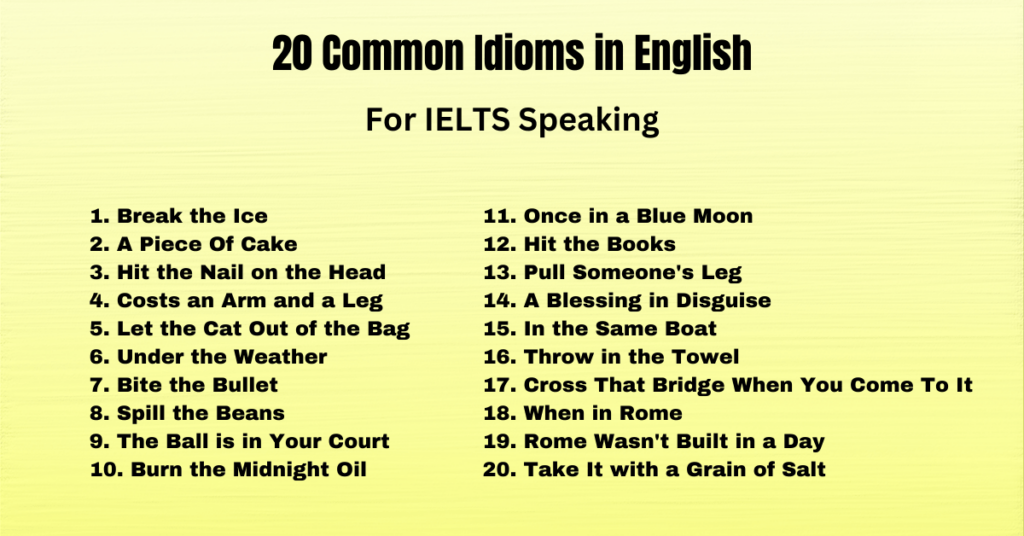
Using idioms in your IELTS Speaking test can be a game-changer. Idiomatic expressions not only make your speech more colorful and engaging but also demonstrate your advanced understanding of the English language. Here, we present the top 20 common idioms in English you should know for the IELTS Speaking test, along with detailed explanations, examples, and practical applications in conversations.

Break the Ice

Meaning: To initiate conversation in a social setting, often to relieve tension. Origin: The phrase comes from breaking the ice to open up a channel in frozen water to allow boats to pass through. Example: “At the beginning of the meeting, I tried to break the ice by sharing a funny story.”

Question and Answer:

  • Q: How do you usually start a conversation with new people?
  • A: I usually try to break the ice with a light-hearted joke or by asking about their hobbies. It’s a great way to ease into a conversation and make everyone feel more comfortable. For instance, when I meet new colleagues, I might share a humorous anecdote or ask them about their favorite movies. This approach not only helps to dissolve any initial awkwardness but also sets a friendly tone for the rest of the interaction. Breaking the ice is crucial in any new social setting because it helps establish rapport and opens up pathways for more meaningful discussions.

A Piece of Cake

Meaning: Something very easy to do. Origin: This idiom likely comes from the simple pleasure associated with eating cake. Example: “Passing the driving test was a piece of cake for me.”

Question and Answer:

  • Q: How did you find your final exams?
  • A: Honestly, they were a piece of cake. I had prepared well, so I found them quite easy. For example, I had spent weeks reviewing all the material, practicing past papers, and even joining study groups to discuss difficult topics. By the time the exams came around, I felt so confident that answering the questions seemed almost effortless. This level of preparation made the exams feel like a walk in the park, and I was able to complete them with time to spare.

Hit the Nail on the Head

Meaning: To be exactly right about something. Origin: This phrase comes from the accuracy required to hit a nail precisely on its head with a hammer. Example: “When you said that practice makes perfect, you hit the nail on the head.”

Question and Answer:

  • Q: What do you think about the importance of daily practice in learning a language?
  • A: You really hit the nail on the head there. Daily practice is essential for mastering any language. For example, when I was learning English, I dedicated at least an hour each day to practicing speaking, listening, reading, and writing. This consistent effort paid off significantly because it allowed me to reinforce my learning and improve steadily over time. Moreover, daily practice helps to build muscle memory and makes using the language more natural and automatic.

Costs an Arm and a Leg

Meaning: Very expensive. Origin: This idiom suggests that something is so expensive that it costs as much as losing one’s limbs. Example: “Buying a house in the city center costs an arm and a leg.”

Question and Answer:

  • Q: Why did you choose to live in the suburbs?
  • A: Living in the city center costs an arm and a leg. The suburbs are much more affordable. For instance, the rent for an apartment in the city center can be double or even triple what you would pay in the suburbs. Additionally, living in the suburbs offers more space and a quieter environment, which is perfect for raising a family. While commuting might be a bit longer, the financial savings and improved quality of life make it a worthwhile trade-off.

Let the Cat Out of the Bag

Meaning: To reveal a secret, often by mistake. Origin: This phrase may come from markets where traders would substitute a cat for a piglet in a bag, revealing the deception when the cat was let out. Example: “She let the cat out of the bag about the surprise party.”

Question and Answer:

  • Q: How did your friend react to the surprise party?
  • A: She found out beforehand because someone let the cat out of the bag. For example, while we were all trying to keep the party a secret, one of our mutual friends accidentally mentioned it in a casual conversation. The friend who was supposed to be surprised started asking questions and it became clear that she had found out about the party. Although the surprise element was lost, we still managed to have a great time celebrating together.

Under the Weather

Meaning: Feeling ill. Origin: This idiom likely comes from sailors feeling seasick during bad weather conditions. Example: “I was under the weather last week, but I’m feeling much better now.”

Question and Answer:

  • Q: You missed the meeting yesterday. Are you okay?
  • A: Yes, I was a bit under the weather, but I’m fine now. Last week, I caught a cold and felt quite miserable with a sore throat and a headache. I spent most of my time resting and taking medication to recover. Fortunately, after a few days of rest and plenty of fluids, I’m feeling much better and ready to get back to work.

Bite the Bullet

Meaning: To face a difficult or unpleasant situation with courage. Origin: In the past, soldiers would bite on a bullet during surgery to endure the pain without anesthesia. Example: “I had to bite the bullet and take the difficult exam.”

Question and Answer:

  • Q: How did you handle the challenging project at work?
  • A: I had to bite the bullet and tackle it head-on despite the difficulties. For example, the project involved tight deadlines and a high level of complexity that made it quite stressful. However, I knew that avoiding it would only make things worse, so I gathered all my resources, made a detailed plan, and started working on it systematically. By staying focused and determined, I managed to complete the project successfully, and the experience helped me grow professionally.

Spill the Beans

Meaning: To reveal secret information unintentionally. Origin: One theory is that it comes from an ancient Greek method of voting using beans, where spilling them would reveal the results. Example: “Who spilled the beans about our surprise trip?”

Question and Answer:

  • Q: How did everyone find out about the surprise trip?
  • A: Someone spilled the beans, and now everyone knows. We had planned a surprise trip for a friend’s birthday, but during a casual conversation, another friend accidentally mentioned the trip. This revelation spread quickly, and soon enough, the birthday friend found out about our plans. Although it was disappointing to lose the element of surprise, we still enjoyed the trip and made great memories together.

The Ball is in Your Court

Meaning: It’s your turn to take action or make a decision. Origin: This idiom comes from tennis, where the ball being in your court signifies it’s your turn to play. Example: “I’ve given you all the information you need. Now the ball is in your court.”

Question and Answer:

  • Q: What’s the next step in our project?
  • A: I’ve completed my part. Now the ball is in your court to finalize the details. For example, I have finished the initial research and compiled all the necessary data. It’s now up to you to review the information, make any necessary adjustments, and prepare the final presentation. This way, we can ensure that everything is ready for our upcoming meeting with the stakeholders.

Burn the Midnight Oil

Meaning: To work late into the night. Origin: Before electric lighting, oil lamps were used for illumination, so working late required burning oil. Example: “I had to burn the midnight oil to finish my report.”

Question and Answer:

  • Q: How did you manage to complete the assignment on time?
  • A: I burned the midnight oil for several nights to get it done. For example, I stayed up late working on the assignment, often until the early hours of the morning. This involved a lot of research, writing, and revising to ensure that the final report was of high quality. Although it was exhausting, the hard work paid off when I submitted the assignment on time and received positive feedback from my professor.

Once in a Blue Moon

Meaning: Very rarely. Origin: A blue moon refers to the rare occurrence of a second full moon within a calendar month. Example: “We only get together once in a blue moon.”

Question and Answer:

  • Q: How often do you see your old friends?
  • A: We meet up once in a blue moon since everyone is so busy. For instance, with everyone’s hectic schedules and different locations, it’s challenging to find time when we can all be free. However, we make a special effort to get together during holidays or special occasions. These rare meetups are always cherished and filled with joy as we catch up on each other’s lives and reminisce about old times.

Hit the Books

Meaning: To study hard. Origin: This idiom conjures the image of someone diligently reading and studying textbooks. Example: “I need to hit the books this weekend to prepare for the exam.”

Question and Answer:

  • Q: What are your plans for the weekend?
  • A: I need to hit the books and study for my upcoming exams. For example, I’ll be spending most of my weekend reviewing lecture notes, reading textbooks, and completing practice problems to ensure I’m fully prepared. I’ve also planned to join a study group session where we can discuss difficult concepts and test each other’s understanding. This intensive study routine will help me feel more confident and ready for the exams.

Pull Someone’s Leg

Meaning: To joke or tease someone playfully. Origin: The origin is unclear, but it’s widely used to describe light-hearted teasing. Example: “Don’t take him seriously, he’s just pulling your leg.”

Question and Answer:

  • Q: Did you really win the lottery?
  • A: No, I was just pulling your leg. For example, I told you that I had won the lottery just to see your reaction and have a bit of fun. I enjoy making playful jokes like this, but it’s important to ensure that the other person understands it’s all in good humor and not meant to be taken seriously. It’s a great way to lighten the mood and share a laugh.

A Blessing in Disguise

Meaning: Something that seems bad but turns out to be good. Origin: This idiom highlights how a seemingly negative situation can have a positive outcome. Example: “Losing that job was a blessing in disguise.”

Question and Answer:

  • Q: How did you cope with losing your job?
  • A: It turned out to be a blessing in disguise because I found a better opportunity. For instance, after being laid off, I had the chance to reassess my career goals and explore new possibilities. This led me to pursue a job in a different industry that I am passionate about. The new role not only offered better pay and benefits but also provided more opportunities for growth and fulfillment.

In the Same Boat

Meaning: In the same situation, especially one involving shared difficulties. Origin: This idiom comes from the idea of people being in a boat together, facing the same conditions. Example: “We’re all in the same boat when it comes to final exams.”

Question and Answer:

  • Q: How are you handling the stress of exams?
  • A: It’s tough, but we’re all in the same boat and supporting each other. For example, my classmates and I are all experiencing the same pressures and challenges as we prepare for our exams. We’ve formed study groups where we can share resources, help each other understand difficult concepts, and provide moral support. Knowing that we are not alone in this situation makes it easier to cope with the stress and stay motivated.

Throw in the Towel

Meaning: To admit defeat or give up. Origin: This idiom comes from boxing, where a trainer would throw a towel into the ring to signal that their fighter was giving up. Example: “After several unsuccessful attempts, I finally threw in the towel.”

Question and Answer:

  • Q: Did you manage to solve the problem?
  • A: No, I had to throw in the towel after multiple tries. For example, despite trying different approaches and seeking advice from colleagues, I couldn’t find a solution to the problem. Eventually, I realized that it was more practical to admit defeat and move on to other tasks where I could be more productive. Although it was frustrating, it was a valuable learning experience that taught me the importance of knowing when to let go.

Cross That Bridge When You Come To It

Meaning: Deal with a problem or situation when it actually happens, rather than worrying about it beforehand. Origin: In the past, bridges were often dangerous to cross, so it was sensible to deal with the challenge only when necessary. Example: “We don’t need to worry about the presentation now. We’ll cross that bridge when we come to it.”

Question and Answer:

  • Q: Aren’t you worried about the challenges we might face?
  • A: Not really. We’ll cross that bridge when we come to it. For example, while it’s important to plan ahead, overthinking potential problems that haven’t occurred yet can lead to unnecessary stress. I prefer to focus on the present tasks and deal with issues as they arise. This approach helps me stay calm and more efficient, as I can address problems with a clear mind when they actually happen.

When in Rome

Meaning: Follow the customs and behavior of the people in the place where you are visiting or living. Origin: Attributed to Saint Ambrose, advising people to adapt to local customs when traveling. Example: “When in Rome, do as the Romans do. It’s best to respect and follow local customs.”

Question and Answer:

  • Q: How do you adjust to different cultures when you travel?
  • A: I believe in the saying, ‘When in Rome,’ so I always try to follow local customs. For example, when I traveled to Japan, I made sure to learn about the local etiquette, such as bowing when greeting people, removing shoes before entering homes, and using chopsticks properly. This not only showed respect for the local culture but also helped me to connect with the people and experience the culture more authentically.

Rome Wasn’t Built in a Day

Meaning: Important work takes time and should not be rushed. Origin: The construction of Rome, one of the greatest cities in history, took centuries. Example: “Learning a new language is a slow process. Remember, Rome wasn’t built in a day.”

Question and Answer:

  • Q: I feel like I’m not making any progress with my studies.
  • A: Don’t be discouraged. Rome wasn’t built in a day. Keep working at it. For example, mastering a new skill or subject takes time, and progress can sometimes be slow and incremental. It’s important to be patient and persistent, celebrating small victories along the way. By maintaining a consistent effort and staying dedicated, you will eventually see significant improvement and achieve your goals.

Take It with a Grain of Salt

Meaning: To view something with skepticism or not to take it too seriously. Origin: This phrase likely comes from the ancient Roman practice of adding a grain of salt to food for improved flavor, implying that what you hear might need a pinch of doubt. Example: “You should take his stories with a grain of salt.”

Question and Answer:

  • Q: Did you believe everything he said?
  • A: Not really. I took his claims with a grain of salt. For example, he tends to exaggerate when telling stories, so while his accounts might contain some truth, they are often embellished for dramatic effect. Therefore, I listen to his stories with a healthy dose of skepticism and don’t take everything at face value. This approach helps me to better discern the accuracy of the information and avoid being misled.

Conclusion

Understanding and using idioms effectively can significantly enhance your IELTS Speaking score. They showcase your ability to use English in a nuanced and native-like manner. Practice incorporating these top 20 common idioms in English into your everyday conversations and observe how native speakers use them in context. By doing so, you’ll not only improve your speaking skills but also gain confidence in using English more naturally and expressively. For an immersive and interactive learning experience, consider using the Best English Learning App for Learning English – EngVarta. This app provides personalized practice sessions and practical tips to help you master English fluently. Good luck with your IELTS preparation!

Frequently Asked Questions about English Idioms

What is an idiom in English?
An idiom is a phrase whose meaning isn’t literal — you can’t figure it out from the individual words. For example, “break a leg” doesn’t mean to actually injure yourself; it means “good luck.” Native English speakers use idioms constantly in casual conversation, business meetings, and writing. Learning common idioms is essential for fluency because they appear everywhere.
Why are idioms important for IELTS speaking?
IELTS speaking band 7+ requires “less common vocabulary and idiomatic language.” Examiners specifically listen for idioms used naturally and correctly. Using 2-3 well-placed idioms in your answer can lift your band score, but force-fitting idioms or using them incorrectly hurts your score. The key is using idioms that genuinely fit the topic, not memorising a list and dropping them in.
What are the most common English idioms?
Most-used English idioms include: “piece of cake” (very easy), “break the ice” (start a conversation), “cost an arm and a leg” (very expensive), “hit the books” (study hard), “bite the bullet” (face something difficult), “let the cat out of the bag” (reveal a secret), “once in a blue moon” (rarely), “spill the beans” (reveal information), “under the weather” (feeling sick), “the ball is in your court” (your decision now). These appear in everyday conversation and IELTS speaking responses.
How do you use idioms correctly in conversation?
To use idioms correctly: (1) Make sure the idiom genuinely fits your meaning — don’t force it. (2) Match the register — formal business idioms (“circle back,” “low-hanging fruit”) vs casual idioms (“hit the road,” “no biggie”). (3) Use idioms native speakers actually use today, not outdated ones from textbooks. (4) Practice them in conversation, not just in writing. Saying “I was over the moon” feels natural in conversation; reading it from a list does not.
What is the difference between an idiom and a proverb?
An idiom is a phrase with figurative meaning (“hit the books”). A proverb is a short sentence stating a general truth or piece of advice (“Actions speak louder than words”). Proverbs are complete sentences with universal lessons. Idioms are smaller phrases that fit inside sentences. Both add colour to English but serve different purposes.
What are common idiom mistakes Indian English speakers make?
Frequent mistakes include: literal translation of Hindi idioms (“eat my brain” instead of “drive me crazy”); using outdated British idioms that native speakers no longer use; forcing idioms in formal contexts where they don’t fit; mispronouncing key words in idioms (“a piece of cake” → “a piece off cake”); and using too many idioms in one answer (sounds rehearsed). Mastering 20-30 idioms used naturally is better than 100 idioms used awkwardly.
How can I learn idioms quickly?
Best methods: (1) Watch English TV shows and note idioms used in real context (Friends, The Office, Modern Family are idiom-rich). (2) Read English newspapers and blogs daily — note 2-3 idioms per day. (3) Use new idioms in conversation within 24 hours of learning them. (4) Pair idiom learning with situations — “what idiom would I use to describe this work meeting?” (5) Daily live speaking practice with feedback. EngVarta connects learners with TESOL/ESL-certified Experts who naturally weave idioms into conversation and correct misuse — the $1 refundable trial lets you experience this.
How many idioms should I learn for IELTS?
For IELTS speaking band 7-8, knowing 30-50 idioms WELL is enough — “well” meaning you can use them naturally, in the right context, with correct pronunciation. Memorising 200 idioms and using none of them naturally won’t lift your score. Examiners notice forced idiom usage. Focus on quality over quantity, master each idiom in real conversation before adding the next.
Are idioms different in American vs British English?
Yes. American and British English share most common idioms but have unique ones. American: “piece of cake,” “hit the road,” “ballpark figure.” British: “bob’s your uncle,” “throw a spanner in the works,” “have a chinwag.” For IELTS (which uses British English), focus on British and globally-shared idioms. For US workplaces, learn American idioms. Most globally-known idioms work in both contexts.

10 Common English Grammar Mistakes and How to Avoid Them

May 18, 2024 • 13 min read • By Swati Raj

10 Common English Grammar Mistakes and How to Avoid Them

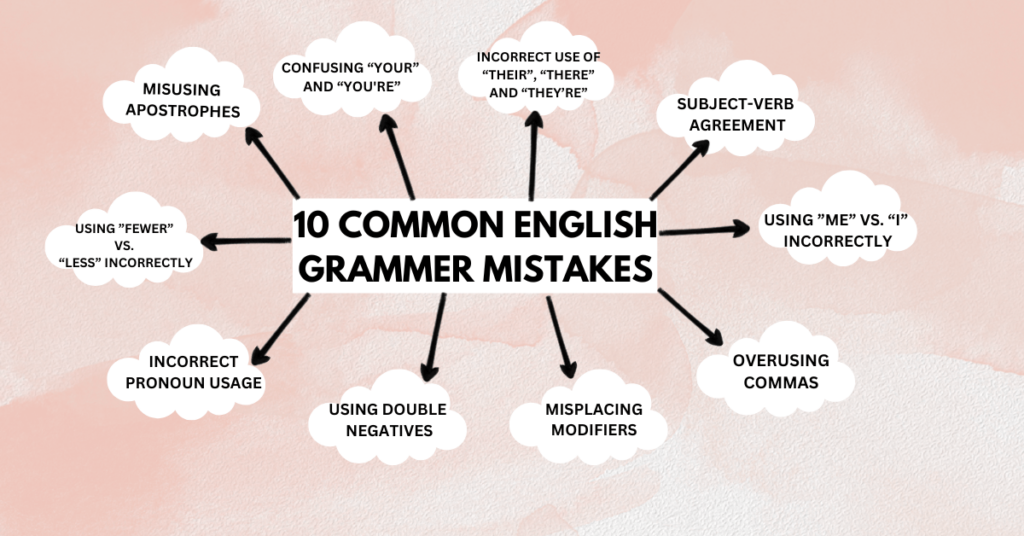
Mastering English grammar can be challenging, especially for non-native speakers. Even advanced learners often stumble over certain grammar rules. Understanding these common English grammar mistakes and learning how to avoid them can significantly improve your English communication skills. The Engvarta App, with its personalized learning sessions and expert tutors, is an excellent tool to help you tackle these errors effectively.

10 Common English Grammar Mistakes and How to Avoid Them

Misusing Apostrophes

Apostrophes are often misused, especially in possessive forms and contractions.

Mistake: Confusing “its” (possessive) with “it’s” (contraction for “it is”).

Correct Usage:

  • “Its tail is long” (possessive).
  • “It’s going to rain” (contraction).

How to Avoid: Practice identifying and using possessives and contractions correctly. Engvarta’s tutors can provide exercises and feedback on apostrophe usage.

Confusing “Your” and “You’re”

These two words sound similar but have different meanings.

Mistake: Using “your” when “you’re” is needed.

Correct Usage:

  • “Your book is on the table” (possessive).
  • “You’re going to love this movie” (contraction for “you are”).

How to Avoid: Remember that “you’re” is short for “you are.” Engvarta sessions can include practice sentences to reinforce this distinction.

Incorrect Use of “Their,” “There,” and “They’re”

These homophones can be tricky.

Mistake: Mixing up “their” (possessive), “there” (location), and “they’re” (contraction for “they are”).

Correct Usage:

  • “Their house is big” (possessive).
  • “The book is over there” (location).
  • “They’re coming to the party” (contraction).

How to Avoid: Engvarta tutors can provide targeted exercises to practice using these words in context.

Subject-Verb Agreement

Ensuring that subjects and verbs agree in number is crucial.

Mistake: “The list of items are on the table.”

Correct Usage: “The list of items is on the table.”

How to Avoid: Regular practice with sentences that involve subject-verb agreement can help. Engvarta offers real-time feedback to correct these errors.

Using “Me” vs. “I” Incorrectly

Choosing between “me” and “I” can be confusing.

Mistake: “Me and my friend went to the store.”

Correct Usage: “My friend and I went to the store.”

How to Avoid: Remove the other person from the sentence to check if “me” or “I” fits. Engvarta tutors can offer exercises to reinforce this rule.

Overusing Commas

Commas are often used incorrectly, leading to comma splices and run-on sentences.

Mistake: “I went to the store, I bought milk.”

Correct Usage: “I went to the store, and I bought milk.” or “I went to the store. I bought milk.”

How to Avoid: Learn the rules for comma usage. Engvarta sessions can include punctuation practice to help you master this.

Misplacing Modifiers

Modifiers should be placed next to the word they modify.

Mistake: “She almost drove her kids to school every day.”

Correct Usage: “She drove her kids to school almost every day.”

How to Avoid: Practice placing modifiers correctly in sentences. Engvarta’s interactive sessions can help identify and correct misplaced modifiers.

Using Double Negatives

Double negatives create a positive statement, which can confuse the meaning.

Mistake: “I don’t need no help.”

Correct Usage: “I don’t need any help.”

How to Avoid: Recognize and avoid double negatives. Engvarta tutors can provide exercises to practice forming negative statements correctly.

Incorrect Pronoun Usage

Pronouns must agree with their antecedents in number and gender.

Mistake: “Each student must bring their book.”

Correct Usage: “Each student must bring his or her book.”

How to Avoid: Ensure pronouns agree with their antecedents. Engvarta offers detailed explanations and practice sentences to master this.

Using “Fewer” vs. “Less” Incorrectly

“Fewer” is used for countable nouns, while “less” is used for uncountable nouns.

Mistake: “There are less people here today.”

Correct Usage: “There are fewer people here today.”

How to Avoid: Practice distinguishing between countable and uncountable nouns. Engvarta sessions can include exercises to reinforce this rule.

How Engvarta Can Help

Engvarta offers a range of features that can help you avoid these common grammar mistakes:

  • Personalized Learning: Engvarta provides one-on-one sessions with expert tutors who can tailor lessons to your specific needs.
  • Real-Time Feedback: During your practice sessions, tutors offer immediate corrections and explanations, helping you learn from your mistakes.
  • Interactive Exercises: Engvarta includes exercises that focus on common grammar mistakes, allowing you to practice and improve continuously.
  • Convenience and Flexibility: You can schedule sessions at your convenience, making it easier to integrate English practice into your daily routine.

Additional Tips for Avoiding These 10 Common English Grammar Mistakes

Read Regularly

One of the best ways to improve your grammar is to read regularly. This exposes you to correct grammar usage in context, helping you internalize the rules.

Write Often

Practice writing to reinforce grammar rules. Whether it’s journaling, writing essays, or even composing emails, the more you write, the better you’ll become at avoiding common mistakes.

Use Grammar Check Tools

There are several online tools like Grammarly that can help you catch mistakes. While they shouldn’t be relied upon exclusively, they can be a great supplementary resource.

Engage in Conversations

Speaking regularly with native speakers or proficient English users can help you identify and correct your grammar mistakes. Engvarta provides a perfect platform for this kind of practice.

Review Grammar Rules

Regularly reviewing grammar rules can help keep them fresh in your mind. Make use of grammar books, online resources, and educational apps to keep learning. Two patterns most learners get wrong are voice and tense—our guide on active and passive voice in English grammar walks through both with side-by-side examples.

Seek Feedback

Don’t hesitate to ask for feedback on your writing and speaking. Engvarta tutors are there to provide constructive criticism and help you improve.

Benefits of Improving Grammar with Engvarta

Engvarta stands out as a robust platform for improving your English grammar. Here’s how:

Structured Learning Path: Engvarta offers a structured learning path that helps you progress from basic to advanced levels systematically. This ensures that you build a solid foundation and then refine your skills progressively.

Practical Applications: Engvarta’s approach is not just theoretical but also practical. You engage in real conversations, write essays, and practice through interactive exercises, which helps in better retention of grammar rules.

Expert Tutors: The tutors at Engvarta are experienced and trained to handle common grammar issues faced by learners. They provide personalized feedback, which is crucial for overcoming specific challenges.

Flexibility and Accessibility: With Engvarta, you can learn at your own pace and schedule sessions at times that suit you. This flexibility is especially beneficial for working professionals and students with busy schedules.

Confidence Building: Regular practice and feedback help in building confidence. As you see improvement in your grammar, your overall communication skills also improve, making you more confident in speaking and writing English.

Customized Sessions: Engvarta allows you to customize your learning sessions based on your specific needs and goals. Whether you need to focus on writing, speaking, or specific grammar rules, the platform adapts to your requirements.

Continuous Improvement: Engvarta tracks your progress and adapts the difficulty level accordingly. This ensures that you are always challenged and continue to improve without getting overwhelmed.

Conclusion

Avoiding 10 common English grammar mistakes is essential for effective communication in English. By understanding these mistakes and practicing regularly, you can significantly improve your language skills. The Engvarta App is an excellent resource for personalized learning and expert guidance, helping you overcome these challenges and become more confident in your English proficiency. With its structured learning path, practical applications, expert tutors, and flexibility, Engvarta provides a comprehensive solution to mastering English grammar.

Frequently Asked Questions about Common English Grammar Mistakes

What are the most common English grammar mistakes?
The most common grammar mistakes English learners make include: subject-verb agreement errors (“She don’t” instead of “She doesn’t”), wrong preposition (“good in English” instead of “good at English”), tense confusion (“I am living here since 2020” instead of “I have been living here since 2020”), article misuse (“I love the music” instead of “I love music”), pronoun confusion (“Me and him went” instead of “He and I went”), and double negatives (“I don’t know nothing” instead of “I don’t know anything”). These six categories cover ~70% of all grammar errors in spoken English.
Why do Indian English speakers make grammar mistakes?
Common reasons: (1) Hindi/regional language structures don’t perfectly map to English (e.g., Hindi doesn’t have articles like a/an/the). (2) Translating mentally from Hindi to English instead of thinking directly in English. (3) Learning English mostly through writing/reading without speaking practice. (4) Repeating mistakes that local English speakers also make (some “Indian English” patterns are actually consistent regional usage rather than mistakes). (5) Lack of feedback — most Indian learners study English without anyone correcting them in real time.
How can I avoid common grammar mistakes when speaking English?
Five practical strategies: (1) Identify your top 3 grammar mistakes and target them deliberately — don’t try to fix everything at once. (2) Practice in real conversation with someone who corrects you in the moment (not just written drills). (3) Read English aloud — your ear catches errors your eye misses. (4) Record yourself speaking, listen back, note errors. (5) Use grammar correction apps for written work but pair with spoken practice for the lasting fix. Daily live practice with a TESOL/ESL-certified Expert (like EngVarta‘s $1 refundable trial) catches grammar errors in real time and fixes them faster than self-study.
What is the difference between ‘less’ and ‘fewer’?
Use “fewer” with countable nouns (things you can count individually): fewer people, fewer mistakes, fewer apples. Use “less” with uncountable nouns (substances, abstract concepts): less water, less time, less stress. Common error: “10 items or less” at supermarkets — should be “10 items or fewer” because items are countable. Modern usage often relaxes this rule, but professional writing should distinguish.
What is the difference between ‘since’ and ‘for’?
Use “since” with a specific point in time when something started: since 2020, since Monday, since I graduated. Use “for” with a duration of time: for two hours, for five years, for a week. Common Indian English error: “I am here since two days” — should be “I have been here for two days.” If you can answer “starting when?” use since. If you can answer “how long?” use for.
When should I use ‘I’ vs ‘me’?
Use “I” when it’s the subject (the one doing the action): “I went to the office.” “Rishish and I went to the meeting.” Use “me” when it’s the object (receiving the action): “He gave the book to me.” “Rishish and me went to the meeting” is incorrect. Test: take out the other person — would you say “Me went to the meeting”? No — you’d say “I went to the meeting.” So “Rishish and I.” Same test for “me”: “He gave the book to me” — works alone.
Is it ‘who’ or ‘whom’?
Use “who” for the subject: “Who is at the door?” Use “whom” for the object: “Whom did you call?” Quick test: replace with he/him. If “he” fits, use “who.” If “him” fits, use “whom.” Modern English: “whom” is increasingly rare in spoken English, but “who” replacing “whom” can sound informal in formal writing. For most spoken English, “who” is acceptable everywhere.
What’s the difference between ‘their’, ‘there’, and ‘they’re’?
“Their” = possessive (belongs to them): “Their car is red.” “There” = location or existence: “There is a problem.” “It’s over there.” “They’re” = contraction of “they are”: “They’re coming tomorrow.” These are homophones (sound the same) but mean completely different things. Test: can you replace it with “they are”? If yes → “they’re.” Does it show ownership? → “their.” Does it show location/existence? → “there.”
How long does it take to fix grammar mistakes?
Fixing a single grammar mistake takes 4-8 weeks of deliberate practice with feedback. Fixing all your top 5-10 mistakes takes 6-12 months of consistent daily practice. Most learners can hear their grammar improving in 30-60 days if they get real-time correction in conversation. Without feedback, errors persist for years — many people speak English their whole life with the same recurring mistakes because no one corrects them.

Understanding and Mastering English Pronunciation Using EngVarta App

May 17, 2024 • 5 min read • By Swati Raj

Understanding and Mastering English Pronunciation Using EngVarta App

Mastering English pronunciation can seem tough, but with the right tools, it can be easy and fun. One such tool is the EngVarta app. It’s designed to help non-native speakers improve their English. This blog will show you how to use EngVarta to understand and master English pronunciation. You’ll get practical tips, techniques, and insights to make big improvements in your spoken English.

What is English Pronunciation?

Understanding the Basics of Pronunciation

English pronunciation is how we say words. It includes how we stress certain syllables, the rhythm of our speech, and how we make specific sounds. Getting pronunciation right is crucial for clear communication.

The Importance of Pronunciation in Communication

Why Pronunciation Matters

Good pronunciation is key to effective communication. If you mispronounce words, people might misunderstand you. Clear pronunciation helps convey your message accurately and boosts your confidence and credibility.

Common Challenges in English Pronunciation

Identifying Pronunciation Hurdles

Many learners struggle with English pronunciation. Common problems include difficulty with certain sounds, different accents, and varying intonation patterns. Recognizing these challenges is the first step in overcoming them.

Introduction to EngVarta

What is EngVarta?

EngVarta is an app that helps you practice speaking English with live conversations. You can talk to English experts who guide you in improving your pronunciation, fluency, and overall communication skills.

Features of EngVarta

Key Features for Pronunciation Improvement

EngVarta has several features that make it great for improving pronunciation:

  • Live Practice Sessions: Speak with English experts in real time.
  • Feedback and Corrections: Get immediate feedback on your pronunciation.
  • Customizable Learning Plans: Sessions tailored to your level.
  • Audio and Video Resources: Access various learning materials.

Setting Up EngVarta for Pronunciation Practice

Getting Started with EngVarta

To start using EngVarta, download the app, create an account, and set up your profile. Pick a plan that suits your needs and schedule your practice sessions.

The Role of Live Conversations

Practicing Pronunciation in Real-Time

Live conversations with English experts give you a practical way to practice pronunciation. EngVarta connects you with native or proficient English speakers who guide you through real-life scenarios, helping you refine your pronunciation skills.

Techniques for Improving Pronunciation

Effective Strategies for Pronunciation Mastery

Here are some techniques to help improve your English pronunciation:

  • Phonetic Training: Learn the sounds of English using phonetic symbols.
  • Shadowing: Mimic native speakers to get the right intonation and rhythm.
  • Listening and Imitation: Listen to and imitate native speakers to grasp correct pronunciation.

Using EngVarta’s Feedback

Leveraging Expert Feedback

EngVarta experts provide valuable feedback on your pronunciation. Pay attention to this feedback and practice the suggested corrections to improve your speaking skills.

Importance of Consistent Practice

Building Pronunciation Skills Over Time

Consistent practice is key to mastering English pronunciation. Regular sessions on EngVarta help reinforce learning and make your pronunciation improvements more lasting.

The Impact of Intonation and Stress

Mastering the Nuances of English Pronunciation

Intonation and stress are critical parts of English pronunciation. EngVarta helps you understand and practice the correct intonation patterns and stress in sentences, which is essential for natural-sounding speech.

Tips for Overcoming Pronunciation Challenges

Practical Tips for Learners

Here are some tips to help you overcome pronunciation challenges:

  • Record and Listen: Record your speech and listen for errors.
  • Use Tongue Twisters: Practice tongue twisters to improve articulation.
  • Slow Down: Speak slowly to focus on pronunciation accuracy.

Integrating Pronunciation Practice into Daily Routine

Making Pronunciation Practice a Habit

Make pronunciation practice part of your daily routine by scheduling regular EngVarta sessions, practicing with friends or family, and using English in daily conversations.

The Role of Technology in Language Learning

How Technology Enhances Pronunciation Practice

Technology, like the EngVarta app, provides innovative ways to practice pronunciation. It offers interactive and engaging methods that traditional learning environments may lack.

Understanding Phonetics with EngVarta

Learning Phonetics for Better Pronunciation

EngVarta can help you understand phonetic symbols and sounds, which are crucial for accurate pronunciation. Learning phonetics helps you recognize and produce the correct sounds in English.

The Influence of Native Language

Addressing Interference from Native Language

Your native language can affect how you pronounce English words. EngVarta experts help you identify and overcome these interferences, ensuring clearer and more accurate pronunciation.

Building Confidence in Speaking

Boosting Confidence Through Practice

Regular practice on EngVarta not only improves pronunciation but also builds confidence in speaking. Confident speakers are more likely to engage in conversations and use their skills effectively.

Success Stories from EngVarta Users

Real-Life Examples of Pronunciation Improvement

Many users have successfully improved their pronunciation using EngVarta. These success stories serve as motivation and proof of the app’s effectiveness.

Customizing Your Learning Experience

Tailoring EngVarta to Your Needs

EngVarta offers customizable learning plans. You can tailor your sessions to focus on specific pronunciation challenges, making the learning experience more effective and personalized.

Additional Resources for Pronunciation Practice

Supplementary Materials for Learning

Besides EngVarta sessions, you can access various resources like pronunciation guides, videos, and audio clips to further enhance your learning.

EngVarta vs. Traditional Language Learning

Comparing Learning Methods

EngVarta offers a more practical and interactive approach to language learning compared to traditional methods. The app’s real-time practice and immediate feedback are significant advantages.

How to Track Your Progress

Monitoring Improvement with EngVarta

EngVarta allows you to track your progress through session reviews and performance assessments. This helps you identify areas of improvement and set new goals.

Overcoming Fear of Speaking

Dealing with Speaking Anxiety

Many learners feel anxious when speaking English. EngVarta provides a supportive environment to practice speaking without fear of judgment, helping you overcome your anxiety.

Conclusion

Mastering English pronunciation is a continuous journey that requires dedication and the right resources. EngVarta provides an effective platform for learners to practice and improve their pronunciation through real-time conversations with experts. By integrating EngVarta into your daily routine and leveraging its features, you can make significant strides in your pronunciation skills, leading to clearer communication and greater confidence in speaking English.

Enhance Your Word Power: Discover the Benefits of the FixoLang App for English Vocabulary

April 15, 2024 • 4 min read • By Swati Raj

Enhance Your Word Power: Discover the Benefits of the FixoLang App for English Vocabulary

Improving your vocabulary is not just about adding more words to your knowledge; it’s about shaping the way you communicate and understands the world—particularly if you are preparing for the IELTS exam. In this context, the FixoLang app emerges as a light for many learners. It is not merely a tool; it is a companion on the journey to mastering English vocabulary effectively and efficiently. Let’s delve into how this innovative app stands out in the crowded field of language learning tools.

Unpacking the FixoLang App: A Gateway to Richer Vocabulary

Understanding the Core Features

The FixoLang app is designed with the specific goal of helping users expand their English vocabulary. This is crucial for any part of the IELTS exam, whether it’s Reading, Writing, Speaking, or Listening. The app provides a user-friendly interface that makes learning new words not just necessary but also enjoyable.

Personalized Learning Journeys

One of the standout features of the FixoLang app is its ability to create personalized learning journeys. Based on initial assessments and ongoing performance analysis, the app tailors vocabulary lists that are most relevant to the user’s learning level and goals. This bespoke approach ensures that learners are neither overwhelmed by the complexity of words that are too advanced nor bored by the simplicity of those they already know.

Innovative Strategies to Enhance Vocabulary Engagement

Innovative strategies to enhance vocabulary engagement can significantly benefit learners. One effective approach is using platforms like FixoLang, that offers an extensive range of cue cards. These cue cards cover various categories, providing learners with diverse contexts and themes. This variety not only helps in learning new words but also in understanding their usage in different situations. Engaging with such tools makes the learning process more interactive and less monotonous, encouraging deeper engagement and better retention of vocabulary. Such strategies are especially useful for exam preparation, where a broad vocabulary is essential.

Real-World Application: Preparing for IELTS

Targeted Practice for Each IELTS Section

The FixoLang app understands that each section of the IELTS test challenges different aspects of language competence. It offers targeted vocabulary lists that are curated to improve performance in each specific section. For instance, vocabulary that enhances descriptive language skills for the Writing section or idiomatic expressions that are often used in the Speaking section.

Simulated IELTS Tests

Practicing under real exam conditions is vital. The FixoLang app provides simulated tests where vocabulary understanding is put to the test in an exam-like environment. This not only helps in applying the learned vocabulary in appropriate contexts but also builds confidence in handling the pressure of the actual exam.

Personalized Feedback

The app also provides personalized feedback to every individual. This feature is invaluable for learners who need a bit more help in understanding complex vocabulary or for those who are stuck at a particular level and need professional advice to move forward.

Conclusion

In the search to conquer English vocabulary for the IELTS, the FixoLang app is more than just a tool—it is a strategic ally. With its personalized learning paths, innovative retention strategies, and a supportive community, the app provides a comprehensive platform for serious IELTS candidates. By integrating the FixoLang app into your study routine, you are setting yourself up for success, equipped with a robust vocabulary that will serve not only in acing the exam but in all your English communications.

FAQs on Vocabulary Learning with FixoLang

Can beginners use the app effectively?

Absolutely! The FixoLang is designed to cater to all levels of learners, from beginners to advanced. The personalized learning paths ensure that every learner starts from their comfort level and progresses at their own pace.

What makes the FixoLang app different from other language learning tools?

Unlike generic language learning tools, the FixoLang app focuses specifically on vocabulary needed for the IELTS exam. It includes features like personalized learning paths, extensive cue card categories, and simulated IELTS tests that provide a comprehensive and targeted learning experience.

What kind of vocabulary is covered in the app?

The app covers a wide range of vocabulary that includes day-to-day words, academic vocabulary, business English, idiomatic expressions, and phrasal verbs, among others.

Is there any feature in the app that helps with pronunciation?

Yes, the app includes audio pronunciations for each word, which is crucial for improving speaking and listening skills, especially in preparation for the IELTS.

How to Master the IELTS Speaking Test with FixoLang | Step-by-Step

April 15, 2024 • 5 min read • By Swati Raj

How to Master the IELTS Speaking Test with FixoLang

Taking the IELTS Speaking Test can feel like stepping onto a global stage—exciting, nerve-wracking, and entirely conquerable when you’ve got the right tools. Enter FixoLang: your AI-powered speaking coach in your pocket, helping you ace cue cards one by one.

Why the IELTS Speaking Test Matters

This section gives you a chance to shine, demonstrating clarity, fluency, pronunciation, and insight. While nerves, vocabulary gaps, and timing can be hurdles, combining a strategic routine with tools like FixoLang can transform challenges into opportunities.

Step 1: Understand the Structure of the IELTS Speaking Test

The test is divided into three parts:

  • Part 1: Warm-up questions—about your background, routine, and interests.

  • Part 2: Cue card challenge—prepare briefly, then speak for 1–2 minutes on a topic. If you’re wondering what types of cue cards can appear in the IELTS Speaking test, you can check out this blog – Top 20 IELTS Speaking Cue Card Questions for 2025.

  • Part 3: Deeper discussion—explore ideas, opinions, and reasoning.

Familiarity with this structure builds confidence and flow.

Step 2: Download FixoLang—Your AI IELTS Coach

Make your practice smarter and smoother with real-time feedback:

Use this tool to practice anytime, anywhere with AI-guided feedback.

Step 3: Stay Motivated with FixoLang’s Social Media

Engage with the learning community and get daily speaking insights:

  • Instagram: Follow @fixolang for bite-sized tips, vocabulary boosts, and speaking motivation.

  • YouTube: Look for FixoLang’s channel for cue card demos, vocabulary tutorials, and speaking strategy videos.

Step 4: Blend Expert Advice & Real Student Experience into Your Practice

Boost your performance using these proven strategies:

  • Avoid scripted answers—authentic, natural responses score better.

  • Focus on clarity, not complexity—short, confident phrasing beats awkward, long-windedness.

  • Mix sentence lengths—short to emphasise, long to expand your answer.

  • Use deliberate pauses—they show reflection and control.

Stories from real users reinforce FixoLang’s value, helping learners improve through structured cue card practice and instant feedback.

Step 5: Enrich Vocabulary in Context

A strong lexical range elevates your Speaking Test responses:

  • Use topic-based cue cards—like “Environment” or “Technology”—to learn vocabulary naturally.

  • Immediately practice new words by speaking sentences that include them—this aids retention.

  • Use flashcards or journaling to reinforce newly acquired vocabulary.

Step 6: Set Up a Success-Oriented Routine

Consistency beats intensity. Here’s a sample weekly schedule:

Days Focus Area
1–2 Cue card practice, fluency-focused responses
3–4 Clarity, coherence, and vocabulary enrichment
Day 5 Full IELTS Speaking Test mock via FixoLang + review
6–7 Feedback review, targeted improvement, reinforcement

Just 15 minutes of daily practice can build fluency, confidence, and skill.

Why This Approach Makes You IELTS-Ready

Component Benefit
FixoLang + Cue Cards Realistic, repeatable practice with feedback
Social Media Learning Daily inspiration and useful speaking content
Vocabulary in Context Natural usage and memory retention
Structured Routine Builds fluency and test familiarity steadily
Instant Feedback Identifies strengths and areas for improvement

Mastering the IELTS Speaking Test is a journey—powered by consistent practice, smart tools, and confident mindset. With FixoLang guiding your speaking sessions, expert strategies enriching your approach, and your daily routine building momentum, the exam becomes just another conversation you walk in to ace.

Frequently Asked Questions (FAQs)

Frequently Asked Questions

– Can I use filler language effectively?

Using minimal and natural fillers like “well…” or “you know…” can help maintain conversational flow. However, excessive fillers may indicate hesitation and affect fluency scoring

– Can I ask the examiner to repeat a question if I didn’t understand?

Yes—asking for clarification is allowed and won’t negatively affect your score, whereas misunderstanding can lead to off-topic answers

– Is the Speaking Test face-to-face or computer-based?

The Speaking Test is always conducted face-to-face, either in person or via video, with a real examiner.

– What are the scoring criteria?

You’re evaluated on four areas—fluency & coherence, lexical resource (vocabulary), grammatical range & accuracy, and pronunciation—each contributing 25% to your overall band score

– How long does the test last?

The test is about 11–14 minutes total—4–5 minutes for Part 1, 3–4 minutes (including prep) for Part 2, and another 4–5 minutes for Part 3.

– How many parts are there in the IELTS Speaking Test?

There are three parts: an interview up to 5 minutes (Part 1), a 1–2 minute “long turn” on a cue card topic (Part 2), and a follow-up discussion related to Part 2 (Part 3).

A Comprehensive Guide to the Exam Pattern of IELTS 2026

April 15, 2024 • 8 min read • By Swati Raj

Comprehensive Guide to Exam Pattern of IELTS 2026

Facing the IELTS 2026 exam might seem daunting, but with the right preparation and tools, it becomes an achievable goal. The IELTS measures your English skills in listening, reading, writing, and speaking, which is crucial for anyone looking to study, work, or live in English-speaking environments. This detailed guide will walk you through the exam pattern of IELTS 2026 and introduce you to the FixoLang app, a specialized tool for boosting your speaking abilities, ensuring you’re well-prepared for every part of the exam.

Unlocking the Secrets of the Exam Pattern of IELTS 2026

Why the IELTS Exam Is Your Gateway to New Opportunities

The International English Language Testing System (IELTS) is your key to unlocking a world of opportunities in English-speaking countries. Excelling in this exam can set the foundation for studying at top universities, embarking on an international career, or migrating to countries like the UK, Canada, and Australia.

Describing the IELTS 2026 Exam Structure

Understanding the exam pattern of IELTS 2026 is the first step to success. The test assesses your proficiency in the four core English language skills: listening, reading, writing, and speaking, each reflecting real-life use of English in academic and professional settings.

Exam Pattern of IELTS 2026: Deep Dive into the IELTS Sections

Listening: Mastering the Art of Attention

Strategies for Exceptional Listening Skills: Active listening to various English content, such as podcasts, lectures, and news, sharpens your ability to catch every detail, preparing you for the diverse accents and situations in the exam.

Reading: Strategies for Success

Maximizing Your Reading Score: Practice reading widely, from scientific articles to literature and news reports. Learning to quickly grasp the main ideas and details will boost your speed and understanding, which is essential for the time-pressured exam.

Writing: Communicating with Clarity

Guidelines for Impactful Writing: The writing section tests your ability to express ideas clearly and logically. Whether describing data or crafting an essay, practice is key. Focus on structuring your writing and using a variety of sentence forms and vocabulary.

Speaking: Confidence is Key

Enhancing Your Speaking with Practice: This section is your chance to show how well you can communicate in English. Using tools like the FixoLang app to practice speaking on a wide range of topics can significantly improve your fluency and confidence.

Why the FixoLang App is a Game-Changer for Speaking Practice  

The FixoLang app is an innovative tool designed to enhance your speaking skills. With its AI-driven feedback and comprehensive practice options, it’s like having a personal IELTS coach available anytime. The

How to Prepare for the IELTS Speaking Section in 2026

The speaking section is where most Indian candidates lose marks. Unlike reading and writing, you cannot prepare for speaking by studying alone — you need to practise with a real person who can evaluate your fluency, pronunciation, and grammatical range in real time.

EngVarta is used by thousands of IELTS aspirants for daily speaking practice. The format is simple: call an English expert, have a natural conversation, and receive feedback on the areas that matter for your IELTS band score. Experts can also run mock IELTS Part 2 (cue card) and Part 3 (discussion) sessions on request.

Daily 15-minute practice sessions over 2-3 months typically improve speaking band scores by 0.5 to 1.5 points. Plans start at ₹2,700 for 25 sessions. Try a ₹69 / $1 trial first — it is fully refundable if you are not satisfied.

What Our Learners Say

Rated 4.5★ from 9,100+ reviews on Google Play

★★★★★
My last conversation was very good. Really very helpful to me. I learnt lots of things from that.
★★★★★
Its just great, I mean in terms of environment that it gives you is just awesome. Thnx again for boosting my confidence.
★★★★★
Engvarta provides the best platform for learners to learn and get comfortable with the language by offering a comfortable and judgment-free environment with regular feedback. Engvarta is the best English learning app available.
★★★★★
very exlent English learning app with live tuters. and they will help to me for improving English.
★★★★★
Excellent experience even in just the first conversation. I'm looking forward to learning English with this app.
★★★★★
It's a incredible app... It builds my confidence to speak English fluently, gives you practice to start your conversation without any hesitation, provides daily free vocabulary and quizes also...Expensive but amazing & worth it...
★★★★★
I enjoyed this course.experts encouraged me to use advanced vocabulary, idioms and phrases daily dose of assignment, quizzes and new vocabulary keep your toes
★★★★★
I have been using this app since three months. I am very much satisfied with their services , experts are too good and their support team members are very supportive and helpful. I must suggest this app to everyone. Thank you Engvarta for helping me.❤️
★★★★★
I have been using this app since three months. I am very much satisfied with their services , experts are too good and their support team members are very supportive and helpful. I must suggest this app to everyone. Thank you Engvarta for helping me.❤️
★★★★★
So comfortable to speak with the expert , really like this app
★★★★★
I have been using EngVarta for the past three months and from the period I am using I feel a considerable amount of difference in how I was speaking earlier and now how I am speaking and I think the EngVarta team has done a commendable job in improving my English fluency skill.
★★★★★
I am happy while speaking with experts and getting feedback on my speaking skills.

Ready to Practice with Real Experts?

Try EngVarta today — ₹69 trial (India) / $1 trial (International) · 100% refundable

H5lEIb” rel=”nofollow noopener” target=”_blank”>FixoLang app is currently available for download on the Play Store and the App Store.

    • A Wide Range of Practice Topics: Prepare for any speaking topic with the app’s extensive library of cue cards.
    • Immediate Scoring: Get instant feedback on your performance to know where you stand.
    • Around-the-Clock Practice: Fit practice into your schedule easily, thanks to 24/7 app access.
    • Personalized Improvement Tips: Receive specific advice on enhancing your grammar, clarity, and vocabulary.


Extending Your Preparation Beyond Speaking

Extending IELTS preparation beyond speaking involves mastering listening, reading, and writing skills through diverse practice materials, timed exercises, and regular feedback. This holistic approach enhances comprehension and expression, crucial for achieving a higher overall band score.

Frequently Asked Questions for Acing the IELTS

Can using the FixoLang App improve my overall band score?

Yes, using the FixoLang App specifically targets enhancing your speaking abilities, which is a critical component of the IELTS. Improved speaking skills can positively impact your overall band score by building greater confidence and proficiency in using the English language conversationally.

How does the FixoLang App help in IELTS speaking preparation?

The FixoLang App offers personalized feedback, immediate scoring, and a vast library of practice topics, making it an essential tool for improving your speaking skills. Its 24/7 availability allows for flexible practice schedules, and the AI-driven feedback helps in pinpointing areas for improvement.

What are the best ways to improve speaking skills for IELTS 2026?

Utilize tools like the FixoLang App to practice speaking. This app offers a wide range of topics and provides AI-driven feedback, helping you enhance fluency and confidence. Additionally, engage in regular conversations in English, focusing on clarity and grammar.

What is the structure of the IELTS 2026 exam?

The IELTS 2026 exam is structured into four main sections: Listening, Reading, Writing, and Speaking. Each section is designed to test your English language proficiency in different contexts, mirroring real-life situations in academic and professional environments.

How can I improve my listening skills for the IELTS 2026?

To enhance your listening skills, engage in active listening practices. This includes regularly listening to English-language podcasts, lectures, and news broadcasts. Focus on understanding different accents and picking up nuances in conversations to better prepare for the variety of situations presented in the exam.

What strategies can help increase my reading score in IELTS 2026?

Boost your reading score by practicing with a wide range of texts. Include scientific articles, literature, and news reports in your preparation. Work on your ability to quickly identify main ideas and detailed information, which is essential for managing the time-limited nature of the reading section.

How should I prepare for the writing section of the IELTS 2026?

Prepare for the writing section by practicing structured writing. Whether you are describing data or writing an essay, focus on clear and logical expression. Use diverse sentence structures and enrich your vocabulary to effectively convey your ideas.

Conclusion: Your Blueprint for IELTS Success

The IELTS 2026 exam is a crucial step towards achieving your global ambitions, and thorough preparation is key to success. By understanding the exam format, practicing diligently, and utilizing resources like the FixoLang app, you can approach the test with confidence. Start your journey today, and open the door to a world of opportunities.

Want a Band 7+? Here’s How to Achieve Your Target IELTS Score in 2025

April 15, 2024 • 5 min read • By Swati Raj

Want a Band 7+? Here’s How to Achieve Your Target IELTS Score in 2025

You don’t need to be perfect. You just need a better IELTS score.

If you’ve been chasing a Band 7 or higher in IELTS, you already know it’s more than just an exam — it’s your ticket to a bigger future.

Maybe it’s studying in your dream university.
Maybe it’s getting a job overseas.
Or maybe it’s migrating to a new country for a better life.

Whatever your reason, your IELTS score matters. And with the right approach, it’s more achievable than ever.

What Does Your IELTS Score Really Reflect?

Your IELTS score isn’t just about English.
It reflects how well you can:

  • Understand native conversations

  • Present your ideas clearly

  • Think in English without translating

  • Handle academic or work-based communication

Scoring Band 7+ shows that you’re ready to function independently in an English-speaking country — at university, work, or even day-to-day life.

Step 1: Know How the IELTS Test Works

Before you aim for a better IELTS score, make sure you know how the test is structured. It’s divided into four parts:

  • Listening (40 minutes)

  • Reading (60 minutes)

  • Writing (60 minutes)

  • Speaking (11–14 minutes)

Each section is scored individually, and your overall IELTS score is the average of all four.

Smart Tip: Don’t just prepare for your strong areas. Balance matters. Even one weak section can bring down your overall score.

Step 2: Practice Under Real Test Conditions

If you want to improve your IELTS score, you need to simulate the pressure of the real exam.

  • Time your writing tasks

  • Listen to full-length recordings without pausing

  • Read with a 60-minute clock ticking

  • Do mock speaking tests out loud

This not only builds speed and stamina but reduces test-day anxiety.

Step 3: Speak Daily — and Get Instant Feedback

Practicing speaking is essential. But even more powerful than practice is feedback — especially if it’s instant and accurate.

That’s where tools like FixoLang can truly help.

FixoLang is an AI-powered IELTS speaking practice app that:

  • Gives you real IELTS speaking questions

  • Lets you speak your answers in real time

  • Offers instant scoring and feedback based on fluency, coherence, grammar, and pronunciation

  • Helps you track progress and improve weak areas every day

It’s like having a speaking coach available whenever you need it.
And because it’s designed specifically for IELTS, the practice is targeted and effective.

Download FixoLang App to start improving your IELTS speaking score today.

And if you want a deeper understanding of how the IELTS Speaking test works, with example questions and examiner tips, check out this guide: 👉 How to Prepare for IELTS Speaking Test

Step 4: Learn IELTS-Specific Strategies

Each section of IELTS has its own pattern and strategy. Don’t just study English — study the test itself.

For Listening:

  • Practice identifying key words

  • Get used to different accents

  • Learn to follow signposts like “however,” “on the other hand,” etc.

For Reading:

  • Skim and scan quickly

  • Don’t get stuck on one passage

  • Learn how to spot paraphrasing in questions

For Writing:

  • Use standard formats for Task 1 and Task 2

  • Always outline your thoughts before you write

  • Learn linking phrases to improve coherence

For Speaking:

  • Smile and be natural

  • Expand your answers beyond 1-2 lines

  • Don’t be afraid to self-correct — it shows awareness

Step 5: Build Vocabulary Around IELTS Themes

Improving your vocabulary boosts all four sections of your IELTS score. But instead of random word lists, focus on topics that frequently appear in IELTS:

  • Education

  • Health

  • Environment

  • Technology

  • Work and lifestyle

  • Culture and society

Make a habit of using new words in your own sentences — especially in speaking and writing.

Apps like FixoLang also help you reinforce topic-specific vocabulary in speaking answers — so you’re not just memorizing words, you’re applying them.

Step 6: Track Your Progress Weekly

Don’t just practice — measure your performance.

  • Do a weekly full mock test

  • Record your speaking tests

  • Track your writing score based on band descriptors

  • Identify your weakest section and double your effort there

With FixoLang, this becomes easier — your speaking performance is scored after each session, so you can monitor exactly where you’re improving (and where you’re not).

Final Thoughts: You Can Improve Your IELTS Score

A high IELTS score isn’t about luck. It’s about preparation, practice, and mindset.

You don’t need a classroom.
You don’t need to memorize the dictionary.
You just need a consistent strategy, daily effort, and the right tools — like FixoLang for speaking and expert feedback when needed.

Your goals are within reach.
Now it’s time to earn the IELTS score that gets you there.

Frequently Asked Questions

Frequently Asked Questions

What is a good IELTS score for study or migration?

A Band 7+ is widely accepted by most universities and immigration programs in countries like Canada, the UK, and Australia.

Can FixoLang replace a speaking coach?

FixoLang is perfect for daily self-practice and real-time scoring. For live feedback, it can be combined with platforms like EngVarta.

How much time does it take to improve my IELTS score by 1 band?

With focused practice and proper feedback, most learners see an improvement of 0.5 to 1 band in 6–8 weeks.

Top 20 IELTS Speaking Cue Card 2026 Questions

April 15, 2024 • 9 min read • By Swati Raj

Top 20 IELTS Speaking Cue Card 2026 Questions

Here are 20 common IELTS Speaking cue card topics that many candidates talked about in 2024. These topics can give you an idea of what to expect and help you get ready for different types of questions in 2026:     

  1. Talk about trying a new food for the first time.  
  2. Describe a time when you had to use your imagination.  
  3. Talk about reconnecting with an old friend.  
  4. Describe a book you recently read and would recommend.  
  5. Describe a goal you achieved that you set for yourself.  
  6. Talk about a family business you know about.  
  7. Describe an interesting conversation you had with someone.  
  8. Talk about a time when you advised someone.  
  9. Describe a piece of local news that people were interested in.  
  10. Talk about a piece of clothing that someone gave you.  
  11. Describe a time when you looked at the sky (day or night).  
  12. Talk about a good decision someone you know made.  
  13. Describe an important river or lake in your country.  
  14. Talk about someone you think is very open.  
  15. Describe a time when you were stuck in traffic.  
  16. Talk about an electronic device you would like to buy.  
  17. Describe an exciting book you enjoy reading.  
  18. Talk about a time when you were surprised to meet someone.  
  19. Describe an older person you admire.  
  20. Talk about a skill that takes a long time to learn.  

IELTS Speaking Cue Card

These topics cover a wide range of subjects, so they encourage you to think deeply and talk about your experiences, opinions, and dreams. Practicing these 

How to Prepare for IELTS Speaking Cue Cards Effectively

Memorising answers to cue cards rarely works in the IELTS speaking test. Examiners are trained to spot rehearsed responses. Instead, focus on building a framework you can apply to any topic:

  • The 4-sentence framework: Open with what/who/where, explain why it matters to you, give a specific detail or story, and close with how it connects to your life today. This works for virtually any Part 2 topic.
  • Practise with a timer: You get 1 minute to prepare and 2 minutes to speak. Practise hitting the 2-minute mark without running out of things to say — or stopping too early.
  • Record yourself: Listen for filler words (um, uh, like), long pauses, and grammar errors you repeat consistently. These patterns are easier to fix when you hear them.
  • Get expert feedback: Apps like EngVarta let you practise with certified English experts who can simulate the IELTS speaking environment and give you real-time feedback on fluency, pronunciation, and vocabulary range.

Common Mistakes That Lower Your IELTS Speaking Score

Avoid these mistakes that consistently cost candidates 0.5 to 1.0 band points:

  • Using overly complex vocabulary incorrectly: Simple, accurate English scores higher than complicated English used wrongly. The examiner is testing your ability to communicate clearly, not your dictionary knowledge.
  • Not extending your answers: In Parts 1 and 3, one-word answers signal low fluency. Always give a reason, example, or comparison alongside your answer.
  • Ignoring pronunciation: Word stress, sentence intonation, and clear vowel sounds matter more than accent. Daily practice with a human partner (not just an AI app) helps you catch pronunciation habits you cannot hear yourself.
  • Speaking too fast: Speed does not equal fluency. Speaking at a natural, clear pace with good sentence structure scores higher than rapid speech full of errors.

The best preparation combines self-study with daily speaking practice. Over 2 million learners use EngVarta to practise English speaking daily — many specifically for IELTS preparation. The ₹69 / $1 trial session is a risk-free way to experience expert feedback on your speaking.

What Our Learners Say

Rated 4.5★ from 9,100+ reviews on Google Play

★★★★★
Wonderful application for English learners and good for speaking with trainers .All trainers are well experienced and help us within the time period,Thanks
★★★★★
I have been using EngVarta for the past three months and from the period I am using I feel a considerable amount of difference in how I was speaking earlier and now how I am speaking and I think the EngVarta team has done a commendable job in improving my English fluency skill.
★★★★★
excellent app for learning fluency and If you genuinely correct your mistakes then you should opt for this
★★★★★
hii i have taken your 69 rs plan for expert calling but no response from your side you gove the number i am trying to call on that number but no response r u making me fool? or what?
★★★★★
My last 12 sessions experience is really great. It's a great app to improve English fluency and communication skills. All experts are quite friendly and highly skilled.
★★★★★
very exlent English learning app with live tuters. and they will help to me for improving English.
★★★★★
Engvarta is a platform where we start from the 0 level to 100 level. That is the best thing I have never seen in my life. There are so many part and so many way, they are always try to teach you until you become a good speaker. Thank you Engvarta
★★★★★
Thank you guys for this amazing app. I think this application will help me to improve my communication skills.
★★★★★
I am happy while speaking with experts and getting feedback on my speaking skills.
★★★★★
I enjoyed this course.experts encouraged me to use advanced vocabulary, idioms and phrases daily dose of assignment, quizzes and new vocabulary keep your toes
★★★★★
Wonderful application for English learners and good for speaking with trainers .All trainers are well experienced and help us within the time period,Thanks
★★★★★
This is the best app for anyone who feels nervous and hesitates during conversation in English.

Ready to Practice with Real Experts?

Try EngVarta today — ₹69 trial (India) / $1 trial (International) · 100% refundable

f=”https://engvarta.com/ielts/”>IEL
TS Speaking cue card topics can help you speak more clearly and confidently during the exam.  

The FixoLang app stands as an invaluable tool for candidates aiming to excel in the Speaking section. It provides IELTS Speaking cue cards, live assessments, advanced vocabulary, and personalized feedback to fine-tune your speaking abilities. The FixoLang app is currently available for download on the Play Store and the App Store.

Conclusion: Your Path to IELTS Success

With dedicated practice and the right resources like the FixoLang app, mastering the IELTS Speaking cue card questions is within your reach. Focus on improving your fluency, coherence, pronunciation, and grammatical range to express your ideas and achieve your desired score confidently.

FAQs: Your IELTS Speaking Questions Answered

Does an accent matter when taking the speaking portion of the IELTS exam?

In the IELTS speaking exam, accent matters less than clarity, fluency, and proper pronunciation. Focus on being understood rather than altering your natural accent.

Is it okay to ask the examiner to repeat the question?

Yes, you can ask the examiner to repeat or clarify the question. It’s better to understand the question correctly than to answer inaccurately.

How can I manage my nervousness during the IELTS Speaking test?

Practice under simulated exam conditions with the FixoLang App. Being well-prepared and familiar with the test format can significantly reduce nervousness.

Can using complex vocabulary improve my IELTS Speaking score?

Yes, but clarity is key. Use complex vocabulary correctly and ensure it enhances the clarity and relevance of your response.

How important is pronunciation in the IELTS Speaking test?

Pronunciation is crucial. It can significantly affect your clarity and comprehension. Focus on practicing difficult sounds and intonation patterns.

What strategies can I use to prepare for cue card topics?

Familiarize yourself with common topics, practice speaking for two minutes on each topic, and structure your answers with a clear beginning, middle, and end.

How can I improve my fluency for the IELTS Speaking test?

Practice speaking English daily. Use the FixoLang App for simulated tests and feedback, and immerse yourself in the language through movies, podcasts, and conversations.

Frequently Asked Questions about IELTS Speaking Cue Cards

What is an IELTS speaking cue card?

A cue card is the topic-prompt card given to you in IELTS Speaking Part 2. You get 1 minute to prepare, then speak for 1-2 minutes on the topic. The card lists 3-4 sub-points to cover (who/what/when/where/why/how/feelings). Cue cards test your ability to speak at length on a topic without pauses, with structure and natural language.

What are common IELTS cue card topics in 2026?

Recurring 2026 cue cards: describe a person you admire, a place you visited, a memorable journey, a time you helped someone, a skill you learned, a book you enjoyed, a habit you want to change, a piece of technology you use, a celebration in your culture, a goal for the future, a difficult decision, a meaningful conversation. For each, prepare 1-2 minute responses covering all sub-points.

How long should I speak on an IELTS cue card?

1-2 minutes ideal, 90 seconds optimal. Less than 60 seconds suggests you ran out of content (loses marks). More than 2 minutes means examiner will cut you off (no penalty but you lost time for follow-up questions). Use the 1-minute prep to outline 4-5 main points, then expand naturally during speaking. Don’t memorise — speak from outline notes.

How do I structure a Part 2 cue card answer?

Effective structure: Opening (10-15 sec) — introduce the topic naturally. Main body (60-75 sec) — cover the 3-4 sub-points on the cue card with examples and details. Closing (10-15 sec) — conclude with a personal reflection or feeling. Use linking words: “Firstly”, “Another thing”, “What’s more”, “On the whole”, “All in all”. Sounds organised and band-7+ ready.

How can I practise IELTS cue cards effectively?

Best practice: (1) Print 30-50 cue cards, randomly select one daily. (2) Set a 1-minute timer for prep, 2-minute timer for speaking. (3) Record your response, listen back, note hesitations and grammar issues. (4) Practise with a TESOL/ESL-certified Expert who knows IELTS scoring. EngVarta‘s daily 25-min sessions can simulate Part 2 cue cards with TESOL/ESL-certified Experts familiar with IELTS scoring — $1 refundable trial available.

What’s the best way to score band 7+ on IELTS cue cards?

Band 7+ requires: (1) Speaking fluently for 2 minutes without long pauses. (2) Using a range of vocabulary including 2-3 less common items. (3) Mix of simple and complex sentences with mostly correct grammar. (4) Clear pronunciation with effective intonation. (5) Using linking words to structure the response. (6) Adding personal examples and reflections (not just abstract answers). Most candidates reach band 7+ with 4-6 weeks of daily cue card practice with feedback.

Mastering IELTS Speaking Test: Cue Cards & Prep with FixoLang App

April 15, 2024 • 4 min read • By Swati Raj

Mastering IELTS Speaking Test: Cue Cards & Prep with FixoLang App

Introduction

The International English Language Testing System (IELTS) Speaking test assesses your English-speaking skills through a structured yet conversational interaction with a certified examiner. One of the most intriguing aspects of this test is the use of cue cards. But, what are the IELTS Speaking Test cue cards, and how can you use the FixoLang app to practice? Let’s dive in. 

The Role of Cue Cards in the IELTS Speaking Test

Cue cards in the IELTS Speaking test serve as prompts to guide the test-taker in part 2 of the examination. This segment requires you to speak on a topic provided on the cue card for 1 to 2 minutes.

What Are Cue Cards?

Cue cards are essentially task cards that provide a topic along with a set of guidelines or questions to consider in your response. They are designed to simulate a natural conversation topic, requiring you to organize your thoughts quickly and speak fluently on a given subject.

Number of Cue Cards in the IELTS Speaking Test

During the test, you will be given one cue card. While this might seem less intimidating, the challenge lies in effectively utilizing the one minute of preparation time you’re given to organize your thoughts and then speaking coherently for up to two minutes.

Strategies for Excelling in the IELTS Speaking Test

Preparing for the IELTS Speaking test, particularly the cue card segment demands a strategy that enhances both your fluency and coherence. The FixoLang app emerges as an invaluable tool in this aspect.

Practice Makes Perfect: Utilizing the FixoLang App

The FixoLang app offers a comprehensive suite of features designed to improve your speaking skills. It provides access to a wide range of practice cue cards, along with model answers and recordings. The FixoLang app is currently available for download on the Play Store and the App Store.

Features of FixoLang for Speaking Practice

    • Practice Cue Cards: Access to an extensive library of cue cards with topics ranging from easy to challenging.
    • Instant Scoring Feature: Get immediate feedback, advice, and your band score by recording your answer to the chosen topic exactly as you would in the real exam.

Tips for Effective Preparation with FixoLang

      • Consistent Practice: Regularly practice with different cue cards to enhance your ability to think on your feet.
      • Seek Feedback: Use the app’s feedback features to gain insights into your speaking strengths and areas for improvement.

Additional Preparation Tips for the IELTS Speaking Test

    • Understand the Assessment Criteria: Familiarize yourself with how your speaking will be evaluated.
    • Time Management: Practice speaking for two minutes to ensure your responses are well-structured and complete.
    • Seek Feedback: Regular feedback is crucial for improvement, making tools like FixoLang invaluable.

IELTS Speaking Test FAQs

How to practice for IELTS speaking test alone?

Prepare independently for the IELTS speaking test by practicing, recording your speech, and analyzing your fluency and pronunciation for continuous improvement.

Can I use complex vocabulary during the speaking test?

Yes, but with caution. Using complex vocabulary correctly can showcase your language proficiency. However, using words accurately is more important than misusing more complex terms. Focus on clarity and appropriateness of vocabulary to the topic.

How often should I practice with cue cards?

Regular practice is key. Aim to practice with at least one cue card daily. This frequency helps you become comfortable with structuring your thoughts quickly and speaking on a variety of topics.

How can I improve my fluency for the speaking test?

Improving fluency for the IELTS Speaking test involves consistent practice and exposure to the English language.

What are the common mistakes to avoid in the speaking test?

Common mistakes in the speaking test include Hesitation and Repetition, Off-topic Responses, Limited Vocabulary, and Ignoring Grammar and Pronunciation.

Conclusion

Preparing for the IELTS Speaking test, especially mastering the cue card section, is a journey that requires practice, strategy, and the right tools. The FixoLang app stands out as a comprehensive resource that can guide you through this process, from understanding the role of cue cards to offering practical, hands-on practice opportunities. By integrating these strategies and leveraging technology, you’re not just preparing for a test you’re enhancing your English-speaking skills for real-world interactions.

How to become fluent in English Speaking

December 23, 2023 • 7 min read • By Richa

How to become fluent in English Speaking


Achieving fluency in English speaking is a common aspiration for many non-native speakers. Fluency not only enhances communication skills but also unlocks numerous opportunities in personal, academic, and professional areas. Reaching fluency requires a combination of regular practice, language immersion, and effective learning resources. This comprehensive guide offers practical tips and strategies to help you become fluent in English speaking and introduces EngVarta, the best English speaking app, to support your learning journey.

Understanding Fluency

Before diving into strategies, it’s essential to understand what fluency in English speaking means. Fluency is the ability to speak smoothly, quickly, and with minimal hesitation. It involves:

  • Speed: Speaking at a natural pace without frequent pauses.
  • Accuracy: Using correct grammar, vocabulary, and pronunciation.
  • Confidence: Expressing ideas clearly and effectively without fear or anxiety.

Strategies to Become Fluent in English-Speaking

1. Set Clear Goals

Define your reasons for wanting to learn English. Whether it’s for work, travel, academics, or personal growth, having a clear goal will help you stay motivated. Clear goals provide direction and purpose, making it easier to stay committed to your language learning journey.

2. Immerse Yourself

Immersion is one of the most effective ways to learn a language. Surrounding yourself with English in daily life will naturally improve fluency.

  • Watch English Media: Regularly watch English movies, TV shows, and YouTube channels. Pay attention to dialogues and try to mimic pronunciation and intonation.
  • Listen to English Music and Podcasts: Listening to songs and podcasts in English improves listening skills and exposes you to different accents and expressions.
  • Read English Books and Articles: Reading helps expand vocabulary and understanding of sentence structure. Choose materials that interest you to stay engaged.

3. Create a Learning Routine

Establishing a routine ensures consistent practice and steady progress. Allocate specific times for English practice each day to maintain consistency.

  • Set Specific Goals: Define clear, achievable goals for your language learning, such as mastering a certain number of new words each week or holding a 10-minute conversation in English.
  • Create a Study Schedule: Allocate specific times for English practice each day to maintain consistency.
  • Track Your Progress: Keep a journal of your learning activities and progress, reflecting on achievements and areas needing improvement.

4. Take Formal Classes

Enroll in English language courses, either online or in person. Classes provide structured learning, and teachers can offer valuable guidance and feedback. This structured approach ensures that you cover all essential aspects of the language systematically.

5. Practice Speaking

Speaking is crucial for fluency. Find language exchange partners, join conversation groups, or use language exchange apps to practice speaking regularly. Don’t be afraid to make mistakes – it’s part of the learning process.

  • Daily Conversations: Engage in conversations with friends, family, or language partners. If no one is available, practice speaking to yourself or using language exchange apps.
  • Role-Playing: Simulate real-life situations, such as ordering food at a restaurant or having a job interview, to practice practical language use.

6. Use Language Learning Apps

Utilize language learning apps like Duolingo, Babbel, or Rosetta Stone. These apps offer interactive exercises, vocabulary building, and pronunciation practice. Check out the best English learning apps to learn fluent English.

7. Expand Your Vocabulary

A broad vocabulary allows you to express yourself more clearly and accurately.

  • Learn New Words Daily: Aim to learn a few new words each day and use them in sentences.
  • Use Flashcards: Flashcards are an effective tool for memorizing new vocabulary. Review them regularly to ensure retention.
  • Contextual Learning: Learn words in context by reading articles or books, helping you understand how words are used naturally.

8. Improve Pronunciation

Proper pronunciation and a clear accent are crucial for being understood and sounding fluent.

  • Phonetic Exercises: Practice phonetic exercises to improve pronunciation, focusing on difficult sounds and practicing them repeatedly.
  • Mimic Native Speakers: Listen to native speakers and try to imitate their pronunciation and intonation using resources like YouTube, podcasts, or language learning apps.
  • Record Yourself: Record your speech and compare it to native speakers to identify areas for improvement.

9. Engage in Writing

Write regularly in English. Start a journal, write essays, or participate in online forums. Writing helps reinforce grammar rules and improves overall language skills.

10. Understand Grammar and Syntax

While fluency is about communication, understanding grammar rules and sentence structure is essential. Invest time in learning the basics of English grammar to ensure you can construct sentences accurately and confidently.

11. Travel or Study Abroad

If possible, immerse yourself in an English-speaking environment. This accelerates the learning process and exposes you to different accents and colloquial expressions. Engaging with native speakers daily provides invaluable practical experience.

12. Use Technology to Your Advantage

Explore language learning platforms like FluentU, which use real-world videos to enhance language learning. Additionally, language exchange apps like Tandem or HelloTalk can be leveraged to practice with native speakers.

13. Be Patient and Persistent

Becoming fluent in any language is a gradual process. Stay patient, celebrate small victories, and don’t get discouraged by challenges. Consistent effort over time will yield results.

14. Seek Feedback

Request feedback on your language skills from teachers, language exchange partners, or online communities. Constructive criticism helps you identify areas for improvement and refine your speaking abilities.

15. Stay Informed

Stay updated with current events in English-speaking countries. This not only enhances your vocabulary but also helps you understand cultural references and nuances in communication.

16. Learn from EngVarta Experts

Embark on your journey to English fluency with EngVarta! In this essential guide, we unveil tried-and-true methods and daily practices that will transform your English speaking skills. Whether you’re just starting or looking to polish your proficiency, this guide is your roadmap to speaking English like a native.

How EngVarta – Best English Speaking App Helps

EngVarta is a leading English-speaking app designed to help learners practice and improve their spoken English skills effectively. Here’s how EngVarta can support your journey to fluency:

1. Personalized Practice Sessions

EngVarta connects you with live English experts for one-on-one practice sessions. This personalized approach ensures you receive tailored feedback and can focus on specific areas of improvement.

2. Flexible Scheduling

With EngVarta, you can schedule practice sessions at convenient times. This flexibility makes it easier to integrate English practice into your daily routine.

3. Real-Life Conversation Practice

EngVarta provides a platform for practicing real-life conversation on various topics. This practical experience is crucial for developing fluency and confidence in speaking English.

4. Immediate Feedback

The experts at EngVarta offer immediate, constructive feedback on pronunciation, grammar, and vocabulary usage. This helps identify and correct mistakes, ensuring continuous improvement.

5. Supportive Learning Environment

EngVarta creates a supportive and motivational environment where you can practice without fear of judgment. This positive atmosphere encourages speaking more and improving faster.

6. Additional Learning Resources

EngVarta provides additional resources like vocabulary lists, practice exercises, and useful tips to further enhance your learning experience. These resources complement live sessions and offer comprehensive support for your English learning journey.

Conclusion

Becoming fluent in English is a journey that requires dedication, practice, and a willingness to step out of your comfort zone. By combining various learning methods, staying consistent, and immersing yourself in the language, you can significantly enhance your English language skills over time. Remember, the key is to enjoy the learning process and celebrate your progress along the way. If standard practice routines have plateaued, browse our list of 15 uncommon ways to practice English and speak like a native for fresh, less-discussed methods. EngVarta stands out as an invaluable tool in this journey, offering personalized practice sessions, flexible scheduling, and expert feedback. With EngVarta’s support, you can enhance your spoken English skills and unlock new opportunities in both your personal and professional life.

Start your journey with EngVarta today and take the first step towards becoming fluent in English speaking.