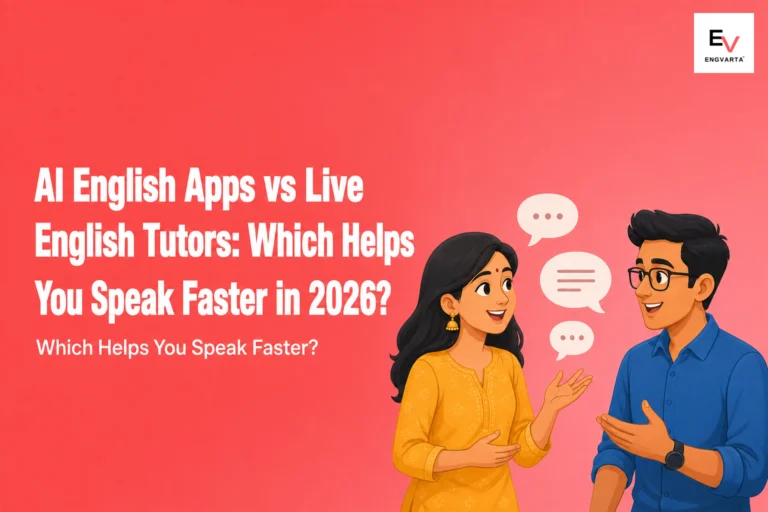
Quick VerdictAI English apps and live English tutors solve different problems. AI is better for daily volume, available 24/7, low pressure, low cost. Live tutors are better for catching subtle errors, accent reduction, real-conversation pressure, and breaking through fluency plateaus. Most learners who combine both — AI for daily reps, live tutoring once or twice a week — make faster progress than learners using either alone. The wrong question is “which is better”; the right question is “what should I do with each?”
The AI English Apps vs Live English Tutors debate defines the English learning landscape in 2026. AI apps — Speak, ELSA, TalkPal, Talkio, Loora, Praktika — promise unlimited conversation practice, instant feedback, and 24/7 availability at low cost. Live tutoring platforms — EngVarta, Cambly, italki, Preply, Lingoda — promise real human correction, accent training, and personalised feedback that AI can’t yet match. Each side claims to be the future of English learning.
The honest answer is that both are useful, both have real limitations, and the learners who progress fastest don’t pick one — they combine both intentionally. This guide explains exactly what each does well, where each falls short, and how to use both together to speak fluent English faster .
Table of Contents [show]
What AI English Apps Do Well in 2026
AI English speaking apps in 2026 are genuinely good at several things that even good human tutors can’t match:
1. Daily volume without scheduling friction
AI is available at 6 AM, at midnight, during your commute, between meetings. There’s no booking, no waiting, no rescheduling. For learners trying to build the daily speaking habit that produces fluency, AI’s always-availability is a real advantage.
2. Low-pressure practice that builds confidence
Many learners freeze when speaking English in front of real humans — afraid of judgment, embarrassed by mistakes, self-conscious about accent. AI removes all of that. It never sighs, never seems bored, never judges your pronunciation. For the first 30–60 days of practice, this low-pressure environment helps learners get comfortable hearing themselves speak.
3. Pronunciation drilling at scale
ELSA Speak in particular has set a high bar for AI pronunciation feedback. It can listen to a sentence, identify which specific phonemes you got wrong, and give you targeted drills to fix them. Doing this with a human tutor would be tedious and expensive; AI does it for free and at scale.
4. Cost per minute of practice
AI conversation costs the developer fractions of a penny per minute. Even paid AI plans typically cost $10–20/month for unlimited use, which converts to a fraction of a cent per minute of speaking practice. Live tutoring at $5–50/hour is significantly more expensive per minute.
5. Practice without judgment about basic mistakes
If you’re a beginner who pronounces “the” wrong every single time, an AI patiently corrects you 100 times. A human tutor will eventually move on, sometimes with visible frustration. For absolute foundational drilling, AI’s patience is a feature.
Where AI English Apps Fall Short
1. Subtle errors that humans catch in seconds
AI tools catch obvious grammatical mistakes (“she don’t” → “she doesn’t”). They often miss the patterns that mark a non-native speaker:
- Using the wrong article (“I went to the school” vs. “I went to school”)
- Mother-tongue syntax leaking into English (“I am having a question” instead of “I have a question”)
- Unnatural sentence rhythm and stress patterns
- Filler word habits specific to your starting language
- Wrong preposition use (“on Monday” vs “in Monday”)
A trained human English Expert catches these inside the first minute of conversation. AI might never catch them, or catch them inconsistently.
2. Real accent reduction
AI pronunciation tools score sounds in isolation. But real accent reduction needs someone who can hear your full speaking pattern over 15–25 minutes and identify which two or three sound clusters are dragging your fluency down. A human can also model the correct sound back to you in different contexts, with different speeds and stress patterns. AI struggles with this.
3. Real conversation under pressure
AI conversation is forgiving. It waits patiently for you to finish a sentence. It never interrupts. It never sounds tired or impatient. Real conversation in interviews, meetings, and public-facing roles isn’t like that — people interrupt, change topic suddenly, lose focus, ask follow-up questions you didn’t expect.
Practising only on AI builds confidence that doesn’t always survive contact with real humans. Practising occasionally with calm-but-real Experts trains you for the actual stress of speaking in front of real people.
4. Cultural and contextual awareness
AI doesn’t know that in an Indian workplace, you say “Good morning sir/ma’am” differently than in an American workplace. It doesn’t know how to navigate British English politeness markers vs American directness vs Australian informality. A human tutor with cross-cultural exposure can teach you these nuances.
5. Breaking through fluency plateaus
Most learners who use only AI plateau somewhere around upper-intermediate level. They feel stuck, making the same mistakes for weeks, not progressing. The reason is usually that they need targeted human feedback on the specific patterns holding them back — and AI either misses these patterns or can’t explain how to fix them in a way that produces lasting change.
What Live English Tutors Do Well
1. Targeted feedback that produces fast progress
A trained Expert listening to you for 15 minutes can usually identify the 2–3 patterns most worth fixing in your speech. Then, instead of practicing 100 things badly, you practice 3 things until they’re fixed. This is the dynamic that breaks through plateaus.
2. Real conversation pressure (in safe form)
Live tutoring gives you the cadence and pressure of real conversation — but with someone trained to be encouraging and to slow down when you need it. This is closer to actual workplace, interview, or social English than AI conversation.
3. Accent reduction that actually transfers
Human tutors can model sounds, listen to your attempt, model again, and walk you through the muscle memory of producing the correct sound. AI can score your pronunciation but it can’t easily teach you how to produce the right sound.
4. Cultural and professional context
For working professionals, real Experts can teach you how to say things in workplace context — how to disagree politely in a meeting, how to frame a request to a senior, how to navigate small talk with native-speaker colleagues. AI doesn’t usually get these registers right.
5. Accountability and habit reinforcement
Booking a session creates accountability. You show up because someone else is showing up. AI conversations are easy to skip; human sessions are easier to keep.
Where Live English Tutors Fall Short
1. Cost
Even affordable platforms cost more per minute than AI. Cambly subscriptions run $50–110/month for limited weekly time. italki community tutors start around $5/hour. EngVarta is among the most affordable at roughly ₹108 per session (about $1.30 per session of 15–50 minutes). Even at the low end, live tutoring is more expensive than $13/month for unlimited AI conversation.
2. Scheduling friction
Most live tutoring platforms require booking specific time slots. If your schedule is unpredictable — common for working professionals, parents, students with shifting class schedules — booking creates friction that interrupts the daily speaking habit.
This is the gap that on-demand live tutoring platforms like EngVarta try to fill — connect in minutes, no booking, pick session length on the spot — but it’s a real limitation for booking-based platforms.
3. Inconsistency between tutors
Human quality varies. On marketplace platforms (italki, Preply), the experience differs hugely between tutors. Even on platforms with screening, you might have a great session followed by a mediocre one.
4. Pressure that some learners aren’t ready for
If you’re a complete beginner or have a lot of trouble speaking, going straight to live tutoring can be scary. Some learners benefit from 60–90 days of AI practice first to build basic confidence before adding human practice.
5. Less helpful for pure pronunciation drilling
Drilling specific phonemes 50 times in a row is what ELSA does well. Most human tutors won’t drill at this pace — they want to do conversation. For learners with severe pronunciation issues, AI tools like ELSA are usually a better starting point than human tutoring alone.
Side-by-Side Comparison: AI English Apps vs Live English Tutors
| Dimension | AI English Apps (Speak, ELSA, etc.) | Live English Tutors (EngVarta, Cambly, italki) |
|---|---|---|
| Availability | 24/7 | Limited to tutor schedules (some on-demand) |
| Cost per minute | Very low | Moderate to high |
| Pressure level | Low (forgiving) | Realistic |
| Subtle error detection | Inconsistent | Strong |
| Pronunciation drilling | Excellent (ELSA-tier) | Less efficient at scale |
| Accent reduction | Limited | Strong |
| Cultural context | Weak | Strong |
| Beginner-friendliness | High | Moderate |
| Plateau-breaking | Often plateaus learners | Best at breaking plateaus |
| Habit accountability | Easy to skip | Booking creates accountability |
The Combined Approach That Works Best
The learners we observe progressing fastest follow some version of this pattern:
- Daily AI practice (15–20 minutes, free or paid): Use Speak, ELSA, or TalkPal for daily speaking volume. The goal is habit and exposure, not deep correction.
- Weekly live Expert sessions (1–3 per week, 25–50 minutes each): Use EngVarta, italki, or similar for human feedback on the patterns AI keeps missing. The goal is targeted error correction.
- Monthly assessment: Once a month, review your progress. What errors are you still making? What does your AI app consistently fail to catch? This tells you what to focus on with your live Expert next month.
This pattern combines AI’s scale and convenience with human depth and accuracy. AI gives you the daily reps; human tutoring gives you the breakthroughs. Most learners who hit fluency plateaus on AI alone progress quickly once they add a few weekly human sessions. We covered the practical app combinations in more detail in our broader 2026 app comparison guide.
When to Use AI vs Live Tutors at Different Levels
Absolute beginners (CEFR A1–A2)
Recommended: 80% AI / 20% live tutoring. AI gives low-pressure exposure to build basic confidence. Add 1 weekly human session to start identifying foundational errors early.
Best AI: Duolingo (vocabulary), Speak free tier (basic conversation), ELSA Speak free tier (pronunciation foundation).
Best live: EngVarta (15-minute sessions are ideal for beginners; lower self-consciousness with voice-only).
Intermediate learners (CEFR B1–B2)
Recommended: 50% AI / 50% live tutoring. This is the sweet spot. AI for volume, humans for breaking out of “I understand English but can’t speak it” frustration.
Best AI: Speak (paid tier for unlimited conversation), ELSA Speak (paid for accent work), TalkPal (free conversations).
Best live: EngVarta for daily practice + occasional Cambly or italki for variety.
Upper-intermediate to advanced (CEFR B2–C1)
Recommended: 30% AI / 70% live tutoring. At this level, AI feedback isn’t usually catching the subtle errors holding you back. Humans add more value per minute.
Best AI: ELSA Speak for residual accent issues; Speak for warming up before important meetings.
Best live: EngVarta for daily practice; italki or Cambly for specialised goals (interview prep, business English, IELTS).
Specific exam preparation (IELTS, TOEFL)
Recommended: 70% live tutoring / 30% AI. Exam Speaking sections grade things AI struggles to evaluate accurately (lexical resource, coherence, discourse markers, fluency under pressure).
Best AI: Speak’s IELTS-specific scenarios for warm-up; ELSA Speak for accent.
Best live: EngVarta for high-volume IELTS Speaking practice; British Council for test-aligned materials. We compared EngVarta against Speak and ELSA in detail for the AI-vs-human-for-IELTS question.
Ready to Practice with Real Experts?
Try EngVarta today — ₹69 trial (India) / $1 trial (International) · 100% refundable


What Our Learners Say
Rated 4.5★ from 9,100+ reviews on Google Play
Where EngVarta Fits in the AI vs Live Tutor Landscape
EngVarta is on the live-tutor side of this comparison, but it tries to address some of the friction that usually pushes learners toward AI: scheduling, cost, and pressure. The no-booking model means you can connect in minutes when you want to practice — closer to AI’s always-availability than to traditional tutoring’s calendar booking. Pricing is among the most affordable for one-on-one human practice at roughly ₹108 per session of 15–50 minutes (about ₹2,700 for 25 sessions). Voice-only sessions reduce self-consciousness for learners who freeze on camera.
For most learners building a daily English speaking habit, the practical pattern is something like: 5 days of AI practice (Speak or ELSA, 15–20 minutes each) + 2 EngVarta sessions per week (25 minutes each, focused on the errors AI keeps missing). This combination gives daily reps for habit and weekly Expert feedback for breakthroughs. We covered the full practical method in our broader speaking improvement guide.
Learn English with confidence — every single day with EngVarta!
✨ Join thousands of learners who are improving their English speaking skills with EngVarta every day!
Frequently Asked Questions about AI English Apps vs Live Tutors
Are AI English apps better than live tutors in 2026?
Can I become fluent in English using only AI apps?
How much do AI English apps and live tutors cost compared?
Should beginners start with AI or live tutors?
What can live tutors do that AI can’t in 2026?
What can AI English apps do that live tutors can’t?
How many AI hours equal one live tutor hour for English progress?
Are there hybrid platforms that combine AI and live tutoring?
Editorial transparency: This guide is independent. Apps and platforms mentioned are not paid placements; we did not receive compensation from any developer for inclusion. Pricing reflects publicly available data as of May 2026 and may change.
Found this useful? Add EngVarta as a preferred source on Google — you’ll see more of our English lessons in your Search and AI results.