Spoken English Improvement Apps |

Tag

spoken english improvement apps

Cambly vs italki for English Speaking Practice — A Buyer’s Guide (2026)

May 30, 2026 • 14 min read • By Rishish Pandey

Cambly vs italki for English Speaking Practice comparison of tutors, pricing, and fluency outcomes

Format, pricing, tutor model, and scheduling — the four factors that decide which platform fits your goals. Plus where each one falls short.

Quick Verdict

Quick VerdictChoose Cambly for on-demand native-speaker video conversation. Choose italki for scheduled lessons with a named tutor. If your goal is affordable daily English speaking practice in India, EngVarta is the stronger fit because it is built for frequent live audio reps.

Why this verdict:

  • Cambly is built for spontaneous video conversation practice with native speakers — its strength is availability and accent variety, not structured curriculum.
  • italki is built for tutor-student relationships with named tutors, scheduled lessons, and customisable curriculum across 150+ languages.
  • The trade-off is not “which is better” — it is “which friction do you accept”: Cambly’s per-session pricing that compounds with daily use, or italki’s scheduling and tutor-search overhead.

Practice fit:

  • Best for: Adult learners deciding between two paid English-practice platforms, prioritising live human conversation over AI scenarios.
  • Practice focus: Both platforms cover spoken fluency, accent exposure, and conversation flow. Differ on structure, scheduling, and pricing model.
  • Not ideal for: Learners on a daily-rep budget — both platforms cost more per practice hour than purpose-built daily-practice apps designed for that volume.

How Cambly and italki actually compare on the four factors that matter

Most “Cambly vs italki” comparisons stop at pricing. That misses the four factors that actually decide fit: format, tutor model, scheduling, and the per-hour math when you scale to daily practice.

Factor 1 — Format: video versus video, but different rhythms

Cambly is video-first by design. You open the app, see available tutors, tap to start a call. Most sessions are 15 or 30 minutes. The format prioritises spontaneity — you do not plan ahead.

italki is also video-based, but the rhythm is scheduled-lesson, not on-demand. Sessions are typically 30 or 60 minutes. You book a slot, the tutor prepares (sometimes lesson plans, homework, slides), and the lesson runs to a structure.

Practical implication : if you want to grab a 20-minute conversation right now, Cambly fits. If you want to know your tutor will work through Module 4 of your CEFR B2-targeted curriculum on Thursday at 7 PM, italki fits.

Factor 2 — Tutor model: native marketplace vs tiered marketplace

Cambly’s tutor pool is predominantly native speakers from the US, UK, Canada, Australia, and Ireland. Cambly does not require formal teaching credentials (no TEFL/TESOL requirement) for most tutors — the pool is closer to “conversational native speakers” than “trained teachers.” Some are excellent communicators; some are not. There is a separate “Cambly Pro” tier where tutors are vetted for specific use cases like interview prep and business English, priced at a premium.

italki’s tutor pool is structured in two formal tiers : Professional Teachers (formal TEFL/TESOL or equivalent teaching credentials required) and Community Tutors (conversational partners, no credential required). italki covers 150+ languages, English being one. Pricing reflects the tier — Professional Teachers cost more per lesson than Community Tutors.

Practical implication : Cambly gives you native variety with variable teaching skill. italki gives you a clearer credential filter — if you want a verified teacher, italki’s Professional tier signals that explicitly. The trade-off: italki’s Community Tutors are not screened for teaching ability, only for being a native or fluent speaker of the target language.

Factor 3 — Scheduling: on-demand vs booked-ahead

This is the largest functional difference, and most learners underweight it.

Cambly is on-demand. You see available tutors, tap, call. If your usual tutor is offline, another is usually available.

italki is booked-ahead. You browse tutor profiles, book a specific slot, the tutor confirms, you show up at the scheduled time. Cancellations require advance notice.

Practical implication for daily-rep learners: scheduling friction is the single biggest predictor of whether a daily-practice plan survives Week 2. italki’s booking model adds enough decision friction that most learners settle into a weekly cadence, not daily. Cambly’s on-demand model removes that friction but introduces a different one — you might not get the same tutor twice in a row, breaking continuity.

Factor 4 — Per-hour math at daily-practice volume

Pricing models are different shapes, so a direct number-to-number comparison is misleading. Here’s how the math actually works out for daily practice:

Cambly uses tiered subscriptions:

  • Cambly Private+ (standard, 1-on-1): roughly $11+ per 30-min session
  • Cambly Pro (vetted specialty tutors): roughly $16–$18 per 30-min session
  • Subscriptions auto-renew until cancelled

For daily 30-min practice across 30 days, Private+ runs ~$330/month; Pro runs ~$480–$540/month.

italki uses per-lesson pricing set by each tutor:

  • Community Tutors (English): $4–$20 per lesson per italki’s own published rates
  • Professional Teachers (English): $10–$40 per lesson per italki’s own published rates
  • Pay-as-you-go, no recurring subscription

For daily 30-min practice across 30 days at typical $10/lesson (Community) or $18/lesson (Professional), italki runs $300–$540/month.

Both platforms are designed for weekly or twice-weekly practice. Neither is structured to make daily practice economically sustainable for most learners.

Where Cambly is the better choice

Pick Cambly if:

  • You want video conversation practice with native speakers and value the spontaneity of on-demand calls.
  • You are already conversationally fluent and want accent exposure, cultural register practice, or refinement — not curriculum-driven lessons.
  • You have specific use cases (interview prep, business English) where Cambly Pro’s vetted tutor pool justifies the higher per-session price for 2–4 high-stakes sessions.
  • Per-session pricing is not a constraint on your budget and you don’t plan daily practice.
  • You want 24/7 availability across time zones.

Where Cambly tends to struggle:

  • Daily-rep budgeting (per-session pricing compounds quickly)
  • Long-term tutor continuity (the on-demand pool churns, your favourite tutor may not be available)
  • Structured curriculum (Cambly is conversation-led, not lesson-plan-led)
  • Subscription auto-renewal (some learners have been surprised by silent renewals)

Where italki is the better choice

Pick italki if:

  • You want a long-term relationship with a named tutor and weekly scheduled lessons.
  • You value structured curriculum, homework, and progress tracking.
  • You are learning multiple languages and want one platform for English plus Spanish, German, French, Mandarin, or any of 150+ languages.
  • You want a clearer credential filter (italki’s Professional Teachers carry formal teaching credentials).
  • You’re preparing for an exam (IELTS, TOEFL, business English certifications) and want tutors who specialise in that area.

Where italki tends to struggle:

  • Daily-practice frequency (the scheduling model resists daily reps for most learners)
  • Tutor consistency (if your tutor cancels or their internet drops mid-session, you re-book and lose momentum)
  • Community Tutor variance (the lower tier has no teaching-credential requirement, so quality varies significantly)
  • Pricing at daily volume (per-lesson rates compound quickly when scaled to 30 lessons per month)

What both platforms share — and where neither is ideal

Both Cambly and italki are paid live-human English practice. Both have legitimate user bases. Both work better than AI scenario apps for fluency outcomes.

Neither is built specifically for daily 15-minute reps on a working-professional budget. That is a different product shape — voice-only (not video) for lower friction, on-demand (not booked) for daily reps, per-15-minute pricing (not per-hour) for daily-practice sustainability, and TESOL/ESL-certified Experts as the default tier (not optional premium tier). Platforms purpose-built for that use case (like EngVarta) target a specific learner segment that Cambly and italki do not serve well.

If you are deciding between Cambly and italki specifically, this guide stays neutral — the right answer depends on your scheduling style and budget. If you are deciding between Cambly, italki, and a daily-rep platform, the daily-rep math reframes the decision.

👉 Connect with EngVarta & Improve Your English Every Day!

Build fluency, confidence, and better communication skills with daily English speaking tips, real-life conversations, and expert guidance that helps you speak naturally and confidently.

📸 Instagram : https://www.instagram.com/engvarta.app/
▶️ YouTube : http://www.youtube.com/@EngVarta
📘 Facebook : https://www.facebook.com/engvarta
💼 LinkedIn : https://www.linkedin.com/company/engvarta

✨ Follow EngVarta today and take your English speaking skills to the next level — one conversation at a time!

How we chose

We compared each platform on five factors: format (video vs audio, on-demand vs booked), tutor model (native marketplace vs tiered marketplace), scheduling friction, pricing at daily-practice volume, and structured-curriculum support. Pricing was checked against each platform’s public page in May 2026. Tutor-pool descriptions are sourced from each platform’s own public documentation and learner-review aggregations (Trustpilot, Reddit r/languagelearning, italki community forums).

FAQs : Cambly vs italki for English Speaking Practice

Q1. Which is cheaper for daily practice, Cambly or italki?

Ans : Neither is genuinely cheap for daily practice. Cambly Private+ runs around $330/month for daily 30-min sessions. italki at $10/lesson Community Tutor runs around $300/month for daily 30-min sessions. Professional Teachers on italki ($18+/lesson) run $540+/month. Both platforms are economically designed for 2–3 sessions per week, not daily. For daily-rep volume, a per-15-minute-priced platform fits better than either.

Q2. Are italki Community Tutors as good as Professional Teachers?

Ans : Variable. Community Tutors are native or fluent speakers without required teaching credentials. Some are excellent conversation partners; many are not trained to systematically diagnose your weak spots or coach corrections. Professional Teachers hold formal TEFL/TESOL credentials and are more consistent in delivering structured teaching. If you specifically want trained instruction, filter for Professional Teachers; expect the price to roughly double.

Q3. Does Cambly auto-renew my subscription?

Ans : Yes. Cambly uses a recurring subscription that auto-charges your card until you cancel. Multiple user reports flag surprise renewals as a friction point. Set a calendar reminder before your billing date if you intend to cancel. italki is pay-as-you-go per lesson, so this concern does not apply on italki.

Q4. Can I use both Cambly and italki together?

Ans : Yes, and some serious learners do. A common pattern: italki for weekly structured lessons with a named tutor (curriculum + homework), Cambly for between-lesson conversation practice with whoever is available (low-friction spontaneous reps). The combination costs more than either alone but produces faster progress than either in isolation. Whether the combined cost is worth it depends on your budget and pace.

Q5. Which is better for accent-specific practice — US, UK, or Australian English?

Ans : Cambly’s native-speaker pool is wider and accent-tagged, making it easier to find a US, UK, Canadian, or Australian tutor specifically. italki has native-speaker tutors across all major English accents but the pool is more fragmented across the marketplace. For accent-specific practice, Cambly’s discovery is faster.

Q6. Is Cambly or italki better for daily English practice in India?

Ans : Both work, but the math is hard at daily-rep volume. Cambly Private+ at ₹27,000+/month for daily 30-min sessions and italki Community Tutors at ₹25,000+/month do not match what most Indian learners budget for daily practice. EngVarta is built for the Indian daily-practice price point: ₹2,700 for 25 sessions of 15-min, with the same live-human-listener model. Choose Cambly or italki if you want a specific accent or curriculum; choose EngVarta if you want daily reps at Indian-market pricing.

Q7. When should I choose EngVarta instead of Cambly or italki?

Ans : Choose EngVarta when (a) you want daily 15-minute live audio reps, not weekly 30-minute video lessons; (b) your goal is response-time and confidence, not accent neutralisation; (c) you are in India or a market where the per-lesson math on Cambly or italki does not fit your budget; (d) you want TESOL/ESL-certified Experts at Indian-market pricing.

Q8. Which option is better for learners who do not want video calls?

Ans : EngVarta. Both Cambly and italki are video-first — the camera adds appearance anxiety on top of speaking anxiety for many learners. EngVarta is audio-only by design, which removes the camera overhead and lets practice land on the speaking layer specifically. If you have repeatedly avoided live tutoring because of the video element, audio-only is the easier first step.

Q9. What happens if my italki tutor cancels at the last minute?

Ans : You re-book the slot with a different tutor or reschedule with the same tutor depending on the cancellation reason and italki’s policy. Cancellations are a known pain point in italki user threads — the platform’s marketplace model means your booked slot is dependent on the individual tutor’s availability and connection quality. Cambly’s on-demand model avoids this specific failure mode but introduces tutor-continuity variability.

How this guide was compiled (methodology)

This comparison is built from public pricing documentation on each platform’s website (checked May 2026), aggregated learner reviews on Trustpilot and Reddit r/languagelearning, and direct comparison of tutor-pool characteristics from each platform’s own public credential descriptions. We did not run user-side comparisons (because we operate a competing English-practice platform). Treat this as a structural comparison of platform models, not a head-to-head learner-outcome study.

Author

Reviewed by Rishish Pandey — Co-founder and CTO, EngVarta.

Last reviewed: May 2026
Related guides on EngVarta

Best Budget-Friendly English Speaking Apps for Daily Practice (2026): 8 Picks Compared by Per-Session Cost

May 26, 2026 • 12 min read • By Rishish Pandey

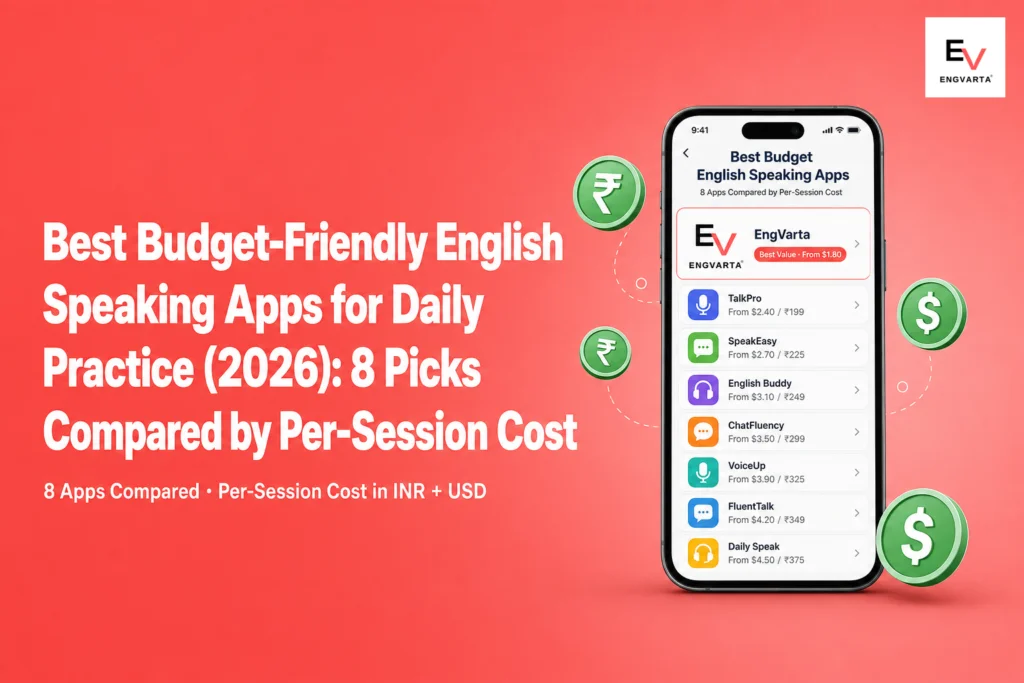
Best Budget-Friendly English Speaking Apps for Daily Practice and fluency improvement
Quick Verdict · 2026 Cheapest daily English speaking practice with a real human: EngVarta — ₹108 / $1.80 per 15-min session with TESOL/ESL-certified Experts. ₹69 / $1 refundable trial. Budget picks by category Cheapest live-human practice: EngVarta — ₹108 / $1.80 per 15-min session. Cheapest AI subscription: TalkPal — unlimited AI conversation from $10/month. Cheapest free option: ChatGPT Voice Mode — free tier with short voice conversations. Cheapest beginner-friendly: Duolingo — free vocabulary and habit-building. Cheapest pronunciation tool: ELSA Speak — $10–15/month sound-level accent feedback.

If you want to practise English speaking every day without burning through your monthly budget, many learners now search for the Best Budget-Friendly English Speaking Apps in 2026. The good news is that there are more affordable options than ever. The bad news? Not all “budget” apps actually deliver speaking practice — many sell vocabulary or grammar drills under the speaking-practice label.

This list compares 8 low-cost apps and platforms for daily English speaking practice, rated by the actual cost per session when used on a daily basis. We include verified 2026 pricing in both INR and USD, what each tool actually delivers (live human vs AI vs solo), and who each option is best for.

What “Budget-Friendly” Actually Means for Daily Practice

Most app comparisons quote sticker prices — the monthly subscription, the per-session rate, the “starts at” number. For daily practice, that’s misleading. What matters is real per-session cost when you actually use the tool every day.

Example : Cambly’s headline price is $12 per session. But Cambly’s “daily plan” bundles cost ₹4,000–5,500/month — which works out to roughly ₹133–183 per session if you use it daily. EngVarta’s daily plan is ₹2,700 / $45 for 25 sessions — ₹108 / $1.80 per session. That’s 25–40% cheaper per session for the same daily-practice use case, with a real human Expert on every call.

For our purposes, budget-friendly = under $50/month for live human practice, or under $25/month for AI/self-paced. Anything above is premium; below those thresholds is where most learners can actually sustain daily practice.

Quick Comparison: 8 Best Budget-Friendly English Speaking Apps by Per-Session Cost (2026)

App / Platform Format Per-session cost (daily use) Best for
EngVarta Live 1-on-1 voice (TESOL/ESL-certified Experts) ₹108 / $1.80 per 15-min Cheapest live-human daily practice
Duolingo Solo gamified app (vocabulary, no real speaking) Free / ₹700 / $7 Super tier Beginners building vocabulary habit
ChatGPT Voice Mode AI voice conversation Free tier / Plus $20/month Solo mock-interview rehearsal
Speak AI conversation app ₹1,650–2,500 / $15–25 /month Daily AI habit, unlimited reps
TalkPal AI conversation app ₹800–2,000 / $10–25 /month Cheapest AI subscription with voice
ELSA Speak AI pronunciation drill ₹999–1,499 / $10–15 /month Accent / pronunciation refinement
italki Community Tutors Marketplace tutor (mostly video) $5–10/session (30–60 min) Variable quality, depends on tutor pick
Cambly (daily plan only) Native-speaker video chat ₹133–183 / $1.60–2.20 per session on daily plan Native-speaker exposure if budget allows daily plan

All pricing verified as of May 2026. Per-session math assumes you actually use the app daily — subscription apps get cheaper per session the more you use them; per-session apps stay flat.

1. EngVarta — Cheapest Live-Human Daily Practice

Per-session cost (daily use) : ₹108 / $1.80 per 15-min session
Plan : ₹2,700 / $45 for 25 sessions, longer-validity plans up to 1 year
Trial : ₹69 / $1, 100% refundable
Format : Live 1-on-1 voice (no video), TESOL/ESL-certified Experts

EngVarta is the budget winner for live human English speaking practice in 2026. You press one button and connect with a TESOL/ESL-certified Expert in minutes, voice-only with an optional username. The Expert corrects your pronunciation, grammar, and fluency mistakes in real time during the call, with consolidated feedback towards the end of each session. Available 7 AM to midnight IST daily — works across time zones for the Gulf, SEA, US East Coast evenings, and UK afternoons.

For daily practice math: at ₹108 / $1.80 per session, 30 days = ₹3,240 / $54. Compare to Cambly’s daily plan (₹4,000–5,500/month) or italki Community Tutors ($5–10/session × 30 = $150–300/month). EngVarta is 30–70% cheaper for the same daily volume with consistent certified-Expert quality.

Best for : learners who want real human practice with measurable speaking progress on a daily-affordable budget.

Ready to Practice with Real Experts?

Try EngVarta today — ₹69 trial (India) / $1 trial (International) · 100% refundable

What Our Learners Say

Rated 4.5★ from 9,100+ reviews on Google Play

★★★★★
It's a beautiful app for beginners. All experts are so good. They talk with you frankly like your friends, so you don't feel bored and you get interest to learn English.
★★★★★
Good app to express yourself because in our house there are no environment n EngVarta provides you environment
★★★★★
Good app to express yourself because in our house there are no environment n EngVarta provides you environment
★★★★★
excellent app for learning fluency and If you genuinely correct your mistakes then you should opt for this
★★★★★
I am learning on this platform. it is really really helpful to upgrade myself. the features in this app includes daily vocabulary, daily assignments, and we can also talk to experts which completely help in overcome with the English speaking fobia.
★★★★★
Engvarta provides the best platform for learners to learn and get comfortable with the language by offering a comfortable and judgment-free environment with regular feedback. Engvarta is the best English learning app available.
★★★★★
The supporting people along with the experts are very supportive. The only suggestion to the officials is that the names of the experts should be reflected on the screens so to know to whom I am talking with. Thank you Engvarta, continue supporting people like me. Thank You.
★★★★★
I have been using EngVarta for the past three months and from the period I am using I feel a considerable amount of difference in how I was speaking earlier and now how I am speaking and I think the EngVarta team has done a commendable job in improving my English fluency skill.
★★★★★
I have been practising English on EngVarta for the past 30 days and results are significant. I’m happy to be here.
★★★★★
Excellent application to improve your communication skills.Thnk you for introducing new vocabulary everyday.God bless you You might not aware of but personally this is helping me a lot
★★★★★
Chicken-hearted person will become lion hearted person after using this app.
★★★★★
EngVarta is one of the best apps for those who want to improve their English fluency and conversation skills. The experts are very helpful and encouraging, giving sufficient confidence.

2. Duolingo — Free Vocabulary & Habit-Building

Cost : Free tier / ₹700 / $7 per month Super tier
Format : Gamified solo app, no real conversation

Duolingo is excellent for the daily-habit problem — the streak-based design genuinely keeps learners practising. Where it falls short for speaking: it’s primarily vocabulary and grammar drills with limited real conversation. Useful as a vocabulary foundation, not as a standalone speaking-practice solution.

Best for : absolute beginners building English vocabulary, or daily-habit anchors paired with a real-conversation tool like EngVarta.

3. ChatGPT Voice Mode — Free Mock-Interview Rehearsal

Cost : Free tier (limited) / Plus $20/month
Format : AI voice conversation, no human feedback

ChatGPT Voice Mode is the strongest free option for solo speaking reps. Useful prompts: “Pretend you are an HR manager interviewing me for a sales role; ask 5 behavioural questions one at a time.” ChatGPT will play along, but it won’t flag your pronunciation, grammar, or phrasing mistakes — you get unstructured talking time, not structured feedback.

Best for: solo mock-interview rehearsal between paid live-practice sessions. Pair with EngVarta for quality feedback.

4. Speak — AI Daily-Habit App

Cost : ₹1,650–2,500 / $15–25 per month
Format : AI conversation, gamified scenarios

Speak is the AI app with the strongest daily-habit design. The AI tutor adapts conversations to your level, gives basic pronunciation feedback, and the scenarios mirror real-world situations (restaurants, meetings, travel). Good for unlimited low-pressure speaking reps. Trade-off: AI can’t replicate the real social pressure that builds genuine speaking confidence.

Best for : learners who want unlimited AI practice and aren’t ready for human conversation yet. Useful as a stepping stone to live human practice.

5. TalkPal — Cheapest AI Subscription with Voice

Cost : ₹800–2,000 / $10–25 per month
Format : AI conversation, lower-priced alternative to Speak

TalkPal entered the market as a Speak alternative at lower price points. Functionally similar — AI conversation, scenario-based practice, basic pronunciation feedback — with a less polished UX but better entry-tier pricing. Same fundamental AI limitation: no real social pressure, no human feedback.

Best for : budget-conscious learners who want AI conversation practice and don’t need Speak’s premium UX.

6. ELSA Speak — Pronunciation on a Budget

Cost : ₹999–1,499 / $10–15 per month
Format : AI accent and pronunciation drill, sound-level analytics

ELSA Speak is narrow but effective for what it does — sound-level accent analysis with corrective feedback on specific phonemes. Not a complete speaking solution; it doesn’t cover grammar, fluency, or conversation. The strongest tool in its lane (pronunciation), and at $10–15/month it’s budget-friendly if pronunciation is your specific gap.

Best for : learners whose specific issue is accent or pronunciation clarity. Pair with EngVarta for actual conversation practice.

7. italki Community Tutors — Cheapest Native-Speaker Access

Cost : $5–10 per session (30–60 min) for Community Tutors; $15–30 for Professional Teachers
Format : Video marketplace, you browse and book individual tutors

italki’s Community Tutor tier is the cheapest way to access international tutors per session — but quality varies dramatically because Community Tutors are not certified teachers. You spend time browsing profiles, dealing with no-shows, and switching tutors when your favourite isn’t available. The marketplace friction adds up for daily practice.

Best for: learners who specifically want to choose their tutor and don’t mind the marketplace friction or quality variance.

8. Cambly — Only Reasonably Priced on the Daily Plan

Cost : Headline $12+/session — daily plan ₹4,000–5,500 / month works out to ₹133–183 per session on daily use
Format : Native-speaker video chat

Cambly is excellent for native-speaker exposure but only fits a budget if you commit to the daily plan and actually use it daily. Pay-per-session pricing makes it premium — not what most learners can sustain for daily practice. Camera-on format adds friction for shy learners or those squeezing practice into a busy day.

Best for : learners who specifically want native-speaker exposure, can afford the daily plan, and are comfortable on video.

A Budget Daily Routine That Actually Compounds

The cheapest path to measurable speaking progress isn’t a single tool — it’s a 30-minute daily stack that combines free + paid where each gives the most value.

  • 5 min vocabulary — FREE : Duolingo or read aloud from any English article.
  • 20 min live speaking — ~₹144 / $2.40 : EngVarta 15–25 min Expert session.
  • 5 min review — FREE: Note 2 corrections from your session, use them in tomorrow’s call.

Monthly cost: roughly ₹3,000–3,500 / $50–60 for the daily routine above. Compare to Cambly daily plan (₹4,000–5,500) or premium AI stacks ($40–60/month for two subscriptions). The stack above gives you the best per-rupee/per-dollar progress because it combines free vocabulary work with the one paid input that genuinely moves the needle — real live human practice.

👉 Connect with EngVarta & Improve Your English Every Day!

Build English fluency, confidence, and strong communication skills with daily speaking practice, real-life conversations, and expert guidance. Start speaking English naturally and confidently in your daily life.

🚀 Learn through:
✔ Daily English speaking practice
✔ Real-life conversation training
✔ Vocabulary & pronunciation improvement
✔ Confidence-building sessions

📲 Follow EngVarta on Social Media:
📸 Instagram : https://www.instagram.com/engvarta.app/
▶️ YouTube : http://www.youtube.com/@EngVarta
📘 Facebook : https://www.facebook.com/engvarta
💼 LinkedIn : https://www.linkedin.com/company/engvarta

✨ Join EngVarta today and take your English speaking skills to the next level — one conversation at a time!

Frequently Asked Questions (FAQs)

Q1. Which app is good for daily English speaking practice on a budget?

Ans : EngVarta. Live 1-on-1 voice practice with TESOL/ESL-certified Experts at ₹108 / $1.80 per 15-min session (₹2,700 / $45 for 25 sessions). For free practice, ChatGPT Voice Mode (free tier) and Duolingo work as supplements but don’t replace real human practice.

Q2. What’s the cheapest way to practice English speaking daily?

Ans : Three options: (1) Free — ChatGPT Voice Mode plus daily reading aloud. (2) AI subscription — Speak or TalkPal at $10–15/month for unlimited AI conversation. (3) Live human — EngVarta at ₹108 / $1.80 per 15-min session, cheapest per-session live practice in 2026.

Q3. Is there a free app to practice English speaking daily?

Ans : Yes — Duolingo (vocabulary, no real speaking), ChatGPT Voice Mode free tier (short voice conversations), and reading aloud to yourself. Limits: no human feedback, no correction of YOUR specific mistakes. For measurable progress, pair free options with one paid live-practice tool.

Q4. How much does daily English speaking practice cost in 2026?

Ans : Free for AI-only or solo practice. Paid AI: $10–25/month (Speak, TalkPal, ELSA). Live human practice: EngVarta ₹108 / $1.80 per session (cheapest), Cambly $4,000–5,500/month for daily plans, italki Community Tutors $5–10/session.

Q5. Are budget apps like Duolingo enough for English speaking fluency?

Ans : No. Duolingo and similar apps are great for vocabulary and habit-building but don’t deliver speaking fluency — they don’t involve real conversation. For fluency, add daily live human practice (EngVarta starts at ₹108 / $1.80 per session, with a ₹69 / $1 refundable trial).

Q6. Which is cheaper for daily English practice — AI apps or live tutors?

Ans : AI apps (Speak, TalkPal) win on per-minute math if you practise 1–2 hours/day. Live tutors (EngVarta) win for 15–50 minute daily practice at ₹108 / $1.80 per session — cheaper than Cambly, italki, Preply for the same volume, with real human feedback that AI can’t replicate.

Q7. What’s the cheapest way to practice with a real human English tutor daily?

Ans : EngVarta is the cheapest live-human option in 2026 — ₹108 / $1.80 per 15-min session with TESOL/ESL-certified Experts. Cambly starts around $12 per session (6× more), italki Community Tutors $5–10/session but with variable quality. Trial is ₹69 / $1, refundable.

Q8. Can I become fluent in English using only free apps?

Ans : Realistically, no. Free apps plateau within 4–6 weeks because they lack the real social pressure and personalised correction that fluency requires. The proven path: free apps for vocabulary + ChatGPT Voice for solo reps + one paid live-human tool (e.g., EngVarta) for measurable speaking progress.

EngVarta vs ChatGPT for English Speaking Practice: An Honest 2026 Comparison

April 16, 2026 • 15 min read • By Rishish Pandey

EngVarta vs ChatGPT comparison — human English tutor vs AI chatbot

EngVarta is better than ChatGPT for building real English speaking fluency because it connects you with trained human experts for daily live conversation, while ChatGPT offers AI-powered text and voice chat with no real social pressure. For pronunciation drills, grammar explanations, and low-stakes practice, ChatGPT is excellent and free. But to build the speaking confidence you need for job interviews, office meetings, and real conversations, you need a real human — which is exactly whon the platform delivers in 2026 at from ₹2,700 for 25 sessions (India) or from $45 for 25 sessions (international).

This honest comparison breaks down where each tool wins, where each falls short, and how to combine them for the fastest path to English fluency. No marketing spin — just what actually works for real learners in 2026.

EngVarta vs ChatGPT — Quick Comparison at a Glance

Bottom line on the platform vs ChatGPT: AI is a helpful drill partner; human practice is what builds real speaking confidence.

Before diving into detailed analysis, here is how EngVarta and ChatGPT compare on the factors that actually matter for English speaking practice in 2026:

Feature EngVarta ChatGPT
Type Live human experts (1-on-1) AI chatbot (text + voice)
Social Pressure Real — trains confidence Zero — feels safe but doesn’t transfer
Corrections Natural, in-conversation Technical, listed out
Accent Exposure Indian accent trained experts Standardized AI voice
Accountability Daily session habit Optional, user-driven
Unpredictability Real conversation flow Predictable AI patterns
Emotional Feedback Human encouragement Generic AI responses
Price (India) from ₹2,700 for 25 sessions Free / Rs 1,700/month (Plus)
Price (International) from $45 for 25 sessions Free / $20/month (Plus)
Trial ₹69 / $1 (100% refundable) Free tier
Best For Building real speaking confidence Grammar, vocabulary, warm-up

What Our Learners Say

Rated 4.5★ from 9,100+ reviews on Google Play

★★★★★
It's always a pleasure talking to you. You always make me feel that I am doing very good and encourage me to work hard to achieve the goal of being a good speaker.
★★★★★
Great !!! Enjoying it 👍experts reAlly help you to see your mistakes and correct them in the mean time.
★★★★★
Great app for learning English speaking. All the experts are supportive and non-judgemental. After every session, constructive feedback is provided to enhance yoilur skills. Also it has AI enabled feature for assignment practice. Overall a great platform to practise English speaking with experts.
★★★★★
Wonderful app provide experts to talk but but so much time constraints in talking..
★★★★★
I am really enjoying this app and it is very useful for my IELTS preparation. It is a great application that I have never seen.
★★★★★
This is the best app for anyone who feels nervous and hesitates during conversation in English.
★★★★★
I am very happy while speaking to you. It was a very good experience. I want to congrats your team for making such an excellent app for helping people who want to learn and speak English.
★★★★★
I took two months of subscription. This platform really helped me to improve my communication and get rid of the fear I had earlier. Now I can talk fully confident and without any fear.
★★★★★
Experts are friendly and supportive. Great platform to improve your communication skills.
★★★★★
It was a very amazing experience to talk to an expert. She suggested how to improve my speaking skills and enhance my confidence level. EngVarta is the best platform to learn English fluently.
★★★★★
Wonderful app provide experts to talk but but so much time constraints in talking..
★★★★★
good and highly talented experts are here..just go for a trail without any doubt.. thank you eng vartha...A small request from my side just take less payment from the people who are joing in your coaching...help to them...thank you

Ready to Practice with Real Experts?

Try EngVarta today — ₹69 trial (India) / $1 trial (International) · 100% refundable

What ChatGPT Does Well for English Practice

Let us give ChatGPT proper credit. It has genuinely transformed how English learners access on-demand help in 2026. Here is where ChatGPT shines:

Authoritative resources like Cambridge English’s learner activities emphasize that speaking confidence is built through consistent live practice and real-time feedback — not just reading or passive input.

  • Grammar explanations on demand. Ask ChatGPT why “has been” is different from “had been,” and you get a clear answer with examples in seconds. For tense rules, article usage, and sentence structure questions, ChatGPT is a powerful tutor.
  • Vocabulary building. ChatGPT can suggest synonyms, explain nuances, and give context for new words. Pair it with our 100 daily-use English words and you have a solid vocabulary foundation.
  • Low-pressure writing practice. Essays, emails, cover letters — ChatGPT can review your written English and suggest improvements without judgment.
  • Available 24/7. Cannot sleep at 3 AM and want to practise English? ChatGPT is there. No scheduling needed.
  • Free tier is genuinely useful. Most English learners will never hit the paid wall for basic practice.
  • Voice mode for warm-up. ChatGPT voice mode lets you speak and hear responses in real time — great for shaking off hesitation before a real conversation.

If your current English speaking practice is zero, adding ChatGPT to your routine is a clear improvement. The question is whether ChatGPT alone is enough to become fluent — and for most learners in 2026, the honest answer is no.

Where ChatGPT Falls Short — The EngVarta vs ChatGPT Gap

Here is where millions of learners get stuck. They practise with ChatGPT for weeks or months, feel like they are improving, then freeze the moment they have to speak English to a real person. Here is why:

1. ChatGPT Cannot Simulate Social Pressure

The single biggest reason you freeze when speaking English is not lack of vocabulary or grammar knowledge — it is social pressure. A real human is listening, waiting, judging. Your brain perceives this as a threat and locks up. ChatGPT removes this pressure entirely, which sounds great until you realise you are not actually training the skill you need. You can chat fluently with ChatGPT at 2 AM and still freeze in a 10 AM meeting, because the skill of managing anxiety while speaking English only develops through real human interaction. Our guide on how to remove hesitation in English speaking breaks this down in detail.

2. ChatGPT Is Too Predictable

Real conversations are messy. People interrupt, change topics mid-sentence, use slang, speak fast with accents, and sometimes trail off without finishing a thought. ChatGPT follows neat, logical patterns. It waits for you to finish, responds relevantly, and stays on topic. Your brain learns to handle AI conversation patterns but remains completely unprepared for the unpredictable flow of real English conversation. This is why learners consistently report that AI practice did not transfer to real meetings, interviews, or social situations.

3. ChatGPT Cannot Build Real Confidence

Confidence comes from evidence. Every time you have a successful conversation in English with a real person — even an imperfect one — your brain records evidence that you can do this. That evidence accumulates and becomes the foundation of real speaking confidence. AI conversations do not create this evidence because your brain knows, at some level, that it was not a real social interaction. You might feel productive during a ChatGPT session, but that feeling evaporates the moment a colleague asks you a question. Building real English speaking confidence requires human interaction.

4. ChatGPT Feedback Is Technical, Not Human

ChatGPT can tell you “your sentence structure was incorrect.” An EngVarta expert will tell you “you sounded nervous at first, but once you relaxed, your fluency was actually really good — focus on that feeling before meetings.” Human feedback addresses the emotional and psychological barriers that AI simply cannot see. It identifies patterns in your hesitation, recognizes when you are translating from Hindi or your native language, and coaches you through the mindset shift that fluency requires.

5. ChatGPT Has No Accountability

Nobody is waiting for you on ChatGPT. No session scheduled. No expectation that you practise today. The result? Most learners use ChatGPT inconsistently — a few days in a row, then weeks off. Language fluency requires daily repetition, which requires accountability. When you have a scheduled practice session, you show up. When ChatGPT is just an app on your phone, you skip it.

What Makes EngVarta Different

EngVarta is specifically designed to solve the problems ChatGPT cannot. Here is what you get:

  • Real human experts — Not AI bots. Not random language partners. Trained English-speaking experts who specialise in helping hesitant speakers find their voice.
  • Daily 1-on-1 sessions — A new real conversation every day. This is where fluency is built. The kind of accountability and repetition that turns English into an automatic skill.
  • Audio-only format — Removes the self-consciousness of video. You focus entirely on speaking, not on how you look or what is behind you.
  • Natural in-conversation corrections — Experts weave corrections into the flow. “Oh, you mean you went to the market?” instead of “Error: incorrect tense usage.” It feels like talking to a supportive friend, not a grammar teacher.
  • Affordable for daily use — From ₹2,700 for 25 sessions in India. From $45 for 25 sessions internationally. That is less than the cost of two coffee shop visits per week for daily professional coaching.
  • Risk-free trial — ₹69 trial in India, $1 trial internationally. 100% refundable. Try a session, see if it works for you, and get your money back if not.
  • 2 million+ learners — It is not an experiment. Over 2 million learners have used it to build English speaking confidence. Sessions available 7 AM to midnight, 7 days a week.

Download EngVarta:
Android | iOS

The Smart Strategy: EngVarta + ChatGPT Together

The real answer is not EngVarta vs ChatGPT in an either/or decision. The learners who progress fastest use both strategically. Here is a 2026 stack that actually works:

  1. Morning (5 minutes) — ChatGPT for grammar warm-up. Ask ChatGPT to explain a grammar concept, quiz you on vocabulary, or suggest synonyms for words you use too often. This activates your English brain for the day.
  2. Midday (10 minutes) — ChatGPT voice mode. Use ChatGPT voice mode to practice sentence construction in a low-pressure environment. Think of this as warm-up reps before the real workout.
  3. Evening (15 minutes) — expert practice session. This is the main event. Open the app, connect with a trained expert, and have a real conversation in English. The social pressure, unpredictability, and real-time correction here are what will actually make you fluent. This is non-negotiable if fluency is your goal.
  4. Before bed (5 minutes) — ChatGPT for reflection. Ask ChatGPT about any grammar question from the day, or have it correct a short paragraph you write about your day. Reinforces what you learned.

This combination gives you 35 minutes of English per day with zero compromise on fluency. Learners who follow this routine for 30 days consistently report measurable improvement — our 30-day English speaking improvement plan walks through the exact schedule and milestones.

EngVarta vs ChatGPT: Who Should Choose What?

Not every learner needs the same approach. Here is a simple decision framework:

Choose ChatGPT Alone If :

  • You already speak English fluently and just want a grammar helper
  • You need written English support (emails, essays, reports)
  • You are a complete beginner building basic vocabulary — start here, then add live expert practice
  • Your budget is zero — ChatGPT free tier gets you started

Choose live expert practice (with optional ChatGPT) If :

  • You understand English but freeze or hesitate when speaking — this is the #1 use case for live practice
  • You have job interviews, meetings, or client calls coming up — you need real speaking practice, not AI chat
  • You have tried Duolingo, Cambly, or other English speaking apps without breakthrough progress
  • You want to build daily practice habit with real accountability
  • You are preparing for IELTS, TOEFL, or visa interviews where spoken fluency determines success

EngVarta vs ChatGPT : The Honest 2026 Verdict

If you want to become fluent in spoken English in 2026, ChatGPT alone is not enough. It is an incredibly useful tool for vocabulary, grammar, and low-stakes practice, but it cannot replicate the social conditions under which fluency is actually built. Real fluency requires real human conversation — repeated, regular, with real-time feedback from someone trained to help you improve.

It is designed specifically for this gap. Over 2 million learners have used it to transform from hesitant English speakers into confident professionals. At from ₹2,700 for 25 sessions (India) or from $45 for 25 sessions (international), daily access to trained human experts is the most cost-effective speaking coach you can find. Try it with the ₹69 / $1 trial — if it does not work for you, full refund, no questions asked.

👉 Follow EngVarta for Daily English Practice

Join our community and improve your English every day:

Conclusion : 

EngVarta vs ChatGPT is not a real competition — they solve different problems. ChatGPT is a brilliant AI tutor for grammar, vocabulary, and written English practice. The platform is the only affordable way to get daily real human conversation practice, which is what actually builds spoken English fluency in 2026.

If you want to become fluent in English this year, the smart move is to use both: ChatGPT for knowledge and warm-up, live practice for the real work of building confidence through real conversation. The ₹69 / $1 trial is 100% refundable — there is zero risk in trying it alongside your ChatGPT practice and seeing the difference real human interaction makes.

Frequently Asked Questions ( FAQs )

Q1. Is ChatGPT enough to become fluent in English?

Ans : No. ChatGPT is excellent for grammar, vocabulary, and low-pressure practice, but it cannot simulate the social pressure and unpredictability of real human conversation — which is where fluency is actually built. You can chat perfectly with ChatGPT and still freeze when a real person asks you a question. Use ChatGPT alongside real human practice for the best results.

Q2. Is EngVarta better than ChatGPT for English speaking practice?

Ans : For building real speaking confidence, yes — The platform connects you with trained human experts for daily conversation, which ChatGPT cannot replicate. For grammar and vocabulary help, ChatGPT is genuinely useful. The smart strategy is to combine both: ChatGPT for knowledge, EngVarta for confidence. Over 2 million learners have chosen the platform at from ₹2,700 for 25 sessions (India) or from $45 for 25 sessions (international) because real human conversation is irreplaceable.

Q3. How much does EngVarta cost compared to ChatGPT?

Ans : ChatGPT is free for basic use, Rs 1,700/month or $20/month for the Plus plan. EngVarta starts at ₹2,700 for 25 sessions in India and $45 for 25 sessions internationally. You can start with a ₹69 (India) or $1 (international) trial, both 100% refundable. For the job most learners need done — building real English speaking confidence — It is significantly cheaper than competitors like Cambly while providing daily human interaction ChatGPT cannot.

Q4. Can I use ChatGPT voice mode for English speaking practice?

Ans : Yes, ChatGPT voice mode is useful for warm-up and low-pressure conversation practice. It will help you form sentences out loud and hear English responses. But it cannot train you to handle the social pressure of real conversations, which is the actual barrier most learners face. Use ChatGPT voice mode as a warm-up, then do your main practice with real humans on dedicated practice platforms.

Q5. Which is better for job interview English preparation?

Ans : Live expert practice is significantly better for job interview English preparation because interviews are high-pressure, unpredictable real conversations — exactly the skill you cannot practice with AI. our experts can simulate mock interviews, correct your responses in real time, and help you build confidence under pressure. Use ChatGPT to research common interview questions and draft answers, then practice delivering them with a live English expert.