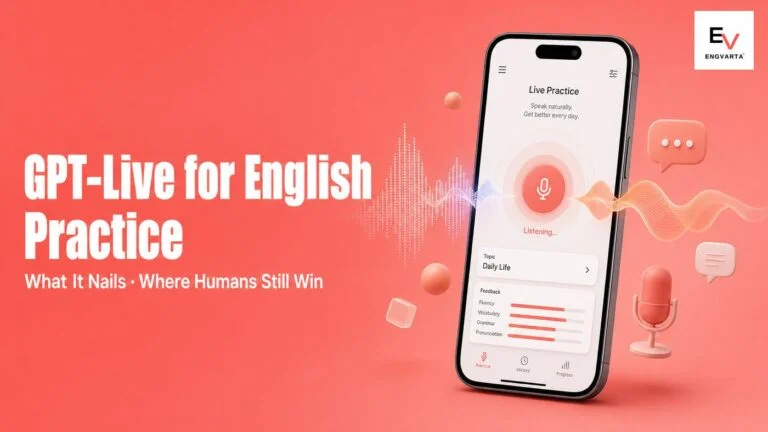
Every few years a tool arrives that genuinely changes how people can practice English. GPT-Live is one of them, and it is worth being honest about that from the first paragraph.
On July 8, 2026, OpenAI released GPT-Live, a new family of voice models that now powers ChatGPT’s voice mode. If you have ever tried practicing English with the older ChatGPT voice — with its walkie-talkie pauses and its habit of talking over you — this is a different experience altogether. And OpenAI has named language practice, with gentle corrections, as one of its headline use cases.
This is a practical guide for English learners: what GPT-Live actually is, what it is genuinely great at, where it stops, and how to build a routine that uses it well. We build a live human practice app ourselves — read the one section describing it with that in mind. Everything else is written the way we would advise a friend.
Table of Contents [show]
What GPT-Live actually is
GPT-Live comes in two versions: GPT-Live-1, which paid ChatGPT users get by default, and GPT-Live-1 mini, which ships to the free tier. Both are rolling out globally across iOS, Android, and the web. OpenAI says more than 150 million people already use ChatGPT’s voice and dictation features every week — this is now the default voice experience for one of the most used apps in the world, not a niche experiment.
The technical change that matters is full-duplex audio. Older voice AI worked in turns: you spoke, it waited, it responded. GPT-Live listens while it speaks. In practice, that means:
- It backchannels like a person. While you talk, it signals attention with a quiet “mhmm” or “got it” instead of dead silence.
- You can interrupt it — and it can interrupt you. If you cut in mid-sentence, it stops and adjusts. If you are practicing English and make a mistake, it can step in with a correction without derailing the conversation.
- It knows when to stay quiet. If you pause to think, it waits instead of filling the gap.
- It delegates hard questions. When you ask something that needs deeper reasoning or a web search, GPT-Live hands the task to OpenAI’s frontier model in the background and keeps chatting with you while it waits for the answer.
- It can show visual cards in the app alongside the conversation — useful when a spelling, a list, or a definition is easier to read than to hear.
For English learners, the significance is simple: the most common criticisms of AI speaking practice — robotic turn-taking, no mid-flow correction, no natural rhythm — no longer apply. Any advice you read that argues against AI practice on those grounds, including some older articles on this very blog, is now out of date. What remains true is more interesting, and we will get to it.
What GPT-Live is genuinely great at for English learners
Used well, GPT-Live solves the single biggest problem most English learners have: not enough speaking minutes. Here is where it shines.
Free, unlimited conversation reps
Fluency is a volume game, and most learners simply do not speak enough. GPT-Live gives you an unlimited conversation partner at zero cost on the free tier. If you currently speak English for ten minutes a week, it can turn that into thirty minutes a day — and that alone will move you forward.
Vocabulary that sticks because it arrives in context
Ask it to use a new word naturally in conversation, then make you use it back. Ask “what’s a more professional way to say that?” mid-sentence. Words you meet inside a real exchange stick far better than words from a list, and GPT-Live makes that effortless.
Trying topics before they matter
Want to rehearse asking for a raise, disagreeing politely in a meeting, or explaining a gap in your resume? GPT-Live will run the scenario twenty times without judgment, at whatever level you are at. It is a superb sandbox for scripts you are not yet ready to say to a person.
Late-night and odd-hour practice
No human partner is available at 1 AM after your shift ends. GPT-Live is. For learners whose schedules make regular classes impossible, this is a real, practical advantage — not a gimmick.
Anxiety-free warm-up for hesitant speakers
If speaking English makes your heart race, an AI partner is a genuinely kind place to start. Nobody is evaluating you. You can fail, restart, and fail again in private. For learners stuck at the “I understand everything but can’t open my mouth” stage, GPT-Live lowers the entry cost of speaking to almost nothing.
Gentle corrections while you speak
This is the feature OpenAI itself highlights for language practice, and it works: say something wrong, and GPT-Live can flag it in the moment — conversationally, without lecture mode. That kind of immediate signal is exactly what self-study usually lacks.
Where GPT-Live stops — four gaps that are not about capability+++
Here is the part most coverage of GPT-Live misses. The remaining gaps are not features waiting for a software update. They are structural properties of talking to something that is not a person — and they matter most at exactly the moments English matters most.
1. Stakes: an AI cannot judge you, and that is the problem
When GPT-Live interrupts you, it costs you nothing. No embarrassment, no social risk, no opinion being formed about you. That is wonderful for warming up — and useless for the skill interviews actually test. A job interview is hard not because the grammar is hard, but because a real person is evaluating you in real time, and your brain knows it. Speaking under mild social pressure is a distinct skill, and it can only be trained in conditions where the pressure exists. A conversation partner that structurally cannot judge you cannot create those conditions, no matter how good the model gets.
2. Transfer: fluency with a bot is not confidence with humans
We have heard this story from learners many times, and GPT-Live will not end it: someone practices daily with an AI, sounds smooth at home, then freezes in the actual interview. The skill you build is the skill you practice — and speaking to an AI is a different experience from speaking to a person with facial expressions, unpredictable reactions, and their own agenda for the conversation. There is a subtler issue too: spend all your speaking time with an AI and you start absorbing its rhythm — the even pacing, the tidy sentences. Real conversation is messier, and native ears notice. You do not want to sound like AI when talking to real humans. Interviews, client calls, and meetings happen with people; some portion of your practice has to as well.
3. Accountability: nobody notices when you skip
GPT-Live will wait for you forever, and that is exactly why most people’s daily-practice resolutions quietly die by week three. A scheduled session with a real person creates the “someone is expecting me” effect that apps cannot replicate. Consistency, not intensity, is what separates learners who become fluent from learners who stay stuck — and humans are still the best consistency technology ever invented.
4. Judgment: a person reads your life, not just your sentence
GPT-Live responds impressively to what you said. A good human partner responds to what you need: they know your interview is on Friday, they notice you always go quiet when talking about your weaknesses, they push you off your comfortable topics precisely because you are comfortable there. That kind of judgment — built from context about your goals and your patterns — is coaching, and it is a different service from conversation.
The smart strategy: pair them
The wrong question is “GPT-Live or a human?” The learners who improve fastest in 2026 will use both, because they solve different problems. A simple weekly structure:
- Daily, with GPT-Live (15–30 minutes): conversation reps, new vocabulary in context, rehearsing upcoming scenarios, late-night practice when that is the only time you have.
- Two or three times a week, with a real person: performance practice under real social stakes — the sessions that transfer to interviews and meetings, with a real person who expects you to show up.
For the human half, you have options. If you want native-speaker marketplaces, platforms like italki, Preply, and Cambly let you book tutors by the hour. A speaking partner from your own circle works too, if you can find one who is consistent.
Where EngVarta fits
EngVarta is our app, so here is the plain description. It offers live 1-on-1 English practice sessions with TESOL/ESL-certified English Experts — on demand, so you connect in minutes rather than booking days ahead. Sessions run 15, 25, or 50 minutes, available 7 AM to midnight IST. You get real-time corrections during the call and consolidated feedback towards the end, session recordings you can replay for 30 days, and milestone certificates based on your accumulated practice hours. It has been running since 2017, with 2M+ learners and a 4.5★ rating on Google Play. The trial session costs ₹69 and is 100% refundable; after that, plans start at ₹2,700 for 25 sessions (about ₹108 per session), or $45 flat for international learners. If the “stakes and transfer” argument above resonates, this is the kind of structured human practice we mean — and if another option fits your budget or goals better, use that instead. The pairing principle matters more than the provider.
For a deeper comparison of the two approaches, see our earlier pieces on EngVarta vs ChatGPT for speaking practice and whether AI conversation apps are enough on their own.
Frequently asked questions
Is GPT-Live good for English speaking practice?
Yes — genuinely good. Its full-duplex design means natural turn-taking, it can correct you gently mid-conversation, and it is free to use on ChatGPT’s free tier (via GPT-Live-1 mini). For daily conversation reps, vocabulary building, and rehearsing scenarios in private, it is the strongest free option available today.
Can GPT-Live replace an English tutor or speaking partner?
For volume and vocabulary, largely yes. For interview and meeting readiness, no — because it cannot recreate the social stakes of a real listener, and fluency with an AI does not automatically transfer to confidence with humans. It also cannot hold you accountable for showing up or coach you based on your specific goals. The most effective approach is pairing: GPT-Live for daily reps, plus regular live sessions with a real person for performance practice.
Is GPT-Live free to use?
Yes. GPT-Live-1 mini is included in ChatGPT’s free tier, while paid subscribers get the full GPT-Live-1 model by default. Both are rolling out globally on iOS, Android, and the web as of July 2026.
How is GPT-Live different from the old ChatGPT voice mode?
The old voice mode worked in strict turns — it waited for you to finish, then replied, and interruptions confused it. GPT-Live is full-duplex: it listens while speaking, reacts naturally when you cut in, backchannels with small acknowledgements like “mhmm,” stays quiet when you pause to think, and can hand complex questions to a stronger model in the background without breaking the conversation.
What is the best way to combine GPT-Live with human practice?
Use GPT-Live daily for 15–30 minutes of low-pressure reps: new vocabulary, topic drills, and rehearsing upcoming conversations. Then schedule two or three live human sessions per week for speaking under real social pressure — the skill that interviews, client calls, and meetings actually test. Rehearse with the AI; perform with the human.
If you want to try the human half of the pair, you can start with EngVarta’s ₹69 refundable trial session and see how speaking to a real English Expert feels after a week of GPT-Live reps. The contrast itself will teach you something.
Found this useful? Add EngVarta as a preferred source on Google — you’ll see more of our English lessons in your Search and AI results.










Comments
Comments load on demand to keep this page fast.
Leave a comment