English Practice App |

Tag

English Practice app

How to Improve Your Business English: A Comprehensive Guide

September 1, 2023 • 4 min read • By Richa

How to Improve Your Business English: A Comprehensive Guide


Effective communication is essential in the business world, and one of the most widely spoken languages for international business communication is English. Whether you are a business professional, an entrepreneur, or a student looking to enhance your career prospects, improving your Business English is a valuable investment. In this article, we will explore various strategies to help you enhance your English language skills for professional success. 

Build a Strong Vocabulary:

  • Enhancing your vocabulary is crucial for effective communication in any language, including English.
  • Read books, articles, and business publications to expose yourself to a wide range of words and phrases.
  • Use vocabulary-building apps and flashcards to learn and retain new words.

ENGVARTA VOCABULARY SERIES – IT’S FREE !

EngVarta has its own vocabulary series where they have unlimited words daily delivered to your mail account. You get three words along with their meaning, their pronunciation, and sentences. It’s quite a handy way. You don’t have to look for words. It’s all there every morning delivered.

Grammar and Writing Skills:

  • Proper grammar and writing skills are essential for creating clear and concise business documents.
  • Consider taking an English grammar course or using grammar-checking tools.
  • Practice writing business emails, reports, and proposals.

Listening Skills:

  • Being a good listener is as important as being a good speaker.
  • Watch English-language news, documentaries, and business-related videos to improve your listening comprehension.
  • Engage with English-speaking podcasts and audiobooks.

Speaking Practice:

    • Speaking English regularly is key to improving your fluency.
    • Engage in conversations with colleagues or friends who are fluent in English.
    • Use language exchange platforms or join English-speaking clubs in your community.
    • EngVarta app offers you a perfect environment to talk in English confidently. If you do not have an English-speaking environment around you, you can always take some help from the EngVarta app. The app will connect you with live English Experts who will help you polish your English speaking skills.

Business-specific Vocabulary:

    • Learn industry-specific terminology to communicate effectively in your field.
    • Attend workshops, webinars, and conferences related to your industry.
    • Engage in discussions and networking events with professionals from your field.

Online Language Learning Platforms:

      • Utilize online resources like EngVarta, Duolingo, Rosetta Stone, or Babbel to enhance your language skills.
      • These platforms offer structured courses and exercises tailored to various proficiency levels.

Set Realistic Goals:

      • Establish achievable language-learning goals to track your progress.
      • Monitor your improvement in speaking, listening, and writing skills.
      • Celebrate your achievements along the way to stay motivated.

Consistency is Key:

      • Regular practice is essential for language development.
      • Dedicate a specific amount of time each day or week to language learning.
      • Incorporate English into your daily routine whenever possible.

Seek Feedback:

    • Encourage colleagues, mentors, or language partners to provide feedback on your language skills.
    • Constructive criticism helps you identify areas for improvement.


Conclusion: Improving your Business English is a valuable investment in your professional growth. With dedication, consistent practice, and the help of resources like English learning apps, you can enhance your language skills and confidently navigate the global business landscape. 

Using an English learning app like EngVarta to improve your English offers many benefits, including convenience and flexibility, personalized learning, interactive and engaging materials, cost-effectiveness, access to a wide range of learning materials, immediate feedback and correction, and gamification. Whether you are a beginner or want to become a proficient English speaker, there are many English learning apps available online where you can practice speaking in English anytime, anywhere.

Remember that language learning is a journey, and the more effort you put into it, the more proficient you will become. So, start today, and watch your career opportunities expand as your English language proficiency grows.

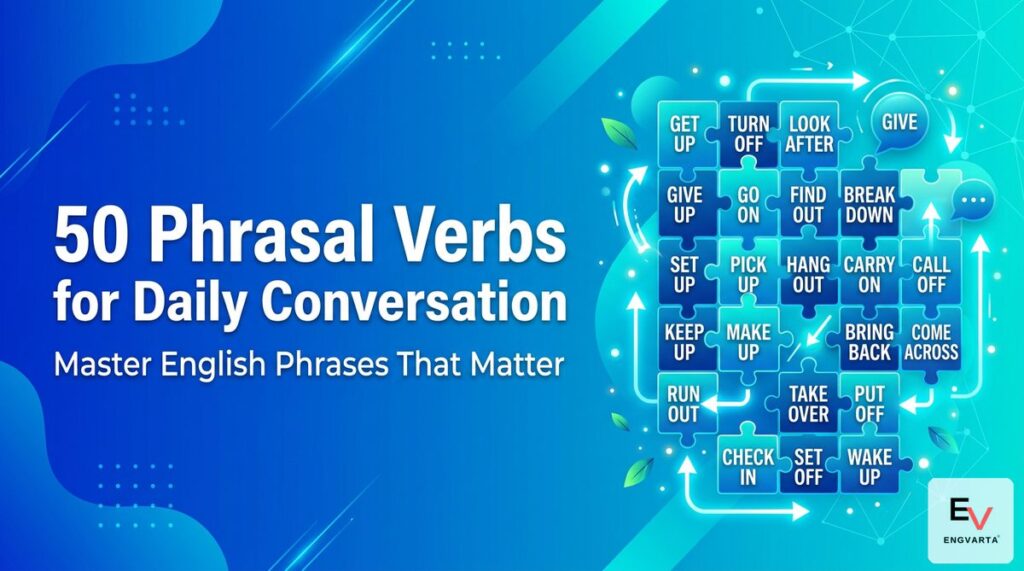
50 interesting phrasal verbs for daily English conversation

December 21, 2022 • 11 min read • By Richa

50 interesting phrasal verbs for daily English conversation
50 phrasal verbs for daily English conversation


Phrasal verbs are very important in daily English conversation. 

They can help you communicate more effectively and accurately. Here are 50 interesting phrasal verbs that you can use in your daily life.


  • Look After

to take care of someone or something and make certain that they have everything they need

He looked after my pets when I was away. 


  • Get On With

 to give your time to something and make progress with it

We can get with the celebration once we finish the work. 


  • Put Up With

 to accept someone or something unpleasant in a patient way

Nobody can put up with bad behavior for a long time. 


  • Come Up With

 to think of something such as an idea or a plan

My friends really come up with the best traveling plans


  • Keep In With

to stay friendly with someone, especially someone who can help you

You should keep in with her friend. They are really helpful. 


  • Pay For

To give money in order to buy something

Let me pay for the dinner. 


  • Take Over 

to begin to do something that someone else was doing

Can you take over the cooking while I walk the dog?


  • Get Away From

 to stop having a particular idea or belief that is oldfashioned or not helpful

We want to get away from this idea that women are meant for cooking. 


  • Get Back To

 to phone, write, or speak to someone at a later time because you were busy or could not answer their question earlier.

I will get back to you once I finish my work. 


  • Put Off 

to delay doing something, especially because you do not want to do it

I was trying to put off the moment when I would have to leave.


  • Give Up On

 to stop hoping that someone will improve and stop trying to help or change them

Most of the teachers gave up on her years ago.


  • Turn Down.

to not accept an offer or request

How could you turn down such a fantastic job?


  • Back Out 

to decide not to do something you agreed to do

I promised to help and I’m not backing out now.


  • Come across 

to meet someone, or to find something by chance

I came across a word I’d never seen before.


  • Dab off

to remove something from a surface by gently touching it several times with something such as a piece of cloth.

He put his handkerchief to his face and dabbed off a tear.


  • Ease off 

if something unpleasant or annoying eases off, it becomes less unpleasant or annoying

If the rain eases off overnight, we’ll leave in the morning.


  • Face down 

with the front or face towards the ground

He was lying face down in the water.


  • Dabble in 

to be involved in an activity for a short time in a way that is not very serious

When he was younger he dabbled in astrology.


  1. Comes down to 

to be the most important aspect of a situation or problem

In the end, it all comes down to who wants the job the most.


  • Triffle with. 

 to deal with something in a way that shows you do not have a serious attitude towards it

Stop trifling with her feelings! 


  • Call for 

to say publicly that something must happen.

Several of the newspapers were calling for his resignation.


  • Boils down to 

to be the main reason for something or the most basic part of something

It’s difficult to choose which appliance to buy, but in the end it usually boils down to cost.


  • Single out 

to choose one person from a group for special attention

Katie was often singled out for punishment.


  1. Send off 

to post something to someone

I must get the parcel sent off tomorrow.


  • Narrow down 

to reduce the number of possibilities or choices

We’re working to narrow down the list of possible suspects.


  • Speak of 

 to seem to prove that something exists or is true

Her extensive library spoke of her love of reading.


  • Bump into 

to meet someone unexpectedly

I bumped into your mother at the supermarket.


  • Blow up at 

to suddenly become angry and shout at someone

She just blew up at me.


  • Cut back 

to reduce the amount of something, especially money that you spend

It’s time we cut back a little.


  • Fall out 

to stop being friendly with someone because you have had a disagreement with them

Have you two fallen out?


  • Get around 

to go or travel to different places

At the age of 85 Milly still gets around quite well.


  • Hang in 

Stay positive 

Hang in there! I’m sure you will find a job soon.


  • Take after 

 to look or behave like an older relative

In looks she takes after her father.


  •  Reflect on 

to give people a particular opinion of someone or something

We hope her success will reflect well on the school.


  • Juice up 

to improve something by making it more interesting, attractive, or powerful

Certain scenes were juiced up for commercial purposes.


  •  Wear off 

if something such as a pain, an emotion, or a feeling wears off, it gradually disappears

The numbness in his shoulder was starting to wear off.


  • Whip up 

to encourage strong emotions or behavior in people

Newspaper articles have whipped up fears of the new tax policies.


  • Ease off 

if something unpleasant or annoying eases off, it becomes less unpleasant or annoying

If the rain eases off overnight, we’ll leave in the morning.


  • End in 

to have something as a final result

His attempt to persuade the boy ended in failure.


  • Map out 

to plan in detail how something will happen

Her own future had been mapped out for her by her parents.


  • Toss around 

to discuss something such as an idea, often in an informal way

We tossed some thoughts around for a while.


  • Keep off 

to not touch something, or to prevent something from touching something

Keep the flies off the food.


  • Knock off 

to reduce a price or an amount

Kelly knocked two seconds off her previous time.


  • Hand down 

to give knowledge or skill to someone who is younger than you and will live after you have died

These skills have been handed down from generation to generation.


  • Keep away 

to avoid someone or something, or to make someone else do this

I’ve told him to keep away, but he won’t listen.


  • Own up 

to admit that you have done something bad or embarrassing

Dan could have made this whole thing go away simply by owning up.


  • Major in 

to have or do a lot of something; to focus on a particular thing.

When someone asked me how my day went, I majored in the things that went wrong rather than the good things.


  • Make off 

to leave quickly, especially after doing something wrong

The kids made off when they heard us coming.


  • Read into 

to find an extra meaning in someone’s words or actions that is not obvious or does not exist

I think you’re reading too much into a casual remark. 


  • Ringback 

to phone someone again.

I’ll ring back later.


Frequently Asked Questions about Phrasal Verbs in English

What are phrasal verbs in English?

Phrasal verbs are verbs combined with one or two short words (prepositions or adverbs) that create a new meaning different from the original verb. Examples: “give up” (quit), “look after” (take care of), “run into” (meet by chance), “put off” (postpone). English has 5,000+ phrasal verbs and native speakers use them constantly — mastering common ones is essential for fluency.

Why are phrasal verbs important in English?

Phrasal verbs make English sound natural. Native speakers use phrasal verbs constantly in casual conversation: “I have to figure out”, “we’ll catch up later”, “I’m running out of time”, “she came up with a good idea”. Using formal verbs (“ascertain”, “communicate”, “depleting”, “originated”) sounds stiff and non-native. Phrasal verbs are the difference between sounding native and sounding like a textbook.

What are the most common English phrasal verbs?

Top high-frequency phrasal verbs every learner should know: look up (search), turn on/off (activate/deactivate), put off (postpone), give up (quit), find out (discover), take off (leave or remove), pick up (collect or learn), go on (continue), come up (arise), get along with (have good relations), look forward to (anticipate), break down (stop functioning), run out of (deplete), set up (arrange), figure out (understand). Mastering 50 phrasal verbs covers ~80% of everyday usage.

How do I learn phrasal verbs effectively?

Effective phrasal verb learning: (1) Group by topic (e.g., business: take over, sign off, follow up). (2) Learn in real sentences, not isolated lists. (3) Use each new phrasal verb in conversation within 24 hours. (4) Watch English shows and note how characters use phrasal verbs naturally. (5) Practice with a TESOL/ESL-certified Expert who can prompt you to use phrasal verbs and correct misuse. EngVarta‘s 1-on-1 audio sessions help you incorporate phrasal verbs naturally — most learners who use them daily for 4-6 weeks shift from textbook English to natural English.

What’s the difference between phrasal verbs and regular verbs?

Regular verbs are single-word verbs (“decide”, “investigate”, “continue”). Phrasal verbs combine a verb with a particle to create new meaning (“decide to vs decide on”, “look into vs look at vs look up”). The same verb can have multiple phrasal forms with different meanings. Native English uses phrasal verbs in casual contexts; formal verbs in academic and professional writing. Both registers matter — fluent speakers switch between them.

Are phrasal verbs separable or inseparable?

Some phrasal verbs are separable: “Pick the kids up” or “Pick up the kids” (both correct). Some are inseparable: “Look after the kids” (NOT “Look the kids after”). Rule of thumb: if the phrasal verb has an object and you can put the object between verb and particle, it’s separable. Common separable: pick up, take off, turn on. Common inseparable: look after, run into, get over. With pronouns, separable phrasal verbs MUST be separated: “Pick them up” (not “Pick up them”).

How long does it take to master English phrasal verbs?

Realistic timeline: master 50 high-frequency phrasal verbs in 6-8 weeks of daily practice with usage. Reach 200 phrasal verbs (covering most everyday English) in 6-12 months. Achieve idiom-level mastery (using phrasal verbs flexibly in any context) in 1-2 years. The key is USING them, not just memorising lists. Daily live conversation accelerates significantly.

Top 15 uncommon ways to practice English and speak in English like a native English speaker

September 30, 2022 • 11 min read • By Richa

Top 15 uncommon ways to practice English and speak in English like a native English speaker

It’s simple to practice written English alone. Just write 100 words each day. 

But what about your spoken English?

Can you claim to be a fluent English speaker without any help? 

The bizarre thing about improving your spoken English is, that even if you memorize a complete dictionary. It won’t make you a fluent English speaker. 

In this guide, you will not get five, not ten, but 15 ways to practice speaking in English all by yourself

  • Record yourself reading a book out loud.

There’s no better way to improve your English than reading out loud. But if you’re like me and,  you hate the idea of reading out loud. Here’s a twist. I read a book while recording myself reading the book. Then, I listen back to the recording, and I read along with my recording. I do this until I can read the book out loud well enough to be understood. 

This method is excellent for improving your intonation, pronunciation, and overall ability to read and speak English. Besides, reading will help you expand your vocabulary, therefore making it easier for you to express your ideas and thoughts

  •  Describe the news in your own words.

Reading news is considered traditional but it is also one of the best ways to practice your English speaking skills. You just need to read articles online, or you can buy newspapers and magazines in English.

In this way, You will learn many new words and expressions. It’s not just reading, but also understanding what you read. You will have an understanding of basic grammar rules and sentence structure when reading articles in English.

  • Learn phrasal verbs for different situations

If you’re looking to improve your vocabulary, learning some phrasal verbs can be a great way to do it. Phrasal verbs are verbs that are made up of a base verb plus one or more prepositions or adverbs. They can be used to express a variety of different concepts, making them a very versatile tool in your vocabulary arsenal.

There are phrasal verbs for all sorts of different situations, so whether you’re talking about work, school, or your personal life, there’s likely a phrasal verb that can help you express what you want to say. 

Here are just a few examples of some common phrasal verbs and what they can be used for:

  1. Get (something) done: To complete a task or goals.

I need to get my homework done before I can watch TV.

  1. Turn (something) in: To submit a piece of work.

I turned my essay in to my teacher this morning.

These are just a few of the many, many phrasal verbs out there. Learning them can help you better express yourself in both speaking and writing. Give it a try and see how they can help you improve your vocabulary!

  • Learn grammar rules that connect real-life conversations 

There are a lot of great grammar resources out there that are specifically designed for learners. These can be really helpful because they explain the rules in a way that’s easy to understand. And they often provide examples so you can see how the rules are used in real life.

For example : Learning the correct use of prepositions are words like “in,” “on,” “at,” and “to.” 

They can be tricky, but it’s important to use them correctly. For example, you would say, “I’m going to the store,” but you would say, “I’m going to school.”

Or, paying attention to the verb tense like If you’re talking about something that happened in the past, use the past tense. For example, “I went to the store.” If you’re talking about something that is happening now or in the future, use the present tense. For example, “I’m going to the movies tonight.”

  • Think in English.

If you want to practice speaking English, one of the best things you can do is to start thinking in the language. This may seem difficult and weird at first, but it’s actually a great way to improve your skills.

When you start thinking in English, you’ll find that you’re better able to remember words and phrases while speaking. You’ll also be able to form sentences more easily. And, as you continue to practice, you’ll find that your speaking skills will improve significantly.

  • Watch English TV shows and movies with English subtitles. 

If you’re looking to improve your English skills, one great way to do so is to watch English TV shows and movies with English subtitles. This can help you get used to hearing English spoken at a natural pace, and you can also pick up new vocabulary and grammar points by reading the subtitles.

Of course, you don’t want to spend all your time watching TV! Make sure to balance your English Immersion with other activities, such as reading, writing, and speaking practice. And have fun with it – after all, you’re learning a new language!

  • Practice speech shadowing. 

Have you ever considered practicing speech shadowing to improve your vocabulary and practice English? It’s a great way to improve your pronunciation and get used to speaking in a foreign language.

If you’re not familiar with speech shadowing, it’s basically when you listen to a native speaker and repeat what they’re saying. It’s a great way to learn new words and phrases and to get used to the rhythm and flow of the language.

To get started, find a short piece of audio or video in English that you can listen to and repeat. It can be anything from a song to a news clip to a scene from a movie. Once you’ve found something, hit play and start repeating what you hear. Try to mimic the speaker’s intonation and stress patterns as closely as possible. At first, it might be difficult to understand everything the speaker is saying, but don’t worry, just keep at it and you’ll gradually improve.

  • Sing along to your favorite songs.  

If you’re looking to improve your English vocabulary and pace of speaking, one great way to do it is by singing along to your favorite songs. Not only is it a fun way to spend some time, but you’ll also be able to pick up new words and phrases. 

So, make a playlist of your favorite tunes and get ready to start singing!

  • Pretend you’re at a party and talk to imaginary guests.

If you want to improve your English vocabulary, one fun way to do it is to pretend you’re at a party and talk to imaginary guests. This may sound silly, but it can actually be quite helpful. By speaking out loud and using the words you want to learn, you’ll start to feel more comfortable and accustomed to them. Plus, it’s a great way to practice your conversation skills. So, next time you say that you don’t have a practice partner, follow this trick. 

  • Use technology as much as you can 

So if you’re looking to improve your English, make sure to take advantage of the technology at your disposal. With a little bit of effort, you’ll be surprised at how quickly your English improves.

One of my personal favorites is Quizlet. It’s a great website where you can create flashcards and quizzes to help you learn new vocabulary. You can also find sets of flashcards that other people have already made.

Next comes EngVarta, where you can practice English on both video and audio calls with the help of live English experts. 

Another great tool is Duolingo. This website/app helps you learn a new language by translating real-world text and speaking conversations. They also have little games to help you learn new words in a fun way.

  • Use a mobile dictionary.

If you want to improve your vocabulary and practice your English, using a mobile dictionary is a great way to do it. You can easily look up words that you don’t know, and get definitions and examples of how to use them.

There are a few different mobile dictionary apps that you can choose from. Some of them are free, while others have a small fee. Whichever one you choose, make sure that it has good reviews and that it will work well on your phone.

Once you have a mobile dictionary installed, start using it every day. Whenever you come across a new word, look it up. This way, you’ll gradually start to build up your vocabulary. You’ll be surprised at how quickly you start to improve!


  • English speaking practice apps.

There are many benefits of using English-speaking practice apps. 

They can help you improve your spoken English, learn new vocabulary, and practice your pronunciation. By practicing your English conversation skills on a regular basis, you can feel more confident and comfortable when speaking with fluent English speakers.

In addition to the benefits mentioned above, English speaking practice apps can also be a lot of fun! They can help you make new friends from all over the world and practice your English speaking skills in a relaxed and informal setting.

EngVarta is one of the best English-speaking practice platforms where you get English experts all over India. The experts are extremely friendly and approachable. They not just correct your mistakes and give you the right feedback. They also make sure to push you out of your comfort zone when you speak in English. 

  • Write comments on blogs and YouTube.

One of the fun ways to improve your English vocabulary is to write comments on blogs and YouTube videos. Yes, and don’t get me wrong. 

You can improve your  English vocabulary by learning from other people’s comments. When you see a comment that you don’t understand, look up the words and add them to your vocabulary list. This is a great way to expand your knowledge of the English language.

  • Create your own vocabulary list. 

Do you have trouble understanding some of the words people use? Well, you’re not alone. A lot of people have trouble keeping up with the latest vocabulary. But don’t worry, there’s a solution. Why not create your own vocabulary list?

Creating your own vocabulary list is a great way to learn new words and to make sure you understand what people are saying. 

Plus, it’s a lot of fun! Here’s how to get started:

  1. Choose a topic.
  2. Start collecting words. Write down the words you hear or see that you don’t know. Look up the definitions of the words you don’t know.
  3. Organize your words. Create categories for your words. For example, you could have a category for words related to food, another category for words related to clothes, and another category for words related to travel.
  4. Practice using your words. Write sentences or stories using the words on your list. Try to use each word in a different sentence.
  • Describe situations.

Learning how to describe situations in English can be tricky, but with a little practice, you’ll be able to do it like a pro!

Here are some tips for describing situations in English:

-Think about what you want to say before you start talking. This will help you organize your thoughts and choose the right words.

-Start by giving some basic information about the situation. Who is involved? What are they doing? When and where is it happening?

-Use verbs to describe what’s happening. For example, if you’re describing a scene, you might say “people are walking,” “cars are honking,” or “the sun is shining.”

-Try to be as specific as possible. The more details you include, the easier it will be for people to understand what you’re talking about.

I hope the article was helpful. Comment down below on how you are practicing English at home alone. 
Why is English important in our life

July 23, 2022 • 4 min read • By Richa

Why is English important in our life


“Why is English important in our life?” Before proceeding with this question I have a question to ask and that is, “Is English really important to learn?” And the answer to it is undoubtedly “YES”. At present, English is among the top spoken languages worldwide. 

English is not a language just to copy and paste the vocabulary from the dictionary, it’s actually fun, it has emotions, expressions and is the best coupon to use when you meet other people around the world. Learning English can be a key to numerous doors in your career and will open up a wide area for the exposure. English is not only important for students only, but English is also important for working professionals too.


Why should I learn English

Connection to the world-

It’s a fact, learning English can help you to explore and connect with new people, not just in some specific area or place but around the world. It can add new exposures and experiences to your life. As it is widely said, always remember to carry your passport, visa and a good knowledge of English with you while going on a foreign trip. 

If you dream of visiting several countries around the world or wish to settle in a foreign country, it is needless to say that learning English may give you a good start. Even if you don’t travel to any of the foreign countries but still with your English speaking skills you can connect to various people on social media from around the world.  


Personal growth 

Let me begin with a very relevant example here: when you visit a ravishing hotel or restaurant and the waiter or waitress greets you in English or when you see your colleagues at office getting high increments and promotions because of being confident and fluent at spoken English during their presentations. At this point of time, you realise the real importance of English and how important it is to speak English fluently. Eventually you will work on your personal growth of spoken English skills. 


Interviews and competitions- 

Moving on, English gives a good impression of yours in interviews. And ignoring the language may affect your chances of selection. Learning the English language can surely boost your career growth as well. And not just interviews, you have a world outside to compete with. You have to set high standards for yourself in the world and English might be the first step to cover your high standards. 


Day to day usage- 

You may notice English is widely used and spoken in your surroundings in your day to day life. The menu at the cafes are mostly in English, schools are now charging fines from the students for not speaking in English, there are more numbers of English contents of English than of our native languages over the internet. Eventually, we can observe English evolving daily. 


How to Practise Speaking English?

Quoting a very famous quote of English here, “Practice makes a man perfect”. And it has been scientifically proven that practice is the only way to learn any language easily and faster. Now a question comes how to practise English speaking because that’ll take so much of your time in English coaching classes or how you will find the right person to speak with or who can correct your errors. Well this is what the Experts of EngVarta do. 

EngVarta is an online English learning app that connects the English learners with the English experts over a phone call. Here you are free to make English errors and speak English with your heart. No one is going to judge you. Here the experts will provide you with the necessary feedback. It aims to build confidence and fluency in spoken English.

English has become a way of living life. It has become dynamic & is constantly evolving. Eventually, learning spoken English is very important in our lives. 


Guide for Reading, Watching and Practicing English

June 30, 2022 • 5 min read • By Richa

Guide for Reading, Watching and Practicing English


In this article, you will get all the resources you need for reading, watching, and practicing English. 

The easiest way to improve your confidence when speaking English is to get more practice.

If you have people around you with whom you can talk in English, it is the best way to improve your English. But if you don’t, you can use mobile applications to improve your English speaking through real-life conversations. 

Practice spoken English daily on this English practice app 

EngVarta is an English practice app that helps you to improve your spoken English. You can book a call with an English expert any time of day for 15 minutes to 60 minutes anytime from 7:00 to midnight 12. You can speak on any random topic of your choice, or on a topic specific to one of your goals like clearing the IELTS or getting ready for an upcoming job interview. At the end of the call, the English expert gives you constructive feedback on any mistakes you made.

Best English reading resources to improve your English 

Online newspapers 

This is another useful resource because it allows you to read articles written by native English speakers on various topics. 

Here is a list of online Indian newspapers that you can check out:

Times of India – www.timesofindia.com/

Indian Express – www.indianexpress.com/

Hindustan Times – www.hindustantimes.com/

Daily News and Analysis – www.dnaindia.com/

Reddit 

If you want to learn English, Reddit can be your best friend. This site is full of people who are eager to help each other and share their knowledge. Here are some tips on how to use Reddit for learning English:

Find new books to read. A good place to start is r/books or r/bookrecommendations. You can search these subreddits for titles or authors you’re interested in reading. Or if you want something a little more off the beaten path, try looking for “weird books” or “lost classics” in r/booksuggestions.

Learn about different genres of literature by browsing through the various subreddit categories; for example, r/fiction contains discussions about what constitutes literary fiction versus genre fiction like fantasy or science fiction.

Ask questions about popular books. If you’re not sure how much time it will take to finish a book or whether you should buy it at all first, ask others for their opinions on the book by posting a question on r/booksuggestions or r/booksm

Free/ Paid online e-books

The Internet is full of websites that offer book downloads and reading material. Many of these sites have thousands of titles available for free, so you’ll always be able to find something interesting to read. Here are some great places to start:

Feedbooks: A website that offers over 25,000 free books available for download in various formats including PDF and EPUB.

ManyBooks: A website with over 11,000 free classics and contemporary titles available for download in multiple formats including EPUB and MOBI (Kindle).

Open Library: An open-source electronic catalog of free e-books available for download, founded by the Internet Archive and Google Inc.

Bookrix: A website that offers 50,000 free books available for download in multiple formats including EPUB and MOBI (Kindle).

Other stuff for improving your English 


Common Sense Media: This website offers reviews of movies and TV shows, as well as books and games. You can search by age or by title

Reader’s Digest: The venerable magazine is now available online. It offers some free articles, but you’ll need to subscribe if you want access to all the content.

The British Council: This website provides information about British culture and society, including current events and politics, business opportunities, and international education.

Dictionary.com: This site offers an extensive dictionary with definitions, synonyms, and pronunciation guides for many words in many languages — including English!

BBC Learn English – This is a great website for listening practice, reading comprehension, and grammar explanations. There are also some excellent videos on slang and idioms.

Online dictionaries – There are lots of online dictionaries available that can help you improve your vocabulary and understand new words in context. Here’s one site I like: Oxford University Press Online Dictionary

Watch these English content to improve your English 

Learn English with Tv series (Netflix or Amazon Prime) 

It’s fun and easy. You can watch the show with subtitles, or without them. If you’re watching without subtitles, then you should try to pay attention to every word that you don’t understand, and look up its meaning later on in an online dictionary such as Merriam Webster.

  1. Friends. 
  2. How I Met Your Mother. 
  3. The Big Bang Theory. 
  4. The office. 
  5. Breaking Bad. 
  6. Friends from College. 
  7. Gilmore Girls. 

EngVarta Youtube channel Engvarta youtube channel has lessons from grammar to daily life English conversation phrases. It provides weekly videos on all topics that are important for you to speak fluent English. 

TED Talks Official – TED talks are the best when it comes to learning new things and improving your vocabulary. They’re usually short, interesting, and educational so they are perfect for language learners. 

BBC Learning – This channel contains many different video series about different topics that will help you improve your listening skills in no time! There are also some videos on grammar, pronunciation, and vocabulary-related topics which is great if you want to learn more but don’t know where to start.

FluentU – FluentU takes real-world videos — like movie trailers, music videos, news, and inspiring talks — and turns them into personalized language lessons. It also provides learning tools like interactive subtitles, flashcards, and more!