Prepositions are those small but mighty words that link nouns, pronouns, or phrases to other words within a sentence. They’re everywhere in spoken English, but mastering their use can be tricky, especially for non-native speakers. Today, we’ll go over 10 common mistakes people make with prepositions and how to avoid them.
1. Confusing ‘In’ and ‘At’ for Locations
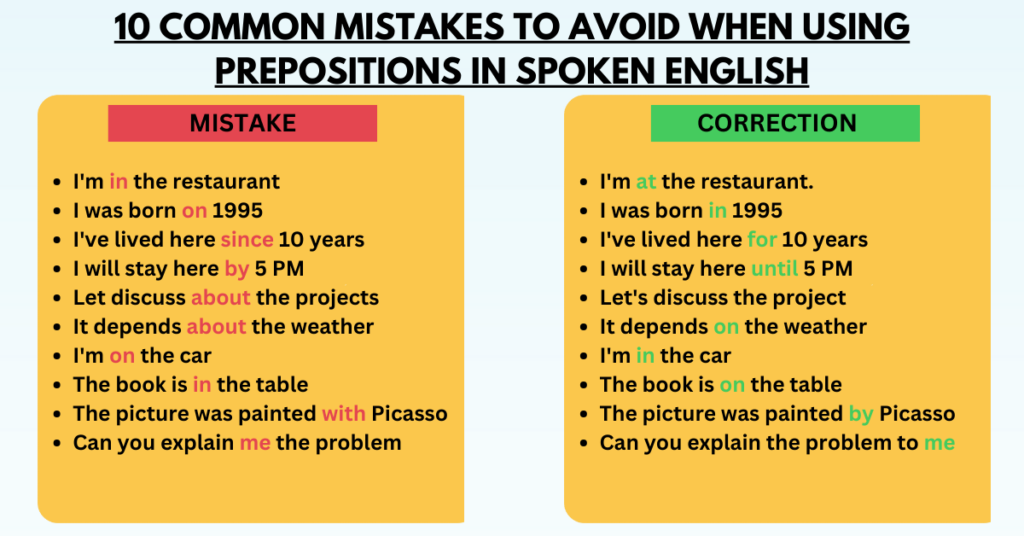
Mistake: Saying, “I’m in the restaurant” when you mean, “I’m at the restaurant.”
Correction: Use ‘at’ when you’re talking about specific locations, like “at the office” or “at the park.” Use ‘in’ when you’re referring to something more general or enclosed, like “in the city” or “in the car.”
2. Using ‘On’ Instead of ‘In’ for Months and Years
Mistake: Saying, “I was born on 1995″ instead of “I was born in 1995.”
Correction: Use ‘in’ for months, years, centuries, and long periods of time, like “in March” or “in 2025.” Use ‘on’ for specific days or dates, like “on Tuesday” or “on December 12th.”
3. Mixing Up ‘For’ and ‘Since’ with Time Expressions
Mistake: Saying, “I’ve lived here since 10 years” instead of “I’ve lived here for 10 years.”
Correction: Use ‘for’ when talking about the length of time (a duration), like “for 10 years.” Use ‘since’ when you’re referring to the starting point in time, like “since 2010.”
4. Incorrect Use of ‘By’ and ‘Until’
Mistake: Saying, “I will stay here by 5 PM” instead of “I will stay here until 5 PM.”
Correction:‘Until’ is used to indicate the time something will continue to happen, like “until 5 PM.”‘By’ is used to show the deadline or when something must be completed, like “Please finish this by Friday.”
5. Incorrect Use of ‘To’ After ‘Discuss’
Mistake: Saying, “Let’s discuss about the project” instead of “Let’s discuss the project.”
Correction: The verb ‘discuss’ doesn’t require a preposition. You should say, “Let’s discuss the project,” without ‘about.’
6. Confusing ‘On’ and ‘About’ After ‘Depend’
Mistake: Saying, “It depends about the weather” instead of “It depends on the weather.”
Correction: Always use ‘on’ after the verb ‘depend,’ as in “It depends on the weather,” or “It depends on you.”
7. Mixing Up ‘In’ and ‘On’ with Transportation
Mistake: Saying, “I’m on the car” instead of “I’m in the car.”
Correction: Use ‘in’ for smaller vehicles like cars or taxis (“in the car”) and ‘on’ for larger modes of transportation like buses, trains, and planes (“on the bus”).
8. Using ‘In’ Instead of ‘On’ for Surfaces
Mistake: Saying, “The book is in the table” instead of “The book is on the table.”
Correction: Use ‘on’ when referring to something that’s on a surface, like “on the table,”“on the floor,” or “on the shelf.”
9. Confusing ‘With’ and ‘By’
Mistake: Saying, “The picture was painted with Picasso” instead of “The picture was painted by Picasso.”
Correction: Use ‘by’ when you’re talking about the agent or doer of an action (“painted by Picasso”), and ‘with’ when you’re referring to the tool or instrument used (“painted with a brush”).
10. Incorrect Use of ‘To’ After ‘Explain’
Mistake: Saying, “Can you explain me the problem?” instead of “Can you explain the problem to me?”
Correction: The verb ‘explain’ needs to be followed by the object first and then the person it’s explained to: “Explain the problem to me.”
Practice Listening and Reading: Exposure to correct usage through podcasts, TV shows, and books will help you naturally pick up the right prepositions.
Use an English Learning App: Apps like EngVarta provide real-time conversations with English experts, helping you identify and correct preposition mistakes in real time.
Create Flashcards: Make a list of common preposition phrases and review them daily.
Speak Regularly: The more you practice speaking English, the more natural it is to use prepositions.
Mastering prepositions may seem challenging, but with practice, you’ll find yourself making fewer and fewer mistakes. Prepositions can often change the entire meaning of a sentence, so using them correctly is key to fluency.
By avoiding these 10 common mistakes, you’ll see a noticeable improvement in your spoken English!
Ready to master prepositions and speak English confidently?Download EngVarta today and start practicing with live experts!
Frequently Asked Questions about English Prepositions
What are English prepositions and why are they tricky?
Prepositions are short words (in, on, at, by, for, of, to, with, from, about) that connect nouns, pronouns, or phrases to other words in a sentence. They’re tricky because they don’t translate directly between languages — Hindi, Tamil, Bengali, and other Indian languages handle position/direction/time differently than English. Learners often calque from their native language, leading to errors like “I’m interested in to learn” (should be “interested in learning”) or “good in maths” (should be “good at maths”).
What are the most common English preposition mistakes?
Frequent errors Indian English speakers make: (1) “Good IN English” → “good AT English”. (2) “Discussing ABOUT this” → “discussing this” (no preposition needed). (3) “Married WITH her” → “married TO her”. (4) “Different THAN” → “different FROM”. (5) “On Monday morning” → “on Monday morning” (correct) but “in the morning” (correct), “at night” (correct). Time prepositions: AT exact times, ON days, IN months/seasons/years. Place prepositions: AT specific locations, ON surfaces, IN enclosed spaces.
What’s the difference between in, on, and at?
For TIME: AT for exact times (at 5pm, at noon), ON for specific days (on Monday, on Christmas), IN for longer periods (in May, in 2026, in winter). For PLACE: AT for specific points (at the bus stop, at the door), ON for surfaces (on the table, on the wall), IN for enclosed spaces (in the room, in the car, in India). When in doubt, think of the preposition as zooming in: IN is broadest (a country), ON is narrower (a street), AT is specific (a corner).
How can I avoid preposition mistakes in spoken English?
Effective strategies: (1) Memorise high-frequency verb-preposition combinations as PHRASES (depend on, listen to, agree with, look forward to, instead of memorising “depend” and “on” separately). (2) Read English daily and note every preposition usage that surprises you. (3) Get feedback from a TESOL/ESL-certified Expert who flags preposition errors as they happen — these errors are often invisible to learners. EngVarta‘s daily 1-on-1 sessions catch preposition mistakes in real conversation, with corrections in the moment.
What are essential English prepositions to know?
Top 20 high-frequency prepositions: in, on, at, by, for, of, to, with, from, about, after, before, between, during, into, through, without, against, among, beyond. Mastering these covers ~95% of everyday English usage. Memorise common phrases that use them (“by the way”, “for instance”, “in fact”, “of course”) rather than learning prepositions in isolation.
How long does it take to master English prepositions?
Most learners reach 80% accuracy on common prepositions in 6-12 months of daily practice with feedback. Reaching 95%+ accuracy takes 1-2 years because some preposition uses are highly idiomatic (e.g., “interested IN” vs “fond OF” — no logical reason for the difference). Acceptance helps: native speakers often disagree on “correct” preposition use too. Focus on the patterns that matter for clarity.
Should I memorise preposition rules or learn them in context?
Both, but lean toward CONTEXT. Rules give you a starting framework (time prepositions: at/on/in pattern). Context (real sentences, conversations, written examples) is what locks usage into memory. Reading English daily and noting prepositions in their natural context is more effective than memorising rule lists. Active production (speaking, writing) with corrections is the fastest path to accuracy.
In today’s world, English has become a global language, essential for communication in almost every country. For travelers, the ability to speak English fluently opens doors to new experiences and smoother journeys. Whether navigating foreign streets or engaging in local markets, speaking English can make all the difference. Here are the top 10 best English learning apps for travelers, providing flexibility and effective learning strategies to help you learn on the go.
Duolingo: Fun and Gamified Learning
Duolingo is a free, gamified language learning app that’s perfect for beginners. It uses a fun, game-like structure to keep learners engaged, offering quick lessons that fit easily into a traveler’s schedule. The app’s bite-sized lessons cover a range of topics, from basic vocabulary to more complex grammar rules, making it one of the best English learning apps for travelers looking for a simple and entertaining way to start learning.
EngVarta: Real-Time Practice with Experts
EngVarta is an innovative app that focuses on live conversation practice with English experts, setting it apart from other language apps that use automated lessons. This is a game-changer for travelers looking to build confidence in speaking English quickly. The app connects users with real people, offering a personalized and practical approach to learning, making it one of the best English learning apps for travelers who want to enhance their speaking skills in a realistic setting.
Why Choose EngVarta?
Real-Time Interaction: Unlike other apps, EngVarta provides live sessions with English experts, allowing for real-time conversation practice. This is particularly valuable for travelers who need to improve their speaking skills quickly.
Personalized Learning: Sessions are tailored to individual needs, whether you want to focus on everyday conversations, business English, or travel-specific scenarios.
Flexible Scheduling: Perfect for travelers, EngVarta allows you to schedule sessions at your convenience, making it easy to fit learning into any itinerary.
Confidence Building: Regular interaction with native speakers helps build confidence and fluency, essential for navigating new countries and cultures.
Rosetta Stone: Immersive Language Learning
Rosetta Stone has been a pioneer in language learning for decades. The app focuses on immersive learning, encouraging users to think and learn in the new language without translation, which can be particularly effective for learning English. This immersive approach makes it one of the best English learning apps for travelers who want to fully dive into the language.
Memrise: Learning with Native Speakers
Memrise uses a combination of video clips of native speakers and interactive games to make learning a new language both fun and effective. It’s ideal for travelers who want to learn practical phrases and expressions used in everyday conversation.
Busuu: Community-Driven Learning
Busuu offers a unique blend of traditional language lessons and social learning features. It allows users to interact with native speakers, providing opportunities to practice writing and speaking with real people, enhancing the learning experience.
HelloTalk: Language Exchange Community
HelloTalk is more of a social network than a traditional learning app. It connects users with native speakers around the world for language exchange, making it perfect for travelers who want to practice conversational English and gain cultural insights directly from locals.
Pimsleur: Audio-Based Learning for On-the-Go
Pimsleur is a renowned audio-based learning app that focuses on listening and speaking skills. It’s perfect for travelers who want to learn hands-free while commuting or multitasking, making language learning seamlessly fit into a busy travel schedule.
Mondly: High-Tech Language Learning
Mondly utilizes modern technology like augmented reality (AR) and chatbots to enhance the language learning experience. It offers a variety of interactive exercises and conversations for comprehensive learning, making it a fun and engaging tool for travelers.
TripLingo: Traveler-Focused Language and Culture App
TripLingo is designed specifically for travelers, offering language learning tools along with cultural insights and essential travel phrases. It’s a handy app for navigating different countries and cultures, providing both language learning and cultural immersion.
Conclusion
For travelers looking to learn English on the go, these apps offer a range of methods and features to suit different learning styles and needs. From gamified lessons with Duolingo to structured courses with Babbel, and immersive learning with Rosetta Stone, there’s something for everyone. However, EngVarta stands out with its unique focus on live conversation practice, making it the best choice for those who want to improve their speaking skills quickly and effectively. So, download EngVarta today and start your journey towards fluent English communication with one of the best English learning apps for travelers!
By incorporating these English learning apps into your travel routine, you can make the most of your time abroad while improving your language skills in engaging and effective ways.
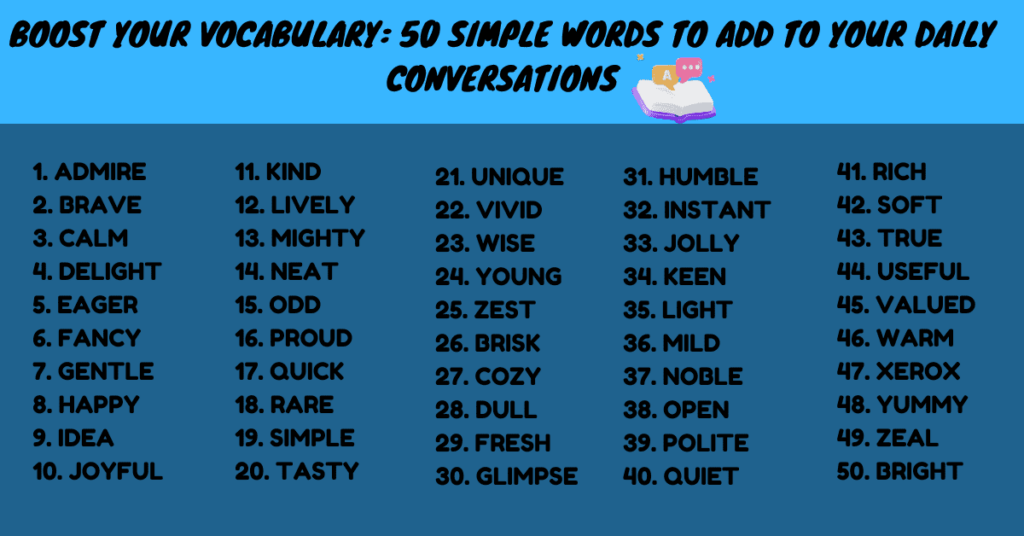
Expanding your vocabulary doesn’t have to be daunting. Simple words can make a big impact on your ability to communicate clearly and effectively. Here are 50 simple words to enhance your daily conversations, along with tips on how to use them.
Why Expanding Your Vocabulary Matters
Expanding your vocabulary:
Improves communication: Simple, clear words help convey your thoughts more accurately.
Enhances understanding: A broader vocabulary aids in comprehending texts and conversations.
Boosts confidence: Knowing the right words can make you more confident in speaking and writing.
How to Incorporate New Words
Read Regularly: Books, articles, and blogs expose you to new words in context.
Use a Dictionary: Look up unfamiliar words and learn their meanings.
Practice Writing: Incorporate new words into your writing to reinforce learning.
Engage in Conversations: Use new words in your daily interactions to make them part of your active vocabulary.
50 Simple Words to Enhance Your Daily Conversations
Admire (verb) – To look up to someone.
Example: “I admire her dedication to her work.”
Brave (adj.) – Showing courage.
Example: “He is a brave firefighter.”
Calm (adj.) – Free from stress or worry.
Example: “She remained calm during the emergency.”
Example: “The instructions were simple to follow.”
Tasty (adj.) – Having a pleasant flavor.
Example: “The cake was very tasty.”
Unique (adj.) – Being the only one of its kind.
Example: “Each person’s fingerprint is unique.”
Vivid (adj.) – Bright and clear.
Example: “She has vivid memories of her childhood.”
Wise (adj.) – Showing good judgment.
Example: “His advice was very wise.”
Young (adj.) – Having lived for a short time.
Example: “The young girl loves to play.”
Zest (noun) – Great enthusiasm and energy.
Example: “She approached life with zest.”
Brisk (adj.) – Quick and energetic.
Example: “They took a brisk walk in the park.”
Cozy (adj.) – Comfortable and warm.
Example: “The cabin was cozy and inviting.”
Dull (adj.) – Lacking interest or excitement.
Example: “The lecture was dull and boring.”
Fresh (adj.) – New and clean.
Example: “She loves the fresh smell of rain.”
Glimpse (noun) – A quick look.
Example: “She caught a glimpse of the sunset.”
Humble (adj.) – Not proud or arrogant.
Example: “He remained humble despite his success.”
Instant (adj.) – Happening immediately.
Example: “She felt an instant connection with him.”
Jolly (adj.) – Happy and cheerful.
Example: “He is always in a jolly mood.”
Keen (adj.) – Eager or enthusiastic.
Example: “She is keen to learn new skills.”
Light (adj.) – Not heavy or intense.
Example: “The dress was made of light fabric.”
Mild (adj.) – Gentle and not extreme.
Example: “The weather was mild and pleasant.”
Noble (adj.) – Having high moral qualities.
Example: “He is a noble and honorable man.”
Open (adj.) – Honest and willing to share.
Example: “She was open about her feelings.”
Polite (adj.) – Showing good manners.
Example: “He was polite and respectful.”
Quiet (adj.) – Making little or no noise.
Example: “The library was quiet and peaceful.”
Rich (adj.) – Having a lot of wealth or resources.
Example: “The soil was rich and fertile.”
Soft (adj.) – Gentle to touch.
Example: “The blanket was soft and warm.”
True (adj.) – In accordance with fact.
Example: “Her story was true and accurate.”
Useful (adj.) – Helpful and practical.
Example: “The guidebook was very useful.”
Valued (adj.) – Highly regarded.
Example: “He was a valued member of the team.”
Warm (adj.) – Having a moderate heat.
Example: “The soup was warm and comforting.”
Xerox (noun) – A copy made by a photocopier.
Example: “Please make a xerox of this document.”
Yummy (adj.) – Tasty and delicious.
Example: “The cookies were yummy.”
Zeal (noun) – Great energy in pursuit of a cause.
Example: “She worked with great zeal.”
Bright (adj.) – Full of light or color.
Example: “The future looks bright.”
Conclusion
Building your vocabulary with simple, everyday words can significantly enhance your ability to communicate and understand others. Start using these words today, and watch your conversations become more engaging and effective. Happy learning!
Frequently Asked Questions about Building English Vocabulary
How can I boost my English vocabulary daily?
Daily vocabulary-building habits: (1) Learn 5 new words per day in CONTEXT (not from word lists). (2) Use each new word in a real sentence within 24 hours. (3) Read 10-15 minutes of English content daily — circle 1-2 unfamiliar words. (4) Use a vocabulary app like Anki or Memrise for spaced repetition. (5) Practise speaking with a TESOL/ESL-certified Expert who introduces vocabulary naturally during conversation. Consistency beats intensity — 5 words daily for 30 days is better than 50 words crammed in one weekend.
What are simple English words to add to daily vocabulary?
High-impact simple words to upgrade your daily English: Beneficial, Crucial, Efficient, Essential, Significant, Tremendous, Practical, Unique, Common, Specific, Various, Several, Numerous, Particular, Relevant. These replace overused words like “good”, “important”, “many”, “different” — making your spoken English sound more precise and educated.
How long does it take to expand English vocabulary?
To meaningfully expand your active vocabulary by 500-1,000 words takes 3-6 months of consistent daily practice (5 new words/day with usage). Reaching truly advanced vocabulary (~5,000 active words) takes 1-2 years. The first 1,000 high-frequency words are the most valuable — they cover ~80% of everyday conversation. Focus there before chasing rare/specialised vocabulary.
What’s the best way to remember new English words?
Most effective memory techniques: (1) Use the word in your own sentence within 24 hours of learning it. (2) Connect new words to existing knowledge (e.g., link “ubiquitous” to “everywhere I’ve seen this”). (3) Spaced repetition apps that re-test you at increasing intervals. (4) Teach the word to someone else — explanation locks it in memory. (5) Encounter the word in 3-5 different contexts before it becomes “active.” Just looking up a definition rarely sticks.
How many English words should I learn per day?
5-10 new words per day is optimal for most learners. Beyond that, retention drops sharply. The key is using each word in real conversation or writing within 24 hours — passive memorisation rarely transfers to active use. EngVarta‘s daily live audio sessions help you actively use new vocabulary in conversation, with TESOL/ESL-certified Experts who can prompt you to incorporate specific words naturally.
Should I focus on vocabulary or grammar first?
Both — but vocabulary slightly more for spoken fluency. With 1,500 high-frequency words and basic grammar, you can communicate most everyday ideas. With perfect grammar but limited vocabulary, you struggle to express complex thoughts. Most fluent non-native speakers have stronger vocabulary than perfect grammar. Allocate 60% of practice time to vocabulary expansion + usage, 40% to grammar drills + correction.
Can reading English books really build vocabulary?
Yes — but only if you ACTIVELY engage with new words. Passive reading where you skim past unfamiliar words doesn’t build vocabulary. Effective reading: (1) Pause at 1-2 unfamiliar words per page, look up the meaning. (2) Note the word in a vocabulary journal with the sentence it appeared in. (3) Use it in your next conversation or writing. Reading 30 minutes daily this way adds ~50-100 new active words per month.
In the journey of learning a new language, few practices are as impactful as regular conversation. English, being one of the most widely spoken languages globally, demands proficiency not just in grammar and vocabulary but also in the ability to communicate effectively. In this article, we explore the transformative power of conversation in enhancing English fluency and provide practical tips to make the most of your speaking practice sessions.
Understanding the Importance of Conversation:
Natural Language Acquisition: Conversing in English mimics the way native speakers communicate. Through conversation, learners are exposed to colloquial expressions, slang, and nuances that textbooks often fail to capture. This immersion in authentic language usage accelerates the learning process.
Cultural Insight: Language is deeply intertwined with culture. Engaging in conversations allows learners to gain insights into the cultural contexts in which English is used. This understanding enhances not only language proficiency but also cultural competence, a crucial skill in today’s interconnected world.
Building Confidence: Regular conversation builds confidence in speaking English. As learners engage in dialogues, express their thoughts, and navigate real-life situations, they gradually overcome the fear of making mistakes. This confidence is invaluable, as it empowers learners to communicate fluently in diverse settings.
Practical Application of Skills: While grammar and vocabulary are essential components of language learning, they are merely tools for effective communication. Conversation puts these skills into practice, allowing learners to apply what they’ve learned in a meaningful context. This practical application solidifies understanding and reinforces learning.
Tips for Effective English Speaking Practice:
Find a Language Partner: Partnering with a language exchange buddy or joining conversation groups provides valuable opportunities for regular practice. Interacting with native speakers or proficient learners exposes you to different accents, speech patterns, and communication styles, enriching your learning experience.
Set Realistic Goals: Establish specific, achievable goals for your speaking practice sessions. Whether it’s mastering a particular topic, improving pronunciation, or increasing fluency, setting targets keeps you motivated and focused on your learning objectives.
Embrace Mistakes: Mistakes are an inevitable part of the learning process. Instead of fearing them, embrace mistakes as learning opportunities. Reflect on errors, learn from them, and integrate feedback to enhance your speaking skills continually.
Diversify Topics: Engage in conversations on a wide range of topics to broaden your vocabulary and deepen your understanding of English. Discussing current events, hobbies, interests, or personal experiences not only keeps conversations engaging but also exposes you to diverse vocabulary and expressions.
Listen Actively: Effective communication involves active listening. Pay attention to the words, intonations, and non-verbal cues of your conversation partner. By actively listening, you not only understand better but also learn to respond appropriately, fostering smoother, more natural conversations.
Practice Consistently: Like any skill, proficiency in English speaking requires consistent practice. Incorporate speaking practice into your daily routine, even if it’s just a few minutes of conversation each day. Consistency is key to building fluency over time.
Seek Feedback: Solicit feedback from your conversation partners or language instructors. Constructive criticism helps identify areas for improvement and provides valuable insights into your progress. Use feedback to refine your English speaking skills and address any weaknesses effectively.
Utilizing EngVarta App for Enhanced English Speaking Practice:
In today’s digital age, technology has revolutionized language learning, making it more accessible and interactive than ever before. EngVarta, a leading english language learning app, offers a unique platform for learners to practice English speaking with live English experts. With EngVarta, users can engage in real-time conversations with experienced tutors, receiving personalized feedback and guidance tailored to their individual learning needs. This innovative approach not only provides valuable speaking practice but also offers instant support and encouragement, helping users overcome challenges and build confidence in their English speaking abilities. By incorporating EngVarta into their language learning routine, learners can harness the power of technology to accelerate their fluency journey and unlock new opportunities for linguistic growth and proficiency.
Conclusion:
Regular English speaking practice is a cornerstone of language fluency. By engaging in conversations, learners not only enhance their language skills but also gain confidence, cultural insight, and practical communication abilities. By following the tips outlined in this article and embracing the power of conversation, learners can accelerate their journey towards English proficiency and unlock a world of opportunities for personal and professional growth. So, don’t hesitate—start speaking, start practicing, and watch your fluency soar!
Understanding the difference between active and passive voice is one of the foundations of clear English writing and confident spoken English. This guide explains what each voice means, when to use it, how to convert between them, and gives 20+ practical examples to help the rules stick.
Hello, grammar enthusiasts and language learners!
In today’s enlightening blog, we’re unraveling the mysteries of “Active and Passive Voice in English Grammar.”
Have you ever wondered why we use active and passive voice in sentences? What’s the difference, and when should you use each one? We’re here to demystify this essential grammatical concept.
Active and passive voice are two essential components of English grammar that determine how sentences are structured. These voices impact the clarity and focus of your writing, making it essential to grasp their distinctions. In this article, we will explore the differences between active and passive voice, understand when to use each, and examine their impact on communication.
Active Voice
Active voice is the most common and straightforward way to construct a sentence in English. In an active voice sentence, the subject of the sentence performs the action, and the object receives the action. This results in clear and direct communication. For example:
The cat (subject) chased (verb) the mouse (object).
In this sentence, it is clear that the cat is the one doing the chasing.
Passive Voice
Passive voice, on the other hand, shifts the focus from the doer of the action to the receiver. In passive voice sentences, the object of the action becomes the subject of the sentence. The agent (the one performing the action) may or may not be mentioned. For example:
The mouse (subject) was chased (verb) by the cat.
In this passive voice sentence, the focus is on the mouse and the action it endured, but the cat, the agent of the action, is not explicitly mentioned. This is a key characteristic of passive voice.
When to Use Active Voice
Clarity: Active voice is generally preferred when clarity is crucial. It leaves no room for ambiguity, making it easier for the reader to understand who is performing the action.
Directness: Active voice is more direct and concise, which is often desirable in both written and spoken communication.
Emphasis: Active voice allows you to emphasize the doer of the action. If you want to highlight the subject, active voice is the way to go.
When to Use Passive Voice
Focus on the Receiver: Passive voice is used when the focus needs to be on the receiver of the action rather than the doer. This can be helpful when the doer is unknown or less important.
Formal Writing: In formal writing, such as scientific reports or academic papers, passive voice is often used to maintain objectivity.
Variety and Style: Using passive voice strategically can add variety to your writing and alter the flow, creating a unique style.
Let’s have a look at a video where we have provided clear explanations, practical examples, and insights into when and why you should use Active and passive voice. Our goal is to make grammar learning not just informative but also empowering. By the end of this video, you’ll have a solid grasp of active and passive voice, enabling you to express yourself with precision and style.
Conclusion
Both active and passive voices have their place in the English language, and choosing the right one depends on your communication goals. Active voice is straightforward, clear, and direct, making it suitable for most situations. Passive voice, on the other hand, offers versatility, allowing you to control the focus of your sentence and convey information differently. By understanding when and how to use each, you can enhance the effectiveness of your writing and communication.
At EngVarta, we believe that understanding grammar is the key to effective communication, one voice at a time! Thank you for being a part of our language-loving community! But don’t stop here! Engvarta provides a unique platform for practicing your English language skills with live tutors. With Engvarta, you can practice your pronunciation, grammar, and conversation skills with expert tutors from around the world. So, start practicing on Engvarta today and take your English skills to the next level. Download the app for one on one spoken English practice with live English experts:https://engv.in
We’re here for you if you are passionate about speaking English. Engvarta app is an English learning app that connects you with live English Experts to help you with daily English practice.
Frequently Asked Questions about Active and Passive Voice
What is active voice in English grammar?
Active voice is when the subject of a sentence performs the action. For example: “The teacher explains the lesson.” The subject (the teacher) does the action (explains), and the object (the lesson) receives it. Active voice is the most direct way to construct a sentence in English and is generally easier to read.
What is passive voice in English grammar?
Passive voice is when the subject of a sentence receives the action rather than performs it. For example: “The lesson is explained by the teacher.” Here, the subject (the lesson) is acted upon, and the doer (the teacher) is moved to a “by” phrase or sometimes omitted entirely. Passive voice shifts the focus to the action or its result rather than the doer.
What is the difference between active and passive voice?
The key difference is who performs the action. In active voice, the subject acts (the cat chased the mouse). In passive voice, the subject is acted upon (the mouse was chased by the cat). Active voice is more direct and uses fewer words. Passive voice emphasizes the action or the receiver and is common in scientific, formal, or legal writing where the doer is unknown or less important.
How do you change a sentence from active voice to passive voice?
Three steps to convert active to passive:
Move the object of the active sentence to the subject position.
Change the verb to its past participle form with the appropriate “to be” verb (am, is, are, was, were, will be, has been, etc.).
Move the original subject to a “by” phrase, or omit it if not needed.
Example: Active — “The chef cooked the meal.” → Passive — “The meal was cooked by the chef.”
What are some common examples of active and passive voice?
Active: She wrote the email. → Passive: The email was written by her.
Active: The team won the match. → Passive: The match was won by the team.
Active: The architect designed the building. → Passive: The building was designed by the architect.
Active: They will announce the results tomorrow. → Passive: The results will be announced tomorrow.
Active: People speak English in many countries. → Passive: English is spoken in many countries.
When should you use active voice vs passive voice?
Use active voice when: you want clear, concise, direct communication (most situations); the doer is important; you’re writing for general readers or business contexts.
Use passive voice when: the doer is unknown or unimportant (“The window was broken.”); you want to emphasize the action or result; you’re writing in formal, scientific, or legal style; you need to avoid blame or shift focus deliberately.
What are the rules of active voice?
The basic rule of active voice is the Subject + Verb + Object (SVO) order: the subject performs the action expressed by the verb on the object. To write strong active sentences: lead with a clear subject (avoid “There is” or “It is” openings); use strong action verbs rather than forms of “to be”; keep the doer-action-receiver order direct; and check that the subject and verb agree in number.
Why does using active voice usually improve writing?
Active voice makes writing clearer, more direct, and more engaging. Most readers process active sentences faster because the doer-action-receiver order matches how we naturally think and speak. In professional contexts (emails, reports, presentations), overusing passive voice can make writing sound stiff, evasive, or unclear. Active voice also typically uses fewer words. Use passive voice deliberately, not by default.
How can I practice active and passive voice for spoken English?
For everyday spoken English, active voice dominates because it’s faster and clearer. Daily live practice with a TESOL/ESL-certified Expert helps you internalize when each voice fits best — switching naturally between casual conversation (active-heavy) and more formal contexts like presentations or interviews (where passive voice has its place). EngVarta connects learners with certified Experts for live 1-on-1 audio practice, with real-time corrections during the call and consolidated feedback at the end. The $1 refundable trial lets you experience this on a real grammar topic before committing.
Is active voice always better than passive voice?
No. Active voice is preferred in most situations because it’s clearer and more direct, but passive voice has legitimate uses: when the doer is unknown (“The painting was stolen overnight”), when the action matters more than the doer (“Penicillin was discovered in 1928”), in scientific writing for objectivity, and when you want to soften a statement (“Mistakes were made”). Strong writing uses both — active voice as the default, passive voice when the rhetorical situation calls for it.