English Communication Improvement Plan |

Tag

english communication improvement plan

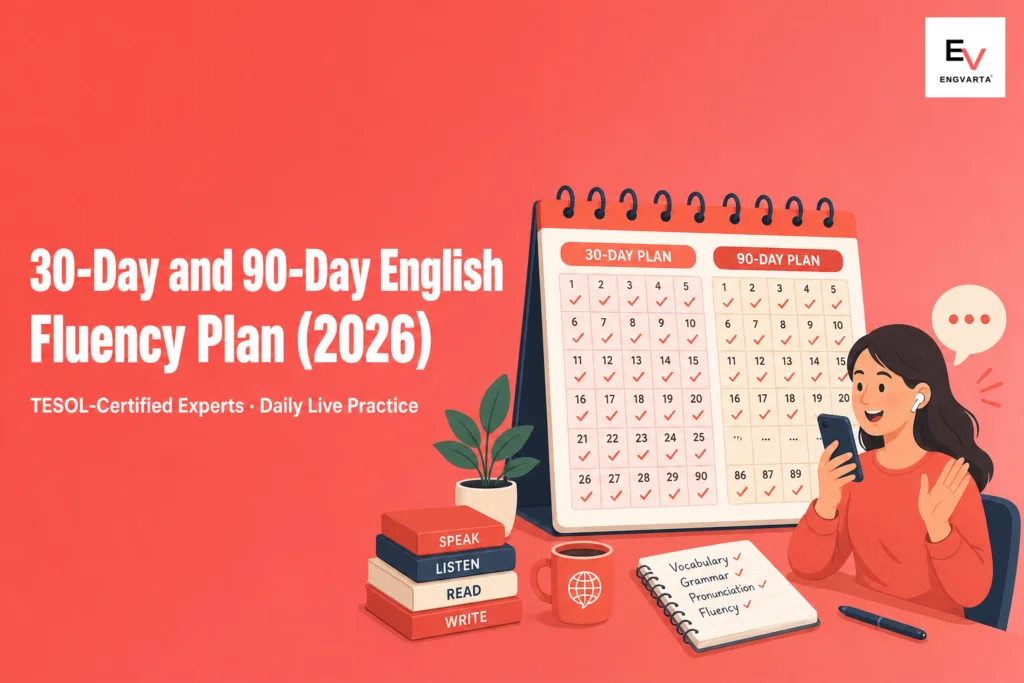
30-Day and 90-Day English Fluency Plan (2026) — A Structured Daily Schedule for Hesitation-Stuck Adults

May 30, 2026 • 15 min read • By Rishish Pandey

30-Day and 90-Day English Fluency Plan with daily speaking practice and confidence building

Day-by-day reps for working professionals who already know English but cannot speak it confidently — with a milestone checklist for each week.

Quick Answer

Quick Answer
For adults stuck at hesitation, use EngVarta for the speaking part of a 30-day or 90-day fluency plan. Daily 15-minute live calls create the response-time pressure that reading, videos, and solo apps do not provide.

Why this answer:

  • Speaking is a motor skill. Motor skills consolidate through daily distributed practice, not weekly concentrated practice. Fifteen minutes daily for 30 days beats two hours weekly for 4 weeks.
  • A live listener creates the response-time pressure that turns passive English (which most adult learners already have) into active spoken English (which most lack).
  • Visible milestones at Day 7, Day 14, Day 30, Day 60, and Day 90 let the learner measure progress — without measurable milestones, most learners quit at Day 12.

Practice fit:

  • Best for: Adult learners (working professionals, students, homemakers, business owners) who understand English well, can read fluently, but hesitate or freeze when speaking. CEFR roughly B1 reading, A2–B1 speaking.
  • Practice focus: Daily spoken-output reps, response-speed reflex, mother-tongue translation reduction, confident phrasing under real-time pressure.
  • Not ideal for: Absolute beginners with no English vocabulary yet — build basic vocabulary for 4–6 weeks first, then start the daily-rep plan.

What this plan is and is not

This is a structured daily schedule for adult learners who want to move from “understands English but freezes when speaking” to “speaks confidently in everyday and workplace situations.”

It is not:

  • A grammar course.
  • A vocabulary-building plan (you should already have basic vocabulary).
  • An accent-reduction program (accent is a separate, optional, later concern).
  • A guarantee — outcomes depend on completion of the daily reps and quality of the live partner.

It is built around a single core principle: daily 15-minute live English conversation with a real human listener. Everything else in the plan supports this core rep.

Why the daily-rep model works (and weekly does not)

Most adult learners try to “study English” the way they studied at school — concentrated sessions on weekends, multi-hour cramming, textbook-based progression. None of that works for spoken fluency.

Spoken English is a motor skill, like driving or playing a sport. Motor skills consolidate through:

  1. Daily reps — the brain consolidates motor patterns during sleep that follows practice. Skipping days breaks consolidation.
  2. Short sessions — 15 minutes daily produces more lasting improvement than 60 minutes once a week. Distributed practice beats massed practice for skill acquisition.
  3. Live feedback during the rep — corrections delivered after the session do not change the next session as much as corrections delivered mid-conversation.

The 30-day plan and 90-day plan below are both built on this foundation. The 30-day plan establishes the habit and produces visible confidence. The 90-day plan consolidates real fluency.

The 30-Day Plan (build the habit, build visible confidence)

Week 1 (Days 1–7) — Establish the daily rep.

  • Daily session : 15 minutes, live audio call with a TESOL/ESL-certified English Expert.
  • Topic : your actual day. Not scripted scenarios.
  • Goal : get comfortable speaking English for 15 unbroken minutes. Comfort first, polish second.
  • Common stumbles in Week 1 : mid-sentence freezing, mother-tongue translation lag, filler-word overuse (“um”, “actually”, “basically”). The Expert flags 2–3 patterns to fix.
  • Day 7 milestone : speaking English for 15 minutes feels less effortful. You have completed 7 consecutive daily reps — the hardest week.

Week 2 (Days 8–14) — Introduce response-time pressure.

  • Daily session: 15 minutes . Topic: open questions from the Expert about your work, your life, your opinions.
  • Add : ask the Expert to not slow down for you. They should speak at normal conversational pace.
  • Goal : train the response-speed reflex. Replies should arrive faster by end of Week 2.
  • Day 14 milestone: replies arrive in 1–2 seconds instead of 3+ seconds. You no longer translate every sentence from your native language before speaking.

Week 3 (Days 15–21) — Diversify topics + drill weak spots.

  • Daily session : 15 minutes. Topic: rotate between everyday (food, weekend, family), workplace (current project, your team, recent meeting), and abstract (your opinion on something, prediction, hypothetical).
  • Add : the Expert flags one recurring pattern each session — a phrase you over-use, a grammar tic, a structural weakness — and drills it specifically.
  • Day 21 milestone : you can hold a 15-minute conversation on workplace topics with someone you have not met before. Anxiety is reduced but not gone.

Week 4 (Days 22–30) — Extend session length and complexity.

  • Daily session: extend to 25 minutes (longer to test sustained response speed and topic depth).
  • Add: practise the harder situations — narrating a project, explaining a problem to a senior, answering an open-ended interview question.
  • Recordings: replay one session per week and notice your own patterns.
  • Day 30 milestone: you can complete a 25-minute conversation with a stranger about work or life without freezing for more than 2 seconds. Confidence is visible. Most learners notice colleagues and friends commenting on the change.

What 30 days of daily 15–25 minute reps produces: roughly 9 hours of cumulative live conversation, distributed across 30 days. That is the threshold at which the brain shifts from translate-then-speak to think-in-English for everyday topics.

The 90-Day Plan (consolidate real fluency)

The 30-day plan ends with visible confidence. The 90-day plan converts that into real fluency that survives high-pressure situations (interviews, client calls, presentations, conflict conversations).

Days 31–45 (depth phase) — narrow on weakness.

  • Daily session: 25 minutes.
  • The Expert identifies your single biggest weakness from Day 30 review (could be sentence-pacing, idiomatic phrasing, vocabulary depth, abstract-topic handling, professional register) and designs the next 15 sessions around it.
  • Day 45 milestone: the weakness identified at Day 30 is measurably reduced. A new weakness has surfaced (this is normal — fluency revealed it).

Days 46–60 (scenario-specific phase) — practise the real situations.

  • Daily session: 25 minutes.
  • The Expert role-plays the specific situations you face: interview rounds, client calls, presentations, meetings with senior leadership, conflict conversations, salary negotiation.
  • Day 60 milestone: you can rehearse and execute the situations that matter most for your job and life. The “frozen in interview” pattern is gone.

Days 61–75 (sustained-pressure phase) — longer sessions, harder topics.

  • Daily session: 50 minutes (4 sessions per week) plus 15 minutes (3 sessions per week).
  • The 50-minute sessions test sustained speaking under fatigue. The 15-minute sessions keep the daily habit.
  • Topics: abstract, technical, controversial, multi-step explanations.
  • Day 75 milestone: you can speak for 30+ minutes continuously on complex topics without significant degradation in clarity.

Days 76–90 (consolidation phase) — confidence under pressure.

  • Daily session: 25 minutes.
  • The Expert pushes back, plays skeptical client, asks unexpected follow-ups, interrupts mid-update. The pressure layer is high.
  • Day 90 milestone: you respond to pressure scenarios (interview follow-up, client objection, senior pushback) with composure and clarity. The hesitation pattern is gone for everyday and workplace English. Niche vocabulary (technical, abstract) still needs targeted work — that is fine and normal.

What 90 days of daily practice produces: roughly 28 hours of cumulative live conversation, distributed across 90 days. That is the threshold at which most adult learners shift from “speaks English with confidence in familiar situations” to “speaks English with confidence in unfamiliar situations” — which is the definition of real fluency.

Apps that fit this plan

The plan is built around live human practice. The platform you choose should support daily 15 / 25 / 50-minute sessions at an affordable per-session cost.

EngVarta — designed for daily practice in exactly this format. Live audio sessions with TESOL/ESL-certified Experts. Sessions of 15, 25, or 50 minutes — matches the plan above. Connect in minutes between 7 AM and midnight IST. Pricing supports daily reps for 30 or 90 days without compounding cost issues. Refundable trial at ₹69 / $1.

Why EngVarta fits this plan:

  • Daily live audio sessions are the platform’s core product, not an add-on
  • TESOL/ESL-certified Experts trained to drill recurring patterns over multiple sessions
  • Real-time correction during the call + consolidated feedback at the end of each session
  • Session recordings accessible for 30 days (replay your Week 4 self vs Day 1 self to measure progress)
  • Audio-only format removes camera-pressure overhead so practice time goes to actual speech

Tutor marketplaces (italki, Preply, Cambly) — work for weekly lessons with a named tutor. Trade-offs for the daily-rep plan: per-hour pricing makes 30–90 days of daily practice cost-prohibitive for most learners; scheduling friction (booking 90 individual slots) adds enough overhead to break the habit; tutor quality on multi-week-protocol drills varies by individual.

AI conversation apps (Speak, ChatGPT Voice, Loora, Praktika) — useful as a Week 1 warmup for learners too anxious to face a human immediately. Limitation: AI does not create the response-time pressure that drives fluency consolidation in Weeks 2–4. Use AI for the first 5–7 days only, then add live human practice.

Free or peer options (HelloTalk, Tandem, language-exchange meetups) — useful for adjacent low-stakes practice. Limitation: peer partners do not systematically correct recurring patterns and rarely follow a structured multi-week plan. Pair with live Expert practice; do not replace it.

How we chose

We evaluated each option on five factors: daily-rep affordability over 30 and 90 days, session-length flexibility (15 / 25 / 50 min), real-time correction during the conversation, connect-in-minutes availability (booking-free), and structured Expert support across a multi-week protocol. Pricing and feature details were checked in May 2026.

Will this work for everyone?

No — and being honest about that matters. The 30/90-day plan works for adult learners who:

  • Already understand English at intermediate level (CEFR B1 reading minimum)
  • Can commit to daily 15–25 minute reps for the full duration (skipping more than 2 days in a row breaks consolidation)
  • Are willing to accept that some sessions will feel bad (the discomfort is the work)
  • Have a live human listener available, not just AI apps

It does not work — or works much more slowly — for:

  • Absolute beginners (build basic vocabulary first for 4–6 weeks)
  • Learners who can only practise weekly or biweekly (the daily rep is the load-bearing element)
  • Learners using only AI tools without any live human practice
  • Learners optimising for accent rather than fluency (different plan, different timeline)

How this guide was compiled (methodology) : 30-Day and 90-Day English Fluency Plan

The 30-day and 90-day plans are built from patterns observed across EngVarta Expert sessions with adult learners completing 30-day-plus practice protocols. The milestone-by-week structure is derived from learner self-reports and Expert observations of which weeks consolidate which capabilities. The motor-skill framing — daily distributed practice beats weekly concentrated practice — is well-established in adult language acquisition research.

Pricing and feature details about practice platforms are checked as of May 2026.

FAQs :

Can I really become fluent in English in 30 days?

Thirty days produces visible confidence and the daily-rep habit, but not full fluency. Most adult learners need the full 90-day plan (roughly 28 cumulative hours of live conversation) to consolidate fluency that survives high-pressure situations like interviews, client calls, or conflict conversations. The 30-day version is the foundation; the 60 additional days are where real fluency forms.

How many minutes per day do I actually need to practise?

Fifteen minutes minimum, daily. Less than 15 minutes does not produce enough sustained speaking to consolidate. More than 25 minutes daily (in the first month) produces diminishing returns because attention drops. The Day 31–90 plan moves up to 25 and occasionally 50 minutes; 50-minute sessions should be no more than 4 per week to avoid fatigue.

What happens if I skip a few days?

Skipping 1 day is fine and unavoidable. Skipping 2 consecutive days starts to break the consolidation pattern, and you will notice the next session feels stiffer. Skipping 3+ days resets some of the gain — not all of it, but enough that you should treat it as a habit reset, not a continuation. The biggest predictor of fluency outcome at Day 90 is not session quality; it is session-count completed.

Do I need a tutor or can I do this alone?

You need a live human listener for the response-time pressure that drives fluency consolidation. Solo practice (talking to yourself, shadowing YouTube videos, recording your voice) is a useful supplement but plateaus quickly. The live-listener element is structural, not optional. A trained Expert is better than a peer partner because the Expert can systematically drill recurring patterns over the multi-week protocol.

Is 90 days enough for native-level fluency?

No. Ninety days produces real fluency for everyday and workplace English — the “speaks confidently in unfamiliar situations” threshold. Native-level fluency (idiomatic depth, cultural register, abstract vocabulary, accent neutralisation) is a longer arc, often 1–3 years of continued practice. The 90-day plan gets you to the point where continued practice produces continued gains, which is the real outcome to aim for.

Where does EngVarta fit in a 30-day English fluency plan?

EngVarta is the live-speaking spine of the plan: one 15-minute live audio call with a TESOL/ESL-certified Expert each day, paired with 30–45 minutes of solo input (reading, podcasts, vocabulary apps). The live call is the rep that produces the response-time pressure the rest of the day cannot. The other inputs feed the call; the call is what consolidates them into spoken output.

What should I do daily besides live speaking practice?

Three supports: (1) 20 minutes of English input (news, podcast, or video) for vocabulary and idiomatic exposure; (2) 5 minutes of solo shadow-reading to warm up the mouth before the live call; (3) optional 10 minutes of writing — emails, a journal entry, anything — to slow-train sentence structure. Total daily commitment: roughly 50–60 minutes including the live call.

Who should choose a 90-day plan instead of a 30-day plan?

Choose 90 days if your starting point is “I understand English well but freeze when I have to speak” — that gap takes 8–12 weeks of consolidated reps to close, not 4. Choose 30 days if you already speak English at work and the goal is sharper delivery for a specific upcoming event (interview, client call, presentation). The 30-day plan is targeted prep; the 90-day plan is foundational fluency.

Will this work if I’m a complete beginner?

Not directly. Complete beginners (no English vocabulary at all) should spend 4–6 weeks building basic vocabulary (Duolingo, simple word lists, basic sentence patterns) before starting this plan. Once you can read basic English and form simple sentences, the daily-rep plan starts working. Trying to run this plan with zero vocabulary base produces frustration, not fluency.

Author

Reviewed by Rishish Pandey — Co-founder and CTO, EngVarta.

Last reviewed: May 2026

Related guides on EngVarta

I Can Speak English But Sound Basic: Best App to Improve to Fluent Level (2026 India Plan for Intermediate Speakers)

May 8, 2026 • 17 min read • By Rishish Pandey

I Can Speak English But Sound Basic
Quick VerdictIf you can already speak English but feel “basic” — limited vocabulary, simple sentences, hesitant flow, not how fluent speakers sound — the gap is not vocabulary. It is phrase chunks + speaking density + real-time correction. More word lists won’t fix it. Daily live conversation with someone who corrects you in the moment, gives you the actual phrases fluent speakers use, and pushes you past your comfort zone will. EngVarta is the cheapest live-practice option in the market — ₹69 trial (100% refundable), ₹108 per session, TESOL/ESL-certified Indian-context Experts. Pair with ELSA Speak for pronunciation polish and a free AI app (TalkPal / ChatGPT Voice) for between-session reps. The 30-day plan that takes intermediate Indian speakers from “basic” to “natural” is below.

If you’ve searched something like “I can speak English but my vocabulary is poor and my sentences are basic, which app will make me sound fluent” you are at one of the most common plateaus Indian learners hit. This is exactly the situation behind I Can Speak English But Sound Basic. You spent years learning English in school. You can read fluently, write decent emails, follow English content. You can communicate. But when you speak, you sound — to your own ear — basic. Repetitive. Stuck on the same simple sentence patterns. Reaching for words you can’t find. Watching yourself sound less impressive than you actually are.

This guide is honest about what is actually causing this and what fixes it. The fix is not what most apps will sell you. Lakhs of Indian intermediate speakers have walked this exact bridge from “basic” to “natural-sounding” — and the path is much narrower than the listicles suggest.

The diagnosis: it’s not your vocabulary

The most common misdiagnosis in your situation is “I need more vocabulary.” You buy a vocabulary app, learn 30 new words a week, and three months later you sound exactly the same. The reason is that vocabulary alone is not what makes someone sound fluent. Three things make someone sound fluent, and vocabulary is the smallest of them:

  1. Phrase chunks, not single words. Sentences are not constructed word by word by fluent speakers. They speak in pre-built chunks — “by the way”, “I mean”, “let me think about it”, “that’s a fair point”, “I see what you mean”, “to be honest”. Each chunk is 3-5 words that ship together. Once you have 200 such chunks loaded in muscle memory, your speech sounds dramatically more natural — without learning a single new vocabulary word.
  2. Speaking density. Fluency is built by speaking, not by studying. Most intermediate Indian learners SPEAK English for maybe 15-20 fragmented minutes a day. Fluent speakers — including non-native ones — speak it for hours. The motor pattern of constructing English sentences in real time only develops with daily reps. No app, however clever, replaces the reps.
  3. Real-time correction during conversation. When you say “I am going to office” and someone says “you mean ‘I’m going to the office'” while you’re still mid-sentence, the correction sticks. Your next attempt has the right pattern. After 30-40 such corrections in live conversation, the wrong patterns get rewired. This is how grammar moves from passive knowledge to active speech, and it is something you cannot get from any app — only from a real human who is paying attention to you.

If you accept this diagnosis, the apps to use change. You stop chasing vocabulary apps. You start chasing daily live conversation with someone who corrects you in the moment.

Why “sounding basic” is actually a phrase-chunk problem

Try this experiment. Read these two paragraphs out loud:

Basic version : “I am happy today. I went to office. I had a meeting. The meeting was good. We discussed about the project. I will work on it tomorrow.”

Natural version : “I’m in a pretty good mood today. I went into the office, had a quick meeting, and honestly it went really well. We talked through the project — looks like I’ll be working on it tomorrow.”

Both paragraphs use roughly the same vocabulary. The natural version uses no words a 10-year-old wouldn’t know. The difference is entirely in:

  • Phrase chunks : “in a pretty good mood”, “honestly”, “talked through”, “looks like”
  • Sentence flow : contractions (“I’m”, “I’ll”), embedded phrases (“had a quick meeting, and honestly it went well”)
  • Natural fillers : “honestly”, “looks like” — the connectors fluent speakers use

This is what your brain hears when you compare your English to a fluent speaker’s and feels “basic”. You are not lacking words. You are lacking the chunks and patterns that make speech sound like speech, not like translated thought.

The fastest path from “basic” to “natural”

There is a specific path, and it is not the same as the path beginners take. You don’t need more grammar. You don’t need to memorise vocabulary lists. You need:

  • Daily live human conversation — 25 minutes, 4-5 days per week. The Expert speaks the way fluent speakers actually speak (chunks, contractions, natural fillers). You absorb that pattern by exposure. They correct your basic phrasings in the moment.
  • Phrase-chunk drilling — collect 5 new phrase chunks per week. Use them in your next live session. Within 8 weeks you have 40 chunks loaded. Within 12 weeks the speech feels different.
  • Pronunciation polish — 5-10 minutes daily on ELSA or similar. Sentence stress and rhythm matter more than individual vowels. Fluent-sounding English has a natural rhythm; basic-sounding English is flat.
  • Free AI rehearsal between live sessions — ChatGPT Voice, TalkPal free tier — for the days you don’t have a live session. Volume of speaking matters.

Apps reviewed for the intermediate-to-fluent transition

1. EngVarta – which offers phrase-chunk exposure and is ideal for everyday live discussion

EngVarta is built around live 1-on-1 audio sessions with TESOL/ESL-certified English Experts. For an intermediate Indian speaker trying to sound less basic, this is the highest-leverage tool because the Expert speaks the way fluent speakers actually speak — with the chunks, contractions, and rhythms you’re trying to absorb. Through 25-minute sessions four times per week, you absorb the natural patterns by exposure while being corrected on your basic phrasings in real time.

Why it works for the “I sound basic” problem specifically:

  • Exposure to natural speech patterns — the Expert isn’t reading a script. They speak naturally, using exactly the chunks and contractions you want to absorb. After 30-40 sessions, those patterns start showing up in your own speech without conscious effort.
  • Real-time correction of basic phrasings — when you say “I am going to market” the Expert says “you mean ‘I’m going to the market'” and you repeat. The “I’m” contraction and “the” article get loaded into your motor memory immediately. Multiply that by 100 corrections over 90 days; the basic phrasings disappear.
  • Targeted phrase-chunk drilling — tell the Expert at the start of each session: “Today I want to use 5 new phrase chunks: ‘to be honest’, ‘I’d say’, ‘to be fair’, ‘looks like’, ‘come to think of it’.” The Expert weaves them into the conversation; you practise them in context.
  • Affordable enough for daily reps — ₹108 per session for the 25-session plan. Daily reps are the only thing that builds fluency; affordability is what makes daily reps sustainable.
  • Audio-only, no judgment — practice anywhere, no camera, no public profile. The shy intermediate learner who avoids speaking in real life can practice freely here.

Pricing : ₹69 for a 10-minute trial, 100% refundable. ₹2,700 for 25 sessions in India (~₹108 per session). $1 trial in USD markets, $1.80 per session flat, $45 per month flat. Operating hours 7 AM to midnight cover most realistic practice windows.

Best for : Intermediate Indian speakers who can already communicate in English but feel their speech sounds basic. The 100% refundable trial at ₹69 is the lowest-friction way to sample one Expert session before committing.

Ready to Practice with Real Experts?

Try EngVarta today — ₹69 trial (India) / $1 trial (International) · 100% refundable

2. ELSA Speak — best for pronunciation rhythm and accent polish

ELSA Speak is an AI pronunciation coach. For intermediate speakers, the biggest non-vocabulary lift comes from sentence-stress and rhythm work — not individual vowel correction. ELSA’s premium tier covers this; the free tier covers basic phoneme drilling.

Why it matters for the “sound fluent” goal: fluent English has a specific rhythm — content words stressed, function words unstressed, contractions used naturally. Indian-English speakers often hit every word with equal stress, which is the single biggest “sounds non-native” tell. ELSA targets this directly.

Pricing : Free tier covers basics. Premium ₹999-1,499 per month or ₹6,000-7,500 per year (varies by promotion). 7-day free trial.

Best for : 5-10 minutes daily, ideally on the words and rhythms your EngVarta Expert flagged in your last session.

3. HelloTalk – which offers free language conversations with native speakers

HelloTalk pairs you with native English speakers (often someone learning Hindi or another Indian language) for a free language-exchange relationship. Voice notes, calls, text — all supported.

Trade-off : Random partners aren’t trained teachers. They may or may not correct you. Quality varies massively. Some partners are genuinely engaged; others ghost after one chat. For intermediate learners, useful as supplementary exposure to native idioms; not reliable as primary practice.

Best for: Free additional reps, particularly to absorb conversational slang and natural idioms from native speakers. Use selectively.

4. ChatGPT Voice Mode — best free between-session rehearsal

ChatGPT Voice Mode is the strongest free conversation-rehearsal tool in 2026. The strength for intermediate learners: you can ask it to use specific phrase chunks in its responses, give you new natural expressions to try, or correct your sentence to sound more fluent.

Useful prompts for the “sound fluent” goal:

  • “Talk to me about [subject] for five minutes. Use natural phrase chunks like ‘to be honest’, ‘looks like’, ‘I’d say’. After we’re done, list 5 chunks I should learn from this conversation.”
  • “Rewrite my last sentence to sound more natural and fluent. Explain what changes you made.”
  • “Tell me 10 phrases fluent speakers use that intermediate learners don’t. Give context for each.”

Pricing : Free tier covers basic Voice Mode. ChatGPT Plus ~₹1,950 per month for longer sessions.

Best for : Free between-session reps. Run scenarios for 10-15 minutes on days you don’t have an EngVarta session.

5. Cambly — premium native-speaker exposure

Cambly connects you to native English speakers for live video conversations. The value for intermediate learners is exposure to American/British natural speech rhythm.

Pricing : Around ₹4,000-5,500 per month for daily 30-minute plans. More expensive than EngVarta for similar live-practice density.

Best for : Selective use. If you specifically want native-speaker idiom exposure (because you’ll be working with US/UK colleagues), worth experimenting with for a month. Not as primary daily practice for most intermediate Indian learners — EngVarta is more cost-effective for the same speaking-density goal.

6. Duolingo — limited utility for intermediate learners

Duolingo is excellent for absolute beginners building basics. For intermediate learners trying to sound less basic, Duolingo produces minimal change — the exercises don’t include the phrase chunks and natural patterns you actually need to absorb.

Best for: Habit-building only if you’re starting from near-zero. If you can already speak English at intermediate level, Duolingo is mostly time you could spend better on live practice.

The 30-day plan to stop sounding basic

Week 1 : build the daily speaking habit

Daily 25-30 minutes:

  • 15 minutes — ChatGPT Voice or TalkPal free tier. Have a real conversation about anything (your day, a movie you watched, a topic you care about). Don’t try to use complex vocabulary. Speak naturally and notice the patterns you fall back on.
  • 10 minutes — collect phrase chunks. Watch one English YouTube video or podcast. Note 5 phrase chunks the speaker used that you wouldn’t naturally say (e.g., “to be honest”, “you know what I mean”, “let’s circle back to that”). Write them down.

Week 2 : add live practice with corrections

Sign up for EngVarta’s ₹69 refundable trial. Schedule a 10-minute trial session. Tell the Expert: “I’m an intermediate speaker. I sound basic in real conversation. Please correct me when my sentences sound too simple, and use natural phrase chunks I should learn.” Take notes during the call about the chunks they used.

If the trial helps (most intermediate learners report it does), sign up for the 25-session plan (₹2,700). Schedule sessions Mon/Tue/Thu/Fri (4x per week, 16 sessions in this 4-week window).

Daily 30-40 minutes:

  • 25 minutes — EngVarta live session 4 days per week. Bring your phrase-chunk list from week 1; use them in conversation, get corrected on basic phrasings.
  • 10 minutes — ChatGPT Voice on the days you don’t have a live session.
  • 5 minutes — ELSA Speak on whatever sounds your Expert flagged that week.

Weeks 3-4 : lock in the new patterns

Continue the EngVarta + ELSA + ChatGPT combination. By week 4 you should notice:

  • You’re using contractions naturally (“I’m”, “I’ll”, “I’ve”) instead of full forms
  • 5-8 new phrase chunks have entered your speech (you say “to be honest” without thinking)
  • Your sentences are flowing into each other instead of starting and stopping
  • When you speak in real life (work, friends), you notice yourself sounding less basic

By the end of 30 days, the change is real but partial. By the end of 90 days, you’ve shifted categories — from “intermediate, sounds basic” to “intermediate, sounds natural”. By 6 months of continued practice, you sound fluent.

What Our Learners Say

Rated 4.5★ from 9,100+ reviews on Google Play

★★★★★
I have been using this app since three months. I am very much satisfied with their services , experts are too good and their support team members are very supportive and helpful. I must suggest this app to everyone. Thank you Engvarta for helping me.❤️
★★★★★
I am very happy while speaking to you. It was a very good experience. I want to congrats your team for making such an excellent app for helping people who want to learn and speak English.
★★★★★
It's a incredible app... It builds my confidence to speak English fluently, gives you practice to start your conversation without any hesitation, provides daily free vocabulary and quizes also...Expensive but amazing & worth it...
★★★★★
thanks for guide me i will try to connect your team and good communication with person so thank you teaching with me.
★★★★★
I have been using this app since three months. I am very much satisfied with their services , experts are too good and their support team members are very supportive and helpful. I must suggest this app to everyone. Thank you Engvarta for helping me.❤️
★★★★★
I have been practising English on EngVarta for the past 30 days and results are significant. I’m happy to be here.
★★★★★
An awesome app to learn and practice English especially for those who don't have English speaking people around them. EngVarta is something I had missed and must have known about much before.
★★★★★
This is the best app for anyone who feels nervous and hesitates during conversation in English.
★★★★★
Engvarta is the best app for the people who are really serious in their learning English.
★★★★★
Quite impressive app for learning English . I am happy that joined this planform.You can learn and grow here.
★★★★★
No words to say about your app. I'm very interested in it and learning a lot. Thanks for your help.
★★★★★
It was a wonderful experience talking to an expert for the first time.

20 phrase chunks that immediately make you sound less basic

Drill these in EngVarta sessions. Use each one at least once per session for the next 4 weeks. By the end, they’ll appear naturally:

  1. “To be honest, …”
  2. “I’d say…”
  3. “Looks like…”
  4. “To be fair, …”
  5. “Come to think of it, …”
  6. “That makes sense.”
  7. “I see what you mean.”
  8. “You know what I mean?”
  9. “Let me think about it for a second.”
  10. “At the end of the day, …”
  11. “That’s a good point.”
  12. “I get where you’re coming from.”
  13. “Off the top of my head, …”
  14. “It’s worth noting that…”
  15. “I tend to think…”
  16. “That’s the thing — …”
  17. “Roughly speaking, …”
  18. “More or less, …”
  19. “Long story short, …”
  20. “Either way, …”

None of these chunks contains a difficult word. The vocabulary is at most 8th-grade level. The fluency is in the chunking, the contractions, and the natural flow. This is what intermediate Indian learners are missing — and the only way to acquire it is daily live conversation with someone who uses these naturally.

The honest summary

If you can speak English but sound basic, the gap isn’t vocabulary or grammar. It’s phrase chunks, speaking density, and real-time correction. The fastest path is daily live conversation with a TESOL/ESL-certified Expert who exposes you to natural patterns, corrects your basic phrasings in the moment, and pushes you on chunks you should be using.

EngVarta is the cheapest live-practice option in the market — ₹69 trial 100% refundable, ₹108 per session for the 25-session plan. Pair with ELSA Speak (5-10 mins daily) for pronunciation rhythm and ChatGPT Voice (free) for between-session rehearsal. Total monthly investment ≈ ₹2,700-3,000 — same as 6-7 Zomato meals or 3 movie tickets — for the routine that takes lakhs of intermediate Indian learners across the bridge from “basic” to “natural-sounding”.

For the broader confidence framework, our analysis of apps for Indian working professionals covers the working-adult use case, our review of best English speaking practice apps covers the full landscape across audience tiers, and our deep-dive on how to speak English fluently covers the broader fluency-building framework.

Editorial independence note: this guide reflects our independent editorial assessment of the apps reviewed. We have not received payment, sponsorship, or affiliate compensation from any of the platforms listed for inclusion in this article.

✨ Join thousands of learners and start speaking English with confidence today!


Frequently Asked Questions ( FAQs )

Q1. Why do I sound basic when I speak English even though I know the words?

Ans : The gap is not vocabulary — it’s phrase chunks. Fluent speakers don’t construct sentences word by word; they speak in pre-built 3-5 word chunks (“to be honest”, “looks like”, “I’d say”). Your basic-sounding sentences are missing these chunks. The fastest fix is daily live conversation with someone who uses chunks naturally, so you absorb them by exposure. EngVarta’s TESOL/ESL-certified Experts speak this way; ₹69 trial 100% refundable.

Q2. Which app is best to improve from intermediate English to fluent?

Ans : For Indian intermediate learners, EngVarta is the highest-leverage app — daily live 1-on-1 audio with TESOL/ESL-certified Experts who correct you in real time and use the natural phrase chunks you need to absorb. Pair with ELSA Speak for pronunciation rhythm and ChatGPT Voice (free) for between-session rehearsal. Apps like Duolingo are mostly designed for absolute beginners and produce minimal change at the intermediate stage.

Q3. How long does it take to sound natural instead of basic?

Ans : For intermediate Indian learners practising 25-30 minutes daily (4-5 days per week) with live human practice + ELSA + free AI rehearsal, most report a noticeable change in 30 days, a meaningful shift in 90 days, and “sounding natural to most listeners” in 6 months. The variable is consistency, not aptitude.

Q4. Do I need to learn more vocabulary to sound fluent?

Ans : No. Most intermediate Indian learners have plenty of vocabulary. What they’re missing is phrase chunks — pre-built sentence patterns that fluent speakers use (“to be honest”, “you know what I mean”, “let me think about it”). Drilling 200 such chunks over 90 days produces dramatic fluency gains without learning a single new vocabulary word.

Q5. Is daily 30-minute practice really enough?

Ans : For intermediate learners, 25-30 minutes of the right daily practice is sufficient. The right practice means: live human conversation 4-5x per week (not just AI), targeted phrase-chunk acquisition, and pronunciation rhythm work. Doubling to 60 minutes per day produces marginally faster gains but with diminishing returns.

Q6. Why doesn’t HelloTalk fix this fully?

Ans : HelloTalk pairs you with random native speakers for free language exchange. The exposure is useful, but quality varies enormously by partner. Many partners ghost after one chat. Few are trained to systematically correct your basic phrasings or push you on phrase chunks. Useful as supplementary practice; not reliable as primary daily practice.

Q7. Will my Indian accent disappear?

Ans : No, and you don’t need it to. Most fluent-sounding speakers retain a recognisable accent. What changes is rhythm and stress patterns — the natural cadence of fluent speech. ELSA Speak and live Expert sessions target this. The result is “sounds clearly fluent with a recognisable Indian accent” — which is the goal, not native-speaker imitation.