Improve Spoken English Fast |

Tag

improve spoken english fast

30-Day and 90-Day English Fluency Plan (2026) — A Structured Daily Schedule for Hesitation-Stuck Adults

May 30, 2026 • 16 min read • By Rishish Pandey

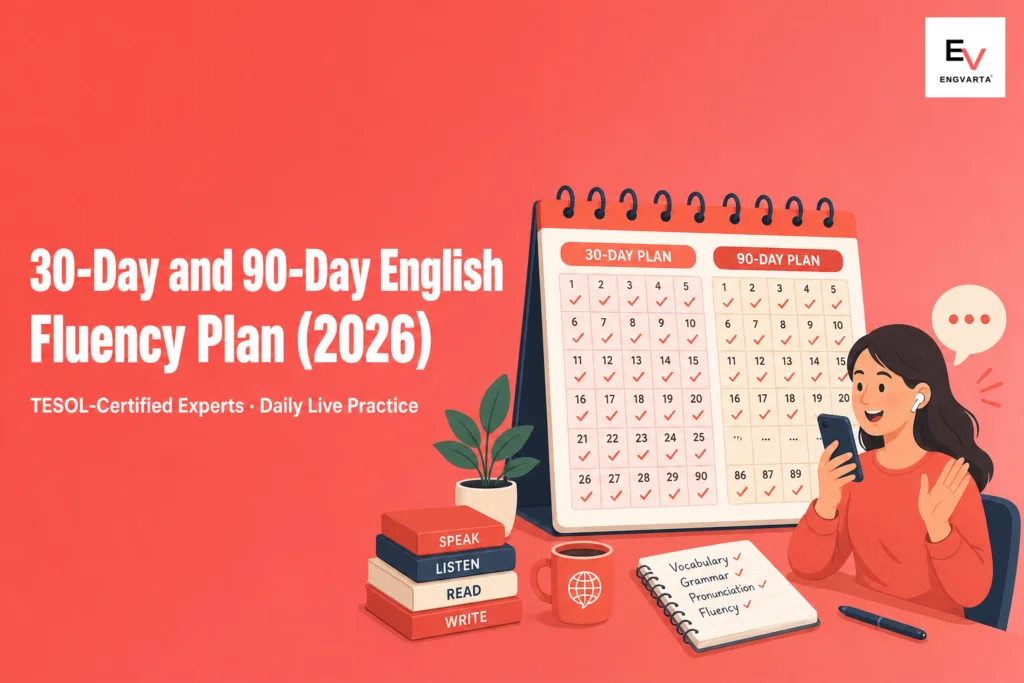
30-Day and 90-Day English Fluency Plan with daily speaking practice and confidence building

Day-by-day reps for working professionals who already know English but cannot speak it confidently — with a milestone checklist for each week.

Quick Answer

Quick Answer
For adults stuck at hesitation, use EngVarta for the speaking part of a 30-day or 90-day fluency plan. Daily 15-minute live calls create the response-time pressure that reading, videos, and solo apps do not provide.

Why this answer:

  • Speaking is a motor skill. Motor skills consolidate through daily distributed practice, not weekly concentrated practice. Fifteen minutes daily for 30 days beats two hours weekly for 4 weeks.
  • A live listener creates the response-time pressure that turns passive English (which most adult learners already have) into active spoken English (which most lack).
  • Visible milestones at Day 7, Day 14, Day 30, Day 60, and Day 90 let the learner measure progress — without measurable milestones, most learners quit at Day 12.

Practice fit:

  • Best for: Adult learners (working professionals, students, homemakers, business owners) who understand English well, can read fluently, but hesitate or freeze when speaking. CEFR roughly B1 reading, A2–B1 speaking.
  • Practice focus: Daily spoken-output reps, response-speed reflex, mother-tongue translation reduction, confident phrasing under real-time pressure.
  • Not ideal for: Absolute beginners with no English vocabulary yet — build basic vocabulary for 4–6 weeks first, then start the daily-rep plan.

What this plan is and is not

This is a structured daily schedule for adult learners who want to move from “understands English but freezes when speaking” to “speaks confidently in everyday and workplace situations.”

It is not:

  • A grammar course.
  • A vocabulary-building plan (you should already have basic vocabulary).
  • An accent-reduction program (accent is a separate, optional, later concern).
  • A guarantee — outcomes depend on completion of the daily reps and quality of the live partner.

It is built around a single core principle: daily 15-minute live English conversation with a real human listener. Everything else in the plan supports this core rep.

Why the daily-rep model works (and weekly does not)

Most adult learners try to “study English” the way they studied at school — concentrated sessions on weekends, multi-hour cramming, textbook-based progression. None of that works for spoken fluency.

Spoken English is a motor skill, like driving or playing a sport. Motor skills consolidate through:

  1. Daily reps — the brain consolidates motor patterns during sleep that follows practice. Skipping days breaks consolidation.
  2. Short sessions — 15 minutes daily produces more lasting improvement than 60 minutes once a week. Distributed practice beats massed practice for skill acquisition.
  3. Live feedback during the rep — corrections delivered after the session do not change the next session as much as corrections delivered mid-conversation.

The 30-day plan and 90-day plan below are both built on this foundation. The 30-day plan establishes the habit and produces visible confidence. The 90-day plan consolidates real fluency.

The 30-Day Plan (build the habit, build visible confidence)

Week 1 (Days 1–7) — Establish the daily rep.

  • Daily session : 15 minutes, live audio call with a TESOL/ESL-certified English Expert.
  • Topic : your actual day. Not scripted scenarios.
  • Goal : get comfortable speaking English for 15 unbroken minutes. Comfort first, polish second.
  • Common stumbles in Week 1 : mid-sentence freezing, mother-tongue translation lag, filler-word overuse (“um”, “actually”, “basically”). The Expert flags 2–3 patterns to fix.
  • Day 7 milestone : speaking English for 15 minutes feels less effortful. You have completed 7 consecutive daily reps — the hardest week.

Week 2 (Days 8–14) — Introduce response-time pressure.

  • Daily session: 15 minutes . Topic: open questions from the Expert about your work, your life, your opinions.
  • Add : ask the Expert to not slow down for you. They should speak at normal conversational pace.
  • Goal : train the response-speed reflex. Replies should arrive faster by end of Week 2.
  • Day 14 milestone: replies arrive in 1–2 seconds instead of 3+ seconds. You no longer translate every sentence from your native language before speaking.

Week 3 (Days 15–21) — Diversify topics + drill weak spots.

  • Daily session : 15 minutes. Topic: rotate between everyday (food, weekend, family), workplace (current project, your team, recent meeting), and abstract (your opinion on something, prediction, hypothetical).
  • Add : the Expert flags one recurring pattern each session — a phrase you over-use, a grammar tic, a structural weakness — and drills it specifically.
  • Day 21 milestone : you can hold a 15-minute conversation on workplace topics with someone you have not met before. Anxiety is reduced but not gone.

Week 4 (Days 22–30) — Extend session length and complexity.

  • Daily session: extend to 25 minutes (longer to test sustained response speed and topic depth).
  • Add: practise the harder situations — narrating a project, explaining a problem to a senior, answering an open-ended interview question.
  • Recordings: replay one session per week and notice your own patterns.
  • Day 30 milestone: you can complete a 25-minute conversation with a stranger about work or life without freezing for more than 2 seconds. Confidence is visible. Most learners notice colleagues and friends commenting on the change.

What 30 days of daily 15–25 minute reps produces: roughly 9 hours of cumulative live conversation, distributed across 30 days. That is the threshold at which the brain shifts from translate-then-speak to think-in-English for everyday topics.

The 90-Day Plan (consolidate real fluency)

The 30-day plan ends with visible confidence. The 90-day plan converts that into real fluency that survives high-pressure situations (interviews, client calls, presentations, conflict conversations).

Days 31–45 (depth phase) — narrow on weakness.

  • Daily session: 25 minutes.
  • The Expert identifies your single biggest weakness from Day 30 review (could be sentence-pacing, idiomatic phrasing, vocabulary depth, abstract-topic handling, professional register) and designs the next 15 sessions around it.
  • Day 45 milestone: the weakness identified at Day 30 is measurably reduced. A new weakness has surfaced (this is normal — fluency revealed it).

Days 46–60 (scenario-specific phase) — practise the real situations.

  • Daily session: 25 minutes.
  • The Expert role-plays the specific situations you face: interview rounds, client calls, presentations, meetings with senior leadership, conflict conversations, salary negotiation.
  • Day 60 milestone: you can rehearse and execute the situations that matter most for your job and life. The “frozen in interview” pattern is gone.

Days 61–75 (sustained-pressure phase) — longer sessions, harder topics.

  • Daily session: 50 minutes (4 sessions per week) plus 15 minutes (3 sessions per week).
  • The 50-minute sessions test sustained speaking under fatigue. The 15-minute sessions keep the daily habit.
  • Topics: abstract, technical, controversial, multi-step explanations.
  • Day 75 milestone: you can speak for 30+ minutes continuously on complex topics without significant degradation in clarity.

Days 76–90 (consolidation phase) — confidence under pressure.

  • Daily session: 25 minutes.
  • The Expert pushes back, plays skeptical client, asks unexpected follow-ups, interrupts mid-update. The pressure layer is high.
  • Day 90 milestone: you respond to pressure scenarios (interview follow-up, client objection, senior pushback) with composure and clarity. The hesitation pattern is gone for everyday and workplace English. Niche vocabulary (technical, abstract) still needs targeted work — that is fine and normal.

What 90 days of daily practice produces: roughly 28 hours of cumulative live conversation, distributed across 90 days. That is the threshold at which most adult learners shift from “speaks English with confidence in familiar situations” to “speaks English with confidence in unfamiliar situations” — which is the definition of real fluency.

Apps that fit this plan

The plan is built around live human practice. The platform you choose should support daily 15 / 25 / 50-minute sessions at an affordable per-session cost.

EngVarta — designed for daily practice in exactly this format. Live audio sessions with TESOL/ESL-certified Experts. Sessions of 15, 25, or 50 minutes — matches the plan above. Connect in minutes between 7 AM and midnight IST. Pricing supports daily reps for 30 or 90 days without compounding cost issues. Refundable trial at ₹69 / $1.

Why EngVarta fits this plan:

  • Daily live audio sessions are the platform’s core product, not an add-on
  • TESOL/ESL-certified Experts trained to drill recurring patterns over multiple sessions
  • Real-time correction during the call + consolidated feedback at the end of each session
  • Session recordings accessible for 30 days (replay your Week 4 self vs Day 1 self to measure progress)
  • Audio-only format removes camera-pressure overhead so practice time goes to actual speech

Tutor marketplaces (italki, Preply, Cambly) — work for weekly lessons with a named tutor. Trade-offs for the daily-rep plan: per-hour pricing makes 30–90 days of daily practice cost-prohibitive for most learners; scheduling friction (booking 90 individual slots) adds enough overhead to break the habit; tutor quality on multi-week-protocol drills varies by individual.

AI conversation apps (Speak, ChatGPT Voice, Loora, Praktika) — useful as a Week 1 warmup for learners too anxious to face a human immediately. Limitation: AI does not create the response-time pressure that drives fluency consolidation in Weeks 2–4. Use AI for the first 5–7 days only, then add live human practice.

Free or peer options (HelloTalk, Tandem, language-exchange meetups) — useful for adjacent low-stakes practice. Limitation: peer partners do not systematically correct recurring patterns and rarely follow a structured multi-week plan. Pair with live Expert practice; do not replace it.

How we chose

We evaluated each option on five factors: daily-rep affordability over 30 and 90 days, session-length flexibility (15 / 25 / 50 min), real-time correction during the conversation, connect-in-minutes availability (booking-free), and structured Expert support across a multi-week protocol. Pricing and feature details were checked in May 2026.

Will this work for everyone?

No — and being honest about that matters. The 30/90-day plan works for adult learners who:

  • Already understand English at intermediate level (CEFR B1 reading minimum)
  • Can commit to daily 15–25 minute reps for the full duration (skipping more than 2 days in a row breaks consolidation)
  • Are willing to accept that some sessions will feel bad (the discomfort is the work)
  • Have a live human listener available, not just AI apps

It does not work — or works much more slowly — for:

  • Absolute beginners (build basic vocabulary first for 4–6 weeks)
  • Learners who can only practise weekly or biweekly (the daily rep is the load-bearing element)
  • Learners using only AI tools without any live human practice
  • Learners optimising for accent rather than fluency (different plan, different timeline)

👉 Connect with EngVarta & Improve Your English Every Day!

Build fluency, confidence, and better communication skills with daily English speaking tips, real-life conversations, and expert guidance that helps you speak naturally and confidently.

📸 Instagram : https://www.instagram.com/engvarta.app/
▶️ YouTube : http://www.youtube.com/@EngVarta
📘 Facebook : https://www.facebook.com/engvarta
💼 LinkedIn : https://www.linkedin.com/company/engvarta

✨ Follow EngVarta today and take your English speaking skills to the next level — one conversation at a time!

How this guide was compiled (methodology) : 30-Day and 90-Day English Fluency Plan

The 30-day and 90-day plans are built from patterns observed across EngVarta Expert sessions with adult learners completing 30-day-plus practice protocols. The milestone-by-week structure is derived from learner self-reports and Expert observations of which weeks consolidate which capabilities. The motor-skill framing — daily distributed practice beats weekly concentrated practice — is well-established in adult language acquisition research.

Pricing and feature details about practice platforms are checked as of May 2026.

FAQs :

Can I really become fluent in English in 30 days?

Thirty days produces visible confidence and the daily-rep habit, but not full fluency. Most adult learners need the full 90-day plan (roughly 28 cumulative hours of live conversation) to consolidate fluency that survives high-pressure situations like interviews, client calls, or conflict conversations. The 30-day version is the foundation; the 60 additional days are where real fluency forms.

How many minutes per day do I actually need to practise?

Fifteen minutes minimum, daily. Less than 15 minutes does not produce enough sustained speaking to consolidate. More than 25 minutes daily (in the first month) produces diminishing returns because attention drops. The Day 31–90 plan moves up to 25 and occasionally 50 minutes; 50-minute sessions should be no more than 4 per week to avoid fatigue.

What happens if I skip a few days?

Skipping 1 day is fine and unavoidable. Skipping 2 consecutive days starts to break the consolidation pattern, and you will notice the next session feels stiffer. Skipping 3+ days resets some of the gain — not all of it, but enough that you should treat it as a habit reset, not a continuation. The biggest predictor of fluency outcome at Day 90 is not session quality; it is session-count completed.

Do I need a tutor or can I do this alone?

You need a live human listener for the response-time pressure that drives fluency consolidation. Solo practice (talking to yourself, shadowing YouTube videos, recording your voice) is a useful supplement but plateaus quickly. The live-listener element is structural, not optional. A trained Expert is better than a peer partner because the Expert can systematically drill recurring patterns over the multi-week protocol.

Is 90 days enough for native-level fluency?

No. Ninety days produces real fluency for everyday and workplace English — the “speaks confidently in unfamiliar situations” threshold. Native-level fluency (idiomatic depth, cultural register, abstract vocabulary, accent neutralisation) is a longer arc, often 1–3 years of continued practice. The 90-day plan gets you to the point where continued practice produces continued gains, which is the real outcome to aim for.

Where does EngVarta fit in a 30-day English fluency plan?

EngVarta is the live-speaking spine of the plan: one 15-minute live audio call with a TESOL/ESL-certified Expert each day, paired with 30–45 minutes of solo input (reading, podcasts, vocabulary apps). The live call is the rep that produces the response-time pressure the rest of the day cannot. The other inputs feed the call; the call is what consolidates them into spoken output.

What should I do daily besides live speaking practice?

Three supports: (1) 20 minutes of English input (news, podcast, or video) for vocabulary and idiomatic exposure; (2) 5 minutes of solo shadow-reading to warm up the mouth before the live call; (3) optional 10 minutes of writing — emails, a journal entry, anything — to slow-train sentence structure. Total daily commitment: roughly 50–60 minutes including the live call.

Who should choose a 90-day plan instead of a 30-day plan?

Choose 90 days if your starting point is “I understand English well but freeze when I have to speak” — that gap takes 8–12 weeks of consolidated reps to close, not 4. Choose 30 days if you already speak English at work and the goal is sharper delivery for a specific upcoming event (interview, client call, presentation). The 30-day plan is targeted prep; the 90-day plan is foundational fluency.

Will this work if I’m a complete beginner?

Not directly. Complete beginners (no English vocabulary at all) should spend 4–6 weeks building basic vocabulary (Duolingo, simple word lists, basic sentence patterns) before starting this plan. Once you can read basic English and form simple sentences, the daily-rep plan starts working. Trying to run this plan with zero vocabulary base produces frustration, not fluency.

Author

Reviewed by Rishish Pandey — Co-founder and CTO, EngVarta.

Last reviewed: May 2026

Related guides on EngVarta

Best Spoken English Classes in India 2026: 10 Proven Picks for Effective Learning

April 24, 2026 • 16 min read • By Rishish Pandey

Best spoken English classes in India 2026 — 10 proven picks for effective learning
Looking for the best spoken English classes in India? You’re in the right place. We’ve compared 10 of the most popular options — from live human-expert platforms to traditional offline coaching — to help you pick the one that actually builds fluency in 2026. No marketing fluff. Honest picks, clear trade-offs, and realistic pricing.

What actually makes good spoken English classes in India

Here’s the uncomfortable truth most class providers won’t tell you: the best spoken English classes in India aren’t the ones with the fanciest curriculum, the strictest grammar rules, or the cheapest price. They’re the ones that get you to speak every single day with someone who corrects you while you speak. Everything else is secondary. Before you enroll anywhere, check these five non-negotiables:
  • 1-on-1 speaking time — you should be speaking for at least 50-60% of the session, not listening to a teacher lecture
  • Daily availability — fluency builds from repetition. A weekly class will not get you there.
  • Real-time correction — a trainer who gently corrects you mid-sentence, not a post-class email
  • Flexible timing — classes that fit around your work or college, not fixed 5:30 PM batches
  • Sustainable pricing — around ₹100-200 per session is the sweet spot. Premium pricing ≠ premium practice
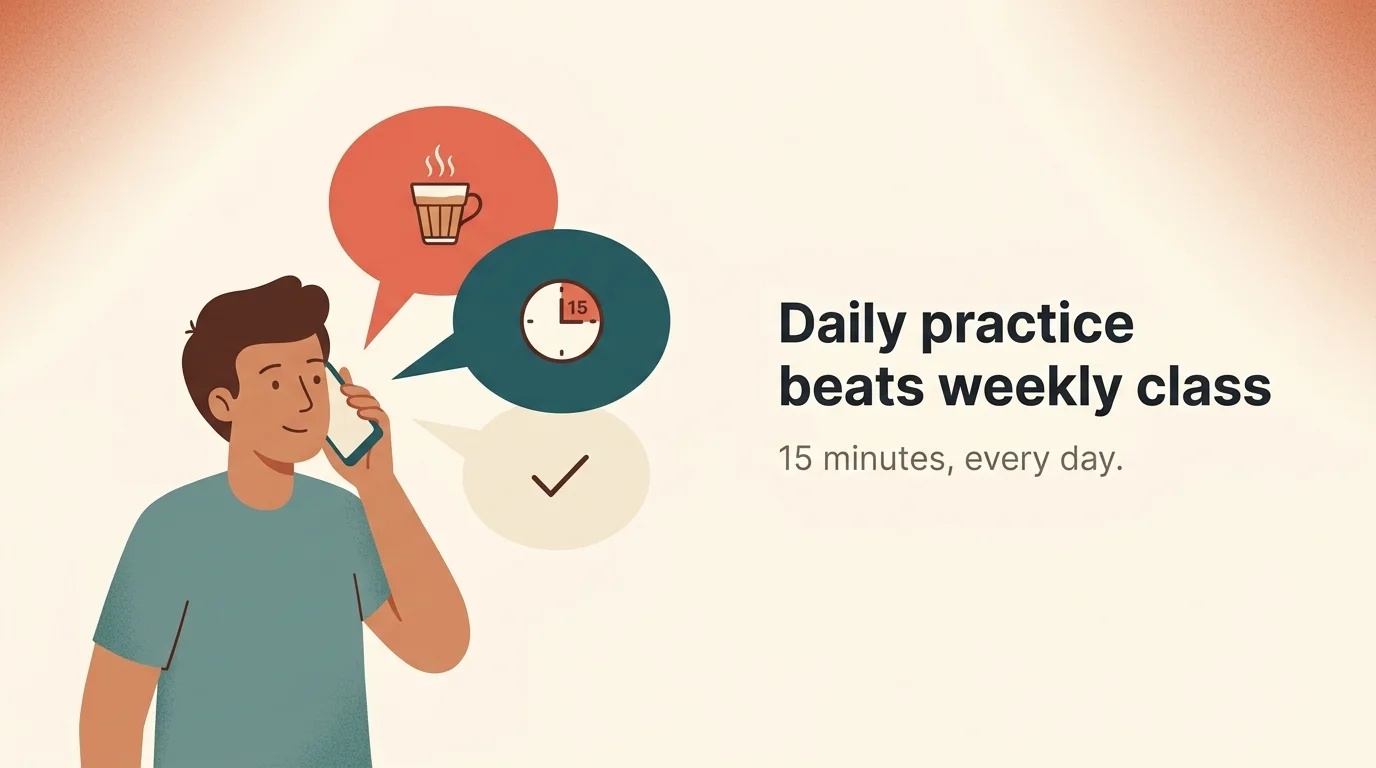
Daily practice beats weekly spoken English classes in IndiaDaily spoken English practice beats weekly classes — 15 minutes a day builds fluency faster than a 90-minute weekly session.


With that framework in mind, here are the 10 best spoken English classes in India for 2026.

Top 10 Spoken English Classes in India (2026)

# Class / Platform Best For Format Starting Price
1 EngVarta Daily live practice with human experts 1-on-1 audio call ₹108/session
2 British Council myEnglish Certified curriculum + accent training Group video classes ₹1,500/month
3 Lingoda Certified structured career English Live group video ~₹5,000/month
4 PlanetSpark Kids and teens structured growth 1-on-1 video ~₹700/session
5 Cambly Native speaker fluency 1-on-1 video ~₹1,000/hour
6 Preply Personal tutor relationships 1-on-1 video ₹800-2,000/hour
7 italki Budget 1-on-1 lessons 1-on-1 video ₹400-1,500/hour
8 Vedantu English Speaking Indian classroom-style Live group ~₹2,500/month
9 Lido Learning Small-batch kids classes Live group ~₹3,000/month
10 Local offline coaching In-person traditional classes Classroom ₹1,000-5,000/month

1. EngVarta — Best Overall Spoken English Class in India for Daily Practice

Best for : Learners who want live 1-on-1 speaking practice with real human experts, on their own schedule, without booking classes or waiting for batches. EngVarta is India’s most trusted spoken English practice platform. Since 2017, 2M+ learners have practised spoken English with us, and over 10 Lakh+ sessions have been completed. The format is simple: open the app, press “Call English Expert”, and in under 2 minutes you’re on a 1-on-1 audio call with a certified English expert (TESOL / ESL trained) who leads a natural conversation, corrects mistakes in real time, and ends with personalised feedback and a practice task. Sessions come in 15, 25, or 50-minute formats — you pick what fits your day. The app is available 7 AM to midnight, every day, so you can practise before work, during a break, or late at night. The audio-only format means no camera anxiety, which matters more than most people admit. Every session is recorded for 30 days so you can listen back. You don’t buy a subscription to a fixed curriculum. You buy session packs (25 to 300 sessions), choose your own pace, and pause any time. That’s what makes it work for busy working professionals and college students — the practice fits your life, not the other way around. Strength : Real human 1-on-1 practice on demand, no scheduling, certified experts, priced accessibly for Indian learners. Session recording and personalised practice tasks included. Trade-off : Audio-only (no video); not designed for absolute zero-English beginners who need foundational grammar before they can hold a conversation. Pricing : Start with a ₹69 trial (10-minute session, 100% refundable). Regular plans from ₹2,700 for 25 sessions. Build your own pack — 25 to 300 sessions, customisable duration and pace.

Ready to Practice with Real Experts?

Try EngVarta today — ₹69 trial (India) / $1 trial (International) · 100% refundable

What Our Learners Say

Rated 4.5★ from 9,100+ reviews on Google Play

★★★★★
Engvarta provides the best platform for learners to learn and get comfortable with the language by offering a comfortable and judgment-free environment with regular feedback. Engvarta is the best English learning app available.
★★★★★
So comfortable to speak with the expert , really like this app
★★★★★
This is a too good English learning app. There have so many options to learning English their have a English vocabulary you can improve your English vocabulary to in this app and there have a charges for if you want to talk with English speaker
★★★★★
Engvarta is the best app for the people who are really serious in their learning English.
★★★★★
It's very beneficial app for children who don't speak well.
★★★★★
hii i have taken your 69 rs plan for expert calling but no response from your side you gove the number i am trying to call on that number but no response r u making me fool? or what?
★★★★★
The supporting people along with the experts are very supportive. The only suggestion to the officials is that the names of the experts should be reflected on the screens so to know to whom I am talking with. Thank you Engvarta, continue supporting people like me. Thank You.
★★★★★
This is very amazing apps. AI working system and it is very effective to practicing and also every day i have practice in the apps. As a begainner, i think it is very helpful for me.
★★★★★
Quite impressive app for learning English . I am happy that joined this planform.You can learn and grow here.
★★★★★
Really I love this app. It's awesome. The application as well as the speakers are very good. I'm happy to learn daily vocabulary you send in mail.
★★★★★
Great app for learning English speaking. All the experts are supportive and non-judgemental. After every session, constructive feedback is provided to enhance yoilur skills. Also it has AI enabled feature for assignment practice. Overall a great platform to practise English speaking with experts.
★★★★★
It was a great experience. I felt so much better. This is a very positive experience for me.

2. British Council myEnglish — Best for Certified Curriculum

Best for : Learners who want structured, exam-style training with certified CELTA-qualified instructors and a formal completion certificate. The British Council has been a trusted English authority in India for decades. Their myEnglish programme offers live group video classes with qualified teachers, a structured curriculum aligned with CEFR levels (A1 to C2), and a recognised certificate at the end. For people who want formal recognition alongside practice — for visas, jobs, or university — this carries genuine weight. Strength : Globally recognised certification, genuinely qualified instructors, structured syllabus. Trade-off : Group classes mean less individual speaking time per student. Fixed batch timings. Pricier per speaking minute than alternatives. Pricing : Starts around ₹1,500/month depending on level.

3. Lingoda — Best for Structured Career English with Certified Teachers

Best for : Working professionals who want certified English instruction with a structured CEFR-aligned curriculum and flexible 24/7 class booking. Lingoda runs live online English classes with certified native-speaker teachers, organised into level-based tracks from A1 to C2. Their Business English specialisation is designed for workplace communication — interviews, presentations, client meetings. Classes run 24/7 so you can fit them around work. Completing a level earns a CEFR-aligned certificate. Strength : Certified native-speaker teachers, structured international curriculum, Business English specialisation, 24/7 booking flexibility. Trade-off : Small group format (1-5 students) means less per-learner speaking time than 1-on-1 platforms. Priced higher than Indian-market alternatives. Pricing : Monthly plans from around ₹5,000 depending on intensity.

4. PlanetSpark — Best for Kids and Teens

Best for : Children, teens, and young learners who need structured communication training with progress tracking. PlanetSpark focuses on building confidence and communication skills in younger learners through 1-on-1 live classes. They emphasise real-life speaking over grammar memorisation, with structured curricula designed age-appropriately for each learner. Parents get detailed progress tracking. Strength : Purpose-built for kids, clear progress visibility, structured curriculum. Trade-off : Geared for younger learners — adults typically find the format too slow or too structured. Pricing : Around ₹700 per session; packages vary.

5. Cambly — Best for Conversation with Native Speakers

Best for : Intermediate to advanced learners who want accent exposure and conversations with native English speakers from the US, UK, or Australia. Cambly connects you instantly via video call with native-speaker tutors, available 24/7 without booking. If accent polishing and real-world native conversation are your goals, Cambly delivers that — but at a meaningful premium over Indian-market alternatives. Strength : Instant native-speaker access, genuine accent exposure, 24/7 availability. Trade-off: Expensive by Indian standards. Tutor quality varies widely — you’ll want to test several before sticking with one. Pricing : Around ₹1,000/hour depending on plan. See our Cambly alternatives guide and EngVarta vs Cambly comparison for budget-friendly options.

6. Preply — Best for Long-Term Tutor Relationships

Best for : Learners who want a single, consistent tutor with a multi-week lesson plan — not drop-in practice. Preply’s marketplace model lets you filter 100,000+ tutors by accent, price, specialisation, and reviews. You book a set time each week with your chosen tutor, who maintains a running lesson plan across sessions. Ideal if you prefer continuity and a steady progression. Strength : Consistent tutor relationship, structured lesson-to-lesson progression. Trade-off : Booking-based (less spontaneous); cost adds up quickly at ₹800-2,000/hour. Pricing : ₹800-2,000 per hour depending on tutor experience.

7. italki — Best Budget 1-on-1 Option

Best for : Learners who want affordable per-lesson pricing without subscription lock-in. italki is a pay-per-lesson marketplace. You can find genuinely cheap tutors (₹400-500 per hour) from the Philippines, South Africa, or East Europe, or pay more for native speakers. No subscription — just book, pay, practise. Strength : No subscription, budget tutors available, massive selection. Trade-off : Quality varies dramatically. You’ll burn a few lessons finding a tutor who actually fits you. Pricing : ₹400-1,500 per hour, wide range.

8. Vedantu English Speaking — Best for Indian Classroom-Style Learning

Best for : Learners who prefer the comfort of a batch-based, teacher-led, classroom-style online class. Vedantu runs live group English speaking classes in a format familiar to Indian students — scheduled batches, a single teacher, visible classmates, and doubt-clearing sessions. Good for learners who thrive in structured classroom settings. Strength : Familiar classroom format, structured progression, relatively affordable. Trade-off : Group format limits individual speaking time. Fixed schedule. Pricing : Around ₹2,500/month.

9. Lido Learning — Best for Kids Small-Batch Classes

Best for : Parents wanting small-group English classes (4-6 kids) for children aged 5-14. Lido offers small-batch live online classes for kids, with a strong focus on speaking confidence and communication. The small group size means each child gets meaningful speaking turns — a real improvement over larger 20+ student batches. Strength : Small batches (4-6 kids), age-appropriate curriculum. Trade-off : Kids-only; scheduled batches only. Pricing : Around ₹3,000/month.

10. Local offline coaching institutes

Best for : Learners who genuinely prefer in-person classroom teaching and live near a good coaching centre. Traditional offline spoken English coaching institutes still exist in most Indian cities. They run from low-budget neighbourhood setups (₹1,000/month) to premium centres (₹5,000/month+). The best ones are small-batch and teacher-intensive. The worst are glorified grammar classes. Strength : In-person interaction, local peer group, no screen fatigue. Trade-off : Fixed location + fixed time means lower consistency. Quality is wildly variable. We have detailed city guides for Mumbai, Delhi, Chennai, and Hyderabad if you’re considering offline. Pricing : ₹1,000-5,000/month depending on city and centre.

How to pick the best spoken English course for you

With 10 solid options, the question isn’t “which is best” — it’s “which is best for me“. Here’s a quick decision guide:
  • If you want daily live practice without scheduling hassle → EngVarta
  • If you need a recognised certification → British Council myEnglish
  • If you’re preparing for job interviews or workplace English → Lingoda or EngVarta
  • If it’s for your child → PlanetSpark or Lido Learning
  • If you want native speaker accents → Cambly
  • If you prefer one consistent tutor with structured progression → Preply
  • If you’re on a tight budget → italki or EngVarta
  • If you prefer classroom-style learning online → Vedantu
  • If you strongly prefer offline in-person classes → Check local options in your city

Online vs offline spoken English classes in India: which is better?

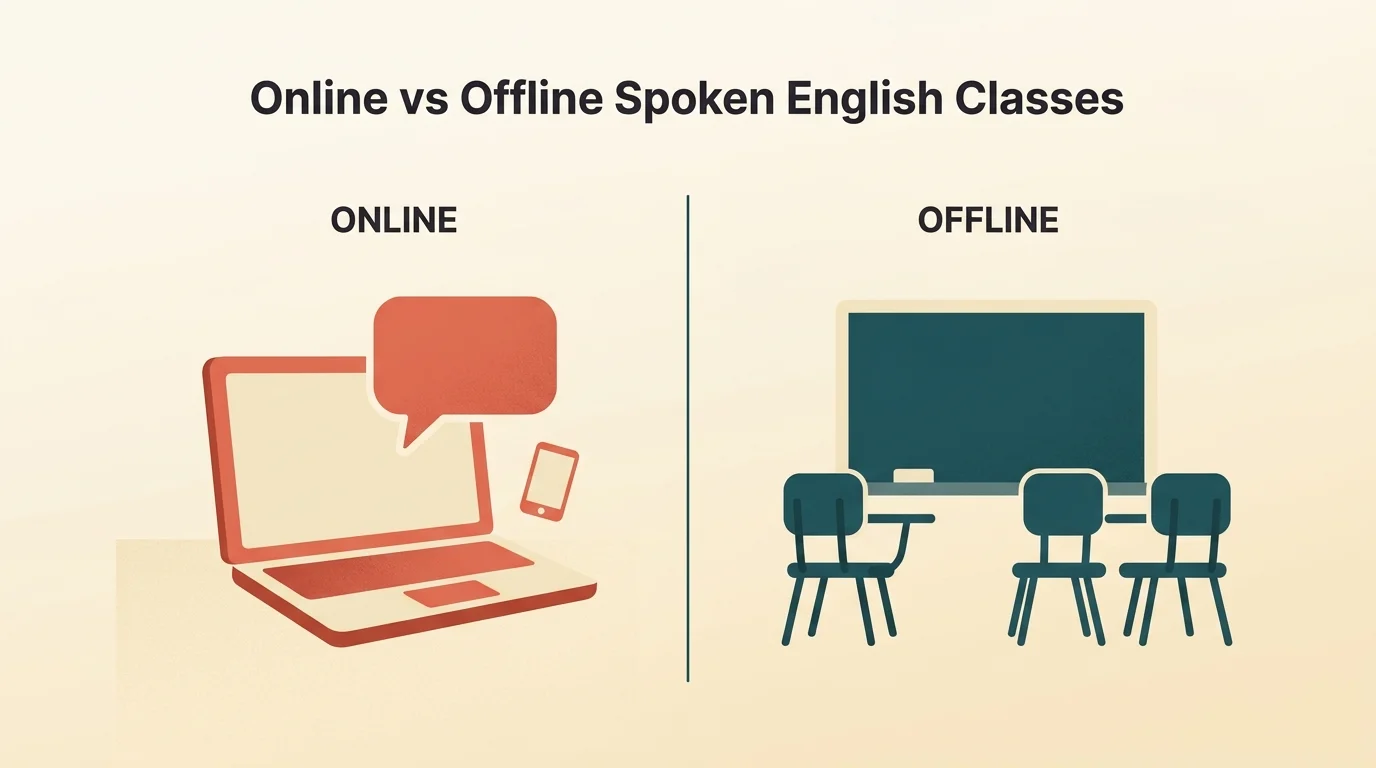
Online vs offline spoken English classes in India comparison
Online vs offline spoken English classes in India — what to choose based on schedule and learning style.
The honest answer: it depends on you, but online has clear structural advantages for most learners in 2026. Online spoken English classes (like EngVarta, Cambly, PlanetSpark) give you flexibility in timing, access to the best trainers regardless of city, lower prices per session, and the ability to practise every single day. The downside is some people need the physical presence of a classroom to stay motivated. Offline spoken English classes work for learners who genuinely crave the in-person energy, need peer accountability to show up, and happen to live near a high-quality coaching centre. But they lock you into fixed timing and location, usually cost more per speaking minute, and you can only attend when you’re physically there. Our honest take: start with a flexible online option (even if it’s just a trial). You can always upgrade to offline later if you discover you genuinely need the classroom energy.

How much do spoken English classes cost in India?

Pricing across Indian spoken English classes in 2026 varies widely:
  • Budget tier (₹100-200 per session): Daily-practice apps like EngVarta
  • Mid tier (₹500-1,000 per session): Career-focused 1-on-1 platforms and Preply budget tutors
  • Premium tier (₹1,000+ per session): Native-speaker platforms like Cambly, senior Preply tutors
  • Subscription/monthly (₹1,500-5,000/month): Structured programmes like British Council, Vedantu
What matters more than price is price per speaking minute and frequency of practice you can sustain. A ₹3,000/month class you attend weekly costs you more per speaking minute than a ₹108/session app you use daily. For more comparison, see our roundup of the best English speaking apps in India and best English speaking practice apps for 2026.

👉 Connect with EngVarta on Social Media

Instagram : 👉  https://www.instagram.com/engvarta.app/ Youtube : 👉  http://www.youtube.com/@EngVarta Facebook : 👉  https://www.facebook.com/engvarta LinkedIn : 👉  https://www.linkedin.com/company/engvarta

Ready to start daily spoken English practice?

The single biggest predictor of success with any spoken English class is how often you actually speak. The best class for you is the one you’ll open every single day. If you want to test the daily-practice approach without committing, start with an EngVarta trial session for ₹69 — a 10-minute call with a real English expert, fully refundable if it doesn’t click for you. Most learners know within 2-3 sessions whether daily practice is the format that finally gets them speaking. Whichever class you choose — online, offline, certified, daily, weekly — make sure you’re actually speaking in every session. That’s what builds fluency. Everything else is just infrastructure.

Frequently asked questions about spoken English classes in India

Which is the best spoken English class in India in 2026?

For most Indian learners who want daily live practice without scheduling hassle, EngVarta is the most practical option — live 1-on-1 practice with certified human experts on demand, starting at ₹108 per session. For learners who specifically need a certificate, British Council myEnglish is the best structured alternative.

How much do online spoken English classes cost in India?

Online spoken English classes in India in 2026 typically cost between ₹100 and ₹2,000 per session depending on format. Budget daily-practice platforms like EngVarta start around ₹108 per session. Mid-range 1-on-1 platforms fall between ₹500-1,000. Premium native-speaker platforms like Cambly can cross ₹1,000 per hour.

Are online or offline spoken English classes better?

Online classes offer better flexibility, access to top trainers regardless of city, and the ability to practise daily at any time — which is the single biggest driver of fluency. Offline classes work if you need in-person energy and peer accountability. For most working professionals and college students in India, online wins on flexibility and cost per speaking minute.

How long does it take to become fluent with spoken English classes?

With daily 15-25 minute speaking practice, most learners see meaningful fluency improvement in 3-6 months. With weekly classes only, the same progress can take 2-3x longer. Consistency beats intensity — a 15-minute daily conversation beats a 90-minute weekly class for building fluency.

Can I learn spoken English in 30 days?

You can build noticeable confidence and start speaking in complete English sentences within 30 days if you commit to daily practice with a real person. Full fluency takes longer, but the core habit — speaking English out loud every day — forms in 30 days. See our 30-day English speaking improvement plan for a structured starting point.