Ielts Speaking Tips |

Tag

ielts speaking tips

Want to Study or Work Abroad? Start with IELTS Exam

June 9, 2025 • 6 min read • By Swati Raj

Want to Study or Work Abroad? Start with the IELTS Exam

For anyone dreaming of settling abroad — whether for higher education, career opportunities, or migration — there’s one bridge you simply can’t skip.
That bridge is called: IELTS.

It’s not just a test.
It’s the first step towards your global journey.

The IELTS Exam (International English Language Testing System) is one of the world’s most popular English proficiency tests, accepted by over 11,000 organizations globally. It is designed to assess how effectively you can communicate in English across four core skills: Listening, Reading, Writing, and Speaking.

Whether you’re planning to study at a university abroad, apply for a job in an English-speaking country, or migrate permanently, the IELTS Exam is often a mandatory requirement in the process.

There are two main types of IELTS:

  • IELTS Academic – for those applying to universities or higher education programs

  • IELTS General Training – for work, training programs, or immigration purposes

Both versions are trusted by governments, employers, and institutions worldwide. Taking the IELTS Exam shows your readiness to live, work, or study in an English-speaking environment and is a vital first step toward your global journey.

The Four Pillars of IELTS: Listening, Reading, Writing, and Speaking

The IELTS Exam is divided into four sections, each designed to assess a specific skill:

1. 🎧 Listening

You’ll hear recordings of native English conversations, lectures, and instructions. You’ll need to answer questions to show how well you understood the context and details.

2. 📖 Reading

Three long texts — could be academic articles or general interest materials — and 40 questions that test your comprehension, scanning, and interpretation skills.

3. ✍️ Writing

This section includes two tasks. In the Academic version, Task 1 involves analyzing a graph or chart, while Task 2 is a formal essay. General version includes letter writing and essay.

4. 🗣️ Speaking

This is a face-to-face interview (or now via video call in many centers). You’ll speak on general topics, express opinions, and answer cue card-based questions — exactly like in the real IELTS Exam.

Why is the IELTS Exam Important?

It’s globally accepted
More than 11,000 institutions in over 140 countries trust IELTS scores.

It unlocks education & career opportunities
A high IELTS score can improve your chances of getting admitted to top universities or landing international jobs.

It supports migration
Countries like Canada, Australia, the UK, and New Zealand use IELTS scores for visa and immigration eligibility.

It’s a mark of language confidence
Preparing for the IELTS Exam doesn’t just help you pass the test — it also builds your real-world communication confidence.

Meet FixoLang: The Smart Way to Practice for IELTS Speaking

Among all the sections, most candidates struggle with speaking.
Why? Because fluency comes from practice — and practice requires guidance, feedback, and repetition.

That’s where FixoLang becomes your best companion.

What is FixoLang?

FixoLang is an AI-powered app designed to help you prepare for the IELTS Speaking section effectively and independently.
It’s like having a private IELTS speaking coach — in your pocket.

How Does FixoLang Work?

Step 1: Choose a Topic
Select from a vast cue card library filled with real IELTS-style prompts. From common questions to trending topics, you’ll find everything that mirrors the actual exam.

👉 Want to see what kind of topics usually appear in the test? Check out these Top 20 IELTS Speaking Cue Card 2025 Questions to get an idea of what to expect and start preparing smartly.

Step 2: Speak
The app records your response in real time. You speak your answer just as you would in the real IELTS Exam.

Step 3: Get Instant Feedback
Within seconds, FixoLang gives you:

  • An estimated band score

  • Feedback on your grammar, pronunciation, fluency, and coherence

  • Suggestions to improve your weak areas

And you can repeat your answer as many times as you like — until you feel confident.

Real Success Stories: How FixoLang Changed Lives

Users across the globe have shared how FixoLang has made a tangible difference in their speaking skills. By incorporating it into their IELTS Exam preparation routine, many have seen remarkable improvements in their scores, showcasing the app’s effectiveness in real-world speaking scenarios.

Final Words: Start Your IELTS Journey Today

Studying or working abroad is not just a dream — it’s a decision.
And like every big journey, it starts with a simple step.

👉 That step is preparing for the IELTS Exam.
And the smartest way to prepare, especially for the speaking section, is by practising daily with FixoLang.

Don’t just study English.
Start speaking it confidently, fluently, and with purpose.

🔗 Ready to Begin? Download FixoLang Now:

📱 Download on App Store: https://apps.apple.com/in/app/fixolang-ielts-prep-app/id6448477499
📱 Get it on Google Play: https://play.google.com/store/apps/details?id=ielts.engvarta.com&hl=en_IN&pli=1
▶️ Watch IELTS tips on YouTube: https://www.youtube.com/@FixoLang
📸 Follow us on Instagram: https://www.instagram.com/fixolang/

Frequently Asked Questions

Can I track my progress?

Yes, after every session you get a band score and feedback so you know exactly where you stand and how to improve.

How often should I practice?

Just 15 minutes a day is enough to see improvement. The more consistently you practice, the better your fluency and score.

Can beginners use FixoLang?

Definitely! It’s beginner-friendly and perfect for shy users. You practice with AI, so there’s no fear of judgment or pressure.

Is FixoLang only for Speaking?

Yes, it’s currently focused on IELTS Speaking practice. More features for Listening, Reading, and Writing are coming soon.

How does FixoLang help with IELTS?

FixoLang gives real IELTS cue cards, AI-powered feedback, and instant band estimates to help improve your speaking fluency and confidence.


How to Introduce Yourself in the IELTS Speaking Exam: A2 to C1 Levels

November 16, 2024 • 8 min read • By Swati Raj

How to Introduce Yourself in the IELTS Speaking Exam: A2 to C1 Levels

Introducing yourself in the IELTS Speaking exam is an important first step. It sets the tone for your interaction with the examiner and reflects your level of English proficiency. Whether you’re at an A2 (Elementary) level or a C1 (Advanced) level, here’s a guide on how to structure and improve your self-introduction according to your language skills.

1. A2 Level: Elementary

At this level, your vocabulary is basic, and your sentences are simple. The goal is to communicate clearly using everyday language.

Sample Introduction

“Hello! My name is Priya. I am 22 years old. I live in Mumbai, India. I am a student, and I study biology. In my free time, I like reading books and listening to music.”

Tips for A2 Level:

  • Focus on short, clear sentences.
  • Use common vocabulary to talk about yourself, such as your name, age, job, hobbies, and where you live.
  • Practice pronouncing basic words correctly.

2. B1 Level: Intermediate

At this stage, you can form more complex sentences and provide brief explanations.

Sample Introduction

“Hi, I’m Priya, and I’m from Mumbai, a busy city in India. I’m 22 years old and currently studying biology at university. In my free time, I enjoy reading novels and listening to classical music because it helps me relax. I also like spending time with my friends on weekends.”

Tips for B1 Level:

  • Add details to your sentences, such as why you like certain hobbies.
  • Use connectors like “and,” “because,” and “also” to link ideas.
  • Be prepared to answer follow-up questions, such as “Why do you enjoy reading?”

3. B2 Level: Upper-Intermediate

Here, your language is more fluent, and you can express your thoughts clearly. You can use a wider range of vocabulary and discuss abstract ideas.

Sample Introduction

“Good morning! My name is Priya, and I’m 22 years old. I come from Mumbai, a vibrant city in western India. I’m currently pursuing a degree in biology at university, and I hope to specialize in environmental sciences in the future. When I’m not studying, I enjoy reading fiction, especially thrillers, and exploring new music genres. I believe hobbies like these keep me inspired and balanced.”

Tips for B2 Level:

  • Include ambitions or future plans to add depth to your introduction.
  • Use descriptive adjectives (“vibrant,” “inspiring”) to make your answers more engaging.
  • Show fluency by speaking without long pauses or hesitations.

4. C1 Level: Advanced

At this level, your introduction should reflect fluency, confidence, and flexibility in using the language. Your sentences should be well-structured and natural.

Sample Introduction

“Hello, I’m Priya. I’m 22 years old and from Mumbai, a bustling metropolis in India known for its diverse culture. I’m in my final year of studying biology at university, with a keen interest in environmental conservation. In my leisure time, I immerse myself in books, particularly psychological thrillers, as I find them intellectually stimulating. I’m also passionate about music and enjoy exploring diverse genres that challenge my perspective. I’m here today to improve my speaking skills and learn how to express myself more eloquently.”

Tips for C1 Level:

  • Use advanced vocabulary (“bustling metropolis,” “intellectually stimulating”).
  • Add sophistication by using phrases like “keen interest in” or “passionate about.”
  • Structure your sentences to flow naturally with varied sentence lengths.

Key Takeaways for All Levels

  • Speak Clearly: Regardless of your level, focus on clarity and proper pronunciation.
  • Be Natural: Avoid memorizing responses word-for-word; instead, practice speaking naturally about yourself.
  • Stay Calm: The introduction is your chance to warm up. Don’t worry about minor mistakes; focus on building confidence.

Practice Questions to Prepare

  • What is your full name?
  • Where are you from?
  • What do you do?
  • What are your hobbies?
  • Why are you taking the IELTS exam?

By practicing these responses at your level, you’ll be ready to start the IELTS Speaking exam with confidence, whether you’re at A2, B1, B2, or C1.

Final Tip: Aim to improve your level step by step. If you’re at A2, work on adding details to your answers. If you’re at B2, focus on refining your fluency and vocabulary. Each step brings you closer to mastering the IELTS Speaking test!

With Fixolang, you can practice real-time IELTS speaking scenarios, receive instant AI feedback on fluency, vocabulary, grammar, and pronunciation, and track your progress effortlessly. Whether you’re at A2, B1, B2, or even aiming for C1, Fixolang provides personalized tips and exercises tailored to your level, helping you move closer to your target band score with consistent practice.

Frequently Asked Questions about IELTS Speaking Self-Introduction

How do I introduce myself in IELTS speaking?

IELTS Speaking starts with simple introduction questions in Part 1: “Can you tell me your full name?”, “Where are you from?”, “What do you do?”, “Are you a student or do you work?”. Keep answers conversational (1-2 sentences each), genuine, and avoid memorised scripts. Examiners often pick up scripted answers and downgrade. Speak naturally, even if your answers are imperfect — fluency matters more than perfection at this stage.

What should I include in my IELTS speaking introduction?

Cover: full name, hometown (with one interesting detail), current activity (work or study with a brief description), one hobby or interest. Example: “My name is Priya Sharma. I’m from Bangalore, which is known as India’s Silicon Valley. I currently work as a software engineer at an MNC, focusing on cloud infrastructure. In my free time, I enjoy reading mystery novels and playing badminton.” Total: 30-40 seconds. Concise, specific, vocabulary-rich.

What are common IELTS speaking introduction mistakes?

Frequent errors: (1) Memorised scripts that sound rehearsed (examiners notice and mark down). (2) Generic answers (“I am from a beautiful country called India” — too vague). (3) Over-long introductions (more than 60 seconds). (4) Avoiding eye contact (signals nervousness). (5) Using overly complex sentences early (forces grammar errors). (6) Listing too many unrelated facts. Keep it natural, specific, and conversational.

What vocabulary should I use in my IELTS introduction?

Avoid generic words. Replace “good” with “rewarding” or “fulfilling”. Replace “many” with “various” or “numerous”. Replace “things” with specific nouns (skills, interests, responsibilities). Use one or two “less common” vocabulary items naturally — examiners reward variety. Examples: “I’m passionate about…”, “My role involves…”, “I find it rewarding to…”, “I have a particular interest in…”.

How long should my IELTS speaking introduction be?

30-45 seconds for the full Part 1 introductory exchange. Each individual answer in Part 1 is 1-3 sentences (15-25 seconds). Avoid both extremes: one-word answers signal weak fluency; minute-long monologues drift off-topic. Aim for “naturally conversational” — like meeting a friend’s colleague at a party.

How can I practise IELTS speaking introduction?

Effective practice: (1) Record yourself answering the 4-5 standard introduction questions. Listen back — does it sound natural or rehearsed? (2) Practise with a TESOL/ESL-certified Expert who can simulate the exam pace and provide feedback. EngVarta‘s daily 25-minute audio sessions let you rehearse Part 1 introduction multiple times per week, with corrections on pace, vocabulary, and naturalness. The $1 refundable trial lets you try this on a real-feel mock exam.

Master Every Cue Card with Fixolang App: Best App for IELTS Speaking Practice

August 3, 2024 • 5 min read • By Swati Raj

Master Every Cue Card with Fixolang App: Best App for IELTS Speaking Practice

If you’re aiming to conquer the IELTS Speaking section, ditch generic English learning apps. Built specifically for IELTS aspirants, FixoLang stands out—the Best App for IELTS Speaking Practice—that helps you master cue card responses with precision and real-time feedback.

Why IELTS Preparation Deserves a Specialized App

IELTS isn’t just any English test—it evaluates your ability to communicate fluently in academic or real-world contexts. Among the four skills—Listening, Reading, Writing, and Speaking—the Speaking section is often the most daunting. It involves authentic cue card responses (Part 2), spontaneous thinking, and polished vocal delivery, all under exam pressure. Generic English apps may improve vocabulary and grammar—but they rarely simulate this speaking experience. FixoLang, on the other hand, is purpose-built to address these exact needs.

Why Choose FixoLang? What Sets It Apart

  • Tailor-Made for IELTS Speaking: Unlike general tools, FixoLang is built solely around IELTS cue card practice and speaking mastery.

  • AI-Powered Scoring & Feedback: Get instant band score estimates and personalized feedback on your fluency, coherence, grammar, vocabulary, and pronunciation—yes, every cue card counts.

  • Rich Cue Card Library: Pick from a wide variety of prompts—ranging from personal experiences to abstract ideas—mirroring the real exam style.

  • 24/7 Practice Availability: Practice anytime anywhere—no coach needed, just you and the app.

  • Pronunciation Support with Expert Mentors: Beyond AI, you can get help from EngVarta’s English mentors to reduce mother tongue interference (MTI) and improve clarity.

Categories of Cue Cards Available

FixoLang’s digital flashcards span a variety of themes central to IELTS cue card topics, including:

  • Personal Experiences (e.g., “Describe a memorable journey”)

  • Social & Cultural Themes (e.g., “A festival you love”)

  • Technology & Education

  • Environment & Lifestyle

  • Abstract Topics (e.g., imagination, time, change)

If you’d like a deeper look into the latest cue card topics, check out this insightful blog: Top 20 IELTS Speaking Cue Card 2025 Questions.

FixoLang Key Features & Benefits

Key Features

  • AI-Powered Speaking Assistant: Gives instant IELTS band estimates and performance feedback.

  • Extensive Cue Card Library: Structured prompts for targeted speaking practice.

  • Personalized Feedback: Covers grammar, structure, vocabulary, coherence, and pronunciation.

  • High-Score Strategies: Built-in tips and guidance aimed at achieving top band scores.

  • 24/7 On-Demand Practice: Your personal coach—always ready.

  • Mentor Support for Pronunciation: Expert help bridges the gap between AI and human feedback.

Benefits at a Glance

Benefit Advantage for You
Targeted IELTS prep Practice with exam-specific prompts and scoring rules
Instant, actionable feedback Improve deliberately and track progress easily
Confidence from realistic practice Rehearse under pressure just like the test
Flexible & on-demand Fits into your schedule—travel, breaks, or nights
Human support when needed Fix pronunciation issues effectively

Real Success Stories

Users worldwide have shared how FixoLang helped boost their speaking skills and IELTS scores. Many credit consistent practice, focused feedback, and real-world cue card experience as game-changers. These testimonies underscore how FixoLang elevates routine practice into effective preparation.

Connect with FixoLang on YouTube & Instagram

Stay inspired and learn with everyday strategies:

Whether you’re learning cue card strategies, vocabulary, or speaking techniques, FixoLang’s YouTube channel shares bite‑sized, exam‑relevant videos. YouTube

Follow on Instagram for quick speaking tips and motivational content:
@fixolang – “Ready for your FREE IELTS speaking assessment? Download the FixoLang app…”

Download Links: Get Practicing Today

In Summary

FixoLang is more than a language app—it’s the Best App for IELTS Speaking Practice. Purpose-built for cue card mastery, it offers a powerful combo of AI feedback, curated prompts, flexibility, and expert support. With support across platforms, engaging video content, and inspiring social updates, FixoLang is your full-stack tool to ace the speaking section.

Ready to speak confidently, fluently, and strategically? Download FixoLang and turn your cue card weaknesses into exam-day strengths!

Frequently Asked Questions (FAQ’s)

Frequently Asked Questions

Where can I download the Fixolang app?

You can download Fixolang from the Google Play Store for Android and the App Store for iOS devices.

Is there a human mentor available for guidance on Fixolang?

Absolutely. In addition to AI feedback, Fixolang users can access EngVarta’s expert mentors for one-on-one help—especially useful for pronunciation and confidence building.

Can Fixolang help me identify and fix my speaking weaknesses?

Yes, through instant AI feedback on fluency, grammar, vocabulary, and pronunciation, Fixolang helps you track, analyze, and improve your weak areas with every session.

What types of cue cards are available in Fixolang?

You’ll find a wide range of cue cards—personal experiences, abstract ideas, technology, travel, education, and lifestyle—covering all IELTS Speaking themes and latest 2025 topics.

Why is Fixolang considered the best app for IELTS Speaking Practice?

Fixolang is designed exclusively for IELTS, offering AI-scored cue card practice, real-time feedback, and expert pronunciation support—making it highly focused and results-driven.

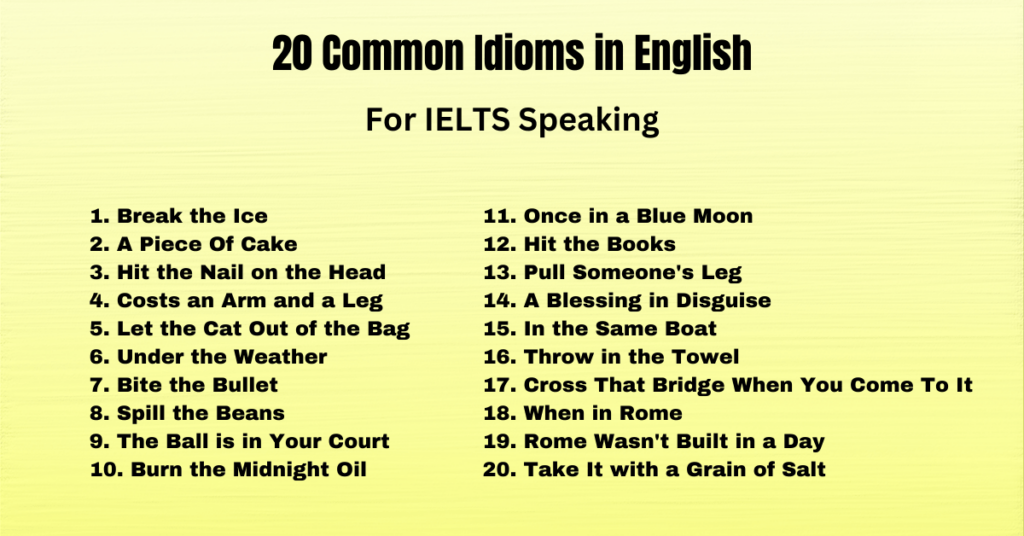
Top 20 Common Idioms in English for IELTS Speaking

May 21, 2024 • 21 min read • By Swati Raj

Top 20 Common Idioms in English for IELTS Speaking

Using idioms in your IELTS Speaking test can be a game-changer. Idiomatic expressions not only make your speech more colorful and engaging but also demonstrate your advanced understanding of the English language. Here, we present the top 20 common idioms in English you should know for the IELTS Speaking test, along with detailed explanations, examples, and practical applications in conversations.

Break the Ice

Meaning: To initiate conversation in a social setting, often to relieve tension. Origin: The phrase comes from breaking the ice to open up a channel in frozen water to allow boats to pass through. Example: “At the beginning of the meeting, I tried to break the ice by sharing a funny story.”

Question and Answer:

  • Q: How do you usually start a conversation with new people?
  • A: I usually try to break the ice with a light-hearted joke or by asking about their hobbies. It’s a great way to ease into a conversation and make everyone feel more comfortable. For instance, when I meet new colleagues, I might share a humorous anecdote or ask them about their favorite movies. This approach not only helps to dissolve any initial awkwardness but also sets a friendly tone for the rest of the interaction. Breaking the ice is crucial in any new social setting because it helps establish rapport and opens up pathways for more meaningful discussions.

A Piece of Cake

Meaning: Something very easy to do. Origin: This idiom likely comes from the simple pleasure associated with eating cake. Example: “Passing the driving test was a piece of cake for me.”

Question and Answer:

  • Q: How did you find your final exams?
  • A: Honestly, they were a piece of cake. I had prepared well, so I found them quite easy. For example, I had spent weeks reviewing all the material, practicing past papers, and even joining study groups to discuss difficult topics. By the time the exams came around, I felt so confident that answering the questions seemed almost effortless. This level of preparation made the exams feel like a walk in the park, and I was able to complete them with time to spare.

Hit the Nail on the Head

Meaning: To be exactly right about something. Origin: This phrase comes from the accuracy required to hit a nail precisely on its head with a hammer. Example: “When you said that practice makes perfect, you hit the nail on the head.”

Question and Answer:

  • Q: What do you think about the importance of daily practice in learning a language?
  • A: You really hit the nail on the head there. Daily practice is essential for mastering any language. For example, when I was learning English, I dedicated at least an hour each day to practicing speaking, listening, reading, and writing. This consistent effort paid off significantly because it allowed me to reinforce my learning and improve steadily over time. Moreover, daily practice helps to build muscle memory and makes using the language more natural and automatic.

Costs an Arm and a Leg

Meaning: Very expensive. Origin: This idiom suggests that something is so expensive that it costs as much as losing one’s limbs. Example: “Buying a house in the city center costs an arm and a leg.”

Question and Answer:

  • Q: Why did you choose to live in the suburbs?
  • A: Living in the city center costs an arm and a leg. The suburbs are much more affordable. For instance, the rent for an apartment in the city center can be double or even triple what you would pay in the suburbs. Additionally, living in the suburbs offers more space and a quieter environment, which is perfect for raising a family. While commuting might be a bit longer, the financial savings and improved quality of life make it a worthwhile trade-off.

Let the Cat Out of the Bag

Meaning: To reveal a secret, often by mistake. Origin: This phrase may come from markets where traders would substitute a cat for a piglet in a bag, revealing the deception when the cat was let out. Example: “She let the cat out of the bag about the surprise party.”

Question and Answer:

  • Q: How did your friend react to the surprise party?
  • A: She found out beforehand because someone let the cat out of the bag. For example, while we were all trying to keep the party a secret, one of our mutual friends accidentally mentioned it in a casual conversation. The friend who was supposed to be surprised started asking questions and it became clear that she had found out about the party. Although the surprise element was lost, we still managed to have a great time celebrating together.

Under the Weather

Meaning: Feeling ill. Origin: This idiom likely comes from sailors feeling seasick during bad weather conditions. Example: “I was under the weather last week, but I’m feeling much better now.”

Question and Answer:

  • Q: You missed the meeting yesterday. Are you okay?
  • A: Yes, I was a bit under the weather, but I’m fine now. Last week, I caught a cold and felt quite miserable with a sore throat and a headache. I spent most of my time resting and taking medication to recover. Fortunately, after a few days of rest and plenty of fluids, I’m feeling much better and ready to get back to work.

Bite the Bullet

Meaning: To face a difficult or unpleasant situation with courage. Origin: In the past, soldiers would bite on a bullet during surgery to endure the pain without anesthesia. Example: “I had to bite the bullet and take the difficult exam.”

Question and Answer:

  • Q: How did you handle the challenging project at work?
  • A: I had to bite the bullet and tackle it head-on despite the difficulties. For example, the project involved tight deadlines and a high level of complexity that made it quite stressful. However, I knew that avoiding it would only make things worse, so I gathered all my resources, made a detailed plan, and started working on it systematically. By staying focused and determined, I managed to complete the project successfully, and the experience helped me grow professionally.

Spill the Beans

Meaning: To reveal secret information unintentionally. Origin: One theory is that it comes from an ancient Greek method of voting using beans, where spilling them would reveal the results. Example: “Who spilled the beans about our surprise trip?”

Question and Answer:

  • Q: How did everyone find out about the surprise trip?
  • A: Someone spilled the beans, and now everyone knows. We had planned a surprise trip for a friend’s birthday, but during a casual conversation, another friend accidentally mentioned the trip. This revelation spread quickly, and soon enough, the birthday friend found out about our plans. Although it was disappointing to lose the element of surprise, we still enjoyed the trip and made great memories together.

The Ball is in Your Court

Meaning: It’s your turn to take action or make a decision. Origin: This idiom comes from tennis, where the ball being in your court signifies it’s your turn to play. Example: “I’ve given you all the information you need. Now the ball is in your court.”

Question and Answer:

  • Q: What’s the next step in our project?
  • A: I’ve completed my part. Now the ball is in your court to finalize the details. For example, I have finished the initial research and compiled all the necessary data. It’s now up to you to review the information, make any necessary adjustments, and prepare the final presentation. This way, we can ensure that everything is ready for our upcoming meeting with the stakeholders.

Burn the Midnight Oil

Meaning: To work late into the night. Origin: Before electric lighting, oil lamps were used for illumination, so working late required burning oil. Example: “I had to burn the midnight oil to finish my report.”

Question and Answer:

  • Q: How did you manage to complete the assignment on time?
  • A: I burned the midnight oil for several nights to get it done. For example, I stayed up late working on the assignment, often until the early hours of the morning. This involved a lot of research, writing, and revising to ensure that the final report was of high quality. Although it was exhausting, the hard work paid off when I submitted the assignment on time and received positive feedback from my professor.

Once in a Blue Moon

Meaning: Very rarely. Origin: A blue moon refers to the rare occurrence of a second full moon within a calendar month. Example: “We only get together once in a blue moon.”

Question and Answer:

  • Q: How often do you see your old friends?
  • A: We meet up once in a blue moon since everyone is so busy. For instance, with everyone’s hectic schedules and different locations, it’s challenging to find time when we can all be free. However, we make a special effort to get together during holidays or special occasions. These rare meetups are always cherished and filled with joy as we catch up on each other’s lives and reminisce about old times.

Hit the Books

Meaning: To study hard. Origin: This idiom conjures the image of someone diligently reading and studying textbooks. Example: “I need to hit the books this weekend to prepare for the exam.”

Question and Answer:

  • Q: What are your plans for the weekend?
  • A: I need to hit the books and study for my upcoming exams. For example, I’ll be spending most of my weekend reviewing lecture notes, reading textbooks, and completing practice problems to ensure I’m fully prepared. I’ve also planned to join a study group session where we can discuss difficult concepts and test each other’s understanding. This intensive study routine will help me feel more confident and ready for the exams.

Pull Someone’s Leg

Meaning: To joke or tease someone playfully. Origin: The origin is unclear, but it’s widely used to describe light-hearted teasing. Example: “Don’t take him seriously, he’s just pulling your leg.”

Question and Answer:

  • Q: Did you really win the lottery?
  • A: No, I was just pulling your leg. For example, I told you that I had won the lottery just to see your reaction and have a bit of fun. I enjoy making playful jokes like this, but it’s important to ensure that the other person understands it’s all in good humor and not meant to be taken seriously. It’s a great way to lighten the mood and share a laugh.

A Blessing in Disguise

Meaning: Something that seems bad but turns out to be good. Origin: This idiom highlights how a seemingly negative situation can have a positive outcome. Example: “Losing that job was a blessing in disguise.”

Question and Answer:

  • Q: How did you cope with losing your job?
  • A: It turned out to be a blessing in disguise because I found a better opportunity. For instance, after being laid off, I had the chance to reassess my career goals and explore new possibilities. This led me to pursue a job in a different industry that I am passionate about. The new role not only offered better pay and benefits but also provided more opportunities for growth and fulfillment.

In the Same Boat

Meaning: In the same situation, especially one involving shared difficulties. Origin: This idiom comes from the idea of people being in a boat together, facing the same conditions. Example: “We’re all in the same boat when it comes to final exams.”

Question and Answer:

  • Q: How are you handling the stress of exams?
  • A: It’s tough, but we’re all in the same boat and supporting each other. For example, my classmates and I are all experiencing the same pressures and challenges as we prepare for our exams. We’ve formed study groups where we can share resources, help each other understand difficult concepts, and provide moral support. Knowing that we are not alone in this situation makes it easier to cope with the stress and stay motivated.

Throw in the Towel

Meaning: To admit defeat or give up. Origin: This idiom comes from boxing, where a trainer would throw a towel into the ring to signal that their fighter was giving up. Example: “After several unsuccessful attempts, I finally threw in the towel.”

Question and Answer:

  • Q: Did you manage to solve the problem?
  • A: No, I had to throw in the towel after multiple tries. For example, despite trying different approaches and seeking advice from colleagues, I couldn’t find a solution to the problem. Eventually, I realized that it was more practical to admit defeat and move on to other tasks where I could be more productive. Although it was frustrating, it was a valuable learning experience that taught me the importance of knowing when to let go.

Cross That Bridge When You Come To It

Meaning: Deal with a problem or situation when it actually happens, rather than worrying about it beforehand. Origin: In the past, bridges were often dangerous to cross, so it was sensible to deal with the challenge only when necessary. Example: “We don’t need to worry about the presentation now. We’ll cross that bridge when we come to it.”

Question and Answer:

  • Q: Aren’t you worried about the challenges we might face?
  • A: Not really. We’ll cross that bridge when we come to it. For example, while it’s important to plan ahead, overthinking potential problems that haven’t occurred yet can lead to unnecessary stress. I prefer to focus on the present tasks and deal with issues as they arise. This approach helps me stay calm and more efficient, as I can address problems with a clear mind when they actually happen.

When in Rome

Meaning: Follow the customs and behavior of the people in the place where you are visiting or living. Origin: Attributed to Saint Ambrose, advising people to adapt to local customs when traveling. Example: “When in Rome, do as the Romans do. It’s best to respect and follow local customs.”

Question and Answer:

  • Q: How do you adjust to different cultures when you travel?
  • A: I believe in the saying, ‘When in Rome,’ so I always try to follow local customs. For example, when I traveled to Japan, I made sure to learn about the local etiquette, such as bowing when greeting people, removing shoes before entering homes, and using chopsticks properly. This not only showed respect for the local culture but also helped me to connect with the people and experience the culture more authentically.

Rome Wasn’t Built in a Day

Meaning: Important work takes time and should not be rushed. Origin: The construction of Rome, one of the greatest cities in history, took centuries. Example: “Learning a new language is a slow process. Remember, Rome wasn’t built in a day.”

Question and Answer:

  • Q: I feel like I’m not making any progress with my studies.
  • A: Don’t be discouraged. Rome wasn’t built in a day. Keep working at it. For example, mastering a new skill or subject takes time, and progress can sometimes be slow and incremental. It’s important to be patient and persistent, celebrating small victories along the way. By maintaining a consistent effort and staying dedicated, you will eventually see significant improvement and achieve your goals.

Take It with a Grain of Salt

Meaning: To view something with skepticism or not to take it too seriously. Origin: This phrase likely comes from the ancient Roman practice of adding a grain of salt to food for improved flavor, implying that what you hear might need a pinch of doubt. Example: “You should take his stories with a grain of salt.”

Question and Answer:

  • Q: Did you believe everything he said?
  • A: Not really. I took his claims with a grain of salt. For example, he tends to exaggerate when telling stories, so while his accounts might contain some truth, they are often embellished for dramatic effect. Therefore, I listen to his stories with a healthy dose of skepticism and don’t take everything at face value. This approach helps me to better discern the accuracy of the information and avoid being misled.

Conclusion

Understanding and using idioms effectively can significantly enhance your IELTS Speaking score. They showcase your ability to use English in a nuanced and native-like manner. Practice incorporating these top 20 common idioms in English into your everyday conversations and observe how native speakers use them in context. By doing so, you’ll not only improve your speaking skills but also gain confidence in using English more naturally and expressively. For an immersive and interactive learning experience, consider using the Best English Learning App for Learning English – EngVarta. This app provides personalized practice sessions and practical tips to help you master English fluently. Good luck with your IELTS preparation!

Frequently Asked Questions about English Idioms

What is an idiom in English?
An idiom is a phrase whose meaning isn’t literal — you can’t figure it out from the individual words. For example, “break a leg” doesn’t mean to actually injure yourself; it means “good luck.” Native English speakers use idioms constantly in casual conversation, business meetings, and writing. Learning common idioms is essential for fluency because they appear everywhere.
Why are idioms important for IELTS speaking?
IELTS speaking band 7+ requires “less common vocabulary and idiomatic language.” Examiners specifically listen for idioms used naturally and correctly. Using 2-3 well-placed idioms in your answer can lift your band score, but force-fitting idioms or using them incorrectly hurts your score. The key is using idioms that genuinely fit the topic, not memorising a list and dropping them in.
What are the most common English idioms?
Most-used English idioms include: “piece of cake” (very easy), “break the ice” (start a conversation), “cost an arm and a leg” (very expensive), “hit the books” (study hard), “bite the bullet” (face something difficult), “let the cat out of the bag” (reveal a secret), “once in a blue moon” (rarely), “spill the beans” (reveal information), “under the weather” (feeling sick), “the ball is in your court” (your decision now). These appear in everyday conversation and IELTS speaking responses.
How do you use idioms correctly in conversation?
To use idioms correctly: (1) Make sure the idiom genuinely fits your meaning — don’t force it. (2) Match the register — formal business idioms (“circle back,” “low-hanging fruit”) vs casual idioms (“hit the road,” “no biggie”). (3) Use idioms native speakers actually use today, not outdated ones from textbooks. (4) Practice them in conversation, not just in writing. Saying “I was over the moon” feels natural in conversation; reading it from a list does not.
What is the difference between an idiom and a proverb?
An idiom is a phrase with figurative meaning (“hit the books”). A proverb is a short sentence stating a general truth or piece of advice (“Actions speak louder than words”). Proverbs are complete sentences with universal lessons. Idioms are smaller phrases that fit inside sentences. Both add colour to English but serve different purposes.
What are common idiom mistakes Indian English speakers make?
Frequent mistakes include: literal translation of Hindi idioms (“eat my brain” instead of “drive me crazy”); using outdated British idioms that native speakers no longer use; forcing idioms in formal contexts where they don’t fit; mispronouncing key words in idioms (“a piece of cake” → “a piece off cake”); and using too many idioms in one answer (sounds rehearsed). Mastering 20-30 idioms used naturally is better than 100 idioms used awkwardly.
How can I learn idioms quickly?
Best methods: (1) Watch English TV shows and note idioms used in real context (Friends, The Office, Modern Family are idiom-rich). (2) Read English newspapers and blogs daily — note 2-3 idioms per day. (3) Use new idioms in conversation within 24 hours of learning them. (4) Pair idiom learning with situations — “what idiom would I use to describe this work meeting?” (5) Daily live speaking practice with feedback. EngVarta connects learners with TESOL/ESL-certified Experts who naturally weave idioms into conversation and correct misuse — the $1 refundable trial lets you experience this.
How many idioms should I learn for IELTS?
For IELTS speaking band 7-8, knowing 30-50 idioms WELL is enough — “well” meaning you can use them naturally, in the right context, with correct pronunciation. Memorising 200 idioms and using none of them naturally won’t lift your score. Examiners notice forced idiom usage. Focus on quality over quantity, master each idiom in real conversation before adding the next.
Are idioms different in American vs British English?
Yes. American and British English share most common idioms but have unique ones. American: “piece of cake,” “hit the road,” “ballpark figure.” British: “bob’s your uncle,” “throw a spanner in the works,” “have a chinwag.” For IELTS (which uses British English), focus on British and globally-shared idioms. For US workplaces, learn American idioms. Most globally-known idioms work in both contexts.


Want a Band 7+? Here’s How to Achieve Your Target IELTS Score in 2025

April 15, 2024 • 5 min read • By Swati Raj

Want a Band 7+? Here’s How to Achieve Your Target IELTS Score in 2025

You don’t need to be perfect. You just need a better IELTS score.

If you’ve been chasing a Band 7 or higher in IELTS, you already know it’s more than just an exam — it’s your ticket to a bigger future.

Maybe it’s studying in your dream university.
Maybe it’s getting a job overseas.
Or maybe it’s migrating to a new country for a better life.

Whatever your reason, your IELTS score matters. And with the right approach, it’s more achievable than ever.

What Does Your IELTS Score Really Reflect?

Your IELTS score isn’t just about English.
It reflects how well you can:

  • Understand native conversations

  • Present your ideas clearly

  • Think in English without translating

  • Handle academic or work-based communication

Scoring Band 7+ shows that you’re ready to function independently in an English-speaking country — at university, work, or even day-to-day life.

Step 1: Know How the IELTS Test Works

Before you aim for a better IELTS score, make sure you know how the test is structured. It’s divided into four parts:

  • Listening (40 minutes)

  • Reading (60 minutes)

  • Writing (60 minutes)

  • Speaking (11–14 minutes)

Each section is scored individually, and your overall IELTS score is the average of all four.

Smart Tip: Don’t just prepare for your strong areas. Balance matters. Even one weak section can bring down your overall score.

Step 2: Practice Under Real Test Conditions

If you want to improve your IELTS score, you need to simulate the pressure of the real exam.

  • Time your writing tasks

  • Listen to full-length recordings without pausing

  • Read with a 60-minute clock ticking

  • Do mock speaking tests out loud

This not only builds speed and stamina but reduces test-day anxiety.

Step 3: Speak Daily — and Get Instant Feedback

Practicing speaking is essential. But even more powerful than practice is feedback — especially if it’s instant and accurate.

That’s where tools like FixoLang can truly help.

FixoLang is an AI-powered IELTS speaking practice app that:

  • Gives you real IELTS speaking questions

  • Lets you speak your answers in real time

  • Offers instant scoring and feedback based on fluency, coherence, grammar, and pronunciation

  • Helps you track progress and improve weak areas every day

It’s like having a speaking coach available whenever you need it.
And because it’s designed specifically for IELTS, the practice is targeted and effective.

Download FixoLang App to start improving your IELTS speaking score today.

And if you want a deeper understanding of how the IELTS Speaking test works, with example questions and examiner tips, check out this guide: 👉 How to Prepare for IELTS Speaking Test

Step 4: Learn IELTS-Specific Strategies

Each section of IELTS has its own pattern and strategy. Don’t just study English — study the test itself.

For Listening:

  • Practice identifying key words

  • Get used to different accents

  • Learn to follow signposts like “however,” “on the other hand,” etc.

For Reading:

  • Skim and scan quickly

  • Don’t get stuck on one passage

  • Learn how to spot paraphrasing in questions

For Writing:

  • Use standard formats for Task 1 and Task 2

  • Always outline your thoughts before you write

  • Learn linking phrases to improve coherence

For Speaking:

  • Smile and be natural

  • Expand your answers beyond 1-2 lines

  • Don’t be afraid to self-correct — it shows awareness

Step 5: Build Vocabulary Around IELTS Themes

Improving your vocabulary boosts all four sections of your IELTS score. But instead of random word lists, focus on topics that frequently appear in IELTS:

  • Education

  • Health

  • Environment

  • Technology

  • Work and lifestyle

  • Culture and society

Make a habit of using new words in your own sentences — especially in speaking and writing.

Apps like FixoLang also help you reinforce topic-specific vocabulary in speaking answers — so you’re not just memorizing words, you’re applying them.

Step 6: Track Your Progress Weekly

Don’t just practice — measure your performance.

  • Do a weekly full mock test

  • Record your speaking tests

  • Track your writing score based on band descriptors

  • Identify your weakest section and double your effort there

With FixoLang, this becomes easier — your speaking performance is scored after each session, so you can monitor exactly where you’re improving (and where you’re not).

Final Thoughts: You Can Improve Your IELTS Score

A high IELTS score isn’t about luck. It’s about preparation, practice, and mindset.

You don’t need a classroom.
You don’t need to memorize the dictionary.
You just need a consistent strategy, daily effort, and the right tools — like FixoLang for speaking and expert feedback when needed.

Your goals are within reach.
Now it’s time to earn the IELTS score that gets you there.

Frequently Asked Questions

Frequently Asked Questions

What is a good IELTS score for study or migration?

A Band 7+ is widely accepted by most universities and immigration programs in countries like Canada, the UK, and Australia.

Can FixoLang replace a speaking coach?

FixoLang is perfect for daily self-practice and real-time scoring. For live feedback, it can be combined with platforms like EngVarta.

How much time does it take to improve my IELTS score by 1 band?

With focused practice and proper feedback, most learners see an improvement of 0.5 to 1 band in 6–8 weeks.