Prepositions are those small but mighty words that link nouns, pronouns, or phrases to other words within a sentence. They’re everywhere in spoken English, but mastering their use can be tricky, especially for non-native speakers. Today, we’ll go over 10 common mistakes people make with prepositions and how to avoid them.
1. Confusing ‘In’ and ‘At’ for Locations
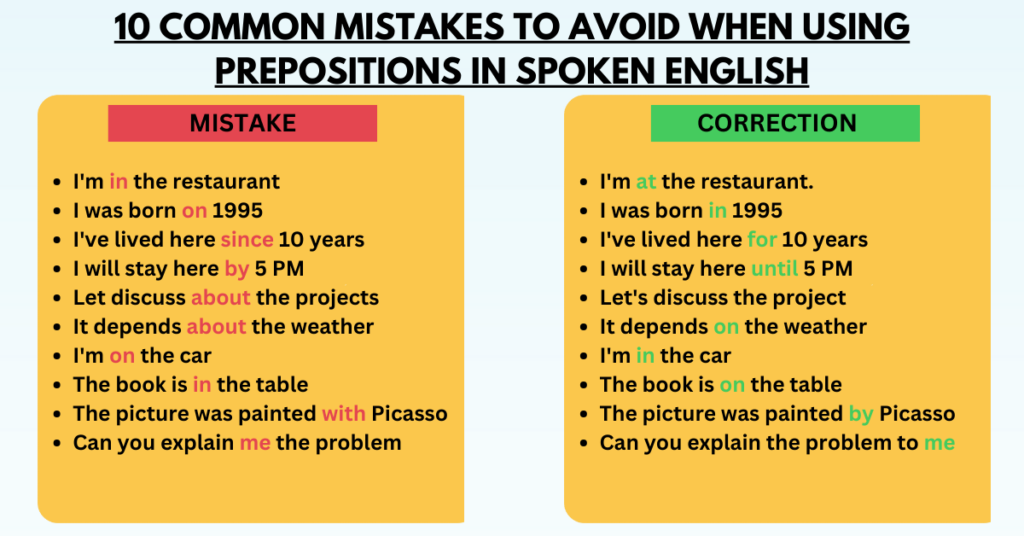
Mistake: Saying, “I’m in the restaurant” when you mean, “I’m at the restaurant.”
Correction: Use ‘at’ when you’re talking about specific locations, like “at the office” or “at the park.” Use ‘in’ when you’re referring to something more general or enclosed, like “in the city” or “in the car.”
2. Using ‘On’ Instead of ‘In’ for Months and Years
Mistake: Saying, “I was born on 1995″ instead of “I was born in 1995.”
Correction: Use ‘in’ for months, years, centuries, and long periods of time, like “in March” or “in 2025.” Use ‘on’ for specific days or dates, like “on Tuesday” or “on December 12th.”
3. Mixing Up ‘For’ and ‘Since’ with Time Expressions
Mistake: Saying, “I’ve lived here since 10 years” instead of “I’ve lived here for 10 years.”
Correction: Use ‘for’ when talking about the length of time (a duration), like “for 10 years.” Use ‘since’ when you’re referring to the starting point in time, like “since 2010.”
4. Incorrect Use of ‘By’ and ‘Until’
Mistake: Saying, “I will stay here by 5 PM” instead of “I will stay here until 5 PM.”
Correction:‘Until’ is used to indicate the time something will continue to happen, like “until 5 PM.”‘By’ is used to show the deadline or when something must be completed, like “Please finish this by Friday.”
5. Incorrect Use of ‘To’ After ‘Discuss’
Mistake: Saying, “Let’s discuss about the project” instead of “Let’s discuss the project.”
Correction: The verb ‘discuss’ doesn’t require a preposition. You should say, “Let’s discuss the project,” without ‘about.’
6. Confusing ‘On’ and ‘About’ After ‘Depend’
Mistake: Saying, “It depends about the weather” instead of “It depends on the weather.”
Correction: Always use ‘on’ after the verb ‘depend,’ as in “It depends on the weather,” or “It depends on you.”
7. Mixing Up ‘In’ and ‘On’ with Transportation
Mistake: Saying, “I’m on the car” instead of “I’m in the car.”
Correction: Use ‘in’ for smaller vehicles like cars or taxis (“in the car”) and ‘on’ for larger modes of transportation like buses, trains, and planes (“on the bus”).
8. Using ‘In’ Instead of ‘On’ for Surfaces
Mistake: Saying, “The book is in the table” instead of “The book is on the table.”
Correction: Use ‘on’ when referring to something that’s on a surface, like “on the table,”“on the floor,” or “on the shelf.”
9. Confusing ‘With’ and ‘By’
Mistake: Saying, “The picture was painted with Picasso” instead of “The picture was painted by Picasso.”
Correction: Use ‘by’ when you’re talking about the agent or doer of an action (“painted by Picasso”), and ‘with’ when you’re referring to the tool or instrument used (“painted with a brush”).
10. Incorrect Use of ‘To’ After ‘Explain’
Mistake: Saying, “Can you explain me the problem?” instead of “Can you explain the problem to me?”
Correction: The verb ‘explain’ needs to be followed by the object first and then the person it’s explained to: “Explain the problem to me.”
Practice Listening and Reading: Exposure to correct usage through podcasts, TV shows, and books will help you naturally pick up the right prepositions.
Use an English Learning App: Apps like EngVarta provide real-time conversations with English experts, helping you identify and correct preposition mistakes in real time.
Create Flashcards: Make a list of common preposition phrases and review them daily.
Speak Regularly: The more you practice speaking English, the more natural it is to use prepositions.
Mastering prepositions may seem challenging, but with practice, you’ll find yourself making fewer and fewer mistakes. Prepositions can often change the entire meaning of a sentence, so using them correctly is key to fluency.
By avoiding these 10 common mistakes, you’ll see a noticeable improvement in your spoken English!
Ready to master prepositions and speak English confidently?Download EngVarta today and start practicing with live experts!
Frequently Asked Questions about English Prepositions
What are English prepositions and why are they tricky?
Prepositions are short words (in, on, at, by, for, of, to, with, from, about) that connect nouns, pronouns, or phrases to other words in a sentence. They’re tricky because they don’t translate directly between languages — Hindi, Tamil, Bengali, and other Indian languages handle position/direction/time differently than English. Learners often calque from their native language, leading to errors like “I’m interested in to learn” (should be “interested in learning”) or “good in maths” (should be “good at maths”).
What are the most common English preposition mistakes?
Frequent errors Indian English speakers make: (1) “Good IN English” → “good AT English”. (2) “Discussing ABOUT this” → “discussing this” (no preposition needed). (3) “Married WITH her” → “married TO her”. (4) “Different THAN” → “different FROM”. (5) “On Monday morning” → “on Monday morning” (correct) but “in the morning” (correct), “at night” (correct). Time prepositions: AT exact times, ON days, IN months/seasons/years. Place prepositions: AT specific locations, ON surfaces, IN enclosed spaces.
What’s the difference between in, on, and at?
For TIME: AT for exact times (at 5pm, at noon), ON for specific days (on Monday, on Christmas), IN for longer periods (in May, in 2026, in winter). For PLACE: AT for specific points (at the bus stop, at the door), ON for surfaces (on the table, on the wall), IN for enclosed spaces (in the room, in the car, in India). When in doubt, think of the preposition as zooming in: IN is broadest (a country), ON is narrower (a street), AT is specific (a corner).
How can I avoid preposition mistakes in spoken English?
Effective strategies: (1) Memorise high-frequency verb-preposition combinations as PHRASES (depend on, listen to, agree with, look forward to, instead of memorising “depend” and “on” separately). (2) Read English daily and note every preposition usage that surprises you. (3) Get feedback from a TESOL/ESL-certified Expert who flags preposition errors as they happen — these errors are often invisible to learners. EngVarta‘s daily 1-on-1 sessions catch preposition mistakes in real conversation, with corrections in the moment.
What are essential English prepositions to know?
Top 20 high-frequency prepositions: in, on, at, by, for, of, to, with, from, about, after, before, between, during, into, through, without, against, among, beyond. Mastering these covers ~95% of everyday English usage. Memorise common phrases that use them (“by the way”, “for instance”, “in fact”, “of course”) rather than learning prepositions in isolation.
How long does it take to master English prepositions?
Most learners reach 80% accuracy on common prepositions in 6-12 months of daily practice with feedback. Reaching 95%+ accuracy takes 1-2 years because some preposition uses are highly idiomatic (e.g., “interested IN” vs “fond OF” — no logical reason for the difference). Acceptance helps: native speakers often disagree on “correct” preposition use too. Focus on the patterns that matter for clarity.
Should I memorise preposition rules or learn them in context?
Both, but lean toward CONTEXT. Rules give you a starting framework (time prepositions: at/on/in pattern). Context (real sentences, conversations, written examples) is what locks usage into memory. Reading English daily and noting prepositions in their natural context is more effective than memorising rule lists. Active production (speaking, writing) with corrections is the fastest path to accuracy.
Achieving fluency in English speakingis a common aspiration for many non-native speakers. Fluency not only enhances communication skills but also unlocks numerous opportunities in personal, academic, and professional areas. Reaching fluency requires a combination of regular practice, language immersion, and effective learning resources. This comprehensive guide offers practical tips and strategies to help you become fluent in English speaking and introduces EngVarta, the best English speaking app, to support your learning journey.
Understanding Fluency
Before diving into strategies, it’s essential to understand what fluency in English speaking means. Fluency is the ability to speak smoothly, quickly, and with minimal hesitation. It involves:
Speed: Speaking at a natural pace without frequent pauses.
Accuracy: Using correct grammar, vocabulary, and pronunciation.
Confidence: Expressing ideas clearly and effectively without fear or anxiety.
Strategies to Become Fluent in English-Speaking
1. Set Clear Goals
Define your reasons for wanting to learn English. Whether it’s for work, travel, academics, or personal growth, having a clear goal will help you stay motivated. Clear goals provide direction and purpose, making it easier to stay committed to your language learning journey.
2. Immerse Yourself
Immersion is one of the most effective ways to learn a language. Surrounding yourself with English in daily life will naturally improve fluency.
Watch English Media: Regularly watch English movies, TV shows, and YouTube channels. Pay attention to dialogues and try to mimic pronunciation and intonation.
Listen to English Music and Podcasts: Listening to songs and podcasts in English improves listening skills and exposes you to different accents and expressions.
Read English Books and Articles: Reading helps expand vocabulary and understanding of sentence structure. Choose materials that interest you to stay engaged.
3. Create a Learning Routine
Establishing a routine ensures consistent practice and steady progress. Allocate specific times for English practice each day to maintain consistency.
Set Specific Goals: Define clear, achievable goals for your language learning, such as mastering a certain number of new words each week or holding a 10-minute conversation in English.
Create a Study Schedule: Allocate specific times for English practice each day to maintain consistency.
Track Your Progress: Keep a journal of your learning activities and progress, reflecting on achievements and areas needing improvement.
4. Take Formal Classes
Enroll in English language courses, either online or in person. Classes provide structured learning, and teachers can offer valuable guidance and feedback. This structured approach ensures that you cover all essential aspects of the language systematically.
5. Practice Speaking
Speaking is crucial for fluency. Find language exchange partners, join conversation groups, or use language exchange apps to practice speaking regularly. Don’t be afraid to make mistakes – it’s part of the learning process.
Daily Conversations: Engage in conversations with friends, family, or language partners. If no one is available, practice speaking to yourself or using language exchange apps.
Role-Playing: Simulate real-life situations, such as ordering food at a restaurant or having a job interview, to practice practical language use.
A broad vocabulary allows you to express yourself more clearly and accurately.
Learn New Words Daily: Aim to learn a few new words each day and use them in sentences.
Use Flashcards: Flashcards are an effective tool for memorizing new vocabulary. Review them regularly to ensure retention.
Contextual Learning: Learn words in context by reading articles or books, helping you understand how words are used naturally.
8. Improve Pronunciation
Proper pronunciation and a clear accent are crucial for being understood and sounding fluent.
Phonetic Exercises: Practice phonetic exercises to improve pronunciation, focusing on difficult sounds and practicing them repeatedly.
Mimic Native Speakers: Listen to native speakers and try to imitate their pronunciation and intonation using resources like YouTube, podcasts, or language learning apps.
Record Yourself: Record your speech and compare it to native speakers to identify areas for improvement.
9. Engage in Writing
Write regularly in English. Start a journal, write essays, or participate in online forums. Writing helps reinforce grammar rules and improves overall language skills.
10. Understand Grammar and Syntax
While fluency is about communication, understanding grammar rules and sentence structure is essential. Invest time in learning the basics of English grammar to ensure you can construct sentences accurately and confidently.
11. Travel or Study Abroad
If possible, immerse yourself in an English-speaking environment. This accelerates the learning process and exposes you to different accents and colloquial expressions. Engaging with native speakers daily provides invaluable practical experience.
12. Use Technology to Your Advantage
Explore language learning platforms like FluentU, which use real-world videos to enhance language learning. Additionally, language exchange apps like Tandem or HelloTalk can be leveraged to practice with native speakers.
13. Be Patient and Persistent
Becoming fluent in any language is a gradual process. Stay patient, celebrate small victories, and don’t get discouraged by challenges. Consistent effort over time will yield results.
14. Seek Feedback
Request feedback on your language skills from teachers, language exchange partners, or online communities. Constructive criticism helps you identify areas for improvement and refine your speaking abilities.
15. Stay Informed
Stay updated with current events in English-speaking countries. This not only enhances your vocabulary but also helps you understand cultural references and nuances in communication.
16. Learn from EngVarta Experts
Embark on your journey to English fluency with EngVarta! In this essential guide, we unveil tried-and-true methods and daily practices that will transform your English speaking skills. Whether you’re just starting or looking to polish your proficiency, this guide is your roadmap to speaking English like a native.
How EngVarta – Best English Speaking App Helps
EngVarta is a leading English-speaking app designed to help learners practice and improve their spoken English skills effectively. Here’s how EngVarta can support your journey to fluency:
1. Personalized Practice Sessions
EngVarta connects you with live English experts for one-on-one practice sessions. This personalized approach ensures you receive tailored feedback and can focus on specific areas of improvement.
2. Flexible Scheduling
With EngVarta, you can schedule practice sessions at convenient times. This flexibility makes it easier to integrate English practice into your daily routine.
3. Real-Life Conversation Practice
EngVarta provides a platform for practicing real-life conversation on various topics. This practical experience is crucial for developing fluency and confidence in speaking English.
4. Immediate Feedback
The experts at EngVarta offer immediate, constructive feedback on pronunciation, grammar, and vocabulary usage. This helps identify and correct mistakes, ensuring continuous improvement.
5. Supportive Learning Environment
EngVarta creates a supportive and motivational environment where you can practice without fear of judgment. This positive atmosphere encourages speaking more and improving faster.
6. Additional Learning Resources
EngVarta provides additional resources like vocabulary lists, practice exercises, and useful tips to further enhance your learning experience. These resources complement live sessions and offer comprehensive support for your English learning journey.
Conclusion
Becoming fluent in English is a journey that requires dedication, practice, and a willingness to step out of your comfort zone. By combining various learning methods, staying consistent, and immersing yourself in the language, you can significantly enhance your English language skills over time. Remember, the key is to enjoy the learning process and celebrate your progress along the way. If standard practice routines have plateaued, browse our list of 15 uncommon ways to practice English and speak like a native for fresh, less-discussed methods. EngVarta stands out as an invaluable tool in this journey, offering personalized practice sessions, flexible scheduling, and expert feedback. With EngVarta’s support, you can enhance your spoken English skills and unlock new opportunities in both your personal and professional life.
Quick Verdict (2026)Daily live human practice — EngVarta. AI conversation reps — Speak, Loora for business English, Talkpal on a budget. Pronunciation — ELSA Speak. Native-speaker conversation — Cambly. A consistent tutor — Preply. Free practice with real people — HelloTalk or Tandem. Ten apps compared below.
Most people who search for apps to improve English speaking skills have the same profile: you understand English well, you can read it and write it, but when you have to speak — in a meeting, an interview, a phone call — the words stop coming. That is not a knowledge problem. It is a practice problem, and it decides which apps will actually help you.
The uncomfortable truth about this category is that most “English apps” never make you speak. You tap, you type, you match words — and your speaking stays exactly where it was. So this list is built around one question: does the app put words in your mouth, out loud, regularly? The ten below all do, in different ways and at different prices. The order runs from the most speaking per rupee to the least.
1. EngVarta — Best for Daily 1-on-1 Practice with Live Human Experts
EngVarta is built around one activity: a daily one-on-one call with a TESOL/ESL-certified English Expert. You choose the session length — 15, 25 or 50 minutes — press call, and connect in minutes. The Expert holds a real conversation with you and gives real-time corrections during the call, not a report card afterwards. Every session is recorded, and the recording stays accessible for 30 days so you can hear exactly where you hesitated and what got fixed.
The audio-only format matters more than it sounds: with no camera, most nervous speakers drop their guard faster, and you can practise from anywhere without dressing up a background. Sessions run from 7 AM to midnight IST, every day.
The honest limitations: it is paid — there is a ₹69 refundable trial in India ($1 internationally), and Practice Plans start from ₹2,700 per month (about ₹108 per session; $1.80 per session internationally). Experts are certified Indian professionals, not native speakers — if native accent exposure is specifically what you want, Cambly below serves that better. And it is a practice platform, not a curriculum: you bring the consistency, it brings the conversation.
Best for: learners who understand English but freeze when speaking, and want a human to practise with every single day. You can see how the sessions work here.
2. Speak — Best AI Conversation Partner
Speak is the most polished AI conversation app in the category. You talk out loud to an AI tutor that responds naturally, keeps the conversation moving, and drills you on the phrases you fumbled. Because it is AI, it is available at any hour, never gets impatient, and never makes you feel judged — which is exactly what a hesitant speaker needs for volume practice.
What it cannot do is read you the way a person does. It will not notice that you always steer around the past tense, or that you went quiet because you lacked a word rather than an opinion. In India it runs roughly ₹1,650–2,500 per month depending on plan. Many learners pair it with human practice rather than choosing between them: AI for reps, human for correction.
Best for: building speaking volume without embarrassment, especially before facing real people.
3. ELSA Speak — Best for Pronunciation and Being Understood
ELSA listens to you speak and scores individual sounds, telling you which syllable went wrong and how to fix it. For Indian learners whose English is fluent but who keep being asked to repeat themselves on international calls, this precision is very hard to get from a human — a person will say “say that again”, ELSA will say your /v/ sounded like /w/.
It is a drill tool, not a conversation tool. You repeat words, phrases and short dialogues; you do not hold a discussion. Treat it as a supplement to conversation practice, not a replacement. Plans in India run roughly ₹999–1,499 per month.
Best for: anyone whose problem is clarity and accent rather than confidence or vocabulary.
4. Cambly — Best for On-Demand Native-Speaker Conversation
Cambly connects you to native English speakers over video, on demand, with no booking. Conversations are casual and unscripted, calls are recorded for review, and the tutor pool spans American, British and Australian accents — genuinely useful if you work with those markets.
Two trade-offs. It is priced in dollars — lessons start around $7.99 per 15-minute session — which adds up fast for daily practice from India. And tutors are conversation partners more than trained correctors: some give sharp feedback, many just chat pleasantly. You are paying mostly for native exposure, not structured correction.
Best for: intermediate speakers who want to tune their ear and confidence with native speakers.
5. Preply — Best for a Consistent Tutor and a Goal
Preply is a tutor marketplace: you browse profiles, read reviews, and book repeat lessons with the same teacher. Per-hour rates are set by each tutor, so there is a price for almost every budget. If you are preparing for something specific — an interview, a presentation, an exam — a consistent tutor who remembers your weak spots beats a rotating cast.
The trade-off is friction. You shortlist, schedule, and occasionally switch tutors when one does not fit. For short daily practice the browsing-and-booking overhead gets tiring, which is why marketplaces suit twice-a-week lessons better than daily reps.
Best for: goal-driven learners who want the same teacher every session.
6. Loora — Best AI Tutor for Business English
Loora is an AI English tutor built around open conversation rather than fixed exercises, with a scenario library that leans professional: meetings, negotiations, interviews, small talk with colleagues. If your speaking problem shows up mainly at work, practising the actual situations is worth more than generic chat. Pricing is roughly $15–20 per month.
Like every AI tutor, it is tireless and judgment-free, and like every AI tutor it misses the human read — hesitation, avoidance, the difference between a grammar gap and a confidence gap.
Best for: working professionals who need workplace English reps at odd hours.
7. Talkpal — Best Budget AI Conversation
Talkpal does the same core job as Speak and Loora — spoken conversation with an AI that corrects you — at a lower price, roughly $12–18 per month, with a stronger emphasis on grammar correction in its feedback. The conversation feels slightly less natural than Speak’s, which is the trade you make for the price.
Best for: daily AI speaking reps when the budget is tight.
8. HelloTalk — Best Free Practice with Real People
HelloTalk pairs you with people learning your language: you help them with Hindi or your regional language, they help you with English — text, voice notes, and calls. It is free, and it is real human conversation, which no drill app can replicate.
The catch: your partner is a learner, not a teacher. They may not catch your mistakes, their availability is unpredictable, and conversations can fade. Consistency — the thing that actually improves speaking — is hard to maintain on goodwill alone.
Best for: zero-budget learners who want genuine conversation and accept the inconsistency.
9. Tandem — Best Matching for Language-Exchange Partners
Tandem is the same exchange concept as HelloTalk with a better matching algorithm — you are more likely to find a partner who shares your interests and actually replies. Same fundamental trade-offs: no expert correction, variable partner quality. Free, with paid features around $7–14 per month. Use HelloTalk or Tandem; running both adds nothing.
Best for: exchange learners who could not find a consistent partner on HelloTalk.
10. Duolingo — Best for Habit and Vocabulary (Not Speaking-First)
Duolingo is on this list with an honest caveat: it will not make you a speaker. What it does brilliantly is habit — the streaks, leaderboards and five-minute lessons keep millions of people practising daily who would otherwise do nothing, and it is free. Its speaking exercises are repeat-after-me lines, not conversation.
Use it as the foundation layer: vocabulary and daily contact with English. Then put your actual speaking practice somewhere that makes you talk.
Best for: beginners building vocabulary and a daily habit alongside real speaking practice.
All 10 Apps Compared
App
Format
Do you actually speak?
Price
Best for
EngVarta
1-on-1 call with certified Expert
Yes — every session
₹69 trial; from ₹2,700/mo
Daily human practice
Speak
AI voice conversation
Yes — with AI
~₹1,650–2,500/mo
Pressure-free reps
ELSA Speak
AI pronunciation coach
Drills, not conversation
~₹999–1,499/mo
Accent clarity
Cambly
Video with native speakers
Yes — on demand
from ~$7.99/15-min
Native exposure
Preply
Tutor marketplace, scheduled
Yes — booked lessons
per-tutor rates
Goal + same tutor
Loora
AI tutor, business scenarios
Yes — with AI
~$15–20/mo
Workplace English
Talkpal
AI voice conversation
Yes — with AI
~$12–18/mo
Budget AI reps
HelloTalk
Language exchange
Yes — with peers
Free
Zero budget
Tandem
Language exchange
Yes — with peers
Free / ~$7–14/mo
Better matching
Duolingo
Gamified self-study
Limited
Free
Habit + vocabulary
How to Actually Improve Speaking with These Apps
Whichever apps you pick, three rules decide whether your speaking improves or stays stuck. First, minutes spoken beats lessons completed — fifteen minutes of actual talking every day will outperform an hour of exercises on Sunday. Second, you need correction from somewhere: pure conversation without feedback fossilises your mistakes, so make sure at least one thing in your stack corrects you, whether that is a human Expert, an AI tutor, or ELSA’s sound-level scoring. Third, two apps are enough — one that makes you speak, one that fills a specific gap like pronunciation or vocabulary. People running four apps usually feel productive while barely speaking at all.
A stack that covers most learners: one conversation app (human or AI) as the core, Duolingo or a vocabulary tool as the free habit layer, and ELSA only if people ask you to repeat yourself.
Frequently Asked Questions
Q1. Can apps really improve English speaking, or do I need a class?
Ans : Apps that put you in real conversation can absolutely improve speaking — the mechanism is the same as a class: speak, get corrected, repeat. What a classroom adds is structure and accountability; what a good app adds is daily frequency at a fraction of the cost. A group class also gives each student only a few minutes of actual speaking time per session, which is exactly what 1-on-1 apps fix.
Q2. Duolingo is free — why is it not enough for speaking?
Ans : Duolingo is genuinely excellent at building vocabulary and a daily habit, and keeping it costs you nothing. But its speaking exercises are repeat-after-me lines, not conversation — you never have to find your own words under time pressure, which is the exact skill speaking requires. Keep Duolingo for the habit; add something that makes you construct sentences out loud.
Q3. Are AI speaking apps as good as practising with a human?
Ans : For volume, yes — an AI partner is available at 2 AM, never judges you, and costs less than any human option. For correction quality, not yet: an AI will fix the sentence you said, but a good human Expert notices the patterns — the tense you always avoid, the topics that make you go quiet — and pushes you into them. The strongest results come from using AI for reps and a human for course-correction.
Q4. Which app should I use if I understand English but freeze when speaking?
Ans : Freezing is a practice deficit, not a knowledge deficit, so pick the option that gets you speaking to a person with the least friction: EngVarta if you want a certified Expert correcting you daily, or Speak if you want to build confidence with an AI before facing a human. Avoid solving it with more grammar study — that is the one approach guaranteed not to work.
Q5. What is the difference between Cambly, Preply and EngVarta?
Ans : All three connect you to a human. Cambly is on-demand video with native speakers — best for accent exposure, priced in dollars. Preply is a marketplace where you pick one tutor and book scheduled lessons — best for a specific goal like an interview. EngVarta is daily 1-on-1 audio practice with certified Indian Experts and real-time correction — built for frequency rather than curriculum. The right pick depends on whether you need exposure, structure, or daily reps.
Q6. How many minutes a day do I need to speak to improve?
Ans : Fifteen focused minutes of actual speaking per day is the realistic floor, and most learners notice less hesitation within four to six weeks at that rate. The metric that predicts improvement is minutes spoken per week, not lessons finished — an hour once a week loses to fifteen minutes daily, because speaking is a motor skill and motor skills need frequency.
Q7. Which apps work for Indian learners on a small budget?
Ans : Fully free: HelloTalk or Tandem for real conversation plus Duolingo for vocabulary — workable if you can tolerate inconsistent partners. First paid step: ELSA at roughly ₹999–1,499 a month if clarity is your gap, or Talkpal for budget AI conversation. For daily human practice, EngVarta starts at ₹69 for a refundable trial session, then from ₹2,700 a month — about ₹108 per session, which is the cheapest daily human correction available in India.
For some of us, work from home jobs are not just fascinating but also self-satisfying because somewhere we find ourselves more productive and focused while setting up our offices at home. Online work not only helps you to create a new network but also provides a subsidiary source of income.
You know what, there are many jobs for fluent English speakers in India and you can earn a good income if you have excellent English speaking skills.
If you are someone who is looking for a job change or starting your career and have fluent English speaking skills, then this blog post is for you!
We have listed work from home jobs for fluent English speakers in India for anyone who speaks fluent English and wants to work from home.
ESL Trainer/Mentor
There has been an ongoing demand for ESL mentors in recent years. It is one of the most trending English speaking work from home jobs in India.
When it comes to earning money online as an ESL mentor, there are a variety of options. You can either start your own sessions independently with the right ad or be on the safe side. You can join a platform or a company that can help you to provide English learners. Now, when it comes to choosing the right platform where you can teach ESL there is an abundance of choices you have. You can either go for face-to-face classes or you may also take sessions over phone calls. The amount of money you can make absolutely depends upon the number of hours you take the sessions. There is flexibility in earrings as well as in working hours in these fluent English speaking jobs in India.
There are many websites available online where you can search for fluent English speaking work from home jobs in India and can directly enroll yourself as an ESL trainer.
Customer support executive in International BPO
Customer Support Executive is another most popular work from home jobs in India for fluent English speakers. If you are just in college and have good English communication skills, working in a BPO can be one of the best options for you and earn a handsome income while you are still in college.
Many BPOs do not ask for a graduation degree. So, working in a bpo can not only make you financially independent but might give you career opportunities as well.
Salary in a BPO completely depends on the complexity and shift requirement of the job offered. Also, the career growth is quite fast and within a few years’ time, you can become a team leader with a great salary increment.
If you are looking for jobs in a BPO, start a LinkedIn profile
There’s a difference between an ESL trainer and an English teacher. English teachers basically focus more on the traditional method of teaching grammar rules and vocabulary.
Online teachers are in high demand and many teachers and subject matter experts are turning to online teaching as a flexible teaching career option. This profession is considered as one of the best work from home jobs for people having fluent English speaking skills
As an English teacher, you can join platforms where you can teach English as a subject. These platforms pay you per student or on an hourly basis. Or, you may also start your own classes independently.
Telephonic interviewer
If you are not familiar with this job role, a telephonic interviewer who takes surveys on calls and shortlists a list of candidates. A telephonic interviewer needs to have a soft tone of communication skills. An efficient interviewer has the ability to anticipate and guide all the applicants through the training path that requires smooth and easy English communication skills.
Subject Matter Expert
A subject matter expert is a person who has authority in a particular area or topic. If you are a novice in the English language, you can become an SME in this language. These are mostly work-from-home jobs where you need to ensure that facts and details are correct so that the deliverables are of best practices.
Where can you find these jobs?
Linkedin is one of the biggest platforms for anyone who is willing to provide a job or someone seeking jobs.
You may also directly visit the company’s website and apply to your desired post.
Engvarta provides a complete work from home job. All you need to set up is a stable internet connection, a mobile phone & a headset, and a silent environment and you are good to go. Within your comfort zone, you can talk to the users and help them improve their English. Beginning with applying as an Expert – the hiring process to the calls – everything is conducted from home.
You will be paid on a per-minute basis. Experts are paid for each minute. This helps in income flexibility. The income calculated by total working minutes is credited to the experts account each month.
Learning English becomes naturally easy when you have a partner who can help you improve and correct your mistakes. Someone who doesn’t judge you. With the advancement of technology, this seems to have become possible now. Your smartphones can become your English-speaking buddy. And the best part about it is? You can improve your English from around any part of the world. Learning has become that easier.
But, the only challenge is you need to install the right application on your smartphones. So, to make life easier, I have a list of apps that will help you work on your speaking, listening and writing skills.
Engvarta – English Speaking Practice App
EngVarta
Don’t have an environment around you to improve your English?
Want to practice English with English experts?
Then Engvarta is the right app for you!
About the app :
Engvarta is one of the best English learning apps for practicing spoken English on a daily basis from around any corner of the country.
Engvarta is an English-speaking app where you can connect with real-time English experts. The English Experts are professionals who will correct your mistakes when you speak in English. You can speak on any topic that you take an interest in. Or, you also have the option of choosing the desired goal and working towards achieving your goal. Goals can be preparing for an interview or an exam.
You can practice any time of the day according to your availability starting from morning 7 am till midnight 12 pm.
Babbel
Babbel
Babbel is an app for exploring a new language. The app-based learning created by a team of learners has everything you need to have a real-world conversation from vocabulary to culture. There are live online classes, podcasts, games, videos, and much more to discover. It is the best app for learners who want to master a language.
Memrise
Memrise
Memrise is all about learning vocabulary using humor. If something is funny you are surely going to remember it. Memrise uses spaced repetition of flashcards to increase the rate of learning. Memrise also has the game form of learning. It uses spaced repetition for language acquisition which is an effective form of memorization.
Duolingo
Duolingo
Duolingo is one of the best free English learning apps that supports dozens of languages and English is one of them. Duolingo is a fun way of learning. Here, you can do a bunch of activities like learning grammar and vocabulary lessons that are disguised as games. It offers a skill tree of lessons that use listening exercises, flashcards, multiple-choice questions. The bite-size lessons also make it great for quick learning sessions over your lunch break. This is definitely one of the English learning apps we recommend first to people.
Fluentu
FluentU
Fluentu helps you access the web’s best foreign-language content. It is an English learning app where you can practice English by using real-world videos and interactive subtitles. You won’t get other grammar lesson videos but real-life conversations videos like commercials, music, interviews, comedy, speech, and much more. Quizzes accompany these videos where you can test yourself and practice the English that you watch and listen to in those videos.
If you are someone who spends a lot of time on Youtube, this can be the best alternative to watch videos that you take interest in as well as improve your English.
Fluent U is also a user-friendly English learning app that can help you to improve your English on a regular basis.
Hello English
Hello English
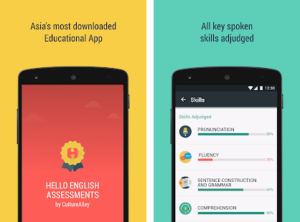
The Hello App comes with 475 free interactive lessons, games, practice videos, and e-books. Whether you want to attend an interview or impress your friends with your flawless English – this English conversation practice app serves the purpose. Hello is a social network that connects you with communities of people who share your interests, around the world, and in your neighborhood.
Learning a language requires consistent practice. Using these amazing apps you will be able to hone your English communication skills. If you are using an application that is helping you improve your English. Write it in the comments section.