English Conversation Practice |

Tag

english conversation practice

Speak vs ELSA Speak: 2026 Comparison for English Fluency Practice

May 9, 2026 • 15 min read • By Rishish Pandey

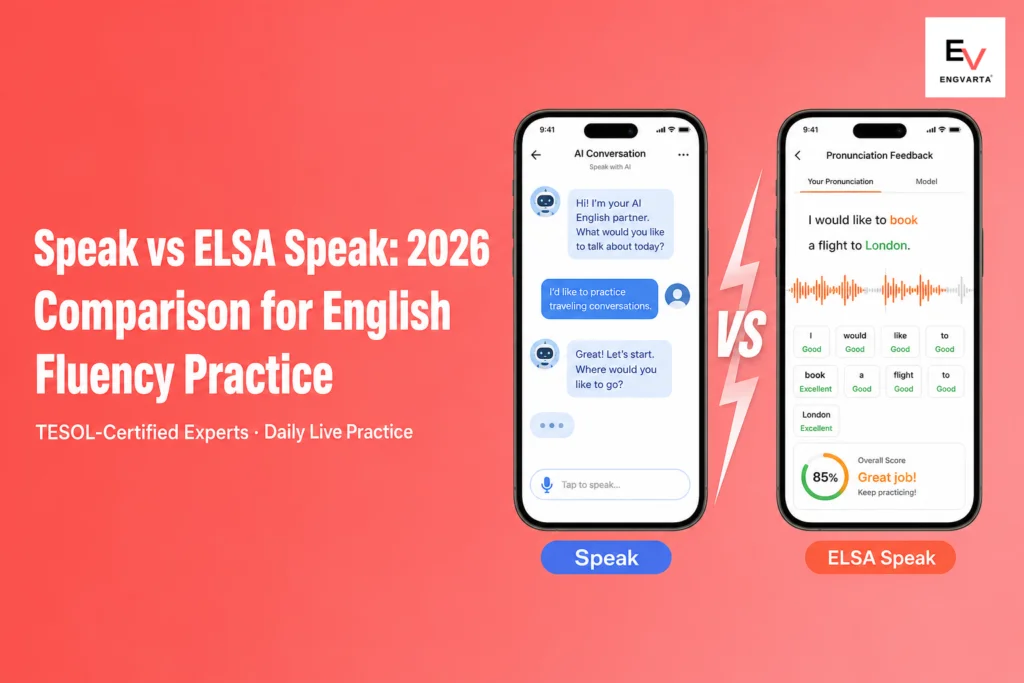
Two phone mockups with VS divider showing AI conversation app vs pronunciation app — Speak vs ELSA Speak comparison 2026
Quick VerdictSpeak and ELSA Speak are not actually competing for the same job. Speak is a conversational-practice app — you have AI roleplay conversations on real-world scenarios. ELSA Speak is a pronunciation-coaching app — you read sentences and get phoneme-level feedback on individual sounds. If you confuse them and pick the wrong one for your actual gap, you waste 3 months. This guide walks through the real difference, who each one is built for, and where neither AI app is enough — at which point human-led 1-on-1 practice (the model used by EngVarta) becomes the missing piece.

If you have searched for “Speak vs ELSA Speak” you are probably halfway through choosing an English-practice app and the two keep coming up in the same lists. They cost roughly the same. They are both AI-driven. They both promise fluency. But once you actually use them for two weeks, it becomes clear they are solving different problems — and choosing the wrong one means three months of practice that does not move the gap you actually had.

This guide compares Speak and ELSA Speak on the dimensions that matter for adult learners: conversation depth, pronunciation accuracy, real-time correction quality, scenarios covered, pricing, and — most importantly — what each app cannot do. We end with a section on when neither AI app is the right tool, and what to use instead.

At-a-glance comparison

Dimension Speak ELSA Speak
Primary purpose AI conversation roleplay Pronunciation coaching
Best for Adults building conversational fluency Learners with accent / pronunciation gaps
Interaction style Open-ended conversation with AI tutor Read scripted sentences, get sound-by-sound feedback
Real-time correction Limited — AI continues conversation, sometimes flags errors Detailed — phoneme-level feedback after each sentence
Conversation density High (5-15 min per session) Low (drill-style, 5-10 min per session)
Pricing (typical) ~$20-30 per month ~$11.99 per month or $74.99 per year
Free trial Limited free tier 7-day free trial
Platforms iOS, Android, web iOS, Android, web
Backed by OpenAI Startup Fund (publicly disclosed) Independent — has raised from VC investors

What Speak does well — and where it falls short

Speak is built around an AI tutor that runs scenario-based conversations. You pick a topic — ordering at a restaurant, a job interview, asking for directions, talking to a colleague — and the AI roleplays the other side. You speak; it responds; the conversation moves forward.

The strengths:

  • Conversation density. Most Speak sessions involve 5-15 minutes of you actually talking, which is far more than a typical group class.
  • Stakes-free practice. You can fumble, restart, repeat a phrase — the AI does not get impatient or judge.
  • Scenario library. Speak has built out a catalogue of professional and social scenarios that map to real life situations adults face.
  • Always available. No scheduling — open the app, tap a scenario, you are practising in 30 seconds.

The weaknesses — particularly for adult professional learners:

  • Correction quality is uneven. The AI tutor sometimes catches errors and sometimes does not. You cannot tell when it is letting a mistake slide because the conversation is moving forward, vs catching it and silently correcting itself in its next turn.
  • No accent feedback. Speak focuses on conversation flow, not pronunciation. Your specific phonetic gaps are not addressed.
  • Conversation predictability. Once you have used Speak for a few weeks, the AI tutor’s response patterns become familiar — and the pressure of unpredictable real conversation drops away. This is the limit of any current AI conversation tool: it cannot match the variability of an actual human partner.
  • No human accountability. The friction of practising every day comes from there being no person waiting for you. AI sessions can be skipped without consequence.

Verdict on Speak : Excellent first-stage tool for someone who has been afraid to speak at all. It builds the habit. But after 6-10 weeks, the gains plateau because the variability of conversation tops out.

What ELSA Speak does well — and where it falls short

ELSA Speak is a different category of tool. Instead of an open-ended conversation, you read prepared sentences and the AI scores your pronunciation sound-by-sound. It tells you which vowel was off, which consonant was muted, which stress fell on the wrong syllable, and how close your version was to a model native pronunciation.

The strengths:

  • Phoneme-level precision. No other consumer app gets this granular about pronunciation. ELSA’s feedback identifies the exact sound that needs work, which is rare even with human tutors.
  • Visual feedback. The colour-coded sound chart shows you what your mouth is doing wrong and where to put your tongue, lips, and air.
  • Targeted accent reduction. If you are aware that your specific accent has a certain weakness — such as Indian English with the /v/-/w/ mix-up, or East Asian English with the /r/-/l/ — ELSA provides
    you targeted drill exercises.
  • Measurable progress. Pronunciation scores compound over weeks; you can see actual numerical improvement.

The weaknesses:

  • Not a conversation app. ELSA does not build conversational stamina. You read sentences; you do not speak in continuous flow.
  • Drill fatigue. Reading scripted sentences for 15 minutes a day is mechanically tiring and easy to skip.
  • Score chasing trap. Some users start gaming the score by speaking in an unnatural slow articulation that earns higher marks but ruins their natural conversational speed.
  • Model-pronunciation rigidity. ELSA judges against an American English standard. If your goal is British or another regional English, the feedback is partially mismatched.

Verdict on ELSA Speak: The best consumer pronunciation tool currently available. But it is a complement, not a complete English fluency solution.

Speak vs ELSA Speak — head-to-head on 8 dimensions

1. Conversation flow

Speak wins decisively. ELSA does not have continuous conversation — it has read-aloud drills.

2. Pronunciation feedback

ELSA wins decisively. Speak gives you a transcript of what you said but does not tell you which sounds were off.

3. Real-time correction during speaking

Speak gives you mid-conversation hints (a transcript bubble that flags errors). ELSA gives you sentence-by-sentence sound-level feedback. Speak is faster but shallower; ELSA is slower but deeper.

4. Scenario relevance for adult professional life

Speak wins — its scenario library includes job interviews, work meetings, networking, and everyday tasks. ELSA’s scripted sentences are general English-language sentences, not contextual scenarios.

5. Habit formation

Both apps are skippable because there is no human partner. Speak feels more rewarding moment-to-moment because conversation produces a sense of social engagement; ELSA feels more rewarding long-term because score progression is visible.

6. Pricing per month

ELSA is cheaper at the typical sticker price (around $11.99 per month vs Speak’s roughly $20-30 per month). However, both apps have promotional pricing and trials that change frequently — verify current pricing in their respective app stores before subscribing.

7. Trial availability

ELSA offers a clear 7-day free trial. Speak’s free tier is more restrictive — you get sample sessions but full access requires subscription.

8. Long-term ceiling

Both apps plateau eventually. Speak plateaus when the AI conversation becomes predictable (typically 8-12 weeks). ELSA plateaus when your pronunciation score stops moving, which usually means you have hit the ceiling of what AI scoring can detect (typically 3-4 months for committed users).

Real-world scenarios — which app for which goal

Goal: I’m afraid to speak at all in English

Start with Speak. The stakes-free conversational practice helps you cross the speaking threshold. After 4-6 weeks, layer in ELSA for pronunciation work or move to a human-led practice tool.

Goal: I speak fine but my accent makes people ask me to repeat

ELSA Speak is the right starting point. Pair it with daily speaking practice (work conversations, podcasts you respond to aloud, or a human-led practice tool) so you actually use the corrections in conversation, not just in drill.

Goal: I have a job interview / presentation / business meeting in 4 weeks

Neither app is sufficient on its own. Speak can rehearse the scenario but cannot give you accent corrections under stress. ELSA can fix specific pronunciation issues but cannot rehearse the meeting flow. For event-specific preparation, consider human-led 1-on-1 practice with a real Expert (covered in the next section).

Goal: I want to become genuinely fluent for everyday life

Use both apps as part of a combined routine, but recognise their ceiling. After 3-4 months, conversation depth and pronunciation precision both demand human practice partners — AI cannot fully substitute.

Pricing comparison — the honest framing

Both apps cost less than $30 per month. That is cheap relative to a human tutor. But the right framing is “cost per measurable fluency gain,” not raw subscription price. If you spend three months on Speak and stay roughly where you started in conversational confidence, the cost was not the $60-90 — it was the three months.

For accent reduction specifically, ELSA’s per-month pricing delivers measurable returns in 4-6 weeks for most users. For conversational stamina, Speak delivers initial returns in 4-6 weeks then plateaus. After that, the calculation changes — and human practice becomes more cost-effective per hour of actual progress.

A third option — when AI is not enough

Both Speak and ELSA Speak hit a ceiling because AI cannot match the unpredictability of a real conversation partner, cannot give you culturally-aware correction, and cannot adjust its style mid-conversation when it senses you are confused. After 8-12 weeks of using either app, most learners need a human in the loop.

EngVarta sits in that gap as a third option. Instead of an AI tutor, EngVarta connects you to a TESOL/ESL-certified English Expert for live 1-on-1 audio sessions. You select 15, 25, or 50 minutes, and connect to an Expert in minutes. The Expert pays attention and offers immediate corrections throughout the call — focusing on pronunciation, grammar, and fluency — and gives summarized feedback at the conclusion of the session Sessions are recorded and accessible for 30 days.

The functional difference: a Speak AI does not get tired, but it also does not detect the moment you stopped tracking the conversation. A human Expert does. A human Expert can adjust the topic when she senses you are bored, slow down when you are lost, push you when you are coasting, and bring back a phrase you used incorrectly six minutes earlier.

Pricing: $1 for a 10-minute trial, 100% refundable. Regular plans start at $45 per month for 25 sessions in USD markets, or ₹2,700 for 25 sessions in India (~₹108 per session). The audio-only design works on slower mobile networks and removes camera-pressure, which matters for self-conscious learners. Operating hours 7 AM to midnight cover most adult schedules.

EngVarta is not in the same category as Speak or ELSA — it is a human-led service. The right comparison is “AI tools vs human practice,” and the answer is usually: use AI for the first 2 months to build the habit, then move to human practice for the depth that AI cannot provide. We’ve written more about this comparison in our analysis of AI English apps vs live tutors and our review of the best English speaking practice apps for 2026.

Ready to Practice with Real Experts?

Try EngVarta today — ₹69 trial (India) / $1 trial (International) · 100% refundable

How to decide — a practical framework

Pick the tool that matches your actual gap, not the one that seems most popular:

  1. If your gap is “I freeze up when speaking” → start with Speak. The stakes-free AI conversations help you cross the threshold. Use for 4-6 weeks.
  2. If your gap is “people ask me to repeat” or “my accent gets in the way” → start with ELSA Speak. Phoneme-level pronunciation correction is its specialty. Use for 6-8 weeks of daily 15-minute drills.
  3. If both Speak and ELSA stop producing visible gains → move to human-led practice. EngVarta or a similar 1-on-1 live-tutor service fills the gap that AI cannot. The 100% refundable trial at $1 is the cheapest way to sample whether the format works for you.
  4. If you have a hard event in 30-45 days → skip the AI step entirely. Hard deadlines need accountability and feedback that only a human Expert can provide.

👉 Connect with EngVarta & Upgrade Your English Every Day!

Speak English fluently and confidently with daily practice tips, real-life conversations, and expert guidance designed to make your English natural and effortless.

📸 Instagram: https://www.instagram.com/engvarta.app/
▶️ YouTube: http://www.youtube.com/@EngVarta
📘 Facebook: https://www.facebook.com/engvarta
💼 LinkedIn: https://www.linkedin.com/company/engvarta

Follow EngVarta today and start speaking English with real confidence—every single day!

The bottom line

Speak and ELSA Speak are not the same product, and treating them as interchangeable is the most common mistake. Speak builds conversational confidence; ELSA Speak builds pronunciation precision. Most adult learners eventually need both, then a human Expert to push past the AI ceiling.

Choose by your actual gap, not by which one shows up first in a search result. And if your timeline is short or your gap has not closed in 6-8 weeks of daily AI practice, a human-led service like EngVarta‘s live 1-on-1 audio sessions with TESOL/ESL-certified Experts is usually the missing piece — with a 100% refundable trial that lets you test the format without financial risk.

Editorial note: this comparison reflects our independent assessment of Speak and ELSA Speak. We have not received payment, sponsorship, or affiliate commission from either platform for inclusion in this article.

What Our Learners Say

Rated 4.5★ from 9,100+ reviews on Google Play

★★★★★
This app is amazing, it's helpful and good. The tutors are very excellent. I am improving and don't shy anymore.
★★★★★
I have thoroughly enjoyed the session and the expert provided me instant feedback that will definitely help me.
★★★★★
Excellent application to improve your communication skills.Thnk you for introducing new vocabulary everyday.God bless you You might not aware of but personally this is helping me a lot
★★★★★
I have been practising English on EngVarta for the past 30 days and results are significant. I’m happy to be here.
★★★★★
I have completed 100 sessions with EV. Today I can speak confidently with anyone and this confidence is a gift from EngVarta. I truly wish I could join the EV family again.
★★★★★
Its just great, I mean in terms of environment that it gives you is just awesome. Thnx again for boosting my confidence.
★★★★★
In the beginning I felt very nervous to talk but when I picked the call the expert spoke in such a gentle way. I really liked it.
★★★★★
I attended just my first class. I literally love it. I got my gurus in this app.
★★★★★
best app for English communication. I have tried lots of English speaking apps till date. but all have some dra backs. but this is really awesome experience of mine. best teachers and best app. 💯
★★★★★
Great app for learning English speaking. All the experts are supportive and non-judgemental. After every session, constructive feedback is provided to enhance yoilur skills. Also it has AI enabled feature for assignment practice. Overall a great platform to practise English speaking with experts.
★★★★★
Good app to express yourself because in our house there are no environment n EngVarta provides you environment
★★★★★
Great !!! Enjoying it 👍experts reAlly help you to see your mistakes and correct them in the mean time.

Frequently Asked Questions

Is Speak better than ELSA Speak?

Neither is inherently superior — they address distinct issues.  Speak is a conversational AI tool that builds speaking stamina. ELSA Speak is a pronunciation coaching tool that scores your sounds. If your gap is hesitation and conversational confidence, Speak is better. If your gap is accent and pronunciation clarity, ELSA Speak is better.

Can I use both Speak and ELSA Speak together?

Yes — they are complementary. A common combined routine is 10-15 minutes of Speak conversation followed by 5-10 minutes of ELSA Speak pronunciation drilling on words or sounds you struggled with in the conversation. Total: 20-25 minutes per day. After 6-8 weeks, evaluate whether the combined routine is still producing visible gains; if it has plateaued, add human practice.

Are Speak and ELSA Speak suitable for absolute beginners?

Speak is more accessible for absolute beginners because it allows you to fumble through scenarios at your own pace. ELSA Speak assumes you can already read English sentences aloud, which makes it harder for beginners. Beginners often benefit more from a structured human-led conversation app or course before adding ELSA for pronunciation refinement.

How long does it take to see fluency improvement with Speak or ELSA Speak?

For consistent daily users (15-25 minutes per day): Speak typically produces visible gains in conversational confidence within 4-6 weeks. ELSA Speak typically produces measurable pronunciation score improvements within 4-6 weeks. Both apps plateau after 8-12 weeks of daily use, at which point most learners need to add a human practice element to keep progressing.

What is the cheapest way to start?

ELSA Speak offers a 7-day free trial of full access. Speak has a limited free tier with restricted scenarios. EngVarta‘s 10-minute trial is $1, 100% refundable — the cheapest way to sample human-led practice with a TESOL/ESL-certified Expert before committing to a monthly plan.

Are Speak and ELSA Speak the same as Cambly or italki?

No. Speak and ELSA Speak are AI-based — you practice with software. Cambly, italki, and EngVarta are human-based — you practice with a real person. AI apps are good for habit formation; human-led services are better for fluency depth and accountability. Most learners use both at different stages of their fluency journey.

Best Apps for English Conversation Practice (2026 Tested Review for Reddit & Real Learners)

May 4, 2026 • 14 min read • By Rishish Pandey

Best Apps for English Conversation Practice — banner
Quick Verdict (2026)If you’ve been searching Reddit for “best app to practice English conversation,” here’s the honest, tested rundown for 2026. Top picks by what they actually do: EngVarta for live 1-on-1 audio conversation with a real TESOL/ESL-certified Expert (~$1.80 per session, what most working professionals end up using daily); Speak and Loora for AI-driven conversation roleplay; HelloTalk and Tandem for free language-exchange chat with strangers (zero-budget option); Cambly for premium native-speaker video tutoring; ELSA Speak for pronunciation-only drilling. The right pick depends on your timeline and budget — details below.

Reddit threads on r/EnglishLearning, r/ChatGPT, r/languagelearning, and r/IWantToLearn have asked some version of “which app is best for practising English conversation?” hundreds of times. The answers in those threads are a mix of useful, outdated, and sponsored.

If you’re looking for the best apps for English conversation practice, this guide gives you a clear, updated answer.

This is a 2026-current, hands-on rundown of the apps that actually work for English conversation practice—with specific recommendations for different learner profiles.

If you’re reading this from a Reddit search, the short version is below. If you want to understand why each app fits a specific use case, the detailed comparison follows.

The 7 Apps That Actually Work for English Conversation Practice in 2026

These are the apps Reddit users keep recommending in 2026, ranked by speed of fluency gain rather than marketing budget:

1. EngVarta — Best Live Human Practice (Most-Used by Indian + South Asian Learners)

EngVarta is the live-human anchor most working learners end up using when they’re serious about conversational English. Each session is a 15, 25, or 50-minute live audio call with a TESOL or ESL-certified English Expert. The Expert listens to you speak, corrects pronunciation/grammar/word choice in real time, and shares consolidated feedback towards the end of every session.

Why it works:

  • Real human Experts handle Indian, Bangladeshi, Sri Lankan, Filipino, and Egyptian accents better than AI
  • Audio-only design (no camera-pressure after a Zoom-heavy workday)
  • Sessions 7 AM to midnight India time daily
  • Recorded for 30 days for self-review
  • ~$1.80 per 25-minute session (sustainable for daily practice)
  • Trial is ₹69 ($1) for 10 minutes, 100% refundable
  • Lakhs of learners across India and expanding markets in US, UAE, Canada, Singapore

Best for : Working professionals, college students preparing for placements, government employees, learners targeting timeline outcomes (interview, IELTS, promotion). Not for: Free practice or 24/7 unlimited reps.

Ready to Practice with Real Experts?

Try EngVarta today — ₹69 trial (India) / $1 trial (International) · 100% refundable


What Our Learners Say

Rated 4.5★ from 9,100+ reviews on Google Play

★★★★★
Wonderful application for English learners and good for speaking with trainers .All trainers are well experienced and help us within the time period,Thanks
★★★★★
Thank u so much @engvarta it is very good for learning English daily I learn new words daily I get new vocabulary again thnxx again 👍🏻👍🏻
★★★★★
So comfortable to speak with the expert , really like this app
★★★★★
It was a great experience praticing with EngVarta. Thank you experts for helping me reach
★★★★★
i completed my trial session, expert was good. I installed this app because chatgpt recommended it and I find it quite good speaking practice. experts are professional and friendly. plans are also economical compared to other english courses i took in the past.
★★★★★
Engvarta is the best app for the people who are really serious in their learning English.
★★★★★
Thanks EngVarta I appreciate your platform sir for those who willing to learn speaking English fluently
★★★★★
It was a very amazing experience to talk to an expert. She suggested how to improve my speaking skills and enhance my confidence level. EngVarta is the best platform to learn English fluently.
★★★★★
Really we can see the positive results from the app. Well done!
★★★★★
Don’t take that, it’s a good application during the trails calls only. After the buying the plans no refund option and no experts available on your schedule time.
★★★★
This app is nice but I think you should increase the time because charges are very much high
★★★★★
hii i have taken your 69 rs plan for expert calling but no response from your side you gove the number i am trying to call on that number but no response r u making me fool? or what?

2. Speak — Best AI Conversation App (Unlimited Reps, 24/7)

Speak is the most-recommended AI conversation app on Reddit for 2026. AI-driven roleplay scenarios, voice-first interface, instant feedback, gamified daily streaks. Best for unlimited low-pressure practice, learners early in their journey who prefer AI before facing a human, and learners who want 24/7 availability.

Limitations : AI corrections are over-polite (lets small mistakes pass), accent recognition gaps for non-native English speakers, no real accountability. Pricing ~$20–25/month.

Detailed Speak alternatives comparison →

3. Loora — Direct Speak Alternative (Similar Concept)

Loora is the closest like-for-like alternative to Speak. AI-driven voice conversation, scenario-based practice. Slightly more business and professional context in the scenario library; pricing sometimes 20–30% cheaper than Speak. ~$15–20/month.

4. Talkpal — Cheaper AI Conversation Option

Talkpal is another direct AI-conversation app with stronger grammar correction emphasis than Speak. ~$12–18/month. Best for learners with intermediate vocabulary but weaker grammar.

5. HelloTalk & Tandem — Free Language Exchange

Both pair you with native English speakers who want to learn your language. Genuinely free for basic use. The trade-off: no expert correction, conversation quality varies wildly partner-to-partner, partners often drift to small talk that doesn’t stretch your vocabulary.

Best for : Zero-budget learners who already have intermediate fluency and want exposure. Not for: Beginners or anyone targeting structured progress on a timeline.

6. Cambly — Premium Native-Speaker Video

Cambly connects you to native-speaker tutors over video. Quality is high; sessions feel real. The catch: ~$10 per 15-minute lesson means daily practice gets expensive. Most Cambly users do 2–3 sessions per week (below the daily-practice frequency that fluency requires).

Best for : Higher-budget learners who want native-speaker exposure and don’t mind video calls.

7. ELSA Speak — Pronunciation Drilling Only

ELSA isn’t a conversation app — it’s a pronunciation tool. Phoneme-by-phoneme accent feedback on scripted text. Best for pronunciation and accent reduction; complement to any of the conversation apps above. ~$11.99/month.

Quick Comparison: Best Apps for English Conversation Practice 2026

App Type Best For Starting Price
EngVarta Live human (audio) Indian + S Asian, daily-practice ~$1.80/session
Speak AI conversation Unlimited AI reps ~$20–25/mo
Loora AI conversation Speak alternative ~$15–20/mo
Talkpal AI conversation + grammar Cheaper AI option ~$12–18/mo
HelloTalk / Tandem Language exchange chat Free option Free / ~$7–14/mo
Cambly Native-speaker video Premium budget ~$10/15min
ELSA Speak AI pronunciation Accent fix ~$11.99/mo

What the Reddit Threads Often Get Wrong

Going through the most-upvoted “best app for English conversation” threads on Reddit, three patterns repeat:

  1. “Just use Duolingo” recommendations. Duolingo is great for vocabulary and daily-streak habit. It’s not a conversation app — the speaking exercises are scripted single-sentence drills, not real dialogue. Reddit users who recommend Duolingo for “conversation” usually haven’t actually tried building conversational fluency on it.
  2. “HelloTalk is enough” recommendations. HelloTalk is fine for casual exposure. It’s a poor fit for structured fluency growth because there’s no expert correction, partners drift to small talk, and conversation quality is wildly variable.
  3. “ChatGPT can replace any app” recommendations. ChatGPT (and similar LLMs) can be useful for written practice and quick translation. They’re weak for spoken conversation practice because they don’t hear your accent, can’t correct pronunciation, and don’t simulate real-time conversational pressure.

The apps that actually work in 2026 are the ones that force you to speak out loud daily with feedback — either from a real human Expert (EngVarta, Cambly) or from a purpose-built AI conversation app (Speak, Loora, Talkpal).

How to Pick: A Decision Framework

If you have a budget and a timeline (interview in 4 weeks, IELTS in 8 weeks, promotion in 6 months)

Pick: EngVarta + ELSA Speak. ~$57/month total. Live human practice for measurable progress + targeted accent drilling. Most successful timeline-driven learners use this combination.

If you want unlimited 24/7 AI practice without scheduling

Pick: Speak (~$25/month) or Loora (~$18/month). Add ELSA if accent is a known weakness.

If your budget is zero and you have intermediate English already

Pick: HelloTalk / Tandem (free) for exposure. Plan to upgrade to a paid live-practice or AI app once you can afford ~$15–45/month.

If you want premium native-speaker video and have higher budget

Pick: Cambly. Plan for 2–3 sessions per week (~$60–90/month).

If you’re an absolute beginner

Pick: Speak (low social pressure, AI doesn’t judge) for the first 30–60 days. Then upgrade to EngVarta for measurable fluency progress.

If you’re Indian, Bangladeshi, Sri Lankan, Filipino, or Egyptian

Pick: EngVarta. The TESOL/ESL-certified Experts specifically handle South Asian and Filipino mother-tongue-influence patterns better than AI apps.

The Truth About How Long This Takes

Reddit threads often promise “fluent in 30 days” or “native-level in 3 months.” That’s marketing copy, not reality.

For most intermediate learners doing 25 minutes of daily live audio practice with feedback (EngVarta or equivalent), realistic timelines are:

  • 3–6 weeks : Visibly less hesitation, faster recall of the right word, more confident sentence-construction
  • 6–9 months : Conversational fluency — you no longer translate from your native language, the right English phrase just shows up
  • 12–18 months : Full professional fluency including domain-specific vocabulary, presentation comfort, salary-negotiation language, difficult-conversation phrasing

The non-negotiable: practice has to be daily and out loud with feedback. Not silent reading. Not group classes where you speak 5 minutes per session. Not YouTube videos.

What Most Reddit Users Don’t Mention: The Practice Stack That Actually Works

The learners who become fluent in 6–12 months don’t use one app. They use a stack:

  • 15–30 min daily speaking practice — live human Expert (EngVarta) or AI conversation app (Speak/Loora/Talkpal). This is the non-negotiable core.
  • 10 min pronunciation drilling — ELSA Speak, 3–4 days a week. Targets specific phonemes.
  • 10 min vocabulary & grammar habit — Duolingo or Memrise, daily. Builds knowledge.
  • 20 min listening immersion — English podcasts or YouTube in your target accent. Builds rhythm and natural pacing.
  • One “hard” conversation per week — volunteer for the difficult presentation, take the client call you’ve been avoiding. Forced reps under real pressure.

Total time: ~75 minutes/day. Total cost (with EngVarta + ELSA): ~$57/month. That’s the actual path to fluency in 2026 — not any single magic app.

Stay connected with EngVarta on social media and never miss an update! 🚀

Follow us here 👇
📸 Instagram : https://www.instagram.com/engvarta.app/
▶️ YouTube : http://www.youtube.com/@EngVarta
📘 Facebook  https://www.facebook.com/engvarta
💼 LinkedIn : https://www.linkedin.com/company/engvarta

Join our community and keep improving your English every day! ✨

Frequently Asked Questions

What is the best app for English conversation practice in 2026?

For most intermediate Indian and South Asian learners, EngVarta is the best app for English conversation practice — live 1-on-1 audio sessions with TESOL/ESL-certified Experts at ~$1.80 per 25-minute session. For unlimited 24/7 AI conversation reps, Speak (~$20–25/month) or Loora (~$15–20/month) are reasonable alternatives.

Which English conversation app do Reddit users actually recommend?

The apps most consistently recommended on r/EnglishLearning, r/languagelearning, r/IWantToLearn, and r/ChatGPT in 2026: EngVarta (live human practice), Speak (AI), HelloTalk + Tandem (free language exchange), Cambly (premium native-speaker video), ELSA Speak (pronunciation drilling). The right pick depends on your budget, timeline, and learning style.

Is HelloTalk enough for English conversation practice?

HelloTalk is fine for casual exposure if you already have intermediate fluency. It’s not enough for structured progress because there’s no expert correction, partners drift to small talk, and conversation quality varies wildly. For measurable fluency progress, pair HelloTalk with a paid live-practice or AI app.

Can ChatGPT replace English conversation practice apps?

ChatGPT is useful for written practice and quick translation but is weak for spoken conversation practice — it doesn’t hear your accent, can’t correct pronunciation, and doesn’t simulate real-time conversational pressure. Apps purpose-built for voice conversation (EngVarta, Speak, Loora, Talkpal) are more effective for spoken fluency.

What’s the best free English conversation practice app?

HelloTalk and Tandem are genuinely free language-exchange apps that pair you with native English speakers wanting to learn your language. They work for zero-budget learners with intermediate fluency. For free + structured content, the EngVarta YouTube channel offers vocabulary series, daily quizzes, and video lessons (no signup, no subscription) — pair with HelloTalk for free conversation practice.

How long does it take to become fluent in English using a conversation app?

For an intermediate learner doing 25 minutes of daily live audio practice with feedback, most see meaningful improvement in spoken English by week 4–6. Conversational fluency — where you no longer hesitate or translate from your native language — typically takes 6–9 months of consistent daily practice.

Are AI English conversation apps as good as human tutors in 2026?

AI conversation apps have improved dramatically and are useful for unlimited low-stakes reps. For the fastest fluency gains, live human Experts still outperform AI on accent recognition (especially for Indian, Bangladeshi, Sri Lankan, Filipino, and Egyptian accents), correction precision (AI tends to over-polite), and real accountability.

What’s the best app for English conversation practice for Indian learners?

For Indian learners specifically, EngVarta is the most-used live-practice app — TESOL/ESL-certified Experts familiar with mother-tongue-influence patterns from Hindi, Tamil, Telugu, Marathi, Bengali, Punjabi, and Gujarati. Sessions are audio-only, available 7 AM to midnight India time, ~$1.80 per session, with a ₹69 refundable trial.

Should I use Duolingo for English conversation practice?

Duolingo is great for vocabulary and daily-streak habit but not designed for conversation practice — the speaking exercises are scripted single-sentence drills, not real dialogue. Use Duolingo for the vocabulary slot in your stack, but pair it with EngVarta or Speak for actual conversation practice.

What’s the cheapest way to practise English conversation daily?

Cheapest paid option: EngVarta at ~$1.80 per 25-minute live human session (~$45/month for daily). Cheapest free option: HelloTalk + Tandem language exchange (free) supplemented by EngVarta YouTube channel for self-learning content. AI app middle ground: Talkpal at ~$12–18/month for unlimited AI conversation reps.


Editorial independence: This is an independent guide to English conversation practice apps in 2026. EngVarta is the publisher and is included as a legitimate option for the live-human practice slot. No app paid for inclusion or placement; rankings reflect actual learner outcomes and value-per-dollar.

How to Remove Hesitation in English Speaking — Proven Daily Method

April 14, 2026 • 21 min read • By Rishish Pandey

How to remove hesitation in English speaking - proven daily method by EngVarta
Quick Verdict · 2026 Hesitation in English speaking is fixed by daily reps under real conversational pressure — not by reading more grammar or memorizing vocabulary. EngVarta‘s voice 1-on-1 sessions with vetted experts (₹69 refundable trial; plans from ₹2,700 for 25 sessions) train the specific muscle that hesitation atrophies: thinking and speaking simultaneously. Below: 3 levels of hesitation, why apps alone don’t fix it, and the proven daily method that does.

Hesitation in English speaking is NOT a grammar problem. It is a confidence problem caused by lack of real speaking practice. You do not need more vocabulary lessons or grammar drills — you need daily spoken practice with a real person. Over 2 million+ learners on EngVarta have proven this in 2026: 15 minutes of real conversation daily produces more confidence in 2-3 weeks than months of app-based learning alone.

This guide explains exactly why you hesitate, where you fall on the hesitation spectrum, and gives you a proven daily method to overcome hesitation in English speaking within weeks — not months. Updated for 2026 with the latest apps and methods.

Why You Hesitate When Speaking English (The Real Reasons)

Before you can fix english speaking hesitation, you need to understand what actually causes it. In 2026, with AI apps everywhere, this problem is more common than ever — people practise on Duolingo and ChatGPT for months but still freeze in real conversations. Here are the four real reasons:

1. You Translate from Your Native Language in Real Time

If your first language is Hindi, Tamil, Telugu, Bengali, or any Indian language, your brain builds sentences in Subject-Object-Verb order. English uses Subject-Verb-Object. When you translate in head from Hindi to English mid-sentence, the word order gets confused and your brain freezes. You want to say “I went to the market” but your brain constructs “I market to went” and then stalls trying to rearrange it. This mother tongue influence is the single biggest cause of hesitation while speaking english. The fix is not learning more grammar — it is training your brain to think in english directly through daily practice.

2. You Fear Judgment from Others

This is the emotional root of hesitation. You are afraid that the other person will judge your accent, laugh at your mistakes, or think less of you. This fear of making mistakes triggers your brain’s threat response — the same system that makes you freeze in danger. This speech anxiety causes your vocabulary to disappear, your mind to go blank, and you default to silence or switch to your native language. This fear is strongest in professional settings: meetings, interviews, client calls. The only way to speak english without fear is repeated exposure to real conversations where you are not judged — this is how you build English speaking confidence — until your brain stops treating English conversation as a threat.

3. You Have Studied English but Never Practised SPEAKING It

India’s education system produces millions of people who can score 90% in English exams but cannot hold a 2-minute conversation. Reading, writing, and speaking are different brain circuits. You have trained the reading and writing circuits for 10-15 years. The speaking circuit has barely been used. It is like knowing the theory of swimming but never entering the water — your muscles have no memory of the actual movement. English speaking practice — real, daily, spoken output — is the only thing that builds this circuit.

4. You Overthink Grammar Rules While Talking

You start a sentence, then pause to check: is it “has went” or “has gone”? Should I use “since” or “from”? Is this the right tense? By the time you have decided, the moment has passed, the other person is waiting, and your hesitation has made the situation awkward. You fill the silence with filler words like “um,” “uh,” and “actually” while your brain scrambles. Fluent speakers do not think about grammar rules while talking — their brain applies them automatically because they have practised speaking enough. For a complete roadmap, read our guide on how to speak English fluently. Overthinking grammar during conversation is a symptom of too much study and too little practice. You need to stop studying and start speaking.

The 3 Levels of Hesitation in English Speaking

Not everyone hesitates the same way. Understanding your level helps you pick the right strategy to remove hesitation in English speaking. Find yourself below:

Level 1: “I Freeze Completely When Someone Speaks to Me in English”

You understand what the other person is saying, but when it is your turn to respond, your mind goes blank. You cannot produce even simple sentences. You might mumble “yes” or “okay” and then switch to your native language. This english speaking mental block is caused by almost zero speaking practice combined with extreme fear of judgment. You need a safe, daily environment for confidence building where you can speak English without any fear — where mistakes are expected and encouraged. The goal at this level is not fluency; it is simply getting words out of your mouth in English every single day.

Level 2: “I Can Speak but I Pause Too Much and Mix Languages”

You can hold a basic conversation in English, but you pause frequently to search for words, you mix Hindi or your native language into English sentences, and your sentences are often incomplete. You start strong but lose steam midway. This level means your brain has some speaking ability but not enough for sustained output. You need structured daily conversation where someone keeps you speaking in English for 10-15 minutes without letting you switch languages. The consistency of daily practice is more important than the length — 15 minutes daily beats 2 hours on weekends.

Level 3: “I Am Okay Casually but Freeze in Meetings and Interviews”

You can speak English with friends or in casual settings, but you freeze in high-pressure situations: job interviews, office meetings, presentations, calls with clients. This is a pressure-specific hesitation. Your speaking ability is actually decent, but anxiety in formal settings shuts it down. You need pressure-practice: regular conversations with someone who gives you real-time feedback, simulates professional scenarios, and gradually raises the difficulty. This is how to stop hesitating when speaking english in situations that matter. Our guide on English speaking for working professionals covers this in depth.

Proven Daily Method to Remove Hesitation in English Speaking

This is the method. It works for all three levels. It takes 30 minutes per day. Results become visible in 2-3 weeks. It is not complicated — but it requires daily consistency. If you skip days, your brain resets. If you do it every day, the compound effect is dramatic.

Morning — 5 Minutes: Self-Talk in English

As soon as you wake up, start self-talk english practice — narrate your morning routine out loud, not in your head. “I am getting out of bed. I need to brush my teeth. The water is cold today. I will make tea first.” Nobody is listening. There is no pressure. You are simply training your brain to produce English sentences first thing in the morning. This activates the English-speaking circuit in your brain before the day begins. Do this while getting ready — it does not require any extra time.

Midday — 5 Minutes: Shadow an English Video

During your lunch break, play a 5-minute English video — a TED Talk, a YouTube vlog, a news clip — and repeat exactly what the speaker says, immediately after they say it. Match their speed, rhythm, and intonation. This is called shadowing. It trains your mouth muscles to produce English at natural speed and teaches your brain correct sentence patterns through repetition. You are not thinking about grammar — you are copying natural speech. This builds the automatic sentence construction that fluent speakers use. Start with slow speakers and gradually increase speed over weeks.

Evening — 15 Minutes: Real Conversation with a Trained Expert on EngVarta

This is the KEY step. The other three steps are warm-ups and supplements. This is where the actual hesitation gets broken. Call an EngVarta expert and have a real 15-minute conversation in English. Talk about your day, discuss a topic, or practice a professional scenario — whatever matches your level. The expert will keep you speaking, gently correct your mistakes, help you finish sentences you struggle with, and push you slightly beyond your comfort zone every session.

Why this step is irreplaceable: self-talk has no social pressure. Shadowing is repetition, not creation. Only a real conversation with a real person forces your brain to construct original sentences under real social conditions. Every time you survive a conversation — even an imperfect one — your brain records evidence that you CAN speak English. This evidence accumulates. After 15-20 sessions, your brain stops treating English conversation as a threat and starts treating it as normal. That is when hesitation disappears.

Before Bed — 5 Minutes: Record a Voice Note About Your Day

Open your phone’s voice recorder and talk about your day for 2 minutes in English. What happened, what you ate, what you learned, what you plan for tomorrow. Do not write a script — just speak. Then play it back and listen. Notice your pauses, your restarts, your sentence structure. You do not need to analyse it technically — just listening makes your brain aware of patterns. Over 30 days, compare your Day 1 recording to Day 30. The improvement will surprise you. This step builds self-awareness and gives you a measurable record of your progress in building english speaking confidence.

Total daily investment: 30 minutes. Here is the breakdown:

  • Morning self-talk: 5 minutes — activates English brain circuits
  • Midday shadowing: 5 minutes — builds mouth muscle memory and natural rhythm
  • Evening EngVarta conversation: 15 minutes — the core confidence builder (real social practice)
  • Bedtime voice recording: 5 minutes — self-awareness and progress tracking

Within 2-3 weeks, you will notice yourself hesitating less. Within 2 months, people around you will notice the difference. The method works because it attacks hesitation from every angle: brain activation, muscle memory, real social practice, and self-awareness.

Why Apps Alone Do Not Fix English Speaking Hesitation

If apps alone could remove hesitation, millions of Duolingo users would be fluent speakers by now. They are not. Here is why each popular app addresses the wrong problem when it comes to how to speak english without hesitation:

Duolingo teaches vocabulary and basic grammar through gamified exercises. It is excellent for learning new words and building reading comprehension. But it does not make you speak. You tap, swipe, and type — you rarely say a full sentence out loud under any kind of pressure. Duolingo builds knowledge of English, not the ability to use that knowledge in real-time conversation. Knowledge without practice is exactly what causes hesitation in the first place.

ELSA Speak is one of the best apps for pronunciation. Its AI can detect exactly which sounds you are mispronouncing and give you targeted drills. But pronunciation and hesitation are completely different problems. You can have perfect pronunciation and still freeze when someone asks you a question in a meeting. ELSA fixes how you say words. It does not fix whether you can produce sentences under social pressure. If pronunciation is your problem, ELSA is great. If hesitation is your problem, ELSA will not help.

ChatGPT Voice is the newest option and it is genuinely impressive. You can have free-flowing conversations in English with an AI that responds naturally, corrects your grammar, and never judges you. The problem is that last part: it never judges you. Your brain knows it is talking to a machine. The social anxiety that causes hesitation never activates, which means you never learn to manage it. You can speak flawlessly to ChatGPT and still freeze when a colleague asks “can you explain this in English?” ChatGPT is a useful warm-up tool, but it will not transfer to real-world situations.

HelloTalk connects you with real language exchange partners around the world. The concept is sound — real people, real conversations. The problem is reliability and quality. Your partner might not show up, might not be a good teacher, might not correct your mistakes, or might only want to practise their Hindi while you want to practise English. You have no control over the quality or consistency of the experience. For casual practice it is fine. As a reliable daily method to remove hesitation, it is too inconsistent.

The uncomfortable truth: the ONLY thing that reliably removes hesitation is speaking to a real person, regularly, in a structured and judgment-free environment. What works and what does not:

  • Works: Daily real conversation with trained expert (EngVarta), consistent shadowing, self-talk routine
  • Partially works: ChatGPT Voice (good warm-up, no pressure transfer), Cambly (good but too expensive for daily use)
  • Does not work alone: Duolingo (grammar games, no speaking), ELSA Speak (pronunciation only), grammar books, vocabulary apps

Apps can supplement real conversation. They cannot replace it.

Best App for English Speaking Confidence

EngVarta is the best app for english speaking confidence because it is specifically designed for people who understand English but hesitate to speak it. It does not teach you grammar or vocabulary — it assumes you already know those. Instead, it gives you what you actually need: a daily 1-on-1 conversation with a trained English expert who helps you break through hesitation.

Here is what makes EngVarta different from every other option:

  • Daily 1-on-1 conversations with trained experts. Not AI bots, not random language partners, not tutors who follow a textbook. Trained experts who specialise in helping hesitant speakers find their voice. They know how to keep you talking, when to correct, and when to just let you struggle through a sentence — because struggling through is how you build the muscle.
  • Audio-only calls remove video self-consciousness. Many learners hesitate more on video because they are worried about how they look. EngVarta is audio-only, which removes that layer of anxiety and lets you focus entirely on speaking. You can call from your bedroom, your car, or during a walk — no camera, no setup.
  • Natural corrections, not clinical feedback. EngVarta experts do not interrupt you with grammar lectures. They weave corrections naturally into the conversation — the way a supportive friend would. “Oh, you mean you went to the market?” instead of “Error: incorrect tense usage.” This keeps the conversation flowing and makes corrections feel natural, not embarrassing.
  • Affordable for daily use. From ₹2,700 for 25 sessions in India. From $45 for 25 sessions internationally. This gives you daily sessions — the equivalent of a personal English speaking coach for less than the cost of two coffee shop visits per week. Cambly charges $52+ per month for just one session per week. EngVarta gives you daily practice at a similar price.
  • $1 trial / Rs 69 trial — 100% refundable. Try it once. If it does not feel right, you get your money back. No risk.
  • 2 million+ learners. EngVarta is not an experiment. Over 2 million learners have used it to build english speaking confidence. Available 7 AM to midnight, 7 days a week.
  • Download: Android | iOS

Comparison: Apps for Removing English Speaking Hesitation

Here is an honest comparison of the most popular apps people try when they want to know how to speak english without hesitation. Each app has its strengths — but only one is designed specifically to solve the hesitation problem.

AppFixes Hesitation?Why / Why NotPrice
EngVartaYes — real daily human practiceTrained experts, judgment-free, daily sessions. Specifically built for people who understand English but hesitate to speak it.from $45 for 25 sessions
ChatGPT VoicePartial — no social pressureGood warm-up tool and grammar practice. But zero social anxiety means skills do not transfer to real situations.Free / $20/mo
ELSA SpeakNo — pronunciation onlyExcellent for accent and sound correction. Does not address hesitation, sentence construction, or conversational confidence.$12/mo
HelloTalkInconsistentReal people but untrained, unreliable partners. Some weeks you get great practice, other weeks nobody shows up.Free
DuolingoNoVocabulary and grammar games. No real speaking practice. You will learn words but still hesitate in conversation.Free / $7/mo
CamblyPartialReal native tutors, which is good. But too expensive for daily use ($52+/mo for just 1 session per week). Hesitation removal requires daily practice.$52+/mo (1x/week)

The key takeaway: hesitation removal requires daily real-person practice. Any app that gives you less than daily human interaction will produce slower results. EngVarta is the only app in this list that provides daily expert-led conversation at a price point that makes daily use feasible.

Ready to Practice with Real Experts?

Try EngVarta today — ₹69 trial (India) / $1 trial (International) · 100% refundable

FAQs

How long does it take to remove hesitation in English speaking?

With the daily 30-minute method described above (self-talk + shadowing + real conversation + voice recording), most learners notice a significant reduction in hesitation within 2-3 weeks. The first change you will notice is that you stop freezing completely — you still pause, but you no longer go blank. By 6-8 weeks of daily practice, most learners report that English conversation feels noticeably more natural. Full confidence — where you speak without thinking about the fact that you are speaking English — typically takes 3-4 months of consistent daily practice.

Can I remove English speaking hesitation without talking to anyone?

Partially, but not completely. Self-talk, shadowing, and recording yourself will improve your ability to produce English sentences. But hesitation is fundamentally a social problem — it happens because another person is listening. You cannot train your brain to handle social pressure without actually experiencing social pressure. Solo practice is an important supplement, but you need real conversations to fully remove hesitation. This is why the evening EngVarta session is the most critical part of the daily routine.

What is the best app for English speaking confidence?

EngVarta is the best app for english speaking confidence because it gives you the one thing that actually builds confidence: daily real conversations with trained experts who specialise in helping hesitant speakers. Unlike AI apps, EngVarta creates real social interaction that trains your brain to handle the pressure of English conversation. Unlike tutoring platforms like Cambly, EngVarta is affordable enough for daily use (from $45 for 25 sessions vs $52+/month for weekly sessions on Cambly). Over 2 million+ learners have used EngVarta. Try it for $1 / Rs 69 — 100% refundable. Download on Android or iOS.

Why do I hesitate when speaking English even though I know grammar?

Because knowing grammar and being able to use it in real-time conversation are two completely different brain functions. Grammar knowledge is stored in your declarative memory (facts and rules). Speaking fluency lives in your procedural memory (automatic skills, like driving or typing). You can know every grammar rule perfectly and still hesitate because your procedural memory has not been trained through enough speaking practice. The solution is not more grammar study — it is daily english speaking practice that converts your knowledge into automatic skill. Think of it like this: you know the rules of driving from a textbook, but you can only drive smoothly after months of actual driving practice.

How to speak English without hesitation in office meetings?

Office meetings are the hardest environment because the stakes are high and multiple people are listening. Here is a specific strategy: First, build a base level of speaking confidence through daily practice on EngVarta for 2-3 weeks. Then, start asking your EngVarta expert to simulate meeting scenarios — “Let us discuss a project update” or “Explain this report to me.” Practice the specific vocabulary and sentence patterns you use at work. Before actual meetings, try breathing exercises speaking coaches recommend — slow deep breaths to calm your nerves — then prepare 2-3 key sentences you want to say and rehearse them out loud. During the meeting, start with short contributions — even one well-spoken sentence builds confidence for the next one. The more meetings you survive, the less your brain treats them as threats. Within a month of daily practice plus real meeting exposure, most learners report a dramatic reduction in meeting-related hesitation.

What Our Learners Say

Rated 4.5★ from 9,100+ reviews on Google Play

★★★★★
Thank u so much @engvarta it is very good for learning English daily I learn new words daily I get new vocabulary again thnxx again 👍🏻👍🏻
★★★★★
Thanks EngVarta I appreciate your platform sir for those who willing to learn speaking English fluently
★★★★★
This app is very useful for e English and the Mam is nice by rating is five star
★★★★★
An excellent platform to enhance communication skills. Kudos to the team.
★★★★★
It's a incredible app... It builds my confidence to speak English fluently, gives you practice to start your conversation without any hesitation, provides daily free vocabulary and quizes also...Expensive but amazing & worth it...
★★★★★
So comfortable to speak with the expert , really like this app
★★★★★
Excellent platform for people who don’t find any people to speak in English. Live experts help to build confidence while speaking and guiding to improve your communication!
★★★★
A very good app its just as good as shown in the advertisement,but I wish it would have been a bit cheaper,
★★★★★
Engvarta is a platform where we start from the 0 level to 100 level. That is the best thing I have never seen in my life. There are so many part and so many way, they are always try to teach you until you become a good speaker. Thank you Engvarta
★★★★★
This app is nice but I think you should increase the time because charges are very much high
★★★★★
Wonderful! They provide you a best platform to talk. A very unique idea I think. English is learned more by speaking than by being taught. So this is the best platform I think. And also you get a chance to interact with intellectual experts so that you can explore yourself.
★★★★★
Nice platform to practice English speaking. Teachers are awesome. Thanks


Hesitation in English speaking is not a permanent condition. It is a solvable problem with a clear solution: daily speaking practice with a real person. Every day you speak English to a real human being, your brain collects one more piece of evidence that you can do this. After enough evidence, your brain stops hesitating — not because you learned a trick, but because speaking English has become normal for you.

You do not need to study more grammar. You do not need a bigger vocabulary. You do not need a perfect accent. You need to open your mouth and speak English to a real person, every single day, for 15 minutes. That is it. That is the entire method.

EngVarta makes this possible. A trained English expert, available every day from 7 AM to midnight, who will talk to you, correct you naturally, and help you build the confidence that no app, no grammar book, and no AI chatbot can give you. Over 2 million learners have already taken this step.

Start today: engvarta.com — $1 trial / Rs 69 trial (100% refundable). Download on Android or iOS. Your hesitation has an expiration date — and today is the day you set it.

Top 7 Exercises to Master Professional English Speaking in 2026

March 24, 2026 • 13 min read • By Mahesh .

Professional English Speaking

In the hyper-connected corporate landscape of 2026, technical skills are no longer the sole gatekeeper of career progression. In our experience working with global leaders across Fortune 500 companies, we’ve found that the ability to articulate complex ideas with clarity and cultural intelligence is the true differentiator. Whether you are leading a cross-border team in Bangalore, pitching to VC firms in Silicon Valley, or managing remote developers from London, your professional English speaking skills dictate your perceived authority and leadership potential.

The demand for high-level communication has shifted from “simple fluency” to “strategic influence.” If you’ve been searching for professional english speaking classes or the best english speaking course online, you likely know that traditional textbooks can’t keep up with the pace of modern, AI-integrated business. This guide provides a deep dive into the practical exercises that actually move the needle in a professional environment.

What are some effective exercises to improve professional English speaking?

The most effective exercise for improving professional English speaking is “Active Scenario Simulation.” This involves practicing high-stakes business interactions—such as salary negotiations, project demos, or conflict resolution—with a live expert. Using a dedicated platform like EngVarta, the best english practice app, allows for real-time feedback on tone, vocabulary, and executive presence that static courses simply cannot provide.

1. The “Shadowing” Technique for Executive Presence

Shadowing is a classic linguistic exercise, but for 2026, we recommend a “Corporate Pivot.” Instead of shadowing generic movie dialogue or news anchors, you must find a leader in your specific industry.

Why industry-specific shadowing matters

Every industry has its own “linguistic DNA.” A tech lead speaks differently than a marketing director. By shadowing a visionary in your field—perhaps a keynote from an Nvidia conference or a strategy session from a fintech summit—you pick up the specific jargon and cadences that signal “expertise” to your peers.

How to do it:

  1. Source High-Quality Audio : Find a 30-second clip of a professional speaker whose style you admire.
  2. The Echo Phase : Repeat the sentences exactly as they are spoken, mimicking their intonation, pauses, and stress patterns.
  3. The Analysis Phase:  Pay close attention to “Power Pauses.” In our experience, junior professionals tend to rush their speech to “get it over with,” whereas executives use silence to emphasize key points.
  4. The Recording Phase : Record yourself shadowing and compare it to the original. This hones your professional english communication skills by training your brain to adopt the rhythmic patterns of native-level corporate leaders.

2. Real-Time Scenario Drills with EngVarta

Static learning is effectively dead in the era of Generative AI. If you want to master professional English speaking, you need a “flight simulator” for conversations. This is where EngVarta excels as the best spoken english app.

Moving Beyond “Hello, How Are You?”

Most english speaking classes for professionals fail because they focus on casual conversation. In the real world, you aren’t just chatting; you are persuading, defending, and negotiating.

Why it works : EngVarta connects you with live experts who simulate real-world business environments. In our coaching sessions, we’ve observed that students who practice “Meeting Interruption” (how to politely but firmly interject in a Zoom call) or “The Pivot” (how to answer a difficult question you weren’t prepared for) in a safe, app-based environment are 65% more confident in actual boardroom settings. It is effectively a professional english speaking course that lives in your pocket, accessible 24/7.

3. The 30-Second “Elevator Pitch” Flash Drill

In 2026, professional attention spans are shorter than ever, driven by the rapid-fire nature of digital communication. Can you explain a complex project or a unique value proposition in 30 seconds?

The Exercise:

  • Topic Randomization : Pick a random professional topic (e.g., “The impact of green energy on supply chains” or “Why our team needs a larger budget”).
  • The Timer : Set a hard 30-second limit.
  • The Goal : Speak without “filler words” (ums, ahs, like, basically).
  • The Audit : Record yourself and listen specifically for “clutter words.”

In professional english communication, brevity is a sign of mastery. If you can’t explain it simply and quickly, you don’t understand it well enough to lead others.

4. Vocabulary Layering: From Basic to Executive

One hallmark of high-level professional english communication is the use of precise, high-impact verbs. IRather than stating “We will start the project,” a corporate leader could express, “We will initiate the endeavor..”

The “Swap List” Methodology

We recommend maintaining a living document of “Executive Swaps.” Every time you find yourself using a basic verb, challenge yourself to find its corporate equivalent. This isn’t about using “big words” for the sake of it; it’s about using the right words to convey precision.

Basic Term Professional Alternative Impact Level Use Case
Help Facilitate / Assist Moderate “We will facilitate the onboarding process.”
Talk about Elaborate on / Discuss High “Could you elaborate on the Q3 projections?”
Fix Rectify / Resolve High “We have acted to fix the issue..”
Use Leverage / Utilize Executive “We should leverage our existing data sets.”
Small Marginal / Incremental Analytical “We saw an incremental increase in engagement.”
Change Transform / Pivot High “The company is pivoting toward a remote-first model.”

Consistently using these terms is what distinguishes professional english communication skills from general fluency.

5. The “Summary” Reflection Exercise (The Post-Meeting Review)

After every professional interaction—be it a high-stakes Zoom call, a networking event, or even a YouTube tutorial—take two minutes to summarize it out loud to yourself.

The Structural Formula : Don’t just ramble. Use a structured format:

  • “The primary objective of this session was…”
  • “The three key takeaways identified were…”
  • “The next logical steps we agreed upon are…”

This reinforces your ability to synthesize information quickly, which is a critical component of professional english speaking. Leaders are expected to be the “summarizers” in the room.

6. Record, Transcribe, and Edit: The “Linguistic Mirror”

We often don’t realize our own linguistic “glitches” until we hear them objectively. Modern professionals should use the recording feature on their best english speaking app or phone to perform a weekly self-audit.

The Workflow:

  1. The Prompt : Record a 2-minute monologue on a current work-related challenge or a recent success.
  2. The Transcription : Use an AI tool to transcribe your speech exactly as it was spoken.
  3. The Edit : Look for repetitive sentence structures. Do you start every sentence with “I think”? Alter them to “In my view,” “Research indicates,” or “It seems that.”
  4. The Re-Record : Speak the edited version. You will notice an immediate jump in your perceived authority.

7. Strategic Listening for Regional Nuances (The GEO Factor)

If you are looking for a professional english speaking course near me, remember that in 2026, “near me” is a global concept. Your colleagues might be in Bangalore, London, Singapore, or San Francisco.

The Exercise : Expose yourself to “Global English.” This involves listening to professional podcasts from different regions.

  • India/SEA : Focus on speed and syllable-timed rhythms.
  • UK/Europe : Focus on idioms and indirect communication styles.
  • US : Focus on directness and “action-oriented” phrasing.

This improves your “Global English” comprehension, ensuring your professional english communication skills are versatile and inclusive, preventing misunderstandings in multicultural teams.

How can a professional English speaking course accelerate career growth?

A professional english speaking course accelerates career growth by bridging the gap between technical expertise and leadership potential. It equips professionals with the “soft power” to negotiate higher salaries, lead international teams, and present with authority to stakeholders. Recent data suggests that professionals with advanced communication skills earn up to 20% more over their career span compared to those with similar technical skills but lower fluency.

The 2026 Comparison: Apps vs. Traditional Classes

When searching for english speaking classes for professionals, many realize that physical classes or traditional tutoring centers are often too rigid for a modern career path.

Feature Traditional Classes EngVarta (App-Based)
Flexibility Fixed schedule/Physical Location 24/7 Access, Anywhere in the world
Personalization Group-based learning (Generic) One-on-one Expert interaction (Specific)
Cost-Effectiveness High (Travel costs + Premium fees) Subscription-based / Highly affordable
Real-world Context Academic/Grammar focus Practical Business Scenarios & Mock Drills
Immediate Feedback Rare (Delayed by days) Instant, Detailed, and Actionable
Privacy Public mistakes in a classroom Private, confidential practice

Why EngVarta is the Best Spoken English App for 2026

As the world becomes more interconnected, mastering spoken English is no longer just an option—it’s a necessity. Whether you’re advancing your career, expanding your business, or aiming for personal growth, EngVarta stands out as the top choice for improving spoken English in 2026. Here’s why:

1. One-on-One Real-Time Practice with Experts

Unlike traditional learning methods, EngVarta offers live, personalized conversations with real English experts. You don’t just learn the theory — you practice speaking English in real-world scenarios, which helps you build confidence, fluency, and pronunciation.

2. Daily Practice Sessions for Continuous Improvement

Consistency is key to mastering any skill, and with EngVarta, you get daily practice sessions tailored to your needs. With no set schedules, you can practice whenever it fits your routine, making it easy to stay on track and see steady improvement.

3. Expert Guidance and Instant Feedback

EngVarta isn’t just about speaking; it’s about improving. Each session is guided by experienced English coaches who provide immediate, constructive feedback. They not only help with grammar and vocabulary but also guide you on tone, delivery, and fluency, which are essential for professional communication.

4. AI-Powered Learning Tools for Smart Progress

In 2026, technology is more integrated than ever, and EngVarta harnesses AI-driven tools to track your progress. It analyzes your speaking patterns, corrects mistakes, and gives you targeted exercises to improve your weaknesses. It’s like having a personal coach 24/7.

5. Perfect for All Levels — From Beginner to Advanced

Whether you’re just starting your journey to learn English or you’re looking to perfect your advanced speaking skills, EngVarta offers content and sessions tailored to your level. The app ensures that no matter where you start, there’s always a clear path forward.

6. Real-World Scenarios for Professional Success

EngVarta focuses on practical business English. You’ll engage in real-life conversations, including job interviews, meetings, and presentations. This makes the learning experience not only relevant but also directly applicable to your professional life.

7. Flexibility to Fit Your Lifestyle

With EngVarta, you have the flexibility to practice whenever you want. Whether you have 10 minutes or an hour, EngVarta adapts to your schedule. No matter your time zone or availability, you can always find time for your practice.

8. Global Reach — Speak with People Worldwide

EngVarta connects you with people from all around the world, exposing you to diverse accents and communication styles. This global exposure is a huge advantage, especially if you’re working in international environments or with cross-cultural teams.

Speak Confident English — Start Now!

Ready to improve your English speaking skills? Don’t just study — practice live with experts.

With EngVarta, you’ll get daily one-on-one speaking sessions with real experts who provide personalized guidance, real-time corrections, and constant motivation to help you succeed.

Stop waiting for the perfect moment.
Start speaking confidently today.

Download the EngVarta App:

Expert Insight: The 2026 Communication Standard

“”During the era of AI, data is a valuable resource.”. Communication is the premium. The most successful professionals we see today aren’t the ones who know the most words; they are the ones who know how to use their words to drive action  — Senior Content Strategist at SEO Insights:

Steps to Start Your Journey Today:

  1. Download the App : Search for the best english learning app (EngVarta) on your App Store or Play Store.
  2. Conduct a Speech Audit : Use Exercise #6 to identify your baseline.
  3. Schedule “Live Sprints” : Commit to just 15 minutes of live practice daily. In our experience, consistency beats intensity every single time.
  4. Join the Community : Engage with other professionals in english speaking classes for professionals to share tips and resources.

Stay Connected with EngVarta on Social Media!

Follow us for updates, tips, and more :

Instagram :   https://www.instagram.com/engvarta.app/

Youtube :  http://www.youtube.com/@EngVarta

Facebook :  https://www.facebook.com/engvarta

LinkedIn :  https://www.linkedin.com/company/engvarta

Conclusion :

Improving your professional English speaking is not just about learning a language; it is an investment in your “Personal Brand.” Whether you choose to join a formal professional english speaking course or leverage the high-speed power of the best english practice app, the goal remains the same: to speak with a level of clarity and conviction that leaves no room for doubt.

Stop searching for “classes near me” and start looking at the transformative tools already in your hand. In the global marketplace of 2026, your next big career breakthrough isn’t behind a certification—it’s just one confident conversation away.

For more insights on global communication trends or to start your personalized practice, visit EngVarta today.

Frequently Asked Questions( FAQs )

Frequently Asked Questions

How long does it take to see improvement with EngVarta?

With daily practice on EngVarta, most users notice improved confidence and smoother speaking within 3–4 weeks. Consistency and expert feedback make the learning process faster and more effective.

Why is real conversation important for professional English?

Real conversation builds fluency and quick thinking. EngVarta provides live speaking practice with experts, helping you respond naturally and communicate effectively in professional settings.

How much daily practice is required to improve professional English?

With EngVarta, even 15–20 minutes of daily speaking practice is enough. Regular short sessions with expert feedback help you improve faster than long, irregular study sessions.

Can I improve professional English speaking without attending classes?

Yes, EngVarta allows you to practice anytime with live experts. You don’t need fixed classes—just open the app, connect instantly, and start speaking. This flexibility makes it easier to stay consistent and improve daily.

What is the best way to improve professional English speaking skills?

The best way is practicing daily with real experts on EngVarta. You get 1-on-1 conversations, real business scenarios, and instant feedback, which helps you improve fluency, clarity, and confidence faster than traditional methods.

How to Find Language Exchange Partners for English Speaking Practice Online

March 17, 2026 • 11 min read • By Mahesh .

English Speaking Practice Online

You know the feeling. You’ve spent years studying grammar. You can read a business report without a dictionary and watch Hollywood movies with ease. But the moment you need to open your mouth to practice English speaking online, your mind goes blank. Your heart races, your throat tightens, and the words simply won’t come.

In our experience, this is the “Fluency Gap.” It is the frustrating space between knowing English and using it. In 2026, the global economy demands more than just “understanding”—it requires English speaking practice online that translates into real-world confidence.

If you are a working professional or a serious student, finding the right partner isn’t just about “chatting.” It’s about building a bridge to your next career breakthrough.

What is English Speaking Practice Online and Why Does It Matter in 2026?

English speaking practice online is the process of engaging in real-time, verbal communication with partners or experts via digital platforms. In 2026, it is essential because global remote work and AI-driven industries prioritize “Strategic Communication”—the ability to explain complex ideas clearly, empathetically, and without hesitation.

In today’s environment, the “Language Learning Market” has evolved. It is no longer enough to use gamified apps that ask you to translate “The apple is red.” Research shows that learners who don’t engage in online speaking practice lose 40% of their active vocabulary within six months.

We’ve found that the most successful learners are those who treat English like a gym workout. You don’t get muscles by watching others lift weights; you get fluent by actually speaking.

How to Find Reliable Language Exchange Partners Online?

To find reliable partners, use “Tandem” learning apps or specialized communities. Focus on filters like “Native Language,” “Interests,” and “Availability.” However, for consistent results, look for platforms that offer verified experts rather than casual learners to avoid the common “ghosting” trend of 2026.

Finding a partner for English conversation practice online used to be easy, but today, the internet is crowded. To find a quality partner, we recommend this 3-Step Filter System:

  1. Define Your Goal : Are you practicing for a job interview or just casual travel? A casual partner won’t help you with “Corporate English.”
  2. Check Reciprocity : In a traditional exchange, you must teach your language for 30 minutes to get 30 minutes of English. Ensure your partner is actually serious about teaching.
  3. Vibe Check : Start with a 5-minute voice note. If the audio quality is bad or the energy is low, move on. Your time is too valuable for poor connections.

Which are the best language exchange apps in 2026?

In 2026, the best apps are those that offer high user verification and built-in AI correction tools. While apps remain the standard for practise English speaking online for hobbyists, professionals are increasingly turning to expert-led platforms like EngVarta to ensure their practice leads to career growth.

To help you decide, we have analyzed the top-performing platforms based on user engagement, feedback quality, and professional utility.

Platform Name Primary Target Key 2026 Feature Professional Utility
HelloTalk Casual Learners AI-Powered Voice Transcripts Low (Mostly Social)
Tandem Serious Hobbyists Verified “Pro-Learner” Badges Medium
Speaky Beginners Instant “Flash-Match” Video Low
EngVarta Working Professionals 1-on-1 Anonymous Expert Calls High (Career Focused)
Reddit Niche Learners Reputation-based Matching Medium

While these language exchange apps serve different needs, the trend in 2026 is moving toward “Micro-Coaching.” Even within peer apps, users are starting to look for partners who can offer more than just small talk. However, for those searching for a dedicated english speaking app, the difference between a peer and an expert becomes clear the moment you need to discuss complex business logic or prepare for a high-stakes interview.

What are the Pros and Limitations of Language Exchange Apps?

Language exchange apps offer great accessibility and exposure to different cultures, making them a popular starting point for learners exploring english speaking practice online. However, they often come with challenges like the “Reciprocity Trap,” inconsistent partner commitment, and limited corrective feedback. While these platforms can support casual, social learning, they may not be enough for professionals who need structured english speaking practice online with consistent guidance and expert-level improvement.

The Reality of Casual Apps in 2026

We’ve monitored thousands of learner journeys, and a pattern emerges. Casual language exchange apps are fun for the first week. But soon, you encounter the “Ghosting Phase.” Your partner gets busy, or they spend the whole time talking about themselves.

Feature Casual Language Exchange Apps Expert-Led English Speaking Apps (e.g., EngVarta)
Cost Often subscription-free (but time-heavy) Premium investment
Feedback Rare or “too polite” to correct Real-time, professional corrections
Consistency Low (Partners often disappear) High (Experts available 15/7)
Pressure High (Video/Social anxiety) Low (Focus on voice & anonymity)
Structure Random “How are you?” chats Scenario-based & Goal-oriented

Why Do Most Language Exchanges Fail? (The Reciprocity Trap)

Most learners struggle with English speaking practice online because of what is known as the Reciprocity Trap. In many language exchanges, you are expected to spend half your time teaching your own language instead of focusing on improving your English. As a result, your actual speaking practice gets limited. On top of that, casual partners are usually not trained to explain why a mistake happens. This often leads to fossilized errors, where you keep repeating the same incorrect phrases without realizing it.

In our experience, the biggest problem with trying to practise english speaking online for free is the lack of authority. If you say, “I have went to the office,” a casual partner might understand you and keep talking. They won’t stop to explain that it should be “I went” or “I have gone.” Over time, these small errors become permanent habits that make you sound unprofessional in boardrooms.

How to Choose the Right Partner for Online Speaking Practice?

When you are looking for someone to practice English with native speakers, look for these five “Green Flags”:

  • Patience over Speed : A good partner doesn’t interrupt; they wait for you to finish your thought before correcting.
  • Active Listening : They ask follow-up questions rather than waiting for their turn to speak.
  • Correction Preference : They ask you, “Do you want me to correct you now or at the end?”
  • Shared Professional Interest : If you’re an engineer, find a partner who understands technical context.
  • Timezone Compatibility : Consistency is the “Secret Sauce” of fluency.

The Professional Solution: Why EngVarta is the Ultimate English Speaking App

If you are fatigued by the “Hi, how are you?” To navigate casual apps effectively, a structured setting is

AI Grammar Checkessential. This is where EngVarta changes the game. It isn’t just another english speaking app; it is a professional training ground.

Why EngVarta Solves the “Speaking Gap”

  1. 1-on-1 Live Calls : You don’t have to wait for a partner to “match” with you. You press a button and instantly connect with a live English expert.
  2. The Power of Anonymity : We’ve found that learners are 60% more likely to speak boldly when they don’t have the “video pressure.” EngVarta focuses on your voice, reducing the social anxiety of making mistakes.
  3. Expert Feedback, Not Just Chat : Unlike a casual partner, EngVarta experts are trained to identify your specific “L1 Interference” (how your native language affects your English) and fix it.
  4. Real-Life Scenarios : You aren’t just talking about the weather. You can practice for job interviews, client presentations, or IELTS speaking tests.
  5. Consistency System : With flexible timings (7 AM to Midnight), you can fit a 15-minute “Fluency Workout” into your lunch break or commute.

Stop just learning English—start speaking it.

Practice real conversations with expert mentors and build your confidence faster.

Download EngVarta today and start your first live English speaking session.

Android And IOS App 

“From Hesitation to Confidence: Real Users Share Their EngVarta Experience”

Real Experiences, Real Success EngVarta Review
Discover how people from diverse backgrounds built their English confidence through consistent daily conversations and real-life practice with EngVarta experts.

What is the Best Daily Routine for English Speaking Practice Online?

A high-impact 30-minute routine consists of 5 minutes of “Input” (listening/reading), 15 minutes of “Active Output” (live speaking on an app like EngVarta), and 10 minutes of “Review” (listening to your call recordings to spot errors).

The 15-Minute Fluency Framework:

  • Minutes 1-3 : Warm up. Talk about your day’s top priority.
  • Minutes 4-12 : Scenario Practice. Role-play a difficult conversation you expect to have this week.
  • Minutes 13-15 : The Feedback Loop. Note down 3 specific corrections provided by the expert.

Common Mistakes Learners Make During Online Speaking Practice

We see these three mistakes repeatedly:

  1. The “Translation” Trap : Trying to translate complex sentences from your native language into English. Solution: Use simpler English sentences to build speed first.
  2. Fear of the “Silence” : Filling every gap with “Um” or “Uh.” Solution: Embrace short silences to think; it makes you sound more authoritative.
  3. Passive Learning Overload : Watching 5 hours of YouTube but speaking for 0 minutes. Solution: For every 1 hour of watching, you must do 15 minutes of live speaking.

Connect with EngVarta on Social Media:

Conclusion :

While casual language exchange apps are excellent for cultural exposure, they rarely lead to professional fluency. For learners who are serious about english speaking practice online and want to grow in their careers, relying only on peer conversations can slow progress. That’s where an expert-led platform like EngVarta becomes more effective, offering structured english speaking practice online with real feedback, helping you move from hesitation to clarity much faster.

In 2026, communication is your most valuable currency. You can choose to spend months searching for a “free” partner who might ghost you tomorrow, or you can invest in a system designed to make you a confident communicator.

Frequently Asked Questions ( FAQ )

Frequently Asked Questions

Can I practice speaking English online with native speakers easily?

It’s possible, but not easy—finding a consistent partner on exchange apps can be difficult..  With EngVarta, you get instant access to experts and consistent English speaking practice online without the hassle.

How many hours of online speaking practice do I need to become fluent?

It’s not about hours—it’s about daily consistency.Just 15 minutes of focused English speaking practice online every day is far more effective than long weekly sessions. Fluency improves with regular use and feedback.

With EngVarta, you can practice daily and get expert guidance to improve faster.

What is the best way to practice english conversation for shy people?

The best method is audio-only, 1-on-1 practice. This removes the “visual judgment” of video calls. Many EngVarta reviews highlight that the anonymity of the platform was the single most important factor in overcoming their fear of speaking.

How can I practice speaking English online without a partner?

You can use “Shadowing” techniques with YouTube or AI-voice assistants. However, while this helps with pronunciation, it lacks the “unpredictability” of human conversation. Real-world fluency requires a live feedback loop that only a human mentor can provide.

Is there a useful english speaking app in 2026?

Yes, EngVarta is highly useful as it focuses on daily 15-minute high-intensity sessions. It is specifically designed to eliminate hesitation by connecting you with experts instantly, making it a powerful tool for career growth.

How to Improve Your English Speaking Skills Everyday: The 2026 Master Guide

February 17, 2026 • 11 min read • By Richa

English Speaking Skills Everyday

In our experience coaching over 100,000 learners worldwide, we’ve witnessed a massive shift in how people achieve true fluency. By 2026, the traditional “study first, speak later” model has officially been replaced by dynamic, real-time engagement. Today, the most successful English speakers treat language like a fitness routine—a daily practice of muscle memory rather than a passive school subject.

To truly master English speaking skills everyday, you must bridge the gap between “knowing” the language and “using” it under pressure. Whether you are a working professional aiming for a C-suite promotion or a student trying to find your voice in a global environment, this guide provides the exact 2026 protocol for daily improvement.

What is the fastest way to improve English speaking skills Everyday?

The fastest way to improve English speaking skills is through Active Output for at least 20 to 30 minutes daily. Prioritize live conversation over passive listening. Using “Output-First” methods—where you speak first and receive real-time corrections—builds the neural pathways required for real-time fluency and eliminates “mental translation.”

The 80/20 Output Rule for 2026

We have found that the “Fluency Gap” exists because most learners spend 80% of their time in “Input Mode” (reading and listening) and only 20% in “Output Mode.” In 2026, the gold standard for rapid growth is the 80/20 Output Rule. This requires you to spend the vast majority of your practice time actually producing sound. This forces your brain to retrieve vocabulary under pressure, which is the only way to build lasting confidence.

Breaking the “Mental Translation” Barrier

Most learners struggle because they translate from their native language to English in their heads. This creates a “lag” in conversation. To fix this, you need to practice high-frequency phrases until they become “automatic.” In our experiments, students who practiced the same 5-minute conversation scenario for seven days straight saw a 40% increase in speaking speed.

Leveraging Emotional Connection in Speech

One of the most overlooked daily English speaking practice tips is involving emotion. When you speak about things you care about—your career, your family, or your passions—your brain creates stronger synaptic links. We always tell our students: don’t just speak English; feel English.

What are the best daily English speaking practice tips for professionals?

For professionals, the best daily English speaking practice tips involve “Scenario Simulation.” Practice upcoming meetings, pitches, or feedback sessions out loud. Integrating English into your professional workflow—such as thinking in English during deep work—reduces the cognitive load of switching languages during high-stakes corporate calls or negotiations.

Master the Art of “Global English”

In the corporate world of 2026, “Global English” is valued over a perfect “British” or “American” accent. Global English is about clarity, brevity, and impact. We recommend professionals focus on Intonation and Stress rather than just rote grammar.

The Professional’s “Warm-Up” Routine

Before any important meeting, spend 5 minutes speaking English out loud. Read a professional article or practice your introduction. This “lubricates” the vocal cords and prepares your brain for the linguistic shift, preventing the “stumble” that often happens in the first few minutes of a call.

Handling Q&A Sessions with Confidence

Practice answering unexpected questions. We suggest recording yourself answering “Why should we hire you?” or “What went wrong with the project?” five different ways. This builds the flexibility needed for real-time corporate negotiations.

Using Connectors for Executive Presence

To sound like a leader, you must use linguistic “glue.” Practice incorporating phrases like:

  • “In light of recent developments…”
  • “To play devil’s advocate for a moment…”
  • “Moving forward, our primary objective is…”

Is there an app to help me speak English fluently everyday?

EngVarta is the best English practice app to speak English fluently everyday. Unlike AI bots, EngVarta focuses on “Human-Centric Learning,” connecting you with live English experts for 1-on-1 sessions. This provides real-time feedback, cultural nuance, and the emotional connection that automated tools simply cannot replicate in 2026.

Why EngVarta is the Ultimate Tool for English Speaking Skills

We’ve tested dozens of platforms, from AI-powered avatars to massive open online courses (MOOCs). However, EngVarta consistently ranks as our top recommendation for the 2026 learner. It isn’t just an app; it’s a bridge to the real world.

1. Anonymous Practice (The Psychological Safety Net)

The dread of being judged is the largest obstacle to fluency. EngVarta allows you to speak with experts anonymously. This removes the “ego” from the equation, allowing you to make mistakes, laugh at them, and learn without social anxiety. When you don’t have to worry about a video camera, you focus 100% on your English speaking skills.

2. Real-World Feedback from Human Experts

AI tools can tell you if a sentence is grammatically correct, but they can’t tell you if it sounds “rude,” “too formal,” or “unnatural” in a specific corporate culture. EngVarta mentors provide contextual feedback that helps with MTI (Mother Tongue Influence). They act as a mirror to your linguistic habits.

3. On-Demand Access for Busy Lifestyles

In our fast-paced world, scheduling a class for 6 PM next Tuesday is a recipe for failure. EngVarta’s “tap to talk” model allows you to practice whenever you have a 15-minute gap—during a commute, a lunch break, or late at night. This accessibility is why it is widely considered the best English practice app.

Comparison: Why Human Mentorship Wins in 2026

Feature AI Language Apps Legacy Language Schools EngVarta (Human-Led)
Feedback Type Grammatical/Syntax Textbook-based Contextual/Professional
Emotional Intelligence Zero Medium High
Confidence Building Low (No social pressure) Medium (Group fear) High (1-on-1 support)
Personalization Algorithm-based Syllabus-based Expert-tailored to your career
Convenience High Low High

Ready to transform your career? Download the EngVarta App  today on Android And IOS App and start your first 1-on-1 session with a live English expert. The confidence you gain today will be appreciated by your future self.

Expert Insights: Why “Thinking in English” is the 2026 Fluency Hack

We’ve noticed that the most fluent speakers don’t translate; they “think” in the target language. This is a skill that can be developed through specific, graduated phases.

Phase 1 : Labeling Your World

Start by labeling your environment. Don’t just look at a chair; think “Chair.” When you see a problem at work, think “Issue” or “Challenge.” This builds a direct link between the object/concept and the English word, bypassing your native language entirely.

Phase 2 : The Internal Monologue

Start a conversation with yourself. Argue with yourself. If you are deciding what to eat for dinner, weigh the pros and cons in English. Use complex structures like “On the other hand” or “Considering the options.” This is how you learn how to speak English fluently everyday.

Phase 3 : Removing the Safety Net

In 2026, AI-generated subtitles and instant translations are everywhere. They are your enemy. Turn off subtitles when watching content. Force your brain to struggle. The “struggle” is where the actual growth of your English speaking skills happens.

Advanced Strategies: How to speak English fluently everyday like a Native

You can learn how to speak English fluently everyday by immersing yourself in “High-Cognitive” tasks. Don’t just chat; debate, explain complex concepts, and tell stories. Using EngVarta to simulate high-pressure scenarios—like a job interview or a project pitch—builds the “executive function” of your brain for seamless fluency.

The Power of Idioms and Phrasal Verbs

Native speakers rarely use “pure” textbook English. We say “get over it” instead of “recover from it.” We say “touch base” instead of “contact you.” To truly improve English speaking skills, you must master these natural expressions.

Why AI Fails at Idiomatic English

While AI can list idioms, it can’t tell you when they are appropriate. Using a business idiom in a casual setting sounds jarring. This is where EngVarta mentors provide the social nuance you need to sound truly sophisticated.

Incorporating Connectors for Flow

To sound fluent, you must connect your thoughts. Practice using “Having said that,” “In light of this,” and “To put it simply.” These are the “glue” of fluent English speaking skills.

Detailed Plan: Your 30-Day Fluency Roadmap

If you want to see real results, you need a structured plan. We recommend the following schedule to improve English speaking skills at home efficiently using the resources available in 2026.

Week 1 : The Foundation (Phonetics & Confidence)

  • Daily : 15 minutes of Shadowing.
  • Daily : 1 session on EngVarta focusing on basic introductions and casual small talk.
  • Goal : Get used to the sound of your own voice and overcome the initial “speech anxiety.”

Week 2 : Expanding the Vocabulary (Contextual Learning)

  • Daily : Label 50 items in your house/office and use them in a sentence.
  • Daily : 1 session on EngVarta focusing on describing your daily work tasks and professional responsibilities.
  • Goal : Stop “searching” for common words and build a bank of high-frequency vocabulary.

Week 3 : Professional Polish (Impact & Clarity)

  • Daily : Record a 2-minute elevator pitch and listen for filler words (um, uh).
  • Daily : 1 session on EngVarta simulating a professional meeting or a conflict resolution scenario.
  • Goal : Reduce MTI and improve sentence stress for a more authoritative presence.

Week 4 : Total Immersion (The Fluency Breakthrough)

  • Daily : No native language for the first 2 hours of the day (Thought-control).
  • Daily : 2 sessions on EngVarta (one morning, one evening) to maintain linguistic momentum.
  • Goal : Achieve a state where you “forget” you are speaking a second language.

    👉 Stay Connected with EngVarta on Social Media

    Follow us on our official social media platforms for the latest updates, tips, and English learning resources:

    Stay updated and engage with the community to accelerate your English learning journey!

Conclusion:

Improving your English speaking skills is a journey built on a thousand small, daily conversations. Whether you are performing English speaking exercises for beginners in your living room or leveling up your career with daily English speaking practice tips from a mentor, the only “wrong” move is staying silent.

In 2026, the world belongs to those who can communicate their ideas clearly and confidently. Don’t let a language barrier hold your potential hostage.

Frequently Asked Questions (FAQs)

Frequently Asked Questions

What if I don’t have enough time for a class?

The EngVarta app is built for busy people. You don’t need an hour; you only need 15 minutes. Consistent 15-minute daily bursts are statistically more effective for language retention than a single 3-hour weekly marathon session.

Can I practice English speaking daily if I’m an introvert?

Yes! Introverts make up a large portion of our most accomplished students. The tips to practice English conversation daily we provide—like Voice-to-Text Journaling and anonymous calls on EngVarta—are designed to build your skills without the “social drain” of a physical classroom.

How do I stop stuttering when I speak English?

Stuttering usually comes from the fear of making a mistake (the “Ego Block”). By practicing anonymously on EngVarta, you lower your cortisol levels. As your anxiety drops, your brain can access vocabulary faster, leading to smoother speech.

What are the best English speaking exercises for beginners?

We recommend three: 1. The Mirror Drill, 2. Reading aloud for 5 minutes daily, and 3. Using the EngVarta App for low-pressure, anonymous conversation practice with real people.

How do I get rid of a heavy accent?

In 2026, we focus on “Neutralization” rather than “Elimination.” You don’t need to sound like a BBC newsreader; you need to be understood globally. Platforms like EngVarta provide specialized mentors who help you smooth out specific sounds that cause misunderstandings in international business.

Which apps are best for improving spoken English and fixing grammar mistakes during practice?

February 9, 2026 • 13 min read • By Mahesh .

improving spoken English and fixing grammar mistakes during practice

In the hyper-competitive Indian corporate landscape of 2026, technical expertise is no longer the sole driver of career success. As multinational corporations (MNCs) expand their footprints in tech hubs like Bangalore, Hyderabad, and Pune, the ability to articulate complex ideas with clarity has become the ultimate “force multiplier” for your salary.

For many professionals, the challenge isn’t a lack of vocabulary or an inability to write emails. The real hurdle is the “Fluency Gap”—the frustrating silence that happens when you try to practice English speaking in real-time but find your brain stuck in translation.

If you’ve ever felt your heart race before a client presentation or hesitated to speak up in a cross-border meeting because of potential grammar mistakes, this guide is for you. We will analyze the best app for spoken English practice, including the EngVarta App, specifically tailored for the Indian workforce, and show you how to use English speaking tools to unlock a projected 34% “fluency premium” in your paycheck.

The 2026 Fluency Economics: Why Spoken English is Your Best Investment

Before we dive into the English speaking apps, let’s look at the “why.” Recent 2026 employment data suggests a staggering trend: fluent English speakers in India earn, on average, 34% higher hourly wages than their non-fluent counterparts. This isn’t just a statistic; it’s the difference between a mid-level role and a leadership position.

In 2026, the demand for spoken English improvement is driven by:

  1. Global Collaboration: Hybrid work models now connect Indian teams with US, UK, and European stakeholders daily.
  2. Leadership Readiness: Promoting a manager to a Director role often hinges on their “executive presence”—a mix of confidence and clear English speaking skills.
  3. Client Trust: International clients equate clear communication with professional competence.

Top-Rated Apps for Spoken English Improvement in 2026

The market for apps for spoken English has evolved. We no longer rely on boring fill-in-the-blank exercises. Today’s tools focus on English conversation practice and high-fidelity feedback.

1. EngVarta: The Premier Choice for Indian Professionals

Real-world confidence, workplace scenarios, and MTI reduction. EngVarta is highlighted as the top suggestion for the Indian scenari. Unlike most apps that use AI bots, EngVarta connects you with live English experts via 1-on-1 phone calls. This simulates the exact environment of a corporate conference call.

  • Key Advantage: It offers a judgment-free, anonymous environment. You can make as many grammar mistakes as you need to without the fear of your boss or colleagues hearing you.
  • India Focus: The experts specifically understand regional accents (Mother Tongue Influence – MTI) and can help you neutralize them for a more global professional tone.

2. ELSA Speak: The Pronunciation Powerhouse

Accent clarity and phonetic precision. ELSA (English Language Speech Assistant) uses advanced AI to compare your speech patterns against a neutral global English accent. If you are worried that your English speaking skills are being hampered by mispronouncing “th” or “v” sounds, ELSA provides visual feedback on exactly how to move your tongue and lips.

3. MySivi AI: The New AI Standard

24/7 AI-driven feedback and interview prep. As we move through 2026, MySivi AI has emerged as a top-tier English speaking tool. It provides a “private speaking space” where an AI tutor engages in human-like dialogue. It is particularly effective for English grammar correction because it highlights errors in your transcript immediately after you speak.

4. HelloTalk & Tandem: The Community Connectors

Casual immersion and cultural exchange. These apps connect you with native speakers globally. While less focused on professional English grammar practice, they are excellent for staying in the “English mindset” during your commute or downtime.

How to Correct Grammar Mistakes While Practicing English Speaking

One of the biggest myths in language learning is that you must master grammar before you speak. In reality, spoken English practice  is most effective when it happens during conversation. This is known as the Feedback Loop.

The Anatomy of a Feedback Loop:

  1. Action: You attempt to explain a project delay.
  2. Error: You say, “He don’t like the new design.”
  3. Correction: A live expert (like those on EngVarta) or a high-end AI gently interrupts: “Remember, for ‘he,’ we use ‘doesn’t.’ Try saying: ‘He doesn’t like the new design.’”
  4. Reinforcement: You repeat the correct sentence immediately.

This real-time English Grammar Correction is what builds “neural pathways.” Reading a textbook doesn’t stop you from making that mistake in a meeting; real-time correction does.

Reasons EngVarta is the “Gold Standard” for the Workforce in India

Indian professionals face unique challenges. We often have a high “passive” vocabulary (we understand what we read) but a low “active” vocabulary (we can’t find the words while speaking).

Eliminating the “Fear of Judgment”

In many Indian corporate cultures, there is an unspoken pressure to be perfect. This “perfection trap” leads to silence. EngVarta’s anonymous platform is a psychological breakthrough. By removing the video element and your real name, it allows you to practice English speaking with total freedom.

Mastering Workplace Scenarios

EngVarta experts aren’t just teaching “English”; they are coaching you for the “corporate world.” You can request sessions specifically for:

  • Mock Interviews
  • Salary Negotiations
  • Client Pitch Practice
  • Handling Difficult Conversations

Call Recordings: Your Secret Weapon

Every EngVarta session is recorded. To truly correct grammar mistakes, you must listen to yourself. Most learners are shocked to hear how many filler words (like “um,” “uh,” “actually”) they use. Reviewing your calls allows you to perform your own English Grammar Correction and track your progress over months.

Download EngVarta App today and start building fluent English skills.

The Psychological Strategy: Overcoming the Fear of Speaking

If you want to learn English online, you must first master your mindset. Fear of speaking English usually stems from three areas:

  1. The Translation Lag: Trying to think in your native language (Hindi, Marathi, Telugu, etc.) and then translating.
  2. The Perfection Trap: The belief that one grammar slip-up ruins your credibility.
  3. Accent Anxiety: The fear that your accent makes you sound less “modern.”

How to Break the Cycle:

  • Shadowing Technique: Use your English speaking apps to listen to a sentence and repeat it exactly, mimicking the tone. This reduces the “translation lag.”
  • Focus on Communication, Not Perfection: Your goal is to get your point across. If you make a minor grammar mistake but the client understands your logic, you have succeeded.
  • Acknowledge MTI: Every native speaker in the world has an accent. Aim for “clarity,” not “erasure” of your identity.

Building Your 30-Minute Daily “Fluency Workout”

Consistency is the only way to achieve spoken English improvement. Here is a proven routine for a busy working professional in India:

Morning: The Brain Primer (5 Minutes)

While getting ready, listen to a 5-minute English business podcast. This primes your brain to “hear” the rhythm of the language.

Afternoon: The High-Intensity Practice (15 Minutes)

During your lunch break or commute, connect with an EngVarta expert. This is your core English conversation practice. Don’t just chat; pick a specific workplace topic to discuss.

Evening: The Correction Phase (10 Minutes)

Log into your app and review the feedback. If you are using ELSA, do two pronunciation drills. If you are using EngVarta, listen to 5 minutes of your recorded call and note down three specific grammar mistakes to avoid tomorrow.

Comparative Analysis: Which Tool Fits Your Career Level?

Professional Goal Recommended Tool Why?
Cracking a Job Interview EngVarta

Real experts deliver live mock interviews with personalized feedback on tone and body language.

Presenting to US/UK Clients ELSA Speak Focuses on neutralizing heavy MTI to ensure global stakeholders understand you.
Building Daily Habit Duolingo / MySivi Gamified and AI-driven; perfect for staying consistent with basic English grammar practice.
Writing Better Reports Grammarly The best for written English Grammar Correction and tone adjustment.

Common Grammar Mistakes Indian Professionals Make (and How to Fix Them)

Through our analysis of thousands of hours of English speaking tools data, we’ve identified the “Big Three” errors:

  1. Tense Consistency: Mixing past and present when telling a story.
    • Incorrect: “Yesterday I go to the office and meet him.”
    • Correction: “Yesterday I went to the office and met him.”
  2. Article Misuse: Overusing or omitting “a,” “an,” and “the.”
    • Incorrect: “I am working on project.”
    • Correction: “I am working on the project.”
  3. Subject-Verb Agreement: Especially with singular/plural subjects.
    • Incorrect: “My team want to reschedule.”
    • Correction: “My team wants to reschedule.”

By using apps for spoken English that provide live feedback, you catch these “blind spots” before they become habits.

The Future of English Learning: AI or Human?

By 2026, the question isn’t “AI vs. Human”—it’s how to use both.

  • AI is great for English grammar practice and repetitive drills. It’s cheap, available 24/7, and patient.
  • Humans are essential for English conversation practice that involves emotion, persuasion, and cultural nuance. You cannot learn “leadership tone” from a bot.

For a career-driven professional, we recommend a Hybrid Approach: Use AI for your daily grammar and pronunciation drills, but spend at least 3 days a week on EngVarta to engage in real human connection.

Social Media & Learning Motivation

Follow EngVarta on social media for daily tips, motivation, and real-life English practice ideas:

Conclusion

Your ability to speak English is a financial asset. In the next three years, the gap between those who can communicate globally and those who cannot will only widen.

To recap, if you want to correct grammar mistakes and see genuine spoken English improvement:

  1. Stop studying, start speaking. Use English speaking apps from Day 1.
  2. Prioritize EngVarta for high-stakes professional preparation and judgment-free practice.
  3. Audit your errors. Use call recordings for English Grammar Correction.
  4. Stay Consistent. 15 minutes a day is better than 2 hours once a week.

The corporate world is waiting for your voice. Don’t let a few grammar mistakes stand between you and your next promotion. Download your chosen English speaking tools today and start your journey toward becoming a global Indian professional.

For job-seekers preparing for MNC interviews in 60 to 90 days — see our fluent English in 2 to 3 months for MNC interview.

Frequently Asked Questions about Apps for Fixing Grammar in Spoken English

Which apps help fix grammar during English speaking practice?

Most-used apps for grammar correction during spoken practice: EngVarta (live 1-on-1 with TESOL/ESL-certified Experts who catch grammar errors in real time and correct on the call), Cambly (similar live tutor model with native speakers), italki (community + professional tutors), Speak (AI-driven feedback, less precise on complex grammar). For pure grammar-only apps: Grammarly (best for written corrections), Duolingo (gamified grammar drills). Combination of live-practice + grammar drilling app produces fastest improvement.

Can apps catch spoken English grammar mistakes?

Live-tutor apps (EngVarta, Cambly, italki) catch grammar mistakes in real time during conversation — this is the gold standard. AI apps (Speak, Talkpal, ELSA) catch BASIC grammar errors but miss subtle issues like article use, tense consistency in long narratives, and idiom-grammar interactions. The most effective combination: AI apps for grammar drill reps + live human practice for nuanced correction during real conversation.

Why is fixing grammar during speaking harder than during writing?

Three reasons: (1) Speaking is real-time — no time to review. (2) Speaking has higher cognitive load (you’re managing pronunciation, vocabulary, listening, AND grammar simultaneously). (3) Most schools/courses focus on written grammar; spoken grammar gets less practice. Result: even people with good written grammar make spoken errors. The fix: deliberate spoken practice with feedback, not more written drills.

What grammar mistakes do apps catch in spoken English?

Live tutor apps catch: subject-verb agreement errors, tense confusion (especially since/for, has been/have been), preposition errors, article misuse (a/an/the), pronoun confusion (I vs me), word order mistakes, modal verb misuse (would/could/should). AI apps catch some of these but often miss conditional sentence errors, reported speech issues, and idiom-grammar combinations. EngVarta‘s TESOL/ESL-certified Experts catch all of these in real time during sessions.

How long until apps fix my spoken English grammar?

Realistic timeline: 4-8 weeks of daily app-based practice with feedback to fix the top 5-10 grammar mistakes you make. Fixing all your grammar habits takes 6-12 months of consistent daily practice. The key variable is REAL-TIME FEEDBACK during speaking — not just learning grammar rules in isolation. Apps that include live human tutors produce faster grammar improvement than AI-only apps.

Are AI grammar apps as good as live tutor apps?

Not for spoken grammar correction. AI is excellent for: written grammar (Grammarly), pronunciation (ELSA), basic conversational reps (Speak). AI falls short for: real-time spoken grammar correction during conversation, nuanced register-switching, idiom-grammar combinations, and the human accountability that drives daily practice. Most fluent non-native speakers used a mix — AI for written grammar drills + live human practice for spoken grammar feedback.

Ready to Practice with Real Experts?

Try EngVarta today — ₹69 trial (India) / $1 trial (International) · 100% refundable

What is the Best Way to Practice English Talking for Job Interviews and Business Meetings?

February 6, 2026 • 10 min read • By Mahesh .

Practice English Talking

In our experience, the biggest hurdle for Indian professionals isn’t a lack of vocabulary; it’s the “fluency gap.” We’ve seen brilliant engineers, data scientists, and senior managers struggle because they spend too much cognitive energy translating thoughts from Hindi, Tamil, or Bengali to English mid-sentence. In 2026, the corporate world moves at the speed of thought. High-stakes environments—whether it’s a “Series B” pitch or a critical stakeholder meeting—don’t allow time for mental translation. Many professionals find that consistent practice English talking sessions, whether with apps, language partners, or one-on-one coaching, help close this fluency gap and build confidence for real-world communication.

Whether you are aiming for a dream role at a global tech giant or leading a cross-border project, the way you practice defines how you perform. To bridge the gap, you need a strategy that moves beyond textbooks and into the realm of neurological conditioning. Apps like EngVarta provide live, one-on-one spoken English practice with real expert coaches, helping professionals build the fluency and confidence required to perform seamlessly in real-world corporate conversations.

What is the fastest way to practice English talking for interviews?

The fastest way to practice English talking for interviews is through “Live Immersion” and “Scenario-Based Simulations.” Instead of memorizing answers to common questions, engage in 1-on-1 conversations with experts. Using apps like EngVarta allows you to simulate real-world interview pressure, receive instant feedback on your vocal variety and sentence structure, and effectively kill the habit of mental translation.

Why EngVarta is the Gold Standard for Indian Job Seekers

In the 2026 job market, recruiters have shifted away from testing technical knowledge (which is now often pre-vetted by AI) toward evaluating “Culture Fit” and “Executive Presence.” Traditional coaching centers often fail because they treat English as a subject to be studied rather than a skill to be performed.

EngVarta changes the game by connecting you with live English experts anonymously. This anonymity is crucial; it removes the “fear of judgment”—the single biggest psychological barrier for Indian professionals. When you practice English talking for job interviews on the app, you are essentially “training your brain” for high-pressure scenarios.

Real-time Corrections: 

Unlike a classroom, where feedback is delayed, here you are corrected as you speak. This creates a neural loop that prevents mistakes from becoming “fossilized.”

Interview Simulations: 

You can request experts to grill you on specific behavioral questions like “Describe a time you failed” or “How do you handle conflict in a remote team?”

The “On-Demand” Advantage: 

Practice during your commute or 15 minutes before your actual interview to “warm up” your vocal cords and shift your brain into English mode.

👉 Get Started on EngVarta:

 📱 Download for Android | 🍎 Download for iOS

How can I improve my English speaking for professional meetings?

To improve English speaking for professional meetings, focus on “Active Rehearsal” and “Collaborative Fluency.” Use the “Shadowing Technique” by mimicking industry leaders on podcasts and participate in live 1-on-1 business English conversation practice. Master transition phrases and “diplomatic language” to sound more authoritative and polished during high-stakes negotiations, while regularly engaging in practice English talking to strengthen real-world fluency.

The Dynamics of 2026 Virtual and Hybrid Meetings

The shift to permanent hybrid work has changed the rules of engagement. You no longer just need to speak; you need to command a “digital presence.” This means your articulation must be crisp, and your ability to summarize complex points must be immediate.

Comparison: Practice Methods for Workplace Communication

Method Best For Time Required Effectiveness Scalability
EngVarta App Real-time confidence, flow & nuance 15 mins/day High Excellent
AI Tutors/Chatbots Basic grammar & simple syntax 30 mins/day Medium Good
YouTube Shadowing Pronunciation & intonation 20 mins/day Medium Limited
Traditional Classes Theoretical grammar & group talk 1 hour/day Low Poor
Reading Books Vocabulary expansion (Passive) 45 mins/day Low Very Poor

For business English conversation practice, we recommend a “Practice-First” approach. In professional meetings, the most respected voice isn’t always the loudest; it’s the one that can handle interruptions with grace and clarify technical points on the fly. This is where practice English for workplace communication through live experts beats passive consumption every time.

Why is “active listening” crucial for business English conversation practice?

Active listening is the secret weapon for professional fluency. It allows you to decode industry-specific jargon, understand the “tonality” of global leadership, and mirror the communication style of your stakeholders. By listening to experts during your improve English speaking for professional meetings sessions, you learn to respond contextually rather than delivering robotic, pre-recorded responses.

The Psychology of “Mirroring” in Business

In global business, rapport is built through mirroring. If your stakeholder uses specific idioms or a certain pace of speech, being able to match that (without losing your identity) creates instant trust. Through active listening practice, you move from “hearing words” to “interpreting intent.”

When you use EngVarta, the expert acts as a mirror. They reflect your communication style back to you, highlighting where you are clear and where you are losing the audience. This feedback loop is essential for practice English talking for job interviews and large-scale presentations.

Contemporary interviews focus less on “What is your job?” and more on “How do you approach problems?” Here’s how to apply spoken English tips for interviews to address the three key aspects of 2026 hiring:

1. The Behavioral Pillar

Questions like “Tell me about a time you managed a cross-functional team” require a narrative arc. Practice the STAR (Situation, Task, Action, Result) method in your practice sessions.

  • Common Pitfall: Using “We” too much.
  • The Fix: Use “I” to highlight your specific contribution, even in a team setting.

2. The Cultural Pillar

Recruiters want to know if you can communicate with teams in London, San Francisco, or Tokyo. This requires “Neutral English”—English that is free of heavy regional slang and is paced for global understanding.

  • Practice Tip: Ask your EngVarta expert to evaluate your “Clarity Index.” Are you speaking too fast? Are your consonants clear?

3. The Crisis Pillar

“What actions would you take if our primary server failed while the CEO was on a call?” These questions test your ability to maintain composure. If you stumble over your English here, it signals a lack of confidence, not just a lack of language.

  • Practice Tip: Practice “Thinking Out Loud.” Narrate your thought process as you solve a problem.

Expert Strategies to Improve English Speaking for Professional Meetings

Beyond the basics, senior professionals need to master “Diplomatic Language.” This involves using softeners to disagree without being disagreeable.

  1. Use Softeners: Instead of saying “You are wrong,” try “I see your point, however, have we considered the impact on X?”
  2. Master Transition Phrases: * To add a point: “Building on what Sarah mentioned…”
    • To shift topics: “If we could pivot for a moment to the budget…”
    • In conclusion: “To bring our conversation to a close on this…”
  3. The “Record and Replay” Protocol: Use the recording feature in EngVarta to listen back to your sessions. You will be surprised at the small fillers (like “um,” “uh,” and “like”) you can easily eliminate once you become aware of them.
  4. Think in English: This is the most cited advice for a reason. Start by narrating your daily tasks in your head. Instead of thinking “Aaj meeting ke liye late ho jayenge,” think “I might be running late for the meeting.”
  5. The 1% Rule: Don’t try to learn 100 new words today. Aim to master one phrasal verb (like bring up, call off, or get across) and use it three times in your next session.

The Long-Term ROI of English Fluency for Indian Professionals

We often view English as a “requirement,” but in 2026, it is a “multiplier.” A professional with high-level communication skills can command a 30% to 50% higher salary than a peer with identical technical skills but lower fluency.

Why? Because leadership is communication. You cannot inspire a team, negotiate a contract, or represent a brand on a global stage if you are struggling with your sentences. Investing in practice English talking for workplace communication is not just a personal hobby; it is a strategic career move.

Final Thoughts

The road to becoming a confident communicator isn’t paved with grammar books or passive YouTube watching; it’s paved with real, uncomfortable, and exhilarating conversations. If you are serious about your career growth in the 2026 economy, you need a daily workout for your speech, such as dedicated practice English talking sessions to build fluency and confidence.

The “fluency gap” is only as wide as your hesitation. Whether you’re looking for spoken English tips for interviews to land your next role or you want to dominate your next board-level Zoom call, the EngVarta app provides the most practical, judgment-free environment to evolve.

Frequently Asked Questions ( FAQs)

Frequently Asked Questions

What type of English speaking practice is best for leadership roles and presentations?

Leadership roles require structured, confident, and impactful communication. Practicing English talking through live roleplays, presentation simulations, and expert feedback is most effective. EngVarta helps professionals rehearse these high-stakes scenarios with real-time guidance.

How can working professionals practice English talking without fear of mistakes?

Working professionals can practice English talking effectively by using platforms that offer anonymous, one-on-one speaking sessions. EngVarta provides a judgment-free environment where professionals can speak freely, make mistakes, and improve fluency without hesitation.

How often should I practice English talking to see results?

For visible improvement, it’s recommended to practice English talking at least 20–30 minutes daily. Regular sessions on EngVarta help you think in English, reduce mental translation, and develop natural fluency needed for professional conversations.

How can I improve my English speaking for business meetings quickly?

To improve English speaking for business meetings quickly, you need daily speaking practice focused on professional scenarios like presentations, negotiations, and updates. EngVarta offers one-on-one spoken English sessions where you practice real business conversations and receive instant feedback to sound more professional and fluent.

What is the best way to practice English talking for job interviews?

The best way to practice English talking for job interviews is through live, real-time conversation practice that simulates actual interview pressure. EngVarta connects you with live English experts who help you practice common interview questions, improve clarity, and build confidence without the fear of judgment.

Why Your English Didn’t Improve in 2025 (Even Though You Tried)

December 15, 2025 • 7 min read • By Swati Raj

Speak English

(A moment of honest reflection)

You didn’t ignore English in 2025.
You didn’t “not care.”

You tried.

You watched videos on pronunciation.
You bookmarked reels on vocabulary.
You told yourself, “This year, I’ll finally improve.”

And yet, as the year quietly came to an end, you found yourself in the same place — still thinking too much before speaking, still hesitating in conversations, still doubting your words.

The image above captures that exact moment.
A quiet evening. A notebook open. A mind full of effort — and frustration.

This blog is not about blaming you.
It’s about understanding why effort didn’t convert into confidence.

Many learners want to speak English confidently, but end up stuck in the same cycle year after year. They understand English, can read it well, and even write decently — yet speaking still feels difficult. This gap between knowing English and speaking it confidently is what frustrates most learners.

The Truth Most Learners Don’t Hear

To speak English confidently, you don’t need more rules or more content. You need repeated exposure to real conversations where you can speak freely, make mistakes, and continue without fear.

Most learners struggle not because they lack intelligence, but because they never get enough chances to actually use English in real life.

English doesn’t improve just because you want it to.
It improves when the right habits replace the wrong ones.

Most learners repeat the same patterns year after year — not because they are lazy, but because no one shows them a better system.

Let’s walk through those patterns honestly.

You Kept Preparing Instead of Speaking

Preparation feels safe.

You can learn silently.
You can pause, rewind, and retry.
No one hears your mistakes.

So you kept preparing.

But here’s the uncomfortable truth:

Preparation without speaking is procrastination in disguise.

English is not absorbed like information.
It’s built like a muscle.

Until your mouth starts moving, improvement stays theoretical.

You Waited to Feel Confident Before Opening Your Mouth

Many learners believe confidence is a prerequisite.

“I’ll speak when I’m confident.”
“I just need a little more clarity.”
“I’m not ready yet.”

But confidence is not a starting point.
It’s a side effect.

Confidence comes after:

  • Saying things wrong

  • Getting corrected

  • Surviving awkward pauses

  • Realising nothing bad happened

Every confident English speaker you admire once spoke badly — repeatedly.

You Practiced Occasionally, Not Consistently

Some weeks you practiced seriously.
Other weeks disappeared into work, family, stress, or exams.

And then English quietly slipped down your priority list.

The problem isn’t missing a day.
The problem is not returning.

English rewards consistency, not intensity.

Ten minutes every day beats two hours once a week — every single time.

You Had No One to Correct You in Real Time

Learning alone creates blind spots.

You may:

  • Repeat the same mistake for months

  • Think your sentence is correct when it isn’t

  • Lose confidence because you’re unsure

Without real-time correction, your brain doesn’t know what to fix.

This is why many learners feel stuck despite “studying” for years.

You Skipped Practice When Life Got Busy — and Never Restarted

Life doesn’t pause for learning.

Deadlines come.
Health issues arise.
Responsibilities pile up.

So practice stops — temporarily.

But without a system, temporary breaks turn into permanent gaps.

English doesn’t disappear — but confidence does.

You Relied on Motivation Instead of a Routine

Motivation is emotional.
Routines are structural.

Motivation says, “I feel like practicing today.”
Routines say, “This is what I do daily.”

English improves when practice becomes as normal as brushing your teeth — not when you’re “in the mood.”

You Learned Alone — So Quitting Was Easy

When no one expects you, stopping feels harmless.

No accountability.
No reminder.
No sense of progress being watched.

Learning alone makes quitting invisible — until months later, when regret shows up.

This Is Not a Failure. It’s a Pattern.

And patterns can be changed.

Learners who finally speak English confidently don’t suddenly become smarter.
They simply change how they practice.

They speak first.
They practice daily.
They get corrected kindly.
They don’t do it alone.

How the EngVarta App Helps You Break This Pattern

EngVarta is designed for learners who want to speak English confidently in real-life situations — interviews, meetings, phone calls, and daily conversations.

EngVarta was created specifically for learners stuck in this exact loop.

Not beginners who don’t know English —
but learners who know English yet struggle to speak confidently.

Here’s how EngVarta directly solves the problems mentioned above:

1. It Forces You to Speak, Not Prepare

EngVarta connects you with real English experts for one-on-one live conversations.
You speak from day one — no waiting, no overthinking.

2. Confidence Comes Through Action

You don’t wait to “feel confident.”
Confidence builds naturally as you speak daily in a safe, supportive environment.

3. Daily Practice Becomes a Habit

Sessions are short and practical, designed for busy lives.
This removes the excuse of “no time” and builds consistency.

4. Real-Time, Friendly Corrections

Experts correct you gently while you speak — helping you improve without embarrassment or interruption.

5. You’re No Longer Learning Alone

Someone listens to you.
Responds to you.
Guides you.

That simple human connection changes everything.

If 2025 Felt Like a Loop, 2026 Can Be a Turning Point

English didn’t fail you.
Your effort didn’t go waste.

It just needed a better system.

One that replaces:

  • Preparation with practice

  • Motivation with routine

  • Isolation with guidance

Start Speaking — Not Someday, Today

👉 Download the EngVarta App:
Download for Android | Download for iOS

Speak daily.
Get corrected.
Build confidence through real conversations.

Stay Connected With EngVarta

Final Thought

Learning English is not the goal.
Being able to speak English confidently — without fear, hesitation, or overthinking — is.

And that confidence is built one real conversation at a time.

Frequently Asked Questions (FAQs)

Frequently Asked Questions

Who should use EngVarta to speak English confidently?

EngVarta is ideal for students, professionals, and job seekers who understand English but hesitate to speak. It helps learners gain confidence through consistent, guided speaking practice.

How does EngVarta help me speak English confidently?

EngVarta helps you speak English confidently through one-on-one live conversations with trained experts. You get real-time, friendly corrections that improve fluency and reduce hesitation.

Can I speak English confidently even if my grammar is weak?

Yes. You can speak English confidently without perfect grammar. Many confident speakers make small mistakes, but they communicate clearly. Grammar improves naturally with daily speaking practice.

How can I speak English confidently in daily life?

To speak English confidently, practice speaking every day in real situations. Focus on expressing your thoughts instead of worrying about mistakes. Confidence grows through usage, not perfection.

Why do I still struggle to speak English confidently?

Most learners struggle to speak English confidently because they prepare too much and speak too little. Without regular real conversations, confidence doesn’t develop—even if your understanding of English is good.

Still Thinking in Hindi Before You Speak English? Here’s How to Stop

June 27, 2025 • 8 min read • By Swati Raj

Still Thinking in Hindi Before You Speak English? Here’s How to Stop

Do you ever catch yourself translating from Hindi to English in your head before you speak?

You’re not alone.

Many English learners — especially in India — go through this exact struggle. You know the words, you understand the grammar, but when it’s time to speak… you pause. You think in Hindi first. Then slowly, you try to turn it into English.

This habit is one of the biggest reasons behind hesitation and slow speech.

In this blog, let’s dive into why you’re still thinking in Hindi — and more importantly, how to train your brain to think directly in English.

Why You’re Still Thinking in Hindi

Here are a few common reasons why this habit develops:

1. Hindi is your default setting

It’s the language you use for emotions, daily life, thoughts — everything. Your brain is hardwired to think in it.

2. English was taught as a subject, not as a skill

You’ve studied English grammar and vocabulary, but you weren’t encouraged to use it in real conversations.

3. Fear of making mistakes

We often think in Hindi because we feel more confident forming a thought in our mother tongue first, and then translating. That translation step is what causes hesitation.

But here’s the thing — you can change this.

You can reprogram your thinking pattern, and it doesn’t take a language degree — it just takes consistency and the right exercises.

How to Stop Thinking in Hindi While Speaking English

Let’s break it down into daily, practical habits.

1. Train Your Eyes and Mind

Wherever you are, look around and name things in English.

“Fan. Table. Plant. Phone. Water bottle.”

Then move to small phrases:

“The fan is running.”
“The bottle is empty.”

This builds an English vocabulary for your everyday surroundings — without depending on Hindi.

If you feel your vocabulary is limited, start expanding it with simple yet powerful words. You can check out this list of 50 simple English words to boost your vocabulary and begin adding them to your daily thoughts.

2. Narrate Your Routine

Talk to yourself in English as you go through your day.

  • “I’m brushing my teeth.”

  • “Let me check my phone.”

  • “Time to cook dinner.”

This constant narration helps you think directly in English without translating in your head.

3. Express Emotions in English

Instead of saying “Mujhe gussa aa raha hai” in your head, say:

“I’m feeling angry.”
“I’m annoyed right now.”
“I’m super excited about this!”

Practicing emotional vocabulary is a powerful way to switch your internal language from Hindi to English.

4. Use the “Slow & Speak” Technique

When someone asks you something in English, don’t panic.
Don’t rush to translate.

Just pause for 5 seconds, think slowly in English, and then respond.

Speed doesn’t equal fluency — clarity of thought does.

5. Don’t Aim for Perfection

Trying to speak perfect English will keep you stuck in the translation loop.

Instead:

  • Speak simply.

  • Use short sentences.

  • Make mistakes — it’s how fluency is built.

Nobody learned English by only thinking about grammar. People learn it by using it daily.

The 7-Day Challenge to Break the Habit

Try this challenge for the next 7 days:

🗓️ Choose one activity each day (walking, cooking, scrolling Instagram)
🗣️ Narrate your thoughts in English only
⏱️ Don’t allow yourself to think in Hindi during that activity

You’ll be amazed at how quickly your brain adjusts.

Your Thoughts Shape Your Fluency

Fluency isn’t just about speaking.

It’s about how you think.

When you’re still thinking in Hindi, English will always feel like a second language. But once your thoughts start flowing in English — even broken English — that’s when real fluency begins.

And the truth is: you already know enough English to begin this journey.

All you need now is practice and a little courage to speak, even if it’s not perfect.

Want to Practice English Without Feeling Judged?

If you’re ready to stop thinking in Hindi and finally start thinking in English, try the EngVarta App.

EngVarta helps you practice live English conversations with experts — so you can stop overthinking and start speaking fluently and naturally.

No books. No boring grammar drills. Just real talk.

Frequently Asked Questions about Thinking in English (Not Hindi)

Why do I think in Hindi when speaking English?

Thinking in Hindi (or any native language) while speaking English is a stage every non-native learner passes through. Reasons: (1) Your brain processes meaning in your native language first, then translates. (2) Your active English vocabulary isn’t broad enough to cover your thoughts directly. (3) Lack of practice in spoken English contexts. (4) Anxiety about errors makes you safer-route through Hindi. The fix: deliberate practice that forces direct English thinking — 25-30 min/day for 4-6 weeks usually starts the shift.

How do I stop translating from Hindi to English in my head?

Effective techniques: (1) Force yourself to think in English during low-stakes solo activities (commentary on cooking, walking, getting ready). (2) Practice English-only conversations daily — when you can’t translate fast enough, the brain adapts to direct English thinking. (3) Build a vocabulary of “English-first” topics (your work, hobbies, interests) where you’ve never used Hindi. (4) Daily live practice with a TESOL/ESL-certified Expert who notices when you’re translating and pushes you to think directly. EngVarta‘s daily 25-min sessions help build this exact skill — Experts can detect translation pauses and prompt direct English thinking.

How long does it take to think in English instead of Hindi?

Realistic timeline: 4-6 weeks of daily practice to start thinking in English for familiar topics; 6-12 months to think in English consistently across most contexts; 2+ years to think in English even in emotional or unexpected situations. Most adult learners always have some Hindi-thinking residue, especially under stress. That’s normal — even fluent multilingual people sometimes “feel” things in their first language while expressing them in English.

Why do I pause when speaking English?

Common reasons for pauses: (1) Translating from Hindi mid-sentence. (2) Searching for vocabulary. (3) Constructing grammar in your head. (4) Anxiety about making errors. (5) Genuine thinking time about content. Some pauses are natural — fluent native speakers pause too. The problem is when pauses are AT EVERY SENTENCE rather than for emphasis or thinking time. Fix: practice speaking out loud daily until your tongue catches up with your thoughts.

How can I speak English without thinking in Hindi?

Practical 4-week plan: Week 1: Choose 3 topics (your job, hobby, daily routine) — practice 5 min/day in English-only mode. Week 2: Expand to 5 topics, 10 min/day each in solo monologue. Week 3: Add 25-min daily live practice with a TESOL/ESL-certified Expert — explicitly request “no translation” feedback. Week 4: Speak English in low-stakes social interactions (ordering food, casual conversation) without preparing translations. Most learners notice substantial reduction in translation by week 4.

Is thinking in Hindi while speaking English a sign of weak fluency?

Yes — but it’s normal at intermediate level. Translating mid-sentence is the #1 indicator of intermediate-vs-advanced fluency. Advanced speakers don’t translate; they think in English directly. The good news: this is one of the most fixable fluency markers. 4-6 weeks of dedicated practice usually produces noticeable shift. Don’t accept “I always think in Hindi” as permanent — it’s a stage, not a destination.

Ready to Practice with Real Experts?

Try EngVarta today — ₹69 trial (India) / $1 trial (International) · 100% refundable