English Communication Skills App |

Tag

English Communication Skills App

EngVarta vs Busuu : 2026 Honest Comparison for English Speaking

May 12, 2026 • 22 min read • By Rishish Pandey

EngVarta vs Busuu comparison for English speaking fluency and daily practice in 2026
Quick VerdictBusuu is a self-paced multi-language lesson app with a unique community-correction feature for your written exercises — useful for vocabulary input, grammar drills, and people who want to dabble in Spanish or French alongside English. EngVarta is a live 1-on-1 spoken practice platform with TESOL or ESL-certified English Experts who correct you in real-time during the call. These are different categories. Use Busuu for written and grammar layer; switch to EngVarta the moment you need to actually speak.

If you’ve searched “EngVarta vs Busuu,” you’re probably partway through a Busuu subscription and noticed something — your reading and grammar have improved, but actually opening your mouth to speak English with another human still feels like a freeze-up. That’s not a Busuu failure. It just isn’t what Busuu was built for.

This is an honest, 2026-current comparison between two tools often lumped together as “English learning apps” but actually living in two different worlds. Busuu is a lesson-and-community platform. EngVarta is live English coaching with certified Experts. Full disclosure — this is written by EngVarta’s co-founder. We’ll be direct about where Busuu is genuinely the better choice, and equally direct about where it stops short for spoken-fluency goals.

Why this comparison matters

Busuu and EngVarta both show up in “best apps to learn English” listicles, so people search them side-by-side. But the moment you actually compare what they do, the differences are structural — not just feature gaps.

Busuu is a Chegg-owned, European-rooted lesson app covering twelve-plus languages with a clever twist: when you write something in your target language, native speakers from Busuu’s community can correct it back to you. English is one of those languages, not the only one. The app’s strengths are vocabulary drills, grammar lessons, written practice, and AI-powered speaking exercises where you repeat or respond to prompts.

EngVarta is a live spoken English practice platform. You open the app, tap to request a session, and you’re connected in minutes to a TESOL or ESL-certified English Expert for a 15, 25, or 50-minute call. The Expert corrects you in real-time during the conversation and shares consolidated feedback towards the end of the session. There is no skill tree, no lesson path, no community wall. The product is the conversation itself.

So the actual decision isn’t “which is better.” It’s “which problem am I solving right now?” If your problem is “I don’t know enough English words and grammar patterns yet,” Busuu probably belongs in your routine. If your problem is “I know the words but I can’t string them together when a human is waiting for me to answer,” that’s a different problem — and you need live spoken practice with a real Expert, not more lessons.

How EngVarta is different from Busuu

Live spoken conversation vs text-first lessons with AI speaking drills

Busuu’s bread and butter is text. You see a sentence, you translate it, you fill in a blank, you build vocabulary through reading exposure. There are AI-powered speaking exercises woven in — you respond to a prompt, the speech recognition scores you — but the dominant medium is the screen, not your voice. The “speaking” in Busuu is closer to oral pronunciation drills than to conversation.

EngVarta is the inverse. Every session is a voice-only call with a live human Expert, with no scripted lesson on the other side. You bring the context — “I have an interview Thursday, let’s roleplay it” or “I want to talk about my weekend so I get comfortable with past tense in real conversation” — and the Expert adapts. The session is unscripted, which is the entire point. Real fluency is built by producing English under unpredictable conditions, not by repeating sentences you can see on a screen.

TESOL or ESL-certified human Expert vs community-corrected written exercises

Busuu’s community-correction feature is genuinely interesting — when you write a sentence or paragraph as part of an exercise, the platform queues it up for native speakers in the community to mark up. You get feedback from someone whose first language is English. It’s a nice idea, and for written practice, it works.

But “native speaker” is a self-declared label on Busuu, not a teaching credential. The 17-year-old in Manchester whose phone language is set to English is on the same correction queue as the retired ESL teacher in Toronto. Their corrections can both be technically correct yet wildly different in pedagogical helpfulness. One says “this is wrong, here’s the right way.” The other says “I’d never write it like that but I’m not sure why.” That variance is the structural challenge with community-driven feedback.

EngVarta’s pool is gated. Every Expert holds TESOL or ESL certification. That doesn’t mean every Expert is a native speaker — and that’s a feature, not a bug. Certification is a consistency floor: the Expert knows how to spot common grammar patterns in non-native speech, knows how to correct without breaking the learner’s confidence, and knows what to say when you stumble. Native-speaker tag alone gives you none of that.

Real-time corrections during the call vs async community feedback (hours or days)

This is the differentiator that matters most for spoken fluency. On Busuu, you write something, you submit it, and you wait. Maybe a community member corrects you in twenty minutes. Maybe two days. Maybe never (lower-traffic language pairs have slower correction loops). By the time you see the correction, you’ve forgotten the mental state you were in when you made the mistake. The lesson lands flat.

On EngVarta, the correction happens inside the same sentence where the mistake was made. You say “I am going to office yesterday” — and the Expert stops you, points out the tense conflict, has you say it again, and moves on. That immediacy is everything in spoken practice. Your brain still has the wrong sentence loaded; the correction replaces it before it can re-encode. Async feedback can never do that, no matter how thoughtful.

Towards the end of the session, the Expert shares consolidated feedback summarizing the patterns they caught — common tense errors, pronunciation tendencies, filler word habits — so you walk away with something to work on. That’s structured coaching from a certified Expert, not after-the-fact pen marks on something you wrote two days ago.

Per-session pricing flexibility vs locked-in subscription

Busuu is subscription. You pay monthly or annually, and the app keeps debiting whether you opened it that month or not. That’s standard for app-based language tools — and it works fine if you use the app daily.

EngVarta uses a one-time payment per plan. You pick the session length (15, 25, or 50 minutes) and the number of sessions (25, 50, 75, 150, or 300), pay once, and use them within the validity window. No auto-debit. No “whoops, I neglected to cancel.” If you cease using the plan, nothing will continue to charge your card. For learners who suspect their consistency might wobble — which honestly is most learners — that structure is psychologically lighter than a subscription clock.

Where Busuu is genuinely better

This is where most comparison posts get dishonest. Let’s not. Busuu has real strengths and a real fit for the right learner.

Multi-language access on one subscription

If you’re learning English but also want to dabble in Spanish, French, or German — or you’re a polyglot juggling three languages at once — Busuu’s Premium covers them all on one subscription. EngVarta focuses on a single aspect: practicing spoken English. We don’t offer any other language. If multi-language exposure on one platform matters to you, that’s a genuine Busuu win and we won’t pretend otherwise.

The community-correction feature for written exercises

Most language apps don’t have anything like this. The fact that you can write a paragraph in English and have it marked up by someone whose first language is English — for free as part of the app — is a genuinely unique feature. It works particularly well for early-stage learners who are still building written competence and need varied feedback on small written assignments. EngVarta doesn’t replicate this and isn’t trying to.

Lower commitment and lower price if you don’t need live speaking practice

Busuu Premium typically runs around $14 per month or about $70 per year (verify current rates on busuu.com — pricing shifts regionally). For pure self-paced lesson access, that’s reasonable. If your goal genuinely doesn’t involve real-time spoken conversation — if you’re prepping for a written exam, learning vocabulary for travel, or supplementing a school course — Busuu’s price tag is lighter than maintaining live Expert sessions.

EngVarta’s plans start at ₹2,700 for 25 sessions of 15 minutes in India (around ₹108 per session) or $45 for the equivalent plan in USD markets (around $1.80 per session). If you’re not going to use the live sessions, that money is wasted. Busuu’s “always-on, use-when-you-want” model has lower stakes if your speaking practice is irregular.

Self-paced — no scheduling or session-booking pressure

Open the app, do a lesson, close the app. No booking, no waiting, no other human involved. For learners with chaotic schedules — frequent travel, irregular shifts, parenting young kids — that low overhead is genuinely valuable. EngVarta is on-demand from 7 AM to midnight IST and you connect in minutes (you don’t book a slot in advance) but it still requires a free 15-to-50 minute window where you can hold a phone call. Busuu requires zero such window.

Where EngVarta wins for the speaking learner

Speaking practice IS the product, not a side-feature

On Busuu, speaking is one feature among several — alongside vocabulary, grammar, reading, and written exercises. You can complete a Busuu lesson without ever speaking out loud. On EngVarta, you can’t complete a session without speaking — because the session is the speaking. Every minute of an EngVarta plan is a minute of producing English with a human listener on the other end. There’s no way to “phantom progress” through it the way you can on a tap-based lesson app.

That matters because spoken fluency is a motor skill, not just a knowledge skill. You don’t get fluent by knowing more vocabulary — you get fluent by producing sentences under conversational pressure until your mouth stops freezing. Busuu can teach you the words. Only a live human listener can teach your nervous system to produce them in real time.

A human Expert hearing and correcting in the moment

This is the part Busuu’s community feedback simply cannot do. When you speak to an EngVarta Expert, they hear your hesitation, your filler words (“uh,” “matlab,” “you know”), the exact consonant cluster that trips you up, the moment your eyes go wide because you’ve lost the next word. They correct what they hear, in the moment. A written correction queue — no matter how good — operates on a different timescale and on a different medium. It can’t fix what it never heard.

Community correction doesn’t work for spoken language

The community-correction model is truly effective for written tasks.  It cannot work for spoken practice — and Busuu doesn’t pretend otherwise. Even if it tried, you’d be uploading audio recordings of yourself speaking, hoping a community member is online and willing to listen, getting feedback hours or days later in a format your brain can’t easily re-correlate with the original mistake. Live, in-the-moment, expert-led conversation is the only model that scales for speaking. EngVarta is built around that model. Busuu isn’t.

Daily-practice pricing model that actually supports daily practice

Twenty-five sessions at around ₹108 per session in India, or $1.80 per session in USD markets, is affordable for daily use. That’s the math that turns “I should practice English” into “I have 25 sessions on this plan and I should burn through them.” Subscription apps don’t have that pressure loop — you’d open them anyway because they’re paid for, but there’s no completion metric pulling you back in. EngVarta’s plan structure makes daily live spoken practice financially sustainable, which is the prerequisite for it being culturally sustainable as a habit.

Indian cultural awareness in the Expert pool

Busuu is a European-origin platform with a global community. The native speakers correcting your writing might be from anywhere — London, Sydney, Lagos, Iowa City. That diversity is fine for general English exposure but it means the corrector likely has no sense of an Indian workplace context. A phrase that’s perfectly normal in California can land as awkward, overly direct, or culturally off in a Mumbai meeting — and vice versa. EngVarta’s Experts work daily with Indian learners and bridge both contexts. That’s not something a global community queue can replicate.

Voice-only by design, works on patchy networks

EngVarta sessions are voice-only — no video, no need to be camera-ready, no “let me find a quiet corner with good lighting” overhead. You can take a session during a lunch break, on a walk, sitting in a parked car. Internet is needed to open the app and request the session, but the call itself can come over a regular telecom phone line with your number kept private. That makes it usable in Tier 2 / Tier 3 city homes with patchy Wi-Fi, in college hostels, and in workplace environments where video would be impossible. Busuu’s lessons require steady internet for the app to function; EngVarta’s call layer is more resilient to network conditions.

Complementary use — Busuu for written and grammar, EngVarta for spoken

The cleanest way to think about Busuu and EngVarta: they’re at different layers of the same fluency pipeline. Busuu builds the input — vocabulary, grammar pattern recognition, written competence, reading comprehension. EngVarta builds the output — producing English out loud, under live conversational pressure, with someone listening and correcting.

A realistic learner using both might do 15 minutes of Busuu in the morning — work through a lesson, get a written exercise corrected by the community by evening — and then a 15 or 25-minute EngVarta session a few hours later, where they actively try to use the vocabulary Busuu introduced earlier. The two reinforce each other. The Busuu lesson plants the seed; the EngVarta call forces you to actually speak the seed out loud, which is when it sticks.

The pattern is consistent: lesson apps build recognition; live Expert-led conversation builds production.

How EngVarta helps when you need live spoken English coaching

If you’ve reached the point in your Busuu journey where you can read English news, follow most movies, and pass written tests — but you freeze the moment someone asks you a question in person — that gap is what EngVarta is built to close.

You open the EngVarta app, set the topic you want to practice (interview prep, casual conversation, presentation rehearsal, client-call simulation — whatever), choose a session length, and request a session. Connect in minutes with a TESOL or ESL-certified Expert. The Expert engages you in unscripted conversation around your chosen focus, corrects mistakes in real-time during the call, and gives you consolidated feedback towards the end. Every session is recorded and accessible for 30 days, so you can listen back to specific stumbles and corrections.

The trial is ₹69 in India or $1 internationally, 100% refundable — so you can test whether live spoken practice actually shifts something for you before committing to a plan. Most learners find the difference between “doing a lesson” and “having a conversation” lands within the first session.

Ready to Practice with Real Experts?

Try EngVarta today — ₹69 trial (India) / $1 trial (International) · 100% refundable

When to pick which one

Pick Busuu if:

  • You’re an early-stage learner still building basic vocabulary and grammar from scratch
  • You want to learn multiple languages on one subscription (English plus Spanish, French, German, etc.)
  • You value asynchronous community feedback on written exercises
  • Your goal is reading and writing competence more than spoken fluency
  • You have an erratic schedule and can’t reliably commit to a 15-to-50-minute call window
  • Your budget is tight and you don’t need live speaking practice yet

Pick EngVarta if:

  • You can read and write English reasonably well but freeze when you try to speak
  • You’re preparing for an interview, client call, presentation, or any spoken-English scenario
  • You want real-time corrections from a TESOL or ESL-certified Expert, not async community feedback
  • You want structured coaching from a certified Expert without paying native-speaker premium rates
  • Voice-only practice fits your day better than video tutoring (camera-ready overhead, network requirements)
  • You want a per-plan one-time payment model instead of an auto-renewing subscription
  • Indian cultural context awareness matters to you (workplace English, family English, regional sensitivity)

Pick both if:

  • You’re serious about building full English competence — reading, writing, listening, AND speaking
  • You have budget for one input-layer app plus one live speaking practice tool
  • You’d benefit from Busuu’s vocabulary drills in the morning and an EngVarta call in the evening to actually use what you learned

Pricing side-by-side (2026) : EngVarta vs Busuu

The models don’t map directly — one is a subscription for self-paced lessons, the other is a session-based plan for live Expert sessions — but here’s the honest breakdown:

Aspect Busuu EngVarta
Free tier Yes (limited lessons) No (refundable trial)
Paid tier Premium ~$14/month or ~$70/year (verify on busuu.com) Plans from ₹2,700 / $45 for 25 × 15-min sessions
Cost per live session (India) N/A (no live sessions) ~₹108 per session (entry plan)
Cost per live session (USD) N/A (no live sessions) ~$1.80 per session (entry plan)
Trial Free tier exists; Premium often has a 7-day Premium trial ₹69 / $1 trial, 100% refundable
Format Self-paced app lessons + community-corrected written exercises + AI speaking drills Live 1-on-1 voice-only call with a certified human Expert
Human teacher No (community members correct written work) TESOL or ESL-certified English Expert
Speaking practice Scripted AI prompts + pronunciation drills Unscripted live conversation
Real-time corrections No (async community feedback on writing) Yes (Expert corrects during call)
Session length Bite-sized lessons (~5–15 min) 15 / 25 / 50 minutes, learner-selected
Languages offered Twelve-plus (English, Spanish, French, German, etc.) English only
Operating hours Always available (app-based) 7 AM to midnight IST daily
Recording N/A (no live sessions to record) Each session recorded, accessible 30 days
Payment model Auto-renewing subscription One-time payment per plan, no auto-debit

A note on the price gap framing: it’s tempting to read this table as “Busuu is cheaper, EngVarta is premium.” That’s not quite right. They’re different products. Busuu is a content library you tap through. EngVarta is a service where a certified human is on the other end of every minute you use. The price reflects the difference in delivery model, not a “premium tier” of the same product. A learner who only needs lesson content shouldn’t pay for EngVarta. A learner who needs spoken fluency shouldn’t expect Busuu’s price to buy them that — no app priced for self-paced lessons can deliver live human Expert time at scale.

The honest answer

If you’re early in your English journey and need vocabulary, grammar, and reading exposure — start with Busuu. The community-correction feature is unique and the multi-language access is genuinely useful if you’re a polyglot. Spend a few months there. Build the foundation.

But the moment you find yourself understanding English well enough to follow conversations but freezing when you try to speak — that’s when Busuu has done its job and EngVarta becomes the next tool. Self-paced apps can build recognition. They can’t build production. Production requires a live human Expert correcting you in the moment. There’s no app workaround for that.

Many of EngVarta’s most consistent learners use Busuu, Duolingo, or other input-layer apps in parallel — see also our EngVarta vs Cambly comparison for how live spoken practice compares to higher-priced video tutoring platforms, and our roundup of the best English speaking platforms for daily practice in 2026. The pattern across thousands of learners is consistent: input apps build the words; live conversation builds the confidence to use them.

Pick the tool that matches the bottleneck you’re currently stuck at. If it’s vocabulary, Busuu. If it’s speaking, EngVarta. If it’s both, use both — they don’t conflict, they compound. And if you want to test whether a session with a certified Expert actually moves the needle for you, the ₹69 / $1 refundable trial is designed to make that decision low-stakes.

For the deeper context on how EngVarta fits into the broader landscape of English speaking apps in 2026, our guide to the best English speaking platforms for daily practice and the English fluency coaching online overview both go further into the live-Expert layer.

Frequently asked questions

Is EngVarta a better Busuu alternative for English speaking?

For spoken English specifically, yes — but that’s because they’re different categories, not because EngVarta is “the upgraded version of Busuu.” Busuu is a self-paced lesson app with community-corrected written exercises and AI speaking drills. EngVarta is live English coaching with TESOL or ESL-certified Experts on real voice calls. If your bottleneck is speaking out loud under conversational pressure, EngVarta directly addresses it; Busuu’s design doesn’t.

Is Busuu Premium worth it for English learners?

If you’re an early-to-intermediate learner who values vocabulary drills, grammar lessons, and community-corrected written practice — and especially if you also want exposure to other languages on the same subscription — Busuu Premium can be a reasonable investment. If your goal is purely spoken English fluency and you already know basic vocabulary, the money is better spent on live spoken practice. Check current Busuu pricing on busuu.com because their rates shift regionally.

How does Busuu’s community correction compare to a live tutor?

Busuu’s community correction is asynchronous and works only on written exercises — you submit text, a native speaker from the community marks it up hours or days later. It’s good for written practice but cannot help with spoken fluency. A live English Expert on EngVarta corrects you in real-time during a voice conversation, in the same sentence the mistake happened. The two operate on different timescales and different mediums. Use community correction for written work; use live Expert sessions for spoken work.

Can I use Busuu and EngVarta together?

Yes, and many serious learners do. Busuu handles the input layer — vocabulary, grammar, written practice. EngVarta handles the output layer — live conversation with real-time Expert corrections. They don’t overlap so they don’t waste money. A common pattern: 15 minutes of Busuu in the morning for vocabulary intake, a 15 or 25-minute EngVarta call in the evening to actively practice using what was introduced earlier.

Does Busuu offer live English tutors like EngVarta does?

Busuu’s core model is self-paced lessons plus async community correction. They have occasionally piloted or partnered for additional services like Live group classes in certain markets, but live 1-on-1 spoken English practice with certified Experts is not Busuu’s core product. If you want structured coaching from a certified Expert with real-time corrections during the call, that’s specifically what EngVarta is built for.

What does EngVarta cost compared to Busuu Premium?

Busuu Premium runs around $14 per month or about $70 per year (verify current rates on their site). EngVarta’s entry plan is $45 for 25 × 15-minute live Expert sessions in USD markets, or ₹2,700 for the same plan in India (around ₹108 per session). The 25 × 25-minute plan is $85 / ₹5,130 (around $3.40 / ₹205 per session). They’re different categories — Busuu pays for self-paced lesson content access, EngVarta pays for time with a certified human Expert.

How quickly can I expect to see improvement in spoken English on EngVarta?

Most learners report noticeable confidence gains within the first 10–15 sessions of consistent live spoken practice. Real fluency takes longer and depends on starting point, session frequency, and the focus areas you discuss with your Expert. The advantage of session-based pricing is that you can pace your investment — start with a 25-session plan, see how it goes, decide whether to renew.

What Our Learners Say

Rated 4.5★ from 9,100+ reviews on Google Play

★★★★★
An excellent platform to enhance communication skills. Kudos to the team.
★★★★★
Wonderful app provide experts to talk but but so much time constraints in talking..
★★★★★
i completed my trial session, expert was good. I installed this app because chatgpt recommended it and I find it quite good speaking practice. experts are professional and friendly. plans are also economical compared to other english courses i took in the past.
★★★★★
This is the best app for anyone who feels nervous and hesitates during conversation in English.
★★★★★
My last 12 sessions experience is really great. It's a great app to improve English fluency and communication skills. All experts are quite friendly and highly skilled.
★★★★★
Thanks EngVarta I appreciate your platform sir for those who willing to learn speaking English fluently
★★★★★
This app is amazing! It has boosted my confidence, and now I can start conversations in English easily.
★★★★★
A very good app its just as good as shown in the advertisement,but I wish it would have been a bit cheaper,
★★★★★
Experts are friendly and supportive. Great platform to improve your communication skills.
★★★★★
good and highly talented experts are here..just go for a trail without any doubt.. thank you eng vartha...A small request from my side just take less payment from the people who are joing in your coaching...help to them...thank you
★★★★★
I have been practising English on EngVarta for the past 30 days and results are significant. I’m happy to be here.
★★★★★
The app has been great in improving your English speaking skills. Experts have great knowledge and indeed all are amicable and they create the environment which is necessary for learning the language.

Reviewed by Rishish Pandey, Co-founder & CTO, EngVarta. Last updated 2026-05-12.

Pricing accurate as of 2026-05-12; verify current rates on the EngVarta app and on busuu.com.


EngVarta vs Babbel : 2026 Comparison for Spoken English Fluency

May 12, 2026 • 20 min read • By Rishish Pandey

EngVarta vs Babbel comparison for spoken English fluency practice in 2026
Quick Verdict Babbel is a self-paced, multi-language lesson app that is genuinely strong at vocabulary, grammar drills, and scripted dialogue exposure — useful if you also want to dabble in Spanish, German, or French. EngVarta is a live 1-on-1 spoken English practice platform where you talk with a TESOL or ESL-certified Expert and get real-time corrections during the call. They are not competitors — they solve different parts of fluency. Use Babbel for input (vocabulary + grammar exposure); switch to EngVarta when you need to actually speak English under real conversational pressure.

If you are comparing EngVarta vs Babbel, you have probably already tried at least one app and felt something is missing. Maybe Babbel taught you a lot of phrases but you still freeze in a real meeting. Maybe you are eyeing live English coaching but want to understand whether a structured lesson app could be enough.

Babbel is a well-engineered product, excellent at one specific job: feeding your brain new vocabulary and grammar patterns through bite-sized, gamified lessons. EngVarta is built for the opposite job — taking what you already know and helping you produce it out loud, with a real human Expert listening on the other side of the line. By the end of this comparison you should know which one fits your current stage, and why the most fluent learners often use both.

Why this comparison matters in 2026

Babbel is one of the more recognisable language-learning brands in the world. Its English course is part of a 14-language catalogue, and learners from India, the UAE, and the wider South Asian diaspora pick it up for brand recognition and a clean app experience.

The problem starts when learners assume that finishing a Babbel English course will translate into holding a confident client call, delivering a stand-up, or interviewing in English. Spoken fluency is a motor skill — it needs reps under real-world pressure with a human who can hear you, push back, and correct you. App lessons prime your brain with raw material, but the conversion from “I know this phrase” to “I can produce it confidently in a meeting” only happens through actual speaking, in front of someone who corrects you. That is why live English coaching with a TESOL or ESL-certified Expert exists as a category of its own.

How EngVarta is different from Babbel

Live human conversation, not scripted dialogue. Babbel’s strength is its lesson architecture — short modules, dialogues you read along with, fill-in-the-blank exercises, and speech-recognition prompts where you repeat scripted phrases. EngVarta is a live 1-on-1 voice session with a TESOL or ESL-certified English Expert. Every session is 15, 25, or 50 minutes of unscripted conversation on topics you choose. You speak, the Expert listens, you stumble, they correct you in real time — a different skill than tapping the right answer on a screen.

Real-time corrections during the call. When you mispronounce “schedule”, drop the third-person s, or land on a phrase that sounds awkward in an Indian workplace, the Expert catches it during the conversation and gives you the fix. Towards the end of the session, they share consolidated feedback verbally — a summary of the patterns they noticed and what to work on next. Babbel’s correction model is binary: green check or red X, then move to the next exercise. That is scoring, not coaching.

Voice-only by design. EngVarta is built as a voice-only practice platform — no camera, no need to be camera-ready before a session. That matters when you are squeezing daily practice between meetings, commute, or chores, and on patchy mobile networks in Tier 2 and Tier 3 cities where video calls drop and voice calls hold. The moment you decide live practice is what you actually need, camera-versus-voice friction is worth thinking about.

Structured English coaching, not lesson consumption. EngVarta is built around the idea that you bring a goal — “I have a client call tomorrow”, “I want to practise my standup”, “I am preparing for a job interview” — and the Expert adapts the session to that. You set your focus in the app and the Expert adjusts the conversation in real time. Babbel’s lesson order is pre-built; you follow the curriculum’s path.

Indian cultural awareness baked in. A phrase that is normal in London or New York can land as awkward, overly direct, or even unintentionally rude in a Mumbai or Bengaluru meeting — and vice versa. Babbel’s lessons are written primarily by European linguists for European audiences, and the generic European phrasing does not always carry over. EngVarta’s Experts understand both contexts and can flag when a phrase you learned from an app will land badly in your actual workplace.

Connect in minutes, 7 AM to midnight IST. EngVarta sessions are on-demand. Open the app, press call, get connected with an Expert in minutes. No scheduling, no calendar invites, no waiting for tomorrow’s lesson to unlock.

Affordable for daily use. EngVarta’s entry plan is 25 × 15-min sessions for ₹2,700 / $45 (~₹108 / $1.80 per session). The comparable 25-min plan is 25 sessions for ₹5,130 / $85 (~₹205 / $3.40 per session). Structured for daily practice rather than weekly lessons — see the EngVarta English speaking course page for detail.

Where Babbel is genuinely better

It would be dishonest to pretend Babbel is a weak product. It is not. There are specific jobs where Babbel beats anything a live coaching app can offer.

Multi-language support. Babbel’s clearest edge. If you want to learn English and also pick up Spanish for a vacation, German for work, or French for fun, Babbel covers 14 languages in one subscription. EngVarta is purely English speaking practice. If multi-language exposure matters to you, Babbel wins outright.

Vocabulary and grammar drilling. Babbel is genuinely strong at teaching new words and grammar patterns through repetition. Lessons are designed by linguists, dialogues are graded by level, and the spaced-repetition review system reinforces what you have already learned. If your gap is “I do not know enough vocabulary yet” or “I cannot get the grammar right when I write”, Babbel addresses that directly. EngVarta assumes you have a working vocabulary and helps you use it.

Self-paced with zero scheduling pressure. Babbel is asynchronous — open the app when you have ten free minutes, do a lesson, close it. No connect wait, no Expert availability to consider. EngVarta is on-demand within 7 AM to midnight IST, but you do connect with a live person, so there is a small connect window every time. For pure self-paced lesson consumption with zero live element, Babbel fits better.

Lower commitment if you are not ready for live pressure. Live English coaching means talking to a human in real time in a language you are still building confidence in. That can feel intimidating in the early stages, and Babbel lets you stay in private learning mode until you feel ready. There is a real argument for spending two or three months on Babbel first if you are starting from a low confidence base — then moving to EngVarta once you can string sentences together comfortably.

Reading-and-writing reinforcement. Babbel is heavy on written exercises. If your job involves a lot of written English and you want a tool that drills reading and writing, Babbel covers it well. EngVarta is a speaking practice tool; it does not drill reading or writing.

Where EngVarta wins for the spoken-fluency learner

The honest framing is: Babbel is a vocabulary and grammar input tool. EngVarta is a spoken-output tool. If your specific goal is speaking English fluently in real situations, the gaps below are why a lesson app alone will not get you there.

Actual unscripted conversation practice. Babbel’s “speaking practice” asks you to repeat scripted phrases into your microphone for speech-recognition scoring. That is useful for pronunciation drill, but it is not conversation. Real conversation is messy — someone interrupts, asks a follow-up, changes the topic mid-sentence, uses a word you do not know. EngVarta sessions replicate that exact mess in a safe environment. The Expert can ask you a follow-up question you did not see coming, and you have to respond. That is the cognitive load you will face in a real meeting, and it is the only kind of practice that prepares you for it.

A human Expert who hears WHY you are struggling and adapts. An app cannot tell whether you froze because you did not know a word, knew it but mispronounced it, or understood the question but could not arrange your thoughts in time. An EngVarta Expert can — hearing your hesitation, noticing filler words, picking up on consonant clusters you avoid, adapting the session to push you on the exact thing holding you back. That kind of structured coaching from a certified Expert is the part of fluency-building no algorithm can replicate.

Pattern-level corrections. “You are dropping the past-tense ending on regular verbs” is feedback a human gives you, in the moment, the third time it happens in the same session. Babbel can mark a sentence wrong but cannot detect the pattern across your spoken output and call it out. EngVarta Experts do this every session, and the consolidated feedback towards the end ties corrections into themes you can work on between sessions.

Live pressure tolerance — the reason Babbel users still freeze. The single most common feedback from learners who have done six or twelve months of a lesson-based app is “I know the words, but when someone actually speaks to me I freeze.” That freeze is not a vocabulary problem — it is a pressure tolerance problem. The only fix is repeated exposure to the actual pressure of being spoken to and having to respond. Live English coaching is that exposure, in a low-stakes setting where the consequence of fumbling is a gentle correction rather than a missed promotion.

Daily-practice pricing fits long-term fluency building. Spoken fluency needs months of consistent daily reps. EngVarta’s plans are structured for that — 25 sessions for ₹2,700 / $45 (15-min entry) or ₹5,130 / $85 (25-min comparable), with the option to extend validity and pause the plan. About ₹108 / $1.80 per session on the entry plan makes daily live English coaching realistic for working professionals and students.

Session recording for self-review. Every EngVarta session is recorded and accessible for 30 days — listen to yourself stumble, hear the Expert’s corrections again, notice patterns you missed in the moment. Babbel does not record you talking to a human, because there is no human to talk to.

Free vocabulary lessons, quizzes, and rewards in-app. The EngVarta app has free daily vocabulary lessons, quizzes, and a rewards system running alongside the paid live sessions, so the “vocabulary input” piece is not absent — just not the centre of the product. The centre is the live call.

Try a live session with a certified Expert

The fastest way to know whether live English coaching fits is one session. Trial: ₹69 / $1, 100% refundable.

Ready to Practice with Real Experts?

Try EngVarta today — ₹69 trial (India) / $1 trial (International) · 100% refundable

Complementary use — stack Babbel and EngVarta

This is the framing that gets lost in most “X vs Y” articles: Babbel and EngVarta are not direct rivals. They serve different parts of the same fluency journey. The most efficient daily routine for an intermediate learner who wants to actually speak English fluently looks like this — 10–15 minutes of Babbel for vocabulary input (new words, grammar patterns, spaced-repetition review) plus 15–25 minutes of EngVarta for spoken output (taking what Babbel has been feeding into your brain and forcing yourself to use it out loud, under real conversational pressure, with a human who corrects you).

The stack works because the two products solve different problems. Skip either step and the fluency curve flattens — too much input without output and you understand everything but freeze when asked to speak; too much output without input and you keep saying the same things, never expanding your range. On a tight budget, priority depends on your current stage: if you do not know enough words yet, Babbel first; if you know enough words but cannot speak, EngVarta first. Most working professionals who can read a business email in English are already in the second group and do not realise it.

When to pick which one

Pick Babbel if:

  • You also want to learn another language (Spanish, French, German, Italian, Portuguese — Babbel covers 14 languages in one subscription)
  • You are an early beginner who needs vocabulary and grammar from scratch
  • Your fluency gap is reading and writing, not speaking under pressure
  • You want pure self-paced lessons with no live element
  • You are not ready for live conversation pressure yet and want to build confidence in private first
  • You have time to be lesson-consumer steady — fifteen minutes a day for several months — before you measure progress

Pick EngVarta if:

  • You can read and write English reasonably but cannot speak fluently when the moment comes
  • You are preparing for a job interview, client call, IELTS speaking, or any spoken English scenario with real stakes
  • You want real-time corrections from a TESOL or ESL-certified Expert, not algorithm scoring
  • You want live English coaching that adapts to your specific weaknesses each session
  • You want voice-only practice that works on patchy networks and does not require being camera-ready
  • Daily live conversation practice at around ₹108 or $1.80 per session fits your budget
  • You are tired of “learning” English without getting fluent — you need the speaking reps that lesson apps cannot give you

Pick both if you can spare 30 minutes a day total — Babbel for input, EngVarta for output — and you are willing to combine tools rather than hoping one app will do everything.

Pricing side-by-side (2026) : EngVarta vs Babbel

The pricing models are not directly comparable because Babbel is a subscription to a lesson catalogue and EngVarta is a plan for live sessions with a human Expert. Here is the honest breakdown:

Aspect Babbel EngVarta
Format Self-paced lesson app, 14 languages Live 1-on-1 audio sessions with a certified Expert, English-only
Pricing model Subscription (monthly or annual) One-time payment per plan (no auto-debit)
Monthly entry ~$14 per month (rolling) 25 × 15-min sessions for ₹2,700 / $45 (~₹108 / $1.80 per session)
Comparable plan ~$84 per year on annual billing 25 × 25-min sessions for ₹5,130 / $85 (~₹205 / $3.40 per session)
Trial Limited free lessons in some markets ₹69 / $1, 100% refundable
Tutor / Expert None (AI scoring on scripted phrases) TESOL or ESL-certified English Expert
Speaking practice Scripted phrase repetition with speech recognition Unscripted real-time conversation
Real-time corrections No (algorithm scoring) Yes (Expert corrects during the call)
Consolidated feedback No Yes, verbally towards the end of each session
Session recording Not applicable Yes, accessible for 30 days
Session length Bite-sized lessons (~10–15 min each) 15 / 25 / 50 minutes, learner-selected
Availability Anytime, app-based 7 AM to midnight IST daily, connect in minutes
Indian cultural context European-linguist-designed, generic Experts familiar with Indian workplace nuance

Babbel at annual billing works out to around $7 a month for unlimited self-paced lessons in 14 languages. EngVarta at the entry plan works out to around $1.80 per live session with a human Expert. Different things — content subscription versus live coaching time. Compare on what you actually need.

The native-speaker economics question

Some live-tutor platforms charge a premium for native-speaker tutors. Their higher pricing largely reflects native-speaker tutor economics — not necessarily a different quality of teaching from what TESOL or ESL-certified Experts deliver in structured coaching sessions. For Indian and South Asian learners specifically, an Expert who understands your workplace context and can bridge between Indian English and global English is often more valuable than a native speaker who has never worked in your environment. That is the trade EngVarta is built around. Babbel’s content is written by European linguists rather than native-speaker tutors, but the European linguist lens introduces its own bias — phrases tuned for European audiences do not always read as natural in Indian or South Asian conversation.

The honest answer

If you have never used a language app and want a clean introduction to English vocabulary and grammar, Babbel is a reasonable starting point. It will not make you fluent — no app on its own will — but it will give you a structured foundation if you are still in the input phase.

When you understand English but freeze while speaking, EngVarta solves the gap Babbel cannot. Live practice with TESOL/ESL-certified Experts helps turn “I know the words” into “I can speak confidently under pressure.” Babbel may improve vocabulary, but spoken fluency improves only through speaking. If your goal is spoken English, choose EngVarta. If your goal is reading, writing, or learning multiple languages, choose Babbel.

For more context, see our comparison of EngVarta vs Cambly (the live-tutor video alternative). Our English fluency coaching online guide covers the format and structure in detail, and the best English speaking platforms for daily practice roundup covers the wider landscape.

Frequently Asked Questions

Is Babbel good for improving spoken English?

Babbel is genuinely strong at building vocabulary and grammar through structured lessons, which is one piece of the fluency puzzle. For actual spoken English — the ability to produce sentences under real conversational pressure — Babbel’s speech-recognition exercises are scripted phrase repetition, not real conversation. Most learners who finish a Babbel course still freeze in real meetings because they have never practised the unpredictable, unscripted speaking that real situations require. For that, you need live English coaching with a human Expert who corrects you in real time, such as EngVarta.

What is a good Babbel alternative for English speaking practice?

If your specific goal is spoken English fluency rather than multi-language vocabulary building, the best alternative to Babbel is a live 1-on-1 practice platform with certified Experts. EngVarta offers 15, 25, or 50-minute live audio sessions with TESOL or ESL-certified English Experts, real-time corrections during the call, and consolidated feedback towards the end. Plans start at ₹2,700 / $45 for 25 sessions (around ₹108 / $1.80 per session), with a ₹69 / $1 refundable trial. The format is voice-only, which makes daily practice realistic on patchy networks and busy schedules.

How does EngVarta compare to Babbel for working professionals?

Working professionals usually need spoken fluency for specific scenarios — client calls, standups, interviews, presentations — and have limited time. Babbel’s strength is structured lesson input that you can do in ten-minute chunks. EngVarta‘s strength is on-demand live coaching where you can practise your actual upcoming scenario (a stand-up, a presentation, an interview) with a human Expert who plays the other side and corrects you. For most working professionals, EngVarta solves the harder problem; Babbel can sit alongside it for vocabulary upkeep.

Can I use Babbel and EngVarta together?

Yes, and many serious learners do. Babbel handles vocabulary input — new words, grammar patterns, written-language exposure. EngVarta handles spoken output — taking what you know and producing it out loud with a certified Expert correcting you in real time. A typical daily routine is 10 to 15 minutes of Babbel for input and 15 to 25 minutes of EngVarta for output. The stack works because the two products solve different parts of the same fluency journey.

How much does EngVarta cost compared to Babbel?

Babbel charges around $14 per month on a rolling subscription or around $84 per year on annual billing for self-paced lessons in 14 languages. EngVarta‘s entry plan is ₹2,700 / $45 for 25 sessions of 15 minutes each (~₹108 / $1.80 per session), and the comparable 25-minute plan is ₹5,130 / $85 for 25 sessions (~₹205 / $3.40 per session). The trial is ₹69 / $1 and 100% refundable. The two are not direct equivalents — Babbel is a content subscription, EngVarta is access to live human coaching time. Compare based on what you actually need: vocabulary input or spoken output.

Does EngVarta work well for Indian English speakers?

Yes — this is one of EngVarta‘s clearest strengths. Babbel’s lessons are designed primarily by European linguists for European audiences, and the generic phrasing does not always carry over to Indian workplaces. EngVarta’s Experts understand Indian workplace nuance, can bridge between Indian English and global English, and can flag phrases that would land awkwardly in a Mumbai or Bengaluru meeting. Because the platform is voice-only, it functions well in Tier 2 and Tier 3 cities with sporadic mobile networks.

What Our Learners Say

Rated 4.5★ from 9,100+ reviews on Google Play

★★★★★
i completed my trial session, expert was good. I installed this app because chatgpt recommended it and I find it quite good speaking practice. experts are professional and friendly. plans are also economical compared to other english courses i took in the past.
★★★★★
Excellent application to improve your communication skills.Thnk you for introducing new vocabulary everyday.God bless you You might not aware of but personally this is helping me a lot
★★★★★
Engvarta is the best app for the people who are really serious in their learning English.
★★★★★
Wonderful! They provide you a best platform to talk. A very unique idea I think. English is learned more by speaking than by being taught. So this is the best platform I think. And also you get a chance to interact with intellectual experts so that you can explore yourself.
★★★★★
Excellent platform for people who don’t find any people to speak in English. Live experts help to build confidence while speaking and guiding to improve your communication!
★★★★★
hello this is Shweta and I will tell you about the engvarta app this is an amazing app to improve our English or any other language so I suggested using this app and doing better things and growing always better . thankyou.
★★★★★
Wonderful application for English learners and good for speaking with trainers .All trainers are well experienced and help us within the time period,Thanks
★★★★★
It's very beneficial app for children who don't speak well.
★★★★★
This is the best app for anyone who feels nervous and hesitates during conversation in English.
★★★★★
This app is amazing! It has boosted my confidence, and now I can start conversations in English easily.
★★★★★
best app for English communication. I have tried lots of English speaking apps till date. but all have some dra backs. but this is really awesome experience of mine. best teachers and best app. 💯
★★★★★
excellent app for learning fluency and If you genuinely correct your mistakes then you should opt for this

Reviewed by Rishish Pandey, Co-founder & CTO, EngVarta. Last updated 2026-05-12. Pricing accurate as of 2026-05-12; verify current rates on the EngVarta app.

Speak App Honest Review for Indian Learners (2026): Is It Worth It vs Live Human Tutoring?

May 11, 2026 • 17 min read • By Rishish Pandey

Speak App Honest Review for Indian Learners (2026)
Quick VerdictSpeak is a polished AI English-conversation app that genuinely works for the first 4-6 weeks of habit-building, especially if you’re an absolute beginner who freezes the moment a real human asks a question. Its scenario-based conversations and pronunciation feedback are well designed. But for the question most learners actually have — “is this enough to get me fluent for an interview / a job / a workplace?” — the honest answer is no. AI practice carries no real stakes, and the pressure of a real interviewer who is actually judging you cannot be simulated by an app. For Indian learners specifically, Speak’s $20-30/month international pricing is also significantly more expensive than live human practice options available in India. The realistic 90-day routine: use Speak for free between-session reps, pair with EngVarta for daily live 1-on-1 audio with TESOL/ESL-certified Experts (₹108/session, real-time corrections during the call), and add ELSA Speak for accent. Full breakdown below.

Whether you Google “is Speak app worth it for English fluency” or “Speak app vs human tutor” or you’re just trying to figure things out, you’re looking at Speak app reviews. If you’re searching for a Speak App Honest Review for Indian Learners to understand whether the Series-C-funded AI English app actually gets you fluent, you’re in the right place. This is an honest, India-specific review based on observing what Indian and South Asian learners actually need over the past 7+ years.

Disclosure upfront: we run EngVarta, a live-tutor English speaking practice app — so we have skin in the game. This guide is written in our independent editorial voice based on real learner outcomes. We’ve tried to be fair on what Speak does well, and equally honest about where it falls short for the specific use cases Indian working professionals face.

What is Speak, in one paragraph?

Speak is an AI-driven English conversation app that runs scripted lessons, scenario-based conversations, and AI tutor sessions. You speak; the AI responds. It scores your pronunciation, suggests corrections, and walks you through structured curricula at different proficiency levels. It’s polished, well-designed, and one of the better-built apps in the AI-conversation category. Founded around 2016, scaled massively post-2022 with OpenAI investment, currently positioned as a global-market consumer app with most marketing focused on Korea, Japan, India, and Latin America.

What Speak actually does well

Three genuinely strong points, before the criticism:

  • Lower-anxiety entry point than live human tutors. If you’re an absolute beginner who freezes the moment a real human asks “tell me about yourself”, an AI app like Speak gives you a no-judgment surface to make mistakes on. This matters. The first 30 days of any English-learning journey are often killed by embarrassment, and Speak removes that bottleneck.
  • Pronunciation feedback is decent. Not as targeted as ELSA Speak (which is purpose-built for pronunciation), but Speak gives you sound-by-sound feedback during conversations. Useful for self-correction in early stages.
  • Available 24/7, no scheduling. Open the app at 2 AM, get a 10-minute conversation. For learners on inconsistent schedules — shift workers, BPO night-shift folks, parents — this matters more than any other single feature.

Where Speak falls short — the honest list

1. AI conversation patterns plateau by week 6-8

This is the structural ceiling on every AI conversation app, not a Speak-specific problem. Newer full-duplex voice AI like GPT-Live keeps the conversation varied — but by week 6 most learners notice something else: talking to software never gets harder emotionally, so the reps stop stretching you the way a real conversation does. Indian learners we’ve observed using Speak typically report feeling “still not interview-ready” after 3 months despite consistent daily use — because the unpredictability that real workplace English requires isn’t something AI replicates well.

2. It cannot simulate interview pressure

An MNC interviewer asks “tell me about yourself”, you give a memorised 60-second answer, and they immediately follow up with “interesting — tell me about a time when that didn’t work.” That second question — the unscripted probe — is the single thing that breaks most candidates. AI apps cannot do this in a way that feels real, because the AI doesn’t have stakes, doesn’t read your nervousness, and doesn’t push when you’re coasting. For interview prep specifically, Speak gives you confidence on rehearsed answers and doesn’t prepare you for what actually happens in the room.

3. Pricing is high for Indian and South Asian learners

Speak’s premium tiers are typically priced in USD: roughly $20-30 per month depending on plan and region. Even at the lowest discount tier, this works out to ₹1,650-2,500 per month — and you’re still talking to an AI, not a human. For comparison, EngVarta’s 25-session monthly plan in India is ₹2,700 (~₹108 per session) for actual TESOL/ESL-certified human Experts. The price-to-actual-human-practice ratio doesn’t favour Speak in the Indian market.

4. Limited India-specific context

The AI was trained on a global content corpus and tuned more heavily on East Asian and Latin American learner patterns than on Indian English speakers. Its corrections sometimes flag perfectly acceptable Indian English usage as wrong (preposition variations, Indian English idioms, Hindi-English code-switching habits). For Indian working professionals, this can be confusing — you don’t always know whether the AI’s correction is a real fluency improvement or a cultural-context misunderstanding.

5. No human accountability

You skip 5 days, the AI doesn’t notice. You give a half-hearted 3-minute session instead of the planned 25 minutes, the AI doesn’t push back. For learners who already struggle with consistency, the lack of human accountability is the silent killer of progress. Most Speak users we’ve talked to who quit said the same thing: “I just stopped opening it.” A live human Expert noticing your absence, reaching out, asking “everything ok?” is the social pressure that separates people who actually become fluent from people who try a lot of apps.

Speak vs human tutor — the honest comparison

This is the question we see most often: “Is Speak enough or do I need a human tutor?” Here’s the side-by-side:

Capability Speak (AI) Live human tutor
Lower anxiety for absolute beginners ✅ Yes (zero judgment) ⚠️ First 5 sessions feel awkward
24/7 availability ✅ Yes ⚠️ Depends on platform (EngVarta = 7 AM to midnight)
Unscripted follow-up questions ⚠️ Yes, but zero stakes ✅ Real-time probing
Reading your nervousness, slowing down ❌ Cannot ✅ Trained Experts adjust mid-session
Mock interview simulation ⚠️ Surface-level only ✅ Real interview rehearsal
Cultural / India-specific context ❌ Limited ✅ India-context Experts available
Accountability when you skip days ❌ None ✅ Real human notices
Pricing in India ~₹1,650-2,500/month ~₹2,700/month for EngVarta 25 sessions
Pronunciation feedback ✅ Decent ✅ Better via specialist tools (ELSA)
Habit-building in first month ✅ Strong ⚠️ Steeper start

The honest read: Speak wins on the first 30 days of habit-building if you’re a complete beginner with serious anxiety. A live human tutor wins on the next 60-90 days when you actually need to become interview-ready, meeting-ready, or workplace-ready. The question isn’t “Speak or human” — it’s “what stage are you in”.

Is Speak worth it? Stage-by-stage answer

If you’re an absolute beginner (week 1-4)

Yes, Speak is worth it. The lower-anxiety entry point genuinely helps. Use the free tier or the cheapest paid tier for 4 weeks. Goal: build the daily-speaking habit without freezing. Don’t expect to become “fluent” — expect to lose the embarrassment of making mistakes out loud.

If you have an interview, meeting, or work deadline in 30-90 days (month 2-3)

Speak alone isn’t enough. By week 8 the AI reps stop stretching you, and you’ll need a real human who can run a mock interview, read your nervousness, and raise the stakes the way interview day will. Layer a live-tutor option on top — EngVarta for affordable daily 1-on-1 audio practice (₹108/session, TESOL/ESL-certified Experts, real-time corrections during the call, sessions recorded for 30 days), or Cambly if budget is unlimited. Keep using Speak for free between-session reps.

If you’re already conversational and want to refine pronunciation (month 3+)

Replace Speak with ELSA Speak. ELSA is purpose-built for pronunciation refinement and outperforms Speak’s pronunciation feedback specifically. Pair with continued live-tutor practice for sustained progress.

If you’re trying to clear an MNC / Big 4 interview specifically

Speak is a poor primary tool for this. The use case is mock interviews under unpredictable pressure — Speak can generate follow-up questions, but none carry the pressure of an interviewer deciding your offer. Use a live human Expert as your primary interview-prep tool (EngVarta’s session-recording feature lets you listen back to your own answers and rehearse weak phrasings, which is the practical mechanism for getting interview-ready). Speak as supplementary daily reps.

Ready to Practice with Real Experts?

Try EngVarta today — ₹69 trial (India) / $1 trial (International) · 100% refundable

The realistic 90-day routine if you’re using Speak

Don’t abandon Speak — pair it with the right complementary tools at the right phase:

Days 1-30: Speak as primary, build the habit

  • 20 minutes daily on Speak. Pick a different scenario each day. Goal: lose the freeze response.
  • 10 minutes daily on ELSA Speak free tier. Drill the sounds you struggle with most.
  • End-of-month-1 check: can you talk about yourself for 90 seconds without stopping? If yes, advance. If no, repeat the phase for 2 more weeks.

Days 31-60: layer in live human practice

  • 25 minutes of EngVarta 4 days a week (Mon/Tue/Thu/Fri). Tell your Expert your goal upfront — interview prep, meeting confidence, workplace fluency, whatever it is. They’ll calibrate accordingly.
  • 15 minutes of Speak on the 3 days without an EngVarta session. Free reps to maintain conversational habit.
  • 5-10 minutes of ELSA Speak daily on the specific words your Expert flagged.
  • End-of-month-2 check: can you handle a 10-minute mock conversation with an unscripted follow-up without freezing? If yes, you’re tracking well.

Days 61-90: rehearsal mode for your specific deadline

  • 25-50 minutes of EngVarta 4-5 days per week. Focus on the actual format you’ll face — interview rounds, presentations, meeting facilitation, whatever your real-world use case is.
  • Drop Speak to maintenance — 10 minutes only on rest days.
  • ELSA Speak on remaining accent friction points.
  • Final week: 1-2 full-length 50-minute mock sessions on EngVarta. Listen to recordings. Identify weak phrasings. Drill them.

What Our Learners Say

Rated 4.5★ from 9,100+ reviews on Google Play

★★★★★
It's a beautiful app for beginners. All experts are so good. They talk with you frankly like your friends, so you don't feel bored and you get interest to learn English.
★★★★★
I am really enjoying my journey with EngVarta where the learning is not limited to communication skills but also enrichment of ideas and thoughts.
★★★★★
good experience this app is very helpfull and user friendly you may also check the app to learn English
★★★★★
I have been using this app since three months. I am very much satisfied with their services , experts are too good and their support team members are very supportive and helpful. I must suggest this app to everyone. Thank you Engvarta for helping me.❤️
★★★★★
EngVarta is a wonderful app for beginners. If you want to build confidence while talking then you must go with this app. I have a wonderful experience with each expert.
★★★★★
The app has been great in improving your English speaking skills. Experts have great knowledge and indeed all are amicable and they create the environment which is necessary for learning the language.
★★★★★
The supporting people along with the experts are very supportive. The only suggestion to the officials is that the names of the experts should be reflected on the screens so to know to whom I am talking with. Thank you Engvarta, continue supporting people like me. Thank You.
★★★★★
This app is amazing, it's helpful and good. The tutors are very excellent. I am improving and don't shy anymore.
★★★★★
This is very amazing apps. AI working system and it is very effective to practicing and also every day i have practice in the apps. As a begainner, i think it is very helpful for me.
★★★★★
Good app to express yourself because in our house there are no environment n EngVarta provides you environment
★★★★★
Good app to express yourself because in our house there are no environment n EngVarta provides you environment
★★★★★
I highly recommend this app.this App is soo good for beginners who want to learn English.

Speak app pricing in India — the honest breakdown

Speak’s pricing varies by region, plan, and ongoing promotions. As of 2026, typical Indian-market pricing:

  • Free tier : limited daily practice, lessons capped, voice features restricted.
  • Premium monthly : roughly $20-30 per month (~₹1,650-2,500 INR equivalent). Region-dependent.
  • Premium annual : typically $99-149 per year (~₹8,200-12,400). Better per-month rate but locks you in.

Compare to other live-practice options Indian learners actually use:

  • EngVarta : ₹2,700 for 25 sessions (~₹108 per 25-min session with TESOL/ESL-certified Expert). ₹69 100% refundable trial.
  • Cambly : ~₹4,000-5,500 per month for daily 30-min plans with native speakers.
  • italki/Preply : ₹500-1,500 per session depending on tutor. Variable quality.

The math, brutally: at ₹2,000/month for Speak (AI-only), you’re paying roughly 75-80% of what you’d pay for actual human Expert practice via EngVarta. The price-to-actual-practice-quality ratio doesn’t favour Speak unless you specifically need the AI lower-anxiety entry point.

Best Speak app alternatives for Indian learners (2026)

Quick mention of credible alternatives. Each is built for slightly different goals:

  • EngVarta — live 1-on-1 audio with TESOL/ESL-certified Experts. Best for daily practice with real correction. ₹108 per session in India, $1.80 flat per session in international markets. ₹69 / $1 refundable trial. Audio-only by design — works on slower connections, removes camera-pressure.
  • ELSA Speak — pure pronunciation app. Best for accent refinement. ₹999-1,499 per month or ~₹6,000-7,500 annually.
  • ChatGPT Voice Mode — free tier for basic Voice Mode. Surprisingly capable for mock-interview rehearsal. ChatGPT Plus ~$20/month for longer sessions.
  • TalkPal AI — usable free tier (not a 7-day trial). Voice + text, scenario roleplay, mid-conversation grammar feedback. Premium $15-25/month.
  • Cambly — premium native speakers for video conversation. Higher cost, better for select practice in the final 2 weeks before an interview.

For the Indian working-professional use case specifically, our deeper dive on best apps for Indian working professionals covers the full landscape. For job-interview-specific prep, see our job interview English practice guide.

The honest summary : Speak App Honest Review for Indian Learners (2026)

Speak is a well-built AI English app that genuinely solves one specific problem: the first 30 days of habit-building for absolute beginners with social anxiety about speaking. Beyond that, it’s not enough. AI practice carries no real stakes so gains plateau by week 6-8, the pressure of real interviews and meetings cannot be simulated, India-specific context is limited, and the pricing isn’t competitive with affordable live human practice in the Indian market.

Use Speak as a phase-one tool, then layer in live human practice for phase two and three. The realistic 90-day routine is Speak (or any AI app) for habit + ELSA Speak for accent + a live human Expert for actual fluency progression. EngVarta fits the live-Expert role for affordable daily practice in India — ₹69 refundable trial, ₹108 per session for the 25-session plan, real-time corrections during the call, consolidated feedback towards the end, sessions recorded for 30 days.

Whatever you pick, the rule that decides everything: discipline beats the platform. The app you’ll actually open every day for 90 days beats the app with the most polished demo every time.

Editorial independence note: this review reflects our independent editorial assessment of Speak and the alternatives mentioned. We have not received payment, sponsorship, or affiliate compensation from Speak or any of the platforms reviewed for inclusion in this article.

Frequently Asked Questions ( FAQs )

Q1. Is the Speak app worth it for English fluency?

Ans : Speak is worth it for the first 30 days of habit-building if you’re an absolute beginner who freezes around live humans. Beyond month 1, no-stakes AI practice plateaus and Speak alone won’t get you interview-ready or meeting-ready. The realistic answer: yes for habit-building, no as a standalone path to fluency. Layer in live human practice (EngVarta in India, Cambly internationally) from month 2 onwards.

Q2. Can I become fluent in English using only the Speak app?

Ans : No, not realistically. AI conversation apps including Speak hit a plateau around week 6-8 because practice with no real listener carries no stakes. Even human-like full-duplex voice AI cannot recreate a real interviewer or manager whose judgement of you actually matters. You’ll get conversational basics from Speak, but real fluency requires daily live human practice with someone who can read your nervousness, push you on follow-ups, and correct you in real time.

Q3. Speak app vs human tutor — which is better?

Ans : It depends on your stage. Absolute beginner with social anxiety in month 1? Speak (AI) wins. Need to be interview-ready in 60-90 days? Live human tutor wins, decisively. The honest answer: pair them. Use Speak for the first month to build habit, then layer in a live tutor (EngVarta in India for ₹108/session, Cambly globally) for actual progression. Most learners who become fluent use both.

Q4. How much does the Speak app cost in India?

Ans : Speak’s Indian-market pricing as of 2026 is roughly $20-30 per month (~₹1,650-2,500) for the premium tier, and ~$99-149 per year (~₹8,200-12,400) for the annual plan. Pricing varies by ongoing promotions. For comparison, EngVarta’s 25-session monthly plan in India is ₹2,700 (~₹108 per session) for actual live Expert practice — making the live-human-practice option roughly comparable in monthly cost while delivering meaningfully different value.

Q5. Is Speak app good for MNC / Big 4 interview preparation?

Ans : Speak is a poor primary tool for MNC interview prep. The use case is mock interviews under unpredictable pressure — handling unscripted follow-up questions, recovering from mistakes mid-sentence, holding a back-and-forth conversation with a real interviewer. AI can run the drill, but nothing is at stake. For interview prep specifically, use a live Expert as your primary tool (EngVarta has a session-recording feature that lets you listen back to your own answers and rehearse weak phrasings before the real interview) and use Speak as supplementary practice between sessions.

Q6. What are the best alternatives to the Speak app?

Ans : For Indian and South Asian learners specifically: EngVarta (live 1-on-1 audio with TESOL/ESL-certified Experts, ₹108/session, real-time correction); ELSA Speak (pure pronunciation refinement, ₹999/month); ChatGPT Voice Mode (free tier surprisingly capable for mock interviews); TalkPal AI (usable free tier with voice and grammar feedback); Cambly (premium native-speaker conversation, higher cost). Most learners who become fluent pair one live-human option with one AI tool — single-app strategies plateau by week 6-8.

Q7. Does the Speak app work without internet?

Ans : No, Speak requires an active internet connection because the AI conversation engine runs in the cloud. This is a real limitation for learners on inconsistent mobile data or in low-connectivity areas. Live tutoring apps like EngVarta also require internet but use audio-only sessions which work on slower connections than the high-bandwidth video and AI-processing demands of Speak.

Speak vs ELSA Speak: 2026 Comparison for English Fluency Practice

May 9, 2026 • 15 min read • By Rishish Pandey

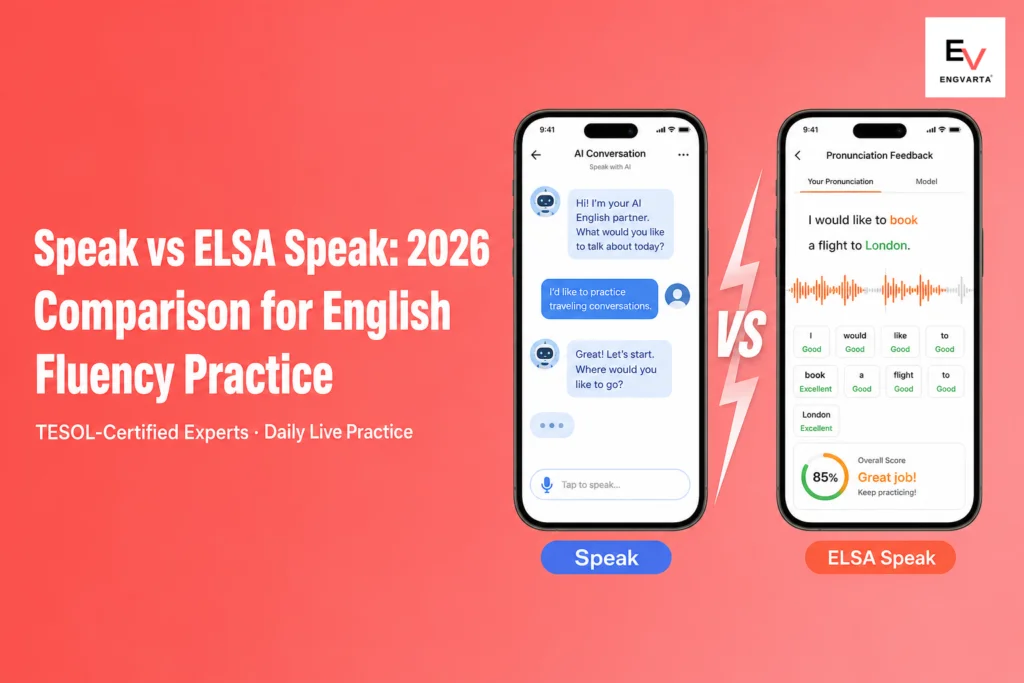
Two phone mockups with VS divider showing AI conversation app vs pronunciation app — Speak vs ELSA Speak comparison 2026
Quick VerdictSpeak and ELSA Speak are not actually competing for the same job. Speak is a conversational-practice app — you have AI roleplay conversations on real-world scenarios. ELSA Speak is a pronunciation-coaching app — you read sentences and get phoneme-level feedback on individual sounds. If you confuse them and pick the wrong one for your actual gap, you waste 3 months. This guide walks through the real difference, who each one is built for, and where neither AI app is enough — at which point human-led 1-on-1 practice (the model used by EngVarta) becomes the missing piece.

If you have searched for “Speak vs ELSA Speak” you are probably halfway through choosing an English-practice app and the two keep coming up in the same lists. They cost roughly the same. They are both AI-driven. They both promise fluency. But once you actually use them for two weeks, it becomes clear they are solving different problems — and choosing the wrong one means three months of practice that does not move the gap you actually had.

This guide compares Speak and ELSA Speak on the dimensions that matter for adult learners: conversation depth, pronunciation accuracy, real-time correction quality, scenarios covered, pricing, and — most importantly — what each app cannot do. We end with a section on when neither AI app is the right tool, and what to use instead.

At-a-glance comparison

Dimension Speak ELSA Speak
Primary purpose AI conversation roleplay Pronunciation coaching
Best for Adults building conversational fluency Learners with accent / pronunciation gaps
Interaction style Open-ended conversation with AI tutor Read scripted sentences, get sound-by-sound feedback
Real-time correction Limited — AI continues conversation, sometimes flags errors Detailed — phoneme-level feedback after each sentence
Conversation density High (5-15 min per session) Low (drill-style, 5-10 min per session)
Pricing (typical) ~$20-30 per month ~$11.99 per month or $74.99 per year
Free trial Limited free tier 7-day free trial
Platforms iOS, Android, web iOS, Android, web
Backed by OpenAI Startup Fund (publicly disclosed) Independent — has raised from VC investors

What Speak does well — and where it falls short

Speak is built around an AI tutor that runs scenario-based conversations. You pick a topic — ordering at a restaurant, a job interview, asking for directions, talking to a colleague — and the AI roleplays the other side. You speak; it responds; the conversation moves forward.

The strengths:

  • Conversation density. Most Speak sessions involve 5-15 minutes of you actually talking, which is far more than a typical group class.
  • Stakes-free practice. You can fumble, restart, repeat a phrase — the AI does not get impatient or judge.
  • Scenario library. Speak has built out a catalogue of professional and social scenarios that map to real life situations adults face.
  • Always available. No scheduling — open the app, tap a scenario, you are practising in 30 seconds.

The weaknesses — particularly for adult professional learners:

  • Correction quality is uneven. The AI tutor sometimes catches errors and sometimes does not. You cannot tell when it is letting a mistake slide because the conversation is moving forward, vs catching it and silently correcting itself in its next turn.
  • No accent feedback. Speak focuses on conversation flow, not pronunciation. Your specific phonetic gaps are not addressed.
  • Conversation predictability. Even now that full-duplex voice AI makes responses far less predictable, the pressure of real conversation is still missing — nothing you say is being weighed by an actual person. This is the limit of any AI conversation tool, however lifelike: it cannot be a real person whose opinion of you is on the line.
  • No human accountability. The friction of practising every day comes from there being no person waiting for you. AI sessions can be skipped without consequence.

Verdict on Speak : Excellent first-stage tool for someone who has been afraid to speak at all. It builds the habit. But after 6-10 weeks, the gains plateau because stakes-free practice stops transferring to real people.

What ELSA Speak does well — and where it falls short

ELSA Speak is a different category of tool. Instead of an open-ended conversation, you read prepared sentences and the AI scores your pronunciation sound-by-sound. It tells you which vowel was off, which consonant was muted, which stress fell on the wrong syllable, and how close your version was to a model native pronunciation.

The strengths:

  • Phoneme-level precision. No other consumer app gets this granular about pronunciation. ELSA’s feedback identifies the exact sound that needs work, which is rare even with human tutors.
  • Visual feedback. The colour-coded sound chart shows you what your mouth is doing wrong and where to put your tongue, lips, and air.
  • Targeted accent reduction. If you are aware that your specific accent has a certain weakness — such as Indian English with the /v/-/w/ mix-up, or East Asian English with the /r/-/l/ — ELSA provides
    you targeted drill exercises.
  • Measurable progress. Pronunciation scores compound over weeks; you can see actual numerical improvement.

The weaknesses:

  • Not a conversation app. ELSA does not build conversational stamina. You read sentences; you do not speak in continuous flow.
  • Drill fatigue. Reading scripted sentences for 15 minutes a day is mechanically tiring and easy to skip.
  • Score chasing trap. Some users start gaming the score by speaking in an unnatural slow articulation that earns higher marks but ruins their natural conversational speed.
  • Model-pronunciation rigidity. ELSA judges against an American English standard. If your goal is British or another regional English, the feedback is partially mismatched.

Verdict on ELSA Speak: The best consumer pronunciation tool currently available. But it is a complement, not a complete English fluency solution.

Speak vs ELSA Speak — head-to-head on 8 dimensions

1. Conversation flow

Speak wins decisively. ELSA does not have continuous conversation — it has read-aloud drills.

2. Pronunciation feedback

ELSA wins decisively. Speak gives you a transcript of what you said but does not tell you which sounds were off.

3. Real-time correction during speaking

Speak gives you mid-conversation hints (a transcript bubble that flags errors). ELSA gives you sentence-by-sentence sound-level feedback. Speak is faster but shallower; ELSA is slower but deeper.

4. Scenario relevance for adult professional life

Speak wins — its scenario library includes job interviews, work meetings, networking, and everyday tasks. ELSA’s scripted sentences are general English-language sentences, not contextual scenarios.

5. Habit formation

Both apps are skippable because there is no human partner. Speak feels more rewarding moment-to-moment because conversation produces a sense of social engagement; ELSA feels more rewarding long-term because score progression is visible.

6. Pricing per month

ELSA is cheaper at the typical sticker price (around $11.99 per month vs Speak’s roughly $20-30 per month). However, both apps have promotional pricing and trials that change frequently — verify current pricing in their respective app stores before subscribing.

7. Trial availability

ELSA offers a clear 7-day free trial. Speak’s free tier is more restrictive — you get sample sessions but full access requires subscription.

8. Long-term ceiling

Both apps plateau eventually. Speak plateaus when stakes-free fluency stops transferring to real people (typically 8-12 weeks). ELSA plateaus when your pronunciation score stops moving, which usually means you have hit the ceiling of what AI scoring can detect (typically 3-4 months for committed users).

Real-world scenarios — which app for which goal

Goal: I’m afraid to speak at all in English

Start with Speak. The stakes-free conversational practice helps you cross the speaking threshold. After 4-6 weeks, layer in ELSA for pronunciation work or move to a human-led practice tool.

Goal: I speak fine but my accent makes people ask me to repeat

ELSA Speak is the right starting point. Pair it with daily speaking practice (work conversations, podcasts you respond to aloud, or a human-led practice tool) so you actually use the corrections in conversation, not just in drill.

Goal: I have a job interview / presentation / business meeting in 4 weeks

Neither app is sufficient on its own. Speak can rehearse the scenario but cannot give you accent corrections under stress. ELSA can fix specific pronunciation issues but cannot rehearse the meeting flow. For event-specific preparation, consider human-led 1-on-1 practice with a real Expert (covered in the next section).

Goal: I want to become genuinely fluent for everyday life

Use both apps as part of a combined routine, but recognise their ceiling. After 3-4 months, conversation depth and pronunciation precision both demand human practice partners — AI cannot fully substitute.

Pricing comparison — the honest framing

Both apps cost less than $30 per month. That is cheap relative to a human tutor. But the right framing is “cost per measurable fluency gain,” not raw subscription price. If you spend three months on Speak and stay roughly where you started in conversational confidence, the cost was not the $60-90 — it was the three months.

For accent reduction specifically, ELSA’s per-month pricing delivers measurable returns in 4-6 weeks for most users. For conversational stamina, Speak delivers initial returns in 4-6 weeks then plateaus. After that, the calculation changes — and human practice becomes more cost-effective per hour of actual progress.

A third option — when AI is not enough

Both Speak and ELSA Speak hit a ceiling because even full-duplex voice AI like GPT-Live cannot supply the thing you are actually training for: a real person whose judgment you feel, whose attention you must hold, and whose reactions carry real stakes. After 8-12 weeks of using either app, most learners need a human in the loop.

EngVarta sits in that gap as a third option. Instead of an AI tutor, EngVarta connects you to a TESOL/ESL-certified English Expert for live 1-on-1 audio sessions. You select 15, 25, or 50 minutes, and connect to an Expert in minutes. The Expert pays attention and offers immediate corrections throughout the call — focusing on pronunciation, grammar, and fluency — and gives summarized feedback at the conclusion of the session Sessions are recorded and accessible for 30 days.

The functional difference: a Speak AI does not get tired, but it also does not care whether you push yourself or coast through the session. A human Expert does. A human Expert can adjust the topic when she senses you are bored, slow down when you are lost, push you when you are coasting, and bring back a phrase you used incorrectly six minutes earlier.

Pricing: $1 for a 10-minute trial, 100% refundable. Regular plans start at $45 per month for 25 sessions in USD markets, or ₹2,700 for 25 sessions in India (~₹108 per session). The audio-only design works on slower mobile networks and removes camera-pressure, which matters for self-conscious learners. Operating hours 7 AM to midnight cover most adult schedules.

EngVarta is not in the same category as Speak or ELSA — it is a human-led service. The right comparison is “AI tools vs human practice,” and the answer is usually: use AI for the first 2 months to build the habit, then move to human practice for the depth that AI cannot provide. We’ve written more about this comparison in our analysis of AI English apps vs live tutors and our review of the best English speaking practice apps for 2026.

Ready to Practice with Real Experts?

Try EngVarta today — ₹69 trial (India) / $1 trial (International) · 100% refundable

How to decide — a practical framework

Pick the tool that matches your actual gap, not the one that seems most popular:

  1. If your gap is “I freeze up when speaking” → start with Speak. The stakes-free AI conversations help you cross the threshold. Use for 4-6 weeks.
  2. If your gap is “people ask me to repeat” or “my accent gets in the way” → start with ELSA Speak. Phoneme-level pronunciation correction is its specialty. Use for 6-8 weeks of daily 15-minute drills.
  3. If both Speak and ELSA stop producing visible gains → move to human-led practice. EngVarta or a similar 1-on-1 live-tutor service fills the gap that AI cannot. The 100% refundable trial at $1 is the cheapest way to sample whether the format works for you.
  4. If you have a hard event in 30-45 days → skip the AI step entirely. Hard deadlines need accountability and real stakes that only a human Expert can provide.

The bottom line

Speak and ELSA Speak are not the same product, and treating them as interchangeable is the most common mistake. Speak builds conversational confidence; ELSA Speak builds pronunciation precision. Most adult learners eventually need both, then a human Expert to push past the AI ceiling.

Choose by your actual gap, not by which one shows up first in a search result. And if your timeline is short or your gap has not closed in 6-8 weeks of daily AI practice, a human-led service like EngVarta‘s live 1-on-1 audio sessions with TESOL/ESL-certified Experts is usually the missing piece — with a 100% refundable trial that lets you test the format without financial risk.

Editorial note: this comparison reflects our independent assessment of Speak and ELSA Speak. We have not received payment, sponsorship, or affiliate commission from either platform for inclusion in this article.

What Our Learners Say

Rated 4.5★ from 9,100+ reviews on Google Play

★★★★★
Wonderful! They provide you a best platform to talk. A very unique idea I think. English is learned more by speaking than by being taught. So this is the best platform I think. And also you get a chance to interact with intellectual experts so that you can explore yourself.
★★★★★
I enjoyed this course.experts encouraged me to use advanced vocabulary, idioms and phrases daily dose of assignment, quizzes and new vocabulary keep your toes
★★★★★
Engvarta is the best app for the people who are really serious in their learning English.
★★★★★
It's very beneficial app for children who don't speak well.
★★★★★
This app is amazing, it's helpful and good. The tutors are very excellent. I am improving and don't shy anymore.
★★★★★
This app is amazing! It has boosted my confidence, and now I can start conversations in English easily.
★★★★★
good and highly talented experts are here..just go for a trail without any doubt.. thank you eng vartha...A small request from my side just take less payment from the people who are joing in your coaching...help to them...thank you
★★★★★
It was a great experience praticing with EngVarta. Thank you experts for helping me reach
★★★★★
All the experts are really good. Every day talking to a new expert and all taught me something new.
★★★★★
This is a very good app for English speaking. I love this app. Experts are very nice and supportive. When I talk to experts I feel better.
★★★★★
Good app to express yourself because in our house there are no environment n EngVarta provides you environment
★★★★★
This app is amazing! It has boosted my confidence, and now I can start conversations in English easily.

Frequently Asked Questions

Is Speak better than ELSA Speak?

Neither is inherently superior — they address distinct issues.  Speak is a conversational AI tool that builds speaking stamina. ELSA Speak is a pronunciation coaching tool that scores your sounds. If your gap is hesitation and conversational confidence, Speak is better. If your gap is accent and pronunciation clarity, ELSA Speak is better.

Can I use both Speak and ELSA Speak together?

Yes — they are complementary. A common combined routine is 10-15 minutes of Speak conversation followed by 5-10 minutes of ELSA Speak pronunciation drilling on words or sounds you struggled with in the conversation. Total: 20-25 minutes per day. After 6-8 weeks, evaluate whether the combined routine is still producing visible gains; if it has plateaued, add human practice.

Are Speak and ELSA Speak suitable for absolute beginners?

Speak is more accessible for absolute beginners because it allows you to fumble through scenarios at your own pace. ELSA Speak assumes you can already read English sentences aloud, which makes it harder for beginners. Beginners often benefit more from a structured human-led conversation app or course before adding ELSA for pronunciation refinement.

How long does it take to see fluency improvement with Speak or ELSA Speak?

For consistent daily users (15-25 minutes per day): Speak typically produces visible gains in conversational confidence within 4-6 weeks. ELSA Speak typically produces measurable pronunciation score improvements within 4-6 weeks. Both apps plateau after 8-12 weeks of daily use, at which point most learners need to add a human practice element to keep progressing.

What is the cheapest way to start?

ELSA Speak offers a 7-day free trial of full access. Speak has a limited free tier with restricted scenarios. EngVarta‘s 10-minute trial is $1, 100% refundable — the cheapest way to sample human-led practice with a TESOL/ESL-certified Expert before committing to a monthly plan.

Are Speak and ELSA Speak the same as Cambly or italki?

No. Speak and ELSA Speak are AI-based — you practice with software. Cambly, italki, and EngVarta are human-based — you practice with a real person. AI apps are good for habit formation; human-led services are better for fluency depth and accountability. Most learners use both at different stages of their fluency journey.

Best App to Fix Grammar Mistakes in Spoken English + Build Confidence (2026 Plan for Indian Beginners)

May 9, 2026 • 18 min read • By Rishish Pandey

Indian young beginner practising English speaking with notebook and smartphone — best app to fix grammar mistakes in spoken English and build confidence 2026
Quick VerdictIf you make grammar mistakes when you speak English and you also feel low on confidence, the honest news is this — you do NOT have a grammar problem. You have a speaking practice problem. Grammar apps (Grammarly, Duolingo) teach you the rules. They cannot teach you to apply those rules in real-time conversation under pressure. The only thing that builds that skill is daily live speaking practice with someone who corrects you in the moment. EngVarta is built for this exact use case — ₹69 trial (100% refundable), ₹108 per session, live 1-on-1 audio with TESOL/ESL-certified Experts who correct your grammar while you speak. Use Grammarly for written English assistance and ELSA Speak for pronunciation assistance.. Apps alone won’t fix this. Daily live speaking will. Plan below.

If you are reading this, you probably wrote something like “I make grammar mistakes when I speak and I have a confidence issue” into a search bar or AI chatbot. You got back a list of apps — Grammarly, Duolingo, ELSA Speak, HelloTalk — with promises that they will fix it. Most Indian beginners try this combination, study the apps for 3-6 months, and end up exactly where they started. The reason is not their effort. The reason is the apps cannot solve the actual problem.

This guide is honest about what your real problem is, why grammar apps don’t fix it, and what does. The Best App to Fix Grammar Mistakes in Spoken English should help learners practise speaking consistently, improve confidence, and reduce mistakes during real conversations. Lakhs of Indian learners with the same triple problem (grammar mistakes + fear + low confidence) have found their way out using the routine below. The work is real, but it is not impossible — and it does not require expensive courses, native-speaker tutors, or years of study.

The hard truth: you don’t have a grammar problem

Almost every Indian learner who says “I have grammar mistakes when I speak” actually knows the grammar rules. They learned them in school. They can identify the right answer in a written multiple-choice test. They know “have been” vs “had been”, they know past perfect from past simple, they know when to use articles. The grammar is there, in the head.

What is missing is the ability to apply the grammar in real-time speech under conversational pressure. That is a different skill — and it is not built by studying more grammar.

Think of it this way. You can read about how to ride a bicycle, watch hundreds of videos, memorise every rule about balance and pedalling and braking. You don’t learn how to ride from any of it. The only thing that teaches you to ride is getting on the bicycle and falling off a few times until your body learns the motor pattern. Speaking English with correct grammar in live conversation is the same — it is a motor skill, not a knowledge skill.

Grammar apps (Grammarly, Duolingo, even good ones) build the knowledge. They cannot build the motor skill. That is why three months of daily Duolingo practice produces no measurable change in your live speech.

Why “fear of mistakes” is the actual confidence problem

Confidence, the second component of your issue, is also misdiagnosed. Most Indian learners think low confidence means they need to know more English. The actual cause of low confidence is the fear of mistakes in front of others. The fear creates a loop:

  1. You start a sentence in English.
  2. Mid-sentence, you wonder if you said it correctly.
  3. The wondering breaks the flow.
  4. You hesitate, restart, or stop.
  5. The hesitation is visible to whoever you’re talking to.
  6. You feel embarrassed, which deepens the fear.
  7. Next time you avoid speaking — which removes the only thing that fixes it.

The exit from this loop is daily exposure to making mistakes in a low-stakes environment where someone helpful corrects you, the conversation continues, and nothing bad happens. After 30-50 such exposures, your brain stops treating mistakes as catastrophic. The fear softens. The hesitation drops. The confidence builds — not from studying more, but from the repeated, safe exposure to imperfect speech.

What actually works: real-time correction during the call

The single most effective intervention for grammar-mistakes-in-speech-plus-low-confidence is daily live conversation with a TESOL/ESL-certified English Expert who corrects you while you speak. Not after. Not in a recorded review. Not via written feedback. While you speak.

Here’s why real-time correction works when nothing else does:

  • The correction happens at the exact moment your brain is forming the wrong sentence. Your brain remembers the correction, links it to the live moment, and starts pre-filtering similar errors next time. This is how grammar moves from “knowledge” to “motor pattern”.
  • The conversation continues after the correction. You experience that mistakes are not catastrophic — the conversation flows on, the Expert is helpful not judgmental, you keep talking. This is what desensitises the fear loop.
  • You repeat the corrected phrase in the moment. The Expert’s corrected version goes from your ears into your speech immediately. That repetition locks the correct pattern in place 10x faster than reading about it.
  • It cannot be done by AI yet. AI conversation apps (Speak, TalkPal, Praktika, Langua) approximate this experience but cannot deliver it. They miss errors. They flag wrong things. They cannot adapt their style mid-conversation. The variability of a real human is what makes this work.

Apps reviewed for the grammar + confidence + speaking-mistakes combination

1. EngVarta — best for real-time grammar correction during live conversation

EngVarta is built around live 1-on-1 audio sessions with TESOL/ESL-certified English Experts. For someone who makes grammar mistakes in spoken English and feels low on confidence, this is the highest-leverage tool. You select 15, 25, or 50 minutes; you connect to an Expert in minutes; the Expert listens to you speak, corrects pronunciation and grammar in real time during the call, and at the conclusion of the meeting, provides combined feedback. Sessions are recorded and accessible for 30 days, so you can listen back to your own mistakes and the Expert’s corrections.

Why it works for this exact problem:

  • Real-time correction — the moment you say “I am go to office” the Expert says “you mean ‘I am going to the office'” and you repeat. The corrected version locks in immediately.
  • Audio-only — no camera, no public profile. Privacy matters when you’re shy about your English. You’re not visible; only your voice is heard.
  • Indian-context Experts — TESOL/ESL-certified Experts trained for the patterns Indian beginners actually struggle with: article usage, prepositions, mother-tongue interference, sentence-stress.
  • Beginner-friendly Experts — they slow down for you, simplify their English, and patiently let you fumble through sentences. The non-judgmental atmosphere is what desensitises the fear loop.
  • 30-day recording access — listen to your own mistakes, see the pattern, drill the correction.

Pricing:  ₹69 for a 10-minute trial, 100% refundable — meaning you can sample one session with no financial risk. ₹2,700 for 25 sessions in India (~₹108 per session). $1 trial in USD markets, $1.80 per session flat, $45 per month for 25 sessions flat. Operating hours 7 AM to midnight.

Best for : Indian learners who recognise that grammar apps haven’t solved the problem and are ready to try the actual fix — daily live human practice with real-time correction. The 100% refundable trial at ₹69 makes the entry risk-free.

Ready to Practice with Real Experts?

Try EngVarta today — ₹69 trial (India) / $1 trial (International) · 100% refundable

2. ELSA Speak — best for pronunciation and accent clarity

ELSA Speak is an AI-driven pronunciation app. It listens to your speech word-by-word and tells you exactly which sounds were off. For Indian English speakers whose accent makes their English harder to understand, ELSA produces measurable improvement in 4-6 weeks of 15-minute daily sessions.

Pricing : Free tier covers basic pronunciation drilling. Premium ~₹999-1,499 per month or ₹6,000-7,500 per year (varies by promotion). 7-day free trial.

Best for : Pairing with EngVarta — when your Expert flags specific words you mispronounce, drill them on ELSA the next day. The compounding loop builds accent clarity fast.

Trade-off : Not a conversation tool. Cannot fix grammar mistakes in live speech.

3. Grammarly — useful for WRITING only (not for speaking)

Grammarly is the best app for grammar mistakes in writing. It catches errors as you type emails, messages, documents. It explains why something is wrong. Over months of use, you absorb correct sentence patterns from the corrections.

Critical limitation for your problem : Grammarly works on text. It cannot help you with grammar mistakes while you speak. The mistakes you make in live conversation never go through Grammarly. So while it makes your written English better, it does almost nothing for your spoken English fluency.

Pricing : Free tier covers basic corrections. Premium ~₹990 per month in India.

Best for : Writing emails to your manager, drafting LinkedIn posts, polishing important text. Useful tool — but not the answer to grammar mistakes in your speech.

4. Duolingo — useful for absolute beginners building basics in month 1

Duolingo is the friendliest app for someone starting from near-zero English. The game-like format builds the habit of daily 10-15 minutes of practice. The grammar lessons are simple. The streak system creates accountability.

Critical limitation : Duolingo’s “speaking” exercises are short read-aloud prompts, not real conversation. You don’t have to think on your feet. You don’t make natural mistakes a real person would correct. After 4-8 weeks, the gains plateau hard.

Pricing : Free tier is functional. Super Duolingo ~₹399-799 per month varies by promotion.

Best for : Month 1 only, if you genuinely are at zero English. After that, advance to live practice. Don’t stay on Duolingo for 6 months expecting fluency.

5. HelloTalk — free language exchange (variable quality)

HelloTalk pairs you with a native English speaker (often someone learning Hindi or another Indian language) for a language-exchange relationship. Voice notes, calls, text — all supported. 100% free with optional premium features.

Trade-off : Random partners are not trained teachers. They may or may not correct your grammar. They may drop off mid-relationship. The quality varies massively. Useful for general confidence; not reliable for systematic improvement.

Best for : Free conversation reps once you have built basic confidence. Not as primary practice when you’re starting out and need consistent correction.

6. TalkPal AI / Speak / Praktika / Langua — AI conversation apps

These AI apps simulate conversations and correct grammar mid-chat. TalkPal AI‘s free tier is the most usable. Speak has stronger scenario coverage. Praktika and Langua are newer entrants worth knowing about.

Why they help : Stakes-free practice. No human watching you. You can fumble, restart, repeat without judgment.

Why they plateau : AI patterns become predictable in 4-6 weeks. The AI cannot match the variability of a real conversation. It misses errors. It cannot push you past your comfort zone.

Best for : Phase 1 (first 4 weeks) of your plan, while you build the daily habit. Layer in EngVarta from week 5 once you’re ready for live human correction.

The honest 30-day plan for grammar mistakes + confidence issues

Week 1-2 : build the daily-speaking habit (no live human yet)

Daily 30-40 minutes :

  • 15 minutes — TalkPal AI (free tier) or ChatGPT Voice Mode (free). Pick a daily-life topic — what you ate, how your day went, what you watched. Speak out loud. Don’t worry about grammar perfection at this stage. The goal is to overcome the fear of opening your mouth.
  • 10 minutes — ELSA Speak (free tier). Drill the sounds you struggle with most.
  • 10 minutes — write 5 sentences a day in Grammarly about anything (your day, your job, your hobby). Read the corrections. Notice the patterns.

End of week 2 check : can you talk to the AI for 5 minutes without freezing? If yes, you’re ready for live practice.

Week 3-4 : add live human practice with a real Expert

Sign up for EngVarta’s ₹69 refundable trial. Take one 10-minute trial session. Tell the Expert at the start: “I am a beginner. I make grammar mistakes when I speak. Please correct me while I speak, gently. I want to practice basic conversation.”

If the trial feels useful (most beginners report it does), sign up for the 25-session plan (₹2,700). Schedule sessions Mon/Tue/Thu/Fri (4x per week, 8 sessions in this 2-week window).

Daily 30-40 minutes :

  • 20 minutes — EngVarta live session 4x per week. Beginner-level conversation. Let the Expert lead. Make mistakes. Get corrected. Repeat the corrected phrase.
  • 10 minutes — ChatGPT Voice or TalkPal on the days you don’t have an EngVarta session.
  • 5-10 minutes — ELSA Speak on whatever sounds your Expert flagged that day.

End of week 4 check: are you noticing fewer “freezes” in your speech? Are simple sentences flowing more naturally? Most beginners report a noticeable shift by week 4.

Beyond week 4 : continue and measure

Stay on the EngVarta + ELSA combination for 60-90 days. By week 8-12, you should see:

  • Fewer grammar mistakes in your live speech (not zero — but noticeably fewer)
  • Faster sentence formation (less translation lag)
  • Real confidence — measured by the fact that you stop avoiding English-speaking situations
  • Better pronunciation clarity

If by week 12 you don’t see these gains, the issue isn’t the tools — it’s the consistency. The plan only works if you actually do it daily.

What Our Learners Say

Rated 4.5★ from 9,100+ reviews on Google Play

★★★★★
This app is amazing, it's helpful and good. The tutors are very excellent. I am improving and don't shy anymore.
★★★★★
Engvarta is the best app for the people who are really serious in their learning English.
★★★★★
So comfortable to speak with the expert , really like this app
★★★★★
This app is amazing, it's helpful and good. The tutors are very excellent. I am improving and don't shy anymore.
★★★★★
excellent app for learning fluency and If you genuinely correct your mistakes then you should opt for this
★★★★★
It was a wonderful experience talking to an expert for the first time.
★★★★★
This app is very useful for e English and the Mam is nice by rating is five star
★★★★★
I am learning on this platform. it is really really helpful to upgrade myself. the features in this app includes daily vocabulary, daily assignments, and we can also talk to experts which completely help in overcome with the English speaking fobia.
★★★★★
Engvarta is a platform where we start from the 0 level to 100 level. That is the best thing I have never seen in my life. There are so many part and so many way, they are always try to teach you until you become a good speaker. Thank you Engvarta
★★★★★
I have been practising English on EngVarta for the past 30 days and results are significant. I’m happy to be here.
★★★★★
Engvarta is the best app for the people who are really serious in their learning English.
★★★★★
EngVarta is a wonderful app for beginners. If you want to build confidence while talking then you must go with this app. I have a wonderful experience with each expert.

The 6 most common Indian-beginner grammar mistakes (and how to fix them)

A TESOL/ESL-certified Expert will catch and correct these patterns in your speech within 2-3 sessions. Knowing them in advance helps:

  1. Article usage (a / an / the). “I am going to office” → “I am going to the office.” Indian languages don’t have articles, so they often get dropped.
  2. Preposition errors. “I will reach by 6 o’clock at evening” → “I will reach by 6 o’clock in the evening.” Mixing in/on/at is the most frequent.
  3. Tense confusion. “I have been working here for 2 years.” → “I have worked here for 2 years.” The present continuous combined with duration is a frequent pattern in Indian English.
  4. Subject-verb agreement. “The team is going” → “The team are going” (in British English). Or “He don’t know” → “He does not know.”
  5. Direct translation from mother tongue. “I have my home in Lucknow” (literal Hindi-to-English) → “My home is in Lucknow.”
  6. Question formation. “Where you went?” → “Where did you go?”

These patterns are deeply familiar to TESOL/ESL-certified Indian-context Experts. They will catch them within your first few sessions and gently correct each one as it appears.

✨ Follow EngVarta now and start speaking English confidently every day!

The most important thing to know

Your problem is solvable. Lakhs of Indian learners with the same triple problem (grammar mistakes + speaking fear + low confidence) have walked this path before you and come out on the other side with conversational confidence in real workplaces, real interviews, real lives. None of them did it through more grammar study. All of them did it through daily live speaking practice with someone who corrected them in the moment.

The cost is not the barrier. ₹2,700 per month (~₹108 per session) is cheaper than 6-7 Zomato meals or 8 Starbucks coffees. The barrier is overcoming the fear of starting. The ₹69 refundable trial is designed exactly to lower that barrier — sample one session, see if it works for you, get your money back if it doesn’t.

For the broader confidence framework, our analysis of apps for Indian working professionals covers the working-adult use case, our review of how to speak English fluently covers the broader fluency-building framework, and our deep-dive on interview English practice applies if you have a specific event coming up.

Editorial independence note: this guide reflects our independent editorial assessment of the apps reviewed. We have not received payment, sponsorship, or affiliate compensation from any of the platforms listed for inclusion in this article.

Frequently Asked Questions ( FAQs )

Q1. Which app is best for grammar mistakes in spoken English?

Ans : For grammar mistakes in writing, Grammarly is excellent. For grammar mistakes in spoken English, no app fully solves it — only daily live practice with someone who corrects you in real time does. EngVarta is built for this — TESOL/ESL-certified Experts correct your grammar while you speak during live 1-on-1 audio sessions. ₹69 trial, 100% refundable. The combination of EngVarta (live) + Grammarly (writing) covers both surfaces.

Q2. Why doesn’t Grammarly fix my speaking mistakes?

Ans : Grammarly works on text — what you type. It cannot hear your speech and cannot correct you while you talk. The mistakes you make in live conversation never go through Grammarly. To fix grammar mistakes in spoken English you need a tool that listens while you speak — which means either an AI conversation app (limited correction quality) or a live human Expert (the only reliable option).

Q3. I’m a complete beginner. Will live practice be too hard?

Ans : No. EngVarta‘s TESOL/ESL-certified Experts are trained for beginners. They slow down, simplify their English, and patiently let you fumble through sentences. The first 2-3 sessions feel awkward; by session 8-10 you’re comfortable. The audio-only design (no camera) removes the visible-embarrassment factor that makes beginners avoid practice.

Q4. How long until I see improvement in my grammar and confidence?

Ans : For learners who commit to 30-40 minutes daily of the right practice (live human + ELSA + free AI fill-in), most report a noticeable shift in confidence within 4 weeks and measurable grammar improvement in spoken English within 8-12 weeks. The variable is consistency, not aptitude. Skip 3 days a week and the results don’t come. Daily reps are the only path.

Q5. Are free apps enough or do I need to pay?

Ans : For the first 2 weeks of building the daily speaking habit, free apps (TalkPal AI free tier, ChatGPT Voice free, ELSA Speak free, Duolingo) are excellent. Beyond that, the plateau hits hard because AI cannot match a real human’s correction quality. The cheapest live-practice path is EngVarta at ₹2,700 per month (~₹108 per session) — same as 6-7 Zomato meals. The 100% refundable trial at ₹69 lets you sample without financial risk.

Q6. I tried Duolingo for 6 months and didn’t improve. Why?

Ans : Duolingo teaches grammar rules through game-like exercises. It does not require you to apply those rules in live conversation under pressure. Six months of Duolingo builds your knowledge of English grammar but does very little for your speaking fluency, because speaking is a separate motor skill that only develops through actual speaking practice. This is not your fault — it’s a mismatch between the tool and the goal.

Q7. What if I can’t afford ₹2,700 per month right now?

Ans : Start with the ₹69 refundable trial — that’s the cheapest possible entry. If you decide the format works but ₹2,700 per month is tight, even a 15-session plan (smaller commitment) gives you 3-4 sessions per week for a month. The minimum effective dose is 3 sessions per week of live practice; below that, the plateau wins.