You didn’t ignore English in 2025. You didn’t “not care.”
You tried.
You watched videos on pronunciation. You bookmarked reels on vocabulary. You told yourself, “This year, I’ll finally improve.”
And yet, as the year quietly came to an end, you found yourself in the same place — still thinking too much before speaking, still hesitating in conversations, still doubting your words.
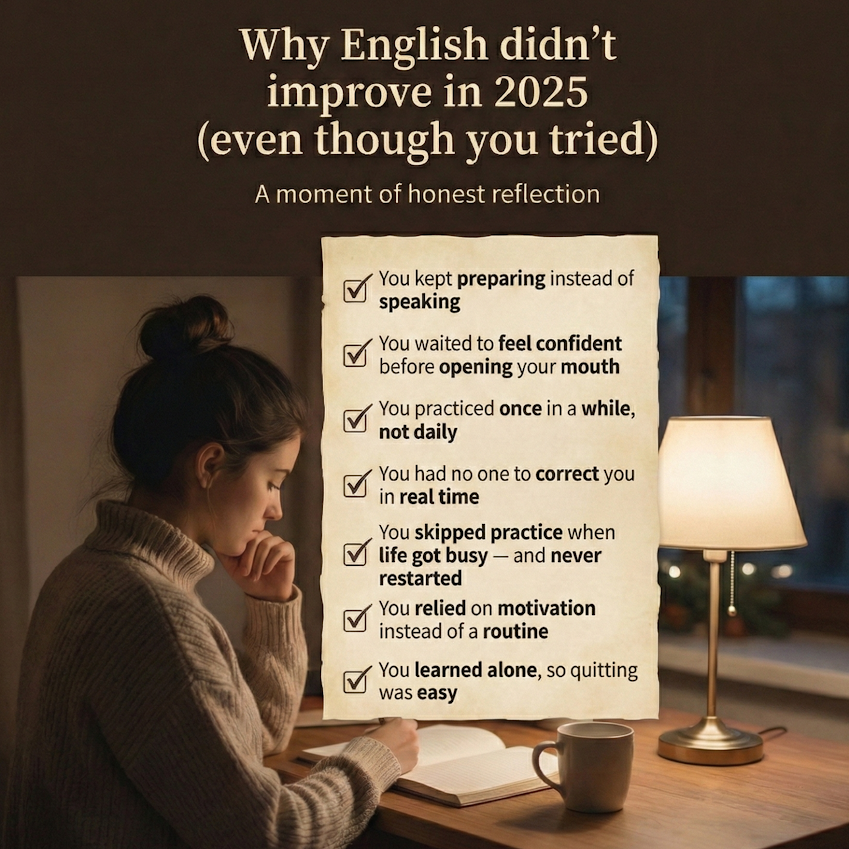
The image above captures that exact moment. A quiet evening. A notebook open. A mind full of effort — and frustration.
This blog is not about blaming you. It’s about understanding why effort didn’t convert into confidence.
Many learners want to speak English confidently, but end up stuck in the same cycle year after year. They understand English, can read it well, and even write decently — yet speaking still feels difficult. This gap between knowing English and speaking it confidently is what frustrates most learners.
The Truth Most Learners Don’t Hear
To speak English confidently, you don’t need more rules or more content. You need repeated exposure to real conversations where you can speak freely, make mistakes, and continue without fear.
Most learners struggle not because they lack intelligence, but because they never get enough chances to actually use English in real life.
English doesn’t improve just because you want it to. It improves when the right habits replace the wrong ones.
Most learners repeat the same patterns year after year — not because they are lazy, but because no one shows them a better system.
Let’s walk through those patterns honestly.
You Kept Preparing Instead of Speaking
Preparation feels safe.
You can learn silently. You can pause, rewind, and retry. No one hears your mistakes.
So you kept preparing.
But here’s the uncomfortable truth:
Preparation without speaking is procrastination in disguise.
English is not absorbed like information. It’s built like a muscle.
Until your mouth starts moving, improvement stays theoretical.
You Waited to Feel Confident Before Opening Your Mouth
Many learners believe confidence is a prerequisite.
“I’ll speak when I’m confident.” “I just need a little more clarity.” “I’m not ready yet.”
But confidence is not a starting point. It’s a side effect.
Confidence comes after:
Saying things wrong
Getting corrected
Surviving awkward pauses
Realising nothing bad happened
Every confident English speaker you admire once spoke badly — repeatedly.
You Practiced Occasionally, Not Consistently
Some weeks you practiced seriously. Other weeks disappeared into work, family, stress, or exams.
And then English quietly slipped down your priority list.
The problem isn’t missing a day. The problem is not returning.
English rewards consistency, not intensity.
Ten minutes every day beats two hours once a week — every single time.
You Had No One to Correct You in Real Time
Learning alone creates blind spots.
You may:
Repeat the same mistake for months
Think your sentence is correct when it isn’t
Lose confidence because you’re unsure
Without real-time correction, your brain doesn’t know what to fix.
This is why many learners feel stuck despite “studying” for years.
You Skipped Practice When Life Got Busy — and Never Restarted
Life doesn’t pause for learning.
Deadlines come. Health issues arise. Responsibilities pile up.
So practice stops — temporarily.
But without a system, temporary breaks turn into permanent gaps.
English doesn’t disappear — but confidence does.
You Relied on Motivation Instead of a Routine
Motivation is emotional. Routines are structural.
Motivation says, “I feel like practicing today.” Routines say, “This is what I do daily.”
English improves when practice becomes as normal as brushing your teeth — not when you’re “in the mood.”
You Learned Alone — So Quitting Was Easy
When no one expects you, stopping feels harmless.
No accountability. No reminder. No sense of progress being watched.
Learning alone makes quitting invisible — until months later, when regret shows up.
This Is Not a Failure. It’s a Pattern.
And patterns can be changed.
Learners who finally speak English confidently don’t suddenly become smarter. They simply change how they practice.
They speak first. They practice daily. They get corrected kindly. They don’t do it alone.
How the EngVarta App Helps You Break This Pattern
EngVarta is designed for learners who want to speak English confidently in real-life situations — interviews, meetings, phone calls, and daily conversations.
EngVarta was created specifically for learners stuck in this exact loop.
Not beginners who don’t know English — but learners who know English yet struggle to speak confidently.
Here’s how EngVarta directly solves the problems mentioned above:
1. It Forces You to Speak, Not Prepare
EngVarta connects you with real English experts for one-on-one live conversations. You speak from day one — no waiting, no overthinking.
2. Confidence Comes Through Action
You don’t wait to “feel confident.” Confidence builds naturally as you speak daily in a safe, supportive environment.
3. Daily Practice Becomes a Habit
Sessions are short and practical, designed for busy lives. This removes the excuse of “no time” and builds consistency.
4. Real-Time, Friendly Corrections
Experts correct you gently while you speak — helping you improve without embarrassment or interruption.
5. You’re No Longer Learning Alone
Someone listens to you. Responds to you. Guides you.
That simple human connection changes everything.
If 2025 Felt Like a Loop, 2026 Can Be a Turning Point
English didn’t fail you. Your effort didn’t go waste.
It just needed a better system.
One that replaces:
Preparation with practice
Motivation with routine
Isolation with guidance
Start Speaking — Not Someday, Today
Speak daily. Get corrected. Build confidence through real conversations.
Final Thought
Learning English is not the goal. Being able to speak English confidently — without fear, hesitation, or overthinking — is.
And that confidence is built one real conversation at a time.
Frequently Asked Questions (FAQs)
Frequently Asked Questions
Who should use EngVarta to speak English confidently?
EngVarta is ideal for students, professionals, and job seekers who understand English but hesitate to speak. It helps learners gain confidence through consistent, guided speaking practice.
How does EngVarta help me speak English confidently?
EngVarta helps you speak English confidently through one-on-one live conversations with trained experts. You get real-time, friendly corrections that improve fluency and reduce hesitation.
Can I speak English confidently even if my grammar is weak?
Yes. You can speak English confidently without perfect grammar. Many confident speakers make small mistakes, but they communicate clearly. Grammar improves naturally with daily speaking practice.
How can I speak English confidently in daily life?
To speak English confidently, practice speaking every day in real situations. Focus on expressing your thoughts instead of worrying about mistakes. Confidence grows through usage, not perfection.
Why do I still struggle to speak English confidently?
Most learners struggle to speak English confidently because they prepare too much and speak too little. Without regular real conversations, confidence doesn’t develop—even if your understanding of English is good.
English has become the language of opportunity. From job interviews and presentations to travelling abroad or simply making friends, strong English communication skills can shape your future in ways you can’t imagine.
But here’s the secret: becoming fluent in English isn’t about memorising grammar rules or learning hundreds of words at once. It’s about practicing consistently, building confidence, and learning how to express yourself naturally.
In this blog, we’ll explore practical steps to improve your English communication skills, and also see how the EngVarta App can be your partner in this journey.
1. Practice Every Day, Even if It’s Just 10 Minutes
Consistency matters more than intensity. Instead of waiting for the “right time,” start small. Talk about your day in English, describe what you see around you, or practice speaking in front of a mirror for 10 minutes daily.
2. Listen More Than You Speak
Fluent speakers are also good listeners. Watch English movies, listen to podcasts, or follow TED Talks. This helps you absorb correct pronunciation, sentence patterns, and natural expressions.
3. Think in English Instead of Translating
One of the biggest obstacles learners face is thinking in their native language and then translating into English. This slows you down and makes you nervous. Train your mind to think directly in English.
This article will guide you with techniques to break free from the translation trap.
4. Expand Your Vocabulary in Context
Instead of cramming 20 new words daily, focus on learning 2–3 words and using them in sentences. For example, if you learn the word “versatile,” try saying: “This jacket is versatile; I can wear it to work or on a trip.” Using words in real life makes them stick.
5. Practice With Real People
Reading and listening are great, but speaking with real people is the ultimate game-changer. You need feedback, correction, and the confidence that comes from real conversations.
How the EngVarta App Can Help You
This is where EngVarta comes in. It’s not just another English learning app—it’s a practice platform where you connect with live English experts over phone calls.
Here’s how EngVarta helps you improve faster:
🗣 Daily conversation practice with experts, just like talking to a friend.
✅ Personalized feedback on grammar, pronunciation, and fluency.
💡 Practical topics like interviews, meetings, and presentations.
📈 Progress tracking to see how far you’ve come.
If you want to transform your English from hesitant to confident, EngVarta provides the safe, judgment-free space you need.
Improving your English communication skills is a journey, not a race. With daily practice, mindful listening, and the right guidance, you can achieve fluency and confidence.
Remember: you don’t have to be perfect to start speaking—you have to start speaking to become perfect.
So why wait? Take your first step today with EngVarta, and let every conversation bring you closer to the confident speaker you want to be.
Frequently Asked Questions (FAQs)
Frequently Asked Questions
Can I learn English just by watching movies or reading books?
Movies and books improve your listening and vocabulary, but they won’t give you fluency. To speak confidently, you need real conversations with people — that’s where EngVarta bridges the gap.
What is the best app to practice English speaking?
EngVarta is one of the best apps because it connects you with live English experts over phone calls. You can practice real conversations, get instant corrections, and build confidence naturally.
Is grammar important for good communication?
Yes, but don’t let grammar stop you from speaking. Communication is more about expressing your ideas clearly. Fluency comes with practice — grammar improves along the way.
How long does it take to become fluent in English?
It depends on your current level and how much time you dedicate daily. With consistent practice for 20–30 minutes a day, most learners see a big improvement in 3–6 months.
How can I improve my English communication skills at home?
You can start by reading English books, listening to podcasts, watching English shows, and practicing speaking daily. The key is consistency. To make it more effective, use apps like EngVarta, where you can practice live with English experts from home.
How To Talk With A Fellow Teacher On Your First Day Of School?
Teachers are an integral part of our life, at various stages of one’s life the role of a teacher or a mentor is unquestionable. Taking the responsibility of a teacher is not a child’s play, the future of many lives is in your hands.
Therefore, we salute all teachers and send across warm wishes and hugs along with congratulations to all the young teachers out there, who are stepping in the world of education providers.
We understand your nervousness for your first day as a teacher and you need to make a good impression not just for students, but also for your fellow teachers thus we offer our services to make this day as memorable as possible.
During your teaching career, you will get an opportunity to meet many teachers who will teach you something new and sometimes you’ll teach them. And its foundation will begin right from your first day when you will meet your fellow teachers and talk to them.
Don’t spoil this opportunity of making an impression just because you are nervous or aren’t confident.
Let us all take you through some basic communication tips for your first day at school.
1. Greet everyone well
Well, this is “the basic etiquette” to follow each day, every day with everyone. When you go to the Staff room or you are introduced to fellow teachers, then you should say Good Morning or hello with a smile.
Making a firm handshake is often taken as a sign of confidence. So, when you are meeting someone individually, then tell your name while shaking hands with them. Please note that if someone has already introduced you, do not repeat your name, just say hello and ask how you are?
Most importantly, always keep a smile on your face and make an eye contact while greeting them. Making an eye contact while conversation demonstrates your confidence and builds a little trust level.
2. Conversation starters
Mostly, the other teacher will start the conversation first out of curiosity. They will be interested in knowing about your college, your education, how are you feeling, how did you find the school, etc. Pre-prepare the answer to such questions beforehand so that you can answer them confidently.
Keep your answers brief, not too small and not too long either.
Let’s just say they do not start the conversation first and it comes up to you, pre – prepare what you can ask as well to avoid awkward silences. Your questions can start from how they are doing? As you haven’t already asked that.
Next, ask them about the class, subject they teach, how long they have been teaching and all. Make sure to include some questions related to attendance sheet, coursework, school rules, etc. while you are at it, as this will reflect your sincerity towards your job.
Now take care of two things here –
Firstly, do not ask any personal questions like their marital status or kids etc.. Or school related questions like how’s the school or does the salary come on time or not, as these questions might make the other person uncomfortable.
Secondly, do listen carefully when someone is answering your questions. For one, you will get new questions to ask. For example, if they say that they have studied in Punjab, you can always quote the obvious question about the food of Punjab.
On the other hand, you can easily predict whether the person in front of you have any interest in talking to you or not. If he doesn’t respond properly or not interrogating you for anything, then you should be silent.
3. Show your nervousness
Not just this helps making you a better impression, but arriving early allows you to reign in your anxiety and prepare yourself for the interview. No one wants to see a sweaty person walking in and apologizing for the delay.
Arriving on time also reflects upon your commitment for the job. Please note before time means 15 – 20 minutes before the scheduled time. No one would appreciate you for sitting on the office stairs waiting for them while the office is still getting cleaned.
Quick Verdict (2026)If real fluency — not gamified streaks — is the goal, the apps that actually work are the ones that force you to speak daily with feedback. Our pick: EngVarta for live human practice with TESOL/ESL-certified Experts (real-time corrections, consolidated feedback towards the end of every call). Pair it with ELSA Speak for pronunciation drills and Duolingo for vocabulary habit-building. AI-only chat apps are improving fast, but in 2026 nothing replicates the speed of fluency gain you get from a real human listening to you.
You’ve studied grammar. Watched English shows. Maybe even repeated dialogues out loud. But when it’s your turn to actually speak — in a meeting, an interview, or with a stranger — you pause, doubt yourself, and switch back to Hindi or your native tongue.
The missing piece isn’t more study. It’s spoken-output reps — daily speaking practice with someone (or something) that catches your mistakes in real time and shows you how a fluent speaker would have phrased it.
This 2026 guide ranks the best English fluency apps by what actually moves the needle on speaking confidence: live human practice, AI conversation, pronunciation feedback, and listening immersion. We’ve tested each one and ordered them by how fast they get an intermediate learner from hesitant to fluent.
2026 Comparison Table: Best Apps for English Fluency
App
Practice Type
Best For
Starting Price
Speed of Fluency Gain
EngVarta
Live 1-on-1 audio with TESOL/ESL Expert
Daily fluency practice (Indian + global learners)
~₹108/session (₹2,700 / 25)
Fastest (3–6 weeks visible)
ELSA Speak
AI pronunciation drills
Accent reduction, MTI fix
~$11.99/month
Medium (8–12 weeks)
Cambly
Native-speaker video tutoring
Higher-budget premium learners
~$10/15-min lesson
Fast (cost-limited frequency)
HelloTalk / Tandem
Language-exchange chat with strangers
Casual practice, free option
Free / ~$7–14 month
Slow (no expert correction)
AI conversation apps (Loora, Talkpal, Praktika)
AI chatbot “tutor”
Privacy-first or unlimited reps
~$12–25/month
Medium (improving fast in 2026)
Duolingo
Gamified vocabulary & grammar
Beginners, daily-streak habit
Free / Super ~$7/month
Slow (low speaking volume)
1. EngVarta — Best Overall for Spoken Fluency
EngVarta is the fastest path to spoken fluency for one simple reason: every session is a live audio call with a TESOL or ESL-certified English Expert who corrects you in real time. There’s no “watch a video, then take a quiz” loop — you talk, the Expert listens, fixes your grammar, pronunciation, and word choice on the spot, and shares consolidated feedback towards the end of the session.
You pick the session length (15, 25, or 50 minutes), book a slot anywhere between 7 AM and midnight, and connect to an Expert in minutes. Audio-only by design — which works on slow mobile data and removes the camera-pressure that holds back self-conscious learners.
Why it ranks #1 for fluency:
Real-time corrections during the call — pronunciation, grammar, fluency — not after-the-fact written reports
Consolidated feedback towards the end of every session highlighting your top 2–3 improvement areas
Sessions recorded and accessible for 30 days for self-review
Personalised practice tasks + a vocabulary builder between calls
Daily-practice priced (~₹108 / ~$1.80 per session) — sustainable for daily reps, which is what fluency actually requires
Milestone certificates as you complete practice-hour thresholds — useful for HR records, departmental training files, and upskilling submissions
Who it’s for: Working professionals, college students preparing for placements, government employees needing English for postings, and homemakers who want to rebuild fluency on their own schedule. Already trusted by lakhs of learners across India and expanding markets in the US, UAE, Canada, and Singapore.
Pricing: ₹69 for a 100% refundable 10-minute trial; plans start at ₹2,700 for 25 sessions (~₹108 each). Plans of 25/50/100/150/300 sessions, with a pause feature for travel or work crunches.
Limitation: Audio-only by design. If you specifically want video tutoring with native speakers, look at Cambly. If you want unlimited free chat with strangers, HelloTalk — though neither will move you to fluency as fast.
ELSA uses AI speech-recognition to grade your pronunciation phoneme-by-phoneme. You read a sentence, ELSA flags exactly which sounds were off, and shows you the mouth position for the correct sound. For Indian learners working on mother-tongue influence (MTI), it’s the most precise pronunciation tool available.
Best for: Pronunciation, accent neutralisation, IELTS/TOEFL speaking-section drilling. Not for: Conversational fluency or unstructured speaking practice — you’re reading scripted prompts, not having real conversations.
3. Cambly — Best for Premium Native-Speaker Practice
Cambly connects you to native-speaker tutors over video for unstructured chat or curriculum-based lessons. Quality is high, sessions feel real, and you can pick the tutor you click with. The catch: pricing. At roughly $10 per 15-minute lesson, daily practice gets expensive fast — most learners end up doing 2–3 sessions per week, which is below the frequency needed for rapid fluency gains.
Best for: Learners with a budget who want native-speaker exposure and don’t mind a lower session count. Not for: Daily-practice budgets or learners who prefer audio-only.
Pricing: ~$10/15-min lesson; group plans cheaper but less personalised.
4. AI Conversation Apps (Loora, Talkpal, Praktika)
2026 has been the breakout year for AI-driven English tutors. Loora, Talkpal, and Praktika let you have unscripted voice conversations with an AI that adapts to your level, suggests better phrasings, and tracks your fluency progress. The voice quality and natural pacing have improved dramatically — for the first time, an AI conversation feels close to a real one.
Best for: Privacy-conscious learners who don’t want a human listening, learners doing 30+ minutes of practice daily who’d burn out a paid tutor budget, and anyone in markets where live tutoring is hard to find.
Limitation in 2026: AI still mishears non-native accents at higher rates than a trained human Expert, and the “corrections” can be over-polite (it lets small errors slide to keep the conversation flowing). For learners specifically targeting fluency — not just exposure — live human feedback is still measurably faster. That’s why we rank EngVarta above this category.
Pricing: ~$12–25/month depending on app and tier.
5. HelloTalk & Tandem — Best Free Option
Language-exchange apps pair you with native English speakers who want to learn your language. Genuinely free for basic use. The trade-off: there’s no expert correcting you, conversation quality varies wildly partner-to-partner, and many partners drift toward small talk that doesn’t stretch your vocabulary.
Best for: Zero-budget learners who already have intermediate-level fluency and want exposure. Not for: Beginners or anyone targeting structured fluency growth on a timeline.
Duolingo is excellent at one thing: getting you to open the app every day. The streak mechanics are addictive, the lessons are bite-sized, and you’ll genuinely build vocabulary and grammar awareness. What it won’t do is make you fluent — the speaking exercises are scripted single-sentence drills, not real conversation.
Best for: Beginners building habit + vocabulary. Pair with: A speaking-focused app (EngVarta, Cambly, or an AI conversation app) once you’re past the first 50 hours of Duolingo.
Pricing: Free; Super Duolingo ~$7/month.
The 2026 Fluency Stack: How to Combine These Apps
Single-app strategies don’t deliver fluency. The learners who actually become fluent in 6–12 months use a stack:
15–30 min daily speaking practice — EngVarta (live human) or an AI conversation app
10 min pronunciation drilling — ELSA Speak, 3–4 days a week
10 min vocabulary & grammar habit — Duolingo or Memrise, daily
20 min listening immersion — English podcasts, YouTube, or shows with subtitles
The non-negotiable element is the speaking practice. Without daily spoken-output reps with feedback, the other three stack components plateau within 6–8 weeks.
Why Most People Fail at Fluency Apps
Three patterns, in order of frequency:
App stacking without speaking practice. Three vocabulary apps and zero conversation apps. You’ll know more words but still freeze in real conversations.
Inconsistent practice. 90 minutes on Sunday, nothing Monday–Saturday. Fluency is built on frequency, not duration. 15 minutes daily beats 2 hours weekly.
Avoiding correction. Sticking with apps that don’t challenge you because the dopamine hit of a correct answer feels good. Fluency growth requires being corrected — that’s where the learning happens.
The combination that fixes all three: a paid live-practice app you actually use daily (not the free apps that get abandoned by week 3) + a habit anchor like a morning walk or after-dinner routine to make practice non-negotiable. More on building a fluency-coaching routine →
What Our Learners Say
Rated 4.5★ from 9,100+ reviews on Google Play
★★★★★
good and highly talented experts are here..just go for a trail without any doubt.. thank you eng vartha...A small request from my side just take less payment from the people who are joing in your coaching...help to them...thank you
★★★★★
This is a too good English learning app. There have so many options to learning English their have a English vocabulary you can improve your English vocabulary to in this app and there have a charges for if you want to talk with English speaker
★★★★★
hello this is Shweta and I will tell you about the engvarta app this is an amazing app to improve our English or any other language so I suggested using this app and doing better things and growing always better . thankyou.
★★★★★
good experience this app is very helpfull and user friendly you may also check the app to learn English
★★★★★
best app for English communication. I have tried lots of English speaking apps till date. but all have some dra backs. but this is really awesome experience of mine. best teachers and best app. 💯
★★★★★
No words to say about your app. I'm very interested in it and learning a lot. Thanks for your help.
★★★★★
In the beginning I felt very nervous to talk but when I picked the call the expert spoke in such a gentle way. I really liked it.
★★★★★
Let me congratulate you on your endeavour to help people gain confidence while speaking. I enrolled for your vocabulary series. You guys are doing a good job. Keep it up.
★★★★★
This is very amazing apps. AI working system and it is very effective to practicing and also every day i have practice in the apps. As a begainner, i think it is very helpful for me.
★★★★★
Its just great, I mean in terms of environment that it gives you is just awesome. Thnx again for boosting my confidence.
★★★★★
Excellent application to improve your communication skills.Thnk you for introducing new vocabulary everyday.God bless you You might not aware of but personally this is helping me a lot
★★★★★
All the experts are really good. Every day talking to a new expert and all taught me something new.
★★★★★
good and highly talented experts are here..just go for a trail without any doubt.. thank you eng vartha...A small request from my side just take less payment from the people who are joing in your coaching...help to them...thank you
★★★★★
This is a too good English learning app. There have so many options to learning English their have a English vocabulary you can improve your English vocabulary to in this app and there have a charges for if you want to talk with English speaker
★★★★★
hello this is Shweta and I will tell you about the engvarta app this is an amazing app to improve our English or any other language so I suggested using this app and doing better things and growing always better . thankyou.
★★★★★
good experience this app is very helpfull and user friendly you may also check the app to learn English
★★★★★
best app for English communication. I have tried lots of English speaking apps till date. but all have some dra backs. but this is really awesome experience of mine. best teachers and best app. 💯
★★★★★
No words to say about your app. I'm very interested in it and learning a lot. Thanks for your help.
★★★★★
In the beginning I felt very nervous to talk but when I picked the call the expert spoke in such a gentle way. I really liked it.
★★★★★
Let me congratulate you on your endeavour to help people gain confidence while speaking. I enrolled for your vocabulary series. You guys are doing a good job. Keep it up.
★★★★★
This is very amazing apps. AI working system and it is very effective to practicing and also every day i have practice in the apps. As a begainner, i think it is very helpful for me.
★★★★★
Its just great, I mean in terms of environment that it gives you is just awesome. Thnx again for boosting my confidence.
★★★★★
Excellent application to improve your communication skills.Thnk you for introducing new vocabulary everyday.God bless you You might not aware of but personally this is helping me a lot
★★★★★
All the experts are really good. Every day talking to a new expert and all taught me something new.
Frequently Asked Questions
Which app is best for English fluency in 2026?
For most intermediate learners, EngVarta delivers the fastest fluency gains because every session involves real-time correction by a TESOL/ESL-certified English Expert over a live audio call. Pair it with ELSA Speak for pronunciation and Duolingo for vocabulary habit, and you have a complete 2026 fluency stack.
Can I become fluent in English using only an app?
Yes, if the app forces daily spoken-output practice with feedback. Apps that just teach grammar, vocabulary, or scripted lessons won’t deliver fluency on their own. The fastest fluency gains come from apps that put a real human (or, increasingly, a high-quality AI) on the other end of a live conversation.
How long does it take to become fluent in English with these apps?
With consistent daily practice (15–30 minutes of speaking + 10–20 minutes of supporting work), most intermediate learners report visible fluency improvement in 6–8 weeks and conversational fluency in 6–9 months. Beginners typically need 12–18 months to reach the same level.
Are AI English speaking apps as good as human tutors in 2026?
AI conversation apps have improved dramatically in 2026 and now deliver useful practice at low cost. They’re excellent for unlimited reps and privacy. But for the fastest fluency gains, live human Experts still outperform AI on accent recognition, nuanced corrections, and conversational depth — especially for non-native accents like Indian English.
What’s the cheapest app for daily English speaking practice?
HelloTalk and Tandem are free if you’re comfortable practising with random language-exchange partners (with no expert correction). For paid daily practice with a real Expert, EngVarta is the lowest cost-per-session option in India at ~₹108 per call when you buy a 25-session plan.
Do these apps work for IELTS or job-interview English?
Yes — speaking-focused apps like EngVarta and ELSA Speak directly target the speaking skills needed for IELTS, TOEFL, and job interviews. Most learners using them for exam or interview prep do 4–6 weeks of focused daily practice in the run-up to the test or interview.
Can I get a certificate from these English speaking apps?
EngVarta issues milestone certificates as learners complete practice-hour thresholds and reach speaking-progress milestones — useful for HR records, departmental training files, and upskilling submissions. Other apps in this list (Duolingo, ELSA, Cambly) offer course-completion or proficiency-level certificates of varying recognition. Always check whether a specific employer or institution accepts the certificate before relying on it.
Is EngVarta available outside India?
Yes — EngVarta serves learners in India, the US, UAE, Canada, Singapore, and other markets. Pricing in USD markets works out to roughly $1.80 per session with similar plan structures.
Editorial independence: This is an independent editorial roundup. EngVarta is the publisher and chooses its own pick, but no app on this list paid for inclusion or placement. We rank apps based on hands-on testing and learner outcomes, not affiliate commissions.
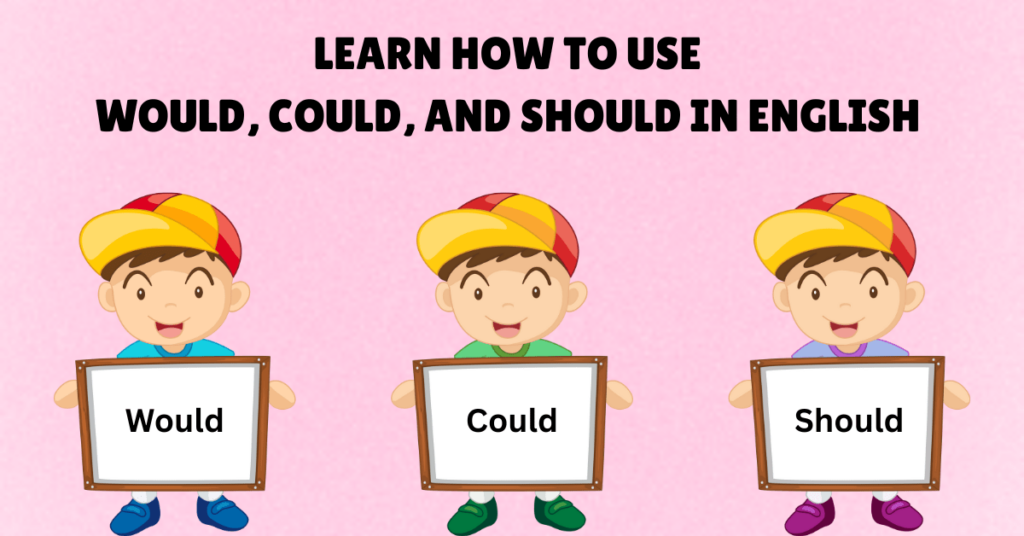
Ever feel confused about when to use would, could, and should in English? You’re not alone! These little words can be tricky, but once you understand how they work, you’ll sound more fluent and confident. Let’s break them down together with simple rules and everyday examples.
What Are Modal Verbs?
Modal verbs are special helper verbs that add meaning to the main verb. They show things like possibility, ability, or advice. The stars of today’s lesson—would, could, and should—are three of the most popular ones!
When to Use Would
Use would to talk about:
Polite requests: Would you help me, please?
Imaginary or unreal situations: I would go to Paris if I had the money.
Future in the past: He said he would call me.
Wishes and desires: I would love a slice of cake.
👉 Quick Tip: Think of would as a softer, more polite version of will.
When to Use Could
Use could for:
Past ability: She could read when she was three!
Polite requests: Could you please pass the salt?
Possibility: It could snow tomorrow.
Suggestions: You could try restarting your phone.
👉 Quick Tip:Could is like a more polite or uncertain form of can.
When to Use Should
Use should when giving advice, opinions, or talking about what’s right:
Advice: You should drink more water.
Expectation: She should be here by now.
Moral obligation: People should be kind.
Suggestions: Should we go out for lunch?
👉 Quick Tip:Should is a gentle way of saying something is the right thing to do.
Final Thoughts
Learning how to use would, could, and should doesn’t have to be hard. Keep practicing with real sentences, and you’ll start using them naturally. They may be small words, but they make a big difference in your English!
Modals also pair with the passive voice—this could be done, the report should be reviewed, that would be appreciated—if you want the full pattern, read our guide on active and passive voice in English grammar.
Frequently Asked Questions about Would, Could, and Should
What is the difference between would, could, and should?
“Would” expresses hypothetical situations, polite requests, or past habits. “Could” expresses past ability or polite possibility. “Should” expresses advice, obligation, or expectation. Quick test: WOULD = imagined/conditional (“I would help if I could”). COULD = ability/possibility (“She could speak three languages”). SHOULD = recommendation (“You should rest”). Each carries a different shade of meaning that English learners often mix up.
When should I use ‘would’?
Use “would” for: (1) Hypothetical/conditional situations: “I would travel more if I had time.” (2) Polite requests: “Would you pass the salt?” (3) Past habits: “When I was young, I would walk to school every day.” (4) Reported speech of “will”: “She said she would call.” (5) Wishes: “I wish I would win the lottery.” Common Indian English error: using “would” for present-tense politeness when “could” or “can” would be more accurate.
When should I use ‘could’?
Use “could” for: (1) Past ability: “I could swim when I was 5.” (2) Polite requests: “Could you help me?” (3) Possibility (less certain than “may”): “It could rain later.” (4) Suggestions: “We could try a different approach.” (5) Past possibility: “He could have been there.” “Could” is generally less formal than “would” for politeness — “Could you” feels softer than “Would you.”
When should I use ‘should’?
Use “should” for: (1) Advice/recommendation: “You should see a doctor.” (2) Expectation: “The package should arrive tomorrow.” (3) Obligation (mild): “We should respect the rules.” (4) Past regret: “I should have studied harder.” (5) Probability: “She should be home by now.” “Should” is the most directive of the three — it implies a recommended course of action, not just a possibility.
What are some examples of would vs could vs should?
Same situation, three meanings: “I WOULD call her if I had her number” (conditional — depends on having her number). “I COULD call her if you want me to” (ability/willingness — I have the option). “I SHOULD call her — it’s been a week” (advice/obligation — I ought to). Or: “WOULD you like coffee?” (polite offer). “COULD I have coffee?” (polite request). “SHOULD I have coffee?” (asking for advice).
What’s the difference between ‘would’ and ‘will’?
“Will” expresses certainty about the future (“I will call you tomorrow”). “Would” expresses hypothetical or conditional (“I would call you if I had time”). Will = definitely. Would = if certain conditions are met. Common error: using “will” when “would” is correct in conditionals — “If I had money, I will buy a house” should be “If I had money, I would buy a house.”
What’s the difference between ‘could’ and ‘can’?
“Can” expresses present ability or permission (“I can speak English”). “Could” expresses past ability OR polite present (“I could speak English at age 8” / “Could I speak English with you for practice?”). When asking for permission politely, “could” is softer than “can” — “Could I leave early today?” sounds more polite than “Can I leave early today?” though both are correct.
How can I practice would, could, and should correctly?
Effective practice: (1) Use each modal verb in 3 sentences daily — one for each purpose (conditional, ability/permission, advice). (2) Listen to English shows and note when speakers use which modal. (3) Practice in real conversation where someone can flag misuse. (4) Read English news articles and circle every “would/could/should” — note why each was chosen. EngVarta‘s TESOL/ESL-certified Experts can prompt you to use specific modals in conversation and explain why one fits better than another. The $1 refundable trial lets you try this on a topic where you typically struggle.