Best English Learning Apps |

Tag

best english learning apps

How to Stop Translating from Your Native Language While Speaking English

November 29, 2024 • 4 min read • By Swati Raj

How to Stop Translating from Your Native Language While Speaking English

Mastering English fluency can feel like scaling a mountain, especially when you find yourself mentally translating sentences from your native language. This habit can slow down your responses, reduce confidence, and make conversations awkward. But here’s the good news—breaking free from this cycle is entirely achievable! In this blog, we’ll explore why this happens and provide actionable tips to think and speak directly in English. We’ll also dive into how the EngVarta, one of the best English learning apps, can be your game-changing tool in this journey.

Why Do You Translate While Speaking English?

  1. Dependency on Familiar Patterns
    Your brain prefers your native language because it’s familiar and comfortable. Translating gives you a sense of security.
  2. Lack of Vocabulary
    Without a strong English vocabulary, you search for equivalents in your native language, creating a habit of translation.
  3. Fear of Making Mistakes
    Translating can feel like a safety net to ensure correctness, even though it slows your fluency.

Effects of Translating on Your English Fluency

  • Slow Response Time
    Mental translation delays your replies, making conversations feel stilted.
  • Grammatical Errors
    Different languages have unique structures, and literal translations often result in incorrect grammar.
  • Reduced Confidence
    You may feel hesitant and self-conscious, hindering your ability to express yourself freely.

7 Practical Tips to Stop Translating in Your Head

1. Immerse Yourself in English

Surround yourself with English content—books, movies, and podcasts. Immersion helps your brain adapt to thinking directly in English.

2. Practice Speaking Daily

Regular practice builds muscle memory for English phrases and expressions. Using apps like EngVarta, widely regarded as the best English practice app, offers real-life speaking opportunities to enhance your fluency.

3. Learn Vocabulary in Context

Instead of memorising word lists, learn words through sentences or situations. This helps you recall them naturally during conversations.

4. Think in English

Start narrating your day, thoughts, or plans in English in your mind. It’s a small step toward forming an English-speaking habit.

5. Use Visual Learning

Connect words directly to images or experiences instead of your native language. For instance, associate “apple” with the fruit, not the translation.

6. Be Okay with Mistakes

Fluency comes with practice, and mistakes are part of the process. Focus on expressing yourself rather than perfection.

7. Engage with Native or Fluent Speakers

Speaking with fluent English speakers forces you to think on your feet and respond quickly without translating.

How EngVarta Can Help You Stop Translating

EngVarta is a practical solution for anyone struggling with fluency issues and translation habits. It’s not just another app; it’s one of the best English speaking apps for immersive learning. Here’s how:

1. Real-Time English Conversations

The app connects you with live English experts, allowing you to practice speaking in real-life scenarios without judgment.

2. Personalized Learning

Experts provide corrections and suggestions tailored to your needs, helping you refine your English without relying on translations.

3. Convenience and Flexibility

Practice anytime, anywhere. The app’s flexibility ensures you never miss a session, keeping your progress consistent.

4. Confidence Building

With daily practice and supportive feedback, you’ll gradually gain the confidence to think and speak directly in English.

When it comes to the best spoken English apps, EngVarta shines with its ability to mimic real-world conversations and give learners the environment they need to succeed.

Success Stories: How Users Overcame Translation Habits with EngVarta

Many EngVarta users have shared inspiring journeys of breaking free from translation dependency. For instance:

    • Ravi, a working professional, mentioned how daily conversations on EngVarta helped him respond confidently during client meetings.
    • Anita, a homemaker, shared that thinking in English became natural after practicing small talk with EngVarta experts every evening.

Their success underscores why EngVarta is considered one of the best English learning apps for building fluency.

Conclusion

Stopping the habit of translating while speaking English isn’t an overnight process—it’s a gradual transformation. By immersing yourself in the language, practicing consistently, and using tools like the EngVarta app, you can train your brain to think and communicate directly in English. Whether you’re preparing for interviews, academic goals, or daily conversations, EngVarta stands out as the best English practice app to help you master fluency.

Ready to level up your English? Download EngVarta, one of the best spoken English apps, today and start your journey to confident, translation-free English conversations!

What Are the 12 Rules of Grammar?

November 5, 2024 • 12 min read • By Swati Raj

What Are the 12 Rules of Grammar?

Good grammar is essential for making sure our sentences are clear, precise, and understood as we intend. Knowing a few fundamental grammar rules can help anyone, from beginners to advanced learners, improve their writing and speaking skills. Here are the 12 essential grammar rules that everyone should know.

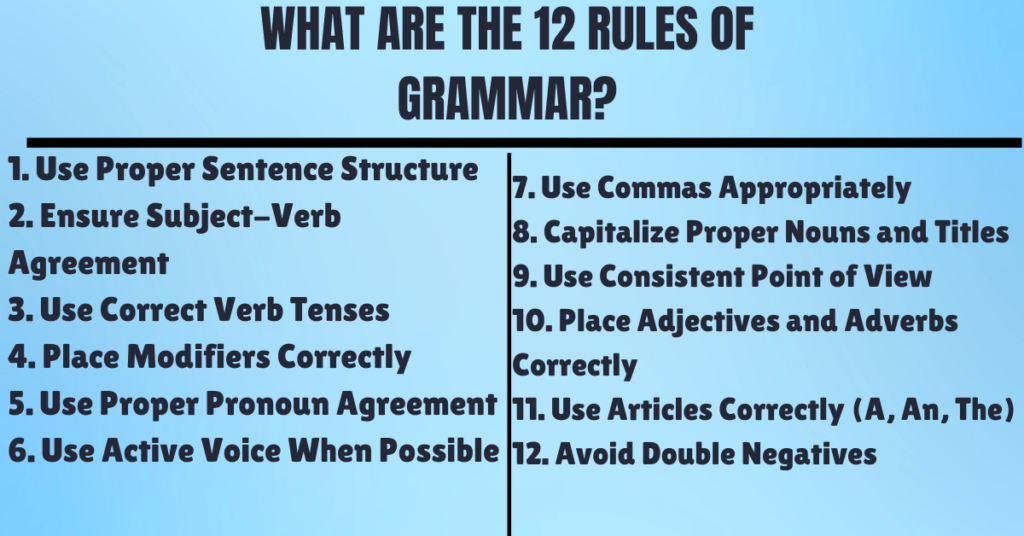
1. Use Proper Sentence Structure

Every sentence should have at least one subject (who or what the sentence is about) and one predicate (what the subject is doing). Together, these form a complete thought. This grammar rule ensures your sentences are clear and convey a complete idea.

Example: The dog barked loudly.
Here, “The dog” is the subject, and “barked loudly” is the predicate.

2. Ensure Subject-Verb Agreement

In a sentence, the subject and verb must agree in number. This means a singular subject takes a singular verb, and a plural subject takes a plural verb. This grammar rule is key to maintaining clarity in your sentences.

Example: She walks to school. (Singular subject and verb)
Example: They walk to school. (Plural subject and verb)

3. Use Correct Verb Tenses

Verb tenses indicate when an action occurs (past, present, or future). It’s essential to use the correct tense and be consistent throughout your sentence or paragraph. This grammar rule ensures your reader or listener knows when the action is happening.

Example: He studied yesterday. (Past tense)
Example: She studies every day. (Present tense)

4. Place Modifiers Correctly

Modifiers add detail to a sentence, but they should be placed close to the word they’re modifying to avoid confusion. Misplaced modifiers can change the meaning of a sentence, so following this grammar rule is essential for accuracy.

Correct: The boy with a red hat is my friend.
Incorrect: The boy is my friend with a red hat.

5. Use Proper Pronoun Agreement

Pronouns must agree with the nouns they replace in both number (singular/plural) and gender. Following this grammar rule helps keep sentences clear and understandable.

Example: Sarah lost her book. (“Her” refers to Sarah)
Example: The students raised their hands. (“Their” refers to students)

6. Use Active Voice When Possible

In the active voice, the subject performs the action, making sentences clearer and more direct. This grammar rule can make your writing and speaking more engaging.

Active Voice: The chef prepared the meal.
Passive Voice: The meal was prepared by the chef.

7. Use Commas Appropriately

Commas help clarify meaning by separating different elements in a sentence. Use them to separate items in a list, introductory phrases, and clauses. This grammar rule is crucial for proper punctuation.

Example: After dinner, we went for a walk.
Example: She bought apples, oranges, and bananas.

8. Capitalize Proper Nouns and Titles

Always capitalize proper nouns (specific names of people, places, and things) and titles when they’re used as part of someone’s name. This grammar rule ensures correct formatting in formal writing.

Example: I visited New York City.
Example: Doctor Smith is here.

9. Use Consistent Point of View

Maintain a consistent point of view throughout a sentence or paragraph. Shifting from “I” to “you” or “he/she” within a sentence can be confusing. This grammar rule keeps the sentence focused.

Correct: I went to the market and bought some vegetables.
Incorrect: I went to the market, and you bought some vegetables.

10. Place Adjectives and Adverbs Correctly

Adjectives describe nouns, while adverbs modify verbs, adjectives, or other adverbs. Make sure they’re placed correctly to clarify what they’re modifying. This grammar rule enhances clarity.

Example: She quickly finished her homework. (Quickly modifies the verb finished)
Example: The blue car is mine. (Blue describes the car)

11. Use Articles Correctly (A, An, The)

“A” and “an” are indefinite articles and are used with non-specific nouns, while “the” is a definite article used for specific nouns. Following this grammar rule helps clarify which nouns are general and which are specific.

Example: I saw a cat. (Any cat)
Example: I saw the cat that lives in our neighborhood. (A specific cat)

12. Avoid Double Negatives

Double negatives can make sentences confusing. In English, using two negatives in the same sentence cancels each other out, making the sentence positive. This grammar rule is essential for clarity.

Incorrect: I don’t have no money.
Correct: I don’t have any money.

In Summary

These 12 grammar rules provide a strong foundation for clear, effective communication in English. Mastering them can make a significant difference in how well you express yourself, whether you’re speaking or writing. But remember, grammar alone isn’t enough. To truly build fluency, you need consistent, real-world practice. That’s where the EngVarta app comes in. It connects you with live English experts over phone calls, giving you a safe space to apply these rules in actual conversations, get instant corrections, and boost your confidence. Download the EngVarta app today and turn grammar knowledge into real communication skills. Happy learning!

Frequently Asked Questions about English Grammar Rules

What is grammar in English?

Grammar is the set of rules that governs how words combine to form sentences in a language. English grammar covers parts of speech (nouns, verbs, adjectives, etc.), tenses, sentence structure, punctuation, and word agreement. Knowing grammar helps you communicate clearly and be understood — it’s the structure underneath every sentence you speak or write.

What are the 12 basic rules of English grammar?

The 12 essential grammar rules every English learner should know:

  1. Subject-verb agreement — singular subjects take singular verbs, plural subjects take plural verbs.
  2. Use the correct tense — past, present, or future, consistently within a sentence or paragraph.
  3. Articles (a, an, the) — use them correctly with nouns to specify identity.
  4. Active vs passive voice — prefer active in most cases for clarity.
  5. Pronouns must agree with their antecedents — match number and gender.
  6. Modifiers are placed correctly — keep adjectives and adverbs near what they describe.
  7. Use prepositions correctly — different prepositions change meaning (“in” the room vs “on” the room).
  8. Capitalization rules — proper nouns, sentence starts, “I” pronoun.
  9. Punctuation — periods, commas, semi-colons, question marks each have specific uses.
  10. Conditional sentences — if/then patterns follow specific tense rules.
  11. Reported speech — direct speech to indirect speech requires tense backshift.
  12. Avoid double negatives — “I don’t know nothing” is incorrect; use “I don’t know anything.”

Why is grammar important in English?

Grammar matters because it creates clarity. Bad grammar in spoken English can change the meaning of what you’re trying to say or make you harder to understand. In professional contexts (interviews, emails, presentations), grammar errors signal lack of attention to detail. In everyday conversation, basic grammar accuracy helps native and fluent speakers process what you say without effort.

How many grammar rules are there in English?

There’s no single agreed-upon number. Comprehensive grammar reference books cover 100+ rules. For practical fluency, mastering the 12 core rules above plus 20-30 commonly-used patterns (tenses, prepositions, conditionals) is enough for most learners. Native speakers don’t consciously remember rules — they internalize patterns through exposure and use.

What are the most common grammar mistakes Indian English speakers make?

Frequent grammar errors include:

  • Using “the” with general statements (“I love the music” instead of “I love music”)
  • Confusing “since” and “for” with time expressions (“I am here since two days” — should be “for two days”)
  • Using continuous tense for stative verbs (“I am understanding” — should be “I understand”)
  • Subject-verb agreement with collective nouns
  • Mixing up “less” and “fewer” (use “less” for uncountable, “fewer” for countable)
  • Using “only” or “also” in the wrong sentence position

How can I improve my English grammar quickly?

To improve grammar in 4-8 weeks:

  1. Pick ONE grammar rule per week and use it deliberately in conversation and writing
  2. Read sector-relevant English content daily (news, blogs in your industry) — exposure cements patterns
  3. Get feedback from a teacher or expert who can flag specific mistakes you make
  4. Practice grammar in spoken contexts, not just written drills
  5. Track your most common errors in a notebook and review weekly

Grammar improves fastest when used in real conversation with someone who corrects you. Daily live practice with a TESOL/ESL-certified Expert (like through EngVarta’s $1 refundable trial) catches errors as you make them, which is more effective than self-study alone.

What is the difference between grammar and syntax?

Grammar is the broader set of rules covering all aspects of language structure (parts of speech, tense, agreement, articles, etc.). Syntax is specifically about how words are arranged in a sentence — the word order. Grammar includes syntax. For example, “The cat sat on the mat” follows English syntax (Subject-Verb-Object). Saying “Sat the cat on mat the” violates syntax even though all words are correct.

How long does it take to master English grammar?

Reaching solid functional grammar — where most of your spoken and written English is accurate — typically takes 6-12 months of consistent practice for intermediate learners. Mastering nuance (when to break grammar rules for style, regional variations, formal vs casual register) takes 2-4 years of immersion or deliberate practice. The 12 core rules above can be learned in 2-4 weeks; internalizing them takes longer.

What is the best way to practice English grammar?

The most effective grammar practice combines:

  • Live conversation with someone who corrects you in real time (1-on-1 with an expert is ideal)
  • Reading 30 minutes a day in English at your level
  • Listening to native English content (podcasts, shows) for natural rhythm
  • Writing short pieces and getting feedback
  • Targeted drills on your weakest areas (don’t just practice what you’re already good at)

Are grammar rules different in spoken English vs written English?

Yes — spoken English is more flexible. Native speakers regularly use sentence fragments, contractions (“gonna,” “wanna”), informal sentence endings, and start sentences with “And” or “But.” These would be flagged as errors in formal writing but are perfectly natural in conversation. Knowing both registers — formal grammar for writing and presentations, conversational grammar for everyday speech — is what fluent speakers do.

Top 10 Confusing Words in English (and How to Use Them Correctly)

October 17, 2024 • 6 min read • By Swati Raj

Top 10 Confusing Words in English (and How to Use Them Correctly)

English can be a tricky language, especially when certain words look similar, sound alike, or seem interchangeable but actually have distinct meanings. These confusing words often trip up even the most proficient speakers. To help you navigate this linguistic minefield, we’ve compiled a list of the top 10 confusing words in English—and how to use them correctly.

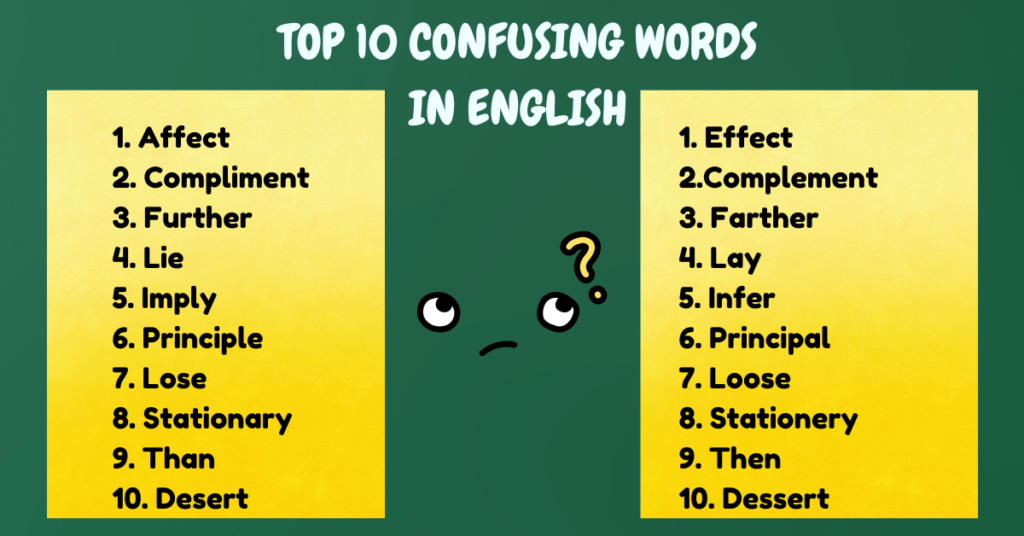
1. Affect vs. Effect

  • Affect (verb): To influence something.
    • Example: The weather can affect your mood.
  • Effect (noun): The result or consequence of an action.
    • Example: The new policy had a positive effect on employee productivity.

Tip: If you’re talking about an action, use “affect.” If you’re talking about a result, use “effect.”

2. Compliment vs. Complement

  • Compliment (noun/verb): A polite expression of praise or admiration.
    • Example: She gave me a nice compliment about my dress.
  • Complement (noun/verb): Something that completes or enhances something else.
    • Example: The wine complements the meal perfectly.

Tip: Remember, “I” in “compliment” stands for admiration, while “E” in “complement” stands for enhancement.

3. Further vs. Farther

  • Further (adjective/adverb): Refers to metaphorical or abstract distance.
    • Example: Let’s discuss this further.
  • Farther (adjective/adverb): Refers to physical distance.
    • Example: The store is farther down the street.

Tip: Use “farther” for measurable distances and “further” for abstract concepts like time or conversation.

4. Lie vs. Lay

  • Lie (verb): To recline or rest on a surface.
    • Example: I need to lie down after a long day.
  • Lay (verb): To place something down.
    • Example: Lay the book on the table.

Tip: People lie down, but you lay things down.

5. Imply vs. Infer

How to Stop Confusing These Words in Conversation

Knowing the difference between confusing words on paper is one thing. Using the correct word in real-time conversation is another. Here are practical tips to stop mixing them up when you speak:

  • Create memory hooks: For affect/effect — “Affect is the Action (both start with A), Effect is the End result (both start with E).” Simple associations stick better than grammar rules.
  • Practise in sentences, not isolation: Do not just memorise definitions. Say the word in 3 different sentences out loud. Your mouth needs to practise the correct usage, not just your brain.
  • Get corrected in real time: When you use the wrong word in conversation, an English expert can catch it immediately and help you self-correct. This is far more effective than studying word lists alone. EngVarta experts are trained to notice these common errors and correct them gently during your session.
  • Read more, speak more: The more you encounter words in natural context (articles, conversations, podcasts), the more instinctive the correct usage becomes. There is no shortcut — exposure plus practice equals accuracy.

Confusing words are one of the most common reasons English learners lose confidence in conversation. The good news: with daily practice, these errors disappear within weeks. Start with a 10-minute EngVarta trial session (₹69 / $1, fully refundable) and experience how expert feedback accelerates your learning.

Frequently Asked Questions

What are the most commonly confused words in English?

The most commonly confused word pairs include: affect/effect, their/there/they’re, then/than, its/it’s, your/you’re, lose/loose, accept/except, and complement/compliment. These are confused because they sound similar but have different meanings.

How can I stop confusing similar English words?

Create memory hooks for each pair, practise using them in sentences out loud, and get real-time corrections from an English expert. Daily speaking practice on platforms like EngVarta helps because experts catch these errors naturally during conversation and correct them immediately.

What Our Learners Say

Rated 4.5★ from 9,100+ reviews on Google Play

★★★★★
Nice platform to practice English speaking. Teachers are awesome. Thanks
★★★★★
Really we can see the positive results from the app. Well done!
★★★★★
It's very beneficial app for children who don't speak well.
★★★★★
good and highly talented experts are here..just go for a trail without any doubt.. thank you eng vartha...A small request from my side just take less payment from the people who are joing in your coaching...help to them...thank you
★★★★★
Excellent application to improve your communication skills.Thnk you for introducing new vocabulary everyday.God bless you You might not aware of but personally this is helping me a lot
★★★★★
Chicken-hearted person will become lion hearted person after using this app.
★★★★★
This app is too much helpful for me. I can surely say that every student must follow this app for their English speaking.
★★★★★
Really I love this app. It's awesome. The application as well as the speakers are very good. I'm happy to learn daily vocabulary you send in mail.
★★★★
A very good app its just as good as shown in the advertisement,but I wish it would have been a bit cheaper,
★★★★★
good experience this app is very helpfull and user friendly you may also check the app to learn English
★★★★★
Today was my first call on EngVarta. I just enjoyed the conversation. It's such a good platform for people who want to explore themselves in English speaking. I just loved it.
★★★★★
Engvarta provides the best platform for learners to learn and get comfortable with the language by offering a comfortable and judgment-free environment with regular feedback. Engvarta is the best English learning app available.

Ready to Practice with Real Experts?

Try EngVarta today — ₹69 trial (India) / $1 trial (International) · 100% refundable

  • Imply (verb): To suggest something without saying it directly.
    • Example: He implied that he wasn’t happy with the decision.
  • Infer (verb): To deduce or conclude something from evidence.
    • Example: From her tone, I could infer that she was upset.

Tip: The speaker implies, while the listener infers.

6. Principle vs. Principal

  • Principle (noun): A fundamental truth or law.
    • Example: Honesty is a key principle in life.
  • Principal (noun/adjective): The head of a school or organization, or the most important thing.
    • Example: The principal of the school gave a speech.

Tip: Remember that your principal is your “pal,” while principle refers to a rule or standard.

7. Lose vs. Loose

  • Lose (verb): To fail to keep, win, or maintain something.
    • Example: I don’t want to lose my keys.
  • Loose (adjective): Not tight or free.
    • Example: The shirt is too loose on me.

Tip: Double the “O” when something is not tight, but just one “O” when you misplace something.

8. Stationary vs. Stationery

  • Stationary (adjective): Not moving, remaining in one place.
    • Example: The car remained stationary at the red light.
  • Stationery (noun): Writing materials like paper and envelopes.
    • Example: She bought new stationery for her office.

Tip: “E” in stationery is for “envelope,” while “A” in stationary is for “at rest.”

9. Than vs. Then

  • Than (conjunction): Used for comparisons.
    • Example: She is taller than her brother.
  • Then (adverb): Refers to time or what comes next.
    • Example: First, we’ll have dinner, then we’ll watch a movie.

Tip: Use “than” for comparisons and “then” for time sequences.

10. Desert vs. Dessert

  • Desert (noun): A dry, sandy area with little to no vegetation.
    • Example: The Sahara is the largest desert in the world.
  • Dessert (noun): The sweet course at the end of a meal.
    • Example: I’ll have chocolate cake for dessert.

Tip: To remember “dessert” has two “s,” think of wanting seconds of something sweet!

Conclusion

Mastering these confusing words is key to becoming more confident in your English writing and speaking. Although some words may seem tricky at first, understanding the context in which they are used can help you avoid mistakes. The more you practice, the more naturally these distinctions will come. If you’re looking to improve your spoken English and clarify any lingering doubts about word usage, apps like EngVarta (download now https://engvarta.com/) offer one-on-one conversation practice with experts, helping you gain fluency and precision in English. Happy learning!

Related reads on EngVarta:


10 Common Mistakes to Avoid When Using Prepositions in Spoken English

September 11, 2024 • 9 min read • By Swati Raj

10 Common Mistakes to Avoid When Using Prepositions in Spoken English

Prepositions are those small but mighty words that link nouns, pronouns, or phrases to other words within a sentence. They’re everywhere in spoken English, but mastering their use can be tricky, especially for non-native speakers. Today, we’ll go over 10 common mistakes people make with prepositions and how to avoid them.

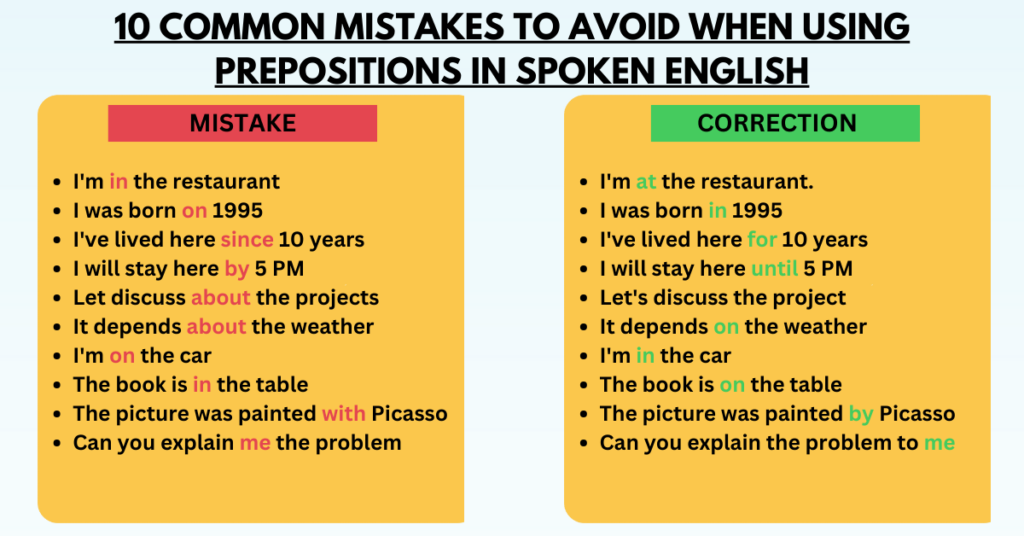
1. Confusing ‘In’ and ‘At’ for Locations

  • Mistake: Saying, “I’m in the restaurant” when you mean, “I’m at the restaurant.”
  • Correction: Use ‘at’ when you’re talking about specific locations, like “at the office” or “at the park.” Use ‘in’ when you’re referring to something more general or enclosed, like “in the city” or “in the car.”

2. Using ‘On’ Instead of ‘In’ for Months and Years

  • Mistake: Saying, “I was born on 1995″ instead of “I was born in 1995.”
  • Correction: Use ‘in’ for months, years, centuries, and long periods of time, like “in March” or “in 2025.” Use ‘on’ for specific days or dates, like “on Tuesday” or “on December 12th.”

3. Mixing Up ‘For’ and ‘Since’ with Time Expressions

  • Mistake: Saying, “I’ve lived here since 10 years” instead of “I’ve lived here for 10 years.”
  • Correction: Use ‘for’ when talking about the length of time (a duration), like “for 10 years.” Use ‘since’ when you’re referring to the starting point in time, like “since 2010.”

4. Incorrect Use of ‘By’ and ‘Until’

  • Mistake: Saying, “I will stay here by 5 PM” instead of “I will stay here until 5 PM.”
  • Correction: ‘Until’ is used to indicate the time something will continue to happen, like “until 5 PM.” ‘By’ is used to show the deadline or when something must be completed, like “Please finish this by Friday.”

5. Incorrect Use of ‘To’ After ‘Discuss’

  • Mistake: Saying, “Let’s discuss about the project” instead of “Let’s discuss the project.”
  • Correction: The verb ‘discuss’ doesn’t require a preposition. You should say, “Let’s discuss the project,” without ‘about.’

6. Confusing ‘On’ and ‘About’ After ‘Depend’

  • Mistake: Saying, “It depends about the weather” instead of “It depends on the weather.”
  • Correction: Always use ‘on’ after the verb ‘depend,’ as in “It depends on the weather,” or “It depends on you.”

7. Mixing Up ‘In’ and ‘On’ with Transportation

  • Mistake: Saying, “I’m on the car” instead of “I’m in the car.”
  • Correction: Use ‘in’ for smaller vehicles like cars or taxis (“in the car”) and ‘on’ for larger modes of transportation like buses, trains, and planes (“on the bus”).

8. Using ‘In’ Instead of ‘On’ for Surfaces

  • Mistake: Saying, “The book is in the table” instead of “The book is on the table.”
  • Correction: Use ‘on’ when referring to something that’s on a surface, like “on the table,” “on the floor,” or “on the shelf.”

9. Confusing ‘With’ and ‘By’

  • Mistake: Saying, “The picture was painted with Picasso” instead of “The picture was painted by Picasso.”
  • Correction: Use ‘by’ when you’re talking about the agent or doer of an action (“painted by Picasso”), and ‘with’ when you’re referring to the tool or instrument used (“painted with a brush”).

10. Incorrect Use of ‘To’ After ‘Explain’

  • Mistake: Saying, “Can you explain me the problem?” instead of “Can you explain the problem to me?”
  • Correction: The verb ‘explain’ needs to be followed by the object first and then the person it’s explained to: “Explain the problem to me.”

For more information, you can check this blog Prepositions of Time in English – At, On, In

How to Avoid These Mistakes?

  1. Practice Listening and Reading: Exposure to correct usage through podcasts, TV shows, and books will help you naturally pick up the right prepositions.
  2. Use an English Learning App: Apps like EngVarta provide real-time conversations with English experts, helping you identify and correct preposition mistakes in real time.
  3. Create Flashcards: Make a list of common preposition phrases and review them daily.
  4. Speak Regularly: The more you practice speaking English, the more natural it is to use prepositions.

Mastering prepositions may seem challenging, but with practice, you’ll find yourself making fewer and fewer mistakes. Prepositions can often change the entire meaning of a sentence, so using them correctly is key to fluency.

By avoiding these 10 common mistakes, you’ll see a noticeable improvement in your spoken English!

Ready to master prepositions and speak English confidently? Download EngVarta today and start practicing with live experts!

Frequently Asked Questions about English Prepositions

What are English prepositions and why are they tricky?

Prepositions are short words (in, on, at, by, for, of, to, with, from, about) that connect nouns, pronouns, or phrases to other words in a sentence. They’re tricky because they don’t translate directly between languages — Hindi, Tamil, Bengali, and other Indian languages handle position/direction/time differently than English. Learners often calque from their native language, leading to errors like “I’m interested in to learn” (should be “interested in learning”) or “good in maths” (should be “good at maths”).

What are the most common English preposition mistakes?

Frequent errors Indian English speakers make: (1) “Good IN English” → “good AT English”. (2) “Discussing ABOUT this” → “discussing this” (no preposition needed). (3) “Married WITH her” → “married TO her”. (4) “Different THAN” → “different FROM”. (5) “On Monday morning” → “on Monday morning” (correct) but “in the morning” (correct), “at night” (correct). Time prepositions: AT exact times, ON days, IN months/seasons/years. Place prepositions: AT specific locations, ON surfaces, IN enclosed spaces.

What’s the difference between in, on, and at?

For TIME: AT for exact times (at 5pm, at noon), ON for specific days (on Monday, on Christmas), IN for longer periods (in May, in 2026, in winter). For PLACE: AT for specific points (at the bus stop, at the door), ON for surfaces (on the table, on the wall), IN for enclosed spaces (in the room, in the car, in India). When in doubt, think of the preposition as zooming in: IN is broadest (a country), ON is narrower (a street), AT is specific (a corner).

How can I avoid preposition mistakes in spoken English?

Effective strategies: (1) Memorise high-frequency verb-preposition combinations as PHRASES (depend on, listen to, agree with, look forward to, instead of memorising “depend” and “on” separately). (2) Read English daily and note every preposition usage that surprises you. (3) Get feedback from a TESOL/ESL-certified Expert who flags preposition errors as they happen — these errors are often invisible to learners. EngVarta‘s daily 1-on-1 sessions catch preposition mistakes in real conversation, with corrections in the moment.

What are essential English prepositions to know?

Top 20 high-frequency prepositions: in, on, at, by, for, of, to, with, from, about, after, before, between, during, into, through, without, against, among, beyond. Mastering these covers ~95% of everyday English usage. Memorise common phrases that use them (“by the way”, “for instance”, “in fact”, “of course”) rather than learning prepositions in isolation.

How long does it take to master English prepositions?

Most learners reach 80% accuracy on common prepositions in 6-12 months of daily practice with feedback. Reaching 95%+ accuracy takes 1-2 years because some preposition uses are highly idiomatic (e.g., “interested IN” vs “fond OF” — no logical reason for the difference). Acceptance helps: native speakers often disagree on “correct” preposition use too. Focus on the patterns that matter for clarity.

Should I memorise preposition rules or learn them in context?

Both, but lean toward CONTEXT. Rules give you a starting framework (time prepositions: at/on/in pattern). Context (real sentences, conversations, written examples) is what locks usage into memory. Reading English daily and noting prepositions in their natural context is more effective than memorising rule lists. Active production (speaking, writing) with corrections is the fastest path to accuracy.

Can an IELTS Preparation App Replace Traditional Coaching? Here’s What You Need to Know

August 10, 2024 • 5 min read • By Swati Raj

Can an IELTS Preparation App Replace Traditional Coaching? Here's What You Need to Know

Let’s face it—life is hectic, and finding the time to attend regular IELTS classes can feel like squeezing water from a stone. Enter the IELTS preparation app: sleek, convenient, and packed with features promising to help you ace the exam. But here’s the burning question: can these apps truly replace the tried-and-true traditional coaching? Let’s unravel the truth behind this digital versus classroom debate.

The Appeal of IELTS Preparation Apps: Why Everyone’s Talking About Them

IELTS preparation app are on the rise, and it’s easy to see why. They offer a modern approach to learning that seems tailor-made for our fast-paced lives. But are they really the game-changers they claim to be?

  1. Study Anywhere, Anytime—Literally: Imagine prepping for the IELTS while waiting for your coffee, during your commute, or in the comfort of your bed. IELTS apps make it possible. The flexibility to study whenever and wherever you want is a massive plus for busy individuals who can’t commit to rigid class schedules.
  2. Learning That Adapts to You: Ever wish your learning material could just ‘get’ you? Many IELTS apps use AI to do just that, adapting to your learning speed, focusing on your weak spots, and pushing you in the right direction. It’s like having a study buddy who knows exactly what you need.
  3. Save Your Wallet: Let’s be real—traditional IELTS coaching can burn a hole in your pocket. In contrast, apps are typically much more affordable, with some offering free versions that are surprisingly robust. For those on a budget, this makes apps a very tempting option.
  4. Instant Gratification: Waiting for feedback from a teacher can feel like an eternity, especially when you’re itching to improve. Apps often provide instant feedback on your practice tests and exercises, giving you the power to correct mistakes on the spot.

The Other Side of the Coin: Where IELTS Apps Might Fall Short

While IELTS apps offer some undeniable perks, they also come with limitations that could be deal-breakers depending on your needs.

  1. No Substitute for a Real Teacher: As smart as these apps are, they can’t replace the wisdom and guidance of a seasoned teacher. Traditional coaching gives you access to expert insights, personalized strategies, and in-depth explanations that apps simply can’t match.
  2. Interaction? Not So Much: Learning is not just about absorbing information—it’s about engaging with it. In a classroom, you can ask questions, participate in discussions, and get immediate clarification. With apps, the interaction is usually one-sided, which might leave you feeling a bit lost on more complex topics.
  3. The Discipline Dilemma: Here’s the thing—studying on your own requires a lot of self-discipline. Without the structure and accountability of a traditional class, it’s easy to slack off or get distracted. Traditional coaching, with its regular schedule and deadlines, helps keep you on track.
  4. Speaking of Speaking…: The speaking section of the IELTS is where many students stumble, and for good reason—it’s tough! While apps can help with pronunciation and vocabulary, they can’t fully replicate the experience of practicing with a real person. In a traditional coaching setting, you get to practice speaking in a supportive environment, which is crucial for building confidence.

The Sweet Spot: Blending Both Worlds

The truth is, you don’t have to choose between an IELTS app and traditional coaching—you can have the best of both worlds.

  • Use Apps to Complement Your Coaching:
    Think of IELTS apps as your on-the-go toolkit. Use them to reinforce what you’ve learned in class, fit in extra practice, and identify where you need more help.
  • Traditional Coaching for the Deep Dive:
    Enroll in traditional coaching to get the personalized guidance and hands-on practice that apps can’t fully provide. It’s where you can ask those tricky questions and get feedback that’s tailored just for you.
  • Consider Online Tutoring:
    If attending in-person classes isn’t feasible, online tutoring could be your golden ticket. It combines the convenience of digital learning with the interactive, personalized touch of traditional coaching.

Final Thoughts: What’s the Best Path for You?

When it comes to preparing for the IELTS, there’s no one-size-fits-all answer. It all boils down to your personal learning style, your goals, and your life circumstances. For some, the convenience and affordability of an app might be all they need. For others, the depth and structure of traditional coaching are irreplaceable.

So, why not blend both approaches? Use the power of an app to supplement the rich experience of traditional coaching, or mix in online tutoring for a personalized touch. Remember, the goal is not just to work hard but to work smart—so choose the path that aligns with your needs and gives you the best shot at IELTS success.