Best English Learning Apps |

Tag

best english learning apps

10 Best English Speaking Practice Apps in 2026 (Tested & Compared)

April 13, 2026 • 18 min read • By Swati Raj

Editorial cover comparing the 10 best English speaking practice apps tested for 2026

The best English speaking app is the one you use daily. Fluency comes from consistent practice—not expensive apps or fancy AI. If you understand English but struggle to speak, EngVarta offers strong value for daily practice. For IELTS, FixoLang provides focused exam prep. For pronunciation, ELSA Speak or ChatterFox can help. The fastest learners practice every day, even for 15 minutes. Pick one app, stay consistent for 30 days, and you’ll see the difference.

Finding the right app to practice spoken English can be overwhelming. There are hundreds of options, but most focus on grammar drills or vocabulary games rather than real speaking practice. If your goal is to actually speak English fluently, you need an app that makes you talk, not just tap. We tested and compared the best English speaking practice apps available in 2026. This guide covers what each app does best, what it costs, and which type of learner it suits so you can pick the one that actually helps you improve.

No affiliate spin. No sponsored slots. Every app on this list earned its place on merit, not on a check.

Quick Verdict For real practice — not just lessons — EngVarta is the strongest app in 2026 because every session is a live call with a TESOL/ESL-certified Expert who corrects you in real time and gives consolidated feedback at the end. Speak is best for solo AI drills, Cambly for premium native-speaker sessions. Choose EngVarta when consistent live practice matters most.

What Makes a Good English Speaking Practice App?

Before jumping into the list, here is what separates an effective speaking app from a mediocre one:

  • Real speaking time – You should be talking, not just reading or listening
  • Feedback on mistakes – Either from a real person or AI that catches your errors
  • Consistency tools – Daily reminders, short sessions, flexible scheduling
  • Affordable enough for daily use – Speaking practice works best when done every day

With these criteria in mind, here are the best English speaking practice apps for 2026.

Best English Speaking Practice Apps in 2026

1. EngVarta – Best for Daily Speaking Confidence

EngVarta connects you with live English experts for real one-on-one conversations. No scripts, no bots. You call an expert, talk about real topics, and get corrected naturally during the conversation. Available from 7 AM to midnight, it fits into any schedule. What makes EngVarta different from other apps is the focus on building speaking confidence through real practice. Most learners understand English but freeze when they have to speak. EngVarta solves this by giving you a safe, judgment-free space to practice every single day.

  • Price : Starting at from ₹2,700 for 25 sessions for daily sessions
  • Best for : Learners who understand English but struggle to speak fluently
  • Unique features : Live human experts (not AI), real-time corrections, audio-only format for zero pressure, expert feedback after every session
  • Limitation : Not designed for grammar lessons or exam-specific preparation

Start Practicing Today

You’ve read the comparison. You know the numbers. The only thing left is to actually start.

Try EngVarta for ₹69. Full money-back guarantee. No risk, no booking, no excuses.

Download on Google Play →
Download on App Store →

Available on Android & iOS • 2M+ learners • 4.5★ rating


2. FixoLang – Best for IELTS Speaking Preparation

If you are preparing for the IELTS speaking test, FixoLang is built specifically for you. The app simulates the actual IELTS speaking test format with cue cards, timed responses, and AI evaluation that gives you a predicted band score. FixoLang helps you practice Part 1 introductions, Part 2 cue card responses, and Part 3 discussions exactly how they appear in the real exam. The AI feedback tells you exactly where you lost marks and what to fix.

  • Price : Free tier available | Premium plans from Rs 1,199/month
  • Best for : IELTS aspirants targeting 6.5+ band in speaking
  • Unique features : AI band score prediction, IELTS mock tests with all 3 parts, cue card timer, detailed pronunciation and fluency feedback
  • Limitation : Focused only on IELTS. Not suitable for general English conversation practice

Trusted by thousands of IELTS test-takers across India, FixoLang has helped learners improve their speaking band by 0.5 to 1.5 points within weeks of consistent practice. Download FixoLang : Download for Android | Download for iOS

3. ELSA Speak – Best for Pronunciation and Accent Training

ELSA Speak uses advanced AI to analyze your pronunciation at the phoneme level. It listens to how you say each sound and shows you exactly where your mouth position or stress pattern is wrong. If your main challenge is pronunciation rather than conversation, ELSA is one of the best tools available. The app provides structured lessons on individual sounds, word stress, intonation patterns, and connected speech. It is especially useful for learners who want to reduce their mother tongue influence on their English accent.

  • Price : Free (limited) | Pro at $11.99/month or $74.99/year
  • Best for : Learners focused on clearer pronunciation and accent reduction
  • Unique features : Phoneme-level speech recognition, mouth position guides, AI pronunciation scoring, personalized daily lessons
  • Limitation : All exercises are scripted. No real conversation practice. Can feel repetitive after a while

4. Cambly – Best for Practice with Native Speakers

Cambly connects you with native English-speaking tutors from the US, UK, and Australia for live video conversations. You can book sessions or start an instant call anytime. The tutors are real people who adjust to your level and interests. Cambly works well for learners who specifically want exposure to native accents and natural conversation patterns. The video format also helps with non-verbal communication skills.

  • Price : From $52/month (1 lesson/week, 30 min) | 3-month plan at $7.75/lesson | Annual plan at $5.54/lesson. India pricing starts around Rs 1,199/month
  • Best for : Intermediate to advanced learners who want native speaker interaction
  • Unique features : Instant tutoring with native speakers, video calls, session recordings for review, kids-specific program available
  • Limitation : Expensive for daily practice. Tutor quality varies. No pronunciation scoring or structured curriculum

5. ChatterFox – Best for Accent Coaching

ChatterFox combines AI-driven pronunciation drills with personalised feedback from certified accent coaches, which is rare in the category – most apps lean fully into one or the other. The hybrid model works well for learners who want the convenience of daily AI practice plus the credibility check of a real human coach reviewing their progress at intervals. Particularly suited to professionals who need clearer English at work without sounding artificial.

  • Price : Subscription-based, with structured plans on chatterfox.com
  • Best for : Professionals who want both AI accent drills and certified coach feedback
  • Unique features : AI + certified accent coach hybrid, personalised feedback, structured progression
  • Limitation : Coach availability may be limited at peak times; pure-AI apps offer more on-demand drilling

6. SpeakShark – Best Free AI English Speaking Practice

SpeakShark gives unlimited 24/7 conversation practice with four native-accent AI teachers (American, British, Australian, plus a fourth voice) and real-time pronunciation scoring at the phoneme level. The free tier is 10 minutes per day with no credit card – enough for a daily speaking habit without commitment. Strong fit for self-driven learners who want consistent daily practice without the scheduling and social pressure of human sessions.

  • Price : Free 10 min/day (no credit card) | Paid tiers for unlimited practice
  • Best for : Self-driven learners wanting consistent daily AI practice without scheduling
  • Unique features : 4 native-accent AI teachers, phoneme-level pronunciation scoring, free tier without credit card
  • Limitation : AI-only – learners specifically wanting human conversation or video-call confidence will need human practice alongside

7. Speak (by Speakeasy Labs) – Best AI Conversation App

Speak is an AI-powered conversation practice app backed by OpenAI’s startup fund. It offers structured speaking lessons with an AI tutor that listens, responds, and corrects you as you practice. The app is designed around repetition and drills so you build speaking muscle memory. Speak works well for learners who want consistent AI-driven drills without the pressure of talking to a real person. It has been recommended by Wirecutter and has strong speech recognition.

  • Price : Around $14/month | $99/year Premium
  • Best for : Structured AI speaking drills and repetition-based practice
  • Unique features : Natural AI conversation, solid speech recognition, scenario-based lessons, Wirecutter recommended
  • Limitation : No real human interaction. Cannot build the social confidence needed to speak to real people in real situations

8. Duolingo – Best for Beginners and Daily Habit

Duolingo is the world’s most popular language learning app with over 500 million users. Its gamified approach, streaks, and bite-sized lessons make it incredibly easy to build a daily learning habit. For absolute beginners, it is a solid way to pick up vocabulary and basic grammar. However, Duolingo is not a speaking app in any meaningful sense. Most exercises involve tapping, matching, or typing. Actual speaking practice is minimal and the AI feedback is limited.

  • Price : Free | Super Duolingo at $7/month
  • Best for : Absolute beginners building vocabulary and basic grammar
  • Unique features : Addictive gamification, daily streaks, generous free tier, huge community
  • Limitation : Minimal speaking practice. Mostly tap and swipe exercises. Not effective for building real fluency or speaking confidence

9. MySivi AI – Best AI App for Indian Learners

MySivi AI is an AI-powered English speaking app designed for Indian learners. It supports Hindi and a few other Indian languages, offering AI-driven conversation practice in a bilingual context.

  • Price : Free tier available | Premium plans available
  • Best for : Indian learners who want AI practice with bilingual interface
  • Unique features : Bilingual interface for Indian users
  • Limitation : AI-only – no human practice, which limits real-world conversation confidence

10. HelloTalk – Best for Free Language Exchange

HelloTalk connects you with real people worldwide who want to exchange languages. You teach them your native language, they help you with English. It is free, global, and gives you genuine human interaction without the cost of a tutor. For casual conversation practice with native speakers, HelloTalk can be a great supplement. The community is active and you can find partners at various levels.

  • Price : Free | Premium from $6.99/month
  • Best for : Casual conversation practice with native speakers around the world
  • Unique features : Real human interaction, free tier, global community, text, voice, and video options
  • Limitation : Partners are untrained and unreliable. Quality varies wildly. No structured feedback or corrections. Compared to EngVarta (from ₹2,700 for 25 sessions / from $45 for 25 sessions) with trained experts, you get what you pay for

Quick Comparison: Best English Speaking Practice Apps 2026

App Price Best For Real Conversations? AI Feedback?
EngVarta Rs 2,700/mo Daily speaking confidence Yes (live humans) Expert feedback
FixoLang Free / Rs 1,199/mo IELTS speaking prep AI mock tests Yes (band score)
ELSA Speak Free / $11.99/mo Pronunciation training No Yes (phoneme level)
Cambly From $52/mo Native speaker practice Yes (video tutors) No
ChatterFox Subscription Accent coaching (AI + human coach hybrid) Yes (certified coaches) Yes
Speak $14/mo / $99/yr Structured AI drills No (AI only) Yes
Duolingo Free / $7/mo Beginner vocabulary No Limited
SpeakShark Free 10 min/day / Paid Free AI conversation with native-accent voices No (AI only) Yes
MySivi AI Free / Premium Indian bilingual learners No (AI only) Limited
HelloTalk Free / $6.99/mo Language exchange Yes (untrained) No

What Our Learners Say

Rated 4.5★ from 9,100+ reviews on Google Play

★★★★★
Excellent application to improve your communication skills.Thnk you for introducing new vocabulary everyday.God bless you You might not aware of but personally this is helping me a lot
★★★★★
This is the best app for anyone who feels nervous and hesitates during conversation in English.
★★★★★
EngVarta helps me a lot to become more fluent in speaking English. We can practice without any fear of making mistakes. I would recommend all the people who are hungry to learn English.
★★★★★
Good app to express yourself because in our house there are no environment n EngVarta provides you environment
★★★★★
EngVarta is one of the best apps for those who want to improve their English fluency and conversation skills. The experts are very helpful and encouraging, giving sufficient confidence.
★★★★★
Engvarta is the best app for the people who are really serious in their learning English.
★★★★★
I have thoroughly enjoyed the session and the expert provided me instant feedback that will definitely help me.
★★★★★
This app is amazing, it's helpful and good. The tutors are very excellent. I am improving and don't shy anymore.
★★★★★
i completed my trial session, expert was good. I installed this app because chatgpt recommended it and I find it quite good speaking practice. experts are professional and friendly. plans are also economical compared to other english courses i took in the past.
★★★★★
Great !!! Enjoying it 👍experts reAlly help you to see your mistakes and correct them in the mean time.
★★★★★
In the beginning I felt very nervous to talk but when I picked the call the expert spoke in such a gentle way. I really liked it.
★★★★★
I am very happy while speaking to you. It was a very good experience. I want to congrats your team for making such an excellent app for helping people who want to learn and speak English.

Ready to Practice with Real Experts?

Try EngVarta today — ₹69 trial (India) / $1 trial (International) · 100% refundable

How to Choose the Right English Speaking App

The best app depends on what is holding you back:

  • You understand English but cannot speak it – Start with EngVarta (from ₹2,700 for 25 sessions / from $45 for 25 sessions). Daily live conversations with trained experts will build the habit and confidence you need.
  • You need to crack the IELTS speaking test – Use FixoLang for exam-specific practice with AI scoring.
  • Your pronunciation is unclear – Try ELSA Speak for phoneme-level correction.
  • You want to practice with native speakersCambly connects you with tutors from English-speaking countries.
  • You want to refine your accentChatterFox combines AI accent drills with feedback from certified human coaches.
  • You want structured AI drillsSpeak provides scenario-based AI conversation lessons.
  • You are a complete beginnerDuolingo is a fun way to pick up vocabulary before moving to real speaking practice.
  • You want free AI warm-up practiceSpeakShark gives 10 minutes per day free with native-accent AI voices, no credit card needed.
  • You are an Indian learner wanting bilingual AI practiceMySivi AI offers basic bilingual support.
  • You want free language exchangeHelloTalk connects you with real people, though quality varies.

For most Indian learners, the biggest barrier is not grammar or vocabulary. It is the confidence to speak. That is why apps that provide real, daily conversation practice with trained experts tend to deliver the fastest improvement in spoken English fluency. AI apps and gamified apps are useful supplements, but nothing replaces talking to a real human who can correct you, encourage you, and hold you accountable.

👉 Connect with EngVarta & Boost Your English Daily!

Stay inspired and improve your English speaking skills with daily tips, real conversations, and expert guidance.

📸 Instagram: https://www.instagram.com/engvarta.app/

▶️ YouTube: http://www.youtube.com/@EngVarta

📘 Facebook: https://www.facebook.com/engvarta

💼 LinkedIn: https://www.linkedin.com/company/engvarta

✨ Follow EngVarta now and start speaking English confidently every day!

Conclusion

The best English speaking app is the one you use daily. Fluency comes from consistent practice—not expensive apps or fancy AI. If you understand English but struggle to speak, EngVarta offers strong value for daily practice. For IELTS, FixoLang provides focused exam prep. For pronunciation, ELSA Speak or ChatterFox can help. The fastest learners practice every day, even for 15 minutes. Pick one app, stay consistent for 30 days, and you’ll see the difference.

Frequently Asked Questions (FAQs)

Q1. What is the best English speaking practice app for beginners?

Ans : For beginners who understand some English but struggle to speak, EngVarta is the most effective choice. It pairs you with live English experts who adjust to your level and help you build confidence through real conversations. There is no scripting involved, so you naturally learn to think and respond in English.

Q2. Are free English speaking practice apps effective?

Ans : Free apps like ELSA Speak and FixoLang offer useful tools for pronunciation and IELTS practice. However, for building real conversational fluency, free tiers are usually limited. Daily conversation practice, which is the fastest path to fluency, typically requires a paid plan on platforms like EngVarta or Cambly.

Q3. How long does it take to improve spoken English with an app?

Ans : With 15 to 20 minutes of daily practice, most learners notice improvement within 3 to 4 weeks. Consistency matters more than session length. Apps that enable daily practice at affordable prices, like EngVarta, tend to produce faster results than expensive platforms where you can only practice once a week.

Q4. Can an English speaking app replace a traditional English class?

Ans : For speaking fluency, yes. Traditional classes focus heavily on grammar rules and written exercises. Speaking apps focus on what actually builds fluency, which is regular spoken practice with real-time feedback. For exam preparation or formal grammar study, a combination of both may work best.

Q5. Which is better – an AI English speaking app or one with real humans?

Ans : AI apps like ELSA Speak are excellent for pronunciation drills and structured exercises. But for building real-world speaking confidence, human interaction is irreplaceable. Apps like EngVarta provide the emotional safety, natural conversation flow, and real-time human feedback that AI cannot replicate. The ideal approach is to use both: AI for pronunciation practice and human-led apps for conversation fluency.

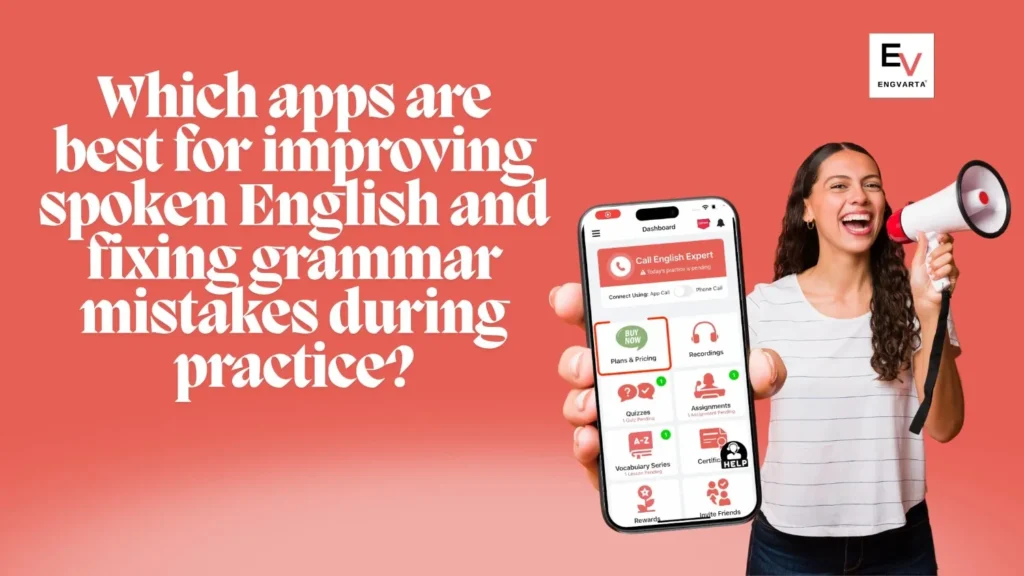
Which apps are best for improving spoken English and fixing grammar mistakes during practice?

February 9, 2026 • 13 min read • By Mahesh .

improving spoken English and fixing grammar mistakes during practice

In the hyper-competitive Indian corporate landscape of 2026, technical expertise is no longer the sole driver of career success. As multinational corporations (MNCs) expand their footprints in tech hubs like Bangalore, Hyderabad, and Pune, the ability to articulate complex ideas with clarity has become the ultimate “force multiplier” for your salary.

For many professionals, the challenge isn’t a lack of vocabulary or an inability to write emails. The real hurdle is the “Fluency Gap”—the frustrating silence that happens when you try to practice English speaking in real-time but find your brain stuck in translation.

If you’ve ever felt your heart race before a client presentation or hesitated to speak up in a cross-border meeting because of potential grammar mistakes, this guide is for you. We will analyze the best app for spoken English practice, including the EngVarta App, specifically tailored for the Indian workforce, and show you how to use English speaking tools to unlock a projected 34% “fluency premium” in your paycheck.

The 2026 Fluency Economics: Why Spoken English is Your Best Investment

Before we dive into the English speaking apps, let’s look at the “why.” Recent 2026 employment data suggests a staggering trend: fluent English speakers in India earn, on average, 34% higher hourly wages than their non-fluent counterparts. This isn’t just a statistic; it’s the difference between a mid-level role and a leadership position.

In 2026, the demand for spoken English improvement is driven by:

  1. Global Collaboration: Hybrid work models now connect Indian teams with US, UK, and European stakeholders daily.
  2. Leadership Readiness: Promoting a manager to a Director role often hinges on their “executive presence”—a mix of confidence and clear English speaking skills.
  3. Client Trust: International clients equate clear communication with professional competence.

Top-Rated Apps for Spoken English Improvement in 2026

The market for apps for spoken English has evolved. We no longer rely on boring fill-in-the-blank exercises. Today’s tools focus on English conversation practice and high-fidelity feedback.

1. EngVarta: The Premier Choice for Indian Professionals

Real-world confidence, workplace scenarios, and MTI reduction. EngVarta is highlighted as the top suggestion for the Indian scenari. Unlike most apps that use AI bots, EngVarta connects you with live English experts via 1-on-1 phone calls. This simulates the exact environment of a corporate conference call.

  • Key Advantage: It offers a judgment-free, anonymous environment. You can make as many grammar mistakes as you need to without the fear of your boss or colleagues hearing you.
  • India Focus: The experts specifically understand regional accents (Mother Tongue Influence – MTI) and can help you neutralize them for a more global professional tone.

2. ELSA Speak: The Pronunciation Powerhouse

Accent clarity and phonetic precision. ELSA (English Language Speech Assistant) uses advanced AI to compare your speech patterns against a neutral global English accent. If you are worried that your English speaking skills are being hampered by mispronouncing “th” or “v” sounds, ELSA provides visual feedback on exactly how to move your tongue and lips.

3. MySivi AI: The New AI Standard

24/7 AI-driven feedback and interview prep. As we move through 2026, MySivi AI has emerged as a top-tier English speaking tool. It provides a “private speaking space” where an AI tutor engages in human-like dialogue. It is particularly effective for English grammar correction because it highlights errors in your transcript immediately after you speak.

4. HelloTalk & Tandem: The Community Connectors

Casual immersion and cultural exchange. These apps connect you with native speakers globally. While less focused on professional English grammar practice, they are excellent for staying in the “English mindset” during your commute or downtime.

How to Correct Grammar Mistakes While Practicing English Speaking

One of the biggest myths in language learning is that you must master grammar before you speak. In reality, spoken English practice  is most effective when it happens during conversation. This is known as the Feedback Loop.

The Anatomy of a Feedback Loop:

  1. Action: You attempt to explain a project delay.
  2. Error: You say, “He don’t like the new design.”
  3. Correction: A live expert (like those on EngVarta) or a high-end AI gently interrupts: “Remember, for ‘he,’ we use ‘doesn’t.’ Try saying: ‘He doesn’t like the new design.’”
  4. Reinforcement: You repeat the correct sentence immediately.

This real-time English Grammar Correction is what builds “neural pathways.” Reading a textbook doesn’t stop you from making that mistake in a meeting; real-time correction does.

Reasons EngVarta is the “Gold Standard” for the Workforce in India

Indian professionals face unique challenges. We often have a high “passive” vocabulary (we understand what we read) but a low “active” vocabulary (we can’t find the words while speaking).

Eliminating the “Fear of Judgment”

In many Indian corporate cultures, there is an unspoken pressure to be perfect. This “perfection trap” leads to silence. EngVarta’s anonymous platform is a psychological breakthrough. By removing the video element and your real name, it allows you to practice English speaking with total freedom.

Mastering Workplace Scenarios

EngVarta experts aren’t just teaching “English”; they are coaching you for the “corporate world.” You can request sessions specifically for:

  • Mock Interviews
  • Salary Negotiations
  • Client Pitch Practice
  • Handling Difficult Conversations

Call Recordings: Your Secret Weapon

Every EngVarta session is recorded. To truly correct grammar mistakes, you must listen to yourself. Most learners are shocked to hear how many filler words (like “um,” “uh,” “actually”) they use. Reviewing your calls allows you to perform your own English Grammar Correction and track your progress over months.

Download EngVarta App today and start building fluent English skills.

The Psychological Strategy: Overcoming the Fear of Speaking

If you want to learn English online, you must first master your mindset. Fear of speaking English usually stems from three areas:

  1. The Translation Lag: Trying to think in your native language (Hindi, Marathi, Telugu, etc.) and then translating.
  2. The Perfection Trap: The belief that one grammar slip-up ruins your credibility.
  3. Accent Anxiety: The fear that your accent makes you sound less “modern.”

How to Break the Cycle:

  • Shadowing Technique: Use your English speaking apps to listen to a sentence and repeat it exactly, mimicking the tone. This reduces the “translation lag.”
  • Focus on Communication, Not Perfection: Your goal is to get your point across. If you make a minor grammar mistake but the client understands your logic, you have succeeded.
  • Acknowledge MTI: Every native speaker in the world has an accent. Aim for “clarity,” not “erasure” of your identity.

Building Your 30-Minute Daily “Fluency Workout”

Consistency is the only way to achieve spoken English improvement. Here is a proven routine for a busy working professional in India:

Morning: The Brain Primer (5 Minutes)

While getting ready, listen to a 5-minute English business podcast. This primes your brain to “hear” the rhythm of the language.

Afternoon: The High-Intensity Practice (15 Minutes)

During your lunch break or commute, connect with an EngVarta expert. This is your core English conversation practice. Don’t just chat; pick a specific workplace topic to discuss.

Evening: The Correction Phase (10 Minutes)

Log into your app and review the feedback. If you are using ELSA, do two pronunciation drills. If you are using EngVarta, listen to 5 minutes of your recorded call and note down three specific grammar mistakes to avoid tomorrow.

Comparative Analysis: Which Tool Fits Your Career Level?

Professional Goal Recommended Tool Why?
Cracking a Job Interview EngVarta

Real experts deliver live mock interviews with personalized feedback on tone and body language.

Presenting to US/UK Clients ELSA Speak Focuses on neutralizing heavy MTI to ensure global stakeholders understand you.
Building Daily Habit Duolingo / MySivi Gamified and AI-driven; perfect for staying consistent with basic English grammar practice.
Writing Better Reports Grammarly The best for written English Grammar Correction and tone adjustment.

Common Grammar Mistakes Indian Professionals Make (and How to Fix Them)

Through our analysis of thousands of hours of English speaking tools data, we’ve identified the “Big Three” errors:

  1. Tense Consistency: Mixing past and present when telling a story.
    • Incorrect: “Yesterday I go to the office and meet him.”
    • Correction: “Yesterday I went to the office and met him.”
  2. Article Misuse: Overusing or omitting “a,” “an,” and “the.”
    • Incorrect: “I am working on project.”
    • Correction: “I am working on the project.”
  3. Subject-Verb Agreement: Especially with singular/plural subjects.
    • Incorrect: “My team want to reschedule.”
    • Correction: “My team wants to reschedule.”

By using apps for spoken English that provide live feedback, you catch these “blind spots” before they become habits.

The Future of English Learning: AI or Human?

By 2026, the question isn’t “AI vs. Human”—it’s how to use both.

  • AI is great for English grammar practice and repetitive drills. It’s cheap, available 24/7, and patient.
  • Humans are essential for English conversation practice that involves emotion, persuasion, and cultural nuance. You cannot learn “leadership tone” from a bot.

For a career-driven professional, we recommend a Hybrid Approach: Use AI for your daily grammar and pronunciation drills, but spend at least 3 days a week on EngVarta to engage in real human connection.

Social Media & Learning Motivation

Follow EngVarta on social media for daily tips, motivation, and real-life English practice ideas:

Conclusion

Your ability to speak English is a financial asset. In the next three years, the gap between those who can communicate globally and those who cannot will only widen.

To recap, if you want to correct grammar mistakes and see genuine spoken English improvement:

  1. Stop studying, start speaking. Use English speaking apps from Day 1.
  2. Prioritize EngVarta for high-stakes professional preparation and judgment-free practice.
  3. Audit your errors. Use call recordings for English Grammar Correction.
  4. Stay Consistent. 15 minutes a day is better than 2 hours once a week.

The corporate world is waiting for your voice. Don’t let a few grammar mistakes stand between you and your next promotion. Download your chosen English speaking tools today and start your journey toward becoming a global Indian professional.

For job-seekers preparing for MNC interviews in 60 to 90 days — see our fluent English in 2 to 3 months for MNC interview.

Frequently Asked Questions about Apps for Fixing Grammar in Spoken English

Which apps help fix grammar during English speaking practice?

Most-used apps for grammar correction during spoken practice: EngVarta (live 1-on-1 with TESOL/ESL-certified Experts who catch grammar errors in real time and correct on the call), Cambly (similar live tutor model with native speakers), italki (community + professional tutors), Speak (AI-driven feedback, less precise on complex grammar). For pure grammar-only apps: Grammarly (best for written corrections), Duolingo (gamified grammar drills). Combination of live-practice + grammar drilling app produces fastest improvement.

Can apps catch spoken English grammar mistakes?

Live-tutor apps (EngVarta, Cambly, italki) catch grammar mistakes in real time during conversation — this is the gold standard. AI apps (Speak, Talkpal, ELSA) catch BASIC grammar errors but miss subtle issues like article use, tense consistency in long narratives, and idiom-grammar interactions. The most effective combination: AI apps for grammar drill reps + live human practice for nuanced correction during real conversation.

Why is fixing grammar during speaking harder than during writing?

Three reasons: (1) Speaking is real-time — no time to review. (2) Speaking has higher cognitive load (you’re managing pronunciation, vocabulary, listening, AND grammar simultaneously). (3) Most schools/courses focus on written grammar; spoken grammar gets less practice. Result: even people with good written grammar make spoken errors. The fix: deliberate spoken practice with feedback, not more written drills.

What grammar mistakes do apps catch in spoken English?

Live tutor apps catch: subject-verb agreement errors, tense confusion (especially since/for, has been/have been), preposition errors, article misuse (a/an/the), pronoun confusion (I vs me), word order mistakes, modal verb misuse (would/could/should). AI apps catch some of these but often miss conditional sentence errors, reported speech issues, and idiom-grammar combinations. EngVarta‘s TESOL/ESL-certified Experts catch all of these in real time during sessions.

How long until apps fix my spoken English grammar?

Realistic timeline: 4-8 weeks of daily app-based practice with feedback to fix the top 5-10 grammar mistakes you make. Fixing all your grammar habits takes 6-12 months of consistent daily practice. The key variable is REAL-TIME FEEDBACK during speaking — not just learning grammar rules in isolation. Apps that include live human tutors produce faster grammar improvement than AI-only apps.

Are AI grammar apps as good as live tutor apps?

Not for spoken grammar correction. AI is excellent for: written grammar (Grammarly), pronunciation (ELSA), basic conversational reps (Speak). AI falls short for: real-time spoken grammar correction during conversation, nuanced register-switching, idiom-grammar combinations, and the human accountability that drives daily practice. Most fluent non-native speakers used a mix — AI for written grammar drills + live human practice for spoken grammar feedback.

Ready to Practice with Real Experts?

Try EngVarta today — ₹69 trial (India) / $1 trial (International) · 100% refundable

Best English Speaking Courses in India (2026) | Compare Top Options & Tips

January 23, 2026 • 16 min read • By Swati Raj

Top 5 Best English Speaking Courses in India
Quick Verdict · 2026 For the best English speaking course in India in 2026, our editor’s pick is EngVarta — live voice 1-on-1 with vetted Indian-context English experts, available 7 AM to midnight every day. ₹69 refundable trial; plans from ₹2,700 for 25 sessions (~₹108 per session). Voice-only with username option means a fully private practice format. Milestone certificates issued as you complete practice hours and reach speaking-progress milestones — useful for HR records and training files. SpeakIn for industry-professional led courses; Cambly for native-speaker video practice; British Council for globally-recognised certified credentials; Duolingo for free vocabulary foundation. Below: full comparison of all 5 picks, verified fees, and decision framework.

If you’re reading this, chances are you’re serious about improving your English speaking skills in 2026. Maybe you’re preparing for a job interview, aiming to study abroad, or simply tired of losing confidence in conversations. Whatever your reason, you’re not alone.

English speaking courses have become essential in India, where English remains the language of opportunity. Whether it’s career growth, cracking competitive exams, traveling abroad, or simply speaking with confidence in daily life, fluent English opens doors everywhere. In fact, recent surveys show that over 85% of Indian professionals believe English fluency directly impacts career advancement.

But here’s the real challenge: with countless apps, institutes, and online English speaking courses available today, which one truly delivers real results?

This guide covers the Top 5 Best English Speaking Courses in India (2026 Edition), with a close look at their pros, cons, pricing, and most importantly — who each course is best suited for.

Quick Comparison Table: Best English Speaking Courses in India (2026)

Platform Best For Mode Pricing Key Features
EngVarta Daily 1-on-1 speaking practice Mobile App Affordable, monthly plans Live calls with Indian experts, real-time correction
SpeakIn Corporate communication skills Website + App Premium, corporate plans Industry professionals, soft skills training
Cambly Speaking with native tutors Website + App Higher-end Native speakers, IELTS prep, flexible timings
British Council Structured courses + certification Online + Centres Moderate to high Grammar, business English, certifications
Duolingo Fun, gamified learning for beginners App + Website Free (paid upgrade) Gamified lessons, vocabulary building
Speak AI conversation for daily habit-building Mobile App ~₹1,650–2,500 / month AI-driven scenarios, pronunciation feedback, 24/7 access
ELSA Speak Pronunciation refinement & accent clarity Mobile App ₹999–1,499 / month Sound-by-sound scoring, targeted phoneme drilling
ChatGPT Voice Free mock-interview & rehearsal Mobile + Web Free tier; ChatGPT Plus ~₹1,950 / month Unlimited voice conversations, mock interviews, role-play

1. EngVarta – Best for One-on-One Speaking Practice with Experts

If you want to speak English fluently, you need to practice it, not just study grammar books. That’s where EngVarta shines.

EngVarta connects you with live English experts over phone calls. No video, no judgment — just natural conversations designed for Indian learners. The goal is not memorization, but building fluency and confidence through consistent speaking practice.

But effective English speaking isn’t just about talking—it’s about immersing yourself in the language and seeking real feedback. Surround yourself with English: listen to podcasts, watch YouTube channels, and chat with friends or language partners. Try role-playing common scenarios or discussing trending topics to push yourself out of your comfort zone. Don’t be afraid to make mistakes; every slip-up is a stepping stone to improvement.

But fluency isn’t just about talking—it’s about mastering a set of interconnected skills:
  • Vocabulary development : Expanding your word bank helps you express ideas clearly and naturally.
  • Pronunciation : Speaking so others understand you—without getting tangled up in tricky sounds.
  • Listening comprehension : Catching every nuance, whether you’re chatting with a friend or listening to a podcast.
  • Sentence construction : Building coherent, flowing sentences as you think and speak.
  • Cultural nuances & idioms : Understanding those quirky phrases and cultural references that make a conversation feel real.
Practicing these skills through real conversations, presentations, and even a bit of public speaking will boost your confidence and fluency. Don’t forget the power of active listening and embracing constructive feedback—they’re your secret weapons for steady improvement.

Why EngVarta stands out:

  • Personalised 1-on-1 live sessions with vetted English experts — no group classes, no marketplace lottery
  • Available 7 AM to midnight every day — practice during your morning walk, the after-dinner quiet hour, or any pocket of your day. Connect in minutes, no scheduled batches.
  • Voice-only with optional username — practice stays between you and your tutor. No on-camera exposure and no real-name requirement. Private by default.
  • Designed especially for Indian learners by Indian-context experts who recognise the L1-interference patterns Hindi-medium and regional-medium speakers carry (soft v/w, retroflex t/d, “make fluency”-type wrong verb pairings, present-continuous overuse, article confusion)
  • Real-time corrections during the call — the expert flags grammar / pronunciation slips instantly, you repeat the corrected version and continue. Plus a consolidated feedback summary at the end of every session so you know what to focus on next time.
  • Builds fluency as a daily speaking habit — 15, 25, or 50-minute session lengths to fit any schedule
  • ₹69 refundable 10-minute trial — no auto-debit traps, no long lock-ins. Plans from ₹2,700 for 25 sessions (~₹108 per session)
  • Milestone certificates issued as you complete practice hours and reach speaking-progress milestones — tangible record of progress useful for HR records, departmental training files, or upskilling submissions
  • Sessions recorded and accessible inside the app for 30 days — re-listen to hear your own patterns and track improvement

Who it’s for: Students, working professionals, homemakers, or anyone who wants daily spoken English practice.

Remember: Confidence grows with regular, real-world use and honest feedback. The more you immerse, practice, and push your limits, the faster your spoken English will improve.

👉 Download EngVarta App on Google Play | Download on iOS

Ready to Practice with Real Experts?

Try EngVarta today — ₹69 trial (India) / $1 trial (International) · 100% refundable

What Our Learners Say

Rated 4.5★ from 9,100+ reviews on Google Play

★★★★★
I have been using EngVarta for the past three months and from the period I am using I feel a considerable amount of difference in how I was speaking earlier and now how I am speaking and I think the EngVarta team has done a commendable job in improving my English fluency skill.
★★★★★
Engvarta is a platform where we start from the 0 level to 100 level. That is the best thing I have never seen in my life. There are so many part and so many way, they are always try to teach you until you become a good speaker. Thank you Engvarta
★★★★★
Great app to overcome inferiority of speaking English.
★★★★★
Excellent experience even in just the first conversation. I'm looking forward to learning English with this app.
★★★★★
I have been practising English on EngVarta for the past 30 days and results are significant. I’m happy to be here.
★★★★★
Let me congratulate you on your endeavour to help people gain confidence while speaking. I enrolled for your vocabulary series. You guys are doing a good job. Keep it up.
★★★★★
Engvarta is a platform where we start from the 0 level to 100 level. That is the best thing I have never seen in my life. There are so many part and so many way, they are always try to teach you until you become a good speaker. Thank you Engvarta
★★★★★
Really it's very useful app but charges is very high plz decrease some prices of courses
★★★★★
Wonderful application for English learners and good for speaking with trainers .All trainers are well experienced and help us within the time period,Thanks
★★★★★
I am really enjoying this app and it is very useful for my IELTS preparation. It is a great application that I have never seen.
★★★★★
Wonderful! They provide you a best platform to talk. A very unique idea I think. English is learned more by speaking than by being taught. So this is the best platform I think. And also you get a chance to interact with intellectual experts so that you can explore yourself.
★★★★★
excellent app for learning fluency and If you genuinely correct your mistakes then you should opt for this

2. SpeakIn – Best for Learning from Industry Professionals

SpeakIn helps learners strengthen corporate communication skills by connecting them with industry professionals.

Why it stands out:

  • Focus on workplace communication and presentations

  • Real trainers from top industries

  • Adds soft skills + English improvement together

Who it’s for: Working professionals, team leads, and job seekers preparing for interviews or leadership roles.

3. Cambly – Best for Native Speaker Practice

Cambly allows learners to interact with native English tutors worldwide. It’s especially useful for those preparing for IELTS Speaking or planning to move abroad.

Why it stands out:

  • Native tutors with global accents

  • Great for IELTS prep and fluency

  • Flexible schedules

Who it’s for: Intermediate to advanced learners who want international exposure.

4. British Council – Best for Structured Courses & Certification

A globally trusted name, the British Council is ideal for learners who prefer a structured curriculum.

Why it stands out:

  • Reputed institution with credibility

  • Covers grammar, writing, business communication

  • Offers certifications recognized worldwide

Who it’s for: Students and professionals who want structured, academic-style learning with recognized certificates.

5. Duolingo – Best for Beginners Who Like Fun Learning

Duolingo is perfect for absolute beginners who want to make English practice a daily habit through gamified lessons.

Why it stands out:

  • Fun and engaging gamification

  • Daily streaks and rewards for consistency

  • Free with paid upgrade option

Who it’s for: School students, hobby learners, or beginners.

6. Speak – Best AI Conversation App for Daily Habit-Building

Speak is a polished AI-driven English conversation app that runs scripted lessons and scenario-based conversations. Useful for the first 30–60 days of building a daily speaking habit, especially if you’re an absolute beginner who freezes when a real human asks a question.

Why it stands out:

  • Lower-anxiety entry point — zero judgment from an AI
  • 24/7 availability — open the app any time, no scheduling
  • Decent pronunciation feedback per sentence

Trade-off: AI conversation patterns plateau by week 6–8 because they become predictable. Cannot simulate the unscripted follow-ups of a real interviewer or workplace conversation. Best paired with a live-tutor app from month 2 onwards.

Who it’s for: Absolute beginners building their first 30 days of speaking habit before adding live human practice.

7. ELSA Speak – Best for Pronunciation Refinement & Accent Clarity

ELSA Speak is a pronunciation-focused AI app — not a conversation app. It scores your speech sound-by-sound and tells you exactly which vowel or consonant was off. For Indian English speakers preparing for an MNC interview or international workplace, the value is targeted accent clarity in 4–6 weeks of 15-minute daily sessions.

Why it stands out:

  • Targets the specific phonemes Indian English speakers tend to soften (the v/w swap, retroflex t/d, syllable-timed rhythm)
  • 15 minutes daily produces measurable improvement
  • 7-day free trial

Who it’s for: Working professionals or interview candidates whose colleagues sometimes ask them to repeat — the underlying issue is pronunciation clarity, and ELSA fixes it in narrow scope.

8. ChatGPT Voice Mode – Best Free Option for Mock-Interview Rehearsal

ChatGPT Voice Mode is genuinely useful as a free mock-interview tool for between-session rehearsal. The free tier handles short voice conversations; ChatGPT Plus (~₹1,950/month) extends sessions and unlocks better voice models.

Why it stands out:

  • Free tier covers daily mock conversations
  • Useful prompts: “Pretend you’re an HR manager interviewing me for an MNC role and ask 5 behavioural questions, one at a time”
  • Run the same scenario 2–3 times to build muscle memory in your phrasing

Trade-off: No structured corrections — ChatGPT will play along but won’t pull you up on errors the way a TESOL/ESL-certified Expert will. Use it for quantity, not quality.

Who it’s for: Anyone preparing for an interview or presentation who needs unlimited free reps between live sessions.

👉 Connect with EngVarta on Social Media

Instagram : 👉  https://www.instagram.com/engvarta.app/ Youtube  👉  http://www.youtube.com/@EngVarta Facebook : 👉  https://www.facebook.com/engvarta

LinkedIn : 👉  https://www.linkedin.com/company/engvarta

Final Thoughts

There’s no one-size-fits-all when it comes to English-speaking courses in India. Some learners prefer structured programs with certifications, while others want flexibility and daily speaking practice.

If your goal is to speak English fluently and confidently in real life, ⭐ EngVarta is the standout option in 2026. Unlike rigid courses or gamified apps, it offers consistent speaking practice with real experts, anytime, anywhere.

Your fluency journey doesn’t need to wait.
👉 Start practicing with EngVarta today

For a focused look at courses that specifically use TESOL or ESL-certified trainers — see our best English speaking courses with TESOL/ESL-certified trainers.

Frequently Asked Questions (FAQs)

Which is the best English speaking course in India in 2026?

For 1-on-1 daily speaking practice with real Indian-context experts, EngVarta is the most-used option in India — ₹69 refundable trial, ₹2,700 for 25 sessions (~₹108 per session), 7 AM to midnight daily availability, real-time corrections during the call, and consolidated feedback at the end. For corporate-led training, SpeakIn. For native-speaker exposure, Cambly. For globally-recognised certification, British Council. For AI conversation habit-building, Speak or TalkPal. For pronunciation refinement, ELSA Speak. For free mock-interview rehearsal, ChatGPT Voice Mode.

How much does an online English speaking course cost in India?

Pricing varies widely. Live human practice: EngVarta ₹108 per 25-min session (₹2,700 for 25 sessions); Cambly ₹4,000–5,500 per month for daily plans; SpeakIn premium corporate plans range higher. AI apps: Speak ₹1,650–2,500 per month; ELSA Speak ₹999–1,499 per month; ChatGPT Plus ~₹1,950 per month. Free options: Duolingo (vocabulary) and ChatGPT Voice free tier (limited mock interviews). Most learners pair one live-human option with one AI tool.

Can I become fluent in English using only an app, without live tutors?

Realistically, no. AI conversation apps (Speak, TalkPal, Praktika) plateau by week 6–8 because their response patterns become predictable. The unscripted unpredictability of real interviews, meetings, and workplace English cannot be simulated by current AI. You can build a daily-speaking habit with apps in the first 30 days, but progressing to interview-ready or workplace-ready fluency requires regular live human practice with someone who can read your nervousness, push you on follow-ups, and correct you in real time.

Which is better for interview prep — EngVarta, Cambly, or Speak?

For Indian working professionals preparing for MNC or job interviews specifically: EngVarta is the strongest fit because TESOL/ESL-certified Indian-context Experts run mock interviews on demand, push you on follow-up questions like a real interviewer would, and correct your phrasing in real time. ₹108 per session is sustainable for daily practice across 60–90 days. Cambly is excellent if you want native-speaker exposure but ~3–4× more expensive per session. Speak is good for habit-building in month 1 but cannot simulate unscripted interview pressure.

Is ChatGPT Voice Mode enough for English speaking practice?

ChatGPT Voice Mode is genuinely useful as a free mock-interview rehearsal tool for between-session practice. The free tier handles short voice conversations; ChatGPT Plus (~₹1,950/month) extends sessions. Useful prompts: “Pretend you are an HR manager interviewing me for a Big 4 consulting role; ask 5 behavioural questions one at a time.” Trade-off: no structured corrections — ChatGPT will play along but won’t flag your errors the way a TESOL/ESL-certified Expert will. Use it for quantity, pair with EngVarta for quality.

Do I need British Council certification to improve my English speaking?

No — unless your specific use case requires globally-recognised credentials (visa applications, university admissions, formal HR documentation), British Council certification is not necessary for fluency. Most working professionals, students, and homemakers improve faster with daily live speaking practice (EngVarta ₹108/session) than with classroom-style certified courses. Certificates help if your employer requires them; daily practice is what actually changes how you speak.

How long does it take to become fluent in English with daily practice?

Realistic timelines for measurable improvement: 30 days = noticeable confidence shift if you do 25–30 minutes daily. 60–90 days = interview-ready, can hold workplace conversations without freezing. 6–12 months = strong workplace fluency, presentations, client calls. The variable is consistency, not aptitude. 25 minutes per day for 90 days produces real change; 2 hours sporadically does not. Most EngVarta learners report meaningful confidence change within the first 5–10 sessions.

Which is the cheapest English speaking course in India?

Free options: Duolingo (vocabulary and beginner basics) and ChatGPT Voice Mode (free tier for short conversations). For affordable live human practice, EngVarta is the most economical at ₹108 per 25-min session (₹2,700 for 25 sessions, with a ₹69 fully-refundable trial). For paid AI apps, Speak and TalkPal range from ₹1,500–2,500 per month. Mid-tier paid live tutoring (italki, Preply) starts around ₹500–1,500 per session depending on tutor.

Can I prepare for IELTS speaking band 7+ with these apps?

Yes — EngVarta and Cambly are both strong options for IELTS Speaking prep. EngVarta’s TESOL/ESL-certified Experts familiar with IELTS speaking format can run mock cue-card sessions, time you to the standard 1–2 minute response window, and push your vocabulary range. Cambly offers native-speaker exposure useful for accent calibration in the final 2–3 weeks before exam. For pronunciation drilling, layer ELSA Speak. Daily 25-minute live practice with mock cue cards for 6–8 weeks is a realistic path to band 7+ for most learners with band 6 baseline.

Best English Learning Apps to Practice Speaking in English (2026 Guide)

January 17, 2026 • 23 min read • By Richa

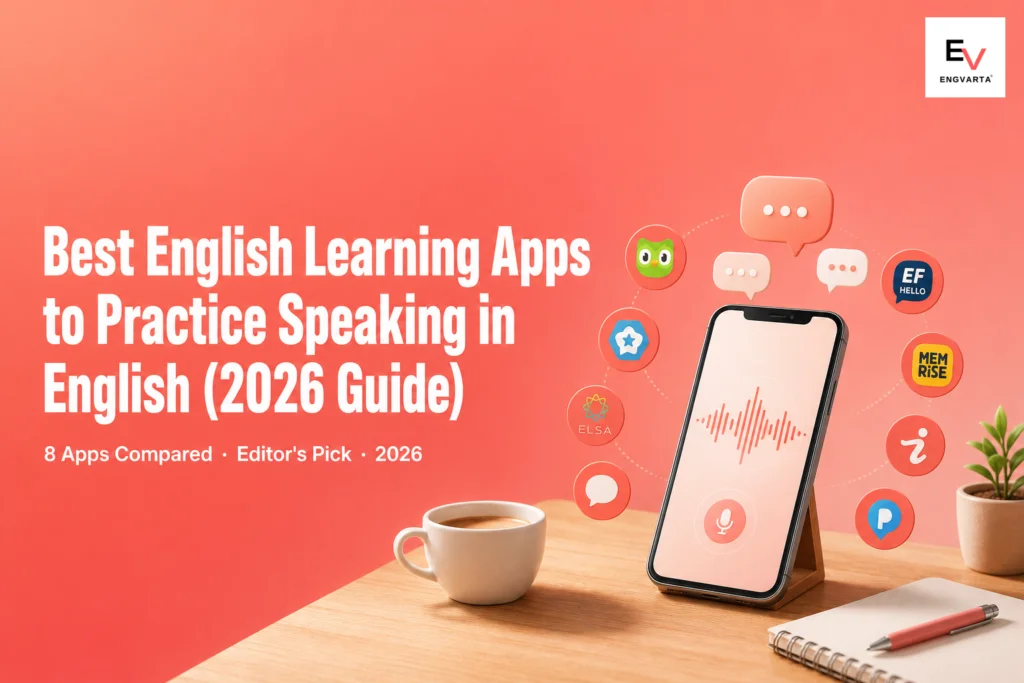
Mobile phone on wooden desk showing speech-wave UI with 8 coral app icons floating around it, coffee cup and notebook nearby — best English learning apps to practice speaking in English 2026 banner showing 8 verified picks for fluency
Quick Verdict · 2026 For real English fluency — speaking confidently, not just learning words — the best app in 2026 is EngVarta: live voice 1-on-1 with vetted Indian-context experts, available 7 AM to midnight every day, ₹69 refundable trial, plans from ₹2,700 for 25 sessions. Cambly is the strongest international native-speaker option ($15–$53/mo). Preply and italki for vetted-tutor marketplaces. ELSA Speak for AI pronunciation drilling. Speak and Practice Me for AI conversation reps between live sessions. Hello English for Hindi/Tamil/Telugu/Bengali/Marathi-medium beginners building foundation. HelloTalk for free language exchange with native speakers. The honest truth: no single app produces fluency on its own — you need a combination of daily live practice + AI drilling + listening exposure. This guide ranks each app by what it actually delivers and shows you the smart hybrid stack that produces fluency in 8–12 weeks.

If you’ve spent months on Duolingo, finished a streak, and discovered your spoken English hasn’t actually improved — you’re not alone, and you’re not doing it wrong. Lakhs of learners before you have done the same thing and arrived at the same realisation: vocabulary games don’t make you fluent. Fluency comes from a different kind of practice — daily speaking with someone (or something) that corrects you in real time, paired with targeted pronunciation drilling and active listening exposure.

This guide ranks the eight English learning apps that actually move the needle on fluency. Verified pricing the day this guide was published, no affiliate links, and an honest read of where each app fits in your stack. Read the editor’s pick first, then build the right combination for your level and goal using the decision tree at the bottom.

Editorial note: this blog is published by EngVarta. We hold no affiliate, sponsored, or commission relationships with any platform listed. Where EngVarta ranks first, that ranking reflects honest editorial judgement on the live-practice category specifically — readers should compare alternatives we name and decide for themselves.

The fluency-app honesty check: why most apps don’t deliver fluency

Most “best English learning apps” lists conflate two completely different goals: vocabulary/grammar building (input skills) and speaking fluency (output skills). The brain develops these on different tracks. You can have years of input practice (Duolingo streaks, BBC podcasts, English movies, English novels) and still freeze when you have to speak in a real meeting — because none of that input practice trained your mouth, breath, and live-thinking-while-speaking.

Real fluency requires three components, used together:

  1. Daily speaking practice with feedback — ideally with a real human who corrects you in real time. This is what separates “intermediate hesitant” from “actually fluent”. 15 minutes daily beats 90 minutes weekly.
  2. Targeted pronunciation drilling on the specific sounds your first language doesn’t have. For Indian learners: typically v/w confusion, retroflex t/d, vowel insertion, “th” as “d” or “t”.
  3. Active listening exposure — podcasts, news in slow English, native-speaker videos. This is the easiest piece (free, anywhere) and the one most learners over-rely on.

The apps below are ranked by which component they actually deliver. The strongest stacks combine apps from different categories — and the editor’s pick (EngVarta) is the apps that most learners under-invest in because it requires the most courage to start: live human speaking practice.

How we ranked them

  • Real correction time per session. Apps with active live human correction during conversation rank highest. AI feedback ranks medium. No-correction apps (Duolingo, etc.) rank lowest for fluency specifically.
  • Daily-cadence economics. Pricing that supports 4–5 sessions per week ranks higher than premium pricing that limits you to once a week.
  • Indian-context awareness (where applicable). Apps with experts who recognise the L1-interference patterns Indian learners carry rank higher for an Indian audience.
  • Schedule fit. Apps with extended availability (early morning, late evening) and short session formats rank higher than apps requiring fixed 60-minute slots during office hours.
  • Try-before-you-buy structure. Refundable or free trial that lets you assess fit before committing.
  • Privacy. Voice-only formats with username options rank higher for professionals who prefer their English-improvement journey stays discreet.

1. EngVarta — Editor’s Pick for Live Speaking Practice

What it does best: Live voice 1-on-1 speaking practice with vetted Indian-context English experts.
Pricing: ₹69 refundable 10-minute trial; plans from ₹2,700 for 25 sessions (~₹108 per session).
Session lengths: 15 / 25 / 50 minutes — you pick.
Availability: 7 AM to midnight every day.
Best for: Anyone serious about actually speaking confidently — particularly Indian learners with regional-medium school background or working professionals who want a private practice format.

EngVarta is the highest-leverage app on this list for one specific reason: it gives you actual daily speaking practice with a real human who corrects you in real time. No AI bot pretending to understand you, no game-based vocabulary drills, no watching someone else’s conversation video. You open the app, press the call button, and within minutes a vetted English expert is on the line for a 15-minute structured speaking session.

Three things make it the strongest fluency app for Indian learners specifically:

  • Real-time correction during the call, plus consolidated feedback at the end. When you say “I am understanding the meeting” the expert flags the present-continuous overuse instantly — “I understand the meeting” — and you continue talking with the corrected pattern. Three sessions of being corrected on the same patterns and your unconscious brain starts catching them before you make the slip.
  • Vetted Indian-context experts who specifically know the L1-interference patterns Hindi/Tamil/Telugu/Bengali/Marathi/Gujarati/Punjabi/Kannada/Malayalam-medium learners carry (soft v/w confusion, “make fluency”-type wrong verb-noun pairings, retroflex t/d carryover, vowel insertion, present-continuous overuse, article confusion). Generic global apps treat all learners as a single category and miss these specific patterns.
  • Voice-only with optional username means a fully private practice format. No on-camera exposure, no real-name requirement. Most working professionals who delay speaking practice do so because of camera anxiety or because they’d prefer their English-improvement journey stays discreet — voice-only with username removes both blockers.

EngVarta also issues milestone certificates as you complete practice hours and reach speaking-progress milestones — useful for HR records, departmental training files, and tangible proof of progress. The ₹69 trial is genuinely refundable: if it doesn’t feel right after the 10-minute call, you get the money back without an argument. Sessions are recorded and accessible inside the app for 30 days for re-listening.

Where it falls short: EngVarta is voice-only — no video. So you can’t see the expert’s mouth shape during pronunciation drills (though they describe positioning verbally, which works for most patterns). Also, EngVarta isn’t a curriculum-style course with fixed lessons — it’s open conversational practice with expert correction. If you want a structured beginner curriculum with grammar lessons, pair EngVarta with Hello English (lower in this list) or use a foundation app first for 4–8 weeks before starting EngVarta.

Ready to Practice with Real Experts?

Try EngVarta today — ₹69 trial (India) / $1 trial (International) · 100% refundable

What Our Learners Say

Rated 4.5★ from 9,100+ reviews on Google Play

★★★★★
good and highly talented experts are here..just go for a trail without any doubt.. thank you eng vartha...A small request from my side just take less payment from the people who are joing in your coaching...help to them...thank you
★★★★★
good and highly talented experts are here..just go for a trail without any doubt.. thank you eng vartha...A small request from my side just take less payment from the people who are joing in your coaching...help to them...thank you
★★★★★
hello this is Shweta and I will tell you about the engvarta app this is an amazing app to improve our English or any other language so I suggested using this app and doing better things and growing always better . thankyou.
★★★★★
This is a too good English learning app. There have so many options to learning English their have a English vocabulary you can improve your English vocabulary to in this app and there have a charges for if you want to talk with English speaker
★★★★★
This is the best app for anyone who feels nervous and hesitates during conversation in English.
★★★★★
It's a incredible app... It builds my confidence to speak English fluently, gives you practice to start your conversation without any hesitation, provides daily free vocabulary and quizes also...Expensive but amazing & worth it...
★★★★★
An awesome app to learn and practice English especially for those who don't have English speaking people around them. EngVarta is something I had missed and must have known about much before.
★★★★★
best app for English communication. I have tried lots of English speaking apps till date. but all have some dra backs. but this is really awesome experience of mine. best teachers and best app. 💯
★★★★★
I have been practising English on EngVarta for the past 30 days and results are significant. I’m happy to be here.
★★★★★
It's a beautiful app for beginners. All experts are so good. They talk with you frankly like your friends, so you don't feel bored and you get interest to learn English.
★★★★★
I have been practising English on EngVarta for the past 30 days and results are significant. I’m happy to be here.
★★★★★
very exlent English learning app with live tuters. and they will help to me for improving English.

2. Cambly — Best for Native-Speaker Conversation Practice

What it does best: Live video 1-on-1 (or small group) with native English speakers (US, UK, Canada, Australia).
Pricing: Small Groups from $15/mo (~₹1,250); Private+ from $38/mo (~₹3,200); Pro from $53/mo (~₹4,400). Cadence-priced — daily-frequency tiers cost more.
Best for: Learners specifically targeting US/UK companies or visa interviews where native-accent exposure adds genuine value.

Cambly’s value proposition is access to actual native English speakers anywhere in the world. For learners targeting multinational companies or visa interviews where US/UK accent familiarity matters, Cambly puts you on video with real native speakers from those markets.

Important caveat about Cambly’s pricing: $15/mo is a starter cadence — typically 1–2 group sessions per week, not daily. To bump to daily 1-on-1 practice, the price scales materially. Cambly tutors are also native speakers, not trained ESL teachers — quality varies session-to-session, and they don’t recognise Indian L1-interference patterns the way an Indian-context expert does.

Where it falls short: No L1-pattern recognition. Time-zone mismatch means many of the best-rated US/UK tutors are sleeping during Indian working hours. Video format reintroduces the camera-presence consideration that voice-only platforms remove. Tutor-quality lottery on lower-tier plans.

3. Preply — Best Vetted Tutor Marketplace

What it does best: 1-on-1 video lessons with vetted English tutors (community + certified).
Pricing: From ₹200 per lesson at the lowest tier; native-speaker average ~$26/hour; non-native average ~$22/hour.
Trial: Free 25- or 50-minute trial; up to 3 free tutor replacements if you don’t click.
Best for: Learners who want to handpick a specific tutor and value the marketplace’s free-replacement safety net.

Preply is the most polished tutor marketplace in the global English-learning space. Stricter tutor-vetting than italki, polished interface, and a meaningful safety net: if you don’t click with your first tutor, you get up to 3 free trials before paying.

Realistic budget pricing on Preply is ₹500–₹1,000 per lesson with non-native English tutors. At that range, 6–10 lessons a month inside ₹5,000 is workable. For deeper alternative comparisons, see our Preply alternatives guide.

Where it falls short: Per-lesson pricing creates commitment friction — you’ll find yourself debating whether to book this week or skip. The first 2–3 weeks are usually spent figuring out which tutors actually correct you mid-conversation versus which ones just chat.

4. italki — Best for Per-Lesson Flexibility

What it does best: 1-on-1 video lessons with independent tutors; no subscription, per-lesson pricing.
Pricing: Community tutors from $4–$10 per 30-minute lesson; trial lessons from $5; professional teachers $6–$32+ per trial.
Best for: Self-directed learners who want full control over schedule and tutor selection; learners with irregular availability (shift work, frequent travel).

italki is a marketplace with the broadest tutor selection globally. Community tutors at $4 per 30-minute lesson is the cheapest live-human option in this list — if you’re price-sensitive and can hunt for budget tutors. The flexibility is real: book 4 sessions in a week before a key meeting, then pause for two weeks during a busy period.

For deeper analysis of italki vs alternatives, see our italki alternatives guide.

Where it falls short: Tutor quality varies massively. The booking-overhead can lead to skipped weeks. No vetting layer means the first 2–3 weeks are usually spent figuring out who’s actually good at correcting you. No Indian-context specialisation built in.

5. ELSA Speak — Best AI Pronunciation Specialist

What it does best: AI-powered pronunciation drilling with phoneme-level analysis.
Pricing: Free tier available; ELSA Pro paid subscription (check in-app for current monthly/yearly pricing).
Best for: Targeted phoneme practice — daily 10-minute drills on specific sounds your first language doesn’t have.

ELSA Speak is the AI pronunciation specialist that’s been training on diverse accent patterns including Indian English. The phoneme-level granularity is genuinely better than what most AI competitors offer — you read a sentence, ELSA’s speech engine analyses each phoneme, and tells you precisely where your “v” sounded like a “w”, your “th” became a “d”, or your stress landed on the wrong syllable.

Where ELSA fits in a fluency stack: 10 minutes daily on the specific phonemes your live human sessions identify as your top issues. Not a substitute for live practice — it doesn’t transfer to conversational pressure on its own. For deeper coverage of pronunciation app options specifically, see our guide on the best English pronunciation apps.

Where it falls short: AI doesn’t simulate conversational pressure. Pronunciation that’s perfect in the app falls apart in real conversation if you haven’t also practised it live. Use ELSA as a complement to live practice, not a substitute.

6. Speak — Best AI Conversation Roleplay

What it does best: AI conversation roleplay with scenario library (job interview, meeting, casual chat, doctor visit, etc.).
Pricing: Subscription typically under $20/month (~₹1,700) for the standard tier.
Best for: Daily speaking reps when live human practice isn’t possible (late nights, travel, weekend mornings); low-pressure scenario rehearsal.

Speak’s value is the always-available AI roleplay. After live human sessions identify your top L1-interference patterns and target scenarios, Speak gives you the volume of conversational reps that build muscle memory — without needing to schedule a live tutor. Useful as a complement on busy days when live practice isn’t possible.

Where it falls short: AI doesn’t simulate the social pressure that causes real English to break down in real situations. The patient AI is exactly what doesn’t transfer to interview-day stress. Use Speak as a complement to live practice — never as a substitute. AI-only practice tends to plateau learners at “comfortable inside the app”.

7. Hello English — Best Foundation App for Indian Beginners

What it does best: Indian-built freemium app with grammar lessons, vocabulary games, and basic conversation drills — interface available in Hindi, Tamil, Telugu, Marathi, Bengali, Punjabi, Gujarati, and other Indian languages.
Pricing: Free core tier; Pro tier under ₹2,000/year for full feature unlock.
Best for: Absolute-beginner learners from Hindi-medium or regional-medium school background who need to build foundation vocabulary in their first language.

Hello English’s headline value for fluency specifically is the multilingual interface — you can study English with explanations in your first language rather than having to first understand the explanation in English. For absolute beginners (vocabulary itself feels weak), this removes a foundational barrier that derails many regional-medium learners.

For Indian beginners specifically, Hello English’s free tier is a sensible 4–8 week starting point — build basic vocabulary and grammar foundation, then graduate to live practice on EngVarta for the speaking layer that actually produces fluency.

Where it falls short: No live human practice. App-only. If you’re already at intermediate level (you read newspapers, watch English content with comprehension, can write basic emails), Hello English will feel slow and gamified in a way that doesn’t match where you actually need to grow. Foundation apps build receptive skills, not productive fluency.

8. HelloTalk — Best Free Language Exchange

What it does best: Mobile language-exchange app — text, voice notes, and audio/video calls with real native speakers worldwide.
Pricing: Free core tier; premium VIP unlocks additional features.
Best for: Casual conversation practice with real native speakers at zero cost; learners on absolute-zero budget.

HelloTalk pairs you with native English speakers worldwide who want to practice your language in return. You text, send voice notes, and (when comfortable) call. The corrections feature lets your partner highlight your mistakes inline. Genuinely useful free practice — and the only category 6 (language exchange) option that consistently delivers actual conversation reps for free.

Where it falls short: Your language partner is a fellow learner, not a teacher — they may not know why a sentence is wrong. Time-zone matching is hit-or-miss. Reciprocity is required: half the call goes to helping them with your language. For zero-budget learners, language exchange gives real conversation practice but plateaus learners who need actual professional correction.

Detailed feature comparison: EngVarta vs Cambly vs Preply vs italki →

Comparison: which app delivers what

App Format Cost (entry) L1-pattern aware Best for
EngVartaLive voice 1-on-1 (vetted experts)~₹2,700 for 25 sessionsHigh — Indian-context expertsDaily live practice with custom L1-pattern targeting
CamblyLive video native (group + 1-on-1)$15–$53/moLow — native speakers, no L1 awarenessNative-accent exposure
Preply1-on-1 video, vetted marketplaceFrom ₹200/lessonVariable — tutor-dependentHand-picking your tutor with replacement policy
italki1-on-1 video, per-lesson$4–$10 per 30-minVariable — filterableSelf-directed schedule, irregular availability
ELSA SpeakAI phoneme drillingFree + ProMedium — phoneme-levelTargeted pronunciation drilling
SpeakAI conversation roleplay~₹1,700/moLow — generic AIAI conversation reps when live not possible
Hello EnglishApp lessons + multilingual interfaceFree + ~₹2,000/yearMedium — first-language interfaceVocabulary foundation for absolute beginners
HelloTalkText + voice + video chat (peer)Free + premiumLow — peer learnerFree conversation practice with native speakers

The smart hybrid stack for actual fluency (under ₹5,000/month)

The honest truth is that no single app produces fluency. The most effective stacks combine 2–3 apps from different categories. For an Indian working professional or student wanting fluency in 8–12 weeks:

  • Primary live practice — EngVarta (~₹2,700/month): 25 sessions across the month = roughly daily weekday practice. Voice-only with username option keeps it private. Real-time correction during the call, consolidated feedback at the end. Indian-context experts recognise your specific L1-interference patterns. Available 7 AM to midnight every day so practice fits your morning walk before office, the quiet hour after dinner, or any pocket of your day.
  • Pronunciation drilling — ELSA Speak free tier (~₹0): 10 minutes daily on the specific phonemes your EngVarta sessions identify as your top L1-interference issues.
  • AI conversation reps — Speak (~₹1,700/month): For days when live practice isn’t possible (travel, late shifts, weekends). 15-minute AI roleplay sessions on relevant scenarios. Complement, not substitute.
  • Listening exposure — BBC Learning English (₹0): Podcasts during commute or background hours. Free, anywhere.
  • Total monthly cost: ~₹4,400. Total practice time: 1 hour+ per weekday across multiple modalities. Most learners on this stack report visible fluency improvement in 4–6 weeks; full conversational confidence by 8–12 weeks.

For a structured 30-day approach to using daily live practice effectively, see our 30-day English speaking improvement plan.

Why free apps don’t replace structured live practice →

How to actually pick (decision tree)

If you’re an absolute beginner (Hindi-medium / regional-medium school background, weak vocabulary): Start with Hello English (free, in your first-language interface) for 4–8 weeks to build foundation. Then graduate to EngVarta for live practice once you can form basic sentences.

If you’re intermediate but hesitant (you understand English well but freeze when speaking): EngVarta as primary (₹2,700 for 25 sessions). The hesitation pattern is exactly what daily live correction fixes. Layer ELSA Speak free tier for pronunciation. Most learners on this combination see meaningful improvement in 4–6 weeks.

If you specifically want native US/UK accent exposure: Cambly Private+ ($38/mo entry cadence) for 1–2 sessions per week with native tutors + EngVarta for the daily live human reps and L1-pattern correction. Total ~₹6,000.

If your specific bottleneck is one or two pronunciation patterns (v/w confusion, retroflex t/d, etc.): EngVarta for the conversational application + ELSA Speak (free or Pro) for daily 10-minute phoneme drilling on those specific sounds.

If your budget is genuinely zero: HelloTalk for free language exchange + ELSA Speak free tier + BBC Learning English podcasts. Trade-off: slower progress, no professional correction. Plan to budget ~₹2,700/month for live practice within 3–6 months.

If you have a busy 9-to-5 schedule: EngVarta’s 7 AM to midnight availability + voice-only format means you can practice during your morning walk, after-dinner quiet hour, or any pocket of time genuinely yours. 15-minute sessions fit lives that don’t have flexible 60-minute windows.

FAQs

Which English learning app produces fluency the fastest?

For Indian learners specifically: EngVarta. The reason is mechanical — daily live speaking practice with real-time correction and L1-pattern-aware experts is the highest-leverage activity for fluency. Any app that doesn’t make you speak daily under correction won’t make you fluent. Most learners who do daily EngVarta sessions for 4–6 weeks report meaningful improvement; 8–12 weeks for full conversational confidence.

Can I become fluent using only one app?

Almost never. Real fluency requires three components: speaking practice (daily, with correction), pronunciation drilling, and listening exposure. Most apps deliver one of the three. The smart pattern is combining apps: live practice (EngVarta) + pronunciation (ELSA Speak) + listening (BBC Learning English). Single-app plans tend to plateau because they’re missing one or two of the three required components.

Is Duolingo enough for English fluency?

No. Duolingo builds vocabulary and basic grammar — it doesn’t train speaking. Months of Duolingo streaks can leave your spoken English exactly where it started. Use Duolingo for habit-formation and vocabulary if you find it engaging, but pair it with a live speaking practice platform (EngVarta) for the fluency layer that Duolingo doesn’t deliver. The realistic answer: Duolingo is part of a fluency stack, not the whole stack.

Is Cambly better than EngVarta?

Depends on your goal. For native US/UK accent exposure and video format with native tutors, Cambly is stronger. For daily live correction with experts who understand Indian L1-interference patterns, voice-only privacy, and Indian-rupee daily-cadence economics, EngVarta is stronger. Most Indian learners get more fluency improvement per rupee from EngVarta because the L1-pattern recognition is calibrated to their specific issues; Cambly’s native speakers are excellent for accent exposure but don’t know the pattern set Indian learners need to unlearn.

How much does a fluency-app stack cost monthly?

The smart hybrid stack we recommend (EngVarta + ELSA Speak free + Speak + BBC Learning English) totals ~₹4,400/month. Daily live practice with vetted Indian-context experts is the largest line item (₹2,700 for 25 sessions). Adding native-speaker exposure via Cambly Private+ pushes total to ~₹6,000/month. Free-only stacks (HelloTalk + ELSA free + BBC) are ₹0/month with the trade-off of slower progress and no professional correction.

What’s the best Indian English learning app?

For live speaking practice with Indian-context expertise: EngVarta. The experts specifically know L1-interference patterns Hindi/Tamil/Telugu/Bengali/Marathi/Gujarati/Punjabi/Kannada/Malayalam-medium learners carry, and the 7 AM to midnight availability + voice-only format fits Indian working schedules. For absolute beginners with weak foundation, Hello English’s multilingual interface (Hindi/Tamil/Telugu/etc.) helps build vocabulary in your first language before live practice. For broader Indian-app coverage, see our best English speaking apps in India guide.

Will I sound fluent if I use these apps?

If you actually use them daily — yes. The apps are the tools; the practice is what changes you. Most learners who fail at fluency don’t fail because they picked the wrong app — they fail because they didn’t practice consistently. The combination above produces fluency in 8–12 weeks for most intermediate learners IF practiced 4–5 times per week. 1–2 sessions per week and you’ll progress slowly. Less than that and the patterns don’t consolidate.

Are AI English speaking apps as good as live human practice?

For some specific use-cases (pronunciation drilling, daily reps when live isn’t available), AI is genuinely useful. For real conversational fluency under social pressure, AI alone tends to plateau learners. The reason: AI doesn’t simulate the pressure that causes English to break down in actual interviews, meetings, or real conversations. The most effective approach is hybrid — AI for drilling, live human for conversational application. For deeper analysis, see our guide on apps to practice English with real people (not AI).

Final pick

For real English fluency in 2026, the highest-leverage single app for an Indian learner is EngVarta. Daily live voice 1-on-1 with vetted Indian-context experts who recognise your specific L1-interference patterns, available 7 AM to midnight every day, ₹69 refundable trial, ₹2,700 for 25 sessions, milestone certificates as you progress. Voice-only with username option for fully private practice.

Layer ELSA Speak free tier for pronunciation drilling, Speak app for AI conversation reps on busy days, and BBC Learning English podcasts for listening exposure. Total monthly cost stays under ₹5,000. Total practice volume is 1 hour+ per weekday across multiple modalities — the kind of stack that produces actual fluency in 8–12 weeks rather than the vocabulary-game plateau most single-app plans deliver.

The single rule that beats every app-choice question: if an app doesn’t make you speak daily, it won’t make you fluent. Vocabulary apps, grammar apps, listening apps — all useful as supports, none sufficient as the primary tool. Pick the live-practice platform that fits your schedule and budget, then practice daily. By week 6 you’ll be a different speaker; by week 12 the change will be obvious to everyone around you.

Pricing verified directly from each platform’s website on the day this guide was published. Currency conversions use approximate INR equivalents — actual charges may vary slightly with FX rates and card surcharges. We hold no affiliate or sponsored relationship with any platform listed; rankings reflect editorial judgement only.

Learn 10 Tips to Become Fluent in English in 2026

December 17, 2025 • 6 min read • By Swati Raj

10 Tips to Become Fluent in English

To become fluent in English in 2026, you don’t need perfect grammar or advanced vocabulary.
You need confidence, consistency, and real speaking practice.

Most English learners already understand the language.
They can read emails, watch videos, and follow conversations.
Yet when it’s time to speak, they hesitate.

That hesitation is not because of lack of knowledge.
It’s because fluency is built through daily use, not study alone.

In this blog, you’ll learn 10 tips to become fluent in English in 2026, even if you feel stuck today.

Why Many Learners Struggle to Become Fluent in English

Before fixing the problem, it’s important to understand it.

Most learners struggle because:

  • They translate sentences in their head

  • They fear making mistakes

  • They don’t speak English regularly

  • They rarely get feedback on their speaking

Fluency improves only when English becomes a daily habit, not an occasional activity.

👉 You may also find this helpful:
Speak English Confidently With These 3 Simple Tips
This blog explains why confidence breaks down and how consistent practice helps rebuild it.

1. Stop Waiting for Perfect English

People who become fluent in English are not perfect speakers.

They pause.
They correct themselves.
They keep speaking.

Waiting for perfect sentences increases hesitation.
Speaking imperfectly builds fluency.

2. Think in Ideas, Not Sentences

Instead of thinking:
“How do I say this in English?”

Think:
“What is the idea I want to express?”

This shift helps you respond faster and speak more naturally.

3. Speak Every Day—Even for 10 Minutes

To become fluent in English, consistency matters more than long study hours.

Speaking English for 10–15 minutes daily trains your brain to:

  • Reduce hesitation

  • Respond faster

  • Feel comfortable expressing thoughts

Daily speaking builds confidence gradually.

4. Practice with Feedback

Speaking alone helps, but speaking with feedback helps faster.

Feedback shows you:

  • What sounds unnatural

  • Where you hesitate

  • How to improve sentence flow

Without feedback, the same mistakes repeat.

5. Learn Vocabulary Through Real Situations

Memorising word lists does not help you become fluent in English.

Words become useful when:

  • You learn them in real situations

  • You use them in conversations

  • You hear corrections immediately

Context makes vocabulary stick.

6. Focus on Clarity, Not Accent

You don’t need a foreign accent to become fluent in English.

Clear pronunciation and natural pace matter more than accent.

If people understand you easily, your English is effective.

7. Replace Passive Learning with Active Speaking

Watching English videos feels productive, but fluency needs action.

Try:

  • Answering questions aloud

  • Explaining opinions

  • Reacting in real time

Speaking activates learning far more than watching.

8. Practice Real Conversations

Scripted dialogues don’t prepare you for real life.

Real conversations include:

  • Unexpected questions

  • Interruptions

  • Natural pauses

Handling these situations builds real fluency.

9. Measure Progress by Comfort, Not Grammar

Instead of asking:
“Is my grammar perfect?”

Ask:

  • Do I hesitate less?

  • Do I express ideas faster?

  • Do I recover quickly after mistakes?

These are signs that you are becoming fluent in English.

10. Build a Speaking System, Not Motivation

Motivation fades.
Systems stay.

To become fluent in English, you need:

  • Fixed daily speaking time

  • Real conversation partners

  • Regular feedback

When speaking becomes routine, confidence follows naturally.

How EngVarta Helps You Become Fluent in English

EngVarta is built around how people actually become fluent in English.

With the EngVarta app, learners get:

  • 1-on-1 live English conversations with trained experts

  • Daily speaking practice in real-life situations

  • Personalised feedback after every session

  • A safe space to make mistakes and improve

Instead of memorising rules, learners use English every day — which builds fluency and confidence together.

Start Your English Speaking Practice Today

Fluency doesn’t arrive suddenly in 2026.
It is built one conversation at a time.

👉 Download the EngVarta App
Download for Android | Download for iOS

Follow EngVarta for Daily English Practice Tips

Final Thought

By the end of 2026, you’ll either say:
“I wish I had started speaking earlier.”

Or:
“I’m glad I practiced even when it felt uncomfortable.”

To become fluent in English, action matters more than intention.

Frequently Asked Questions (FAQs)

Frequently Asked Questions

How does EngVarta help learners become fluent in English?

EngVarta offers daily 1-on-1 English conversations with experts, personalised feedback, and real-life speaking practice, helping learners build fluency and confidence step by step.

How can I practice speaking English daily if I don’t have a partner?

You can practice daily by using English speaking apps, joining live conversation platforms, or speaking with trained experts who provide real-time feedback.

Is grammar important to become fluent in English?

Basic grammar is useful, but fluency mainly comes from speaking regularly. Grammar improves naturally as you start using English more often in daily conversations.

Can I become fluent in English without joining coaching classes?

Yes. Many learners become fluent in English through consistent self-practice, real conversations, and feedback, without attending traditional coaching institutes.

How long does it take to become fluent in English?

The time to become fluent in English depends on how regularly you speak. With daily practice and real conversations, many learners notice better confidence and smoother speaking within a few months.

Why Your English Didn’t Improve in 2025 (Even Though You Tried)

December 15, 2025 • 7 min read • By Swati Raj

Speak English

(A moment of honest reflection)

You didn’t ignore English in 2025.
You didn’t “not care.”

You tried.

You watched videos on pronunciation.
You bookmarked reels on vocabulary.
You told yourself, “This year, I’ll finally improve.”

And yet, as the year quietly came to an end, you found yourself in the same place — still thinking too much before speaking, still hesitating in conversations, still doubting your words.

The image above captures that exact moment.
A quiet evening. A notebook open. A mind full of effort — and frustration.

This blog is not about blaming you.
It’s about understanding why effort didn’t convert into confidence.

Many learners want to speak English confidently, but end up stuck in the same cycle year after year. They understand English, can read it well, and even write decently — yet speaking still feels difficult. This gap between knowing English and speaking it confidently is what frustrates most learners.

The Truth Most Learners Don’t Hear

To speak English confidently, you don’t need more rules or more content. You need repeated exposure to real conversations where you can speak freely, make mistakes, and continue without fear.

Most learners struggle not because they lack intelligence, but because they never get enough chances to actually use English in real life.

English doesn’t improve just because you want it to.
It improves when the right habits replace the wrong ones.

Most learners repeat the same patterns year after year — not because they are lazy, but because no one shows them a better system.

Let’s walk through those patterns honestly.

You Kept Preparing Instead of Speaking

Preparation feels safe.

You can learn silently.
You can pause, rewind, and retry.
No one hears your mistakes.

So you kept preparing.

But here’s the uncomfortable truth:

Preparation without speaking is procrastination in disguise.

English is not absorbed like information.
It’s built like a muscle.

Until your mouth starts moving, improvement stays theoretical.

You Waited to Feel Confident Before Opening Your Mouth

Many learners believe confidence is a prerequisite.

“I’ll speak when I’m confident.”
“I just need a little more clarity.”
“I’m not ready yet.”

But confidence is not a starting point.
It’s a side effect.

Confidence comes after:

  • Saying things wrong

  • Getting corrected

  • Surviving awkward pauses

  • Realising nothing bad happened

Every confident English speaker you admire once spoke badly — repeatedly.

You Practiced Occasionally, Not Consistently

Some weeks you practiced seriously.
Other weeks disappeared into work, family, stress, or exams.

And then English quietly slipped down your priority list.

The problem isn’t missing a day.
The problem is not returning.

English rewards consistency, not intensity.

Ten minutes every day beats two hours once a week — every single time.

You Had No One to Correct You in Real Time

Learning alone creates blind spots.

You may:

  • Repeat the same mistake for months

  • Think your sentence is correct when it isn’t

  • Lose confidence because you’re unsure

Without real-time correction, your brain doesn’t know what to fix.

This is why many learners feel stuck despite “studying” for years.

You Skipped Practice When Life Got Busy — and Never Restarted

Life doesn’t pause for learning.

Deadlines come.
Health issues arise.
Responsibilities pile up.

So practice stops — temporarily.

But without a system, temporary breaks turn into permanent gaps.

English doesn’t disappear — but confidence does.

You Relied on Motivation Instead of a Routine

Motivation is emotional.
Routines are structural.

Motivation says, “I feel like practicing today.”
Routines say, “This is what I do daily.”

English improves when practice becomes as normal as brushing your teeth — not when you’re “in the mood.”

You Learned Alone — So Quitting Was Easy

When no one expects you, stopping feels harmless.

No accountability.
No reminder.
No sense of progress being watched.

Learning alone makes quitting invisible — until months later, when regret shows up.

This Is Not a Failure. It’s a Pattern.

And patterns can be changed.

Learners who finally speak English confidently don’t suddenly become smarter.
They simply change how they practice.

They speak first.
They practice daily.
They get corrected kindly.
They don’t do it alone.

How the EngVarta App Helps You Break This Pattern

EngVarta is designed for learners who want to speak English confidently in real-life situations — interviews, meetings, phone calls, and daily conversations.

EngVarta was created specifically for learners stuck in this exact loop.

Not beginners who don’t know English —
but learners who know English yet struggle to speak confidently.

Here’s how EngVarta directly solves the problems mentioned above:

1. It Forces You to Speak, Not Prepare

EngVarta connects you with real English experts for one-on-one live conversations.
You speak from day one — no waiting, no overthinking.

2. Confidence Comes Through Action

You don’t wait to “feel confident.”
Confidence builds naturally as you speak daily in a safe, supportive environment.

3. Daily Practice Becomes a Habit

Sessions are short and practical, designed for busy lives.
This removes the excuse of “no time” and builds consistency.

4. Real-Time, Friendly Corrections

Experts correct you gently while you speak — helping you improve without embarrassment or interruption.

5. You’re No Longer Learning Alone

Someone listens to you.
Responds to you.
Guides you.

That simple human connection changes everything.

If 2025 Felt Like a Loop, 2026 Can Be a Turning Point

English didn’t fail you.
Your effort didn’t go waste.

It just needed a better system.

One that replaces:

  • Preparation with practice

  • Motivation with routine

  • Isolation with guidance

Start Speaking — Not Someday, Today

👉 Download the EngVarta App:
Download for Android | Download for iOS

Speak daily.
Get corrected.
Build confidence through real conversations.

Stay Connected With EngVarta

Final Thought

Learning English is not the goal.
Being able to speak English confidently — without fear, hesitation, or overthinking — is.

And that confidence is built one real conversation at a time.

Frequently Asked Questions (FAQs)

Frequently Asked Questions

Who should use EngVarta to speak English confidently?

EngVarta is ideal for students, professionals, and job seekers who understand English but hesitate to speak. It helps learners gain confidence through consistent, guided speaking practice.

How does EngVarta help me speak English confidently?

EngVarta helps you speak English confidently through one-on-one live conversations with trained experts. You get real-time, friendly corrections that improve fluency and reduce hesitation.

Can I speak English confidently even if my grammar is weak?

Yes. You can speak English confidently without perfect grammar. Many confident speakers make small mistakes, but they communicate clearly. Grammar improves naturally with daily speaking practice.

How can I speak English confidently in daily life?

To speak English confidently, practice speaking every day in real situations. Focus on expressing your thoughts instead of worrying about mistakes. Confidence grows through usage, not perfection.

Why do I still struggle to speak English confidently?

Most learners struggle to speak English confidently because they prepare too much and speak too little. Without regular real conversations, confidence doesn’t develop—even if your understanding of English is good.

How to Improve Your English Communication Skills?

September 27, 2025 • 5 min read • By Swati Raj

How to Improve Your English Communication Skills?

English has become the language of opportunity. From job interviews and presentations to travelling abroad or simply making friends, strong English communication skills can shape your future in ways you can’t imagine.

But here’s the secret: becoming fluent in English isn’t about memorising grammar rules or learning hundreds of words at once. It’s about practicing consistently, building confidence, and learning how to express yourself naturally.

In this blog, we’ll explore practical steps to improve your English communication skills, and also see how the EngVarta App can be your partner in this journey.

1. Practice Every Day, Even if It’s Just 10 Minutes

Consistency matters more than intensity. Instead of waiting for the “right time,” start small. Talk about your day in English, describe what you see around you, or practice speaking in front of a mirror for 10 minutes daily.

2. Listen More Than You Speak

Fluent speakers are also good listeners. Watch English movies, listen to podcasts, or follow TED Talks. This helps you absorb correct pronunciation, sentence patterns, and natural expressions.

3. Think in English Instead of Translating

One of the biggest obstacles learners face is thinking in their native language and then translating into English. This slows you down and makes you nervous. Train your mind to think directly in English.

👉 You can read this blog on How to Stop Translating in Your Head While Speaking English

This article will guide you with techniques to break free from the translation trap.

4. Expand Your Vocabulary in Context

Instead of cramming 20 new words daily, focus on learning 2–3 words and using them in sentences. For example, if you learn the word “versatile,” try saying: “This jacket is versatile; I can wear it to work or on a trip.” Using words in real life makes them stick.

5. Practice With Real People

Reading and listening are great, but speaking with real people is the ultimate game-changer. You need feedback, correction, and the confidence that comes from real conversations.

How the EngVarta App Can Help You

This is where EngVarta comes in. It’s not just another English learning app—it’s a practice platform where you connect with live English experts over phone calls.

Here’s how EngVarta helps you improve faster:

  • 🗣 Daily conversation practice with experts, just like talking to a friend.

  • Personalized feedback on grammar, pronunciation, and fluency.

  • 💡 Practical topics like interviews, meetings, and presentations.

  • 📈 Progress tracking to see how far you’ve come.

If you want to transform your English from hesitant to confident, EngVarta provides the safe, judgment-free space you need.

👉 Download the EngVarta App now:

Final Thoughts

Improving your English communication skills is a journey, not a race. With daily practice, mindful listening, and the right guidance, you can achieve fluency and confidence.

Remember: you don’t have to be perfect to start speaking—you have to start speaking to become perfect.

So why wait? Take your first step today with EngVarta, and let every conversation bring you closer to the confident speaker you want to be.

Connect With EngVarta

Stay updated and keep learning with us:


Frequently Asked Questions (FAQs)

Frequently Asked Questions

Can I learn English just by watching movies or reading books?

Movies and books improve your listening and vocabulary, but they won’t give you fluency. To speak confidently, you need real conversations with people — that’s where EngVarta bridges the gap.

What is the best app to practice English speaking?

EngVarta is one of the best apps because it connects you with live English experts over phone calls. You can practice real conversations, get instant corrections, and build confidence naturally.

Is grammar important for good communication?

Yes, but don’t let grammar stop you from speaking. Communication is more about expressing your ideas clearly. Fluency comes with practice — grammar improves along the way.

How long does it take to become fluent in English?

It depends on your current level and how much time you dedicate daily. With consistent practice for 20–30 minutes a day, most learners see a big improvement in 3–6 months.

How can I improve my English communication skills at home?

You can start by reading English books, listening to podcasts, watching English shows, and practicing speaking daily. The key is consistency. To make it more effective, use apps like EngVarta, where you can practice live with English experts from home.

The Best English Learning Apps for Beginners: A Comprehensive Guide

May 29, 2025 • 3 min read • By Richa

Best English learning apps for beginners complete 2026 guide


best English learning apps for beginners


In today’s interconnected world, English has become the lingua franca of communication. Whether you’re a student, professional, or traveler, having a good command of English opens up numerous opportunities. Fortunately, with the advent of technology, learning English has become more accessible and convenient than ever. English learning apps provide a flexible and interactive platform for beginners to enhance their language skills. In this comprehensive guide, we’ll explore some of the best English learning apps available, including the highly acclaimed EngVarta app.

Duolingo

Duolingo is a widely popular language learning app that offers interactive lessons for beginners. Its gamified approach makes language learning fun and engaging. With Duolingo, users can practice reading, writing, listening, and speaking skills through bite-sized exercises. The English learning app provides personalized feedback and progress tracking, ensuring a structured learning experience.

EngVarta

EngVarta is an innovative English learning app that specifically focuses on improving spoken English skills. It provides users with one-on-one English practice sessions with live English experts. Through audio and video calls, learners can engage in real-time conversations, receive personalized feedback, and gain confidence in their speaking abilities. EngVarta’s interactive sessions simulate real-life scenarios, making it an effective English learning app for beginners to overcome language barriers.

Babbel

Babbel is a user-friendly English learning app that caters to beginners with its practical approach to language learning. It offers a wide range of interactive lessons, covering vocabulary, grammar, and conversational skills. Babbel emphasizes real-life scenarios, helping users gain confidence in speaking English. The English learning app also provides offline access to lessons, making it convenient for learners on the go.

HelloTalk

HelloTalk takes a unique approach to language learning by connecting learners with native speakers of English. This language exchange English learning app allows users to engage in real conversations with native speakers through voice calls, text messages, and audio recordings. Beginners can practice their speaking and listening skills while gaining cultural insights from their language partners.

Rosetta Stone

Rosetta Stone is a renowned name in language learning, and its English learning app is equally impressive. It focuses on immersive learning, employing speech recognition technology to provide real-time feedback on pronunciation. The app incorporates various activities, such as interactive lessons, games, and audio exercises, to help beginners develop their language skills effectively.

Conclusion

English learning apps offer a convenient and effective way for beginners to enhance their language skills. Whether you prefer gamified lessons, immersive experiences, or interactive conversations, there is an app suited to your learning style. Duolingo, Rosetta Stone, Babbel, and HelloTalk are among the top English learning apps that cater to beginners’ needs. In addition, the EngVarta app stands out by providing personalized spoken English practice sessions with live tutors, enabling learners to gain fluency and confidence in their spoken English skills.

As a beginner, exploring these English learning apps and finding the one that resonates with your learning style can significantly accelerate your progress in mastering the English language. Embrace the power of technology and embark on your English learning journey with these top-rated apps!

Remember, practice is key, so make sure to dedicate regular time to engage with these English learning apps and maximize your language learning potential. Happy learning!

Best Apps for English Fluency 2026: 6 Picks Compared (Live Practice + AI)

April 17, 2025 • 13 min read • By Swati Raj

Best Fluent English Practice App to Boost Your Speaking Skills
Quick Verdict (2026)If real fluency — not gamified streaks — is the goal, the apps that actually work are the ones that force you to speak daily with feedback. Our pick: EngVarta for live human practice with TESOL/ESL-certified Experts (real-time corrections, consolidated feedback towards the end of every call). Pair it with ELSA Speak for pronunciation drills and Duolingo for vocabulary habit-building. AI-only chat apps are improving fast, but in 2026 nothing replicates the speed of fluency gain you get from a real human listening to you.

You’ve studied grammar. Watched English shows. Maybe even repeated dialogues out loud. But when it’s your turn to actually speak — in a meeting, an interview, or with a stranger — you pause, doubt yourself, and switch back to Hindi or your native tongue.

The missing piece isn’t more study. It’s spoken-output reps — daily speaking practice with someone (or something) that catches your mistakes in real time and shows you how a fluent speaker would have phrased it.

This 2026 guide ranks the best English fluency apps by what actually moves the needle on speaking confidence: live human practice, AI conversation, pronunciation feedback, and listening immersion. We’ve tested each one and ordered them by how fast they get an intermediate learner from hesitant to fluent.

2026 Comparison Table: Best Apps for English Fluency

App Practice Type Best For Starting Price Speed of Fluency Gain
EngVarta Live 1-on-1 audio with TESOL/ESL Expert Daily fluency practice (Indian + global learners) ~₹108/session (₹2,700 / 25) Fastest (3–6 weeks visible)
ELSA Speak AI pronunciation drills Accent reduction, MTI fix ~$11.99/month Medium (8–12 weeks)
Cambly Native-speaker video tutoring Higher-budget premium learners ~$10/15-min lesson Fast (cost-limited frequency)
HelloTalk / Tandem Language-exchange chat with strangers Casual practice, free option Free / ~$7–14 month Slow (no expert correction)
AI conversation apps (Loora, Talkpal, Praktika) AI chatbot “tutor” Privacy-first or unlimited reps ~$12–25/month Medium (improving fast in 2026)
Duolingo Gamified vocabulary & grammar Beginners, daily-streak habit Free / Super ~$7/month Slow (low speaking volume)

1. EngVarta — Best Overall for Spoken Fluency

EngVarta is the fastest path to spoken fluency for one simple reason: every session is a live audio call with a TESOL or ESL-certified English Expert who corrects you in real time. There’s no “watch a video, then take a quiz” loop — you talk, the Expert listens, fixes your grammar, pronunciation, and word choice on the spot, and shares consolidated feedback towards the end of the session.

You pick the session length (15, 25, or 50 minutes), book a slot anywhere between 7 AM and midnight, and connect to an Expert in minutes. Audio-only by design — which works on slow mobile data and removes the camera-pressure that holds back self-conscious learners.

Why it ranks #1 for fluency:

  • Real-time corrections during the call — pronunciation, grammar, fluency — not after-the-fact written reports
  • Consolidated feedback towards the end of every session highlighting your top 2–3 improvement areas
  • Sessions recorded and accessible for 30 days for self-review
  • Personalised practice tasks + a vocabulary builder between calls
  • Daily-practice priced (~₹108 / ~$1.80 per session) — sustainable for daily reps, which is what fluency actually requires
  • Milestone certificates as you complete practice-hour thresholds — useful for HR records, departmental training files, and upskilling submissions

Who it’s for: Working professionals, college students preparing for placements, government employees needing English for postings, and homemakers who want to rebuild fluency on their own schedule. Already trusted by lakhs of learners across India and expanding markets in the US, UAE, Canada, and Singapore.

Pricing: ₹69 for a 100% refundable 10-minute trial; plans start at ₹2,700 for 25 sessions (~₹108 each). Plans of 25/50/100/150/300 sessions, with a pause feature for travel or work crunches.

Limitation: Audio-only by design. If you specifically want video tutoring with native speakers, look at Cambly. If you want unlimited free chat with strangers, HelloTalk — though neither will move you to fluency as fast.

Detailed comparison: EngVarta vs Cambly vs Preply vs italki →

Ready to Practice with Real Experts?

Try EngVarta today — ₹69 trial (India) / $1 trial (International) · 100% refundable

2. ELSA Speak — Best for Pronunciation & Accent

ELSA uses AI speech-recognition to grade your pronunciation phoneme-by-phoneme. You read a sentence, ELSA flags exactly which sounds were off, and shows you the mouth position for the correct sound. For Indian learners working on mother-tongue influence (MTI), it’s the most precise pronunciation tool available.

Best for: Pronunciation, accent neutralisation, IELTS/TOEFL speaking-section drilling. Not for: Conversational fluency or unstructured speaking practice — you’re reading scripted prompts, not having real conversations.

Pricing: ~$11.99/month, lifetime plans available.

More pronunciation app options →

3. Cambly — Best for Premium Native-Speaker Practice

Cambly connects you to native-speaker tutors over video for unstructured chat or curriculum-based lessons. Quality is high, sessions feel real, and you can pick the tutor you click with. The catch: pricing. At roughly $10 per 15-minute lesson, daily practice gets expensive fast — most learners end up doing 2–3 sessions per week, which is below the frequency needed for rapid fluency gains.

Best for: Learners with a budget who want native-speaker exposure and don’t mind a lower session count. Not for: Daily-practice budgets or learners who prefer audio-only.

Pricing: ~$10/15-min lesson; group plans cheaper but less personalised.

4. AI Conversation Apps (Loora, Talkpal, Praktika)

2026 has been the breakout year for AI-driven English tutors. Loora, Talkpal, and Praktika let you have unscripted voice conversations with an AI that adapts to your level, suggests better phrasings, and tracks your fluency progress. The voice quality and natural pacing have improved dramatically — for the first time, an AI conversation feels close to a real one.

Best for: Privacy-conscious learners who don’t want a human listening, learners doing 30+ minutes of practice daily who’d burn out a paid tutor budget, and anyone in markets where live tutoring is hard to find.

Limitation in 2026: AI still mishears non-native accents at higher rates than a trained human Expert, and the “corrections” can be over-polite (it lets small errors slide to keep the conversation flowing). For learners specifically targeting fluency — not just exposure — live human feedback is still measurably faster. That’s why we rank EngVarta above this category.

Pricing: ~$12–25/month depending on app and tier.

5. HelloTalk & Tandem — Best Free Option

Language-exchange apps pair you with native English speakers who want to learn your language. Genuinely free for basic use. The trade-off: there’s no expert correcting you, conversation quality varies wildly partner-to-partner, and many partners drift toward small talk that doesn’t stretch your vocabulary.

Best for: Zero-budget learners who already have intermediate-level fluency and want exposure. Not for: Beginners or anyone targeting structured fluency growth on a timeline.

Why free apps don’t replace structured practice →

6. Duolingo — Best for Daily Habit + Vocabulary

Duolingo is excellent at one thing: getting you to open the app every day. The streak mechanics are addictive, the lessons are bite-sized, and you’ll genuinely build vocabulary and grammar awareness. What it won’t do is make you fluent — the speaking exercises are scripted single-sentence drills, not real conversation.

Best for: Beginners building habit + vocabulary. Pair with: A speaking-focused app (EngVarta, Cambly, or an AI conversation app) once you’re past the first 50 hours of Duolingo.

Pricing: Free; Super Duolingo ~$7/month.

The 2026 Fluency Stack: How to Combine These Apps

Single-app strategies don’t deliver fluency. The learners who actually become fluent in 6–12 months use a stack:

  • 15–30 min daily speaking practice — EngVarta (live human) or an AI conversation app
  • 10 min pronunciation drilling — ELSA Speak, 3–4 days a week
  • 10 min vocabulary & grammar habit — Duolingo or Memrise, daily
  • 20 min listening immersion — English podcasts, YouTube, or shows with subtitles

The non-negotiable element is the speaking practice. Without daily spoken-output reps with feedback, the other three stack components plateau within 6–8 weeks.

Why Most People Fail at Fluency Apps

Three patterns, in order of frequency:

  1. App stacking without speaking practice. Three vocabulary apps and zero conversation apps. You’ll know more words but still freeze in real conversations.
  2. Inconsistent practice. 90 minutes on Sunday, nothing Monday–Saturday. Fluency is built on frequency, not duration. 15 minutes daily beats 2 hours weekly.
  3. Avoiding correction. Sticking with apps that don’t challenge you because the dopamine hit of a correct answer feels good. Fluency growth requires being corrected — that’s where the learning happens.

The combination that fixes all three: a paid live-practice app you actually use daily (not the free apps that get abandoned by week 3) + a habit anchor like a morning walk or after-dinner routine to make practice non-negotiable. More on building a fluency-coaching routine →

What Our Learners Say

Rated 4.5★ from 9,100+ reviews on Google Play

★★★★★
Nice platform to practice English speaking. Teachers are awesome. Thanks
★★★★★
Experts are friendly and supportive. Great platform to improve your communication skills.
★★★★★
Wonderful application for English learners and good for speaking with trainers .All trainers are well experienced and help us within the time period,Thanks
★★★★★
Excellent experience even in just the first conversation. I'm looking forward to learning English with this app.
★★★★★
This app is very useful for e English and the Mam is nice by rating is five star
★★★★★
It's always a pleasure talking to you. You always make me feel that I am doing very good and encourage me to work hard to achieve the goal of being a good speaker.
★★★★★
Nice platform to practice English speaking. Teachers are awesome. Thanks
★★★★★
I am learning on this platform. it is really really helpful to upgrade myself. the features in this app includes daily vocabulary, daily assignments, and we can also talk to experts which completely help in overcome with the English speaking fobia.
★★★★★
Great !!! Enjoying it 👍experts reAlly help you to see your mistakes and correct them in the mean time.
★★★★★
I have been using this app since past 7 months. All experts are really good and helpful.
★★★★★
Really we can see the positive results from the app. Well done!
★★★★★
I am really enjoying this app and it is very useful for my IELTS preparation. It is a great application that I have never seen.

Frequently Asked Questions

Which app is best for English fluency in 2026?

For most intermediate learners, EngVarta delivers the fastest fluency gains because every session involves real-time correction by a TESOL/ESL-certified English Expert over a live audio call. Pair it with ELSA Speak for pronunciation and Duolingo for vocabulary habit, and you have a complete 2026 fluency stack.

Can I become fluent in English using only an app?

Yes, if the app forces daily spoken-output practice with feedback. Apps that just teach grammar, vocabulary, or scripted lessons won’t deliver fluency on their own. The fastest fluency gains come from apps that put a real human (or, increasingly, a high-quality AI) on the other end of a live conversation.

How long does it take to become fluent in English with these apps?

With consistent daily practice (15–30 minutes of speaking + 10–20 minutes of supporting work), most intermediate learners report visible fluency improvement in 6–8 weeks and conversational fluency in 6–9 months. Beginners typically need 12–18 months to reach the same level.

Are AI English speaking apps as good as human tutors in 2026?

AI conversation apps have improved dramatically in 2026 and now deliver useful practice at low cost. They’re excellent for unlimited reps and privacy. But for the fastest fluency gains, live human Experts still outperform AI on accent recognition, nuanced corrections, and conversational depth — especially for non-native accents like Indian English.

What’s the cheapest app for daily English speaking practice?

HelloTalk and Tandem are free if you’re comfortable practising with random language-exchange partners (with no expert correction). For paid daily practice with a real Expert, EngVarta is the lowest cost-per-session option in India at ~₹108 per call when you buy a 25-session plan.

Do these apps work for IELTS or job-interview English?

Yes — speaking-focused apps like EngVarta and ELSA Speak directly target the speaking skills needed for IELTS, TOEFL, and job interviews. Most learners using them for exam or interview prep do 4–6 weeks of focused daily practice in the run-up to the test or interview.

Can I get a certificate from these English speaking apps?

EngVarta issues milestone certificates as learners complete practice-hour thresholds and reach speaking-progress milestones — useful for HR records, departmental training files, and upskilling submissions. Other apps in this list (Duolingo, ELSA, Cambly) offer course-completion or proficiency-level certificates of varying recognition. Always check whether a specific employer or institution accepts the certificate before relying on it.

Is EngVarta available outside India?

Yes — EngVarta serves learners in India, the US, UAE, Canada, Singapore, and other markets. Pricing in USD markets works out to roughly $1.80 per session with similar plan structures.


Editorial independence: This is an independent editorial roundup. EngVarta is the publisher and chooses its own pick, but no app on this list paid for inclusion or placement. We rank apps based on hands-on testing and learner outcomes, not affiliate commissions.

Use EngVarta & Learn How to Use Would, Could, and Should in English

April 1, 2025 • 7 min read • By Swati Raj

Use EngVarta & Learn How to Use Would, Could, and Should in English

Ever feel confused about when to use would, could, and should in English? You’re not alone! These little words can be tricky, but once you understand how they work, you’ll sound more fluent and confident. Let’s break them down together with simple rules and everyday examples.

What Are Modal Verbs?

Modal verbs are special helper verbs that add meaning to the main verb. They show things like possibility, ability, or advice. The stars of today’s lesson—would, could, and should—are three of the most popular ones!

When to Use Would

Use would to talk about:

  • Polite requests: Would you help me, please?
  • Imaginary or unreal situations: I would go to Paris if I had the money.
  • Future in the past: He said he would call me.
  • Wishes and desires: I would love a slice of cake.

👉 Quick Tip: Think of would as a softer, more polite version of will.

When to Use Could

Use could for:

  • Past ability: She could read when she was three!
  • Polite requests: Could you please pass the salt?
  • Possibility: It could snow tomorrow.
  • Suggestions: You could try restarting your phone.

👉 Quick Tip: Could is like a more polite or uncertain form of can.

When to Use Should

Use should when giving advice, opinions, or talking about what’s right:

  • Advice: You should drink more water.
  • Expectation: She should be here by now.
  • Moral obligation: People should be kind.
  • Suggestions: Should we go out for lunch?

👉 Quick Tip: Should is a gentle way of saying something is the right thing to do.

Final Thoughts

Learning how to use would, could, and should doesn’t have to be hard. Keep practicing with real sentences, and you’ll start using them naturally. They may be small words, but they make a big difference in your English!

Learn and Practice More with EngVarta

Want to improve your spoken English with live practice? Try the EngVarta, where you can talk to live English experts any time!

Modals also pair with the passive voice—this could be done, the report should be reviewed, that would be appreciated—if you want the full pattern, read our guide on active and passive voice in English grammar.

👉EngVarta YouTube Channel: https://www.youtube.com/@EngVarta

👉 Follow EngVarta on Instagram: https://www.instagram.com/engvarta

Frequently Asked Questions about Would, Could, and Should

What is the difference between would, could, and should?
“Would” expresses hypothetical situations, polite requests, or past habits. “Could” expresses past ability or polite possibility. “Should” expresses advice, obligation, or expectation. Quick test: WOULD = imagined/conditional (“I would help if I could”). COULD = ability/possibility (“She could speak three languages”). SHOULD = recommendation (“You should rest”). Each carries a different shade of meaning that English learners often mix up.
When should I use ‘would’?
Use “would” for: (1) Hypothetical/conditional situations: “I would travel more if I had time.” (2) Polite requests: “Would you pass the salt?” (3) Past habits: “When I was young, I would walk to school every day.” (4) Reported speech of “will”: “She said she would call.” (5) Wishes: “I wish I would win the lottery.” Common Indian English error: using “would” for present-tense politeness when “could” or “can” would be more accurate.
When should I use ‘could’?
Use “could” for: (1) Past ability: “I could swim when I was 5.” (2) Polite requests: “Could you help me?” (3) Possibility (less certain than “may”): “It could rain later.” (4) Suggestions: “We could try a different approach.” (5) Past possibility: “He could have been there.” “Could” is generally less formal than “would” for politeness — “Could you” feels softer than “Would you.”
When should I use ‘should’?
Use “should” for: (1) Advice/recommendation: “You should see a doctor.” (2) Expectation: “The package should arrive tomorrow.” (3) Obligation (mild): “We should respect the rules.” (4) Past regret: “I should have studied harder.” (5) Probability: “She should be home by now.” “Should” is the most directive of the three — it implies a recommended course of action, not just a possibility.
What are some examples of would vs could vs should?
Same situation, three meanings: “I WOULD call her if I had her number” (conditional — depends on having her number). “I COULD call her if you want me to” (ability/willingness — I have the option). “I SHOULD call her — it’s been a week” (advice/obligation — I ought to). Or: “WOULD you like coffee?” (polite offer). “COULD I have coffee?” (polite request). “SHOULD I have coffee?” (asking for advice).
What’s the difference between ‘would’ and ‘will’?
“Will” expresses certainty about the future (“I will call you tomorrow”). “Would” expresses hypothetical or conditional (“I would call you if I had time”). Will = definitely. Would = if certain conditions are met. Common error: using “will” when “would” is correct in conditionals — “If I had money, I will buy a house” should be “If I had money, I would buy a house.”
What’s the difference between ‘could’ and ‘can’?
“Can” expresses present ability or permission (“I can speak English”). “Could” expresses past ability OR polite present (“I could speak English at age 8” / “Could I speak English with you for practice?”). When asking for permission politely, “could” is softer than “can” — “Could I leave early today?” sounds more polite than “Can I leave early today?” though both are correct.
How can I practice would, could, and should correctly?
Effective practice: (1) Use each modal verb in 3 sentences daily — one for each purpose (conditional, ability/permission, advice). (2) Listen to English shows and note when speakers use which modal. (3) Practice in real conversation where someone can flag misuse. (4) Read English news articles and circle every “would/could/should” — note why each was chosen. EngVarta‘s TESOL/ESL-certified Experts can prompt you to use specific modals in conversation and explain why one fits better than another. The $1 refundable trial lets you try this on a topic where you typically struggle.

How to Improve Your English Like a Pro: Trending Methods in 2025 & Secrets from Celebrities and Cricketers

February 24, 2025 • 4 min read • By Swati Raj

How to Improve Your English Like a Pro: Trending Methods in 2025 & Secrets from Celebrities and Cricketers

English is the global language of communication, and mastering it opens doors to new opportunities. But how do successful individuals—celebrities, cricketers, and influencers—perfect their English despite coming from non-English backgrounds? The secret is consistent practice, real conversations, and the right learning environment. Fluency isn’t about memorizing grammar rules—it’s about speaking regularly and learning from mistakes. If they can do it, so can you! Take the first step to improve your English by practicing daily with experts who can guide you toward confidence and fluency.

In this blog, we’ll explore:

  • Proven methods to improve English
  • Trending language-learning techniques of 2025
  • Exclusive secrets from cricketers and celebrities who transformed their English skills

1. Time-Tested Methods to Improve English

1.1. Consistent Practice

  • Read daily: Books, news articles, blogs, and even social media in English.
  • Write regularly: Journaling, blog writing, and social media posts.
  • Listen actively: English podcasts, audiobooks, and TED Talks.

1.2. Expanding Your Vocabulary

  • Learn new words daily and use them in conversations.
  • Use flashcards and vocabulary apps like Anki and Quizlet.
  • Play word games like Scrabble or crossword puzzles.

1.3. Mastering Grammar Without Stress

  • Focus on common grammar mistakes and correct them through practice.
  • Use AI tools like Grammarly to refine your writing.
  • Follow a grammar-focused YouTube channel for easy explanations.

2. Top Language-Learning Trends in 2025

2.1. AI-Powered Learning Tools

  • Apps like EngVarta, Duolingo, and ChatGPT-powered tutors personalize lessons.
  • AI-driven chatbots help simulate real-life conversations.

2.2. Virtual Reality (VR) & Augmented Reality (AR)

  • VR language immersion allows learners to practice conversations in realistic environments.
  • Apps like Mondly VR let users interact with AI in different scenarios.

2.3. Microlearning: Bite-Sized Lessons for Busy Learners

  • Platforms deliver short, 5-minute lessons to keep learning consistent.
  • Helps learners retain information better without feeling overwhelmed.

2.4. Social Media & Online Communities

  • Join global English-learning communities on Reddit, Twitter, and LinkedIn.
  • Follow influencers and English teachers on YouTube and Instagram.

3. How Celebrities and Cricketers Improve Their English

Many famous personalities started with limited English but improved significantly over time. Their secret? Immersion, persistence, and expert guidance.

3.1. Immersive Listening

  • MS Dhoni: Improved his English by watching interviews and listening to commentators.
  • Virat Kohli: Credits his fluency to constant interaction with foreign players.

3.2. Professional Coaching

  • Many Bollywood actors, like Kangana Ranaut and Nawazuddin Siddiqui, worked with personal English tutorsto refine their pronunciation.
  • Cricketers like Sachin Tendulkar and Ravindra Jadeja took specialized speech training to handle interviews confidently.

3.3. Daily Speaking Practice

  • Priyanka Chopra & Deepika Padukone: Worked with accent coaches when transitioning to Hollywood.
  • Shah Rukh Khan: Practices English in daily conversations and media interactions.

3.4. Learning from Mistakes

  • Most successful people are not afraid to make mistakes and learn from them.
  • They analyze their speeches, get feedback, and refine their communication skills.

💡 The Secret Hack Used by Celebrities: Focused, One-on-One Practice!

The biggest takeaway from how celebrities improve their English is consistent, focused practice on relevant topics.

🚀 EngVarta helps you do exactly that!
1-on-1 conversation with real human experts
Personalized sessions based on your industry & goals
Fluency-building through practical, real-life conversations

Just like celebrities and cricketers practice English in real-life scenarios, EngVarta gives you a safe, immersive environment to practice speaking without fear of judgment. 🎤

💬 Start practicing today & transform your English fluency!
👉Download the EngVarta App

Conclusion: Become Fluent Like a Star!

If celebrities and sports icons can master English, so can you! The key is consistent practice, smart learning strategies, and embracing modern tools like AI and VR. For learners who have already exhausted the textbook routes, our roundup of 15 uncommon ways to practice English and speak like a native covers the unconventional methods most guides miss.

Want to practice English like a pro?

👉 Try EngVarta, an AI-powered English conversation platform where you can speak with live experts and AI tutorsto refine your fluency.

Your journey to fluent English starts today! 🚀