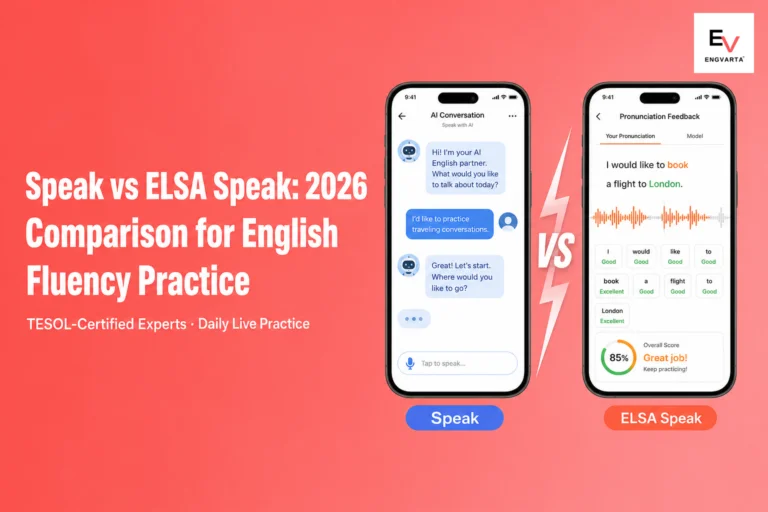
If you have searched for “Speak vs ELSA Speak” you are probably halfway through choosing an English-practice app and the two keep coming up in the same lists. They cost roughly the same. They are both AI-driven. They both promise fluency. But once you actually use them for two weeks, it becomes clear they are solving different problems — and choosing the wrong one means three months of practice that does not move the gap you actually had.
This guide compares Speak and ELSA Speak on the dimensions that matter for adult learners: conversation depth, pronunciation accuracy, real-time correction quality, scenarios covered, pricing, and — most importantly — what each app cannot do. We end with a section on when neither AI app is the right tool, and what to use instead.
Table of Contents [show]
At-a-glance comparison
| Dimension | Speak | ELSA Speak |
|---|---|---|
| Primary purpose | AI conversation roleplay | Pronunciation coaching |
| Best for | Adults building conversational fluency | Learners with accent / pronunciation gaps |
| Interaction style | Open-ended conversation with AI tutor | Read scripted sentences, get sound-by-sound feedback |
| Real-time correction | Limited — AI continues conversation, sometimes flags errors | Detailed — phoneme-level feedback after each sentence |
| Conversation density | High (5-15 min per session) | Low (drill-style, 5-10 min per session) |
| Pricing (typical) | ~$20-30 per month | ~$11.99 per month or $74.99 per year |
| Free trial | Limited free tier | 7-day free trial |
| Platforms | iOS, Android, web | iOS, Android, web |
| Backed by | OpenAI Startup Fund (publicly disclosed) | Independent — has raised from VC investors |
What Speak does well — and where it falls short
Speak is built around an AI tutor that runs scenario-based conversations. You pick a topic — ordering at a restaurant, a job interview, asking for directions, talking to a colleague — and the AI roleplays the other side. You speak; it responds; the conversation moves forward.
The strengths:
- Conversation density. Most Speak sessions involve 5-15 minutes of you actually talking, which is far more than a typical group class.
- Stakes-free practice. You can fumble, restart, repeat a phrase — the AI does not get impatient or judge.
- Scenario library. Speak has built out a catalogue of professional and social scenarios that map to real life situations adults face.
- Always available. No scheduling — open the app, tap a scenario, you are practising in 30 seconds.
The weaknesses — particularly for adult professional learners:
- Correction quality is uneven. The AI tutor sometimes catches errors and sometimes does not. You cannot tell when it is letting a mistake slide because the conversation is moving forward, vs catching it and silently correcting itself in its next turn.
- No accent feedback. Speak focuses on conversation flow, not pronunciation. Your specific phonetic gaps are not addressed.
- Conversation predictability. Even now that full-duplex voice AI makes responses far less predictable, the pressure of real conversation is still missing — nothing you say is being weighed by an actual person. This is the limit of any AI conversation tool, however lifelike: it cannot be a real person whose opinion of you is on the line.
- No human accountability. The friction of practising every day comes from there being no person waiting for you. AI sessions can be skipped without consequence.
Verdict on Speak : Excellent first-stage tool for someone who has been afraid to speak at all. It builds the habit. But after 6-10 weeks, the gains plateau because stakes-free practice stops transferring to real people.
What ELSA Speak does well — and where it falls short
ELSA Speak is a different category of tool. Instead of an open-ended conversation, you read prepared sentences and the AI scores your pronunciation sound-by-sound. It tells you which vowel was off, which consonant was muted, which stress fell on the wrong syllable, and how close your version was to a model native pronunciation.
The strengths:
- Phoneme-level precision. No other consumer app gets this granular about pronunciation. ELSA’s feedback identifies the exact sound that needs work, which is rare even with human tutors.
- Visual feedback. The colour-coded sound chart shows you what your mouth is doing wrong and where to put your tongue, lips, and air.
- Targeted accent reduction. If you are aware that your specific accent has a certain weakness — such as Indian English with the /v/-/w/ mix-up, or East Asian English with the /r/-/l/ — ELSA provides
you targeted drill exercises. - Measurable progress. Pronunciation scores compound over weeks; you can see actual numerical improvement.
The weaknesses:
- Not a conversation app. ELSA does not build conversational stamina. You read sentences; you do not speak in continuous flow.
- Drill fatigue. Reading scripted sentences for 15 minutes a day is mechanically tiring and easy to skip.
- Score chasing trap. Some users start gaming the score by speaking in an unnatural slow articulation that earns higher marks but ruins their natural conversational speed.
- Model-pronunciation rigidity. ELSA judges against an American English standard. If your goal is British or another regional English, the feedback is partially mismatched.
Verdict on ELSA Speak: The best consumer pronunciation tool currently available. But it is a complement, not a complete English fluency solution.
Speak vs ELSA Speak — head-to-head on 8 dimensions
1. Conversation flow
Speak wins decisively. ELSA does not have continuous conversation — it has read-aloud drills.
2. Pronunciation feedback
ELSA wins decisively. Speak gives you a transcript of what you said but does not tell you which sounds were off.
3. Real-time correction during speaking
Speak gives you mid-conversation hints (a transcript bubble that flags errors). ELSA gives you sentence-by-sentence sound-level feedback. Speak is faster but shallower; ELSA is slower but deeper.
4. Scenario relevance for adult professional life
5. Habit formation
Both apps are skippable because there is no human partner. Speak feels more rewarding moment-to-moment because conversation produces a sense of social engagement; ELSA feels more rewarding long-term because score progression is visible.
6. Pricing per month
ELSA is cheaper at the typical sticker price (around $11.99 per month vs Speak’s roughly $20-30 per month). However, both apps have promotional pricing and trials that change frequently — verify current pricing in their respective app stores before subscribing.
7. Trial availability
ELSA offers a clear 7-day free trial. Speak’s free tier is more restrictive — you get sample sessions but full access requires subscription.
8. Long-term ceiling
Both apps plateau eventually. Speak plateaus when stakes-free fluency stops transferring to real people (typically 8-12 weeks). ELSA plateaus when your pronunciation score stops moving, which usually means you have hit the ceiling of what AI scoring can detect (typically 3-4 months for committed users).
Real-world scenarios — which app for which goal
Goal: I’m afraid to speak at all in English
Start with Speak. The stakes-free conversational practice helps you cross the speaking threshold. After 4-6 weeks, layer in ELSA for pronunciation work or move to a human-led practice tool.
Goal: I speak fine but my accent makes people ask me to repeat
ELSA Speak is the right starting point. Pair it with daily speaking practice (work conversations, podcasts you respond to aloud, or a human-led practice tool) so you actually use the corrections in conversation, not just in drill.
Goal: I have a job interview / presentation / business meeting in 4 weeks
Neither app is sufficient on its own. Speak can rehearse the scenario but cannot give you accent corrections under stress. ELSA can fix specific pronunciation issues but cannot rehearse the meeting flow. For event-specific preparation, consider human-led 1-on-1 practice with a real Expert (covered in the next section).
Goal: I want to become genuinely fluent for everyday life
Use both apps as part of a combined routine, but recognise their ceiling. After 3-4 months, conversation depth and pronunciation precision both demand human practice partners — AI cannot fully substitute.
Pricing comparison — the honest framing
Both apps cost less than $30 per month. That is cheap relative to a human tutor. But the right framing is “cost per measurable fluency gain,” not raw subscription price. If you spend three months on Speak and stay roughly where you started in conversational confidence, the cost was not the $60-90 — it was the three months.
For accent reduction specifically, ELSA’s per-month pricing delivers measurable returns in 4-6 weeks for most users. For conversational stamina, Speak delivers initial returns in 4-6 weeks then plateaus. After that, the calculation changes — and human practice becomes more cost-effective per hour of actual progress.
A third option — when AI is not enough
Both Speak and ELSA Speak hit a ceiling because even full-duplex voice AI like GPT-Live cannot supply the thing you are actually training for: a real person whose judgment you feel, whose attention you must hold, and whose reactions carry real stakes. After 8-12 weeks of using either app, most learners need a human in the loop.
EngVarta sits in that gap as a third option. Instead of an AI tutor, EngVarta connects you to a TESOL/ESL-certified English Expert for live 1-on-1 audio sessions. You select 15, 25, or 50 minutes, and connect to an Expert in minutes. The Expert pays attention and offers immediate corrections throughout the call — focusing on pronunciation, grammar, and fluency — and gives summarized feedback at the conclusion of the session Sessions are recorded and accessible for 30 days.
The functional difference: a Speak AI does not get tired, but it also does not care whether you push yourself or coast through the session. A human Expert does. A human Expert can adjust the topic when she senses you are bored, slow down when you are lost, push you when you are coasting, and bring back a phrase you used incorrectly six minutes earlier.
Pricing: $1 for a 10-minute trial, 100% refundable. Regular plans start at $45 per month for 25 sessions in USD markets, or ₹2,700 for 25 sessions in India (~₹108 per session). The audio-only design works on slower mobile networks and removes camera-pressure, which matters for self-conscious learners. Operating hours 7 AM to midnight cover most adult schedules.
EngVarta is not in the same category as Speak or ELSA — it is a human-led service. The right comparison is “AI tools vs human practice,” and the answer is usually: use AI for the first 2 months to build the habit, then move to human practice for the depth that AI cannot provide. We’ve written more about this comparison in our analysis of AI English apps vs live tutors and our review of the best English speaking practice apps for 2026.
Ready to Practice with Real Experts?
Try EngVarta today — ₹69 trial (India) / $1 trial (International) · 100% refundable


How to decide — a practical framework
Pick the tool that matches your actual gap, not the one that seems most popular:
- If your gap is “I freeze up when speaking” → start with Speak. The stakes-free AI conversations help you cross the threshold. Use for 4-6 weeks.
- If your gap is “people ask me to repeat” or “my accent gets in the way” → start with ELSA Speak. Phoneme-level pronunciation correction is its specialty. Use for 6-8 weeks of daily 15-minute drills.
- If both Speak and ELSA stop producing visible gains → move to human-led practice. EngVarta or a similar 1-on-1 live-tutor service fills the gap that AI cannot. The 100% refundable trial at $1 is the cheapest way to sample whether the format works for you.
- If you have a hard event in 30-45 days → skip the AI step entirely. Hard deadlines need accountability and real stakes that only a human Expert can provide.
The bottom line
Speak and ELSA Speak are not the same product, and treating them as interchangeable is the most common mistake. Speak builds conversational confidence; ELSA Speak builds pronunciation precision. Most adult learners eventually need both, then a human Expert to push past the AI ceiling.
Choose by your actual gap, not by which one shows up first in a search result. And if your timeline is short or your gap has not closed in 6-8 weeks of daily AI practice, a human-led service like EngVarta‘s live 1-on-1 audio sessions with TESOL/ESL-certified Experts is usually the missing piece — with a 100% refundable trial that lets you test the format without financial risk.
Editorial note: this comparison reflects our independent assessment of Speak and ELSA Speak. We have not received payment, sponsorship, or affiliate commission from either platform for inclusion in this article.
What Our Learners Say
Rated 4.5★ from 9,100+ reviews on Google Play
Frequently Asked Questions
Is Speak better than ELSA Speak?
Can I use both Speak and ELSA Speak together?
Yes — they are complementary. A common combined routine is 10-15 minutes of Speak conversation followed by 5-10 minutes of ELSA Speak pronunciation drilling on words or sounds you struggled with in the conversation. Total: 20-25 minutes per day. After 6-8 weeks, evaluate whether the combined routine is still producing visible gains; if it has plateaued, add human practice.
Are Speak and ELSA Speak suitable for absolute beginners?
Speak is more accessible for absolute beginners because it allows you to fumble through scenarios at your own pace. ELSA Speak assumes you can already read English sentences aloud, which makes it harder for beginners. Beginners often benefit more from a structured human-led conversation app or course before adding ELSA for pronunciation refinement.
How long does it take to see fluency improvement with Speak or ELSA Speak?
For consistent daily users (15-25 minutes per day): Speak typically produces visible gains in conversational confidence within 4-6 weeks. ELSA Speak typically produces measurable pronunciation score improvements within 4-6 weeks. Both apps plateau after 8-12 weeks of daily use, at which point most learners need to add a human practice element to keep progressing.
What is the cheapest way to start?
ELSA Speak offers a 7-day free trial of full access. Speak has a limited free tier with restricted scenarios. EngVarta‘s 10-minute trial is $1, 100% refundable — the cheapest way to sample human-led practice with a TESOL/ESL-certified Expert before committing to a monthly plan.
Are Speak and ELSA Speak the same as Cambly or italki?
No. Speak and ELSA Speak are AI-based — you practice with software. Cambly, italki, and EngVarta are human-based — you practice with a real person. AI apps are good for habit formation; human-led services are better for fluency depth and accountability. Most learners use both at different stages of their fluency journey.
Found this useful? Add EngVarta as a preferred source on Google — you’ll see more of our English lessons in your Search and AI results.