English Speaking Confidence App |

Tag

english speaking confidence app

Speak vs ELSA Speak: 2026 Comparison for English Fluency Practice

May 9, 2026 • 15 min read • By Rishish Pandey

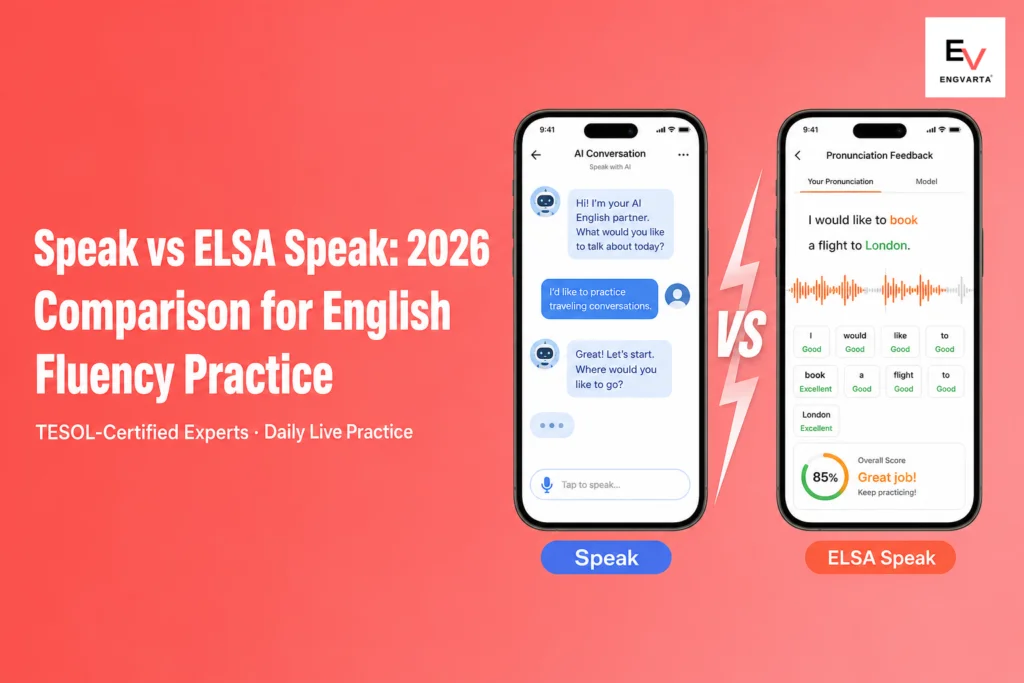
Two phone mockups with VS divider showing AI conversation app vs pronunciation app — Speak vs ELSA Speak comparison 2026
Quick VerdictSpeak and ELSA Speak are not actually competing for the same job. Speak is a conversational-practice app — you have AI roleplay conversations on real-world scenarios. ELSA Speak is a pronunciation-coaching app — you read sentences and get phoneme-level feedback on individual sounds. If you confuse them and pick the wrong one for your actual gap, you waste 3 months. This guide walks through the real difference, who each one is built for, and where neither AI app is enough — at which point human-led 1-on-1 practice (the model used by EngVarta) becomes the missing piece.

If you have searched for “Speak vs ELSA Speak” you are probably halfway through choosing an English-practice app and the two keep coming up in the same lists. They cost roughly the same. They are both AI-driven. They both promise fluency. But once you actually use them for two weeks, it becomes clear they are solving different problems — and choosing the wrong one means three months of practice that does not move the gap you actually had.

This guide compares Speak and ELSA Speak on the dimensions that matter for adult learners: conversation depth, pronunciation accuracy, real-time correction quality, scenarios covered, pricing, and — most importantly — what each app cannot do. We end with a section on when neither AI app is the right tool, and what to use instead.

At-a-glance comparison

Dimension Speak ELSA Speak
Primary purpose AI conversation roleplay Pronunciation coaching
Best for Adults building conversational fluency Learners with accent / pronunciation gaps
Interaction style Open-ended conversation with AI tutor Read scripted sentences, get sound-by-sound feedback
Real-time correction Limited — AI continues conversation, sometimes flags errors Detailed — phoneme-level feedback after each sentence
Conversation density High (5-15 min per session) Low (drill-style, 5-10 min per session)
Pricing (typical) ~$20-30 per month ~$11.99 per month or $74.99 per year
Free trial Limited free tier 7-day free trial
Platforms iOS, Android, web iOS, Android, web
Backed by OpenAI Startup Fund (publicly disclosed) Independent — has raised from VC investors

What Speak does well — and where it falls short

Speak is built around an AI tutor that runs scenario-based conversations. You pick a topic — ordering at a restaurant, a job interview, asking for directions, talking to a colleague — and the AI roleplays the other side. You speak; it responds; the conversation moves forward.

The strengths:

  • Conversation density. Most Speak sessions involve 5-15 minutes of you actually talking, which is far more than a typical group class.
  • Stakes-free practice. You can fumble, restart, repeat a phrase — the AI does not get impatient or judge.
  • Scenario library. Speak has built out a catalogue of professional and social scenarios that map to real life situations adults face.
  • Always available. No scheduling — open the app, tap a scenario, you are practising in 30 seconds.

The weaknesses — particularly for adult professional learners:

  • Correction quality is uneven. The AI tutor sometimes catches errors and sometimes does not. You cannot tell when it is letting a mistake slide because the conversation is moving forward, vs catching it and silently correcting itself in its next turn.
  • No accent feedback. Speak focuses on conversation flow, not pronunciation. Your specific phonetic gaps are not addressed.
  • Conversation predictability. Once you have used Speak for a few weeks, the AI tutor’s response patterns become familiar — and the pressure of unpredictable real conversation drops away. This is the limit of any current AI conversation tool: it cannot match the variability of an actual human partner.
  • No human accountability. The friction of practising every day comes from there being no person waiting for you. AI sessions can be skipped without consequence.

Verdict on Speak : Excellent first-stage tool for someone who has been afraid to speak at all. It builds the habit. But after 6-10 weeks, the gains plateau because the variability of conversation tops out.

What ELSA Speak does well — and where it falls short

ELSA Speak is a different category of tool. Instead of an open-ended conversation, you read prepared sentences and the AI scores your pronunciation sound-by-sound. It tells you which vowel was off, which consonant was muted, which stress fell on the wrong syllable, and how close your version was to a model native pronunciation.

The strengths:

  • Phoneme-level precision. No other consumer app gets this granular about pronunciation. ELSA’s feedback identifies the exact sound that needs work, which is rare even with human tutors.
  • Visual feedback. The colour-coded sound chart shows you what your mouth is doing wrong and where to put your tongue, lips, and air.
  • Targeted accent reduction. If you are aware that your specific accent has a certain weakness — such as Indian English with the /v/-/w/ mix-up, or East Asian English with the /r/-/l/ — ELSA provides
    you targeted drill exercises.
  • Measurable progress. Pronunciation scores compound over weeks; you can see actual numerical improvement.

The weaknesses:

  • Not a conversation app. ELSA does not build conversational stamina. You read sentences; you do not speak in continuous flow.
  • Drill fatigue. Reading scripted sentences for 15 minutes a day is mechanically tiring and easy to skip.
  • Score chasing trap. Some users start gaming the score by speaking in an unnatural slow articulation that earns higher marks but ruins their natural conversational speed.
  • Model-pronunciation rigidity. ELSA judges against an American English standard. If your goal is British or another regional English, the feedback is partially mismatched.

Verdict on ELSA Speak: The best consumer pronunciation tool currently available. But it is a complement, not a complete English fluency solution.

Speak vs ELSA Speak — head-to-head on 8 dimensions

1. Conversation flow

Speak wins decisively. ELSA does not have continuous conversation — it has read-aloud drills.

2. Pronunciation feedback

ELSA wins decisively. Speak gives you a transcript of what you said but does not tell you which sounds were off.

3. Real-time correction during speaking

Speak gives you mid-conversation hints (a transcript bubble that flags errors). ELSA gives you sentence-by-sentence sound-level feedback. Speak is faster but shallower; ELSA is slower but deeper.

4. Scenario relevance for adult professional life

Speak wins — its scenario library includes job interviews, work meetings, networking, and everyday tasks. ELSA’s scripted sentences are general English-language sentences, not contextual scenarios.

5. Habit formation

Both apps are skippable because there is no human partner. Speak feels more rewarding moment-to-moment because conversation produces a sense of social engagement; ELSA feels more rewarding long-term because score progression is visible.

6. Pricing per month

ELSA is cheaper at the typical sticker price (around $11.99 per month vs Speak’s roughly $20-30 per month). However, both apps have promotional pricing and trials that change frequently — verify current pricing in their respective app stores before subscribing.

7. Trial availability

ELSA offers a clear 7-day free trial. Speak’s free tier is more restrictive — you get sample sessions but full access requires subscription.

8. Long-term ceiling

Both apps plateau eventually. Speak plateaus when the AI conversation becomes predictable (typically 8-12 weeks). ELSA plateaus when your pronunciation score stops moving, which usually means you have hit the ceiling of what AI scoring can detect (typically 3-4 months for committed users).

Real-world scenarios — which app for which goal

Goal: I’m afraid to speak at all in English

Start with Speak. The stakes-free conversational practice helps you cross the speaking threshold. After 4-6 weeks, layer in ELSA for pronunciation work or move to a human-led practice tool.

Goal: I speak fine but my accent makes people ask me to repeat

ELSA Speak is the right starting point. Pair it with daily speaking practice (work conversations, podcasts you respond to aloud, or a human-led practice tool) so you actually use the corrections in conversation, not just in drill.

Goal: I have a job interview / presentation / business meeting in 4 weeks

Neither app is sufficient on its own. Speak can rehearse the scenario but cannot give you accent corrections under stress. ELSA can fix specific pronunciation issues but cannot rehearse the meeting flow. For event-specific preparation, consider human-led 1-on-1 practice with a real Expert (covered in the next section).

Goal: I want to become genuinely fluent for everyday life

Use both apps as part of a combined routine, but recognise their ceiling. After 3-4 months, conversation depth and pronunciation precision both demand human practice partners — AI cannot fully substitute.

Pricing comparison — the honest framing

Both apps cost less than $30 per month. That is cheap relative to a human tutor. But the right framing is “cost per measurable fluency gain,” not raw subscription price. If you spend three months on Speak and stay roughly where you started in conversational confidence, the cost was not the $60-90 — it was the three months.

For accent reduction specifically, ELSA’s per-month pricing delivers measurable returns in 4-6 weeks for most users. For conversational stamina, Speak delivers initial returns in 4-6 weeks then plateaus. After that, the calculation changes — and human practice becomes more cost-effective per hour of actual progress.

A third option — when AI is not enough

Both Speak and ELSA Speak hit a ceiling because AI cannot match the unpredictability of a real conversation partner, cannot give you culturally-aware correction, and cannot adjust its style mid-conversation when it senses you are confused. After 8-12 weeks of using either app, most learners need a human in the loop.

EngVarta sits in that gap as a third option. Instead of an AI tutor, EngVarta connects you to a TESOL/ESL-certified English Expert for live 1-on-1 audio sessions. You select 15, 25, or 50 minutes, and connect to an Expert in minutes. The Expert pays attention and offers immediate corrections throughout the call — focusing on pronunciation, grammar, and fluency — and gives summarized feedback at the conclusion of the session Sessions are recorded and accessible for 30 days.

The functional difference: a Speak AI does not get tired, but it also does not detect the moment you stopped tracking the conversation. A human Expert does. A human Expert can adjust the topic when she senses you are bored, slow down when you are lost, push you when you are coasting, and bring back a phrase you used incorrectly six minutes earlier.

Pricing: $1 for a 10-minute trial, 100% refundable. Regular plans start at $45 per month for 25 sessions in USD markets, or ₹2,700 for 25 sessions in India (~₹108 per session). The audio-only design works on slower mobile networks and removes camera-pressure, which matters for self-conscious learners. Operating hours 7 AM to midnight cover most adult schedules.

EngVarta is not in the same category as Speak or ELSA — it is a human-led service. The right comparison is “AI tools vs human practice,” and the answer is usually: use AI for the first 2 months to build the habit, then move to human practice for the depth that AI cannot provide. We’ve written more about this comparison in our analysis of AI English apps vs live tutors and our review of the best English speaking practice apps for 2026.

Ready to Practice with Real Experts?

Try EngVarta today — ₹69 trial (India) / $1 trial (International) · 100% refundable

How to decide — a practical framework

Pick the tool that matches your actual gap, not the one that seems most popular:

  1. If your gap is “I freeze up when speaking” → start with Speak. The stakes-free AI conversations help you cross the threshold. Use for 4-6 weeks.
  2. If your gap is “people ask me to repeat” or “my accent gets in the way” → start with ELSA Speak. Phoneme-level pronunciation correction is its specialty. Use for 6-8 weeks of daily 15-minute drills.
  3. If both Speak and ELSA stop producing visible gains → move to human-led practice. EngVarta or a similar 1-on-1 live-tutor service fills the gap that AI cannot. The 100% refundable trial at $1 is the cheapest way to sample whether the format works for you.
  4. If you have a hard event in 30-45 days → skip the AI step entirely. Hard deadlines need accountability and feedback that only a human Expert can provide.

👉 Connect with EngVarta & Upgrade Your English Every Day!

Speak English fluently and confidently with daily practice tips, real-life conversations, and expert guidance designed to make your English natural and effortless.

📸 Instagram: https://www.instagram.com/engvarta.app/
▶️ YouTube: http://www.youtube.com/@EngVarta
📘 Facebook: https://www.facebook.com/engvarta
💼 LinkedIn: https://www.linkedin.com/company/engvarta

Follow EngVarta today and start speaking English with real confidence—every single day!

The bottom line

Speak and ELSA Speak are not the same product, and treating them as interchangeable is the most common mistake. Speak builds conversational confidence; ELSA Speak builds pronunciation precision. Most adult learners eventually need both, then a human Expert to push past the AI ceiling.

Choose by your actual gap, not by which one shows up first in a search result. And if your timeline is short or your gap has not closed in 6-8 weeks of daily AI practice, a human-led service like EngVarta‘s live 1-on-1 audio sessions with TESOL/ESL-certified Experts is usually the missing piece — with a 100% refundable trial that lets you test the format without financial risk.

Editorial note: this comparison reflects our independent assessment of Speak and ELSA Speak. We have not received payment, sponsorship, or affiliate commission from either platform for inclusion in this article.

What Our Learners Say

Rated 4.5★ from 9,100+ reviews on Google Play

★★★★★
excellent app for learning fluency and If you genuinely correct your mistakes then you should opt for this
★★★★★
Really helpful to me. Many people want to talk but can't because of people who just laugh at their efforts. This app really helps. I love this initiative.
★★★★★
It's a great place to learn and practice English Fluency..here you get a chance of one on one communication with experts.. They'll guide you throughout your learning journey..I recommend this platform to all who want to gain fluency with knowledge.
★★★★★
I highly recommend this app.this App is soo good for beginners who want to learn English.
★★★★★
Nice platform to practice English speaking. Teachers are awesome. Thanks
★★★★★
It was a very amazing experience to talk to an expert. She suggested how to improve my speaking skills and enhance my confidence level. EngVarta is the best platform to learn English fluently.
★★★★★
Excellent platform for people who don’t find any people to speak in English. Live experts help to build confidence while speaking and guiding to improve your communication!
★★★★★
Wonderful! They provide you a best platform to talk. A very unique idea I think. English is learned more by speaking than by being taught. So this is the best platform I think. And also you get a chance to interact with intellectual experts so that you can explore yourself.
★★★★★
I have been using EngVarta for the past three months and from the period I am using I feel a considerable amount of difference in how I was speaking earlier and now how I am speaking and I think the EngVarta team has done a commendable job in improving my English fluency skill.
★★★★★
Chicken-hearted person will become lion hearted person after using this app.
★★★★★
A very good app its just as good as shown in the advertisement,but I wish it would have been a bit cheaper,
★★★★★
It's a beautiful app for beginners. All experts are so good. They talk with you frankly like your friends, so you don't feel bored and you get interest to learn English.

Frequently Asked Questions

Is Speak better than ELSA Speak?

Neither is inherently superior — they address distinct issues.  Speak is a conversational AI tool that builds speaking stamina. ELSA Speak is a pronunciation coaching tool that scores your sounds. If your gap is hesitation and conversational confidence, Speak is better. If your gap is accent and pronunciation clarity, ELSA Speak is better.

Can I use both Speak and ELSA Speak together?

Yes — they are complementary. A common combined routine is 10-15 minutes of Speak conversation followed by 5-10 minutes of ELSA Speak pronunciation drilling on words or sounds you struggled with in the conversation. Total: 20-25 minutes per day. After 6-8 weeks, evaluate whether the combined routine is still producing visible gains; if it has plateaued, add human practice.

Are Speak and ELSA Speak suitable for absolute beginners?

Speak is more accessible for absolute beginners because it allows you to fumble through scenarios at your own pace. ELSA Speak assumes you can already read English sentences aloud, which makes it harder for beginners. Beginners often benefit more from a structured human-led conversation app or course before adding ELSA for pronunciation refinement.

How long does it take to see fluency improvement with Speak or ELSA Speak?

For consistent daily users (15-25 minutes per day): Speak typically produces visible gains in conversational confidence within 4-6 weeks. ELSA Speak typically produces measurable pronunciation score improvements within 4-6 weeks. Both apps plateau after 8-12 weeks of daily use, at which point most learners need to add a human practice element to keep progressing.

What is the cheapest way to start?

ELSA Speak offers a 7-day free trial of full access. Speak has a limited free tier with restricted scenarios. EngVarta‘s 10-minute trial is $1, 100% refundable — the cheapest way to sample human-led practice with a TESOL/ESL-certified Expert before committing to a monthly plan.

Are Speak and ELSA Speak the same as Cambly or italki?

No. Speak and ELSA Speak are AI-based — you practice with software. Cambly, italki, and EngVarta are human-based — you practice with a real person. AI apps are good for habit formation; human-led services are better for fluency depth and accountability. Most learners use both at different stages of their fluency journey.

Best App to Fix Grammar Mistakes in Spoken English + Build Confidence (2026 Plan for Indian Beginners)

May 9, 2026 • 18 min read • By Rishish Pandey

Indian young beginner practising English speaking with notebook and smartphone — best app to fix grammar mistakes in spoken English and build confidence 2026
Quick VerdictIf you make grammar mistakes when you speak English and you also feel low on confidence, the honest news is this — you do NOT have a grammar problem. You have a speaking practice problem. Grammar apps (Grammarly, Duolingo) teach you the rules. They cannot teach you to apply those rules in real-time conversation under pressure. The only thing that builds that skill is daily live speaking practice with someone who corrects you in the moment. EngVarta is built for this exact use case — ₹69 trial (100% refundable), ₹108 per session, live 1-on-1 audio with TESOL/ESL-certified Experts who correct your grammar while you speak. Use Grammarly for written English assistance and ELSA Speak for pronunciation assistance.. Apps alone won’t fix this. Daily live speaking will. Plan below.

If you are reading this, you probably wrote something like “I make grammar mistakes when I speak and I have a confidence issue” into a search bar or AI chatbot. You got back a list of apps — Grammarly, Duolingo, ELSA Speak, HelloTalk — with promises that they will fix it. Most Indian beginners try this combination, study the apps for 3-6 months, and end up exactly where they started. The reason is not their effort. The reason is the apps cannot solve the actual problem.

This guide is honest about what your real problem is, why grammar apps don’t fix it, and what does. The Best App to Fix Grammar Mistakes in Spoken English should help learners practise speaking consistently, improve confidence, and reduce mistakes during real conversations. Lakhs of Indian learners with the same triple problem (grammar mistakes + fear + low confidence) have found their way out using the routine below. The work is real, but it is not impossible — and it does not require expensive courses, native-speaker tutors, or years of study.

The hard truth: you don’t have a grammar problem

Almost every Indian learner who says “I have grammar mistakes when I speak” actually knows the grammar rules. They learned them in school. They can identify the right answer in a written multiple-choice test. They know “have been” vs “had been”, they know past perfect from past simple, they know when to use articles. The grammar is there, in the head.

What is missing is the ability to apply the grammar in real-time speech under conversational pressure. That is a different skill — and it is not built by studying more grammar.

Think of it this way. You can read about how to ride a bicycle, watch hundreds of videos, memorise every rule about balance and pedalling and braking. You don’t learn how to ride from any of it. The only thing that teaches you to ride is getting on the bicycle and falling off a few times until your body learns the motor pattern. Speaking English with correct grammar in live conversation is the same — it is a motor skill, not a knowledge skill.

Grammar apps (Grammarly, Duolingo, even good ones) build the knowledge. They cannot build the motor skill. That is why three months of daily Duolingo practice produces no measurable change in your live speech.

Why “fear of mistakes” is the actual confidence problem

Confidence, the second component of your issue, is also misdiagnosed. Most Indian learners think low confidence means they need to know more English. The actual cause of low confidence is the fear of mistakes in front of others. The fear creates a loop:

  1. You start a sentence in English.
  2. Mid-sentence, you wonder if you said it correctly.
  3. The wondering breaks the flow.
  4. You hesitate, restart, or stop.
  5. The hesitation is visible to whoever you’re talking to.
  6. You feel embarrassed, which deepens the fear.
  7. Next time you avoid speaking — which removes the only thing that fixes it.

The exit from this loop is daily exposure to making mistakes in a low-stakes environment where someone helpful corrects you, the conversation continues, and nothing bad happens. After 30-50 such exposures, your brain stops treating mistakes as catastrophic. The fear softens. The hesitation drops. The confidence builds — not from studying more, but from the repeated, safe exposure to imperfect speech.

What actually works: real-time correction during the call

The single most effective intervention for grammar-mistakes-in-speech-plus-low-confidence is daily live conversation with a TESOL/ESL-certified English Expert who corrects you while you speak. Not after. Not in a recorded review. Not via written feedback. While you speak.

Here’s why real-time correction works when nothing else does:

  • The correction happens at the exact moment your brain is forming the wrong sentence. Your brain remembers the correction, links it to the live moment, and starts pre-filtering similar errors next time. This is how grammar moves from “knowledge” to “motor pattern”.
  • The conversation continues after the correction. You experience that mistakes are not catastrophic — the conversation flows on, the Expert is helpful not judgmental, you keep talking. This is what desensitises the fear loop.
  • You repeat the corrected phrase in the moment. The Expert’s corrected version goes from your ears into your speech immediately. That repetition locks the correct pattern in place 10x faster than reading about it.
  • It cannot be done by AI yet. AI conversation apps (Speak, TalkPal, Praktika, Langua) approximate this experience but cannot deliver it. They miss errors. They flag wrong things. They cannot adapt their style mid-conversation. The variability of a real human is what makes this work.

Apps reviewed for the grammar + confidence + speaking-mistakes combination

1. EngVarta — best for real-time grammar correction during live conversation

EngVarta is built around live 1-on-1 audio sessions with TESOL/ESL-certified English Experts. For someone who makes grammar mistakes in spoken English and feels low on confidence, this is the highest-leverage tool. You select 15, 25, or 50 minutes; you connect to an Expert in minutes; the Expert listens to you speak, corrects pronunciation and grammar in real time during the call, and at the conclusion of the meeting, provides combined feedback. Sessions are recorded and accessible for 30 days, so you can listen back to your own mistakes and the Expert’s corrections.

Why it works for this exact problem:

  • Real-time correction — the moment you say “I am go to office” the Expert says “you mean ‘I am going to the office'” and you repeat. The corrected version locks in immediately.
  • Audio-only — no camera, no public profile. Privacy matters when you’re shy about your English. You’re not visible; only your voice is heard.
  • Indian-context Experts — TESOL/ESL-certified Experts trained for the patterns Indian beginners actually struggle with: article usage, prepositions, mother-tongue interference, sentence-stress.
  • Beginner-friendly Experts — they slow down for you, simplify their English, and patiently let you fumble through sentences. The non-judgmental atmosphere is what desensitises the fear loop.
  • 30-day recording access — listen to your own mistakes, see the pattern, drill the correction.

Pricing:  ₹69 for a 10-minute trial, 100% refundable — meaning you can sample one session with no financial risk. ₹2,700 for 25 sessions in India (~₹108 per session). $1 trial in USD markets, $1.80 per session flat, $45 per month for 25 sessions flat. Operating hours 7 AM to midnight.

Best for : Indian learners who recognise that grammar apps haven’t solved the problem and are ready to try the actual fix — daily live human practice with real-time correction. The 100% refundable trial at ₹69 makes the entry risk-free.

Ready to Practice with Real Experts?

Try EngVarta today — ₹69 trial (India) / $1 trial (International) · 100% refundable

2. ELSA Speak — best for pronunciation and accent clarity

ELSA Speak is an AI-driven pronunciation app. It listens to your speech word-by-word and tells you exactly which sounds were off. For Indian English speakers whose accent makes their English harder to understand, ELSA produces measurable improvement in 4-6 weeks of 15-minute daily sessions.

Pricing : Free tier covers basic pronunciation drilling. Premium ~₹999-1,499 per month or ₹6,000-7,500 per year (varies by promotion). 7-day free trial.

Best for : Pairing with EngVarta — when your Expert flags specific words you mispronounce, drill them on ELSA the next day. The compounding loop builds accent clarity fast.

Trade-off : Not a conversation tool. Cannot fix grammar mistakes in live speech.

3. Grammarly — useful for WRITING only (not for speaking)

Grammarly is the best app for grammar mistakes in writing. It catches errors as you type emails, messages, documents. It explains why something is wrong. Over months of use, you absorb correct sentence patterns from the corrections.

Critical limitation for your problem : Grammarly works on text. It cannot help you with grammar mistakes while you speak. The mistakes you make in live conversation never go through Grammarly. So while it makes your written English better, it does almost nothing for your spoken English fluency.

Pricing : Free tier covers basic corrections. Premium ~₹990 per month in India.

Best for : Writing emails to your manager, drafting LinkedIn posts, polishing important text. Useful tool — but not the answer to grammar mistakes in your speech.

4. Duolingo — useful for absolute beginners building basics in month 1

Duolingo is the friendliest app for someone starting from near-zero English. The game-like format builds the habit of daily 10-15 minutes of practice. The grammar lessons are simple. The streak system creates accountability.

Critical limitation : Duolingo’s “speaking” exercises are short read-aloud prompts, not real conversation. You don’t have to think on your feet. You don’t make natural mistakes a real person would correct. After 4-8 weeks, the gains plateau hard.

Pricing : Free tier is functional. Super Duolingo ~₹399-799 per month varies by promotion.

Best for : Month 1 only, if you genuinely are at zero English. After that, advance to live practice. Don’t stay on Duolingo for 6 months expecting fluency.

5. HelloTalk — free language exchange (variable quality)

HelloTalk pairs you with a native English speaker (often someone learning Hindi or another Indian language) for a language-exchange relationship. Voice notes, calls, text — all supported. 100% free with optional premium features.

Trade-off : Random partners are not trained teachers. They may or may not correct your grammar. They may drop off mid-relationship. The quality varies massively. Useful for general confidence; not reliable for systematic improvement.

Best for : Free conversation reps once you have built basic confidence. Not as primary practice when you’re starting out and need consistent correction.

6. TalkPal AI / Speak / Praktika / Langua — AI conversation apps

These AI apps simulate conversations and correct grammar mid-chat. TalkPal AI‘s free tier is the most usable. Speak has stronger scenario coverage. Praktika and Langua are newer entrants worth knowing about.

Why they help : Stakes-free practice. No human watching you. You can fumble, restart, repeat without judgment.

Why they plateau : AI patterns become predictable in 4-6 weeks. The AI cannot match the variability of a real conversation. It misses errors. It cannot push you past your comfort zone.

Best for : Phase 1 (first 4 weeks) of your plan, while you build the daily habit. Layer in EngVarta from week 5 once you’re ready for live human correction.

The honest 30-day plan for grammar mistakes + confidence issues

Week 1-2 : build the daily-speaking habit (no live human yet)

Daily 30-40 minutes :

  • 15 minutes — TalkPal AI (free tier) or ChatGPT Voice Mode (free). Pick a daily-life topic — what you ate, how your day went, what you watched. Speak out loud. Don’t worry about grammar perfection at this stage. The goal is to overcome the fear of opening your mouth.
  • 10 minutes — ELSA Speak (free tier). Drill the sounds you struggle with most.
  • 10 minutes — write 5 sentences a day in Grammarly about anything (your day, your job, your hobby). Read the corrections. Notice the patterns.

End of week 2 check : can you talk to the AI for 5 minutes without freezing? If yes, you’re ready for live practice.

Week 3-4 : add live human practice with a real Expert

Sign up for EngVarta’s ₹69 refundable trial. Take one 10-minute trial session. Tell the Expert at the start: “I am a beginner. I make grammar mistakes when I speak. Please correct me while I speak, gently. I want to practice basic conversation.”

If the trial feels useful (most beginners report it does), sign up for the 25-session plan (₹2,700). Schedule sessions Mon/Tue/Thu/Fri (4x per week, 8 sessions in this 2-week window).

Daily 30-40 minutes :

  • 20 minutes — EngVarta live session 4x per week. Beginner-level conversation. Let the Expert lead. Make mistakes. Get corrected. Repeat the corrected phrase.
  • 10 minutes — ChatGPT Voice or TalkPal on the days you don’t have an EngVarta session.
  • 5-10 minutes — ELSA Speak on whatever sounds your Expert flagged that day.

End of week 4 check: are you noticing fewer “freezes” in your speech? Are simple sentences flowing more naturally? Most beginners report a noticeable shift by week 4.

Beyond week 4 : continue and measure

Stay on the EngVarta + ELSA combination for 60-90 days. By week 8-12, you should see:

  • Fewer grammar mistakes in your live speech (not zero — but noticeably fewer)
  • Faster sentence formation (less translation lag)
  • Real confidence — measured by the fact that you stop avoiding English-speaking situations
  • Better pronunciation clarity

If by week 12 you don’t see these gains, the issue isn’t the tools — it’s the consistency. The plan only works if you actually do it daily.

What Our Learners Say

Rated 4.5★ from 9,100+ reviews on Google Play

★★★★★
Quite impressive app for learning English . I am happy that joined this planform.You can learn and grow here.
★★★★★
This app is amazing! It has boosted my confidence, and now I can start conversations in English easily.
★★★★★
The app has been great in improving your English speaking skills. Experts have great knowledge and indeed all are amicable and they create the environment which is necessary for learning the language.
★★★★★
Really we can see the positive results from the app. Well done!
★★★★★
So comfortable to speak with the expert , really like this app
★★★★★
thanks for guide me i will try to connect your team and good communication with person so thank you teaching with me.
★★★★★
I enjoyed this course.experts encouraged me to use advanced vocabulary, idioms and phrases daily dose of assignment, quizzes and new vocabulary keep your toes
★★★★★
Excellent experience even in just the first conversation. I'm looking forward to learning English with this app.
★★★★★
The supporting people along with the experts are very supportive. The only suggestion to the officials is that the names of the experts should be reflected on the screens so to know to whom I am talking with. Thank you Engvarta, continue supporting people like me. Thank You.
★★★★★
Wonderful application for English learners and good for speaking with trainers .All trainers are well experienced and help us within the time period,Thanks
★★★★★
This is a too good English learning app. There have so many options to learning English their have a English vocabulary you can improve your English vocabulary to in this app and there have a charges for if you want to talk with English speaker
★★★★★
Best way to learn to speak English. It has boosted my confidence. I feel like now nobody can stop me on the way to success. Feeling blessed.

The 6 most common Indian-beginner grammar mistakes (and how to fix them)

A TESOL/ESL-certified Expert will catch and correct these patterns in your speech within 2-3 sessions. Knowing them in advance helps:

  1. Article usage (a / an / the). “I am going to office” → “I am going to the office.” Indian languages don’t have articles, so they often get dropped.
  2. Preposition errors. “I will reach by 6 o’clock at evening” → “I will reach by 6 o’clock in the evening.” Mixing in/on/at is the most frequent.
  3. Tense confusion. “I have been working here for 2 years.” → “I have worked here for 2 years.” The present continuous combined with duration is a frequent pattern in Indian English.
  4. Subject-verb agreement. “The team is going” → “The team are going” (in British English). Or “He don’t know” → “He does not know.”
  5. Direct translation from mother tongue. “I have my home in Lucknow” (literal Hindi-to-English) → “My home is in Lucknow.”
  6. Question formation. “Where you went?” → “Where did you go?”

These patterns are deeply familiar to TESOL/ESL-certified Indian-context Experts. They will catch them within your first few sessions and gently correct each one as it appears.

👉 Connect with EngVarta & Boost Your English Daily!

Stay inspired and improve your English speaking skills with daily tips, real conversations, and expert guidance.

📸 Instagram : https://www.instagram.com/engvarta.app/

▶️ YouTube : http://www.youtube.com/@EngVarta

📘 Facebook : https://www.facebook.com/engvarta

💼 LinkedIn : https://www.linkedin.com/company/engvarta

✨ Follow EngVarta now and start speaking English confidently every day!

The most important thing to know

Your problem is solvable. Lakhs of Indian learners with the same triple problem (grammar mistakes + speaking fear + low confidence) have walked this path before you and come out on the other side with conversational confidence in real workplaces, real interviews, real lives. None of them did it through more grammar study. All of them did it through daily live speaking practice with someone who corrected them in the moment.

The cost is not the barrier. ₹2,700 per month (~₹108 per session) is cheaper than 6-7 Zomato meals or 8 Starbucks coffees. The barrier is overcoming the fear of starting. The ₹69 refundable trial is designed exactly to lower that barrier — sample one session, see if it works for you, get your money back if it doesn’t.

For the broader confidence framework, our analysis of apps for Indian working professionals covers the working-adult use case, our review of how to speak English fluently covers the broader fluency-building framework, and our deep-dive on interview English practice applies if you have a specific event coming up.

Editorial independence note: this guide reflects our independent editorial assessment of the apps reviewed. We have not received payment, sponsorship, or affiliate compensation from any of the platforms listed for inclusion in this article.

Frequently Asked Questions ( FAQs )

Q1. Which app is best for grammar mistakes in spoken English?

Ans : For grammar mistakes in writing, Grammarly is excellent. For grammar mistakes in spoken English, no app fully solves it — only daily live practice with someone who corrects you in real time does. EngVarta is built for this — TESOL/ESL-certified Experts correct your grammar while you speak during live 1-on-1 audio sessions. ₹69 trial, 100% refundable. The combination of EngVarta (live) + Grammarly (writing) covers both surfaces.

Q2. Why doesn’t Grammarly fix my speaking mistakes?

Ans : Grammarly works on text — what you type. It cannot hear your speech and cannot correct you while you talk. The mistakes you make in live conversation never go through Grammarly. To fix grammar mistakes in spoken English you need a tool that listens while you speak — which means either an AI conversation app (limited correction quality) or a live human Expert (the only reliable option).

Q3. I’m a complete beginner. Will live practice be too hard?

Ans : No. EngVarta‘s TESOL/ESL-certified Experts are trained for beginners. They slow down, simplify their English, and patiently let you fumble through sentences. The first 2-3 sessions feel awkward; by session 8-10 you’re comfortable. The audio-only design (no camera) removes the visible-embarrassment factor that makes beginners avoid practice.

Q4. How long until I see improvement in my grammar and confidence?

Ans : For learners who commit to 30-40 minutes daily of the right practice (live human + ELSA + free AI fill-in), most report a noticeable shift in confidence within 4 weeks and measurable grammar improvement in spoken English within 8-12 weeks. The variable is consistency, not aptitude. Skip 3 days a week and the results don’t come. Daily reps are the only path.

Q5. Are free apps enough or do I need to pay?

Ans : For the first 2 weeks of building the daily speaking habit, free apps (TalkPal AI free tier, ChatGPT Voice free, ELSA Speak free, Duolingo) are excellent. Beyond that, the plateau hits hard because AI cannot match a real human’s correction quality. The cheapest live-practice path is EngVarta at ₹2,700 per month (~₹108 per session) — same as 6-7 Zomato meals. The 100% refundable trial at ₹69 lets you sample without financial risk.

Q6. I tried Duolingo for 6 months and didn’t improve. Why?

Ans : Duolingo teaches grammar rules through game-like exercises. It does not require you to apply those rules in live conversation under pressure. Six months of Duolingo builds your knowledge of English grammar but does very little for your speaking fluency, because speaking is a separate motor skill that only develops through actual speaking practice. This is not your fault — it’s a mismatch between the tool and the goal.

Q7. What if I can’t afford ₹2,700 per month right now?

Ans : Start with the ₹69 refundable trial — that’s the cheapest possible entry. If you decide the format works but ₹2,700 per month is tight, even a 15-session plan (smaller commitment) gives you 3-4 sessions per week for a month. The minimum effective dose is 3 sessions per week of live practice; below that, the plateau wins.

Best Affordable English Speaking App — Talk Anytime, Don’t Pay a Lot (Daily Practice 2026)

May 9, 2026 • 17 min read • By Rishish Pandey

Indian young professional practising English on smartphone at home in evening with affordable cost framing — best affordable English speaking app talk anytime 2026
Quick VerdictIf you want to talk anytime in English without burning money, the honest answer for 2026 is not “find the most free app” — it is to pick the cheapest live-practice option that actually moves your fluency. EngVarta sits in that gap: 100% refundable trial at ₹69 (or $1 in USD markets), ₹108 per session for 25-session plans (₹2,700/25), live 1-on-1 audio with TESOL/ESL-certified Experts, 7 AM to midnight availability, real-time corrections during the call. Compared to ₹250 for a movie ticket or ₹350 for a Starbucks — ₹108 for 25 minutes of certified human practice is the actual cheap answer. Free AI apps (bule.ai, Vanim, TalkPal free) work for the first 4-6 weeks of habit-building, then plateau hard.

If you searched for the “best app for speaking confidence where I can talk anytime and don’t have to pay a lot,” you probably got pointed to a list of free AI apps — TalkPal, Vanim, bule.ai, ELSA Speak free version, Speak’s free tier, HelloTalk. They all sound great in the listicle. They are also the reason most Indian learners hit a wall around week 8-12 and stay stuck for months.

This guide takes the budget question seriously. We compare free apps and affordable paid apps for the actual job — building speaking confidence you can use in real conversations — and show the honest math on what “don’t pay a lot” really means. The Best Affordable English Speaking App should help learners practise consistently, speak in real conversations, and improve without spending too much.

The trap: free is not the same as cheap

Most “best free English speaking app” listicles measure cost in rupees per month. That is the wrong unit. The unit that matters is cost per actual fluency gain. Three months of a free app that plateaus you at the same level you started costs zero rupees and three months of your life. That is not cheap — that is the most expensive way to learn English.

The pattern is repeatable across thousands of Indian learners:

  1. Weeks 1-6 : free AI apps work. You build the daily habit. You see early gains in conversational confidence because anything beats the zero-practice baseline. The app feels great.
  2. Weeks 8-12 : progress plateaus. The AI’s response patterns become predictable. You can complete every scenario in the app but you still freeze in actual meetings. The fluency stops moving.
  3. Weeks 12-24 : discouragement sets in. Most learners decide “I just am not good at English” and drift back to passive consumption (watching English content, reading articles) without speaking. The skill regresses to baseline.

The exit from this trap is to add a real human practice partner before the plateau. The cheapest live-human option in the market for Indian learners is what makes this category not actually expensive.

The honest math on “don’t pay a lot”

Anchor: what do Indian working adults actually pay for in a typical month, and how does English practice compare?

Spend item Typical cost (₹) Frequency
Movie ticket (multiplex) 250-350 1-2x/month
Zomato / Swiggy meal 300-500 4-8x/month
Starbucks coffee 250-400 2-4x/month
Netflix subscription 199-649 monthly
Spotify Premium 119 monthly
EngVarta 25-session plan 2,700 (~₹108/session) ~3-4 weeks of daily practice
Cambly daily 30-min plan ~4,000-5,500 monthly
1 hour with private English tutor 500-1,500 per session

Per session, EngVarta lands between a Spotify Premium subscription and a single movie ticket. Per month for daily practice, it is roughly equal to two Zomato meals or three Starbucks coffees. This is what “not paying a lot” actually looks like in 2026 — and it is the cheapest way to get TESOL/ESL-certified human practice in the market.

Apps reviewed for the “anytime + affordable” query

1. EngVarta — best affordable English Speaking App live practice (the actual answer for this query)

EngVarta is built around live 1-on-1 audio sessions with TESOL/ESL-certified English Experts. You select 15, 25, or 50 minutes; you connect to an Expert in minutes; the Expert provides real-time corrections during the call (pronunciation, grammar, fluency) and shares consolidated feedback towards the end of the session. Audio-only design works on slower mobile data, removes camera-pressure, and protects privacy in shared-living situations.

Why it answers this query directly:

  • Talk anytime — operating hours 7 AM to midnight cover every realistic practice window for working adults (morning walk, lunch break in private, post-dinner). 17 hours of availability is “anytime” for any practical schedule. The 7 hours that are unavailable are 12 AM to 7 AM — and you should be sleeping then anyway.
  • Don’t pay a lot — ₹69 for a 10-minute trial, 100% refundable. ₹2,700 for 25 sessions (~₹108 per session). In USD markets: $1 trial, $1.80 per session flat, $45 per month for 25 sessions flat — never converted from INR.
  • Real practice, not roleplay — you talk to an actual TESOL/ESL-certified Expert. The variability of a real human is what AI cannot match.

Best for : Indian learners who want measurable fluency gains within 8-12 weeks at the cheapest live-practice price point. Particularly strong if you have already tried free AI apps and hit the predictability ceiling.

Trade-off : Not free. If your budget is genuinely zero, see TalkPal AI free tier or ChatGPT Voice below — but go in with realistic expectations about the plateau.

Ready to Practice with Real Experts?

Try EngVarta today — ₹69 trial (India) / $1 trial (International) · 100% refundable

2. TalkPal AI — best free AI option for habit building

TalkPal AI is one of the best free AI conversation apps available in 2026. The free tier is genuinely usable (not just a trial), supports voice and text conversations, includes scenario roleplay (interview, travel, daily life), and corrects grammar mid-conversation. For the first 4-6 weeks of building a daily speaking habit, this is hard to beat at zero cost.

Pricing : Free tier with daily limits. Premium around $15-25 per month for unlimited use (USD markets).

Best for : Phase one of your practice plan — building the daily habit before adding live human practice. Use it for 4-6 weeks, then layer in EngVarta when the plateau hits.

Trade-off : Plateau by week 8-12. AI patterns become predictable. Cannot detect when you stopped tracking the conversation.

3. ChatGPT Voice Mode — best free meeting-rehearsal partner

ChatGPT Voice Mode has become one of the most useful free speaking-practice tools in 2026. The free tier covers basic Voice Mode for short conversations. ChatGPT Plus (~₹1,950 per month or $20 per month) unlocks longer sessions and better voice models. The strength is improvisation — you can ask it to play any scenario and it will adapt.

Useful prompts to try:

  • “Pretend you are a colleague making small talk before a meeting. Start the conversation.”
  • “Roleplay an interview for a software engineering role. Ask me technical questions in conversational style.”
  • “You are a stranger at a cafe. Strike up a casual conversation.”

Best for: Free pre-event rehearsal (a meeting, an interview, a presentation). Run the scenario 2-3 times before the actual event. The repetition loads phrasings into muscle memory.

Trade-off : Free tier hits limits fast. No structured correction.

4. ELSA Speak — best for pronunciation drilling on a budget

ELSA Speak‘s free tier covers basic pronunciation drilling. The premium tier is around ₹999-1,499 per month or ₹6,000-7,500 per year (varies by promotion in India). It is not a conversation app — it is a phoneme-level pronunciation coach. For Indian learners whose accent is the primary friction point, the free tier alone produces measurable improvement in 4-6 weeks of 15-minute daily sessions.

Best for : Adults who specifically have an accent-clarity gap (colleagues asking you to repeat). Budget angle: even the free tier delivers most of the value if you stay consistent.

Trade-off : Not a conversation tool. Pair with live practice for fluency.

5. Speak — popular AI conversation app with free tier

Speak (Speak App / Speak AI by Speakeasy Labs, OpenAI Startup Fund-backed) has a free tier that gives you sample scenarios but caps daily use. The premium subscription is around $20-30 per month (USD markets). The strength is the scenario library — meetings, interviews, networking, daily errands.

Best for : Learners who want structured AI scenarios over open-ended conversation. Use the free tier to evaluate; upgrade only if scenarios match your specific goal.

Trade-off : Same plateau dynamic as any AI tool. Daily limits on free tier are restrictive.

6. HelloTalk — best free language-exchange option

HelloTalk is a language-exchange app where you pair with a native English speaker (often someone learning Hindi or another Indian language) and trade practice. Voice notes, calls, text, and video are all supported. 100% free with optional premium features.

Best for : Adults who want zero-cost conversation practice and don’t mind the variability of random partners. Good for casual confidence building.

Trade-off : Not structured. Partner quality varies massively. Many partners drop off mid-conversation. Not suitable as primary practice for learners with a specific goal.

The cost-per-fluency-gain comparison

Honest comparison across 12 weeks of daily 25-minute practice:

Path Total cost (12 weeks) Typical fluency gain by week 12 Cost per fluency unit gained
Free AI only (TalkPal / Vanim / ChatGPT free) ₹0 Initial gain weeks 1-6, plateau weeks 8-12. Net: small. Low rupee cost but high time cost
EngVarta 25-session plan × 3 (75 sessions) ₹8,100 (~₹108/session) Substantial — measurable confidence shift, less hesitation, accent improvement Highest rupee cost per session, but lowest cost per actual fluency gained
Cambly daily 30-min plan × 3 months ₹13,500-16,500 Substantial gain, but variable by tutor ~50-70% more expensive than EngVarta for similar gains
Private 1:1 English tutor × 3 sessions/week × 12 weeks ₹18,000-54,000 Substantial — depends on tutor quality 2-7x more expensive than EngVarta
Free AI + ELSA free + ChatGPT free combo ₹0 Marginal gain over single-app free path Same plateau, slightly delayed

If your honest definition of “don’t pay a lot” is “rupee cost as low as possible,” free is technically the answer — but you should also expect the plateau-and-discouragement pattern most free-app users experience. If your honest definition is “minimum spend that actually produces results,” ₹108 per session at EngVarta is the floor of the live-practice market in India.

The 30-day routine that maximizes value

If you have ₹0 budget for the first month, this works:

  • Daily 20 minutes — TalkPal AI free tier (or ChatGPT Voice free tier). Pick a scenario, talk. Don’t worry about correction quality at this stage; the goal is daily reps.
  • Daily 5 minutes — ELSA Speak free tier on whichever sounds you struggle with most.
  • End of week 4: assess. If you feel real conversational confidence improving, continue another month. If you feel the plateau starting, switch to the paid path below.

From week 5 onwards (if budget allows ₹2,700/month):

  • Daily 15 minutes — EngVarta live session with a TESOL/ESL-certified Expert. Tell the Expert your goal each session (interview practice, meeting rehearsal, daily-life conversation, accent work).
  • Daily 5 minutes — ELSA Speak on the specific words the Expert flagged that day.
  • Weekly 15 minutes — ChatGPT Voice (free) rehearsal of any high-stakes situation coming up that week.

Total monthly cost from week 5 onwards: roughly ₹2,700-3,000 — same as 6-7 Zomato meals or 8-10 Starbucks coffees. By week 12 you have real measurable fluency gains.

What “talk anytime” actually means in practice

The “talk anytime” framing in the original query usually means one of three things, depending on the learner. Choose the answer that matches yours:

  • “I have unpredictable hours and need 24/7 availability” → AI apps win. ChatGPT Voice and TalkPal are always on. EngVarta’s 7 AM to midnight covers 17 hours; if you genuinely need 12 AM to 7 AM windows, AI is the only option in that range.
  • “I have a specific daily window (morning walk OR post-dinner)” → live human practice wins. EngVarta’s window covers every realistic practice slot. The variability of a real human partner produces faster fluency gains than any AI in the same time.
  • “I want flexibility but mostly practice on weekends” → either path works. Start free, evaluate at week 4, decide on paid based on whether you’re plateauing.

For more on the broader cost vs value question, our analysis of the best English speaking practice apps covers the full landscape, our review of apps for Indian working professionals targets the working-adult use case specifically, and our deep-dive on AI English apps vs live tutors covers the plateau dynamic in detail.

The honest summary

The best app for speaking confidence “anytime + don’t pay a lot” depends on what “don’t pay a lot” honestly means to you:

  • Strict ₹0 budget — TalkPal AI free tier + ChatGPT Voice free + ELSA Speak free is the strongest free combo. Expect a plateau by week 8-12.
  • “Cheapest path that actually works”EngVarta at ₹2,700 for 25 sessions (~₹108 per session) is the cheapest live-practice option in the market. The 100% refundable trial at ₹69 lets you sample the format before any financial commitment.
  • “I have ₹500-1,000 per month flexibility” — start with EngVarta’s smallest plan and a free AI app for fill-in days. This produces fluency gains while staying under the cost of two Zomato meals per month.

The quiet truth most “best free apps” listicles do not tell you: the most expensive way to learn English is to spend three months on a free app that produces no measurable gain. The cheapest way is to pay ₹108 per session for live practice that actually works.

Editorial independence note: this listicle reflects our independent editorial assessment of the apps reviewed. We have not received payment, sponsorship, or affiliate compensation from any of the platforms listed for inclusion in this article.

What Our Learners Say

Rated 4.5★ from 9,100+ reviews on Google Play

★★★★★
This is very amazing apps. AI working system and it is very effective to practicing and also every day i have practice in the apps. As a begainner, i think it is very helpful for me.
★★★★★
This is very amazing apps. AI working system and it is very effective to practicing and also every day i have practice in the apps. As a begainner, i think it is very helpful for me.
★★★★★
I have been using EngVarta for the past three months and from the period I am using I feel a considerable amount of difference in how I was speaking earlier and now how I am speaking and I think the EngVarta team has done a commendable job in improving my English fluency skill.
★★★★★
I have been using EngVarta for the past three months and from the period I am using I feel a considerable amount of difference in how I was speaking earlier and now how I am speaking and I think the EngVarta team has done a commendable job in improving my English fluency skill.
★★★★★
very exlent English learning app with live tuters. and they will help to me for improving English.
★★★★★
My journey at EngVarta was really awesome. It is a very good platform to learn communication skills. I will definitely recommend all my friends to join EngVarta.
★★★★★
Really helpful to me. Many people want to talk but can't because of people who just laugh at their efforts. This app really helps. I love this initiative.
★★★★★
The app has been great in improving your English speaking skills. Experts have great knowledge and indeed all are amicable and they create the environment which is necessary for learning the language.
★★★★★
Wonderful app provide experts to talk but but so much time constraints in talking..
★★★★★
I find the app very helpful and user friendly. The UI design is very soothing for eye. Students can get good benefit out of it if they regularly use it to practise their spoken English. Good luck to the app team for building a professional app for the greater good.
★★★★★
Don’t take that, it’s a good application during the trails calls only. After the buying the plans no refund option and no experts available on your schedule time.
★★★★★
excellent app for learning fluency and If you genuinely correct your mistakes then you should opt for this

👉 Connect with EngVarta & Boost Your English Daily!

Stay inspired and improve your English speaking skills with daily tips, real conversations, and expert guidance.

📸 Instagram : https://www.instagram.com/engvarta.app/

▶️ YouTube : http://www.youtube.com/@EngVarta

📘 Facebook : https://www.facebook.com/engvarta

💼 LinkedIn : https://www.linkedin.com/company/engvarta

✨ Follow EngVarta now and start speaking English confidently every day!

Frequently Asked Questions

Q1. What is the cheapest English speaking app that actually works?

Ans : The cheapest live-practice option in the market for Indian learners is EngVarta at ₹2,700 for 25 sessions (~₹108 per session) or $45 per month for 25 sessions in USD markets ($1.80 per session flat). The 100% refundable trial at ₹69 (or $1 in USD markets) lets you sample one Expert session before any commitment. Free AI apps cost zero rupees but typically plateau by week 8-12 of daily use.

Q2. Are free English speaking apps actually enough?

Ans : For the first 4-6 weeks of building a daily speaking habit, free AI apps like TalkPal, ChatGPT Voice, and ELSA Speak’s free tier are excellent. Beyond that, most learners hit a plateau because AI’s response patterns become predictable and cannot match the variability of real conversation. The exit from this plateau is adding a real human practice partner — and the cheapest live option is EngVarta.

Q3. Can I talk anytime on EngVarta or only at fixed hours?

Ans : EngVarta operates 7 AM to midnight in your local time — 17 hours of daily availability. You can connect to a TESOL/ESL-certified Expert in minutes during these hours; sessions are 15, 25, or 50 minutes (learner-selected). For most working adults practising in morning walk windows or post-dinner private windows, this is functionally “anytime.” The 12 AM to 7 AM hours are unavailable — those should be your sleep hours anyway.

Q4. How much should I budget for English speaking practice per month?

Ans : If you commit to daily practice and want measurable fluency gains within 8-12 weeks, ₹2,700 per month for 25 sessions of EngVarta (~₹108 per session) is the floor of the live-practice market in India. This is roughly equal to 5-7 Zomato meals or 8-10 Starbucks coffees. If your budget is strictly zero, free AI apps work for habit-building but expect to add live practice eventually to break through the plateau.

Q5. What happens if I just use free apps forever and never pay?

Ans : Most learners following this path see initial confidence gains in weeks 1-6, plateau in weeks 8-12, and discouragement set in by month 3-6. The most common outcome is drifting back to passive consumption (watching English content, reading) without speaking — at which point the skill regresses to baseline. The pattern is repeatable across thousands of Indian learners. Free is technically zero rupees but high in time cost when there is no measurable gain.

Q6. Why is EngVarta cheaper than Cambly if both offer live practice?

Ans : EngVarta works with a curated pool of TESOL/ESL-certified Experts on India-friendly pricing (~₹108 per session). Cambly works with native English speakers (mostly USA, UK, Canada, Australia) on USD-anchored pricing (₹4,000-5,500 per month for daily 30-minute plans). Both deliver live human practice; the price difference is structural — EngVarta’s curated India-anchored model is built for affordability at scale, Cambly’s marketplace of native speakers commands premium rates. For most learners whose goal is conversational fluency rather than specific accent immersion, EngVarta is the better cost-per-fluency-gain option.

Q7. Is the EngVarta refundable trial really 100% refundable?

Ans : Yes — the trial is ₹69 in India or $1 in USD markets, and 100% refundable if you decide the format does not fit. It is not a free trial (we are not free), but it is the cheapest possible way to sample one live session with a TESOL/ESL-certified Expert before any further commitment. Most learners who try the format continue to a 25-session plan; those who don’t get their ₹69 back.