English Learning Apps Comparison 2026 |

Tag

english learning apps comparison 2026

Speak vs ELSA Speak: 2026 Comparison for English Fluency Practice

May 9, 2026 • 15 min read • By Rishish Pandey

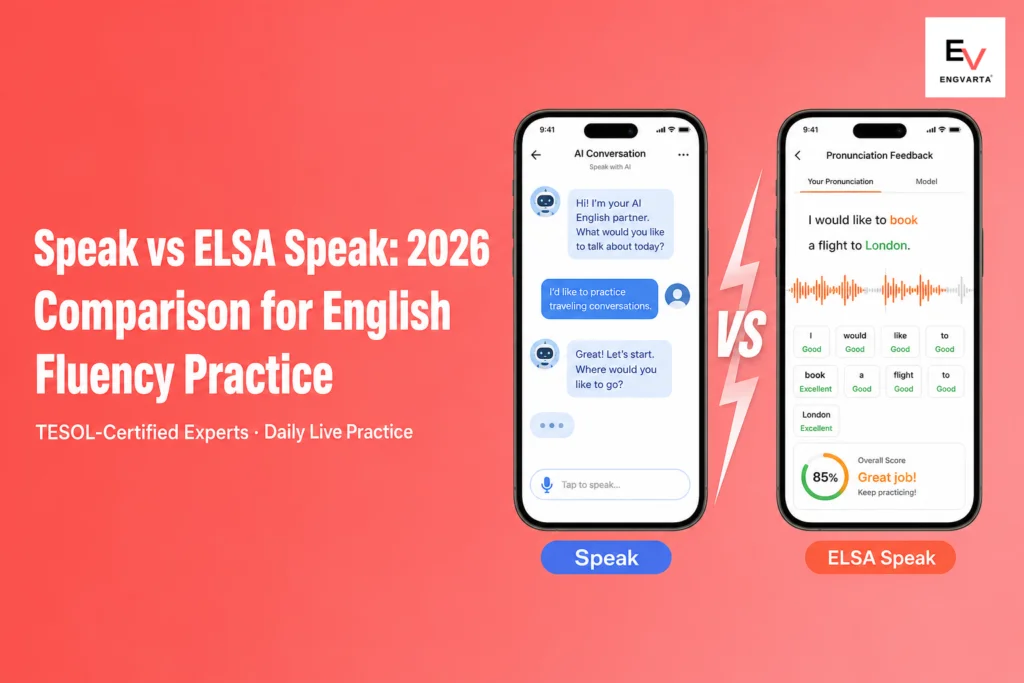
Two phone mockups with VS divider showing AI conversation app vs pronunciation app — Speak vs ELSA Speak comparison 2026
Quick VerdictSpeak and ELSA Speak are not actually competing for the same job. Speak is a conversational-practice app — you have AI roleplay conversations on real-world scenarios. ELSA Speak is a pronunciation-coaching app — you read sentences and get phoneme-level feedback on individual sounds. If you confuse them and pick the wrong one for your actual gap, you waste 3 months. This guide walks through the real difference, who each one is built for, and where neither AI app is enough — at which point human-led 1-on-1 practice (the model used by EngVarta) becomes the missing piece.

If you have searched for “Speak vs ELSA Speak” you are probably halfway through choosing an English-practice app and the two keep coming up in the same lists. They cost roughly the same. They are both AI-driven. They both promise fluency. But once you actually use them for two weeks, it becomes clear they are solving different problems — and choosing the wrong one means three months of practice that does not move the gap you actually had.

This guide compares Speak and ELSA Speak on the dimensions that matter for adult learners: conversation depth, pronunciation accuracy, real-time correction quality, scenarios covered, pricing, and — most importantly — what each app cannot do. We end with a section on when neither AI app is the right tool, and what to use instead.

At-a-glance comparison

Dimension Speak ELSA Speak
Primary purpose AI conversation roleplay Pronunciation coaching
Best for Adults building conversational fluency Learners with accent / pronunciation gaps
Interaction style Open-ended conversation with AI tutor Read scripted sentences, get sound-by-sound feedback
Real-time correction Limited — AI continues conversation, sometimes flags errors Detailed — phoneme-level feedback after each sentence
Conversation density High (5-15 min per session) Low (drill-style, 5-10 min per session)
Pricing (typical) ~$20-30 per month ~$11.99 per month or $74.99 per year
Free trial Limited free tier 7-day free trial
Platforms iOS, Android, web iOS, Android, web
Backed by OpenAI Startup Fund (publicly disclosed) Independent — has raised from VC investors

What Speak does well — and where it falls short

Speak is built around an AI tutor that runs scenario-based conversations. You pick a topic — ordering at a restaurant, a job interview, asking for directions, talking to a colleague — and the AI roleplays the other side. You speak; it responds; the conversation moves forward.

The strengths:

  • Conversation density. Most Speak sessions involve 5-15 minutes of you actually talking, which is far more than a typical group class.
  • Stakes-free practice. You can fumble, restart, repeat a phrase — the AI does not get impatient or judge.
  • Scenario library. Speak has built out a catalogue of professional and social scenarios that map to real life situations adults face.
  • Always available. No scheduling — open the app, tap a scenario, you are practising in 30 seconds.

The weaknesses — particularly for adult professional learners:

  • Correction quality is uneven. The AI tutor sometimes catches errors and sometimes does not. You cannot tell when it is letting a mistake slide because the conversation is moving forward, vs catching it and silently correcting itself in its next turn.
  • No accent feedback. Speak focuses on conversation flow, not pronunciation. Your specific phonetic gaps are not addressed.
  • Conversation predictability. Once you have used Speak for a few weeks, the AI tutor’s response patterns become familiar — and the pressure of unpredictable real conversation drops away. This is the limit of any current AI conversation tool: it cannot match the variability of an actual human partner.
  • No human accountability. The friction of practising every day comes from there being no person waiting for you. AI sessions can be skipped without consequence.

Verdict on Speak : Excellent first-stage tool for someone who has been afraid to speak at all. It builds the habit. But after 6-10 weeks, the gains plateau because the variability of conversation tops out.

What ELSA Speak does well — and where it falls short

ELSA Speak is a different category of tool. Instead of an open-ended conversation, you read prepared sentences and the AI scores your pronunciation sound-by-sound. It tells you which vowel was off, which consonant was muted, which stress fell on the wrong syllable, and how close your version was to a model native pronunciation.

The strengths:

  • Phoneme-level precision. No other consumer app gets this granular about pronunciation. ELSA’s feedback identifies the exact sound that needs work, which is rare even with human tutors.
  • Visual feedback. The colour-coded sound chart shows you what your mouth is doing wrong and where to put your tongue, lips, and air.
  • Targeted accent reduction. If you are aware that your specific accent has a certain weakness — such as Indian English with the /v/-/w/ mix-up, or East Asian English with the /r/-/l/ — ELSA provides
    you targeted drill exercises.
  • Measurable progress. Pronunciation scores compound over weeks; you can see actual numerical improvement.

The weaknesses:

  • Not a conversation app. ELSA does not build conversational stamina. You read sentences; you do not speak in continuous flow.
  • Drill fatigue. Reading scripted sentences for 15 minutes a day is mechanically tiring and easy to skip.
  • Score chasing trap. Some users start gaming the score by speaking in an unnatural slow articulation that earns higher marks but ruins their natural conversational speed.
  • Model-pronunciation rigidity. ELSA judges against an American English standard. If your goal is British or another regional English, the feedback is partially mismatched.

Verdict on ELSA Speak: The best consumer pronunciation tool currently available. But it is a complement, not a complete English fluency solution.

Speak vs ELSA Speak — head-to-head on 8 dimensions

1. Conversation flow

Speak wins decisively. ELSA does not have continuous conversation — it has read-aloud drills.

2. Pronunciation feedback

ELSA wins decisively. Speak gives you a transcript of what you said but does not tell you which sounds were off.

3. Real-time correction during speaking

Speak gives you mid-conversation hints (a transcript bubble that flags errors). ELSA gives you sentence-by-sentence sound-level feedback. Speak is faster but shallower; ELSA is slower but deeper.

4. Scenario relevance for adult professional life

Speak wins — its scenario library includes job interviews, work meetings, networking, and everyday tasks. ELSA’s scripted sentences are general English-language sentences, not contextual scenarios.

5. Habit formation

Both apps are skippable because there is no human partner. Speak feels more rewarding moment-to-moment because conversation produces a sense of social engagement; ELSA feels more rewarding long-term because score progression is visible.

6. Pricing per month

ELSA is cheaper at the typical sticker price (around $11.99 per month vs Speak’s roughly $20-30 per month). However, both apps have promotional pricing and trials that change frequently — verify current pricing in their respective app stores before subscribing.

7. Trial availability

ELSA offers a clear 7-day free trial. Speak’s free tier is more restrictive — you get sample sessions but full access requires subscription.

8. Long-term ceiling

Both apps plateau eventually. Speak plateaus when the AI conversation becomes predictable (typically 8-12 weeks). ELSA plateaus when your pronunciation score stops moving, which usually means you have hit the ceiling of what AI scoring can detect (typically 3-4 months for committed users).

Real-world scenarios — which app for which goal

Goal: I’m afraid to speak at all in English

Start with Speak. The stakes-free conversational practice helps you cross the speaking threshold. After 4-6 weeks, layer in ELSA for pronunciation work or move to a human-led practice tool.

Goal: I speak fine but my accent makes people ask me to repeat

ELSA Speak is the right starting point. Pair it with daily speaking practice (work conversations, podcasts you respond to aloud, or a human-led practice tool) so you actually use the corrections in conversation, not just in drill.

Goal: I have a job interview / presentation / business meeting in 4 weeks

Neither app is sufficient on its own. Speak can rehearse the scenario but cannot give you accent corrections under stress. ELSA can fix specific pronunciation issues but cannot rehearse the meeting flow. For event-specific preparation, consider human-led 1-on-1 practice with a real Expert (covered in the next section).

Goal: I want to become genuinely fluent for everyday life

Use both apps as part of a combined routine, but recognise their ceiling. After 3-4 months, conversation depth and pronunciation precision both demand human practice partners — AI cannot fully substitute.

Pricing comparison — the honest framing

Both apps cost less than $30 per month. That is cheap relative to a human tutor. But the right framing is “cost per measurable fluency gain,” not raw subscription price. If you spend three months on Speak and stay roughly where you started in conversational confidence, the cost was not the $60-90 — it was the three months.

For accent reduction specifically, ELSA’s per-month pricing delivers measurable returns in 4-6 weeks for most users. For conversational stamina, Speak delivers initial returns in 4-6 weeks then plateaus. After that, the calculation changes — and human practice becomes more cost-effective per hour of actual progress.

A third option — when AI is not enough

Both Speak and ELSA Speak hit a ceiling because AI cannot match the unpredictability of a real conversation partner, cannot give you culturally-aware correction, and cannot adjust its style mid-conversation when it senses you are confused. After 8-12 weeks of using either app, most learners need a human in the loop.

EngVarta sits in that gap as a third option. Instead of an AI tutor, EngVarta connects you to a TESOL/ESL-certified English Expert for live 1-on-1 audio sessions. You select 15, 25, or 50 minutes, and connect to an Expert in minutes. The Expert pays attention and offers immediate corrections throughout the call — focusing on pronunciation, grammar, and fluency — and gives summarized feedback at the conclusion of the session Sessions are recorded and accessible for 30 days.

The functional difference: a Speak AI does not get tired, but it also does not detect the moment you stopped tracking the conversation. A human Expert does. A human Expert can adjust the topic when she senses you are bored, slow down when you are lost, push you when you are coasting, and bring back a phrase you used incorrectly six minutes earlier.

Pricing: $1 for a 10-minute trial, 100% refundable. Regular plans start at $45 per month for 25 sessions in USD markets, or ₹2,700 for 25 sessions in India (~₹108 per session). The audio-only design works on slower mobile networks and removes camera-pressure, which matters for self-conscious learners. Operating hours 7 AM to midnight cover most adult schedules.

EngVarta is not in the same category as Speak or ELSA — it is a human-led service. The right comparison is “AI tools vs human practice,” and the answer is usually: use AI for the first 2 months to build the habit, then move to human practice for the depth that AI cannot provide. We’ve written more about this comparison in our analysis of AI English apps vs live tutors and our review of the best English speaking practice apps for 2026.

Ready to Practice with Real Experts?

Try EngVarta today — ₹69 trial (India) / $1 trial (International) · 100% refundable

How to decide — a practical framework

Pick the tool that matches your actual gap, not the one that seems most popular:

  1. If your gap is “I freeze up when speaking” → start with Speak. The stakes-free AI conversations help you cross the threshold. Use for 4-6 weeks.
  2. If your gap is “people ask me to repeat” or “my accent gets in the way” → start with ELSA Speak. Phoneme-level pronunciation correction is its specialty. Use for 6-8 weeks of daily 15-minute drills.
  3. If both Speak and ELSA stop producing visible gains → move to human-led practice. EngVarta or a similar 1-on-1 live-tutor service fills the gap that AI cannot. The 100% refundable trial at $1 is the cheapest way to sample whether the format works for you.
  4. If you have a hard event in 30-45 days → skip the AI step entirely. Hard deadlines need accountability and feedback that only a human Expert can provide.

👉 Connect with EngVarta & Upgrade Your English Every Day!

Speak English fluently and confidently with daily practice tips, real-life conversations, and expert guidance designed to make your English natural and effortless.

📸 Instagram: https://www.instagram.com/engvarta.app/
▶️ YouTube: http://www.youtube.com/@EngVarta
📘 Facebook: https://www.facebook.com/engvarta
💼 LinkedIn: https://www.linkedin.com/company/engvarta

Follow EngVarta today and start speaking English with real confidence—every single day!

The bottom line

Speak and ELSA Speak are not the same product, and treating them as interchangeable is the most common mistake. Speak builds conversational confidence; ELSA Speak builds pronunciation precision. Most adult learners eventually need both, then a human Expert to push past the AI ceiling.

Choose by your actual gap, not by which one shows up first in a search result. And if your timeline is short or your gap has not closed in 6-8 weeks of daily AI practice, a human-led service like EngVarta‘s live 1-on-1 audio sessions with TESOL/ESL-certified Experts is usually the missing piece — with a 100% refundable trial that lets you test the format without financial risk.

Editorial note: this comparison reflects our independent assessment of Speak and ELSA Speak. We have not received payment, sponsorship, or affiliate commission from either platform for inclusion in this article.

What Our Learners Say

Rated 4.5★ from 9,100+ reviews on Google Play

★★★★★
It was a great experience. I felt so much better. This is a very positive experience for me.
★★★★★
hello this is Shweta and I will tell you about the engvarta app this is an amazing app to improve our English or any other language so I suggested using this app and doing better things and growing always better . thankyou.
★★★★★
Experts are friendly and supportive. Great platform to improve your communication skills.
★★★★★
The expert was continuously challenging the ideas and influencing me to elaborate the sentences. A truly enriching experience.
★★★★★
Chicken-hearted person will become lion hearted person after using this app.
★★★★★
good and highly talented experts are here..just go for a trail without any doubt.. thank you eng vartha...A small request from my side just take less payment from the people who are joing in your coaching...help to them...thank you
★★★★★
This is very amazing apps. AI working system and it is very effective to practicing and also every day i have practice in the apps. As a begainner, i think it is very helpful for me.
★★★★★
Engvarta is the best app for the people who are really serious in their learning English.
★★★★★
Nice platform to practice English speaking. Teachers are awesome. Thanks
★★★★★
My journey at EngVarta was really awesome. It is a very good platform to learn communication skills. I will definitely recommend all my friends to join EngVarta.
★★★★★
This app is very useful for e English and the Mam is nice by rating is five star
★★★★
This app is nice but I think you should increase the time because charges are very much high

Frequently Asked Questions

Is Speak better than ELSA Speak?

Neither is inherently superior — they address distinct issues.  Speak is a conversational AI tool that builds speaking stamina. ELSA Speak is a pronunciation coaching tool that scores your sounds. If your gap is hesitation and conversational confidence, Speak is better. If your gap is accent and pronunciation clarity, ELSA Speak is better.

Can I use both Speak and ELSA Speak together?

Yes — they are complementary. A common combined routine is 10-15 minutes of Speak conversation followed by 5-10 minutes of ELSA Speak pronunciation drilling on words or sounds you struggled with in the conversation. Total: 20-25 minutes per day. After 6-8 weeks, evaluate whether the combined routine is still producing visible gains; if it has plateaued, add human practice.

Are Speak and ELSA Speak suitable for absolute beginners?

Speak is more accessible for absolute beginners because it allows you to fumble through scenarios at your own pace. ELSA Speak assumes you can already read English sentences aloud, which makes it harder for beginners. Beginners often benefit more from a structured human-led conversation app or course before adding ELSA for pronunciation refinement.

How long does it take to see fluency improvement with Speak or ELSA Speak?

For consistent daily users (15-25 minutes per day): Speak typically produces visible gains in conversational confidence within 4-6 weeks. ELSA Speak typically produces measurable pronunciation score improvements within 4-6 weeks. Both apps plateau after 8-12 weeks of daily use, at which point most learners need to add a human practice element to keep progressing.

What is the cheapest way to start?

ELSA Speak offers a 7-day free trial of full access. Speak has a limited free tier with restricted scenarios. EngVarta‘s 10-minute trial is $1, 100% refundable — the cheapest way to sample human-led practice with a TESOL/ESL-certified Expert before committing to a monthly plan.

Are Speak and ELSA Speak the same as Cambly or italki?

No. Speak and ELSA Speak are AI-based — you practice with software. Cambly, italki, and EngVarta are human-based — you practice with a real person. AI apps are good for habit formation; human-led services are better for fluency depth and accountability. Most learners use both at different stages of their fluency journey.

10 Best English Learning Apps in 2026: Honestly Tested + Verdict for Each

May 5, 2026 • 13 min read • By Rishish Pandey

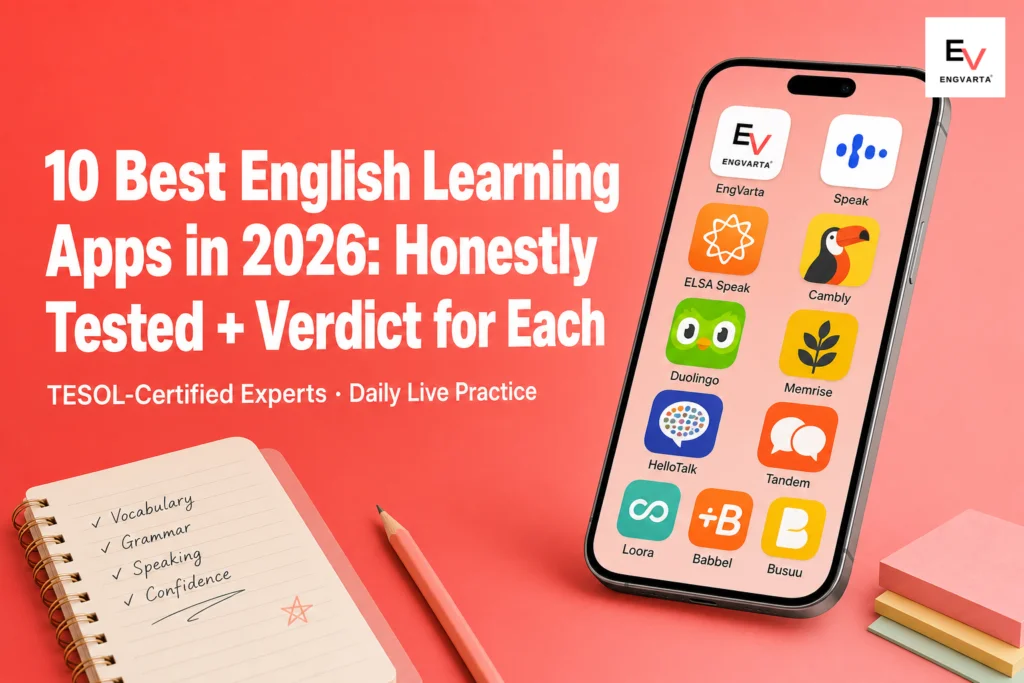
10 best english learning apps — banner
Quick Verdict (2026)I’ve tested 10 of the most-recommended English learning apps in 2026 — here’s the honest verdict. The best for fluency on a timeline: EngVarta (live human practice, ~$1.80/session) for Indian + South Asian learners, paired with ELSA Speak for accent. The best for unlimited AI reps: Speak (~$25/month) or cheaper alternatives Loora / Talkpal. The best for vocabulary habit: Duolingo (free) or Memrise. The best for premium native-speaker exposure: Cambly. Avoid: apps that promise “fluent in 30 days” with no human practice component, free apps that bait-and-switch into expensive subscriptions, and apps that don’t actually let you speak (text-only chatbots, scripted-drill-only apps).

If you’ve been searching for the 10 Best English Learning Apps in 2026, you’ve likely run into the same issue most learners face: dozens of apps, all claiming to be #1. Reddit threads, YouTube videos, and app store reviews add more noise than clarity. This guide cuts through that with a real, hands-on test of the 10 Best English Learning Apps, along with a clear verdict on what each app does well—and where it falls short.

This analysis comes from the perspective of a TESOL/ESL practitioner who has helped lakhs of learners build conversational English—primarily across Indian, South Asian, Filipino, and GCC-expat audiences. The recommendations are straightforward and outcome-focused. EngVarta is included as one of the evaluated apps, and while I’m the publisher, the rankings are based on actual learner results, not marketing

The 10 Apps Tested + Honest Verdict

1. EngVarta — Best Live Human Practice (My Pick for Most Learners)

EngVarta is the live-human option. Each session is a 15, 25, or 50-minute audio call with a TESOL/ESL-certified Expert who corrects you in real time and shares consolidated feedback at the end.

What it does well : The 7 AM to midnight India-time window covers most working-pro schedules. Audio-only design works on slow data and removes camera-pressure. ~$1.80 per session is sustainable for daily practice. Used by lakhs of learners across India + US, UAE, Canada, Singapore. Issues milestone certificates as you complete practice-hour thresholds.

What it doesn’t do : No 24/7 unlimited reps (sessions are scheduled, max ~4-5 per day). No video tutoring. Not free.

Verdict: 9/10. The pick for working professionals, IELTS/CELPIP candidates, government employees, and anyone targeting measurable fluency progress on a timeline. Trial is ₹69 ($1), 100% refundable.

Ready to Practice with Real Experts?

Try EngVarta today — ₹69 trial (India) / $1 trial (International) · 100% refundable

2. Speak — Best AI Conversation Reps

Speak is the most-popular AI conversation app in 2026. AI-driven roleplay, voice-first interface, gamified streaks.

What it does well : truly unlimited 24/7 practice; reasonable scenario library (interviews, casual chat, work meetings).

What it doesn’t do : AI corrections are over-polite; accent recognition gaps for non-native speakers; no real accountability. ~$20–25/month.

Verdict : 7/10. Solid for unlimited low-pressure reps, especially early-stage or anxious learners.

3. ELSA Speak —  Best Pronunciation Tool

ELSA isn’t a conversation app — it’s a pronunciation drill tool. AI grades your pronunciation phoneme-by-phoneme.

What it does well : precise feedback on specific sounds (v/w swap, retroflex T/D, “th” sound, vowel duration). Specifically tuned for non-native English.

What it doesn’t do : conversation; you’re reading scripted prompts.

Verdict : 8/10 for pronunciation specifically; not a standalone fluency solution. ~$11.99/month.

4. Duolingo — Best Vocabulary + Daily Habit

One thing Duolingo excels at is persuading you to open the app each day. The streak mechanics are addictive; the lessons are bite-sized.

What it does well : vocabulary building, grammar awareness, daily-habit anchor.

What it doesn’t do : conversation. Instead of actual dialogue, the speaking activities are programmed single-sentence drills.

Verdict : 8/10 for vocabulary + habit; 3/10 for actual fluency. Pair with a speaking-focused app once you’re past the first 50 hours of Duolingo. Free; Super tier ~$7/month.

5. Cambly — Best Premium Native-Speaker Practice

Cambly connects you to native English-speaker tutors over video.

What it does well : high-quality native-speaker exposure; you can pick the tutor you click with.

What it doesn’t do well : daily practice on a normal budget — ~$10 per 15-minute lesson means most users do 2–3 sessions per week, which is below the daily-practice frequency fluency requires.

Verdict : 8/10 for higher-budget learners who specifically want native-speaker exposure.

EngVarta vs Cambly vs Preply vs italki detailed comparison →

6. HelloTalk — Best Free Language Exchange

Connects you with English native speakers who are interested in learning your language.

What it does well : genuinely free for basic use; exposure to native speakers.

What it doesn’t do : structured practice, expert correction, consistency — conversation quality varies wildly partner-to-partner.

Verdict : 6/10 for free exposure if you’re intermediate already; 4/10 for structured progress.

7. Tandem — Similar to HelloTalk With Better Matching

Same core concept as HelloTalk; matching algorithm is slightly better. Same trade-offs — no expert correction, variable partner quality. Free / ~$7–14/month for paid features.

Verdict : 6/10. Use HelloTalk OR Tandem; one is enough.

8. Loora — Direct Speak Alternative

AI-driven voice conversation, similar to Speak. Slightly more business and professional context in the scenario library.

Verdict : 7/10. ~$15–20/month.

9. Talkpal — Cheaper AI Conversation

Another direct AI-conversation app. Stronger grammar correction emphasis than Speak. ~$12–18/month.

Verdict : 7/10.

10. Memrise — Best for Listening + Real-Life Phrases

Uses videos of native speakers to teach phrases in real-life context.

What it does well : listening comprehension, natural phrase exposure.

What it doesn’t do : conversation practice. ~$8.49/month.

Verdict : 7/10 as a listening supplement.

The 5 Apps to AVOID (My Honest Take)

  1. Apps promising “fluent in 30 days.” Marketing copy, not reality. Real fluency takes 6–12+ months of daily practice. Apps that promise faster usually skip the speaking-practice component entirely.
  2. Free apps that bait-and-switch into expensive subscriptions. Several “free” apps lock conversation features behind $40–80/month tiers. Before registering, review the cost page.
  3. Text-only chatbots that claim to teach speaking. Speaking is a different skill from typing. An app that doesn’t make you actually speak out loud won’t build verbal fluency.
  4. Scripted-drill-only apps marketed as conversation apps. If “practice conversation” means reading 1-line prompts to a mic, it’s not conversation practice. Real conversation requires unscripted back-and-forth.
  5. Apps with no native-speaker or certified-tutor verification. Many cheap tutoring marketplaces let anyone become a “tutor” without any credentials. The tutoring quality varies from excellent to actively harmful.

How to Stack These Apps for Real Fluency

One app rarely delivers fluency. The learners I see actually become fluent in 6–12 months use a stack:

  • 15–30 min daily speaking practice — live human Expert (EngVarta) or AI conversation app (Speak/Loora/Talkpal). Non-negotiable core.
  • 10 min pronunciation drilling — ELSA Speak, 3–4 days a week.
  • 10 min vocabulary & grammar habit — Duolingo or Memrise, daily.
  • 20 min listening immersion — English podcasts, YouTube, or Memrise videos in your target accent.
  • One “hard” conversation per week — volunteer for difficult presentations, take client calls. Real-pressure reps.

Total time: ~75 minutes/day. Total cost (EngVarta + ELSA + Duolingo Super): ~$64/month. That’s the actual path to fluency in 2026.

The Decision Framework: Which Apps for Which Learner?

Learner Profile Recommended Stack Monthly Cost
Indian working pro, timeline goal EngVarta + ELSA + Duolingo ~$64
College student / fresher EngVarta + Duolingo ~$52
Absolute beginner Speak + Duolingo (3 months) → switch to EngVarta + ELSA ~$32 → $64
Zero-budget learner EngVarta YouTube + HelloTalk + Duolingo free $0
Higher-budget premium learner EngVarta + Cambly + ELSA ~$140
IELTS / CELPIP / TOEFL prep (4–8 weeks) EngVarta + ELSA ~$57
Privacy-first / introvert Speak + ELSA ~$37

The Honest Truth About Timeline

For an intermediate learner doing 25 minutes of daily live practice with feedback (EngVarta or equivalent):

  • 3–6 weeks: Visibly less hesitation, faster word recall
  • 6–9 months: Conversational fluency — you no longer translate from your native language
  • 12–18 months: Full professional fluency including domain vocabulary, presentation comfort, salary-negotiation language

For absolute beginners, add 6–12 months. For advanced learners polishing accent and idiom usage, the same timelines apply but visible improvement starts sooner.

What Our Learners Say

Rated 4.5★ from 9,100+ reviews on Google Play

★★★★★
It was a great experience praticing with EngVarta. Thank you experts for helping me reach
★★★★★
Great app for learning English speaking. All the experts are supportive and non-judgemental. After every session, constructive feedback is provided to enhance yoilur skills. Also it has AI enabled feature for assignment practice. Overall a great platform to practise English speaking with experts.
★★★★★
very exlent English learning app with live tuters. and they will help to me for improving English.
★★★★★
Really helpful to me. Many people want to talk but can't because of people who just laugh at their efforts. This app really helps. I love this initiative.
★★★★★
Nice platform to practice English speaking. Teachers are awesome. Thanks
★★★★★
It's a great place to learn and practice English Fluency..here you get a chance of one on one communication with experts.. They'll guide you throughout your learning journey..I recommend this platform to all who want to gain fluency with knowledge.
★★★★★
This app is amazing, it's helpful and good. The tutors are very excellent. I am improving and don't shy anymore.
★★★★★
Wonderful application for English learners and good for speaking with trainers .All trainers are well experienced and help us within the time period,Thanks
★★★★★
best app for English communication. I have tried lots of English speaking apps till date. but all have some dra backs. but this is really awesome experience of mine. best teachers and best app. 💯
★★★★★
All the experts are really good. Every day talking to a new expert and all taught me something new.
★★★★★
My last 12 sessions experience is really great. It's a great app to improve English fluency and communication skills. All experts are quite friendly and highly skilled.
★★★★★
I am learning on this platform. it is really really helpful to upgrade myself. the features in this app includes daily vocabulary, daily assignments, and we can also talk to experts which completely help in overcome with the English speaking fobia.

Stay connected with EngVarta and never miss an update!

Follow us across platforms 👇

📸 Instagram : https://www.instagram.com/engvarta.app/
▶️ YouTube : http://www.youtube.com/@EngVarta
📘 Facebook : https://www.facebook.com/engvarta
💼 LinkedIn : https://www.linkedin.com/company/engvarta

Be part of our community and keep improving your English every single day!

For a head-to-head Speak vs ELSA Speak breakdown (pricing, accent depth, conversation realism) — see our Speak vs ELSA Speak comparison.

Frequently Asked Questions ( FAQs )

Q1. What are the 10 best English learning apps in 2026?

Ans : Based on hands-on testing: EngVarta (live human, best for fluency on a timeline), Speak (best AI conversation), ELSA Speak (best pronunciation), Duolingo (best vocabulary + habit), Cambly (best premium native-speaker), HelloTalk + Tandem (best free language exchange), Loora and Talkpal (Speak alternatives), Memrise (best listening). Different apps fit different goals; most learners use 2–3 in combination.

Q2. Which English learning app actually works best for fluency?

Ans : For measurable fluency progress on a timeline (job interview, IELTS, promotion), EngVarta delivers fastest because live TESOL/ESL-certified Experts handle accent recognition and targeted MTI corrections better than AI. For unlimited low-pressure AI conversation reps, Speak is reasonable. Most successful learners use EngVarta + ELSA + Duolingo as a stack.

Q3. Are paid English learning apps worth the money?

Ans : Depends on your goal. For casual exposure, free apps (Duolingo, HelloTalk, EngVarta YouTube) are enough. For measurable fluency progress on a timeline, paid live-practice (~$45/month for EngVarta daily) or paid AI conversation (~$25/month for Speak) deliver visible results in 4–8 weeks — far cheaper than 1-on-1 tutoring or institute classes.

Q4. Can I become fluent in English using only free apps?

Ans : Possible but slow. Free apps (Duolingo + HelloTalk + EngVarta YouTube) can deliver basic fluency over 18–24 months of daily use, IF you’re self-disciplined and find consistent native-speaker conversation partners. Most learners who become fluent in under 12 months use at least one paid live-practice or AI conversation app.

Q5. What’s the best English learning app for Indian and South Asian learners?

Ans : EngVarta is the most-used by Indian, Bangladeshi, Sri Lankan, and other South Asian learners — TESOL/ESL-certified Experts familiar with mother-tongue-influence patterns from Hindi, Tamil, Telugu, Marathi, Bengali, Punjabi, Gujarati, and Sinhala. Sessions are audio-only, ~$1.80 per session, 7 AM to midnight India time daily. Pair with ELSA for accent and Duolingo for vocabulary.

Q6. Which app should an absolute beginner start with?

Ans : Speak (low social pressure, AI doesn’t judge) or Duolingo (gamified, vocabulary-focused) for the first 30–60 days. After basic conversational footing is established, switch to or add EngVarta for measurable fluency progress with a real Expert.

Q7. Are AI English apps as good as human tutors in 2026?

Ans : AI apps have improved dramatically and are useful for unlimited low-stakes reps. For the fastest fluency gains, live human Experts still outperform AI on accent recognition (especially for Indian, Bangladeshi, Sri Lankan, Filipino, and Egyptian accents), correction precision, and real accountability. Most serious learners combine both.

Q8. What’s the worst mistake people make picking English learning apps?

Ans : App stacking without a speaking-practice component. Three vocabulary apps and zero conversation apps means you’ll know more words but still freeze in real conversations. The non-negotiable: at least one app in your stack has to make you actually speak out loud daily with feedback.

Q9. Is Duolingo enough to learn English?

Ans : No. Duolingo is great for vocabulary and daily-streak habit but not designed for conversation practice. Pair Duolingo with EngVarta or Speak for actual conversation practice. Duolingo alone delivers vocabulary growth without conversational fluency — the most common mistake on Reddit threads.

Q10. How much should I spend monthly on English learning apps?

Ans : Realistic ranges in 2026: $0 (Duolingo + HelloTalk + EngVarta YouTube; slow but works); $25–35/month (Speak alone or Talkpal + Duolingo); $45–65/month (EngVarta + ELSA + Duolingo, the highest-leverage stack for most learners); $140+/month (premium with Cambly added). Most successful learners spend $50–70/month for 6–12 months and reach conversational fluency.


Editorial independence: This is a hands-on review of 10 English learning apps in 2026. EngVarta is the publisher and is reviewed alongside competitors. The rankings and verdicts reflect actual learner outcomes I’ve observed across the lakhs of learners EngVarta serves. No app paid for inclusion or placement.

Free vs Paid English Speaking Apps — What’s Actually Worth It? (2026)

April 21, 2026 • 15 min read • By Rishish Pandey

Free vs Paid English Speaking Apps

When comparing Free vs Paid English Speaking Apps, the difference becomes clear. Duolingo, HelloTalk, Tandem, and ChatGPT’s free tier offer English speaking practice at zero cost. In contrast, the paid versions of these apps—and platforms like EngVarta, Cambly, italki, and ELSA Pro—range from ₹1,800 to ₹30,000 per year. So the real question every learner faces is: are paid English speaking apps worth the money, or are free options enough?

The response varies depending on your specific goals. Some goals can be reached with free apps. Others cannot, no matter how many hours you put in. This article breaks down what free apps can and cannot do, where paid apps actually deliver value, and how to decide without wasting money on a subscription you will not use.

What You Can Get for Free in 2026

The free tier of English speaking apps has genuinely improved over the last three years. A learner starting today has access to more free resources than anyone did five years ago.

  • Duolingo (free) — gamified vocabulary and grammar exercises. Works for beginners learning the basics of English.
  • ChatGPT (free tier) — conversation practice with AI, grammar explanations, vocabulary questions. Limited to the 4o-mini model on the free plan but still very capable.
  • ELSA Speak (free tier) — limited pronunciation drills, a few exercises per day.
  • Tandem / HelloTalk (free) — language exchange with real people. You talk to them in English, they talk to you in whatever language they want to practise.
  • YouTube English learning channels — endless free content on grammar, vocabulary, and pronunciation. EngVarta’s own channel has 1,000+ free lessons.
  • Free newsletters and blogs — our own free daily vocabulary email for example, or the BBC Learning English podcasts.

With these tools alone, a motivated learner can absolutely improve their English. The question is how far they can go.

Why Paid English Coaching Beats Free Practice Apps

There is a ceiling on what free apps can deliver, and most serious learners hit it within a few months. What sits above that ceiling is real coaching — structured, live correction from a certified Expert. Here is what free practice apps fundamentally cannot replicate, no matter how many hours you put in.

Reliable daily practice with a real human

Free language exchange apps (Tandem, HelloTalk) technically give you access to real people. But the experience is wildly unreliable. Your partner may not show up. They may want to practise their language for the whole call, leaving you five minutes to speak English. They may have low English skills themselves. They may be looking for dating, not practice. They may ghost you after two sessions.

The pattern is consistent: free language exchange works for the first week, feels inconsistent for the second and third week, and most learners quit by week four because the experience is frustrating. Finding a reliable speaking partner is the single biggest challenge in free practice.

Structured corrections that actually make you better

Free AI apps correct grammar, but only the obvious mistakes. Free language exchange partners typically do not correct you at all — they understand what you mean and move on, leaving your mistakes unchallenged. Free YouTube videos explain rules but cannot catch errors you specifically make while speaking.

To actually improve, you need someone trained to notice subtle errors, correct them without breaking the flow of conversation, and track your progress over time. This is what structured coaching from a certified Expert provides — and it is the one thing free apps fundamentally cannot replicate.

Speaking confidence under real social pressure

Every free option either removes social pressure (AI, self-practice) or makes it unreliable (language exchange). Speaking confidence is built through repeated exposure to real human interaction with real stakes — someone listening, waiting, judging. Without that, you can study English for years and still freeze in a real meeting. This is the most common learner story, and it is entirely a product of practising with the wrong tools.

Free vs Paid English Speaking Apps — The Actual Comparison

What you need Free tier can do it? Paid option needed?
Learn basic vocabulary ✅ Yes (Duolingo, YouTube) Not really
Understand grammar rules ✅ Yes (ChatGPT, YouTube) Not really
Practise pronunciation of specific sounds ⚠️ Limited (ELSA free) Helpful (ELSA Pro)
Have one real conversation ⚠️ Sometimes (Tandem) Helpful
Have daily reliable practice with real humans ❌ No Yes
Get structured corrections that track progress ❌ No Yes
Build speaking confidence that transfers to real life ❌ No Yes
Prepare for a specific event (interview, meeting) ❌ No Yes

If all your goals are in the first three rows, free tools can take you there. If any of your goals are in the bottom four rows, you are no longer paying for practice time — you are paying for coaching. The only question is how much.

Paid Options — What You Actually Get

These are the prices and features of the main paid English-speaking applications in 2026.

Paid app Monthly cost What you get
Duolingo Super ₹1,799/year (~₹150/mo) Ad-free vocabulary and grammar. No speaking with humans.
ChatGPT Plus $20/mo (~₹1,700) Unlimited AI voice chat, advanced models. Still no human practice.
ELSA Pro $12/mo (~₹1,000) Pronunciation drills only. No conversation.
Cambly From $12/session Live native speakers over video. Inconsistent tutor quality.
italki / Preply $15-30/hour Private tutors. Scheduled lessons. Expensive for daily use.
EngVarta From ₹108 / $1.80 per session Daily live human practice with certified experts. Audio-only. App-based. No scheduling.

The important number to notice is the cost per real human conversation, not the monthly subscription. Duolingo Super at ₹150/month gives you zero human conversations. Cambly at ₹1,000+ per session gives you one. EngVarta at ₹108 per session gives you one — which means at ₹2,700/month (same as a single Cambly session), you get 25 EngVarta sessions with certified experts. If you are comparing with Duolingo Super, the honest framing is: they solve different problems. Duolingo teaches vocabulary cheaply; EngVarta provides real human practice at the lowest available price per session.

When Free Is Actually Enough

Free tools are enough for you if:

  • You are an absolute beginner just learning the alphabet, basic vocabulary, and sentence structure. Duolingo and ChatGPT’s free tier can cover this.
  • You only need English occasionally and are not under real-world pressure to speak fluently.
  • You are comfortable with the social dimension of English already and just want to refine grammar or vocabulary.
  • You have a native-speaker friend or colleague you can practise with for 15 minutes every day consistently — this is rare, but if you have it, it may be enough.

If any of these describe you, stick with free apps. Save your money.

When Paid Is Worth Every Rupee

Paid practice becomes genuinely worth it when:

  • You already know English but freeze when speaking to real people. This is the single most common case and the clearest return on investment for paid practice.
  • You have a specific upcoming event — a job interview, a meeting, a visa conversation — and need to build confidence quickly.
  • Your career depends on English fluency. Promotions, client-facing roles, and international opportunities require speaking skills that free apps cannot build.
  • You have tried free apps for several months and still cannot hold a confident conversation. This means the ceiling of free tools is the problem, not your effort.
  • You are a new immigrant in the USA, Canada, UK, or Australia and need workplace-ready English quickly.

The Smart 2026 Combination (Best Value)

The most effective and cost-efficient setup we see among learners who actually achieve fluency looks like this:

  1. Free layer: Duolingo or Hello English for daily vocabulary (5 min/day) + ChatGPT free tier for grammar questions. Cost: ₹0.
  2. Paid layer: EngVarta at ₹2,700 for 25 sessions. 10-15 minutes of real human practice per day with a certified expert.
  3. Optional: ELSA Pro ($12/mo) if pronunciation is a specific concern.

Total monthly cost: roughly ₹2,700-3,700 ($45-60 international), delivering daily human practice plus free drilling. Compare this to Cambly at ₹12,000-24,000/month for equivalent human practice time.

A structured 30-day plan using this exact combination is available on our blog.

Why EngVarta Exists in the Paid Tier

EngVarta is built specifically to solve the “daily English coaching is too expensive” problem. Live native-speaker platforms like Cambly charge $12 or more per 30-minute session, pricing out most learners from daily coaching. Private tutors on italki and Preply charge even more per hour.

At EngVarta, a 15-minute live coaching session with a TESOL or ESL-certified English Expert costs ₹108 in India or $1.80 internationally. You get real-time corrections during the call and consolidated feedback towards the end — real-time coaching that AI-generated feedback fundamentally cannot match. It is cheap enough that serious learners can practise every single day without thinking about the cost. Sessions are audio-only (no video) and available daily 7 AM to midnight IST.

Over 2 million learners across 50+ countries have used EngVarta since 2017. Rated 4.5 stars on Google Play and the App Store with 10,000+ verified reviews. A trial session is available for ₹69 / $1 with a 100% refund guarantee.

What Our Learners Say

Rated 4.5★ from 9,100+ reviews on Google Play

★★★★★
engverta is good for those who is struggling to speak English...I m new commer but I feel good experience with engverta experts they listen our broken English, they rectify mistakes ,they talk withvery humbly..
★★★★★
This app is very useful for e English and the Mam is nice by rating is five star
★★★★★
Thanks EngVarta I appreciate your platform sir for those who willing to learn speaking English fluently
★★★★★
very exlent English learning app with live tuters. and they will help to me for improving English.
★★★★★
Wonderful! They provide you a best platform to talk. A very unique idea I think. English is learned more by speaking than by being taught. So this is the best platform I think. And also you get a chance to interact with intellectual experts so that you can explore yourself.
★★★★★
So comfortable to speak with the expert , really like this app
★★★★★
So comfortable to speak with the expert , really like this app
★★★★★
This app is too much helpful for me. I can surely say that every student must follow this app for their English speaking.
★★★★★
Great !!! Enjoying it 👍experts reAlly help you to see your mistakes and correct them in the mean time.
★★★★★
Excellent platform for people who don’t find any people to speak in English. Live experts help to build confidence while speaking and guiding to improve your communication!
★★★★★
Nice platform to practice English speaking. Teachers are awesome. Thanks
★★★★★
excellent app for learning fluency and If you genuinely correct your mistakes then you should opt for this

Ready to Practice with Real Experts?

Try EngVarta today — ₹69 trial (India) / $1 trial (International) · 100% refundable

👉 Follow EngVarta for Daily English Practice

Join our community and improve your English every day:

Bottom Line

Free English speaking apps are enough if you are a beginner building basics or if you do not need English under real pressure. If you need real speaking fluency — for work, interviews, immigration, or career growth — free apps alone will not take you there.

The best value comes from combining free AI drills with affordable daily human practice. At ₹108 / $1.80 per session on EngVarta, daily live human practice is priced at a level where anyone serious about fluency can afford it. Start with a ₹69 / $1 trial — fully refundable if it is not for you.

Common Questions

Can I become fluent in English using only free apps?

Up to an intermediate level, yes. Beyond that, you will hit a ceiling. Every learner we speak to who relies only on free tools for more than three to six months reports the same thing: they understand more English, but still cannot speak confidently in real situations. The ceiling is not about effort — it is about the fundamental limits of free tools. To cross it, you need reliable daily practice with a human, which requires paid access.

Is Duolingo Super worth ~₹1,799/year?

Only if you were already using the free version regularly and found the ads annoying. Duolingo Super is an improvement over free Duolingo, but both have the same fundamental limitation — they do not teach you to speak with real people. If you want to actually improve your spoken English, that same ~₹1,800 is better spent on 16+ EngVarta sessions with real human experts.

Should I pay for Cambly or ChatGPT Plus?

ChatGPT Plus at $20/month is useful if you want unlimited AI conversation practice alongside your other tools. Cambly is good if you specifically want native-speaker conversation and budget is not a concern. Neither is necessary if you have limited budget — a cheaper human practice platform like EngVarta plus free ChatGPT covers 90% of the same need.

What is the minimum I should spend to actually improve my spoken English?

About ₹2,700 / $45 per month gets you daily live human practice on EngVarta combined with free AI drills. This is the minimum spend that reliably produces visible fluency improvement within 30-60 days. Spending less (free only) generally does not produce fluency. Spending more (Cambly, italki) does not produce meaningfully better results for most learners.

I am on a tight budget. What is the smartest free+paid combination?

Free: Duolingo (5 min daily vocabulary), ChatGPT free tier (for grammar questions). Paid: EngVarta’s smallest plan, used for one 10-minute live session per day. The smallest EngVarta plan starts well under ₹3,000 and delivers roughly 25 sessions. Pair with the free tools and you will see visible improvement within three weeks without significant cost.

Related reading:


Frequently Asked Questions about Free vs Paid English Speaking Apps

Are free English speaking apps worth it?

Free apps (Duolingo, HelloTalk, BBC Learning English, free YouTube channels) are worth it for: building daily habit, vocabulary expansion, exposure to native English. They’re insufficient for: real spoken fluency, professional English nuance, accent improvement, IELTS/TOEFL prep. Most learners who reach fluency use free apps for daily habit + paid live-practice apps for breakthrough work. Free alone rarely produces fluency in adults.

What’s the difference between free and paid English apps?

Free apps offer: limited daily practice, no human feedback, basic vocabulary/grammar drills, some ads. Paid apps offer: longer practice sessions, human tutors (live-practice apps), IELTS/TOEFL-specific prep, ad-free experience, downloadable content. The biggest paid-app advantage is LIVE HUMAN FEEDBACK — apps like EngVarta connect you with TESOL/ESL-certified Experts who correct errors in real time, which AI-only apps cannot match.

Which is better: free Duolingo or paid English app?

Duolingo (free) is excellent for: vocabulary building, gamified habit, casual grammar reinforcement. It’s NOT designed for spoken fluency. Paid apps with live human practice (EngVarta, Cambly, italki) are better for: real conversation, fluency development, accent feedback, professional English. The pragmatic answer: USE BOTH. Free Duolingo for daily 10-15 min vocabulary habit + paid live-practice app for 25-30 min daily speaking breakthrough.

How much should I spend on English apps?

Realistic budgets by goal: Casual learner: $0 (free apps + YouTube). Building fluency: $15-30/month (free apps + one paid live-practice tool). Working professional racing for promotion: $30-60/month (paid live-practice + pronunciation app). IELTS/TOEFL candidate: $40-80/month for 4-6 weeks pre-test (test-prep apps + daily live practice). Most fluency is achievable on $20-40/month — you don’t need expensive Cambly-tier subscriptions.

Are paid English speaking apps worth the investment?

Yes for working professionals — for two reasons: (1) Time efficiency: paid apps deliver structured 25-min sessions vs free apps requiring you to self-direct your practice. (2) Accountability: paying small amounts ($1.80 per EngVarta session) creates psychological commitment that free options don’t. ROI math: if speaking fluency unlocks a promotion or new job within 12 months, $300/year on apps pays itself back many times. The risk of staying stuck in your current role due to weak English is much higher than the cost of paid apps.

Is paid English coaching worth it over free practice apps?

Yes — because paid coaching gives you what free apps structurally cannot: a TESOL or ESL-certified English Expert who corrects you in real time during the call, plus consolidated feedback towards the end. EngVarta plans start at ₹2,700 for 25 × 15-minute sessions in India (~₹108 per session) or $45 for 25 sessions (~$1.80 per session) in USD markets, with a 100% refundable trial at ₹69 / $1. Free apps give you exposure; coaching gives you correction.

Can I get fluent in English with only free apps?

Possible but slow. Most learners who try fully-free fluency journeys either: (1) Take 2-4x longer than learners using paid live-practice. (2) Plateau at intermediate level and stall. (3) Miss the breakthrough corrections that live human feedback provides. Free is great for years 1-2 of learning when you’re building basics. Years 3+ benefit dramatically from at least some paid live human practice — even 1-2 sessions per week with a TESOL/ESL-certified Expert (~$10/month) accelerates dramatically.