Ai English Speaking Apps |

Tag

ai english speaking apps

Speak vs ELSA Speak: 2026 Comparison for English Fluency Practice

May 9, 2026 • 15 min read • By Rishish Pandey

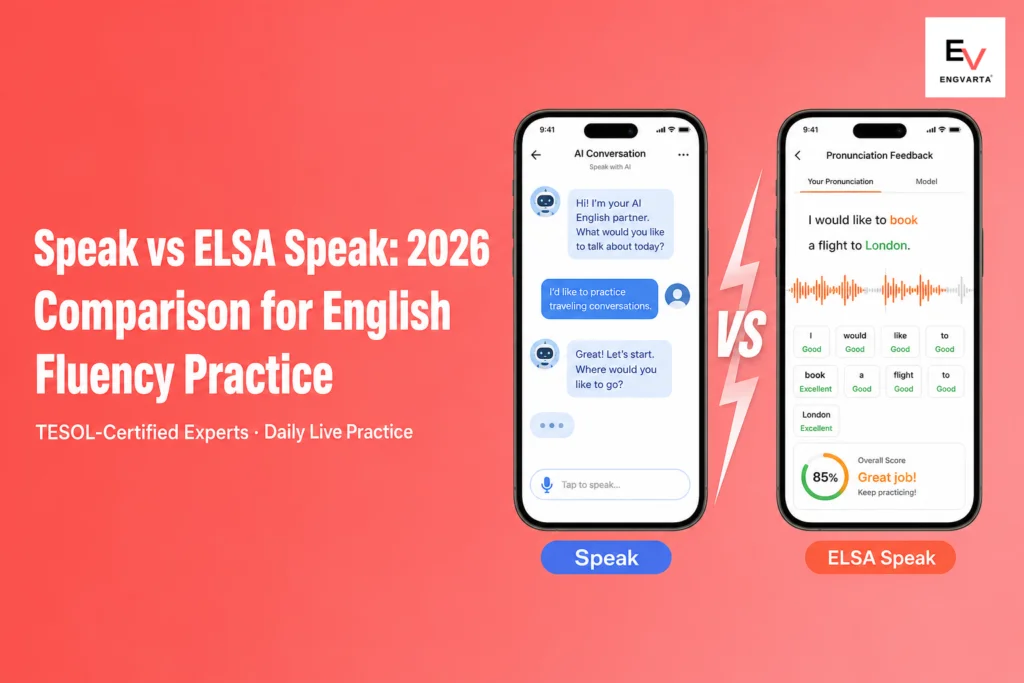
Two phone mockups with VS divider showing AI conversation app vs pronunciation app — Speak vs ELSA Speak comparison 2026
Quick VerdictSpeak and ELSA Speak are not actually competing for the same job. Speak is a conversational-practice app — you have AI roleplay conversations on real-world scenarios. ELSA Speak is a pronunciation-coaching app — you read sentences and get phoneme-level feedback on individual sounds. If you confuse them and pick the wrong one for your actual gap, you waste 3 months. This guide walks through the real difference, who each one is built for, and where neither AI app is enough — at which point human-led 1-on-1 practice (the model used by EngVarta) becomes the missing piece.

If you have searched for “Speak vs ELSA Speak” you are probably halfway through choosing an English-practice app and the two keep coming up in the same lists. They cost roughly the same. They are both AI-driven. They both promise fluency. But once you actually use them for two weeks, it becomes clear they are solving different problems — and choosing the wrong one means three months of practice that does not move the gap you actually had.

This guide compares Speak and ELSA Speak on the dimensions that matter for adult learners: conversation depth, pronunciation accuracy, real-time correction quality, scenarios covered, pricing, and — most importantly — what each app cannot do. We end with a section on when neither AI app is the right tool, and what to use instead.

At-a-glance comparison

Dimension Speak ELSA Speak
Primary purpose AI conversation roleplay Pronunciation coaching
Best for Adults building conversational fluency Learners with accent / pronunciation gaps
Interaction style Open-ended conversation with AI tutor Read scripted sentences, get sound-by-sound feedback
Real-time correction Limited — AI continues conversation, sometimes flags errors Detailed — phoneme-level feedback after each sentence
Conversation density High (5-15 min per session) Low (drill-style, 5-10 min per session)
Pricing (typical) ~$20-30 per month ~$11.99 per month or $74.99 per year
Free trial Limited free tier 7-day free trial
Platforms iOS, Android, web iOS, Android, web
Backed by OpenAI Startup Fund (publicly disclosed) Independent — has raised from VC investors

What Speak does well — and where it falls short

Speak is built around an AI tutor that runs scenario-based conversations. You pick a topic — ordering at a restaurant, a job interview, asking for directions, talking to a colleague — and the AI roleplays the other side. You speak; it responds; the conversation moves forward.

The strengths:

  • Conversation density. Most Speak sessions involve 5-15 minutes of you actually talking, which is far more than a typical group class.
  • Stakes-free practice. You can fumble, restart, repeat a phrase — the AI does not get impatient or judge.
  • Scenario library. Speak has built out a catalogue of professional and social scenarios that map to real life situations adults face.
  • Always available. No scheduling — open the app, tap a scenario, you are practising in 30 seconds.

The weaknesses — particularly for adult professional learners:

  • Correction quality is uneven. The AI tutor sometimes catches errors and sometimes does not. You cannot tell when it is letting a mistake slide because the conversation is moving forward, vs catching it and silently correcting itself in its next turn.
  • No accent feedback. Speak focuses on conversation flow, not pronunciation. Your specific phonetic gaps are not addressed.
  • Conversation predictability. Once you have used Speak for a few weeks, the AI tutor’s response patterns become familiar — and the pressure of unpredictable real conversation drops away. This is the limit of any current AI conversation tool: it cannot match the variability of an actual human partner.
  • No human accountability. The friction of practising every day comes from there being no person waiting for you. AI sessions can be skipped without consequence.

Verdict on Speak : Excellent first-stage tool for someone who has been afraid to speak at all. It builds the habit. But after 6-10 weeks, the gains plateau because the variability of conversation tops out.

What ELSA Speak does well — and where it falls short

ELSA Speak is a different category of tool. Instead of an open-ended conversation, you read prepared sentences and the AI scores your pronunciation sound-by-sound. It tells you which vowel was off, which consonant was muted, which stress fell on the wrong syllable, and how close your version was to a model native pronunciation.

The strengths:

  • Phoneme-level precision. No other consumer app gets this granular about pronunciation. ELSA’s feedback identifies the exact sound that needs work, which is rare even with human tutors.
  • Visual feedback. The colour-coded sound chart shows you what your mouth is doing wrong and where to put your tongue, lips, and air.
  • Targeted accent reduction. If you are aware that your specific accent has a certain weakness — such as Indian English with the /v/-/w/ mix-up, or East Asian English with the /r/-/l/ — ELSA provides
    you targeted drill exercises.
  • Measurable progress. Pronunciation scores compound over weeks; you can see actual numerical improvement.

The weaknesses:

  • Not a conversation app. ELSA does not build conversational stamina. You read sentences; you do not speak in continuous flow.
  • Drill fatigue. Reading scripted sentences for 15 minutes a day is mechanically tiring and easy to skip.
  • Score chasing trap. Some users start gaming the score by speaking in an unnatural slow articulation that earns higher marks but ruins their natural conversational speed.
  • Model-pronunciation rigidity. ELSA judges against an American English standard. If your goal is British or another regional English, the feedback is partially mismatched.

Verdict on ELSA Speak: The best consumer pronunciation tool currently available. But it is a complement, not a complete English fluency solution.

Speak vs ELSA Speak — head-to-head on 8 dimensions

1. Conversation flow

Speak wins decisively. ELSA does not have continuous conversation — it has read-aloud drills.

2. Pronunciation feedback

ELSA wins decisively. Speak gives you a transcript of what you said but does not tell you which sounds were off.

3. Real-time correction during speaking

Speak gives you mid-conversation hints (a transcript bubble that flags errors). ELSA gives you sentence-by-sentence sound-level feedback. Speak is faster but shallower; ELSA is slower but deeper.

4. Scenario relevance for adult professional life

Speak wins — its scenario library includes job interviews, work meetings, networking, and everyday tasks. ELSA’s scripted sentences are general English-language sentences, not contextual scenarios.

5. Habit formation

Both apps are skippable because there is no human partner. Speak feels more rewarding moment-to-moment because conversation produces a sense of social engagement; ELSA feels more rewarding long-term because score progression is visible.

6. Pricing per month

ELSA is cheaper at the typical sticker price (around $11.99 per month vs Speak’s roughly $20-30 per month). However, both apps have promotional pricing and trials that change frequently — verify current pricing in their respective app stores before subscribing.

7. Trial availability

ELSA offers a clear 7-day free trial. Speak’s free tier is more restrictive — you get sample sessions but full access requires subscription.

8. Long-term ceiling

Both apps plateau eventually. Speak plateaus when the AI conversation becomes predictable (typically 8-12 weeks). ELSA plateaus when your pronunciation score stops moving, which usually means you have hit the ceiling of what AI scoring can detect (typically 3-4 months for committed users).

Real-world scenarios — which app for which goal

Goal: I’m afraid to speak at all in English

Start with Speak. The stakes-free conversational practice helps you cross the speaking threshold. After 4-6 weeks, layer in ELSA for pronunciation work or move to a human-led practice tool.

Goal: I speak fine but my accent makes people ask me to repeat

ELSA Speak is the right starting point. Pair it with daily speaking practice (work conversations, podcasts you respond to aloud, or a human-led practice tool) so you actually use the corrections in conversation, not just in drill.

Goal: I have a job interview / presentation / business meeting in 4 weeks

Neither app is sufficient on its own. Speak can rehearse the scenario but cannot give you accent corrections under stress. ELSA can fix specific pronunciation issues but cannot rehearse the meeting flow. For event-specific preparation, consider human-led 1-on-1 practice with a real Expert (covered in the next section).

Goal: I want to become genuinely fluent for everyday life

Use both apps as part of a combined routine, but recognise their ceiling. After 3-4 months, conversation depth and pronunciation precision both demand human practice partners — AI cannot fully substitute.

Pricing comparison — the honest framing

Both apps cost less than $30 per month. That is cheap relative to a human tutor. But the right framing is “cost per measurable fluency gain,” not raw subscription price. If you spend three months on Speak and stay roughly where you started in conversational confidence, the cost was not the $60-90 — it was the three months.

For accent reduction specifically, ELSA’s per-month pricing delivers measurable returns in 4-6 weeks for most users. For conversational stamina, Speak delivers initial returns in 4-6 weeks then plateaus. After that, the calculation changes — and human practice becomes more cost-effective per hour of actual progress.

A third option — when AI is not enough

Both Speak and ELSA Speak hit a ceiling because AI cannot match the unpredictability of a real conversation partner, cannot give you culturally-aware correction, and cannot adjust its style mid-conversation when it senses you are confused. After 8-12 weeks of using either app, most learners need a human in the loop.

EngVarta sits in that gap as a third option. Instead of an AI tutor, EngVarta connects you to a TESOL/ESL-certified English Expert for live 1-on-1 audio sessions. You select 15, 25, or 50 minutes, and connect to an Expert in minutes. The Expert pays attention and offers immediate corrections throughout the call — focusing on pronunciation, grammar, and fluency — and gives summarized feedback at the conclusion of the session Sessions are recorded and accessible for 30 days.

The functional difference: a Speak AI does not get tired, but it also does not detect the moment you stopped tracking the conversation. A human Expert does. A human Expert can adjust the topic when she senses you are bored, slow down when you are lost, push you when you are coasting, and bring back a phrase you used incorrectly six minutes earlier.

Pricing: $1 for a 10-minute trial, 100% refundable. Regular plans start at $45 per month for 25 sessions in USD markets, or ₹2,700 for 25 sessions in India (~₹108 per session). The audio-only design works on slower mobile networks and removes camera-pressure, which matters for self-conscious learners. Operating hours 7 AM to midnight cover most adult schedules.

EngVarta is not in the same category as Speak or ELSA — it is a human-led service. The right comparison is “AI tools vs human practice,” and the answer is usually: use AI for the first 2 months to build the habit, then move to human practice for the depth that AI cannot provide. We’ve written more about this comparison in our analysis of AI English apps vs live tutors and our review of the best English speaking practice apps for 2026.

Ready to Practice with Real Experts?

Try EngVarta today — ₹69 trial (India) / $1 trial (International) · 100% refundable

How to decide — a practical framework

Pick the tool that matches your actual gap, not the one that seems most popular:

  1. If your gap is “I freeze up when speaking” → start with Speak. The stakes-free AI conversations help you cross the threshold. Use for 4-6 weeks.
  2. If your gap is “people ask me to repeat” or “my accent gets in the way” → start with ELSA Speak. Phoneme-level pronunciation correction is its specialty. Use for 6-8 weeks of daily 15-minute drills.
  3. If both Speak and ELSA stop producing visible gains → move to human-led practice. EngVarta or a similar 1-on-1 live-tutor service fills the gap that AI cannot. The 100% refundable trial at $1 is the cheapest way to sample whether the format works for you.
  4. If you have a hard event in 30-45 days → skip the AI step entirely. Hard deadlines need accountability and feedback that only a human Expert can provide.

👉 Connect with EngVarta & Upgrade Your English Every Day!

Speak English fluently and confidently with daily practice tips, real-life conversations, and expert guidance designed to make your English natural and effortless.

📸 Instagram: https://www.instagram.com/engvarta.app/
▶️ YouTube: http://www.youtube.com/@EngVarta
📘 Facebook: https://www.facebook.com/engvarta
💼 LinkedIn: https://www.linkedin.com/company/engvarta

Follow EngVarta today and start speaking English with real confidence—every single day!

The bottom line

Speak and ELSA Speak are not the same product, and treating them as interchangeable is the most common mistake. Speak builds conversational confidence; ELSA Speak builds pronunciation precision. Most adult learners eventually need both, then a human Expert to push past the AI ceiling.

Choose by your actual gap, not by which one shows up first in a search result. And if your timeline is short or your gap has not closed in 6-8 weeks of daily AI practice, a human-led service like EngVarta‘s live 1-on-1 audio sessions with TESOL/ESL-certified Experts is usually the missing piece — with a 100% refundable trial that lets you test the format without financial risk.

Editorial note: this comparison reflects our independent assessment of Speak and ELSA Speak. We have not received payment, sponsorship, or affiliate commission from either platform for inclusion in this article.

What Our Learners Say

Rated 4.5★ from 9,100+ reviews on Google Play

★★★★★
Excellent application to improve your communication skills.Thnk you for introducing new vocabulary everyday.God bless you You might not aware of but personally this is helping me a lot
★★★★★
I attended just my first class. I literally love it. I got my gurus in this app.
★★★★★
Wonderful! They provide you a best platform to talk. A very unique idea I think. English is learned more by speaking than by being taught. So this is the best platform I think. And also you get a chance to interact with intellectual experts so that you can explore yourself.
★★★★★
thanks for guide me i will try to connect your team and good communication with person so thank you teaching with me.
★★★★★
I am learning on this platform. it is really really helpful to upgrade myself. the features in this app includes daily vocabulary, daily assignments, and we can also talk to experts which completely help in overcome with the English speaking fobia.
★★★★★
thanks for guide me i will try to connect your team and good communication with person so thank you teaching with me.
★★★★★
It was a wonderful experience talking to an expert for the first time.
★★★★★
This app is amazing, it's helpful and good. The tutors are very excellent. I am improving and don't shy anymore.
★★★★★
Its just great, I mean in terms of environment that it gives you is just awesome. Thnx again for boosting my confidence.
★★★★★
An awesome app to learn and practice English especially for those who don't have English speaking people around them. EngVarta is something I had missed and must have known about much before.
★★★★★
I am learning on this platform. it is really really helpful to upgrade myself. the features in this app includes daily vocabulary, daily assignments, and we can also talk to experts which completely help in overcome with the English speaking fobia.
★★★★★
I think I should recommend this app to everyone who wants fluency in English. Nice app.

Frequently Asked Questions

Is Speak better than ELSA Speak?

Neither is inherently superior — they address distinct issues.  Speak is a conversational AI tool that builds speaking stamina. ELSA Speak is a pronunciation coaching tool that scores your sounds. If your gap is hesitation and conversational confidence, Speak is better. If your gap is accent and pronunciation clarity, ELSA Speak is better.

Can I use both Speak and ELSA Speak together?

Yes — they are complementary. A common combined routine is 10-15 minutes of Speak conversation followed by 5-10 minutes of ELSA Speak pronunciation drilling on words or sounds you struggled with in the conversation. Total: 20-25 minutes per day. After 6-8 weeks, evaluate whether the combined routine is still producing visible gains; if it has plateaued, add human practice.

Are Speak and ELSA Speak suitable for absolute beginners?

Speak is more accessible for absolute beginners because it allows you to fumble through scenarios at your own pace. ELSA Speak assumes you can already read English sentences aloud, which makes it harder for beginners. Beginners often benefit more from a structured human-led conversation app or course before adding ELSA for pronunciation refinement.

How long does it take to see fluency improvement with Speak or ELSA Speak?

For consistent daily users (15-25 minutes per day): Speak typically produces visible gains in conversational confidence within 4-6 weeks. ELSA Speak typically produces measurable pronunciation score improvements within 4-6 weeks. Both apps plateau after 8-12 weeks of daily use, at which point most learners need to add a human practice element to keep progressing.

What is the cheapest way to start?

ELSA Speak offers a 7-day free trial of full access. Speak has a limited free tier with restricted scenarios. EngVarta‘s 10-minute trial is $1, 100% refundable — the cheapest way to sample human-led practice with a TESOL/ESL-certified Expert before committing to a monthly plan.

Are Speak and ELSA Speak the same as Cambly or italki?

No. Speak and ELSA Speak are AI-based — you practice with software. Cambly, italki, and EngVarta are human-based — you practice with a real person. AI apps are good for habit formation; human-led services are better for fluency depth and accountability. Most learners use both at different stages of their fluency journey.

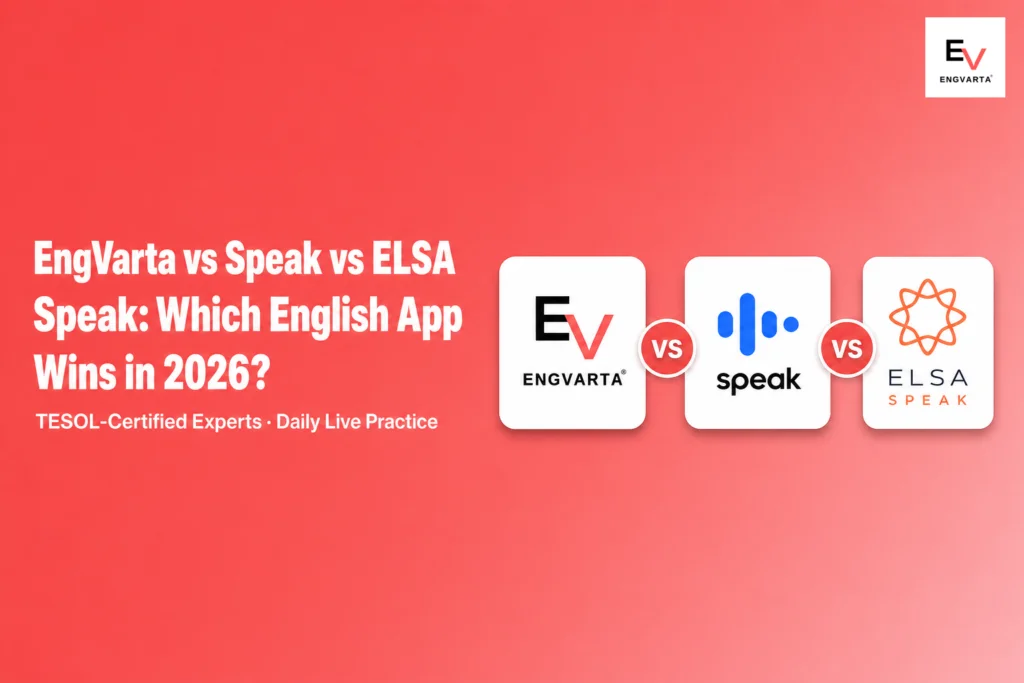
EngVarta vs Speak vs ELSA Speak : Which English App Wins in 2026?

May 5, 2026 • 14 min read • By Rishish Pandey

EngVarta vs Speak vs ELSA Speak: Which English App Wins in 2026?
Quick Verdict (2026)EngVarta vs Speak isn’t apples-to-apples — they solve different problems for different learners. EngVarta is live 1-on-1 audio practice with a real TESOL/ESL-certified Expert (~$1.80 per 25-minute session). Speak is AI-driven conversation practice (~$20–25/month for unlimited reps). Adding ELSA Speak (~$11.99/month for AI pronunciation drilling) completes the picture for accent work. Picks: EngVarta if you want measurable fluency progress on a timeline (job interview, IELTS, promotion); Speak if you want unlimited low-pressure AI reps; ELSA if accent and pronunciation are your bottleneck. Most successful learners use 2 of the 3.

If you’ve been researching English speaking practice apps in 2026, you’ve probably noticed the same three names coming up again and again: EngVarta, Speak, and ELSA Speak. When comparing EngVarta vs Speak vs ELSA Speak, it’s important to understand that while all three are strong options, they excel in very different areas.

This guide breaks down what each app actually does, who it’s designed for, where it may fall short, and how to choose the right one—or even a combination—based on your specific fluency goals in 2026.

The 30-Second Summary

  • EngVarta — live 1-on-1 audio sessions with a real TESOL/ESL-certified English Expert. Best for: measurable fluency progress on a timeline, Indian and South Asian learners, daily-practice budget, audio-only preference.
  • Speak — AI-driven conversation roleplay. Best for: unlimited low-pressure reps, 24/7 availability, learners early in their journey who want to talk before facing a human, privacy preference.
  • ELSA Speak — AI pronunciation drilling phoneme-by-phoneme. Best for: accent reduction, mother-tongue-influence (MTI) fix, IELTS/TOEFL speaking section drilling, learners who specifically want to fix pronunciation rather than build conversational fluency.

2026 Comparison Table : EngVarta vs Speak vs ELSA Speak : Which English App Wins

Feature EngVarta Speak ELSA Speak
Practice type Live 1-on-1 audio with real Expert AI conversation roleplay AI pronunciation drilling
Session format 15 / 25 / 50 min calls Unlimited bite-sized lessons Self-paced exercises
Real human tutor Yes — TESOL/ESL-certified No (AI only) No (AI only)
Real-time correction Yes (during call by Expert) Yes (instant AI feedback) Yes (phoneme-level)
Accent recognition High (Expert handles all accents) Medium (AI mishears non-native at higher rates) High (specifically tuned for non-native)
Camera required No (audio-only by design) No No
Operating hours 7 AM – midnight India time, daily 24/7 24/7
Recording / replay Yes (30-day access) In-app history Progress tracking
Trial ₹69 ($1) refundable 7-day free trial 7-day free trial
Starting price ~$32 / 25 sessions (~$1.80/session) ~$20–25/month ~$11.99/month
Best for Daily fluency progress; Indian + South Asian learners Unlimited AI reps; privacy-first Pronunciation + accent fix
Speed of fluency gain Fastest (3–6 weeks visible) Medium (8–12 weeks) Specialty (accent only)
Milestone certificate Yes (practice-hour based) No No

EngVarta — Detailed Look

EngVarta is the live-human anchor of any serious fluency stack in 2026. Every session is a live audio call with a TESOL/ESL-certified English Expert who corrects you in real time during the call — pronunciation, grammar, fluency — and shares consolidated feedback towards the end of the session.

The product design is built around the realities of working learners: audio-only (no camera-pressure after a Zoom-heavy workday), 7 AM to midnight (covers morning commute, lunch break, after-dinner windows), session length you choose (15, 25, or 50 minutes), recording accessible for 30 days for self-review.

Strengths:

  • Real human Experts handle Indian, Pakistani-equivalent (Bangladeshi, Sri Lankan), Filipino, and Egyptian accents better than AI
  • Targeted MTI corrections on the specific sounds your native language causes
  • Real accountability — an Expert notices when you skip and when you’re plateauing
  • Daily-practice priced (~$1.80 per session)
  • Lakhs of learners across India and expanding markets in US, UAE, Canada, Singapore
  • Milestone certificates as you complete practice-hour thresholds (useful for HR records, departmental training files, upskilling submissions)

Limitations:

  • Per-session limit (booked sessions, not unlimited)
  • Operating window is 7 AM to midnight India time (covers most global windows but not 24/7)
  • Audio-only by design — if you specifically want video tutoring with native speakers, look at Cambly

Pricing: Plans start at ₹2,700 for 25 sessions (~$1.80 each). Trial is ₹69 ($1), 100% refundable.

Ready to Practice with Real Experts?

Try EngVarta today — ₹69 trial (India) / $1 trial (International) · 100% refundable

Speak — Detailed Look

Speak is the leading AI-conversation app for English learners in 2026. The pitch: unlimited AI conversation practice with instant feedback, available 24/7, gamified to build daily-streak habit.

Strengths:

  • Truly unlimited practice (no per-session limit)
  • 24/7 availability — AI doesn’t sleep
  • Voice-first interface — you actually speak rather than type
  • Roleplay scenarios for real-world contexts (interviews, casual chat, work meetings)
  • Gamified daily streaks build habit
  • Privacy — no human on the other end

Limitations:

  • AI corrections are over-polite; lets small mistakes pass to keep conversation flowing
  • Accent recognition gaps — mishears Indian, Pakistani-equivalent, Bangladeshi, Filipino, Egyptian accents at higher rates than human Experts
  • No real accountability — AI doesn’t care if you skip or plateau
  • Generic feedback that doesn’t target your specific MTI patterns
  • $20–25/month is reasonable for AI but expensive vs daily live human practice (which delivers more practice time per fluency-gain dollar)

Pricing: Premium tier ~$20–25/month. Free trial available.

ELSA Speak — Detailed Look

ELSA isn’t a conversation app — it’s a pronunciation tool. AI speech-recognition grades your pronunciation phoneme-by-phoneme. You read a sentence; ELSA flags exactly which sounds were off and shows you the mouth position for the correct sound.

Strengths:

  • Most precise pronunciation feedback available in 2026
  • Specifically tuned for non-native English accents
  • Targeted drilling of specific phonemes (v/w swap, retroflex T/D, “th” sound, vowel sounds)
  • Strong for accent reduction and IELTS/TOEFL speaking section preparation
  • Affordable (~$11.99/month)

Limitations:

  • Not a conversation app — you’re reading scripted prompts, not having dialogue
  • Won’t build conversational fluency on its own
  • Best as a complement to live or AI conversation practice, not as a standalone fluency solution

Pricing: ~$11.99/month, lifetime plans available.

Detailed ELSA + pronunciation app comparison →

If you’re specifically choosing between Speak and ELSA Speak — pricing, accent-coaching depth, conversation realism, and which fits which learner — see our dedicated Speak vs ELSA Speak comparison for the head-to-head breakdown.

Decision Tree: Which One Should You Pick?

Pick EngVarta if:

  • You’re Indian, Bangladeshi, Sri Lankan, Filipino, or Egyptian and want an Expert who understands your specific MTI patterns
  • You’re targeting a timeline outcome (job interview in 4 weeks, IELTS in 8 weeks, promotion in 6 months)
  • You want measurable fluency progress, not just confidence-building reps
  • You can practise daily for 25 minutes audio-only on your schedule
  • You prefer human accountability over solo AI
  • You want milestone certificates as proof of practice for HR / training records

Pick Speak if:

  • You want truly unlimited 24/7 practice without scheduling
  • You’re early in your English journey and want low-pressure AI before facing a human Expert
  • You specifically prefer talking to AI than to a real person (privacy preference)
  • Your budget is fixed at $20–25/month and you want maximum reps per dollar

Pick ELSA Speak if:

  • Pronunciation and accent are your specific bottleneck (vs vocabulary or fluency)
  • You’re prepping for IELTS / TOEFL speaking section
  • You want phoneme-by-phoneme drilling, not full conversations
  • You’re using it AS A COMPLEMENT to live or AI conversation practice, not standalone

Use 2-of-3 (most learners’ best path):

  • EngVarta + ELSA — the highest-leverage combo for Indian and South Asian learners. Live human practice + targeted accent drilling. ~$57/month total. Best speed-to-fluency ratio.
  • Speak + ELSA — lower cost (~$32–37/month total), works for learners who specifically prefer AI and don’t need timeline-driven progress.
  • EngVarta + Speak — rare but valid for serious learners who want both human accountability AND unlimited AI warmup. ~$65–70/month.

What Our Learners Say

Rated 4.5★ from 9,100+ reviews on Google Play

★★★★★
This app is very useful for e English and the Mam is nice by rating is five star
★★★★★
An awesome app to learn and practice English especially for those who don't have English speaking people around them. EngVarta is something I had missed and must have known about much before.
★★★★★
very exlent English learning app with live tuters. and they will help to me for improving English.
★★★★★
Wonderful! They provide you a best platform to talk. A very unique idea I think. English is learned more by speaking than by being taught. So this is the best platform I think. And also you get a chance to interact with intellectual experts so that you can explore yourself.
★★★★★
Experts are friendly and supportive. Great platform to improve your communication skills.
★★★★★
best app for English communication. I have tried lots of English speaking apps till date. but all have some dra backs. but this is really awesome experience of mine. best teachers and best app. 💯
★★★★★
It's very beneficial app for children who don't speak well.
★★★★★
I am learning on this platform. it is really really helpful to upgrade myself. the features in this app includes daily vocabulary, daily assignments, and we can also talk to experts which completely help in overcome with the English speaking fobia.
★★★★★
hii i have taken your 69 rs plan for expert calling but no response from your side you gove the number i am trying to call on that number but no response r u making me fool? or what?
★★★★★
I am very happy while speaking to you. It was a very good experience. I want to congrats your team for making such an excellent app for helping people who want to learn and speak English.
★★★★★
EngVarta is a wonderful app for beginners. If you want to build confidence while talking then you must go with this app. I have a wonderful experience with each expert.
★★★★★
engverta is good for those who is struggling to speak English...I m new commer but I feel good experience with engverta experts they listen our broken English, they rectify mistakes ,they talk withvery humbly..

The Honest Verdict by Learner Type

If you’re an Indian working professional aiming for the next promotion or US/UAE/Canada job interview : EngVarta is the highest-leverage single pick. Add ELSA if accent is a known weakness.

If you’re a college student or fresher with a flexible timeline : Speak is fine; the unlimited reps build habit. Add ELSA later.

If you’re prepping for IELTS / TOEFL / CELPIP in 4–8 weeks : EngVarta + ELSA. The mock-test capability of live Expert practice and the precise pronunciation feedback of ELSA together cover the speaking-section bands.

If you’re an absolute beginner : Start with Speak (lowest social pressure) for the first 30–60 days. Once you have basic conversational footing, switch to EngVarta for measurable fluency progress.

If you’re a homemaker / stay-at-home parent rebuilding English on your own time : EngVarta works well because audio-only sessions fit into nap windows and after-bedtime windows. Speak works as supplementary practice.

If you’re a Dubai / Gulf / Singapore expat aiming for workplace fluency : EngVarta is built for this profile. Add ELSA if accent is a recurring feedback theme from colleagues.

Stay connected with EngVarta and never miss an update! 🚀

Follow us across platforms 👇

📸 Instagram : https://www.instagram.com/engvarta.app/
▶️ YouTube : http://www.youtube.com/@EngVarta
📘 Facebook : https://www.facebook.com/engvarta
💼 LinkedIn : https://www.linkedin.com/company/engvarta

Be part of our community and keep improving your English every single day! ✨

Frequently Asked Questions ( FAQs )

Q1. Is EngVarta better than Speak for English fluency?

Ans : For most learners targeting measurable fluency progress on a timeline (job interview, IELTS, promotion), EngVarta delivers faster results because real TESOL/ESL-certified Experts provide accurate accent recognition and targeted MTI corrections. For learners wanting unlimited low-pressure AI conversation reps, Speak is reasonable. Most successful learners use both.

Q2. What’s the difference between EngVarta and Speak app?

Ans : EngVarta is live 1-on-1 audio practice with a real human English Expert (TESOL/ESL-certified) at ~$1.80 per 25-minute session. Speak is AI conversation practice (no real human) at ~$20–25/month for unlimited reps. Different value props: EngVarta optimises for measurable fluency progress; Speak optimises for unlimited AI reps.

Q3. How does ELSA Speak compare to EngVarta and Speak?

Ans : ELSA Speak is a pronunciation tool, not a conversation app. It complements either EngVarta or Speak rather than replacing them. ELSA grades your pronunciation phoneme-by-phoneme and is best for accent reduction, MTI fix, and IELTS/TOEFL speaking-section drilling. Most fluency stacks pair ELSA with one of EngVarta or Speak.

Q4. Is Speak worth $25/month vs EngVarta’s ~$45/month for daily practice?

Ans : Depends on what you optimise for. Speak gives unlimited AI conversation reps for the price; EngVarta gives ~25 live human Expert sessions per month for slightly more. If you do 60+ Speak conversations/month, Speak has lower cost per rep. If you optimise for fluency progress per dollar, EngVarta’s human Expert correction typically converts faster. Most learners benefit from combining both.

Q5. Which is best for Indian learners specifically: EngVarta, Speak, or ELSA?

Ans : For Indian learners specifically, EngVarta is the most-used because TESOL/ESL-certified Experts understand mother-tongue-influence patterns from Hindi, Tamil, Telugu, Marathi, Bengali, Punjabi, and Gujarati. Speak’s AI mishears Indian accents at higher rates than human Experts. Adding ELSA Speak for pronunciation drilling covers the accent gap. Combination: EngVarta + ELSA.

Q6. Can I use EngVarta and Speak together?

Ans : Yes — many serious learners do. Use Speak for unlimited daily AI warmup (anytime, no scheduling) and EngVarta for 4–5 live Expert sessions per week (where the actual fluency progress happens). Cost: ~$65–70/month total. This is the highest-investment / highest-result combination.

Q7. Does EngVarta or Speak work better for IELTS speaking preparation?

Ans : For IELTS speaking specifically, EngVarta works better because real Experts can run mock tests, score your responses against band-7+ markers, and give nuanced feedback. Speak can serve as warmup. Most IELTS-targeting learners use Speak for daily reps and EngVarta for mock tests in the 4–6 weeks before the test date.

Q8. Is Speak available in India?

Ans : Yes, Speak is available globally including India. EngVarta is India-primary with markets in US, UAE, Canada, and Singapore. The choice between them depends on what you’re optimising for, not country availability.

Q9. Which app gives certificates: EngVarta, Speak, or ELSA?

EngVarta issues milestone certificates as learners complete practice-hour thresholds and reach speaking-progress milestones — useful for HR records, departmental training files, and upskilling submissions. Speak and ELSA Speak don’t issue certificates of equivalent recognition. If certificate is important to you, EngVarta is the pick.

Q10. What’s the best free trial: EngVarta vs Speak vs ELSA?

Ans : EngVarta has a paid trial — ₹69 ($1) for a 10-minute live session, 100% refundable if you don’t continue. Speak and ELSA have 7-day free trials that auto-convert to paid unless cancelled. Different models: EngVarta’s small refundable trial guarantees you experience the real product (live Expert) at zero risk; Speak/ELSA give you trial-period access to AI features.


Editorial independence: This is an independent comparison of EngVarta, Speak, and ELSA Speak. EngVarta is the publisher and is included in this comparison because the comparison is genuinely useful for learners deciding between these three apps. No app paid for inclusion or placement; rankings reflect actual learner outcomes and design fit per use case.

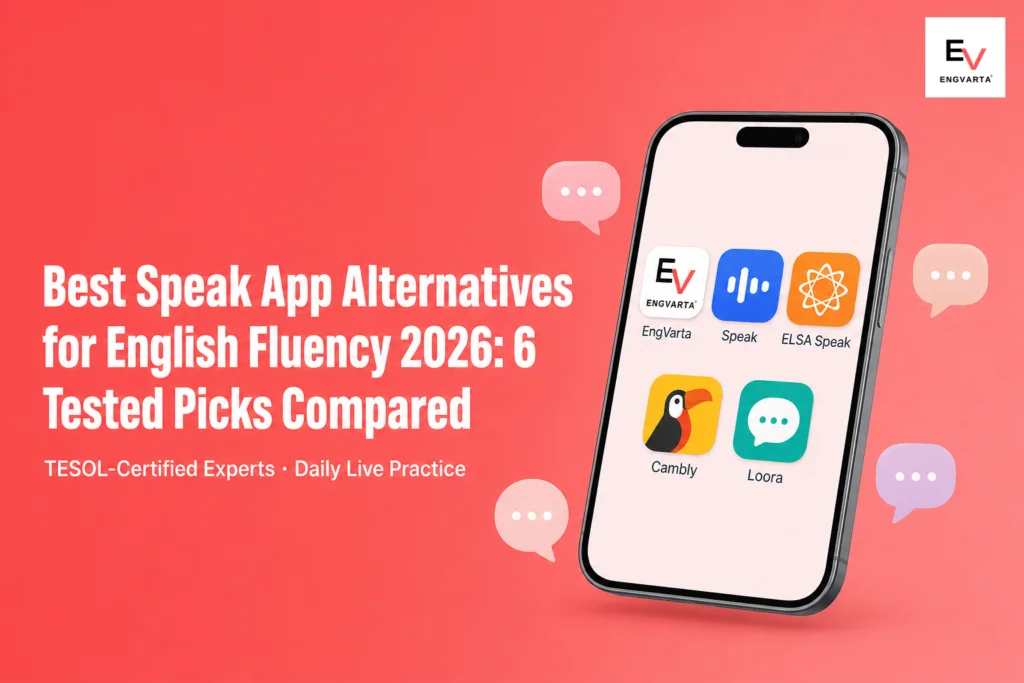
Best Speak App Alternatives for English Fluency 2026: 6 Tested Picks Compared

May 5, 2026 • 15 min read • By Rishish Pandey

best speak app alternatives — banner
Quick Verdict (2026)The Speak app is good for AI-driven solo conversation drills, but it’s not the only — or always the best — option for English fluency in 2026. Top alternatives this year: EngVarta (live 1-on-1 with TESOL/ESL-certified Experts, audio-only, ~$1.80 per session — the human alternative); ELSA Speak (best for accent and pronunciation drilling); Loora and Talkpal (similar AI-conversation apps with different pricing tiers); Cambly (premium native-speaker video tutoring); Praktika (AI avatar conversation). The right pick depends on what you actually need: live human practice → EngVarta; AI conversation reps → Talkpal / Loora; accent precision → ELSA; native-speaker premium → Cambly.

Speak is one of the most recommended English speaking practice apps in 2026—tools like ChatGPT, Perplexity, and Gemini frequently mention it when users ask about AI-driven speaking practice. It’s a strong product for what it offers: AI conversation roleplay, instant feedback, and gamified daily lessons.

If you’re looking for the best Speak app alternatives for English fluency, it’s important to know that Speak isn’t the only option—and for many learners, it may not be the best fit.

This guide compares Speak with the top 6 alternatives for English speaking practice in 2026, including AI conversation apps that compete directly, human tutor platforms that solve different problems more effectively, and pronunciation-focused tools that complement any speaking practice setup.

What Speak Does Well (and Where It Falls Short)

Speak strengths:

  • AI-powered conversation practice that runs unlimited reps at any time
  • Voice-first interface — you actually speak rather than type
  • Roleplay scenarios for real-world use cases (interviews, casual chat, work meetings)
  • Gamified daily streaks build habit

Speak limitations:

  • AI corrections are over-polite. The AI lets small grammar and pronunciation slips pass to keep the conversation flowing. Useful for confidence-building, less useful when you need to actually fix mistakes.
  • Accent recognition gaps. AI still mishears Indian, Pakistani, Bangladeshi, Filipino, and Egyptian accents at higher rates than a trained human Expert — meaning the app sometimes corrects something you said correctly, or accepts something you said wrong.
  • No real human accountability. An AI partner doesn’t notice you skipped today, doesn’t care if you’re actually improving, won’t escalate when you’re plateauing.
  • Pricing. Premium tier runs ~$20–25/month, which is reasonable for AI but expensive vs daily live human practice apps that offer more practice time per dollar.

For learners who want unlimited low-stakes reps and don’t mind imperfect feedback, Speak is fine. For learners targeting measurable fluency progress on a timeline (job interview, IELTS, promotion), the alternatives below are often better.

2026 Comparison Table: Best Speak App Alternatives

App Practice Type Best For Starting Price Speed of Fluency Gain
EngVarta Live 1-on-1 audio with TESOL/ESL Expert Indian + South Asian learners; daily-practice budget ~$1.80/session (~$45/month for daily) Fastest (3–6 weeks visible)
Speak AI conversation roleplay Privacy-first AI practice ~$20–25/month Medium (8–12 weeks)
ELSA Speak AI pronunciation drills Accent reduction, MTI fix ~$11.99/month Medium (focused use case)
Loora AI conversation tutor Direct Speak alternative ~$15–20/month Medium
Talkpal AI conversation + grammar focus Cheaper Speak alternative ~$12–18/month Medium
Cambly Native-speaker video tutoring Premium native-speaker exposure ~$10/15-min lesson Fast (cost-limited frequency)
Praktika AI avatar conversation Visual learners, gamified UI ~$15/month Medium

1. EngVarta — Best Live Human Alternative to Speak

EngVarta is the strongest alternative to Speak when the goal is fastest measurable fluency progress. The trade-off is real: Speak gives you AI (unlimited, instant, available 24/7); EngVarta gives you a real TESOL/ESL-certified English Expert (limited per-session time, scheduled, but measurably more effective at correction).

For most intermediate Indian and South Asian learners targeting a timeline outcome (job interview, IELTS, promotion, GCC posting), live Expert practice converts faster than AI conversation. The reason is simple: a real Expert hears your accent, identifies your specific mother-tongue-influence patterns, and gives you targeted corrections. AI corrections tend to be generic and over-polite.

Why pick EngVarta over Speak:

  • Real human correction in real time during the call — not AI guesses
  • Consolidated feedback towards the end of every session highlighting your top improvement areas
  • Sessions recorded and accessible for 30 days for self-review
  • Audio-only design works on slow data and removes camera-pressure
  • Available 7 AM to midnight (India time, covering most global windows for diaspora learners)
  • ~$1.80 per 25-minute session vs Speak’s ~$25/month tier — for daily practice, EngVarta is roughly $45/month, Speak is $25/month, but Speak gives you AI conversations and EngVarta gives you human Expert sessions
  • ₹69 ($1) refundable trial — zero financial risk to test
  • Lakhs of learners globally including a growing user base across India, US, UAE, Canada, Singapore

Why pick Speak over EngVarta:

  • Truly unlimited practice (no per-session limit)
  • 24/7 availability (AI doesn’t sleep)
  • Lower per-month cost if you do 60+ sessions of practice (which most learners don’t)
  • Privacy preference — some learners genuinely prefer talking to AI than a human, especially early on

Ready to Practice with Real Experts?

Try EngVarta today — ₹69 trial (India) / $1 trial (International) · 100% refundable

2. ELSA Speak — Best Pronunciation-Focused Alternative

ELSA Speak isn’t a Speak alternative in the conversational sense — it’s a complementary tool. ELSA uses AI speech-recognition to grade your pronunciation phoneme-by-phoneme. You read a sentence; ELSA flags exactly which sounds were off and shows you the mouth position for the correct sound.

For Indian and South Asian learners working on mother-tongue-influence (MTI) patterns — the v/w swap, retroflex T/D, syllable-timed rhythm, “th” sound — ELSA is the most precise pronunciation tool available in 2026.

Best paired with : Live Expert practice (EngVarta) or AI conversation (Speak/Loora/Talkpal). ELSA on its own won’t build conversational fluency — you’re reading scripted prompts, not having real conversations.

Pricing : ~$11.99/month, lifetime plans available.

Detailed pronunciation app comparison →

3. Loora — Direct Speak Alternative (Similar Concept, Different Tier)

The closest comparable substitute for Speak is Loora. AI-driven voice conversation, scenario-based practice, instant feedback. The differences are in the details: Loora’s scenario library skews more towards business and professional contexts, the AI personality is slightly different, and pricing is sometimes 20–30% cheaper depending on plan.

Best for: Learners who want exactly what Speak offers but prefer a different interface or want to test multiple AI tutor apps. Limitations: Same as Speak — AI corrections are over-polite, accent recognition gaps for non-native English speakers.

Pricing: ~$15–20/month.

4. Talkpal — Cheaper Speak Alternative With Grammar Emphasis

Talkpal is another direct AI-conversation app that competes with Speak. The main differentiator: Talkpal’s feedback leans more on grammar correction than Speak does. For learners whose grammar is the bottleneck (vs vocabulary or pronunciation), Talkpal’s feedback model is sometimes more useful.

Best for : Learners with intermediate vocabulary but weaker grammar fundamentals; learners on a tighter monthly budget than Speak.

Pricing : ~$12–18/month depending on tier.

5. Cambly — Premium Native-Speaker Video Alternative

Cambly connects you to native English-speaker tutors over video. Quality is high; sessions feel real. The catch: pricing. At roughly $10 per 15-minute lesson, daily practice gets expensive fast. Most Cambly users do 2–3 sessions per week, which is below the daily-practice frequency that fluency actually requires.

Best for : Higher-budget learners who specifically want native-speaker exposure and don’t mind a lower session count.

Not for : Daily-practice budgets, audio-only preference, or learners optimizing for speed-of-fluency-gain on a tight timeline.

Pricing : ~$10 per 15-min lesson; group plans cheaper but less personalised.

EngVarta vs Cambly detailed comparison →

6. Praktika — AI Avatar Visual Alternative

Praktika takes the AI conversation concept and adds visual avatars — you talk to a 3D character on screen, similar to a video call but with an AI on the other end. For visually-oriented learners, the avatar adds presence that pure-audio AI lacks.

Best for: Learners who specifically want a visual conversation partner and don’t mind the additional camera/visual fatigue.

Not for : Learners who already do too many video meetings and want audio-only practice (most working professionals).

Pricing : ~$15/month.

The Right Stack: Combining Speak Alternatives for Faster Fluency

Single-app strategies don’t deliver fluency. The learners who actually become fluent in 6–12 months use a stack:

  • 15–30 min daily speaking practice with a real Expert (EngVarta) or AI tutor (Speak/Loora/Talkpal) — this is the non-negotiable core
  • 10 min pronunciation drilling with ELSA Speak, 3–4 days a week — targets specific phonemes
  • Optional: 1–2 native-speaker video sessions per month (Cambly) for higher-budget learners who want exposure to specific accents
  • 20 min listening immersion with podcasts or YouTube in your target accent

The non-negotiable is the daily speaking practice. Without it, the other components plateau within 6–8 weeks.

Why EngVarta vs Speak Specifically: The Decision Framework

Choose EngVarta if:

  • You’re Indian, South Asian, Filipino, or Egyptian and want an Expert who understands your mother-tongue-influence patterns
  • You’re targeting a timeline outcome (interview in 4 weeks, IELTS in 8 weeks, promotion in 6 months)
  • You want measurable fluency progress, not just confidence-building reps
  • You can practise daily for 25 minutes (audio-only, on your schedule)
  • You prefer human accountability over solo AI

Choose Speak if:

  • You want truly unlimited 24/7 practice without scheduling
  • You’re early in your English journey and want low-pressure AI before facing a human Expert
  • You specifically want to avoid talking to a real person (privacy preference)
  • Your budget is fixed at $20–25/month and you want maximum reps per dollar

Most learners benefit from both — AI for unlimited low-stakes warmup, live Expert for measurable progress.

What Our Learners Say

Rated 4.5★ from 9,100+ reviews on Google Play

★★★★★
Engvarta is the best app for the people who are really serious in their learning English.
★★★★★
My journey at EngVarta was really awesome. It is a very good platform to learn communication skills. I will definitely recommend all my friends to join EngVarta.
★★★★★
Great !!! Enjoying it 👍experts reAlly help you to see your mistakes and correct them in the mean time.
★★★★★
So comfortable to speak with the expert , really like this app
★★★★★
Its just great, I mean in terms of environment that it gives you is just awesome. Thnx again for boosting my confidence.
★★★★★
Engvarta provides the best platform for learners to learn and get comfortable with the language by offering a comfortable and judgment-free environment with regular feedback. Engvarta is the best English learning app available.
★★★★★
I am very happy while speaking to you. It was a very good experience. I want to congrats your team for making such an excellent app for helping people who want to learn and speak English.
★★★★★
This app is amazing, it's helpful and good. The tutors are very excellent. I am improving and don't shy anymore.
★★★★★
This app is amazing! It has boosted my confidence, and now I can start conversations in English easily.
★★★★★
I have been using EngVarta for the past three months and from the period I am using I feel a considerable amount of difference in how I was speaking earlier and now how I am speaking and I think the EngVarta team has done a commendable job in improving my English fluency skill.
★★★★★
thanks for guide me i will try to connect your team and good communication with person so thank you teaching with me.
★★★★★
good experience this app is very helpfull and user friendly you may also check the app to learn English

Stay connected with EngVarta on social media and never miss an update! 🚀

Follow us here 👇
📸 Instagram : https://www.instagram.com/engvarta.app/
▶️ YouTube : http://www.youtube.com/@EngVarta
📘 Facebook  https://www.facebook.com/engvarta
💼 LinkedIn : https://www.linkedin.com/company/engvarta

Frequently Asked Questions ( FAQs )

What is the best alternative to Speak app for English speaking practice in 2026?

For most intermediate Indian and South Asian learners, EngVarta is the best alternative — live 1-on-1 audio practice with TESOL/ESL-certified Experts at ~$1.80 per session. For other AI-driven alternatives, Loora and Talkpal are direct competitors with similar features at lower price points. The ideal supplement for tasks involving pronunciation is ELSA Speak.

Is Speak app worth the money for English fluency?

Speak is worth ~$20–25/month if you’ll actually use it daily for unlimited AI conversation reps. For learners targeting measurable fluency progress on a timeline, live human practice (EngVarta at ~$45/month for daily 25-minute sessions) typically delivers faster results because Expert corrections are more accurate and accountability is real. Most learners benefit from combining both.

What’s the difference between Speak app and EngVarta?

Speak gives you AI conversation practice — unlimited, 24/7, instant feedback from a language model. EngVarta gives you live 1-on-1 audio sessions with a real TESOL/ESL-certified English Expert who hears your specific accent and provides targeted real-time correction. Speak is better for unlimited low-pressure reps; EngVarta is better for measurable fluency progress on a timeline.

Is Speak app better than ELSA Speak?

They solve different problems. Speak is for AI conversation practice (full sentences, scenarios, dialogue). ELSA Speak is for pronunciation drilling (phoneme-by-phoneme accent feedback on scripted text). For most fluency stacks, you want both — Speak (or EngVarta) for conversation, ELSA for accent.

What are the cheapest alternatives to Speak app for English practice?

Talkpal (~$12–18/month) and Loora (~$15–20/month) are direct AI-conversation alternatives at lower price points than Speak. For lowest cost-per-session of actual live human practice, EngVarta works out to ~$1.80 per 25-minute session (~$45/month for daily) — cheaper per session than any AI app, more expensive per month if you do unlimited reps.

Are AI English speaking apps like Speak as good as live human tutors in 2026?

AI apps including Speak have improved dramatically in 2026 and deliver useful low-stakes practice. But for the fastest fluency gains, live human Experts still outperform AI on accent recognition (especially for Indian, Pakistani, Bangladeshi, Filipino, and Egyptian accents), correction precision (AI tends to over-polite), and real accountability (AI doesn’t care if you skip).

Can I use Speak app for IELTS speaking preparation?

Speak can help with conversational reps for IELTS, but it’s not specifically designed for IELTS scoring criteria (fluency, lexical resource, grammatical range, pronunciation). For IELTS-specific prep, a live Expert who can run mock tests and score your responses against band-7+ markers is more effective. Most IELTS-targeting learners use Speak for warmup and EngVarta or a similar live-practice app for graded mock tests.

Does Speak app work for Indian and South Asian accents?

Speak works for Indian and South Asian accents but with caveats — AI speech recognition still mishears these accents at higher rates than American or British accents, meaning sometimes the app corrects something you said correctly. For accent-aware practice, ELSA Speak (specifically tuned for non-native English) or EngVarta (TESOL/ESL Experts trained on South Asian MTI) deliver more reliable feedback.

Which Speak app alternative is best for Indian learners specifically?

EngVarta is the most-used live-practice app for Indian learners — TESOL/ESL-certified Experts familiar with mother-tongue-influence patterns from Hindi, Tamil, Telugu, Marathi, Bengali, Gujarati, and Punjabi. Sessions are audio-only, available 7 AM to midnight India time, ~$1.80 per session, with a ₹69 refundable trial. Lakhs of learners across India use it for daily practice.

Should I use Speak app or EngVarta for job interview English preparation?

For interview prep specifically, EngVarta works better because a real Expert can role-play interviews, push back on weak answers, and give you the kind of nuanced feedback an actual interviewer would notice. Speak can serve as warmup for unlimited reps. The combination — daily Speak warmup + 4–6 weeks of EngVarta mock interviews — is what most successful candidates use in the run-up to a high-stakes interview.


Editorial independence: This is an independent comparison of English speaking practice apps. EngVarta is the publisher and is included in this comparison because it’s a legitimate alternative to Speak for the live-human practice slot. No app paid for inclusion or placement; rankings reflect actual learner outcomes and value-per-dollar.

Best English Pronunciation Apps 2026: 6 Verified Platforms Compared (Indian-Context Focus)

May 2, 2026 • 17 min read • By Rishish Pandey

Coral microphone with concentric sound waves radiating outward and a checkmark speech bubble — best English pronunciation apps 2026 banner showing voice-led pronunciation training Indian context
Quick Verdict · 2026 Best English pronunciation app for 2026: EngVarta — live voice 1-on-1 with vetted Indian-context experts who catch the specific patterns AI pronunciation apps miss (v/w confusion, th-as-d, syllable stress that doesn’t travel). ₹69 refundable trial; plans from ₹2,700 for 25 sessions. ELSA Speak is the best AI pronunciation specialist (phoneme-level analysis, free tier + Pro). BoldVoice for video accent coaching with expert + AI hybrid (7-day free trial). Practice Me ($19/mo) for AI conversation with American/British accent practice. Speak for daily AI roleplay with pronunciation feedback. Cambly Private+ ($38/mo) for live video pronunciation work with native speakers. Skip apps that promise pronunciation without giving you actual conversational practice — that’s where the gap between drill and real speech opens.

Search “best English pronunciation apps” in 2026 and you’ll get a list dominated by AI tools — ELSA, BoldVoice, Speakometer, Practice Me. They’re all real products, they all do something useful, and none of them are the complete answer for an Indian English speaker who wants their pronunciation to actually travel — to land cleanly on a US client call, to not get the “sorry, can you repeat that?” in a job interview, to stop being asked “where are you from?” mid-conversation.

This guide ranks the platforms that genuinely move pronunciation forward for Indian learners. Six options compared, with verified pricing the day this guide was published, ranked by what actually closes the pronunciation gap — not just what scores well on isolated phoneme drills.

Editorial note: this blog is published by EngVarta. We hold no affiliate, sponsored, or commission relationships with any platform listed. Where EngVarta ranks first, that ranking reflects our honest read of how Indian-context pronunciation actually gets fixed — readers should compare alternatives we name and decide for themselves.

The pronunciation problem AI apps don’t fully solve

AI pronunciation apps work by listening to you say a word, comparing your audio to a reference pattern, and flagging the deviations. That works well for two things:

  • Isolated phoneme drilling — practising the “th” sound 50 times in a row until your tongue and teeth coordinate it
  • Single-word feedback — saying “development” and getting told the stress is on the wrong syllable

Both useful. Both insufficient. Here’s why:

  • Real pronunciation collapses under conversational pressure. You can pronounce “development” perfectly when you’re focused on it. In a real conversation, you’re also tracking what you want to say next, listening to whether the other person agrees, monitoring your tone — and the pronunciation is the first thing your brain offloads. AI drills fix isolated pronunciation; conversational pressure breaks it.
  • Indian-English-specific patterns are systemic, not isolated. Soft v/w, “th”-as-“d”, syllable stress shifted toward the end of the word, word-final consonant softening — these aren’t random mistakes. They’re a coherent pattern that needs to be unlearned across many words simultaneously. AI flags each instance; it doesn’t drill the underlying pattern.
  • You don’t hear yourself in real time. AI feedback comes after you finish speaking. By then the brain has already encoded the wrong version. A live human can interrupt mid-word and say “wait — say that again, but with the tongue between the teeth” — that’s the correction loop AI can’t replicate.
  • Pronunciation has to land for a listener, not for a microphone. AI scores you against an algorithmic reference. A human listener notices when your pronunciation distracts them, even if it’s “technically” close enough. The goal isn’t algorithmic perfection — it’s listener clarity.

The takeaway isn’t “AI apps are bad” — they’re useful tools. The takeaway is “AI apps alone won’t get you to pronunciation that travels.” You need them plus live human conversation practice. The platforms below are ranked with that combination in mind.

How we ranked them

  • Real-time correction quality. Does the platform catch pronunciation errors during conversation, or only after the fact?
  • Indian-context awareness. Does the platform understand the specific patterns Indian English speakers fall into — soft v/w, th sounds, syllable stress, intonation — or treat you as a generic ESL learner?
  • Conversational pressure. Does the platform put you in conversational scenarios where pronunciation has to hold up under cognitive load, or only drill isolated words and sentences?
  • Cost per actual progress hour. AI subscriptions look cheap, but if they only train isolated phonemes, you also need live practice — total cost-of-pronunciation-fix matters more than any single platform’s price.
  • Listener-clarity feedback (vs algorithmic-clarity feedback). Does someone tell you when your pronunciation is distracting, or only an algorithm score?

1. EngVarta — Editor’s Pick for Indian-Context Live Pronunciation Practice

Format: Live voice 1-on-1 with vetted Indian-context English experts
Pricing: ₹69 refundable 10-minute trial; plans from ₹2,700 for 25 sessions
Session lengths: 15, 25, or 50 minutes
Best for: Indian English speakers who want pronunciation that actually travels — tested under real conversational pressure with experts who know Indian-specific patterns

EngVarta isn’t built as a “pronunciation app.” It’s built as a live speaking practice platform — and that turns out to be the most effective pronunciation training framework an Indian learner can use, for three specific reasons:

  • Real-time correction during the call. When you say “wery good” instead of “very good”, the expert flags it instantly, you repeat the corrected version, and you continue the conversation. That’s not three steps — that’s one conversational beat. AI apps make you stop, see a score, repeat. Live correction integrates the fix into normal speech flow.
  • Indian-context expert pool. The experts know — from coaching thousands of Indian learners — which patterns matter most. Soft v/w. “Th” pronounced as “d” or “t”. Syllable stress shifted toward the end (“DEvelopment” said as “deveLOPment”). Word-final consonant clarity (“walk” said as “walka”). They drill against these patterns specifically, in priority order, in real conversational context.
  • Pronunciation is tested under conversational pressure. You’re not reading prepared sentences — you’re describing your weekend, explaining a project, debating a topic. Pronunciation that holds up there holds up in actual interviews, calls, and meetings. AI apps can’t replicate cognitive load; humans naturally do.

After each call, you get consolidated feedback — every pronunciation pattern that came up during the session, summarised so you know what to drill before the next one. Sessions are recorded and accessible for 30 days; you can re-listen and hear the patterns yourself. This self-awareness loop is where most pronunciation fixes actually consolidate.

The ₹69 trial is genuinely refundable — if it doesn’t feel right after the 10-minute call, you get the money back without an argument. Most learners doing serious pronunciation work buy the 25-session plan and run 12–20 sessions over 4–8 weeks; that’s enough to break the dominant Indian-English patterns and replace them with patterns that travel.

Where it falls short : EngVarta is voice-only — no video. So you can’t see the expert’s mouth shape during pronunciation drills (though they describe tongue/teeth positioning verbally, which works for most patterns). Also, EngVarta isn’t built for isolated phoneme drilling — if you specifically want to do “say ‘th’ 50 times” repetition, layer ELSA Speak or BoldVoice on top for that drill work. EngVarta gives you the conversational application; the AI tool gives you the isolation drill.

Ready to Practice with Real Experts?

Try EngVarta today — ₹69 trial (India) / $1 trial (International) · 100% refundable

What Our Learners Say

Rated 4.5★ from 9,100+ reviews on Google Play

★★★★★
Best way to learn to speak English. It has boosted my confidence. I feel like now nobody can stop me on the way to success. Feeling blessed.
★★★★★
Thank u so much @engvarta it is very good for learning English daily I learn new words daily I get new vocabulary again thnxx again 👍🏻👍🏻
★★★★★
Experts are friendly and supportive. Great platform to improve your communication skills.
★★★★★
The supporting people along with the experts are very supportive. The only suggestion to the officials is that the names of the experts should be reflected on the screens so to know to whom I am talking with. Thank you Engvarta, continue supporting people like me. Thank You.
★★★★★
All the experts are really good. Every day talking to a new expert and all taught me something new.
★★★★★
hii i have taken your 69 rs plan for expert calling but no response from your side you gove the number i am trying to call on that number but no response r u making me fool? or what?
★★★★★
thanks for guide me i will try to connect your team and good communication with person so thank you teaching with me.
★★★★★
Engvarta is the best app for the people who are really serious in their learning English.
★★★★★
best app for English communication. I have tried lots of English speaking apps till date. but all have some dra backs. but this is really awesome experience of mine. best teachers and best app. 💯
★★★★★
This is very amazing apps. AI working system and it is very effective to practicing and also every day i have practice in the apps. As a begainner, i think it is very helpful for me.
★★★★★
Thanks EngVarta I appreciate your platform sir for those who willing to learn speaking English fluently
★★★★★
This is a too good English learning app. There have so many options to learning English their have a English vocabulary you can improve your English vocabulary to in this app and there have a charges for if you want to talk with English speaker

2. ELSA Speak — Best AI Pronunciation Specialist

Format: AI-powered pronunciation drilling with phoneme-level analysis
Pricing: Free tier (3 sample scenarios + dictionary exercises); ELSA Pro paid subscription (check in-app for current monthly/yearly pricing)
Best for: Targeted phoneme practice — daily 10-minute drills on the specific sounds you struggle with

ELSA Speak is the most established AI pronunciation specialist in the market and remains the gold standard for phoneme-level feedback. You read a sentence, ELSA’s speech engine analyses each phoneme, and tells you precisely where your “v” sounded like a “w”, where your “th” became a “d”, and where your stress landed on the wrong syllable. The phoneme-level granularity is genuinely better than what other AI competitors offer.

For Indian speakers specifically, ELSA’s strength is that it’s been trained on diverse accent patterns and can flag the specific Indian-English phoneme deviations (soft v/w, th-as-d, retroflex t/d) without dismissing them as outright errors. The free tier is genuinely useful — three scenarios + dictionary exercises is enough to figure out if ELSA’s drilling style works for you before paying for Pro.

Where ELSA fits in a pronunciation stack: 10 minutes daily on the specific phonemes you struggle with. Use the data EngVarta sessions reveal (which patterns came up most this week) and drill those specifically in ELSA between sessions.

Where it falls short: ELSA drills isolated phonemes brilliantly but doesn’t transfer to conversational pressure on its own. You’ll feel competent in the app and still freeze in real conversations. AI feedback comes after you finish speaking — there’s no real-time interruption. And ELSA can’t tell you when your pronunciation is “distracting” to a listener even though it’s algorithmically close — that’s a human-listener judgment.

3. BoldVoice — Hybrid Expert Coach + AI Accent Training

Format: Pre-recorded video lessons from professional accent coaches + AI pronunciation feedback
Pricing: 7-day free trial; subscription pricing available after trial start (check in-app for current monthly/yearly tiers)
Best for: Learners who want structured accent-training curriculum with on-demand video content from credentialled coaches

BoldVoice’s edge is the hybrid: video lessons from professional accent coaches walk you through pronunciation patterns visually (you see the coach’s mouth, tongue, lip shape), and the AI then evaluates your attempts. For learners who learn better from watching mouth movements than from reading instructions, the visual demonstrations are valuable.

The 7-day free trial is generous — enough time to work through several coaching modules and assess whether the curriculum matches your specific accent goals. Most BoldVoice users target American or General American accent; if your goal is something else (UK RP, Canadian, Australian), check the curriculum availability before subscribing.

Where it falls short: Video lessons are pre-recorded, so the coach can’t actually watch you and correct in real time. The AI feedback layer plugs that gap partially but has the same limits as other AI pronunciation tools — drill quality not conversational quality. Indian-context coaching specifically isn’t BoldVoice’s primary focus — most of the curriculum is American-accent-target rather than addressing Indian-English patterns directly.

4. Practice Me — AI Conversation with Pronunciation Feedback

Format: AI tutor conversations with American + British accent options
Pricing: 3-day free trial; Practice Me Pro $19/month (or annual with 57% discount)
Best for: Learners who want unlimited AI conversation reps with pronunciation feedback layered into the chat flow

Practice Me sits between pure pronunciation drilling (ELSA) and pure conversation practice (Speak / Cambly). The AI tutors — Sarah (American everyday), Oliver (British academic), Marcus (travel) — hold conversations with you and give pronunciation feedback as you speak. The cross-session memory means the AI remembers your previous conversations and adapts.

For pronunciation specifically, Practice Me’s strength is the accent variety: you can practice with American or British accent reference and get feedback tuned to that target. The 3-day free trial is short but enough to test the conversational style.

Where it falls short: $19/month adds up fast — same price band as ELSA Pro plus EngVarta combined. AI conversations don’t generate the same cognitive load as real human pressure; the AI is patient where humans aren’t, and that patience is exactly what doesn’t transfer to interview-day stress. Indian-context awareness isn’t a stated specialisation.

5. Speak — AI Roleplay with Pronunciation Layer

Format: AI conversation roleplay with scenario library + pronunciation feedback
Pricing: Subscription typically under $20/month for the standard tier (verify current pricing in-app)
Best for: Daily 15-minute conversational practice with pronunciation feedback as a layer, not the focus

Speak’s primary value is conversational scenario practice — job interviews, restaurant orders, casual chats, doctor visits. The pronunciation feedback is a layer on top, not the central feature. For learners who want to practise pronunciation in context (not as isolated drills) but also can’t access live human practice yet, Speak’s hybrid model fits.

For the under-₹5K monthly stack, Speak (~₹1,700) + ELSA Speak free tier + 1 EngVarta session per weekday (~₹2,700 for 25 sessions) gives you: AI conversation reps daily, isolated phoneme drilling daily, and live human correction every weekday. That’s the most comprehensive pronunciation-fix budget setup available.

Where it falls short: Speak’s pronunciation feedback is shallower than ELSA’s phoneme-level analysis. If your specific issue is one or two persistent phonemes, ELSA is sharper. If your issue is broader conversational fluency with pronunciation, Speak is better.

6. Cambly Private+ — Live Video with Native Speakers (Premium)

Format: 1-on-1 video calls with native English-speaking tutors (US/UK/Canada/Australia)
Pricing: Cambly Private+ from $38/mo (~₹3,200) entry cadence; Pro from $53/mo (~₹4,400)
Best for: Learners who specifically want native-speaker visual pronunciation coaching (you see the tutor’s mouth shape) — typically targeting US/UK workplace English

Cambly’s Private+ tier puts you on video with an actual American, British, Canadian, or Australian native speaker for 1-on-1 conversation. The video format adds visual pronunciation cues — you can see the tutor’s tongue, teeth, and lip positioning, which is helpful for tricky phonemes (th, w, soft v) where visual demonstration accelerates the fix.

Important caveat: Cambly tutors aren’t trained ESL teachers — they’re native speakers. Quality varies session-to-session. Some give precise pronunciation corrections; others just chat. The first 2–3 sessions are usually spent figuring out which tutors actually correct your pronunciation versus which ones let it pass.

Where it falls short: $38/month is cadence-priced — entry tier is 1–2 sessions per week, not daily. Daily-cadence Cambly Pro pushes past ₹4,500/month. No Indian-context pronunciation specialisation. Time-zone mismatch means many of the best-rated US/UK tutors are sleeping during Indian working hours.

“Comparison: Which Best English Pronunciation Apps Fits Which Goal?”

Platform Format Cost (entry) Indian-context fit Best for
EngVarta Live voice 1-on-1 (vetted experts) ~₹2,700 for 25 sessions High — Indian-context experts Pronunciation that travels under conversational pressure
ELSA Speak AI phoneme drilling Free tier + Pro Medium — flags Indian patterns Targeted phoneme drilling
BoldVoice Video lessons + AI feedback 7-day free trial Low — American-accent target Visual mouth-shape demonstration
Practice Me AI conversation + pronunciation $19/mo (~₹1,580) Low — generic ESL AI conversation reps with pronunciation layer
Speak AI scenario roleplay ~₹1,700/mo Low — generic ESL Conversational pronunciation in context
Cambly Private+ Live video native tutors $38/mo (~₹3,200) entry Low — no Indian specialisation Native-speaker visual coaching

How to actually pick (decision tree)

If you’re an Indian English speaker and pronunciation is your main bottleneck: EngVarta. Daily live voice 1-on-1 with experts who know Indian-English patterns specifically. Real-time correction integrates the fix into normal speech flow, which is what transfers to actual interviews and meetings. ₹2,700 for 25 sessions = roughly daily weekday practice for a month.

If your pronunciation issue is one or two persistent phonemes (you keep saying “v” as “w” or “th” as “d”): ELSA Speak free tier first. Drill those specific phonemes for 10 minutes daily. If after 2 weeks you’ve made measurable progress, upgrade to ELSA Pro. If you’ve plateaued, layer EngVarta on top for the conversational transfer.

If you specifically want native-speaker visual coaching (mouth-shape demonstrations): Cambly Private+. Be honest with yourself: at $38/mo entry it’s 1–2 sessions per week, not daily. For pronunciation work, that cadence is enough.

If you can’t access live human practice and want the best AI-only setup: ELSA Speak (free tier or Pro) for phoneme drilling + Practice Me Pro ($19/mo) for AI conversation with pronunciation feedback. Total ~$30/mo. You’ll plateau eventually without live practice, but this stack maximises AI-tool effectiveness.

The smart hybrid (~₹4,500/month total): EngVarta for daily live correction (₹2,700 for 25 sessions) + ELSA Speak free tier for daily 10-minute phoneme drilling + Speak app (~₹1,700) for AI conversation reps between sessions. You get live human correction every weekday, AI phoneme drilling in idle moments, and AI conversation practice for additional volume — all under ₹5,000.

The Indian-English pronunciation patterns that matter most

If you’re Indian and want to know which patterns to prioritise drilling, here are the ones that move the needle most for listener clarity (in approximate priority order):

  1. v / w confusion. “Very” and “wery” sound nearly identical to Indian speakers but completely different to listeners. Practice tongue against upper teeth for “v”; lips rounded for “w”.
  2. “th” sound. “This” said as “dis”, “three” as “tree”. Practice tongue between front teeth, exhaling — the sound is unfamiliar but trainable.
  3. Syllable stress. Indian English shifts stress toward later syllables (“DEvelopment” said as “deveLOPment”). Practice the standard stress patterns of common multi-syllable words used in your work context.
  4. Word-final consonants. Indian English softens word endings (“walk” said as “walka”, “want” as “wanta”). Practice clipping the consonant cleanly without trailing vowel sound.
  5. Retroflex t / d. Indian speakers often use the retroflex (tongue curled back) for English t/d, which sounds harder to a listener. For softer dental t/d, practise the tip of your tongue right behind your top front teeth.
  6. Intonation patterns. Indian English uses a different prosody (rising-falling pattern at sentence end). For neutral/American patterns, practice falling tone at statement ends, rising tone only on yes/no questions.

Drilling each of these in isolation (with ELSA or BoldVoice) is necessary but not sufficient. The actual fix happens when you can produce them under conversational pressure — which is what EngVarta sessions train.

Stay Connected with EngVarta on Social Media!

Follow us here 👇
📸 Instagram : https://www.instagram.com/engvarta.app/
▶️ YouTube : http://www.youtube.com/@EngVarta
📘 Facebook : https://www.facebook.com/engvarta
💼 LinkedIn:  https://www.linkedin.com/company/engvarta

FAQ

How long does it take to fix Indian English pronunciation?

For most Indian learners doing consistent daily practice, the dominant patterns (v/w, th, syllable stress) become noticeably better by week 4–6. Full pattern replacement — where the new pronunciation is automatic under stress — typically takes 8–12 weeks. Less than 4 weeks and you’ll still revert when nervous; more than 12 weeks and you’ve usually plateaued and need to vary your training stack.

Should I aim for an American or British accent?

Neither, for most people. The actual goal isn’t to swap one accent for another — it’s neutral, intelligible English that travels. Most Indian learners over-target an “American accent” and end up with a hybrid that sounds awkward to both Indian and American listeners. Aim instead for clear, neutral pronunciation: correct phonemes, clear word endings, standard stress patterns. Your accent will naturally settle into something professional without forcing it.

Is it possible to fix my pronunciation as an adult?

Yes — the “critical period” for accent acquisition is for full native-like pronunciation. For clear, professional, intelligible pronunciation that travels, adults can absolutely make significant changes in 8–12 weeks of consistent practice. The neuroplasticity for this kind of change persists throughout adult life. The barrier is consistency, not biology.

Will AI pronunciation apps eventually replace human teachers?

For isolated phoneme drilling, AI is already arguably better than the average human teacher. For conversational pronunciation under pressure, no — and this gap may widen rather than close. Real conversational pressure is generated by another mind tracking yours, with stakes; AI can simulate the surface but not the underlying social pressure that’s what causes pronunciation to break down in the first place. The best near-term setup is hybrid: AI for drills, human for conversational application.

Is voice-only practice (like EngVarta) really effective for pronunciation when video shows mouth shapes?

Voice-only is sufficient for most pronunciation patterns because the expert can describe tongue/teeth/lip positioning verbally, and you self-correct using your own physical feedback. Visual mouth shapes (from video tutors or BoldVoice video lessons) help with 2–3 specific phonemes (th, w, soft v) where visual demonstration accelerates learning. The pragmatic stack: voice-only EngVarta for the bulk of practice + occasional video reference (free YouTube content from accent coaches works) for visual phoneme cues.

What about apps not on this list — Speakometer, Speakshark, others?

Several smaller pronunciation apps exist. We focused on the 6 above because they have either substantial user bases, distinct positioning, or transparent pricing we could verify. If a smaller app fits a specific edge case for you (e.g., you specifically want a regional UK accent and find a small specialist app), there’s no reason not to test it — but the principle stays the same: AI alone won’t transfer pronunciation to real conversation; layer live human practice on top.

Pricing verified directly from each platform’s website on the day this guide was published. Currency conversions use approximate INR equivalents — actual charges may vary slightly with FX rates and card surcharges. We hold no affiliate or sponsored relationship with any platform listed; rankings reflect editorial judgement only.


Why AI English Speaking Apps Are Not Enough to Become Fluent

April 14, 2026 • 12 min read • By Rishish Pandey

Why AI English speaking apps are not enough to become fluent - AI vs human practice

AI English speaking apps have exploded in 2026. Every english fluency app on the market — ChatGPT, ELSA Speak, Speak, TalkPal, Praktika, Duolingo — promises fluency through AI conversation. And they are genuinely useful for certain things. But here is the uncomfortable truth that these apps do not advertise: you cannot become truly fluent in spoken English using only AI.

This is not opinion. It is based on how your brain actually processes language under social pressure — and what 2 million+ learners on EngVarta have discovered after trying every English speaking apps option available.

What AI English Apps Are Good At

Let us give credit where it is due. AI speaking apps do these things well:

  • Pronunciation practice — ELSA Speak is excellent at identifying which sounds you are getting wrong and offers real-time pronunciation feedback on every attempt (see our EngVarta vs ELSA Speak comparison)
  • Grammar feedback — Any decent AI English tutor like ChatGPT or Speak can point out sentence structure errors in real time
  • Available 24/7 — You can practice at 3 AM if you want, no scheduling needed
  • No judgment — There is zero embarrassment speaking to a machine, which lowers the entry barrier
  • Affordable — Most AI apps cost $10-25/month, and several offer free tiers

If you are at a beginner stage and these are your main needs, any language learning app powered by AI is a fine starting point. For english conversation practice with zero stakes, they work. But the problem starts when you expect english speaking apps to get you all the way to fluency on their own.

What AI English Apps Cannot Do

Here is where english speaking apps fall short — and why people who use only AI apps often still freeze in real conversations:

1. AI Cannot Recreate Social Pressure

The reason you freeze when speaking English is not because you lack vocabulary. It is because your brain panics under social pressure — a real person is listening, waiting, judging. AI removes that pressure entirely, which means you never practice handling it. You can speak perfectly to ChatGPT and still freeze in a meeting with your manager. The skill of managing anxiety while forming sentences in a second language is only built through real human interaction.

2. AI Conversations Are Predictable

Real conversations are messy. People interrupt, change topics mid-sentence, use slang, speak fast, and say unexpected things. AI conversations follow logical patterns — the bot waits for you to finish, responds neatly, and stays on topic. Your brain learns to handle AI patterns but is not prepared for real human unpredictability. This is why many learners report that english practice with AI felt productive, but actual work calls still felt impossible.

3. AI Cannot Build Real Confidence

Confidence comes from surviving real social situations. Every time you have a real conversation in English — even an imperfect one — your brain records it as evidence that you can do it. AI conversations do not create this evidence because your brain knows it is not a real social interaction. You finish the AI session feeling good, but that feeling does not transfer when a colleague asks you a question in a meeting. If you want to understand this better, read our guide on how to build English speaking confidence.

4. AI Feedback Is Technical, Not Human

AI can tell you “your pronunciation of ‘th’ was incorrect.” A real English expert can tell you “you sounded nervous at the beginning but once you relaxed, your fluency was actually really good — focus on that feeling.” Human feedback addresses the emotional and psychological barriers that AI cannot see. It identifies patterns in your hesitation, recognizes when you are translating from your first language, and coaches you through the mindset shift that spoken english improvement requires.

5. AI Does Not Teach You to Handle Accents and Speaking Speeds

AI voices are clear, consistent, and perfectly paced. Real people speak with accents from Texas, Liverpool, Mumbai, and Lagos. They speak fast, mumble, use filler words like “you know” and “basically,” and sometimes trail off without finishing a sentence. If the only english speaking practice app you use is a voice-based english learning tool with a perfectly articulated AI voice, your listening comprehension in real-world situations will remain weak. No amount of accent training from an AI can prepare you for the variety of real human speech. Practicing with real humans exposes you to the variety of speech patterns you will actually encounter in workplaces, interviews, and social settings.

Signs You Have Hit the AI Ceiling

How do you know if AI has taken you as far as it can? Here are the signs learners commonly report:

  • “I can talk to ChatGPT fluently but freeze in meetings.” — This is the most common sign. Using a conversation practice app with AI builds a false sense of readiness — your fluency does not transfer to social situations because the social pressure component was never trained.
  • “My ELSA score is 85+ but I still hesitate on calls.” — Pronunciation accuracy and speaking fluency are different skills. You can have perfect pronunciation and still not be able to form sentences under pressure.
  • “I have been using AI apps for 6 months but my colleagues still switch to Hindi/my language when I try English.” — Your real-world speaking has not improved enough for others to notice, even though your app metrics look great.
  • “I understand everything in English but cannot respond fast enough.” — Response speed under social pressure is a skill that only develops through real conversation. AI waits patiently for you. Humans do not.
  • “I sound robotic or textbook-like when I speak.” — AI teaches you technically correct English, but natural, conversational English comes from interacting with real people who use casual, flowing speech.

If any of these sound familiar, you have not failed — you have simply reached the limit of what AI alone can do. The next step is adding real human practice to your routine.

Comparing the Best English Speaking Apps: AI vs Human

To help you decide which is the best app to learn english speaking fluently, here is an honest comparison of the major options available in 2026. For a deeper dive, see our full 10 best English speaking apps for 2026 guide.

App Type Best For Monthly Price Real Conversation? Builds Confidence?
EngVarta Human experts Daily speaking confidence from $45 for 25 sessions (from ₹2,700 in India) Yes — real 1-on-1 calls Yes
ChatGPT AI chatbot Grammar, vocabulary, writing Free / $20 (Plus) No No
ELSA Speak AI pronunciation Accent and pronunciation $12/month No No
Speak AI conversation Structured speaking drills $14/month No Partial
Duolingo Gamified AI Beginners, vocabulary Free / $7 (Super) No No
TalkPal AI conversation Roleplay scenarios $10/month No Partial
Praktika AI avatar Visual AI conversation $14/month No Partial

Notice the pattern: every AI-based spoken english app excels at specific technical skills — pronunciation, grammar, vocabulary — but none of them provide real conversation with a real person. EngVarta is the only option on this list where you speak with a trained human expert every day. That distinction matters because fluency is not just about knowing English — it is about being able to use it under real social conditions.

The Best Approach: AI + Real Human Practice

The fastest path to English fluency is not AI alone or human practice alone — and you cannot learn english online through apps alone either. It is a combination. Use each tool for what it does best:

  • Use AI apps (ELSA Speak, ChatGPT, Duolingo) for pronunciation drills, grammar correction, vocabulary building, and low-pressure warm-up
  • Use a real-person app (EngVarta) for daily conversation practice that builds actual confidence and real-world speaking ability

EngVarta is specifically built for the part AI cannot do. It connects you with trained English-speaking experts for real one-on-one conversations every day. The experts correct your mistakes naturally during conversation (not as technical feedback after), and the real social interaction trains your brain to handle pressure.

  • Price: From ₹2,700 for 25 sessions in India, from $45 for 25 sessions internationally
  • Trial: Rs 69 / $1 (100% refundable)
  • How it works: Open app → call expert → have real conversation → get feedback
  • Users: 2 million+ learners and growing

What About Free English Speaking Apps?

Many learners search for the best free app to practice english speaking, and there are legitimate free options — but you need to understand what they can and cannot deliver.

Free AI apps like Duolingo and ChatGPT (free tier) are excellent for building vocabulary and basic sentence structures. Duolingo gamifies learning so it is easy to stay consistent. ChatGPT lets you have open-ended text and voice conversations at no cost. For a complete beginner, these free tools are a great starting point.

Free language exchange apps like HelloTalk and Tandem connect you with native speakers who want to learn your language (see our EngVarta vs Cambly comparison for a closer look at real-person alternatives). The concept is great but the execution is unreliable — partners cancel, conversation quality varies wildly, and there is no structured feedback. You might spend 30 minutes helping someone with Hindi and get only 5 minutes of useful English practice in return.

The limitation of all free options is that none of them provide consistent, daily, expert-guided conversation practice. Free AI apps lack the human element. Free exchange apps lack reliability and expertise. If you are serious about fluency, the most cost-effective path is to use free AI tools for the basics and invest in affordable human practice (like EngVarta’s $1 trial) for the confidence-building piece that free apps cannot provide.

Why This Matters in 2026

The current trend of using AI for everything is leading millions of English learners down a path where they feel like they are improving (because AI gives positive feedback and rising scores) but then freeze the moment they face a real person. The AI practice was not wasted — it built your vocabulary and grammar foundation. But the speaking confidence, the ability to think on your feet, the skill of recovering from mistakes mid-sentence — none of that was trained.

Every best english speaking app list in 2026 is dominated by AI tools. They deserve to be there — they are genuinely useful. But if your goal is to actually speak English confidently in meetings, interviews, and social situations, you need more than AI. You need the combination of AI efficiency and human authenticity. Our complete guide on how to speak English fluently covers the full roadmap.

What Our Learners Say

Rated 4.5★ from 9,100+ reviews on Google Play

★★★★★
I attended just my first class. I literally love it. I got my gurus in this app.
★★★★★
So comfortable to speak with the expert , really like this app
★★★★★
Engvarta provides the best platform for learners to learn and get comfortable with the language by offering a comfortable and judgment-free environment with regular feedback. Engvarta is the best English learning app available.
★★★★★
Nice platform to practice English speaking. Teachers are awesome. Thanks
★★★★★
I have been using this app since three months. I am very much satisfied with their services , experts are too good and their support team members are very supportive and helpful. I must suggest this app to everyone. Thank you Engvarta for helping me.❤️
★★★★★
I have been practising English on EngVarta for the past 30 days and results are significant. I’m happy to be here.
★★★★★
very exlent English learning app with live tuters. and they will help to me for improving English.
★★★★★
My last conversation was very good. Really very helpful to me. I learnt lots of things from that.
★★★★★
Great app for learning English speaking. All the experts are supportive and non-judgemental. After every session, constructive feedback is provided to enhance yoilur skills. Also it has AI enabled feature for assignment practice. Overall a great platform to practise English speaking with experts.
★★★★★
good and highly talented experts are here..just go for a trail without any doubt.. thank you eng vartha...A small request from my side just take less payment from the people who are joing in your coaching...help to them...thank you
★★★★★
This app is amazing, it's helpful and good. The tutors are very excellent. I am improving and don't shy anymore.
★★★★★
An excellent platform to enhance communication skills. Kudos to the team.


AI English speaking apps are not the enemy — they are a useful but incomplete tool. ChatGPT, ELSA Speak, Speak, Duolingo, TalkPal, and Praktika all serve real purposes in your learning journey. Use them. But do not stop there.

The learners who actually become fluent are the ones who combine AI drills with real human conversation. They use ELSA for pronunciation, ChatGPT for grammar, and then pick up the phone and talk to a real English expert every day. That daily human practice is what turns knowledge into fluency.

Make english speaking practice daily — add 15 minutes of real human english conversation practice to your routine and you will see the difference within 2-3 weeks. Try EngVarta alongside your AI app and compare the results yourself. The $1 trial is 100% refundable — there is nothing to lose except the hesitation that has been holding you back.

Download EngVarta: Android | iOS

Frequently Asked Questions

Is ChatGPT enough to become fluent in English?

No. ChatGPT is excellent for grammar correction, vocabulary building, and low-pressure practice, but it cannot replicate the social pressure of a real conversation. Fluency requires your brain to form sentences while managing anxiety, reading social cues, and responding in real time — skills that only develop through practice with real humans. Use ChatGPT as a supplement, not a substitute.

What is the best english speaking practice app for fluency?

For fluency specifically — not just pronunciation or grammar — the best english speaking practice app is one that connects you with real people. EngVarta offers daily one-on-one sessions with trained English experts from ₹2,700 for 25 sessions in India (from $45 for 25 sessions internationally), with a ₹69 / $1 fully refundable trial. For AI-based practice, ELSA Speak and Speak are strong options to pair alongside human conversation.

Can I improve english conversation practice using only AI?

You can improve certain aspects — pronunciation accuracy, grammar knowledge, and vocabulary — using only AI. But real english conversation practice requires unpredictability, social pressure, and natural human speech patterns that AI cannot simulate. Most learners who rely solely on AI report that they sound fluent with the app but freeze in real-world situations like meetings and interviews.

What is the best app to learn english speaking fluently?

There is no single best app to learn english speaking fluently because fluency requires multiple skills. The most effective approach is a combination: use Duolingo or ChatGPT for vocabulary and grammar (free), ELSA Speak for pronunciation ($12/month), and EngVarta for daily real-person conversation practice (from $45 for 25 sessions, or from ₹2,700 for 25 sessions in India). This covers all aspects of fluency — knowledge, accuracy, and confidence.

Are free spoken english apps effective?

Free spoken english apps like Duolingo and ChatGPT’s free tier are effective for building a foundation — vocabulary, basic grammar, and simple sentence construction. However, they are limited in building real speaking confidence because they lack human interaction. For complete beginners, free apps are a great starting point. But to move beyond basics to actual fluency, you will eventually need real human practice, which apps like EngVarta provide starting at just $1 for a trial session.