English Speaking Practice For Beginners |

Tag

english speaking practice for beginners

Speak vs ELSA Speak: 2026 Comparison for English Fluency Practice

May 9, 2026 • 15 min read • By Rishish Pandey

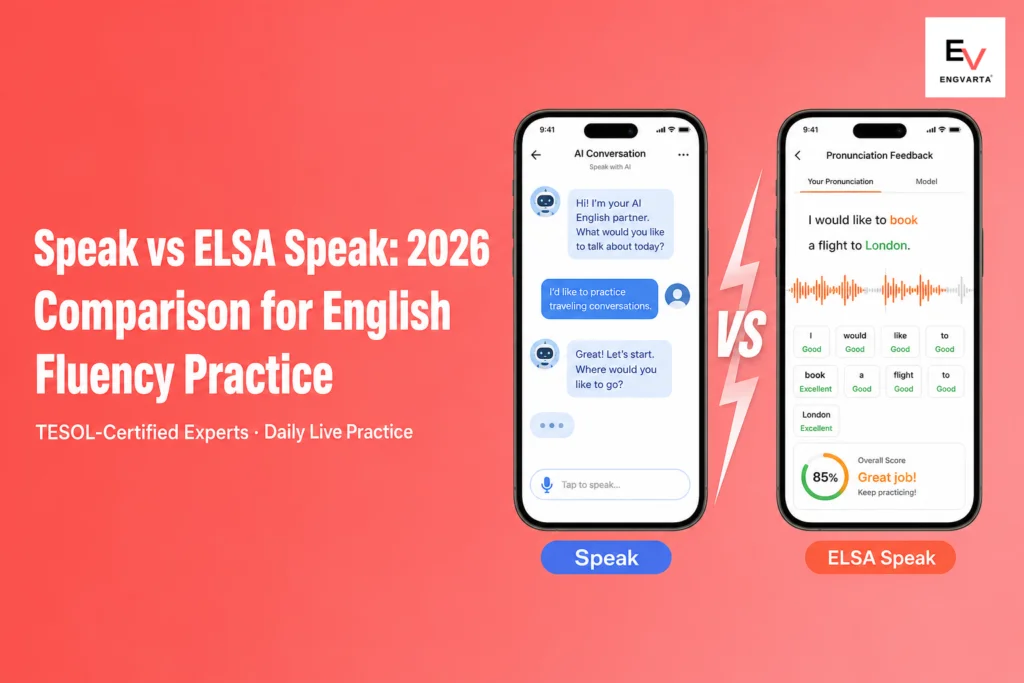
Two phone mockups with VS divider showing AI conversation app vs pronunciation app — Speak vs ELSA Speak comparison 2026
Quick VerdictSpeak and ELSA Speak are not actually competing for the same job. Speak is a conversational-practice app — you have AI roleplay conversations on real-world scenarios. ELSA Speak is a pronunciation-coaching app — you read sentences and get phoneme-level feedback on individual sounds. If you confuse them and pick the wrong one for your actual gap, you waste 3 months. This guide walks through the real difference, who each one is built for, and where neither AI app is enough — at which point human-led 1-on-1 practice (the model used by EngVarta) becomes the missing piece.

If you have searched for “Speak vs ELSA Speak” you are probably halfway through choosing an English-practice app and the two keep coming up in the same lists. They cost roughly the same. They are both AI-driven. They both promise fluency. But once you actually use them for two weeks, it becomes clear they are solving different problems — and choosing the wrong one means three months of practice that does not move the gap you actually had.

This guide compares Speak and ELSA Speak on the dimensions that matter for adult learners: conversation depth, pronunciation accuracy, real-time correction quality, scenarios covered, pricing, and — most importantly — what each app cannot do. We end with a section on when neither AI app is the right tool, and what to use instead.

At-a-glance comparison

Dimension Speak ELSA Speak
Primary purpose AI conversation roleplay Pronunciation coaching
Best for Adults building conversational fluency Learners with accent / pronunciation gaps
Interaction style Open-ended conversation with AI tutor Read scripted sentences, get sound-by-sound feedback
Real-time correction Limited — AI continues conversation, sometimes flags errors Detailed — phoneme-level feedback after each sentence
Conversation density High (5-15 min per session) Low (drill-style, 5-10 min per session)
Pricing (typical) ~$20-30 per month ~$11.99 per month or $74.99 per year
Free trial Limited free tier 7-day free trial
Platforms iOS, Android, web iOS, Android, web
Backed by OpenAI Startup Fund (publicly disclosed) Independent — has raised from VC investors

What Speak does well — and where it falls short

Speak is built around an AI tutor that runs scenario-based conversations. You pick a topic — ordering at a restaurant, a job interview, asking for directions, talking to a colleague — and the AI roleplays the other side. You speak; it responds; the conversation moves forward.

The strengths:

  • Conversation density. Most Speak sessions involve 5-15 minutes of you actually talking, which is far more than a typical group class.
  • Stakes-free practice. You can fumble, restart, repeat a phrase — the AI does not get impatient or judge.
  • Scenario library. Speak has built out a catalogue of professional and social scenarios that map to real life situations adults face.
  • Always available. No scheduling — open the app, tap a scenario, you are practising in 30 seconds.

The weaknesses — particularly for adult professional learners:

  • Correction quality is uneven. The AI tutor sometimes catches errors and sometimes does not. You cannot tell when it is letting a mistake slide because the conversation is moving forward, vs catching it and silently correcting itself in its next turn.
  • No accent feedback. Speak focuses on conversation flow, not pronunciation. Your specific phonetic gaps are not addressed.
  • Conversation predictability. Once you have used Speak for a few weeks, the AI tutor’s response patterns become familiar — and the pressure of unpredictable real conversation drops away. This is the limit of any current AI conversation tool: it cannot match the variability of an actual human partner.
  • No human accountability. The friction of practising every day comes from there being no person waiting for you. AI sessions can be skipped without consequence.

Verdict on Speak : Excellent first-stage tool for someone who has been afraid to speak at all. It builds the habit. But after 6-10 weeks, the gains plateau because the variability of conversation tops out.

What ELSA Speak does well — and where it falls short

ELSA Speak is a different category of tool. Instead of an open-ended conversation, you read prepared sentences and the AI scores your pronunciation sound-by-sound. It tells you which vowel was off, which consonant was muted, which stress fell on the wrong syllable, and how close your version was to a model native pronunciation.

The strengths:

  • Phoneme-level precision. No other consumer app gets this granular about pronunciation. ELSA’s feedback identifies the exact sound that needs work, which is rare even with human tutors.
  • Visual feedback. The colour-coded sound chart shows you what your mouth is doing wrong and where to put your tongue, lips, and air.
  • Targeted accent reduction. If you are aware that your specific accent has a certain weakness — such as Indian English with the /v/-/w/ mix-up, or East Asian English with the /r/-/l/ — ELSA provides
    you targeted drill exercises.
  • Measurable progress. Pronunciation scores compound over weeks; you can see actual numerical improvement.

The weaknesses:

  • Not a conversation app. ELSA does not build conversational stamina. You read sentences; you do not speak in continuous flow.
  • Drill fatigue. Reading scripted sentences for 15 minutes a day is mechanically tiring and easy to skip.
  • Score chasing trap. Some users start gaming the score by speaking in an unnatural slow articulation that earns higher marks but ruins their natural conversational speed.
  • Model-pronunciation rigidity. ELSA judges against an American English standard. If your goal is British or another regional English, the feedback is partially mismatched.

Verdict on ELSA Speak: The best consumer pronunciation tool currently available. But it is a complement, not a complete English fluency solution.

Speak vs ELSA Speak — head-to-head on 8 dimensions

1. Conversation flow

Speak wins decisively. ELSA does not have continuous conversation — it has read-aloud drills.

2. Pronunciation feedback

ELSA wins decisively. Speak gives you a transcript of what you said but does not tell you which sounds were off.

3. Real-time correction during speaking

Speak gives you mid-conversation hints (a transcript bubble that flags errors). ELSA gives you sentence-by-sentence sound-level feedback. Speak is faster but shallower; ELSA is slower but deeper.

4. Scenario relevance for adult professional life

Speak wins — its scenario library includes job interviews, work meetings, networking, and everyday tasks. ELSA’s scripted sentences are general English-language sentences, not contextual scenarios.

5. Habit formation

Both apps are skippable because there is no human partner. Speak feels more rewarding moment-to-moment because conversation produces a sense of social engagement; ELSA feels more rewarding long-term because score progression is visible.

6. Pricing per month

ELSA is cheaper at the typical sticker price (around $11.99 per month vs Speak’s roughly $20-30 per month). However, both apps have promotional pricing and trials that change frequently — verify current pricing in their respective app stores before subscribing.

7. Trial availability

ELSA offers a clear 7-day free trial. Speak’s free tier is more restrictive — you get sample sessions but full access requires subscription.

8. Long-term ceiling

Both apps plateau eventually. Speak plateaus when the AI conversation becomes predictable (typically 8-12 weeks). ELSA plateaus when your pronunciation score stops moving, which usually means you have hit the ceiling of what AI scoring can detect (typically 3-4 months for committed users).

Real-world scenarios — which app for which goal

Goal: I’m afraid to speak at all in English

Start with Speak. The stakes-free conversational practice helps you cross the speaking threshold. After 4-6 weeks, layer in ELSA for pronunciation work or move to a human-led practice tool.

Goal: I speak fine but my accent makes people ask me to repeat

ELSA Speak is the right starting point. Pair it with daily speaking practice (work conversations, podcasts you respond to aloud, or a human-led practice tool) so you actually use the corrections in conversation, not just in drill.

Goal: I have a job interview / presentation / business meeting in 4 weeks

Neither app is sufficient on its own. Speak can rehearse the scenario but cannot give you accent corrections under stress. ELSA can fix specific pronunciation issues but cannot rehearse the meeting flow. For event-specific preparation, consider human-led 1-on-1 practice with a real Expert (covered in the next section).

Goal: I want to become genuinely fluent for everyday life

Use both apps as part of a combined routine, but recognise their ceiling. After 3-4 months, conversation depth and pronunciation precision both demand human practice partners — AI cannot fully substitute.

Pricing comparison — the honest framing

Both apps cost less than $30 per month. That is cheap relative to a human tutor. But the right framing is “cost per measurable fluency gain,” not raw subscription price. If you spend three months on Speak and stay roughly where you started in conversational confidence, the cost was not the $60-90 — it was the three months.

For accent reduction specifically, ELSA’s per-month pricing delivers measurable returns in 4-6 weeks for most users. For conversational stamina, Speak delivers initial returns in 4-6 weeks then plateaus. After that, the calculation changes — and human practice becomes more cost-effective per hour of actual progress.

A third option — when AI is not enough

Both Speak and ELSA Speak hit a ceiling because AI cannot match the unpredictability of a real conversation partner, cannot give you culturally-aware correction, and cannot adjust its style mid-conversation when it senses you are confused. After 8-12 weeks of using either app, most learners need a human in the loop.

EngVarta sits in that gap as a third option. Instead of an AI tutor, EngVarta connects you to a TESOL/ESL-certified English Expert for live 1-on-1 audio sessions. You select 15, 25, or 50 minutes, and connect to an Expert in minutes. The Expert pays attention and offers immediate corrections throughout the call — focusing on pronunciation, grammar, and fluency — and gives summarized feedback at the conclusion of the session Sessions are recorded and accessible for 30 days.

The functional difference: a Speak AI does not get tired, but it also does not detect the moment you stopped tracking the conversation. A human Expert does. A human Expert can adjust the topic when she senses you are bored, slow down when you are lost, push you when you are coasting, and bring back a phrase you used incorrectly six minutes earlier.

Pricing: $1 for a 10-minute trial, 100% refundable. Regular plans start at $45 per month for 25 sessions in USD markets, or ₹2,700 for 25 sessions in India (~₹108 per session). The audio-only design works on slower mobile networks and removes camera-pressure, which matters for self-conscious learners. Operating hours 7 AM to midnight cover most adult schedules.

EngVarta is not in the same category as Speak or ELSA — it is a human-led service. The right comparison is “AI tools vs human practice,” and the answer is usually: use AI for the first 2 months to build the habit, then move to human practice for the depth that AI cannot provide. We’ve written more about this comparison in our analysis of AI English apps vs live tutors and our review of the best English speaking practice apps for 2026.

Ready to Practice with Real Experts?

Try EngVarta today — ₹69 trial (India) / $1 trial (International) · 100% refundable

How to decide — a practical framework

Pick the tool that matches your actual gap, not the one that seems most popular:

  1. If your gap is “I freeze up when speaking” → start with Speak. The stakes-free AI conversations help you cross the threshold. Use for 4-6 weeks.
  2. If your gap is “people ask me to repeat” or “my accent gets in the way” → start with ELSA Speak. Phoneme-level pronunciation correction is its specialty. Use for 6-8 weeks of daily 15-minute drills.
  3. If both Speak and ELSA stop producing visible gains → move to human-led practice. EngVarta or a similar 1-on-1 live-tutor service fills the gap that AI cannot. The 100% refundable trial at $1 is the cheapest way to sample whether the format works for you.
  4. If you have a hard event in 30-45 days → skip the AI step entirely. Hard deadlines need accountability and feedback that only a human Expert can provide.

👉 Connect with EngVarta & Upgrade Your English Every Day!

Speak English fluently and confidently with daily practice tips, real-life conversations, and expert guidance designed to make your English natural and effortless.

📸 Instagram: https://www.instagram.com/engvarta.app/
▶️ YouTube: http://www.youtube.com/@EngVarta
📘 Facebook: https://www.facebook.com/engvarta
💼 LinkedIn: https://www.linkedin.com/company/engvarta

Follow EngVarta today and start speaking English with real confidence—every single day!

The bottom line

Speak and ELSA Speak are not the same product, and treating them as interchangeable is the most common mistake. Speak builds conversational confidence; ELSA Speak builds pronunciation precision. Most adult learners eventually need both, then a human Expert to push past the AI ceiling.

Choose by your actual gap, not by which one shows up first in a search result. And if your timeline is short or your gap has not closed in 6-8 weeks of daily AI practice, a human-led service like EngVarta‘s live 1-on-1 audio sessions with TESOL/ESL-certified Experts is usually the missing piece — with a 100% refundable trial that lets you test the format without financial risk.

Editorial note: this comparison reflects our independent assessment of Speak and ELSA Speak. We have not received payment, sponsorship, or affiliate commission from either platform for inclusion in this article.

What Our Learners Say

Rated 4.5★ from 9,100+ reviews on Google Play

★★★★★
Really we can see the positive results from the app. Well done!
★★★★★
This app is very useful for e English and the Mam is nice by rating is five star
★★★★★
It's a incredible app... It builds my confidence to speak English fluently, gives you practice to start your conversation without any hesitation, provides daily free vocabulary and quizes also...Expensive but amazing & worth it...
★★★★★
It was a great experience praticing with EngVarta. Thank you experts for helping me reach
★★★★★
I enjoyed this course.experts encouraged me to use advanced vocabulary, idioms and phrases daily dose of assignment, quizzes and new vocabulary keep your toes
★★★★★
This app is very useful for e English and the Mam is nice by rating is five star
★★★★★
Really I love this app. It's awesome. The application as well as the speakers are very good. I'm happy to learn daily vocabulary you send in mail.
★★★★★
Excellent application to improve your communication skills.Thnk you for introducing new vocabulary everyday.God bless you You might not aware of but personally this is helping me a lot
★★★★★
I am learning on this platform. it is really really helpful to upgrade myself. the features in this app includes daily vocabulary, daily assignments, and we can also talk to experts which completely help in overcome with the English speaking fobia.
★★★★★
I am happy while speaking with experts and getting feedback on my speaking skills.
★★★★★
I have been practising English on EngVarta for the past 30 days and results are significant. I’m happy to be here.
★★★★★
Really it's very useful app but charges is very high plz decrease some prices of courses

Frequently Asked Questions

Is Speak better than ELSA Speak?

Neither is inherently superior — they address distinct issues.  Speak is a conversational AI tool that builds speaking stamina. ELSA Speak is a pronunciation coaching tool that scores your sounds. If your gap is hesitation and conversational confidence, Speak is better. If your gap is accent and pronunciation clarity, ELSA Speak is better.

Can I use both Speak and ELSA Speak together?

Yes — they are complementary. A common combined routine is 10-15 minutes of Speak conversation followed by 5-10 minutes of ELSA Speak pronunciation drilling on words or sounds you struggled with in the conversation. Total: 20-25 minutes per day. After 6-8 weeks, evaluate whether the combined routine is still producing visible gains; if it has plateaued, add human practice.

Are Speak and ELSA Speak suitable for absolute beginners?

Speak is more accessible for absolute beginners because it allows you to fumble through scenarios at your own pace. ELSA Speak assumes you can already read English sentences aloud, which makes it harder for beginners. Beginners often benefit more from a structured human-led conversation app or course before adding ELSA for pronunciation refinement.

How long does it take to see fluency improvement with Speak or ELSA Speak?

For consistent daily users (15-25 minutes per day): Speak typically produces visible gains in conversational confidence within 4-6 weeks. ELSA Speak typically produces measurable pronunciation score improvements within 4-6 weeks. Both apps plateau after 8-12 weeks of daily use, at which point most learners need to add a human practice element to keep progressing.

What is the cheapest way to start?

ELSA Speak offers a 7-day free trial of full access. Speak has a limited free tier with restricted scenarios. EngVarta‘s 10-minute trial is $1, 100% refundable — the cheapest way to sample human-led practice with a TESOL/ESL-certified Expert before committing to a monthly plan.

Are Speak and ELSA Speak the same as Cambly or italki?

No. Speak and ELSA Speak are AI-based — you practice with software. Cambly, italki, and EngVarta are human-based — you practice with a real person. AI apps are good for habit formation; human-led services are better for fluency depth and accountability. Most learners use both at different stages of their fluency journey.

Best Cambly Alternatives in India (2026): 6 Cheaper & Better Options

April 20, 2026 • 28 min read • By Rishish Pandey

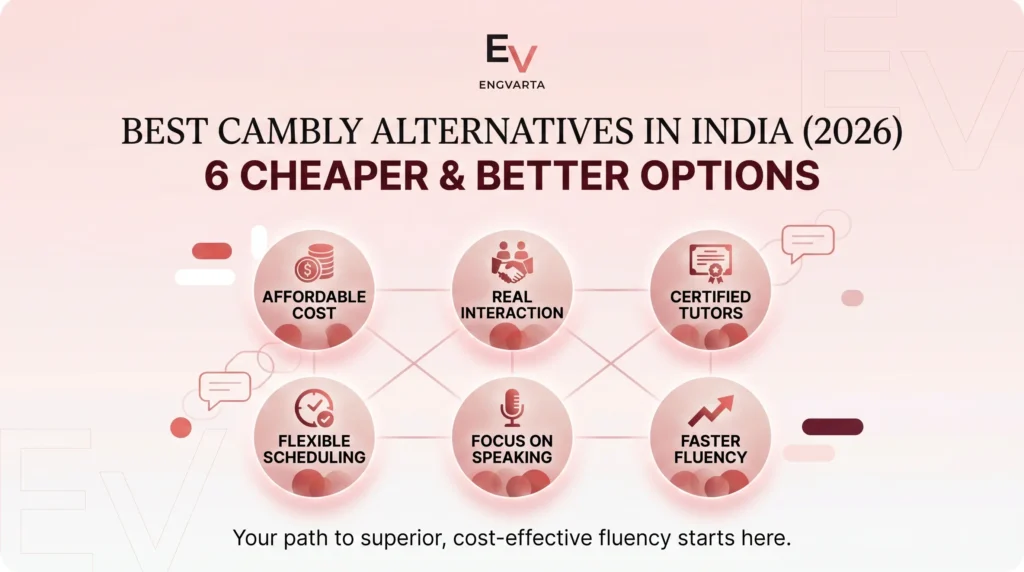
Cover illustration showing the best Cambly alternatives available for Indian learners in 2026

If you are looking for a Cambly alternative in 2026, you are not alone. Cambly works well for some learners, but its monthly cost for meaningful daily practice often lands between $50 and $100+ — more than many serious learners want to spend, especially in markets like India where rupee-priced options exist. This guide ranks the best Cambly alternatives for different use cases, with honest pricing and real trade-offs for each.

Short version: for most Indian learners and budget-conscious international learners, EngVarta is the best Cambly alternative — audio-only 1-on-1 sessions with trained experts at roughly ₹108 per session. For learners who specifically want native English speakers and have the budget, italki gives Cambly-like access at lower per-lesson prices with no subscription lock-in. Details below.

Most “best Cambly alternatives” lists you'll find online are paid placement disguised as recommendations. This one isn't. No affiliate links, no sponsorships — we earn nothing whether you click on EngVarta or any of the alternatives below.

Why Are People Searching for Cambly Alternatives?

Cambly is a legitimate platform with real advantages — a large pool of native English speakers, 24/7 availability, and a simple product. So why do thousands of learners search “Cambly alternatives” every month? Four reasons dominate:

1. Daily practice gets expensive fast

On Cambly’s monthly plan, a single 30-minute lesson costs around $12 (roughly ₹1,000). Two 30-minute sessions per week totals about $85/month — close to ₹7,000. Moving to 5-7 sessions per week (which is what actually builds fluency) pushes costs to $150-$250 per month. For most learners, this is unsustainable after the first few months. Sustainability matters because consistency — not intensity — is what builds speaking fluency.

2. “Native speaker” does not equal “trained teacher”

Cambly tutors are required to be native English speakers but do not need formal teaching qualifications. That means some tutors are excellent, some are amateur, and you often cycle through several before finding someone who actually helps you improve. A trained English expert — even a non-native one — knows how to correct mistakes without crushing your confidence, how to scaffold a beginner up, and how to push an intermediate learner. A native speaker with no training often just chats and misses teachable moments.

3. Video adds anxiety most learners do not need

Cambly defaults to video. For shy learners, beginners, and anyone practising from home around family, the camera is a barrier. Research on speaking anxiety consistently shows that learners say more, attempt harder phrases, and make more mistakes (which is how you learn) when they do not have to worry about appearance. Audio-only platforms remove that friction — see our guide on English speaking apps without video calls for why this matters.

4. Auto-renewing subscription locks you in

Cambly’s annual plan saves money per lesson but locks you in for 12 months. If life gets in the way — a busy work month, a family event, exam season — unused minutes often carry a time cap and expire. Pay-per-session or short-commitment alternatives avoid this trap.

What to Look For in a Cambly Alternative

Before we rank alternatives, here is a quick framework. A good Cambly replacement should have:

  • Live 1-on-1 human practice — AI apps cannot replicate real conversational pressure
  • Affordable per-session cost — ideally under $5 per session for daily practice
  • Trained teachers, not just natives — look for platforms that vet for teaching ability
  • Low-risk trial — a refundable or free first session so you can evaluate fit
  • No long-term lock-in — unless you are already in a confirmed daily habit
  • Real-time correction + written feedback — conversation without correction is just chat
  • Recording access — being able to listen back is one of the fastest ways to improve

The 6 Best Cambly Alternatives in 2026 (Ranked)

1. EngVarta — Best overall for Indian & budget-conscious learners

Price : ₹69 / $1 trial (10 min, refundable). ₹2,700 / $45 for 25 sessions (~₹108 / $1.80 per session).

Format : Audio-only, 1-on-1, live sessions with trained English experts. 10, 15, 25, or 50-minute options. Available 7 AM to midnight IST.

Why it beats Cambly for most learners : EngVarta is roughly 6x cheaper per session than Cambly’s monthly plan. That matters because fluency is built through daily practice, and daily practice needs to be affordable. Experts are trained specifically to work with learners who understand English but cannot speak it confidently — a huge segment in India. Sessions are audio-only, which removes video anxiety. Every session includes real-time correction, written feedback, and a 30-day recording.

Where Cambly is better : If you specifically want to practise with a British, American, or Australian native speaker for accent reduction, EngVarta will not give you that — most experts are Indian. For accent-focused learners (preparing for roles where accent matters, like voiceover or call centre work), Cambly is still a valid choice.

Best for : Working professionals, students, homemakers, immigrants, and anyone who already understands English but cannot speak it confidently. Also ideal if you are afraid of speaking English and want a low-pressure audio-only format. See our detailed EngVarta vs Cambly comparison for a side-by-side breakdown.

What Our Learners Say

Rated 4.5★ from 9,100+ reviews on Google Play

★★★★★
Excellent experience even in just the first conversation. I'm looking forward to learning English with this app.
★★★★★
I have been using this app since three months. I am very much satisfied with their services , experts are too good and their support team members are very supportive and helpful. I must suggest this app to everyone. Thank you Engvarta for helping me.❤️
★★★★★
The supporting people along with the experts are very supportive. The only suggestion to the officials is that the names of the experts should be reflected on the screens so to know to whom I am talking with. Thank you Engvarta, continue supporting people like me. Thank You.
★★★★★
excellent app for learning fluency and If you genuinely correct your mistakes then you should opt for this
★★★★★
Really helpful to me. Many people want to talk but can't because of people who just laugh at their efforts. This app really helps. I love this initiative.
★★★★★
good and highly talented experts are here..just go for a trail without any doubt.. thank you eng vartha…A small request from my side just take less payment from the people who are joing in your coaching…help to them…thank you
★★★★★
This app is amazing! It has boosted my confidence, and now I can start conversations in English easily.
★★★★★
best app for English communication. I have tried lots of English speaking apps till date. but all have some dra backs. but this is really awesome experience of mine. best teachers and best app. 💯
★★★★★
A very good app its just as good as shown in the advertisement,but I wish it would have been a bit cheaper,
★★★★★
It's very beneficial app for children who don't speak well.
★★★★★
It's a beautiful app for beginners. All experts are so good. They talk with you frankly like your friends, so you don't feel bored and you get interest to learn English.
★★★★★
In the beginning I felt very nervous to talk but when I picked the call the expert spoke in such a gentle way. I really liked it.

Ready to Practice with Real Experts?

Try EngVarta today — ₹69 trial (India) / $1 trial (International) · 100% refundable

2. italki — Best for flexibility and native speaker choice

Price : Community tutors from $4-$20 per lesson, professional teachers $10-$40. Pay-per-lesson with credits that do not expire. Most tutors offer discounted trial lessons.

Format : Video calls (with option to use audio-only if both parties agree). Scheduled in advance. You pick the tutor from a marketplace.

Why it beats Cambly for many learners : No subscription lock-in. You buy credits and use them whenever. Tutor variety is massive — you can find native speakers from every English-speaking country at lower prices than Cambly, and you can see reviews before booking. If you do not like a tutor, you just book someone else.

Where it falls short : Scheduling every lesson manually is a friction point. You have to book in advance, wait for confirmation, and work around tutor availability. For daily practice, that friction compounds. Also, community tutors are often not trained teachers.

Best for : Learners who want to choose specific tutors, have flexible schedules, and want to try different teaching styles. Good for intermediate-to-advanced learners. See our EngVarta vs italki comparison.

3. Preply — Best for structured lessons with one long-term tutor

Price : Tutors set their own rates; typically $10-$40 per hour. Subscription-based (weekly hour package), with a trial lesson available.

Format : Scheduled video lessons with a tutor you pick and stick with long-term. Includes homework, lesson materials, and progress tracking.

Why it beats Cambly : Better structure. You build a relationship with one tutor who knows your weaknesses and progression. Great for IELTS/TOEFL prep where continuity matters. Pricing often ends up similar to Cambly but the tutor quality can be higher since you can filter by experience.

Where it falls short : Subscription format. Scheduling required. Not ideal for “I want to practise today because I have a meeting tomorrow” situations. Price per hour adds up quickly for daily practice. See our EngVarta vs Preply comparison.

Best for : Learners who want a structured long-term tutor relationship and value continuity over flexibility.

4. AmazingTalker — Best for Asian market learners

Price : Variable by tutor; typically $10-$30 per lesson. Pay-per-lesson model.

Format : Scheduled video lessons with tutors chosen from a marketplace. Similar model to italki but with stronger presence in Taiwan, Japan, Korea, and Hong Kong.

Best for : Learners in East Asia who prefer region-specific platforms and want tutors familiar with their native language.

5. ChatGPT Voice / AI Voice Apps — Best free budget complement

Price : Free tier available. ChatGPT Plus ($20/month) for extended voice mode.

Format : Conversational AI. You speak, it responds, you continue. Available any time, any topic.

Where it beats Cambly : Zero cost (free tier) or $20/month — cheaper than any human option. Available 24/7. Judgement-free — you can try and fail without a human witnessing it. Useful for vocabulary drills, grammar review, and low-stakes conversational practice.

Where it falls short : AI does not replicate real conversational pressure. It does not notice when you are about to give up. It does not push you out of your comfort zone. It does not correct you naturally — you have to ask. For actual fluency building (as opposed to vocabulary/grammar practice), AI falls short. We covered this in detail in why AI English speaking apps are not enough.

Best for : Use AI as a complement, not a replacement. Drill vocabulary with ChatGPT. Practice real speaking with humans on EngVarta or italki.

6. Language Exchange Apps (Tandem, HelloTalk) — Free but inconsistent

Price : Free, with paid tiers for advanced features.

Format : You match with native English speakers who want to learn your language. You help each other.

Where it wins : Free. Casual. Can be fun.

Where it falls short : Your partner is not a teacher and usually will not correct you. Conversation quality is wildly inconsistent. Matches ghost, reschedule, or lose interest. Fine for exposure, not for structured fluency building.

Best for : Advanced learners who just want casual practice and do not need correction.

Comparison Table: Cambly vs Top Alternatives

Platform Per session Format Trained teachers Best for
EngVarta ₹108 / $1.80 Audio-only, on-demand Yes (certified) Daily practice, India, budget, no-video preference
Cambly $5.54–$12 Video (camera optional), on-demand No requirement Native speaker exposure, accent practice
italki $4–$40 Video, scheduled Yes for professional; no for community Flexibility, tutor variety
Preply $10–$40/hr Video, scheduled Mixed Structured long-term tutor, test prep
AmazingTalker $10–$30 Video, scheduled Mixed East Asian learners
ChatGPT Voice Free / $20/mo AI voice, any time N/A (AI) Budget, vocabulary drill
Tandem / HelloTalk Free Peer exchange, scheduled No Casual advanced practice

For broader context on the best English speaking apps overall, see our guide on best English speaking apps in India.

How to Choose the Right Cambly Alternative

The best alternative depends on what actually pushed you to search for one. Match your reason to the recommendation:

  • “Cambly is too expensive for daily practice” → Go with EngVarta. Daily practice at ~₹108/session is sustainable for most budgets. Compare plans on the plans & pricing page.
  • “My tutor quality was inconsistent” → Go with Preply or EngVarta. Both have trained/vetted experts.
  • “I do not like the video format” → Go with EngVarta. Audio-only by design.
  • “I want to pick my own tutor and not be locked in” → Go with italki. Pay-per-lesson, credits do not expire.
  • “I am an Indian working professional preparing for interviews or workplace English” → EngVarta is the strongest fit — experts understand MTI and professional contexts.
  • “I need to build a daily habit” → EngVarta’s on-demand model removes scheduling friction. Our 30-day English speaking plan and daily practice guide show how to structure it.
  • “I want to pair human practice with AI drills for cheap” → EngVarta for human practice + ChatGPT Voice for vocabulary/grammar drills is an efficient combo.

The Honest Take on Cambly in 2026

Cambly is not a bad product. For learners who specifically want native English speakers, have the budget, and like video calls, it works. But for the more common case — Indian professional, budget-conscious international learner, shy beginner, someone who needs daily practice — Cambly is over-priced for the outcome. The market has evolved since Cambly launched, and platforms like EngVarta, italki, and Preply each solve specific parts of the problem better.

If you are already on Cambly’s annual plan, see it through. If you are evaluating your options now, we recommend testing EngVarta first — the ₹69 / $1 trial is the lowest-risk way to find out whether affordable, audio-only, trained-expert practice works for you. Most learners who try it do not go back to searching for alternatives.

For a deeper independent review of Cambly’s pricing, tutor quality, and IELTS preparation specifically, see My Engineering Buddy’s Cambly review — useful complementary reading if you want a more focused breakdown of Cambly itself before deciding.

👉 Connect with EngVarta & Boost Your English Daily!

Stay inspired and improve your English speaking skills with daily tips, real conversations, and expert guidance.

📸 Instagram : https://www.instagram.com/engvarta.app/

▶️ YouTube : http://www.youtube.com/@EngVarta

📘 Facebook : https://www.facebook.com/engvarta

💼 LinkedIn : https://www.linkedin.com/company/engvarta

✨ Follow EngVarta now and start speaking English confidently every day!

Conclusion : 

If you want a single recommendation: start with EngVarta’s ₹69 / $1 trial. It is the lowest-risk way to test affordable daily human practice. If that format fits, you have replaced Cambly at a fraction of the cost. If it does not fit (you specifically need video or native speakers), try italki’s trial lesson next — pay-per-session, no lock-in.

Cambly works for a specific type of learner. If you are searching for alternatives, you are probably not that learner. The good news: 2026 has better options for your actual situation.

Start your EngVarta trial →

Common Questions About Cambly Alternatives

Why are so many learners looking for Cambly alternatives in 2026?

Three reasons dominate: Cambly’s per-session price is high for daily practice (roughly $12 per lesson on monthly plans, or $5.54 even on the 12-month annual plan as of April 2026), tutor quality is inconsistent because Cambly tutors are native speakers but not always trained teachers, and video-based sessions create camera anxiety for many learners who would prefer audio-only practice. Indian learners in particular find Cambly’s USD pricing expensive relative to rupee-priced alternatives.

What is the cheapest Cambly alternative for daily practice?

EngVarta is the most affordable option for live human practice in India at roughly ₹108 per session (₹2,700 for 25 sessions) compared to Cambly’s $5.54 to $12 per 30-minute lesson. For international learners, EngVarta’s $45 for 25 sessions (~$1.80/session) is also significantly cheaper than Cambly. italki community tutors can also be inexpensive (starting around $4-$8/lesson) but require scheduling and tutor selection for each session.

Which Cambly alternative is best for Indian learners?

EngVarta is built for Indian learners specifically. Experts understand Mother Tongue Influence (MTI), pricing is in rupees and affordable enough for daily practice, sessions are audio-only so there is no video anxiety, and experts can switch between English and Hindi when a learner gets stuck. Preply and italki have Indian tutors as well but require you to schedule lessons and choose tutors each time.

Is Cambly cheaper on the annual plan worth it?

Cambly’s annual plan drops the per-lesson price to around $5.54 (50% off the monthly rate), but you are locked in for 12 months. If you are sure you will use it daily, the savings are real. However, most learners do not stick to daily practice for 12 months straight, so the effective per-session cost ends up higher because unused minutes often expire. Pay-as-you-go or shorter commitments (like EngVarta’s 25-session plans or italki’s credit system) usually work out better unless you are already in a strong daily habit.

Can I get Cambly-style native speaker practice without the Cambly price?

Yes, but with trade-offs. italki has native speakers from the US, UK, Australia, and elsewhere starting at around $8-$15/lesson — cheaper than Cambly but you schedule each lesson manually. For most Indian learners whose goal is confidence and clarity (not accent reduction), a trained non-native expert on EngVarta at ₹108/session delivers better learning per rupee than a random native speaker. Accent matters much less than fluency for professional communication.

Is EngVarta really a Cambly alternative if it does not have video?

Yes. Cambly’s video component is optional — you can turn off the camera if you want. What matters is live 1-on-1 conversation with a real human, real-time corrections, and structured feedback — which both platforms provide. EngVarta simply removes video by design because research and learner feedback show most people are more willing to speak freely on audio-only calls. If you specifically need video practice (for visa interviews, Zoom meeting simulation, etc.), Cambly or italki is still the right choice.

What is the trial like on EngVarta vs Cambly?

Cambly offers a free trial minute or two with a tutor; EngVarta offers a ₹69 (India) or $1 (international) full 10-minute trial session that is 100% refundable. EngVarta’s trial gives you a more realistic experience because it is a full session with a real expert — not a sampler.

What if I want to try multiple alternatives before deciding?

Start with the cheapest, lowest-commitment trial. EngVarta’s ₹69/$1 refundable trial is the lowest-risk way to experience 1-on-1 human speaking practice. If that format works, you have your answer. If you specifically need video or a native speaker accent, try italki’s trial lesson next. Avoid committing to Cambly’s annual plan until you have tested at least one alternative.

Related reading :