EngVarta App |

Tag

EngVarta app

Best Apps for English Fluency 2026: 6 Picks Compared (Live Practice + AI)

April 17, 2025 • 13 min read • By Swati Raj

Best Fluent English Practice App to Boost Your Speaking Skills
Quick Verdict (2026)If real fluency — not gamified streaks — is the goal, the apps that actually work are the ones that force you to speak daily with feedback. Our pick: EngVarta for live human practice with TESOL/ESL-certified Experts (real-time corrections, consolidated feedback towards the end of every call). Pair it with ELSA Speak for pronunciation drills and Duolingo for vocabulary habit-building. AI-only chat apps are improving fast, but in 2026 nothing replicates the speed of fluency gain you get from a real human listening to you.

You’ve studied grammar. Watched English shows. Maybe even repeated dialogues out loud. But when it’s your turn to actually speak — in a meeting, an interview, or with a stranger — you pause, doubt yourself, and switch back to Hindi or your native tongue.

The missing piece isn’t more study. It’s spoken-output reps — daily speaking practice with someone (or something) that catches your mistakes in real time and shows you how a fluent speaker would have phrased it.

This 2026 guide ranks the best English fluency apps by what actually moves the needle on speaking confidence: live human practice, AI conversation, pronunciation feedback, and listening immersion. We’ve tested each one and ordered them by how fast they get an intermediate learner from hesitant to fluent.

2026 Comparison Table: Best Apps for English Fluency

App Practice Type Best For Starting Price Speed of Fluency Gain
EngVarta Live 1-on-1 audio with TESOL/ESL Expert Daily fluency practice (Indian + global learners) ~₹108/session (₹2,700 / 25) Fastest (3–6 weeks visible)
ELSA Speak AI pronunciation drills Accent reduction, MTI fix ~$11.99/month Medium (8–12 weeks)
Cambly Native-speaker video tutoring Higher-budget premium learners ~$10/15-min lesson Fast (cost-limited frequency)
HelloTalk / Tandem Language-exchange chat with strangers Casual practice, free option Free / ~$7–14 month Slow (no expert correction)
AI conversation apps (Loora, Talkpal, Praktika) AI chatbot “tutor” Privacy-first or unlimited reps ~$12–25/month Medium (improving fast in 2026)
Duolingo Gamified vocabulary & grammar Beginners, daily-streak habit Free / Super ~$7/month Slow (low speaking volume)

1. EngVarta — Best Overall for Spoken Fluency

EngVarta is the fastest path to spoken fluency for one simple reason: every session is a live audio call with a TESOL or ESL-certified English Expert who corrects you in real time. There’s no “watch a video, then take a quiz” loop — you talk, the Expert listens, fixes your grammar, pronunciation, and word choice on the spot, and shares consolidated feedback towards the end of the session.

You pick the session length (15, 25, or 50 minutes), book a slot anywhere between 7 AM and midnight, and connect to an Expert in minutes. Audio-only by design — which works on slow mobile data and removes the camera-pressure that holds back self-conscious learners.

Why it ranks #1 for fluency:

  • Real-time corrections during the call — pronunciation, grammar, fluency — not after-the-fact written reports
  • Consolidated feedback towards the end of every session highlighting your top 2–3 improvement areas
  • Sessions recorded and accessible for 30 days for self-review
  • Personalised practice tasks + a vocabulary builder between calls
  • Daily-practice priced (~₹108 / ~$1.80 per session) — sustainable for daily reps, which is what fluency actually requires
  • Milestone certificates as you complete practice-hour thresholds — useful for HR records, departmental training files, and upskilling submissions

Who it’s for: Working professionals, college students preparing for placements, government employees needing English for postings, and homemakers who want to rebuild fluency on their own schedule. Already trusted by lakhs of learners across India and expanding markets in the US, UAE, Canada, and Singapore.

Pricing: ₹69 for a 100% refundable 10-minute trial; plans start at ₹2,700 for 25 sessions (~₹108 each). Plans of 25/50/100/150/300 sessions, with a pause feature for travel or work crunches.

Limitation: Audio-only by design. If you specifically want video tutoring with native speakers, look at Cambly. If you want unlimited free chat with strangers, HelloTalk — though neither will move you to fluency as fast.

Detailed comparison: EngVarta vs Cambly vs Preply vs italki →

Ready to Practice with Real Experts?

Try EngVarta today — ₹69 trial (India) / $1 trial (International) · 100% refundable

2. ELSA Speak — Best for Pronunciation & Accent

ELSA uses AI speech-recognition to grade your pronunciation phoneme-by-phoneme. You read a sentence, ELSA flags exactly which sounds were off, and shows you the mouth position for the correct sound. For Indian learners working on mother-tongue influence (MTI), it’s the most precise pronunciation tool available.

Best for: Pronunciation, accent neutralisation, IELTS/TOEFL speaking-section drilling. Not for: Conversational fluency or unstructured speaking practice — you’re reading scripted prompts, not having real conversations.

Pricing: ~$11.99/month, lifetime plans available.

More pronunciation app options →

3. Cambly — Best for Premium Native-Speaker Practice

Cambly connects you to native-speaker tutors over video for unstructured chat or curriculum-based lessons. Quality is high, sessions feel real, and you can pick the tutor you click with. The catch: pricing. At roughly $10 per 15-minute lesson, daily practice gets expensive fast — most learners end up doing 2–3 sessions per week, which is below the frequency needed for rapid fluency gains.

Best for: Learners with a budget who want native-speaker exposure and don’t mind a lower session count. Not for: Daily-practice budgets or learners who prefer audio-only.

Pricing: ~$10/15-min lesson; group plans cheaper but less personalised.

4. AI Conversation Apps (Loora, Talkpal, Praktika)

2026 has been the breakout year for AI-driven English tutors. Loora, Talkpal, and Praktika let you have unscripted voice conversations with an AI that adapts to your level, suggests better phrasings, and tracks your fluency progress. The voice quality and natural pacing have improved dramatically — for the first time, an AI conversation feels close to a real one.

Best for: Privacy-conscious learners who don’t want a human listening, learners doing 30+ minutes of practice daily who’d burn out a paid tutor budget, and anyone in markets where live tutoring is hard to find.

Limitation in 2026: AI still mishears non-native accents at higher rates than a trained human Expert, and the “corrections” can be over-polite (it lets small errors slide to keep the conversation flowing). For learners specifically targeting fluency — not just exposure — live human feedback is still measurably faster. That’s why we rank EngVarta above this category.

Pricing: ~$12–25/month depending on app and tier.

5. HelloTalk & Tandem — Best Free Option

Language-exchange apps pair you with native English speakers who want to learn your language. Genuinely free for basic use. The trade-off: there’s no expert correcting you, conversation quality varies wildly partner-to-partner, and many partners drift toward small talk that doesn’t stretch your vocabulary.

Best for: Zero-budget learners who already have intermediate-level fluency and want exposure. Not for: Beginners or anyone targeting structured fluency growth on a timeline.

Why free apps don’t replace structured practice →

6. Duolingo — Best for Daily Habit + Vocabulary

Duolingo is excellent at one thing: getting you to open the app every day. The streak mechanics are addictive, the lessons are bite-sized, and you’ll genuinely build vocabulary and grammar awareness. What it won’t do is make you fluent — the speaking exercises are scripted single-sentence drills, not real conversation.

Best for: Beginners building habit + vocabulary. Pair with: A speaking-focused app (EngVarta, Cambly, or an AI conversation app) once you’re past the first 50 hours of Duolingo.

Pricing: Free; Super Duolingo ~$7/month.

The 2026 Fluency Stack: How to Combine These Apps

Single-app strategies don’t deliver fluency. The learners who actually become fluent in 6–12 months use a stack:

  • 15–30 min daily speaking practice — EngVarta (live human) or an AI conversation app
  • 10 min pronunciation drilling — ELSA Speak, 3–4 days a week
  • 10 min vocabulary & grammar habit — Duolingo or Memrise, daily
  • 20 min listening immersion — English podcasts, YouTube, or shows with subtitles

The non-negotiable element is the speaking practice. Without daily spoken-output reps with feedback, the other three stack components plateau within 6–8 weeks.

Why Most People Fail at Fluency Apps

Three patterns, in order of frequency:

  1. App stacking without speaking practice. Three vocabulary apps and zero conversation apps. You’ll know more words but still freeze in real conversations.
  2. Inconsistent practice. 90 minutes on Sunday, nothing Monday–Saturday. Fluency is built on frequency, not duration. 15 minutes daily beats 2 hours weekly.
  3. Avoiding correction. Sticking with apps that don’t challenge you because the dopamine hit of a correct answer feels good. Fluency growth requires being corrected — that’s where the learning happens.

The combination that fixes all three: a paid live-practice app you actually use daily (not the free apps that get abandoned by week 3) + a habit anchor like a morning walk or after-dinner routine to make practice non-negotiable. More on building a fluency-coaching routine →

What Our Learners Say

Rated 4.5★ from 9,100+ reviews on Google Play

★★★★★
Quite impressive app for learning English . I am happy that joined this planform.You can learn and grow here.
★★★★★
Great app for learning English speaking. All the experts are supportive and non-judgemental. After every session, constructive feedback is provided to enhance yoilur skills. Also it has AI enabled feature for assignment practice. Overall a great platform to practise English speaking with experts.
★★★★★
Thanks EngVarta I appreciate your platform sir for those who willing to learn speaking English fluently
★★★★★
It was a great experience. I felt so much better. This is a very positive experience for me.
★★★★★
My last 12 sessions experience is really great. It's a great app to improve English fluency and communication skills. All experts are quite friendly and highly skilled.
★★★★★
I took two months of subscription. This platform really helped me to improve my communication and get rid of the fear I had earlier. Now I can talk fully confident and without any fear.
★★★★★
I have been practising English on EngVarta for the past 30 days and results are significant. I’m happy to be here.
★★★★★
Wonderful! They provide you a best platform to talk. A very unique idea I think. English is learned more by speaking than by being taught. So this is the best platform I think. And also you get a chance to interact with intellectual experts so that you can explore yourself.
★★★★★
i completed my trial session, expert was good. I installed this app because chatgpt recommended it and I find it quite good speaking practice. experts are professional and friendly. plans are also economical compared to other english courses i took in the past.
★★★★★
good and highly talented experts are here..just go for a trail without any doubt.. thank you eng vartha...A small request from my side just take less payment from the people who are joing in your coaching...help to them...thank you
★★★★★
This is a too good English learning app. There have so many options to learning English their have a English vocabulary you can improve your English vocabulary to in this app and there have a charges for if you want to talk with English speaker
★★★★★
Really I love this app. It's awesome. The application as well as the speakers are very good. I'm happy to learn daily vocabulary you send in mail.

Frequently Asked Questions

Which app is best for English fluency in 2026?

For most intermediate learners, EngVarta delivers the fastest fluency gains because every session involves real-time correction by a TESOL/ESL-certified English Expert over a live audio call. Pair it with ELSA Speak for pronunciation and Duolingo for vocabulary habit, and you have a complete 2026 fluency stack.

Can I become fluent in English using only an app?

Yes, if the app forces daily spoken-output practice with feedback. Apps that just teach grammar, vocabulary, or scripted lessons won’t deliver fluency on their own. The fastest fluency gains come from apps that put a real human (or, increasingly, a high-quality AI) on the other end of a live conversation.

How long does it take to become fluent in English with these apps?

With consistent daily practice (15–30 minutes of speaking + 10–20 minutes of supporting work), most intermediate learners report visible fluency improvement in 6–8 weeks and conversational fluency in 6–9 months. Beginners typically need 12–18 months to reach the same level.

Are AI English speaking apps as good as human tutors in 2026?

AI conversation apps have improved dramatically in 2026 and now deliver useful practice at low cost. They’re excellent for unlimited reps and privacy. But for the fastest fluency gains, live human Experts still outperform AI on accent recognition, nuanced corrections, and conversational depth — especially for non-native accents like Indian English.

What’s the cheapest app for daily English speaking practice?

HelloTalk and Tandem are free if you’re comfortable practising with random language-exchange partners (with no expert correction). For paid daily practice with a real Expert, EngVarta is the lowest cost-per-session option in India at ~₹108 per call when you buy a 25-session plan.

Do these apps work for IELTS or job-interview English?

Yes — speaking-focused apps like EngVarta and ELSA Speak directly target the speaking skills needed for IELTS, TOEFL, and job interviews. Most learners using them for exam or interview prep do 4–6 weeks of focused daily practice in the run-up to the test or interview.

Can I get a certificate from these English speaking apps?

EngVarta issues milestone certificates as learners complete practice-hour thresholds and reach speaking-progress milestones — useful for HR records, departmental training files, and upskilling submissions. Other apps in this list (Duolingo, ELSA, Cambly) offer course-completion or proficiency-level certificates of varying recognition. Always check whether a specific employer or institution accepts the certificate before relying on it.

Is EngVarta available outside India?

Yes — EngVarta serves learners in India, the US, UAE, Canada, Singapore, and other markets. Pricing in USD markets works out to roughly $1.80 per session with similar plan structures.


Editorial independence: This is an independent editorial roundup. EngVarta is the publisher and chooses its own pick, but no app on this list paid for inclusion or placement. We rank apps based on hands-on testing and learner outcomes, not affiliate commissions.
Use EngVarta & Learn How to Use Would, Could, and Should in English

April 1, 2025 • 7 min read • By Swati Raj

Use EngVarta & Learn How to Use Would, Could, and Should in English

Ever feel confused about when to use would, could, and should in English? You’re not alone! These little words can be tricky, but once you understand how they work, you’ll sound more fluent and confident. Let’s break them down together with simple rules and everyday examples.

What Are Modal Verbs?

Modal verbs are special helper verbs that add meaning to the main verb. They show things like possibility, ability, or advice. The stars of today’s lesson—would, could, and should—are three of the most popular ones!

When to Use Would

Use would to talk about:

  • Polite requests: Would you help me, please?
  • Imaginary or unreal situations: I would go to Paris if I had the money.
  • Future in the past: He said he would call me.
  • Wishes and desires: I would love a slice of cake.

👉 Quick Tip: Think of would as a softer, more polite version of will.

When to Use Could

Use could for:

  • Past ability: She could read when she was three!
  • Polite requests: Could you please pass the salt?
  • Possibility: It could snow tomorrow.
  • Suggestions: You could try restarting your phone.

👉 Quick Tip: Could is like a more polite or uncertain form of can.

When to Use Should

Use should when giving advice, opinions, or talking about what’s right:

  • Advice: You should drink more water.
  • Expectation: She should be here by now.
  • Moral obligation: People should be kind.
  • Suggestions: Should we go out for lunch?

👉 Quick Tip: Should is a gentle way of saying something is the right thing to do.

Final Thoughts

Learning how to use would, could, and should doesn’t have to be hard. Keep practicing with real sentences, and you’ll start using them naturally. They may be small words, but they make a big difference in your English!

Learn and Practice More with EngVarta

Want to improve your spoken English with live practice? Try the EngVarta, where you can talk to live English experts any time!

Modals also pair with the passive voice—this could be done, the report should be reviewed, that would be appreciated—if you want the full pattern, read our guide on active and passive voice in English grammar.

Frequently Asked Questions about Would, Could, and Should

What is the difference between would, could, and should?
“Would” expresses hypothetical situations, polite requests, or past habits. “Could” expresses past ability or polite possibility. “Should” expresses advice, obligation, or expectation. Quick test: WOULD = imagined/conditional (“I would help if I could”). COULD = ability/possibility (“She could speak three languages”). SHOULD = recommendation (“You should rest”). Each carries a different shade of meaning that English learners often mix up.
When should I use ‘would’?
Use “would” for: (1) Hypothetical/conditional situations: “I would travel more if I had time.” (2) Polite requests: “Would you pass the salt?” (3) Past habits: “When I was young, I would walk to school every day.” (4) Reported speech of “will”: “She said she would call.” (5) Wishes: “I wish I would win the lottery.” Common Indian English error: using “would” for present-tense politeness when “could” or “can” would be more accurate.
When should I use ‘could’?
Use “could” for: (1) Past ability: “I could swim when I was 5.” (2) Polite requests: “Could you help me?” (3) Possibility (less certain than “may”): “It could rain later.” (4) Suggestions: “We could try a different approach.” (5) Past possibility: “He could have been there.” “Could” is generally less formal than “would” for politeness — “Could you” feels softer than “Would you.”
When should I use ‘should’?
Use “should” for: (1) Advice/recommendation: “You should see a doctor.” (2) Expectation: “The package should arrive tomorrow.” (3) Obligation (mild): “We should respect the rules.” (4) Past regret: “I should have studied harder.” (5) Probability: “She should be home by now.” “Should” is the most directive of the three — it implies a recommended course of action, not just a possibility.
What are some examples of would vs could vs should?
Same situation, three meanings: “I WOULD call her if I had her number” (conditional — depends on having her number). “I COULD call her if you want me to” (ability/willingness — I have the option). “I SHOULD call her — it’s been a week” (advice/obligation — I ought to). Or: “WOULD you like coffee?” (polite offer). “COULD I have coffee?” (polite request). “SHOULD I have coffee?” (asking for advice).
What’s the difference between ‘would’ and ‘will’?
“Will” expresses certainty about the future (“I will call you tomorrow”). “Would” expresses hypothetical or conditional (“I would call you if I had time”). Will = definitely. Would = if certain conditions are met. Common error: using “will” when “would” is correct in conditionals — “If I had money, I will buy a house” should be “If I had money, I would buy a house.”
What’s the difference between ‘could’ and ‘can’?
“Can” expresses present ability or permission (“I can speak English”). “Could” expresses past ability OR polite present (“I could speak English at age 8” / “Could I speak English with you for practice?”). When asking for permission politely, “could” is softer than “can” — “Could I leave early today?” sounds more polite than “Can I leave early today?” though both are correct.
How can I practice would, could, and should correctly?
Effective practice: (1) Use each modal verb in 3 sentences daily — one for each purpose (conditional, ability/permission, advice). (2) Listen to English shows and note when speakers use which modal. (3) Practice in real conversation where someone can flag misuse. (4) Read English news articles and circle every “would/could/should” — note why each was chosen. EngVarta‘s TESOL/ESL-certified Experts can prompt you to use specific modals in conversation and explain why one fits better than another. The $1 refundable trial lets you try this on a topic where you typically struggle.

Have Fun with Words: Discovering the Magic of Anagrams

December 23, 2024 • 11 min read • By Swati Raj

Have Fun with Words: Discovering the Magic of Anagrams

Language is a playground where words take center stage, and one of the most delightful games you can play is with anagrams. An anagram is a rearrangement of the letters of a word or phrase to create a new word or phrase. It’s not just a fun pastime—it’s also a brilliant way to sharpen your English skills.

Let’s dive into the fascinating world of anagrams, uncover their charm, and see how they can become a powerful tool in your English learning journey.

What is an Anagram?

An anagram is when you take a word like listen and rearrange its letters to form another word, like silent. The two words use the exact same letters but tell different stories. Simple, right? Yet, this simple concept has intrigued word lovers for centuries.

Why Should You Play with Anagrams?

Here’s why exploring anagrams can benefit your English fluency:

  1. Boost Vocabulary: Discovering new words while forming anagrams expands your vocabulary. For example, from save you can learn vase.
  2. Enhance Creativity: Crafting anagrams encourages creative thinking as you explore different combinations of letters.
  3. Improve Spelling: Rearranging letters reinforces your spelling skills as you become familiar with word patterns.
  4. Make Learning Fun: Anagrams add a playful twist to learning English, making it enjoyable and less stressful.

Examples of Anagrams

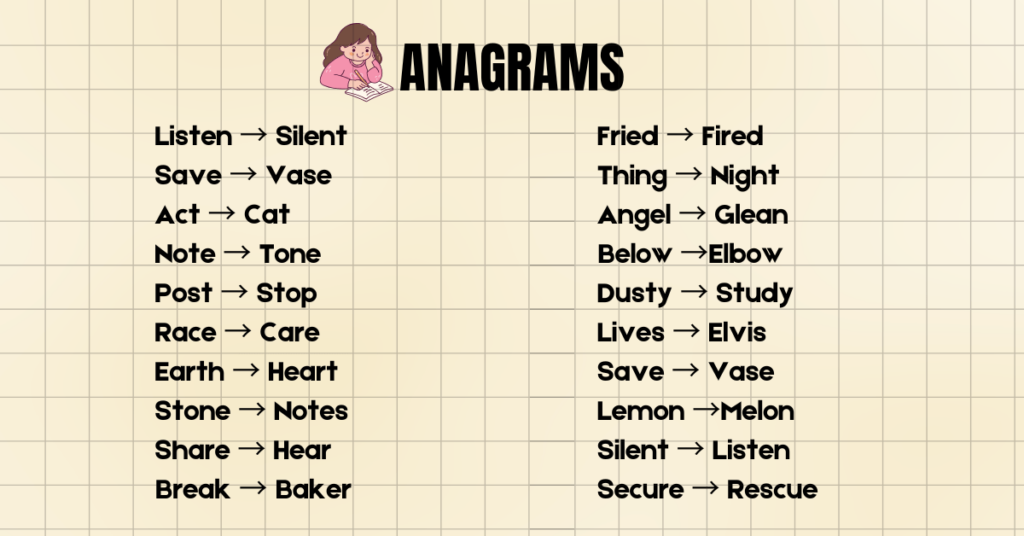
  • ListenSilent
  • SaveVase
  • ActCat
  • NoteTone
  • PostStop
  • RaceCare
  • EarthHeart
  • StoneNotes
  • ShareHear
  • BreakBaker
  • FriedFired
  • ThingNight
  • AngelGlean
  • BelowElbow
  • DustyStudy
  • LivesElvis
  • SaveVase
  • LemonMelon
  • SilentListen
  • SecureRescue

50+ Common Anagram Examples with Meanings

Here is a curated list of 50+ anagram examples—some simple single-word flips, others clever multi-word classics. Read these aloud to train your brain to spot letter patterns quickly.

# Original Word / Phrase Anagram Type
1 LISTEN SILENT Classic single-word
2 EARTH HEART Classic single-word
3 NIGHT THING Classic single-word
4 SAVE VASE Beginner
5 STRESSED DESSERTS Meaningful reversal
6 TEACHER CHEATER Ironic
7 BEDROOM BOREDOM Playful
8 DORMITORY DIRTY ROOM Clever multi-word
9 ASTRONOMER MOON STARER Clever multi-word
10 SCHOOLMASTER THE CLASSROOM Clever multi-word
11 DEBIT CARD BAD CREDIT Ironic phrase
12 ELEVEN PLUS TWO TWELVE PLUS ONE Mathematical
13 THE EYES THEY SEE Clever multi-word
14 PUNISHMENT NINE THUMPS Playful
15 A DECIMAL POINT I’M A DOT IN PLACE Self-descriptive
16 ELECTION RESULTS LIES — LET’S RECOUNT Political humor
17 MOTHER-IN-LAW WOMAN HITLER Humorous
18 CONVERSATION VOICES RANT ON Self-descriptive
19 DICTIONARY INDICATORY Advanced
20 SLOT MACHINES CASH LOST IN ME Self-descriptive
21 SNOOZE ALARMS ALAS! NO MORE Z’S Witty
22 FUNERAL REAL FUN Ironic
23 THE MORSE CODE HERE COME DOTS Famous classic
24 THE COUNTRYSIDE NO CITY DUST HERE Self-descriptive
25 SOFTWARE SWEAR OFT Humorous
26 ANGEL GLEAN Single-word
27 BELOW ELBOW Beginner
28 DUSTY STUDY Beginner
29 LIVES ELVIS Pop culture
30 LEMON MELON Beginner
31 SECURE RESCUE Single-word
32 FRIED FIRED Beginner
33 NAMES MEANS Single-word
34 ENRAGED ANGERED Synonymous
35 FOREST FOSTER Single-word
36 CAUTIONED EDUCATION Clever
37 STATUE ASTUTE Intermediate
38 FLUSTER RESTFUL Opposites
39 DIRTY ROOM DORMITORY Reverse classic
40 A GENTLEMAN ELEGANT MAN Self-descriptive
41 HIBERNATES BANISHETH Archaic / advanced
42 PRESBYTERIAN BEST IN PRAYER Thematic
43 OLD WEST ACTION CLINT EASTWOOD Celebrity
44 DESPERATION A ROPE ENDS IT Dark thematic
45 ELEVATION TO A LEVEL IN Thematic
46 SIGNATURE A TRUE SIGN Thematic
47 PAYMENT RECEIVED EVERY CENT PAID ME Clever long
48 ACT CAT Beginner
49 NOTE TONE Beginner
50 POST STOP Beginner
51 RACE CARE Beginner
52 BREAK BAKER Single-word
53 STONE NOTES Single-word
54 SHARE HEARS Single-word
55 RESISTANCE ANCESTRIES Advanced

Tip: Try covering the right column and guess the anagram yourself. This simple drill—five minutes a day—accelerates both vocabulary recall and spelling confidence.

How to Use Anagrams in Learning English

  1. Word Games
    Try finding anagrams for words you encounter daily. For instance, if you see stone, think of tones or notes.
  2. Challenge Yourself
    Take a sentence or phrase and see how many anagrams you can form. Apps and online tools like Anagram Solver can help!
  3. Practice Spelling
    Use anagrams to test and improve your spelling. Rearrange the letters of a word in your head and try to recreate it.
  4. Learn Idioms and Phrases
    Create anagrams for idioms or phrases, like turning The Morse Code into Here come dots. It’s a great memory trick!

Anagrams and Communication

Anagrams are more than just a fun activity—they improve your cognitive skills and ability to see connections. When speaking or writing in English, this ability to think creatively and spot patterns can make your communication more engaging and impactful.

Try This: An Anagram Challenge!

Here’s a quick challenge for you:
Rearrange the letters of the word spar to form a new word. (Hint: You use this word when you want to wrap a gift!)

Drop your answer in the comments or share your own favorite anagrams!

👉 Boost Your English Speaking with EngVarta Daily!

Final Thoughts

Anagrams are proof that language is not just a tool but a craft that invites you to experiment and enjoy its endless possibilities. Whether you’re an English learner or a seasoned speaker, playing with anagrams can be a delightful way to grow your skills.

So, the next time you want to spice up your learning routine, dive into the magical world of anagrams. And remember, with every twist and turn of letters, you’re not just rearranging words—you’re unlocking the beauty of language.

You’ve read the comparison. You know the numbers. The only thing left is to actually start.


Frequently Asked Questions about Anagrams

What is an anagram?

An anagram is a word or phrase formed by rearranging the letters of another word or phrase. For example, “listen” can be rearranged into “silent” — the two words use the exact same letters but spell completely different things. Anagrams have been used for centuries as wordplay, in puzzles, in literature, and as a way to sharpen vocabulary and pattern recognition.

What is the meaning of anagram?

The word “anagram” comes from the Greek ana (back, again) and gramma (letter), literally meaning “letters back” or “letters rearranged.” In simple terms, an anagram is a rearrangement of the letters of one word or phrase to form another, using all the original letters exactly once.

How do you make an anagram?

To make an anagram from a word or phrase, follow these steps:

  1. Write down all the letters of the original word.
  2. Try rearranging them to form a new word or phrase using ALL the letters exactly once.
  3. Check that the new word or phrase makes sense as a real English word or meaningful phrase.

For longer phrases, anagram solvers and dictionaries can help. For learners, starting with short common words (4-6 letters) is the easiest entry point.

What are some common examples of anagrams?

Here are popular English anagrams:

  • listen ↔ silent
  • night ↔ thing
  • elbow ↔ below
  • state ↔ taste
  • earth ↔ heart
  • angel ↔ angle
  • study ↔ dusty
  • stressed ↔ desserts
  • astronomer ↔ moon starer
  • school master ↔ the classroom

What is the difference between an anagram and a palindrome?

An anagram is a rearrangement of letters that forms a different word or phrase (“listen” → “silent”). A palindrome is a word, phrase, or sequence that reads the same forwards and backwards (“level,” “racecar,” “madam”). Anagrams change letter order to create new meaning; palindromes preserve symmetry. They are different forms of wordplay.

How do you solve an anagram?

To solve an anagram puzzle (where you have scrambled letters and need to find the hidden word):

  1. List the letters and count them.
  2. Look for common letter patterns and prefixes/suffixes (like -ing, -tion, un-, re-).
  3. Identify vowels and consonants — most English words follow predictable vowel-consonant patterns.
  4. Try common word lengths first (3-5 letter words) before longer combinations.
  5. Use process of elimination if you find one word — try the remaining letters separately.

Are anagrams useful for learning English?

Yes — anagrams are a strong vocabulary-building tool. They train you to recognise letter patterns, expand your active word recall, and notice spelling structure. They also make vocabulary learning playful, which improves retention. For learners building English fluency, regular anagram practice (10-15 minutes a day) reinforces the spelling-meaning connection that fast readers develop naturally.

What are anagram names?

Anagram names are personal or brand names that rearrange to form another meaningful word or name. They’re used as pen names by authors, in branding, in literature, and as puzzles. For example, the author Anne Bradstreet’s anagram is “Anne Bradstreet” → “are best in tread.” Many writers and brands use anagram names to add hidden meaning or playfulness to their identity.

How can I practice anagrams as part of English learning?

Daily anagram practice (10-15 minutes) builds vocabulary recall and spelling pattern recognition. You can use online anagram solvers, word puzzle apps, or browser-based games. For learners working on broader spoken English, pairing anagram vocabulary with daily live speaking practice helps you actively use the new words rather than just recognise them. EngVarta’s TESOL/ESL-certified Experts can help you incorporate new vocabulary into real conversation through 1-on-1 audio sessions, with a $1 refundable trial to try the format on a vocabulary topic.

Why are anagrams included in English learning curricula?

Anagrams are included in English curricula because they:

  • Strengthen letter-pattern recognition (foundation of reading fluency)
  • Expand active vocabulary by forcing you to retrieve words from memory
  • Improve spelling accuracy through repeated exposure to letter combinations
  • Build problem-solving skills that transfer to other language tasks
  • Make vocabulary learning playful, which improves retention especially in younger learners

Phone Call Vocabulary & Phrases in English

July 25, 2024 • 7 min read • By Swati Raj

Phone Call Vocabulary & Phrases in English

Effective communication is vital in both personal and professional settings, and phone calls are a significant part of our daily interactions. Mastering phone call vocabulary and phrases can greatly enhance your confidence and clarity when talking on the phone. Whether you’re making a business call, setting up an appointment, or catching up with a friend, here are some essential phrases and tips to help you navigate phone calls with ease.

Introduction to Phone Call Etiquette

Before diving into specific phone call vocabulary and phrases, it’s important to understand some basic phone call etiquette:

  • Greet politely: Always start with a friendly greeting.
  • Identify yourself: State your name and, if necessary, your company or organization.
  • Be clear and concise: Get to the point while being courteous.
  • Listen actively: Pay attention to the other person and respond appropriately.
  • End the call gracefully: Summarize key points and say goodbye politely.

Common Phone Call Vocabulary and Phrases

Starting the Call

  1. Making a Call:
    • “Hello, this is [Your Name]. May I speak with [Recipient’s Name], please?”
    • “Good morning/afternoon/evening, this is [Your Name] from [Your Company]. I’m calling regarding [reason for the call].”
  2. Receiving a Call:
    • “Hello, [Your Name] speaking. How can I help you?”
    • “Thank you for calling [Your Company]. This is [Your Name]. How may I assist you?”

Requesting Information or Action

  1. Asking for Someone:
    • “Could I speak to [Recipient’s Name], please?”
    • “Is [Recipient’s Name] available?”
  2. Leaving a Message:
    • “Could you please take a message for [Recipient’s Name]?”
    • “Please let [Recipient’s Name] know that I called and ask them to call me back.”
  3. Clarifying Information:
    • “Could you please repeat that?”
    • “I didn’t catch that. Could you say it again, please?”

Confirming and Arranging Details

  1. Confirming Information:
    • “Let me confirm that. You said [details], correct?”
    • “Just to be sure, your appointment is at [time] on [date], right?”
  2. Making Appointments:
    • “I’d like to schedule an appointment with [Recipient’s Name].”
    • “Is [time] on [date] convenient for you?”
  3. Agreeing to Arrangements:
    • “That works for me. Thank you.”
    • “I look forward to it. See you then.”

Handling Issues

  1. Expressing Concerns:
    • “I’m afraid there’s a problem with [issue].”
    • “I’m not happy with [issue]. Can you help resolve it?”
  2. Seeking Assistance:
    • “Can you please help me with [problem]?”
    • “I’m having trouble with [issue]. Could you assist me?”

Ending the Call

  1. Summarizing the Call:
    • “To summarize, we’ve agreed on [details].”
    • “Just to recap, you will [action].”
  2. Saying Goodbye:
    • “Thank you for your time. Goodbye.”
    • “Have a great day. Bye!”

For Commonly Used Telephone Phrasal Verbs in English you can check this blog https://engvarta.com/commonly-used-telephone-phrasal-verbs-in-english/

Advanced Tips for Phone Conversations

  1. Stay Positive: Always maintain a positive and friendly tone, even if the conversation is challenging.
  2. Take Notes: Write down important details during the call to avoid forgetting key points.
  3. Speak Clearly: Communicate your words clearly and avoid speaking too quickly.
  4. Be Patient: Allow the other person to speak without interrupting.
  5. Use Polite Language: Phrases like “please,” “thank you,” and “excuse me” go a long way in maintaining politeness.

Conclusion

Mastering phone call vocabulary and phrases in English can significantly improve your communication skills. By using these phrases and tips, you can handle various phone conversations with confidence and professionalism. Remember, practice makes perfect, so don’t hesitate to use this phone call vocabulary in your daily interactions.

Frequently Asked Questions about Phone Call English

What vocabulary do I need for English phone calls?

Essential phone call English vocabulary: Greetings — “Hello”, “Good morning”, “May I speak to…?”. Holding — “Could you hold on a moment?”, “I’ll put you on hold”. Transfer — “Let me transfer you”, “I’m putting you through”. Asking — “Could you repeat that?”, “Could you spell that?”, “Could you speak more slowly?”. Closing — “Thank you for calling”, “Have a great day”, “I’ll get back to you”. Master these and you can handle 90% of professional phone English.

How do I sound professional on English phone calls?

Professional phone English: (1) Speak slightly slower than your normal pace — phone audio loses nuance. (2) Articulate clearly, especially numbers, names, and email addresses. (3) Use polite phrasing (“Could I”, “Would you mind”, “I’d appreciate”). (4) Confirm details by repeating (“So that’s 9 AM on Tuesday — correct?”). (5) Smile while speaking — it changes your tone audibly. (6) End with clear next steps (“I’ll send the email by 5 PM today”).

What are common English phrases for taking phone messages?

Standard message-taking phrases: “Could I take a message?”, “Who’s calling please?”, “Could I have your name and number?”, “What’s this regarding?”, “When would be a good time to call back?”, “I’ll make sure they get the message”. Have a notepad ready before answering work calls. Confirm spelling of names and numbers — phone audio is lossy.

How do I introduce myself on an English phone call?

Standard professional introductions: “Hello, this is Rishish Pandey from EngVarta”, “Good morning, my name’s Anshul, calling from EngVarta about…”. Always include: your name, your company/role, the reason for calling. Keep introduction under 15 seconds. Don’t start with apologies (“Sorry to bother you”) — sounds insecure. Just be direct and professional.

How can I improve my English phone speaking skills?

Effective practice: (1) Record mock phone calls — simulate work scenarios, listen back, identify weaknesses. (2) Practice speaking through your phone (audio-only) instead of in-person — different cognitive demands. (3) Take a TESOL/ESL-certified Expert call to simulate real conditions. EngVarta‘s sessions are audio-only by design (no video) — perfect simulation of phone-call conditions, with TESOL/ESL-certified Experts who can flag specific phone-English mistakes. The $1 refundable trial lets you experience this on a real-world phone scenario.

What are common mistakes on English phone calls?

Frequent errors: (1) Speaking too fast (audio loses clarity). (2) Mumbling or trailing off at sentence ends. (3) Not confirming details (numbers, dates, names misheard). (4) Filler words (“uhmm”, “yaani”) indicate uncertainty. (5) Not smiling — listeners hear the difference. (6) Cultural mismatches (over-formal in casual contexts, too casual in formal contexts). (7) Hanging up without clear next steps. Daily phone-mode practice fixes most of these in 4-6 weeks.

Boost Your Vocabulary: 50 Simple Words to Add to Your Daily Conversations

July 8, 2024 • 9 min read • By Swati Raj

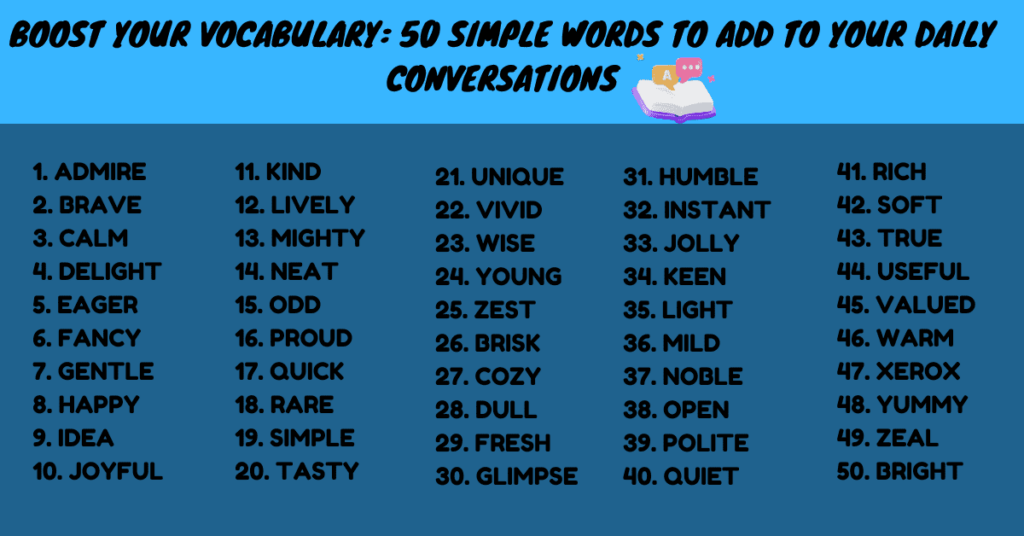
Boost Your Vocabulary: 50 Simple Words to Add to Your Daily Conversations

Expanding your vocabulary doesn’t have to be daunting. Simple words can make a big impact on your ability to communicate clearly and effectively. Here are 50 simple words to enhance your daily conversations, along with tips on how to use them.

Why Expanding Your Vocabulary Matters

Expanding your vocabulary:

  • Improves communication: Simple, clear words help convey your thoughts more accurately.
  • Enhances understanding: A broader vocabulary aids in comprehending texts and conversations.
  • Boosts confidence: Knowing the right words can make you more confident in speaking and writing.

How to Incorporate New Words

  1. Read Regularly: Books, articles, and blogs expose you to new words in context.
  2. Use a Dictionary: Look up unfamiliar words and learn their meanings.
  3. Practice Writing: Incorporate new words into your writing to reinforce learning.
  4. Engage in Conversations: Use new words in your daily interactions to make them part of your active vocabulary.

50 Simple Words to Enhance Your Daily Conversations

  1. Admire (verb) – To look up to someone.
    • Example: “I admire her dedication to her work.”
  2. Brave (adj.) – Showing courage.
    • Example: “He is a brave firefighter.”
  3. Calm (adj.) – Free from stress or worry.
    • Example: “She remained calm during the emergency.”
  4. Delight (noun) – A feeling of great pleasure.
    • Example: “The children’s laughter was a delight.”
  5. Eager (adj.) – Very interested and excited.
    • Example: “She was eager to start her new job.”
  6. Fancy (adj.) – Elaborate or decorative.
    • Example: “He wore a fancy suit to the party.”
  7. Gentle (adj.) – Kind and soft.
    • Example: “He gave the baby a gentle hug.”
  8. Happy (adj.) – Feeling or showing pleasure.
    • Example: “She was happy with her gift.”
  9. Idea (noun) – A thought or suggestion.
    • Example: “He had a great idea for a new project.”
  10. Joyful (adj.) – Full of joy.
    • Example: “Their reunion was a joyful occasion.”
  11. Kind (adj.) – Friendly and generous.
    • Example: “She is always kind to strangers.”
  12. Lively (adj.) – Full of life and energy.
    • Example: “The concert was lively and fun.”
  13. Mighty (adj.) – Strong and powerful.
    • Example: “The mighty lion roared loudly.”
  14. Neat (adj.) – Tidy and organized.
    • Example: “His desk was always neat.”
  15. Odd (adj.) – Strange or unusual.
    • Example: “He had an odd habit of talking to himself.”
  16. Proud (adj.) – Feeling pleased and satisfied.
  17. Quick (adj.) – Fast in movement or action.
    • Example: “She gave a quick response.”
  18. Rare (adj.) – Not common or frequent.
    • Example: “It is rare to see such kindness.”
  19. Simple (adj.) – Easy to understand or do.
    • Example: “The instructions were simple to follow.”
  20. Tasty (adj.) – Having a pleasant flavor.
    • Example: “The cake was very tasty.”
  21. Unique (adj.) – Being the only one of its kind.
    • Example: “Each person’s fingerprint is unique.”
  22. Vivid (adj.) – Bright and clear.
    • Example: “She has vivid memories of her childhood.”
  23. Wise (adj.) – Showing good judgment.
    • Example: “His advice was very wise.”
  24. Young (adj.) – Having lived for a short time.
    • Example: “The young girl loves to play.”
  25. Zest (noun) – Great enthusiasm and energy.
    • Example: “She approached life with zest.”
  26. Brisk (adj.) – Quick and energetic.
    • Example: “They took a brisk walk in the park.”
  27. Cozy (adj.) – Comfortable and warm.
    • Example: “The cabin was cozy and inviting.”
  28. Dull (adj.) – Lacking interest or excitement.
    • Example: “The lecture was dull and boring.”
  29. Fresh (adj.) – New and clean.
    • Example: “She loves the fresh smell of rain.”
  30. Glimpse (noun) – A quick look.
    • Example: “She caught a glimpse of the sunset.”
  31. Humble (adj.) – Not proud or arrogant.
    • Example: “He remained humble despite his success.”
  32. Instant (adj.) – Happening immediately.
    • Example: “She felt an instant connection with him.”
  33. Jolly (adj.) – Happy and cheerful.
    • Example: “He is always in a jolly mood.”
  34. Keen (adj.) – Eager or enthusiastic.
    • Example: “She is keen to learn new skills.”
  35. Light (adj.) – Not heavy or intense.
    • Example: “The dress was made of light fabric.”
  36. Mild (adj.) – Gentle and not extreme.
    • Example: “The weather was mild and pleasant.”
  37. Noble (adj.) – Having high moral qualities.
    • Example: “He is a noble and honorable man.”
  38. Open (adj.) – Honest and willing to share.
    • Example: “She was open about her feelings.”
  39. Polite (adj.) – Showing good manners.
    • Example: “He was polite and respectful.”
  40. Quiet (adj.) – Making little or no noise.
    • Example: “The library was quiet and peaceful.”
  41. Rich (adj.) – Having a lot of wealth or resources.
    • Example: “The soil was rich and fertile.”
  42. Soft (adj.) – Gentle to touch.
    • Example: “The blanket was soft and warm.”
  43. True (adj.) – In accordance with fact.
    • Example: “Her story was true and accurate.”
  44. Useful (adj.) – Helpful and practical.
    • Example: “The guidebook was very useful.”
  45. Valued (adj.) – Highly regarded.
    • Example: “He was a valued member of the team.”
  46. Warm (adj.) – Having a moderate heat.
    • Example: “The soup was warm and comforting.”
  47. Xerox (noun) – A copy made by a photocopier.
    • Example: “Please make a xerox of this document.”
  48. Yummy (adj.) – Tasty and delicious.
    • Example: “The cookies were yummy.”
  49. Zeal (noun) – Great energy in pursuit of a cause.
    • Example: “She worked with great zeal.”
  50. Bright (adj.) – Full of light or color.
    • Example: “The future looks bright.”

Conclusion

Building your vocabulary with simple, everyday words can significantly enhance your ability to communicate and understand others. Start using these words today, and watch your conversations become more engaging and effective. Happy learning!

Frequently Asked Questions about Building English Vocabulary

How can I boost my English vocabulary daily?

Daily vocabulary-building habits: (1) Learn 5 new words per day in CONTEXT (not from word lists). (2) Use each new word in a real sentence within 24 hours. (3) Read 10-15 minutes of English content daily — circle 1-2 unfamiliar words. (4) Use a vocabulary app like Anki or Memrise for spaced repetition. (5) Practise speaking with a TESOL/ESL-certified Expert who introduces vocabulary naturally during conversation. Consistency beats intensity — 5 words daily for 30 days is better than 50 words crammed in one weekend.

What are simple English words to add to daily vocabulary?

High-impact simple words to upgrade your daily English: Beneficial, Crucial, Efficient, Essential, Significant, Tremendous, Practical, Unique, Common, Specific, Various, Several, Numerous, Particular, Relevant. These replace overused words like “good”, “important”, “many”, “different” — making your spoken English sound more precise and educated.

How long does it take to expand English vocabulary?

To meaningfully expand your active vocabulary by 500-1,000 words takes 3-6 months of consistent daily practice (5 new words/day with usage). Reaching truly advanced vocabulary (~5,000 active words) takes 1-2 years. The first 1,000 high-frequency words are the most valuable — they cover ~80% of everyday conversation. Focus there before chasing rare/specialised vocabulary.

What’s the best way to remember new English words?

Most effective memory techniques: (1) Use the word in your own sentence within 24 hours of learning it. (2) Connect new words to existing knowledge (e.g., link “ubiquitous” to “everywhere I’ve seen this”). (3) Spaced repetition apps that re-test you at increasing intervals. (4) Teach the word to someone else — explanation locks it in memory. (5) Encounter the word in 3-5 different contexts before it becomes “active.” Just looking up a definition rarely sticks.

How many English words should I learn per day?

5-10 new words per day is optimal for most learners. Beyond that, retention drops sharply. The key is using each word in real conversation or writing within 24 hours — passive memorisation rarely transfers to active use. EngVarta‘s daily live audio sessions help you actively use new vocabulary in conversation, with TESOL/ESL-certified Experts who can prompt you to incorporate specific words naturally.

Should I focus on vocabulary or grammar first?

Both — but vocabulary slightly more for spoken fluency. With 1,500 high-frequency words and basic grammar, you can communicate most everyday ideas. With perfect grammar but limited vocabulary, you struggle to express complex thoughts. Most fluent non-native speakers have stronger vocabulary than perfect grammar. Allocate 60% of practice time to vocabulary expansion + usage, 40% to grammar drills + correction.

Can reading English books really build vocabulary?

Yes — but only if you ACTIVELY engage with new words. Passive reading where you skim past unfamiliar words doesn’t build vocabulary. Effective reading: (1) Pause at 1-2 unfamiliar words per page, look up the meaning. (2) Note the word in a vocabulary journal with the sentence it appeared in. (3) Use it in your next conversation or writing. Reading 30 minutes daily this way adds ~50-100 new active words per month.