Language is a playground where words take center stage, and one of the most delightful games you can play is with anagrams. An anagram is a rearrangement of the letters of a word or phrase to create a new word or phrase. It’s not just a fun pastime—it’s also a brilliant way to sharpen your English skills.
Let’s dive into the fascinating world of anagrams, uncover their charm, and see how they can become a powerful tool in your English learning journey.
Table of Contents [show]
What is an Anagram?
An anagram is when you take a word like listen and rearrange its letters to form another word, like silent. The two words use the exact same letters but tell different stories. Simple, right? Yet, this simple concept has intrigued word lovers for centuries.
Why Should You Play with Anagrams?
Here’s why exploring anagrams can benefit your English fluency:
- Boost Vocabulary: Discovering new words while forming anagrams expands your vocabulary. For example, from save you can learn vase.
- Enhance Creativity: Crafting anagrams encourages creative thinking as you explore different combinations of letters.
- Improve Spelling: Rearranging letters reinforces your spelling skills as you become familiar with word patterns.
- Make Learning Fun: Anagrams add a playful twist to learning English, making it enjoyable and less stressful.
Examples of Anagrams
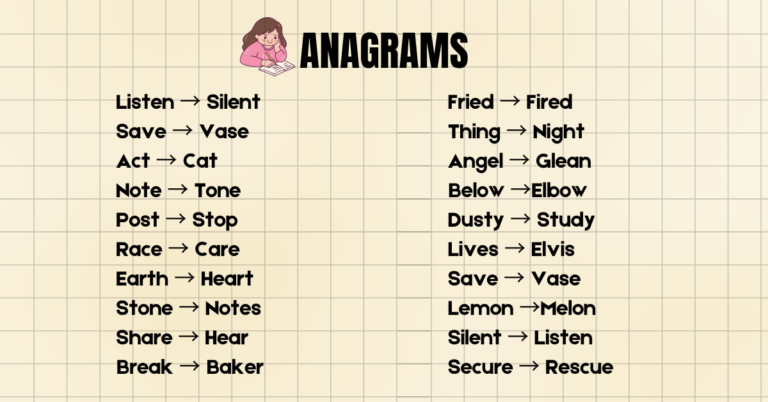
- Listen → Silent
- Save → Vase
- Act → Cat
- Note → Tone
- Post → Stop
- Race → Care
- Earth → Heart
- Stone → Notes
- Share → Hear
- Break → Baker
- Fried → Fired
- Thing → Night
- Angel → Glean
- Below → Elbow
- Dusty → Study
- Lives → Elvis
- Save → Vase
- Lemon → Melon
- Silent → Listen
- Secure → Rescue
50+ Common Anagram Examples with Meanings
Here is a curated list of 50+ anagram examples—some simple single-word flips, others clever multi-word classics. Read these aloud to train your brain to spot letter patterns quickly.
| # | Original Word / Phrase | Anagram | Type |
|---|---|---|---|
| 1 | LISTEN | SILENT | Classic single-word |
| 2 | EARTH | HEART | Classic single-word |
| 3 | NIGHT | THING | Classic single-word |
| 4 | SAVE | VASE | Beginner |
| 5 | STRESSED | DESSERTS | Meaningful reversal |
| 6 | TEACHER | CHEATER | Ironic |
| 7 | BEDROOM | BOREDOM | Playful |
| 8 | DORMITORY | DIRTY ROOM | Clever multi-word |
| 9 | ASTRONOMER | MOON STARER | Clever multi-word |
| 10 | SCHOOLMASTER | THE CLASSROOM | Clever multi-word |
| 11 | DEBIT CARD | BAD CREDIT | Ironic phrase |
| 12 | ELEVEN PLUS TWO | TWELVE PLUS ONE | Mathematical |
| 13 | THE EYES | THEY SEE | Clever multi-word |
| 14 | PUNISHMENT | NINE THUMPS | Playful |
| 15 | A DECIMAL POINT | I’M A DOT IN PLACE | Self-descriptive |
| 16 | ELECTION RESULTS | LIES — LET’S RECOUNT | Political humor |
| 17 | MOTHER-IN-LAW | WOMAN HITLER | Humorous |
| 18 | CONVERSATION | VOICES RANT ON | Self-descriptive |
| 19 | DICTIONARY | INDICATORY | Advanced |
| 20 | SLOT MACHINES | CASH LOST IN ME | Self-descriptive |
| 21 | SNOOZE ALARMS | ALAS! NO MORE Z’S | Witty |
| 22 | FUNERAL | REAL FUN | Ironic |
| 23 | THE MORSE CODE | HERE COME DOTS | Famous classic |
| 24 | THE COUNTRYSIDE | NO CITY DUST HERE | Self-descriptive |
| 25 | SOFTWARE | SWEAR OFT | Humorous |
| 26 | ANGEL | GLEAN | Single-word |
| 27 | BELOW | ELBOW | Beginner |
| 28 | DUSTY | STUDY | Beginner |
| 29 | LIVES | ELVIS | Pop culture |
| 30 | LEMON | MELON | Beginner |
| 31 | SECURE | RESCUE | Single-word |
| 32 | FRIED | FIRED | Beginner |
| 33 | NAMES | MEANS | Single-word |
| 34 | ENRAGED | ANGERED | Synonymous |
| 35 | FOREST | FOSTER | Single-word |
| 36 | CAUTIONED | EDUCATION | Clever |
| 37 | STATUE | ASTUTE | Intermediate |
| 38 | FLUSTER | RESTFUL | Opposites |
| 39 | DIRTY ROOM | DORMITORY | Reverse classic |
| 40 | A GENTLEMAN | ELEGANT MAN | Self-descriptive |
| 41 | HIBERNATES | BANISHETH | Archaic / advanced |
| 42 | PRESBYTERIAN | BEST IN PRAYER | Thematic |
| 43 | OLD WEST ACTION | CLINT EASTWOOD | Celebrity |
| 44 | DESPERATION | A ROPE ENDS IT | Dark thematic |
| 45 | ELEVATION | TO A LEVEL IN | Thematic |
| 46 | SIGNATURE | A TRUE SIGN | Thematic |
| 47 | PAYMENT RECEIVED | EVERY CENT PAID ME | Clever long |
| 48 | ACT | CAT | Beginner |
| 49 | NOTE | TONE | Beginner |
| 50 | POST | STOP | Beginner |
| 51 | RACE | CARE | Beginner |
| 52 | BREAK | BAKER | Single-word |
| 53 | STONE | NOTES | Single-word |
| 54 | SHARE | HEARS | Single-word |
| 55 | RESISTANCE | ANCESTRIES | Advanced |
Tip: Try covering the right column and guess the anagram yourself. This simple drill—five minutes a day—accelerates both vocabulary recall and spelling confidence.
How to Use Anagrams in Learning English
- Word Games
Try finding anagrams for words you encounter daily. For instance, if you see stone, think of tones or notes. - Challenge Yourself
Take a sentence or phrase and see how many anagrams you can form. Apps and online tools like Anagram Solver can help! - Practice Spelling
Use anagrams to test and improve your spelling. Rearrange the letters of a word in your head and try to recreate it. - Learn Idioms and Phrases
Create anagrams for idioms or phrases, like turning The Morse Code into Here come dots. It’s a great memory trick!
Anagrams and Communication
Anagrams are more than just a fun activity—they improve your cognitive skills and ability to see connections. When speaking or writing in English, this ability to think creatively and spot patterns can make your communication more engaging and impactful.
Try This: An Anagram Challenge!
Here’s a quick challenge for you:
Rearrange the letters of the word spar to form a new word. (Hint: You use this word when you want to wrap a gift!)
Drop your answer in the comments or share your own favorite anagrams!
 Boost Your English Speaking with EngVarta Daily!
Final Thoughts
Anagrams are proof that language is not just a tool but a craft that invites you to experiment and enjoy its endless possibilities. Whether you’re an English learner or a seasoned speaker, playing with anagrams can be a delightful way to grow your skills.
So, the next time you want to spice up your learning routine, dive into the magical world of anagrams. And remember, with every twist and turn of letters, you’re not just rearranging words—you’re unlocking the beauty of language.
You’ve read the comparison. You know the numbers. The only thing left is to actually start.
Frequently Asked Questions about Anagrams
What is an anagram?
An anagram is a word or phrase formed by rearranging the letters of another word or phrase. For example, “listen” can be rearranged into “silent” — the two words use the exact same letters but spell completely different things. Anagrams have been used for centuries as wordplay, in puzzles, in literature, and as a way to sharpen vocabulary and pattern recognition.
What is the meaning of anagram?
The word “anagram” comes from the Greek ana (back, again) and gramma (letter), literally meaning “letters back” or “letters rearranged.” In simple terms, an anagram is a rearrangement of the letters of one word or phrase to form another, using all the original letters exactly once.
How do you make an anagram?
To make an anagram from a word or phrase, follow these steps:
- Write down all the letters of the original word.
- Try rearranging them to form a new word or phrase using ALL the letters exactly once.
- Check that the new word or phrase makes sense as a real English word or meaningful phrase.
For longer phrases, anagram solvers and dictionaries can help. For learners, starting with short common words (4-6 letters) is the easiest entry point.
What are some common examples of anagrams?
Here are popular English anagrams:
- listen ↔ silent
- night ↔ thing
- elbow ↔ below
- state ↔ taste
- earth ↔ heart
- angel ↔ angle
- study ↔ dusty
- stressed ↔ desserts
- astronomer ↔ moon starer
- school master ↔ the classroom
What is the difference between an anagram and a palindrome?
An anagram is a rearrangement of letters that forms a different word or phrase (“listen” → “silent”). A palindrome is a word, phrase, or sequence that reads the same forwards and backwards (“level,” “racecar,” “madam”). Anagrams change letter order to create new meaning; palindromes preserve symmetry. They are different forms of wordplay.
How do you solve an anagram?
To solve an anagram puzzle (where you have scrambled letters and need to find the hidden word):
- List the letters and count them.
- Look for common letter patterns and prefixes/suffixes (like -ing, -tion, un-, re-).
- Identify vowels and consonants — most English words follow predictable vowel-consonant patterns.
- Try common word lengths first (3-5 letter words) before longer combinations.
- Use process of elimination if you find one word — try the remaining letters separately.
Are anagrams useful for learning English?
Yes — anagrams are a strong vocabulary-building tool. They train you to recognise letter patterns, expand your active word recall, and notice spelling structure. They also make vocabulary learning playful, which improves retention. For learners building English fluency, regular anagram practice (10-15 minutes a day) reinforces the spelling-meaning connection that fast readers develop naturally.
What are anagram names?
Anagram names are personal or brand names that rearrange to form another meaningful word or name. They’re used as pen names by authors, in branding, in literature, and as puzzles. For example, the author Anne Bradstreet’s anagram is “Anne Bradstreet” → “are best in tread.” Many writers and brands use anagram names to add hidden meaning or playfulness to their identity.
How can I practice anagrams as part of English learning?
Daily anagram practice (10-15 minutes) builds vocabulary recall and spelling pattern recognition. You can use online anagram solvers, word puzzle apps, or browser-based games. For learners working on broader spoken English, pairing anagram vocabulary with daily live speaking practice helps you actively use the new words rather than just recognise them. EngVarta’s TESOL/ESL-certified Experts can help you incorporate new vocabulary into real conversation through 1-on-1 audio sessions, with a $1 refundable trial to try the format on a vocabulary topic.
Why are anagrams included in English learning curricula?
Anagrams are included in English curricula because they:
- Strengthen letter-pattern recognition (foundation of reading fluency)
- Expand active vocabulary by forcing you to retrieve words from memory
- Improve spelling accuracy through repeated exposure to letter combinations
- Build problem-solving skills that transfer to other language tasks
- Make vocabulary learning playful, which improves retention especially in younger learners
Found this useful? Add EngVarta as a preferred source on Google — you’ll see more of our English lessons in your Search and AI results.










Comments
Comments load on demand to keep this page fast.
Leave a comment