Prepositions are those small but mighty words that link nouns, pronouns, or phrases to other words within a sentence. They’re everywhere in spoken English, but mastering their use can be tricky, especially for non-native speakers. Today, we’ll go over 10 common mistakes people make with prepositions and how to avoid them.
1. Confusing ‘In’ and ‘At’ for Locations
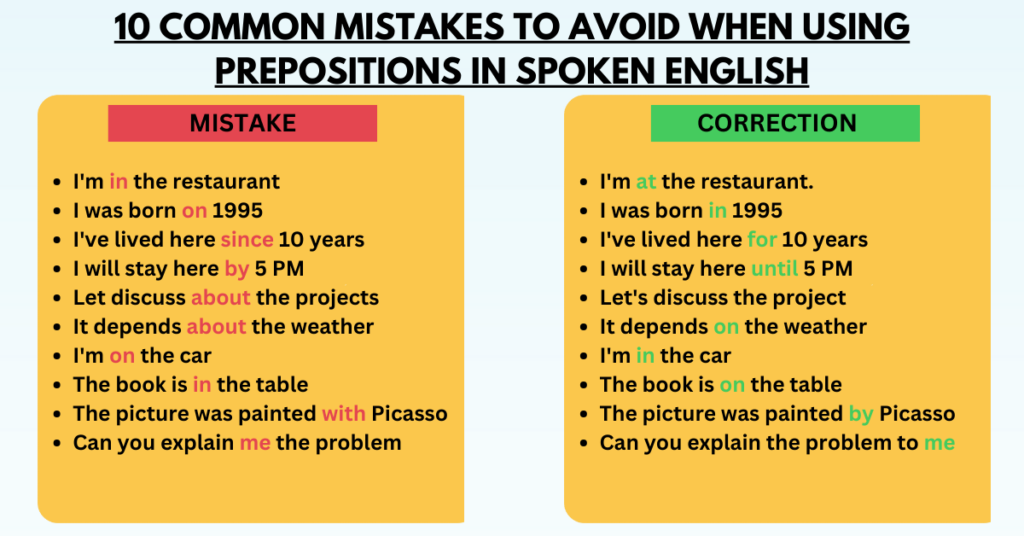
Mistake: Saying, “I’m in the restaurant” when you mean, “I’m at the restaurant.”
Correction: Use ‘at’ when you’re talking about specific locations, like “at the office” or “at the park.” Use ‘in’ when you’re referring to something more general or enclosed, like “in the city” or “in the car.”
2. Using ‘On’ Instead of ‘In’ for Months and Years
Mistake: Saying, “I was born on 1995″ instead of “I was born in 1995.”
Correction: Use ‘in’ for months, years, centuries, and long periods of time, like “in March” or “in 2025.” Use ‘on’ for specific days or dates, like “on Tuesday” or “on December 12th.”
3. Mixing Up ‘For’ and ‘Since’ with Time Expressions
Mistake: Saying, “I’ve lived here since 10 years” instead of “I’ve lived here for 10 years.”
Correction: Use ‘for’ when talking about the length of time (a duration), like “for 10 years.” Use ‘since’ when you’re referring to the starting point in time, like “since 2010.”
4. Incorrect Use of ‘By’ and ‘Until’
Mistake: Saying, “I will stay here by 5 PM” instead of “I will stay here until 5 PM.”
Correction:‘Until’ is used to indicate the time something will continue to happen, like “until 5 PM.”‘By’ is used to show the deadline or when something must be completed, like “Please finish this by Friday.”
5. Incorrect Use of ‘To’ After ‘Discuss’
Mistake: Saying, “Let’s discuss about the project” instead of “Let’s discuss the project.”
Correction: The verb ‘discuss’ doesn’t require a preposition. You should say, “Let’s discuss the project,” without ‘about.’
6. Confusing ‘On’ and ‘About’ After ‘Depend’
Mistake: Saying, “It depends about the weather” instead of “It depends on the weather.”
Correction: Always use ‘on’ after the verb ‘depend,’ as in “It depends on the weather,” or “It depends on you.”
7. Mixing Up ‘In’ and ‘On’ with Transportation
Mistake: Saying, “I’m on the car” instead of “I’m in the car.”
Correction: Use ‘in’ for smaller vehicles like cars or taxis (“in the car”) and ‘on’ for larger modes of transportation like buses, trains, and planes (“on the bus”).
8. Using ‘In’ Instead of ‘On’ for Surfaces
Mistake: Saying, “The book is in the table” instead of “The book is on the table.”
Correction: Use ‘on’ when referring to something that’s on a surface, like “on the table,”“on the floor,” or “on the shelf.”
9. Confusing ‘With’ and ‘By’
Mistake: Saying, “The picture was painted with Picasso” instead of “The picture was painted by Picasso.”
Correction: Use ‘by’ when you’re talking about the agent or doer of an action (“painted by Picasso”), and ‘with’ when you’re referring to the tool or instrument used (“painted with a brush”).
10. Incorrect Use of ‘To’ After ‘Explain’
Mistake: Saying, “Can you explain me the problem?” instead of “Can you explain the problem to me?”
Correction: The verb ‘explain’ needs to be followed by the object first and then the person it’s explained to: “Explain the problem to me.”
Practice Listening and Reading: Exposure to correct usage through podcasts, TV shows, and books will help you naturally pick up the right prepositions.
Use an English Learning App: Apps like EngVarta provide real-time conversations with English experts, helping you identify and correct preposition mistakes in real time.
Create Flashcards: Make a list of common preposition phrases and review them daily.
Speak Regularly: The more you practice speaking English, the more natural it is to use prepositions.
Mastering prepositions may seem challenging, but with practice, you’ll find yourself making fewer and fewer mistakes. Prepositions can often change the entire meaning of a sentence, so using them correctly is key to fluency.
By avoiding these 10 common mistakes, you’ll see a noticeable improvement in your spoken English!
Ready to master prepositions and speak English confidently?Download EngVarta today and start practicing with live experts!
Frequently Asked Questions about English Prepositions
What are English prepositions and why are they tricky?
Prepositions are short words (in, on, at, by, for, of, to, with, from, about) that connect nouns, pronouns, or phrases to other words in a sentence. They’re tricky because they don’t translate directly between languages — Hindi, Tamil, Bengali, and other Indian languages handle position/direction/time differently than English. Learners often calque from their native language, leading to errors like “I’m interested in to learn” (should be “interested in learning”) or “good in maths” (should be “good at maths”).
What are the most common English preposition mistakes?
Frequent errors Indian English speakers make: (1) “Good IN English” → “good AT English”. (2) “Discussing ABOUT this” → “discussing this” (no preposition needed). (3) “Married WITH her” → “married TO her”. (4) “Different THAN” → “different FROM”. (5) “On Monday morning” → “on Monday morning” (correct) but “in the morning” (correct), “at night” (correct). Time prepositions: AT exact times, ON days, IN months/seasons/years. Place prepositions: AT specific locations, ON surfaces, IN enclosed spaces.
What’s the difference between in, on, and at?
For TIME: AT for exact times (at 5pm, at noon), ON for specific days (on Monday, on Christmas), IN for longer periods (in May, in 2026, in winter). For PLACE: AT for specific points (at the bus stop, at the door), ON for surfaces (on the table, on the wall), IN for enclosed spaces (in the room, in the car, in India). When in doubt, think of the preposition as zooming in: IN is broadest (a country), ON is narrower (a street), AT is specific (a corner).
How can I avoid preposition mistakes in spoken English?
Effective strategies: (1) Memorise high-frequency verb-preposition combinations as PHRASES (depend on, listen to, agree with, look forward to, instead of memorising “depend” and “on” separately). (2) Read English daily and note every preposition usage that surprises you. (3) Get feedback from a TESOL/ESL-certified Expert who flags preposition errors as they happen — these errors are often invisible to learners. EngVarta‘s daily 1-on-1 sessions catch preposition mistakes in real conversation, with corrections in the moment.
What are essential English prepositions to know?
Top 20 high-frequency prepositions: in, on, at, by, for, of, to, with, from, about, after, before, between, during, into, through, without, against, among, beyond. Mastering these covers ~95% of everyday English usage. Memorise common phrases that use them (“by the way”, “for instance”, “in fact”, “of course”) rather than learning prepositions in isolation.
How long does it take to master English prepositions?
Most learners reach 80% accuracy on common prepositions in 6-12 months of daily practice with feedback. Reaching 95%+ accuracy takes 1-2 years because some preposition uses are highly idiomatic (e.g., “interested IN” vs “fond OF” — no logical reason for the difference). Acceptance helps: native speakers often disagree on “correct” preposition use too. Focus on the patterns that matter for clarity.
Should I memorise preposition rules or learn them in context?
Both, but lean toward CONTEXT. Rules give you a starting framework (time prepositions: at/on/in pattern). Context (real sentences, conversations, written examples) is what locks usage into memory. Reading English daily and noting prepositions in their natural context is more effective than memorising rule lists. Active production (speaking, writing) with corrections is the fastest path to accuracy.
In today’s world, English has become a global language, essential for communication in almost every country. For travelers, the ability to speak English fluently opens doors to new experiences and smoother journeys. Whether navigating foreign streets or engaging in local markets, speaking English can make all the difference. Here are the top 10 best English learning apps for travelers, providing flexibility and effective learning strategies to help you learn on the go.
Duolingo: Fun and Gamified Learning
Duolingo is a free, gamified language learning app that’s perfect for beginners. It uses a fun, game-like structure to keep learners engaged, offering quick lessons that fit easily into a traveler’s schedule. The app’s bite-sized lessons cover a range of topics, from basic vocabulary to more complex grammar rules, making it one of the best English learning apps for travelers looking for a simple and entertaining way to start learning.
EngVarta: Real-Time Practice with Experts
EngVarta is an innovative app that focuses on live conversation practice with English experts, setting it apart from other language apps that use automated lessons. This is a game-changer for travelers looking to build confidence in speaking English quickly. The app connects users with real people, offering a personalized and practical approach to learning, making it one of the best English learning apps for travelers who want to enhance their speaking skills in a realistic setting.
Why Choose EngVarta?
Real-Time Interaction: Unlike other apps, EngVarta provides live sessions with English experts, allowing for real-time conversation practice. This is particularly valuable for travelers who need to improve their speaking skills quickly.
Personalized Learning: Sessions are tailored to individual needs, whether you want to focus on everyday conversations, business English, or travel-specific scenarios.
Flexible Scheduling: Perfect for travelers, EngVarta allows you to schedule sessions at your convenience, making it easy to fit learning into any itinerary.
Confidence Building: Regular interaction with native speakers helps build confidence and fluency, essential for navigating new countries and cultures.
Rosetta Stone: Immersive Language Learning
Rosetta Stone has been a pioneer in language learning for decades. The app focuses on immersive learning, encouraging users to think and learn in the new language without translation, which can be particularly effective for learning English. This immersive approach makes it one of the best English learning apps for travelers who want to fully dive into the language.
Memrise: Learning with Native Speakers
Memrise uses a combination of video clips of native speakers and interactive games to make learning a new language both fun and effective. It’s ideal for travelers who want to learn practical phrases and expressions used in everyday conversation.
Busuu: Community-Driven Learning
Busuu offers a unique blend of traditional language lessons and social learning features. It allows users to interact with native speakers, providing opportunities to practice writing and speaking with real people, enhancing the learning experience.
HelloTalk: Language Exchange Community
HelloTalk is more of a social network than a traditional learning app. It connects users with native speakers around the world for language exchange, making it perfect for travelers who want to practice conversational English and gain cultural insights directly from locals.
Pimsleur: Audio-Based Learning for On-the-Go
Pimsleur is a renowned audio-based learning app that focuses on listening and speaking skills. It’s perfect for travelers who want to learn hands-free while commuting or multitasking, making language learning seamlessly fit into a busy travel schedule.
Mondly: High-Tech Language Learning
Mondly utilizes modern technology like augmented reality (AR) and chatbots to enhance the language learning experience. It offers a variety of interactive exercises and conversations for comprehensive learning, making it a fun and engaging tool for travelers.
TripLingo: Traveler-Focused Language and Culture App
TripLingo is designed specifically for travelers, offering language learning tools along with cultural insights and essential travel phrases. It’s a handy app for navigating different countries and cultures, providing both language learning and cultural immersion.
Conclusion
For travelers looking to learn English on the go, these apps offer a range of methods and features to suit different learning styles and needs. From gamified lessons with Duolingo to structured courses with Babbel, and immersive learning with Rosetta Stone, there’s something for everyone. However, EngVarta stands out with its unique focus on live conversation practice, making it the best choice for those who want to improve their speaking skills quickly and effectively. So, download EngVarta today and start your journey towards fluent English communication with one of the best English learning apps for travelers!
By incorporating these English learning apps into your travel routine, you can make the most of your time abroad while improving your language skills in engaging and effective ways.
Let’s face it—life is hectic, and finding the time to attend regular IELTS classes can feel like squeezing water from a stone. Enter the IELTS preparation app: sleek, convenient, and packed with features promising to help you ace the exam. But here’s the burning question: can these apps truly replace the tried-and-true traditional coaching? Let’s unravel the truth behind this digital versus classroom debate.
The Appeal of IELTS Preparation Apps: Why Everyone’s Talking About Them
IELTS preparation app are on the rise, and it’s easy to see why. They offer a modern approach to learning that seems tailor-made for our fast-paced lives. But are they really the game-changers they claim to be?
Study Anywhere, Anytime—Literally: Imagine prepping for the IELTS while waiting for your coffee, during your commute, or in the comfort of your bed. IELTS appsmake it possible. The flexibility to study whenever and wherever you want is a massive plus for busy individuals who can’t commit to rigid class schedules.
Learning That Adapts to You: Ever wish your learning material could just ‘get’ you? Many IELTS apps use AI to do just that, adapting to your learning speed, focusing on your weak spots, and pushing you in the right direction. It’s like having a study buddy who knows exactly what you need.
Save Your Wallet: Let’s be real—traditional IELTS coaching can burn a hole in your pocket. In contrast, apps are typically much more affordable, with some offering free versions that are surprisingly robust. For those on a budget, this makes apps a very tempting option.
Instant Gratification: Waiting for feedback from a teacher can feel like an eternity, especially when you’re itching to improve. Apps often provide instant feedback on your practice tests and exercises, giving you the power to correct mistakes on the spot.
The Other Side of the Coin: Where IELTS Apps Might Fall Short
While IELTS apps offer some undeniable perks, they also come with limitations that could be deal-breakers depending on your needs.
No Substitute for a Real Teacher: As smart as these apps are, they can’t replace the wisdom and guidance of a seasoned teacher. Traditional coaching gives you access to expert insights, personalized strategies, and in-depth explanations that apps simply can’t match.
Interaction? Not So Much: Learning is not just about absorbing information—it’s about engaging with it. In a classroom, you can ask questions, participate in discussions, and get immediate clarification. With apps, the interaction is usually one-sided, which might leave you feeling a bit lost on more complex topics.
The Discipline Dilemma: Here’s the thing—studying on your own requires a lot of self-discipline. Without the structure and accountability of a traditional class, it’s easy to slack off or get distracted. Traditional coaching, with its regular schedule and deadlines, helps keep you on track.
Speaking of Speaking…: The speaking section of the IELTS is where many students stumble, and for good reason—it’s tough! While apps can help with pronunciation and vocabulary, they can’t fully replicate the experience of practicing with a real person. In a traditional coaching setting, you get to practice speaking in a supportive environment, which is crucial for building confidence.
The Sweet Spot: Blending Both Worlds
The truth is, you don’t have to choose between an IELTS app and traditional coaching—you can have the best of both worlds.
Use Apps to Complement Your Coaching:
Think of IELTS apps as your on-the-go toolkit. Use them to reinforce what you’ve learned in class, fit in extra practice, and identify where you need more help.
Traditional Coaching for the Deep Dive:
Enroll in traditional coaching to get the personalized guidance and hands-on practice that apps can’t fully provide. It’s where you can ask those tricky questions and get feedback that’s tailored just for you.
Consider Online Tutoring:
If attending in-person classes isn’t feasible, online tutoring could be your golden ticket. It combines the convenience of digital learning with the interactive, personalized touch of traditional coaching.
Final Thoughts: What’s the Best Path for You?
When it comes to preparing for the IELTS, there’s no one-size-fits-all answer. It all boils down to your personal learning style, your goals, and your life circumstances. For some, the convenience and affordability of an app might be all they need. For others, the depth and structure of traditional coaching are irreplaceable.
So, why not blend both approaches? Use the power of an app to supplement the rich experience of traditional coaching, or mix in online tutoring for a personalized touch. Remember, the goal is not just to work hard but to work smart—so choose the path that aligns with your needs and gives you the best shot at IELTS success.
Effective communication is vital in both personal and professional settings, and phone calls are a significant part of our daily interactions. Mastering phone call vocabulary and phrases can greatly enhance your confidence and clarity when talking on the phone. Whether you’re making a business call, setting up an appointment, or catching up with a friend, here are some essential phrases and tips to help you navigate phone calls with ease.
Introduction to Phone Call Etiquette
Before diving into specific phone call vocabulary and phrases, it’s important to understand some basic phone call etiquette:
Greet politely: Always start with a friendly greeting.
Identify yourself: State your name and, if necessary, your company or organization.
Be clear and concise: Get to the point while being courteous.
Listen actively: Pay attention to the other person and respond appropriately.
End the call gracefully: Summarize key points and say goodbye politely.
Common Phone Call Vocabulary and Phrases
Starting the Call
Making a Call:
“Hello, this is [Your Name]. May I speak with [Recipient’s Name], please?”
“Good morning/afternoon/evening, this is [Your Name] from [Your Company]. I’m calling regarding [reason for the call].”
Receiving a Call:
“Hello, [Your Name] speaking. How can I help you?”
“Thank you for calling [Your Company]. This is [Your Name]. How may I assist you?”
Requesting Information or Action
Asking for Someone:
“Could I speak to [Recipient’s Name], please?”
“Is [Recipient’s Name] available?”
Leaving a Message:
“Could you please take a message for [Recipient’s Name]?”
“Please let [Recipient’s Name] know that I called and ask them to call me back.”
Clarifying Information:
“Could you please repeat that?”
“I didn’t catch that. Could you say it again, please?”
Confirming and Arranging Details
Confirming Information:
“Let me confirm that. You said [details], correct?”
“Just to be sure, your appointment is at [time] on [date], right?”
Making Appointments:
“I’d like to schedule an appointment with [Recipient’s Name].”
“Is [time] on [date] convenient for you?”
Agreeing to Arrangements:
“That works for me. Thank you.”
“I look forward to it. See you then.”
Handling Issues
Expressing Concerns:
“I’m afraid there’s a problem with [issue].”
“I’m not happy with [issue]. Can you help resolve it?”
Seeking Assistance:
“Can you please help me with [problem]?”
“I’m having trouble with [issue]. Could you assist me?”
Stay Positive: Always maintain a positive and friendly tone, even if the conversation is challenging.
Take Notes: Write down important details during the call to avoid forgetting key points.
Speak Clearly: Communicate your words clearly and avoid speaking too quickly.
Be Patient: Allow the other person to speak without interrupting.
Use Polite Language: Phrases like “please,” “thank you,” and “excuse me” go a long way in maintaining politeness.
Conclusion
Mastering phone call vocabulary and phrases in English can significantly improve your communication skills. By using these phrases and tips, you can handle various phone conversations with confidence and professionalism. Remember, practice makes perfect, so don’t hesitate to use this phone call vocabulary in your daily interactions.
Frequently Asked Questions about Phone Call English
What vocabulary do I need for English phone calls?
Essential phone call English vocabulary: Greetings — “Hello”, “Good morning”, “May I speak to…?”. Holding — “Could you hold on a moment?”, “I’ll put you on hold”. Transfer — “Let me transfer you”, “I’m putting you through”. Asking — “Could you repeat that?”, “Could you spell that?”, “Could you speak more slowly?”. Closing — “Thank you for calling”, “Have a great day”, “I’ll get back to you”. Master these and you can handle 90% of professional phone English.
How do I sound professional on English phone calls?
Professional phone English: (1) Speak slightly slower than your normal pace — phone audio loses nuance. (2) Articulate clearly, especially numbers, names, and email addresses. (3) Use polite phrasing (“Could I”, “Would you mind”, “I’d appreciate”). (4) Confirm details by repeating (“So that’s 9 AM on Tuesday — correct?”). (5) Smile while speaking — it changes your tone audibly. (6) End with clear next steps (“I’ll send the email by 5 PM today”).
What are common English phrases for taking phone messages?
Standard message-taking phrases: “Could I take a message?”, “Who’s calling please?”, “Could I have your name and number?”, “What’s this regarding?”, “When would be a good time to call back?”, “I’ll make sure they get the message”. Have a notepad ready before answering work calls. Confirm spelling of names and numbers — phone audio is lossy.
How do I introduce myself on an English phone call?
Standard professional introductions: “Hello, this is Rishish Pandey from EngVarta”, “Good morning, my name’s Anshul, calling from EngVarta about…”. Always include: your name, your company/role, the reason for calling. Keep introduction under 15 seconds. Don’t start with apologies (“Sorry to bother you”) — sounds insecure. Just be direct and professional.
How can I improve my English phone speaking skills?
Effective practice: (1) Record mock phone calls — simulate work scenarios, listen back, identify weaknesses. (2) Practice speaking through your phone (audio-only) instead of in-person — different cognitive demands. (3) Take a TESOL/ESL-certified Expert call to simulate real conditions. EngVarta‘s sessions are audio-only by design (no video) — perfect simulation of phone-call conditions, with TESOL/ESL-certified Experts who can flag specific phone-English mistakes. The $1 refundable trial lets you experience this on a real-world phone scenario.
What are common mistakes on English phone calls?
Frequent errors: (1) Speaking too fast (audio loses clarity). (2) Mumbling or trailing off at sentence ends. (3) Not confirming details (numbers, dates, names misheard). (4) Filler words (“uhmm”, “yaani”) indicate uncertainty. (5) Not smiling — listeners hear the difference. (6) Cultural mismatches (over-formal in casual contexts, too casual in formal contexts). (7) Hanging up without clear next steps. Daily phone-mode practice fixes most of these in 4-6 weeks.
Learning English online has never been easier, thanks to the plethora of resources available at our fingertips. Whether you’re a beginner or looking to polish your skills, there’s something for everyone. Here are the top 10 online resources to help you master the English language from the comfort of your home.
1. Duolingo
Duolingo is a popular app known for its gamified approach to language learning. It offers bite-sized lessons that are perfect for daily practice. The app covers reading, writing, listening, and speaking, making it a comprehensive tool for beginners and intermediate learners who are learning English online.
Features:
Interactive exercises
Immediate feedback
Progress tracking
The Most Underrated Resource: Daily Live Conversation Practice
Most learners spend 90% of their time on reading, grammar exercises, and vocabulary apps — but only 10% on actual speaking. This is backwards. Speaking is the skill that matters most in real life, and it is the one you cannot improve without practising with another person.
In 2026, platforms like EngVarta make daily speaking practice accessible to anyone. Press one button on the app, and you are connected with a certified English expert for a live 1-on-1 conversation. No scheduling, no video, no judgement — just focused speaking practice with real-time feedback.
The combination that works best: use free online resources (YouTube, podcasts, grammar websites) to build knowledge, then use EngVarta to convert that knowledge into actual speaking ability. Knowledge without practice stays knowledge. Practice is what builds fluency.
How to Build an Effective Daily English Learning Routine
Morning (10 min): Read one English article or listen to one English podcast episode. Note 3 new words.
Afternoon (5 min): Use a vocabulary app to review your new words. Write one sentence with each.
Evening (15 min): Practise speaking with a real person — an EngVarta expert session, a language exchange partner, or an English-speaking friend. Use the words you learned that day.
This 30-minute daily routine covers all four skills: reading, listening, writing, and speaking. The key is consistency — 30 minutes every day beats 3 hours once a week. Over 2 million learners have improved their English with this approach.
What Our Learners Say
Rated 4.5★ from 9,100+ reviews on Google Play
★★★★★
Engvarta provides the best platform for learners to learn and get comfortable with the language by offering a comfortable and judgment-free environment with regular feedback. Engvarta is the best English learning app available.
★★★★★
Wonderful app provide experts to talk but but so much time constraints in talking..
★★★★★
Excellent platform for people who don’t find any people to speak in English. Live experts help to build confidence while speaking and guiding to improve your communication!
★★★★★
good and highly talented experts are here..just go for a trail without any doubt.. thank you eng vartha...A small request from my side just take less payment from the people who are joing in your coaching...help to them...thank you
★★★★★
thanks for guide me i will try to connect your team and good communication with person so thank you teaching with me.
★★★★★
hii i have taken your 69 rs plan for expert calling but no response from your side you gove the number i am trying to call on that number but no response r u making me fool? or what?
★★★★★
best app for English communication. I have tried lots of English speaking apps till date. but all have some dra backs. but this is really awesome experience of mine. best teachers and best app. 💯
★★★★★
It's very beneficial app for children who don't speak well.
★★★★★
No words to say about your app. I'm very interested in it and learning a lot. Thanks for your help.
★★★★★
I am happy while speaking with experts and getting feedback on my speaking skills.
★★★★★
Nice platform to practice English speaking.
Teachers are awesome.
Thanks
★★★★★
A very good app its just as good as shown in the advertisement,but I wish it would have been a bit cheaper,
★★★★★
Engvarta provides the best platform for learners to learn and get comfortable with the language by offering a comfortable and judgment-free environment with regular feedback. Engvarta is the best English learning app available.
★★★★★
Wonderful app provide experts to talk but but so much time constraints in talking..
★★★★★
Excellent platform for people who don’t find any people to speak in English. Live experts help to build confidence while speaking and guiding to improve your communication!
★★★★★
good and highly talented experts are here..just go for a trail without any doubt.. thank you eng vartha...A small request from my side just take less payment from the people who are joing in your coaching...help to them...thank you
★★★★★
thanks for guide me i will try to connect your team and good communication with person so thank you teaching with me.
★★★★★
hii i have taken your 69 rs plan for expert calling but no response from your side you gove the number i am trying to call on that number but no response r u making me fool? or what?
★★★★★
best app for English communication. I have tried lots of English speaking apps till date. but all have some dra backs. but this is really awesome experience of mine. best teachers and best app. 💯
★★★★★
It's very beneficial app for children who don't speak well.
★★★★★
No words to say about your app. I'm very interested in it and learning a lot. Thanks for your help.
★★★★★
I am happy while speaking with experts and getting feedback on my speaking skills.
★★★★★
Nice platform to practice English speaking.
Teachers are awesome.
Thanks
★★★★★
A very good app its just as good as shown in the advertisement,but I wish it would have been a bit cheaper,
BBC Learning English provides a wealth of free resources, including videos, audio, and written lessons. It covers grammar, vocabulary, and pronunciation, along with news stories to improve listening skills. It’s an excellent resource for those learning English online.
Features:
Daily updates
Real-life language use
Engaging content
3. EngVarta
EngVarta stands out as an exceptional resource for mastering English through real-time practice sessions with live language experts. It’s perfect for learners who want to improve their speaking skills and gain confidence in conversations. EngVarta is a premier choice for those focused on learning English online.
Features:
One-on-one sessions: Personalized interactions with language experts.
Expert feedback: Receive immediate and constructive feedback on your speaking.
Flexible scheduling: Choose session times that fit your schedule.
Interactive learning: Engage in conversations on various topics to enhance fluency.
EngVarta’s approach is tailored to individual needs, making it an ideal choice for anyone looking to boost their English speaking skills quickly and effectively while learning English online.
Coursera offers online courses from top universities and institutions. Their English learning courses range from beginner to advanced levels, covering academic English, business English, and general communication skills. Coursera is a solid choice for structured and comprehensive learning English online.
Features:
University-level courses
Certificates of completion
Flexible learning schedule
5. Grammarly
Grammarly is an excellent tool for improving your writing skills. It checks your grammar, punctuation, and style in real-time, providing suggestions to enhance your writing quality. It’s particularly useful for learners focusing on learning English online and improving their written communication.
Features:
Real-time writing feedback
Vocabulary enhancement
Detailed explanations
6. TED Talks
TED Talks are a great resource for learning English online while being inspired by experts in various fields. The talks cover a wide range of topics and come with subtitles and interactive transcripts. TED Talks are ideal for those learning English online through engaging and thought-provoking content.
Features:
Engaging content
Subtitles in multiple languages
Interactive transcripts
7. Memrise
Memrise uses spaced repetition and mnemonic techniques to help you remember new vocabulary. It’s a fun and effective way to expand your English vocabulary and improve your language retention. Memrise is a popular choice for learners who are learning English online.
Features:
Spaced repetition system
Mnemonic aids
User-generated content
8. English Central
English Central offers video lessons with interactive exercises. It covers a variety of topics, from everyday conversation to business English, and provides personalized feedback on your pronunciation and usage. English Central is a comprehensive platform for learning English online.
Features:
Video-based learning
Interactive exercises
Pronunciation feedback
9. Quizlet
Quizlet allows you to create and study flashcards on any topic, including English vocabulary and grammar. It’s a versatile tool that’s perfect for reinforcing what you’ve learned. Quizlet is highly effective for learners focused on learning English online.
Features:
Customizable flashcards
Study games
Progress tracking
10. ESL Pod
ESL Pod offers audio lessons designed for English learners. Each podcast episode covers a specific topic, providing vocabulary, explanations, and cultural insights to enhance your understanding of the language. ESL Pod is a convenient resource for those learning English online through audio content.
Features:
Topic-specific podcasts
Detailed explanations
Cultural insights
Conclusion
These top 10 resources provide a variety of methods and tools to help you learn English online. While all these resources offer unique benefits, EngVarta’s personalized approach with live practice sessions makes it a standout choice for improving your English speaking skills. Start exploring these resources today and take your English skills to the next level! Happy learning English online!