Best English Learning App |

Tag

best english learning app

How to Use “Will,” “Shall,” and “Going To” When Talking About the Future

January 21, 2025 • 10 min read • By Swati Raj

How to Use "Will," "Shall," and "Going To" When Talking About the Future

Mastering future tenses in English is essential for clear and effective communication. Three common ways to discuss the future are “will,” “shall,” and “going to.” Each has distinct nuances and usage patterns, which we’ll explore in this comprehensive guide.

Understanding “Will”

“Will” is a versatile auxiliary verb used to express various types of future actions. Below are its primary uses:

  1. Expressing Decisions Made at the Moment of Speaking
    • Example: I’ll call you after the meeting.
    • Explanation: “Will” indicates a spontaneous decision.
  2. Making Predictions
    • Example: It will rain tomorrow.
    • Explanation: Predictions based on intuition or general knowledge often use “will.”
  3. Promises, Offers, and Threats
    • Example: I’ll help you with your homework.
    • Explanation: “Will” conveys commitments or intentions.
  4. Expressing Certainty
    • Example: You’ll love this movie.
    • Explanation: When speakers are confident about an outcome, “will” is appropriate.

Decoding “Shall”

“Shall” is less commonly used in modern English but remains relevant in specific contexts:

  1. Formal Suggestions and Offers
    • Example: Shall we go for a walk?
    • Explanation: “Shall” can be used for polite proposals.
  2. Legal or Formal Obligations
    • Example: The tenant shall pay rent on the first of each month.
    • Explanation: In legal or formal documents, “shall” denotes obligation.
  3. Expressing Determination (Old-Fashioned)
    • Example: I shall overcome these challenges.
    • Explanation: In literary or older texts, “shall” conveys resolve or intent.

Exploring “Going To”

“Going to” emphasizes plans, intentions, and evidence-based predictions:

  1. Planned Actions
    • Example: I’m going to visit my grandparents next weekend.
    • Explanation: Use “going to” for premeditated actions or decisions.
  2. Predictions Based on Evidence
    • Example: Look at those clouds; it’s going to rain.
    • Explanation: When there is visible evidence, “going to” is preferred.
  3. Informal Tone
    • Example: I’m going to grab a coffee. Want one?
    • Explanation: “Going to” suits casual conversation.

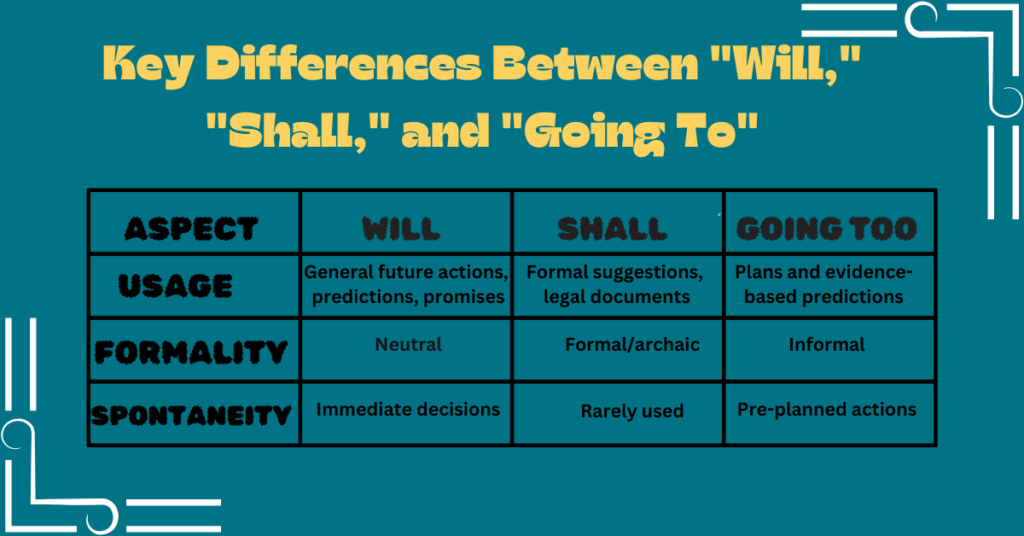
Key Differences Between “Will,” “Shall,” and “Going To”

Aspect Will Shall Going To
Usage General future actions, predictions, promises Formal suggestions, legal documents Plans and evidence-based predictions
Formality Neutral Formal/archaic Informal
Spontaneity Immediate decisions Rarely used Pre-planned actions

Tips for Choosing the Right Form

  1. Consider the context: Is it formal, casual, or spontaneous?
  2. Analyze the intent: Are you predicting, planning, or making an offer?
  3. Focus on regional preferences: British English tends to use “shall” more than American English.
  4. Decide on voice: Future statements take both active (The team will deliver the report) and passive (The report will be delivered by the team) forms—see our guide on active and passive voice in English grammar for the full pattern.

Examples in Everyday Context

  1. Spontaneous Decisions: I’ll take care of it right away.
  2. Formal Suggestions: Shall we meet at 10 a.m.?
  3. Planned Actions: She’s going to study abroad next year.
  4. Predictions: It’s going to be a great day.

20+ Example Sentences: Will, Shall, and Going To in Context

The best way to understand the difference between will, shall, and going to is to see them in real-life sentences. Below are 25+ examples grouped by form, covering predictions, plans, formal offers, promises, and spontaneous decisions.

Examples with “Will” (predictions, spontaneous decisions, promises, certainty)

  1. I think it will rain tomorrow.
  2. I will help you with that report.
  3. She will be 30 next month.
  4. Don’t worry — I’ll pick you up from the airport.
  5. You’ll love this new restaurant.
  6. I’ll call you as soon as I land.
  7. He will probably win the election.
  8. I’ll have the pasta, please.
  9. Technology will change how we work in the next decade.
  10. I promise I’ll never lie to you again.

Examples with “Shall” (formal suggestions, offers, British usage, determination)

  1. Shall we dance?
  2. Shall I open the window? It’s a bit stuffy in here.
  3. We shall overcome this challenge together.
  4. Shall we meet at 10 a.m. tomorrow?
  5. The tenant shall pay rent on the first of each month.
  6. Shall I call a taxi for you?
  7. I shall never forget your kindness.

Examples with “Going To” (planned future, evidence-based predictions)

  1. I’m going to visit Mumbai next week.
  2. Look at those clouds — it’s going to rain.
  3. She’s going to start a new business this year.
  4. We’re going to buy a house next summer.
  5. He’s going to propose to her on her birthday.
  6. I’m going to learn French this year.
  7. Be careful! You’re going to fall.
  8. They’re going to announce the results on Friday.
  9. I’m going to hit the gym after work.
  10. She’s going to appear for the IELTS exam in June.

Quick takeaway: Use will when you decide on the spot or make a prediction from intuition. Use shall for formal offers or polite suggestions (especially in British English). Use going to when the plan already exists in your head, or when you can see the evidence right in front of you.

Conclusion

“Will,” “shall,” and “going to” each bring unique nuances to English communication. By understanding their specific roles and applications, you can confidently navigate future-tense expressions. Practice these distinctions in real-life scenarios to enhance your fluency and precision.

You’ve read the comparison. You know the numbers. The only thing left is to actually start.

Frequently Asked Questions about Will, Shall, and Going to

What is the difference between will, shall, and going to?

Will: spontaneous decisions, predictions, promises, offers (“I will help you”). Shall: formal English, suggestions, polite questions (“Shall we begin?”). Going to: planned future actions, predictions based on evidence (“I’m going to study tonight”). All three express future tense but with different shades of meaning.

When should I use ‘will’ for the future?

Use “will” for: (1) Spontaneous decisions (“The phone is ringing — I’ll get it”). (2) Predictions about the future (“I think it will rain”). (3) Promises and offers (“I will help you study”). (4) Future facts and certainties (“The sun will rise at 6 am”). (5) Polite requests (“Will you pass the salt?”).

When should I use ‘going to’ for the future?

Use “going to” for: (1) Planned future actions (“I’m going to start a new course next month”). (2) Predictions based on evidence you can see now (“Look at those clouds — it’s going to rain”). (3) Intentions decided before now (“She’s going to be a doctor”). The key signal: “going to” implies the decision was made BEFORE the moment of speaking.

Is ‘shall’ still used in modern English?

“Shall” is much less common in modern American English but still used in British English and formal contexts. Common modern uses: (1) Suggestions (“Shall we go?”). (2) Polite questions (“Shall I open the window?”). (3) Formal/legal documents (“The party shall provide…”). (4) First-person intent (“I shall return”). For most everyday English, “will” and “going to” are sufficient. “Shall” sounds formal or old-fashioned in casual conversation.

What’s the difference between ‘I will’ and ‘I’m going to’?

“I will” suggests a spontaneous decision or promise (“I will help you” — decided right now). “I’m going to” suggests a pre-existing plan (“I’m going to help you” — already decided this earlier). Both are correct future tenses, but the meaning shifts subtly. Native speakers use both but lean toward “going to” for planned actions and “will” for in-the-moment decisions or formal predictions.

Can ‘will’ and ‘going to’ be used interchangeably?

Sometimes yes, sometimes no. Interchangeable: future predictions where there’s no evidence (“I think it will rain” / “I think it’s going to rain”). NOT interchangeable: spontaneous decisions need “will” (“I’ll get it” — not “I’m going to get it” when responding to a ringing phone). Plans always use “going to” (“We’re going to Goa next month” — not “We will go to Goa next month” unless you’re making the decision now).

What are common mistakes with will, shall, and going to?

Frequent errors: (1) Using “will” for pre-existing plans (“I will visit Mumbai next month” — better: “I’m going to visit Mumbai next month”). (2) Using “going to” for spontaneous decisions (“Wait — I’m going to get the door”). (3) Overusing “shall” in casual conversation (sounds stiff). (4) Confusing “will” with “would” in conditional sentences (“If I had time, I will help” — should be “would help”). (5) Using future tense after “when/if” (“When you will arrive, call me” — should be “When you arrive, call me”).

How can I practise will, shall, and going to in spoken English?

Effective practice: (1) Plan tomorrow’s day using “going to” — list 5 actions. (2) React to surprise scenarios using “will” — what would you do? (3) Make formal suggestions in meetings using “shall” — practise 2-3 per week. (4) Read English news predictions and notice which form the writer chose. (5) Daily live conversation with a TESOL/ESL-certified Expert who can flag misuse in the moment. EngVarta‘s $1 refundable trial lets you practise tense usage in real conversation.
Have Fun with Words: Discovering the Magic of Anagrams

December 23, 2024 • 11 min read • By Swati Raj

Have Fun with Words: Discovering the Magic of Anagrams

Language is a playground where words take center stage, and one of the most delightful games you can play is with anagrams. An anagram is a rearrangement of the letters of a word or phrase to create a new word or phrase. It’s not just a fun pastime—it’s also a brilliant way to sharpen your English skills.

Let’s dive into the fascinating world of anagrams, uncover their charm, and see how they can become a powerful tool in your English learning journey.

What is an Anagram?

An anagram is when you take a word like listen and rearrange its letters to form another word, like silent. The two words use the exact same letters but tell different stories. Simple, right? Yet, this simple concept has intrigued word lovers for centuries.

Why Should You Play with Anagrams?

Here’s why exploring anagrams can benefit your English fluency:

  1. Boost Vocabulary: Discovering new words while forming anagrams expands your vocabulary. For example, from save you can learn vase.
  2. Enhance Creativity: Crafting anagrams encourages creative thinking as you explore different combinations of letters.
  3. Improve Spelling: Rearranging letters reinforces your spelling skills as you become familiar with word patterns.
  4. Make Learning Fun: Anagrams add a playful twist to learning English, making it enjoyable and less stressful.

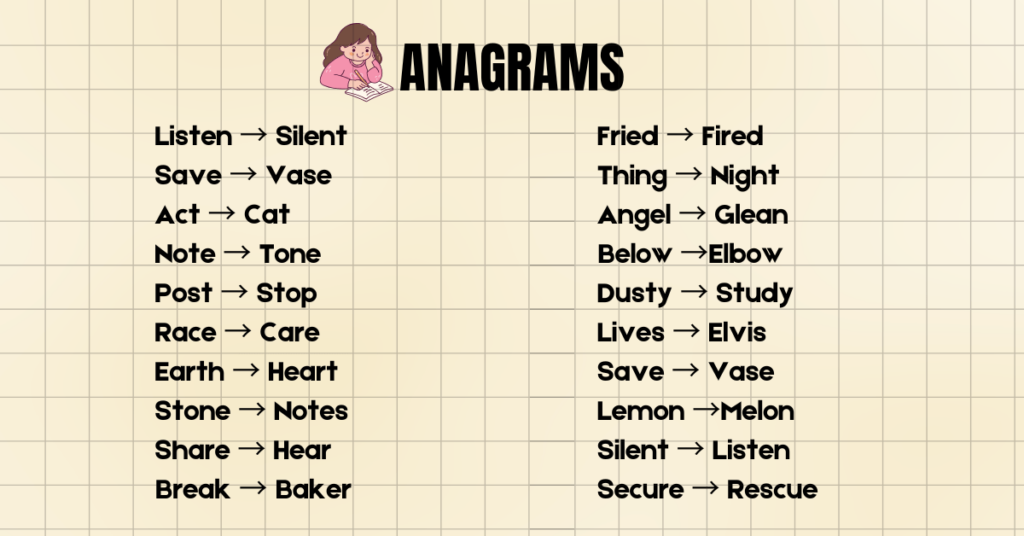
Examples of Anagrams

  • ListenSilent
  • SaveVase
  • ActCat
  • NoteTone
  • PostStop
  • RaceCare
  • EarthHeart
  • StoneNotes
  • ShareHear
  • BreakBaker
  • FriedFired
  • ThingNight
  • AngelGlean
  • BelowElbow
  • DustyStudy
  • LivesElvis
  • SaveVase
  • LemonMelon
  • SilentListen
  • SecureRescue

50+ Common Anagram Examples with Meanings

Here is a curated list of 50+ anagram examples—some simple single-word flips, others clever multi-word classics. Read these aloud to train your brain to spot letter patterns quickly.

# Original Word / Phrase Anagram Type
1 LISTEN SILENT Classic single-word
2 EARTH HEART Classic single-word
3 NIGHT THING Classic single-word
4 SAVE VASE Beginner
5 STRESSED DESSERTS Meaningful reversal
6 TEACHER CHEATER Ironic
7 BEDROOM BOREDOM Playful
8 DORMITORY DIRTY ROOM Clever multi-word
9 ASTRONOMER MOON STARER Clever multi-word
10 SCHOOLMASTER THE CLASSROOM Clever multi-word
11 DEBIT CARD BAD CREDIT Ironic phrase
12 ELEVEN PLUS TWO TWELVE PLUS ONE Mathematical
13 THE EYES THEY SEE Clever multi-word
14 PUNISHMENT NINE THUMPS Playful
15 A DECIMAL POINT I’M A DOT IN PLACE Self-descriptive
16 ELECTION RESULTS LIES — LET’S RECOUNT Political humor
17 MOTHER-IN-LAW WOMAN HITLER Humorous
18 CONVERSATION VOICES RANT ON Self-descriptive
19 DICTIONARY INDICATORY Advanced
20 SLOT MACHINES CASH LOST IN ME Self-descriptive
21 SNOOZE ALARMS ALAS! NO MORE Z’S Witty
22 FUNERAL REAL FUN Ironic
23 THE MORSE CODE HERE COME DOTS Famous classic
24 THE COUNTRYSIDE NO CITY DUST HERE Self-descriptive
25 SOFTWARE SWEAR OFT Humorous
26 ANGEL GLEAN Single-word
27 BELOW ELBOW Beginner
28 DUSTY STUDY Beginner
29 LIVES ELVIS Pop culture
30 LEMON MELON Beginner
31 SECURE RESCUE Single-word
32 FRIED FIRED Beginner
33 NAMES MEANS Single-word
34 ENRAGED ANGERED Synonymous
35 FOREST FOSTER Single-word
36 CAUTIONED EDUCATION Clever
37 STATUE ASTUTE Intermediate
38 FLUSTER RESTFUL Opposites
39 DIRTY ROOM DORMITORY Reverse classic
40 A GENTLEMAN ELEGANT MAN Self-descriptive
41 HIBERNATES BANISHETH Archaic / advanced
42 PRESBYTERIAN BEST IN PRAYER Thematic
43 OLD WEST ACTION CLINT EASTWOOD Celebrity
44 DESPERATION A ROPE ENDS IT Dark thematic
45 ELEVATION TO A LEVEL IN Thematic
46 SIGNATURE A TRUE SIGN Thematic
47 PAYMENT RECEIVED EVERY CENT PAID ME Clever long
48 ACT CAT Beginner
49 NOTE TONE Beginner
50 POST STOP Beginner
51 RACE CARE Beginner
52 BREAK BAKER Single-word
53 STONE NOTES Single-word
54 SHARE HEARS Single-word
55 RESISTANCE ANCESTRIES Advanced

Tip: Try covering the right column and guess the anagram yourself. This simple drill—five minutes a day—accelerates both vocabulary recall and spelling confidence.

How to Use Anagrams in Learning English

  1. Word Games
    Try finding anagrams for words you encounter daily. For instance, if you see stone, think of tones or notes.
  2. Challenge Yourself
    Take a sentence or phrase and see how many anagrams you can form. Apps and online tools like Anagram Solver can help!
  3. Practice Spelling
    Use anagrams to test and improve your spelling. Rearrange the letters of a word in your head and try to recreate it.
  4. Learn Idioms and Phrases
    Create anagrams for idioms or phrases, like turning The Morse Code into Here come dots. It’s a great memory trick!

Anagrams and Communication

Anagrams are more than just a fun activity—they improve your cognitive skills and ability to see connections. When speaking or writing in English, this ability to think creatively and spot patterns can make your communication more engaging and impactful.

Try This: An Anagram Challenge!

Here’s a quick challenge for you:
Rearrange the letters of the word spar to form a new word. (Hint: You use this word when you want to wrap a gift!)

Drop your answer in the comments or share your own favorite anagrams!

👉 Boost Your English Speaking with EngVarta Daily!

Final Thoughts

Anagrams are proof that language is not just a tool but a craft that invites you to experiment and enjoy its endless possibilities. Whether you’re an English learner or a seasoned speaker, playing with anagrams can be a delightful way to grow your skills.

So, the next time you want to spice up your learning routine, dive into the magical world of anagrams. And remember, with every twist and turn of letters, you’re not just rearranging words—you’re unlocking the beauty of language.

You’ve read the comparison. You know the numbers. The only thing left is to actually start.


Frequently Asked Questions about Anagrams

What is an anagram?

An anagram is a word or phrase formed by rearranging the letters of another word or phrase. For example, “listen” can be rearranged into “silent” — the two words use the exact same letters but spell completely different things. Anagrams have been used for centuries as wordplay, in puzzles, in literature, and as a way to sharpen vocabulary and pattern recognition.

What is the meaning of anagram?

The word “anagram” comes from the Greek ana (back, again) and gramma (letter), literally meaning “letters back” or “letters rearranged.” In simple terms, an anagram is a rearrangement of the letters of one word or phrase to form another, using all the original letters exactly once.

How do you make an anagram?

To make an anagram from a word or phrase, follow these steps:

  1. Write down all the letters of the original word.
  2. Try rearranging them to form a new word or phrase using ALL the letters exactly once.
  3. Check that the new word or phrase makes sense as a real English word or meaningful phrase.

For longer phrases, anagram solvers and dictionaries can help. For learners, starting with short common words (4-6 letters) is the easiest entry point.

What are some common examples of anagrams?

Here are popular English anagrams:

  • listen ↔ silent
  • night ↔ thing
  • elbow ↔ below
  • state ↔ taste
  • earth ↔ heart
  • angel ↔ angle
  • study ↔ dusty
  • stressed ↔ desserts
  • astronomer ↔ moon starer
  • school master ↔ the classroom

What is the difference between an anagram and a palindrome?

An anagram is a rearrangement of letters that forms a different word or phrase (“listen” → “silent”). A palindrome is a word, phrase, or sequence that reads the same forwards and backwards (“level,” “racecar,” “madam”). Anagrams change letter order to create new meaning; palindromes preserve symmetry. They are different forms of wordplay.

How do you solve an anagram?

To solve an anagram puzzle (where you have scrambled letters and need to find the hidden word):

  1. List the letters and count them.
  2. Look for common letter patterns and prefixes/suffixes (like -ing, -tion, un-, re-).
  3. Identify vowels and consonants — most English words follow predictable vowel-consonant patterns.
  4. Try common word lengths first (3-5 letter words) before longer combinations.
  5. Use process of elimination if you find one word — try the remaining letters separately.

Are anagrams useful for learning English?

Yes — anagrams are a strong vocabulary-building tool. They train you to recognise letter patterns, expand your active word recall, and notice spelling structure. They also make vocabulary learning playful, which improves retention. For learners building English fluency, regular anagram practice (10-15 minutes a day) reinforces the spelling-meaning connection that fast readers develop naturally.

What are anagram names?

Anagram names are personal or brand names that rearrange to form another meaningful word or name. They’re used as pen names by authors, in branding, in literature, and as puzzles. For example, the author Anne Bradstreet’s anagram is “Anne Bradstreet” → “are best in tread.” Many writers and brands use anagram names to add hidden meaning or playfulness to their identity.

How can I practice anagrams as part of English learning?

Daily anagram practice (10-15 minutes) builds vocabulary recall and spelling pattern recognition. You can use online anagram solvers, word puzzle apps, or browser-based games. For learners working on broader spoken English, pairing anagram vocabulary with daily live speaking practice helps you actively use the new words rather than just recognise them. EngVarta’s TESOL/ESL-certified Experts can help you incorporate new vocabulary into real conversation through 1-on-1 audio sessions, with a $1 refundable trial to try the format on a vocabulary topic.

Why are anagrams included in English learning curricula?

Anagrams are included in English curricula because they:

  • Strengthen letter-pattern recognition (foundation of reading fluency)
  • Expand active vocabulary by forcing you to retrieve words from memory
  • Improve spelling accuracy through repeated exposure to letter combinations
  • Build problem-solving skills that transfer to other language tasks
  • Make vocabulary learning playful, which improves retention especially in younger learners

How to Stop Translating from Your Native Language While Speaking English

November 29, 2024 • 4 min read • By Swati Raj

How to Stop Translating from Your Native Language While Speaking English

Mastering English fluency can feel like scaling a mountain, especially when you find yourself mentally translating sentences from your native language. This habit can slow down your responses, reduce confidence, and make conversations awkward. But here’s the good news—breaking free from this cycle is entirely achievable! In this blog, we’ll explore why this happens and provide actionable tips to think and speak directly in English. We’ll also dive into how the EngVarta, one of the best English learning apps, can be your game-changing tool in this journey.

Why Do You Translate While Speaking English?

  1. Dependency on Familiar Patterns
    Your brain prefers your native language because it’s familiar and comfortable. Translating gives you a sense of security.
  2. Lack of Vocabulary
    Without a strong English vocabulary, you search for equivalents in your native language, creating a habit of translation.
  3. Fear of Making Mistakes
    Translating can feel like a safety net to ensure correctness, even though it slows your fluency.

Effects of Translating on Your English Fluency

  • Slow Response Time
    Mental translation delays your replies, making conversations feel stilted.
  • Grammatical Errors
    Different languages have unique structures, and literal translations often result in incorrect grammar.
  • Reduced Confidence
    You may feel hesitant and self-conscious, hindering your ability to express yourself freely.

7 Practical Tips to Stop Translating in Your Head

1. Immerse Yourself in English

Surround yourself with English content—books, movies, and podcasts. Immersion helps your brain adapt to thinking directly in English.

2. Practice Speaking Daily

Regular practice builds muscle memory for English phrases and expressions. Using apps like EngVarta, widely regarded as the best English practice app, offers real-life speaking opportunities to enhance your fluency.

3. Learn Vocabulary in Context

Instead of memorising word lists, learn words through sentences or situations. This helps you recall them naturally during conversations.

4. Think in English

Start narrating your day, thoughts, or plans in English in your mind. It’s a small step toward forming an English-speaking habit.

5. Use Visual Learning

Connect words directly to images or experiences instead of your native language. For instance, associate “apple” with the fruit, not the translation.

6. Be Okay with Mistakes

Fluency comes with practice, and mistakes are part of the process. Focus on expressing yourself rather than perfection.

7. Engage with Native or Fluent Speakers

Speaking with fluent English speakers forces you to think on your feet and respond quickly without translating.

How EngVarta Can Help You Stop Translating

EngVarta is a practical solution for anyone struggling with fluency issues and translation habits. It’s not just another app; it’s one of the best English speaking apps for immersive learning. Here’s how:

1. Real-Time English Conversations

The app connects you with live English experts, allowing you to practice speaking in real-life scenarios without judgment.

2. Personalized Learning

Experts provide corrections and suggestions tailored to your needs, helping you refine your English without relying on translations.

3. Convenience and Flexibility

Practice anytime, anywhere. The app’s flexibility ensures you never miss a session, keeping your progress consistent.

4. Confidence Building

With daily practice and supportive feedback, you’ll gradually gain the confidence to think and speak directly in English.

When it comes to the best spoken English apps, EngVarta shines with its ability to mimic real-world conversations and give learners the environment they need to succeed.

Success Stories: How Users Overcame Translation Habits with EngVarta

Many EngVarta users have shared inspiring journeys of breaking free from translation dependency. For instance:

    • Ravi, a working professional, mentioned how daily conversations on EngVarta helped him respond confidently during client meetings.
    • Anita, a homemaker, shared that thinking in English became natural after practicing small talk with EngVarta experts every evening.

Their success underscores why EngVarta is considered one of the best English learning apps for building fluency.

Conclusion

Stopping the habit of translating while speaking English isn’t an overnight process—it’s a gradual transformation. By immersing yourself in the language, practicing consistently, and using tools like the EngVarta app, you can train your brain to think and communicate directly in English. Whether you’re preparing for interviews, academic goals, or daily conversations, EngVarta stands out as the best English practice app to help you master fluency.

Ready to level up your English? Download EngVarta, one of the best spoken English apps, today and start your journey to confident, translation-free English conversations!

What Are the 12 Rules of Grammar?

November 5, 2024 • 12 min read • By Swati Raj

What Are the 12 Rules of Grammar?

Good grammar is essential for making sure our sentences are clear, precise, and understood as we intend. Knowing a few fundamental grammar rules can help anyone, from beginners to advanced learners, improve their writing and speaking skills. Here are the 12 essential grammar rules that everyone should know.

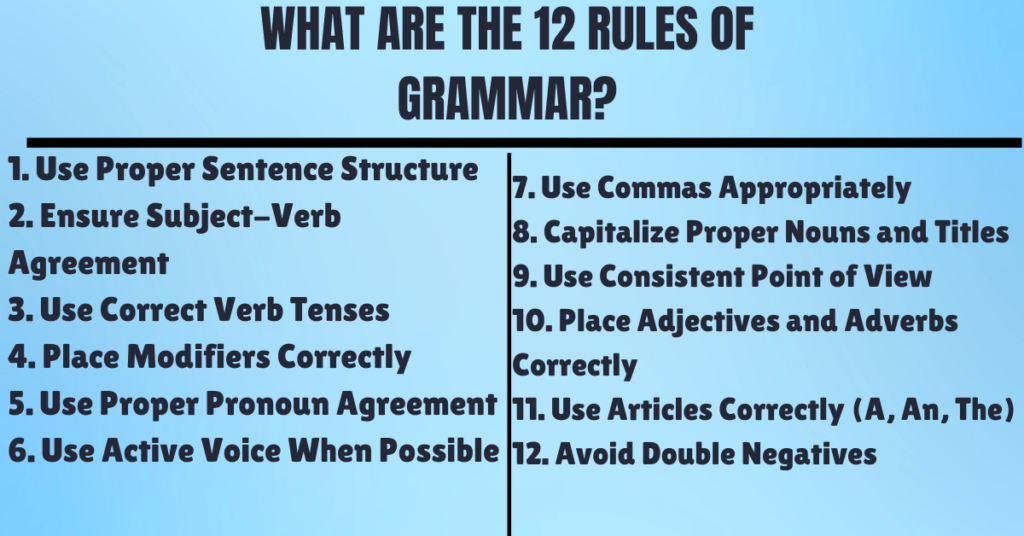
1. Use Proper Sentence Structure

Every sentence should have at least one subject (who or what the sentence is about) and one predicate (what the subject is doing). Together, these form a complete thought. This grammar rule ensures your sentences are clear and convey a complete idea.

Example: The dog barked loudly.
Here, “The dog” is the subject, and “barked loudly” is the predicate.

2. Ensure Subject-Verb Agreement

In a sentence, the subject and verb must agree in number. This means a singular subject takes a singular verb, and a plural subject takes a plural verb. This grammar rule is key to maintaining clarity in your sentences.

Example: She walks to school. (Singular subject and verb)
Example: They walk to school. (Plural subject and verb)

3. Use Correct Verb Tenses

Verb tenses indicate when an action occurs (past, present, or future). It’s essential to use the correct tense and be consistent throughout your sentence or paragraph. This grammar rule ensures your reader or listener knows when the action is happening.

Example: He studied yesterday. (Past tense)
Example: She studies every day. (Present tense)

4. Place Modifiers Correctly

Modifiers add detail to a sentence, but they should be placed close to the word they’re modifying to avoid confusion. Misplaced modifiers can change the meaning of a sentence, so following this grammar rule is essential for accuracy.

Correct: The boy with a red hat is my friend.
Incorrect: The boy is my friend with a red hat.

5. Use Proper Pronoun Agreement

Pronouns must agree with the nouns they replace in both number (singular/plural) and gender. Following this grammar rule helps keep sentences clear and understandable.

Example: Sarah lost her book. (“Her” refers to Sarah)
Example: The students raised their hands. (“Their” refers to students)

6. Use Active Voice When Possible

In the active voice, the subject performs the action, making sentences clearer and more direct. This grammar rule can make your writing and speaking more engaging.

Active Voice: The chef prepared the meal.
Passive Voice: The meal was prepared by the chef.

7. Use Commas Appropriately

Commas help clarify meaning by separating different elements in a sentence. Use them to separate items in a list, introductory phrases, and clauses. This grammar rule is crucial for proper punctuation.

Example: After dinner, we went for a walk.
Example: She bought apples, oranges, and bananas.

8. Capitalize Proper Nouns and Titles

Always capitalize proper nouns (specific names of people, places, and things) and titles when they’re used as part of someone’s name. This grammar rule ensures correct formatting in formal writing.

Example: I visited New York City.
Example: Doctor Smith is here.

9. Use Consistent Point of View

Maintain a consistent point of view throughout a sentence or paragraph. Shifting from “I” to “you” or “he/she” within a sentence can be confusing. This grammar rule keeps the sentence focused.

Correct: I went to the market and bought some vegetables.
Incorrect: I went to the market, and you bought some vegetables.

10. Place Adjectives and Adverbs Correctly

Adjectives describe nouns, while adverbs modify verbs, adjectives, or other adverbs. Make sure they’re placed correctly to clarify what they’re modifying. This grammar rule enhances clarity.

Example: She quickly finished her homework. (Quickly modifies the verb finished)
Example: The blue car is mine. (Blue describes the car)

11. Use Articles Correctly (A, An, The)

“A” and “an” are indefinite articles and are used with non-specific nouns, while “the” is a definite article used for specific nouns. Following this grammar rule helps clarify which nouns are general and which are specific.

Example: I saw a cat. (Any cat)
Example: I saw the cat that lives in our neighborhood. (A specific cat)

12. Avoid Double Negatives

Double negatives can make sentences confusing. In English, using two negatives in the same sentence cancels each other out, making the sentence positive. This grammar rule is essential for clarity.

Incorrect: I don’t have no money.
Correct: I don’t have any money.

In Summary

These 12 grammar rules provide a strong foundation for clear, effective communication in English. Mastering them can make a significant difference in how well you express yourself, whether you’re speaking or writing. But remember, grammar alone isn’t enough. To truly build fluency, you need consistent, real-world practice. That’s where the EngVarta app comes in. It connects you with live English experts over phone calls, giving you a safe space to apply these rules in actual conversations, get instant corrections, and boost your confidence. Download the EngVarta app today and turn grammar knowledge into real communication skills. Happy learning!

Frequently Asked Questions about English Grammar Rules

What is grammar in English?

Grammar is the set of rules that governs how words combine to form sentences in a language. English grammar covers parts of speech (nouns, verbs, adjectives, etc.), tenses, sentence structure, punctuation, and word agreement. Knowing grammar helps you communicate clearly and be understood — it’s the structure underneath every sentence you speak or write.

What are the 12 basic rules of English grammar?

The 12 essential grammar rules every English learner should know:

  1. Subject-verb agreement — singular subjects take singular verbs, plural subjects take plural verbs.
  2. Use the correct tense — past, present, or future, consistently within a sentence or paragraph.
  3. Articles (a, an, the) — use them correctly with nouns to specify identity.
  4. Active vs passive voice — prefer active in most cases for clarity.
  5. Pronouns must agree with their antecedents — match number and gender.
  6. Modifiers are placed correctly — keep adjectives and adverbs near what they describe.
  7. Use prepositions correctly — different prepositions change meaning (“in” the room vs “on” the room).
  8. Capitalization rules — proper nouns, sentence starts, “I” pronoun.
  9. Punctuation — periods, commas, semi-colons, question marks each have specific uses.
  10. Conditional sentences — if/then patterns follow specific tense rules.
  11. Reported speech — direct speech to indirect speech requires tense backshift.
  12. Avoid double negatives — “I don’t know nothing” is incorrect; use “I don’t know anything.”

Why is grammar important in English?

Grammar matters because it creates clarity. Bad grammar in spoken English can change the meaning of what you’re trying to say or make you harder to understand. In professional contexts (interviews, emails, presentations), grammar errors signal lack of attention to detail. In everyday conversation, basic grammar accuracy helps native and fluent speakers process what you say without effort.

How many grammar rules are there in English?

There’s no single agreed-upon number. Comprehensive grammar reference books cover 100+ rules. For practical fluency, mastering the 12 core rules above plus 20-30 commonly-used patterns (tenses, prepositions, conditionals) is enough for most learners. Native speakers don’t consciously remember rules — they internalize patterns through exposure and use.

What are the most common grammar mistakes Indian English speakers make?

Frequent grammar errors include:

  • Using “the” with general statements (“I love the music” instead of “I love music”)
  • Confusing “since” and “for” with time expressions (“I am here since two days” — should be “for two days”)
  • Using continuous tense for stative verbs (“I am understanding” — should be “I understand”)
  • Subject-verb agreement with collective nouns
  • Mixing up “less” and “fewer” (use “less” for uncountable, “fewer” for countable)
  • Using “only” or “also” in the wrong sentence position

How can I improve my English grammar quickly?

To improve grammar in 4-8 weeks:

  1. Pick ONE grammar rule per week and use it deliberately in conversation and writing
  2. Read sector-relevant English content daily (news, blogs in your industry) — exposure cements patterns
  3. Get feedback from a teacher or expert who can flag specific mistakes you make
  4. Practice grammar in spoken contexts, not just written drills
  5. Track your most common errors in a notebook and review weekly

Grammar improves fastest when used in real conversation with someone who corrects you. Daily live practice with a TESOL/ESL-certified Expert (like through EngVarta’s $1 refundable trial) catches errors as you make them, which is more effective than self-study alone.

What is the difference between grammar and syntax?

Grammar is the broader set of rules covering all aspects of language structure (parts of speech, tense, agreement, articles, etc.). Syntax is specifically about how words are arranged in a sentence — the word order. Grammar includes syntax. For example, “The cat sat on the mat” follows English syntax (Subject-Verb-Object). Saying “Sat the cat on mat the” violates syntax even though all words are correct.

How long does it take to master English grammar?

Reaching solid functional grammar — where most of your spoken and written English is accurate — typically takes 6-12 months of consistent practice for intermediate learners. Mastering nuance (when to break grammar rules for style, regional variations, formal vs casual register) takes 2-4 years of immersion or deliberate practice. The 12 core rules above can be learned in 2-4 weeks; internalizing them takes longer.

What is the best way to practice English grammar?

The most effective grammar practice combines:

  • Live conversation with someone who corrects you in real time (1-on-1 with an expert is ideal)
  • Reading 30 minutes a day in English at your level
  • Listening to native English content (podcasts, shows) for natural rhythm
  • Writing short pieces and getting feedback
  • Targeted drills on your weakest areas (don’t just practice what you’re already good at)

Are grammar rules different in spoken English vs written English?

Yes — spoken English is more flexible. Native speakers regularly use sentence fragments, contractions (“gonna,” “wanna”), informal sentence endings, and start sentences with “And” or “But.” These would be flagged as errors in formal writing but are perfectly natural in conversation. Knowing both registers — formal grammar for writing and presentations, conversational grammar for everyday speech — is what fluent speakers do.

How to Pass the IELTS Test for Your Work Permit

September 19, 2024 • 6 min read • By Swati Raj

How to Pass the IELTS Test for Your Work Permit

Are you dreaming of securing a work permit abroad? Whether it’s the fast-paced life in Canada, the tech boom in Australia, or the rich cultural heritage of the UK, there’s one crucial step between you and your dream job: the IELTS test. The International English Language Testing System (IELTS) is a requirement for anyone seeking a work permit in an English-speaking country. But here’s the good news – with the right strategy, mindset, and practice, passing the IELTS test is entirely achievable!

This guide will walk you through key steps to crack the IELTS exam and get closer to that work permit you’ve been working toward.

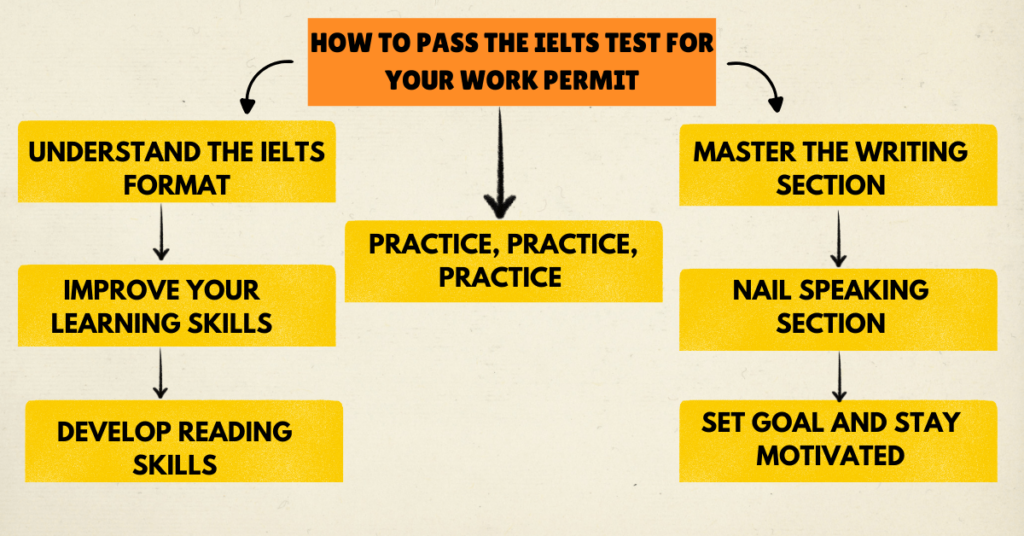
1. Understand the IELTS Format

The IELTS test assesses your English language skills across four areas: Listening, Reading, Writing, and Speaking. Each section is scored on a band scale from 1 to 9. The score you need depends on your destination country and job requirements.

Here’s a quick overview of what each section involves:

  • Listening: 40 questions based on four recorded monologues and conversations. (Duration: 30 minutes)
  • Reading: 40 questions testing comprehension from three texts. (Duration: 60 minutes)
  • Writing: Two tasks, including essay writing and report/letter writing. (Duration: 60 minutes)
  • Speaking: A face-to-face interview with the examiner. (Duration: 11-14 minutes)

Familiarizing yourself with the test format is the first step toward success. Knowing what to expect will help reduce exam anxiety and allow you to manage time effectively.

2. Improve Your Listening Skills with Authentic Resources

The Listening section evaluates not only your understanding but also your ability to follow different accents, word stress, and informal language. You’ll hear speakers from various English-speaking countries, so exposing yourself to different accents is key.

Pro Tips:

  • Watch English-language news channels like BBC, CBC, or Australian Broadcasting Corporation to get used to multiple accents.
  • Listen to podcasts on a variety of topics that interest you. Podcasts are great because they expose you to conversational English.
  • Practice listening to dialogues, interviews, and audio resources where speakers use different accents and speeds.

Regular exposure to authentic English content will sharpen your ability to catch key details and understand various accents, which is essential for scoring well in the Listening section.

 3. Develop Analytical Reading Skills

The Reading section is more than just scanning texts quickly. You’ll need to understand and analyze the material. This section requires you to identify key ideas, understand arguments, and draw inferences.

Pro Tips:

  • Read a variety of texts, such as newspapers, research articles, blogs, and opinion pieces. Focus on publications like The Guardian, The Economist, or National Geographic.
  • Pay attention to how the content is structured. Look at how arguments are presented, evidence is supported, and conclusions are drawn. This practice will help you recognize similar patterns in the IELTS exam.
  • Practice skimming for general ideas and scanning for specific information.

Make it a habit to ask yourself questions like, “What’s the main idea?” and “What’s the writer’s argument?” This will help you prepare for the wide range of texts you’ll encounter during the test.

4. Master the Writing Section with Structured Practice

For the Writing section, structure and clarity are essential. Task 1 typically involves writing a report based on visual data or a letter, while Task 2 requires you to write an essay on a specific topic. Here, you’ll need to demonstrate strong grammar skills and the ability to organize your thoughts logically.

Pro Tips:

  • Task 1: Practice writing short reports or letters. Focus on describing graphs, charts, or data trends in clear, concise language.
  • Task 2: Develop your essay-writing skills using a simple structure: Introduction, Body (two paragraphs), and Conclusion. Ensure each paragraph has a clear point and supporting evidence.
  • Avoid overly complicated sentences. Simplicity and clarity score higher than complex yet unclear writing.
  • Time yourself during practice. Write essays within the 40-minute limit for Task 2, and ensure you don’t spend more than 20 minutes on Task 1.

Aim for coherence (a smooth flow of ideas) and accuracy (correct grammar and vocabulary). These are the hallmarks of a high-scoring essay.

5. Nail the Speaking Section with Fluency and Confidence

The Speaking section can be intimidating because it involves a face-to-face interview with an examiner. However, it’s also one of the most rewarding sections if you can demonstrate fluency and confidence in your speaking ability.

Pro Tips:

  • Practice speaking English daily. Find a language partner or join an online speaking club to practice with native or fluent speakers.
  • Record yourself speaking on random topics, then listen to your recordings to improve pronunciation and fluency.
  • Focus on fluency over perfection. Don’t pause too often to think about grammar. Speak naturally and confidently.

The examiner isn’t looking for flawless English. Instead, they’ll assess how well you can communicate your ideas. Confidence plays a huge role here, so the more you practice, the more comfortable you’ll be during the actual exam.

6. Practice, Practice, Practice

There’s no shortcut to success in the IELTS exam – consistent practice is the key. Schedule dedicated time to practice each section of the test, and simulate real exam conditions whenever possible. This will help you manage your time during the actual test and avoid feeling overwhelmed.

Pro Tips:

  • Use official IELTS practice tests available online or in study books to familiarize yourself with the test format and question types.
  • Join IELTS preparation courses or work with a tutor to receive personalized feedback and guidance.
  • Track your progress by identifying mistakes and weak areas, then systematically work on improving them.

7. Set a Goal and Stay Motivated

Finally, keep your eye on the prize. Passing the IELTS test is your gateway to better job opportunities, higher income, and a world of possibilities. Set clear, achievable goals for each section, and stay disciplined in your preparation.

If you ever feel stuck or unmotivated, remind yourself why you’re taking this test. Your work permit is within reach, and each day of preparation brings you closer to that goal.

Final Thoughts

Passing the IELTS test isn’t just about language proficiency – it’s about preparation, practice, and persistence. By understanding the test format, honing your English skills, and developing the right strategies, you’ll be well on your way to success. Every day you spend preparing is a step closer to that work permit and the dream job you’ve been envisioning.

So, gear up, put in the effort, and get ready to ace the IELTS. Your future abroad is waiting for you!

Stay Connected with Fixolang

For more tips and real-time practice, connect with us on all our social media platforms:

Or download the Fixolang App for instant IELTS practice and feedback:

Prepare smarter, and pass your IELTS test with confidence. Happy learning!