Speak English Confidently |

TAG: speak English confidently

Why Does My Mind Go Blank When Speaking English? (And How to Fix It)

April 13, 2026 • 12 min read • By Rishish Pandey

Why Does My Mind Go Blank When Speaking English ?

When your mind go blank while speaking English, it can feel frustrating and confusing. You may know the words, understand grammar, and still find yourself unable to speak in real conversations. You are not alone—this is a very common problem among English learners around the world.

The good news is that when your mind goes blank while speaking English, there is a clear fix. It is not just about finding the best spoken English app or joining the best English speaking course online, although these can support your learning. The real solution is regular, daily speaking practice that trains your brain to respond in English automatically.

Platforms like EngVarta help you bridge this gap by giving you real speaking practice with experts, so you don’t just learn English — you actually use it in real conversations. In this guide, we break down exactly why your mind goes blank when speaking English and the proven methods to overcome it.

Why Does Your Mind Go Blank When Speaking English?

When you speak your native language, your brain processes words almost automatically. Years of practice have built deep neural pathways. With English, those pathways are still developing. Every sentence needs active mental effort. When you add nervousness or fear of judgment on top of that effort, your brain gets overwhelmed and words that you know become temporarily inaccessible.

This is why intelligent people with strong written English can still experience their mind going blank while speaking English. It is not a vocabulary problem. It is a processing speed problem.

The 4 Main Reasons Your Mind Goes Blank

  • Translation habit — You mentally translate from your mother tongue to English before speaking. This doubles your brain’s workload and causes mid-sentence freezing.
  • Fear of making mistakes — The moment you start monitoring your grammar while speaking, your brain splits attention between producing speech and judging it. Both suffer.
  • Lack of automaticity — You know the words but your brain has not practised retrieving them fast enough for real-time conversation.
  • Infrequent speaking practice — Without regular practice, English stays in your conscious-effort brain instead of your automatic-response brain.

How to Stop Freezing While Speaking English: 7 Proven Methods

If you want to stop your mind from going blank when speaking English, these strategies address the root causes — not just the symptoms. Each method helps build the automaticity your brain needs to speak without freezing.

1. Practise Speaking English Every Day

Your brain builds automatic responses through daily repetition. Ten minutes of actual English conversation practice every day is more effective than three hours of grammar study once a week. Consistency is what rewires your brain to think in English while speaking, rather than translating from your mother tongue.

The fastest way to build this habit is with a dedicated English conversation practice platform where you speak with a real person daily. This is far more effective than self-study for overcoming the freeze response.

2. Train Your Brain to Think in English While Speaking

Every time you mentally translate, your brain does double work. To stop your mind going blank when speaking English, you need to eliminate this translation step. Start small:

  • Narrate your daily activities in English inside your head
  • When cooking, commuting, or walking, describe what you see in English
  • Think about your to-do list in English, not your native language
  • Set your phone and social media to English

This habit, practised consistently for a few weeks, gradually trains your brain to think in English while speaking. The translation delay disappears and words start flowing naturally.

3. Practise Under Real Social Pressure

AI chatbots and language apps are useful, but they do not replicate the specific nervousness of speaking with a real person. That nervousness — the pressure of someone listening and waiting for your response — is precisely what you need to practise under to overcome English speaking fear.

The only way to get comfortable speaking English under pressure is to practise speaking English under pressure — gradually and in a safe environment. This is where platforms like EngVarta make a real difference. You speak with trained English experts in real conversations, building exactly the kind of speaking English confidence that eliminates the freeze response.

4. Learn Filler Phrases to Buy Your Brain Time

Even fluent native English speakers pause and search for words. The difference is they have automatic filler phrases that prevent awkward silence while their brain catches up:

  • “That’s a great question, let me think…”
  • “What I mean is…”
  • “So basically…”
  • “To be honest…”
  • “How do I put this…”

Memorise 8-10 of these phrases and use them deliberately. They are not cheating — they are a legitimate conversational tool that stops your mind from going blank when speaking English by giving your brain a few extra seconds to find the right word.

5. Record Yourself Speaking Every Day

Record a 2-3 minute video of yourself speaking English on any topic. This does two powerful things:

  • It removes the social pressure, letting you practise output without freezing
  • When you listen back, you discover you speak better than you thought — which directly reduces future anxiety

Most people who struggle with their mind going blank while speaking English are surprised to find that their actual speaking ability is much better than it feels in the moment.

6. Accept That Pauses Are Normal

Silence feels much longer to the speaker than to the listener. Research shows that pauses of 2-3 seconds are completely normal in any conversation. Listeners rarely even notice them. When you accept that a pause is okay, the panic reduces, and the pause itself becomes shorter.

Reframing pauses as normal is one of the simplest ways to overcome English speaking fear. You do not need to speak perfectly or without breaks. You just need to keep going.

7. Gradually Increase the Difficulty

Start with low-pressure practice and work your way up:

  1. Talk to yourself in English (zero pr

    What Our Learners Say

    Rated 4.5★ from 9,100+ reviews on Google Play

    ★★★★★
    In the beginning I felt very nervous to talk but when I picked the call the expert spoke in such a gentle way. I really liked it.
    ★★★★★
    This app is amazing, it's helpful and good. The tutors are very excellent. I am improving and don't shy anymore.
    ★★★★★
    Really we can see the positive results from the app. Well done!
    ★★★★★
    Thank you guys for this amazing app. I think this application will help me to improve my communication skills.
    ★★★★★
    All the experts are really good. Every day talking to a new expert and all taught me something new.
    ★★★★★
    Let me congratulate you on your endeavour to help people gain confidence while speaking. I enrolled for your vocabulary series. You guys are doing a good job. Keep it up.
    ★★★★★
    thanks for guide me i will try to connect your team and good communication with person so thank you teaching with me.
    ★★★★★
    Thanks EngVarta I appreciate your platform sir for those who willing to learn speaking English fluently
    ★★★★★
    I find the app very helpful and user friendly. The UI design is very soothing for eye. Students can get good benefit out of it if they regularly use it to practise their spoken English. Good luck to the app team for building a professional app for the greater good.
    ★★★★★
    It's a incredible app... It builds my confidence to speak English fluently, gives you practice to start your conversation without any hesitation, provides daily free vocabulary and quizes also...Expensive but amazing & worth it...
    ★★★★★
    I highly recommend this app.this App is soo good for beginners who want to learn English.
    ★★★★★
    This app is too much helpful for me. I can surely say that every student must follow this app for their English speaking.

    Ready to Practice with Real Experts?

    Try EngVarta today — ₹69 trial (India) / $1 trial (International) · 100% refundable

    essure)
  2. Speak with a trusted friend or family member
  3. Practise with a trained expert on EngVarta (structured, judgment-free)
  4. Speak with colleagues or strangers in real situations

Each step up trains your nervous system to handle more social pressure without your mind going blank when speaking English. Do not skip steps — the gradual exposure is what makes the improvement stick.

How EngVarta Helps You Stop Freezing When Speaking English

EngVarta is built specifically for people whose mind goes blank when speaking English. Here is how it works:

  • Daily live conversations — Speak with trained English experts every day, not once a week. Daily practice is what builds automaticity.
  • Real humans, not AI bots — The social element of speaking with a real person is preserved, which is exactly what trains your brain to handle real conversations.
  • Audio-only format — No video means less pressure. You can practise from anywhere without worrying about how you look.
  • Real-time corrections — Experts gently correct your mistakes during conversation, so you improve naturally without textbook study.
  • Flexible timing — Available 7 AM to midnight, so you can practise at whatever time fits your schedule.
  • Affordable for daily use — Starting at from ₹2,700 for 25 sessions for daily sessions, making it accessible for consistent practice.

Over 2 million learners have used EngVarta to build their spoken English confidence. Most users report noticeable improvement in speaking fluency within 3-4 weeks of daily practice.

Download EngVarta:

Start with the ₹69 / $1 trial. If it does not work for you, get a full refund. No questions asked.

Download on Google Play →
Download on App Store →

Available on Android & iOS • 2M+ learners • 4.5★ rating


How Long Does It Take to Improve Spoken English?

Most people notice their mind goes blank less often within 3-4 weeks of consistent daily speaking practice. Full automaticity — where English feels natural and words come without searching — usually develops over 3-6 months.

The amount of time you spend studying is not the crucial factor. It depends on how often you practise speaking. Because your brain consolidates language learning during sleep following each practice session, even 15 minutes of daily English conversation practice results in quantifiable improvement.

👉 Connect with EngVarta
Stay inspired and improve your English every day with us:

📸 Instagram : https://www.instagram.com/engvarta.app/
▶️ YouTube : http://www.youtube.com/@EngVarta
📘 Facebook : https://www.facebook.com/engvarta
💼 LinkedIn : https://www.linkedin.com/company/engvarta

✨ Follow us and start your English learning journey today!

Conclusion

If your mind goes blank when speaking English, the problem is not your intelligence or your vocabulary. It is simply that your brain has not had enough real speaking practice to make English automatic. The solution is straightforward: speak English every day, even if it is just for 15 minutes, in a structured and supportive environment.

Stop studying more grammar. Stop memorising more vocabulary. Start speaking. That is how you improve spoken English and build the confidence to never freeze again.

Ready to stop your mind going blank? Start daily English conversation practice with a real expert on EngVarta today.

Frequently Asked Questions

Q1, Why does my mind go blank while speaking English but not in my native language?

Ans : You have spent decades speaking your mother tongue. The neural pathways are deeply automatic. English pathways are newer and require conscious effort. When nervousness is added, your brain’s resources get overwhelmed and words become temporarily inaccessible. The gap closes with regular daily speaking practice over weeks and months.

Q2. How can I overcome English speaking fear?

Ans : The most effective way to overcome English speaking fear is gradual exposure. Start with low-pressure situations like talking to yourself, then move to structured practice with a trained expert on EngVarta, then to real-world conversations. Each step teaches your brain that speaking English is safe. Avoiding English conversations makes the fear worse, not better.

Q3. How to stop freezing while speaking English at work?

Ans : Workplace freezing happens because the stakes feel high. The fix is to practise the same type of conversations (presentations, meetings, client calls) in a low-stakes environment first. Daily English conversation practice with an expert builds the automatic responses you need so that when the pressure is on at work, words come without effort.

Q4. How many minutes a day should I practise to improve spoken English?

Ans : Even 10-15 minutes of real spoken English practice per day produces noticeable improvement within 3-4 weeks. Consistency beats duration. Practising 15 minutes daily is far more effective than a two-hour session once a week, because your brain builds and reinforces neural pathways during sleep after each practice session.

Q5. Is there an app that helps build speaking English confidence?

Ans : EngVarta is designed specifically for building speaking English confidence. It provides daily live conversations with trained English experts who correct your mistakes in real time. Unlike AI chatbots, the human interaction element helps your brain learn to handle real social pressure, which is what actually builds lasting confidence.

Q6. Will my English speaking ever feel natural and effortless?

Ans : Yes. With 3-6 months of consistent daily practice, most learners reach a point where English conversation feels natural in familiar situations. Your mind will stop going blank when speaking English because the neural pathways become automatic — similar to how driving a car becomes effortless after enough practice.

How to Build English Speaking Confidence: 8 Habits That Actually Work

March 20, 2026 • 8 min read • By Rishish Pandey

How to Build English Speaking Confidence

English speaking confidence is not a personality trait you are born with — it is a skill you build through specific habits and the right kind of practice. Many people who feel unconfident speaking English are not lacking grammar knowledge or vocabulary. They are lacking the repeated experience of speaking successfully. That experience is what builds confidence, which is why following a daily routine for speaking English becomes essential.

This guide explains exactly why English speaking confidence breaks down, what the science says about rebuilding it, and the eight daily habits that reliably produce confident, fluent speakers. It also highlights the best apps for English confidence and how a daily routine for speaking English can help you improve

Why You Lack Confidence Speaking English (It’s Not What You Think)

Most people assume their lack of confidence comes from not knowing English well enough. In reality, confidence and competence are two separate things. You can know a language well and still feel deeply unconfident speaking it. The reason is almost always one of the following:

  • Too few successful speaking experiences.

    Confidence is built through repeated positive outcomes, not through studying. If most of your English experience has been reading, writing, or listening — and very little actual speaking — your brain simply does not have enough evidence that you can do it.

  • A critical inner voice.

    Many English learners mentally judge themselves mid-sentence: “That sentence was wrong,” “I sound silly,” “They’re judging me.” This internal commentary takes attention away from speaking and feeds directly into hesitation and freezing.

  • Learned English in a low-speaking environment.

    Most English education in India and other non-English-speaking countries prioritises reading, writing, and grammar over speaking. Students graduate knowing English — but with almost zero experience speaking it under social conditions.

  • Comparing yourself to native speakers.

    Fluency exists on a spectrum. Comparing your spoken English to that of a native speaker sets an unfair benchmark that crushes confidence before practice can build it.

The Psychology of Confidence: What Actually Changes It

Psychologist Albert Bandura’s concept of “self-efficacy” — your belief in your ability to perform a specific task — is the most useful framework for understanding English speaking confidence. Self-efficacy is changed by four specific things:

  1. Mastery experiences — Successfully completing a speaking task (even a small one) raises self-efficacy more than anything else.
  2. Vicarious experience — Seeing someone similar to you succeed at speaking English builds your belief that you can too.
  3. Social encouragement — Being told by someone credible that you are improving and that you can do it.
  4. Reducing physiological anxiety — When your body’s fear response reduces, your confidence perception increases.

Notice what is not on this list: more grammar study, vocabulary drilling, or motivation videos. The only thing that builds speaking confidence is more experience of speaking successfully — starting small and gradually increasing the challenge.

8. Daily Habits to Build English Speaking Confidence
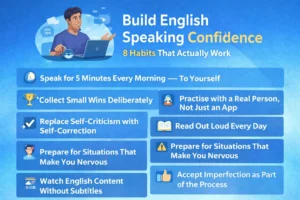
Build English Speaking Confidence 8 Habits That Actually Work
8 powerful daily habits to help you build English speaking confidence and improve fluency step by step

1. Speak for 5 Minutes Every Morning — To Yourself

Every morning, before your day begins, speak out loud in English for 5 minutes. Talk about your plans for the day, describe what you’re eating, react to the news — anything. The goal is not to say something interesting or grammatically perfect. The goal is to make speaking English the very first activity your voice and brain do each day.

2. Collect Small Wins Deliberately

Confidence is built from a pile of small successes, not a single breakthrough moment. Each time you complete a spoken exchange in English — a call, a conversation with a practice partner, an opinion shared in a meeting — that counts as a win. Keep a simple log. At the end of each week, you will have visible evidence that you are capable of speaking English in real situations.

3. Practise with a Real Person, Not Just an App

The single most effective thing you can do for English speaking confidence is speak with a real person regularly. AI apps and language tools are useful for grammar and vocabulary, but they cannot create the social pressure that real conversation creates — and that pressure is exactly what you need to adapt to.

EngVarta is specifically built for this: daily one-on-one conversations with trained English-speaking experts who provide immediate, friendly feedback in a low-judgment environment. Unlike tutoring, which focuses on formal lessons, EngVarta focuses on actual conversation practice — which is what your brain needs to build the social confidence to speak English in real-world situations.

4. Replace Self-Criticism with Self-Correction

There is a critical difference between self-criticism (“I made a mistake, I’m bad at English”) and self-correction (“I used the wrong tense there — I’ll use the right one next time”). The first destroys confidence. The second builds competence. Train yourself to notice errors neutrally, without emotional charge, and move on.

5. Read Out Loud Every Day

Reading out loud for 5 to 10 minutes daily builds the physical habit of producing English sounds and sentences, and separates the act of speaking from the fear of being judged. Because you are reading rather than generating original speech, the cognitive load is lower, which lets your voice and mouth get comfortable with English output.

6. Prepare for Situations That Make You Nervous

Most English speaking anxiety is situational: a meeting with a foreign client, a job interview, a presentation, a phone call. Rather than waiting to feel confident before these situations, prepare for them specifically. Practise the vocabulary and phrases you will likely need. Run through likely questions and practise your answers out loud. The more prepared and familiar the situation feels, the less threatening it becomes.

7. Watch English Content Without Subtitles

Watching English films, shows, or YouTube content without subtitles trains your brain to process spoken English at natural speed. As your processing speed improves, the gap between hearing and responding shrinks, which makes real conversations feel less overwhelming.

8. Accept Imperfection as Part of the Process

The pursuit of perfect English before speaking is the single biggest confidence trap. No fluent speaker — native or non-native — speaks perfectly. Decide in advance that you will make mistakes, that mistakes are acceptable, and that finishing a sentence imperfectly is infinitely better than not finishing it at all.

Which App Should You Use to Build English Speaking Confidence?

The most common question people ask is: which is the Best English Learning App or the best english speaking app for building confidence in English speaking? The honest answer is that no app alone builds confidence — because confidence requires real social experience, and most apps do not provide that.

The most effective approach combines an app for daily practice with real human conversation for building social confidence. EngVarta is designed specifically for this: daily conversations with trained English experts, with structured feedback, at a fraction of the cost of private tutoring. Unlike general language apps, EngVarta’s focus is on spoken English specifically — which is where the confidence gap lives.

Can English practice apps really fix your hesitation?

Yes, but the type of app matters. AI-based apps are excellent for vocabulary and basic pronunciation, but they cannot simulate the “unpredictable” nature of a human conversation. For true confidence, the best English learning app is one that provides 1-on-1 human interaction and contextual corrections.

Comparison: Choosing the Best Way to Practice in 2026

Feature

AI Chatbots

Traditional Courses

EngVarta (Expert-Led)

Judgment Factor

Zero (Robot)

High (Peer pressure)

Zero (Anonymous Experts)

Real-world Spontaneity

Low (Programmed)

Medium

High (Unpredictable dialogue)

Correction Type

Grammar Only

Academic

Contextual & Professional

Accessibility

24/7

Scheduled

On-demand (7 AM – 12 AM)

Best For

Vocabulary

Writing/Grammar

Confidence & Fluency

Ready to Speak Confident English?

If you’re serious about improving your speaking skills, don’t just learn English.

Practice it live.

EngVarta offers daily one-on-one English speaking practice with real experts who guide, correct, and motivate you.

Stop waiting to feel “ready.”

Start speaking today.

 Download EngVarta App on Google Play | Download on iOS

How Long Does It Take to Become a Confident English Speaker?

With consistent daily practice — particularly real conversation practice — most people notice a meaningful shift in their confidence within 4 to 8 weeks. Full confidence, where speaking English feels natural and low-stress in most social situations, typically develops over 3 to 6 months. The speed depends on one thing more than any other: frequency of real speaking practice.

Join our Community for Daily Tips :

Conclusion: 

Building English speaking confidence in 2026 isn’t about how many grammar books you’ve read. It’s about how many minutes you’ve spent actually moving your mouth. Many people ask, “English confidence kaise badhaye?”—the answer is always: By speaking when you aren’t ready.

Ready to break your silence? Don’t wait for “perfect” English. Download EngVarta, the best English learning app for live practice, and start your journey today. Your first 1-on-1 session with an expert is just a tap away. Stop being a spectator in your own career; start speaking up.

Frequently Asked Questions

Why Your English Didn’t Improve in 2025 (Even Though You Tried)

December 15, 2025 • 7 min read • By Swati Raj

Speak English

(A moment of honest reflection)

You didn’t ignore English in 2025.
You didn’t “not care.”

You tried.

You watched videos on pronunciation.
You bookmarked reels on vocabulary.
You told yourself, “This year, I’ll finally improve.”

And yet, as the year quietly came to an end, you found yourself in the same place — still thinking too much before speaking, still hesitating in conversations, still doubting your words.

The image above captures that exact moment.
A quiet evening. A notebook open. A mind full of effort — and frustration.

This blog is not about blaming you.
It’s about understanding why effort didn’t convert into confidence.

Many learners want to speak English confidently, but end up stuck in the same cycle year after year. They understand English, can read it well, and even write decently — yet speaking still feels difficult. This gap between knowing English and speaking it confidently is what frustrates most learners.

The Truth Most Learners Don’t Hear

To speak English confidently, you don’t need more rules or more content. You need repeated exposure to real conversations where you can speak freely, make mistakes, and continue without fear.

Most learners struggle not because they lack intelligence, but because they never get enough chances to actually use English in real life.

English doesn’t improve just because you want it to.
It improves when the right habits replace the wrong ones.

Most learners repeat the same patterns year after year — not because they are lazy, but because no one shows them a better system.

Let’s walk through those patterns honestly.

You Kept Preparing Instead of Speaking

Preparation feels safe.

You can learn silently.
You can pause, rewind, and retry.
No one hears your mistakes.

So you kept preparing.

But here’s the uncomfortable truth:

Preparation without speaking is procrastination in disguise.

English is not absorbed like information.
It’s built like a muscle.

Until your mouth starts moving, improvement stays theoretical.

You Waited to Feel Confident Before Opening Your Mouth

Many learners believe confidence is a prerequisite.

“I’ll speak when I’m confident.”
“I just need a little more clarity.”
“I’m not ready yet.”

But confidence is not a starting point.
It’s a side effect.

Confidence comes after:

  • Saying things wrong

  • Getting corrected

  • Surviving awkward pauses

  • Realising nothing bad happened

Every confident English speaker you admire once spoke badly — repeatedly.

You Practiced Occasionally, Not Consistently

Some weeks you practiced seriously.
Other weeks disappeared into work, family, stress, or exams.

And then English quietly slipped down your priority list.

The problem isn’t missing a day.
The problem is not returning.

English rewards consistency, not intensity.

Ten minutes every day beats two hours once a week — every single time.

You Had No One to Correct You in Real Time

Learning alone creates blind spots.

You may:

  • Repeat the same mistake for months

  • Think your sentence is correct when it isn’t

  • Lose confidence because you’re unsure

Without real-time correction, your brain doesn’t know what to fix.

This is why many learners feel stuck despite “studying” for years.

You Skipped Practice When Life Got Busy — and Never Restarted

Life doesn’t pause for learning.

Deadlines come.
Health issues arise.
Responsibilities pile up.

So practice stops — temporarily.

But without a system, temporary breaks turn into permanent gaps.

English doesn’t disappear — but confidence does.

You Relied on Motivation Instead of a Routine

Motivation is emotional.
Routines are structural.

Motivation says, “I feel like practicing today.”
Routines say, “This is what I do daily.”

English improves when practice becomes as normal as brushing your teeth — not when you’re “in the mood.”

You Learned Alone — So Quitting Was Easy

When no one expects you, stopping feels harmless.

No accountability.
No reminder.
No sense of progress being watched.

Learning alone makes quitting invisible — until months later, when regret shows up.

This Is Not a Failure. It’s a Pattern.

And patterns can be changed.

Learners who finally speak English confidently don’t suddenly become smarter.
They simply change how they practice.

They speak first.
They practice daily.
They get corrected kindly.
They don’t do it alone.

How the EngVarta App Helps You Break This Pattern

EngVarta is designed for learners who want to speak English confidently in real-life situations — interviews, meetings, phone calls, and daily conversations.

EngVarta was created specifically for learners stuck in this exact loop.

Not beginners who don’t know English —
but learners who know English yet struggle to speak confidently.

Here’s how EngVarta directly solves the problems mentioned above:

1. It Forces You to Speak, Not Prepare

EngVarta connects you with real English experts for one-on-one live conversations.
You speak from day one — no waiting, no overthinking.

2. Confidence Comes Through Action

You don’t wait to “feel confident.”
Confidence builds naturally as you speak daily in a safe, supportive environment.

3. Daily Practice Becomes a Habit

Sessions are short and practical, designed for busy lives.
This removes the excuse of “no time” and builds consistency.

4. Real-Time, Friendly Corrections

Experts correct you gently while you speak — helping you improve without embarrassment or interruption.

5. You’re No Longer Learning Alone

Someone listens to you.
Responds to you.
Guides you.

That simple human connection changes everything.

If 2025 Felt Like a Loop, 2026 Can Be a Turning Point

English didn’t fail you.
Your effort didn’t go waste.

It just needed a better system.

One that replaces:

  • Preparation with practice

  • Motivation with routine

  • Isolation with guidance

Start Speaking — Not Someday, Today

👉 Download the EngVarta App:
Download for Android | Download for iOS

Speak daily.
Get corrected.
Build confidence through real conversations.

Stay Connected With EngVarta

Final Thought

Learning English is not the goal.
Being able to speak English confidently — without fear, hesitation, or overthinking — is.

And that confidence is built one real conversation at a time.

Frequently Asked Questions (FAQs)

Frequently Asked Questions

Who should use EngVarta to speak English confidently?

EngVarta is ideal for students, professionals, and job seekers who understand English but hesitate to speak. It helps learners gain confidence through consistent, guided speaking practice.

How does EngVarta help me speak English confidently?

EngVarta helps you speak English confidently through one-on-one live conversations with trained experts. You get real-time, friendly corrections that improve fluency and reduce hesitation.

Can I speak English confidently even if my grammar is weak?

Yes. You can speak English confidently without perfect grammar. Many confident speakers make small mistakes, but they communicate clearly. Grammar improves naturally with daily speaking practice.

How can I speak English confidently in daily life?

To speak English confidently, practice speaking every day in real situations. Focus on expressing your thoughts instead of worrying about mistakes. Confidence grows through usage, not perfection.

Why do I still struggle to speak English confidently?

Most learners struggle to speak English confidently because they prepare too much and speak too little. Without regular real conversations, confidence doesn’t develop—even if your understanding of English is good.

Speak English Confidently With These 3 Simple Tips

December 13, 2025 • 7 min read • By EngVarta

Speak English Confidently

Speaking English confidently is not about using advanced vocabulary or having perfect grammar.
To speak English confidently, the most important thing is feeling comfortable expressing your thoughts, even if your sentences are not perfect.

Many learners understand English very well but still hesitate when it comes to speaking.
The challenge is usually not a lack of knowledge, but a lack of confidence to speak English confidently in real conversations.

The problem is lack of real speaking practice.

In real conversations with English learners, one pattern appears again and again — people know what they want to say,  but freeze the moment they start speaking. This hesitation isn’t caused by weak grammar but by a lack of regular, judgment-free speaking practice.

If you want to speak English confidently in daily life, interviews, meetings, or social situations, these three simple tips can change the way you approach English forever.

Why Speaking English Confidently Feels Difficult

Before fixing the problem, it’s important to understand it.

Most learners struggle because:

  • They translate sentences in their head
  • They fear making mistakes
  • They don’t get regular speaking opportunities

Confidence doesn’t come from reading or watching videos alone.

When learners only consume English instead of using it, their brain stays in “understanding mode,” not “response mode.” Speaking requires fast thinking under pressure — something that only develops through real conversation.
It comes from using English regularly in real conversations.

Let’s look at what actually works.

Tip 1: Stop Preparing Sentences. Start Expressing Thoughts.

One of the biggest mistakes learners make is over-preparation.

They try to:

  • Memorise full sentences
  • Plan responses in advance
  • Wait for the “right moment” to speak

But real conversations don’t work like exams.

Learners who over-prepare sentences often pause mid-conversation, lose confidence, and abandon their point halfway. Those who allow themselves to speak imperfectly tend to recover faster and communicate more clearly.

To speak English confidently, you must learn to think while speaking, not before speaking.

What to Do Instead

Start expressing simple thoughts out loud — even if they sound incomplete.

For example:

  • Talk about what you are doing right now
  • Describe your day in simple English
  • Speak without stopping yourself for mistakes

Fluency grows when your mind learns that speaking is safe, even when it’s imperfect.

Tip 2: Make Mistakes in a Safe Environment

Mistakes are not the problem. Fear of judgement is.

Many learners stop speaking because:

  • People laugh
  • Corrections feel harsh
  • They feel embarrassed

This fear is natural — especially for adult learners. Confidence drops not because of mistakes, but because of repeated negative speaking experiences.

To speak English confidently, you need:

  • A patient listener
  • Supportive correction
  • Encouragement, not pressure

This is why practicing alone is not enough.
You need real human interaction with someone who helps you improve while you speak.

Tip 3: Practice English Daily, Not Occasionally

Confidence is not built in one day.

It is built through daily exposure.

Many learners wait for:

  • Free weekends
  • Long study hours
  • Motivation

But confidence grows faster with:

  • 10–15 minutes every day
  • Short, consistent speaking sessions
  • Regular feedback

Daily practice trains your brain to stop panicking and start responding naturally. Even short daily speaking sessions reduce hesitation within weeks because the brain stops treating English as a “performance” and starts treating it as a normal communication tool.

While you’re at it, make sure you’re also confident with small but essential elements like “a,” “an,” and “the.” These articles may seem simple, but they affect how professional and polished your English sounds.

Here’s a quick guide to brush up on them: Articles in English Grammar – A, An and The

How the EngVarta App Helps You Speak English Confidently

EngVarta was created for learners who understand English but struggle to use it in real conversations — a gap noticed repeatedly during live speaking interactions.

Knowing what to do is one thing.
Doing it daily is another.

This is where EngVarta helps learners bridge the gap between knowing English and speaking it confidently.

What Makes EngVarta App Effective

  • One-on-One Live English Conversations
    Speak directly with trained English experts.
  • Friendly, Real-Time Corrections
    Improve naturally without interruptions or embarrassment.
  • Daily Speaking Habit
    Short sessions designed for busy schedules.
  • Confidence-Focused Learning
    The goal is fluency through comfort, not fear.

EngVarta is designed for learners who already know English but struggle to use it confidently in real life.

Who Is This For?

Beginners

If English feels intimidating, EngVarta helps you start speaking gently, without pressure.

Practicing Learners

If you understand English but hesitate while speaking, real conversations help unlock fluency.

Serious Learners

If you want faster improvement for interviews, work communication, or daily confidence, consistent speaking practice makes the difference.

Start Speaking English Confidently Today

Confidence doesn’t come first.
Speaking comes first.

🔗 Download EngVarta:
Download for Android | Download for iOS

Practice real conversations.
Speak daily.
Build confidence naturally.

Stay Connected With EngVarta

Follow EngVarta for daily English tips, speaking guidance, and confidence-building content:

This article is based on real speaking interactions and learning patterns observed while helping English learners practice spoken English daily.

Conclusion :

Speaking English confidently is not about becoming perfect.
It’s about becoming comfortable.

And comfort only comes from practice.

Frequently Asked Questions

Who should use the EngVarta app?

EngVarta is ideal for students, working professionals, and anyone who understands English but struggles to speak confidently in real-life situations.

How does the EngVarta app help improve speaking confidence?

EngVarta provides one-on-one live conversations with trained English experts who offer friendly corrections, helping learners speak freely without fear or judgement.

Is speaking practice more important than reading and watching videos?

Yes. Reading and videos help with understanding, but speaking practice trains your brain to respond in real time, which is essential for confidence.

Do I need perfect grammar to speak English confidently?

No. Many confident speakers make small grammar mistakes. When you speak regularly, your grammar improves naturally over time through usage and feedback.

How can I speak English confidently without hesitation?

You can speak English confidently by practicing daily in real conversations. Focus on expressing your thoughts instead of worrying about mistakes. Confidence builds through repetition, not perfection.