MNC Interview English Fluency |

Tag

MNC interview english fluency

Best English Speaking App for College Students Preparing for Campus Placement Interviews (2026): Professor-Recommended for Interview Confidence

May 25, 2026 • 14 min read • By Rishish Pandey

Best English Speaking App for Campus Placements and interview preparation for college students

Quick Verdict

For Indian college students preparing campus placements, many learners now search for the best English speaking app for campus placements in 2026. EngVarta stands out because it gives daily live mock-interview practice with TESOL-certified English Experts on HR rounds, technical screening, and behavioural answers. Add peer group practice for GD specifically.

Why this verdict:

  • Best for: pre-final and final-year students before campus placements
  • Practice focus: HR rounds, technical screening, behavioural STAR answers, GD rhythm
  • Not ideal for: students whose technical or aptitude prep is the actual gap

Why Campus Placement Interview English Is Unlike Anything College Taught You

Indian engineering and arts colleges teach English as a subject — comprehension, essays, grammar, occasionally a presentation or two. They rarely teach spoken interview fluency. So you walk into your first campus placement round having never actually practiced answering a tough behavioural question out loud, in real time, with someone pushing back.

Campus recruiters know this. The HR round and behavioural round are deliberately designed to test exactly what college did not prepare you for:

  • Real-time response under interview pressure. The interviewer asks a question. You have 5 seconds to start answering coherently. There is no editing, no rewriting, and no time to construct the ideal words; simply speak.
  • STAR-format behavioural questions. “Tell me about a time you worked under a tight deadline.” “Describe a conflict in a team project.” You need a 90-second structured answer with situation, task, action, result — in confident spoken English without rehearsed-sounding delivery.
  • Group discussion (GD). 8-10 candidates, one moderator, a topic announced 30 seconds before the discussion starts. You need to enter the conversation, hold your point under interruption, build on others’ arguments, and summarise at the end. Students typically freeze within the first minute
  • Technical screening in spoken English. Even technical interviews are conducted in English now. Explaining a concept clearly in spoken English (not just writing code or recalling a definition) is the actual test.
  • “Tell me about yourself” answer. The deceptively simple opener. Most Indian students give a rambling chronological account (“I was born in…” or “My parents are…”). Trained students give a 60-second professional positioning that maps their background, key wins, and the role they want next.

None of these are knowledge gaps. They are spoken-English-under-pressure gaps, and they close only with daily live practice in interview scenarios.

The Six Campus Placement Interview Scenarios Every Indian Student Should Drill

1. “Tell me about yourself” — the 60-second answer that opens every interview

Practice opening with present-day positioning, then key wins, then forward-looking goal. “I am a final-year computer science student at [college]. My main focus has been in [domain], where I have done [project / internship]. Outside academics, I am also actively involved in [activity]. I am looking to start my career at a company where I can [specific skill / role focus].” Sixty seconds. Confident first-person delivery. Practice it until you can deliver it 20 different times with slight variations and still sound natural.

2. The STAR-format behavioural question

“Tell me about a time you handled a difficult teammate / missed a deadline / had to convince someone.” The trained pattern: Situation (10 seconds — what was happening), Task (10 seconds — what you needed to do), Action (40 seconds — what you specifically did), Result (20 seconds — what happened and what you learned). Total 80 seconds. Practice with 6-8 different real college / internship stories, mapped to the most common STAR questions.

3. The technical-explanation question in spoken English

“Explain DBMS normalisation in simple words” or “Walk me through how HTTPS works” or “How would you improve a sluggish SQL query?. The trained response: open with a one-sentence definition, give a relatable analogy, explain the core mechanism, mention one common gotcha or trade-off. Practice this for 8-10 concepts from your core subjects.

4. The group discussion entry and turn-taking

GDs reward whoever enters early with a structured opening + soft assertion. Practise opening statements: “Before we go into detail about the issue, may I briefly give three things that I believe will help frame our discussion?” Use the turn-taking signal: “I’d like to expand on what [name] just said—and add one more dimension…” Use the summary close: “We have covered [three important points]. . Putting it together, I think the key takeaway is…”

5. The “why this company / why this role” question

“Why TCS?” “Why Infosys?” “Why are you choosing IT services over product companies?” The trained response is research-backed and specific: one sentence on the company’s recent strategic direction, one sentence on a specific project or team or value that aligns with you, one sentence on what you would bring. Sixty seconds. Vague answers (“It is a good company”) lose the round.

6. “your weakness” and “salary expectation” curveballs

The two questions most Indian students answer badly. Weakness — never “I am a perfectionist”. Pick a real, specific, professional weakness with a credible plan to address it (“I tend to over-engineer solutions; I am learning to ship MVPs first”). Salary — honest range based on market and your value-add, not a deflection. Practice both until smooth.

The 8-12 Week Daily Practice Plan for Campus Placement

Weeks 1-3 (8-12 weeks before placement season): Foundation

  • Daily 15-minute live session with a TESOL/ESL-certified Expert.
  • Tell the Expert: “I am a final-year college student preparing for campus placement interviews. I want to drill HR rounds, behavioural questions, and confidence under pressure.”
  • Practice topic: spoken delivery of your TAY (tell-me-about-yourself) answer, your top 3 STAR stories, and 3-4 concepts from your core subjects.
  • Goal: by end of week 3, you can deliver TAY in 60 seconds without rehearsing, deliver each STAR story in 80 seconds, and explain any one core concept in 90 seconds.

Weeks 4-7: Full mock interview sessions

  • Daily 25-minute live sessions structured as full mock interview rounds.
  • Tell the Expert: “Today is a full mock. Start with TAY, then ask 2-3 behavioural questions, then 2 technical screens, then a curveball. Push back, follow up, do not let me wander.”
  • By end of week 7, you should have done 25-30 mock interview sessions — significantly more than the 2-3 mocks your college placement cell will give you.

Weeks 8-10: Pressure phase and GD drills

  • Daily 25-minute sessions with the Expert specifically pushing pace, interrupting you, and asking the curveball questions interviewers actually use.
  • Add 1-2 sessions per week on GD simulation — ask the Expert to play 1-2 group members with different viewpoints and force you to enter the discussion, hold your point, and summarise.
  • Record one session per week and listen back. Hearing your own filler words, pause patterns, and rambling moments is the fastest way to catch what to fix.

Weeks 11-12: Final consolidation and real interview prep

  • Drop intensity slightly — 4-5 sessions per week.
  • If you have an actual scheduled interview, do a specific mock the night before with the Expert simulating the company you are interviewing for.
  • Sleep matters more than additional drills in the final 2-3 days. Trust the muscle you have built over 8-10 weeks.

Total mock interview reps over 12 weeks: 60-90. This is the volume that converts “I freeze in interviews” to “I walk in calm and the answers come automatically.”

Why Professors Are Recommending EngVarta to Their Students

Across multiple Indian colleges in 2025-2026, we have seen professors and placement coordinators recommend EngVarta to their final-year students. Specifically, professors of placement-heavy departments (Computer Science, IT, Electronics, Commerce, MBA) are pointing students to daily live English practice because:

  • Placement cells cannot give every student daily interview practice. A college of 1,000 final-year students cannot run individual mock interviews daily. EngVarta is the scalable per-student supplement that fills the gap.
  • Group mocks at the placement cell are insufficient. One or two group mock-interview sessions before placement season is not enough volume to build interview-day confidence. Daily 15-minute sessions over 8-12 weeks delivers the volume.
  • Students from regional-medium backgrounds need more reps than English-medium students. For students who have a high CGPA but are nervous about interviews, instructors of mixed-medium classrooms especially advise regular live practice. Students are exposed to a variety of accents and conversational styles through the changing Expert pool, which mirrors the unpredictability of multi-round university interviews.
  • The recording feature lets professors review student progress. When a faculty mentor is involved, sessions recorded and accessible for 30 days mean the professor can spot-check student delivery and give targeted feedback before placement day.
  • Affordable for student budgets and parent budgets. ₹2,700 for 25 sessions of 15 minutes is sustainable across an 8-12 week prep window — most parents pay this for their child’s placement-prep specifically, since the ROI of one offer is many multiples of the platform cost.

If your college’s placement cell, English faculty, or department professor has recommended EngVarta, the typical path is: ₹69 refundable trial first, confirm the format works for you, then the 25-session entry plan to cover the 8-12 week prep window.

Ready to Practice with Real Experts?

Try EngVarta today — ₹69 trial (India) / $1 trial (International) · 100% refundable

What to Specifically Ask the Expert During Each Mock Interview Session

To get the most out of each session, tell the Expert at session start what kind of interview round you want them to run. Examples:

  • “Today is a TCS HR round. Start with TAY, ask 3 behavioural questions, push back when I am vague.”
  • “Today is an Infosys technical interview. Ask me to explain 2-3 data structures and 1 SQL concept.”
  • “Today is a banking-exam panel interview. Ask current affairs, banking-sector questions, ethics scenarios.”
  • “Today is an MAANG-India behavioural round using Amazon Leadership Principles.”
  • “Today is a GD simulation. Play two students with opposing views on [topic]. Force me to enter the discussion.”
  • “Today is a final-round CEO conversation. Ask me curveball questions about my career goals.”

The Expert adapts to your scenario. Different Experts each day means you encounter different personalities, accents, and conversational styles — exactly the unpredictability of multi-round campus interviews where you may interview with HR, technical leads, and senior management in the same day.

For Students From Regional-Medium / Tier-2 College Backgrounds

If you are from a Hindi-medium, Marathi-medium, Tamil-medium, Telugu-medium, Kannada-medium, or other regional-medium college background and worried that your spoken English will hold you back at placements — the honest answer is: yes, the gap is real but it is fully closeable in 10-12 weeks of daily live practice. Many Indian students who cleared TCS NQT, Infosys SP, Wipro Elite, Cognizant, and similar campus drives come from regional-medium backgrounds. The pattern that works:

  • Start 12 weeks before placement season — earlier if your spoken English is currently very limited.
  • Tell the Expert at session 1: “I am from a [regional-language] medium college. My spoken English is intermediate. I need to build interview-day confidence.”
  • Do not skip days. Daily 15-minute sessions, even on weekends.
  • By week 6-8 you will notice the shift — fewer pauses, less translating in your head, smoother sentence construction.
  • By week 12 you will be interview-ready at a level that surprises you.

Verdict for Indian College Students in 2026

The gap between students who clear campus placement interviews and students who do not is rarely a CGPA gap or an aptitude-score gap. It is a spoken-English-under-interview-pressure gap. Daily live mock interview practice over 8-12 weeks reliably closes this gap for students from any background.

Start with EngVarta’s ₹69 refundable trial as early as possible — ideally 12 weeks before your first campus drive. If the format works, lock in the 25-session entry plan and commit to daily 15-minute sessions. Pair with placement-cell mocks and any company-specific prep your college provides. For broader context on platforms suited to professionals (relevant once you graduate), see our guide to English speaking platforms for working professionals. For questions before starting, reach out via our contact page.

Frequently Asked Questions :

Q.1 Is EngVarta really suitable for college students or built for working professionals?

Ans : EngVarta works for both. Students use it for placement-interview prep (HR rounds, technical screening, behavioural answers); working professionals use it for meeting English. The platform is scenario-agnostic — you brief the Expert on your goal, they adapt. The 15-minute session length suits a student schedule between classes.

Q2. Should I practise in group (GD-style) or always 1-on-1 for campus placement?

Ans : Do both. Daily 1-on-1 sessions build personal interview English, fluency, and freeze-resistance. Weekly group sessions with 3-4 peers practise GD rhythm — interjecting cleanly, holding the floor, disagreeing without aggression. Most placed candidates use 1-on-1 for daily reps and group for GD-specific timing.

Q3. Can EngVarta Experts run mock interview rounds for specific companies like TCS, Infosys, Wipro, MAANG?

Ans : Yes. Brief the Expert at session start: “Run a TCS HR round” or “MAANG behavioural with STAR follow-ups.” Experts adapt to the role-play request. Each company has predictable question patterns documented in placement guides; you supply the pattern, the Expert plays the interviewer.

Q4. I am from a regional-medium college background — will I have enough time before placements?

Ans : If placements are 8-12 weeks away, daily 15-minute practice meaningfully closes the gap for HR and behavioural rounds. If less than 6 weeks, prioritise the highest-leverage scenarios: self-introduction, “tell me about yourself,” three rehearsed STAR answers, and one practised technical explainer. Reps matter more than range.

Q5. My college placement cell gives mock interviews. Do I need EngVarta on top?

Ans : Placement-cell mocks are weekly and group-format. EngVarta adds daily 1-on-1 reps where you can fail safely and iterate. Most students who clear top campus offers use placement-cell mocks for periodic benchmarking and daily 1-on-1 practice for actual fluency-building between mocks.

Q6. Do parents typically pay for this or do students pay themselves?

Ans : Both are common. The entry plan is affordable enough that many final-year students pay themselves from internship stipends. Parents often pay when the student is in pre-final year and placement is still 12 months away. Either way, treat it as placement infrastructure, not a luxury subscription.

Fluent English in 2 to 3 Months for MNC Interview : Honest Plan for Indian Job Seekers (2026)

May 8, 2026 • 21 min read • By Rishish Pandey

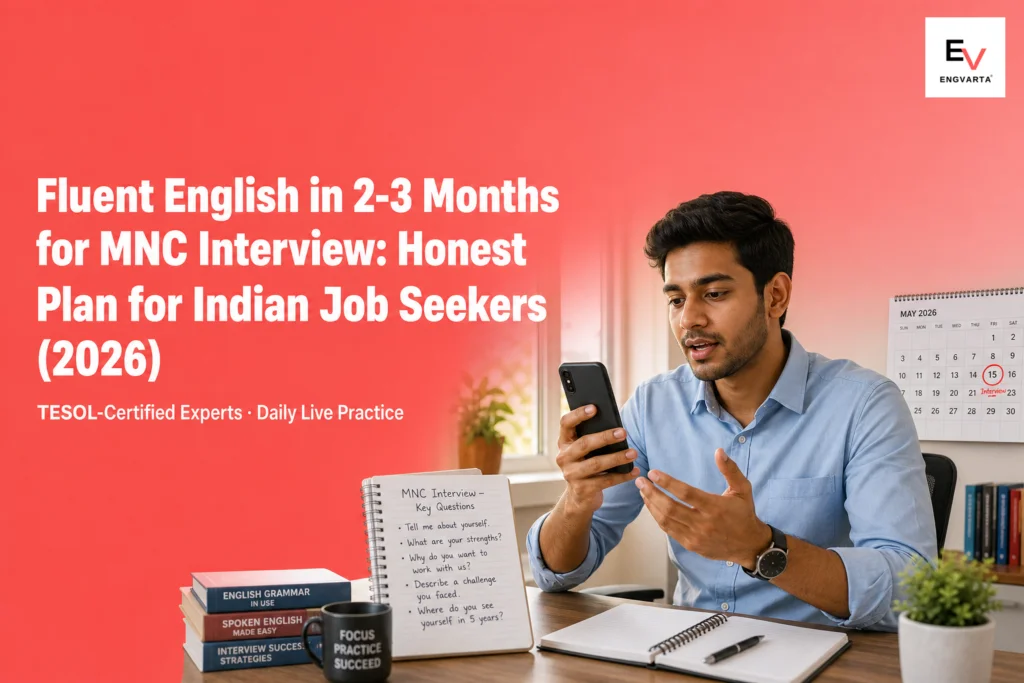
Indian young professional practising English on smartphone at desk with calendar showing interview date — fluent English in 2 to 3 months for MNC interview 2026
Quick VerdictTwo to three months is enough time to walk into an MNC interview and clear it — provided you accept that interview-ready and native-fluent are two different goals. Anything claiming to deliver native fluency in 90 days is marketing fiction. The path that actually works for Indian job seekers is daily live conversation with a TESOL/ESL-certified Expert who can corner you with realistic follow-ups, fix your phrasing the moment it goes wrong, and rehearse the same six interview questions until you stop translating in your head. EngVarta is purpose-built for this — ₹69 refundable trial, ₹108 per session on the 25-session plan, audio-only 1-on-1 with India-context Experts, real-time corrections during the call, consolidated feedback towards the end, recordings accessible for 30 days. Layer ELSA Speak on top for pronunciation drilling and use ChatGPT Voice as your free between-session rehearsal partner. The full 90-day blueprint is below.

Lakhs of Indian job seekers Google some version of fluent English in 2 to 3 months for MNC interview every year, and most of them are quietly hoping the answer is “yes, here’s the magic app.” This guide is the opposite. The honest answer is yes — but only if you separate the realistic goal (clearing the interview) from the impossible one (sounding like you grew up in Boston). Once that separation is clean, the timeline is extremely doable.

What follows is the practical sequence: what 60-90 days of focused work actually buys you, why the apps that look identical in listicles are nothing alike for interview prep, the daily routine that produces measurable change, and the six questions you must rehearse until they’re automatic. No grammar drills disguised as conversation. No promises that aren’t real.

What “interview-ready in 90 days” actually buys you

An MNC interviewer isn’t auditing your sentence construction. They are examining three signals approximately in this sequence:

  1. Does this person communicate clearly? A simple sentence delivered with conviction outperforms a complex one delivered with hesitation, every single round.
  2. Do they hold up under pressure? The interview itself is pressure. If you melt during low-stakes practice, you’ll melt in the room. The fix is daily exposure to spoken pressure, not extra vocabulary cards.
  3. Can they answer the standard questions without reaching for a script? “Tell me about yourself”, “Why this role”, “Strengths and weaknesses”, “Walk me through a project”, “Five-year plan”, “Why are you leaving” — six questions, roughly 70% of any MNC interview. Drilling these specific answers daily for three months is the highest-ROI thing on the table.

Ninety days of consistent practice will get you fluent enough on all three. You won’t sound like a TED Talk speaker. You’ll sound like a clear-thinking working professional — which is what hiring managers are actually optimising for.

The honest “what’s achievable” breakdown

Capability Realistic in 90 days?
Answer the six standard interview questions without freezing ✅ Yes
Construct sentences in real time, not after a 4-second pause ✅ Yes
Cut the mother-tongue translation lag substantially ✅ Yes
Structure behavioural answers using STAR ✅ Yes
Explain your work in plain English, even technical work ✅ Yes
Improve pronunciation clarity on the words that trip you up ✅ Yes
Carry yourself with audible confidence ✅ Yes
Speak with native-grade grammar precision ❌ No — that’s a multi-year goal
Erase your Indian accent ❌ No (and not the goal anyway)
Discuss philosophy, abstract topics, or wordplay fluently ❌ No — and irrelevant for MNC rounds
Pass for a native speaker ❌ No — and unnecessary

Look at the pattern: every “yes” is something an interviewer evaluates. Every “no” is something they don’t. You don’t need to lose your accent or master idioms to clear an MNC round. You need to communicate cleanly under pressure, and that’s a 90-day target, not a five-year one.

Why daily live human conversation outperforms the alternatives

Search “best apps for fluent English” and you’ll get the same five names cycled in different orders — Duolingo, ELSA Speak, TalkPal, Speak, HelloTalk. The lists aren’t wrong about what exists. They’re wrong about what moves the needle when your interview is six weeks away.

Here’s how each tool actually performs against a 90-day MNC-prep deadline:

  • Grammar drill apps (Duolingo and similar): useful in your first month if you’re rebuilding basics. After that, they’re a comfort zone — you feel productive without speaking. Cannot simulate interview pressure. Cannot conduct a mock interview.
  • Pronunciation tools (ELSA Speak): excellent at one specific job — fixing the phonemes that make Indian English speakers ask to be repeated. High value in narrow scope. Cannot hold a conversation or run an interview.
  • AI conversation apps (TalkPal, Speak, Praktika, SmallTalk2Me): good for the first month or so of habit-building. By week 8 the AI’s response patterns become predictable, and predictable conversation is the opposite of an interview. AI cannot read your nervousness, push you when you’re coasting, or follow up on a vague answer the way a real interviewer will.
  • Free language exchange (HelloTalk, Tandem): wildly variable partner quality. Most partners are not trained interviewers and many won’t correct you at all. Use it for casual chat exposure, not interview rehearsal.
  • Premium video tutors (Cambly): high quality but ₹4,000-5,500 per month for daily plans. Not all tutors are certified. Some run mock interviews; many treat sessions as casual conversation.
  • Live 1-on-1 audio with a TESOL/ESL-certified Expert (EngVarta): the closest civilian practice gets to an actual MNC round. The Expert plays interviewer, asks the unscripted follow-up that breaks your prepared answer, corrects you the moment you say “discuss about” instead of “discuss”, and pushes you when your energy drops. Real-time correction during the call is what builds the muscle memory of speaking under pressure. ₹108 per session on the 25-session plan in India; $1.80 per session flat in USD markets.

For a 90-day deadline, daily live practice with a certified Expert is the leverage point. Bolt ELSA Speak on for accent fine-tuning and ChatGPT Voice for free between-session reps, and that’s the routine that has carried lakhs of Indian working professionals through MNC rounds.

App-by-app review for the 90-day MNC-prep use case

1. EngVarta — the daily live mock-interview engine

EngVarta runs on live 1-on-1 audio sessions with TESOL/ESL-certified English Experts. The format is what makes it work for interview prep: at the start of any session, tell your Expert “I have an MNC round in five weeks — please run a behavioural mock today and push me on follow-ups.” They take the interviewer’s chair, ask the kind of probing questions you’d actually face, correct your phrasing in the moment, and at the end give you consolidated feedback on the two or three patterns dragging you down. Sessions are recorded and accessible for 30 days, so you can re-listen to your own answers, catch the spots where you stalled, and rehearse a cleaner version before the next session.

Why it’s the strongest fit for this use case:

  • Corrections happen during the call — not in a written report afterwards. In-the-moment fixes stick because you immediately use the corrected version in the same conversation.
  • Mock interviews on demand — every session can be a different format. HR screen, technical depth check, behavioural deep-dive, salary negotiation, panel round.
  • India-context Experts — TESOL/ESL-certified Experts who know the patterns Indian speakers actually struggle with: dropped articles, preposition slips, sentence-stress placement, mother-tongue interference.
  • Audio-only by design — works on a 4G connection, removes camera-pressure when you’re already nervous about your English, and protects privacy if you live with extended family.
  • 7 AM to midnight availability — fits whatever schedule your current job, your interview rounds, or your travel allows.

Pricing: ₹69 for a 10-minute trial, 100% refundable. ₹2,700 for 25 sessions in India (~₹108 per session). $45 per month for 25 sessions in USD markets ($1.80 per session, flat — never INR-converted). $1 trial in USD markets, also 100% refundable. Inside the same app you’ll find free vocabulary lessons, daily quizzes, and rewards for between-session reinforcement (also on the EngVarta YouTube channel without signup).

The 90-day routine: 25-minute session, four days a week — that’s 16 sessions a month, around 48 over the full timeline. Two cycles of the 25-session plan covers it (₹5,400 total, working out to roughly ₹85 per session of certified-Expert practice). There isn’t a cheaper way to log this volume of expert-led interview rehearsal in India.

Ready to Practice with Real Experts?

Try EngVarta today — ₹69 trial (India) / $1 trial (International) · 100% refundable

2. ELSA Speak — accent and pronunciation under the microscope

ELSA Speak is a pronunciation app, not a conversation app — that distinction matters. It scores you sound by sound, telling you exactly which vowel was off, which consonant got swallowed, and where the syllable stress went sideways. For Indian English speakers preparing for an MNC interview, it solves one specific problem in four to six weeks of 15-minute daily sessions: clarity.

Why it earns a slot in the routine: if your interviewers (or current colleagues) sometimes ask you to repeat yourself, the bottleneck is pronunciation precision, not vocabulary. ELSA targets the exact phonemes Indian speakers tend to soften or merge.

Pricing: roughly ₹999-1,499 per month or ₹6,000-7,500 annually in India (varies by ongoing promotions). 7-day free trial.

How to slot it in: 5-10 minutes daily, drilling the specific words your EngVarta Expert flagged in the previous live session. Live correction → targeted drill → next live session is the compounding loop that produces audible accent shift in about six weeks.

3. ChatGPT Voice Mode — free, unlimited between-session rehearsal

ChatGPT Voice Mode is the most underrated free tool for MNC interview prep. The free tier handles short voice conversations; ChatGPT Plus (~₹1,950 / $20 per month) extends sessions and unlocks the better voice models.

Prompts that actually work for interview rehearsal:

  • “Act as an HR manager interviewing me for a software engineering role at a Fortune 500 firm. Ask five behavioural questions, one at a time, and probe my answers.”
  • “I have an MNC interview coming up. Open with ‘Tell me about yourself’ and follow with two to three sharp probes on whatever I say.”
  • “Play a panel interviewer at a Big 4 consulting firm. Run a 10-minute mock case interview.”
  • “Pretend you’re my hiring manager. Ask me to walk through my last project and push hard on technical depth.”

How to slot it in: free pre-event rehearsal sandwiched between EngVarta sessions. Run the same scenario two or three times — repetition forces phrasing into muscle memory. ChatGPT for volume; EngVarta for depth and correction.

Where it falls short: no structured correction. ChatGPT will play interviewer all day but won’t pull you up on errors the way a TESOL/ESL-certified Expert will. Use it for quantity, not quality.

4. SmallTalk2Me — niche AI mock-interview app

SmallTalk2Me runs interview-format AI sessions and grades your answer on fluency, grammar, and confidence. Newer than the bigger names, and more job-search-specific in positioning.

Pricing: region-dependent, typically $15-25 per month subscription.

Where it fits: extra mock-interview reps when you’ve burned through ChatGPT Voice for the day. Same plateau dynamic any AI tool hits — useful for the first six weeks, predictable thereafter.

5. TalkPal AI — habit-building free tier

TalkPal AI stands out for one reason: a genuinely usable free tier (not a 7-day trial), with voice and text, scenario roleplay, and mid-conversation grammar feedback. For weeks 1-4 of building a daily speaking habit before live practice begins, it’s hard to beat.

Pricing: free tier with daily caps. Premium around $15-25 per month for unlimited use.

Where it fits: phase one of the 90-day plan. Use it to nail the daily-speaking habit before adding the EngVarta live-Expert layer.

6. Cambly — premium native-speaker conversation

Cambly connects you to native English speakers — predominantly American and British — for live video conversation. Some tutors are certified teachers; many aren’t. The unique value is exposure to native conversational pace and idiom, useful if your interviewer will be a US/UK native.

Pricing: roughly ₹4,000-5,500 per month for daily 30-minute plans (varies by region). More expensive than EngVarta for comparable density.

Where it fits: targeted use in the final two to three weeks before an interview where you want native-speaker calibration. Not the primary daily tool unless your budget is unconstrained.

The honest 90-day plan

Days 1-30: build the speaking habit, cover any basics

Daily commitment: 45-60 minutes.

  • 20 minutes of TalkPal AI free tier or ChatGPT Voice. Pick one scenario per day — daily-life chat, telling a story, describing your weekend, ordering at a café. Reps and confidence are the priority here, not interview content.
  • 15 minutes of ELSA Speak on whichever sounds give you the most trouble. Free tier is plenty at this stage.
  • 15 minutes of write-then-speak on the six standard MNC questions. Don’t memorise — speak them, change the wording each day, get comfortable with the structure.

End-of-month-1 check: can you talk about yourself for two minutes without freezing? If yes, advance. If you still freeze, hold this phase for another two weeks.

Days 31-60: layer in live human practice

This is when EngVarta enters the routine. Sign up for the ₹2,700 / 25-session plan in India (or $45 / 25 sessions in USD markets). Schedule sessions Mon/Tue/Thu/Fri — four days a week, around 16-18 sessions in this window.

Daily commitment: 45-60 minutes.

  • 25 minutes of EngVarta four days a week. At the start of each session, tell your Expert your interview is in 60 days and request a different mock-interview scenario each time — HR screen, technical, behavioural, salary discussion, panel.
  • 15 minutes of ChatGPT Voice mock interview on the three days without an EngVarta session. Free, unlimited reps.
  • 5-10 minutes of ELSA Speak on the specific words your Expert flagged that day or week.

End-of-month-2 check: can you push through a full 10-minute mock interview with at most one freeze? If yes, you’re tracking well. If not, lean harder into EngVarta sessions in phase three.

Days 61-90: company-specific rehearsal mode

EngVarta sessions continue, but the focus shifts. Now you’re rehearsing the actual interview format you’ll face. Most MNCs have their interview process documented on Glassdoor and AmbitionBox. Tell your EngVarta Expert exactly what the format is — say, 30-minute HR + 45-minute technical + 30-minute behavioural — and have them simulate that full sequence across multiple sessions.

Daily commitment: 45-75 minutes.

  • 25-50 minutes of EngVarta four to five days a week. In the final fortnight, push to 50-minute sessions for full-format rehearsal.
  • 15 minutes of ChatGPT Voice drilling the company-specific behavioural questions you mined from Glassdoor.
  • 5-10 minutes of ELSA Speak on whatever accent friction points are still flagged.

The final week: run one or two full-length 50-minute mock interviews on EngVarta, listen to the recordings the next morning, identify your three weakest phrasings, and drill them. Sleep eight hours the night before. Walk in confident.

What Our Learners Say

Rated 4.5★ from 9,100+ reviews on Google Play

★★★★★
Thank you guys for this amazing app. I think this application will help me to improve my communication skills.
★★★★★
This app is amazing, it's helpful and good. The tutors are very excellent. I am improving and don't shy anymore.
★★★★★
good experience this app is very helpfull and user friendly you may also check the app to learn English
★★★★★
Experts are friendly and supportive. Great platform to improve your communication skills.
★★★★★
Wonderful application for English learners and good for speaking with trainers .All trainers are well experienced and help us within the time period,Thanks
★★★★★
The app has been great in improving your English speaking skills. Experts have great knowledge and indeed all are amicable and they create the environment which is necessary for learning the language.
★★★★★
I am really enjoying this app and it is very useful for my IELTS preparation. It is a great application that I have never seen.
★★★★★
It's very beneficial app for children who don't speak well.
★★★★★
It's a great place to learn and practice English Fluency..here you get a chance of one on one communication with experts.. They'll guide you throughout your learning journey..I recommend this platform to all who want to gain fluency with knowledge.
★★★★★
Great app for learning English speaking. All the experts are supportive and non-judgemental. After every session, constructive feedback is provided to enhance yoilur skills. Also it has AI enabled feature for assignment practice. Overall a great platform to practise English speaking with experts.
★★★★★
An awesome app to learn and practice English especially for those who don't have English speaking people around them. EngVarta is something I had missed and must have known about much before.
★★★★★
I have been using this app since three months. I am very much satisfied with their services , experts are too good and their support team members are very supportive and helpful. I must suggest this app to everyone. Thank you Engvarta for helping me.❤️

The six interview questions you must drill daily

These cover roughly 70% of what any MNC interviewer will ask. Rehearsing the same six answers daily for 90 days is the single most leveraged use of your prep time:

  1. “Tell me about yourself.” 60-90 seconds, structured: education → relevant experience → current role and what you’re looking for next. Practise until it feels natural, not memorised.
  2. “Why this company / role?” Demonstrate research. Connect the company’s actual work to your skills.
  3. “Walk me through a project you led.” STAR format — Situation, Task, Action, Result. Have two or three projects ready and rehearsed.
  4. “Strengths and weaknesses?” One or two strengths with concrete examples. One real weakness with a credible story of how you’re addressing it.
  5. “Where do you see yourself in five years?” Show ambition tied to the role. Don’t say “in your job” — it reads as performative.
  6. “Why are you leaving your current role?” Stay positive. Frame as growth, not escape.

Drill these in EngVarta sessions. Get the Expert to fire follow-ups. Listen back to the recordings. Refine the phrasing. By day 90, the answers should arrive without conscious thought.

The mistakes that derail 90-day MNC prep

  • Studying grammar instead of speaking. Grammar matters in month one if you’re a beginner. After that, more grammar is procrastination. Only speaking makes you fluent.
  • Skipping live practice because it’s embarrassing. The embarrassment is the practice. The first five sessions feel awkward, the next 20 feel routine, by session 30 you’re confident. There’s no path around it.
  • Memorising answers word-for-word. Memorised answers sound robotic and collapse the second the interviewer asks an unscripted follow-up. Rehearse the structure, not the script.
  • Practising in your head. Internal rehearsal does not transfer. The motor pathways for spoken English only develop when you actually speak out loud.
  • Trying to lose your accent entirely. Don’t bother. MNC interviewers globally speak English as a second language. Clear is more important than accent-perfect. Aim for clarity, not erasure.
  • Stopping practice the week before the interview. Wrong move. Final seven days are when you go full-format daily — that’s when phrasing locks in.

For the broader landscape, our analysis of best apps for Indian working professionals covers the full working-adult use case, our deep-dive on job interview English practice covers interview communication in detail, and our guide on reducing Indian accent for the American workplace covers the phonetic-clarity work that compounds with daily live practice.

✨ Join thousands of learners and start speaking English with confidence today!

The honest summary

Yes, you can become MNC-interview-ready in 2 to 3 months even if your English is currently weak. No, you won’t sound native by the end of it — and you don’t need to. The fastest path to interview-ready is daily live conversation with a TESOL/ESL-certified Expert who runs mock interviews, corrects your phrasing in real time, and drills you on the same standard questions until your answers flow without hesitation.

EngVarta is the strongest fit for this 90-day window — ₹69 refundable trial, ₹108 per session on the 25-session plan, real-time corrections during the call, consolidated feedback towards the end, sessions accessible for 30 days. Layer ELSA Speak for pronunciation (5-10 minutes daily) and ChatGPT Voice for free mock-interview reps between live sessions. Total monthly outlay around ₹2,700-3,000 — equivalent to six or seven Zomato meals — for the routine that has carried lakhs of Indian working professionals through MNC interviews before you.

The interview isn’t a test of your English. It’s a test of whether you can communicate clearly and confidently. That’s a 90-day project. Start today.

Editorial independence note: this guide reflects our independent editorial assessment of the apps reviewed. We have not received payment, sponsorship, or affiliate compensation from any of the platforms listed for inclusion in this article.

Frequently Asked Questions : Fluent English in 2 to 3 Months for MNC Interview

( FAQs )

Is it really possible to speak fluent English in 2 to 3 months for an MNC interview?

You can become MNC-interview-ready in 2-3 months — meaning you can answer standard interview questions confidently, communicate ideas clearly, hold up under pressure, and pass MNC interview rounds. You will NOT become native-fluent in that time; that takes years. The good news is MNC interviewers don’t test for native fluency. They test for clear communication and confidence — both achievable in 90 days of focused daily practice.

Which app is best to speak fluent English before an MNC interview?

For MNC interview prep specifically, the strongest tool is EngVarta — live 1-on-1 audio sessions with TESOL/ESL-certified English Experts who can run actual mock interviews, correct your phrasing in real time, and push you on the standard MNC questions. ₹69 refundable trial in India (or $1 in USD markets). ₹108 per session on the 25-session plan. Pair with ELSA Speak for accent and ChatGPT Voice Mode for free between-session rehearsal.

I am a complete beginner. Can I still clear an MNC interview in 3 months?

If your English is genuinely beginner-level (you struggle to form basic sentences), you’ll need the full 90 days plus near-perfect consistency — 60-90 minutes daily, no skip days. The first month focuses on basics and the daily-speaking habit using free apps. From day 31, layer in live human practice with a TESOL/ESL-certified Expert (EngVarta) for daily mock interviews. The variable that determines success is consistency, not aptitude.

Is daily 1-hour practice enough or do I need more?

For most learners targeting an MNC interview in 60-90 days, 45-60 minutes per day is plenty if it’s the right kind of practice (live speaking + targeted drilling, not passive listening). Doubling to two hours produces faster gains but with steep diminishing returns and burnout risk. Sixty quality minutes consistently across 90 days beats two hours sporadically.

What if my interview is in 4 weeks, not 8-12 weeks?

A four-week timeline is tight but workable if you commit to 60-90 minutes of daily live practice (EngVarta sessions five days a week, ChatGPT Voice mock interviews on the others, ELSA Speak for accent). You won’t reach the level 12 weeks would produce, but you can absolutely become interview-ready for one specific interview. Top priority: drill the six standard questions until your answers flow without hesitation.

Why isn’t Duolingo or Babbel enough for MNC interview prep?

Duolingo and Babbel are grammar-and-vocabulary apps, not speaking-practice apps. MNC interview prep requires speaking under pressure — answering follow-ups in real time, recovering from mistakes mid-sentence, sustaining a back-and-forth. Grammar apps cannot simulate any of that. They have a role for absolute beginners in month one but they aren’t the primary tool for interview prep.

How do I find time to practise daily if I’m working full-time?

Most working professionals slot live practice into either the morning walk window (6:30-8 AM) or the post-dinner private window (9-11 PM). EngVarta‘s 7 AM to midnight availability covers both. Pick whichever window your household supports better and protect it like an unmissable meeting. 25 minutes a day for 90 days produces real change; missing three days a week does not.