Best Ways to Improve Your English Speaking Vocabulary

English Speaking Vocabulary

You understand English.

You read articles.
You watch movies.
You even think in English sometimes.

But when it’s time to speak…
You pause. You search for words. You repeat “good,” “nice,” and “very.”

This is not because you are weak in English.

It’s because your English Speaking Vocabulary is limited.

And that’s completely normal.

Most Indian learners study English for years. But they rarely practice vocabulary for spoken english in real conversations.

The result?

They know English — but they don’t use English confidently.

The good news is this:

Improving your English Speaking Vocabulary is possible.
And it doesn’t require memorizing thousands of difficult words.

It requires the right strategy.

Let’s break it down.

Why English Speaking Vocabulary Matters More Than You Think

Grammar helps you build sentences.

But vocabulary helps you express ideas.

Imagine this situation in an interview.

You say:
“I worked very hard.”

Another candidate says:
“I consistently delivered results under pressure.”

Who sounds more confident?

The second person.

Not because of grammar.

Because of stronger english speaking vocabulary words.

Your vocabulary affects:

  • Confidence
  • Professional image
  • Clarity
  • Communication power
  • Fluency

If you want to improve english vocabulary and speaking together, vocabulary must become your priority.

The Real Problem: Passive Learning

Many learners focus on:

  • Watching English videos
  • Reading articles
  • Learning grammar rules

But they don’t practice speaking.

That’s why vocabulary stays passive.

You recognize words.

But you can’t use them.

To improve english vocabulary for spoken english, you must activate words through conversation.

This is where live speaking practice platforms like EngVarta become useful.

EngVarta allows learners to speak with real human experts and apply vocabulary in real-time conversations.

And vocabulary grows when used — not when memorized.

Common Mistakes That Block Vocabulary Growth

Before improving, let’s remove obstacles.

1. Learning Difficult Words Only

Many learners think advanced words mean better English.

But if you cannot say:

“I’m not comfortable with this plan.”

Then learning “meticulous” won’t help much.

Focus on practical english speaking important words first.

2. Learning Too Many Words at Once

Some learners try to learn 30 daily English words in one day.

That doesn’t work.

Your brain needs repetition.

5 words daily is enough.

3. Not Using Words in Sentences

Vocabulary grows only when used.

If you don’t speak the word, you forget the word.

4. Avoiding Real Conversations

You cannot improve English Speaking Vocabulary silently.

You must speak.

That’s why learners who practice on EngVarta often improve faster. They get corrected instantly and learn better word choices naturally during live conversations.

15 Practical Ways to Improve English Speaking Vocabulary

Let’s go step by step.

1. Learn Words in Context, Not Isolation

Instead of learning:

“Opportunity”

Learn phrases like:

  • Career opportunity
  • Golden opportunity
  • Missed opportunity

Context makes vocabulary useful.

2. Use the 5-Sentence Technique

For every new word, make 5 sentences.

Example: “Confident”

  • I feel confident today.
  • She sounds confident.
  • I’m confident about my decision.
  • Confidence improves with practice.
  • He answered confidently.

This method improves vocabulary for spoken english effectively.

3. Replace Basic Words Daily

Upgrade simple vocabulary.

Very good → Excellent
Very big → Huge
Very small → Tiny
Very happy → Delighted

These are some of the best words for speaking english naturally.

4. Read Aloud Daily

Reading silently helps understanding.

Reading aloud helps speaking.

10 minutes daily improves pronunciation and English Speaking Vocabulary together.

5. Practice Topic-Based Vocabulary

Pick one topic daily:

  • Office meeting
  • Travel
  • Job interview
  • Daily routine
  • Self-introduction

Learn 8–10 english speaking vocabulary words related to that topic.

Then speak about that topic.

6. Keep a Vocabulary Notebook

Divide into sections:

  • Daily speaking English words
  • Business vocabulary
  • Emotional expressions
  • Opinion words

Writing strengthens memory.

7. Record Yourself Speaking

Speak for 2 minutes about your day.

Listen.

Notice repeated simple words.

Replace them.

This builds awareness.

8. Use Synonyms Smartly

Important → Essential
Problem → Issue
Help → Assist
Start → Initiate

These small upgrades improve English Speaking Vocabulary quickly.

9. Watch Interviews and Copy Sentence Structures

Observe how professionals speak.

They don’t use very difficult words.

They use clear, confident language.

Imitate them.

10. Speak Daily — Even for 10 Minutes

Vocabulary grows through usage.

Even short conversations help.

EngVarta learners often practice 15 minutes daily with experts and gradually improve vocabulary and communication skills together.

11. Think in English

Stop translating.

Instead of thinking in Hindi and converting, train yourself to think directly in English.

Start small.

Think:

“I’m hungry.”
“I’m tired.”
“I need a break.”

This improves english vocabulary for spoken english naturally.

12. Use Words in WhatsApp Messages

Try upgrading daily messages.

Instead of:
“I’m busy.”

Say:
“I’m tied up right now.”

Small changes matter.

13. Play Vocabulary Games With Yourself

Pick one word.

Use it 10 times today.

For example: “Improve”

  • I want to improve my skills.
  • I need to improve my pronunciation.

Repetition builds confidence.

14. Practice Real Conversations With Feedback

Self-practice is good.

But correction is better.

On EngVarta, learners get real-time feedback from experts who suggest better vocabulary during live speaking sessions.

That helps vocabulary stick permanently.

15. Review Old Words Weekly

Repetition prevents forgetting.

Every Sunday, review 30 words learned that week.

Use them in a small speech.

Daily Habits That Accelerate Vocabulary Growth

Consistency is everything.

Here’s a simple daily plan.

Morning:
Learn 5 new daily English words.

Afternoon:
Make sentences.

Evening:
Use them in conversation.

Many EngVarta users follow this system and see visible improvement within a few weeks.

Small effort daily gives big results.

Real-Life Practice Methods

Let’s upgrade everyday situations.

Office Meeting

Instead of:
“I don’t agree.”

Say:
“I understand your viewpoint, but I hold a different opinion.”

Interview Answer

Instead of:
“I worked hard.”

Say:
“I consistently delivered results under tight deadlines.”

Casual Conversation

Instead of:
“I’m tired.”

Say:
“I’m exhausted after a long day.”

These upgrades strengthen English Speaking Vocabulary.

How EngVarta Helps Improve English Vocabulary

Vocabulary improves fastest in real conversations.

EngVarta is a live English speaking practice platform where learners talk to real human experts.

During sessions, experts:

  • Suggest better word choices
  • Correct repeated mistakes
  • Introduce natural expressions
  • Encourage confident speaking

When learners use new words during live conversations, vocabulary becomes active.

That’s how EngVarta helps improve English vocabulary — not through theory, but through practice.

Ready to Speak English with Confidence?

If you truly want to improve your speaking skills, learning alone isn’t enough.

You need real conversation practice.

With EngVarta, you get daily one-on-one English speaking sessions with real experts who guide you, correct your mistakes, and help you grow confidently.

👉 Download EngVarta App on Google Play | Download on iOS

Check out our newest videos on YouTube and begin enhancing today:

👉 Subscribe to EngVarta on YouTube Channel

40 Daily Speaking English Words You Should Use

Here are practical english speaking important words:

  1. Confident
  2. Comfortable
  3. Improve
  4. Manage
  5. Support
  6. Suggest
  7. Discuss
  8. Decide
  9. Prefer
  10. Important
  11. Necessary
  12. Possible
  13. Opportunity
  14. Challenge
  15. Focus
  16. Explain
  17. Experience
  18. Flexible
  19. Responsible
  20. Reliable
  21. Prepare
  22. Organize
  23. Complete
  24. Appreciate
  25. Expect
  26. Achieve
  27. Deliver
  28. Clarify
  29. Understand
  30. Improve
  31. Efficient
  32. Effective
  33. Creative
  34. Practical
  35. Professional
  36. Confidently
  37. Comfortable
  38. Initiative
  39. Strategy
  40. Perspective

Mini Exercise:

Pick 10 words.

Speak for 2 minutes using them.

If possible, practice them in your next EngVarta session.

Mistakes to Avoid While Improving Vocabulary

Avoid these:

  • Waiting for perfect grammar
  • Feeling embarrassed
  • Comparing yourself to others
  • Learning without speaking
  • Ignoring pronunciation

Improving your vocabulary and communication skills requires courage.

Mistakes are part of growth.

How to Practice Vocabulary in Conversations

Here’s a powerful rule.

Before speaking, ask:

“Can I use a stronger word?”

Instead of:
“I did many things.”

Say:
“I handled multiple responsibilities.”

Instead of:
“I’m not sure.”

Say:
“I’m uncertain about this.”

When you practice like this daily — especially in live conversations on EngVarta — vocabulary improves naturally.

Improving Your Vocabulary and Communication Skills Together

Vocabulary alone is not enough.

You must also:

  • Control tone
  • Maintain clarity
  • Speak with confidence
  • Use natural pauses

EngVarta helps learners improve English vocabulary and speaking together because they practice with experts who guide both language and confidence.

Practice + Feedback = Growth.

Final Thoughts

Improving your English Speaking Vocabulary is not about memorizing big words.

It’s about:

  • Learning practical vocabulary
  • Using it daily
  • Speaking confidently
  • Practicing consistently

You don’t need 10,000 words.

You need the right words — used naturally.

Start today.

Learn 5 daily speaking English words.

Use them in sentences.

Speak them in real conversations.

And if you want structured live practice with real experts, platforms like EngVarta can help you apply vocabulary confidently in real situations.

Don’t wait to feel ready.

Start speaking.

Your vocabulary will grow with your confidence.

Frequently Asked Questions ( FAQs )

How to Improve English Grammar and Vocabulary?

How to Improve English Grammar and Vocabulary

Improving English grammar and vocabulary is not just an academic goal anymore—it is a practical life skill. Whether you are a working professional, a student, or someone preparing for interviews, presentations, or global communication, strong grammar and vocabulary directly influence how confident, clear, and credible you sound in spoken English.

Many learners reach an intermediate level where they understand English well but struggle to express ideas fluently and accurately. This gap usually exists not because of lack of intelligence, but because grammar and vocabulary have not yet become automatic in real conversations.

This blog offers a structured, evidence-based guide on how to improve English grammar and vocabulary in a way that supports spoken English mastery, not just written correctness. You’ll also learn how modern tools like the EngVarta App and educational YouTube channels can accelerate progress when used correctly.

Why English Grammar and Vocabulary Matter in Spoken English

Grammar Shapes Clarity

Grammar determines how clearly your ideas are understood. Incorrect tense usage, subject-verb disagreement, or sentence structure errors can confuse listeners—even if your vocabulary is good.

Example:

  • I am working there since two years.
  • I have been working there for two years.

The difference is grammatical, but the impact is communication clarity.

Vocabulary Builds Precision and Confidence

Vocabulary allows you to express exact meaning, emotions, and intent. Limited vocabulary leads to repetition, hesitation, and filler words like umm or actually.

Strong vocabulary helps you:

  • Sound confident
  • Avoid pauses
  • Explain ideas naturally

Grammar and vocabulary together create fluency, not separately.

How can I improve English grammar and vocabulary effectively?

You can improve English grammar and vocabulary by combining daily speaking practice, contextual learning, active usage, and guided feedback—rather than memorization alone.

Common Problems Learners Face

Understanding the challenges helps solve them effectively.

1. Knowing Rules but Not Using Them

Many learners can explain grammar rules but hesitate while speaking. This happens because grammar is learned theoretically, not practically.

2. Passive Vocabulary

Learners recognize words while reading but cannot use them while speaking. This means vocabulary is passive, not active.

3. Fear of Making Mistakes

Fear leads to silence. Silence stops progress.

4. Overdependence on Translation

Thinking in the native language and translating slows down speech and causes errors.

Step 1: Shift from Rule-Based Learning to Usage-Based Learning

Grammar improves fastest when learned through use, not definitions.

Practical Strategy

Instead of memorizing:

“Present perfect continuous tense is used for…”

Practice sentences like:

  • I have been learning English for six months.
  • She has been working late these days.

Your brain learns patterns faster than rules.

Step 2: Improve Grammar Through Daily Speaking Practice

Why Speaking Is Essential

Grammar becomes natural only when your brain uses it in real time. Writing helps accuracy; speaking builds fluency.

Daily Spoken Practice Ideas

  • Describe your day aloud
  • Explain your job or studies
  • Talk about plans, experiences, or opinions

This activates grammar subconsciously.

How Engvarta Helps Improve Grammar and Vocabulary Faster

Engvarta offers one-on-one live English practice sessions with expert trainers, helping learners apply grammar and vocabulary in real conversations.

Benefits of Practicing with Engvarta

  • Real-time grammar correction
  • Vocabulary expansion through conversation
  • Confidence building
  • Personalized feedback
  • Flexible learning schedule

Instead of memorizing rules, you learn by speaking, which leads to faster and long-lasting improvement.

Practice real conversations, get instant feedback, and improve your communication skills with daily 1-on-1 English sessions on EngVarta.

👉 Get Started on EngVarta:

 📱 Download for Android 📱 Download for iOS

Step 3: Learn Vocabulary in Context, Not Lists

Memorizing word lists rarely improves spoken English.

Better Approach: Contextual Vocabulary

Learn words with:

  • Situations
  • Emotions
  • Real-life usage

Example:
Instead of learning “anxious”, learn:

I felt anxious before my interview.

This makes recall faster during conversations.

Step 4: Activate Vocabulary (From Passive to Active)

Knowing a word is not enough—you must use it repeatedly.

Activation Technique

For every new word:

  1. Say it aloud
  2. Create your own sentence
  3. Use it in a conversation within 24 hours

This transforms vocabulary into usable speech.

EngVarta’s Role

EngVarta sessions naturally push learners to reuse vocabulary in conversations, helping words move from memory to muscle.

Step 5: Use Immersive Learning Methods

Immersion helps grammar and vocabulary grow together.

Effective Immersion Methods

  • Listening to English podcasts
  • Watching English videos with subtitles
  • Thinking in English during daily tasks

YouTube Channels for Grammar & Vocabulary

Educational YouTube channels are useful when used intentionally:

  • Watch short videos
  • Note one grammar pattern
  • Apply it while speaking the same day

Passive watching alone does not improve fluency—application does.

Step 6: Focus on High-Impact Grammar Areas

You don’t need to master all grammar to speak well.

Priority Grammar Topics for Spoken English

  • Tenses (present, past, present perfect)
  • Subject-verb agreement
  • Question formation
  • Prepositions in speech
  • Sentence connectors

These cover most real-life conversations.

Step 7: Build Vocabulary for Daily and Professional Use

Vocabulary Types You Should Focus On

  • Daily-life expressions
  • Workplace vocabulary
  • Opinion phrases
  • Common collocations

Examples:

  • take a decision → ❌
  • make a decision → ✅

Such small improvements significantly raise spoken quality.

Step 8: Reduce Grammar Anxiety While Speaking

Overcorrecting yourself breaks fluency.

Smart Rule for Spoken English

  • Clarity first
  • Accuracy second
  • Perfection later

Listeners value understanding more than perfection.

How EngVarta Builds Confidence

EngVarta provides a low-pressure speaking environment where learners are guided—not judged. This reduces anxiety and increases speaking frequency, which is essential for improvement.

Step 9: Consistency Beats Intensity

Learning grammar for 3 hours once a week is less effective than 20 minutes daily.

Ideal Daily Routine (20–30 Minutes)

  • 10 minutes speaking practice
  • 10 minutes vocabulary usage
  • 5 minutes review

This routine leads to measurable progress within weeks.

Read Regularly to Improve Grammar and Vocabulary Naturally

Reading is one of the most powerful ways to improve English grammar and vocabulary without conscious memorization. When you read, your brain absorbs sentence structures, word usage, and grammar patterns naturally.

Benefits of Reading in English

  • Improves sentence formation
  • Expands vocabulary in context
  • Strengthens grammar understanding
  • Enhances comprehension skills

Best Reading Materials for English Learners

  • Novels and short stories
  • Newspapers and magazines
  • Blogs and online articles
  • Academic or professional content

Read content related to your goals—business English, spoken English, or exam preparation.

Practice Writing to Strengthen Grammar Accuracy

Writing forces you to apply grammar rules actively. It helps you identify mistakes and improve sentence clarity over time.

Importance of Writing Practice

  • Improves grammar accuracy
  • Reinforces new vocabulary
  • Builds sentence confidence
  • Enhances structured thinking

Effective Writing Exercises

  • Daily journaling
  • Writing short essays
  • Drafting emails or messages
  • Creating short stories

📌 Tip: After writing, review your sentences or get feedback to correct errors.

Learn New English Words Daily (Without Memorizing Lists)

Vocabulary building works best when words are learned in context, not isolation.

Techniques to Learn New Words Daily

  • Maintain a vocabulary notebook
  • Use flashcards or spaced repetition apps
  • Learn words by themes (travel, office, food)
  • Use new words in sentences immediately

🎯 Set a realistic goal: 5–10 new words per day.

Engage in Conversations to Improve Spoken Grammar

Speaking is where improve english grammar and vocabulary truly come alive. Many learners know rules but struggle to speak fluently.

Benefits of Speaking Practice

  • Improves real-time grammar usage
  • Builds confidence
  • Improves pronunciation
  • Reduces hesitation

Conversation Practice Ideas

  • Speak with friends or colleagues
  • Join English-speaking clubs
  • Participate in online discussion forums
  • Practice with language partners

Consistent speaking is the fastest way to convert knowledge into fluency.

Use Mobile Apps for Daily Grammar and Vocabulary Practice

Mobile apps make English practice convenient and consistent.

Features to Look For

  • Grammar exercises
  • Vocabulary builders
  • Pronunciation support
  • Interactive quizzes

Best Apps for English Learning

  • EngVarta – vocabulary focus, grammar correction, Speaking Practice
  • Duolingo – gamified learning
  • Memrise – vocabulary focus
  • Grammarly – grammar correction

Using apps daily, even for 15 minutes, creates long-term improvement.

Why This Matters for Indian Learners

In India, many learners:

  • Study English academically
  • Rarely speak English daily
  • Fear being judged for mistakes

This creates a fluency gap despite strong understanding.

Platforms like EngVarta address this by offering India-focused, real-world speaking practice, helping learners bridge the gap between knowledge and usage.

Connect with EngVarta on Social Media

Follow us for practical English tips, live speaking insights, and updates.

Instagram | YouTube | Facebook | LinkedIn

Final Thoughts:

Improving English grammar and vocabulary is not about becoming perfect—it’s about becoming clear, confident, and comfortable while speaking.

When you:

  • Practice speaking daily
  • Learn grammar through usage
  • Activate vocabulary through conversation
  • Use guided platforms like EngVarta App

…your English naturally improves.

Grammar stops feeling like a rulebook. Vocabulary stops feeling limited. And spoken English becomes a tool, not a challenge.

FAQs  (Frequently Asked Questions)

  • What is the EngVarta App and how does it help?
    • EngVarta provides 1-on-1 live English practice with expert trainers, helping learners improve grammar, expand vocabulary, and speak confidently. It offers personalized feedback in a flexible, real-world learning environment.

  • Do apps really help with spoken English?
    • Yes, apps like EngVarta, Duolingo, Memrise, and Grammarly can improve grammar, vocabulary, and pronunciation. They work best when combined with real-life conversations and contextual practice, rather than just passive usage.

  • Is vocabulary more important than grammar?
    • Both are essential. Vocabulary allows you to express ideas precisely, while grammar ensures clarity and structure. For spoken English, learning vocabulary in context combined with natural grammar usage boosts fluency and confidence.

  • Can I improve grammar without studying rules?
    • Yes! Grammar can be learned naturally through speaking, writing, reading, and listening in context. Using the EngVarta App for live, 1-on-1 practice helps internalize patterns faster, making your speaking fluent and confident without rote study.

  • How long does it take to improve English grammar and vocabulary?
    • With consistent daily practice of 20–30 minutes, learners can see noticeable improvement in 3–6 months. Using EngVarta’s live sessions accelerates learning by combining real conversation, feedback, and contextual vocabulary and grammar practice.

ENGVARTA VIDEO VOCABULARY SERIES – How does it work?


Engvarta vocabulary series - Learn new words daily
Engvarta vocabulary series – Learn new words daily


EngVarta has its own video vocabulary series where you get to learn three new words daily through our video lessons in the app. These video lessons include explanations of word meanings, usage in sentences, and examples to help learners understand and remember new words.

How to subscribe to the Vocabulary series? 

Follow the three simple steps to use EngVarta free vocabulary series – 

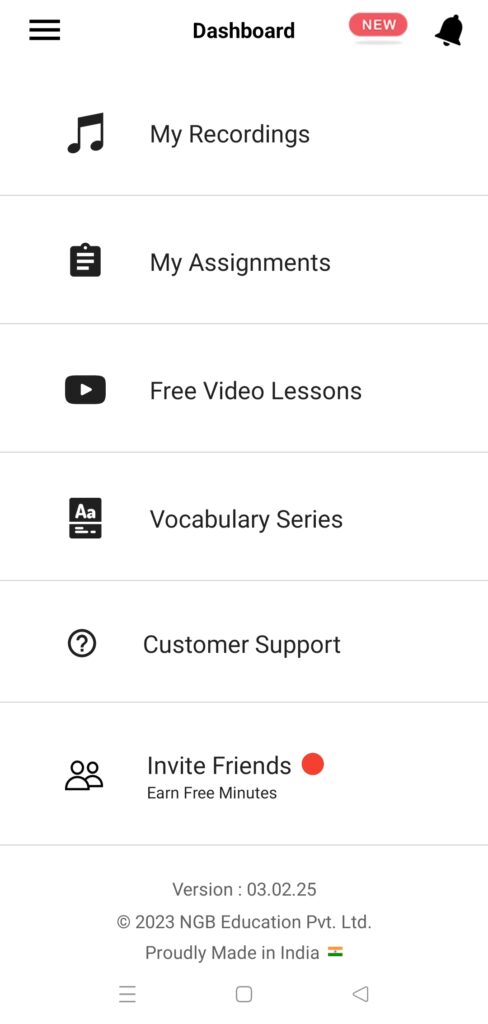
  1. Download the EngVarta app
  2. Go to the ‘Menu’ option
  3. Select Vocabulary series


IMG 20230911 121423

4. You need to watch the introduction video to provide you with important information before you can access the vocabulary series.

IMG 20230911 121504

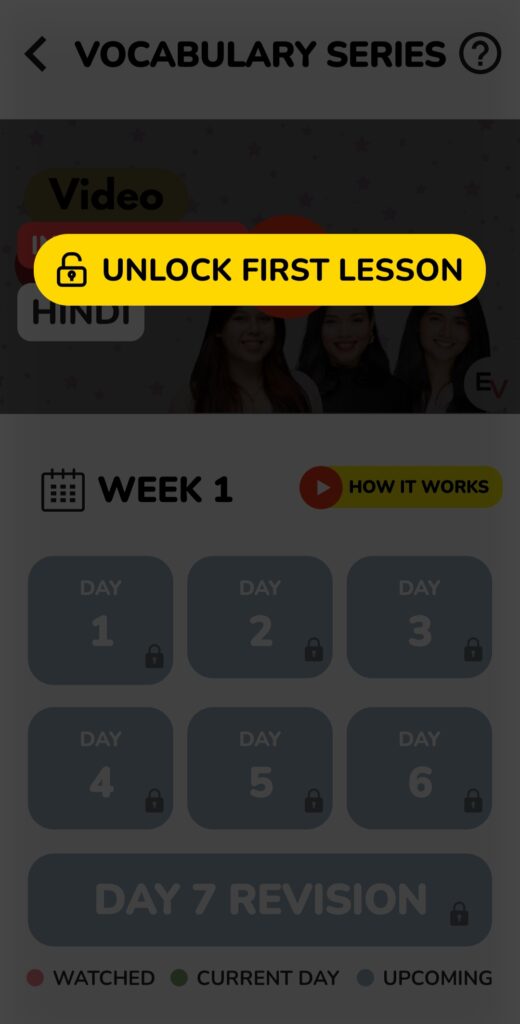
5. After you have watched the introduction video, you will see an option to ‘Unlock First Lesson’

IMG 20230911 121532

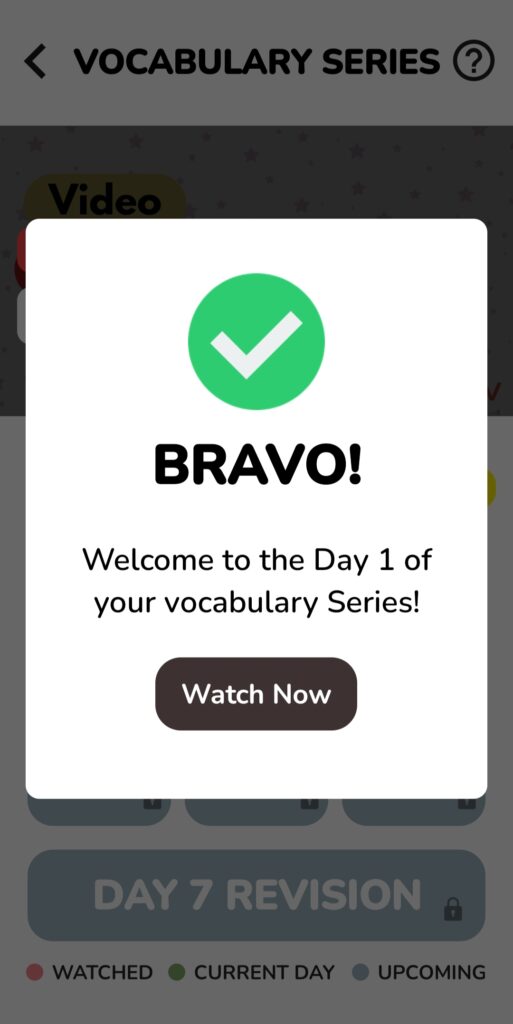
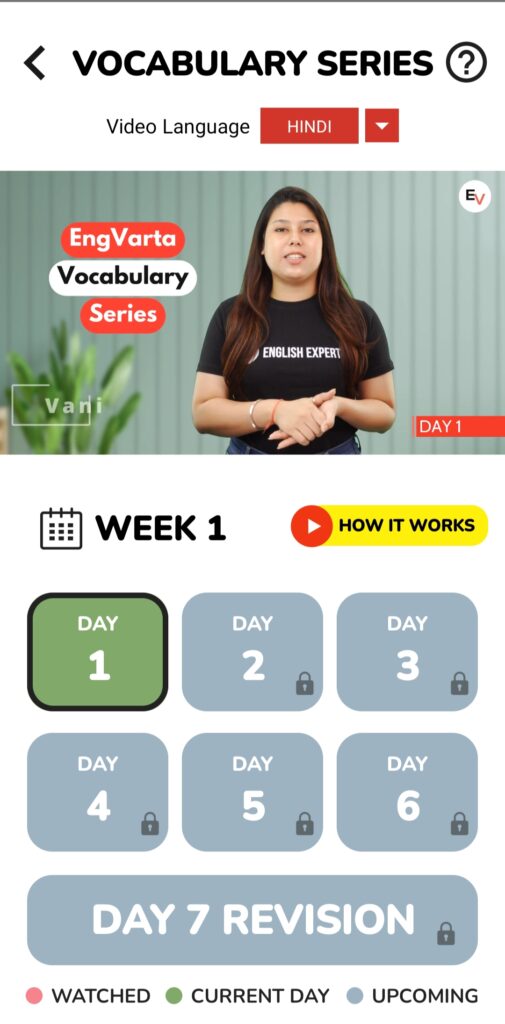
6. After clicking on ‘Unlock first Session’ you will be able to watch the video of Day 1 of your vocabulary series! In this video you will get to learn 3 new words daily!

IMG 20230911 121551

7. You can select the language preference to watch the video.


IMG 20230911 121607

8. Then the next day you will be able to unlock your Day 2 of vocabulary series.

Continue learning new words and use them in your daily English conversation. Isn’t it great? So what are you waiting for? Download the EngVarta app now and start your English learning journey today!

Learn more about EngVarta vocabulary series. It’s free! 

Want to Improve your English? Practice English With Experts

English learning app

If I ask you on the very first day of your fitness training to do 30 push-ups and you enthusiastically say ……

Okay! Let’s do it and you started doing.

Great! I am your coach here and I am counting…. 1, 2, 3, 4, 5,… & so on…
(After 12 push-ups)

Oh, God! It’s too painful…..
You feel like giving up after 12 push-ups and there you say: I can’t do anymore!
Oh No! What happened to you after 12 pushups? Don’t you have enough strength?

Right?

Now if I ask you to keep on doing it on a daily basis, then what will happen after a month?

You’ll be able to do 30 push-ups or even more very easily. Why?

Because now you’ve got enough strength and that’s how you build your stamina.

The same thing applies when it comes to your English communication. You need to practice speaking English daily to improve your communication skills. All I want you to do is to speak English with a new person every day. Whatever words you are learning, call the random person, talk with him/her and use those words. Take the critics, listen to feedback and improve. Keep on doing this for a month and I bet, you will see improvements.


Now you’re wondering how to find a random person to speak English every day, And why a random person? I can talk to my friend or my brother.

So here is another tip:

Doing it daily is important because you gotta build strength, but doing it daily with a new person is as important. And here is why:


Did you ever notice you get super comfortable with your friends and family. And it’s easy to say things and communicate with them. But that’s not what happens when you go for that job interview or meet someone and there you need to talk in English. That new person with whom you need to communicate is a total stranger & it gets weirder when that person doesn’t care about your knowledge but instead how well you communicate in English.


Hey listen, you have been practicing English with your friends and family so far. So your mind is not ready to carry on a conversation in English with a stranger in a comfortable way. You start sweating, panic starts and then you lose control over what you speak or you get quiet for a long time and that makes a bad impression. So the takeaway here is that you’re not ready to communicate in English with strangers.


So in your practice, what was missing? That Stranger was missing.
You need to bring a nice stranger to practice English every day. The good thing is, you don’t need to go on a hunt for a stranger every day. Just call EngVarta and it will find you a nice stranger (verified English experts) who speaks English and is ready to help you improve your communication.


For Regular English Practice with Expert: Download EngVarta Mobile App

playstoreitune