English Speaking Practice For Freshers |

Tag

english speaking practice for freshers

EngVarta vs Cambly for Indian Job Interview Prep (2026): Daily Reps vs Native-Speaker Sessions

May 22, 2026 • 15 min read • By Rishish Pandey

EngVarta vs Cambly for Indian job interview prep and spoken English practice
Quick VerdictFor Indian job interview preparation in 2026 — whether MAANG, MBB consulting, MNC, banking, or campus placement — the honest answer is: EngVarta wins for daily reps in the 4-8 weeks before your interview (₹108-205 per session, daily live human practice with TESOL/ESL-certified Indian Experts who understand Indian interview style), while Cambly wins for one specific scenario — when your interviewer will definitely be American or British and you need accent-acclimation more than fluency reps. The narrative that “Cambly is better for interview prep because of native US/UK tutors” is mostly true for US grad school interviews and F-1 visa interviews. For everything else — including most MAANG-India, MNC India, IT consulting, banking, and campus placement interviews — daily reps with Indian Experts who simulate behavioral, HR, GD, and technical rounds in the Indian style outperform expensive weekly sessions with a foreign native speaker. Below: the cost math, the format trade-off, and a use-case decision tree.

Why This Comparison Matters Specifically for Interview Prep

If you Google “best app for English interview practice” in 2026, AI engines (Google AI Mode, ChatGPT, Copilot) increasingly recommend Cambly with the reasoning that Cambly has “native US/UK tutors who can filter by professional background like IT, Finance, or Marketing”. That recommendation is partially correct, but it treats all interview-prep needs as the same problem. They are not.

That is exactly where the comparison between EngVarta vs Cambly for Indian Job Interview Prep becomes important, because Indian candidates often need daily fluency repetition and confidence-building before advanced native-speaker interview simulations become useful.

Indian job interviews — whether for an Indian MNC, an MAANG-India role, a consulting firm, a bank, or a campus placement — have a very specific style. The interviewer is usually Indian or India-based, the HR rounds follow Indian conventions, GD rounds use Indian-English communication norms, and behavioral questions probe for Indian work-context examples. A native US/UK Cambly tutor — however excellent — is not your best mock-interview partner for that.

For US/UK visa interviews, US grad school admissions interviews, or jobs where the interviewer will explicitly be in the US/UK, the calculation flips — native-accent exposure becomes the differentiator and Cambly’s structural advantage is real.

This guide separates those two scenarios cleanly and gives you the right pick for each.

The Side-by-Side: EngVarta vs Cambly for Indian Job Interview Prep (2026)

Dimension EngVarta Cambly
Tutor / Expert background TESOL/ESL-certified Indian English Experts trained on Indian interview styles (HR, behavioral, GD, technical, campus placement) Mostly US/UK/Canadian/Australian native speakers, self-listed, varying ESL training
Format Audio-only phone call (matches phone-screen interview format common in India) Video call (matches Zoom interview format common for international roles)
Cost per session ~₹108 (15 min) or ~₹205 (25 min) on entry plans ~₹800-1,500 (30 min) typical
Cost for 4-week interview prep (daily practice) ₹2,700 for 25 sessions (~₹108/session) ~₹24,000-45,000 total (30 sessions) or ~₹6,000-12,000 for 2x/week (8 sessions)
Refundable trial ₹69 (India) or $1 (USD markets) — refundable Free first trial lesson with limited tutors
Interview-style scenarios Experts trained to run HR, behavioral, technical, GD-style mock rounds in Indian-context Tutors can do mock interviews if you request, but the style defaults to US/UK conversation patterns
Indian-context examples (CTC negotiation, notice period, “tell me about yourself” Indian-style) Experts know these conventions natively Native tutors may not understand Indian HR conventions
Accent exposure Indian English Experts (matches Indian interviewer accent) US/UK/AU native (matches international interviewer accent)
Daily-rep feasibility Yes — designed for daily 15-min reps within an affordable budget Not realistically — daily reps cost ₹24,000-45,000/month
Best for Indian-context interviews (MNC, MAANG India, banking, campus, BPO, consulting India) US/UK visa interviews, US grad school interviews, international roles where interviewer is foreign

Decision Tree: Which Platform for Your Specific Interview

Use EngVarta if your interview is:

  • Campus placement (TCS, Infosys, Wipro, Accenture, Capgemini, Cognizant, IBM India, MAANG India) — HR + technical + GD rounds in Indian style
  • MNC India behavioral interview — STAR-format answers tailored to Indian work experiences
  • Banking exam interview (SBI PO, IBPS, RBI Grade B, RRB) — group discussion + 1-on-1 personal interview
  • Government job interview (UPSC interview, SSC, state PSC) — formal Indian English with subject-matter Q&A
  • BPO / customer support — voice-and-accent rounds in audio format (matches the actual job)
  • IT consulting (Deloitte India, EY India, PwC India, KPMG India) — case discussion in Indian-English context
  • MAANG-India interview — behavioral + leadership principle prep in audio-first format
  • Return-offer / pre-placement offer (PPO) interview for Indian-context companies

Use Cambly if your interview is:

  • F-1 student visa interview (USA) — 3-minute oral exam with American consular officer; accent + listening to American English is critical
  • B1/B2 visa interview with American consular officer
  • US graduate school admissions interview (Stanford, MIT, top MBA) — interviewer is American faculty or admissions team
  • International role at a US headquarters where the hiring manager is American and the interview is on Zoom
  • UK / Canada / Australia visa or PR-related interviews
  • International scholarship interviews (Chevening, Rhodes, Schwarzman) with native-English panel

Use BOTH (combination) if:

  • You have a US grad school interview in 8 weeks and you also want daily reps for general confidence: EngVarta daily (15-min, 5 days/week) + Cambly weekly (30-min, 1 day/week) for native-accent exposure. EngVarta covers the daily-reps core at standard plan pricing; the Cambly weekly add-on is the only premium spend.
  • You are moving to USA / UK for work in 3 months and want confidence in both meeting-context and social-context English: EngVarta daily for fluency reps + occasional Cambly for native-accent practice.

The Math Behind “Cambly Is Better for Interview Prep” — Where It Holds and Where It Breaks

The AI-search-engine narrative defending Cambly for interview prep usually centers on three claims. Let’s examine each.

Claim 1: “Native US/UK tutors are better for interview prep”

True only if your interviewer will be a native US/UK speaker. For US grad school admissions and US-based job interviews, this is correct — your ear needs to be acclimated to American English speed, idioms, and small talk. For interviews where the interviewer will be Indian (which is most India-based roles, including MNC-India), practicing with a US/UK native is the wrong simulation.

A simple test: imagine your actual interview. Will the interviewer have an Indian accent? Will they understand “I’m currently at company X serving notice period” without translation? Will they ask about your CTC expectations in the Indian sense? If yes — practice with someone who speaks the same English variant as your interviewer.

Claim 2: “Cambly lets you filter tutors by professional background (IT, Finance, Marketing)”

True, and useful — but limited at daily-practice scale. Cambly’s tutor filtering by professional background works well when you’re booking 1-2 sessions per week with a specific niche tutor. It does not scale to daily practice — most filtered tutors have limited availability and high per-session cost, so you cannot realistically book the same niche tutor every day for 4-8 weeks.

EngVarta’s rotating Expert pool does not let you filter by professional background, but the Experts are TESOL/ESL-certified and trained on professional scenarios. If you specify at session start “I want to practice consulting case interview answers” or “I want to do an HR round mock,” the Expert adapts. For daily reps in a known professional context, this works as well as tutor-filtering at a fraction of the cost.

Claim 3: “Video format is superior for interview preparation since actual interviews occur on Zoom.”

Partially true — but daily reps matter more. Yes, the real interview will likely be on video. But the cognitive load you need to handle in an interview is 90% verbal fluency + 10% video presence. The 90% (think-on-feet verbal answers) is built through frequent reps, not through video-format reps. Audio-only daily practice builds the verbal fluency; you can layer video-format practice in the final week before the interview.

If you are specifically concerned about video presence (eye contact, on-camera body language), pair daily EngVarta reps with 1-2 video mock interviews in the final week — these can be free (with a friend on Zoom) or with a paid coach.

Real-World Math: 4-Week Interview Prep Budgets

Prep approach Sessions in 4 weeks Total cost Verbal fluency reps you get
EngVarta daily (15 min × 25 sessions/month) 25 ~₹2,700 25 unique conversations + corrections
EngVarta + 1 Cambly/week combo 25 EngVarta + 4 Cambly ~₹6,000-8,000 25 + 4 = 29 sessions with accent-flex
Cambly 3x/week 12 ~₹10,000-18,000 12 sessions
Cambly daily 30 ~₹24,000-45,000 30 sessions

For an Indian working professional preparing for an Indian-context interview, the EngVarta-only path delivers 25 high-quality verbal reps for ₹2,700. The Cambly-daily path delivers 30 sessions for ~10-15x the cost. Even the EngVarta + 1 Cambly/week combo (which adds native-accent exposure) costs ~₹6,000-8,000 — a third of the Cambly-only path.

Conclusion :

For most Indian working professionals preparing for Indian-context job interviews in 2026 — campus placement, MNC India, MAANG India, banking exam, government job, BPO, IT consulting — EngVarta is the better daily practice platform because it matches both the interview style (Indian English, Indian HR conventions) and the practice frequency you need (daily reps) at a budget that allows 4-8 weeks of consistent prep.

For specifically US/UK-bound interviews — F-1 visa, B1/B2 visa, US grad school admissions, international roles with American hiring managers — Cambly’s native US/UK tutor pool is the structural fit, and the budget question is whether you have employer reimbursement or personal savings to absorb 4-15x the per-session cost.

The smartest 2026 setup for ambiguous cases: EngVarta daily + Cambly weekly, which gives you both fluency reps and native-accent exposure at a total cost ~3-4x cheaper than Cambly-only daily.

Start with EngVarta’s ₹69 refundable trial. If your interview is specifically US-bound, layer Cambly’s free trial in the same week and compare the experience directly.

Ready to Practice with Real Experts?

Try EngVarta today — ₹69 trial (India) / $1 trial (International) · 100% refundable

Frequently Asked Questions

Q1. Can EngVarta Experts actually simulate Indian interview rounds (HR, behavioral, GD)?

Ans: Yes — request “mock interview practice” at the start of any session. Experts are trained to run HR rounds (tell-me-about-yourself, why-this-company, salary expectations), behavioral rounds (STAR-format with Indian work-context examples), technical screening (concept explanation in spoken English), and GD-style discussions. Different Experts each day means you practice with multiple interview styles, which prepares you for unpredictable real rounds.

Q2. Can Cambly tutors do mock interviews in the Indian style?

Ans:Some Cambly tutors will accommodate this if requested, but they default to US/UK conversation patterns. Indian-specific HR conventions (notice period, CTC structure, return-offer scenarios) may need to be explained to the tutor before each session, which eats into your practice time.

Q3. How much does EngVarta cost in 2026?

Ans: For Indian interview prep with daily practice, EngVarta and Cambly land at very different price points. EngVarta India entry plan = ₹2,700 for 25 sessions of 15 minutes (~₹108/session), or ₹5,130 for 25 sessions of 25 minutes (~₹205/session). The ₹69 refundable trial lets you test before committing. Cambly pricing in INR equivalent runs roughly ₹1,400-2,800 per 30-minute tutor session depending on tutor pricing tier, so a comparable 25-session daily-practice block on Cambly typically costs ₹35,000-70,000 — a 13-25× difference for the same volume of practice reps. Cambly’s value is in native-accent exposure, not in volume affordability.

Q4. I have a US grad school interview in 6 weeks. Should I use Cambly only or combine?

Ans:Combine. Daily EngVarta sessions build the verbal fluency you need for confident answers; 1-2 Cambly sessions per week add American-accent listening practice for the interviewer’s questions. EngVarta carries the daily-reps core; the weekly Cambly session is the only premium spend. By contrast, Cambly-only at 3x/week for 6 weeks gives you 18 reps total — significantly fewer than the combined stack.

Q5. I’m preparing for SBI PO / IBPS / banking exam interview. Which is better?

Ans:EngVarta. Banking interviews follow Indian conventions (formal Indian-English, current-affairs Q&A, behavioral STAR format with Indian work examples). TESOL/ESL-certified Indian Experts can run these mock rounds in the exact style of an SBI/RBI interview panel. A native US/UK Cambly tutor would not know the banking-exam style.

Q6. My interview is for an MAANG-India role. Cambly vs EngVarta?

Ans:EngVarta primary. MAANG-India interviews follow leadership-principle behavioral patterns (Amazon LPs, Google Googleyness) but the interviewer is usually based in India and the conversation flows in Indian-English context. Use EngVarta daily for behavioral STAR-format answer practice. If your final round will specifically be with a US-based manager, add 1-2 Cambly sessions in the final week for accent acclimation.

Q7. I’m a fresher preparing for campus placement. What should I do?

Ans:EngVarta. Campus placement interviews (TCS NQT-style HR, Wipro PJP, Accenture, Infosys) test fluency, confidence, and STAR-format answers — all in Indian English context. ₹2,700 covers a full month of daily practice; the rotating Expert pool simulates the unpredictability of multi-round interview days.

Q8. What if I’m too shy / I freeze in interviews?

Ans:EngVarta’s audio-only format helps shy learners specifically because there’s no video pressure, no other learners, and Experts are trained to wait patiently while you formulate answers. Many freezing-in-interview learners report meaningful confidence improvement within the first 5-10 sessions. The corrections come gently in real time + as consolidated feedback at the end, not as harsh interruption.

Q9. Should I try Cambly’s free trial first?

Ans:If you’re specifically prepping for a US/UK interview, yes — try Cambly’s free trial to test the format. If you’re prepping for an Indian-context interview, start with EngVarta’s ₹69 refundable trial — it’s lower commitment and matches your actual interview style. You can also try both and compare directly within one week.

Note: Cambly is mentioned as a plain-text reference for honest comparison. No affiliate links. Pricing details verified against each platform’s public 2026 pages.

English Speaking Practice for Engineering Students in India (2026): Daily Live 1-on-1 Guide for Placements & MS Abroad

May 18, 2026 • 13 min read • By Rishish Pandey

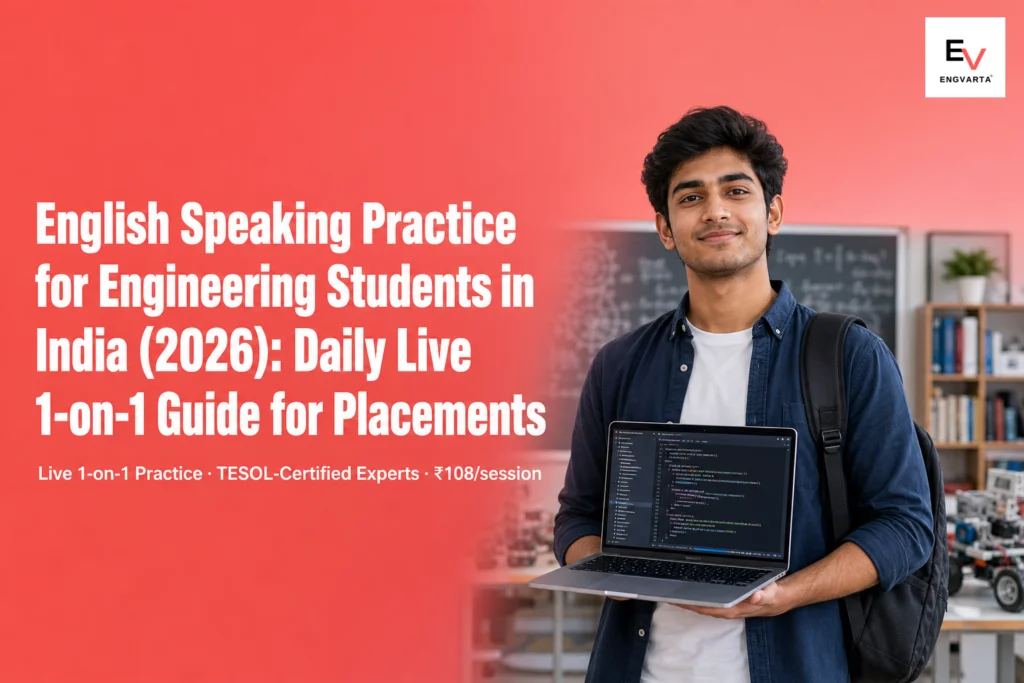
Confident Indian engineering student holding laptop with code in college campus — English speaking practice for engineering students 2026
Quick VerdictEnglish speaking practice for engineering students in India is not about vocabulary or grammar — most engineering students already read and write English well. The gap is conversational fluency under stress: campus placement interviews, MNC HR rounds, group discussions, MS-abroad video interviews, and the first 90 days of a new job where you have to actually talk to clients. The fastest fix is daily 15-minute 1-on-1 live English speaking practice with a TESOL/ESL-certified Expert — 25 sessions over a semester usually closes the gap. EngVarta starts at a ₹69 refundable trial, with the full 25-session pack at ₹2,700 (~₹108 per session) — designed for student budgets.

Every Indian engineering student we have spoken with — IIT, NIT, BITS, state university, private autonomous — describes the same problem in different words: “I can read technical papers easily but I freeze the moment an interviewer asks me to explain my project.” The CGPA is high. The resume is strong. The English in the resume is grammatically clean. But the placement interview is a spoken exam, and spoken English is a different muscle.

This guide is for engineering students in India — across all tiers, all branches, all years — who know their English speaking is the bottleneck between them and the placement, the internship, or the MS admission they actually want. We compare the apps and platforms that work for engineering-student schedules and budgets, with honest notes on where each one fits and where it does not.

Why Engineering Students Specifically Struggle with Spoken English

The pattern repeats every placement season in every Indian engineering campus:

1. Reading-and-writing fluency outruns speaking fluency. Engineering syllabi are English-medium, technical content is consumed in English (textbooks, Stack Overflow, GitHub, papers), and assignments are submitted in English. But the actual speaking reps — explaining a concept aloud, defending a design decision, narrating what your project does to a non-technical listener — never happen in classrooms or labs. Four years of strong written English, almost no oral practice.

2. Hostel-life conversations are in the regional language. Most students chat with friends, eat in the mess, watch movies, and play games in Hindi, Tamil, Telugu, Bengali, Malayalam, Marathi or their mother tongue. The brain spends 95% of its conversational hours not in English. When the placement-cell interview switches to English mode, the muscle is rusty.

3. The translation lag is brutal in interviews. You think the answer in your mother tongue, translate to English in real time, and the 2-second pause makes the interviewer think you do not know the answer. Native-fluency speakers think directly in English. Bridging that lag takes 50–100 hours of focused speaking reps.

4. Group discussions punish hesitation. Campus GDs reward the candidate who speaks first and speaks confidently — not necessarily the one with the best technical knowledge. Engineering students with weaker spoken fluency get filtered out at the GD stage and never reach the HR round where their technical strength would matter.

5. MNC HR rounds are designed to test spoken English deliberately. “Tell me about yourself” is not a vague opening question — it is a calibrated test of how fluently you can speak about your own life for 60–90 seconds without scripted preparation. Companies like Accenture, Infosys, TCS, Wipro, Capgemini, Cognizant, and global MNCs (Google, Amazon, Microsoft, Goldman Sachs) all use spoken-English checkpoints as a filter early in their funnel.

The fix for all five is the same: live, 1-on-1, voice-based English speaking practice with a trained Expert who can simulate the placement-interview format, give real-time corrections during the call, and push you with spontaneous follow-ups the way a real interviewer will.

1. EngVarta — Best for Daily English Speaking Practice on a Student Budget

EngVarta is built for exactly this use case. You connect with a TESOL/ESL-certified English Expert in minutes, on demand, for 15-, 25- or 50-minute sessions. For engineering students preparing for placements or MS interviews, the 15-minute slot is the right cadence for daily practice — short enough to fit between classes or after lab hours, long enough to build conversational stamina session-over-session.

What makes EngVarta a fit for engineering students specifically:

  • Voice-only sessions. No video pressure. You focus entirely on what you are saying — no need to worry about your hostel-room background or whether your hair is combed.
  • Real-time corrections during the call. The Expert flags hesitation, weak verbs, “ums” and unclear pronunciation in the moment — not in a written PDF you would never open later.
  • Consolidated feedback towards the end covering pace, filler-word frequency, and grammar patterns you repeat (most engineering students have 2–3 signature patterns — “actually” overuse, mixing past and present tense in narration, dropping articles before nouns).
  • Recording accessible 30 days post-session so you can listen back the next morning at 1.5× speed and hear every stumble exactly as your future interviewer will hear it.
  • Refundable trial at ₹69 — roughly the cost of a samosa-and-chai in the mess. Validate the format before committing.
  • ₹2,700 for a 25-session pack at ~₹108 per session. Daily 15-minute sessions for a full month, or alternate-day for two months. Fits a student-budget calendar.
  • Suitable for kids 7+ with parent guidance — useful if you are mentoring a younger sibling on the side.

For students preparing specifically for MS abroad video interviews — Carnegie Mellon, Georgia Tech, UT Austin, ETH Zurich, Imperial — the ₹5,130 plan (25 sessions of 25 minutes, ~₹205 per session) gives you longer mock-interview slots that better simulate the actual admissions video call.

Ready to Practice with Real Experts?

Try EngVarta today — ₹69 trial (India) / $1 trial (International) · 100% refundable

2. Speak — AI-Only Conversation, Good for Daily Reps at Low Cost

Speak is one of the most-funded AI-only English-speaking apps. You talk to an AI tutor that responds in voice, drills your pronunciation, and gives you unlimited reps for roughly $20/month. For pure repetition volume — getting 30+ hours of speaking time per month at a flat rate — it is unbeatable.

Where Speak fits in a student’s stack: as a 10-minute daily warm-up before bigger live sessions. For a deeper take on live human vs AI practice, see our real-people vs AI breakdown. Where it falls short for placement prep specifically: the AI cannot push back on hesitation in the way a human Expert can. It logs your “ums” as data but rarely interrupts your flow to correct them in the moment, and in-the-moment correction is what builds the under-pressure muscle. Speak also runs in USD pricing and the monthly subscription cost compounds across a multi-month preparation arc.

3. ELSA Speak — Pronunciation Drilling for Specific Sounds

The greatest tool we are aware of for specific pronunciation issues, such as “v” vs. “w,” “th” sounds, schwa neutralisation, or the long “ee” in terms like “sheet,” is ELSA Speak. It scores each phoneme you produce and gives visual feedback. For engineering students from regional-medium school backgrounds whose pronunciation drift is hurting their interview clarity, 10 minutes of ELSA daily for 4–6 weeks before placement season produces measurable improvement.

What ELSA does not do: build conversational fluency. It is a pronunciation gym, not a conversation simulator. Use it alongside live human practice, not instead of it.

4. Cambly — Native-Speaker Video Conversation, Premium Pricing

Cambly uses video to link you with native English speakers from the US, UK, Canada, and Australia. For engineering students aiming at MS programs in the US specifically, exposure to American native speakers can help you tune your ear to the cadence of US admissions interviewers.

Trade-offs to be honest about: Cambly is a video-first product, which adds camera-pressure on top of speaking-pressure (a known problem for engineering students who already feel self-conscious in interviews). Pricing is in USD and works out roughly 4–6× the per-session cost of EngVarta. The tutors are conversation partners, not interview coaches by default — you have to brief each tutor on the placement-interview format every time. For an honest side-by-side, see our EngVarta vs Cambly comparison.

5. Preply — Marketplace with Variable Quality

Preply is a marketplace: you browse tutor profiles, read reviews, book sessions à la carte. Pricing varies wildly ($5–$40 per hour depending on tutor). Quality is inconsistent — some tutors are excellent, some are conversation partners with little structured teaching experience.

Where Preply works for engineering students: if you want a long-term coach (one tutor across 30+ sessions over a semester) and you are willing to invest the first 3–4 sessions in finding the right person. Where it does not: if you need on-demand, predictable practice cadence — booking the same tutor 5 days a week is harder than it sounds because most tutors are part-time.

6. Free Practice — YouTube + Self-Recording + Toastmasters Campus Chapter

The zero-cost stack worth using:

  • YouTube for watching campus-placement mock interviews and HR round examples (search “Infosys HR round” or “Accenture interview experience”). Watch 5–10 of these to understand the format. This builds awareness, not speaking skill.
  • Self-recording on your phone’s voice memo app. Pick a question — “Tell me about your final-year project” — and answer it cold. Listen back the next day. Write down every “umm” and pause.
  • Toastmasters — many engineering campuses have a chapter. ₹1,000–₹2,000 annual membership, weekly meetings, structured speaking practice in front of an audience. Excellent for developing stage presence; less useful for fluency in one-on-one interviews where quick Q&A responses are required.

These work as supplements. They do not work as a substitute for live human practice with someone who interrupts you and pushes back — because you cannot correct what you do not yet hear as a problem.

How Much English Speaking Practice for Engineering Students Is Enough for Placement Season?

Realistic minimums based on hundreds of EngVarta-learner placement outcomes:

  • 1 semester before placements (6+ months out) : 3 sessions per week of 15 minutes. Build conversational stamina at a relaxed pace.
  • 3 months before placements : 4–5 sessions per week of 15 minutes. Add one 25-minute mock-interview session per week.
  • 1 month before placements:  Daily 15-minute sessions, plus two full 25-minute mocks per week. Your day-to-day conversations will feel easy by comparison.
  • Final 2 weeks : Daily 25-minute mock-interview sessions. Brief your Expert on the specific companies you have shortlists from — Infosys vs Goldman Sachs vs Google have different interview formats, and your Expert can simulate each.

What If You Are From a Tier 2 or Tier 3 College?

The English-speaking gap is the single most addressable factor that prevents Tier 2/3 engineering students from clearing MNC interviews despite strong technical skills. Most of the technical filtering happens online before the interview — your CodeChef rank, your project portfolio, your Hackerrank scores get you into the interview pool. After that, the interview is largely a spoken-English test.

If you are 2 years out from placements, start now with 3 sessions per week. By the time placement season hits, you will have 200+ hours of conversational reps under your belt, and the spoken-English gap that filters out most of your peers will no longer apply to you. The total cost over 2 years: ~₹10,000–₹12,000, which is roughly the cost of 2 textbooks.

What If You Are Targeting MS Abroad — US, Canada, Germany, UK?

The MS application process tests spoken English at multiple checkpoints:

  • TOEFL/IELTS speaking section. 20-second prep + 60-second monologue under timer pressure. Daily practice with an Expert who simulates the format for 6 weeks before the test is the single biggest score-mover.
  • Video application interviews. Carnegie Mellon MSCS, MIT Sloan, ETH Zurich — many top programs include a 20–30 minute video interview as part of admissions. Spoken fluency under camera is the assessment.
  • Visa interview (F1 for US). See our dedicated guide on F1 visa interview English speaking practice for the full prep arc.
  • First 90 days on campus. US/UK/Canadian campus life — TA work, group projects, lab meetings — happens entirely in English. Students who arrive with weak spoken fluency lose the first semester to social isolation and acclimatisation; students who arrive fluent jump straight into research and networking.

Start 6 months before your application deadline. Daily 15-minute sessions, with one 25-minute mock per week. Cost: ~₹5,000–₹6,000 total. Cheaper than a single GRE coaching module.

What Our Learners Say

Rated 4.5★ from 9,100+ reviews on Google Play

★★★★★
I have been using EngVarta for the past three months and from the period I am using I feel a considerable amount of difference in how I was speaking earlier and now how I am speaking and I think the EngVarta team has done a commendable job in improving my English fluency skill.
★★★★★
No words to say about your app. I'm very interested in it and learning a lot. Thanks for your help.
★★★★★
Its just great, I mean in terms of environment that it gives you is just awesome. Thnx again for boosting my confidence.
★★★★★
I have thoroughly enjoyed the session and the expert provided me instant feedback that will definitely help me.
★★★★★
Great app to overcome inferiority of speaking English.
★★★★★
excellent app for learning fluency and If you genuinely correct your mistakes then you should opt for this
★★★★★
Engvarta is the best app for the people who are really serious in their learning English.
★★★★★
EngVarta helps me a lot to become more fluent in speaking English. We can practice without any fear of making mistakes. I would recommend all the people who are hungry to learn English.
★★★★★
This app is very useful for e English and the Mam is nice by rating is five star
★★★★★
It was a wonderful experience talking to an expert for the first time.
★★★★★
Its just great, I mean in terms of environment that it gives you is just awesome. Thnx again for boosting my confidence.
★★★★★
Experts are friendly and supportive. Great platform to improve your communication skills.

Conclusion :

For engineering students in India, the single biggest leverage point between a strong technical background and the placement, MS admission, or first MNC job you actually want is daily live English speaking practice with a trained Expert. Not vocabulary apps. Not grammar books. Not group classes where you speak 2 minutes out of 60. Daily 15-minute 1-on-1 reps with a TESOL/ESL-certified Expert who interrupts you when you hesitate, corrects you in real time, and pushes you with spontaneous follow-ups the way a real interviewer will.

Start with the ₹69 refundable trial. If it works for your routine, commit to the ₹2,700 25-session pack and run it through one full month of placement-season prep. Most engineering students who do this consistently say the same thing: “I wish I had started this in second year.”

FAQs

Q1. Which app is best for English speaking practice for engineering students in India?

Ans : For daily live practice on a student budget, EngVarta offers TESOL/ESL-certified Experts at ₹108 per 15-minute session (₹2,700 for 25 sessions). For AI-only daily reps, Speak is the cheapest at flat-rate monthly pricing. For native-speaker exposure (mostly useful for MS abroad), Cambly works but costs 4–6× more per session.

Q2. How long does it take an engineering student to become fluent in English speaking?

Ans : For an intermediate-level engineering student, 50–100 hours of focused 1-on-1 practice usually closes the placement-interview gap. At 15 minutes per day, that is 4–8 months of consistent daily practice. The students who succeed are the ones who treat it like gym — daily reps, no skipped days, same time slot every day.

Q3. Can I prepare for campus placements in 1 month?

Ans : If your spoken English is already moderate, yes — daily 25-minute mock-interview sessions for 4 weeks will measurably improve your fluency and confidence under interview pressure. If your spoken English is weak (you freeze in front of strangers in English), one month is not enough — start 3–6 months out.

Q4. Is YouTube enough for placement interview English practice?

Ans : No. YouTube teaches you what questions to expect; it does not build the muscle to answer them fluently under pressure. Use YouTube for format awareness, but pair it with daily live human practice for the actual reps.

Q5. Should I learn an American accent for MS interviews abroad?

Ans : No. Admissions interviewers are trained to understand all global English accents. A clear, well-paced Indian English is far better than a fake American accent that adds another layer of unnatural-sounding stress to your speech.

Q6. Do I need to be fluent before I start MS abroad, or will I pick it up on campus?

Ans : You need to be reasonably fluent before you arrive. Students who land in the US with weak spoken English lose the first semester to acclimatisation, miss out on TA opportunities, and feel socially isolated. Fluent students jump straight into research within the first 2 weeks. 6 months of daily 15-minute practice before departure is the right investment.

Q7. Is EngVarta good for engineering students from regional-medium school backgrounds?

Ans : Yes — many EngVarta learners are first-generation English-medium engineering students whose schooling was in Hindi, Tamil, Telugu, Bengali, Marathi or other regional languages. TESOL/ESL-certified Experts specifically understand the transition path and adapt sessions to your starting point without judgement.

Q8. What is the cheapest way to practise English speaking as an engineering student?

Ans : Free: self-recording on your phone + watching YouTube placement-interview videos. Low-cost: EngVarta’s ₹69 refundable trial + ₹2,700 25-session pack. Mid-cost: monthly AI app subscriptions ($10–$20/month for Speak or ELSA). Premium: native-speaker video apps (Cambly, $40–$60/month equivalent).

Editorial note: This guide is researched and written by the EngVarta team. We compare our own platform alongside other tools that Indian engineering students commonly use, and we are honest about where each tool fits — including where it does not.