Tips To Improve English Communication Skills |

TAG: tips to improve english communication skills

Speak English Confidently With These 3 Simple Tips

December 13, 2025 • 7 min read • By EngVarta

Speak English Confidently

Speaking English confidently is not about using advanced vocabulary or having perfect grammar.
To speak English confidently, the most important thing is feeling comfortable expressing your thoughts, even if your sentences are not perfect.

Many learners understand English very well but still hesitate when it comes to speaking.
The challenge is usually not a lack of knowledge, but a lack of confidence to speak English confidently in real conversations.

The problem is lack of real speaking practice.

In real conversations with English learners, one pattern appears again and again — people know what they want to say,  but freeze the moment they start speaking. This hesitation isn’t caused by weak grammar but by a lack of regular, judgment-free speaking practice.

If you want to speak English confidently in daily life, interviews, meetings, or social situations, these three simple tips can change the way you approach English forever.

Why Speaking English Confidently Feels Difficult

Before fixing the problem, it’s important to understand it.

Most learners struggle because:

  • They translate sentences in their head
  • They fear making mistakes
  • They don’t get regular speaking opportunities

Confidence doesn’t come from reading or watching videos alone.

When learners only consume English instead of using it, their brain stays in “understanding mode,” not “response mode.” Speaking requires fast thinking under pressure — something that only develops through real conversation.
It comes from using English regularly in real conversations.

Let’s look at what actually works.

Tip 1: Stop Preparing Sentences. Start Expressing Thoughts.

One of the biggest mistakes learners make is over-preparation.

They try to:

  • Memorise full sentences
  • Plan responses in advance
  • Wait for the “right moment” to speak

But real conversations don’t work like exams.

Learners who over-prepare sentences often pause mid-conversation, lose confidence, and abandon their point halfway. Those who allow themselves to speak imperfectly tend to recover faster and communicate more clearly.

To speak English confidently, you must learn to think while speaking, not before speaking.

What to Do Instead

Start expressing simple thoughts out loud — even if they sound incomplete.

For example:

  • Talk about what you are doing right now
  • Describe your day in simple English
  • Speak without stopping yourself for mistakes

Fluency grows when your mind learns that speaking is safe, even when it’s imperfect.

Tip 2: Make Mistakes in a Safe Environment

Mistakes are not the problem. Fear of judgement is.

Many learners stop speaking because:

  • People laugh
  • Corrections feel harsh
  • They feel embarrassed

This fear is natural — especially for adult learners. Confidence drops not because of mistakes, but because of repeated negative speaking experiences.

To speak English confidently, you need:

  • A patient listener
  • Supportive correction
  • Encouragement, not pressure

This is why practicing alone is not enough.
You need real human interaction with someone who helps you improve while you speak.

Tip 3: Practice English Daily, Not Occasionally

Confidence is not built in one day.

It is built through daily exposure.

Many learners wait for:

  • Free weekends
  • Long study hours
  • Motivation

But confidence grows faster with:

  • 10–15 minutes every day
  • Short, consistent speaking sessions
  • Regular feedback

Daily practice trains your brain to stop panicking and start responding naturally. Even short daily speaking sessions reduce hesitation within weeks because the brain stops treating English as a “performance” and starts treating it as a normal communication tool.

While you’re at it, make sure you’re also confident with small but essential elements like “a,” “an,” and “the.” These articles may seem simple, but they affect how professional and polished your English sounds.

Here’s a quick guide to brush up on them: Articles in English Grammar – A, An and The

How the EngVarta App Helps You Speak English Confidently

EngVarta was created for learners who understand English but struggle to use it in real conversations — a gap noticed repeatedly during live speaking interactions.

Knowing what to do is one thing.
Doing it daily is another.

This is where EngVarta helps learners bridge the gap between knowing English and speaking it confidently.

What Makes EngVarta App Effective

  • One-on-One Live English Conversations
    Speak directly with trained English experts.
  • Friendly, Real-Time Corrections
    Improve naturally without interruptions or embarrassment.
  • Daily Speaking Habit
    Short sessions designed for busy schedules.
  • Confidence-Focused Learning
    The goal is fluency through comfort, not fear.

EngVarta is designed for learners who already know English but struggle to use it confidently in real life.

Who Is This For?

Beginners

If English feels intimidating, EngVarta helps you start speaking gently, without pressure.

Practicing Learners

If you understand English but hesitate while speaking, real conversations help unlock fluency.

Serious Learners

If you want faster improvement for interviews, work communication, or daily confidence, consistent speaking practice makes the difference.

Start Speaking English Confidently Today

Confidence doesn’t come first.
Speaking comes first.

🔗 Download EngVarta:
Download for Android | Download for iOS

Practice real conversations.
Speak daily.
Build confidence naturally.

Stay Connected With EngVarta

Follow EngVarta for daily English tips, speaking guidance, and confidence-building content:

This article is based on real speaking interactions and learning patterns observed while helping English learners practice spoken English daily.

Conclusion :

Speaking English confidently is not about becoming perfect.
It’s about becoming comfortable.

And comfort only comes from practice.

Frequently Asked Questions

Who should use the EngVarta app?

EngVarta is ideal for students, working professionals, and anyone who understands English but struggles to speak confidently in real-life situations.

How does the EngVarta app help improve speaking confidence?

EngVarta provides one-on-one live conversations with trained English experts who offer friendly corrections, helping learners speak freely without fear or judgement.

Is speaking practice more important than reading and watching videos?

Yes. Reading and videos help with understanding, but speaking practice trains your brain to respond in real time, which is essential for confidence.

Do I need perfect grammar to speak English confidently?

No. Many confident speakers make small grammar mistakes. When you speak regularly, your grammar improves naturally over time through usage and feedback.

How can I speak English confidently without hesitation?

You can speak English confidently by practicing daily in real conversations. Focus on expressing your thoughts instead of worrying about mistakes. Confidence builds through repetition, not perfection.

How to Improve Your English Communication Skills?

September 27, 2025 • 5 min read • By Swati Raj

How to Improve Your English Communication Skills?

English has become the language of opportunity. From job interviews and presentations to travelling abroad or simply making friends, strong English communication skills can shape your future in ways you can’t imagine.

But here’s the secret: becoming fluent in English isn’t about memorising grammar rules or learning hundreds of words at once. It’s about practicing consistently, building confidence, and learning how to express yourself naturally.

In this blog, we’ll explore practical steps to improve your English communication skills, and also see how the EngVarta App can be your partner in this journey.

1. Practice Every Day, Even if It’s Just 10 Minutes

Consistency matters more than intensity. Instead of waiting for the “right time,” start small. Talk about your day in English, describe what you see around you, or practice speaking in front of a mirror for 10 minutes daily.

2. Listen More Than You Speak

Fluent speakers are also good listeners. Watch English movies, listen to podcasts, or follow TED Talks. This helps you absorb correct pronunciation, sentence patterns, and natural expressions.

3. Think in English Instead of Translating

One of the biggest obstacles learners face is thinking in their native language and then translating into English. This slows you down and makes you nervous. Train your mind to think directly in English.

👉 You can read this blog on How to Stop Translating in Your Head While Speaking English

This article will guide you with techniques to break free from the translation trap.

4. Expand Your Vocabulary in Context

Instead of cramming 20 new words daily, focus on learning 2–3 words and using them in sentences. For example, if you learn the word “versatile,” try saying: “This jacket is versatile; I can wear it to work or on a trip.” Using words in real life makes them stick.

5. Practice With Real People

Reading and listening are great, but speaking with real people is the ultimate game-changer. You need feedback, correction, and the confidence that comes from real conversations.

How the EngVarta App Can Help You

This is where EngVarta comes in. It’s not just another English learning app—it’s a practice platform where you connect with live English experts over phone calls.

Here’s how EngVarta helps you improve faster:

  • 🗣 Daily conversation practice with experts, just like talking to a friend.

  • Personalized feedback on grammar, pronunciation, and fluency.

  • 💡 Practical topics like interviews, meetings, and presentations.

  • 📈 Progress tracking to see how far you’ve come.

If you want to transform your English from hesitant to confident, EngVarta provides the safe, judgment-free space you need.

👉 Download the EngVarta App now:

Final Thoughts

Improving your English communication skills is a journey, not a race. With daily practice, mindful listening, and the right guidance, you can achieve fluency and confidence.

Remember: you don’t have to be perfect to start speaking—you have to start speaking to become perfect.

So why wait? Take your first step today with EngVarta, and let every conversation bring you closer to the confident speaker you want to be.

Connect With EngVarta

Stay updated and keep learning with us:


Frequently Asked Questions (FAQs)

Frequently Asked Questions

Can I learn English just by watching movies or reading books?

Movies and books improve your listening and vocabulary, but they won’t give you fluency. To speak confidently, you need real conversations with people — that’s where EngVarta bridges the gap.

What is the best app to practice English speaking?

EngVarta is one of the best apps because it connects you with live English experts over phone calls. You can practice real conversations, get instant corrections, and build confidence naturally.

Is grammar important for good communication?

Yes, but don’t let grammar stop you from speaking. Communication is more about expressing your ideas clearly. Fluency comes with practice — grammar improves along the way.

How long does it take to become fluent in English?

It depends on your current level and how much time you dedicate daily. With consistent practice for 20–30 minutes a day, most learners see a big improvement in 3–6 months.

How can I improve my English communication skills at home?

You can start by reading English books, listening to podcasts, watching English shows, and practicing speaking daily. The key is consistency. To make it more effective, use apps like EngVarta, where you can practice live with English experts from home.

Have Fun with Words: Discovering the Magic of Anagrams

December 23, 2024 • 5 min read • By Swati Raj

Have Fun with Words: Discovering the Magic of Anagrams

Language is a playground where words take center stage, and one of the most delightful games you can play is with anagrams. An anagram is a rearrangement of the letters of a word or phrase to create a new word or phrase. It’s not just a fun pastime—it’s also a brilliant way to sharpen your English skills.

Let’s dive into the fascinating world of anagrams, uncover their charm, and see how they can become a powerful tool in your English learning journey.

What is an Anagram?

An anagram is when you take a word like listen and rearrange its letters to form another word, like silent. The two words use the exact same letters but tell different stories. Simple, right? Yet, this simple concept has intrigued word lovers for centuries.

Why Should You Play with Anagrams?

Here’s why exploring anagrams can benefit your English fluency:

  1. Boost Vocabulary: Discovering new words while forming anagrams expands your vocabulary. For example, from save you can learn vase.
  2. Enhance Creativity: Crafting anagrams encourages creative thinking as you explore different combinations of letters.
  3. Improve Spelling: Rearranging letters reinforces your spelling skills as you become familiar with word patterns.
  4. Make Learning Fun: Anagrams add a playful twist to learning English, making it enjoyable and less stressful.

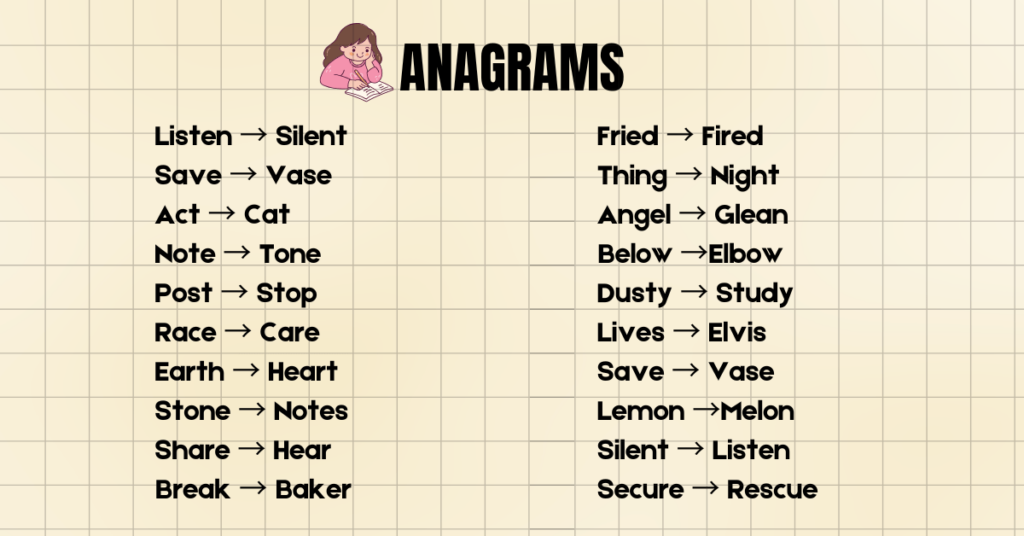
Examples of Anagrams

  • ListenSilent
  • SaveVase
  • ActCat
  • NoteTone
  • PostStop
  • RaceCare
  • EarthHeart
  • StoneNotes
  • ShareHear
  • BreakBaker
  • FriedFired
  • ThingNight
  • AngelGlean
  • BelowElbow
  • DustyStudy
  • LivesElvis
  • SaveVase
  • LemonMelon
  • SilentListen
  • SecureRescue

50+ Common Anagram Examples with Meanings

Here is a curated list of 50+ anagram examples—some simple single-word flips, others clever multi-word classics. Read these aloud to train your brain to spot letter patterns quickly.

# Original Word / Phrase Anagram Type
1 LISTEN SILENT Classic single-word
2 EARTH HEART Classic single-word
3 NIGHT THING Classic single-word
4 SAVE VASE Beginner
5 STRESSED DESSERTS Meaningful reversal
6 TEACHER CHEATER Ironic
7 BEDROOM BOREDOM Playful
8 DORMITORY DIRTY ROOM Clever multi-word
9 ASTRONOMER MOON STARER Clever multi-word
10 SCHOOLMASTER THE CLASSROOM Clever multi-word
11 DEBIT CARD BAD CREDIT Ironic phrase
12 ELEVEN PLUS TWO TWELVE PLUS ONE Mathematical
13 THE EYES THEY SEE Clever multi-word
14 PUNISHMENT NINE THUMPS Playful
15 A DECIMAL POINT I’M A DOT IN PLACE Self-descriptive
16 ELECTION RESULTS LIES — LET’S RECOUNT Political humor
17 MOTHER-IN-LAW WOMAN HITLER Humorous
18 CONVERSATION VOICES RANT ON Self-descriptive
19 DICTIONARY INDICATORY Advanced
20 SLOT MACHINES CASH LOST IN ME Self-descriptive
21 SNOOZE ALARMS ALAS! NO MORE Z’S Witty
22 FUNERAL REAL FUN Ironic
23 THE MORSE CODE HERE COME DOTS Famous classic
24 THE COUNTRYSIDE NO CITY DUST HERE Self-descriptive
25 SOFTWARE SWEAR OFT Humorous
26 ANGEL GLEAN Single-word
27 BELOW ELBOW Beginner
28 DUSTY STUDY Beginner
29 LIVES ELVIS Pop culture
30 LEMON MELON Beginner
31 SECURE RESCUE Single-word
32 FRIED FIRED Beginner
33 NAMES MEANS Single-word
34 ENRAGED ANGERED Synonymous
35 FOREST FOSTER Single-word
36 CAUTIONED EDUCATION Clever
37 STATUE ASTUTE Intermediate
38 FLUSTER RESTFUL Opposites
39 DIRTY ROOM DORMITORY Reverse classic
40 A GENTLEMAN ELEGANT MAN Self-descriptive
41 HIBERNATES BANISHETH Archaic / advanced
42 PRESBYTERIAN BEST IN PRAYER Thematic
43 OLD WEST ACTION CLINT EASTWOOD Celebrity
44 DESPERATION A ROPE ENDS IT Dark thematic
45 ELEVATION TO A LEVEL IN Thematic
46 SIGNATURE A TRUE SIGN Thematic
47 PAYMENT RECEIVED EVERY CENT PAID ME Clever long
48 ACT CAT Beginner
49 NOTE TONE Beginner
50 POST STOP Beginner
51 RACE CARE Beginner
52 BREAK BAKER Single-word
53 STONE NOTES Single-word
54 SHARE HEARS Single-word
55 RESISTANCE ANCESTRIES Advanced

Tip: Try covering the right column and guess the anagram yourself. This simple drill—five minutes a day—accelerates both vocabulary recall and spelling confidence.

How to Use Anagrams in Learning English

  1. Word Games
    Try finding anagrams for words you encounter daily. For instance, if you see stone, think of tones or notes.
  2. Challenge Yourself
    Take a sentence or phrase and see how many anagrams you can form. Apps and online tools like Anagram Solver can help!
  3. Practice Spelling
    Use anagrams to test and improve your spelling. Rearrange the letters of a word in your head and try to recreate it.
  4. Learn Idioms and Phrases
    Create anagrams for idioms or phrases, like turning The Morse Code into Here come dots. It’s a great memory trick!

Anagrams and Communication

Anagrams are more than just a fun activity—they improve your cognitive skills and ability to see connections. When speaking or writing in English, this ability to think creatively and spot patterns can make your communication more engaging and impactful.

Try This: An Anagram Challenge!

Here’s a quick challenge for you:
Rearrange the letters of the word spar to form a new word. (Hint: You use this word when you want to wrap a gift!)

Drop your answer in the comments or share your own favorite anagrams!

👉 Boost Your English Speaking with EngVarta Daily!


Improve your English faster with daily speaking practice, real conversations, and expert guidance. Build confidence, speak fluently, and express yourself clearly—one conversation at a time.

📸 Instagram : https://www.instagram.com/engvarta.app/
▶️ YouTube : http://www.youtube.com/@EngVarta
📘 Facebook : https://www.facebook.com/engvarta
💼 LinkedIn : https://www.linkedin.com/company/engvarta

✨ Follow EngVarta now and start speaking English confidently every day! 🚀

Final Thoughts

Anagrams are proof that language is not just a tool but a craft that invites you to experiment and enjoy its endless possibilities. Whether you’re an English learner or a seasoned speaker, playing with anagrams can be a delightful way to grow your skills.

So, the next time you want to spice up your learning routine, dive into the magical world of anagrams. And remember, with every twist and turn of letters, you’re not just rearranging words—you’re unlocking the beauty of language.

Start Practicing Today

You’ve read the comparison. You know the numbers. The only thing left is to actually start.

Try EngVarta for ₹69. Full money-back guarantee. No risk, no booking, no excuses.

Download on Google Play →
Download on App Store →

Available on Android & iOS • 2M+ learners • 4.5★ rating