English Learning Tips |

Tag

English learning tips

How to Improve English Grammar and Vocabulary?

January 28, 2026 • 10 min read • By Swati Raj

How to Improve English Grammar and Vocabulary

Improving English grammar and vocabulary is not just an academic goal anymore—it is a practical life skill. Whether you are a working professional, a student, or someone preparing for interviews, presentations, or global communication, strong grammar and vocabulary directly influence how confident, clear, and credible you sound in spoken English.

Many learners reach an intermediate level where they understand English well but struggle to express ideas fluently and accurately. This gap usually exists not because of lack of intelligence, but because grammar and vocabulary have not yet become automatic in real conversations.

This blog offers a structured, evidence-based guide on how to improve English grammar and vocabulary in a way that supports spoken English mastery, not just written correctness. You’ll also learn how modern tools like the EngVarta App and educational YouTube channels can accelerate progress when used correctly.

Why English Grammar and Vocabulary Matter in Spoken English

Grammar Shapes Clarity

Grammar determines how clearly your ideas are understood. Incorrect tense usage, subject-verb disagreement, or sentence structure errors can confuse listeners—even if your vocabulary is good.

Example:

  • I am working there since two years.
  • I have been working there for two years.

The difference is grammatical, but the impact is communication clarity.

Vocabulary Builds Precision and Confidence

Vocabulary allows you to express exact meaning, emotions, and intent. Limited vocabulary leads to repetition, hesitation, and filler words like umm or actually.

Strong vocabulary helps you:

  • Sound confident
  • Avoid pauses
  • Explain ideas naturally

Grammar and vocabulary together create fluency, not separately.

How can I improve English grammar and vocabulary effectively?

You can improve English grammar and vocabulary by combining daily speaking practice, contextual learning, active usage, and guided feedback—rather than memorization alone.

Common Problems Learners Face

Understanding the challenges helps solve them effectively.

1. Knowing Rules but Not Using Them

Many learners can explain grammar rules but hesitate while speaking. This happens because grammar is learned theoretically, not practically.

2. Passive Vocabulary

Learners recognize words while reading but cannot use them while speaking. This means vocabulary is passive, not active.

3. Fear of Making Mistakes

Fear leads to silence. Silence stops progress.

4. Overdependence on Translation

Thinking in the native language and translating slows down speech and causes errors.

Step 1: Shift from Rule-Based Learning to Usage-Based Learning

Grammar improves fastest when learned through use, not definitions.

Practical Strategy

Instead of memorizing:

“Present perfect continuous tense is used for…”

Practice sentences like:

  • I have been learning English for six months.
  • She has been working late these days.

Your brain learns patterns faster than rules.

Step 2: Improve Grammar Through Daily Speaking Practice

Why Speaking Is Essential

Grammar becomes natural only when your brain uses it in real time. Writing helps accuracy; speaking builds fluency.

Daily Spoken Practice Ideas

  • Describe your day aloud
  • Explain your job or studies
  • Talk about plans, experiences, or opinions

This activates grammar subconsciously.

How Engvarta Helps Improve Grammar and Vocabulary Faster

Engvarta offers one-on-one live English practice sessions with expert trainers, helping learners apply grammar and vocabulary in real conversations.

Benefits of Practicing with Engvarta

  • Real-time grammar correction
  • Vocabulary expansion through conversation
  • Confidence building
  • Personalized feedback
  • Flexible learning schedule

Instead of memorizing rules, you learn by speaking, which leads to faster and long-lasting improvement.

Practice real conversations, get instant feedback, and improve your communication skills with daily 1-on-1 English sessions on EngVarta.

👉 Get Started on EngVarta:

 📱 Download for Android 📱 Download for iOS

Step 3: Learn Vocabulary in Context, Not Lists

Memorizing word lists rarely improves spoken English.

Better Approach: Contextual Vocabulary

Learn words with:

  • Situations
  • Emotions
  • Real-life usage

Example:
Instead of learning “anxious”, learn:

I felt anxious before my interview.

This makes recall faster during conversations.

Step 4: Activate Vocabulary (From Passive to Active)

Knowing a word is not enough—you must use it repeatedly.

Activation Technique

For every new word:

  1. Say it aloud
  2. Create your own sentence
  3. Use it in a conversation within 24 hours

This transforms vocabulary into usable speech.

EngVarta’s Role

EngVarta sessions naturally push learners to reuse vocabulary in conversations, helping words move from memory to muscle.

Step 5: Use Immersive Learning Methods

Immersion helps grammar and vocabulary grow together.

Effective Immersion Methods

  • Listening to English podcasts
  • Watching English videos with subtitles
  • Thinking in English during daily tasks

YouTube Channels for Grammar & Vocabulary

Educational YouTube channels are useful when used intentionally:

  • Watch short videos
  • Note one grammar pattern
  • Apply it while speaking the same day

Passive watching alone does not improve fluency—application does.

Step 6: Focus on High-Impact Grammar Areas

You don’t need to master all grammar to speak well.

Priority Grammar Topics for Spoken English

  • Tenses (present, past, present perfect)
  • Subject-verb agreement
  • Question formation
  • Prepositions in speech
  • Sentence connectors

These cover most real-life conversations.

Step 7: Build Vocabulary for Daily and Professional Use

Vocabulary Types You Should Focus On

  • Daily-life expressions
  • Workplace vocabulary
  • Opinion phrases
  • Common collocations

Examples:

  • take a decision → ❌
  • make a decision → ✅

Such small improvements significantly raise spoken quality.

Step 8: Reduce Grammar Anxiety While Speaking

Overcorrecting yourself breaks fluency.

Smart Rule for Spoken English

  • Clarity first
  • Accuracy second
  • Perfection later

Listeners value understanding more than perfection.

How EngVarta Builds Confidence

EngVarta provides a low-pressure speaking environment where learners are guided—not judged. This reduces anxiety and increases speaking frequency, which is essential for improvement.

Step 9: Consistency Beats Intensity

Learning grammar for 3 hours once a week is less effective than 20 minutes daily.

Ideal Daily Routine (20–30 Minutes)

  • 10 minutes speaking practice
  • 10 minutes vocabulary usage
  • 5 minutes review

This routine leads to measurable progress within weeks.

Read Regularly to Improve Grammar and Vocabulary Naturally

Reading is one of the most powerful ways to improve English grammar and vocabulary without conscious memorization. When you read, your brain absorbs sentence structures, word usage, and grammar patterns naturally.

Benefits of Reading in English

  • Improves sentence formation
  • Expands vocabulary in context
  • Strengthens grammar understanding
  • Enhances comprehension skills

Best Reading Materials for English Learners

  • Novels and short stories
  • Newspapers and magazines
  • Blogs and online articles
  • Academic or professional content

Read content related to your goals—business English, spoken English, or exam preparation.

Practice Writing to Strengthen Grammar Accuracy

Writing forces you to apply grammar rules actively. It helps you identify mistakes and improve sentence clarity over time.

Importance of Writing Practice

  • Improves grammar accuracy
  • Reinforces new vocabulary
  • Builds sentence confidence
  • Enhances structured thinking

Effective Writing Exercises

  • Daily journaling
  • Writing short essays
  • Drafting emails or messages
  • Creating short stories

📌 Tip: After writing, review your sentences or get feedback to correct errors.

Learn New English Words Daily (Without Memorizing Lists)

Vocabulary building works best when words are learned in context, not isolation.

Techniques to Learn New Words Daily

  • Maintain a vocabulary notebook
  • Use flashcards or spaced repetition apps
  • Learn words by themes (travel, office, food)
  • Use new words in sentences immediately

🎯 Set a realistic goal: 5–10 new words per day.

Engage in Conversations to Improve Spoken Grammar

Speaking is where improve english grammar and vocabulary truly come alive. Many learners know rules but struggle to speak fluently.

Benefits of Speaking Practice

  • Improves real-time grammar usage
  • Builds confidence
  • Improves pronunciation
  • Reduces hesitation

Conversation Practice Ideas

  • Speak with friends or colleagues
  • Join English-speaking clubs
  • Participate in online discussion forums
  • Practice with language partners

Consistent speaking is the fastest way to convert knowledge into fluency.

Use Mobile Apps for Daily Grammar and Vocabulary Practice

Mobile apps make English practice convenient and consistent.

Features to Look For

  • Grammar exercises
  • Vocabulary builders
  • Pronunciation support
  • Interactive quizzes

Best Apps for English Learning

  • EngVarta – vocabulary focus, grammar correction, Speaking Practice
  • Duolingo – gamified learning
  • Memrise – vocabulary focus
  • Grammarly – grammar correction

Using apps daily, even for 15 minutes, creates long-term improvement.

Why This Matters for Indian Learners

In India, many learners:

  • Study English academically
  • Rarely speak English daily
  • Fear being judged for mistakes

This creates a fluency gap despite strong understanding.

Platforms like EngVarta address this by offering India-focused, real-world speaking practice, helping learners bridge the gap between knowledge and usage.

Connect with EngVarta on Social Media

Follow us for practical English tips, live speaking insights, and updates.

Instagram | YouTube | Facebook | LinkedIn

Final Thoughts:

Improving English grammar and vocabulary is not about becoming perfect—it’s about becoming clear, confident, and comfortable while speaking.

When you:

  • Practice speaking daily
  • Learn grammar through usage
  • Activate vocabulary through conversation
  • Use guided platforms like EngVarta App

…your English naturally improves.

Grammar stops feeling like a rulebook. Vocabulary stops feeling limited. And spoken English becomes a tool, not a challenge.

FAQs  (Frequently Asked Questions)

Frequently Asked Questions

What is the EngVarta App and how does it help?

EngVarta provides 1-on-1 live English practice with expert trainers, helping learners improve grammar, expand vocabulary, and speak confidently. It offers personalized feedback in a flexible, real-world learning environment.

Do apps really help with spoken English?

Yes, apps like EngVarta, Duolingo, Memrise, and Grammarly can improve grammar, vocabulary, and pronunciation. They work best when combined with real-life conversations and contextual practice, rather than just passive usage.

Is vocabulary more important than grammar?

Both are essential. Vocabulary allows you to express ideas precisely, while grammar ensures clarity and structure. For spoken English, learning vocabulary in context combined with natural grammar usage boosts fluency and confidence.

Can I improve grammar without studying rules?

Yes! Grammar can be learned naturally through speaking, writing, reading, and listening in context. Using the EngVarta App for live, 1-on-1 practice helps internalize patterns faster, making your speaking fluent and confident without rote study.

How long does it take to improve English grammar and vocabulary?

With consistent daily practice of 20–30 minutes, learners can see noticeable improvement in 3–6 months. Using EngVarta’s live sessions accelerates learning by combining real conversation, feedback, and contextual vocabulary and grammar practice.


Still Thinking in Hindi Before You Speak English? Here’s How to Stop

June 27, 2025 • 8 min read • By Swati Raj

Still Thinking in Hindi Before You Speak English? Here’s How to Stop

Do you ever catch yourself translating from Hindi to English in your head before you speak?

You’re not alone.

Many English learners — especially in India — go through this exact struggle. You know the words, you understand the grammar, but when it’s time to speak… you pause. You think in Hindi first. Then slowly, you try to turn it into English.

This habit is one of the biggest reasons behind hesitation and slow speech.

In this blog, let’s dive into why you’re still thinking in Hindi — and more importantly, how to train your brain to think directly in English.

Why You’re Still Thinking in Hindi

Here are a few common reasons why this habit develops:

1. Hindi is your default setting

It’s the language you use for emotions, daily life, thoughts — everything. Your brain is hardwired to think in it.

2. English was taught as a subject, not as a skill

You’ve studied English grammar and vocabulary, but you weren’t encouraged to use it in real conversations.

3. Fear of making mistakes

We often think in Hindi because we feel more confident forming a thought in our mother tongue first, and then translating. That translation step is what causes hesitation.

But here’s the thing — you can change this.

You can reprogram your thinking pattern, and it doesn’t take a language degree — it just takes consistency and the right exercises.

How to Stop Thinking in Hindi While Speaking English

Let’s break it down into daily, practical habits.

1. Train Your Eyes and Mind

Wherever you are, look around and name things in English.

“Fan. Table. Plant. Phone. Water bottle.”

Then move to small phrases:

“The fan is running.”
“The bottle is empty.”

This builds an English vocabulary for your everyday surroundings — without depending on Hindi.

If you feel your vocabulary is limited, start expanding it with simple yet powerful words. You can check out this list of 50 simple English words to boost your vocabulary and begin adding them to your daily thoughts.

2. Narrate Your Routine

Talk to yourself in English as you go through your day.

  • “I’m brushing my teeth.”

  • “Let me check my phone.”

  • “Time to cook dinner.”

This constant narration helps you think directly in English without translating in your head.

3. Express Emotions in English

Instead of saying “Mujhe gussa aa raha hai” in your head, say:

“I’m feeling angry.”
“I’m annoyed right now.”
“I’m super excited about this!”

Practicing emotional vocabulary is a powerful way to switch your internal language from Hindi to English.

4. Use the “Slow & Speak” Technique

When someone asks you something in English, don’t panic.
Don’t rush to translate.

Just pause for 5 seconds, think slowly in English, and then respond.

Speed doesn’t equal fluency — clarity of thought does.

5. Don’t Aim for Perfection

Trying to speak perfect English will keep you stuck in the translation loop.

Instead:

  • Speak simply.

  • Use short sentences.

  • Make mistakes — it’s how fluency is built.

Nobody learned English by only thinking about grammar. People learn it by using it daily.

The 7-Day Challenge to Break the Habit

Try this challenge for the next 7 days:

🗓️ Choose one activity each day (walking, cooking, scrolling Instagram)
🗣️ Narrate your thoughts in English only
⏱️ Don’t allow yourself to think in Hindi during that activity

You’ll be amazed at how quickly your brain adjusts.

Your Thoughts Shape Your Fluency

Fluency isn’t just about speaking.

It’s about how you think.

When you’re still thinking in Hindi, English will always feel like a second language. But once your thoughts start flowing in English — even broken English — that’s when real fluency begins.

And the truth is: you already know enough English to begin this journey.

All you need now is practice and a little courage to speak, even if it’s not perfect.

Want to Practice English Without Feeling Judged?

If you’re ready to stop thinking in Hindi and finally start thinking in English, try the EngVarta App.

EngVarta helps you practice live English conversations with experts — so you can stop overthinking and start speaking fluently and naturally.

No books. No boring grammar drills. Just real talk.

Frequently Asked Questions about Thinking in English (Not Hindi)

Why do I think in Hindi when speaking English?

Thinking in Hindi (or any native language) while speaking English is a stage every non-native learner passes through. Reasons: (1) Your brain processes meaning in your native language first, then translates. (2) Your active English vocabulary isn’t broad enough to cover your thoughts directly. (3) Lack of practice in spoken English contexts. (4) Anxiety about errors makes you safer-route through Hindi. The fix: deliberate practice that forces direct English thinking — 25-30 min/day for 4-6 weeks usually starts the shift.

How do I stop translating from Hindi to English in my head?

Effective techniques: (1) Force yourself to think in English during low-stakes solo activities (commentary on cooking, walking, getting ready). (2) Practice English-only conversations daily — when you can’t translate fast enough, the brain adapts to direct English thinking. (3) Build a vocabulary of “English-first” topics (your work, hobbies, interests) where you’ve never used Hindi. (4) Daily live practice with a TESOL/ESL-certified Expert who notices when you’re translating and pushes you to think directly. EngVarta‘s daily 25-min sessions help build this exact skill — Experts can detect translation pauses and prompt direct English thinking.

How long does it take to think in English instead of Hindi?

Realistic timeline: 4-6 weeks of daily practice to start thinking in English for familiar topics; 6-12 months to think in English consistently across most contexts; 2+ years to think in English even in emotional or unexpected situations. Most adult learners always have some Hindi-thinking residue, especially under stress. That’s normal — even fluent multilingual people sometimes “feel” things in their first language while expressing them in English.

Why do I pause when speaking English?

Common reasons for pauses: (1) Translating from Hindi mid-sentence. (2) Searching for vocabulary. (3) Constructing grammar in your head. (4) Anxiety about making errors. (5) Genuine thinking time about content. Some pauses are natural — fluent native speakers pause too. The problem is when pauses are AT EVERY SENTENCE rather than for emphasis or thinking time. Fix: practice speaking out loud daily until your tongue catches up with your thoughts.

How can I speak English without thinking in Hindi?

Practical 4-week plan: Week 1: Choose 3 topics (your job, hobby, daily routine) — practice 5 min/day in English-only mode. Week 2: Expand to 5 topics, 10 min/day each in solo monologue. Week 3: Add 25-min daily live practice with a TESOL/ESL-certified Expert — explicitly request “no translation” feedback. Week 4: Speak English in low-stakes social interactions (ordering food, casual conversation) without preparing translations. Most learners notice substantial reduction in translation by week 4.

Is thinking in Hindi while speaking English a sign of weak fluency?

Yes — but it’s normal at intermediate level. Translating mid-sentence is the #1 indicator of intermediate-vs-advanced fluency. Advanced speakers don’t translate; they think in English directly. The good news: this is one of the most fixable fluency markers. 4-6 weeks of dedicated practice usually produces noticeable shift. Don’t accept “I always think in Hindi” as permanent — it’s a stage, not a destination.

Ready to Practice with Real Experts?

Try EngVarta today — ₹69 trial (India) / $1 trial (International) · 100% refundable

Have Fun with Words: Discovering the Magic of Anagrams

December 23, 2024 • 11 min read • By Swati Raj

Have Fun with Words: Discovering the Magic of Anagrams

Language is a playground where words take center stage, and one of the most delightful games you can play is with anagrams. An anagram is a rearrangement of the letters of a word or phrase to create a new word or phrase. It’s not just a fun pastime—it’s also a brilliant way to sharpen your English skills.

Let’s dive into the fascinating world of anagrams, uncover their charm, and see how they can become a powerful tool in your English learning journey.

What is an Anagram?

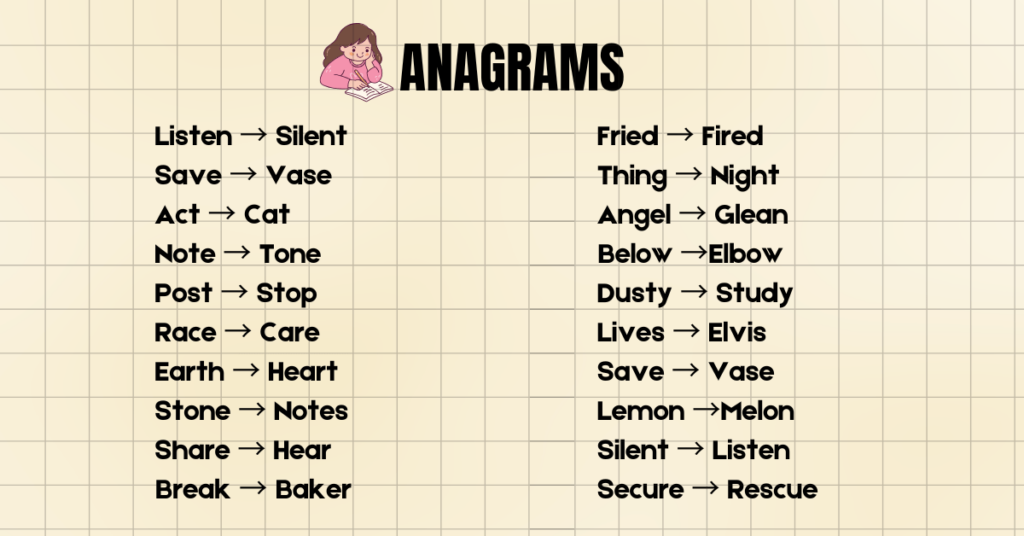
An anagram is when you take a word like listen and rearrange its letters to form another word, like silent. The two words use the exact same letters but tell different stories. Simple, right? Yet, this simple concept has intrigued word lovers for centuries.

Why Should You Play with Anagrams?

Here’s why exploring anagrams can benefit your English fluency:

  1. Boost Vocabulary: Discovering new words while forming anagrams expands your vocabulary. For example, from save you can learn vase.
  2. Enhance Creativity: Crafting anagrams encourages creative thinking as you explore different combinations of letters.
  3. Improve Spelling: Rearranging letters reinforces your spelling skills as you become familiar with word patterns.
  4. Make Learning Fun: Anagrams add a playful twist to learning English, making it enjoyable and less stressful.

Examples of Anagrams

  • ListenSilent
  • SaveVase
  • ActCat
  • NoteTone
  • PostStop
  • RaceCare
  • EarthHeart
  • StoneNotes
  • ShareHear
  • BreakBaker
  • FriedFired
  • ThingNight
  • AngelGlean
  • BelowElbow
  • DustyStudy
  • LivesElvis
  • SaveVase
  • LemonMelon
  • SilentListen
  • SecureRescue

50+ Common Anagram Examples with Meanings

Here is a curated list of 50+ anagram examples—some simple single-word flips, others clever multi-word classics. Read these aloud to train your brain to spot letter patterns quickly.

# Original Word / Phrase Anagram Type
1 LISTEN SILENT Classic single-word
2 EARTH HEART Classic single-word
3 NIGHT THING Classic single-word
4 SAVE VASE Beginner
5 STRESSED DESSERTS Meaningful reversal
6 TEACHER CHEATER Ironic
7 BEDROOM BOREDOM Playful
8 DORMITORY DIRTY ROOM Clever multi-word
9 ASTRONOMER MOON STARER Clever multi-word
10 SCHOOLMASTER THE CLASSROOM Clever multi-word
11 DEBIT CARD BAD CREDIT Ironic phrase
12 ELEVEN PLUS TWO TWELVE PLUS ONE Mathematical
13 THE EYES THEY SEE Clever multi-word
14 PUNISHMENT NINE THUMPS Playful
15 A DECIMAL POINT I’M A DOT IN PLACE Self-descriptive
16 ELECTION RESULTS LIES — LET’S RECOUNT Political humor
17 MOTHER-IN-LAW WOMAN HITLER Humorous
18 CONVERSATION VOICES RANT ON Self-descriptive
19 DICTIONARY INDICATORY Advanced
20 SLOT MACHINES CASH LOST IN ME Self-descriptive
21 SNOOZE ALARMS ALAS! NO MORE Z’S Witty
22 FUNERAL REAL FUN Ironic
23 THE MORSE CODE HERE COME DOTS Famous classic
24 THE COUNTRYSIDE NO CITY DUST HERE Self-descriptive
25 SOFTWARE SWEAR OFT Humorous
26 ANGEL GLEAN Single-word
27 BELOW ELBOW Beginner
28 DUSTY STUDY Beginner
29 LIVES ELVIS Pop culture
30 LEMON MELON Beginner
31 SECURE RESCUE Single-word
32 FRIED FIRED Beginner
33 NAMES MEANS Single-word
34 ENRAGED ANGERED Synonymous
35 FOREST FOSTER Single-word
36 CAUTIONED EDUCATION Clever
37 STATUE ASTUTE Intermediate
38 FLUSTER RESTFUL Opposites
39 DIRTY ROOM DORMITORY Reverse classic
40 A GENTLEMAN ELEGANT MAN Self-descriptive
41 HIBERNATES BANISHETH Archaic / advanced
42 PRESBYTERIAN BEST IN PRAYER Thematic
43 OLD WEST ACTION CLINT EASTWOOD Celebrity
44 DESPERATION A ROPE ENDS IT Dark thematic
45 ELEVATION TO A LEVEL IN Thematic
46 SIGNATURE A TRUE SIGN Thematic
47 PAYMENT RECEIVED EVERY CENT PAID ME Clever long
48 ACT CAT Beginner
49 NOTE TONE Beginner
50 POST STOP Beginner
51 RACE CARE Beginner
52 BREAK BAKER Single-word
53 STONE NOTES Single-word
54 SHARE HEARS Single-word
55 RESISTANCE ANCESTRIES Advanced

Tip: Try covering the right column and guess the anagram yourself. This simple drill—five minutes a day—accelerates both vocabulary recall and spelling confidence.

How to Use Anagrams in Learning English

  1. Word Games
    Try finding anagrams for words you encounter daily. For instance, if you see stone, think of tones or notes.
  2. Challenge Yourself
    Take a sentence or phrase and see how many anagrams you can form. Apps and online tools like Anagram Solver can help!
  3. Practice Spelling
    Use anagrams to test and improve your spelling. Rearrange the letters of a word in your head and try to recreate it.
  4. Learn Idioms and Phrases
    Create anagrams for idioms or phrases, like turning The Morse Code into Here come dots. It’s a great memory trick!

Anagrams and Communication

Anagrams are more than just a fun activity—they improve your cognitive skills and ability to see connections. When speaking or writing in English, this ability to think creatively and spot patterns can make your communication more engaging and impactful.

Try This: An Anagram Challenge!

Here’s a quick challenge for you:
Rearrange the letters of the word spar to form a new word. (Hint: You use this word when you want to wrap a gift!)

Drop your answer in the comments or share your own favorite anagrams!

👉 Boost Your English Speaking with EngVarta Daily!

Improve your English faster with daily speaking practice, real conversations, and expert guidance. Build confidence, speak fluently, and express yourself clearly—one conversation at a time.

📸 Instagram : https://www.instagram.com/engvarta.app/
▶️ YouTube : http://www.youtube.com/@EngVarta
📘 Facebook : https://www.facebook.com/engvarta
💼 LinkedIn : https://www.linkedin.com/company/engvarta

✨ Follow EngVarta now and start speaking English confidently every day! 🚀

Final Thoughts

Anagrams are proof that language is not just a tool but a craft that invites you to experiment and enjoy its endless possibilities. Whether you’re an English learner or a seasoned speaker, playing with anagrams can be a delightful way to grow your skills.

So, the next time you want to spice up your learning routine, dive into the magical world of anagrams. And remember, with every twist and turn of letters, you’re not just rearranging words—you’re unlocking the beauty of language.

Start Practicing Today

You’ve read the comparison. You know the numbers. The only thing left is to actually start.

Try EngVarta for ₹69. Full money-back guarantee. No risk, no booking, no excuses.

Download on Google Play →
Download on App Store →

Available on Android & iOS • 2M+ learners • 4.5★ rating


Frequently Asked Questions about Anagrams

What is an anagram?

An anagram is a word or phrase formed by rearranging the letters of another word or phrase. For example, “listen” can be rearranged into “silent” — the two words use the exact same letters but spell completely different things. Anagrams have been used for centuries as wordplay, in puzzles, in literature, and as a way to sharpen vocabulary and pattern recognition.

What is the meaning of anagram?

The word “anagram” comes from the Greek ana (back, again) and gramma (letter), literally meaning “letters back” or “letters rearranged.” In simple terms, an anagram is a rearrangement of the letters of one word or phrase to form another, using all the original letters exactly once.

How do you make an anagram?

To make an anagram from a word or phrase, follow these steps:

  1. Write down all the letters of the original word.
  2. Try rearranging them to form a new word or phrase using ALL the letters exactly once.
  3. Check that the new word or phrase makes sense as a real English word or meaningful phrase.

For longer phrases, anagram solvers and dictionaries can help. For learners, starting with short common words (4-6 letters) is the easiest entry point.

What are some common examples of anagrams?

Here are popular English anagrams:

  • listen ↔ silent
  • night ↔ thing
  • elbow ↔ below
  • state ↔ taste
  • earth ↔ heart
  • angel ↔ angle
  • study ↔ dusty
  • stressed ↔ desserts
  • astronomer ↔ moon starer
  • school master ↔ the classroom

What is the difference between an anagram and a palindrome?

An anagram is a rearrangement of letters that forms a different word or phrase (“listen” → “silent”). A palindrome is a word, phrase, or sequence that reads the same forwards and backwards (“level,” “racecar,” “madam”). Anagrams change letter order to create new meaning; palindromes preserve symmetry. They are different forms of wordplay.

How do you solve an anagram?

To solve an anagram puzzle (where you have scrambled letters and need to find the hidden word):

  1. List the letters and count them.
  2. Look for common letter patterns and prefixes/suffixes (like -ing, -tion, un-, re-).
  3. Identify vowels and consonants — most English words follow predictable vowel-consonant patterns.
  4. Try common word lengths first (3-5 letter words) before longer combinations.
  5. Use process of elimination if you find one word — try the remaining letters separately.

Are anagrams useful for learning English?

Yes — anagrams are a strong vocabulary-building tool. They train you to recognise letter patterns, expand your active word recall, and notice spelling structure. They also make vocabulary learning playful, which improves retention. For learners building English fluency, regular anagram practice (10-15 minutes a day) reinforces the spelling-meaning connection that fast readers develop naturally.

What are anagram names?

Anagram names are personal or brand names that rearrange to form another meaningful word or name. They’re used as pen names by authors, in branding, in literature, and as puzzles. For example, the author Anne Bradstreet’s anagram is “Anne Bradstreet” → “are best in tread.” Many writers and brands use anagram names to add hidden meaning or playfulness to their identity.

How can I practice anagrams as part of English learning?

Daily anagram practice (10-15 minutes) builds vocabulary recall and spelling pattern recognition. You can use online anagram solvers, word puzzle apps, or browser-based games. For learners working on broader spoken English, pairing anagram vocabulary with daily live speaking practice helps you actively use the new words rather than just recognise them. EngVarta’s TESOL/ESL-certified Experts can help you incorporate new vocabulary into real conversation through 1-on-1 audio sessions, with a $1 refundable trial to try the format on a vocabulary topic.

Why are anagrams included in English learning curricula?

Anagrams are included in English curricula because they:

  • Strengthen letter-pattern recognition (foundation of reading fluency)
  • Expand active vocabulary by forcing you to retrieve words from memory
  • Improve spelling accuracy through repeated exposure to letter combinations
  • Build problem-solving skills that transfer to other language tasks
  • Make vocabulary learning playful, which improves retention especially in younger learners

10 Common Mistakes to Avoid When Using Prepositions in Spoken English

September 11, 2024 • 8 min read • By Swati Raj

10 Common Mistakes to Avoid When Using Prepositions in Spoken English

Prepositions are those small but mighty words that link nouns, pronouns, or phrases to other words within a sentence. They’re everywhere in spoken English, but mastering their use can be tricky, especially for non-native speakers. Today, we’ll go over 10 common mistakes people make with prepositions and how to avoid them.

1. Confusing ‘In’ and ‘At’ for Locations

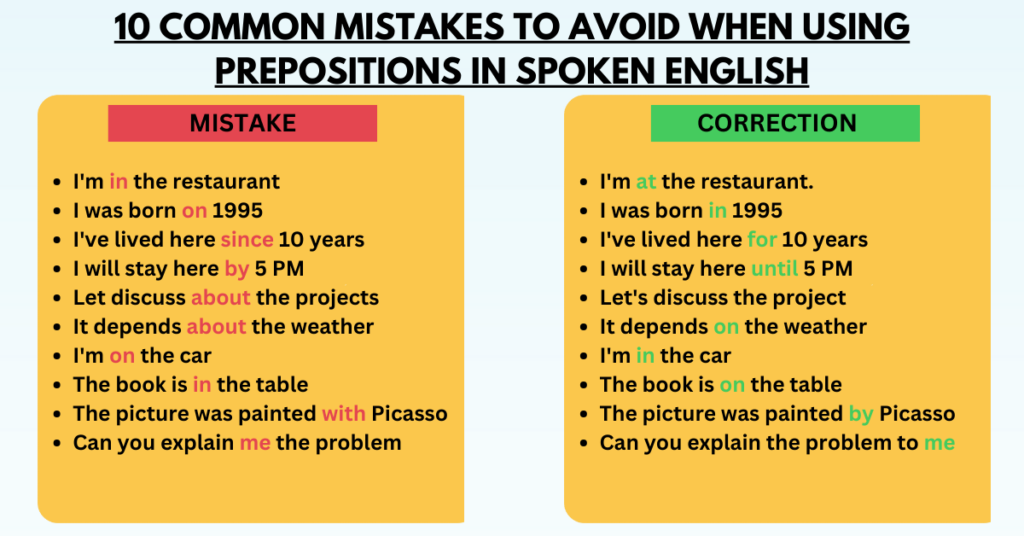
  • Mistake: Saying, “I’m in the restaurant” when you mean, “I’m at the restaurant.”
  • Correction: Use ‘at’ when you’re talking about specific locations, like “at the office” or “at the park.” Use ‘in’ when you’re referring to something more general or enclosed, like “in the city” or “in the car.”

2. Using ‘On’ Instead of ‘In’ for Months and Years

  • Mistake: Saying, “I was born on 1995″ instead of “I was born in 1995.”
  • Correction: Use ‘in’ for months, years, centuries, and long periods of time, like “in March” or “in 2025.” Use ‘on’ for specific days or dates, like “on Tuesday” or “on December 12th.”

3. Mixing Up ‘For’ and ‘Since’ with Time Expressions

  • Mistake: Saying, “I’ve lived here since 10 years” instead of “I’ve lived here for 10 years.”
  • Correction: Use ‘for’ when talking about the length of time (a duration), like “for 10 years.” Use ‘since’ when you’re referring to the starting point in time, like “since 2010.”

4. Incorrect Use of ‘By’ and ‘Until’

  • Mistake: Saying, “I will stay here by 5 PM” instead of “I will stay here until 5 PM.”
  • Correction: ‘Until’ is used to indicate the time something will continue to happen, like “until 5 PM.” ‘By’ is used to show the deadline or when something must be completed, like “Please finish this by Friday.”

5. Incorrect Use of ‘To’ After ‘Discuss’

  • Mistake: Saying, “Let’s discuss about the project” instead of “Let’s discuss the project.”
  • Correction: The verb ‘discuss’ doesn’t require a preposition. You should say, “Let’s discuss the project,” without ‘about.’

6. Confusing ‘On’ and ‘About’ After ‘Depend’

  • Mistake: Saying, “It depends about the weather” instead of “It depends on the weather.”
  • Correction: Always use ‘on’ after the verb ‘depend,’ as in “It depends on the weather,” or “It depends on you.”

7. Mixing Up ‘In’ and ‘On’ with Transportation

  • Mistake: Saying, “I’m on the car” instead of “I’m in the car.”
  • Correction: Use ‘in’ for smaller vehicles like cars or taxis (“in the car”) and ‘on’ for larger modes of transportation like buses, trains, and planes (“on the bus”).

8. Using ‘In’ Instead of ‘On’ for Surfaces

  • Mistake: Saying, “The book is in the table” instead of “The book is on the table.”
  • Correction: Use ‘on’ when referring to something that’s on a surface, like “on the table,” “on the floor,” or “on the shelf.”

9. Confusing ‘With’ and ‘By’

  • Mistake: Saying, “The picture was painted with Picasso” instead of “The picture was painted by Picasso.”
  • Correction: Use ‘by’ when you’re talking about the agent or doer of an action (“painted by Picasso”), and ‘with’ when you’re referring to the tool or instrument used (“painted with a brush”).

10. Incorrect Use of ‘To’ After ‘Explain’

  • Mistake: Saying, “Can you explain me the problem?” instead of “Can you explain the problem to me?”
  • Correction: The verb ‘explain’ needs to be followed by the object first and then the person it’s explained to: “Explain the problem to me.”

For more information, you can check this blog Prepositions of Time in English – At, On, In

How to Avoid These Mistakes?

  1. Practice Listening and Reading: Exposure to correct usage through podcasts, TV shows, and books will help you naturally pick up the right prepositions.
  2. Use an English Learning App: Apps like EngVarta provide real-time conversations with English experts, helping you identify and correct preposition mistakes in real time.
  3. Create Flashcards: Make a list of common preposition phrases and review them daily.
  4. Speak Regularly: The more you practice speaking English, the more natural it is to use prepositions.

Mastering prepositions may seem challenging, but with practice, you’ll find yourself making fewer and fewer mistakes. Prepositions can often change the entire meaning of a sentence, so using them correctly is key to fluency.

By avoiding these 10 common mistakes, you’ll see a noticeable improvement in your spoken English!

Ready to master prepositions and speak English confidently? Download EngVarta today and start practicing with live experts!

Frequently Asked Questions about English Prepositions

What are English prepositions and why are they tricky?

Prepositions are short words (in, on, at, by, for, of, to, with, from, about) that connect nouns, pronouns, or phrases to other words in a sentence. They’re tricky because they don’t translate directly between languages — Hindi, Tamil, Bengali, and other Indian languages handle position/direction/time differently than English. Learners often calque from their native language, leading to errors like “I’m interested in to learn” (should be “interested in learning”) or “good in maths” (should be “good at maths”).

What are the most common English preposition mistakes?

Frequent errors Indian English speakers make: (1) “Good IN English” → “good AT English”. (2) “Discussing ABOUT this” → “discussing this” (no preposition needed). (3) “Married WITH her” → “married TO her”. (4) “Different THAN” → “different FROM”. (5) “On Monday morning” → “on Monday morning” (correct) but “in the morning” (correct), “at night” (correct). Time prepositions: AT exact times, ON days, IN months/seasons/years. Place prepositions: AT specific locations, ON surfaces, IN enclosed spaces.

What’s the difference between in, on, and at?

For TIME: AT for exact times (at 5pm, at noon), ON for specific days (on Monday, on Christmas), IN for longer periods (in May, in 2026, in winter). For PLACE: AT for specific points (at the bus stop, at the door), ON for surfaces (on the table, on the wall), IN for enclosed spaces (in the room, in the car, in India). When in doubt, think of the preposition as zooming in: IN is broadest (a country), ON is narrower (a street), AT is specific (a corner).

How can I avoid preposition mistakes in spoken English?

Effective strategies: (1) Memorise high-frequency verb-preposition combinations as PHRASES (depend on, listen to, agree with, look forward to, instead of memorising “depend” and “on” separately). (2) Read English daily and note every preposition usage that surprises you. (3) Get feedback from a TESOL/ESL-certified Expert who flags preposition errors as they happen — these errors are often invisible to learners. EngVarta‘s daily 1-on-1 sessions catch preposition mistakes in real conversation, with corrections in the moment.

What are essential English prepositions to know?

Top 20 high-frequency prepositions: in, on, at, by, for, of, to, with, from, about, after, before, between, during, into, through, without, against, among, beyond. Mastering these covers ~95% of everyday English usage. Memorise common phrases that use them (“by the way”, “for instance”, “in fact”, “of course”) rather than learning prepositions in isolation.

How long does it take to master English prepositions?

Most learners reach 80% accuracy on common prepositions in 6-12 months of daily practice with feedback. Reaching 95%+ accuracy takes 1-2 years because some preposition uses are highly idiomatic (e.g., “interested IN” vs “fond OF” — no logical reason for the difference). Acceptance helps: native speakers often disagree on “correct” preposition use too. Focus on the patterns that matter for clarity.

Should I memorise preposition rules or learn them in context?

Both, but lean toward CONTEXT. Rules give you a starting framework (time prepositions: at/on/in pattern). Context (real sentences, conversations, written examples) is what locks usage into memory. Reading English daily and noting prepositions in their natural context is more effective than memorising rule lists. Active production (speaking, writing) with corrections is the fastest path to accuracy.