Working Professionals |

Tag

working professionals

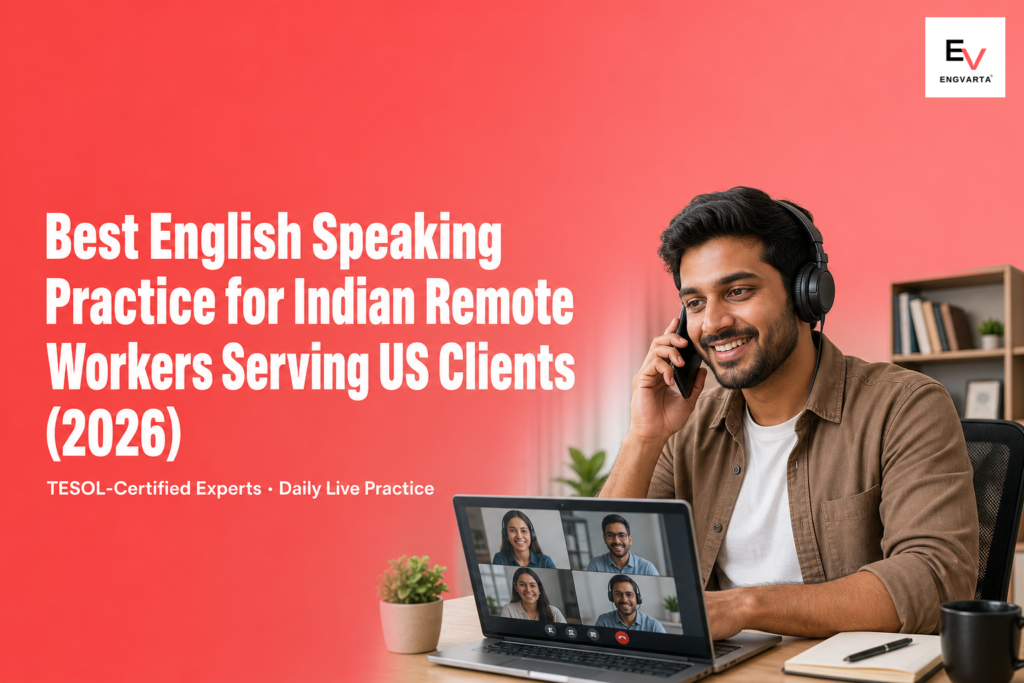
Best English Speaking Practice for Indian Remote Workers Serving US Clients (2026)

May 18, 2026 • 19 min read • By Rishish Pandey

English speaking practice for Indian remote workers in Zoom meetings and client calls
Quick VerdictIndian remote workers serving US clients face a very specific English-speaking gap: their async written English on Slack and email is strong, but their live spoken English on Zoom standups, demos, and client calls freezes them. The fix is daily live-conversation reps. EngVarta offers live English coaching with TESOL or ESL-certified Experts in 15, 25, and 50-minute sessions that fit between async work blocks — real-time corrections during the call, consolidated feedback towards the end, and a recording you can revisit for 30 days. Daily-practice plans start at ₹2,700 for 25 sessions of 15 minutes (about ₹108 per session) in India and $45 for 25 sessions in USD markets.

Your last three Slack messages had clean copy. Your last Zoom standup had four “um”s and a “sorry, let me restart that sentence”. That contradiction is the quiet career tax that Indian remote workers serving US clients pay every week, and it does not show up in any performance review until it has already cost a promotion, a renewal, or a warm referral.

That is why English Speaking Practice for Indian Remote Workers for US Client Calls has become increasingly important for professionals working with global teams. The market for Indian remote talent supporting US clients has matured fast. Developers, product designers, performance-marketing freelancers, customer success specialists, agency-side account managers — all of them are now on permanent India payroll while their work product lands in San Francisco, Austin, and New York standups. Async writing is taught well in Indian schools and engineering colleges. Live spoken English, especially the American collaborative register, is not.

This guide is for the engineer who can write a perfect pull-request description but freezes when a US tech lead asks “can you walk me through your reasoning here?” It is for the marketing manager who runs five-figure ad budgets in a spreadsheet but stumbles on a 90-second standup. The fix is not another grammar app or a written-English course. The fix is daily live English coaching — structured live-conversation reps with a certified Expert who can model the exact register your US clients use.

The async-sync English gap is real, measurable, and India-specific

If you grew up in India and studied in English-medium schools, your reading and writing English is probably stronger than your speaking. You have had decades to read English passively. Speaking English with native-rhythm pacing under live time-pressure is a separate skill, and it does not transfer automatically from writing.

Remote work makes this worse. In an office, you could walk over and clarify in mixed Hindi-English. On Slack, you have all the time in the world to redraft. On Zoom, the silence after a US manager’s question is loud and expensive. The async-sync gap is not about vocabulary. It is about live spoken English under pressure, in the American collaborative register, with no buffer time.

The six English-speaking pressure points in India-to-US remote work

1. The 60 to 90-second standup at 10 PM IST

You are tired. You have been heads-down all day. The US team is on their first coffee. You get 90 seconds. You need to land three things — what you shipped yesterday, what you are picking up today, what is blocking you — in a register that does not sound like a status report you copy-pasted from Jira. American standups reward energy, brevity, and ownership language (“I’ll have the PR up by EOD” beats “the work is in progress”). Indian remote workers consistently underperform here not because their English is bad, but because they have not drilled the format under live time-pressure.

2. Client demos in executive register

Narrating a product walkthrough for a US client is not the same as explaining it to a teammate. You are speaking to someone who may be a VP or a founder. You need to do three things at once — drive the screen, narrate the flow, and listen for mid-demo questions. Indian remote workers often default to a “let me show you everything” tour. American executive register is closer to “here is the one thing that matters, the second thing that matters, and the question I expect you’ll ask next.” That is a learned conversational structure, and it only sharpens with live reps.

3. The async-to-sync escalation call

A Slack thread has been going for two hours. A teammate writes “let’s just jump on a quick sync.” You have five minutes to ramp up vocally from typing-silence to speaking-fluency. That five-minute warm-up gap is where most accent-cushioning, filler-word habits, and rapid-fire vocabulary retrieval breaks down. You need to be able to enter a call cold and sound articulate within the first 30 seconds.

4. Performance reviews and 1:1s with US-based managers

This is where Indian remote workers leave the most money on the table. A performance review with a US manager rewards specific, metrics-anchored, ownership-language storytelling — “I led the migration that cut our deploy time by 40%, and the next thing I want to own is the platform team’s reliability metrics.” That sentence in English, said cleanly and confidently, can move your comp band. Said hesitantly with filler words, it sounds like you are unsure of your own work.

5. Cross-functional alignment calls where you are the bridge

Product, engineering, sales, and support all need a single decision. You are the senior IC who has to translate one team’s blocker into another team’s language, in English, in real time. This is the highest-leverage English-speaking skill in remote work — and it is almost never taught explicitly.

6. Networking with US peers

Coffee chats, virtual conferences, meetup small talk. These do not have an agenda. They have a 30-second elevator pitch about who you are and what you do, followed by curiosity questions that pull the other person in. American networking small talk is its own register — direct, warm, light on hierarchy, heavy on specific questions. Indian remote workers who can master this open up entire layers of warm referrals.

Why generic English apps fail Indian remote workers

Walk into any app store and search “English speaking.” You will find vocabulary builders, grammar drills, AI chatbots, and group classes. Each of these has a place, but none of them solve the specific problem an India-to-US remote worker has.

Vocabulary builders teach words you can already read. They do not build live-speaking pressure tolerance. AI chatbots are predictable — they wait politely, they do not interrupt, they do not push back. A real US client interrupts. A real US client says “actually, let me push back on that.” You need live human practice that mimics that unpredictability, not a polite AI conversation partner.

Group classes are too slow. In a six-person group class, you might speak for five minutes out of an hour. A remote worker prepping for a standup tomorrow needs 15 to 25 dedicated minutes of speaking, today, with structured coaching from a certified Expert who is listening to every filler word.

Reading-heavy apps fail for the same reason — they reinforce a skill (passive comprehension) you already have. They do not build the new skill (active live speaking) you actually need. And almost none of them coach the async-to-sync ramp-up, which is the most under-trained live-speaking skill in remote work.

The American conversational register has its own quirks. It is more direct than textbook English. It uses collaborative hedges like “I’d love to hear your take on this” and “what if we tried” instead of declarative commands. It rewards specific examples over abstract reasoning. None of this is in a TOEFL prep book. It is learned through live reps with someone who can model it.

Six specific scenarios a remote worker can drill with EngVarta

This is where live English coaching with a certified Expert earns its place. Every EngVarta session is a live 1-on-1 audio call with a TESOL or ESL-certified English Expert who provides real-time corrections during the call and consolidated feedback towards the end. The session length is yours to pick — 15, 25, or 50 minutes — and you can request specific role-plays. Six high-leverage role-plays for India-to-US remote workers:

Role-play 1: The 90-second standup mock

Ask your Expert to play the role of a US tech lead. Deliver a 90-second update including a blocker. The Expert times you, corrects filler words in real time, and at the end consolidates the patterns — where you slowed down, where you used hedge language that softened your ownership, where your blocker request was too vague. Repeat three times in one 25-minute session. By session three the muscle memory starts to lock in.

Role-play 2: The five-minute product demo

Pick a product or feature you actually work on. Narrate a five-minute walkthrough. Ask your Expert to interrupt with two mid-demo questions — one clarification, one push-back. You will quickly discover whether your demo structure holds up under interruption. The Expert’s real-time corrections will catch register slips — when you over-explain, when you bury the lede, when you default to passive voice.

Role-play 3: The async-to-sync ramp

Cold-start a five-minute “context loading” speech, the kind you would give at the top of an escalation call. The Expert grades you on the first 30 seconds especially — that is where Indian remote workers most often sound under-prepared even when they have the right content.

Role-play 4: The performance review impact narrative

Walk through your last quarter’s impact. The Expert plays your US manager and asks the standard prompts — “what was the most important thing you shipped?”, “where do you want to grow?”, “what would unlock more impact for you?” Practice the metrics-anchored ownership-language answer. Get real-time coaching on hedge phrases that undersell your own work.

Role-play 5: Cross-functional alignment

Explain a real engineering blocker to a fictional sales lead, or a marketing experiment to a fictional engineering manager. The Expert listens for jargon-slips and unclear hand-offs. This is the single most under-practised remote-work English skill, and the one that most often separates senior ICs from staff-level ICs in eyes of US managers.

Role-play 6: Networking small talk

30-second elevator pitch + three curiosity questions. The Expert role-plays a US peer at a virtual conference. After the call, you will know exactly which curiosity questions sound natural and which ones sound rehearsed.

How EngVarta’s coaching format fits the remote-worker rhythm

Remote workers do not have evenings the way office workers do. Your evening is somebody else’s standup. Your lunch break is somebody else’s morning sync. Daily English speaking practice has to slot into the gaps that already exist, not demand a new daily commitment.

EngVarta’s session lengths are built for exactly this. The 15-minute session is your lunch-break drill — a quick standup mock, a vocabulary warm-up, a single role-play. The 25-minute session is a full mock client call with end-of-call feedback. The 50-minute session is a mock performance review or quarterly review prep, with enough time for two rounds of feedback. You pick the length when you book.

The real-time correction model is the part that matters most for remote workers. You do not get a written report three hours after the call. The Expert catches the filler word the moment it leaves your mouth. Pacing on technical terms — corrected mid-sentence. Register slips — flagged the same beat. This is the closest you can get to the “high-pressure live feedback” that an actual US client meeting delivers, without the career risk of failing it in front of the actual client.

Towards the end of every session, the Expert delivers a consolidated feedback summary — the three or four patterns they noticed, the specific words you stumbled on, the register changes that would land cleanest with a US listener. That summary is verbal, in-conversation, during the closing minutes. You can rewind the session recording any time in the next 30 days to revisit it.

The time-zone fit is unusually good for India-to-US remote workers. EngVarta Experts operate 7 AM to midnight IST every day. That window covers from 6:30 PM US Eastern the previous day to 11:30 AM US Eastern the same day. Translation: you can drill your English right before your evening US standup, not after a long day of work when you are already cognitively drained. Most Indian remote workers default to “practice after work” — which is the worst possible time. Practicing in your fresh morning or early afternoon hours, before your US-overlap window starts, gives you a vocal warm-up that the rest of your competitors do not have.

Pricing is built for daily-habit usage. The entry plan is ₹2,700 for 25 sessions of 15 minutes (about ₹108 per session) in India and $45 for 25 sessions in USD markets — flat, never converted from rupees. The next tier is ₹5,130 for 25 sessions of 25 minutes (around ₹205 per session) in India and $85 in USD markets. Before committing to a plan you can try the live coaching with a 100% refundable trial — ₹69 in India, $1 in USD markets.

Free vocabulary lessons, daily quizzes, and rewards are available inside the EngVarta app and on the EngVarta YouTube channel — useful between sessions if you want a self-paced top-up on workplace-relevant vocabulary.

Ready to Practice with Real Experts?

Try EngVarta today — ₹69 trial (India) / $1 trial (International) · 100% refundable

A six-week English upgrade plan for Indian remote workers serving US clients

Pick one 15 to 25-minute slot, three times a week, in your fresh morning hours. Six weeks of structured live coaching will move the needle on the parts of your live spoken English that your US clients actually notice.

Week 1: Standup discipline

Three sessions, all 15 minutes. Every session is a 90-second standup mock. By Friday you should be able to deliver yesterday-today-blockers in 90 seconds without a filler word. This week is pure muscle memory.

Week 2: Demo narration

Two 25-minute sessions, one 15-minute session. The 25-minute sessions are full five-minute demo walkthroughs with mid-demo interruptions. The 15-minute session is a quick standup refresher to keep last week’s muscle memory active.

Week 3: Async-to-sync ramp

Three 15-minute sessions. Cold-start a five-minute context-loading speech. Pay attention to the first 30 seconds. This is the week where you train yourself to enter a call vocally warmed-up.

Week 4: Performance review prep

One 50-minute session (mock performance review with real metrics from your last quarter), two 15-minute sessions on specific impact stories. The 50-minute session is the high-leverage one — book it for a fresh morning slot when your energy is up.

Week 5: Cross-functional alignment

Three 25-minute sessions. Each session, explain one team’s blocker to another team. Rotate the framing — engineer-to-sales, sales-to-engineering, product-to-support. The Expert will catch jargon-slips you have stopped noticing.

Week 6: Networking and integration

Two 15-minute sessions on networking small talk. One 50-minute session that integrates all five prior skills — standup + demo + escalation + impact narrative + alignment. By end of week 6 you should be able to handle any of the six pressure points without preparation.

👉 Connect with EngVarta & Improve Your English Every Day!

Build fluency, confidence, and better communication skills with daily English speaking tips, real-life conversations, and expert guidance that helps you speak naturally and confidently.

📸 Instagram : https://www.instagram.com/engvarta.app/
▶️ YouTube : http://www.youtube.com/@EngVarta
📘 Facebook : https://www.facebook.com/engvarta
💼 LinkedIn : https://www.linkedin.com/company/engvarta

✨ Follow EngVarta today and take your English speaking skills to the next level — one conversation at a time!

What Our Learners Say

Rated 4.5★ from 9,100+ reviews on Google Play

★★★★★
excellent app for learning fluency and If you genuinely correct your mistakes then you should opt for this
★★★★★
EngVarta helps me a lot to become more fluent in speaking English. We can practice without any fear of making mistakes. I would recommend all the people who are hungry to learn English.
★★★★★
I think I should recommend this app to everyone who wants fluency in English. Nice app.
★★★★★
I have thoroughly enjoyed the session and the expert provided me instant feedback that will definitely help me.
★★★★★
Good app to express yourself because in our house there are no environment n EngVarta provides you environment
★★★★★
The expert was continuously challenging the ideas and influencing me to elaborate the sentences. A truly enriching experience.
★★★★★
thanks for guide me i will try to connect your team and good communication with person so thank you teaching with me.
★★★★
A very good app its just as good as shown in the advertisement,but I wish it would have been a bit cheaper,
★★★★★
Great app to overcome inferiority of speaking English.
★★★★★
good and highly talented experts are here..just go for a trail without any doubt.. thank you eng vartha...A small request from my side just take less payment from the people who are joing in your coaching...help to them...thank you
★★★★★
Great !!! Enjoying it 👍experts reAlly help you to see your mistakes and correct them in the mean time.
★★★★★
The app has been great in improving your English speaking skills. Experts have great knowledge and indeed all are amicable and they create the environment which is necessary for learning the language.

The accent question — what your US clients actually expect

This is the most common worry Indian remote workers have, and it is the most over-rated. Most US clients in 2026 do not expect a neutral American accent from their Indian engineers or designers or account managers. The US tech industry has worked with Indian English for two decades. American managers are familiar with Indian-English pacing and intonation.

What they do expect, and what they are quietly graded on every call, is three things:

First, clear consonants. The crispness of your “t”, “d”, “p”, “b” matters more than your vowels. Indian English often drops consonant endings on fast speech. A US listener will not parse “I’ll send it” if it comes out as “I send i”. This is a fixable speaking habit — five minutes of consonant-ending drills in a 15-minute session, repeated three times a week, will sharpen it.

Second, slowed-down pacing on technical terms. When you are saying “Kubernetes” or “deprecation” or “third-party SDK” in a fast Indian-English rhythm, your US listener hears one continuous blur. Slow down by 20% on technical terms only. The rest of your speech can stay at your natural pace.

Third, recognisable rhythm. Indian English has a stress-timing pattern that compresses syllables. American English is more syllable-timed and uses pitch contours to signal emphasis. You do not need to mimic this perfectly — you need to be unmistakably understood. A certified Expert can model the right rhythm in a 25-minute session, and your ear will start adapting after three or four reps.

The goal is not to sound American. The goal is to be unmistakably understood by an American listener on the first take, every time, without them having to ask “can you repeat that?”. That is a far more achievable target — and it is what actually moves the needle on promotions, renewals, and warm referrals.

If accent specifically is your blocker, our deeper guide on how to reduce Indian accent for the American workplace walks through the consonant and pacing drills in more detail. For meeting confidence in particular, see best English speaking app for meeting confidence with bosses. If you are a software engineer specifically, the role-play patterns in English speaking practice for software engineers in India overlap heavily with this guide. If your work is sales or account management, see our dedicated guide on client-facing English. And if you want the broader framework for structured live coaching, our hub piece on English fluency coaching online covers the format end-to-end. For US-market context generally, see best English speaking apps in the US.

Frequently Asked Questions : (English Speaking Practice for Indian Remote Workers)

Q1. Why is my Slack English fine but my Zoom English weak?

Ans : Async writing gives you unlimited drafting time. Live speaking does not. Writing English is a passive comprehension skill turned active with re-reading. Speaking English under live pressure is a separate motor skill that only sharpens with live reps. Daily live English coaching closes the gap.

Q2. Will EngVarta help me sound more American to my US clients?

Ans : The goal is not to sound American. The goal is to be unmistakably understood by an American listener on the first take. EngVarta’s TESOL or ESL-certified Experts coach you on clear consonants, slowed pacing on technical terms, and recognisable rhythm — without forcing accent imitation.

Q3. How much time per day should a remote worker spend on English speaking practice?

Ans :  to twenty-five minutes, three to five days a week, of structured live coaching with a certified Expert beats an hour of passive vocabulary drilling. Daily-habit-priced live English coaching is the highest leverage activity. Free in-app vocabulary lessons and quizzes top up the rest.

Q4. Can EngVarta help me with client demo storytelling?

Ans : Yes. Book a 25-minute session and request a demo role-play. The Expert will play your US client, ask mid-demo questions, and at the end consolidate the patterns — where you over-explained, where your demo structure lost its lede, where your register slipped from executive to engineering-detail.

Q5. Will daily practice actually move the needle on my performance review?

Ans : The metrics-anchored ownership-language narrative your US manager rewards is a learnable spoken-English skill. Six weeks of structured live coaching from a certified Expert, with one mock performance review at the end, is enough to shift how your impact story lands. Most Indian remote workers do not prepare this at all.

Q6. Is EngVarta an online English coaching app for Indian remote workers?

Ans : Yes. EngVarta is a live English coaching app with TESOL or ESL-certified Experts, audio-only by design, with 15 / 25 / 50-minute sessions you pick. It is built for working professionals who need daily-habit live English coaching — including Indian remote workers serving US clients, freelancers, and agency-side account managers.

Reviewed by Rishish Pandey, Co-founder & CTO, EngVarta. Last updated 2026-05-14.

Pricing accurate as of 2026-05-14; verify current rates on the EngVarta app.

How to Stop Freezing When Speaking English in Meetings (2026 Guide for Working Professionals)

May 16, 2026 • 20 min read • By Rishish Pandey

Professional learning how to stop freezing when speaking English in meetings
Quick VerdictThe freeze when you are asked to speak English in a meeting is real and it is fixable. It is rarely about vocabulary or grammar — it is about three things: not rehearsing under pressure, the mental-translation lag from your native language, and the absence of meeting-specific verbal reflexes. The fastest cheap fix is daily live conversation reps with a certified Expert, plus two pattern changes (pre-loaded opening sentences and a one-second pause-breathe-sentence reset). EngVarta‘s 15-minute live coaching sessions are built precisely for this — you can do one before work and the freeze stops happening within three to four weeks.

The question lands in the meeting. Your manager looks at you. You know the answer. In Hindi or Marathi or Tamil or Bengali, the full sentence is already forming in your head — clear, sharp, with the exact word for the situation. But somewhere between knowing the answer and saying it in English, a gap opens up. Two seconds. Three seconds. Long enough for somebody else to jump in, or for you to mumble something half-formed that does not sound like the version that was in your head. This is exactly why so many professionals search for practical ways on How to Stop Freezing When Speaking English in Meetings.

That gap is the freeze. If you are reading this, you have lived it more than once — maybe in a daily standup, a client call, or a quarterly review. It is one of the most common experiences in Indian and South Asian working life: engineers, sales professionals, chartered accountants, project managers, customer success leads, BPO supervisors, expat workers in Singapore and Dubai. People who passed every English exam in school, who write impeccable Slack messages and clean technical documents, who read English novels for fun. And yet, when the meeting goes live, the freeze shows up.

This is not a language problem. It is a performance problem with a clear mechanism and a known fix. In this guide we will break down why the freeze happens, the five techniques that actually work, what a 30-day freeze-removal plan looks like, and how structured coaching from a certified Expert collapses the timeline from months to weeks.

Why the freeze happens (three real mechanisms, not “lack of confidence”)

Most advice you have read about meeting anxiety starts with “just be confident” or “believe in yourself.” That advice fails because it treats the symptom as the cause. The freeze has three identifiable mechanisms, all of them physical-cognitive and all of them trainable.

1. Mental translation lag

If your native language is Hindi, Tamil, Telugu, Marathi, Bangla, Gujarati, Malayalam, Punjabi, Kannada, Urdu — and you grew up thinking in it — your brain is doing an invisible translation step every time you speak English. You receive the question, your brain forms the answer in your native language, and a translator-process runs in your head to convert it to English before your mouth opens. That step costs one to three seconds. In a live meeting, those seconds are the entire window. Someone else has already spoken.

You probably do not notice the translation step happening — it has been part of your thinking since school. But it is the single biggest reason fluent readers and writers freeze. Until you train your brain to stop mental translation and form thoughts directly in English, the lag will keep happening when stakes rise.

2. Anxiety amplification of working memory

Your working memory — the mental scratchpad where you assemble a sentence in real time — has a fixed capacity. In a relaxed coffee-machine chat, you have plenty of bandwidth and your English flows. In a meeting where you fear sounding wrong, fear takes up part of that bandwidth. The brain now juggles sentence construction and the threat-monitor. Sentence construction loses. The freeze is the result.

This is why the freeze gets worse exactly when you want it to get better. Higher stakes, more freeze. It is also why “just relax” is useless — telling your brain to ignore a real threat does not free up bandwidth. The mechanism only weakens when rehearsal makes sentence construction automatic, so it no longer competes with the threat-monitor.

3. No live reps under pressure

You have probably read a thousand English articles this month, written a hundred Slack messages, and a handful of documents. But how many minutes did you actually speak English live? For most Indian working professionals the honest answer is twenty to forty minutes — most of it clipped responses in scheduled meetings.

You cannot build a verbal-output skill on input alone. Reading and writing build passive vocabulary. Speaking builds an active retrieval system. Without enough live reps, retrieval stays slow even though passive vocabulary is rich. This is why people with a 30,000-word reading vocabulary stall on a basic sentence in a meeting — their retrieval system has not had enough exercise.

Five techniques that actually work

Once you understand the three mechanisms, the techniques that actually fix the freeze become obvious. These are protocols, not “tips” at all. Do them daily, in order, and the freeze will retreat.

Technique 1: Pre-load opening sentences before every meeting

The freeze almost always strikes on the opening sentence — the moment you have to break the silence. Once you are mid-flow, sentence construction is easier. The cheapest hack: before each meeting, jot two or three openers you are likely to say. The primary risk, in my opinion, is “From a numbers standpoint, what we are seeing is…” “Can I add to that — my read is…” Practise them in silence  before the meeting starts.

One of your pre-loaded openers is present when the question appears and you would typically freeze. The first sentence breaks the freeze. The second and third are easier because you are now in flow. This single habit cuts freeze frequency roughly in half within a week.

Technique 2: The “pause, breathe, sentence” pattern

Most people who freeze try to start talking the moment they sense it coming. They want to plug the silence. This makes everything worse — starting mid-translation produces a half-sentence that loses you mid-thought. Instead, deliberately pause one to two seconds when the question lands. Take one breath. Then deliver one complete sentence.

Counter-intuitively, this is faster than racing. The pause gives your brain a clean half-second to form a complete thought. The breath calms the anxiety amplifier. Committing to one complete sentence (not a stream of fragments) means the listener gets a clear answer. Senior leaders especially respect the pause — it sounds like deliberation, not hesitation.

Technique 3: English-only inner monologue, ten minutes a day

This addresses mechanism one — translation lag — at the root. For ten minutes a day, narrate your activities silently, in English. “Now I am rinsing. The water is colder than usual.” Walking to your desk: “It’s already 9:42, and the standup is at 10.While cleaning your teeth: “Now I’m rinsing. The water is colder than normal.” Walking to your desk: “It is already 9:42, and the standup is at 10.” “I want to gently push back on that—here is what I am seeing.” I want to mention the staging deployment first.” Just narrate. No one hears it.

Within two weeks, your brain starts forming thoughts in English by default instead of routing through your native language. The translation step shortens, becomes optional, then quietly disappears for routine sentences. This is the single highest-leverage technique on this list because it permanently changes the cognitive mechanism, not just the surface behaviour.

Technique 4: Daily live conversation reps, ideally before work

The freeze dies fastest when you have already spoken English live that same day, before the meeting that matters. It almost does not matter what you spoke about. Ten or fifteen minutes of real, live English earlier in the day primes the retrieval system in a way no amount of reading can replicate. Your mouth, your breath, your sentence-construction reflex are all switched on. When the high-stakes meeting hits at 11 a.m., you walk in with the warmth loaded.

This is the most powerful technique and the hardest to execute alone. You cannot just decide to “have a live English conversation every morning at 7:30.” You need a counterparty who is there reliably, who will push you, and who will correct you so you do not solidify mistakes. That is exactly what structured live English coaching with a certified Expert is for. A 15-minute session before work prevents the day’s freeze better than any amount of evening Duolingo.

Technique 5: Phrase-bank over word-bank

Most people try to improve meeting English by memorising vocabulary lists. This rarely transfers to live speech because individual words do not carry the syntax around them. Memorise complete, ready-to-deploy meeting phrases instead — small chunks of language you can drop into a conversation without constructing them on the fly. A few examples:

  • “Can I add one thing to that?”
  • “I want to gently push back on that — here is what I am seeing.”
  • “Let me make sure I understand your concern correctly.”
  • “Let me reiterate — you are stating…”
  • “Could we set that aside and return to it after the following topic?””
  • “What would change your mind on this?”

Each is a complete unit. You retrieve the whole phrase instead of assembling it word by word. Cognitive load drops from ten words to one chunk — freeing up the working memory that mechanism two keeps stealing.

What doesn’t work (and why people keep trying it)

“Just relax” or “be more confident” does not work because confidence is an output of competence, not an input. Telling someone with the freeze to be confident is like telling someone with a sprained ankle to walk normally. The mechanism is physical-cognitive. You fix it with reps and pattern changes, not with affirmations.

Watching English movies and Netflix shows does not stop the freeze. It builds comprehension — a receptive skill — but the freeze is a productive-skill problem. You can understand every word a Christopher Nolan character says and still freeze in your 10 a.m. standup. The two systems in the brain are different.

Memorising vocabulary lists does not transfer to live speech. A new word learned out of context stacks in long-term memory but has no retrieval pathway under pressure. This is why you can score in the 95th percentile on a vocabulary test and still grope for a basic word when your manager asks you a question. The phrase-bank approach in Technique 5 fixes this.

Reading more English actively widens the gap between input vocabulary and output retrieval. The fix is not less reading — it is more speaking, until the output catches up. Apps that have helped reduce mother-tongue influence work precisely because they force speaking output, not because they push more input.

“Just speak more English at work” is not a plan — it is a wish. Your colleagues are not going to stop their workday so you can practise. You need a dedicated, repeatable, low-stakes space to speak English live every day. That is what online English coaching exists to provide.

How EngVarta’s session format is built for the freeze

Every EngVarta session is a live, audio-only, one-on-one conversation with a TESOL or ESL-certified English Expert. You pick the session length — 15, 25, or 50 minutes — and you connect in minutes to an available Expert. The format was not designed as a generic English app. It was specifically tuned for working professionals who freeze in meetings, and the design choices reflect that.

The Expert will interrupt you mid-sentence. This is intentional. In a real meeting your sentence will be interrupted. If your daily practice never simulates that — if you only speak in monologues to an AI that lets you finish — you have not trained the meeting reflex. Within two to three weeks, the interruption stops throwing you off mid-thought.

Real-time corrections during the call. When you slip on pronunciation, grammar, or trail off in a freeze moment, the Expert catches it in the same minute. You internalise the fix together with the memory of failure — which is how the brain rewires fastest. The Expert shares consolidated feedback towards the end of the session: a verbal summary of what you worked on and where to focus tomorrow.

15-minute sessions are the right unit for freeze-prevention. Short enough to do before your workday starts. Long enough for two or three meaty exchanges. Daily small reps beat weekly long ones every time for skill formation.

Recording accessible 30 days. Listening back to yourself freeze, recover, mispronounce, then correct — in your own voice — is the fastest internalisation tool that exists. Most learners do this for the first few sessions only; those who continue through week four progress measurably faster.

Audio-only, no camera. Camera-on practice adds self-consciousness that is exactly what you do not need when you are already battling meeting anxiety. Audio-only also works on slower mobile networks, which matters if you are squeezing in a session from a metro train or a tier-two-city home connection.

Pricing built for daily use. Most English-coaching platforms charge ₹1,000+ per session, which forces a weekly cadence — too slow to dismantle a freeze. EngVarta’s entry plan is ₹2,700 for 25 sessions of 15 minutes (roughly ₹108 per session); the 25-minute plan is ₹5,130 for 25 sessions (~₹205 per session). In USD markets the flat rate is $45 for 25 × 15-min sessions or $85 for 25 × 25-min sessions. The 100% refundable trial is ₹69 or $1.

Ready to Practice with Real Experts?

Try EngVarta today — ₹69 trial (India) / $1 trial (International) · 100% refundable

A 30-day freeze-removal plan

Here is the concrete program. Four weeks. Do not skip steps. Each week builds on the previous one.

Week 1: Establish the daily rep + restart inner monologue

Book one 15-minute EngVarta session every morning at the same time, ideally before your workday starts. Tell the Expert at session one that you want to work on stopping the freeze in meetings — they will calibrate. Separately, do ten minutes of English-only inner monologue (Technique 3) every day during low-stakes moments: getting ready, walking, waiting. By the end of week one, the freeze frequency will be unchanged but you will be forming small English thoughts on your own, and your sessions will be getting more comfortable.

Week 2: Layer in pre-loaded opening sentences

Before each work meeting, write down two or three opening sentences you might say. Rehearse them silently before joining. In your daily session, tell the Expert about a real upcoming meeting and ask them to role-play it; get corrections on tone and phrasing. You will start to notice that on days you pre-loaded, the freeze either does not happen or it lasts half as long. This is the most morale-shifting week because the effect shows up in real meetings, not just practice.

Week 3: Drill pause-breathe-sentence with the Expert

Practise Technique 2 inside your sessions. Ask the Expert to put hard questions to you and force yourself to pause one to two seconds, take one breath, deliver one complete sentence. Get feedback on whether the pause was visible and the sentence complete. Outside sessions, deploy the pattern in two or three real meetings this week. It will feel slow the first few times — trust the discomfort, listeners will hear it as deliberation, not hesitation.

Week 4: Build your phrase-bank from your own recordings

Listen back to two or three of your recordings from prior weeks. Note phrases the Expert used that landed well — natural meeting-English chunks you wish were in your active vocabulary. Add them to a personal phrase-bank. Aim for fifty phrases by the end of week four. Deliberately drop three new phrases into each session. By end of week four most learners report the freeze going from “almost every meeting” to “occasional and shorter when it happens.” Three months in, it is rare enough that you stop thinking about it.

Who this approach is for

This program is designed for working professionals who already understand English well — you can read this article without effort and you write fluently in English at work — but who freeze in live conversation. If you are a beginner, the EngVarta sessions still work for you (the Expert will calibrate), but the techniques here assume an intermediate base. The same applies if you are a shy speaker building core speaking confidence first. For boss-facing scenarios specifically, see our companion guide on the meeting-confidence English app; for the wider career picture, see improve your English speaking for working professionals.

What changes in your work life after the freeze goes

The freeze is invisible cost. The projects you do not volunteer for because they involve client calls. The promotions you almost got because the visible person in the meeting was a peer with weaker English on paper but better delivery. The career trajectory that quietly bends sideways because senior leaders form impressions in those exact moments where the freeze hits.

Once the freeze stops happening, the meetings stop being a battery drain. You contribute earlier in the call instead of waiting for written follow-ups. You answer in the moment instead of saying “let me get back to you.” You volunteer for the client-facing piece because you trust your verbal delivery. That is what the 30-day plan is actually buying you — not just smoother meetings, a different career arc.

👉 Connect with EngVarta & Improve Your English Every Day!

Build fluency, confidence, and better communication skills with daily English speaking tips, real-life conversations, and expert guidance that helps you speak naturally and confidently.

📸 Instagram : https://www.instagram.com/engvarta.app/
▶️ YouTube : http://www.youtube.com/@EngVarta
📘 Facebook : https://www.facebook.com/engvarta
💼 LinkedIn : https://www.linkedin.com/company/engvarta

✨ Follow EngVarta today and take your English speaking skills to the next level — one conversation at a time!

What Our Learners Say

Rated 4.5★ from 9,100+ reviews on Google Play

★★★★★
This is a very good app for English speaking. I love this app. Experts are very nice and supportive. When I talk to experts I feel better.
★★★★★
i completed my trial session, expert was good. I installed this app because chatgpt recommended it and I find it quite good speaking practice. experts are professional and friendly. plans are also economical compared to other english courses i took in the past.
★★★★★
excellent app for learning fluency and If you genuinely correct your mistakes then you should opt for this
★★★★★
hii i have taken your 69 rs plan for expert calling but no response from your side you gove the number i am trying to call on that number but no response r u making me fool? or what?
★★★★★
I enjoyed this course.experts encouraged me to use advanced vocabulary, idioms and phrases daily dose of assignment, quizzes and new vocabulary keep your toes
★★★★★
Wonderful application for English learners and good for speaking with trainers .All trainers are well experienced and help us within the time period,Thanks
★★★★★
Thank you guys for this amazing app. I think this application will help me to improve my communication skills.
★★★★★
Let me congratulate you on your endeavour to help people gain confidence while speaking. I enrolled for your vocabulary series. You guys are doing a good job. Keep it up.
★★★★★
All the experts are really good. Every day talking to a new expert and all taught me something new.
★★★★★
So comfortable to speak with the expert , really like this app
★★★★★
excellent app for learning fluency and If you genuinely correct your mistakes then you should opt for this
★★★★★
hello this is Shweta and I will tell you about the engvarta app this is an amazing app to improve our English or any other language so I suggested using this app and doing better things and growing always better . thankyou.

Frequently Asked Questions

Why do I freeze when speaking English in meetings even though I understand it well?

Three reasons working together: your brain is translating from your native language before speaking (which costs one to three seconds), meeting anxiety hijacks the working memory you need for sentence construction, and you do not have enough live speaking reps to make English retrieval automatic. Comprehension and production are different systems. Live coaching addresses all three at once.

How long until the freeze stops happening?

Most learners notice a meaningful reduction within two to three weeks of daily 15-minute live English sessions plus the pre-loaded opening sentences habit. By 30 days the freeze typically goes from “almost every meeting” to “occasional and shorter.” Full elimination usually takes two to three months of consistent practice — not because the freeze is mysterious, but because verbal-output reflexes need that much repetition to become automatic.

Does daily English speaking practice really help with meeting anxiety?

Yes, and more than anything else. The freeze is partly a working-memory bandwidth problem — anxiety eats the same mental capacity you need to construct a sentence. When sentence construction becomes automatic through daily reps, it no longer competes with anxiety for bandwidth and the freeze stops happening. This is why a daily 15-minute session before work is more effective than a weekly long session.

Can EngVarta coach me specifically for high-stakes meeting scenarios?

Yes. At the start of any session you can tell your EngVarta Expert that you want to role-play a specific scenario — a client presentation, a difficult performance conversation, a quarterly review, a customer escalation call. The Expert will set up the role-play, push back the way a real counterparty would, and give you real-time corrections during the call and consolidated feedback towards the end. This kind of scenario rehearsal is the single most effective use of structured coaching from a certified Expert.

Is the freeze caused by lack of vocabulary or something else?

It is almost never vocabulary. People who freeze in meetings usually have a 20,000 to 40,000 word reading vocabulary — more than enough for any business conversation. The freeze is a retrieval difficulty, not a knowledge one. The words exist in your head but the retrieval pathway under pressure is slow. Reps and pattern changes fix retrieval. Memorising more words usually does not.

Is EngVarta an online English coaching app for confidence in meetings?

Yes. EngVarta is an online English coaching app focused specifically on building live speaking confidence — including for working professionals dealing with meeting anxiety, the freeze, and high-stakes conversations. Sessions are 15, 25, or 50 minutes with TESOL or ESL-certified English Experts, audio-only by design, with real-time corrections during the call and consolidated feedback towards the end. The 100% refundable trial is ₹69 in India or $1 in USD markets.

Reviewed by Rishish Pandey, Co-founder & CTO, EngVarta. Last updated 2026-05-14.

Pricing accurate as of 2026-05-14; verify current rates on the EngVarta app.
English Speaking Practice for Indian Product Managers Dealing with US Clients (2026)

May 15, 2026 • 19 min read • By Rishish Pandey

English speaking practice for product managers working with US clients in 2026
Quick VerdictIndian product managers serving US customers need English speaking practice for product managers that simulates real PM scenarios — customer discovery, exec readouts, sprint reviews, roadmap defense, and cross-functional alignment. Generic English apps drill grammar, not stakeholder management. EngVarta offers live 1-on-1 coaching with TESOL or ESL-certified English Experts who can role-play a skeptical CTO, an unhappy customer, or a US-based skip-level manager, give real-time corrections during the call, and share consolidated feedback towards the end. From ₹2,700 for 25 sessions in India or $45 for 25 sessions in USD markets, with a ₹69 / $1 refundable trial.

You wrote the PRD in two hours. The customer review call took two weeks to recover from. The product is sound, the research is solid, the spec is airtight — and yet, twelve minutes into a discovery call with a US-based VP of Engineering, you heard yourself say “yeah, so, basically, we are thinking” three times in a row and watched the customer’s attention drift to their second monitor.

If you are an Indian product manager at a SaaS startup, a global capability center, or an MNC product team serving US customers, this gap shows up everywhere. Your written PRDs read fluently. Your Slack messages are crisp. Your investor-deck slides are clean. But the moment the work moves from text to live conversation — a 30-minute discovery call, a 10-minute exec readout, a sprint review with a US-based engineering lead asking “”Why are we doing this instead of X?” – the polish drops.

This guide is for mid-level and senior PMs who already have the product playbook but need English speaking practice for product managers that mirrors the actual scenarios on a PM’s calendar. Not grammar drills. Not Toastmasters speeches. Customer interviews. Exec readouts. Sprint reviews. Roadmap defense. The kind of structured coaching from a certified Expert that turns the freeze into a habit of fluent, confident replies in front of a US audience.

Why spoken English for product managers is a different skill from “general English fluency”

General English fluency is about getting your message across — ordering food, making small talk, narrating your weekend. The bar is being understood. There is no clock running and no professional cost to a clumsy phrase.

Product management English has a completely different bar. Discovery interviews are 30 minutes, exec readouts are often 10, and your stakeholders are listening for signal in every sentence. A pause to find a word costs you the perception of strategic thinking. Two filler words in a single answer (“basically”, “actually”) repeated through a roadmap meeting can quietly cap your next promotion. A reactive, defensive tone when a CTO challenges your prioritization signals that the decision was not yours to begin with.

The skill stack for PM English is specific: framing open-ended discovery questions in real time, narrating a product decision under cross-functional scrutiny, defending a roadmap “no” with authority, switching register between engineer and executive audiences inside the same meeting, and holding a steady voice when a senior US-based stakeholder pushes back hard on a slide you rehearsed for a week. None of these are vocabulary problems.

6 specific English-speaking scenarios every Indian PM at a US-customer company faces

Before we get into how to practise, please identify the specific circumstances in which your English is the bottleneck. Most PMs cannot articulate this — they say “I want to improve my English for work” when what they actually mean is “I lose authority in front of US executives because my replies sound rehearsed instead of decisive.”

1. Customer interviews and discovery calls

The hardest English on a PM’s calendar is the second half of a customer discovery call, when the script runs out and you have to follow the user where their pain leads. A US customer says “we tried to solve this with a spreadsheet” and you have ten seconds to decide whether the right follow-up is “walk me through what broke first”, “how often does that come up”, or “what would have to be true for that spreadsheet to keep working.”

The fluent move is open-ended and probing. The default move under English pressure is closed-ended — “did the spreadsheet have problems?” — which gets you a yes and a dead branch. Live practice with an Expert who plays the user, gives a vague answer on purpose, and forces you to probe again is the only way to build that muscle.

2. Executive readouts — the 10-minute exec register

An exec readout is the most compressed English on the PM’s calendar. You have ten minutes — sometimes five — to summarize a quarter of work, defend a prioritization decision, surface a risk, and ask for a specific commitment. Senior US executives expect bottom-line-first English: the conclusion in the first sentence, the evidence in the second, the ask in the third, the rationale only if they pull on it.

Most Indian PMs default to the opposite pattern — context first, then the build-up, then finally the recommendation in minute eight. Culturally this reads as thorough back home and as buried-the-lede in a US exec meeting. The exec register has to be practiced live, with someone playing the time-poor sponsor, before it lands in the actual meeting.

3. Sprint reviews and demo-day storytelling

Narrating a product decision in front of engineers, designers, sales, and customer success is a separate English skill from anything else in product. You are not selling, not teaching, not pitching. You are explaining “here is what we shipped, here is why we made the trade-offs, here is what we learned” in a way that holds attention across four professional vocabularies.

Most PMs reach for hedged language under cross-functional scrutiny — “we kind of decided”, “we sort of saw”, “we thought maybe” — which signals to the engineering lead that the decision is open for relitigation. The fix is rehearsed live narration, with an Expert pushing back the way an engineer would, until the hedge disappears.

4. Cross-functional alignment meetings

Engineering, design, sales, and customer success each have their own professional vocabulary in English. An engineering lead wants constraints, dependencies, edge cases. A design lead wants user goals and validation evidence. A sales lead wants deal impact and competitor framing. A CS lead wants adoption risk and support load.

Most Indian PMs explain everything to everyone the same way — usually the engineering way — and watch the design lead disengage, the sales lead get frustrated, and the CS lead miss the support-load implication entirely. A live Expert can simulate each audience in a separate session, so by the real alignment meeting you have already practiced the four versions.

5. Roadmap defense — saying no with grace, in English, to a CTO or VP

Saying no to a senior stakeholder is the most politically charged English a PM speaks. The wrong phrasing — “we cannot do that”, “that is not on the roadmap”, “the team is too busy” — reads as a wall. The right phrasing — “the cost of that work this quarter is X, the trade-off would be Y, here is what I would deprioritize to make room” — reads as a partnership.

Most PMs do not learn this English from a textbook because it does not exist in textbooks. It exists in the rooms where senior PMs have already taken the hit and developed a playbook. The closest substitute is rehearsing the no-with-grace conversation live, with an Expert playing the CTO who is not happy with the answer.

6. 1:1s with US-based directs or skip-level managers

The most underrated English on the PM’s calendar is the casual 1:1 with a US-based director or skip-level manager. American conversational register is informal but signal-dense — “how is your week going” is a check on bandwidth and stress. “What is keeping you up at night” is a request for the top risk on your plate. Indian deference patterns — “everything is fine, sir, no issues” — are read as “this PM is not tracking anything serious” and quietly cap how much new scope you get trusted with. The fix is practicing the American 1:1 register specifically — surfacing one real risk per check-in, asking for one specific thing, being warm without being formal.

Why generic English apps fail product managers

No PM-context scenarios. Most apps drill grammar, vocabulary, and pronunciation in isolation. None of them put you in a discovery call where the customer goes silent, or in an exec readout where the sponsor cuts you off at minute two. Without the scenario, the practice is content without context.

AI drills cannot push back like a real stakeholder. The hardest English moment in a PM’s week is when a real human disagrees with you in real time. An AI role-play partner cannot reproduce the sharpness of a CTO saying “I do not buy that data” or a customer saying “we do not actually need that feature.” The pressure is what makes the practice productive.

No feedback on register-switching. Apps optimize for one English voice. PMs need three — exec, engineer, customer — sometimes inside the same hour. A live Expert can switch register on demand and call out when your switch missed.

Reading-heavy apps do not build live-speaking pressure tolerance. The bottleneck is not knowing English. It is producing English under time pressure in front of an audience. That tolerance only builds from reps in live conversations. This is the gap that online English coaching with a real human Expert is built to close.

3 specific role-plays a product manager can practice with EngVarta

One of the underused features of EngVarta sessions is that you can tell the Expert exactly what to role-play before the call starts. Below are three role-plays that map directly to the highest-stakes English moments in a PM’s week.

Role-play 1: “Walk me through the customer-research summary” — the unrehearsed exec readout

Tell the Expert: “I will spend two minutes summarizing the key findings from a recent customer-research project. Cut me off at minute two and ask one tough follow-up — either about sample size, about how I am sure the pain is real, or about what we should do next.” Then begin.

The point of this role-play is not the content. It is the cadence under interruption. By the third or fourth rep you will start opening with the conclusion, not the methodology — which is the exact muscle you need in front of a real US executive.

Role-play 2: “Why are we building X over Y?” — defending a prioritization decision

Tell the Expert: “Pretend you are a senior engineering lead in the US who thinks we should be building Y instead of X. Push back on my reasoning. Do not let me off the hook with vague answers.” Then defend a real prioritization decision from your last quarter.

The English skill this builds is the ability to hold a position under live pressure without sliding into defensive or apologetic language. The first three runs will be uncomfortable. By run five you will hear your own voice settle into a steadier register.

Role-play 3: “What is the customer pain we are solving?” — the PM elevator pitch under cross-functional questioning

Tell the Expert: “I have 60 seconds to explain the customer pain we are solving and why now. After my 60 seconds, ask me three questions — one from an engineer’s perspective, one from a designer’s perspective, one from a sales lead’s perspective.” Then begin.

This role-play builds the register-switching muscle in a single session. You hear how your same answer lands differently for three audiences, and the Expert can flag in real time which version was sharpest.

How EngVarta’s coaching format fits a PM’s calendar

EngVarta is built around live 1-on-1 audio sessions with TESOL or ESL-certified English Experts. The session length is learner-selected — 15, 25, or 50 minutes — which maps cleanly onto the PM workday.

15-minute sessions = sprint-review pre-rehearsal. Use these the morning before a sprint review or demo day. Narrate the decision or the demo flow once, get real-time corrections, run it again. Two reps in 15 minutes is enough to settle the cadence.

25-minute sessions = full mock customer-interview practice. A 25-minute session gives you enough room to run a complete discovery script with the Expert playing the customer, then debrief at the end. This is the sweet spot for PMs preparing for a high-stakes user interview or a design-partner conversation.

50-minute sessions = full executive readout plus Q&A simulation. A 50-minute session is long enough to run a complete readout, take live pushback, recover, and then debrief on register, pacing, and which answers landed. This is the format to use the week before a board readout, a customer advisory board, or a leadership offsite.

Across all three formats, the mechanics are the same. Connect in minutes with the next available Expert. Audio-only, so you focus on voice, pacing, and word choice rather than how you look on camera. Real-time corrections during the call, and consolidated feedback towards the end of the session pulling together the patterns the Expert noticed. The session recording is accessible for 30 days so you can review your own framing — useful for PMs who want to study how their answer to a roadmap-defense question evolved from rep one to rep five.

Pricing is set up for daily practice rather than one-off sessions. India: ₹2,700 for a 25-session plan of 15-minute sessions (about ₹108 per session), or ₹5,130 for a 25-session plan of 25-minute sessions (about ₹205 per session). USD markets: $45 for 25 sessions of 15-minutes (about $1.80 per session) or $85 for 25 sessions of 25-minutes (about $3.40 per session). The trial is ₹69 in India or $1 internationally — 100% refundable.

Ready to Practice with Real Experts?

Try EngVarta today — ₹69 trial (India) / $1 trial (International) · 100% refundable

A 6-week practice plan for a PM preparing for an exec-level English moment

If you have a specific upcoming moment — a new role, a board readout, a major customer pitch, a leadership offsite, a skip-level interview — six weeks is enough runway to move your spoken English from “competent on paper” to “confident on the call.”

Week 1 — Diagnostic and baseline

Two 25-minute sessions. In the first, talk for ten minutes about a product you shipped recently, then get a consolidated read on pacing, filler words, and register. In the second, run a customer-interview role-play. You are baselining where you are. Record the patterns the Expert flags — these become the targets for the next four weeks.

Week 2 — Discovery and customer-interview reps

Three 25-minute customer-interview role-plays. Different scenarios each time — a happy customer, a frustrated customer, a customer who is not sure they have the problem you think they have. The goal is to make open-ended probing questions automatic.

Week 3 — Exec readout and bottom-line-first English

Two 50-minute sessions. Each one is a full mock readout — you prepare a real readout from your calendar, deliver it in the first 15 minutes, the Expert pushes back hard for the next 20, you recover and debrief for the last 15. The skill you are building is leading with the conclusion.

Week 4 — Roadmap defense and the no-with-grace

Three 25-minute roadmap-defense role-plays. The Expert plays a different senior stakeholder each session — a CTO who wants speed, a VP of Sales who wants a competitive feature, a CS leader who wants migration tooling. You defend the current roadmap without sliding into defensive or apologetic phrasing.

Week 5 — Register-switching and cross-functional alignment

Three 25-minute sessions. The Expert switches audience inside each session — engineer, designer, sales lead. You narrate the same product decision in different registers across the week. The skill is register flexibility.

Week 6 — Full dress rehearsal and consolidation

Two 50-minute sessions. The first is a full dress rehearsal of the upcoming moment — board readout, customer pitch, whatever it is. The second is a recovery session two days before the real meeting, where you run the toughest parts again and lock in the cadence. By the time the real meeting starts, you will have rehearsed the same English in different formats roughly 15 times. That is what confidence on the call actually is.

Why live human coaching beats apps alone for PMs

Most English-learning categories now have a credible AI-only option. PMs are an exception. The English moments PMs care about are the ones where value is generated by friction with a real human stakeholder. An AI cannot replicate the sharpness of a real CTO’s pushback, the silence of a real customer unsure how to answer your question, or the warmth of an American 1:1 that catches you off-guard.

What live online English coaching gives a PM that an app cannot: a partner who can read your hedge, call it out in the moment, ask you to re-run the answer, and explain the pattern at the end. That feedback loop — real-time corrections during the call plus consolidated feedback towards the end of the session — is the single highest-leverage practice format for the kind of English a senior PM uses on a US-customer call.

👉 Connect with EngVarta & Improve Your English Every Day!

Build fluency, confidence, and better communication skills with daily English speaking tips, real-life conversations, and expert guidance that helps you speak naturally and confidently.

📸 Instagram : https://www.instagram.com/engvarta.app/
▶️ YouTube : http://www.youtube.com/@EngVarta
📘 Facebook : https://www.facebook.com/engvarta
💼 LinkedIn : https://www.linkedin.com/company/engvarta

✨ Follow EngVarta today and take your English speaking skills to the next level — one conversation at a time!

Frequently Asked Questions : ( English speaking practice for product managers)

Q1. Why do Indian product managers struggle with spoken English when they write well?

Ans : Written English has no clock. You can edit, restart, and reread before sending. Spoken English in a PM meeting is real-time, audience-aware, and unforgiving. The gap is not vocabulary — it is producing the right register and cadence under live pressure with a US stakeholder. That gap only closes with live speaking reps.

Q2. Can EngVarta cover PM-specific scenarios in coaching sessions?

Ans :Yes. Tell the Expert before the session what scenario you want to role-play — customer discovery, exec readout, roadmap defense, cross-functional alignment, or a tough 1:1. Experts are trained to switch register, play different stakeholders, and push back the way a real audience would. Each session can simulate a different PM scenario.

Q3. How is English coaching for PMs different from general English coaching?

Ans : General coaching builds everyday fluency. PM-focused coaching builds register-switching, bottom-line-first phrasing for exec readouts, open-ended discovery question framing, and roadmap-defense language. The vocabulary overlap is large but the practice format and feedback focus are entirely different. EngVarta Experts can adjust their session toward PM scenarios on request.

Q4. Will this help me with customer interviews and discovery calls?

Ans : Yes — customer interview practice is one of the highest-value role-plays a PM can request. The Expert plays the customer, gives intentionally vague answers, and forces you to probe with open-ended follow-ups. By rep five your discovery questions will flow without textbook construction, and you will lose fewer interviews to dead-end yes-or-no branches.

Q5. How much time per day should a PM spend on English speaking practice?

15 to 25 minutes of focused live practice per day is enough for most working PMs. The bottleneck is not hours — it is reps under live pressure. A 15-minute session before a sprint review, or a 25-minute session three times a week for general practice, compounds faster than an hour of self-paced app drills.

Q6. Is EngVarta an online English coaching app for product managers?

Ans : EngVarta is a live 1-on-1 online English coaching app where every session is an audio call with a TESOL or ESL-certified English Expert. It is not PM-only — but PM scenarios like customer discovery, exec readout, and roadmap defense are exactly the kind of role-plays Experts are trained to run, which makes it a strong fit for working product managers.

What Our Learners Say

Rated 4.5★ from 9,100+ reviews on Google Play

★★★★★
I enjoyed this course.experts encouraged me to use advanced vocabulary, idioms and phrases daily dose of assignment, quizzes and new vocabulary keep your toes
★★★★★
Thank u so much @engvarta it is very good for learning English daily I learn new words daily I get new vocabulary again thnxx again 👍🏻👍🏻
★★★★★
An excellent platform to enhance communication skills. Kudos to the team.
★★★★★
Excellent application to improve your communication skills.Thnk you for introducing new vocabulary everyday.God bless you You might not aware of but personally this is helping me a lot
★★★★
A very good app its just as good as shown in the advertisement,but I wish it would have been a bit cheaper,
★★★★★
It's a incredible app... It builds my confidence to speak English fluently, gives you practice to start your conversation without any hesitation, provides daily free vocabulary and quizes also...Expensive but amazing & worth it...
★★★★★
My journey at EngVarta was really awesome. It is a very good platform to learn communication skills. I will definitely recommend all my friends to join EngVarta.
★★★★★
I have been using EngVarta for the past three months and from the period I am using I feel a considerable amount of difference in how I was speaking earlier and now how I am speaking and I think the EngVarta team has done a commendable job in improving my English fluency skill.
★★★★★
very exlent English learning app with live tuters. and they will help to me for improving English.
★★★★★
I am happy while speaking with experts and getting feedback on my speaking skills.
★★★★★
I think I should recommend this app to everyone who wants fluency in English. Nice app.
★★★★★
Best way to learn to speak English. It has boosted my confidence. I feel like now nobody can stop me on the way to success. Feeling blessed.

Reviewed by Rishish Pandey, Co-founder & CTO, EngVarta. Last updated 2026-05-14.

Pricing accurate as of 2026-05-14; verify current rates on the EngVarta app.
Related reading on engvarta.com: the engineering-PM English handoff guide for software engineers in India, the PM-to-sales handoff English for B2B SaaS sellers, a guide on meeting confidence with senior stakeholders, our take on accent and clarity for the American workplace, the full live English coaching overview, and the roundup of the best English speaking apps in the US for diaspora professionals.

English Speaking Practice for Indian Chartered Accountants (CAs) in 2026: From Audit Calls to Partner Meetings

May 15, 2026 • 16 min read • By Rishish Pandey

English speaking practice for chartered accountants in client meetings and finance discussions
Quick Verdict · 2026 Indian Chartered Accountants don’t need generic English app drills — they need structured English speaking practice built for audit walkthroughs, IFRS terminology and partner-meeting register. EngVarta’s live 1-on-1 audio sessions with TESOL or ESL-certified Experts let a CA rehearse a going-concern explanation, a variance walkthrough, or a Group CFO pushback — with real-time corrections During the call, we consolidated input at the end.. Trial at ₹69 (India) / $1 (international), 100% refundable.

You can draft a 60-page audit report in Ind AS-perfect English. Then a Group CFO from London joins the call, asks “Walk me through your basis for the going-concern conclusion,” and your throat tightens. The technical answer sits fully formed in your head — but the English to deliver it crisply, at partner speed, is the bottleneck.

This is the most under-discussed gap behind the growing demand for English Speaking Practice for Chartered Accountants. Big 4 firms in Gurgaon, Mumbai, Bengaluru and Pune hire bright CAs who read, write and email in English fluently — but freeze when an audit walkthrough goes live with a sceptical international client. Mid-tier firms (BDO, Grant Thornton, Nexia, Crowe, RSM) face the same gap, as do in-house finance teams at MNCs and independent CAs advising UK or Singapore clients.

What works isn’t another vocabulary app or AI drill. What works is structured English speaking practice that simulates the precise scenarios that a CA will encounter – audit walkthroughs, IFRS explanations, board Q&A, regulatory defence. walkthroughs, IFRS explanations, board Q&A, regulatory defence. This guide breaks down those scenarios, why generic apps miss them, three role-plays you can request in an online English coaching session, and a six-week plan if you’re preparing for a partner-track move or international client onboarding.

The “I Can Write It But I Freeze Saying It” Issue

Every CA has lived this scene. The audit is complete, the workpapers tied out, the report signed. Then the client walkthrough begins, the CFO asks, “Why is that different from last year?” and the script in your head disappears. The issue is structural, not intellectual. Indian CAs are trained in technical English — standards, statutes, templates. But they are rarely trained in conversational English under pressure: giving one-line summaries, disagreeing diplomatically with clients, or explaining finance in simple language to non-finance stakeholders. As you move from articleship to manager to partner-track, the amount of English speaking in your day rises sharply — and so does the communication gap.

Six English-Speaking Scenarios Every Indian CA Faces

These six scenarios come up again and again with Big 4 managers and mid-tier audit seniors. Each needs a slightly different register, vocabulary and pacing — which is why a single English speaking app that treats “working professionals” as one block can’t help you efficiently.

1. The Audit Walkthrough — Explaining Findings to a CFO Live

The highest-stakes spoken English moment in audit work. You take a complex finding — a revenue cut-off issue, a related-party adjustment — and explain it so the CFO understands the impact, accepts the conclusion, and agrees to the management response. You need precise auditing English (assertion, sufficiency of evidence, materiality) plus diplomatic English (we have observed, we recommend, our position is). Most CAs over-rehearse the technical part and under-rehearse the diplomatic part.

2. Financial Statement Review — IFRS and Ind AS in Plain English

When you walk through draft financials with a CFO or audit committee chair, half your sentences will contain IFRS, Ind AS or US GAAP terms — right-of-use asset, expected credit loss, lease modification, hedge effectiveness. The challenge is the connective tissue: the “which means”, “in practical terms”, “the impact on EPS is” sentences that translate the standard into board-room insight. Practise only the standard and you sound textbook-stiff; practise only plain language and you sound vague.

3. Partner Meetings — Speaking Up in Front of Senior Partners

Partner-meeting register is formal but not stiff, assertive but not pushy, concise but not curt. When a senior partner asks “What’s your view on the going-concern call here?”, a good answer is two sentences with a clear position. A terrible answer consists of six phrases of hedging. The difference isn’t competence — it’s the spoken English habit of leading with the conclusion, learnable only with reps in conversation.

4. International Client Calls — UK, US, Singapore CFOs

An Indian CA serving an international client crosses three friction points in one call: accent comprehension, pace mismatch (international finance calls move faster), and idiom gap (“move the needle”, “what’s your read?”, “table that” — which means defer in UK English and discuss in US English). None of this is in your CA Final syllabus. All of it can be drilled in live English coaching sessions.

5. Regulatory Body Discussions — Defending an Audit Position

Whether it’s an NFRA inspection, a Peer Review committee call, or a regulator query on an SEC-filer engagement, regulatory English rewards precision, calm tone and structured answers. The wrong move is to over-explain or sound defensive. The right move is to confirm the standard you applied, the evidence you obtained, and the judgement you exercised — in that order.

6. GST and Tax Advisory Calls — Translating Regulation Simply

If your practice is tax advisory, half your job is translating Section 7 of the CGST Act into one sentence a non-finance founder can act on. “The supply is deemed inter-state, so IGST applies” is correct but useless. “Because supplier and place of supply are in different states, you’ll pay IGST instead of CGST plus SGST — net cost is the same, but the credit chain works differently” is what the client actually needs. That in-the-moment simplification needs structured coaching practice.

Why Generic English Speaking Apps Fail Indian CAs

If you’ve downloaded a popular English speaking app and quit within a week, here’s why. These apps were built for someone ordering food at a restaurant or introducing themselves at a meetup — not for a senior manager defending a Key Audit Matter on a live call.

No Finance and Audit Vocabulary Integration

Vocabulary lists in most English-learning apps stop at “professional” level — meeting, deadline, deliverable. They don’t include impairment indicators, ECL methodology, transfer pricing arm’s length, ICOFR, going-concern emphasis, modified opinion. A CA spends time rehearsing vocabulary they know cold, while the vocabulary that matters in the workday is missing.

AI Drills Don’t Simulate a Sharp Group-CFO Follow-Up

The defining feature of high-stakes CA conversations is the unexpected follow-up. An AI chat partner trained on generic flows accepts your answer, paraphrases it, and asks a polite next question — the opposite of what you need. A real human coach has the ability to push back, interrupt, and enquire, “Are you sure?”, demand a more straightforward version, just like a genuine partner would.

No Practice for Partner-Meeting Register

Partner-meeting English is formal, assertive, concise and lead-with-conclusion. Generic apps train casual conversational English — the opposite register. A CA who practises only casual English then walks into a partner meeting sounds either too informal or wooden. Structured coaching from a certified Expert who knows the register lets you practise the right one directly.

Generic Apps Treat All Working Professionals the Same

A software engineer, sales manager and CA are categorised together as “working professionals”. The role-plays are identical. But an engineer’s high-stakes moment is a sprint demo, a salesperson’s is objection-handling, a CA’s is an audit walkthrough. None transfer cleanly across roles. The CA needs their own scenarios.

Three Specific Role-Plays an Indian CA Can Request in an EngVarta Session

Here’s what makes live English coaching with a TESOL or ESL-certified Expert valuable for a CA: you walk into the call with a specific scenario, and the Expert plays the counter-party. No fixed curriculum — you bring the situation, the Expert brings the conversational pressure.

Role-Play 1: “Walk Me Through the Going-Concern Note”

The Expert plays a Group CFO who has just received the draft audit report with an emphasis-of-matter paragraph on going-concern. Their opener: “Walk me through why you’ve included this — we don’t think there’s a going-concern issue.” Your job: explain the audit basis, defend the judgement, stay diplomatic. The Expert pushes back twice, asks for a one-sentence summary, and gives real-time corrections on phrasing, pace and assertiveness.

Role-Play 2: “Why Are These Numbers Different from Last Year?”

You hand the Expert a one-pager with the prior-year balance sheet and current-year draft. They play an audit committee chair. “Receivables are up 40% year over year,” is the first query. Walk me through what’s going on.” Your job: deliver a clean variance walkthrough — volume effect, mix, ageing, provisioning — in three minutes. The Expert interrupts, asks for simpler language, and forces you to land on a clear position.

Role-Play 3: “Explain This Tax Position to Our Board”

Bring a real (or anonymised) tax issue your firm is advising on — an indirect transfer query, a GST classification dispute, a Section 56 valuation matter. The Expert plays a non-finance board member who needs to understand the position, the risk and the recommendation. They make you define exposure in clear terms and ask, “So what could happen if we’re wrong?” They also take place once a week, and within a quarter, this one role-play completely changes the way you present to boards.

How EngVarta’s Coaching Format Fits the CA Workday

Session lengths are matched to actual CA workday gaps — you don’t need a one-hour class three times a week, you need targeted reps in the windows you already have.

15, 25 and 50-Minute Sessions

A 15-minute slot fits one focused role-play between site visits — the entry plan in India is ₹2,700 for 25 sessions (around ₹108 each). The 25-minute session is the sweet spot for a full walkthrough — opening, technical explanation, two follow-ups, closing summary, feedback — at ₹5,130 for 25 sessions (around ₹205 each). The 50-minute format is built for a full simulated partner meeting with twenty minutes of consolidated feedback towards the end — ideal in the run-up to a partner-track interview or a high-stakes international client call.

Real-Time Corrections During the Call

The Expert listens for pronunciation slips, grammar issues and pacing problems in real time and corrects you as you go — the part generic apps cannot replicate. You say a sentence, get corrected, say it again the right way, and it sticks. For CAs who are aware of camera pressure during client calls, audio-only design emphasises language rather than camera presence.

Recording Accessible for 30 Days

Each session recording is available for 30 days. You can re-listen to catch habits you missed live (filler words, hedging, where your pace drops), and revisit a specific role-play before the actual meeting with the same scenario — a literal rehearsal tape.

USD Pricing for CAs Working Internationally

Many Indian CAs working in Singapore, the UK or the Gulf prefer USD billing. International plan is $45 for 25 sessions of 15 minutes (around $1.80 each) or $85 for 25 sessions of 25 minutes (around $3.40 each). Trial is $1, 100% refundable. CAs at Indian Big 4 offices serving global clients often start on the INR plan and switch to USD when they relocate — same account, same Experts.

Ready to Practice with Real Experts?

Try EngVarta today — ₹69 trial (India) / $1 trial (International) · 100% refundable

A 6-Week Practice Plan for a Partner-Track Move or International Onboarding

If you have a specific milestone ahead — a partner-track interview, a relocation, a new international client — this plan front-loads the high-leverage scenarios. Each week assumes five 25-minute sessions plus self-listening to the recordings.

  • Week 1 — Baseline + audit walkthrough basics. One diagnostic where the Expert observes you explain a recent finding cold. From the consolidated feedback, lock the top two issues (pace, register, hedging, pronunciation). Four more audit-walkthrough role-plays at rising difficulty.
  • Week 2 — Variance and financial statement explanations. Five sessions translating real (anonymised) financial movements into plain English. The Expert plays a non-finance audit committee member; you have to land it in 60 seconds without jargon.
  • Week 3 — IFRS, Ind AS, and US GAAP in conversation. Five sessions weaving technical standards into conversational answers — ECL, leases under Ind AS 116, revenue under Ind AS 115, hedge accounting. The week your textbook English sheds its rigidity.
  • Week 4 — Partner-meeting register and lead-with-conclusion. Five sessions of partner-style interrogations. Every answer must start with the conclusion, two supporting points, a recommendation. Reps in conversation break the build-up-to-the-answer habit.
  • Week 5 — International client communication. Five sessions on UK, US and Singapore client patterns: accent comprehension, idiom recognition, pace matching, polite disagreement, asking for clarification without losing face.
  • Week 6 — Full mock meetings and self-review. Three 50-minute sessions plus two 25-minute. Run mock partner meetings or onboarding calls end to end. Re-listen to all six weeks — you’ll hear the change in your own voice.

👉 Connect with EngVarta & Improve Your English Every Day!

Build fluency, confidence, and better communication skills with daily English speaking tips, real-life conversations, and expert guidance that helps you speak naturally and confidently.

📸 Instagram : https://www.instagram.com/engvarta.app/
▶️ YouTube : http://www.youtube.com/@EngVarta
📘 Facebook : https://www.facebook.com/engvarta
💼 LinkedIn : https://www.linkedin.com/company/engvarta

✨ Follow EngVarta today and take your English speaking skills to the next level — one conversation at a time!

How This Differs from CA Final Spoken English Prep

A common question: isn’t this what CA Final’s communication prep was supposed to do? No. CA Final tests whether you can draft a report or summarise a passage — it doesn’t test live spoken English under interruption. And CA Final happens once; the spoken English skill you need at manager, senior manager and partner level is built continuously through your career, especially as you move into international client work. Structured English fluency coaching online with a certified Expert is the continuing-professional-development version of the work CA Final only sketched.

Further Reading for CAs Building Spoken-English Confidence

Frequently Asked Questions : (English Speaking Practice for Chartered Accountants)

Why do Indian CAs need English speaking practice if they already speak English daily?

Daily-use English (routine email, status updates, casual client chat) is not the same as English under pressure. Audit walkthroughs, partner meetings, regulatory discussions and international client calls demand lead-with-conclusion structure, diplomatic precision and quick recovery from interruptions. Structured speaking practice trains those muscles — daily use does not.

Can EngVarta cover IFRS, Ind AS and tax vocabulary in coaching sessions?

Yes. EngVarta sessions are unscripted — you bring the topic, the Expert runs the role-play. CAs routinely bring anonymised audit findings, Ind AS application questions, GST disputes or transfer pricing positions. The Expert focuses on your English delivery — pronunciation, pace, register, conviction — while you land the technical content.

How is EngVarta different from CA Final spoken English prep?

CA Final tests written English under exam conditions — it doesn’t simulate live conversation with a sceptical counter-party. EngVarta sessions are live audio with a TESOL or ESL-certified Expert who interrupts, pushes back and forces you to think on your feet. CA Final builds the foundation; EngVarta builds the workday application.

Will EngVarta help me with Big 4 partner meetings?

Yes — use the 25 or 50-minute format and bring real scenarios. The Expert plays a senior partner, pushes you on lead-with-conclusion answers, and gives consolidated feedback on register, pace and hedging. The six-week plan above builds muscle memory before the real meeting.

How much time per day should a CA spend on English speaking practice?

One 15-minute session a day is the baseline during audit season. One 25-minute session every other day works better in lean season. Consistency beats duration — four to five sessions a week over six to eight weeks typically produces a visible change.

Is EngVarta an online English coaching app for CA professionals?

EngVarta is an online English coaching app for adult professionals — Indian CAs at Big 4 and mid-tier firms are a core audience. Sessions are 15, 25 or 50 minutes with TESOL or ESL-certified Experts, with real-time corrections and consolidated feedback. India from ₹2,700 / 25 sessions; international from $45.

What Our Learners Say

Rated 4.5★ from 9,100+ reviews on Google Play

★★★★★
Great app for learning English speaking. All the experts are supportive and non-judgemental. After every session, constructive feedback is provided to enhance yoilur skills. Also it has AI enabled feature for assignment practice. Overall a great platform to practise English speaking with experts.
★★★★★
I have been using this app since three months. I am very much satisfied with their services , experts are too good and their support team members are very supportive and helpful. I must suggest this app to everyone. Thank you Engvarta for helping me.❤️
★★★★★
I am really enjoying my journey with EngVarta where the learning is not limited to communication skills but also enrichment of ideas and thoughts.
★★★★★
I highly recommend this app.this App is soo good for beginners who want to learn English.
★★★★★
Excellent platform for people who don’t find any people to speak in English. Live experts help to build confidence while speaking and guiding to improve your communication!
★★★★★
Its just great, I mean in terms of environment that it gives you is just awesome. Thnx again for boosting my confidence.
★★★★★
Nice platform to practice English speaking. Teachers are awesome. Thanks
★★★★★
I have been practising English on EngVarta for the past 30 days and results are significant. I’m happy to be here.
★★★★★
Thanks EngVarta I appreciate your platform sir for those who willing to learn speaking English fluently
★★★★★
The expert was continuously challenging the ideas and influencing me to elaborate the sentences. A truly enriching experience.
★★★★★
I highly recommend this app.this App is soo good for beginners who want to learn English.
★★★★★
The app has been great in improving your English speaking skills. Experts have great knowledge and indeed all are amicable and they create the environment which is necessary for learning the language.

Reviewed by Rishish Pandey, Co-founder & CTO, EngVarta. Last updated 2026-05-14.

Pricing accurate as of 2026-05-14; verify current rates on the EngVarta app.

English Speaking Practice for Sales Professionals : B2B / SaaS Edition (2026)

May 13, 2026 • 21 min read • By Rishish Pandey

English speaking practice for sales professionals in client meetings and sales calls
Quick VerdictSales professionals need English speaking practice that simulates real sales calls — discovery, objection handling, demo narration, pricing pushback. Generic English apps and AI drills do not deliver this. EngVarta offers live 1-on-1 role-play coaching with TESOL or ESL-certified English Experts who play the prospect, push back the way a real CRO would, and give real-time corrections during the call plus consolidated feedback towards the end. From ₹2,700 for 25 sessions in India or $45 for 25 sessions in USD markets, with a ₹69 / $1 refundable trial.

You had a strong discovery call. The buyer said the right things, agreed to the demo, even nodded at the pricing slide. Then the words “let me think about it” landed — and your English froze. You wanted to say something specific about ROI timing, about your competitor’s hidden costs, about the renewal-cycle risk of waiting. Instead you defaulted to “sure, take your time, I will follow up next week” and watched a five-figure deal slip into the slow-no graveyard.

If you sell software or services from India to buyers in the US, UK, Australia, or Singapore, this scene repeats more than you would like. Your technical knowledge is solid. Your CRM hygiene is fine. Your value proposition makes sense on paper. The bottleneck is sales English under live pressure — the kind of pressure where a buyer interrupts your demo, a CFO challenges your pricing in front of three other stakeholders, or an executive sponsor asks “what is your differentiation in one sentence” and your brain serves a four-paragraph product spec instead of a sharp answer.

This guide is for inside sales reps, BDRs, account executives, account managers, and customer success managers who already have the sales playbook but need English speaking practice for sales professionals that mirrors the actual scenarios on a sales call. Not vocabulary drills. Not generic chit-chat. Sales calls. Objections. Demos. Pricing defense. Executive small talk. The kind of structured coaching from a certified Expert that turns the freeze into a habit of fluent, confident replies.

Why English for B2B sales is a different skill from “general English fluency”

General English fluency is about getting your message across in everyday situations — ordering food, asking for directions, making small talk. The bar is being understood. You can be slow, you can hesitate, you can restart a sentence. There is no clock running on the conversation.

English for B2B sales has a completely different bar. The clock is always running — discovery calls are typically 30 minutes, demos are 45, and the buyer’s attention budget shrinks every time you hesitate. A three-second pause to find a word costs you authority. A two-syllable filler (“uh”, “umm”, “basically”) repeated five times costs you the perception of expertise. A reactive defensive tone on a pricing objection costs you the deal.

The skill stack for sales English is specific. It includes: structured discovery question framing in real time, narrating a product demo without losing the buyer’s attention, pacing your speech so a US buyer can follow without asking you to repeat, handling unscripted objections without breaking flow, defending pricing without sounding defensive, and shifting your register when the meeting is hijacked by a senior executive. None of these show up in a vocabulary app. They only sharpen through live online English coaching that simulates the sales call itself.

6 specific English-speaking scenarios every B2B and SaaS sales pro faces

Before we get into how to practice, name the exact scenarios where your English is the bottleneck. Most reps cannot articulate this — they say “I want to improve my English” when what they actually mean is “I lose deals at the pricing slide because I cannot phrase my pushback.” Specificity is what makes sales call English practice productive.

1. The cold call opener — 15 seconds to earn the next 15 seconds

The hardest English on any sales call is the first three sentences of a cold call. A US prospect picks up, you have roughly 15 seconds before they decide whether to hang up or hear you out. The English has to land three things in those 15 seconds: who you are, why you are calling them specifically, and why now. No filler, no apologetic “sorry to disturb you”, no rambling preamble.

This is muscle memory work. You cannot read the opener — your voice will sound flat. You cannot improvise it — you will fumble. You need to have practiced the structure live, with someone playing a skeptical buyer, enough times that the opener flows naturally even when the buyer interrupts you mid-sentence.

2. The discovery call — open-ended question framing

Discovery is where sales English separates the rookies from the experienced reps. The framing of a discovery question changes the answer you get. “Do you have problems with X?” gets a yes-or-no. “Walk me through how your team currently handles X” gets a story. The difference is English construction, not curiosity.

For Indian sales reps selling to North American buyers, the additional challenge is unlearning reflex patterns — starting questions with “actually”, over-using “kindly”, saying “do the needful” or “revert back” in a follow-up email. Buyers do not flag these out loud, but they accumulate as a perception of “this person sounds like they are following a script.” Live practice with an Expert who has heard these patterns hundreds of times can rewire them quickly.

3. Demo narration — pacing plus storytelling in English

A SaaS demo is not a product tour. It is a story where the buyer is the protagonist and your software is the tool that resolves the tension. Narrating that story in English while clicking through screens, watching the buyer’s reactions, and improvising around their interruptions is a separate skill from everything else in sales.

Most reps default to feature-listing during demos because it requires less English construction than storytelling does. The buyer disengages by minute four. Practicing demo narration live, with someone interrupting and asking buyer-shaped questions, is the only fix.

4. Objection handling — the three killer English moments

Three objections decide most deals. “Isn’t this just like Salesforce / HubSpot / [bigger competitor]?” “We already use [incumbent], why switch?” “Just send me the pricing and I will get back to you.” Each one requires a specific English response architecture: acknowledge, reframe, anchor, ask. Reps who can execute that architecture in English live, without sounding rehearsed, win significantly more deals than reps who improvise.

The killer is the unpredictability. A buyer might combine two objections, drop a third one in the middle, or pivot to a personal frustration with their current vendor. AI drills cannot simulate this because they cannot improvise pushback the way a real CRO would. You need a human partner who can be unpredictable on purpose.

5. Pricing negotiation — defending value without sounding defensive

This is the highest-leverage English on any sales call. The buyer says “your pricing is too high” — and in the next 60 seconds, your tone, your word choice, and your composure decide whether the deal closes at full price, closes at a discount, or stalls. The English for this is counter-intuitive: confident reps slow down, lower their voice slightly, and ask one anchoring question before responding. The instinct for most reps is to speed up, justify, and over-explain. Both reactions are about English under stress.

The fix is not memorizing scripts. It is practicing the live emotional regulation of pricing pushback in English until your voice and pacing stay calm even when the buyer is pushing hard.

6. Executive sponsor calls — adjusting register for C-level

When the deal escalates to a VP or C-level executive, the English changes completely. Sentences shorten. Detail compresses. Acronyms disappear. The register becomes more direct, less qualifier-heavy, and far more business-outcome focused. A rep who pitches a CRO the same way they pitched an analyst will get politely dismissed.

There are no courses that teach this register shift. It is absorbed by talking to a lot of executives — or by simulating those conversations with a coach who can play that part. Inside-sales reps who never get to C-level conversations in their own deals can still build this skill with an Expert who knows the register difference.

Why generic English apps fail sales professionals

Most professionals have tried at least one popular English app — Duolingo, Cambly, Speak, ELSA, an AI chatbot — before searching for something better. The reason those tools do not move the needle for sales English is structural.

Generic conversation has no sales context

Cambly, Preply, and italki connect you with English speakers for conversation practice. Useful for general fluency. Weak for sales because the conversation partner does not know your sales playbook, has never run a discovery call, and cannot push back on pricing the way a procurement officer would. You walk away from the session feeling chatty, not closer to closing the next deal.

AI drills cannot pushback like a real CRO

AI conversation apps give you a chatbot that follows a predictable script. They are decent for repetition and accent drilling. They break the moment you need unscripted pushback. Real sales objections are unpredictable, emotional, and shaped by what the buyer just heard from your competitor that morning. No AI today simulates that texture.

Reading-heavy apps do not build live-speaking pressure tolerance

Apps that lean on flashcards, reading comprehension, and grammar quizzes build vocabulary and reading fluency but do nothing for live speaking under time pressure. A sales call is the opposite of a flashcard drill. You do not get to pause, look up a word, or restart. That tolerance is built only by live speaking practice, repeatedly, against someone who can simulate the pressure.

No accent-comprehension training for the buyers you actually sell to

Indian sales reps selling into North America face a two-way accent problem. The buyer’s North American accent — especially Southern US, Midwestern, or fast East Coast English — is harder to follow than the British or Singaporean English most Indian schools teach. Missing one phrase like “we are going to need to circle back on that” or “let me loop in procurement” can cost you the deal-flow momentum. Generic apps do not train your ear for these specific accents the way a TESOL or ESL-certified Expert can.

3 specific role-plays a sales pro can practice with EngVarta

The shift from “I want to improve my English” to “I want to handle the timing objection in English without freezing” is what makes practice productive. Below are three live role-plays you can request in your next EngVarta session. Show up to the call, tell the Expert which role-play you want, and walk through it as if it were a real call.

Role-play 1: “I’m interested but let me think about it”

This is the timing objection — the most common deal-killer in B2B SaaS. Your English in the next 90 seconds decides whether you create urgency or accept the slow-no. Ask your Expert to play a buyer who has just heard your demo and ended with “this looks promising, let me think about it.” Your job is to respond in English that acknowledges the buyer’s need to think, surfaces what specifically they want to think about, introduces a time-bound consequence (renewal cycle, pricing change), and asks for a concrete next step. Run this three times in the same session, varying your phrasing each time. By the third run, the English flows without thinking.

Role-play 2: “Why should I pick you over [competitor]?”

This is competitive positioning in English under live pressure. Your job is not to badmouth the competitor or recite a feature list. It is to explain one or two real differentiators confidently and clearly. Ask your Expert to play a buyer who says, “We are also considering [competitor]. Why you?” Practice a three-part response: validate the competitor briefly, explain your differentiator in simple English, and suggest a way to verify it through a pilot, customer reference, or use-case test. Then repeat with the Expert acting as a skeptical buyer asking, “Why is that better?”

Role-play 3: “Your pricing is too high”

This is the pricing objection — the highest-leverage English moment in any sales call. Ask your Expert to play a buyer who has just seen your pricing slide and said “this is too expensive, we cannot justify this internally.” Practice the value-anchored English response by avoiding defensiveness, discounting, and line-by-line justification. Rather, take your time and ask one anchoring question, such as “compared to what?” or “which budget did you utilize?”

, and use the buyer’s response to shift the focus of the discussion from price to value. The Expert can push back twice, saying “no, we just cannot afford this,” and the third pass determines whether you hold value or fold. “No, we just cannot afford this” is one of the Expert’s two pushback options. The third pass determines whether you hold value or fold. By session three, your tone, pacing, and word choice on the pricing objection are visibly more confident.

How EngVarta’s coaching format fits a sales rep’s calendar

Sales reps do not have time for hour-long courses. The day is fragmented — back-to-back calls, internal syncs, CRM updates, pipeline reviews. The English practice that works inside this calendar is short, frequent, and outcome-focused. EngVarta’s three session lengths fit this rhythm.

15-minute session — pre-call warm-up

Before a high-stakes call, book a 15-minute EngVarta session 30 minutes earlier. Tell the Expert what is coming. Run two quick objection drills. Get your voice warm, your pacing settled, your filler words trimmed. Walk into the real call already in flow. This single habit, repeated for a quarter, changes what your first three minutes of a call sound like.

25-minute session — full mock discovery or demo

A 25-minute session is enough for a full mock discovery call or a compressed demo narration. Tell the Expert the buyer persona — industry, role, company size, what they probably care about. The Expert plays the buyer through the entire arc: opener, qualifying questions, your pitch, their pushback, your close. Real-time corrections happen during the call on pacing, filler words, sentence construction, and tone. Consolidated feedback towards the end of the session names the two or three patterns to work on next.

50-minute session — full mock close with feedback

For the highest-stakes calls — a multi-stakeholder close, an executive sponsor presentation, a renewal that decides next year’s quota — book a 50-minute session. You get a full mock conversation that includes opener, demo, pricing, objection handling, and close. The Expert plays multiple roles within the same call to simulate the multi-stakeholder dynamic. Recording is accessible for 30 days so you can listen back and re-run the same role-play next time.

This level of live English coaching — where the Expert plays the buyer with unpredictable pushback and gives specific corrections in the moment — is what separates EngVarta from generic conversation apps and AI drills.

Pricing built for daily practice

Sales English is not a one-off skill you build in a weekend. It is a daily discipline. EngVarta’s pricing is built for that cadence: ₹2,700 for 25 sessions in India (about ₹108 per session for the 15-minute format, or ₹5,130 for 25 sessions of the 25-minute format), or $45 for 25 sessions in USD markets ($1.80 per session, or $85 for 25 sessions of the 25-minute format). A ₹69 or $1 trial — 100% refundable — lets you test a full session with an Expert before committing.

If you are ramping into a quota-bearing month, two 15-minute sessions per week — one pre-call warm-up, one mock objection drill — for four weeks costs less than a single client dinner and changes the way you sound on every deal in your pipeline.

Ready to Practice with Real Experts?

Try EngVarta today — ₹69 trial (India) / $1 trial (International) · 100% refundable

A 5-week practice ramp for sales reps preparing for a quota-bearing month

If you have a quota-bearing month coming up and you want to ramp your sales English deliberately, here is a five-week structure. Adjust the cadence to your calendar.

Week 1: Foundation reset

Three 15-minute sessions across the week. Focus: filler word audit, pacing baseline, accent-comprehension drills with North American audio. Ask the Expert to flag every “uh”, “um”, “basically”, “actually”, “kind of” in the first session — most reps are shocked by the count. By session three, the count drops meaningfully.

Week 2: Discovery English

Two 25-minute mock discovery calls. Use real persona profiles from your CRM. Ask the Expert to play the buyer with realistic vagueness, evasive answers, and one curve-ball question per call.

Week 3: Demo narration

Two 25-minute mock demos. Practice narrating your real product demo as a story, not a feature tour. Ask the Expert to interrupt twice per demo with buyer-shaped questions. Use the recording afterwards to spot where your narration loses momentum.

Week 4: Objection handling and pricing defense

Three 15-minute objection drills (one per killer objection — competitor, incumbent, timing) plus one 25-minute pricing negotiation role-play. By the end of this week, your value-anchored pricing response is muscle memory.

Week 5: Full close simulation

One 50-minute mock close conversation. The Expert plays the multi-stakeholder dynamic — economic buyer, technical evaluator, end user. You run the whole arc. Use the recording for a final self-review before the quota month starts.

A rep who completes this five-week ramp walks into their quota month with measurably better English on every type of call. The skill compounds — once you have practiced pricing pushback live ten times, it never freezes you again.

👉 Connect with EngVarta & Improve Your English Every Day!

Build fluency, confidence, and better communication skills with daily English speaking tips, real-life conversations, and expert guidance that helps you speak naturally and confidently.

📸 Instagram : https://www.instagram.com/engvarta.app/
▶️ YouTube : http://www.youtube.com/@EngVarta
📘 Facebook : https://www.facebook.com/engvarta
💼 LinkedIn : https://www.linkedin.com/company/engvarta

✨ Follow EngVarta today and take your English speaking skills to the next level — one conversation at a time!

Frequently Asked Questions

How is English speaking practice for sales different from general English practice?

General English practice optimizes for being understood in everyday situations — small talk, ordering, asking for help. Sales English optimizes for being persuasive under live time pressure with a skeptical, busy buyer. The scenarios are completely different: discovery question framing, demo narration, objection handling, pricing defense, executive-register adjustment. None of these surface in general conversation practice. EngVarta‘s 1-on-1 format lets you specify the exact sales scenario you want to practice — your Expert plays the buyer and pushes back the way a real prospect would.

Can EngVarta help me handle pricing objections in English?

Yes — this is one of the most-requested role-plays. You can ask your Expert to play a buyer who has just seen your pricing and pushed back with “this is too expensive” or “your competitor is cheaper” or “we cannot justify this internally.” The Expert holds the objection through multiple counter-responses so you practice not folding under repeated pressure. Real-time corrections during the call focus on tone, pacing, and word choice. Consolidated feedback towards the end of the session names the patterns to work on next.

Will practicing with EngVarta help my close rate?

Close rate depends on many things — product, ICP fit, pricing, pipeline quality, manager support. English under pressure is one input among many. What EngVarta reliably changes is your fluency, pacing, and composure on the specific moments where English was the bottleneck — the timing objection, the competitor question, the pricing pushback. Whether that translates to a measurable close-rate lift depends on whether English was actually your bottleneck.

How long before my sales English feels natural?

The honest answer: filler words and pacing improve in two to three weeks of consistent practice. Objection-handling fluency takes four to six weeks of live role-plays. Pricing-defense composure takes eight to twelve weeks because the emotional regulation underneath the English is what takes longest to rewire. The skill compounds — once a specific scenario is muscle memory, it stays.

Do US or UK buyers care about my Indian accent?

Most experienced North American and British buyers in B2B SaaS do not care about an Indian accent — they have worked with Indian engineers, vendors, and salespeople for years. What they care about is clarity, pacing, and confidence. A clear Indian accent at the right pace lands well. EngVarta‘s Experts focus on clarity and pacing rather than accent neutralization — most reps do not need to lose their accent, they need to slow down by 10 percent and trim the filler words.

Is EngVarta an online English coaching app for sales professionals?

Yes. EngVarta is a live online English coaching app that connects you with TESOL or ESL-certified English Experts in minutes for 15, 25, or 50-minute audio practice sessions. Sales professionals use the format for pre-call warm-ups, full mock discovery calls, demo narration practice, objection-handling drills, and full-arc close simulations. The Expert provides real-time corrections during the call and consolidated feedback towards the end. Recording is accessible for 30 days. The audio-only design works on slower mobile networks — useful for reps on the road or in shared workspaces.

If you sell software, services, or anything B2B, the deals you lose to “let me think about it” are not always lost on price or product fit. Sometimes they are lost in the 60 seconds where your English froze. That is a skill, and skills are trainable. Live coaching with an Expert who plays the buyer is the most direct way to train it. Start with a ₹69 refundable trial, try one objection role-play, and you will know within a single session whether this is the missing piece in your sales English.

For more on related professional English skills, see our guides on building meeting confidence with senior stakeholders, clarity and pacing for the American workplace, live English coaching for working professionals, improving English speaking for working professionals, and apps to help you speak with US clients confidently.

What Our Learners Say

Rated 4.5★ from 9,100+ reviews on Google Play

★★★★★
In the beginning I felt very nervous to talk but when I picked the call the expert spoke in such a gentle way. I really liked it.
★★★★★
It was a wonderful experience talking to an expert for the first time.
★★★★★
So comfortable to speak with the expert , really like this app
★★★★★
I think I should recommend this app to everyone who wants fluency in English. Nice app.
★★★★★
excellent app for learning fluency and If you genuinely correct your mistakes then you should opt for this
★★★★★
It's a incredible app... It builds my confidence to speak English fluently, gives you practice to start your conversation without any hesitation, provides daily free vocabulary and quizes also...Expensive but amazing & worth it...
★★★★★
The app has been great in improving your English speaking skills. Experts have great knowledge and indeed all are amicable and they create the environment which is necessary for learning the language.
★★★★★
It's a beautiful app for beginners. All experts are so good. They talk with you frankly like your friends, so you don't feel bored and you get interest to learn English.
★★★★★
very exlent English learning app with live tuters. and they will help to me for improving English.
★★★★★
I have been using EngVarta for the past three months and from the period I am using I feel a considerable amount of difference in how I was speaking earlier and now how I am speaking and I think the EngVarta team has done a commendable job in improving my English fluency skill.
★★★★★
Wonderful application for English learners and good for speaking with trainers .All trainers are well experienced and help us within the time period,Thanks
★★★★★
hello this is Shweta and I will tell you about the engvarta app this is an amazing app to improve our English or any other language so I suggested using this app and doing better things and growing always better . thankyou.

Reviewed by Rishish Pandey, Co-founder & CTO, EngVarta. Last updated 2026-05-12.

Pricing accurate as of 2026-05-12; verify current rates on the EngVarta app.