Daily English Speaking Practice App |

Tag

daily English speaking practice app

Best Apps to Practise English Phone Calls (2026)

May 28, 2026 • 12 min read • By Rishish Pandey

Best App to Practise English Phone Calls and improve voice conversation fluency

Why audio-only practice fits phone-call confidence better than video — and the 10-session protocol that closes the phone-anxiety gap.

Quick Answer

For learners searching for the Best App to Practise English Phone Calls, EngVarta is a strong option fit because it is live, audio-first, and correction-led — the exact format real phone calls test. Daily 15-minute calls with TESOL/ESL-certified Experts train opening lines, listening without visual cues, clarification, nervous pauses, and professional closings.

Why this answer:

  • Phone calls strip away the visual cues that video calls and in-person conversations rely on — facial expression, gesture, body language. Audio-only practice trains the listener and the speaker for that specific reduction in information.
  • Most learners practising on video apps build skills that do not transfer cleanly to voice-only calls (where 40% of business communication in many companies still happens).
  • The phone-call confidence gap closes in 7–10 daily live audio sessions for most adult learners, faster than most other speaking-confidence gaps.

Practice fit:

  • Best for : Working professionals who handle phone calls with US, UK, or Australian clients; BPO and customer-support agents; sales reps doing cold outreach; anyone whose job includes voice-only customer or client communication.
  • Practice focus : Opening greetings, holding silence without filler words, asking clarifying questions without admitting confusion, narrating updates without visual aids, professional closings.
  • Not ideal for : Learners who specifically need video-call confidence (face on camera, body language management) — those need a different practice format.
Quick answer
For live audio practice that mirrors a real phone call with real-time correction, practise with an Expert on EngVarta. For native-speaker video chat, Cambly. For pronunciation and clarity on the line, ELSA. For free voice chat with native speakers, HelloTalk. For a structured tutor, Preply. For free language exchange, Tandem. Most people pair a free app for reps with one live option for real-call practice.

Why English phone calls feel harder

A phone call strips away everything that makes face-to-face English easier: you lose body language, you cannot read the other person’s reactions, and you carry the whole exchange on your voice. That is why people who are fine in person still freeze on calls. What helps is practising voice-only, under a little pressure, until it feels normal. The apps below are the ones our learners lean on to do that.

The best apps to practise English phone calls

Apps to get comfortable speaking on the phone, where you lose body language and carry the call on voice alone.

App Best for Price
EngVarta live audio practice like a real call ₹69 / $1 trial; ~₹108 a session
Cambly native-speaker video chat from ~$11 / 30-min
ELSA Speak pronunciation & clarity on the line free tier; Pro ~$11.99/mo
HelloTalk free voice chat with native speakers Free; premium optional
Preply a structured tutor from ~$15/hr
Tandem free language exchange Free; Pro optional

1. EngVarta

EngVarta gives you daily 15-minute live 1-on-1 audio sessions — audio-only, exactly like a real phone call — where a trained Expert role-plays the call and corrects your phrasing in real time, so the voice-only format stops feeling intimidating.

  • Pros: 100% live practice with trained human Experts (not AI, not random volunteers) · real-time correction during the call · session recordings stay 30 days
  • Cons: audio-only (no video) · live sessions run on India hours · paid after the ₹69 / $1 trial
  • Price: ₹69 / $1 refundable trial; ₹2,700 / $45 for 25 sessions (~₹108 / $1.80 each)
  • Best for: live audio practice that mirrors real phone calls

2. Cambly

Cambly connects you on demand to native English speakers over video. It is not audio-only, but the unscripted conversation builds the fluency and quick thinking a phone call demands.

  • Pros: native speakers available 24/7 · fully flexible scheduling · strong accent and idiom exposure
  • Cons: tutors are not required to be certified teachers · per-minute cost adds up for daily use
  • Price: from ~$11 per 30-min session (auto-renewing subscription)
  • Best for: native-speaker video conversation

3. ELSA Speak

ELSA scores your pronunciation sound by sound and drills the exact sounds that blur on a phone line, where the listener cannot read your lips — handy if people often ask you to repeat yourself on calls.

  • Pros: very detailed pronunciation scoring · targets your specific problem sounds · practise anytime
  • Cons: pronunciation only — not real conversation · feedback is AI, not a human ear
  • Price: free tier; ELSA Pro from ~$11.99/month
  • Best for: pronunciation and clarity on the line

4. HelloTalk

HelloTalk is a free language-exchange app where you can voice-call native and fluent speakers worldwide, getting low-pressure, voice-only practice with real people before the calls that actually matter.

  • Pros: free to use · practise with real native speakers · text and voice both
  • Cons: unstructured — no lessons or correction · partner quality varies · you teach in return
  • Price: Free, with an optional premium tier
  • Best for: free voice chat with native speakers

5. Preply

Preply lets you book a tutor for structured, regular 1-on-1 practice on a schedule — good if you want a consistent person to rehearse call scenarios with over a few weeks.

  • Pros: large choice of tutors incl. business-English · structured, scheduled lessons · pick by budget or specialty
  • Cons: you commit to one tutor and a schedule · per-hour cost adds up
  • Price: from ~$15/hour
  • Best for: a structured tutor for regular practice

6. Tandem

Tandem pairs you with language-exchange partners for free voice practice — relaxed, real conversations that build the speaking reflexes a phone call needs.

  • Pros: free language exchange · real native and fluent partners · large global community
  • Cons: unstructured — no lessons or correction · you help your partner in return
  • Price: Free, with an optional Pro subscription
  • Best for: free language exchange

Which one should you choose?

There is no single best app — pick by what is missing from your routine and your budget:

  • Want free reps? HelloTalk or Tandem for voice chat with real people.
  • Worried about clarity on the line? ELSA Speak.
  • Want native-speaker video or a regular tutor? Cambly or Preply.
  • Want audio practice that feels like a real call, with live correction? A trained Expert on EngVarta.

Most people combine a free app for reps with one live option for real-call practice.

The 5 phone-call situations you should drill

Different phone-call situations test different skills. Drill the ones that apply to your job.

Situation 1 : The unscheduled client call (“Quick question for you…”). What it tests: opening greetings, rapid context-switching, clarifying questions, professional closing. Common failure: getting caught off-guard and stuttering through the first 30 seconds.

Situation 2 : The structured status-update call. What it tests: 90-second narrative delivery, handling interruptions without losing thread, summarising next steps. Common failure: rambling for 4+ minutes, losing the client’s attention.

Situation 3 : The objection or escalation call. What it tests: acknowledging without defensive language, clarifying the concern, responding with a structured resolution. Common failure: getting defensive, talking over the client, escalating the tension.

Situation 4 : The technical-explanation call. What it tests: explaining a technical concept to a non-technical audience using analogies and clear language. Common failure: defaulting to jargon, losing the listener mid-explanation.

Situation 5 : The cold outreach or first call with a stranger. What it tests: introducing yourself confidently, framing the purpose of the call, transitioning into the substance smoothly. Common failure: rushing through the opening, sounding rehearsed or robotic.

A structured 10-session phone-call practice plan should cycle through all five situations at least once, with repeated drilling on the situation that matches your highest-stakes use case.

The 10-session phone-call confidence protocol

This protocol is built for working professionals with a phone-call-heavy job (BPO, sales, customer support, consulting, account management).

Sessions 1–2 — Opening confidence.

  • 15-minute live audio session each day.
  • Drill: phone-call openings on rotation. The Expert plays the other end; you open the call cold five times in 15 minutes, refining each time.
  • Goal: by Session 2, the opening template arrives in under 10 seconds without rehearsal.

Sessions 3–4 — Listening and clarifying.

  • 15-minute session.
  • Drill: the Expert intentionally garbles a sentence or asks an ambiguous question. You practise the four clarifying phrases without admitting confusion.
  • Goal: the recovery move feels automatic by Session 4.

Sessions 5–6 — Update delivery without visual cues.

  • 25-minute session.
  • Drill: narrate a structured update (completed / in progress / blocked / next) in 90 seconds. The Expert interrupts mid-update; you recover and continue.
  • Goal: clean 90-second updates with mid-update recovery.

Sessions 7–8 — Objection handling.

  • 25-minute session.
  • Drill: the Expert plays a frustrated client. You acknowledge, clarify, respond. Repeat across timeline objections, quality objections, scope objections.
  • Goal: no defensive language; no over-talking.

Session 9 — Technical-explanation drill.

  • 25-minute session.
  • Drill: explain a project, feature, or concept from your actual job to the Expert, who plays a non-technical listener.
  • Goal: avoid jargon, use analogies, check understanding mid-explanation.

Session 10 — Full mock phone call.

  • 50-minute session.
  • The Expert runs a complete mock call covering opening, update, an objection, a clarifying moment, and a professional close. You complete it without scripting.
  • Goal: a 50-minute call that feels natural and that you would not be embarrassed by if it were the real client.

After 10 sessions (roughly 4 hours of live audio practice, distributed across 10 days), most working professionals report a measurable shift in phone-call confidence. The change shows up first in the opening 30 seconds — colleagues and clients notice you sounding more composed.

How we chose

We evaluated each option on five factors: native audio-only format (not video adapted to audio), live human listener for recovery and objection drills, ability to role-play different caller personas, telecom-call fallback for patchy networks, and per-15-minute pricing that supports a 10-day daily-rep protocol. Pricing and features were checked in May 2026.

FAQs : Best App to Practise English Phone Calls

Q1. Why are phone calls harder than face-to-face conversation in English?

Ans : Phone calls strip away the visual layer — facial expression, gesture, body language — that adds redundancy to spoken communication. When you mishear a word in person, expressions help you recover. On phone, there is no visual fallback. This is why even fluent English speakers sometimes report more nervousness on phone calls than in person, especially first calls with US or UK clients.

Q2. Can ChatGPT Voice mode train phone-call confidence?

Ans : Partially. ChatGPT Voice mode is useful for rehearsing opening templates and practising the structural delivery of an update or explanation. Its limitation is the recovery layer — AI does not garble a sentence, does not get frustrated mid-call, does not show the silent skepticism a real listener shows when an answer is weak. For openings and structured delivery, AI is a useful warmup. For recovery, objection handling, and unscripted situations, live human practice is the only format that works.

Q3. How long until my phone-call English feels confident?

Ans : For most working professionals doing daily 15-minute live audio practice with structured drills, the confidence shift becomes visible by Session 5–7 (roughly 1 week of daily practice) and consolidates by Session 10. The shift shows up most clearly in the opening 30 seconds and in objection-handling moments. Phone-call confidence builds faster than general spoken fluency because the skill set is narrower and the drill structure is more focused.

Q4. Is video-call practice useful for phone-call confidence?

Ans : Partially. Video practice builds general spoken fluency, which transfers. It does not specifically train the audio-only listening recovery, the silence management, or the visual-cue-absence anxiety that phone calls test. If your goal is phone-call confidence specifically, choose audio-only practice. If your goal is general fluency, either format works.

Q5. What if I get nervous before phone calls at work?

Ans : Phone-call anxiety is common and is usually a confidence gap, not a language gap. The 10-session drill above closes most of it because confidence comes from repetition, not from “trying to be less nervous.” Specifically, repeated drilling of the opening 30 seconds and one type of objection-handling reduces baseline anxiety because the high-pressure parts no longer feel novel. Pair the practice with brief breathing reset (3 slow breaths) immediately before the real call.

Q6. Which app is best for practising English phone calls?

Ans : EngVarta is the closest fit for phone-call English specifically because the format is audio-only and the drills target the exact skills phone calls test — openings, listening without visual cues, clarification, nervous pauses, and closings. Cambly and italki are video-first, which does not train the audio-only recovery layer. ChatGPT Voice and Speak help with planned opener rehearsal but cannot simulate the unscripted side of a real call.

Q7. Is audio-only practice better than video for phone-call confidence?

Ans : For phone-call confidence specifically, yes. Video practice adds the visual layer that phone calls remove — facial expressions, gestures, lip-reading help — so confidence built on video does not fully transfer to audio-only settings. Practising in the same modality as the real call (audio-only) trains the listening-without-visual-cues skill directly. For general fluency, either format works.

Q8. Can EngVarta help with customer-support or sales phone calls?

Ans : Yes. Customer-support and sales-call English are narrower drill targets within the broader phone-call skill set. Tell the Expert your role and call type at session start; they can role-play the customer or prospect side of common scenarios — angry customer, technical clarification request, objection-to-pricing, escalation, polite closing. This is one of the more requested role-play patterns on the platform.

Q9. Can I practise phone-call English on my regular phone, or do I need a special app?

Ans : Either works. Some platforms (EngVarta) can route the practice session over a regular telecom phone call — which is closer to the actual experience you are training for, and useful on slow mobile networks. Other platforms run only over app audio, which is fine for practice but does not replicate the exact audio compression and latency of a real telecom call. For pure realism, choose a platform that supports telecom-call routing.

Best Affordable English Speaking Apps and Platforms for Daily Practice (2026)

May 9, 2026 • 12 min read • By Rishish Pandey

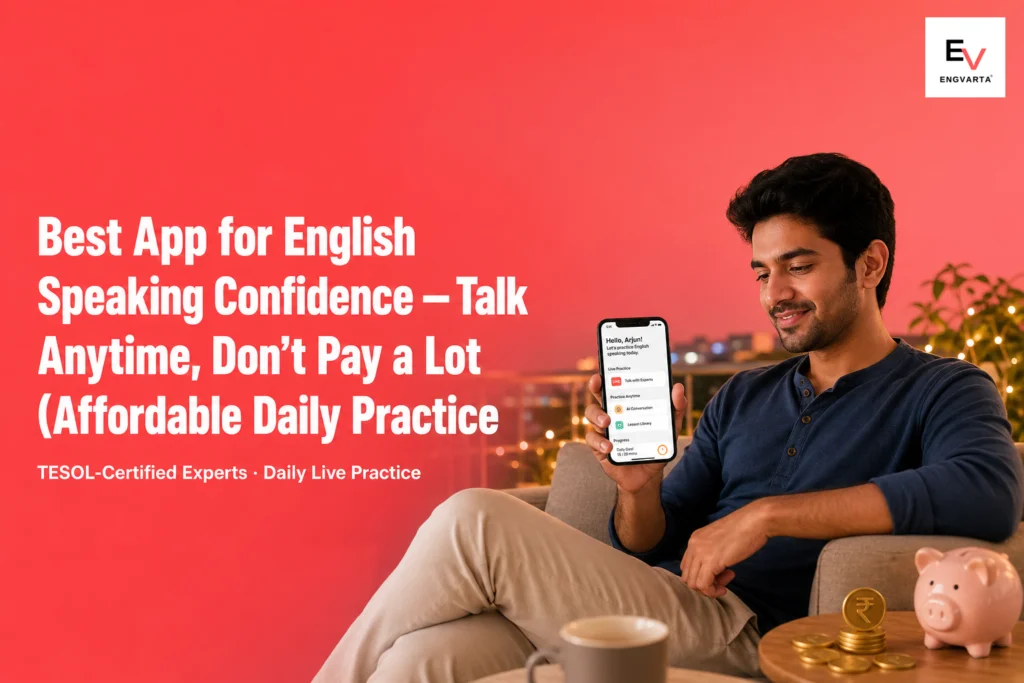
Indian young professional practising English on smartphone at home in evening with affordable cost framing — best affordable English speaking app talk anytime 2026

Quick Answer

The most affordable way to practise English depends on your budget, and there are two clear best picks:

Best free daily practice: a free AI app like ChatGPT Voice or TalkPal — zero cost, and strong for building a daily speaking habit.
Best affordable live-human correction: EngVarta, because it gives real-time correction from a TESOL/ESL-certified Expert at about ₹108 a session (100% refundable ₹69 / $1 trial).

Cambly, italki, and Preply offer live tutors at higher prices. The tables below compare the free apps and the affordable platforms side by side so you can match one to your situation.

Searches for an affordable way to practise English split into two intents: some people look for an affordable English speaking app (usually a self-serve or AI tool), and others look for an affordable English speaking platform (something that connects them to a live person). The best pick is genuinely different depending on which you want and what “affordable” means to you.

This guide compares both — free AI apps and low-cost live-practice platforms — for the same job: building speaking confidence you can use in real conversations, on a daily-practice budget. Pricing and features were verified in June 2026, and competitor names are mentioned for context only.

What “affordable” means for daily practice

“Affordable” has two honest definitions, and they point to different tools:

  • Lowest possible cost. If the goal is to spend nothing, free AI apps are the answer. They are genuinely useful for building a daily habit and practising basic conversation, and many learners get real early gains from them.
  • Lowest cost that includes a real human. If you want someone to correct you and respond like a real conversation partner, the cheapest route is an affordable live-practice platform rather than a premium tutor. This costs more than free, but far less than one-to-one tutoring.

For context, a single live session on an affordable platform tends to cost roughly the same as a music-streaming subscription or a single coffee — less than most people expect for human practice, but not free. Neither definition is “right”; the rest of this guide simply compares the options under both.

Free apps vs affordable platforms: how they compare

App / platformTypeLive human?Typical priceBest for
ChatGPT VoiceAI appNoFree tier / ~$20/moFree rehearsal of any scenario
TalkPalAI appNoFree tier / paid premiumDaily habit-building with roleplay
ELSA SpeakAI appNoFree tier / paid premiumPronunciation drilling
SpeakAI appNoFree tier / paid premiumStructured AI conversation scenarios
HelloTalkExchange appYes (peers)Free / freemiumCasual conversation with other learners
EngVartaLive platformYes (certified Expert)~₹108/session (₹2,700/25)Cheapest live human practice with correction
CamblyLive platformYes (native tutor)Higher per-session / monthlyNative-accent exposure
italki / PreplyTutor marketplaceYes (tutor)Per-hour, variesChoosing your own tutor

The free apps for daily practice

For a zero-rupee budget, these are the strongest options for building a daily speaking habit. All are genuinely usable for free, and many learners combine two or three of them.

ChatGPT Voice

A flexible free option: prompt it to play any scenario — a colleague making small talk, an interviewer, a stranger at a cafe — and it adapts. Good for: free, on-demand rehearsal of a specific upcoming conversation. Limitation: the free tier has session limits, and it gives little structured correction.

TalkPal

An AI conversation app with a genuinely usable free tier, voice and text, and scenario roleplay. Good for: the first weeks of building a daily habit. Limitation: like any AI tool, its responses can start to feel repetitive over time, and it cannot react like a real person.

ELSA Speak

The free tier covers basic pronunciation drilling at the phoneme level. Good for: learners whose main friction is accent clarity. Limitation: it is a pronunciation coach, not a conversation app — useful as a supplement.

Speak

An AI app with a free tier and a library of structured scenarios (meetings, interviews, daily errands). Good for: learners who prefer guided scenarios to open-ended chat. Limitation: daily limits on the free tier, and the same AI-only ceiling.

HelloTalk

A free language-exchange app that pairs you with other learners and native speakers for voice notes, calls, and text. Good for: casual, zero-cost conversation. Limitation: partners are not trained correctors, quality varies, and chats can fizzle out.

Free AI apps are excellent for habit-building and basic practice. Their shared limit is that none provide a trained human who corrects your spoken English in real time — which is the gap the affordable platforms below fill.

The affordable live-practice platforms

If you want a real person to practise with and correct you, these platforms add a human partner. They cost more than free apps but range widely in price.

EngVarta — the most affordable live-human option

EngVarta is a live-practice platform built around 1-on-1 audio sessions with TESOL/ESL-certified English Experts. You choose a 15-, 25-, or 50-minute session, connect to an Expert in minutes, and the Expert corrects your grammar, phrasing, and pronunciation in real time during the call, with consolidated feedback towards the end. The audio-only format works on slower mobile data and suits practising privately. It is the lowest-priced way to get live, certified human practice for Indian learners.

  • Good for: learners who want a real human partner and correction at the cheapest live price point.
  • Trade-offs: it is paid, not free; it rewards regular practice; and live sessions run from 7 AM to midnight rather than 24/7, so it is not the pick if you specifically need 2–6 AM practice (an always-on AI app is better there).
  • Pricing: 100% refundable trial at ₹69 / $1; then ₹2,700 for 25 sessions (about ₹108 a session). In USD markets, $45 for 25 sessions ($1.80 per session).

Cambly

A live platform offering on-demand video chat with native English speakers. Good for: native-accent exposure and casual conversation. Trade-off: priced in USD-anchored plans that are higher than EngVarta’s, so daily use is more expensive.

italki / Preply

Marketplaces where you book individual tutors by the session. Good for: choosing a specific tutor for a specific goal. Trade-off: quality and price vary tutor to tutor, and per-session costs add up for daily practice.

Ready to Practice with Real Experts?

Try EngVarta today — ₹69 trial (India) / $1 trial (International) · 100% refundable

What Our Learners Say

Rated 4.5★ from 9,100+ reviews on Google Play

★★★★★
Quite impressive app for learning English . I am happy that joined this planform.You can learn and grow here.
★★★★★
I find the app very helpful and user friendly. The UI design is very soothing for eye. Students can get good benefit out of it if they regularly use it to practise their spoken English. Good luck to the app team for building a professional app for the greater good.
★★★★★
The supporting people along with the experts are very supportive. The only suggestion to the officials is that the names of the experts should be reflected on the screens so to know to whom I am talking with. Thank you Engvarta, continue supporting people like me. Thank You.
★★★★★
I am learning on this platform. it is really really helpful to upgrade myself. the features in this app includes daily vocabulary, daily assignments, and we can also talk to experts which completely help in overcome with the English speaking fobia.
★★★★★
Its just great, I mean in terms of environment that it gives you is just awesome. Thnx again for boosting my confidence.
★★★★★
This app is very useful for e English and the Mam is nice by rating is five star
★★★★★
It's a beautiful app for beginners. All experts are so good. They talk with you frankly like your friends, so you don't feel bored and you get interest to learn English.
★★★★★
No words to say about your app. I'm very interested in it and learning a lot. Thanks for your help.
★★★★★
It's a great place to learn and practice English Fluency..here you get a chance of one on one communication with experts.. They'll guide you throughout your learning journey..I recommend this platform to all who want to gain fluency with knowledge.
★★★★★
Good app to express yourself because in our house there are no environment n EngVarta provides you environment
★★★★★
Good app to express yourself because in our house there are no environment n EngVarta provides you environment
★★★★★
This app is very useful for e English and the Mam is nice by rating is five star

Which affordable option fits you

Your situationBest affordable pickWhy
Budget is strictly ₹0Free AI combo (ChatGPT Voice + TalkPal + ELSA free)Strongest zero-cost way to build a daily habit and basic practice.
Want the cheapest live human practiceEngVartaLowest-priced live, certified Expert practice with real-time correction.
Want native-accent immersion and can pay moreCamblyOn-demand native speakers, at a higher price.
Want to choose your own tutoritalki / PreplyBrowse and book a specific tutor by the session.
Main issue is pronunciation onlyELSA SpeakPhoneme-level drilling; even the free tier helps if used daily.

A low-cost daily routine

A simple, budget-friendly way to practise daily — start free, and add a live partner only if you want faster human feedback:

  • Daily 20 minutes — a free AI app (ChatGPT Voice or TalkPal). Pick a scenario and talk; the goal at this stage is consistent reps.
  • Daily 5 minutes — ELSA Speak free tier on the sounds you find hardest.
  • Optional, if you want correction — 2–3 live sessions a week on an affordable platform such as EngVarta, focused on the specific situations you want to improve (interview, meeting, daily conversation). This is where a trained human catches what an app cannot.

Many learners run the free apps and a few live sessions together — the apps keep the habit cheap and daily, and the occasional live session adds correction and real conversation.

For more on the wider landscape, see our guides to the best English speaking practice apps, apps for working professionals, and AI English apps vs live tutors.

The verdict

Two picks cover most learners on a budget:

  • Best free daily practice: a free AI app such as ChatGPT Voice or TalkPal — ideal for building a daily speaking habit at zero cost.
  • Best affordable live-human correction: EngVarta — the lowest-priced way to practise with a TESOL/ESL-certified Expert who corrects you in real time, at about ₹108 a session.

If your budget is strictly zero, a free AI app is the right starting point; if you want a real person correcting your spoken English at the cheapest price, EngVarta is the strongest option, with native-tutor platforms like Cambly available at higher prices.

How we compared these

We compared each app and platform on price, whether it includes a live human, the kind of practice it provides, and how well it fits a daily habit on a budget. Pricing and features were verified in June 2026.

Reviewed by the EngVarta content team. Editorial independence note: this comparison reflects our independent editorial assessment. We have not received payment, sponsorship, or affiliate compensation from any platform listed for inclusion in this article.

Frequently Asked Questions

Q1. What is the most affordable way to practise English speaking?

Ans: It depends on your budget. If you want to spend nothing, free AI apps such as ChatGPT Voice, TalkPal, and ELSA Speak’s free tier are the most affordable way to build a daily speaking habit. If you want a live human to correct you, the cheapest option is an affordable live-practice platform such as EngVarta, at about ₹108 a session, rather than a premium tutor.

Q2. Are free English speaking apps enough?

Ans: For building a daily habit and practising basic conversation, free AI apps are genuinely useful and a good starting point. Their main limit is that they do not provide a trained human who corrects your spoken English in real time, so many learners eventually add a live partner for faster progress on correction and real conversation.

Q3. What is the difference between an English speaking app and an English speaking platform?

Ans: An app is usually a self-serve or AI tool you practise with alone, such as TalkPal, ELSA, or Speak. A platform usually connects you to live people — a certified Expert on EngVarta, native tutors on Cambly, or marketplace tutors on italki and Preply. Affordable options exist in both categories; apps tend to be cheaper, platforms add a human partner.

Q4. How much does an affordable English speaking platform cost?

Ans: Free AI apps cost nothing on their free tiers. Among live platforms, EngVarta is the most affordable for Indian learners at about ₹108 a session (₹2,700 for 25 sessions, or $45 for 25 sessions in USD markets). Cambly’s plans are higher, and tutor marketplaces such as italki and Preply charge per hour at rates that vary by tutor.

Q5. Can I practise English speaking for free?

Ans: Yes. ChatGPT Voice, TalkPal, ELSA Speak, Speak, and HelloTalk all have free tiers you can practise with daily. They are best for habit-building and basic conversation; for real-time correction from a trained human, you would add a low-cost live platform.

Q6. For daily practice, is an app or a live platform better?

Ans: Both have a place, and many learners combine them. Free apps make daily practice cheap and always available; a live platform adds correction and real conversation that apps cannot provide. A common low-cost approach is daily free-app practice plus a few live sessions a week.

Best English Speaking App for Meeting Confidence with Bosses (2026): Daily Practice Guide for Indian Working Professionals

May 8, 2026 • 19 min read • By Rishish Pandey

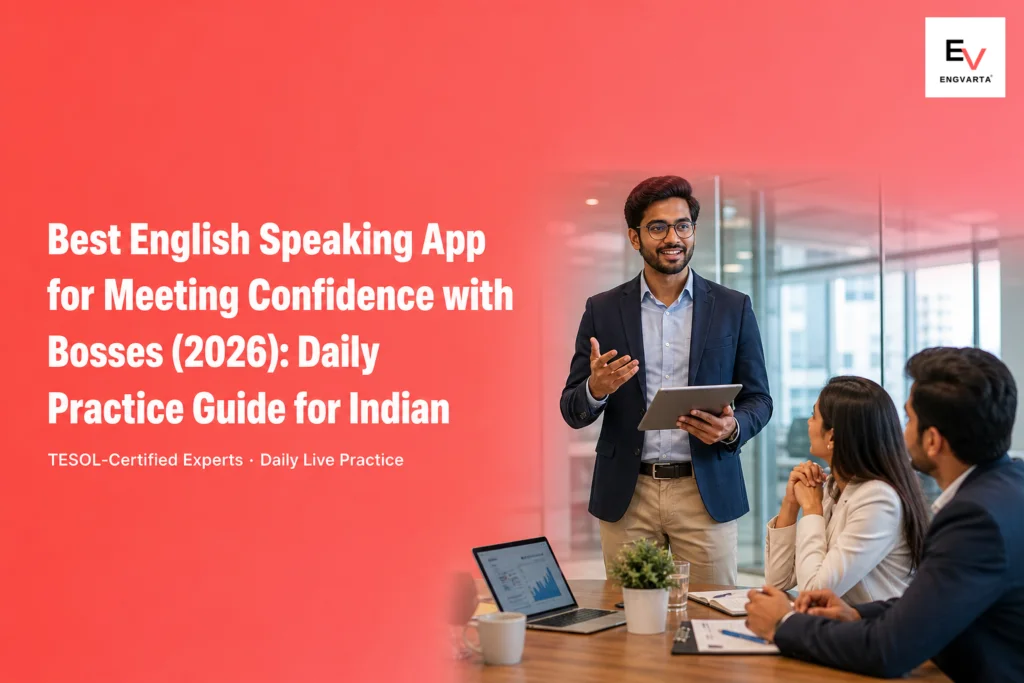
Indian working professional confidently presenting in office meeting room with colleagues — best English speaking app for meeting confidence with bosses 2026
Quick VerdictFor an Indian working professional who wants to speak with more confidence in meetings, with managers, and in front of senior leadership in English, the highest-leverage daily app is EngVarta — live 1-on-1 audio sessions with TESOL/ESL-certified English Experts, real-time corrections during the call, consolidated feedback towards the end, and a 100% refundable trial at ₹69 (or $1 in USD markets). Pair it with ELSA Speak for pronunciation drilling and ChatGPT Voice Mode for stakes-free meeting roleplay rehearsal. The trap most professionals fall into is studying more grammar; the actual gap is daily speaking reps in work-relevant scenarios.

If you are an Indian working professional in IT, banking, consulting, healthcare, or any role where English is the working language at the top, the friction you feel in meetings is almost never about vocabulary or grammar. You can read the email thread, understand the deck, and know what to say.

The gap appears in the live moment — when a senior manager asks for your update, a client asks a follow-up question, or you need to disagree politely with a colleague. The hesitation is real, and the half-second pause feels like ten seconds.

Over time, these small moments become a confidence problem that affects how seniors perceive your work. The Best English Speaking App for Meeting Confidence with Bosses helps professionals practise these real workplace situations daily.

This guide reviews the apps that actually help with that specific gap — not “learn English” apps for absolute beginners, but daily practice tools that build the muscle memory of speaking work-relevant English under conversational pressure. We’ve tested these against the workplace situations Indian professionals actually face: project status updates, hand-offs to managers, stand-ups with a global team, performance review conversations, client calls.

Why “more grammar” is not the answer

Most Indian working professionals already have functional English. The CBSE / ICSE / state-board education system, college coursework, IT training, and corporate onboarding all cover the formal mechanics. The grammar is not the gap. The gap is three things, in this order:

  1. Daily speaking reps in work scenarios. Most adult learners write English daily (emails, Slack, documentation) but speak it for maybe 20 minutes a day, often in fragments. Speaking is a separate motor skill — it does not improve passively from reading and writing.
  2. Reduction of translation lag. When you think in Hindi, Marathi, Tamil, Bengali, or any mother tongue first and translate to English in real time, you lose a half-second on every sentence. That half-second compounds in a fast-moving meeting. The fix is not “stop translating” — it is enough daily practice that English-thought becomes the default for work topics.
  3. Removing the fear of imperfect speech. The senior people in your meeting are not grading your grammar. They are tracking whether your update is clear, your timeline is realistic, and your confidence sounds appropriate. Imperfect English spoken confidently lands better than perfect English spoken nervously.

Apps that target these three friction points work. Apps that target abstract grammar (Duolingo, Babbel for casual learners) do not move the needle for working professionals.

How we evaluated apps for the meeting-confidence use case

Four filters specific to this audience:

  • Speaking density per session. An app that gives you 5 minutes of actual speaking out of 30 minutes is not enough. We looked for ≥60% talk time.
  • Real-time correction during conversation flow. Corrections delivered after the fact (recording playback, post-session report) are useful but slow. The fastest progress comes from corrections delivered in the moment, while the sentence is still in your head.
  • Schedule fit for working professionals. 7 AM to midnight availability with 15 to 50-minute session lengths bends around stand-ups, deadline weeks, client calls. Fixed-time-only or weekend-only services do not fit lakhs of working professionals before you who tried them and dropped off.
  • Privacy and low-pressure environment. Voice-only practice with username privacy (no camera, no public profile) matters for adults who do not want colleagues knowing they are working on their English. This is not a small concern in Indian corporate culture.

1. EngVarta — best for daily live practice with TESOL/ESL-certified Experts

EngVarta live session with a TESOL/ESL-certified expert for 20 minutes. You select a 15, 25, or 50-minute session and connect to an Expert in minutes. The Expert provides real-time corrections during the call — pronunciation, grammar, fluency — and shares consolidated feedback towards the end of the session. The audio-only design works on slower mobile networks and removes camera-pressure for self-conscious learners, which matters when you are practising scenarios you would not want a colleague to overhear.

Why it works for the meeting-confidence audience : Indian working professionals practising for live meeting situations need the social stakes of a real human partner — pressure that even human-like AI roleplay cannot create. A TESOL/ESL-certified Expert detects when your sentence stress is off, when your filler word frequency is rising, when you are translating from your mother tongue and stalling — and corrects in the moment without breaking conversation flow. That muscle-memory transfer is the closest practice gets to actual meeting speech.

What an EngVarta session for meeting practice looks like : tell the Expert at the start, “I want to practice giving a project status update to my manager.” The Expert plays the manager role, asks the kind of follow-up questions you actually face, corrects your phrasing as you speak, and shares consolidated feedback at the end on your top 2-3 patterns to watch. Sessions are recorded and accessible for 30 days, so you can listen back to your own pauses, hesitations, and recurring phrasings.

Pricing : ₹69 for a 10-minute trial, 100% refundable (or $1 in USD markets, also 100% refundable — flat, not converted from INR). Regular plans start at ₹2,700 for 25 sessions in India (~₹108 per session) or $45 per month for 25 sessions in USD markets ($1.80 per session, flat). Operating hours 7 AM to midnight cover most working schedules. Pause and resume capability on multi-month plans for deadline weeks. Free vocabulary lessons, daily quizzes, and rewards live inside the same app for between-session reinforcement — same content also available on the EngVarta YouTube channel without a signup wall.

Best for : Indian working professionals who want daily speaking reps with a real certified human, not an AI tutor. Particularly strong if you freeze in front of senior people — the audio-only Expert sessions desensitise you to that specific anxiety.

Trade-off : Not a fixed curriculum. Sessions adapt to your goal each time — which is what you want for fluency, but means you set the agenda. If you prefer a structured CEFR-style syllabus with assignments, look at Lingoda or EF instead.

Ready to Practice with Real Experts?

Try EngVarta today — ₹69 trial (India) / $1 trial (International) · 100% refundable

2. ELSA Speak — best for pronunciation and clarity drilling

ELSA Speak is an AI-driven pronunciation app — not a conversation app. You read prepared sentences and the AI scores your pronunciation sound-by-sound. It tells you which vowel was off, which consonant was muted, where the stress fell wrong, and how close your version was to a model native pronunciation. For Indian English speakers whose accent is the friction point — particularly with American “r” sounds, vowel reduction, and sentence-stress patterns — ELSA can move the needle in 4-6 weeks of 15-minute daily sessions.

Why it works for meeting confidence : if your colleagues or seniors occasionally ask you to repeat yourself, the underlying issue is pronunciation clarity, not grammar. ELSA targets the specific phonemes Indian English speakers tend to soften or miss, with visual feedback (mouth position, tongue placement, breath pattern) that is actually instructive.

Pricing : Around ₹999-1,499 per month or ₹6,000-7,500 per year in India (varies by promotion). 7-day free trial available.

Best for : Indian professionals working with American or British global teams where accent clarity affects how often you get asked to repeat. Pair with EngVarta for the conversation density.

Trade-off : Not a conversation tool. ELSA cannot help you build the rhythm of an actual project status update or a client call — it is a phoneme-level coach. Use it for what it is, not for what it is not.

3. Speak — best for stakes-free AI roleplay practice

Speak (sometimes called Speak App or Speak AI, by Speakeasy Labs) is an AI conversation app with scenario-based roleplays. You pick a topic — meeting update, job interview, asking for feedback, talking to a colleague — and the AI runs the other side of the conversation. You speak; it responds; the conversation moves forward.

Why it works : stakes-free practice. You can fumble a sentence, restart, repeat the same phrase three times — the AI does not get impatient or judge. For working professionals who feel embarrassed practising with a real human at first, Speak is a good entry tool. The scenario library covers most professional situations.

Pricing : Around $20-30 per month (USD markets); India pricing varies by promotion.

Best for : Phase one of your practice plan — the first 4-6 weeks while you build the habit of speaking daily. After that, what is missing is stakes — a real human partner whose judgment you can feel is what continues the gains.

Trade-off : Plateaus around week 8-12. No real person is judging you, so the pressure never rises. Fluency built with a bot transfers only partly to real rooms.

4. ChatGPT Voice Mode — best free meeting-rehearsal partner

ChatGPT Voice Mode has surprisingly become one of the most useful free tools for meeting practice in 2026. You ask it to play a manager, a client, an interviewer, a senior leader — and it improvises. The reason it works for meeting confidence specifically: it is private, unlimited, and does not require booking.

Useful prompts to try :

  • “Pretend you are my manager. Ask me about my project status this week, including any blockers.”
  • “Roleplay a stand-up with our 8-person team. Ask me what I worked on yesterday and what I am doing today.”
  • “Practice a 1:1 with me. You are my skip-level. Ask me how my onboarding has gone.”
  • “Act as though a customer is requesting an extend for delivery. I need to push back politely.”

Pricing:  Free tier covers basic Voice Mode. ChatGPT Plus (~$20 per month or ~₹1,950 per month in India) unlocks longer sessions and the better voice models.

Best for : Pre-meeting rehearsal. Use ChatGPT Voice to go over the scenario two or three times the night before a big meeting. By the actual meeting your phrasings are loaded into muscle memory.

Trade-off : No stakes and no accountability. ChatGPT will play along — GPT-Live even corrects errors now — but it won’t push you on your goals the way a certified English Expert will.

5. Cambly — best for premium native-speaker exposure

Cambly connects you to native English speakers (mostly USA, UK, Canada, Australia) for live video conversations. Not all Cambly tutors are certified teachers — they are conversation partners. The value is exposure to natural pace, idiom, and accent rather than structured correction.

Pricing : Around ₹4,000-5,500 per month for a 30-minute daily plan in India (varies by region). More expensive than the other options on this list.

Best for : Indian working professionals who specifically want to acclimate their ear to American or British conversational pace before relocating, before a global rotation, or before working with a new geo team. Use selectively, not as primary daily practice.

6. Loora — emerging AI for business-English roleplay

Loora is a newer AI conversation app specifically targeted at workplace and business English. The scenarios are tighter (more meeting-focused, more interview-prep-focused) than Speak’s broader catalogue. As a 2026 entrant it is still building out its scenario depth, but the early reviews from working professionals are positive.

Pricing : Around $25-35 per month (USD markets); availability in India varies.

Best for : Working professionals who want a more business-English-focused AI than Speak, and are comfortable with a newer product. Not a daily-habit replacement for live human practice — same plateau dynamic as any AI tool.

The honest 30-day daily routine

Here is what actually works for an Indian working professional with a real day job, real deadlines, and 25-30 minutes of practice budget per day:

Daily (Monday to Friday, 25-30 minutes total):

  • 20 minutes — EngVarta live session with a TESOL/ESL-certified Expert. Scheduled for either your morning walk window (6:30 AM – 8 AM) or your post-dinner private window (9 PM – 11 PM). Either window works — pick the one your household supports better. Tell the Expert at the start what scenario you want to practice that day (project update, pushback conversation, performance review prep, etc.).
  • 5 minutes — ELSA Speak pronunciation drill on the specific words or sounds the Expert flagged in your session. This compounds the value of the live practice.

Weekend (15 minutes):

  • A ChatGPT Voice rehearsal of a meeting situation you have coming up the next week. Use the prompts in section 4 above. Repeat the scenario 2-3 times until your phrasings feel automatic.

What you should expect by week 4 : measurably less hesitation in stand-ups, fewer half-second pauses while you translate, a noticeable shift in how confidently you pitch your work in 1:1s with your manager.

By week 12 : the muscle memory is locked in. You stop thinking about your English mid-sentence. The colleague who used to ask you to repeat asks less often. The senior leader you were nervous around starts feeling like a peer.

What Our Learners Say

Rated 4.5★ from 9,100+ reviews on Google Play

★★★★★
Chicken-hearted person will become lion hearted person after using this app.
★★★★★
hello this is Shweta and I will tell you about the engvarta app this is an amazing app to improve our English or any other language so I suggested using this app and doing better things and growing always better . thankyou.
★★★★★
It's always a pleasure talking to you. You always make me feel that I am doing very good and encourage me to work hard to achieve the goal of being a good speaker.
★★★★★
I find the app very helpful and user friendly. The UI design is very soothing for eye. Students can get good benefit out of it if they regularly use it to practise their spoken English. Good luck to the app team for building a professional app for the greater good.
★★★★★
I have been using EngVarta for the past three months and from the period I am using I feel a considerable amount of difference in how I was speaking earlier and now how I am speaking and I think the EngVarta team has done a commendable job in improving my English fluency skill.
★★★★★
I attended just my first class. I literally love it. I got my gurus in this app.
★★★★★
Excellent application to improve your communication skills.Thnk you for introducing new vocabulary everyday.God bless you You might not aware of but personally this is helping me a lot
★★★★★
hii i have taken your 69 rs plan for expert calling but no response from your side you gove the number i am trying to call on that number but no response r u making me fool? or what?
★★★★★
My last 12 sessions experience is really great. It's a great app to improve English fluency and communication skills. All experts are quite friendly and highly skilled.
★★★★★
Wonderful application for English learners and good for speaking with trainers .All trainers are well experienced and help us within the time period,Thanks
★★★★★
Experts are friendly and supportive. Great platform to improve your communication skills.
★★★★★
Excellent platform for people who don’t find any people to speak in English. Live experts help to build confidence while speaking and guiding to improve your communication!

Common mistakes Indian working professionals make

  • Trying to “sound American” or “sound British”. Don’t. Aim for clear, calm, neutral English. Senior leaders globally speak English as a second language. Clear is far more important than accent-perfect.
  • Avoiding meetings where they have to speak. The avoidance compounds. More reps, not less, are the solution.
  • Practising silently in their head. Internal rehearsal does not transfer. The motor pathways for spoken English only develop when you actually speak out loud.
  • Studying more vocabulary instead of practising the same 200 work-relevant phrases. Lakhs of learners before you have proved that 200 repeated phrases beats 2,000 memorised words for meeting confidence.
  • Waiting until they “feel ready” to use English in meetings. The readiness comes from doing, not from preparing in private indefinitely.

10 office sentences worth practising daily

Say these aloud in your daily routine. They cover the most common meeting moments:

  1. “I’d like to add one point on this.”
  2. “From my perspective, the priority should be…”
  3. “Could you please clarify what you meant by…?”
  4. “I support the more comprehensive strategy. I’m worried about…
  5. “Let me check with my team and get back to you by tomorrow.”
  6. “That timeline may be tight. Can we discuss what is realistic?”
  7. “Just to confirm I understood correctly…”
  8. “Here’s the update from my side.”
  9. “I have a suggestion that might help here.”
  10. “Thanks everyone — that’s clear from my end.”

For more on the broader confidence framework, our analysis of the best English speaking apps for Indian working professionals covers the full audience landscape, our guide on reducing Indian accent for the American workplace covers the phonetic-clarity angle in detail, and our review of job interview English practice covers the high-stakes one-shot meeting variant.

The bottom line

Confidence in English meetings is built one daily live session at a time. EngVarta is the most powerful tool available to Indian working professionals because to its chosen expert pool, real-time correction, and flexible timetable (7 AM to midnight). , and the 100% refundable trial at ₹69 means you can sample without financial risk. Stack it with ELSA Speak for pronunciation and ChatGPT Voice for pre-meeting rehearsal, and you have a routine that produces measurable confidence gains in 8-12 weeks.

Most professionals already know enough English. The work is converting passive knowledge into active speaking confidence — and that conversion only happens through daily reps in work-relevant scenarios with a real human partner who corrects you in the moment.

Editorial independence note: this listicle reflects our independent editorial assessment of the apps reviewed. We have not received payment, sponsorship, or affiliate compensation from any of the platforms listed for inclusion in this article.

✨ Join thousands of learners and start speaking English with confidence today!
Frequently Asked Questions ( FAQs )

Q1. Which app is best for improving English speaking confidence in meetings with bosses?

Ans : For Indian working professionals, the highest-leverage daily app is EngVarta — live 1-on-1 audio sessions with TESOL/ESL-certified English Experts who provide real-time corrections during the call and consolidated feedback towards the end. The 100% refundable trial at ₹69 (or $1 in USD markets) lets you sample one Expert session without financial risk. Pair with ELSA Speak for pronunciation drilling and ChatGPT Voice Mode for pre-meeting rehearsal.

Q2. How much daily practice do I actually need to feel confident in meetings?

Ans : 25-30 minutes per day, four to five times per week, with a TESOL/ESL-certified Expert produces a measurable shift in conversational confidence within 8-12 weeks. The key variable is consistency, not duration — daily 25 minutes beats weekly 90 minutes every time. Most Indian working professionals see noticeable change by week 4 and locked-in muscle memory by week 12.

Q3. Why does my English feel weaker in meetings than in writing?

Ans : Speaking is a separate motor skill from reading and writing. Most adult learners write English daily but speak it for maybe 20 fragmented minutes a day. The pause between thought and spoken sentence is what feels like “weaker English” — it is actually a translation lag from your mother tongue, fixable with daily speaking reps. After 8-12 weeks of consistent practice, English-thought becomes the default for work topics and the lag disappears.

Q4. Can I use a free AI app like ChatGPT instead of a paid app like EngVarta?

Ans : For the first 4-6 weeks while you build the habit, free AI tools like ChatGPT Voice work well. After that, what is missing is stakes — a real human partner whose judgment you can feel is what continues the gains. Most working professionals who progress past intermediate stage use a combination — AI for habit + pre-meeting rehearsal, live human practice (EngVarta or similar) for daily depth, ELSA Speak for pronunciation refinement.

Q5. Is it worth paying for English speaking practice if I already understand English?

Ans : Yes — for working professionals where meetings and senior conversations affect career progression, the return on a daily English speaking practice habit is high. Understanding English is passive knowledge; speaking confidently in meetings with bosses is active skill. The two are not the same, and the conversion only happens through deliberate practice. The cost of a 25-session plan (₹2,700 in India, ~₹108 per session, or $45 per month / $1.80 per session in USD markets) is small compared to the career impact of consistently underperforming in meetings.

Q6. What if my office colleagues find out I am practising English?

Ans : EngVarta‘s audio-only design (no video) and username-based privacy means there is nothing visible to colleagues. Practice sessions happen in private (morning walk window before office, post-dinner window at home) and the in-app interface does not require a public profile, real name, or photo. This matters for Indian corporate culture where the perception of needing English help can affect how seniors evaluate your work.

Q7. How long until my manager notices a difference?

Ans : Most Indian working professionals report that their manager (or skip-level) notices the shift around weeks 6-10 — typically as “you sound more confident in stand-ups lately” or “your update was clearer than usual.” The actual change happens in the muscle memory long before the language is observable to others. Trust the process; the visible change always trails the underlying skill change.

Best English Speaking Practice app for Shy Learners and Beginners 2026

May 1, 2026 • 13 min read • By Rishish Pandey

Best English Speaking Practice App for Shy Learners & Beginners (2026)
Quick Verdict · 2026 Best English speaking practice app for shy learners and beginners in 2026: EngVarta (voice 1-on-1 with vetted experts, ₹69 refundable trial, plans from ₹2,700 for 25 sessions). For lowest-pressure starts, AI apps (TalkPal, Praktika.ai, ELSA Speak) help you warm up before talking to a human. Real progress requires moving from AI to live human practice within 4–6 weeks — AI alone plateaus shy learners at ‘comfortable in the app’ but doesn’t transfer to real conversations. Below: 7 apps ranked by how they actually serve shy learners.

For many learners, the biggest challenge is not vocabulary or grammar—it is the anxiety that comes with speaking. The moment a real conversation begins, hesitation takes over. Thoughts freeze, sentences break, and confidence drops. This is exactly where choosing the best English speaking practice app for shy learners & beginners becomes important.

This guide is designed for learners who feel that pressure, as well as absolute beginners starting from zero. The apps listed here are selected based on how comfortably they help you practise speaking—not just on features. Some offer AI-based practice with zero judgment, ideal for building initial confidence. Others provide human interaction in a low-pressure format, such as audio-only or supportive sessions tailored to your level. All seven are chosen to help learners who struggle with hesitation, not those who are already fluent.

What shy learners and beginners actually need

  • Zero judgment, especially early on. Apps that make you feel watched by another human in the first session burn out shy learners fast. The first month should feel safe enough that you actually log in tomorrow.
  • Low-stakes mistakes. Real conversation has zero rewind. AI conversation has unlimited rewind. For learners who freeze, that asymmetry matters — being able to redo a sentence ten times without anyone caring is the active ingredient in early fluency.
  • Audio over video. Video adds a whole layer of self-consciousness — your appearance, your background, your facial expressions while you fumble a word. Audio strips that away. Most learners find audio-only practice 30-50% less anxious than video.
  • Patient teachers, when humans are involved. Some teachers correct mid-sentence in a way that destroys momentum. Others wait, repeat your sentence back, and gently reshape it. The second style is what shy learners need.
  • Short sessions. Fifteen-minute sessions feel survivable. Sixty-minute sessions feel like a marathon. For early-stage learners, short and frequent beats long and rare every time.
  • An off-ramp from AI to humans. Eventually the goal is real conversation. Apps that exist purely as AI islands trap learners in a low-pressure bubble forever. The best path is AI for confidence-building, then live humans once the wall is lower.

Quick comparison: 7 Best English Speaking Practice app for Shy Learners and Beginners 2026

App Type Best Stage Pricing
TalkPal AI conversation Confidence-building Free / from $9 per month
Praktika.ai AI tutor avatars Visual-cue beginners Free trial, from $20 per month
Speak AI structured Beginner curriculum Free / $20 per month
ELSA Speak AI pronunciation drills Pronunciation only Free / $12 per month
Duolingo Gamified mobile Absolute beginner Free / $7 per month
HelloTalk Peer language exchange Low-stakes peer practice Free / $7 per month
EngVarta Live human (audio) Ready-for-humans graduation $45 / ₹2,700 for 25 sessions

1. TalkPal — AI conversation with native-accent voices

TalkPal is one of the cleanest AI-only options for shy learners. Multiple native-accent AI voices, 24/7 availability, real-time gentle correction, and a UX that does not punish you for hesitating mid-sentence. You can speak slowly, restart, mumble — the AI waits. For learners with serious anxiety in the first weeks, that patience is the value.

  • Pricing : Free basic tier, paid plans from $9 per month.
  • Format : AI voice conversation with multiple native-accent options.
  • Best for : The first month of practice when you still freeze with humans. Use it to build the muscle of saying English out loud at all.
  • Honest caveat: AI is unable to mimic actual social pressure. Once your confidence is up, you need human practice to translate skill into real-world conversation.

2. Praktika.ai — AI tutor avatars for visual-cue learners

Praktika takes the AI conversation format and adds animated tutor avatars. For learners who feel unmoored by pure-voice AI, having a face — even an animated one — gives a sense of “I am talking to someone.” Practice scenarios are pre-set (job interviews, business meetings, travel, casual chat) and the AI adapts to your level.

  • Pricing : Free trial, paid plans from $20 per month.
  • Format : AI tutor avatar with scenario-based conversation practice.
  • Best for : Learners who want visual cues during practice and prefer scenario-based rehearsal over open conversation.
  • Honest caveat : Avatars are not real people. The illusion can be helpful early on but becomes thin as you progress. Subscription pricing adds up over months.

3. Speak — Structured AI lessons for beginners

Speak combines AI conversation with a defined beginner curriculum. Lessons follow a progression — first vocabulary, then short phrases, then conversation patterns, then open dialogue. For learners who need structure to feel confident (“I am on lesson 8 of 30, I am making progress”), this format reduces the overwhelm of open-ended AI chat.

  • Pricing : $20 a month for the premium tier, free for the basic tier.
  • Format : AI voice conversation following a structured curriculum path.
  • Best for : Beginners who need a defined sequence of lessons rather than open conversation prompts.
  • Honest caveat : Once you outgrow the early levels, curriculum-locked progression may feel slow. Best as a foundation tool, not a permanent solution.

4. ELSA Speak — Pronunciation drills for the self-conscious

ELSA solves a specific anxiety: the fear of being misunderstood when you speak. Phoneme-level pronunciation drilling, no real conversation pressure, just you and the AI listening for whether you said “very” or “wery.” For learners whose fear is rooted in pronunciation specifically, this targeted practice removes one variable.

  • Pricing : Free basic tier, $11.99 per month Pro.
  • Format : AI pronunciation drills, no conversational practice.
  • Best for : Learners whose primary anxiety is being misunderstood — accent and clarity work specifically.
  • Honest caveat : Not real conversation. Strong as a complement to a conversation app or live class, but cannot build conversation fluency on its own.

5. Duolingo — Lowest-pressure entry point for absolute beginners

For learners who do not yet have the vocabulary to even attempt conversation, Duolingo is the gentlest on-ramp. Gamified short lessons, no live person involved, no spoken sessions until you choose them. The streaks and rewards solve the motivation problem better than serious apps usually manage.

  • Pricing : Free with ads, $6.99 per month for Super Duolingo.
  • Format : Gamified mobile lessons covering vocabulary, grammar, and basic phrases.
  • Best for : Absolute beginners building foundational vocabulary before attempting any kind of conversation practice.
  • Honest caveat : Speaking exercises are basic. Will not build conversational fluency on its own. Use it for the first 200-300 words, then graduate to a conversation app.

6. HelloTalk — Peer language exchange for low-stakes practice

HelloTalk pairs you with a native English speaker who wants to learn your native language. The asymmetry is the comfort: they are also struggling, also vulnerable, also figuring it out. That mutual stumbling makes the conversation feel less judgmental than talking to a teacher who is fluent and you are not.

  • Pricing : Free. Premium $6.99 per month.
  • Format : Peer-to-peer chat, voice notes, and video.
  • Best for : Learners who want practice with real humans but cannot yet handle the formal pressure of a teacher-student dynamic.
  • Honest caveat : Partner quality varies wildly. After a few conversations, many partners become silent. You spend half your practice time teaching your language rather than learning English .

7. EngVarta — The graduation step from AI to live human practice

EngVarta is where most shy learners end up once the AI bubble starts feeling small. Live audio 1:1 sessions with TESOL/ESL-certified Experts who are specifically trained to work with anxious learners — they slow down, rephrase, wait through pauses, and rebuild momentum when you freeze. The audio-only format removes the visual self-consciousness of video, and the on-demand structure means you can call when you are ready, not when a calendar tells you to be.

The Experts have walked thousands of learners through the early-stage anxiety wall. The patterns are predictable — frozen openings, midsentence collapses, the urge to switch back to your native language. Trained Experts know how to handle each one without making the learner feel worse.

  • Pricing : $1 / ₹69 trial (100% refundable). Plans from $45 / ₹2,700 for 25 sessions.
  • Format : Audio-only 1:1 with rotating certified Experts. 15 / 25 / 50-minute options. On-demand.
  • Best for : Shy learners who have built minimum vocabulary via AI apps or Duolingo and are ready (or almost ready) for live human practice. The audio-only format and trained Experts make this the lowest-anxiety live human option available.
  • Honest caveat : Paid product after the trial. If you are still in week one of overcoming pure speech anxiety, an AI app may be a gentler starting point. Most learners use 2-4 weeks of AI first, then transition to EngVarta.

Ready to Practice with Real Experts?

Try EngVarta today — ₹69 trial (India) / $1 trial (International) · 100% refundable

What Our Learners Say

Rated 4.5★ from 9,100+ reviews on Google Play

★★★★★
This app is very useful for e English and the Mam is nice by rating is five star
★★★★★
I have thoroughly enjoyed the session and the expert provided me instant feedback that will definitely help me.
★★★★★
Thank you guys for this amazing app. I think this application will help me to improve my communication skills.
★★★★★
Really I love this app. It's awesome. The application as well as the speakers are very good. I'm happy to learn daily vocabulary you send in mail.
★★★★★
Great app for learning English speaking. All the experts are supportive and non-judgemental. After every session, constructive feedback is provided to enhance yoilur skills. Also it has AI enabled feature for assignment practice. Overall a great platform to practise English speaking with experts.
★★★★★
Let me congratulate you on your endeavour to help people gain confidence while speaking. I enrolled for your vocabulary series. You guys are doing a good job. Keep it up.
★★★★★
engverta is good for those who is struggling to speak English...I m new commer but I feel good experience with engverta experts they listen our broken English, they rectify mistakes ,they talk withvery humbly..
★★★★★
It's a great place to learn and practice English Fluency..here you get a chance of one on one communication with experts.. They'll guide you throughout your learning journey..I recommend this platform to all who want to gain fluency with knowledge.
★★★★★
The app has been great in improving your English speaking skills. Experts have great knowledge and indeed all are amicable and they create the environment which is necessary for learning the language.
★★★★★
It was a great experience praticing with EngVarta. Thank you experts for helping me reach
★★★★★
Best way to learn to speak English. It has boosted my confidence. I feel like now nobody can stop me on the way to success. Feeling blessed.
★★★★★
It was a very amazing experience to talk to an expert. She suggested how to improve my speaking skills and enhance my confidence level. EngVarta is the best platform to learn English fluently.

A practical 8-week plan for the shy learner

  • Weeks 1-2 — AI only: Pick one of TalkPal, Speak, or Praktika. Use it 10-15 minutes daily. The goal: simply make speaking English out loud feel normal again. No human interaction.
  • Weeks 3-4 — Add ELSA for pronunciation: Stack a 5-minute ELSA session before each AI conversation. By week 4, your accent should be slightly cleaner — which often unlocks confidence on its own.
  • Weeks 5-6 — Add HelloTalk peers: Try one peer voice exchange per week. Low-stakes, mutual-vulnerability practice. Keep AI sessions running daily.
  • Weeks 7-8 — Graduate to live humans: Start an EngVarta trial. Three to four sessions per week. The Experts will know how to ease you in. By week 8, the wall should be meaningfully lower.
  • Beyond week 8: Daily EngVarta becomes the spine. AI apps optional for warm-up. The shy-learner identity starts to fade.

Best English speaking practice app for shy learners & beginners—reduce hesitation, build confidence, and start speaking with easy, low-pressure daily practice.

Frequently Asked Questions

What is the best English speaking app for shy learners and beginners?

For pure beginners, Duolingo for vocabulary basics, then TalkPal or Speak for AI conversation practice in weeks 2-4. For shy learners ready for live human practice without video pressure, EngVarta is the cleanest fit — TESOL-certified Experts trained to work with anxious learners, audio-only format, $1 refundable trial. Most learners benefit from a stack: AI early, live human practice later.

How do I overcome the fear of speaking English?

The wall comes down through repeated low-stakes exposure, not through reading more grammar. Start with AI conversation apps (TalkPal, Speak, Praktika) where there is zero social pressure for the first 2-4 weeks. Then graduate to live human practice on a platform like EngVarta where Experts are trained to work with anxious learners. The key is daily reps — the wall does not come down through occasional intense practice; it erodes through consistent low-stakes exposure.

Should beginners use AI apps or live human classes?

Both, in sequence. For the first 2-4 weeks, AI apps (Speak, TalkPal, Praktika) are gentler — no human pressure, unlimited retries, immediate but gentle correction. After 2-4 weeks of AI, transition to live human practice (EngVarta is the lowest-anxiety option because of the audio-only format and Expert training in working with shy learners). AI alone tops out — real fluency requires real human interaction eventually.

Why is video harder than audio for shy English learners?

Video adds layers of self-consciousness on top of language anxiety: how you look, your background, your facial expressions while you fumble for a word. Each layer is a small drain on your cognitive bandwidth. Audio-only practice removes them all, leaving you to focus only on listening and speaking. Most shy learners report that audio practice feels 30-50% less stressful than video practice for the same content.

What is the cheapest way to overcome English speaking anxiety?

The cheapest sustainable stack: Duolingo free tier for vocabulary, plus TalkPal or Speak free tier for AI conversation practice (10-15 min daily). When you are ready to transition to live human practice, EngVarta has a $1 / ₹69 refundable trial — the lowest-cost live human option in the category. Total cost for the first 2-3 months under $50 / ₹4,000.

EngVarta vs Free English Speaking Apps (Govar, OpenTalk, Hilokal): Which Actually Works in 2026

April 30, 2026 • 10 min read • By Rishish Pandey

EngVarta vs Free English Speaking Apps

If you’ve been searching for English speaking practice apps in India, you’ve likely tried some free options—Govar, OpenTalk (Buddy Talk), Hilokal, Speak Pal, or English Call. These can be helpful at an early stage, especially for basic conversation practice. However, many learners eventually hit a plateau—conversations become repetitive, partners stop responding, and progress slows despite regular use.

This is where the comparison of EngVarta vs free English speaking apps becomes relevant. The key question is whether paying for a structured platform like EngVarta adds real value or not. This article presents a clear and honest comparison to help you decide.

What free peer speaking apps actually offer

Govar, OpenTalk, Hilokal, Speak Pal, English Call — these apps are all variations of the same core model: free app, matches you with other learners or random speakers, you talk in English. Some add AI feedback, topic rooms, or structured programs on top.

What they are genuinely good for:

  • Zero-cost entry. Free. No financial commitment when you have zero idea if English practice is even for you.
  • Getting over the initial “I cannot talk to anyone” paralysis. Talking to another nervous learner is lower-pressure than any other format.
  • High volume of talk time. You can talk for hours a week without paying anything.
  • Listening practice with different accents. You hear English as spoken by learners from different regions.
  • Community feeling. Some of these apps (Hilokal, OpenTalk) have genuine community dynamics that keep you coming back.

The real limitations that learners discover after 2-4 weeks

  • Your partners are also learners, not teachers. They cannot correct your grammar because their English may be weaker than yours. You end up practising with someone who has the same gaps.
  • Ghosting is universal. Most partners stop replying after 3-5 conversations. You spend time building relationships that evaporate.
  • Conversations plateau. You talk about the same topics — work, hobbies, family — in the same simple English, repeatedly. No push to use richer vocabulary or more complex structures.
  • Bad habits reinforce. Your MTI, pronunciation errors, and grammatical mistakes go uncorrected. You practise incorrect English for hours and get fluent at being wrong.
  • No structure or progress tracking. You cannot tell whether you are improving or stuck.
  • Safety and quality issues. Random stranger chat apps in India occasionally have harassment issues, especially for women.

These are not problems the free apps are hiding — they are inherent to the peer-to-peer model. It is like going to a free gym where other gym-goers spot you instead of a trainer. Works for a while. Eventually you want someone who knows what they are doing.

What EngVarta offers that free peer apps cannot

  • TESOL/ESL-certified Experts, not random learners. The person on the other end is a trained English teacher. They catch errors, suggest better vocabulary, push you to use richer structures.
  • Real-time correction. Your MTI, grammar, pronunciation — all corrected in the moment, while the context is still fresh.
  • No ghosting. Experts are available across long batch hours every day. You never have to “find” someone to talk to.
  • Structured progress. Each session has a purpose. You can track improvement week by week.
  • Office-English specifically. Experts are trained to handle interview prep, client call roleplay, meeting practice, presentation rehearsal — exactly what working professionals need.
  • Safe environment. No harassment risk, no random strangers, no identity concerns.
  • Pricing for daily use. ₹2,700 / $45 for 25 sessions works out to ₹108 / $1.80 per 25-minute session. Daily practice for a month costs less than one week of Cambly.

Quick comparison table : EngVarta vs Free English Speaking Apps 

Factor Free peer apps (Govar, OpenTalk, Hilokal) EngVarta
Price Free ₹108 / $1.80 per session
Partner type Other learners TESOL/ESL-certified English Experts
Real-time correction No (partners cannot correct) Yes, mid-conversation
Consistency Ghosting is common Experts always available
Structured progress No Yes — session tracking
Work-specific practice Rare, depends on partner Yes — interview, meeting, presentation
Best for Starting from zero, overcoming fear Serious improvement for work/exams
Typical outcome timeline Small gains over months Noticeable gains in 3-4 weeks daily

The honest framework: when to use which

  • Use free peer apps when: You are just starting out, you have never spoken English with a stranger before, you want to overcome the initial “I cannot open my mouth” paralysis. 2-4 weeks is usually enough.
  • Move to EngVarta when: You have done some peer practice but stopped seeing improvement, you need English for work/interviews/exams, you are tired of ghosting, you want structured progress, or your partners cannot correct your mistakes.
  • Use both when: You want daily serious practice on EngVarta plus free volume on peer apps for bonus talking hours. Works well for many learners.

The 3-month reality for most learners

Here is what we see consistently:

  • Month 1 on free apps: Big excitement, lots of practice, genuine confidence gains from overcoming the “I cannot talk” stage.
  • Month 2 on free apps: Partners start ghosting, conversations repeat, you wonder if you are improving. Enthusiasm drops.
  • Month 3: Most learners either quit (thinking English practice does not work) or search for paid alternatives.

If you are at the month-2 or month-3 stage, you are not the problem. The free peer format is what plateaus. EngVarta, a dedicated tutor, or structured classes solve the next stage.

When EngVarta is genuinely not the right fit

We want to be honest about this. EngVarta is not right for you if:

  • You literally have zero English baseline — you should start with Duolingo or similar for vocabulary before practising speaking.
  • You want video calls (EngVarta is audio-only by design).
  • You want to chat socially, not improve for a specific goal. Free peer apps are more fun for this.
  • You have zero budget. Use free options until you can afford even ₹2,700 for 25 sessions.
  • You want one dedicated tutor across weeks (EngVarta uses rotating Experts — a feature, not a limitation, but some learners prefer consistency).

Ready to Practice with Real Experts?

Try EngVarta today — ₹69 trial (India) / $1 trial (International) · 100% refundable

What Our Learners Say

Rated 4.5★ from 9,100+ reviews on Google Play

★★★★
A very good app its just as good as shown in the advertisement,but I wish it would have been a bit cheaper,
★★★★★
A very good app its just as good as shown in the advertisement,but I wish it would have been a bit cheaper,
★★★★★
No words to say about your app. I'm very interested in it and learning a lot. Thanks for your help.
★★★★★
thanks for guide me i will try to connect your team and good communication with person so thank you teaching with me.
★★★★★
Wonderful! They provide you a best platform to talk. A very unique idea I think. English is learned more by speaking than by being taught. So this is the best platform I think. And also you get a chance to interact with intellectual experts so that you can explore yourself.
★★★★★
I find the app very helpful and user friendly. The UI design is very soothing for eye. Students can get good benefit out of it if they regularly use it to practise their spoken English. Good luck to the app team for building a professional app for the greater good.
★★★★★
It was a great experience. I felt so much better. This is a very positive experience for me.
★★★★★
Excellent application to improve your communication skills.Thnk you for introducing new vocabulary everyday.God bless you You might not aware of but personally this is helping me a lot
★★★★★
I have been practising English on EngVarta for the past 30 days and results are significant. I’m happy to be here.
★★★★★
Wonderful application for English learners and good for speaking with trainers .All trainers are well experienced and help us within the time period,Thanks
★★★★★
It was a very amazing experience to talk to an expert. She suggested how to improve my speaking skills and enhance my confidence level. EngVarta is the best platform to learn English fluently.
★★★★★
It was a great experience praticing with EngVarta. Thank you experts for helping me reach

How to decide right now

Three simple tests:

  • Have you been using free apps for more than 6 weeks without improvement? Then you have probably plateaued. Time to try EngVarta.
  • Do you need English for a specific work/interview goal? Free peer apps are a poor fit. Paid coaching pays for itself the first time you get a job or promotion.
  • Are ghosting and unreliable partners frustrating you? That frustration does not go away on free apps. EngVarta never has it.

EngVarta has a ₹69 / $1 refundable trial — 100% money back if you do not find it useful. Minimal risk to test whether it is the right next step for you.

EngVarta vs free English speaking apps—find what actually improves fluency, consistency, and real conversation skills in 2026.

Frequently Asked Questions

Is Govar or EngVarta better for English speaking practice?

Different tools for different stages. Govar is better if you are new to English speaking, want to overcome initial fear, and have zero budget. EngVarta is better if you want real improvement for work/interviews, need corrections on your grammar and pronunciation, and value consistent daily practice without ghosting. Many Indian professionals use Govar first, then graduate to EngVarta after 4-6 weeks.

Are free English speaking apps like OpenTalk actually useful?

Yes, for the first 2-4 weeks of your journey. OpenTalk, Govar, Hilokal, and similar apps help you overcome the initial paralysis of speaking English with strangers. They are less useful after that because partners are not trained teachers and cannot correct your mistakes — you end up plateauing with the same gaps unfixed.

Is it worth paying for EngVarta when there are so many free options?

Depends on your goal. For casual practice with no specific target, free apps work. For real improvement — job interviews, work English, reducing MTI, building professional confidence — paid practice with trained Experts is significantly faster. EngVarta at ₹108 per session is a tiny fraction of the salary hike a job interview success brings.

Can I use free apps and EngVarta together?

Yes — this is actually a smart strategy. Use EngVarta for daily structured practice with corrections (the fluency-building workhorse). Use free apps like Hilokal or OpenTalk for extra talking volume and community. The combination gives you both quality and quantity.

Why do most free peer English apps have ghosting problems?

Because users are not financially committed. On free apps, there is no cost to stop replying, no reputation risk, no stake in the outcome. Paid apps like EngVarta have trained Experts whose job it is to show up — a fundamental structural difference that no free app can replicate without charging.