Spoken English For International Students |

Tag

spoken english for international students

English Speaking Practice for Indian Immigrants in the USA (2026) Guide: H-1B, F-1, H-4 & New Citizens

May 19, 2026 • 14 min read • By Rishish Pandey

Confident Indian immigrant professional in American urban setting with smartphone — English speaking practice for Indian immigrants in USA 2026
Quick VerdictEnglish speaking practice for Indian immigrants in USA is not about learning English from zero — most Indian immigrants in the USA — most Indian immigrants already read, write, and understand English well. The gap is conversational fluency under American social and workplace pressure: small-talk with neighbours, navigating the DMV, parent-teacher meetings at your kid’s school, performance reviews at work, networking events where the conversation moves fast and changes topic every 90 seconds. The fastest fix is daily 15-minute 1-on-1 live English speaking practice with a TESOL/ESL-certified Expert who understands the India-to-US transition and can simulate the American conversational style. EngVarta starts at a ₹69 refundable trial, with a 25-session pack at ₹2,700 — a fraction of US tutoring rates, and the time-zone difference works in your favour for evening sessions.

Every Indian immigrant in the USA we have spoken with describes the same surprise: arriving with strong English on paper, then realising in the first 90 days that American English at conversational speed — full of idioms, references, fast topic changes, and culturally-specific small-talk — moves twice as fast as the formal English they grew up with. The 8.0 IELTS band, the 110+ TOEFL score, the years of English-medium schooling and college — all of it produces strong written and reading English, but does not produce the conversational reflexes you actually need at the grocery store, in a Zoom standup, or at your kid’s birthday party where the other parents are all native speakers.

This guide is for Indian immigrants in the USA — H-1B holders, L-1 transferees, F-1 students who graduated and stayed, green card holders, spouses on H-4, and recent citizens — who know their spoken English fluency is the bottleneck between them and the social and professional fluency they actually want in America. We cover the specific gaps the Indian-to-USA transition creates, the apps and platforms that actually move the needle, and the realistic time investment to close the fluency gap.

Why Indian Immigrants in the USA Specifically Struggle with Spoken English

The pattern is consistent across software engineers in the Bay Area, doctors in residency programs, business school grads in NYC, IT consultants in Texas, and second-generation H-1B-spouse families across the suburbs:

1. Indian-English vs American-English conversational pace. Indian English in India is spoken at roughly 130–150 words per minute in casual conversation. American English is spoken at 160–190 wpm, with shorter sentences, more interruptions, and more “yeah”, “totally”, “for sure” filler phrases. Indian immigrants often feel they are constantly catching up — by the time they have composed a response, the conversation has already moved on.

2. Idioms and pop-culture references you never grew up with. “Drop the ball”, “out of left field”, “Monday-morning quarterback”, “throwing shade”, “punching above your weight” — American conversations are dense with idioms that have specific meanings tied to baseball, football, basketball, US TV shows, and US workplace culture. You can technically decode each word but the meaning is locked behind cultural context that takes years to absorb.

3. Small-talk anxiety. Indian social norms tend toward direct, content-rich conversation. American conversational norms include 5–10 minutes of small-talk before getting to the actual subject — weather, weekend plans, the latest sports score, your kids’ soccer schedule. Indian immigrants often feel this is wasted time and freeze when expected to participate fluently. The freeze creates a social signal that gets read as “reserved” or “hard to know” — exactly the opposite of what most immigrants want professionally.

4. Workplace English under American performance-review pressure. Indian workplace English (even at MNCs in India) tends to be deferential, indirect, qualified — “I think we could perhaps consider…”. American workplace English is direct, assertive, confident — “Let’s do X by Friday.” Indian immigrants who carry the deferential pattern into US performance reviews and salary negotiations often get read as unsure or uncommitted, even when their work is strong.

5. School and community parent-interactions. Parents of school-age kids in the US face high-stakes English-speaking moments: parent-teacher conferences, IEP meetings if your kid has learning needs, sports-team parent groups, PTA meetings, neighbourhood block parties. These are not formal exams but they shape your kid’s social experience, and Indian immigrant parents who hold back socially in these settings often regret it later.

6. The accent self-consciousness loop. Many Indian immigrants get told (sometimes politely, sometimes not) early in their US tenure that their accent is “hard to understand”. The result is a confidence collapse that creates more hesitation, which itself becomes harder to understand than the accent ever was. The fix is not accent-changing — it is fluency-under-pressure, which actually resolves both the perceived-accent issue and the comprehension issue at the same time.

The fix for all six is the same: live, 1-on-1, voice-only English speaking practice with a trained Expert who can simulate fast American conversational style, push you through small-talk scenarios, and correct hesitation in real time — every day, in slots short enough to fit between work meetings, kid pickups, and weekend chaos.

1. EngVarta — Live 1-on-1 Practice from India, Time-Zone-Optimised for US Evenings

EngVarta is built for daily 1-on-1 live English speaking practice. For Indian immigrants in the USA specifically, the time-zone math works strongly in your favour: an evening session in Seattle (7pm PST) is a morning session in Lucknow (7:30am IST the next day) — exactly when EngVarta Experts are starting their work day. You get fresh, alert Experts at your most convenient evening slot.

What makes EngVarta a fit for the India-to-USA transition specifically:

  • TESOL/ESL-certified English Experts who understand the India-to-US transition because most of them have coached previous immigrants through exactly this arc — they can speed up their own pace to simulate American conversational tempo, they can throw in idiom-heavy phrasing for you to decode in real time, and they can act out small-talk scenarios (block party, parent-teacher meeting, networking event).
  • Voice-only sessions. No video pressure. Take a session from your home office during lunch, from the car after work in the parking lot, or from the kitchen after the kids are asleep — wherever and however your US schedule actually allows.
  • Real-time corrections during the call. The Expert flags hesitation, weak verbs, “ums” and any India-isms that an American listener would silently note. Real-time correction builds the under-pressure muscle that performance reviews and salary negotiations actually require.
  • Consolidated feedback towards the end covering pace, filler-word frequency, and the 2–3 conversation-flow patterns you repeat — including any India-English carryovers that are blurring your American-context clarity.
  • Recording accessible 30 days post-session so you can replay your own conversations and hear yourself exactly as your colleagues, neighbours, and your kid’s teacher hear you.
  • Refundable trial at ₹69 — roughly $0.85 — so you can validate the format before committing. At US tutoring market rates ($40–$80/hour for an in-person ESL coach), this is essentially free.
  • ₹2,700 for a 25-session pack (~$32 total for a month of daily 15-minute sessions). For comparison, a single 1-hour session with a US-based ESL coach typically costs more.

For immigrants specifically preparing for US workplace high-stakes moments — performance reviews, promotion conversations, salary negotiations, on-camera client presentations — the ₹5,130 plan (25 sessions of 25 minutes, ~₹205 per session, ~$2.50 per session) gives you longer mock-conversation slots that better simulate American workplace conversational density.

Ready to Practice with Real Experts?

Try EngVarta today — ₹69 trial (India) / $1 trial (International) · 100% refundable

2. Cambly — Native-Speaker Video Practice from Within the US

Cambly connects you with native English speakers, including a large pool of US-based tutors (some are full-time ESL teachers, some are retired professionals, some are college students). For Indian immigrants specifically wanting to immerse in American conversational rhythm, Cambly puts you in direct contact with the demographic you are trying to converse with daily.

Trade-offs to be honest about: Cambly is video-first, which adds camera pressure on top of speaking-pressure — a known issue for immigrants who already feel self-conscious in their first US year. Pricing is in USD and works out roughly 4–6× the per-session cost of EngVarta. Tutors are conversation partners by default — you have to brief each one specifically if you want workplace-scenario practice rather than open chat. For a deeper take, see our EngVarta vs Cambly comparison.

3. italki Professional Teachers — Structured American-English Coaching

italki has a “Professional Teachers” tier where verified ESL teachers offer structured lesson packages. For Indian immigrants who want a structured curriculum (not open chat) with an American-accented teacher, italki gives you that option at $20–$45 per hour depending on the tutor.

Where italki fits: if you want a long-term coach for 30+ sessions with a structured plan (workplace communication, accent neutralisation, idiom-mastery course). Where it does not fit: daily on-demand practice — booking the same teacher 5 days a week is logistically harder than it sounds, and the pricing compounds over a multi-month program.

4. ELSA Speak — Pronunciation Drilling for Sounds Americans Particularly Notice

If your problem is specific sounds that American listeners flag — the “v” vs “w” confusion, “th” sounds, the schwa neutralisation in words like “literature” or “comfortable”, the long “ee” in “sheet” vs “shit” — ELSA Speak is the best tool we know of for solo daily drilling. 10 minutes a day for 4–6 weeks usually produces measurable clarity improvement in the specific sounds American ears parse as “accented”.

What ELSA does not do: build conversational fluency. It is a pronunciation gym. Use it alongside live practice, not instead of it.

5. Toastmasters US Chapters — In-Person English Speaking Practice with Other Immigrants

For a complementary perspective on solo at-home techniques while you build live-session habits, see our guide on how to practice English speaking alone at home. Most US suburbs and cities have a Toastmasters chapter that meets weekly. Membership is around $60–$80 per year. Meetings include prepared 5–7 minute speeches, impromptu 1–2 minute “table topics” responses, and evaluator feedback.

Where Toastmasters works for immigrants: it builds public-speaking confidence in front of an audience, gives you regular practice with a mixed-immigrant group (Indian, Chinese, Korean, Vietnamese, Latin American — all working on similar fluency-under-pressure muscles), and the structured speech format is excellent for building monologue stamina. Where it does not: 1-on-1 back-and-forth conversational reps (you speak for 5–7 minutes then sit down for 60 minutes of listening to others), so it complements rather than substitutes for live 1-on-1 practice.

How Much English Speaking Practice for Indian Immigrants in USA Is Enough?

Realistic minimums based on outcomes from Indian immigrants who used EngVarta during their first 12 months in the US:

  • First 90 days in US: Daily 15-minute sessions. This is when the gap is widest — you are facing new conversational scenarios every day, your confidence is at its lowest, and the cumulative friction of small frustrations can settle into long-term self-consciousness if not addressed early.
  • Months 4–6: 4–5 sessions per week. By now you have built some baseline conversational reflexes; sessions shift toward workplace-scenario practice (meetings, performance conversations, networking events) and idiom-mastery.
  • Months 7–12: 3 sessions per week, focused on the specific high-stakes moments coming up — annual review, conference presentation, job interview for a new role, parent-teacher conference for your kid.
  • Year 2 onward (maintenance phase for English speaking practice for Indian immigrants in USA): 2 sessions per week as maintenance. Your daily conversational fluency is established; sessions are now about polish (sentence variety, idiom range, presentation skills) rather than basic muscle-building.

What If You Are Preparing for the US Citizenship Interview?

The N-400 naturalisation interview is essentially a 20–30 minute spoken-English exam disguised as an immigration interview. USCIS officers test:

  • Your ability to read one sentence in English aloud
  • Your ability to write one sentence in English from dictation
  • Your ability to answer the civics questions in spoken English
  • Your ability to answer personal questions about your immigration history, ties, and intent — in spoken English, under pressure, without long pauses

The civics-knowledge questions are widely studied; the spoken-English fluency dimension is what catches most applicants off-guard. Start preparation 3 months out with daily 15-minute live practice; switch to alternate-day 25-minute mock interviews in the final month. Brief your Expert specifically on the N-400 format. For an honest take on the visa-interview prep arc, see our companion guide on F1 visa interview English speaking practice — the structural lessons translate directly.

👉 Connect with EngVarta & Improve Your English Every Day!

Build fluency, confidence, and better communication skills with daily English speaking tips, real-life conversations, and expert guidance that helps you speak naturally and confidently.

📸 Instagram : https://www.instagram.com/engvarta.app/
▶️ YouTube : http://www.youtube.com/@EngVarta
📘 Facebook : https://www.facebook.com/engvarta
💼 LinkedIn : https://www.linkedin.com/company/engvarta

✨ Follow EngVarta today and take your English speaking skills to the next level — one conversation at a time!

What Our Learners Say

Rated 4.5★ from 9,100+ reviews on Google Play

★★★★★
The app has been great in improving your English speaking skills. Experts have great knowledge and indeed all are amicable and they create the environment which is necessary for learning the language.
★★★★★
It's always a pleasure talking to you. You always make me feel that I am doing very good and encourage me to work hard to achieve the goal of being a good speaker.
★★★★★
Excellent application to improve your communication skills.Thnk you for introducing new vocabulary everyday.God bless you You might not aware of but personally this is helping me a lot
★★★★★
It was a wonderful experience talking to an expert for the first time.
★★★★★
Really we can see the positive results from the app. Well done!
★★★★★
This app is amazing, it's helpful and good. The tutors are very excellent. I am improving and don't shy anymore.
★★★★★
I have been using EngVarta for the past three months and from the period I am using I feel a considerable amount of difference in how I was speaking earlier and now how I am speaking and I think the EngVarta team has done a commendable job in improving my English fluency skill.
★★★★★
Great !!! Enjoying it 👍experts reAlly help you to see your mistakes and correct them in the mean time.
★★★★★
Engvarta provides the best platform for learners to learn and get comfortable with the language by offering a comfortable and judgment-free environment with regular feedback. Engvarta is the best English learning app available.
★★★★★
EngVarta is a wonderful app for beginners. If you want to build confidence while talking then you must go with this app. I have a wonderful experience with each expert.
★★★★★
This is very amazing apps. AI working system and it is very effective to practicing and also every day i have practice in the apps. As a begainner, i think it is very helpful for me.
★★★★★
Really we can see the positive results from the app. Well done!

Summary :

For Indian immigrants in the USA, the single biggest leverage point between having strong written English and actually thriving socially and professionally in America is daily live English speaking practice with a trained Expert who can simulate the fast American conversational style. Not vocabulary apps. Not grammar books. Not “fix your accent” courses. Daily 15-minute 1-on-1 reps with a TESOL/ESL-certified Expert who interrupts you when you hesitate, pushes you through small-talk and workplace scenarios, and corrects you in real time the way a friendly native speaker would if you had one in your life — except scheduled, paid for, and available daily.

Start with the ₹69 refundable trial (~$0.85). If it works for your routine, commit to the ₹2,700 25-session pack (~$32) and run it through your first 90 days in the USA — or your next 90 days, whenever you are reading this. Connect in minutes, voice-only, real-time corrections during the call, recording accessible 30 days post-session. Built specifically for the Indian-English-speaker-becoming-American-fluent arc.

FAQs :

Q1. Which app is best for English speaking practice for Indian immigrants in the USA?

Ans : For daily live practice with TESOL/ESL-certified Experts who understand the India-to-US transition, EngVarta at ₹108 per 15-minute session is the most cost-effective option (₹2,700 for 25 sessions). For US-based native-speaker conversation, Cambly works but costs 4–6× more per session. For structured American-English coaching with a long-term tutor, italki Professional Teachers tier works.

Q2. How long does it take for Indian immigrants to become fluent in American English?

Ans :  For an immigrant who already has strong written English (most Indian immigrants), 50–100 hours of focused 1-on-1 conversational practice usually closes the workplace and social fluency gap. At 15 minutes per day, that is 4–8 months of consistent daily practice. The immigrants who succeed are the ones who start in their first 90 days rather than waiting to “settle in first”.

Q3. Do I need to change my accent to succeed in the USA?

Ans :  No. American workplaces are deeply familiar with Indian English. The bar is clarity and fluency, not accent-changing. A clear, well-paced Indian English is far better than a fake American accent that adds unnaturalness on top of speaking pressure. Focus on hesitation reduction and pace, not phoneme replacement.

Q4. Is EngVarta a good fit for H-1B spouses on H-4 who want to improve their English?

Ans :  Yes — H-4 spouses are one of the most common EngVarta user groups in the US-diaspora market. The daily 15-minute format fits around kid pickups and household routines; the voice-only format means you can take sessions while doing other things at home; the time-zone math (evening US = morning IST) means you reach Experts at their freshest. Most H-4 users report measurable confidence gains in their first month.

Q5. Can I prepare for an American performance review or salary negotiation in 1 month?

Ans :  Yes, if you start with a clear plan. Daily 25-minute mock-conversation sessions for 4 weeks, briefed specifically on the assertive-direct American workplace style, will measurably improve your fluency and assertiveness in the actual review or negotiation. Many EngVarta users in the US use the platform specifically for this purpose 3–4 weeks before quarterly reviews.

Q6. How is EngVarta different from a US-based ESL coach?

Ans :  Three differences: (1) cost — EngVarta is ~$1.30 per 15-minute session vs $40–$80/hour for a US-based ESL coach, (2) availability — EngVarta is on-demand daily, US-based coaches usually book weekly, (3) cultural awareness — EngVarta Experts understand the specific India-to-US transition because they have coached previous immigrants through it. US-based coaches are excellent for accent-specific work but typically more expensive and less on-demand.

Q7. What about my kids — should they also use EngVarta to improve their English?

Ans :  EngVarta is suitable for kids 7+ with parent guidance. For Indian-immigrant kids who are bilingual at home and English-medium at school, the platform can help with confidence and conversational pace, though most second-generation kids do not need formal English practice — they will pick up American English from their school peers within 6–12 months of arrival.

Editorial note: This guide is researched and written by the EngVarta team based on coaching outcomes with thousands of Indian immigrants in the USA. We compare our platform alongside other tools commonly used by the India-to-USA immigrant community, and we are honest about where each tool fits — including where it does not.

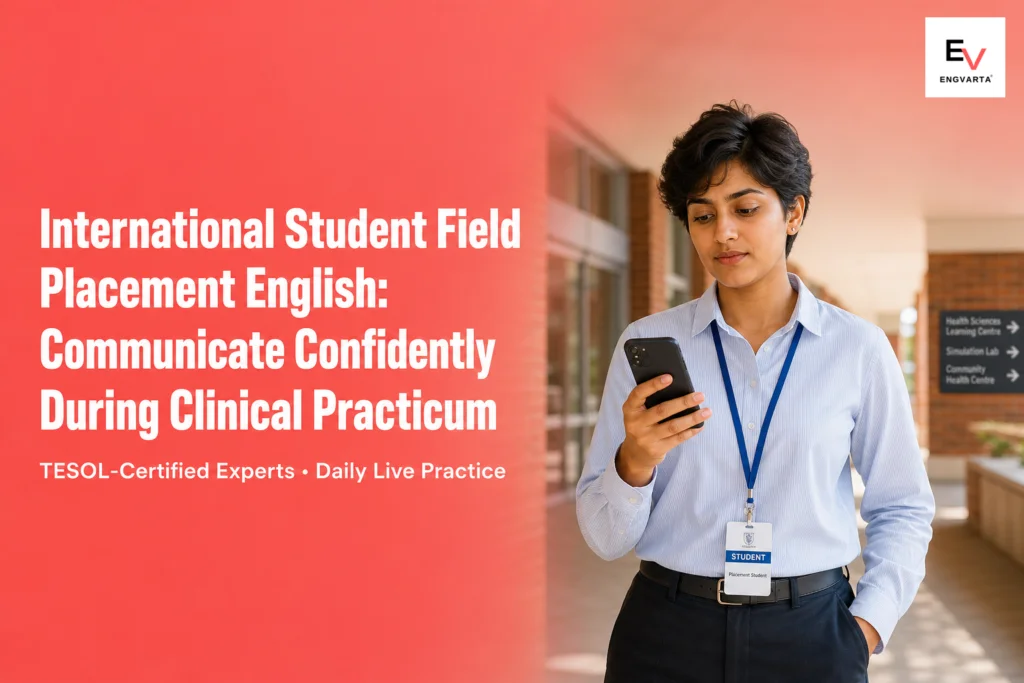
International Student Field Placement English : Communicate Confidently During Clinical Practicum (Australia / UK / Canada / USA 2026)

May 15, 2026 • 17 min read • By Rishish Pandey

Best English speaking app for international students on clinical placements
Quick VerdictIf you cleared IELTS 7-plus, flew to Melbourne, Manchester, Mississauga or Manhattan for your clinical practicum, and discovered on day one that your throat closes up the moment a real patient turns to you, the gap you are hitting is not language proficiency. It is encounter-grade English — the verbal reflex of running a 90-second SBAR sprint to an overloaded registrar, asking an 82-year-old with dementia an open question without sounding scripted, and pushing back politely when a senior is half-listening. EngVarta is the online English coaching app most calibrated for this audience — short live audio sessions with TESOL or ESL-certified English Experts who role-play your exact placement scenarios. ₹69 trial in India / $1 trial in USD markets (both 100% refundable). Then ~₹108 per session in India or $1.80 per session ($45 per month for 25 × 15-minute sessions) in USD markets. Real-time corrections during the call, consolidated feedback towards the end, 30-day session recording you can replay on the tram before your next shift.

Mira finished her MSc Nursing in Dhaka, scored 7.5 on IELTS Academic, and landed in Melbourne for a hospital practicum. On day two she was asked to take obs on a frail 79-year-old man with hearing loss and a thick Greek accent. She froze — not because her English was wrong, but because nothing in three years of textbook prep had taught her how to ask “Mr Papadopoulos, may I check your pulse for a moment?” in a register that felt warm, not clinical.

This is exactly why many students now look for the Best English Speaking App for International Students on Clinical Placements to practise real patient communication before entering hospital environments. Her clinical educator’s note shadowed her for the rest of the week: “Engagement with patient muted. Recommend revisit.”

This guide is for international students who recognise themselves in Mira — from India, Bangladesh, Sri Lanka, Nepal, the Philippines and Egypt, arriving in Australia, UK, Canada or USA with a strong academic English score and a placement they cannot fail. The fix is not more textbooks. It is structured live English coaching in short daily bursts. The route from “I can pass exams” to “I can hold space for a real human while my supervisor is watching” takes 30 to 60 days.

Why an IELTS 7.5 score does not protect you on the ward

Proficiency exams (IELTS, PTE, TOEFL, OET) test reading speed, scripted-audio listening, and structured writing. None of them test the six skills that decide your placement grade:

  1. Structured handover under cognitive load. SBAR (or ISBAR) is the verbal currency of every clinical setting from Royal Melbourne to NHS Manchester. Think of it as a verbal sprint — a 90-second pitch to a colleague whose attention you have to earn in the first sentence.
  2. Patient-facing register switch. An elderly patient in pain, a confused dementia patient, a hostile family member — each calls for a different conversational temperature. Holding a soft tone for 25 minutes is a stamina skill.
  3. Real-time team conversation. Ward rounds and MDT meetings move at the pace of clinicians triaging four other patients. There is implicit etiquette about when to interject as the most junior person in the room.
  4. Cultural register defaults. South Asian norms often default to deference. Host-country clinical norms expect junior staff to flag concerns directly. The mismatch reads as disengagement, not respect.
  5. Bidirectional accent friction. Your accent shapes how a patient hears you; their accent shapes how easily you catch a drug name on a hospital phone. The fix is twin-track ear training plus clarity drilling, not “accent removal”.
  6. High-stakes verbal documentation. Telephone reports, verbal read-back of medication orders, shift-change handover. One mis-pronounced milligram is a clinical incident.

Real fluency does not come from memorising the framework. It comes from running it in scenarios that look enough like reality that your brain stops reaching for the textbook version.

The country layer: Sydney, Sheffield, Saskatoon, San Diego

Country What trips up the ear Register cues you will hear daily
Australia Vowel shift, dropped final consonants, fast pace, casual register even in clinical settings “How ya going”, “no worries”, “good on ya”, “yeah nah”
UK Regional dialect (Geordie, Scouse, Yorkshire, Glaswegian), sarcasm, layered understatement “Quite”, “right then”, “brilliant”, “cheers”, “you alright?”
Canada Intelligible North American with regional pockets; French-influenced English in Quebec “Eh”, “for sure”, “no problem”, “the GTA”
USA Faster pace, jargon density, regional variation (Southern, Midwestern, NY, West Coast) “Got it”, “circle back”, “touch base”, “reach out”

The repair structure is identical across countries: daily local-accent listening, daily live conversation practice, targeted clarity drilling. Only listening sources change.

SBAR / ISBAR — a phrasebook that survives interruption

For nursing, medicine, allied health, midwifery or paramedic placements, the single most important spoken skill to drill is a fluent SBAR (or ISBAR) handover that holds shape even when the listener interrupts:

  • I — Introduction. “Hi, I’m Priya, a third-year nursing student. I’m calling about Mr Singh in bed 14.” Name, role, patient, bed.
  • S — Situation. “67-year-old admitted yesterday with community-acquired pneumonia. His SpO2 has dropped from 94 to 88 percent on room air.” Lead with the change.
  • B — Background. “PMH: COPD and type 2 diabetes. On IV ceftriaxone and oral metformin. “No known allergies.” No more than two sentences.
  • A — Assessment. “My read: worsening respiratory picture. Tachypnoeic at 28, more fatigued than last obs, accessory muscles working.” Own your clinical thinking.
  • R — Recommendation. “Could you come and review? I’d also appreciate guidance on starting supplemental oxygen now.” End with a specific, time-sensitive ask.

Inside an EngVarta coaching session, ask your Expert to play the receiving senior and interrupt mid-handover with the questions a real registrar fires: “How long has he been like this?”, “What were obs last round?”, “Have you spoken to the family?”. That interruption practice builds the encounter-grade reflex. The only difference between week one and week four is the number of interrupted reps.

Patient-facing English — five reflexes that change your placement notes

  • Open-question stems that land warmly. “Tell me a bit about what’s been going on for you.” Hands the floor back without leading them. Better than “Are you feeling pain?” which boxes into yes/no.
  • Empathy phrases that do not sound scripted. The most common stumble is pacing, not wording. “That sounds really difficult” said at half speed with one beat of silence after lands as care.
  • Plain-language swaps. Hypertension → “high blood pressure”; myocardial infarction → “a heart attack”; nil by mouth → “nothing to eat or drink for now”.
  • Holding silence on purpose. Three to five seconds after difficult information lets the patient catch up. Drill the pause until it feels like a choice, not an awkward gap.
  • Recovering after a missed phrase. The repair line: “Sorry, can I just check I’ve understood — you’ve been having chest pain since yesterday morning, is that right?” Far better than smile-and-nod, which is how dosage errors happen.

This is what structured online English coaching is for. The Expert plays the patient (elderly, anxious, hostile, parent of a sick child) and you build the responses until automatic. Most learners report warmth returns to their tone within two weeks.

Ward rounds and MDT meetings — claiming airtime as the most junior person

  1. The polite interject. “Just on that — “ / “Sorry to jump in, but — “ / “Can I add one thing about Mrs Patel’s medication?” Start the sentence before you have a perfect ending — students wait for the perfect sentence and miss the window.
  2. The face-saving clarify. “Sorry, could you say that last bit again?” / “Just to be sure — that’s 40 mg, twice daily?” Asking always beats guessing in a clinical setting.
  3. The 60-second case present. When the consultant asks “And what about Mrs Chen?”, deliver a compact summary: who she is, current picture, today’s issue, the plan. Drill as a 60-second monologue until you stop reaching for filler (“um”, “like”, “basically”).

Cultural register: when politeness becomes a liability

  • Over-deference to seniors. Agreeing with everything a registrar says, even when you have spotted a concern. Host-country norms expect junior staff to speak up. Threading framings: “I’m not sure if this is relevant, but I noticed — “ / “Could I flag something I’m a bit worried about?”
  • Reluctance to ask for help. A deep feeling that asking is weakness. On placements, asking is patient safety. “I haven’t done this before — could you walk me through it?” / “Could I shadow you on this one?” These read as professionalism.

Rehearse these inside coaching sessions — disagreeing politely, asking for help, raising a safety concern. The first time they come out on a real ward they feel rehearsed. By rep ten they feel like yours.

Accent comprehension — a two-lane road

Your own clarity. The target is not native-speaker imitation — that is not our goal. The target is clearly-understandable, internationally-accented professional English. Four levers matter: keep final consonants, preserve vowel length distinction (sit vs seat), put sentence stress on content words, and slow your pacing on numbers, drug names and dosages. A live Expert flags these in real time during sessions, which an AI app cannot do reliably.

Their accents. Twenty minutes of daily local-country audio, headphones on, active listening only. For Australia specifically, our guide on understanding and speaking with an Australian accent covers ear-calibration drills for the Aussie vowel shift. For Indian-to-American clarity, our deep-dive on making your Indian accent work for the American workplace covers the substitutions that change comprehensibility most.

Verbal documentation — where one wrong syllable becomes an incident

  • Telephone reports. Same SBAR scaffolding, but the listener cannot see you. Slow pacing on numbers and drug names. If a drug name has any ambiguity, spell it phonetically: “Furosemide — F for Foxtrot — 40 mg IV stat.” The phonetic alphabet feels excessive until the first “fifty” gets heard as “fifteen”.
  • Verbal read-back. “Just to confirm — 80 mg furosemide IV stat, repeat obs in 30 minutes. Correct?” Read-back is a patient-safety standard in every host country.
  • Shift-change handover. Practise the bridging rhythm between patients: “That brings us to Mrs Wong in bed 9…” The bridges signal you are organised.

How EngVarta fits — daily live coaching on a student-visa budget

EngVarta connects you to TESOL or ESL-certified English Experts for live 1-on-1 audio coaching. The Expert can simulate the precise scenarios you face on shift — patient intake, history-taking, SBAR with interruption, supervisor debrief, MDT meeting, mid-placement review.

  • Scenario customisation. Brief the Expert at session start on placement type, setting, country, and the scenario to role-play.
  • Real-time corrections during the call + consolidated feedback towards the end — you walk out with two or three priorities, not a fog of corrections.
  • Audio-only by design. Practise from your share-house, dorm, or campus library. No camera, no public profile.
  • 30-day session recording. Replay before your next shift — the difference between practising and improving.
  • 15, 25 or 50-minute lengths — most placement students settle into 25-minute sessions four times a week.
  • Free daily vocabulary lessons, quizzes and rewards in the app between sessions.
  • Operating hours 7 AM to midnight IST — covers afternoon/evening windows in Australia, UK, Canada, USA and New Zealand.

Pricing: ₹69 / $1 trial (100% refundable). Entry plan ₹2,700 for 25 × 15-minute sessions in India (~₹108 per session); $45 monthly for 25 × 15-minute sessions in USD markets ($1.80 per session flat). For 25-minute sessions: ₹5,130 / $85 for 25 × 25-minute.

Ready to Practice with Real Experts?

Try EngVarta today — ₹69 trial (India) / $1 trial (International) · 100% refundable

Other tools worth keeping in your stack

ELSA Speak — pronunciation drilling

AI pronunciation coach. Use 5 to 10 minutes daily on whichever sounds your EngVarta Expert flagged. Complement to live coaching, not a replacement — the AI cannot tell you which mispronunciation matters clinically.

Local-country podcasts (free) — ear calibration

Twenty minutes daily, active listening:

  • Australia: ABC News Daily, Conversations (ABC RN), Health Report
  • UK: BBC Radio 4 Today, BBC Inside Health, The Guardian Daily
  • Canada: CBC The World This Hour, Front Burner, White Coat Black Art
  • USA: NPR Up First, The Daily (NYT), Tradeoffs

University placement support — necessary, not sufficient

Universities offer one to two hours weekly of workshops, peer groups and learning advisors. Use it; it is free. The catch is density: a fraction of the speaking volume needed to dissolve encounter freeze. Pair with daily live coaching.

The 30-day placement-confidence plan

Week 1-2: install the daily habit

Daily 30 to 40 minutes: take EngVarta’s $1 trial (₹69 in India) in the first two days, briefed on your placement type. Move to the 25-session monthly plan; block four sessions Monday to Thursday. Add 10 to 15 minutes of local-country podcast on the commute, plus 5 minutes of ELSA on the sounds your Expert flagged.

Week 3-4: line sessions against your placement schedule

The night before any significant event — a difficult patient, a complex MDT, a mid-placement review — block a 25-minute EngVarta session for the morning of that day and rehearse the exact scenario. This is the highest-leverage use of practice time we have observed. Learners’ clinical-educator notes get warmer in tone — “engaging with patient”, “good rapport” — within four to six weeks.

End-of-week-4 check

You should be: noticeably less hesitant in patient encounters, recovering inside three seconds when you miss what your supervisor said, asking clarifying questions without the apology dropping in tone, and feeling warmth return to your voice. If yes, hold the routine another 30 to 60 days.

What Our Learners Say

Rated 4.5★ from 9,100+ reviews on Google Play

★★★★★
This app is amazing, it's helpful and good. The tutors are very excellent. I am improving and don't shy anymore.
★★★★★
Quite impressive app for learning English . I am happy that joined this planform.You can learn and grow here.
★★★★★
I have been using this app since three months. I am very much satisfied with their services , experts are too good and their support team members are very supportive and helpful. I must suggest this app to everyone. Thank you Engvarta for helping me.❤️
★★★★★
Excellent application to improve your communication skills.Thnk you for introducing new vocabulary everyday.God bless you You might not aware of but personally this is helping me a lot
★★★★★
Engvarta is a platform where we start from the 0 level to 100 level. That is the best thing I have never seen in my life. There are so many part and so many way, they are always try to teach you until you become a good speaker. Thank you Engvarta
★★★★★
engverta is good for those who is struggling to speak English...I m new commer but I feel good experience with engverta experts they listen our broken English, they rectify mistakes ,they talk withvery humbly..
★★★★★
This is very amazing apps. AI working system and it is very effective to practicing and also every day i have practice in the apps. As a begainner, i think it is very helpful for me.
★★★★★
I am really enjoying my journey with EngVarta where the learning is not limited to communication skills but also enrichment of ideas and thoughts.
★★★★★
This app is very useful for e English and the Mam is nice by rating is five star
★★★★★
An excellent platform to enhance communication skills. Kudos to the team.
★★★★★
It's very beneficial app for children who don't speak well.
★★★★★
Wonderful application for English learners and good for speaking with trainers .All trainers are well experienced and help us within the time period,Thanks

Eight placement scenarios worth drilling on rotation

  1. Initial patient or client intake — rapport in the first 90 seconds, framing sensitive questions
  2. History-taking — sequencing open and closed questions, picking up cues, summarising back
  3. SBAR / ISBAR handover — 60-second structured handover with interruption practice
  4. Breaking difficult news — bad-news delivery with pacing and intentional silence
  5. Cultural sensitivity moments — navigating without stereotyping
  6. Supervisor debrief — describing case work, asking for feedback without sounding defensive
  7. Multidisciplinary team meeting — speaking up among allied-health colleagues
  8. Mid-placement review — receiving feedback gracefully, setting development goals

For audience-specific depth, our guide on English speaking practice for Indian international students in Australia covers Australia scenarios; our piece on the best English speaking app for IMG doctors in the USA applies if you are on US clinical placements.

The cost-versus-tuition framing

You have spent $30,000 to $100,000 in tuition. Your placement is graded, your visa often depends on completion, and a failed extension drags another semester. Against that math, ₹2,700 / $45 a month for 25 coaching sessions is the cheapest insurance on the rest of your degree. Our overview of online English coaching covers format options; the best English speaking apps in the US 2026 roundup includes placement-relevant comparisons.

👉 Connect with EngVarta & Improve Your English Every Day!

Build fluency, confidence, and better communication skills with daily English speaking tips, real-life conversations, and expert guidance that helps you speak naturally and confidently.

📸 Instagram : https://www.instagram.com/engvarta.app/
▶️ YouTube : http://www.youtube.com/@EngVarta
📘 Facebook : https://www.facebook.com/engvarta
💼 LinkedIn : https://www.linkedin.com/company/engvarta

✨ Follow EngVarta today and take your English speaking skills to the next level — one conversation at a time!

Summary :

Your placement is graded, your visa hinges on it, and the moment of truth is not a final exam — it is the daily patient and supervisor encounters where your English needs to come through with clarity and warmth. The fastest path is daily live English coaching with TESOL or ESL-certified English Experts who simulate your specific scenarios and correct you in real time, paired with local-country podcasts for ear calibration.

EngVarta fits because it folds together affordability ($1.80 per session, $45/month for 25 × 15-minute sessions), certified Experts who understand the starting point of an Indian or South Asian English speaker, audio-only privacy that respects shared living, and hours that cover practice windows across Australia, UK, Canada and USA. The 100% refundable $1 trial is zero-risk. Mira moved from “engagement with patient muted” on day two to “warm rapport, good clarity” by week four.

Editorial independence note: this guide reflects our independent editorial assessment. We have not received payment, sponsorship, or affiliate compensation from any of the platforms listed for inclusion.

Frequently Asked Questions

Q1. Which English speaking app is best for international students on clinical placement abroad?

Ans : For South and Southeast Asian students on placements in Australia, the UK, Canada or USA, EngVarta is the highest-leverage tool — live 1-on-1 audio coaching with TESOL or ESL-certified Experts who role-play placement scenarios. $1 trial 100% refundable; $45 monthly for 25 × 15-minute sessions.

Q2. Is EngVarta an online English coaching app?

Ans : Yes. EngVarta delivers live 1-on-1 audio coaching with TESOL or ESL-certified English Experts. Real-time corrections during the call, consolidated feedback towards the end. Sessions are 15, 25 or 50 minutes, scenario-customisable, recorded for 30-day playback.

Q3. Does EngVarta work across timezones for international students?

Ans : Yes. EngVarta Experts are available 7 AM to midnight IST, which comfortably covers afternoon and evening windows for placement students in Australia, the UK, Canada and the USA. Your after-class or post-dinner slot almost always lands inside operating hours.

Q4. How fast can I improve before my placement assessment?

Ans : Practising 30 to 40 minutes daily, most students report a confidence shift in 7 to 14 days, substantial change by 4 weeks, locked-in muscle memory by 8 to 12 weeks. If your assessment is 4 to 6 weeks out, prioritise scenario rehearsal in weeks 3 to 4.

Q5. I’m in nursing / OT / PT / medicine / MSW placement — does the same approach work?

Ans : Yes. Brief your EngVarta Expert on your specific placement and they customise scenarios — patient intake, SBAR handover, family conversation, MDT rounds, supervisor debrief. The principle is identical across client- and patient-facing placements; only vocabulary and scenario shapes change.

Q6. Will my Indian or South Asian accent be a problem on placement?

Ans : Generally no. Host-country healthcare systems are accustomed to international staff with accents. What matters more than neutralisation is clarity — sentence stress, key consonants, pacing on numbers and drug names — and warmth in tone. We coach toward clearly-understandable, internationally-accented professional English.

Q7. Can I afford EngVarta on a student-visa budget?

Ans : $45 a month for 25 × 15-minute coaching sessions is roughly one meal out in most placement cities. Against $30K to $100K+ tuition, it is a small insurance cost on the asset that determines whether the rest of the investment pays off. The 100% refundable $1 trial is zero-risk.

Reviewed by Rishish Pandey, Co-founder & CTO, EngVarta. Last updated 14 May 2026.

* Pricing accurate as of 14 May 2026; verify current rates on the EngVarta app at the time of purchase.

How to Understand and Speak with Australian Accent : Confidence Guide for Indian Students and Professionals (2026)

May 11, 2026 • 16 min read • By Rishish Pandey

How to Understand and Speak with Australian Accent (2026)
Quick VerdictIf you’re an Indian student or working professional in Australia and the Aussie accent is causing you to freeze, miss what people say, or feel less confident than you actually are — the fix is two parallel tracks. One: targeted listening immersion (Australian podcasts, ABC, AFL commentary) for 20 minutes daily. Two: live conversation practice with TESOL/ESL-certified Experts who simulate Aussie-context scenarios and correct your real-time response patterns. EngVarta is the cheapest live-practice option — ₹69 trial (100% refundable), $1 in USD markets, ~$45/month for 25 sessions. Australian timezone fit: 12:30 PM-5:30 AM AEST. There’s no need to eliminate your Indian accent.
You need to understand the Aussie one + speak with calm confidence in front of it. Both are projects lasting 30 days, not several years.

If you’ve moved to Australia recently — for study, for work, on a partner visa, on a skilled migration pathway — and you’re noticing yourself freezing when an Aussie colleague speaks fast, asking people to repeat themselves more often than you’d like, or feeling like your English suddenly sounds simpler than it actually is, you’re in the most common phase of accent adjustment. This is exactly why many newcomers search for practical ways on How to Understand and Speak with Australian Accent in real daily conversations. This is not a sign your English is weak. It’s a sign your ear hasn’t fully calibrated to the Australian rhythm yet, and your speech hasn’t fully relaxed into the new conversational pace.

This guide is honest about what works for Indian speakers in Australia. It separates the two challenges most listicles conflate (understanding Aussie accents vs being understood by Aussies), gives you the daily routine that closes the gap in 4-6 weeks, and points you at the apps and free resources that actually move the needle for Indian-Australian context. Lakhs of Indian migrants and students have walked this same bridge. The path is well-trodden.

The two separate problems most learners conflate

“Aussie accent issue” usually means one of two distinct things:

  1. You don’t understand what Aussies say in real time. Their speech runs faster than IELTS prep audio. They use idioms (“how ya going?”, “no worries”, “she’ll be right”, “fair dinkum”) you weren’t taught. They drop word endings. They speak through a different vowel system than the British English you studied in school. The result: you nod along while internally panicking about which words you missed.
  2. Aussies don’t always understand you on the first try. Your Indian English is grammatically correct but your sentence stress, key consonants, and pacing are Indian-rhythm. Your colleague says “sorry, what?” and you feel exposed. Over time you start speaking less to avoid the embarrassment.

These are different problems with different fixes. Most “best Australian accent app” listicles bundle them together and recommend the same generic solution. They shouldn’t. The first problem is solved by listening immersion + practice asking for clarification. The second is solved by pronunciation + sentence-stress work. The third leg — confidence in the actual conversation — is solved by daily live speaking practice with someone who corrects you in the moment.

Problem 1 — Understanding Aussie accents (listening + idiom)

Australian English has its own rhythm and idiom set that differs from American or British English (which is what most Indian schools and IELTS prep teach). Three sub-skills to build:

Daily listening to native Australian content (free, highest-leverage)

20 minutes per day of Australian podcasts, news, or video — not as background noise, as active listening. The first week feels strenuous. By week 3, the rhythm starts feeling familiar. By week 6, idioms that once tripped you up sound natural.

Recommended sources (all free):

  • ABC News Daily — 15-minute daily news podcast in Aussie professional English; clear pacing, easy entry point
  • Conversations (ABC Radio National) — long-form interviews with Australians from all backgrounds; rich idiom exposure
  • Mamamia Out Loud — fast-paced women’s lifestyle podcast; conversational Aussie register at full speed (intermediate-advanced)
  • The Weekly with Charlie Pickering (ABC iView) — political comedy, harder accents, native Aussie idiom
  • AFL or NRL match commentary — for sport-curious learners; commentators speak FAST in pure Australian idiom; great challenge mode
  • YouTube creators: ozzy man reviews, How to DAD, Hamish & Andy, ABC News In-depth — different intensities of Aussie accent for different practice levels

Build a personal Aussie-idiom dictionary

Every time you hear a phrase you don’t immediately understand, note it. Look it up. Say it out loud. After 4 weeks you’ll have a 50-100 entry list of Aussie idioms you now own. Common ones to start with:

  • “How ya going?” / “How’s it goin’?” — = “How are you?”
  • “No worries” / “All good” — = “You’re welcome / it’s fine”
  • There’s no need to eliminate your Indian accent.
  • “Fair dinkum” / “Fair go” — = “honest / give someone a chance”
  • “Heaps” / “Reckon” — = “a lot / I think”
  • “Arvo” — = “afternoon”
  • “Brekkie” — = “breakfast”
  • “Servo” — = “petrol station”
  • “Bottle-o” — = “liquor store”
  • “Bushed” / “Knackered” — = “exhausted”
  • “Sus” — = “suspicious”
  • “Stoked” — = “excited / pleased”

This isn’t trivia. Knowing these means you stop missing 10-15% of casual conversation, which compounds into much-better-flowing interactions.

Practise asking for clarification with confidence

This is the underrated unlock. Most Indian speakers in Australia avoid asking “sorry, can you repeat that?” because they feel it makes them look unprofessional. The opposite is true. Native Australian speakers ask each other for repeats constantly. It’s normal conversation maintenance.

Drill these phrasings until they come out naturally:

  • “Sorry, could you repeat that?”
  • “I want to make sure I caught that — you said X?”
  • “I missed the last bit, could you go through it again?”
  • “Just to confirm I understood — you mean Y?”
  • “Could you spell that for me?” (for names, places, technical terms)

Asking for repeats with confidence flips the dynamic. You become “engaged and detail-oriented” instead of “the person who didn’t catch what was said.” Same situation, different perception.

Problem 2 — Being understood by Aussies (your pronunciation + clarity)

If Australians occasionally ask you to repeat yourself, the issue is rarely your accent itself — Australia is one of the most multicultural countries in the world, and Aussies are accustomed to international accents. The issue is usually one or more of these specific clarity gaps:

  • Final consonants getting dropped or softened — “want” sounding like “wan”, “told” like “tol”
  • Vowel reduction missing — Indian English tends to give every vowel equal weight, which sounds different to Aussies who reduce unstressed vowels naturally
  • Sentence stress patterns — Indian English often hits content words and function words with similar emphasis; Aussie English drops stress on function words (“the”, “a”, “to”, “of”) and lifts content words
  • Speaking too fast when nervous — paradoxically, slowing down by 15-20% improves comprehensibility much more than accent neutralisation
  • Hesitation fillers in Hindi/Marathi rhythm — “uh, like, you know” said with the stress pattern of your mother tongue can break the listener’s parsing

None of these require losing your Indian accent. They require targeted clarity work on the 4-5 specific patterns that affect comprehension most.

Tools and apps for Aussie-accent navigation

1. EngVarta — best for daily live conversation practice with real-time correction

EngVarta facilitates live one-on-one audio sessions with TESOL/ESL-certified English experts. For Indian speakers in Australia, this works on both problems simultaneously. The Expert speaks at fluent professional pace (your ear calibrates to the rhythm), corrects your phrasing in real time (your speech adjusts), and lets you rehearse the specific scenarios you face — work meetings, doctor’s appointments, customer service calls, university tutorials, supervisor conversations.

How to use EngVarta for Aussie-context practice:

  • Tell the Expert at session start: “I’m in Australia. I want to practise [scenario] and have you correct me on sentence stress and clarity, not just grammar.”
  • Ask them to push back faster than you expect — Aussie conversation moves quickly; practising at faster pace makes real-life feel slow by comparison
  • Use sessions to debrief difficult conversations from your week — “I had this exchange at work and I froze; let’s redo it”

Pricing : ₹69 trial in India / $1 trial in USD markets, 100% refundable. ₹2,700 / 25 sessions in India. $45 per month / 25 sessions in USD markets ($1.80 per session, flat). Operating hours 7 AM to midnight IST = 12:30 PM to 5:30 AM AEST — covers Australian afternoon/evening practice windows.

Best for : Indian students, professionals, and migrants in Australia who want daily live reps with real-time correction at affordable cost. Pair with the listening immersion below.

Ready to Practice with Real Experts?

Try EngVarta today — ₹69 trial (India) / $1 trial (International) · 100% refundable

2. ELSA Speak — best for targeted clarity drills

ELSA Speak is an AI pronunciation coach. For Australian context, the value is targeting the 4-5 specific patterns that affect Aussie comprehension of Indian English: final consonants, vowel reduction, sentence stress, content-vs-function-word emphasis.

Pricing: Free tier covers basics. Premium ~₹999-1,499 per month (varies by promotion); roughly AUD $15/month equivalent.

Best for: 5 to 10 minutes every day on the noises that your EngVarta Expert identified. Compounds with live practice.

3. Australian podcasts (free) — best for ear calibration

Already covered above. ABC News Daily, Conversations, Mamamia Out Loud, AFL/NRL commentary. 20 minutes daily, active listening, free.

4. Tandem and HelloTalk: free language interaction with English-speaking Australians

HelloTalk can pair you with Australian speakers (often someone learning Hindi or another language) for free voice/text exchange. Variable partner quality but useful for casual idiom acquisition.

5. Cambly — premium Australian-tutor exposure (selective use)

Cambly includes Australian native-speaker tutors. Use for accent immersion before specific high-stakes situations (job interview, important presentation, family event with Aussie in-laws). Pricing AUD ~$80-100 per month for daily 30-minute access — meaningful spend; use selectively rather than as primary daily practice.

The 30-day Aussie-accent confidence plan

Week 1-2: ear calibration + scenario practice

Daily 30-40 minutes:

  • 20 minutes — Australian podcast or video listening. Active listening, headphones on, no other distractions. Note 3 idioms or phrases per session.
  • Sign up for EngVarta’s $1 refundable trial. Take a 10-minute trial in the first 2-3 days. Tell the Expert: “I’m in Australia. Help me practise [your most common real-life scenario]. Correct my sentence stress and pacing, not just grammar.”
  • If trial helps, sign up for the 25-session monthly plan. Schedule sessions Mon-Fri (4-5x per week, 16-20 sessions in this 4-week window).

Week 3-4: integrate clarity drills + situation rehearsal

Daily 30-45 minutes:

  • 20-25 minutes — EngVarta live session 4 days per week. Each session targets a real-life scenario from your week.
  • 10-15 minutes — Australian podcast listening (continue, build idiom dictionary)
  • 5-10 minutes — ELSA Speak drilling whichever sounds your Expert flagged

By week 4 you should be comfortably handling fast Aussie conversation, asking for repeats with confidence, and noticing your colleagues stop saying “sorry, what?” when you speak.

Beyond week 4: maintain the habit

The biggest improvements happen weeks 1-8. After that, the habit becomes self-sustaining — you absorb idiom passively from your daily Australian life, and your live-practice schedule is locked in. Most Indian-Australians report that by month 3 the accent gap stops feeling like a barrier and starts feeling like a familiar feature.

What Our Learners Say

Rated 4.5★ from 9,100+ reviews on Google Play

★★★★★
Quite impressive app for learning English . I am happy that joined this planform.You can learn and grow here.
★★★★★
This is the best app for anyone who feels nervous and hesitates during conversation in English.
★★★★★
This app is very useful for e English and the Mam is nice by rating is five star
★★★★★
I have completed 100 sessions with EV. Today I can speak confidently with anyone and this confidence is a gift from EngVarta. I truly wish I could join the EV family again.
★★★★★
A very good app its just as good as shown in the advertisement,but I wish it would have been a bit cheaper,
★★★★★
Great !!! Enjoying it 👍experts reAlly help you to see your mistakes and correct them in the mean time.
★★★★★
Good app to express yourself because in our house there are no environment n EngVarta provides you environment
★★★★★
I took two months of subscription. This platform really helped me to improve my communication and get rid of the fear I had earlier. Now I can talk fully confident and without any fear.
★★★★★
Really helpful to me. Many people want to talk but can't because of people who just laugh at their efforts. This app really helps. I love this initiative.
★★★★★
I am living in Italy for 20 years. I never got the chance to speak English but now I want to speak again to help my children. It was a very good experience. I want to congrats your team for making such an excellent app.
★★★★★
i completed my trial session, expert was good. I installed this app because chatgpt recommended it and I find it quite good speaking practice. experts are professional and friendly. plans are also economical compared to other english courses i took in the past.
★★★★★
I have been practising English on EngVarta for the past 30 days and results are significant. I’m happy to be here.

Common scenarios where the gap shows up — and how to drill them

  • Workplace meetings — drilling colleague banter + meeting interruptions in EngVarta sessions
  • Customer service calls — call centre interactions, banks, telcos, government services
  • Doctor / GP appointments — explaining symptoms, asking questions, understanding instructions
  • University tutorials — joining group discussions, disagreeing politely, asking clarifying questions
  • Casual social situations — coffee with colleagues, after-work drinks, neighbour conversations
  • Customer/client-facing roles — retail, hospitality, healthcare, social services
  • Job interviews — Australian interview English includes specific patterns (behavioural questions framed Aussie-style)
  • Real estate / rental viewings — viewing properties, negotiating with agents, signing leases

Each of these has specific phrasings that recur. Drilling each of them in EngVarta sessions over 4 weeks produces noticeable change in your real-life experience.

The mindset shift that matters most

You don’t have to eliminate your Indian accent. You don’t need to imitate Aussies. Plenty of well-respected Indian-Australians — doctors, professors, executives, media personalities — speak with strong Indian accents and are fully understood and credible. What matters is clarity (your speech is comprehensible), pace (you don’t rush when nervous), and confidence (you don’t apologise for your accent or shrink when speaking).

The goal is “clearly-understandable Indian-Australian professional” — not “person trying to sound like an Aussie.” Aussies appreciate authenticity over imitation. Your Indian accent is part of who you are; your job is to make sure your meaning lands every time.

For broader context, our analysis of reducing Indian accent for the American workplace covers similar phonetic principles for the US context — the techniques transfer to Australian English. For Indian healthcare and MSW students specifically, our guide for Australian field placement covers the client-facing professional scenarios in depth. And for working professionals in cross-cultural workplaces, our review of English speaking app for meeting confidence applies to the workplace-meeting use case.

The honest summary

The Aussie accent is not a barrier you can’t cross. It’s a 4-6 week ear-calibration project + a 4-6 week clarity-drilling project, running in parallel. The cheapest path is daily Australian-podcast listening (free) + daily EngVarta sessions ($1.80 per session in USD markets) + occasional ELSA Speak drills. Total monthly investment ≈ $45-50 — same as a single Indian dinner-out in Sydney. The return is seamless conversation, professional credibility, and the daily-life ease that disappears when you can’t follow what people are saying.

You don’t need to lose your accent. You need to understand theirs and make sure they understand you. Both are short-term projects with measurable outcomes. Start today.

Editorial independence note: this guide reflects our independent editorial assessment of the apps and resources reviewed. We have not obtained payment, sponsorship, or affiliate remuneration from any of the platforms mentioned for their inclusion in this article

👉 Connect with EngVarta & Speak English Confidently Every Day!

Improve your fluency, pronunciation, and speaking confidence with daily English tips, real conversations, and expert guidance designed for real-life communication.

📸 Instagram : https://www.instagram.com/engvarta.app/
▶️ YouTube : https://www.youtube.com/@EngVarta
📘 Facebook : https://www.facebook.com/engvarta
💼 LinkedIn : https://www.linkedin.com/company/engvarta

✨ Follow EngVarta today and make confident English speaking a part of your daily life!

Frequently Asked Questions ( FAQs )

Q1. How long does it take to understand the Aussie accent fluently?

Ans : For Indian speakers practising 20 minutes daily with active listening to Australian content + daily live conversation reps, comprehension typically improves noticeably in 7-14 days, substantially by 4 weeks, and locked-in by 8-12 weeks. The first week feels strenuous; by week 3 the rhythm becomes familiar. The gap closes faster than most learners expect.

Q2. Do I need to lose my Indian accent to be understood in Australia?

Ans : No. Australia is one of the most multicultural countries in the world, and Aussies are accustomed to international accents. What matters is clarity (sentence stress, key consonants, pacing) — not accent neutralisation. Plenty of well-respected Indian-Australians retain strong Indian accents. The goal is “clearly-understandable Indian-Australian professional,” not “imitating an Aussie.”

Q3. Which app is best for Indian speakers learning Australian English?

Ans : For daily live conversation practice with real-time correction, EngVarta is the most affordable option ($1 trial 100% refundable, $45 per month for 25 sessions, $1.80 per session flat in USD markets). For pronunciation clarity, ELSA Speak. For ear calibration to Australian rhythm and idiom, free Australian podcasts (ABC News Daily, Conversations, Mamamia Out Loud). Combine all three for fastest results.

Q4. Does EngVarta work for Australian timezone?

Ans : EngVarta operates 7 AM to midnight IST = 12:30 PM to 5:30 AM AEST. This covers Australian afternoon and evening practice windows — between classes, after work, post-dinner. For most Indian-Australians the after-work (5-7 PM) and post-dinner (8-11 PM) windows are the realistic practice times, both within EngVarta’s hours.

Q5. What if my colleague keeps asking me to repeat myself?

Ans : This is a clarity issue, not an accent issue. The fix is targeted work on 4-5 specific patterns: final consonants (don’t drop them), vowel reduction (let unstressed vowels relax), sentence stress (lift content words, drop function words), pacing (slow down 15-20% when speaking professionally). ELSA Speak targets these directly. Within 4-6 weeks of daily 10-minute drilling, most Indian speakers in Australia report fewer “sorry, what?” moments at work.

Q6. Can I practise during my Australian morning commute?

Ans : Listening immersion (Australian podcasts) is perfect for the morning commute — passive intake while you’re on the train, bus, or driving. Live EngVarta sessions are not available before 8 AM AEST due to IST hours, so save those for the post-class or post-dinner windows.

Q7. How do I ask Australians to repeat themselves without sounding rude?

Ans : Native Australian speakers ask each other for repeats constantly — it’s normal conversation maintenance, not rude. Drill these phrasings: “Sorry, could you repeat that?”, “I want to make sure I caught that — you said X?”, “I missed the last bit, could you go through it again?”, “Just to confirm I understood — you mean Y?”. Asked with calm confidence, these flip the dynamic from “person who missed it” to “engaged listener.” Use them frequently.