Spoken English App |

Tag

spoken english app

EngVarta vs Busuu : 2026 Honest Comparison for English Speaking

May 12, 2026 • 22 min read • By Rishish Pandey

EngVarta vs Busuu comparison for English speaking fluency and daily practice in 2026
Quick VerdictBusuu is a self-paced multi-language lesson app with a unique community-correction feature for your written exercises — useful for vocabulary input, grammar drills, and people who want to dabble in Spanish or French alongside English. EngVarta is a live 1-on-1 spoken practice platform with TESOL or ESL-certified English Experts who correct you in real-time during the call. These are different categories. Use Busuu for written and grammar layer; switch to EngVarta the moment you need to actually speak.

If you’ve searched “EngVarta vs Busuu,” you’re probably partway through a Busuu subscription and noticed something — your reading and grammar have improved, but actually opening your mouth to speak English with another human still feels like a freeze-up. That’s not a Busuu failure. It just isn’t what Busuu was built for.

This is an honest, 2026-current comparison between two tools often lumped together as “English learning apps” but actually living in two different worlds. Busuu is a lesson-and-community platform. EngVarta is live English coaching with certified Experts. Full disclosure — this is written by EngVarta’s co-founder. We’ll be direct about where Busuu is genuinely the better choice, and equally direct about where it stops short for spoken-fluency goals.

Why this comparison matters

Busuu and EngVarta both show up in “best apps to learn English” listicles, so people search them side-by-side. But the moment you actually compare what they do, the differences are structural — not just feature gaps.

Busuu is a Chegg-owned, European-rooted lesson app covering twelve-plus languages with a clever twist: when you write something in your target language, native speakers from Busuu’s community can correct it back to you. English is one of those languages, not the only one. The app’s strengths are vocabulary drills, grammar lessons, written practice, and AI-powered speaking exercises where you repeat or respond to prompts.

EngVarta is a live spoken English practice platform. You open the app, tap to request a session, and you’re connected in minutes to a TESOL or ESL-certified English Expert for a 15, 25, or 50-minute call. The Expert corrects you in real-time during the conversation and shares consolidated feedback towards the end of the session. There is no skill tree, no lesson path, no community wall. The product is the conversation itself.

So the actual decision isn’t “which is better.” It’s “which problem am I solving right now?” If your problem is “I don’t know enough English words and grammar patterns yet,” Busuu probably belongs in your routine. If your problem is “I know the words but I can’t string them together when a human is waiting for me to answer,” that’s a different problem — and you need live spoken practice with a real Expert, not more lessons.

How EngVarta is different from Busuu

Live spoken conversation vs text-first lessons with AI speaking drills

Busuu’s bread and butter is text. You see a sentence, you translate it, you fill in a blank, you build vocabulary through reading exposure. There are AI-powered speaking exercises woven in — you respond to a prompt, the speech recognition scores you — but the dominant medium is the screen, not your voice. The “speaking” in Busuu is closer to oral pronunciation drills than to conversation.

EngVarta is the inverse. Every session is a voice-only call with a live human Expert, with no scripted lesson on the other side. You bring the context — “I have an interview Thursday, let’s roleplay it” or “I want to talk about my weekend so I get comfortable with past tense in real conversation” — and the Expert adapts. The session is unscripted, which is the entire point. Real fluency is built by producing English under unpredictable conditions, not by repeating sentences you can see on a screen.

TESOL or ESL-certified human Expert vs community-corrected written exercises

Busuu’s community-correction feature is genuinely interesting — when you write a sentence or paragraph as part of an exercise, the platform queues it up for native speakers in the community to mark up. You get feedback from someone whose first language is English. It’s a nice idea, and for written practice, it works.

But “native speaker” is a self-declared label on Busuu, not a teaching credential. The 17-year-old in Manchester whose phone language is set to English is on the same correction queue as the retired ESL teacher in Toronto. Their corrections can both be technically correct yet wildly different in pedagogical helpfulness. One says “this is wrong, here’s the right way.” The other says “I’d never write it like that but I’m not sure why.” That variance is the structural challenge with community-driven feedback.

EngVarta’s pool is gated. Every Expert holds TESOL or ESL certification. That doesn’t mean every Expert is a native speaker — and that’s a feature, not a bug. Certification is a consistency floor: the Expert knows how to spot common grammar patterns in non-native speech, knows how to correct without breaking the learner’s confidence, and knows what to say when you stumble. Native-speaker tag alone gives you none of that.

Real-time corrections during the call vs async community feedback (hours or days)

This is the differentiator that matters most for spoken fluency. On Busuu, you write something, you submit it, and you wait. Maybe a community member corrects you in twenty minutes. Maybe two days. Maybe never (lower-traffic language pairs have slower correction loops). By the time you see the correction, you’ve forgotten the mental state you were in when you made the mistake. The lesson lands flat.

On EngVarta, the correction happens inside the same sentence where the mistake was made. You say “I am going to office yesterday” — and the Expert stops you, points out the tense conflict, has you say it again, and moves on. That immediacy is everything in spoken practice. Your brain still has the wrong sentence loaded; the correction replaces it before it can re-encode. Async feedback can never do that, no matter how thoughtful.

Towards the end of the session, the Expert shares consolidated feedback summarizing the patterns they caught — common tense errors, pronunciation tendencies, filler word habits — so you walk away with something to work on. That’s structured coaching from a certified Expert, not after-the-fact pen marks on something you wrote two days ago.

Per-session pricing flexibility vs locked-in subscription

Busuu is subscription. You pay monthly or annually, and the app keeps debiting whether you opened it that month or not. That’s standard for app-based language tools — and it works fine if you use the app daily.

EngVarta uses a one-time payment per plan. You pick the session length (15, 25, or 50 minutes) and the number of sessions (25, 50, 75, 150, or 300), pay once, and use them within the validity window. No auto-debit. No “whoops, I neglected to cancel.” If you cease using the plan, nothing will continue to charge your card. For learners who suspect their consistency might wobble — which honestly is most learners — that structure is psychologically lighter than a subscription clock.

Where Busuu is genuinely better

This is where most comparison posts get dishonest. Let’s not. Busuu has real strengths and a real fit for the right learner.

Multi-language access on one subscription

If you’re learning English but also want to dabble in Spanish, French, or German — or you’re a polyglot juggling three languages at once — Busuu’s Premium covers them all on one subscription. EngVarta focuses on a single aspect: practicing spoken English. We don’t offer any other language. If multi-language exposure on one platform matters to you, that’s a genuine Busuu win and we won’t pretend otherwise.

The community-correction feature for written exercises

Most language apps don’t have anything like this. The fact that you can write a paragraph in English and have it marked up by someone whose first language is English — for free as part of the app — is a genuinely unique feature. It works particularly well for early-stage learners who are still building written competence and need varied feedback on small written assignments. EngVarta doesn’t replicate this and isn’t trying to.

Lower commitment and lower price if you don’t need live speaking practice

Busuu Premium typically runs around $14 per month or about $70 per year (verify current rates on busuu.com — pricing shifts regionally). For pure self-paced lesson access, that’s reasonable. If your goal genuinely doesn’t involve real-time spoken conversation — if you’re prepping for a written exam, learning vocabulary for travel, or supplementing a school course — Busuu’s price tag is lighter than maintaining live Expert sessions.

EngVarta’s plans start at ₹2,700 for 25 sessions of 15 minutes in India (around ₹108 per session) or $45 for the equivalent plan in USD markets (around $1.80 per session). If you’re not going to use the live sessions, that money is wasted. Busuu’s “always-on, use-when-you-want” model has lower stakes if your speaking practice is irregular.

Self-paced — no scheduling or session-booking pressure

Open the app, do a lesson, close the app. No booking, no waiting, no other human involved. For learners with chaotic schedules — frequent travel, irregular shifts, parenting young kids — that low overhead is genuinely valuable. EngVarta is on-demand from 7 AM to midnight IST and you connect in minutes (you don’t book a slot in advance) but it still requires a free 15-to-50 minute window where you can hold a phone call. Busuu requires zero such window.

Where EngVarta wins for the speaking learner

Speaking practice IS the product, not a side-feature

On Busuu, speaking is one feature among several — alongside vocabulary, grammar, reading, and written exercises. You can complete a Busuu lesson without ever speaking out loud. On EngVarta, you can’t complete a session without speaking — because the session is the speaking. Every minute of an EngVarta plan is a minute of producing English with a human listener on the other end. There’s no way to “phantom progress” through it the way you can on a tap-based lesson app.

That matters because spoken fluency is a motor skill, not just a knowledge skill. You don’t get fluent by knowing more vocabulary — you get fluent by producing sentences under conversational pressure until your mouth stops freezing. Busuu can teach you the words. Only a live human listener can teach your nervous system to produce them in real time.

A human Expert hearing and correcting in the moment

This is the part Busuu’s community feedback simply cannot do. When you speak to an EngVarta Expert, they hear your hesitation, your filler words (“uh,” “matlab,” “you know”), the exact consonant cluster that trips you up, the moment your eyes go wide because you’ve lost the next word. They correct what they hear, in the moment. A written correction queue — no matter how good — operates on a different timescale and on a different medium. It can’t fix what it never heard.

Community correction doesn’t work for spoken language

The community-correction model is truly effective for written tasks.  It cannot work for spoken practice — and Busuu doesn’t pretend otherwise. Even if it tried, you’d be uploading audio recordings of yourself speaking, hoping a community member is online and willing to listen, getting feedback hours or days later in a format your brain can’t easily re-correlate with the original mistake. Live, in-the-moment, expert-led conversation is the only model that scales for speaking. EngVarta is built around that model. Busuu isn’t.

Daily-practice pricing model that actually supports daily practice

Twenty-five sessions at around ₹108 per session in India, or $1.80 per session in USD markets, is affordable for daily use. That’s the math that turns “I should practice English” into “I have 25 sessions on this plan and I should burn through them.” Subscription apps don’t have that pressure loop — you’d open them anyway because they’re paid for, but there’s no completion metric pulling you back in. EngVarta’s plan structure makes daily live spoken practice financially sustainable, which is the prerequisite for it being culturally sustainable as a habit.

Indian cultural awareness in the Expert pool

Busuu is a European-origin platform with a global community. The native speakers correcting your writing might be from anywhere — London, Sydney, Lagos, Iowa City. That diversity is fine for general English exposure but it means the corrector likely has no sense of an Indian workplace context. A phrase that’s perfectly normal in California can land as awkward, overly direct, or culturally off in a Mumbai meeting — and vice versa. EngVarta’s Experts work daily with Indian learners and bridge both contexts. That’s not something a global community queue can replicate.

Voice-only by design, works on patchy networks

EngVarta sessions are voice-only — no video, no need to be camera-ready, no “let me find a quiet corner with good lighting” overhead. You can take a session during a lunch break, on a walk, sitting in a parked car. Internet is needed to open the app and request the session, but the call itself can come over a regular telecom phone line with your number kept private. That makes it usable in Tier 2 / Tier 3 city homes with patchy Wi-Fi, in college hostels, and in workplace environments where video would be impossible. Busuu’s lessons require steady internet for the app to function; EngVarta’s call layer is more resilient to network conditions.

Complementary use — Busuu for written and grammar, EngVarta for spoken

The cleanest way to think about Busuu and EngVarta: they’re at different layers of the same fluency pipeline. Busuu builds the input — vocabulary, grammar pattern recognition, written competence, reading comprehension. EngVarta builds the output — producing English out loud, under live conversational pressure, with someone listening and correcting.

A realistic learner using both might do 15 minutes of Busuu in the morning — work through a lesson, get a written exercise corrected by the community by evening — and then a 15 or 25-minute EngVarta session a few hours later, where they actively try to use the vocabulary Busuu introduced earlier. The two reinforce each other. The Busuu lesson plants the seed; the EngVarta call forces you to actually speak the seed out loud, which is when it sticks.

The pattern is consistent: lesson apps build recognition; live Expert-led conversation builds production.

How EngVarta helps when you need live spoken English coaching

If you’ve reached the point in your Busuu journey where you can read English news, follow most movies, and pass written tests — but you freeze the moment someone asks you a question in person — that gap is what EngVarta is built to close.

You open the EngVarta app, set the topic you want to practice (interview prep, casual conversation, presentation rehearsal, client-call simulation — whatever), choose a session length, and request a session. Connect in minutes with a TESOL or ESL-certified Expert. The Expert engages you in unscripted conversation around your chosen focus, corrects mistakes in real-time during the call, and gives you consolidated feedback towards the end. Every session is recorded and accessible for 30 days, so you can listen back to specific stumbles and corrections.

The trial is ₹69 in India or $1 internationally, 100% refundable — so you can test whether live spoken practice actually shifts something for you before committing to a plan. Most learners find the difference between “doing a lesson” and “having a conversation” lands within the first session.

Ready to Practice with Real Experts?

Try EngVarta today — ₹69 trial (India) / $1 trial (International) · 100% refundable

When to pick which one

Pick Busuu if:

  • You’re an early-stage learner still building basic vocabulary and grammar from scratch
  • You want to learn multiple languages on one subscription (English plus Spanish, French, German, etc.)
  • You value asynchronous community feedback on written exercises
  • Your goal is reading and writing competence more than spoken fluency
  • You have an erratic schedule and can’t reliably commit to a 15-to-50-minute call window
  • Your budget is tight and you don’t need live speaking practice yet

Pick EngVarta if:

  • You can read and write English reasonably well but freeze when you try to speak
  • You’re preparing for an interview, client call, presentation, or any spoken-English scenario
  • You want real-time corrections from a TESOL or ESL-certified Expert, not async community feedback
  • You want structured coaching from a certified Expert without paying native-speaker premium rates
  • Voice-only practice fits your day better than video tutoring (camera-ready overhead, network requirements)
  • You want a per-plan one-time payment model instead of an auto-renewing subscription
  • Indian cultural context awareness matters to you (workplace English, family English, regional sensitivity)

Pick both if:

  • You’re serious about building full English competence — reading, writing, listening, AND speaking
  • You have budget for one input-layer app plus one live speaking practice tool
  • You’d benefit from Busuu’s vocabulary drills in the morning and an EngVarta call in the evening to actually use what you learned

Pricing side-by-side (2026) : EngVarta vs Busuu

The models don’t map directly — one is a subscription for self-paced lessons, the other is a session-based plan for live Expert sessions — but here’s the honest breakdown:

Aspect Busuu EngVarta
Free tier Yes (limited lessons) No (refundable trial)
Paid tier Premium ~$14/month or ~$70/year (verify on busuu.com) Plans from ₹2,700 / $45 for 25 × 15-min sessions
Cost per live session (India) N/A (no live sessions) ~₹108 per session (entry plan)
Cost per live session (USD) N/A (no live sessions) ~$1.80 per session (entry plan)
Trial Free tier exists; Premium often has a 7-day Premium trial ₹69 / $1 trial, 100% refundable
Format Self-paced app lessons + community-corrected written exercises + AI speaking drills Live 1-on-1 voice-only call with a certified human Expert
Human teacher No (community members correct written work) TESOL or ESL-certified English Expert
Speaking practice Scripted AI prompts + pronunciation drills Unscripted live conversation
Real-time corrections No (async community feedback on writing) Yes (Expert corrects during call)
Session length Bite-sized lessons (~5–15 min) 15 / 25 / 50 minutes, learner-selected
Languages offered Twelve-plus (English, Spanish, French, German, etc.) English only
Operating hours Always available (app-based) 7 AM to midnight IST daily
Recording N/A (no live sessions to record) Each session recorded, accessible 30 days
Payment model Auto-renewing subscription One-time payment per plan, no auto-debit

A note on the price gap framing: it’s tempting to read this table as “Busuu is cheaper, EngVarta is premium.” That’s not quite right. They’re different products. Busuu is a content library you tap through. EngVarta is a service where a certified human is on the other end of every minute you use. The price reflects the difference in delivery model, not a “premium tier” of the same product. A learner who only needs lesson content shouldn’t pay for EngVarta. A learner who needs spoken fluency shouldn’t expect Busuu’s price to buy them that — no app priced for self-paced lessons can deliver live human Expert time at scale.

👉 Connect with EngVarta & Improve Your English Speaking Skills Daily!

Build confidence, improve fluency, and practice real English conversations with expert guidance and daily speaking tips. Start speaking English naturally with EngVarta.

📸 Instagram : https://www.instagram.com/engvarta.app/
▶️ YouTube : http://www.youtube.com/@EngVarta
📘 Facebook : https://www.facebook.com/engvarta
💼 LinkedIn : https://www.linkedin.com/company/engvarta

✨ Follow EngVarta today and take your English communication skills to the next level!

The honest answer

If you’re early in your English journey and need vocabulary, grammar, and reading exposure — start with Busuu. The community-correction feature is unique and the multi-language access is genuinely useful if you’re a polyglot. Spend a few months there. Build the foundation.

But the moment you find yourself understanding English well enough to follow conversations but freezing when you try to speak — that’s when Busuu has done its job and EngVarta becomes the next tool. Self-paced apps can build recognition. They can’t build production. Production requires a live human Expert correcting you in the moment. There’s no app workaround for that.

Many of EngVarta’s most consistent learners use Busuu, Duolingo, or other input-layer apps in parallel — see also our EngVarta vs Cambly comparison for how live spoken practice compares to higher-priced video tutoring platforms, and our roundup of the best English speaking platforms for daily practice in 2026. The pattern across thousands of learners is consistent: input apps build the words; live conversation builds the confidence to use them.

Pick the tool that matches the bottleneck you’re currently stuck at. If it’s vocabulary, Busuu. If it’s speaking, EngVarta. If it’s both, use both — they don’t conflict, they compound. And if you want to test whether a session with a certified Expert actually moves the needle for you, the ₹69 / $1 refundable trial is designed to make that decision low-stakes.

For the deeper context on how EngVarta fits into the broader landscape of English speaking apps in 2026, our guide to the best English speaking platforms for daily practice and the English fluency coaching online overview both go further into the live-Expert layer.

Frequently asked questions

Is EngVarta a better Busuu alternative for English speaking?

For spoken English specifically, yes — but that’s because they’re different categories, not because EngVarta is “the upgraded version of Busuu.” Busuu is a self-paced lesson app with community-corrected written exercises and AI speaking drills. EngVarta is live English coaching with TESOL or ESL-certified Experts on real voice calls. If your bottleneck is speaking out loud under conversational pressure, EngVarta directly addresses it; Busuu’s design doesn’t.

Is Busuu Premium worth it for English learners?

If you’re an early-to-intermediate learner who values vocabulary drills, grammar lessons, and community-corrected written practice — and especially if you also want exposure to other languages on the same subscription — Busuu Premium can be a reasonable investment. If your goal is purely spoken English fluency and you already know basic vocabulary, the money is better spent on live spoken practice. Check current Busuu pricing on busuu.com because their rates shift regionally.

How does Busuu’s community correction compare to a live tutor?

Busuu’s community correction is asynchronous and works only on written exercises — you submit text, a native speaker from the community marks it up hours or days later. It’s good for written practice but cannot help with spoken fluency. A live English Expert on EngVarta corrects you in real-time during a voice conversation, in the same sentence the mistake happened. The two operate on different timescales and different mediums. Use community correction for written work; use live Expert sessions for spoken work.

Can I use Busuu and EngVarta together?

Yes, and many serious learners do. Busuu handles the input layer — vocabulary, grammar, written practice. EngVarta handles the output layer — live conversation with real-time Expert corrections. They don’t overlap so they don’t waste money. A common pattern: 15 minutes of Busuu in the morning for vocabulary intake, a 15 or 25-minute EngVarta call in the evening to actively practice using what was introduced earlier.

Does Busuu offer live English tutors like EngVarta does?

Busuu’s core model is self-paced lessons plus async community correction. They have occasionally piloted or partnered for additional services like Live group classes in certain markets, but live 1-on-1 spoken English practice with certified Experts is not Busuu’s core product. If you want structured coaching from a certified Expert with real-time corrections during the call, that’s specifically what EngVarta is built for.

What does EngVarta cost compared to Busuu Premium?

Busuu Premium runs around $14 per month or about $70 per year (verify current rates on their site). EngVarta’s entry plan is $45 for 25 × 15-minute live Expert sessions in USD markets, or ₹2,700 for the same plan in India (around ₹108 per session). The 25 × 25-minute plan is $85 / ₹5,130 (around $3.40 / ₹205 per session). They’re different categories — Busuu pays for self-paced lesson content access, EngVarta pays for time with a certified human Expert.

How quickly can I expect to see improvement in spoken English on EngVarta?

Most learners report noticeable confidence gains within the first 10–15 sessions of consistent live spoken practice. Real fluency takes longer and depends on starting point, session frequency, and the focus areas you discuss with your Expert. The advantage of session-based pricing is that you can pace your investment — start with a 25-session plan, see how it goes, decide whether to renew.

What Our Learners Say

Rated 4.5★ from 9,100+ reviews on Google Play

★★★★★
I am living in Italy for 20 years. I never got the chance to speak English but now I want to speak again to help my children. It was a very good experience. I want to congrats your team for making such an excellent app.
★★★★★
This is very amazing apps. AI working system and it is very effective to practicing and also every day i have practice in the apps. As a begainner, i think it is very helpful for me.
★★★★★
This app is too much helpful for me. I can surely say that every student must follow this app for their English speaking.
★★★★★
engverta is good for those who is struggling to speak English...I m new commer but I feel good experience with engverta experts they listen our broken English, they rectify mistakes ,they talk withvery humbly..
★★★★★
Excellent platform for people who don’t find any people to speak in English. Live experts help to build confidence while speaking and guiding to improve your communication!
★★★★★
I am really enjoying this app and it is very useful for my IELTS preparation. It is a great application that I have never seen.
★★★★★
My last 12 sessions experience is really great. It's a great app to improve English fluency and communication skills. All experts are quite friendly and highly skilled.
★★★★★
This app is amazing! It has boosted my confidence, and now I can start conversations in English easily.
★★★★★
best app for English communication. I have tried lots of English speaking apps till date. but all have some dra backs. but this is really awesome experience of mine. best teachers and best app. 💯
★★★★★
Let me congratulate you on your endeavour to help people gain confidence while speaking. I enrolled for your vocabulary series. You guys are doing a good job. Keep it up.
★★★★★
This is very amazing apps. AI working system and it is very effective to practicing and also every day i have practice in the apps. As a begainner, i think it is very helpful for me.
★★★★★
This app is amazing, it's helpful and good. The tutors are very excellent. I am improving and don't shy anymore.

Reviewed by Rishish Pandey, Co-founder & CTO, EngVarta. Last updated 2026-05-12.

Pricing accurate as of 2026-05-12; verify current rates on the EngVarta app and on busuu.com.


EngVarta vs Babbel : 2026 Comparison for Spoken English Fluency

May 12, 2026 • 20 min read • By Rishish Pandey

EngVarta vs Babbel comparison for spoken English fluency practice in 2026
Quick Verdict Babbel is a self-paced, multi-language lesson app that is genuinely strong at vocabulary, grammar drills, and scripted dialogue exposure — useful if you also want to dabble in Spanish, German, or French. EngVarta is a live 1-on-1 spoken English practice platform where you talk with a TESOL or ESL-certified Expert and get real-time corrections during the call. They are not competitors — they solve different parts of fluency. Use Babbel for input (vocabulary + grammar exposure); switch to EngVarta when you need to actually speak English under real conversational pressure.

If you are comparing EngVarta vs Babbel, you have probably already tried at least one app and felt something is missing. Maybe Babbel taught you a lot of phrases but you still freeze in a real meeting. Maybe you are eyeing live English coaching but want to understand whether a structured lesson app could be enough.

Babbel is a well-engineered product, excellent at one specific job: feeding your brain new vocabulary and grammar patterns through bite-sized, gamified lessons. EngVarta is built for the opposite job — taking what you already know and helping you produce it out loud, with a real human Expert listening on the other side of the line. By the end of this comparison you should know which one fits your current stage, and why the most fluent learners often use both.

Why this comparison matters in 2026

Babbel is one of the more recognisable language-learning brands in the world. Its English course is part of a 14-language catalogue, and learners from India, the UAE, and the wider South Asian diaspora pick it up for brand recognition and a clean app experience.

The problem starts when learners assume that finishing a Babbel English course will translate into holding a confident client call, delivering a stand-up, or interviewing in English. Spoken fluency is a motor skill — it needs reps under real-world pressure with a human who can hear you, push back, and correct you. App lessons prime your brain with raw material, but the conversion from “I know this phrase” to “I can produce it confidently in a meeting” only happens through actual speaking, in front of someone who corrects you. That is why live English coaching with a TESOL or ESL-certified Expert exists as a category of its own.

How EngVarta is different from Babbel

Live human conversation, not scripted dialogue. Babbel’s strength is its lesson architecture — short modules, dialogues you read along with, fill-in-the-blank exercises, and speech-recognition prompts where you repeat scripted phrases. EngVarta is a live 1-on-1 voice session with a TESOL or ESL-certified English Expert. Every session is 15, 25, or 50 minutes of unscripted conversation on topics you choose. You speak, the Expert listens, you stumble, they correct you in real time — a different skill than tapping the right answer on a screen.

Real-time corrections during the call. When you mispronounce “schedule”, drop the third-person s, or land on a phrase that sounds awkward in an Indian workplace, the Expert catches it during the conversation and gives you the fix. Towards the end of the session, they share consolidated feedback verbally — a summary of the patterns they noticed and what to work on next. Babbel’s correction model is binary: green check or red X, then move to the next exercise. That is scoring, not coaching.

Voice-only by design. EngVarta is built as a voice-only practice platform — no camera, no need to be camera-ready before a session. That matters when you are squeezing daily practice between meetings, commute, or chores, and on patchy mobile networks in Tier 2 and Tier 3 cities where video calls drop and voice calls hold. The moment you decide live practice is what you actually need, camera-versus-voice friction is worth thinking about.

Structured English coaching, not lesson consumption. EngVarta is built around the idea that you bring a goal — “I have a client call tomorrow”, “I want to practise my standup”, “I am preparing for a job interview” — and the Expert adapts the session to that. You set your focus in the app and the Expert adjusts the conversation in real time. Babbel’s lesson order is pre-built; you follow the curriculum’s path.

Indian cultural awareness baked in. A phrase that is normal in London or New York can land as awkward, overly direct, or even unintentionally rude in a Mumbai or Bengaluru meeting — and vice versa. Babbel’s lessons are written primarily by European linguists for European audiences, and the generic European phrasing does not always carry over. EngVarta’s Experts understand both contexts and can flag when a phrase you learned from an app will land badly in your actual workplace.

Connect in minutes, 7 AM to midnight IST. EngVarta sessions are on-demand. Open the app, press call, get connected with an Expert in minutes. No scheduling, no calendar invites, no waiting for tomorrow’s lesson to unlock.

Affordable for daily use. EngVarta’s entry plan is 25 × 15-min sessions for ₹2,700 / $45 (~₹108 / $1.80 per session). The comparable 25-min plan is 25 sessions for ₹5,130 / $85 (~₹205 / $3.40 per session). Structured for daily practice rather than weekly lessons — see the EngVarta English speaking course page for detail.

Where Babbel is genuinely better

It would be dishonest to pretend Babbel is a weak product. It is not. There are specific jobs where Babbel beats anything a live coaching app can offer.

Multi-language support. Babbel’s clearest edge. If you want to learn English and also pick up Spanish for a vacation, German for work, or French for fun, Babbel covers 14 languages in one subscription. EngVarta is purely English speaking practice. If multi-language exposure matters to you, Babbel wins outright.

Vocabulary and grammar drilling. Babbel is genuinely strong at teaching new words and grammar patterns through repetition. Lessons are designed by linguists, dialogues are graded by level, and the spaced-repetition review system reinforces what you have already learned. If your gap is “I do not know enough vocabulary yet” or “I cannot get the grammar right when I write”, Babbel addresses that directly. EngVarta assumes you have a working vocabulary and helps you use it.

Self-paced with zero scheduling pressure. Babbel is asynchronous — open the app when you have ten free minutes, do a lesson, close it. No connect wait, no Expert availability to consider. EngVarta is on-demand within 7 AM to midnight IST, but you do connect with a live person, so there is a small connect window every time. For pure self-paced lesson consumption with zero live element, Babbel fits better.

Lower commitment if you are not ready for live pressure. Live English coaching means talking to a human in real time in a language you are still building confidence in. That can feel intimidating in the early stages, and Babbel lets you stay in private learning mode until you feel ready. There is a real argument for spending two or three months on Babbel first if you are starting from a low confidence base — then moving to EngVarta once you can string sentences together comfortably.

Reading-and-writing reinforcement. Babbel is heavy on written exercises. If your job involves a lot of written English and you want a tool that drills reading and writing, Babbel covers it well. EngVarta is a speaking practice tool; it does not drill reading or writing.

Where EngVarta wins for the spoken-fluency learner

The honest framing is: Babbel is a vocabulary and grammar input tool. EngVarta is a spoken-output tool. If your specific goal is speaking English fluently in real situations, the gaps below are why a lesson app alone will not get you there.

Actual unscripted conversation practice. Babbel’s “speaking practice” asks you to repeat scripted phrases into your microphone for speech-recognition scoring. That is useful for pronunciation drill, but it is not conversation. Real conversation is messy — someone interrupts, asks a follow-up, changes the topic mid-sentence, uses a word you do not know. EngVarta sessions replicate that exact mess in a safe environment. The Expert can ask you a follow-up question you did not see coming, and you have to respond. That is the cognitive load you will face in a real meeting, and it is the only kind of practice that prepares you for it.

A human Expert who hears WHY you are struggling and adapts. An app cannot tell whether you froze because you did not know a word, knew it but mispronounced it, or understood the question but could not arrange your thoughts in time. An EngVarta Expert can — hearing your hesitation, noticing filler words, picking up on consonant clusters you avoid, adapting the session to push you on the exact thing holding you back. That kind of structured coaching from a certified Expert is the part of fluency-building no algorithm can replicate.

Pattern-level corrections. “You are dropping the past-tense ending on regular verbs” is feedback a human gives you, in the moment, the third time it happens in the same session. Babbel can mark a sentence wrong but cannot detect the pattern across your spoken output and call it out. EngVarta Experts do this every session, and the consolidated feedback towards the end ties corrections into themes you can work on between sessions.

Live pressure tolerance — the reason Babbel users still freeze. The single most common feedback from learners who have done six or twelve months of a lesson-based app is “I know the words, but when someone actually speaks to me I freeze.” That freeze is not a vocabulary problem — it is a pressure tolerance problem. The only fix is repeated exposure to the actual pressure of being spoken to and having to respond. Live English coaching is that exposure, in a low-stakes setting where the consequence of fumbling is a gentle correction rather than a missed promotion.

Daily-practice pricing fits long-term fluency building. Spoken fluency needs months of consistent daily reps. EngVarta’s plans are structured for that — 25 sessions for ₹2,700 / $45 (15-min entry) or ₹5,130 / $85 (25-min comparable), with the option to extend validity and pause the plan. About ₹108 / $1.80 per session on the entry plan makes daily live English coaching realistic for working professionals and students.

Session recording for self-review. Every EngVarta session is recorded and accessible for 30 days — listen to yourself stumble, hear the Expert’s corrections again, notice patterns you missed in the moment. Babbel does not record you talking to a human, because there is no human to talk to.

Free vocabulary lessons, quizzes, and rewards in-app. The EngVarta app has free daily vocabulary lessons, quizzes, and a rewards system running alongside the paid live sessions, so the “vocabulary input” piece is not absent — just not the centre of the product. The centre is the live call.

Try a live session with a certified Expert

The fastest way to know whether live English coaching fits is one session. Trial: ₹69 / $1, 100% refundable.

Ready to Practice with Real Experts?

Try EngVarta today — ₹69 trial (India) / $1 trial (International) · 100% refundable

Complementary use — stack Babbel and EngVarta

This is the framing that gets lost in most “X vs Y” articles: Babbel and EngVarta are not direct rivals. They serve different parts of the same fluency journey. The most efficient daily routine for an intermediate learner who wants to actually speak English fluently looks like this — 10–15 minutes of Babbel for vocabulary input (new words, grammar patterns, spaced-repetition review) plus 15–25 minutes of EngVarta for spoken output (taking what Babbel has been feeding into your brain and forcing yourself to use it out loud, under real conversational pressure, with a human who corrects you).

The stack works because the two products solve different problems. Skip either step and the fluency curve flattens — too much input without output and you understand everything but freeze when asked to speak; too much output without input and you keep saying the same things, never expanding your range. On a tight budget, priority depends on your current stage: if you do not know enough words yet, Babbel first; if you know enough words but cannot speak, EngVarta first. Most working professionals who can read a business email in English are already in the second group and do not realise it.

When to pick which one

Pick Babbel if:

  • You also want to learn another language (Spanish, French, German, Italian, Portuguese — Babbel covers 14 languages in one subscription)
  • You are an early beginner who needs vocabulary and grammar from scratch
  • Your fluency gap is reading and writing, not speaking under pressure
  • You want pure self-paced lessons with no live element
  • You are not ready for live conversation pressure yet and want to build confidence in private first
  • You have time to be lesson-consumer steady — fifteen minutes a day for several months — before you measure progress

Pick EngVarta if:

  • You can read and write English reasonably but cannot speak fluently when the moment comes
  • You are preparing for a job interview, client call, IELTS speaking, or any spoken English scenario with real stakes
  • You want real-time corrections from a TESOL or ESL-certified Expert, not algorithm scoring
  • You want live English coaching that adapts to your specific weaknesses each session
  • You want voice-only practice that works on patchy networks and does not require being camera-ready
  • Daily live conversation practice at around ₹108 or $1.80 per session fits your budget
  • You are tired of “learning” English without getting fluent — you need the speaking reps that lesson apps cannot give you

Pick both if you can spare 30 minutes a day total — Babbel for input, EngVarta for output — and you are willing to combine tools rather than hoping one app will do everything.

Pricing side-by-side (2026) : EngVarta vs Babbel

The pricing models are not directly comparable because Babbel is a subscription to a lesson catalogue and EngVarta is a plan for live sessions with a human Expert. Here is the honest breakdown:

Aspect Babbel EngVarta
Format Self-paced lesson app, 14 languages Live 1-on-1 audio sessions with a certified Expert, English-only
Pricing model Subscription (monthly or annual) One-time payment per plan (no auto-debit)
Monthly entry ~$14 per month (rolling) 25 × 15-min sessions for ₹2,700 / $45 (~₹108 / $1.80 per session)
Comparable plan ~$84 per year on annual billing 25 × 25-min sessions for ₹5,130 / $85 (~₹205 / $3.40 per session)
Trial Limited free lessons in some markets ₹69 / $1, 100% refundable
Tutor / Expert None (AI scoring on scripted phrases) TESOL or ESL-certified English Expert
Speaking practice Scripted phrase repetition with speech recognition Unscripted real-time conversation
Real-time corrections No (algorithm scoring) Yes (Expert corrects during the call)
Consolidated feedback No Yes, verbally towards the end of each session
Session recording Not applicable Yes, accessible for 30 days
Session length Bite-sized lessons (~10–15 min each) 15 / 25 / 50 minutes, learner-selected
Availability Anytime, app-based 7 AM to midnight IST daily, connect in minutes
Indian cultural context European-linguist-designed, generic Experts familiar with Indian workplace nuance

Babbel at annual billing works out to around $7 a month for unlimited self-paced lessons in 14 languages. EngVarta at the entry plan works out to around $1.80 per live session with a human Expert. Different things — content subscription versus live coaching time. Compare on what you actually need.

The native-speaker economics question

Some live-tutor platforms charge a premium for native-speaker tutors. Their higher pricing largely reflects native-speaker tutor economics — not necessarily a different quality of teaching from what TESOL or ESL-certified Experts deliver in structured coaching sessions. For Indian and South Asian learners specifically, an Expert who understands your workplace context and can bridge between Indian English and global English is often more valuable than a native speaker who has never worked in your environment. That is the trade EngVarta is built around. Babbel’s content is written by European linguists rather than native-speaker tutors, but the European linguist lens introduces its own bias — phrases tuned for European audiences do not always read as natural in Indian or South Asian conversation.

👉 Connect with EngVarta & Improve Your English Every Day!

Build fluency and confidence with daily speaking tips, real conversations, and expert support designed to help you speak English naturally.

📸 Instagram : https://www.instagram.com/engvarta.app/
▶️ YouTube : http://www.youtube.com/@EngVarta
📘 Facebook : https://www.facebook.com/engvarta
💼 LinkedIn : https://www.linkedin.com/company/engvarta

✨ Follow EngVarta today and start speaking English with confidence, every single day!

The honest answer

If you have never used a language app and want a clean introduction to English vocabulary and grammar, Babbel is a reasonable starting point. It will not make you fluent — no app on its own will — but it will give you a structured foundation if you are still in the input phase.

When you understand English but freeze while speaking, EngVarta solves the gap Babbel cannot. Live practice with TESOL/ESL-certified Experts helps turn “I know the words” into “I can speak confidently under pressure.” Babbel may improve vocabulary, but spoken fluency improves only through speaking. If your goal is spoken English, choose EngVarta. If your goal is reading, writing, or learning multiple languages, choose Babbel.

For more context, see our comparison of EngVarta vs Cambly (the live-tutor video alternative). Our English fluency coaching online guide covers the format and structure in detail, and the best English speaking platforms for daily practice roundup covers the wider landscape.

Frequently Asked Questions

Is Babbel good for improving spoken English?

Babbel is genuinely strong at building vocabulary and grammar through structured lessons, which is one piece of the fluency puzzle. For actual spoken English — the ability to produce sentences under real conversational pressure — Babbel’s speech-recognition exercises are scripted phrase repetition, not real conversation. Most learners who finish a Babbel course still freeze in real meetings because they have never practised the unpredictable, unscripted speaking that real situations require. For that, you need live English coaching with a human Expert who corrects you in real time, such as EngVarta.

What is a good Babbel alternative for English speaking practice?

If your specific goal is spoken English fluency rather than multi-language vocabulary building, the best alternative to Babbel is a live 1-on-1 practice platform with certified Experts. EngVarta offers 15, 25, or 50-minute live audio sessions with TESOL or ESL-certified English Experts, real-time corrections during the call, and consolidated feedback towards the end. Plans start at ₹2,700 / $45 for 25 sessions (around ₹108 / $1.80 per session), with a ₹69 / $1 refundable trial. The format is voice-only, which makes daily practice realistic on patchy networks and busy schedules.

How does EngVarta compare to Babbel for working professionals?

Working professionals usually need spoken fluency for specific scenarios — client calls, standups, interviews, presentations — and have limited time. Babbel’s strength is structured lesson input that you can do in ten-minute chunks. EngVarta‘s strength is on-demand live coaching where you can practise your actual upcoming scenario (a stand-up, a presentation, an interview) with a human Expert who plays the other side and corrects you. For most working professionals, EngVarta solves the harder problem; Babbel can sit alongside it for vocabulary upkeep.

Can I use Babbel and EngVarta together?

Yes, and many serious learners do. Babbel handles vocabulary input — new words, grammar patterns, written-language exposure. EngVarta handles spoken output — taking what you know and producing it out loud with a certified Expert correcting you in real time. A typical daily routine is 10 to 15 minutes of Babbel for input and 15 to 25 minutes of EngVarta for output. The stack works because the two products solve different parts of the same fluency journey.

How much does EngVarta cost compared to Babbel?

Babbel charges around $14 per month on a rolling subscription or around $84 per year on annual billing for self-paced lessons in 14 languages. EngVarta‘s entry plan is ₹2,700 / $45 for 25 sessions of 15 minutes each (~₹108 / $1.80 per session), and the comparable 25-minute plan is ₹5,130 / $85 for 25 sessions (~₹205 / $3.40 per session). The trial is ₹69 / $1 and 100% refundable. The two are not direct equivalents — Babbel is a content subscription, EngVarta is access to live human coaching time. Compare based on what you actually need: vocabulary input or spoken output.

Does EngVarta work well for Indian English speakers?

Yes — this is one of EngVarta‘s clearest strengths. Babbel’s lessons are designed primarily by European linguists for European audiences, and the generic phrasing does not always carry over to Indian workplaces. EngVarta’s Experts understand Indian workplace nuance, can bridge between Indian English and global English, and can flag phrases that would land awkwardly in a Mumbai or Bengaluru meeting. Because the platform is voice-only, it functions well in Tier 2 and Tier 3 cities with sporadic mobile networks.

What Our Learners Say

Rated 4.5★ from 9,100+ reviews on Google Play

★★★★★
Really I love this app. It's awesome. The application as well as the speakers are very good. I'm happy to learn daily vocabulary you send in mail.
★★★★★
Great app to overcome inferiority of speaking English.
★★★★★
Thanks EngVarta I appreciate your platform sir for those who willing to learn speaking English fluently
★★★★★
Great app for learning English speaking. All the experts are supportive and non-judgemental. After every session, constructive feedback is provided to enhance yoilur skills. Also it has AI enabled feature for assignment practice. Overall a great platform to practise English speaking with experts.
★★★★★
It's a great place to learn and practice English Fluency..here you get a chance of one on one communication with experts.. They'll guide you throughout your learning journey..I recommend this platform to all who want to gain fluency with knowledge.
★★★★★
I attended just my first class. I literally love it. I got my gurus in this app.
★★★★★
An excellent platform to enhance communication skills. Kudos to the team.
★★★★★
Wonderful application for English learners and good for speaking with trainers .All trainers are well experienced and help us within the time period,Thanks
★★★★★
I have been using this app since past 7 months. All experts are really good and helpful.
★★★★★
It's very beneficial app for children who don't speak well.
★★★★★
hii i have taken your 69 rs plan for expert calling but no response from your side you gove the number i am trying to call on that number but no response r u making me fool? or what?
★★★★★
Really it's very useful app but charges is very high plz decrease some prices of courses

Reviewed by Rishish Pandey, Co-founder & CTO, EngVarta. Last updated 2026-05-12. Pricing accurate as of 2026-05-12; verify current rates on the EngVarta app.

How to Improve English Grammar and Vocabulary?

January 28, 2026 • 10 min read • By Swati Raj

How to Improve English Grammar and Vocabulary

Improving English grammar and vocabulary is not just an academic goal anymore—it is a practical life skill. Whether you are a working professional, a student, or someone preparing for interviews, presentations, or global communication, strong grammar and vocabulary directly influence how confident, clear, and credible you sound in spoken English.

Many learners reach an intermediate level where they understand English well but struggle to express ideas fluently and accurately. This gap usually exists not because of lack of intelligence, but because grammar and vocabulary have not yet become automatic in real conversations.

This blog offers a structured, evidence-based guide on how to improve English grammar and vocabulary in a way that supports spoken English mastery, not just written correctness. You’ll also learn how modern tools like the EngVarta App and educational YouTube channels can accelerate progress when used correctly.

Why English Grammar and Vocabulary Matter in Spoken English

Grammar Shapes Clarity

Grammar determines how clearly your ideas are understood. Incorrect tense usage, subject-verb disagreement, or sentence structure errors can confuse listeners—even if your vocabulary is good.

Example:

  • I am working there since two years.
  • I have been working there for two years.

The difference is grammatical, but the impact is communication clarity.

Vocabulary Builds Precision and Confidence

Vocabulary allows you to express exact meaning, emotions, and intent. Limited vocabulary leads to repetition, hesitation, and filler words like umm or actually.

Strong vocabulary helps you:

  • Sound confident
  • Avoid pauses
  • Explain ideas naturally

Grammar and vocabulary together create fluency, not separately.

How can I improve English grammar and vocabulary effectively?

You can improve English grammar and vocabulary by combining daily speaking practice, contextual learning, active usage, and guided feedback—rather than memorization alone.

Common Problems Learners Face

Understanding the challenges helps solve them effectively.

1. Knowing Rules but Not Using Them

Many learners can explain grammar rules but hesitate while speaking. This happens because grammar is learned theoretically, not practically.

2. Passive Vocabulary

Learners recognize words while reading but cannot use them while speaking. This means vocabulary is passive, not active.

3. Fear of Making Mistakes

Fear leads to silence. Silence stops progress.

4. Overdependence on Translation

Thinking in the native language and translating slows down speech and causes errors.

Step 1: Shift from Rule-Based Learning to Usage-Based Learning

Grammar improves fastest when learned through use, not definitions.

Practical Strategy

Instead of memorizing:

“Present perfect continuous tense is used for…”

Practice sentences like:

  • I have been learning English for six months.
  • She has been working late these days.

Your brain learns patterns faster than rules.

Step 2: Improve Grammar Through Daily Speaking Practice

Why Speaking Is Essential

Grammar becomes natural only when your brain uses it in real time. Writing helps accuracy; speaking builds fluency.

Daily Spoken Practice Ideas

  • Describe your day aloud
  • Explain your job or studies
  • Talk about plans, experiences, or opinions

This activates grammar subconsciously.

How Engvarta Helps Improve Grammar and Vocabulary Faster

Engvarta offers one-on-one live English practice sessions with expert trainers, helping learners apply grammar and vocabulary in real conversations.

Benefits of Practicing with Engvarta

  • Real-time grammar correction
  • Vocabulary expansion through conversation
  • Confidence building
  • Personalized feedback
  • Flexible learning schedule

Instead of memorizing rules, you learn by speaking, which leads to faster and long-lasting improvement.

Practice real conversations, get instant feedback, and improve your communication skills with daily 1-on-1 English sessions on EngVarta.

👉 Get Started on EngVarta:

 📱 Download for Android 📱 Download for iOS

Step 3: Learn Vocabulary in Context, Not Lists

Memorizing word lists rarely improves spoken English.

Better Approach: Contextual Vocabulary

Learn words with:

  • Situations
  • Emotions
  • Real-life usage

Example:
Instead of learning “anxious”, learn:

I felt anxious before my interview.

This makes recall faster during conversations.

Step 4: Activate Vocabulary (From Passive to Active)

Knowing a word is not enough—you must use it repeatedly.

Activation Technique

For every new word:

  1. Say it aloud
  2. Create your own sentence
  3. Use it in a conversation within 24 hours

This transforms vocabulary into usable speech.

EngVarta’s Role

EngVarta sessions naturally push learners to reuse vocabulary in conversations, helping words move from memory to muscle.

Step 5: Use Immersive Learning Methods

Immersion helps grammar and vocabulary grow together.

Effective Immersion Methods

  • Listening to English podcasts
  • Watching English videos with subtitles
  • Thinking in English during daily tasks

YouTube Channels for Grammar & Vocabulary

Educational YouTube channels are useful when used intentionally:

  • Watch short videos
  • Note one grammar pattern
  • Apply it while speaking the same day

Passive watching alone does not improve fluency—application does.

Step 6: Focus on High-Impact Grammar Areas

You don’t need to master all grammar to speak well.

Priority Grammar Topics for Spoken English

  • Tenses (present, past, present perfect)
  • Subject-verb agreement
  • Question formation
  • Prepositions in speech
  • Sentence connectors

These cover most real-life conversations.

Step 7: Build Vocabulary for Daily and Professional Use

Vocabulary Types You Should Focus On

  • Daily-life expressions
  • Workplace vocabulary
  • Opinion phrases
  • Common collocations

Examples:

  • take a decision → ❌
  • make a decision → ✅

Such small improvements significantly raise spoken quality.

Step 8: Reduce Grammar Anxiety While Speaking

Overcorrecting yourself breaks fluency.

Smart Rule for Spoken English

  • Clarity first
  • Accuracy second
  • Perfection later

Listeners value understanding more than perfection.

How EngVarta Builds Confidence

EngVarta provides a low-pressure speaking environment where learners are guided—not judged. This reduces anxiety and increases speaking frequency, which is essential for improvement.

Step 9: Consistency Beats Intensity

Learning grammar for 3 hours once a week is less effective than 20 minutes daily.

Ideal Daily Routine (20–30 Minutes)

  • 10 minutes speaking practice
  • 10 minutes vocabulary usage
  • 5 minutes review

This routine leads to measurable progress within weeks.

Read Regularly to Improve Grammar and Vocabulary Naturally

Reading is one of the most powerful ways to improve English grammar and vocabulary without conscious memorization. When you read, your brain absorbs sentence structures, word usage, and grammar patterns naturally.

Benefits of Reading in English

  • Improves sentence formation
  • Expands vocabulary in context
  • Strengthens grammar understanding
  • Enhances comprehension skills

Best Reading Materials for English Learners

  • Novels and short stories
  • Newspapers and magazines
  • Blogs and online articles
  • Academic or professional content

Read content related to your goals—business English, spoken English, or exam preparation.

Practice Writing to Strengthen Grammar Accuracy

Writing forces you to apply grammar rules actively. It helps you identify mistakes and improve sentence clarity over time.

Importance of Writing Practice

  • Improves grammar accuracy
  • Reinforces new vocabulary
  • Builds sentence confidence
  • Enhances structured thinking

Effective Writing Exercises

  • Daily journaling
  • Writing short essays
  • Drafting emails or messages
  • Creating short stories

📌 Tip: After writing, review your sentences or get feedback to correct errors.

Learn New English Words Daily (Without Memorizing Lists)

Vocabulary building works best when words are learned in context, not isolation.

Techniques to Learn New Words Daily

  • Maintain a vocabulary notebook
  • Use flashcards or spaced repetition apps
  • Learn words by themes (travel, office, food)
  • Use new words in sentences immediately

🎯 Set a realistic goal: 5–10 new words per day.

Engage in Conversations to Improve Spoken Grammar

Speaking is where improve english grammar and vocabulary truly come alive. Many learners know rules but struggle to speak fluently.

Benefits of Speaking Practice

  • Improves real-time grammar usage
  • Builds confidence
  • Improves pronunciation
  • Reduces hesitation

Conversation Practice Ideas

  • Speak with friends or colleagues
  • Join English-speaking clubs
  • Participate in online discussion forums
  • Practice with language partners

Consistent speaking is the fastest way to convert knowledge into fluency.

Use Mobile Apps for Daily Grammar and Vocabulary Practice

Mobile apps make English practice convenient and consistent.

Features to Look For

  • Grammar exercises
  • Vocabulary builders
  • Pronunciation support
  • Interactive quizzes

Best Apps for English Learning

  • EngVarta – vocabulary focus, grammar correction, Speaking Practice
  • Duolingo – gamified learning
  • Memrise – vocabulary focus
  • Grammarly – grammar correction

Using apps daily, even for 15 minutes, creates long-term improvement.

Why This Matters for Indian Learners

In India, many learners:

  • Study English academically
  • Rarely speak English daily
  • Fear being judged for mistakes

This creates a fluency gap despite strong understanding.

Platforms like EngVarta address this by offering India-focused, real-world speaking practice, helping learners bridge the gap between knowledge and usage.

Connect with EngVarta on Social Media

Follow us for practical English tips, live speaking insights, and updates.

Instagram | YouTube | Facebook | LinkedIn

Final Thoughts:

Improving English grammar and vocabulary is not about becoming perfect—it’s about becoming clear, confident, and comfortable while speaking.

When you:

  • Practice speaking daily
  • Learn grammar through usage
  • Activate vocabulary through conversation
  • Use guided platforms like EngVarta App

…your English naturally improves.

Grammar stops feeling like a rulebook. Vocabulary stops feeling limited. And spoken English becomes a tool, not a challenge.

FAQs  (Frequently Asked Questions)

Frequently Asked Questions

What is the EngVarta App and how does it help?

EngVarta provides 1-on-1 live English practice with expert trainers, helping learners improve grammar, expand vocabulary, and speak confidently. It offers personalized feedback in a flexible, real-world learning environment.

Do apps really help with spoken English?

Yes, apps like EngVarta, Duolingo, Memrise, and Grammarly can improve grammar, vocabulary, and pronunciation. They work best when combined with real-life conversations and contextual practice, rather than just passive usage.

Is vocabulary more important than grammar?

Both are essential. Vocabulary allows you to express ideas precisely, while grammar ensures clarity and structure. For spoken English, learning vocabulary in context combined with natural grammar usage boosts fluency and confidence.

Can I improve grammar without studying rules?

Yes! Grammar can be learned naturally through speaking, writing, reading, and listening in context. Using the EngVarta App for live, 1-on-1 practice helps internalize patterns faster, making your speaking fluent and confident without rote study.

How long does it take to improve English grammar and vocabulary?

With consistent daily practice of 20–30 minutes, learners can see noticeable improvement in 3–6 months. Using EngVarta’s live sessions accelerates learning by combining real conversation, feedback, and contextual vocabulary and grammar practice.

Why Your English Didn’t Improve in 2025 (Even Though You Tried)

December 15, 2025 • 7 min read • By Swati Raj

Speak English

(A moment of honest reflection)

You didn’t ignore English in 2025.
You didn’t “not care.”

You tried.

You watched videos on pronunciation.
You bookmarked reels on vocabulary.
You told yourself, “This year, I’ll finally improve.”

And yet, as the year quietly came to an end, you found yourself in the same place — still thinking too much before speaking, still hesitating in conversations, still doubting your words.

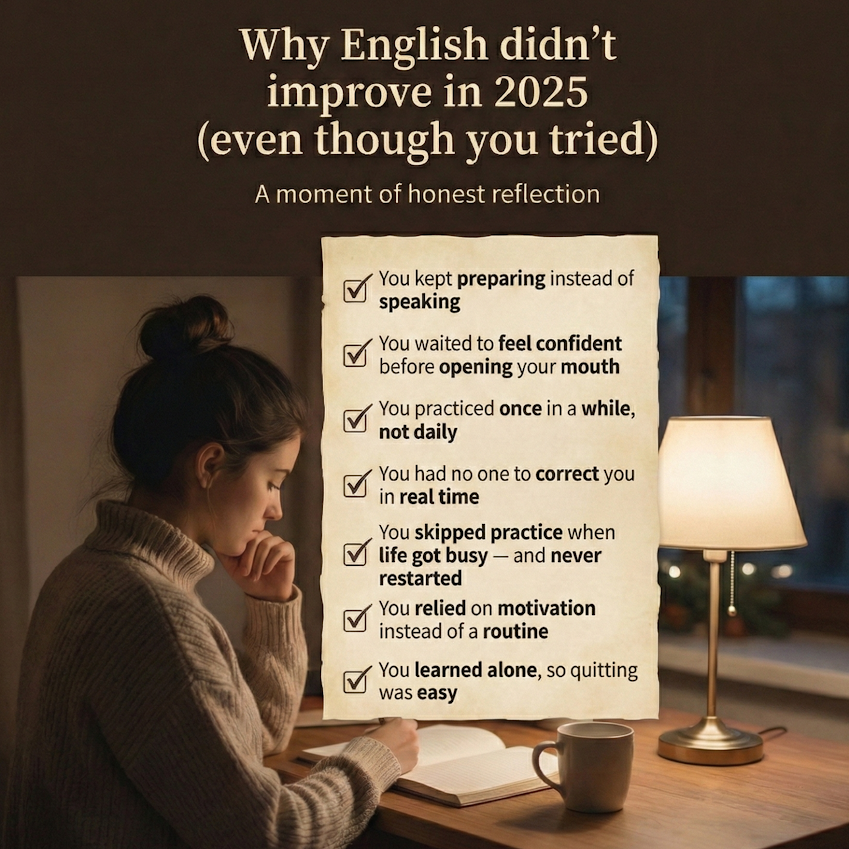
The image above captures that exact moment.
A quiet evening. A notebook open. A mind full of effort — and frustration.

This blog is not about blaming you.
It’s about understanding why effort didn’t convert into confidence.

Many learners want to speak English confidently, but end up stuck in the same cycle year after year. They understand English, can read it well, and even write decently — yet speaking still feels difficult. This gap between knowing English and speaking it confidently is what frustrates most learners.

The Truth Most Learners Don’t Hear

To speak English confidently, you don’t need more rules or more content. You need repeated exposure to real conversations where you can speak freely, make mistakes, and continue without fear.

Most learners struggle not because they lack intelligence, but because they never get enough chances to actually use English in real life.

English doesn’t improve just because you want it to.
It improves when the right habits replace the wrong ones.

Most learners repeat the same patterns year after year — not because they are lazy, but because no one shows them a better system.

Let’s walk through those patterns honestly.

You Kept Preparing Instead of Speaking

Preparation feels safe.

You can learn silently.
You can pause, rewind, and retry.
No one hears your mistakes.

So you kept preparing.

But here’s the uncomfortable truth:

Preparation without speaking is procrastination in disguise.

English is not absorbed like information.
It’s built like a muscle.

Until your mouth starts moving, improvement stays theoretical.

You Waited to Feel Confident Before Opening Your Mouth

Many learners believe confidence is a prerequisite.

“I’ll speak when I’m confident.”
“I just need a little more clarity.”
“I’m not ready yet.”

But confidence is not a starting point.
It’s a side effect.

Confidence comes after:

  • Saying things wrong

  • Getting corrected

  • Surviving awkward pauses

  • Realising nothing bad happened

Every confident English speaker you admire once spoke badly — repeatedly.

You Practiced Occasionally, Not Consistently

Some weeks you practiced seriously.
Other weeks disappeared into work, family, stress, or exams.

And then English quietly slipped down your priority list.

The problem isn’t missing a day.
The problem is not returning.

English rewards consistency, not intensity.

Ten minutes every day beats two hours once a week — every single time.

You Had No One to Correct You in Real Time

Learning alone creates blind spots.

You may:

  • Repeat the same mistake for months

  • Think your sentence is correct when it isn’t

  • Lose confidence because you’re unsure

Without real-time correction, your brain doesn’t know what to fix.

This is why many learners feel stuck despite “studying” for years.

You Skipped Practice When Life Got Busy — and Never Restarted

Life doesn’t pause for learning.

Deadlines come.
Health issues arise.
Responsibilities pile up.

So practice stops — temporarily.

But without a system, temporary breaks turn into permanent gaps.

English doesn’t disappear — but confidence does.

You Relied on Motivation Instead of a Routine

Motivation is emotional.
Routines are structural.

Motivation says, “I feel like practicing today.”
Routines say, “This is what I do daily.”

English improves when practice becomes as normal as brushing your teeth — not when you’re “in the mood.”

You Learned Alone — So Quitting Was Easy

When no one expects you, stopping feels harmless.

No accountability.
No reminder.
No sense of progress being watched.

Learning alone makes quitting invisible — until months later, when regret shows up.

This Is Not a Failure. It’s a Pattern.

And patterns can be changed.

Learners who finally speak English confidently don’t suddenly become smarter.
They simply change how they practice.

They speak first.
They practice daily.
They get corrected kindly.
They don’t do it alone.

How the EngVarta App Helps You Break This Pattern

EngVarta is designed for learners who want to speak English confidently in real-life situations — interviews, meetings, phone calls, and daily conversations.

EngVarta was created specifically for learners stuck in this exact loop.

Not beginners who don’t know English —
but learners who know English yet struggle to speak confidently.

Here’s how EngVarta directly solves the problems mentioned above:

1. It Forces You to Speak, Not Prepare

EngVarta connects you with real English experts for one-on-one live conversations.
You speak from day one — no waiting, no overthinking.

2. Confidence Comes Through Action

You don’t wait to “feel confident.”
Confidence builds naturally as you speak daily in a safe, supportive environment.

3. Daily Practice Becomes a Habit

Sessions are short and practical, designed for busy lives.
This removes the excuse of “no time” and builds consistency.

4. Real-Time, Friendly Corrections

Experts correct you gently while you speak — helping you improve without embarrassment or interruption.

5. You’re No Longer Learning Alone

Someone listens to you.
Responds to you.
Guides you.

That simple human connection changes everything.

If 2025 Felt Like a Loop, 2026 Can Be a Turning Point

English didn’t fail you.
Your effort didn’t go waste.

It just needed a better system.

One that replaces:

  • Preparation with practice

  • Motivation with routine

  • Isolation with guidance

Start Speaking — Not Someday, Today

👉 Download the EngVarta App:
Download for Android | Download for iOS

Speak daily.
Get corrected.
Build confidence through real conversations.

Stay Connected With EngVarta

Final Thought

Learning English is not the goal.
Being able to speak English confidently — without fear, hesitation, or overthinking — is.

And that confidence is built one real conversation at a time.

Frequently Asked Questions (FAQs)

Frequently Asked Questions

Who should use EngVarta to speak English confidently?

EngVarta is ideal for students, professionals, and job seekers who understand English but hesitate to speak. It helps learners gain confidence through consistent, guided speaking practice.

How does EngVarta help me speak English confidently?

EngVarta helps you speak English confidently through one-on-one live conversations with trained experts. You get real-time, friendly corrections that improve fluency and reduce hesitation.

Can I speak English confidently even if my grammar is weak?

Yes. You can speak English confidently without perfect grammar. Many confident speakers make small mistakes, but they communicate clearly. Grammar improves naturally with daily speaking practice.

How can I speak English confidently in daily life?

To speak English confidently, practice speaking every day in real situations. Focus on expressing your thoughts instead of worrying about mistakes. Confidence grows through usage, not perfection.

Why do I still struggle to speak English confidently?

Most learners struggle to speak English confidently because they prepare too much and speak too little. Without regular real conversations, confidence doesn’t develop—even if your understanding of English is good.

How to Practice English using Self Talk

December 20, 2021 • 4 min read • By Richa

How to Practice English using Self Talk


One habit every English learner must adopt is – Self Talk – it can be a great way to practice as well because for this you don’t need anyone and we all are continuously having chats with ourselves.

So how to do that?

First thing: You don’t have to be fluent to start speaking English to yourself. You don’t need to know a lot of words or grammar to start learning English? 

Here’s how to start with Self Talk 

First of all, talking to yourself means talking about what’s going on in your mind. You can do that almost anywhere when you are alone. Because self-talk in public is weird right? So, just find a place where no one can hear you and just start speaking. 

Now, you may wonder – What should I speak? 

My answer is – Anything that you love talking about. 

Maybe your recent crush or your dream destination. 

The beauty of self-talk is there are no dos and don’ts. You can be yourself and express your thoughts just the way you like in English. 

Self-talk for beginners  

If you are a beginner, the first thing you should do is train your mouth to produce the sound of your target language, i.e, English. You need to practice the pronunciation, the usage of common English words and learn to frame them into sentences. 

Just like you did when you were a child. You imitated your parents and people around you and that’s how you picked up the language. 

Right now, English words may sound unfamiliar to you, so the best way to get accustomed to the language is to watch and listen to people in English. And whatever you listen to, just repeat after them. 

Once you can pronounce the sounds in that language you can take some time to look around yourself, like your apartment, your office, or places you visit, and just call out names in English that you see. 

Another idea could be – Describe what you are doing right now? Are you working at your desk or are you gardening, cooking? Just elaborate on the activities that you are doing and speak it out. 

If you want to talk about the past, you can speak about – How was your week and what are the things that you learned? 

Or, if you want to talk about the future – You can just elaborate on your goals for the year or what you will do in the coming week. 

The third way to do self-talk is to give yourself imaginable situations. Like how would you start a conversation if you have to order something? Or, how would you take an appointment in English?  What would you do if you meet your favorite celebrity? 

If you dedicate at least a few minutes to this activity every day, you’ll be able to take up a conversation in English with anyone even if you have fewer phrases and words. You’ll be able to pave new ways to learn English. 

Self-talk for advanced learners

If you have words and phrases but you just need practice, narrating personal stories is the best way to do self-talk. Mark my words – the more real and emotional your story is, the faster you will be able to get words and phrases. 

You can talk about – 

  1. One of the biggest achievements in your life 
  2. Who has inspired you most in your life? 
  3. What would you like to do if you get a fully paid 1-year leave?
  4. When was the last time you met your cousins & what was it like?
  5. If you could help someone today who would that be & what would you do?

I have a separate blog on topics that you can pick for self-talks – 30 Interesting Topics to practice English

A fun self-talk activity 

Take up a situation where you wanted to win an argument but couldn’t. This is the best time for you to recreate that situation and think of an angle & vocabulary/phrases that could have helped you make your point better and potentially win that argument. 

This will help you aim for two birds at the same time – Win an argument in English and enhance your English word bank too. 

So, are you ready to take up the habit of self-talk? If you have any questions, ask me in comments below. 

Want to Improve your English? Practice English With Experts

September 29, 2018 • 3 min read • By EngVarta

Want to Improve your English? Practice English With Experts

English learning app

If I ask you on the very first day of your fitness training to do 30 push-ups and you enthusiastically say ……

Okay! Let’s do it and you started doing.

Great! I am your coach here and I am counting…. 1, 2, 3, 4, 5,… & so on…
(After 12 push-ups)

Oh, God! It’s too painful…..
You feel like giving up after 12 push-ups and there you say: I can’t do anymore!
Oh No! What happened to you after 12 pushups? Don’t you have enough strength?

Right?

Now if I ask you to keep on doing it on a daily basis, then what will happen after a month?

You’ll be able to do 30 push-ups or even more very easily. Why?

Because now you’ve got enough strength and that’s how you build your stamina.

The same thing applies when it comes to your English communication. You need to practice speaking English daily to improve your communication skills. All I want you to do is to speak English with a new person every day. Whatever words you are learning, call the random person, talk with him/her and use those words. Take the critics, listen to feedback and improve. Keep on doing this for a month and I bet, you will see improvements.


Now you’re wondering how to find a random person to speak English every day, And why a random person? I can talk to my friend or my brother.

So here is another tip:

Doing it daily is important because you gotta build strength, but doing it daily with a new person is as important. And here is why:


Did you ever notice you get super comfortable with your friends and family. And it’s easy to say things and communicate with them. But that’s not what happens when you go for that job interview or meet someone and there you need to talk in English. That new person with whom you need to communicate is a total stranger & it gets weirder when that person doesn’t care about your knowledge but instead how well you communicate in English.


Hey listen, you have been practicing English with your friends and family so far. So your mind is not ready to carry on a conversation in English with a stranger in a comfortable way. You start sweating, panic starts and then you lose control over what you speak or you get quiet for a long time and that makes a bad impression. So the takeaway here is that you’re not ready to communicate in English with strangers.


So in your practice, what was missing? That Stranger was missing.
You need to bring a nice stranger to practice English every day. The good thing is, you don’t need to go on a hunt for a stranger every day. Just call EngVarta and it will find you a nice stranger (verified English experts) who speaks English and is ready to help you improve your communication.


For Regular English Practice with Expert: Download EngVarta Mobile App

playstoreitune