You know the feeling. You’ve spent years studying grammar. You can read a business report without a dictionary and watch Hollywood movies with ease. But the moment you need to open your mouth to practice English speaking online, your mind goes blank. Your heart races, your throat tightens, and the words simply won’t come.
In our experience, this is the “Fluency Gap.” It is the frustrating space between knowing English and using it. In 2026, the global economy demands more than just “understanding”—it requires English speaking practice online that translates into real-world confidence.
If you are a working professional or a serious student, finding the right partner isn’t just about “chatting.” It’s about building a bridge to your next career breakthrough.
What is English Speaking Practice Online and Why Does It Matter in 2026?
English speaking practice online is the process of engaging in real-time, verbal communication with partners or experts via digital platforms. In 2026, it is essential because global remote work and AI-driven industries prioritize “Strategic Communication”—the ability to explain complex ideas clearly, empathetically, and without hesitation.
In today’s environment, the “Language Learning Market” has evolved. It is no longer enough to use gamified apps that ask you to translate “The apple is red.” Research shows that learners who don’t engage in online speaking practice lose 40% of their active vocabulary within six months.
We’ve found that the most successful learners are those who treat English like a gym workout. You don’t get muscles by watching others lift weights; you get fluent by actually speaking.
How to Find Reliable Language Exchange Partners Online?
To find reliable partners, use “Tandem” learning apps or specialized communities. Focus on filters like “Native Language,” “Interests,” and “Availability.” However, for consistent results, look for platforms that offer verified experts rather than casual learners to avoid the common “ghosting” trend of 2026.
Finding a partner for English conversation practice online used to be easy, but today, the internet is crowded. To find a quality partner, we recommend this 3-Step Filter System:
- Define Your Goal : Are you practicing for a job interview or just casual travel? A casual partner won’t help you with “Corporate English.”
- Check Reciprocity : In a traditional exchange, you must teach your language for 30 minutes to get 30 minutes of English. Ensure your partner is actually serious about teaching.
- Vibe Check : Start with a 5-minute voice note. If the audio quality is bad or the energy is low, move on. Your time is too valuable for poor connections.
Which are the best language exchange apps in 2026?
In 2026, the best apps are those that offer high user verification and built-in AI correction tools. While apps remain the standard for practise English speaking online for hobbyists, professionals are increasingly turning to expert-led platforms like EngVarta to ensure their practice leads to career growth.
To help you decide, we have analyzed the top-performing platforms based on user engagement, feedback quality, and professional utility.
| Platform Name | Primary Target | Key 2026 Feature | Professional Utility |
| HelloTalk | Casual Learners | AI-Powered Voice Transcripts | Low (Mostly Social) |
| Tandem | Serious Hobbyists | Verified “Pro-Learner” Badges | Medium |
| Speaky | Beginners | Instant “Flash-Match” Video | Low |
| EngVarta | Working Professionals | 1-on-1 Anonymous Expert Calls | High (Career Focused) |
| Niche Learners | Reputation-based Matching | Medium |
While these language exchange apps serve different needs, the trend in 2026 is moving toward “Micro-Coaching.” Even within peer apps, users are starting to look for partners who can offer more than just small talk. However, for those searching for a dedicated english speaking app, the difference between a peer and an expert becomes clear the moment you need to discuss complex business logic or prepare for a high-stakes interview.
What are the Pros and Limitations of Language Exchange Apps?
Language exchange apps offer great accessibility and exposure to different cultures, making them a popular starting point for learners exploring english speaking practice online. However, they often come with challenges like the “Reciprocity Trap,” inconsistent partner commitment, and limited corrective feedback. While these platforms can support casual, social learning, they may not be enough for professionals who need structured english speaking practice online with consistent guidance and expert-level improvement.
The Reality of Casual Apps in 2026
We’ve monitored thousands of learner journeys, and a pattern emerges. Casual language exchange apps are fun for the first week. But soon, you encounter the “Ghosting Phase.” Your partner gets busy, or they spend the whole time talking about themselves.
| Feature | Casual Language Exchange Apps | Expert-Led English Speaking Apps (e.g., EngVarta) |
| Cost | Often subscription-free (but time-heavy) | Premium investment |
| Feedback | Rare or “too polite” to correct | Real-time, professional corrections |
| Consistency | Low (Partners often disappear) | High (Experts available 15/7) |
| Pressure | High (Video/Social anxiety) | Low (Focus on voice & anonymity) |
| Structure | Random “How are you?” chats | Scenario-based & Goal-oriented |
Why Do Most Language Exchanges Fail? (The Reciprocity Trap)
Most learners struggle with English speaking practice online because of what is known as the Reciprocity Trap. In many language exchanges, you are expected to spend half your time teaching your own language instead of focusing on improving your English. As a result, your actual speaking practice gets limited. On top of that, casual partners are usually not trained to explain why a mistake happens. This often leads to fossilized errors, where you keep repeating the same incorrect phrases without realizing it.
In our experience, the biggest problem with trying to practise english speaking online for free is the lack of authority. If you say, “I have went to the office,” a casual partner might understand you and keep talking. They won’t stop to explain that it should be “I went” or “I have gone.” Over time, these small errors become permanent habits that make you sound unprofessional in boardrooms.
How to Choose the Right Partner for Online Speaking Practice?
When you are looking for someone to practice English with native speakers, look for these five “Green Flags”:
- Patience over Speed : A good partner doesn’t interrupt; they wait for you to finish your thought before correcting.
- Active Listening : They ask follow-up questions rather than waiting for their turn to speak.
- Correction Preference : They ask you, “Do you want me to correct you now or at the end?”
- Shared Professional Interest : If you’re an engineer, find a partner who understands technical context.
- Timezone Compatibility : Consistency is the “Secret Sauce” of fluency.
The Professional Solution: Why EngVarta is the Ultimate English Speaking App
If you are fatigued by the “Hi, how are you?” To navigate casual apps effectively, a structured setting is
AI Grammar Checkessential. This is where EngVarta changes the game. It isn’t just another english speaking app; it is a professional training ground.
Why EngVarta Solves the “Speaking Gap”
- 1-on-1 Live Calls : You don’t have to wait for a partner to “match” with you. You press a button and instantly connect with a live English expert.
- The Power of Anonymity : We’ve found that learners are 60% more likely to speak boldly when they don’t have the “video pressure.” EngVarta focuses on your voice, reducing the social anxiety of making mistakes.
- Expert Feedback, Not Just Chat : Unlike a casual partner, EngVarta experts are trained to identify your specific “L1 Interference” (how your native language affects your English) and fix it.
- Real-Life Scenarios : You aren’t just talking about the weather. You can practice for job interviews, client presentations, or IELTS speaking tests.
- Consistency System : With flexible timings (7 AM to Midnight), you can fit a 15-minute “Fluency Workout” into your lunch break or commute.
Stop just learning English—start speaking it.
Practice real conversations with expert mentors and build your confidence faster.
Download EngVarta today and start your first live English speaking session.
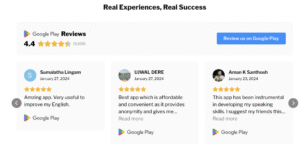
“From Hesitation to Confidence: Real Users Share Their EngVarta Experience”
What is the Best Daily Routine for English Speaking Practice Online?
A high-impact 30-minute routine consists of 5 minutes of “Input” (listening/reading), 15 minutes of “Active Output” (live speaking on an app like EngVarta), and 10 minutes of “Review” (listening to your call recordings to spot errors).
The 15-Minute Fluency Framework:
- Minutes 1-3 : Warm up. Talk about your day’s top priority.
- Minutes 4-12 : Scenario Practice. Role-play a difficult conversation you expect to have this week.
- Minutes 13-15 : The Feedback Loop. Note down 3 specific corrections provided by the expert.
Common Mistakes Learners Make During Online Speaking Practice
We see these three mistakes repeatedly:
- The “Translation” Trap : Trying to translate complex sentences from your native language into English. Solution: Use simpler English sentences to build speed first.
- Fear of the “Silence” : Filling every gap with “Um” or “Uh.” Solution: Embrace short silences to think; it makes you sound more authoritative.
- Passive Learning Overload : Watching 5 hours of YouTube but speaking for 0 minutes. Solution: For every 1 hour of watching, you must do 15 minutes of live speaking.
Connect with EngVarta on Social Media:
- Instagram : https://www.instagram.com/engvarta.app/
- YouTube : http://www.youtube.com/@EngVarta
- Facebook : https://www.facebook.com/engvarta
- LinkedIn : https://www.linkedin.com/company/engvarta
Conclusion :
While casual language exchange apps are excellent for cultural exposure, they rarely lead to professional fluency. For learners who are serious about english speaking practice online and want to grow in their careers, relying only on peer conversations can slow progress. That’s where an expert-led platform like EngVarta becomes more effective, offering structured english speaking practice online with real feedback, helping you move from hesitation to clarity much faster.
In 2026, communication is your most valuable currency. You can choose to spend months searching for a “free” partner who might ghost you tomorrow, or you can invest in a system designed to make you a confident communicator.
Frequently Asked Questions ( FAQ )
-
Can I practice speaking English online with native speakers easily?
-
It’s possible, but not easy—finding a consistent partner on exchange apps can be difficult.. With EngVarta, you get instant access to experts and consistent English speaking practice online without the hassle.
-
-
How many hours of online speaking practice do I need to become fluent?
-
It’s not about hours—it’s about daily consistency.Just 15 minutes of focused English speaking practice online every day is far more effective than long weekly sessions. Fluency improves with regular use and feedback.
With EngVarta, you can practice daily and get expert guidance to improve faster.
-
-
What is the best way to practice english conversation for shy people?
-
The best method is audio-only, 1-on-1 practice. This removes the “visual judgment” of video calls. Many EngVarta reviews highlight that the anonymity of the platform was the single most important factor in overcoming their fear of speaking.
-
-
How can I practice speaking English online without a partner?
-
You can use “Shadowing” techniques with YouTube or AI-voice assistants. However, while this helps with pronunciation, it lacks the “unpredictability” of human conversation. Real-world fluency requires a live feedback loop that only a human mentor can provide.
-
-
Is there a useful english speaking app in 2026?
-
Yes, EngVarta is highly useful as it focuses on daily 15-minute high-intensity sessions. It is specifically designed to eliminate hesitation by connecting you with experts instantly, making it a powerful tool for career growth.
-