How to Score Better in IELTS Speaking: Proven Tips to Improve Your Band Score

How to Score Better in IELTS Speaking

In our experience coaching thousands of aspirants across India, we’ve witnessed a seismic shift in the IELTS speaking test landscape for 2026. Gone are the days when rote memorization of “idioms of the day” could trick an examiner. Today, the focus has shifted toward communicative agility—the ability to pivot between complex ideas with natural rhythm and precision.

Whether you are struggling to move past a Band 6.5 or you are a high-achiever aiming for a Band 9, your IELTS speaking preparation must be data-driven and habit-based. This guide serves as your definitive roadmap to mastering the IELTS speaking exam, featuring the Fixolang App as the cornerstone of your daily practice.

How to Score Better in IELTS Speaking?

To score better in IELTS Speaking, you must demonstrate high-level fluency and coherence by expanding answers naturally, utilizing a wide lexical resource without over-complicating, and maintaining clear pronunciation with correct word stress. Consistent IELTS speaking practice using AI tools like the Fixolang App helps eliminate Mother Tongue Influence (MTI) and builds the muscle memory required for spontaneous interaction.

Mastering the 4 Pillars : IELTS Speaking Tips for 2026

To hit a Band 8 or 9, you need to stop “studying” English and start “performing” it. The examiner evaluates you on four distinct criteria. Here is how to optimize each for the 2026 standards.

1. Fluency and Coherence (FC)

Fluency is not speed; it is the absence of “linguistic hesitation.” In 2026, examiners are trained to distinguish between content hesitation (thinking of an idea) and language hesitation (searching for a word).

  • Expert Insight : Use “Signposting” words. Instead of pausing, say, “That’s an intriguing question; from a personal standpoint, I believe…”
  • Regional Nuance : Indian students often speak too fast to compensate for nerves. Slowing down by 10% actually increases your coherence score.

2. Lexical Resource (LR)

Your vocabulary for IELTS speaking should be precise, not just “big.”

  • The Precision Rule : Instead of saying “very happy,” use “exhilarated.” Instead of “big problem,” use “monumental challenge.”
  • Collocations : High-band scorers use word pairs that naturally go together, such as “mitigating circumstances” or “striking a balance.”

3. Grammatical Range and Accuracy (GRA)

Don’t just stick to the present tense. To prove your range, weave in:

  • Conditionals : “Had the government invested more in infrastructure, our commute would be quicker.”
  • Passive Voice : “It is often stated that technology isolates us.

4. Pronunciation (P)

This is where most Indian students lose marks due to MTI. Clarity is what you need, not a British accent.

  • Focus Area : Intonation. English is a “stress-timed” language. If your speech is “flat,” you will likely plateau at Band 6.5.

How can the Fixolang App accelerate your IELTS speaking practice?

The Fixolang App uses 2026-grade AI to simulate a real IELTS speaking exam environment. It provides instant Band Score estimations, identifies MTI (Mother Tongue Influence) errors, and offers a 24/7 “Speaking Partner” that gives real-time feedback on fluency and coherence, making it the most efficient tool for modern IELTS speaking preparation.

Most students fail because they “study” English but don’t “speak” it. We recommend Fixolang because it bridge the gap between passive learning and active production.

Why Fixolang Outperforms Traditional Coaching

In the current landscape, waiting for a weekly coaching session is too slow. Fixolang allows for “Micro-Practice”—short, 15-minute bursts of high-quality interaction that build muscle memory.

Feature Traditional Offline Coaching Fixolang App (AI-Powered)
Availability Fixed class hours 24/7 Instant Access
Feedback Speed Next day or week Within seconds of speaking
Error Tracking Manual & subjective Data-driven AI analytics
Cost in India ₹12,00 – ₹10,000 / month Highly affordable subscription
Topic Range Limited to textbook Updated daily with 2026 trends

How to use Fixolang to improve your band score :

  1. The Daily Sprint : Try one “Cue Card” from Part 2 each morning.
  2. The Feedback Loop : Review the AI’s transcript of your speech to see where you repeated words.
  3. The MTI Fix : Use the pronunciation module to target specific sounds (like the ‘v’ vs ‘w’ confusion) common in regional Indian accents.

FixoLang App Availability

The FixoLang app is easily accessible on both major mobile platforms, so you can start your IELTS speaking preparation anytime, anywhere.

 Available on :

How to Practice for the IELTS Speaking Test at Home?

Create an “English Only” zone. For 30 minutes a day, use the Fixolang App to record yourself. Listen back to your recordings—this is the most painful but effective way to improve. Pay attention to your “word stress” and “intonation” to sound more organic.l.

A Daily 30-Minute Routine for Band 8 :

  1. Morning (10 Mins) : Attempt one random Cue Card on Fixolang.
  2. Afternoon (10 Mins) : Review the AI’s “Sentence Correction” feedback.
  3. Night (10 Mins) : Re-record the same topic, implementing the suggested vocabulary for ielts speaking.

Trending IELTS Speaking Topics & Questions for 2026

The most common IELTS speaking topics in 2026 include Artificial Intelligence (AI) in Daily Life, Sustainable Urban Development, The Impact of Social Media on Mental Health, and Hybrid Working Environments. Preparing for these specific IELTS speaking questions ensures you have the “lexical precision” ready for the more abstract discussions in Part 3.

1. Technology & AI

  • Part 1 : Do you use AI tools to help with your studies?
  • Part 3 : Will AI eventually replace human creativity in the arts?

2. Environment & Climate Anxiety

  • Part 1 : How do you conserve energy at home?
  • Part 2 : Describe an environmental law you would like to see implemented.

3. Work & Career Evolution

  • Part 1 : Do you prefer working from home or in an office?
  • Part 3 : How has the “Gig Economy” changed the career paths of young people in India?

Step-by-Step Strategy: IELTS Speaking Exam Mastery

Part 1 : The Personal Interview (4–5 Minutes)

The Goa l: Build rapport and show comfort.

  • Pro Tip : Never give one-word answers. Use the “Response + Justification + Illustration” format.
  • Example Question: “Do you like your hometown?”
  • Band 8 Response: “Absolutely. It’s a vibrant metropolis steeped in history, though the traffic congestion can be quite overwhelming at times.”

Part 2 : The Cue Card (3–4 Minutes)

The Goal : Narrative flow and coherence.

  • The 1-Minute Prep : Do not write full sentences. Write 5 “Power Keywords” and one “Advanced Grammar” structure you plan to use.
  • The Storytelling Method : Turn your cue card into a story with a beginning, middle, and end. This naturally increases your fluency and coherence.

Part 3: The Abstract Discussion (4–5 Minutes)

The Goal : Deep analysis and critical thinking.

  • The Shift : Stop talking about “I” and start talking about “Society” or “People.”
  • Technique : Use “On the one hand… on the other hand” to show you can weigh different perspectives.

How do you improve fluency and coherence without a tutor?

Employ the “Recording & Shadowing” method to enhance your fluency: capture yourself speaking for two minutes on any topic, listen to the recording to identify “hesitation gaps,” and then repeat the answer until it flows smoothly. Use Fixolang’s AI feedback to pinpoint exactly where your coherence breaks down.

The Pyramid Technique for Fluency

This is a method we’ve developed that works exceptionally well for Indian students:

  • Step 1 : Speak on a topic for 30 seconds (Basic ideas).
  • Step 2 : Speak on the same topic for 60 seconds (Add “Reasons”).
  • Step 3 : Speak for 90 seconds (Add “Examples” and “Complex Grammar”).

By the time you reach Step 3, your brain has automated the basic vocabulary, allowing you to focus on the high-level lexical resource needed for Band 8+.

What is the Best Vocabulary for IELTS Speaking?

The best vocabulary for ielts speaking consists of “topic-specific” collocations rather than random long words. Instead of saying “very happy,” use “absolutely thrilled.” Instead of “important,” try “crucial” or “pivotal.” Use the Fixolang App to learn context-aware idioms that fit 2026 topics.

2026 Topic-Based Vocabulary Lists

To hit a Band 8, you must move beyond basic English. Here are some advanced terms for the most common ielts speaking topics in 2026:

  1. Technology & AI
  • Cutting-edge: Highly advanced.
  • A double-edged sword is something that has advantages and disadvantages.
  • Automate: To make a process run by itself.
  1. Environment & Climate
  • Environmental footprint: The impact a person has on the planet.
  • A way of life that aims to minimise the consumption of Earth’s natural resources is known as sustainable living.
  1. Work & Education
  • 3. Work and Education
  • Work-life balance is the equilibrium of one’s personal and professional lives.
  • Vocational training: Instruction centred on particular occupational competencies.

Conclusion :

Improving your band score is not about luck; it is about a data-driven approach to your IELTS speaking preparation. By mastering the four assessment criteria, staying current with 2026 topics, and leveraging the AI power of the Fixolang App, you are giving yourself a massive competitive edge.

Final Expert Tip: Start today. Record your voice on the Fixolang App, get your baseline score, and watch your confidence soar as the AI guides you toward your dream Band 8+. Your future abroad is just one conversation away!

Frequently Asked Questions (FAQs)

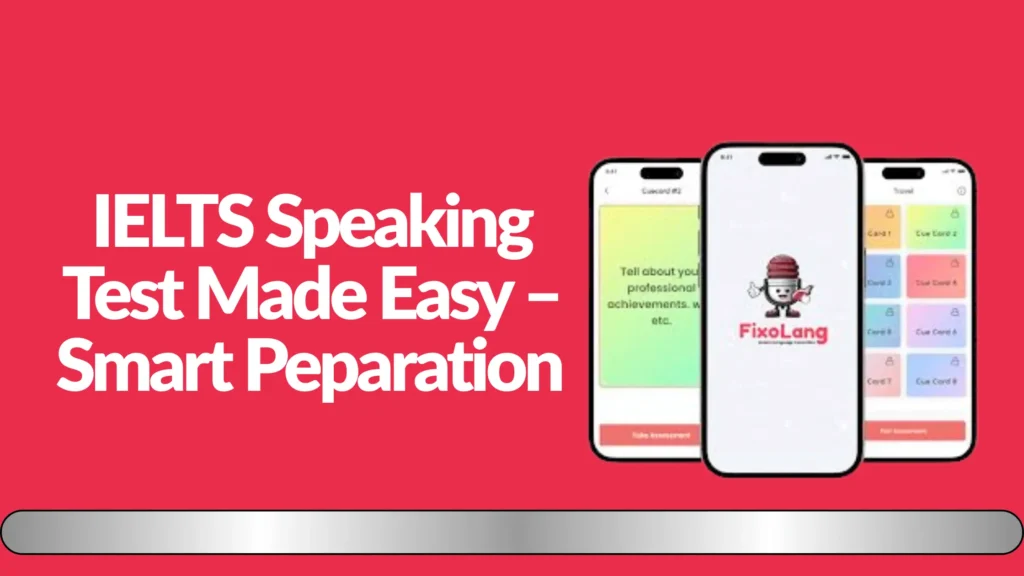
IELTS Speaking Test Made Easy: Complete Smart Preparation Guide

IELTS Speaking Test

The IELTS Speaking Test makes even confident students nervous.

You may read English well.
You may understand movies and podcasts.
However, your thoughts abruptly stop when someone says, “Let’s begin.” 

This fear is common among Indian IELTS aspirants. Whether you’re planning to study abroad or applying for PR, the IELTS Speaking Test feels like the most unpredictable part of the exam.

Here’s the truth: it’s not unpredictable. It’s structured. And once you understand how it works and follow a smart preparation strategy, scoring Band 7+ becomes realistic.

In this complete guide, you’ll learn how the IELTS Speaking Test works, what examiners expect, common mistakes to avoid, and how smart tools like FixoLang can help you practice in a structured, confidence-building way.

Understanding the IELTS Speaking Test Format

The IELTS Speaking Test lasts 11–14 minutes and is conducted face-to-face or via video call with a certified examiner.

It has three parts, and each part tests different skills.

Let’s break it down clearly.

Part 1: Introduction & Interview (4–5 Minutes)

In Part 1 of the IELTS Speaking Test, you answer simple questions about familiar topics.

Common areas include:

  • Hometown
  • Studies or work
  • Hobbies
  • Daily routine
  • Family

Example questions:

  • Do you work or study?
  • What do you like about your hometown?
  • How often do you meet your friends?

This part checks your IELTS English speaking ability in everyday situations.

You don’t need complex vocabulary.
You need natural fluency and clarity.

Part 2: Cue Card (3–4 Minutes)

This is the most feared section of the IELTS Speaking Test.

You receive a cue card with a topic and bullet points.
You get 1 minute to prepare.
Then you speak for 1–2 minutes.

Example topic:
Describe a memorable event in your life.

This part tests:

  • Idea organization
  • Fluency
  • Vocabulary variety

Practicing with structured IELTS speaking topics with answers helps you feel prepared instead of surprised.

Part 3: Discussion (4–5 Minutes)

Part 3 is more analytical.

The examiner asks deeper questions connected to Part 2. 

Example:

  • Why are celebrations important in society?
  • How have celebrations changed over time?

Here, your ability to develop ideas matters more than memorized answers.

Regular IELTS speaking practise helps you improve logical thinking and fluency for this section.

IELTS Speaking Test Scoring Criteria Explained

To succeed in the IELTS Speaking Test, you must understand how it’s evaluated.

Examiners score you on four criteria:

1. Fluency and Coherence

  • Do you speak smoothly?
  • Do your ideas connect naturally?

2. Lexical Resource (Vocabulary)

  • Do you use varied vocabulary?
  • Can you paraphrase when stuck?

3. Grammatical Range and Accuracy

  • Do you use different sentence structures?
  • Are your sentences mostly correct?

4. Pronunciation

  • Is your speech clear?
  • Is your intonation natural?

Many students focus only on vocabulary.
But fluency and coherence carry equal weight in the IELTS Speaking Test.

Structured IELTS speaking practice online can help you balance all four areas.

Common Mistakes in the IELTS Speaking Test

Even competent pupils receive lower grades as a result of preventable errors. 

Here are common errors:

  • Memorizing scripted answers
  • Speaking too fast
  • Giving one-line responses
  • Using difficult words incorrectly
  • Ignoring follow-up questions

The IELTS Speaking Test checks real communication, not memorization.

Instead of learning fixed answers, practice developing ideas naturally.

Smart Preparation Strategy for IELTS Speaking Test

Preparation doesn’t mean practicing randomly.

It means following a clear system.

Here’s a practical roadmap.

1. Master Frequent IELTS Speaking Topics

Focus on common themes:

  • Education
  • Technology
  • Environment
  • Travel
  • Work
  • Culture

Study IELTS speaking topics with answers to understand structure.

But always personalize your responses.

2. Practice Under Time Pressure

Simulate the real IELTS Speaking Test environment.

  • Set a timer
  • Give yourself 1 minute to prepare
  • Speak for 2 minutes

This builds confidence and timing control.

3. Record and Evaluate Yourself

After answering an IELTS speaking test sample, ask:

  • Did I hesitate too much?
  • Did I repeat words?
  • Did I develop ideas fully?

Self-review improves awareness.

Why IELTS Speaking Practice Online Is Powerful

Many students prepare alone.

But solo practice has limits.

When you do IELTS speaking practice online, you:

  • Speak with real people
  • Get instant feedback
  • Experience test-like pressure

This is especially helpful for working professionals who don’t have time for offline IELTS speaking classes.

Role of Vocabulary in IELTS English Speaking

Vocabulary plays a major role in the IELTS Speaking Test.

But don’t aim for “big” words.

Aim for:

  • Topic-relevant vocabulary
  • Natural expressions
  • Collocations

Example:

Instead of:
“Very big problem”

Say:
“A significant challenge”

Instead of:
“Very happy”

Say:
“Absolutely delighted”

Improving lexical resource boosts your band score.

Consistent IELTS speaking practise helps you use vocabulary naturally rather than forcefully.

4-Week IELTS Speaking Test Preparation Plan

Here’s a structured weekly plan.

Week 1: Foundations

  • Understand IELTS Speaking Test format
  • Practice Part 1 daily
  • Build topic-wise vocabulary
  • Record 3 answers daily

Week 2: Cue Card Mastery

  • Practice 2 cue cards daily
  • Focus on storytelling
  • Work on idea expansion

Week 3: Advanced Discussion

  • Practice analytical questions
  • Use linking words
  • Develop arguments logically

Week 4: Mock Simulations

  • Take 3–5 full IELTS Speaking Test simulations
  • Analyze band score feedback
  • Improve weak areas

Apps like FixoLang help structure this preparation through guided sessions and mock simulations.

IELTS Speaking Test Sample Answer

Cue Card:
Describe a skill you recently learned.

Sample Answer:

“Recently, I learned basic photography skills. I started watching online tutorials and practiced during weekends. What I enjoy most is capturing natural light. It has improved my creativity and patience.”

Notice:

  • Clear structure
  • Natural vocabulary
  • Logical flow

That’s how a strong IELTS speaking test sample sounds.

Advantages of the Free Online IELTS Speaking Mock Test with Score 

Taking an IELTS speaking mock test online free with score offers major advantages:

  • You understand your current band
  • You reduce test anxiety
  • You get structured improvement points
  • You track progress clearly

Mock tests simulate the real IELTS Speaking Test environment.

FixoLang provides mock test simulations with structured feedback and band insights, helping students see exactly where improvement is needed.

Why FixoLang Is a Smarter Solution for IELTS Speaking Test

Preparing for the IELTS Speaking Test alone can feel confusing.

You may not know:

  • Are my answers good enough?
  • Is my vocabulary strong enough?
  • Am I speaking naturally?

FixoLang is a smart IELTS speaking practice app designed to solve these problems.

It offers:

  • Live practice sessions
  • IELTS speaking mock test simulations
  • Structured band score insights
  • Personalized feedback
  • Flexible IELTS speaking classes

It’s useful for:

  • Students targeting Band 7+
  • Professionals preparing for immigration
  • Beginners building confidence

The focus is not memorization.

It’s smart preparation with measurable improvement.

FixoLang App Availability

The FixoLang app is easily accessible on both major mobile platforms, so you can start your IELTS speaking preparation anytime, anywhere.

📱 Available on:

Self-Practice vs Guided IELTS Speaking Practise

Let’s compare honestly.

Self-Practice

Pros:

  • Free
  • Flexible

Cons:

  • No expert feedback
  • Hard to evaluate performance
  • Limited improvement tracking

Guided IELTS Speaking Practise (Using FixoLang)

Pros:

  • Real-time corrections
  • Structured mock simulations
  • Band score insights
  • Clear improvement roadmap

Cons:

  • Requires consistency

Guided preparation accelerates confidence and clarity.

How to Improve Fluency for the IELTS Speaking Test

Fluency doesn’t mean speaking fast.

It means speaking smoothly.

Here are simple ways to improve fluency:

1. Stop Translating in Your Head

Think directly in English.
Start with simple sentences.

2. Use Linking Phrases

These help in the IELTS Speaking Test:

  • To begin with
  • On the other hand
  • For instance
  • In my opinion
  • As far as I know

3. Practice Speaking Daily

Even 15 minutes of structured IELTS speaking practice online can make a difference.

Consistency builds fluency.

Handling Nervousness During the IELTS Speaking Test

Let’s address something real.

Many Indian students know answers — but freeze during the exam.

Here’s how to manage anxiety:

  • Take one deep breath before answering
  • Smile naturally
  • Maintain eye contact
  • Speak slightly slower than usual

Remember:
You are not being personally judged by the examiner. 

They are assessing communication ability in the IELTS Speaking Test.

Confidence grows with repeated mock simulations.

That’s why structured IELTS speaking mock test online free with score practice is so effective.

Conclusion:

The IELTS Speaking Test is not about perfect English.

It’s about:

  • Confidence
  • Clarity
  • Logical answers
  • Consistent practice

If you prepare randomly, progress will be slow.

If you prepare smartly — with structured mock simulations, live practice sessions, and band score insights — improvement becomes visible.

Start practicing regularly.
Take mock tests.
Improve vocabulary.
Build fluency.

And if you want structured IELTS speaking practice online with real feedback, download FixoLang and begin your smart preparation journey today.

Your Band 7+ in the IELTS Speaking Test is achievable — one confident answer at a time.

Frequently Asked Questions (FAQs )

  • Are IELTS speaking classes necessary?
    • IELTS speaking classes are not mandatory, but guided preparation makes a big difference. FixoLang offers flexible IELTS speaking classes and live practice sessions that help you improve faster with structured feedback and band-level evaluation.

  • Can I practice IELTS speaking online free?
    • Yes, you can find IELTS speaking practice online free resources. However, FixoLang provides structured practice with mock test simulations and performance insights, which helps you track your progress more effectively than random free resources.

  • How many months are needed to prepare?
    • Most learners improve significantly within 6–8 weeks of consistent practice. Using the FixoLang app regularly for IELTS speaking practice, mock tests, and vocabulary improvement can help you target Band 7+ within this time frame.

  • Is IELTS Speaking Test difficult?
    • The IELTS Speaking Test is not difficult if you prepare properly. With FixoLang, you can practice in a test-like environment, understand the format clearly, and reduce exam fear through regular mock sessions. Smart preparation makes the test manageable and predictable.

  • How can I improve my IELTS Speaking Test score quickly?
    • You can improve your IELTS Speaking Test score quickly by practicing daily with the FixoLang app. It provides live speaking sessions, mock test simulations, and structured band score feedback. Regular practice with real-time correction helps you improve fluency, vocabulary, and confidence faster.

Master Every Cue Card with Fixolang App: Best App for IELTS Speaking Practice

Master Every Cue Card with Fixolang App: Best App for IELTS Speaking Practice

If you’re aiming to conquer the IELTS Speaking section, ditch generic English learning apps. Built specifically for IELTS aspirants, FixoLang stands out—the Best App for IELTS Speaking Practice—that helps you master cue card responses with precision and real-time feedback.

Why IELTS Preparation Deserves a Specialized App

IELTS isn’t just any English test—it evaluates your ability to communicate fluently in academic or real-world contexts. Among the four skills—Listening, Reading, Writing, and Speaking—the Speaking section is often the most daunting. It involves authentic cue card responses (Part 2), spontaneous thinking, and polished vocal delivery, all under exam pressure. Generic English apps may improve vocabulary and grammar—but they rarely simulate this speaking experience. FixoLang, on the other hand, is purpose-built to address these exact needs.

Why Choose FixoLang? What Sets It Apart

  • Tailor-Made for IELTS Speaking: Unlike general tools, FixoLang is built solely around IELTS cue card practice and speaking mastery.

  • AI-Powered Scoring & Feedback: Get instant band score estimates and personalized feedback on your fluency, coherence, grammar, vocabulary, and pronunciation—yes, every cue card counts.

  • Rich Cue Card Library: Pick from a wide variety of prompts—ranging from personal experiences to abstract ideas—mirroring the real exam style.

  • 24/7 Practice Availability: Practice anytime anywhere—no coach needed, just you and the app.

  • Pronunciation Support with Expert Mentors: Beyond AI, you can get help from EngVarta’s English mentors to reduce mother tongue interference (MTI) and improve clarity.

Categories of Cue Cards Available

FixoLang’s digital flashcards span a variety of themes central to IELTS cue card topics, including:

  • Personal Experiences (e.g., “Describe a memorable journey”)

  • Social & Cultural Themes (e.g., “A festival you love”)

  • Technology & Education

  • Environment & Lifestyle

  • Abstract Topics (e.g., imagination, time, change)

If you’d like a deeper look into the latest cue card topics, check out this insightful blog: Top 20 IELTS Speaking Cue Card 2025 Questions.

FixoLang Key Features & Benefits

Key Features

  • AI-Powered Speaking Assistant: Gives instant IELTS band estimates and performance feedback.

  • Extensive Cue Card Library: Structured prompts for targeted speaking practice.

  • Personalized Feedback: Covers grammar, structure, vocabulary, coherence, and pronunciation.

  • High-Score Strategies: Built-in tips and guidance aimed at achieving top band scores.

  • 24/7 On-Demand Practice: Your personal coach—always ready.

  • Mentor Support for Pronunciation: Expert help bridges the gap between AI and human feedback.

Benefits at a Glance

Benefit Advantage for You
Targeted IELTS prep Practice with exam-specific prompts and scoring rules
Instant, actionable feedback Improve deliberately and track progress easily
Confidence from realistic practice Rehearse under pressure just like the test
Flexible & on-demand Fits into your schedule—travel, breaks, or nights
Human support when needed Fix pronunciation issues effectively

Real Success Stories

Users worldwide have shared how FixoLang helped boost their speaking skills and IELTS scores. Many credit consistent practice, focused feedback, and real-world cue card experience as game-changers. These testimonies underscore how FixoLang elevates routine practice into effective preparation.

Connect with FixoLang on YouTube & Instagram

Stay inspired and learn with everyday strategies:

Whether you’re learning cue card strategies, vocabulary, or speaking techniques, FixoLang’s YouTube channel shares bite‑sized, exam‑relevant videos. YouTube

Follow on Instagram for quick speaking tips and motivational content:
@fixolang – “Ready for your FREE IELTS speaking assessment? Download the FixoLang app…”

Download Links: Get Practicing Today

In Summary

FixoLang is more than a language app—it’s the Best App for IELTS Speaking Practice. Purpose-built for cue card mastery, it offers a powerful combo of AI feedback, curated prompts, flexibility, and expert support. With support across platforms, engaging video content, and inspiring social updates, FixoLang is your full-stack tool to ace the speaking section.

Ready to speak confidently, fluently, and strategically? Download FixoLang and turn your cue card weaknesses into exam-day strengths!

Frequently Asked Questions (FAQ’s)